



Abstract
Social media are widely held to have played an important role in the 2017 UK general elections. But it is not altogether clear how exactly they contributed to the communication battle between Labour and the Conservatives. This article analyses the posts and comments on the official Facebook pages of the Labour Party and the Conservative Party and their respective leaders, Jeremy Corbyn and Theresa May. We look at the relationship between topics, emotions, and user engagement. Labour clearly outperformed the Tories, with Corbyn’s personal page having 10 times the interactions of May’s. We retrieve part of the reason for this success in the “positive posting” strategy adopted by Labour and the way it helped to attract user engagement. While the Conservative Party focused on negative issues such as Brexit, terrorism, and national security, Labour focused on positive issues, such as the promise of higher social spending and appeals to the grassroots, generating far higher levels of engagement. Overall, positive topic tended to fare better than more negative and controversial issues, such as security and Brexit. Our findings thus suggest the need for a more balanced understanding of the relationship between content, emotions, and user engagement on social media, moving beyond simplistic views of social media politics as necessarily biased in favor of aggressive and negative campaigning.
Introduction
The relationship between social media content, emotions, and user engagement is a central question for the understanding of politics in the digital era. A number of recent elections, from the 2016 Trump and Brexit votes to the 2018 Italian vote, have been seen as largely driven by campaigning on social media, and in particular, by negative campaigning, dominated by negative emotions such as fear, hate, anger, and resentment, most notably deployed by populist candidates such as Trump, Salvini, and Bolsonaro. The idea that social media politics is dominated by a strong emotionally negative charge and that negative communication tactics are more effective than positive campaigning has become firmly established in public debates, and supported by some empirical evidence (see Ceron & d’Adda, 2016). More generally, people have come to associate online politics with its most antagonistic and incendiary aspects, such as trolling attacks and shitstorms developing around political discussions on social media (Settle, 2018) and fake news (Bakir & McStay, 2018).
In this article, we shall question this widespread consensus on the dominance of negative campaigning of social media. In fact, in recent years, we have witnessed a number of online campaigns waged by social movements and parties that have proven very effective by using a far more positive emotional tone than the one of right-wing populist formations. Examples include the movements of 2011 such as Occupy Wall Street and the Indignados alongside new Left leaders, such as Bernie Sanders, Alexandria Ocasio-Cortez, that have been well-known for their appeal to hope and optimism.
A good case study to explore these questions is provided by the UK 2017 national elections campaign in which social media are widely considered to have played an important role. News media suggested social media campaigning was instrumental in the surprising Labour comeback, which starting in the polls at around 25% secured 40% in the ballots, thus achieving its greatest growth in votes since 1945. How did social media campaigning contribute to this performance, and what made Labour’s social media communication more effective than the Conservatives’?
This article develops an in-depth analysis of Facebook campaigning during the 2017 national elections in the United Kingdom, drawing on mixed quantitative and qualitative content analysis of the main accounts of Labour and the Conservatives. We focus on 1,004 posts published on Facebook between April 18, 2017, to June 11, 2017, on the official Facebook pages of Labour, the Conservatives, and their leaders, Jeremy Corbyn and Theresa May. We utilize Natural Language Processing (NLP) methods to recognize topics in Facebook posts and measure variations in user engagement around those topics over time. To this end, we use the User Engagement index (UE; Rieder, 2013) defined here as the sum of all interactions performed by users around a post, including likes, shares, comments, and other Facebook “reactions” (i.e., love, laugh, surprise, sad, angry). The UE provides us with a quite precise insight of how much attention, either positive or negative, was attracted by a post during the campaign.
In the course of this analysis, we explore a number of key questions relevant to the understanding of the relationship between social media, emotions, and user engagement. We are interested in the correlation between the content of social media communication, and its emotional charge, and user engagement. We identify the different topics discussed in the course of the campaign, and whether they evoke positive or negative emotions. Furthermore, we track user engagement over the course of the campaign on the main pages of Labour and the Conservatives, and look for correlations between levels of user engagement and the emotional quality of social media content. This allows us to explore the role of positive and negative contents in driving user engagement.
Our analysis demonstrates that during the 2017 national elections campaign, positive contents attracted a far higher level of user engagement than negative contents. Labour’s deliberate choice to opt for “positive posting” and to focus on promises of social improvement, welfare, and public services was prized over the Conservatives’ strategy which mostly focused on negative topics, such as those regarding issues of national security and terrorism. We find a strong correlation between positive contents and high user engagement. This is interesting not just for an understanding of the 2017 UK election campaign but also more broadly as a way to re-examine assumptions about the dominance of negative content on social media and Facebook in particular.
The article begins with a review of the literature on Facebook and political campaigning, focusing on issues of emotions, engagement, and personalization. Next, we present the methodology and discuss the data, starting from an overview of user engagement in the course of the campaign, to continue with an analysis of topics and the analysis of their consequences for user engagement. In the final section of the article, we present the findings of our analysis and consider its implications for an understanding of the relationship between political contents, user engagement, and emotions in current research in digital politics.
Facebook, Political Campaigning, and Emotions
In recent years, a growing body of scholarship has looked at social media and political campaigning with particular reference to elections (Andersen & Medaglia, 2009; Gerodimos & Justinussen, 2015; Karpf, 2016; Katz, Barris, & Jain, 2013). This debate harks back to the late 2000s and the first campaigns with a strong social media component, with Barack Obama’s daring use of social media in the 2008 and 2012 elections usually being considered as a key watershed (Kreiss, 2012). These days, social media is not a newcomer or an auxiliary medium anymore. As of 2017, 62% of US citizens used Facebook and 78% have a social media profile. Social media played an important role in the competition between Donald Trump and Hillary Clinton in the 2016 presidential elections. Although outgunned by Hillary Clinton in fundraising and having spent a fifth of Hillary Clinton’s campaign on TV election ads, Donald Trump managed to prevail, also thanks to his ability to win on the social media battlefield (Faris et al., 2017). Facebook in particular has firmly established itself as a central platform for political communication, not only for militants of different political parts but also for parties and politicians, which use their official Facebook pages as a key mean of political communication (Hong & Nadler, 2011; Larsson & Moe, 2011; Stieglitz & Dang-Xuan, 2012). Facebook is still at some distance compared to 78% on television, but its influence has been growing in recent years, especially among young people (Duggan & Smith, 2016; Gottfried, Barthel, Shearer, & Mitchell, 2016).
The UK 2017 elections campaign make for a good case to explore the relationship between social media and politics during election campaigns. The 2017 elections have witnessed a very surprising campaign, due to the way in which its expectations were upset, with the Conservatives calling for snap elections hoping in an easy victory only to be rebuffed by a late Labour surge (Cowley & Kavanagh, 2018). They have also been described as the first real digital elections, given the important role they played in the course of the campaign compared with previous campaigns. As of June 2017, the time of the general elections, 40 million UK voters were on Facebook and political Facebook pages commanded a large following (Ofcom, 2017). According to The Guardian, the Tories spent £2.1 million on Facebook advertisements, a significant increase on the 2015 elections (Walker, 2018), though still a fraction of the investment in more traditional advertising.
What matters most for the purpose of our analysis is that social media are widely considered to have played a major role in the campaign, contributing to the surge in popularity for Labour during the last few weeks of the campaign (Bridge, 2017). This successful performance came to many as a surprise. The Conservatives had outperformed Ed Miliband on social media in the 2015 electoral campaign, and in 2017, they could also count on assistance of famed Australian political strategist Lynton Crosby alongside Jim Messina, Barack Obama’s digital spin doctor.
A number of news reports have highlighted the strong online support enjoyed by Corbyn, both on official campaign channels and in informal networks of support (Wendling, 2017). As proposed by Helen Margetts (2017), social media were particularly important for Corbyn’s Labour, due to the strong opposition of mainstream media. Drawing from interviews with digital strategists, Guardian journalists Robert Booth and Alex Hern (2017) suggested that Labour success was due to its focus on get-out-the-vote operations and its preference for positive motivational messages. Referring to the role played in Labour campaign by propaganda materials such as videos of street rallies and electoral events as communication tools, Matt Walsh (2017) argues that while “sceptics suggested he was preaching to the converted [. . .] videos of these events built into a powerful narrative of a social movement gaining widespread popular support.” The focus on positive campaigning was all the more remarkable, given that the Tories were doing quite the opposite, reportedly spending £1 million in negative advertising against Labour and Corbyn on social media (Walker, 2018).
To date, there exists little academic research on social media campaigning in the 2017 UK national elections. While a pair of studies have been conducted on the role of Twitter (Bright et al., 2017; Cram, Llewellyn, Hill, & Magdy, 2017), no comparable analysis has been conducted on Facebook, despite the fact that it should be considered at least as important as Facebook given their relative size. At the time of the data collection, there were 44 million Facebook users, vis-à-vis around 15 million Twitter users in the United Kingdom (Internet World Stats, 2018). To address this gap in knowledge, this article investigates the most important channels of Facebook communication during the campaign: the official Facebook pages of the two main parties and their respective candidates, focusing on the relationship between content, emotions, and user engagement.
Emotional Interactions
A key question in debates about digital politics is the effect of social media on political discourse. In recent years, some pundits and academics have argued that social media produces a bias in favor of negative content, thus making political debates highly toxic (Persily, 2017; Ott, 2017). One of the proponents of this thesis is American legal scholar Cass Sunstein (2018) who in his book #Republic, argues that social media lead to excessive political partisanship and even extremism. Much attention has been paid to the role played by fake news, often used as a means of “mud-throwing” and character assassination (Allcott & Gentzkow, 2017), and similar objectionable tactics, such as negative campaign ads on Facebook (Auter & Fine, 2016). Some researchers have argued that social media’s bias for negative content helps right-wing populists win elections (Groshek & Koc-Michalska, 2017).
Facebook in particular is often represented as an uncivil space where political debate is distorted by fake news and trolling and too often degenerates into flames (see, for example, Rowe, 2015). This bias of social media toward negative communication is supported by a Pew research center survey of social media users, according to which “roughly half of users feel the political conversations they see on social media are angrier (49%), less respectful (53%) and less civil (49%) than those in other areas of life” (Pew, 2016). However, the view of social media as dominated by negative emotions is over-simplistic and risks overlooking the complexity of emotional processes on social media. Besides the “negative posting” tactics widely used by many political pages, “positive posting,” namely, reliance on more optimistic contents, has recently emerged as a catchword among marketers and social media campaigners, to stress the effectiveness of hope-driven and positive content in digital communication. For the purpose of this article, we shall use this term to indicate a social media campaigning strategy focusing likely to elicit a positive emotional reaction from the user base, with the ultimate aim of maximizing motivation and engagement.
That social media have a strong emotional content has been widely discussed by scholars in recent (Papacharissi, 2015; Stieglitz & Dang-Xuan, 2013). This emotional element is highlighted by a number of features, such as the use of emojis, which stand to express various emotional situations, and the standard Facebook reactions (love, haha, wow, angry, sad). In recent years, scholars have explored processes of emotional reaction, activation, and contagion that are facilitated by social media (Berger & Milkman, 2012; Bernecker, Wenzler, & Sassenberg, 2019; Ceron & d’Adda, 2016; Coviello et al., 2014; Kramer, Guillory, & Hancock, 2014; Stieglitz & Dang-Xuan, 2013).
These studies have yielded quite diverging findings about the role of emotions. Stieglitz and Dang-Xuan (2013) found a positive correlation between the sentiment content of messages and the number of retweets in an analysis of the state parliament elections in Berlin in 2011, “the higher level of emotionality (positive or negative) a political Twitter message exhibits, the more often it is retweeted” (p. 817). For some scholars, social media tend to favor negative emotions. In a study of the Italia 2013 election campaign on Twitter, Ceron and d’Adda (2016) argue that “negative campaigns seem to matter [. . .] while positive campaigns only wields circumstantial effects” (p. 1947). In his recent book Frenemies, James E. Settle (2018) has argued that social media lead to “affective polarization,” heavily laden with both positive and negative emotions. While most attention has been often paid to the role played by negative sentiments, such as “anger, hostility, [and] obstructionism” (p. 232), these are far from being the only emotions that matter online.
A number of studies have in fact highlighted that on social media, positive emotions tend to be more conducive to engagement than negative ones. A widely cited study by Jonah Berger and Katherine L. Milkman (2012) showed that positive news contents are more likely to go viral on social media. An experimental research conducted by the Facebook data science team, which was criticized because of its overlooking of ethical standards and informed consent, pointed to this bias toward positive emotions in Facebook conversations (Kramer et al., 2014). Similarly, examining the features of successful political posts of Israeli politicians, Nir Noon Nave, Limor Shifman, and Keren Tenenboim-Weinblatt (2018) have highlighted that “positive and high-arousal emotions have been demonstrated to be particularly effective in increasing involvement” (p. 2). Thus, it is far from settled whether social media favors negative emotions. We may posit that in different circumstances, we see exactly the opposite process going on, a sort of process of “positive contagion,” through which positive emotional contents elicit user engagement.
Analytical Framework
Drawing on the insights coming from the literature, we proceed to formulate our analytical framework focusing on the relationship between three factors: (a) selection of topics, (b) kinds of political emotion, and (c) level of user engagement. We are interested in exploring the topics that got most attention and coverage in political Facebook pages, and what is their emotional value, either positive or negative. Furthermore, we want to explore the relationship between topics, emotional polarity, and user engagement, an issue that has been studied in previous analyses of social media campaigning (Pennington, Winfrey, Warner, & Kearne, 2015). Examining this nexus offers us the opportunity to address the question of effectiveness of social media messages, and assess the existence of a supposed bias toward negative content in social media and Facebook in particular.
In light of the discussion conducted thus far and considering the empirical analysis that follows, we shall formulate our research questions as follows:
RQ1. In which way do candidates and parties engage users around different topics from their official accounts?
RQ2. How does the emotional content of Facebook posts contribute in affecting user engagement?
RQ3. Did positive or negative contents perform better in the course of the campaign?
Methodology
For the purpose of our study, we decided to focus on four Facebook pages: Labour and Conservatives official Facebook pages (@labourparty and @conservatives), and their leaders (@JeremyCorbynMP and @TheresaMayOfficial). This choice was justified by the fact that the electoral race was strongly dominated by the two main parties, Labour and Conservatives, and that the official party and the leader page are by far the most important official channels of political communication on Facebook. For the purpose of data collection, we covered the period between April 18, 2017, the day campaigning officially started, and June 8, 2017, election day. Using the Netvizz application, 1 we collected 1,004 Facebook posts, whose overall characteristics are summarized in Table 1.
Overview of the research corpus.

Bold values represent highest values.
Two key elements were addressed in the course of the investigation: UE and Topic Analysis. UE is measured as the sum of total reactions (likes, hahas, wows, etc.) to a post plus the number of shares and comments relative to that post (Rieder, 2013). This indicator enables us to make sense of the response of users to social media messages, and is therefore a proxy of the latter’s effectiveness in reaching potential voters. It is worth noticing that, although we use UE as a measure of popularity, it does not take into account either the polarity or the irony expressed in comments. Computing the polarity of a post is beyond the purpose of this work: we want to identify which topics attracted the most attention, regardless the electorate’s opinion about the topic.
We combine user engagement analysis and topic analysis for more cogent interpretation of the data. Topic analysis is an effective way to explore textual content. It has so far mostly been used in linguistics and information science (Hall, Jurafsky, & Manning, 2008). But it bears much promise for analyzing political content on social media (Nulty, Theocharis, Popa, Parnet, & Benoit, 2016; Sharma, Saha, Ernala, Ghoshal, & De Choudhury, 2017). For the purposes of this article, we used the Latent Dirichlet Allocation (LDA) algorithm on collected posts to cluster posts having similar content (Blei, Ng Andrecw, & Jordan Michael, 2003). The posts were grouped based on the week when they were published and analyzed as distinct documents using Gensim implementation of LDA, trained on the default training corpus of Gensim tool. 2 The analysis yielded four main topics: security, Brexit, welfare, and call to vote. The allocation of posts to topics was manually validated by an expert considering a subset of posts. Manual validation was conducted as follows. For each considered Facebook page, posts belonging to two different weeks were randomly selected for evaluation, consisting of 8 weeks out of the 32 in the corpus (25%). One expert was asked to assign one or more topics of the four identified using the LDA model to each post. Afterward, the annotations proposed by the LDA algorithm and the expert were compared. Manual validation proved the good performance of the LDA model, in particular, the distribution of topics for each week made by the algorithm and by the experts showed an average Spearman correlation of .97 (p-value: .02).
For the purpose of interpretation, we looked at the correlation between the volume of posts on certain topics and levels of UE in that period, and drew on qualitative analyses of examples, to ascertain the meaning and motivations of specific political contents.
Emotional Content and User Engagement
We shall begin our analysis with an overview of user engagement, and the emotional reactions of “fans” on Facebook pages. Next, we shall turn to the analysis of the dominant topics addressed by Facebook posts, and finish with an interpretation of the correlation between topics and user engagement (Figure 1).

Overall user engagement per page.
Looking at overall UE over the 53 days of the election campaign, we can see that Labour outperformed the Conservatives, and that Corbyn surpassed May in terms of engagement by a much wider margin. Jeremy Corbyn’s personal Facebook page outscored Theresa May’s Facebook page by a multiple of eight (5 million vs. 771,000). Looking at political parties’ Facebook pages, Labour had the upper hand attracting 3 million user engagements over the course of the campaign, almost three times the number of user interactions achieved by the Conservatives (1.3 million) during the campaign.
We can get a better sense of the trajectory of the social media campaign by looking at average engagement across time, as seen in Figure 2. The graph shows that Jeremy Corbyn’s page started quite low, with less average UE than Theresa May’s, then grew considerably in the two first weeks of May, before plateauing for a couple of weeks and experiencing a momentous growth in the very last week of campaign. In less than 2 months, average post engagement almost doubled (from 13k to 20k) to being more than three times bigger (36k) during the last week of the election campaign. The TV debate on June 1, 2017, marked an acceleration in Corbyn’s Facebook popularity. Corbyn managed to give a convincing momentum to his campaign at the very moment when it mattered the most, namely in the days preceding the opening of the polling stations.

Average engagement per user across time.
To the contrary, Theresa May’s UE dipped at the beginning of the campaign, going from 20k to 4.7k in less than a month. It continued to slowly slide until mid-May, and then grew at decreasing rates for the rest of the campaign. She only regained popularity during the last phase of the campaign, reaching 12k in the last week, but still significantly below the UE score it had at the beginning. The Manchester and London Bridge terrorist attacks, which were widely seen at the time as favoring May over Corbyn, seem to have had only a limited impact on online engagement in her favor.
The performance of official party pages was less uneven, but still put Labour on the winning side. The Conservatives’ Facebook page followed a pattern similar to May’s page, gaining some momentum toward the end of May (15k) and then approaching the same level of May’s page toward the end of the campaign (13k). Labour’s Facebook page was basically flat for the entire campaign in terms of average UE (between 4k and 7k), with a small increase in the last week of the campaign (reaching 9k). However, it needs to be borne in mind that averages conceal that Labour’s overall UE was higher than the Tories’ (around three times as much), due to the fact that, as summarized by Table 1, Labour posted a lot more on its official Facebook page than the Conservatives did. Still, Labour’s ended up generating an average level of engagement that was 3.5 times lower than Corbyn’s (9k vs. 36k), although the disparity was much smaller at the beginning of the campaign (7k vs. 13k).
Next, we looked at reaction emoticons clicked on by Facebook users in response to political posts, as illustrated in Figures 3 and 4. Facebook reactions provide useful information about the attitude of users in response to certain contents (Tian, Galery, Dulcinati, Molimpakis, & Sun, 2017). Reactions to posts by Corbyn and Labour were far more positive than those to posts made by the Conservatives and Theresa May on their pages. Corbyn’s page generated a number of love reactions that was four times that of angry ones (383,167 vs. 88,902). In the case of Theresa May’s page, love and angry reactions almost balanced out (33,272 vs. 26,408). Given that Facebook reactions can be taken as proxies of public sentiment (Tian et al., 2017), this means that the incumbent primes minister’s fan page, and similarly the official Facebook page of the Conservative Party, generated sentiments in voters characterized by negative bias.

Facebook reactions on Theresa May and Jeremy Corbyn’s official Facebook pages.

Facebook reactions on the Conservatives and Labour official Facebook pages.
Interestingly, in the case of Corbyn’s fan page, we have identified a very high correlation between love reactions and user engagement (r = .894, t = 39.44, degrees of freedom = 388) with high statistical significance (t test), suggesting that the number of love reactions strongly predicts overall user engagement, despite love being just 10% of the number of likes. An even stronger correlation was found in the case of Theresa May page (r = .908, t = 20.074, degrees of freedom = 85). As Figure 3 shows, the page had a far lower share of love reactions.
Thus far, we have shown the superiority of Labour’s social media campaign over the Conservatives in terms of user engagement, as well as a dramatic difference in the emotional tone of the reactions engendered in users, with Conservatives registering far more negative reactions. We go on to explore the reasons for this gap in performance, seeing how a given topic choice favored or hindered UE for either party or candidate. To this end, we shall turn to topic analysis of Facebook pages, looking at the correlation between topics having emotional valence and user engagement.
Topic Analysis
The topics covered by the two candidates’ and two parties’ Facebook pages differed significantly in the course of the 2017 campaign. The Labour camp tended to focus on positive messages, such as the promise of higher social spending, and motivational messages which called on the people to mobilize in Corbyn’s favor. On the contrary, the Tory message was more negative, dwelling on negative topics such as Brexit and national security, which evoked emotions of fear and dismay in users. This difference in the emotional polarity of content appears to have favored Labour over the Conservatives.
Theresa May and the Conservatives
The Conservatives’ Facebook communication insisted on “negative” issues, such as national security, Brexit, and terrorism, as well as engaging in call to vote messages.
Security
Under this rubric, we filed contents that concerned the security of the United Kingdom vis-à-vis external threats, with particular reference to defense and terrorism. The topic was particularly relevant in the aftermath of a series of terrorist attacks that took place before and during the election campaign (i.e., the London Bridge and Manchester attacks). Posts belonging to this category frequently employ words such as security (occurrences in posts: 47), safe society (18), threat (12), as well as more specific references such as extremism (30), attack (17), and terrorism and terrorist (31). This kind of messaging tried to ride the emotional wave of indignation in the aftermath of the wave of terrorist attacks that hit Britain in 2018.
Brexit
This was clearly a key topic for Theresa May due to her central message of being a far safer pair of hands than Jeremy Corbyn to negotiate Brexit with the European Union, as encapsulated by her campaign slogan “strong and stable.” Posts belonging to this category included, besides the obvious Brexit (occurrences in the text: 131), terms such as strengthen (28), stronger (99), and support (44), together with economy (44) and businesses (17). In one of the posts exemplifying well the type of content falling under this topic, she asserted, “Your vote will help secure a stronger economy and a brighter future for Britain.” 3 Despite some allusions to economic improvement, the emphasis was mostly on securing the economy. Compared to May’s page, the Tories’ page concentrated more on attacking Corbyn, by questioning his ability to manage Brexit, underscoring the role of May as a more trustworthy leader. For example, one post read, “A strong economy, the best Brexit deal and Theresa May as Prime Minister. Vote Conservative today and let’s secure a stronger Britain and a brighter future.” 4
Call to Vote
A significant amount of posts were direct or indirect calls to vote. Posts in this category were often surprisingly neutral from an emotional standpoint, lacking the enthusiasm usually found in such appeals. Their content mostly focused on the promise of security, in line with the campaign’s overarching message. In one of the posts, for example, the Tory candidate asserted, “If you back me, we can build a more secure Britain. Continuing to invest in the finest intelligence services and hugely respected armed forces that do so much to keep us safe. Tackling the threat from Islamist extremism.” 5 In another post, she claimed that “If we get Brexit right, we can do great things as a country.” 6 The Conservatives’ Facebook page followed the same strategy, by underlining May’s suitability for the job due to her steadfastness.
As Figure 5 shows, the topic of security was overwhelmingly prevalent in Theresa May’s posts (reaching around 80% in the beginning of the month of May), followed by Brexit that became the most important one in the middle of the campaign (around 60% in mid-May). Approaching election day, there is an obvious increase in the Call to Vote topic (gradually passing from 23% to 90%) which becomes the leading topic at the end of the campaign. This shift together with a higher frequency of posts, managed to drive stronger engagement to the page, increasing from 5k UE average per week of mid-May to 13k at the end of the campaign. A turning point for engagement was in the days after the Manchester terrorist attack (May 22), which led to frequent references to security issues (28%), but was not sufficient to give enough momentum to user engagement. The topics and levels of engagement are similar in the Conservatives page, which shared the same difficulties in attracting engagement.
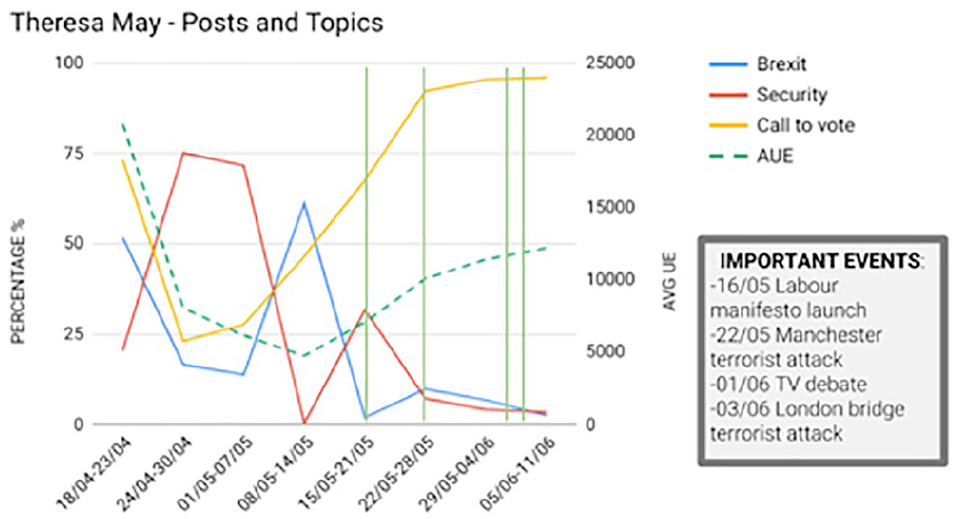
Percentage of posts per topic across time on Theresa May’s Facebook page.
Jeremy Corbyn and the Labour Party
Labour focused more on positive issues, with the apparent aim to project an optimistic and motivational narrative. This attitude was coherent with the campaign slogan “for the many, not the few” and was backed up by strong ground mobilization with campaign rallies often attended by large crowds. This positive spirit is well represented in the post published on the day of the election, which read “This is our day. Our time. Our chance. Today, let’s come together and vote Labour to transform Britain for the many, not the few.” 7 Labour’s and Corbyn’s posts focused on two main topics which alone account for almost the entirety of content on these pages:
Welfare
This wide-ranging topic comprises posts calling for improvements in welfare, public services, health, and labor conditions as outlined in the Labour election manifesto. In Corbyn’s page, this was expressed by frequent references to “change” (occurrences in the corpus: 41) needed for the “NHS” (203) among other public services, to defend the “rights” (53) and create “jobs” (26) of “workers” (130), as well as to “support” (50) and “deliver services” (58) to people. In one post, it was asserted that “Labour’s manifesto proposals are much better designed to strengthen and develop the economy and ensure that its benefits are more fairly shared and sustainable.” 8 The Labour’s page followed the same strategy focusing on welfare issues, such as the NHS and workers’ rights. One post, for example, said “We will fix the broken market to provide homes for the many, not investment opportunities for a wealthy few.” 9 Only few references were made to Brexit compared to the Conservatives.
Call to Vote
This topic includes all those posts that make an explicit or implicit allocution to people to invite them to vote for Labour. Under this category, we find frequent references to terms such as “people” (196) and “rallies” (18) and often references to emotions as seen in the frequency of the term “hope” (13) and semantically related terms. One post, for example, read Our campaign has been about hope. If there’s one thing that symbolises that, it’s our pledge to abolish tuition fees so that our young people aren’t weighed down with debt. I want to make it possible for everyone to reach their potential, whatever they do.
10
This message expresses well the optimism that was at the heart of Corbyn’s campaign message.
As shown in Figure 6, Corbyn’s Facebook page enjoyed high user engagement over the course of the campaign with a marked increase in the week before the election. Over this period, the Facebook page was almost entirely occupied by welfare and call to vote topics which managed to attract high levels of engagement in a consistent manner. Many posts contained a strong element of personalization as seen in references to Corbyn and quotes from his speeches. Thus, one post asserted, “For affordable housing, maternity rights and a debt-free future—young women across our country are asking their parents and grandparents to #VoteForMe.” A similar trajectory was followed by the Labour’s page, which though not as successful as Corbyn managed to attract high engagement by focusing on the same topics.

Percentage of posts per topic across time on Jeremy Corbyn’s Facebook page.
Discussion
Our analysis evidences the need to adopt a more nuanced understanding of the relationship between online political discussions and emotions, moving away from the view of social media discussions as being necessarily biased toward negative content. We highlight how, in certain circumstances, positive and hope-driven social media content can prove highly effective and elicit strong levels of user engagement. This possibility is well represented by the social media operations of the Labour campaign in 2017, whose emphasis on positive topics and promises of social improvement rather than on more negative and divisive topics, appears to have contributed to high levels of user engagement.
Focusing on the promise of social improvement through public spending, and the overhaul of welfare, health, and employment policies, and adopting a hope-driven call to vote to supporters infused with positive terms such as change, hope, together, and care, Labour managed to make many of its messages viral and to attract high user engagement. To the contrary, the Facebook pages of the Conservative Party and Theresa May gave priority to negative content, adopting a style of discourse that was dominated by fear-inducing terms such as “threats” by destructive forces, “terrorists,” and “extremism.” Despite the supposed salience of this kind of messaging amid the uncertainty created by the Brexit referendum, and the bloody terrorist attacks before and during the campaign, this kind of political discourse was met with a rather lukewarm response.
These findings offer useful insights to the scholarly debate on social media and politics, and in particular on the question of emotions in social media and social media campaigning. It highlights how, contrary to much recent analysis, which has emphasized the negative content of political discussions on social media, positive content can in certain circumstances prove highly effective to mobilize people. We found a positive correlation between posts on positive topics and user engagement, which led Labour that focused on promises of social advancement to be favored over the Conservatives that focused on more negative issues such as national security and Brexit. This more positive strategy, which was explicitly outlined by Labour strategy, proved capable of better eliciting user response, despite the fact that a number of events, such as terrorist attacks before and during the campaign, may have seemed to favor Theresa May’s more negative strategy. Furthermore, our work also contributes significant methodological innovations, combining linguistic analysis of social media analysis and user engagement analysis for the study of online emotions.
Countering recent scholarship which has emphasized the negative nature of political communication on Facebook (Ceron & d’Adda, 2016; Sunstein, 2018; Groshek & Koc-Michalska, 2017), our case study points to the fact that “positive posting” can be highly effective in eliciting engagement. Making appeal to positive emotions of hope, compassion, and optimism can be extremely effective in attracting user attention and engaging them in conversations. This finding, while apparently surprising given the overall negative tone of debates about digital politics, complements research that has already identified the virality of positive content. Studies on “emotional contagion,” have already found positive content to be correlated with greater rapidity of diffusion of messages (Kramer et al., 2014; Coviello et al., 2014). Furthermore, studies looking at political content found that positive messages are more likely to be shared (Stieglitz & Dang-Xuan, 2013). According to the analysis by Noon Nave et al. (2018), this is particularly important for Left candidates, who are more reliant on a sense of optimism and hope to make their social media messages effective. It should also be noted that the emphasis on positive campaigning connected well with Corbyn’s promise to deliver a “kinder politics” and with his down-to-earth personality.
Therefore, we should develop a more nuanced understanding of the interplay between emotions and political communication on Facebook. We need to go beyond a simplistic representation of Facebook, and social media more generally, as a “polluted” environment (Sunstein, 2018) where trolls, fake news, and mud-throwing bots have the upper hand and account for more positive and constructive uses of these media. Furthermore, we need to develop a more multi-faceted understanding of the process of “affective polarisation” (Settle, 2018) facilitated by social media, as not being necessarily a negative or divisive phenomenon, given that in certain cases such polarization can also be facilitated by positive content.
A key question going forward is the role played by emotional intensity (regardless of its negative or positive polarity) as a predictor for user engagement. Building on recent research arguing that emotionality is correlated with information diffusion (see Dang-Xuan, Stieglitz, Wladarsch, & Neuberger, 2013), and on the findings of our research which show that the salience/engagement for a political page are driven by the emotional strength of the messaging, we need to develop a more systematic theory of this process, which may be applied to different case studies.
Our analysis has also retrieved a strong element of personalization in campaigning on Facebook, which seems to corroborate existing literature (Bennett, 2012; Bimber, 2014; Enli & Skogerbø, 2013; Garzia, 2011; Katz et al., 2013). As we have seen in the course of the analysis, the success of Labour social media campaigning was down to Jeremy Corbyn’s popularity as registered by the performance of his personal page that generated eight times the UE of Theresa May’s Facebook page. This finding raises interesting questions about the implications of political personalization for emotional contents on social media. It has been seen in much recent research (Nave et al., 2018) that a personal element is often present in successful Facebook posts. In the case of our study, we have seen how identification with Corbyn combined with positive messaging helped drive user engagement. It should be further discussed whether strong personalization may be an important element in making positive campaigning on social media a successful tactic.
Conclusion
In this article, we have explored the relationship between topics, emotions, and user engagement in the 2017 UK election campaign on Facebook. We have seen how counter to the opinion of many pundits and scholars, it is not true that negative campaigning and negative emotions tend to prevail on social media. To the contrary, we have retrieved a correlation between positive content and user engagement. As we demonstrated in this article, Labour clearly outperformed the Conservatives on Facebook during the 2017 campaign. This high performance seems to have been facilitated by Corbyn’s party choice to accord a higher priority to positive and optimistic messaging, which in turn generated higher levels of engagement, with respect to the rather bleaker narrative put forward by the Conservatives in the course of the 2017 electoral campaign. As we have proposed, our analysis has important implications for the study of social media and politics. It invites to abandon simplistic understandings of social media and politics as a space favoring negative content. To the contrary, it highlights that in certain circumstances, a more positive communication strategy can be very effective, and can serve the goal of enthusing and motivating the base of supporters.
Our analysis has limitations in terms of validity and generalization. Due to the type of algorithm employed, it was not possible to classify individual posts as belonging to a given topic, leading to low granularity in our analysis. However, we were able to pay remedy to some of these problems by using qualitative methods, that is, by manually checking a selection of posts composing the cluster analyzed by the algorithm. It needs to be borne in mind that one of the major reasons for the dismal performance of the Conservatives and Theresa May stems from the very low number of posts (between one third and one fourth of those published by Labour), which in and of itself constituted a major weakness. Furthermore, the differences found in emotional reactions and user engagement between the two major parties may derive from differential levels of enthusiasm and engagement, as well as different sizes, in the online supporter bases of these two parties, rather than from the content of the parties’ and leaders’ posts on Facebook.
Bearing in mind these limitations, our analysis suggests the need abandon simplistic narratives of social media politics as being dominated by negative propaganda and critically re-assess the impact that social media is having on current politics. Further research should approach these questions in more depth and with a larger body of data, to explore how the correlation between topics, emotions, and levels of user engagement is represented across other case studies. Given the importance of this issue, the relationship between emotions, politics, and engagement on social media is likely to remain a hotly debated question both within academia and beyond. Therefore, it is urgent that we develop a more sophisticated analysis of these processes, better accounting for the way in which positive and negative emotions intermix in political online conversations, and how they contribute differentially to processes of mobilization.
Footnotes
Declaration of Conflicting Interests
The author(s) declared no potential conflicts of interest with respect to the research, authorship, and/or publication of this article.
Funding
The author(s) received no financial support for the research, authorship, and/or publication of this article.
