




Abstract
This article focuses on the use of a remote-controlled vibrator on Chaturbate, a sexually explicit webcam platform. Looking at the complex arrangement formed by so-called human and nonhuman counterparts in networked settings, I analyze an intimate moment hosted by the selected erotic platform, observing how a sex toy that can be controlled by distance modulates the affective underpinnings of such “vibrant” assemblage and participates in this carnal activity by heightening and clustering different groupings of bodies to create an orgasmic moment. Drawing on Actor–Network Theory and theories of affect, I focus on the sociotechnical affordances that constitute this sexual setting and describe the movement of actants as they throb to develop senses of intimacy and presence in the unfurling event, thus showing how a great number of players, from varied scopes of intelligibility, participate jointly to develop visceral affect and body friction even though they do not share the same spatial frame.
The Man Machine
Besides cat-video sharing, landscape-picture posting, and instant-message exchanging, much of Internet use nowadays relies on the development of sexual activities, which, per se, also rely on current sociotechnical affordances to occur. By aiming attention at the use of a sex toy that can be remotely controlled during a livestream performance on a sexcam website, this article argues that all the technological infrastructure that surrounds such event is not a mere supporting part of it, it is one of the very partners of the whole erotic setting, for it partakes, along with so-called humans, to forge the very idea of sex and intimacy that arouse in these contexts. We not only have sex with people, we have sex with machines, and machines have sex with us too. At a broader perspective, the division between humans and objects does not follow the affective surroundings that are formed among constant groupings and regroupings of assemblages, where “persons” and “things” are both actants in the shaping of world happenings and both modify their surroundings as they interact with and influence one another (Latour, 2005).
Chaturbate (CB), the selected website for this research, is a hosting platform for erotic webcam performances, which are organized and consumed via app-driven transactions. Remote-controlled vibrators are one of the sex features of this website, configured in a techno-capitalistic way so that the audience can turn these devices on—and be turned on in return—by their tipping activity. In this context, the operation of such device poses great complexity since the instrument in question does not require a physically present entity to function and can be activated from any point of the globe, allowing that a large number of people, along with their wallets, broadband connection, and other electronic paraphernalia, participate in the sensuous interaction and produce arousal stimuli in a very intricate techno-somatic arrangement. Regardless of any traditional view of touching, which presupposes ideas of presence, organicity, and the sensorium, CB promotes collective intimate relations, in a touching ambience with visceral affect and bodies being frictioned against each other.
Considering the dense network of relations collectives of bodies engage at particular situations, I take the event on CB as my primary unit of analysis and move out from there, observing how a great number of players, from varied scopes of intelligibility, configure the intimate moment that is taking place in the passage of affective intensities, transforming and re-elaborating each participating counterpart on their trajectory. To do so, I employ Latour’s (2005) Actor–Network Theory and theories of affect to question the ontological subject/object partition, arguing that its thresholds are constantly formed and modeled anew as bodies move and influence one another. Affect is here understood as the interfering energies that alter bodies, whereas intimacy is seen as an energy of attachment, “a drive that creates spaces around it through practices,” as Berlant (1998, p. 284) states. This way, intimacy arises on these erotic performances with the development of sexual/intimate practices that create gatherings and draw bodies together in specific assemblages, constantly and ceaselessly sewing and resewing what we understand and classify as subject or object.
Within the realms of adult webcam modeling, scholars have mainly focused on entrepreneurial aspects (Bleakley, 2014; Jones, 2016; van Doorn & Velthuis, 2018), amateur and professional entanglements (Hofer, 2014; Nayar, 2017), and race, class, and gender inequity intersections (Jones, 2015; Korn, 2017; Reece, 2015). I drift apart from these topics to focus on how current technological affordances shape user interactions in sexual activities performed in digital contexts, demonstrating that such infrastructure of intimacy (Paasonen, 2018), rather than sheer backstage machinery, is an engaged actant in the building and molding of the intimate arrangement deployed in webcam performances. Moreover, this line of thought contributes to a more ecological sensibility toward matter as vigorous entities, which allows scientific inquiry to pay attention to affective body politics of social media in all its vital materialism, showing how human culture is inextricably enmeshed with active agencies and encouraging “more intelligent and sustainable engagement with vibrant matter and lively things” (Bennett, 2010, p. viii).
In light of this, in the following section I introduce CB as a platform for erotic pleasure and describe its ways of dealing with intimacy, also showing the great surrounding of technological gadgetry that makes it possible. I then focus on the sociotechnical infrastructure of Lovense Lush, CB’s most used vibrator, detailing its operating features and how they modulate the sexual performances on the website. After exploring the technical surrounds and the ontological issues of the event in focus, I concentrate on an actual erotic broadcasting with the vibrator, aiming attention at the assemblage formed by so-called human and nonhuman instances and analyzing how closeness and intimacy is developed among all its participants, making it possible for bodies to “come together” and bind into each other so they can get in touch. I conclude the article with expanding thoughts about collective entanglements and the relations between intimacy and networked media, advocating for new and vibrant political ecologies.
Note that all the sections of this article, including its title, are named after the musical work of Kraftwerk, a techno-pop band that dealt extensively with human–machine interaction and the adoption of technology in everyday routine. Their lyrics expressed how daily activities are being influenced by technological development, and their ritornello melodies simulated the endless loop of engines with machine-like rhythm structures that repeat themselves over and over. Like Kraftwerk’s The Man Machine, a person–robot amalgam, the interplay between varied bodies on CB gives rise to unique relations, complex types of agency, and peculiar forms of closeness, in which objects and persons operate jointly to produce or experience intensity. In a like manner, the majority of this article was written with the German group as the soundtrack, to develop an affecting surrounding that would lead to creative ways of thinking the use of technology in our current world. I strongly recommend that the reader also listen to their music while reading it. Unfortunately, headphones are not included.
We Are the Robots
CB is a hosting platform for livestream erotic performances. Founded in 2011, it is ranked third among the most accessed adult websites, and it is the first one in the webcam sub-category list (based on Alexa’s web traffic analytics 1 ). About 780,000 people visit the site every day, and the number of cammers that broadcast at the same time is usually around thousands. Registered full-age users can perform shows using their own audiovisual resources and produce sensual content from the comfort of their house setting, as well as use the website’s own applications and virtual currency to charge for such production. The viewers, ranging from 0 to 20,000 people on a same room, can purchase tokens (1 token costs approximately US$0.10) and give them away during ongoing shows, which are credited to the performer’s account and can be later transferred into actual dollars. The site keeps 50% of the total amount.
Camshows range from casual and nonchalant ambience to high-tech and high-performative productions, varying around relaxed clothing, posing, and self-presenting, on one hand, and well-elaborated costumes, scenarios, and scripting, on the other. There are users who broadcast randomly and do not see the platform as a source of income, while others face it as an actual occupation and put a lot of effort to deliver quality erotic content and earn from it. In fact, the myriad possibilities offered by the website, both in show categories and computational infrastructure, makes it difficult to precisely address the great number of features that happen there. And these attributes are continually under development: CB allows tech-savvy users to program and run apps on shows to generate participating activities such as games (dice, naval battle), bots, wireless device control, and many other innovative ways of interacting that are reshaped as new technologies appear. According to Guyer (2016), in platform economy practices, these novelties work as “apportunities,” that is, as pieces of application software that are constantly adapted to maintain the durability and usage of these very applications, incorporating new components, connections, and capacities and making their content always fresh.
The greatest appeal of CB as a sexcam platform lies on the promotion of specific intimate moments, a series of features that generate, expand, and intensify the idea that the performances portray an “authentic eroticism,” reiterated in many ways along the website experience just like Kraftwerk recurrent melodies. Proximity is here generated in an overtly intensified loop, speed, and rhythm, and the productions of authenticity that promote such sensation—offering “real” people, “real” time, and “real” touch—draw on a plethora of technological affordances that help efface their very presence on these experiences, as if a cammer and viewer had no-“thing” between them. This disappearing feature facilitates the view of all the machines that participate in this operation as passive objects, nothing more than a conduit of impulses from Point A to Point B. But if we pay attention to this very movement, it is possible to verify that, in fact, “machines are the concealed wishes of actants which have tamed forces so effectively that they no longer look like forces” (Latour, 1993, p. 204). Objects on CB are not mere channels for the sensations generated on a platform, they form a complex orgasmic machinery that actively participates and interferes in the transmission of the affective intensities that unfold during erotic events.
This can be noticed, first, from the apparent non-professional aspect of the page, with people comfortably showing themselves in their very living room sofa. Such feature corroborates to the sensation that the material being depicted feels more “real” than studio-made erotic productions, and thus more delightful for the allegedly amateur cammer (and the bystander public). By disguising the laboring production of such activity in household settings, performers develop what Hofer (2014) calls pornographic domesticity, a dynamic produced by the oscillation “between work and the home, labour and pleasure, public and private spheres, rather than from a separation of these domains from one another” (p. 335). This interim production, that on CB tensions these categories so that the viewer experience both content sides within the same performance, contributes to approximate performer and audience in a very intricate way, as if the show is occurring at the same room for both who performs and who watches thanks to the supposed absence of mediation (Paasonen, 2011).
The second aspect of CB’s erotic authenticity relies on the way the website deals with time and its passage. Its main page (named “Featured”) lines up and ranks the most viewed cams the moment the website is accessed, displaying an erotic showcase of thumbnails with screenshots of the actual ongoing broadcastings (along with each user’s basic info). Every 60 s, performances are recaptured to depict the latest and most up-to-date minute of the current camshow and the thumbnails are reordered to line up profiles according to the latest number of viewers. This way, the present time is repeatedly suspended and stretched forward, constantly reiterating that what is being shown is occurring at that very moment, right before the viewer’s eyes, as well as the livestream performances that are happening on each user’s room. And, once more, the closeness between viewers and performers is greatly intensified, in such a hyperbolic way that the proximity generated through this twofold movement appears to erase all the technological affordances that partake in this event.
The cherry on the cake comes with the use of high-tech sexual gadgets that can be controlled by distance. In this regard, remote-controlled vibrators comprise the most used sex toys on CB, which can be noticed from some of the most used hashtags 2 used on the website: #dildo, #interactivetoy, #lovense, and #ohmibod (the last two concerning famous vibrator brands). Chat rooms that make use of such playthings often display a cam model with a vibrating device plugged in their 3 body, configured to respond to viewer’s tipping activity by shaking every time a certain number of tokens are given. Therefore, tip-operated vibrators promote intimacy by intricately bringing performers and audience together, allowing space to be compressed in a way that approximate people regardless of their geographical whereabouts. The absence of a delimited physical range to control this remote object connects bodies in a unique and particular spatial frame, heightening the binding experience with great intensity, and, one more time, putting aside the network of relations that make it possible.
This way, the intimate moments featured on CB are made possible thanks to all this elaborate interactional gadgetry, which deepens the intensity generated and binds a large collective of bodies in a big and complex sexual engine. The tension of thresholds in such blend comes from the climactic environment produced in the transmission of intensities, whereas these limits keep being reinforced as language is used to make sense of what is happening there. This is a monstrous contraption, with blurred and confusing boundaries, but at the same time with specific bodily formations through which sensations are produced: sexual affective relations, traditionally understood as “organic,” “human,” or even “natural” experiences, are being conveyed through electronic devices, and sensations are being transmitted and felt through machines. In this sense, We Are the Robots, and a clear division between human/machine or subject/object does not stand; what needs to be taken into account, here, is the capacity of this conglomerate of bodies to affect each other, for it is only following this movement that we can delimit and understand what a body is. As Deleuze and Guattari (1987) affirm: We know nothing about a body until we know what it can do, in other words, what its affects are, how they can or cannot enter into composition with other affects, with the affects of another body, either to destroy that body or to be destroyed by it, either to exchange actions and passions with it or to join with it in composing a more powerful body. (p. 257)
When questioning the localization of the self and the ontological boundaries that separate subjects and things, Bateson (1987) draws on the example of a blind man with a stick, arguing that it is nonproductive to determine the man’s limits—his beginnings and ends—in relation to the guiding object he holds. According to the anthropologist, this way of reasoning cuts off the pathway along differences are transmitted under transformation, which allows the sightless person to make sense of the world around him and move. Similarly, on CB, we do not have a person holding a stick, we have a person “holding” a vibrator, equally losing their selfness in a guiding activity throughout the highways of desire. It is important, then, to maintain this ontological line of reasoning to comprehend what happens when this vibratory device affects (and is affected by) its surroundings when transmitting and creating carnal connections. And to trace this network of relations, we shall turn to the actual vibrator used on the platform.
Pocket Vibrator
On the top-left of CB’s page, a slogan reads: “The act of masturbating while chatting online.” Masturbation is thus the way in which users are supposed to interact sexually on the platform, each at one end of the screen, the idea being that the self-stimulating activity cammers perform in their own body arouses not only themselves but also the viewer (who is also assumed to be masturbating). Chatter is seen as a form of expanding this interaction, allowing people to actively partake and determine the flow of the erotic performance while verbally exposing their wishes and desires. Such exchange becomes much more complex and varied when high-tech vibrators come into play, and viewers have the possibility to actively interfere in the recluse enticing activity another person is developing by reaching their bodies with a throbbing object (and also feel touched by it).
The technological conditions of vibrators as interacting devices are multiple and have changed over time. Initially developed as a medical instrument to treat diverse nervous conditions, like asthma, obesity, and even hysteria in women (seen as a pathology by the American Psychiatric Association until 1952), electromechanical vibrators were gradually turned into commodities, reaching the sexual marketplace and people’s homes around 1960 and becoming an important instrument for both sex-toy businesses and feminist sexuality (Comella, 2017; Maines, 2001). Their early therapeutic features have faded, giving place to devices solely designed for intimate pleasure on a wide and diverse range of colors, sizes, shapes, functions, and concepts. Nowadays, the integration between dildoes and telepresence gave rise to a field called Teledildonics, a new chapter in the commercialization of intimacy with the production of sexual gadgets that can be controlled by distance. 4
Lush (Figure 1) is one of the latest goods from the Teledildonic industry. It is part of a lineage of eight long-distance toys produced by Lovense, an interactive sex-toy company based in Hong Kong, and their top-selling item. Backed in 2015 by a crowdfunding project 5 and having received US$106,234 for its development (513% more than the initial pledge), it is nowadays advertised as the flagship of remote-controlled sexual interactions, its webpage 6 fully adorned with illustrating pictures of sound waves that reinforce the product’s main feature. It is clearly designed and commercialized as a cisgender women’s plaything, which can be noticed not only by its gendered pink color but also by one of its mottos—“Let him control you . . . From anywhere!” This cis-heteronormative logic corroborates to reinforce what Faustino (2018) calls coital imperative, in which sex is still idealized as an activity where a cis man’s penis penetrates a cis woman’s vagina even though new technologies allow much more diversity and possibilities in terms of sexual interplay.

Lovesense Lush main page.
But as naïve as its concept may seem, Lovense Lush is a very high-tech and advanced piece of technology. Composed of one insertable part and a bendable Bluetooth antenna, it offers up to 2 hr of continuous use, even underwater, and can be recharged with USB connectors. To be controlled remotely, it runs specific applications—compatible with the latest operating systems, for both desktop and smartphones (Apple Watch included)—that sync the vibrator to computing devices and make it possible to manipulate its functioning. These apps provide a great diversity of vibrating patterns and forms of control, like responding to screen touching or swiping, shaking in consonance with the music that is being played, or even throbbing according to the sounds that are being echoed in the room. All these conveniences allow people to develop innovative and creative ways of interacting while using the vibrator, a sex toy surely very diverse in its “apportunities” (Guyer, 2016).
Indeed, it was Lush openness for novelty and innovation that have turned it into a great component to be used during CB performances, transforming it into the latest fad on the platform. By running pairing apps and a specific web browser, cammers can broadcast with this interactive dildo as an erotic feature, and sync it so it responds to viewer’s tipping activity. Its vibrating levels are largely customizable, allowing performers to decide how many tokens viewers have to give for the toy to vibrate in a determined level and time length (see Figure 2). For example, Lush can be configured to vibrate during 2 s in low intensity if someone tips from 1 to 5 tokens; for 5 s in medium intensity if someone tips from 6 to 10 tokens; 15 s in high intensity if someone tips from 11 to 50 tokens, and so on. Special commands are also possible, with pre-set vibrating patterns or random levels that are activated after a certain amount is tipped.
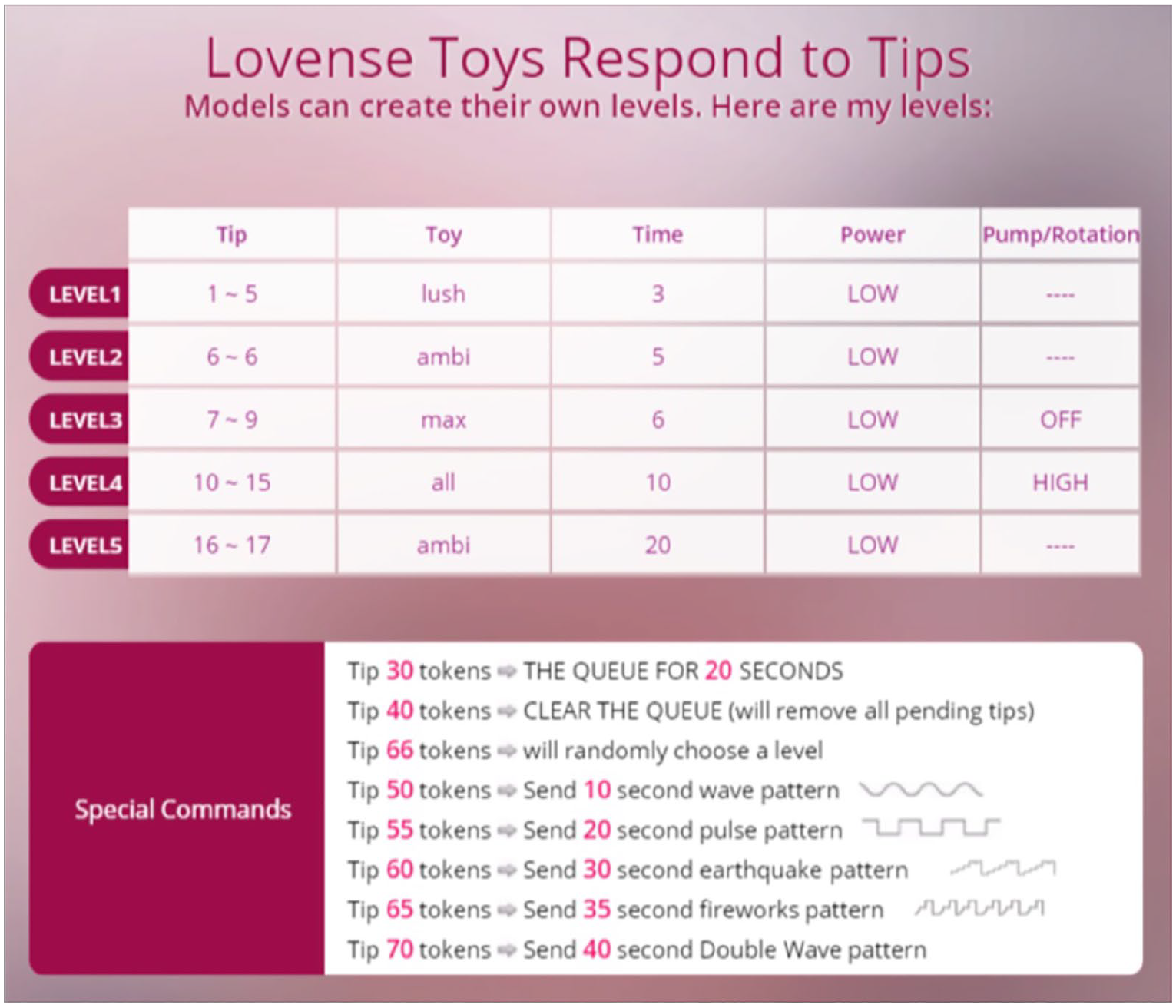
Lovense products vibrating levels example.
Lush operating process greatly complexifies the notion of owning and operating a piece of equipment. The cammers are the ones responsible for selecting the vibrating levels and tokens amount, but they are not the ones in charge of controlling it: every paying viewer, at any location, in any desired moment, has the power to turn it on and, by tipping, decide its vibrating patterns and span. The number of individuals in charge of the functioning of this object thus goes from a single person to thousands at the same time, making the performer completely susceptible to tippers’ commands. The vibrator itself is also involved in the management of the situation, for to feel pleasure, cammers and viewers must subject themselves to its mode of operation, and consent to its functioning configurations and set of adjustments. Thus, the sexual activity is modulated by all participants—cammer, tipper, vibrator—and Lush plays the people who use it as much as it is played by them.
This way, Lovense Lush—along with all its high-tech functionalities and possible customizations—comes into play in sexual interactions on CB and participates in the erotic performances deployed as an active entity in the construction of closeness between viewers and performers. Quite different from Kraftwerk’s Pocket Calculator, where being the operator (“with my pocket calculator”) means a whole new way of interacting with technology and the world, CB’s pocket vibrator operation implies engaging with technologic apparatus and establishing unique connectivities, sensations, arousals, body conglomerates, and operation-logi(sti)cs. And just like its crowdfunding project, in which many people participated in its conception, a large number of people now share its ownership and operate it in diverse and multiple ways—a crowdfucking event. Intimacy is produced in and through this collectivity: in the gap between human and machines, the sex industry seeks revenue while users try to have sex.
When Airwaves Swing
Let us now focus on the actual use of the Lovense Lush vibrator on a livestream performance on CB, paying attention to the affective intensities that circulate in the development of proximity between cammer and viewer and the sociotechnical apparatuses that take part in this type of interaction. As Paasonen (2018) argues, “intimacies that are managed through social media depend on the ever-increasing performance of server farms, the capacity of underwater cables and the usability of material devices, alike” (p. 111). Such performance is not only related to the technical efficiency machines produce but also their very acting in the event. This way, the network connectivity that takes place on the selected platform is a specific assemblage that determines and shapes the maintenance of bonds and feelings among collectives of bodies. In such a case, it is an energy of attachment that produces arousal and sexual closeness among its participants.
The camshow here described was drawn on from participant observations I have conducted on CB as part of my ongoing ethnographic research, in which I attended cammers’ broadcastings that use the Lush vibrator on their performances to observe how this toy is being used to shape sexual interactions. The idea is to trace the association between human and nonhuman agents in this particular event (Latour, 2005), analyzing how they come together and what affective intensities are transported along these entities to generate the arousing, sexual, and intimate environment the whole setting is presumed to encompass. Furthermore, investigating how intimacy is constructed when actors engage in technological uses means seeing how cyborg subjectivities—blurred between so-called machinic and organic entities—emerge, disrupting the idea of an ontological “natural human” and complexifying the intricate relations that are formed between subjectivity and technology (Haraway, 1991).
However, the interactions analyzed in this article were not taken from actual extracts of the shows on the platform, they were constructed specifically for this study. This methodological course of action was chosen due to the particular circumstances that have arisen as developing research on CB, a networked environment with a giant fluidity of camshows and users, making it extremely difficult to obtain participants’ acknowledgment of the conducted research. Furthermore, anonymizing data is no longer enough in Internet research where spaces become more and more archivable, searchable, and traceable. This way, following Markham’s (2012) idea of fabrication as ethical practice, I created a fictional performer and their shows, based on my experience as an audience of the website, to present details of the dynamics of the platform and, at the same time, protect participants’ privacy in a space where vulnerability and potential harm is not easily given. As the show here described does not correspond to any specific performer, the data will not lead to any particular cammer, but will help illustrate the sociotechnical affordances of the vibrator and the collective intimate relations that arise with its use.
The constructed character for the following camshow is a cisgender woman, Caucasian, thin, with shoulder-length straight brown hair and brown eyes. On her profile bio, she says to be 24 years old, located in Europe, speaker of English and Spanish, and interested in men, women, trans, and couples (all four CB profile categories). She uses the tag #lovense 7 in the room description, and at a certain point of her shows reaches around 4,000 people watching her performance simultaneously, a number that oscillated as much as her ranking position. Indeed, profiles that are ranked best on CB are usually of white, toned, youthful, and able-bodied people, a preference that indicates of how race, class, and gender-based inequities intersect with the popularity and prominence of cammers (Jones, 2015).
The performer was wearing a red skirt and a yellow necklace only, and all her body was on display. The bright room where the broadcasting was being shot appeared to be a living room setting—she was lay down on a gray sofa with bed sheets covering the cushions and a pillow was positioned next to her head. Behind her, a window and some plants completed the scenario, and sometimes the sound of passing cars could be heard in the background. As argued before, the domestic ambience of such setting contributes to its constructed authenticity and the feeling of a “real world” screening, which was reiterated by the relaxed attitude of the cammer, constantly speaking with viewers and responding to their written messages in a very casual way. At one point, her dog even jumped on the sofa and came close to her, making her pull the animal’s tail down and say: “don’t show your ass on camera, do it for money.” Mediation kept dissolving as performer and audience were feeling “at home.”
The Lovense Lush was plugged inside the camgirl’s vagina, and we could only see its pink antenna coming out. To attract viewers interested in Teledildonic interaction, her room description had the following message: “Good Morning! Gimme the best orgasm, make me cum hard! #lovense.” The matinal interjection written in such message contributed to the construction of the broadcasting as a homey ambience: the brightness of the room could then be interpreted as morning lights, while also setting both performer and viewer in the same space-time frame—“you are here, now, with me”—even though viewers would share different time zones and room lighting. Furthermore, the message also requested viewers to participate in the performer’s orgasmic moment, helping her reach the best climax by taking part in her show and, once more, getting closer and feeling more engaged to the whole erotic activity.
As the hashtag in the message indicates, Lovense Lush was the piece of equipment responsible for such sexual connection, but its vibrating functions would only occur provided that viewers spend money during the performance. Sexual arousal experience on CB is highly monetized, and its transactions are all operated by machines: specific pieces of software pair the vibrator to the tipping activity of the audience and make sure that, whenever someone tips, the device functions for a couple of seconds according to the amount given. The vibrating patterns had already been set by the performer prior to the camshow, and a repeated automatic message in the chat box kept viewers informed about costs and machine responses:
MY LOVENSE LUSH VIBRATOR IS SET TO REACT TO YOUR TIPS. THERE ARE 5 LEVELS OF INTENSITY OR RANDOMLY CHOOSE A LEVEL FROM 1-5:
Level 1 - Tip (1-14) 3 seconds (Low vibrations)
Level 2 - Tip (15-99) 6 seconds (Medium vibrations)
Level 3 - Tip (100-499) 10 seconds (Medium vibrations)
Level 4 - Tip (500-999) 1 Minute
Level 5 - Tip (1,000-1,000+) 3 Minutes (High vibrations)
These notices were being managed by chatbots, a very common resource in rooms that use remote-controlled vibrators. Such pieces of software are very important elements of the erotic setting hosted on CB, for they conduct and manage the tipping activity, modulating the interplay between machines and persons. They are responsible not only for letting viewers know the vibration levels and duration related to how much they spend, but also for communicating who and how much someone has given in a specific moment. During the camgirl’s performance, whenever someone tipped, a chatbox generated and sent a message informing the registered username of the tipper and the number of tokens given by them, as the following example of the chat illustrates:
[Username] tipped 50 tokens
This automatic message notified the cammer and her audience that the tipper in question has tipped 50 tokens, letting this particular user aware that the vibrating response the performer was receiving at that moment was occurring thanks to their contribution, a very brief moment in which they were in control of that machine, participating even further in the sexual interplay and standing out in the audience as the one responsible for that specific arousal moment. Right after it happened, other viewers started sending messages through chat thanking the tipper and praising their “tipping” skills, heightening the crowdfucking and participatory atmosphere of the platform. The chatbox also engaged in these interactions, sending an automatic message with “Notice: Niiiiceeeeeee (username) 8 ” written, which helped the establishment of a sexual environment by reinforcing the development of the erotic setting and acknowledging the high intensity viewers, cammer, and machines were experiencing while engaging in this specific arousing situation.
Along with the written report, another very important element participated in the erotic moment: sound. On CB, tipping activity is followed by an audible stimulus that not only signalizes the moment someone has given any money but also heightens the experience by echoing high-pitched and funny noises. There are five different sound emissions according to how much is given at once: for low tips, like 1 token, there is a short beep, and if someone tips a bit higher, a 2-s alarm clock ding is played (the type of sound that echoed right after the user tipped 50 tokens). From 100 to 499 tokens, CB emits the sound of coins falling, which is complemented by a “hit the jackpot” noise (or the G-spot, in this case) if 500 to 999 tokens are given, and a “yee haw” utterance for 1,000+. 9 This way, When Airwaves Swing, such noises produce a different type of framing for the event, less sexual and more entertaining, like a gaming situation in which players appear to be competing to make the cammer reach orgasm.
The development of a gaming atmosphere on CB performances helps to reinforce the relaxed and binding atmosphere that unfolds. In their work about machine gambling addiction in Las Vegas, Schüll (2015) studies the absorbing and suspended feeling slot machine players experience while gambling, describing in detail how these machines are meticulously designed to hook people and make them spend a great deal of time and money on them. Similarly, the material and computational features of sexcam on CB, including sound, networked infrastructure, and cammer broadcasting, are carefully built to shape and modulate its erotic and relaxed flow, grabbing people by the eye (and ear) and make them stay in a performer’s room for a long period of time, at the same time as prompting their consumption of carnal moments through tipping.
Indeed, the peak of intensity produced by tipping activity, sound emission, and vibrator response provides an ongoing stream of action-inducing cues to viewers. CB’s architecture sticks users to its platform and acts upon viewer’s bodies, tying them together and making them stay. Speed is a crucial element here: to keep the flow of the sexual act, that is, to keep Lush continuously shaking, tippers engage in a stream of token giving, maintaining the inciting environment being developed and greatly binding all bodies together. This can be noticed in the following chat excerpt of the show, in which one tipper starts tipping repeatedly and is followed by others:
(Tipper 1) tipped 1 token
(Tipper 1) tipped 1 token
(Tipper 2) tipped 1 token
(Tipper 2) tipped 1 token
(Tipper 2) tipped 1 token
(Tipper 2) tipped 1 token
(Tipper 2) tipped 1 token
(Tipper 2) tipped 1 token
(Tipper 3) tipped 15 tokens
Notice: Mmmm
(Tipper 4) tipped 15 tokens
Notice: Mmmm
(Tipper 5) tipped 15 tokens
Notice: Mmmm
On this moment, Tipper 1 started their stream of tokens, which was continued by Tipper 2. The flaming excitement generated by this repeated act was followed by Tipper 3, but this time with a bigger number of tokens, heightening the situation even more and generating a moaning response (“Notice: Mmmm”) by the chatbox. Such stickiness was then reiterated by Tippers 4 and 5, who kept the flow going by tipping the same amount the previous tipper did and also generating the same chatbox reinforcing message. Every time a token was given, different audible noises were produced, which created a large flow of high-pitched noises that overlapped over each other in a very intense velocity. The climatic experience was also felt and enacted by the cammer, who moved, contorted, and moaned every time the vibrator was activated. Sound here struck again: as sex sounds (like moaning, gasping, and sighing) are very important components in the construction of erotic settings (Mowlabocus & Medhurst, 2017), especially when it comes to female orgasm performances, the performer kept moaning and reiterating her bodily pleasure at every tip, doing it higher and louder when tippers started to increase the token amount. This incited even more the continued escalation of the sexual flow, as the following fragment shows:
(Tipper 6) tipped 100 tokens
Notice: Niiiiceeeeeee (Tipper 6)
(Tipper 6) tipped 100 tokens
Notice: Niiiiceeeeeee (Tipper 6)
(Tipper 6) tipped 100 tokens
Notice: Niiiiceeeeeee (Tipper 6)
(Tipper 6) tipped 100 tokens
Notice: Niiiiceeeeeee (Tipper 6)
(Tipper 6) tipped 100 tokens
Notice: Niiiiceeeeeee (Tipper 6)
(Tipper 6) tipped 100 tokens
Notice: Niiiiceeeeeee (Tipper 6)
(Tipper 6) tipped 100 tokens
Notice: Niiiiceeeeeee (Tipper 6)
(Tipper 6) tipped 100 tokens
Notice: Niiiiceeeeeee (Tipper 6)
Notice: Lovense info Give me pleasure with your tips!
(Tipper 6) tipped 15 tokens
Notice: Mmmm
(Tipper 6) tipped 15 tokens
Notice: Mnmm
(Viewer 1): Go 500
(Tipper 6) tipped 15 tokens
Notice: Mmmm
(Tipper 6) tipped 15 tokens
Notice: Mmmm
Moments after users started giving tips of 15 tokens, a new tipper started a sequence of eight 100-token tips, each of them making the vibrator function for 10 s in medium level and also resulting in a flow of coin-like sounds and chatbox endorsements. The cammer started responding with greater enthusiasm, moaning even louder and contorting even more. Another automatic message also appeared (“Notice: Lovense info Give me pleasure with your tips!”), informing the room that the Lovense Lush was being used there. This type of note is quite common during CB performances, and they appear on the chat from time to time just like the vibrating levels notice. But on the event in question, instead of inducing more tips, perhaps it cooled the interaction down as the tipping was already happening and its reinforcement may have brought the automaticity of the interaction back into consideration. As the wave of tipping-sounding-vibrating-moaning was not followed by any other tipper, Tipper 6 started lowering their bet, despite the request by another user to tip 500, a number that would keep increasing the intensity of the situation like the previous 100-token tips were.
The short periods here analyzed indicate that the interaction between all the participating bodies on the erotic event follow some type of script that dictates the flow and the development of the proximity generated among its counterparts. Machines manage tipping activities with vibrating responses and written notices, whereas the audience usually start tipping very low and then increase amounts (and vibrating levels, sound pitches, and bodily responses) as the crowdfucking event escalates and heightens the intensity of sensations. In any way, the climax of the situation—that is, the orgasm—was not performed during the watched moments of the sexshow: after some time, the camgirl started showing signs of tiredness, which made her write “I need a drink” and “I think my pussy needs a break now” a few minutes later and then unplug the device. Still, she continued the performance after a short break, which indeed may have led to many other new interactions, tippings, moanings, costumes, and vibrations.
Computer Love
This article explored the intricate techno-somatic relation between so-called machines and persons in an intimate networked setting. Focusing on the sociotechnical affordances of a sexcam website and the “apportunities” offered by a remote-controlled vibrator, I analyzed the collective underpinnings of a sexual livestream performance and demonstrated how affect intensities travel through multiple actants and is modulated, by different assemblages, to bring people together and make them feel aroused and connected to one another. Intimacy was here produced at the intersection and friction of a whole collective of bodies, in a vibrant and pulsating movement that moved its entities and their surroundings onward, shaping and reshaping the threshold of subjects and machines as it unfolded.
On CB, the great number of simultaneous occurrences is overwhelming. There are countless cammers, viewers, costumes, vibrators, actings, voices, noises, chatting, and plants, and birds, and rocks, and things, making it difficult to analyze it thoroughly and not to feel astonished and bewildered by all its complexity. In light of this, I concentrated my analysis on the uses of the Lovense Lush vibrator, even though much of its interaction depends upon a series of other technologies and actors that must be also considered. In any way, the number of actants of any particular event should always be increased (Latour, 2005), for it is always made of much more multiple forces than meets the eye (of scientific inquiry). Furthermore, we should also acknowledge that scholarly practice is as elusive, messy, undisciplined, and dirty as the events it describes, and a research about online sex cannot—or at least should not—be different (Law, 2004; Moita-Lopes, 2006).
I remember that once, during a show on CB, one of the viewers asked the performer through chat if she preferred an actual penis or, as they said, to “ride a wave,” referring to the vibrating stimulus of Lovense Lush. Even though the whole sexual interaction was being developed with all sorts of technological apparatuses, a traditional view of sex was still being used as a framework to make sense of the event itself. Taking this into consideration, I would rather question, quoting Haraway (1991): “why should our bodies end at the skin, or include at best other beings encapsulated by skin?” (p. 178). And I would also add: why should our feelings and nerve endings end at our organic boundaries? Why don’t we pay attention to the whole infrastructural networked world that we live in, and how these assemblages move us to new directions, new embodiments, new sensations, new proximities, and subjectivities?
It is necessary to remove humanity from its lone agentic role and consider the intricate network of relations formed by multiple bodies in every unfolding event. This means rethinking the idea of matter as an end-in-itself, and focus on the vitality of material formations, paying attention that the perceived boundaries that determine what we understand by “objects” or “individuals” are in constant formings and reformings, reinscribing or dismantling territories so that established notions of humans and machines do not last long enough to account for the erratic feature of such vivid confederations. By doing so, we should be able to construct a more ecological sensibility, noticing that whenever “we” act, a whole array of bodies cooperates in this action to move collective arrangements forward. According to Bennett (2010, p. 108), being prone to how things affect each other in a huge and distributed chain of inter-related events means developing new ontological reasoning: If human culture is inextricably enmeshed with vibrant, nonhuman agencies, and if human intentionality can be agentic only if accompanied by a vast entourage of nonhumans, then it seems that the appropriate unit of analysis for democratic theory is neither the individual human nor an exclusively human collective but the (ontologically heterogeneous) “public” coalescing around a problem. We need not only to invent or reinvoke concepts like conatus, actant, assemblage, small agency, operator, disruption, and the like but also to devise new procedures, technologies, and regimes of perception that enable us to consult nonhumans more closely, or to listen and respond more carefully to their outbreaks, objections, testimonies, and propositions. For these offerings are profoundly important to the health of the political ecologies to which we belong.
The erotic moments in focus here demonstrated an actual crowdfucking event: the establishment of a highly intense erotic environment where human and nonhuman entities gather in a big-networked orgy, touching and feeling deeply and intimately attached to one another. During such carnal resonance (Paasonen, 2011), bodies related, connected, stimulated, enticed, aroused, and, of course, vibrated. Intimacy practices mediated by networked settings, as argued by Andreassen, Petersen, Harrison, and Raun (2018), resemble a choreography: “a new form of human-technological entanglement that does not radically change the dance, but rather where and how we move and are moved” (p. 15). Just like pocket calculators changed the way we performed the most basic calculating operations in the past, current networked technologies have been promoting Computer Love, changing the ways we conduct, make, think, and conceive sex. Paying attention to these current and ongoing assemblages, and recognizing the participatory role sociotechnical affordances have in their own making, can move us toward better understandings of social practices, with different political ecologies, less unproductive binaries, and, why not, new pocket vibrator allegories.
Footnotes
Declaration of Conflicting Interests
The author declared no potential conflicts of interest with respect to the research, authorship, and/or publication of this article.
Funding
The author disclosed receipt of the following financial support for the research, authorship, and/or publication of this article: This work was carried out with the support of the Brazilian Foundation CAPES – Coordination for the Improvement of Higher Education Personnel – Funding Code 001.
