



Abstract
The paper examines ideological segregation among Ukrainian users in online environments, using as a case study partisan news communities on Vkontakte, the largest online platform in post-communist states. Its findings suggest that despite their insignificant numbers, partisan news communities attract substantial attention from Ukrainian users and can encourage the formation of isolated ideological cliques – or ‘echo chambers’ – that increase societal polarisation. The paper also investigates factors that predict users’ interest in partisan content and establishes that the region of residence is the key predictor of selective consumption of pro-Ukrainian or pro-Russian partisan news content.
Keywords
Introduction
The advent of digital media, in particular social networking sites (SNSs), has had a significant impact on news consumption worldwide. The decreased costs of content production and distribution together with the adoption of data-driven techniques for user profiling and targeting allow both traditional and alternative news providers to reach their audiences through a multitude of socially mediated channels and formats. However, the growing digitisation of news industries also raises numerous concerns, varying from the possible abuse of users’ personal data and privacy by news providers (Helberger, 2016; Zuiderveen Borgesius et al., 2017) to the manipulation of the public sphere through fake news and disinformation (Allcott and Gentzkow, 2017; Lazer et al., 2018; Tandoc et al., 2018).
One of the major concerns about the use of SNSs in the context of news consumption is related to the threat of ideological segregation – that is, the tendency among consumers to limit themselves to the content which is likely to confirm their earlier views (Flaxman et al., 2016; Gentzkow and Shapiro, 2011). Frequently discussed in the context of ‘selective exposure’ (Stroud, 2008), ‘filter bubbles’ (Pariser, 2011) and ‘echo chambers’ (Sunstein, 2017), ideological segregation can undermine the shared public agenda by leading to the formation of isolated social groups, which nurture biases and limit the societal participation of their members. It can also facilitate the formation of discriminatory views and subsequent radicalisation by diminishing the exposure to opposing opinions; such a threat is particularly pronounced in the case of societies characterised by a high degree of polarisation (e.g. in the case of a political crisis or a military conflict).
A number of academic studies (Flaxman et al., 2016; Hahn et al., 2015; Saez-Trumper et al., 2013) use exposure to partisan news content as an indicator of ideological segregation. Hahn et al. (2015) show that subscription to accounts of specific news outlets on Twitter follows partisan lines and is influenced by demographic variables such as gender and age. Similarly, Flaxman et al. (2016) note that users who regularly read partisan news content online tend to expose themselves only to a single side of the ideological spectrum. Gruzd and Roy (2014) suggest that selective exposure on social media can increase partisanship and polarisation, which, in our view, is especially alarming for societies with a high degree of political polarisation.
In our study, we are looking at how online news consumption interacts with ideological segregation in Ukraine. Our choice of case study is motivated by two major factors. First, Ukraine is a country in transition in terms of digital innovations and their adaptation by the news market. Similar to most post-Soviet countries, Ukraine is characterised by low Internet penetration rate when compared with Western Europe (Kharchenko, 2016); however, the country is currently experiencing fast development of internet infrastructure (Freedom House, 2017) together with an explosive growth of information technology (IT) industries (Kirilenko and Tyshchuk, 2018). By examining the case of Ukraine, we strive to go beyond the current focus on the small set of Western countries characterised by a high level of technological innovations as well as their legislative regulations and to produce observations which can be applied to other countries which undergo a similar transition towards datafied media industries.
Second, since 2014, Ukraine has been experiencing conflict between the central government and separatist forces backed by Russia. Under conditions of limited information supply from the conflict zone caused both by censorship and limited possibilities for journalists’ access to the frontline, digital media, in particular SNSs, turn into a major source of news both in Ukraine and in other separatist republics (Makhortykh and Sydorova, 2017; Pantti, 2016). While online news channels are less susceptible to censorship and the control of authorities, many of them are dominated by pro-Ukrainian and pro-Russian partisan media outlets, leading to significant biases in their coverage of the conflict and the subsequent polarisation of the Ukrainian public (Karamshuk et al., 2016; Zhukov and Baum, 2016). Often, these news channels are also instrumentalised as a means of information warfare, and used for the distribution of fake and propagandist content and stigmatisation of political opponents (Khaldarova and Pantti, 2017).
Based on this, we argue that the case of Ukraine is of particular interest for studying the impact of SNSs on online news consumption under conditions of high ideological segregation and intense information warfare. To achieve this purpose, we examine how a large sample of Ukrainian users consume digital news content on Vkontakte, a Russian SNS which remains highly popular in Ukraine despite it being banned by the Ukrainian authorities. By doing so, we specifically address three aspects related to news consumption on the SNS. First, we compare the visibility of online news communities, in particular those that are devoted to partisan news content, with other types of SNS communities (e.g. entertainment-related ones). Second, we examine if partisan news communities actually lead to ideological segregation (e.g. by creating conditions for the formation of ‘echo chambers’). Third, we identify contextual factors (e.g. geographic and demographic variables) that predict users’ interest in pro-Ukrainian and pro-Russian partisan news content.
Theoretical background
In today’s media ecologies, SNSs constitute an integral component of the process of news distribution and consumption. A growing number of media organisations and journalists employ SNSs as a part of their content distribution routines extending their reach and adopting novel news formats (Newman, 2011; Russell, 2011; Thurman and Schifferes, 2012). The use of SNSs allows users to engage with news in a multitude of ways by commenting, liking and sharing specific stories across their personal networks (Hermida et al., 2012). By navigating these networks of contacts and connecting to other people and communities, SNS users are able to expand their information diets by selecting stories to read instead of selecting news outlets (Messing and Westwood, 2014); however, these novel selection capabilities also undermine the agenda-setting potential of legacy outlets and facilitate the distribution of fake and manipulative content, which can increase societal polarisation.
The content provided through SNSs, however, is not limited exclusively to news; instead, as De Zuniga et al. (2012) note, online content often focuses on entertainment and not public affairs. This argument is supported both by user surveys (Nielsen and Schrøder, 2014) and large-scale studies of SNS content, for instance on Twitter (Gerlitz and Rieder, 2013), which find that only a small portion of content is devoted to news and that users themselves do not necessarily view SNS as a major source for news. Similarly, the analysis of user behaviour indicates a small percentage of online news consumers contrasting with the higher self-reported values of news consumption (Flaxman et al., 2016; Kleppe and Otte, 2017).
The contradiction between the significant potential of SNSs as a means of news distribution and the uneven degree of actual realisation of this potential prompts the need to assess the presence of news content within specific platforms compared with other types of content. Such an assessment of content preferences is essential for understanding the political implications of a specific medium through which the content is consumed (Prior, 2005). Consequently, we argue that comparing the distribution of news and non-news content is important for assessing the role of SNSs in the context of partisan news consumption online. Hence, the first research question we address in our paper is:
Following the identification of the overall place of online news content on Vkontakte, we move towards examining its impact on partisan news consumption 1 and assessing if it actually leads to ideological segregation. Following earlier studies, we interpret ideological segregation as a tendency of users to consume disparate news content based on their pre-existing views that leads to the formation of fragmented news communities (Flaxman et al., 2013, 2016). However, unlike Flaxman et al. (2013), who use an audience-based approach to identify the partisan slant of specific news outlets and differentiate between pro-Republican and pro-Democratic outlets, we followed Hahn et al. (2015) and adopted a content-based approach 2 to identify the partisanship of specific SNS communities. We also differentiated between pro-Ukrainian and pro-Russian partisan communities because this construct is particularly applicable for measuring partisanship in Ukraine in the context of the current Russian-Ukrainian conflict (Karamshuk et al., 2016).
The increase in the levels of audience fragmentation is a prominent concern in connection to news consumption on SNSs. It causes moral panic relating to the perspective of the formation of isolated ideological communities in the form of ‘filter bubbles’ (Pariser, 2011) or ‘echo chambers’ (Sunstein, 2017). The division of the audience into isolated clusters can lead to ideological segregation, which is detrimental for the shared public sphere, and increase societal polarisation; in the longer perspective, ideological segregation can result in the radicalisation and reinforcement of internal divides, which can erode the foundations of democratic systems (Beaufort, 2018).
The concerns about the impact of online news consumption on audience fragmentation, however, so far have found little empirical support (Zuiderveen Borgesius et al., 2016). Instead, a number of studies (Flaxman et al., 2016; Mukerjee et al., 2018) demonstrate that communities of digital news consumers do not form isolated ideological clusters, but their audiences instead frequently overlap with each other. Mukerjee et al. (2018) show that audience networks are often centred around digital outlets of legacy media, which have disproportional reach compared with other outlets – in particular, the more partisan ones. Similar observations are reported by Flaxman et al. (2016) who argue that news consumption on social media not only reinforces mainstream – and non-partisan – interpretations, but also allows users to expose themselves to opposing views and diversify their information diets.
At the same time, the majority of studies mentioned above focus on Western democratic societies, which are often characterised by rather low degrees of ideological segregation. Even in the case of the US, where the degree of partisanship is high, the society is less ideologically segregated than in many non-Western countries, which suffer from extreme political polarisation. Romenskyy et al. (2018) note that in these non-Western contexts, ideological segregation has a significant detrimental effect on the public sphere, leading to the escalation of hate crimes, political instability and violence; in some cases, it can also result in armed conflicts, such as the one currently occurring in Eastern Ukraine. Under such extreme conditions, not only is the impact of ideological segregation more visible than in the case of democratic systems, but the necessity to deal with it is also significantly more pressing as the persistence of segregated communities can lead to the aggravation of hostilities and undermine conflict resolution efforts (Hoffmann, 2014; Lynch et al., 2016).
For these reasons, we emphasise the importance of advancing research on potential polarising effects of online news consumption beyond the current focus on Western media systems, and specifically towards the societies which are already characterised by high degrees of partisanship. In this vein, we align with several existing studies (Duvanova et al., 2015; Gruzd and Tsyganova, 2015; Karamshuk et al., 2016) and suggest using the case of Ukraine to examine whether under the condition of high ideological segregation, online news outlets in a particular society turn into isolated partisan communities or their audiences still overlap, thus enabling the exposure of readers to different opinions on the ongoing strife. Thus, the second research question we discuss in the paper is:
Lastly, we examine the factors influencing user involvement with partisan news sources, which is another urgent subject of academic inquiry on online news consumption (Hahn et al., 2015; Mitchell et al., 2015; Taneja et al., 2018). Taneja et al. (2018) note the role of age in their analysis of online news consumption by baby boomers and millennials: despite a number of similarities between the two age groups, the former tended to consume news from the digital outlets of legacy media and favoured more conservative outlets, whereas the latter preferred more liberal news sources. At the same time, Mitchell et al. (2015) found that older users are inclined to consume news aligning with their views more than younger news consumers. By contrast, some other demographic variables (e.g. gender (Chyi and Lee, 2013) seem to have a limited impact both on online news consumption in general, and partisan news consumption in particular.
In the case of Ukraine, Duvanova et al. (2015) emphasise the importance of geographic factors – that is, the region where the user lives – in online partisanship. The significance of these specific factors is related to the regional divide of the Ukrainian political sphere, in particular the south-east versus north-west geographical division between pro-Russian and pro-Western voters (Clem and Craumer, 2008; Duvanova et al., 2015). In the case of online news consumption through SNSs, these distinctions translate into differences in information diets which can potentially lead to ideological segregation between users from different regions (Duvanova et al., 2016).
In our article, we use data on demographic and geographic factors to analyse how these factors influence user involvement with partisan news communities on Vkontakte. Additionally, we employ data on linguistic factors – that is, if the users communicate in Ukrainian, Russian, or both languages. The importance of the language factor is attributed to the specific Ukrainian content, where the choice of a certain language is often viewed as an identity marker that makes it an important element of identity politics (Charnysh, 2013). It also aligns with existing observations on the significant difference in the way the events in Ukraine, in particular those related to the Russian-Ukrainian conflict and its background, are presented in different language streams on SNSs (Etling, 2014; Lyebyedyev and Makhortykh, 2018). Consequently, we examine these three categories of factors – demographic, geographic and linguistic – to provide a more detailed assessment of possible predictors of the Ukrainian users’ interest in partisan content. Thus, the third research question we examine in our article is:
Methodology
Similar to earlier studies on ideological segregation in the region (Duvanova et al., 2016; Gruzd and Tsyganova, 2015), we used data from Vkontakte, a popular Russian social media platform. Despite its ban in 2017 by the Ukrainian authorities, Vkontakte remains the seventh most popular website in Ukraine (Alexa, 2018) with approximately nine million active users (Tikhonova, 2018). Besides its popularity in the state-controlled parts of Ukraine, Vkontakte is used extensively in the separatist state formations in Eastern Ukraine as well as Crimea (Szwed, 2016) for distributing partisan news content, which offers interpretations of the situation in Ukraine alternative to the ones provided by the mainstream Ukrainian outlets.
Using Vkontakte API, in June 2018, we collected publicly available data about a large sample of users from Ukraine (n = 50,702) together with the information about online communities to which these users subscribe. To avoid selection bias, we used a random sample of users. First, we generated a random sample of numerical user IDs and then filtered out from it only the Ukrainian users. For identifying whether a user was from Ukraine, we relied on Vkontakte profile data; specifically, we used profile sections which allow users to self-report their country of living, and included in the final sample users who stated that their country of living is Ukraine. For each user in the final sample, we extracted the profile data about their gender, age, languages they speak and their geographic location 3 ; for the latter, we relied on Vkontakte profile fields which allow users to state the country and city where they live. Until now, Vkontakte identifies insurgent-controlled territories in Eastern Ukraine as part of Ukraine, so our sample included Vkontakte users from these regions; in the case of Crimea, the situation is more complicated, because Vkontakte attributes the peninsula differently, depending on the country of living stated in the user profile.
After collecting user data, we used qualitative content analysis to analyse communities to which Ukrainian users subscribed. Using inductive coding, we classified all communities which had more than 100 members from the initial sample (n = 4219) according to the type of content these communities promote. While doing so, we removed from the sample deleted or blocked communities (n = 24), so the final sample of the communities is slightly smaller (n = 4195). Our classification consists of five community types:
Commercial: Communities focused on advertising specific services or goods (e.g. gepur and clothes_staff);
Entertainment: Communities distributing entertainment content such as jokes or music (e.g. exclusive_muzic and chotkiy_paca);
News: Communities informing users about current events in Ukraine and/or abroad (e.g. tsnua and strelkov_info);
Politics: Communities devoted to political actors and parties (e.g. poroshenko.petro); and
Technical: Communities focused on providing professional consultancy and help in relation to the technical aspects of Vkontakte (e.g. team and ua).
The classification was done by two coders, each of whom coded 2109 and 2110 communities, respectively; then each coder coded 420 (20%) communities coded by the other coder to assess the degree of intercoder reliability. The resulting estimation of intercoder reliability measured with Krippendorff’s alpha is 0.94, which suggests that the degree of intercoder reliability is high.
Following the classification of communities by type, we focused on the news communities and examined each of them to determine whether the community promotes partisan or non-partisan content. In the former case, we also noted whether the community distributes pro-Ukrainian (e.g. by expressing unequivocal support for Ukrainian right-wing groups such as Pravyi Sector) or pro-Russian content (i.e. by expressing unequivocal support for pro-Russian state formations in Eastern Ukraine, such as Donetsk and Luhansk People’s Republics, or the annexation of Crimea). Two original coders examined all news communities (n = 112) and coded each of them as pro-Ukrainian, pro-Russian or neutral. After producing the classification, both coders examined the resulting lists together and resolved disagreements through consensus coding.
After determining the partisan orientation of news communities, we used exploratory network analysis to determine whether partisan news communities form isolated clusters in the Vkontakte community topography. After identifying the position of news communities within the user-community network, we analysed the degree of ideological segregation among the news consumers using the audience overlap approach (Webster and Ksiazek, 2012). This approach has been successfully applied to study audience fragmentation (Fletcher and Nielsen, 2017) and polarisation between the audiences of partisan news outlets (Ksiazek, 2016), and to explore selective exposure among online news consumers (Mukerjee et al., 2018; Nelson and Webster, 2017). Using a subset of users who subscribed to at least one news group from our list (n = 14,899), we constructed a news groups’ audience duplication network based on the audience-centric approach to audience fragmentation. The approach assumes that media environments are either fragmented or duplicated: if the audiences of the majority of outlets overlap, then these environments are duplicated, whereas limited overlap indicates that these environments are fragmented and, in some cases, polarised (Ksiazek, 2011; Webster and Ksiazek, 2012). In the resulting network, each node represents a news group; two nodes are connected if their audiences overlap and the number of overlapping users is higher than the one which can occur by chance (for details, see Fletcher and Nielsen, 2017; Ksiazek, 2011; Webster and Ksiazek, 2012). Afterwards, we applied community detection algorithms to analyse the resulting network to see if there are clusters of tightly connected nodes – that is, the ones that have a significantly higher audience overlap with each other than with other news communities.
Finally, we analysed possible factors influencing users’ subscription to partisan news communities. Specifically, we looked at self-reported demographic variables (e.g. age and gender) as well as language preferences (e.g. Ukrainian or Russian); furthermore, we employed geographic variables (i.e. the region where users live), which, according to Duvanova et al. (2016), are important predictors of ideological segregation in Ukraine. Out of 14,899 users who subscribed to at least one news community, only 5001 provided information about all these variables. Data about these 5001 users were used to build a logistic regression model (Ordinary Least Square) to examine variables which can be significant for predicting subscription to the partisan news groups.
Findings
News content within Vkontakte media ecology
We started our analysis by examining differences between subscriptions to different types of online communities among Ukrainian users in Vkontakte. Based on the results of our coding summarised in Table 1, we found that the vast majority of communities (95%) to which users subscribe are entertainment-oriented and deal with humour, cooking and music. In contrast, news communities constitute a rather small number of communities with 100+ subscribers from our sample: 112 out of 4206 (around 2.5%). Communities relating to political/public actors are even more underrepresented in our sample; the only community we found is devoted to the fifth president of Ukraine, Petro Poroshenko. These observations align with earlier studies (De Zuniga et al., 2012; Flaxman et al., 2016) on Western social media platforms (e.g. Facebook), which argue that news content constitutes only a small proportion of social media content, thus making the impact of SNSs on news consumption questionable.
Vkontakte community subscriptions by content type.
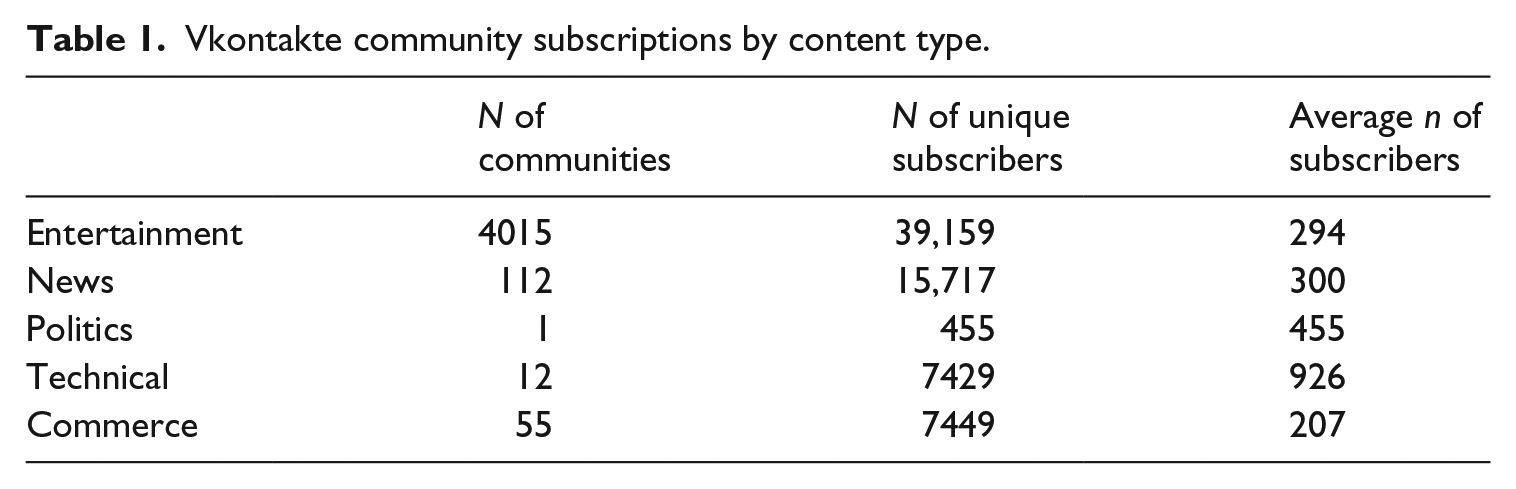
Despite the fact that the number of news communities on Vkontakte is relatively small, our observations also indicate that these communities are rather popular. Approximately 30 per cent of Vkontakte users from our sample subscribed to at least one news community, thus suggesting that these communities are more visible than commerce-oriented or Vkontakte service-oriented ones. In order to identify possible differences between the audiences of these communities, we examined the distribution of self-reported user data according to the type of community. Specifically, we looked at the self-reported gender and age of users together with declared knowledge of the Russian and Ukrainian languages and the region where users live.
As Table 2 indicates, the distribution of demographic variables showed little variance between different types of Vkontakte communities. 4 The only exception is represented by the politics-related communities. However, these distinctions can be attributed to the data bias caused by the presence of only one such community in our sample. For all other types of communities, except Vkontakte service-oriented ones, users reporting their gender as female are prevalent; similarly, in all four cases, the majority of users state that their age is either 30–49 or 18–24 years. Independently of the community type, more than half the users note that they speak only the Ukrainian language, with approximately 40 per cent mentioning both Ukrainian and Russian languages in their profiles. Relatively few users – between 6 and 8 per cent – state that they speak only Russian; such a marginal percentage of Russian-only speakers can be attributed to the increasing number of Russophone Ukrainians switching to the Ukrainian language since the beginning of the conflict in Eastern Ukraine (International Alert, 2017). Surprisingly enough, the number of self-reported bilinguals and Ukrainian-only speakers was also high among the users from Eastern Ukraine, including the ones in the insurgent-controlled areas.
Vkontakte community subscriptions by content type and demographic variables.
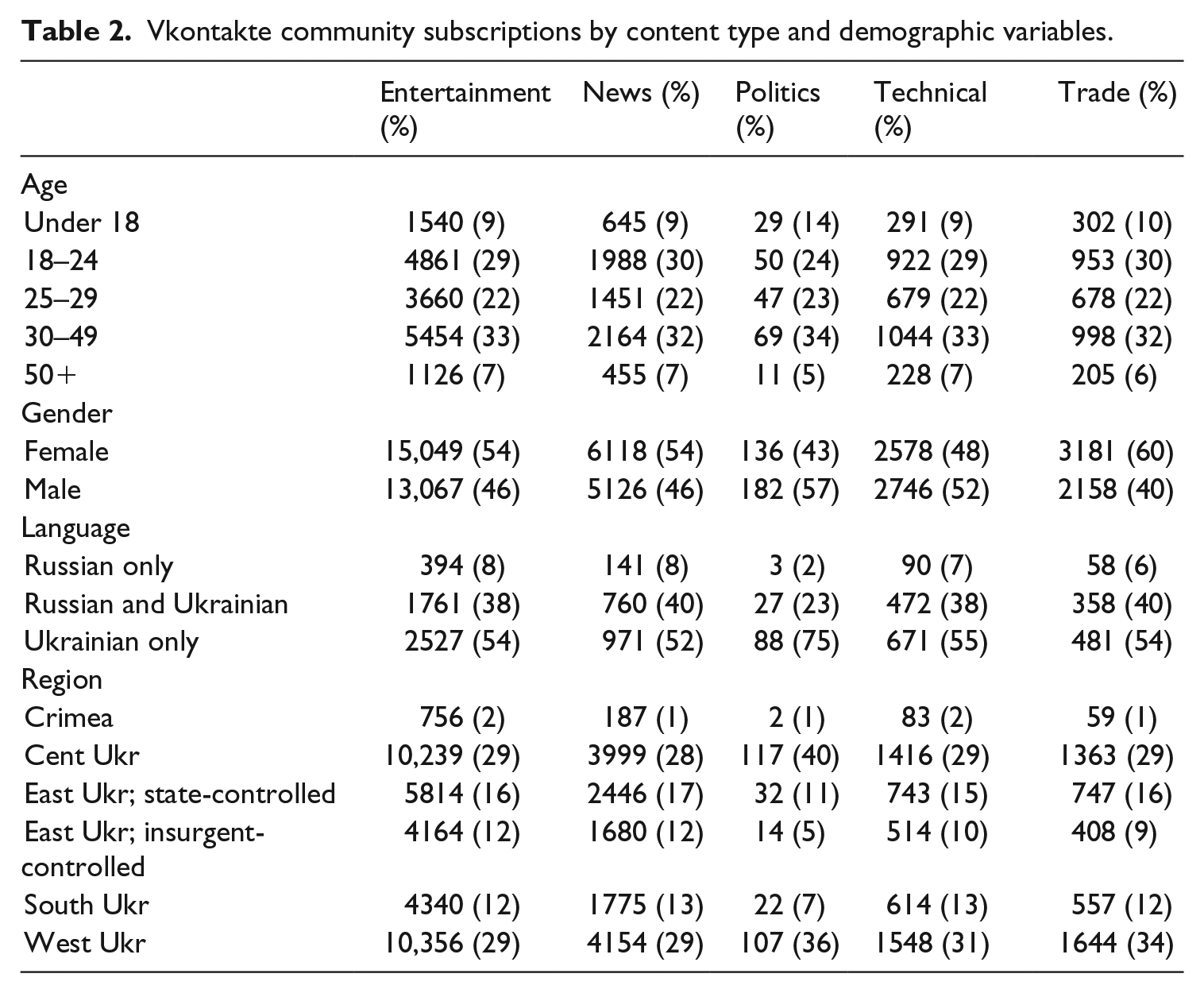
The geographical distribution of users is similarly consistent between community types. In all four cases, the majority of users were either from Central or Western Ukraine; such user distribution reflects the general population trends in Ukraine, where these two regions are the most populous. The number of users from the separatist-controlled parts of Eastern Ukraine and Crimea in our sample was relatively low and varied from 10 per cent to 14 per cent of users who stated where they live in their profiles. In the case of Crimea, the low numbers can be explained by the possibility of changing the attribution of the region to Russia introduced by Vkontakte in 2014. By contrast, the number of users from separatist-controlled parts of Ukraine was higher than we expected based on the population distribution: with approximately three million people living in DNR and LNR, the number of unique subscribers was the same as in the case of Southern Ukraine with roughly six million inhabitants (DSSU, 2017).
Together, our findings suggest that new communities constitute a relatively small part of the Vkontakte media ecologies in terms of community numbers that resonate with earlier studies (De Zuniga et al., 2012; Nielsen and Schrøder, 2014) arguing that the presence of news content on SNSs – as well as its impact on the public sphere – can be overestimated. At the same time, we observe that these communities attract rather significant attention from the users with approximately 30 per cent of all users from our sample being subscribed to news content. Our analysis also did not show significant differences in terms of the demographic/geographic profile of the subscribers to different types of communities: independently of the community type, the majority of Vkontakte users from our sample are Ukrainophone or bilingual speakers who belong to the young (18–24) and middle (30–49) age groups who come primarily from Western and Central Ukraine.
Partisan news content on Vkontakte
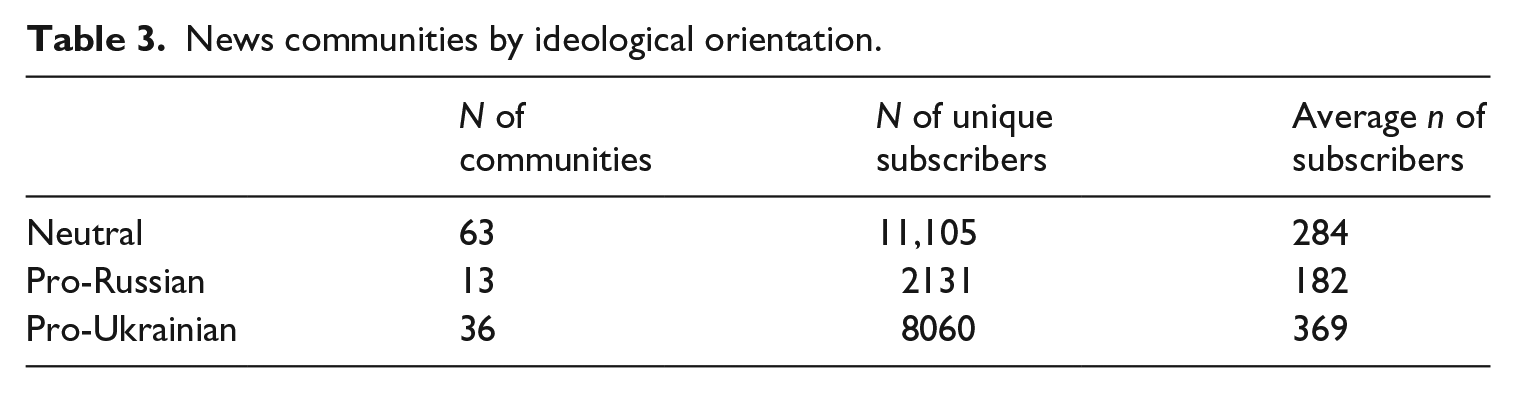
After examining the general place of news content within the Vkontakte media ecology, we moved towards exploring the role of partisan news content. Table 3 summarises the distribution of news communities according to their ideological orientation and the number of user subscriptions. The summary shows that while the majority of news communities promote non-partisan content, around 43 per cent of news communities propagate partisan views. Contrary to the common assumption that Vkontakte is used for spreading pro-Russian propaganda in Ukraine (see, for instance, The Economist, 2017), Table 3 suggests that the majority of partisan news communities to which Ukrainian users subscribe actually have pro-Ukrainian orientation; furthermore, the average number of subscribers is significantly higher for pro-Ukrainian news communities than for pro-Russian ones.
News communities by ideological orientation.
After identifying the distribution of news communities among Ukrainian users, we moved towards examining user subscriptions to news content on Vkontakte using clustering analysis. Specifically, we employed a community detection algorithm by Blondel et al. (2008), which resulted in 17 distinct clusters (modularity = 0.562) as shown in Figure 1. The modularity rating was verified with other community detection algorithms, as, for example, walktrap (Gruzd and Tsyganova, 2015), which produced similar estimates.
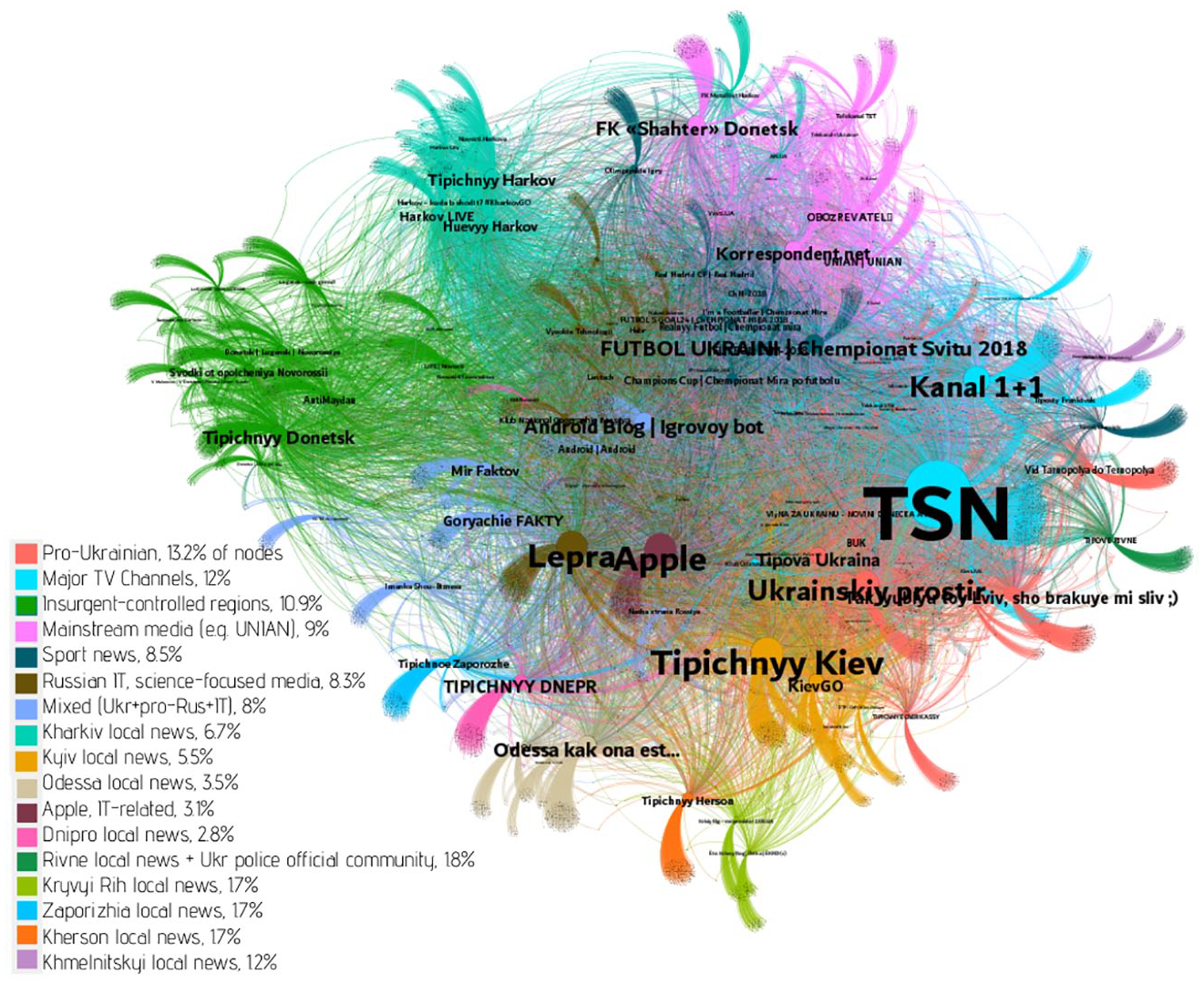
The network of Ukrainian Vkontakte users and the news communities they follow (divided into clusters based on the network topology; the size of the nodes is proportional to the number of followers a community has; network layout is based on the Forced Atlas 2 algorithm (Jacomy et al., 2014).
Our examination of the resulting clusters supports earlier observations by Gruzd and Tsyganova (2015), who found that geography is a strong factor for the modularity classification. Specifically, we identified distinct clusters which united local news communities from the large Ukrainian cities (e.g. Odessa, Kharkiv, Kyiv and Lviv). Similarly, we identified a cluster of Luhansk/Donetsk local news communities; the latter cluster also includes the majority of pro-Russian partisan news communities, which might indicate the geographic focus of these groups.
We observed a similar connection between partisan news communities and regional news communities in the case of the largest cluster of our network, which ties pro-Ukrainian partisan content with Western Ukrainian news communities. We also identified two distinct clusters of communities related to legacy news organisations (e.g. 1 + 1 TV channel and UNIAN news agency); these communities are grouped together, so potentially there might be a gap between the users who mostly subscribe to the legacy media news communities and users who consume news produced by alternative media. Finally, there are a few clusters focused on thematic news (e.g. sport); these clusters are located in the centre of the graph and act as ‘bridges’ between partisan news communities.
The results of the analysis of the audience fragmentation of these news communities based on the audience overlap approach (Webster and Ksiazek, 2012) suggest that news consumption on Vkontakte is characterised by rather high partisanship. As Figure 2 shows, the audience overlap network of news communities is divided into tightly connected modules; using the Louvain community detection algorithm (Blondel et al., 2008), we calculated the modularity of this network, which is equal to 0.412.
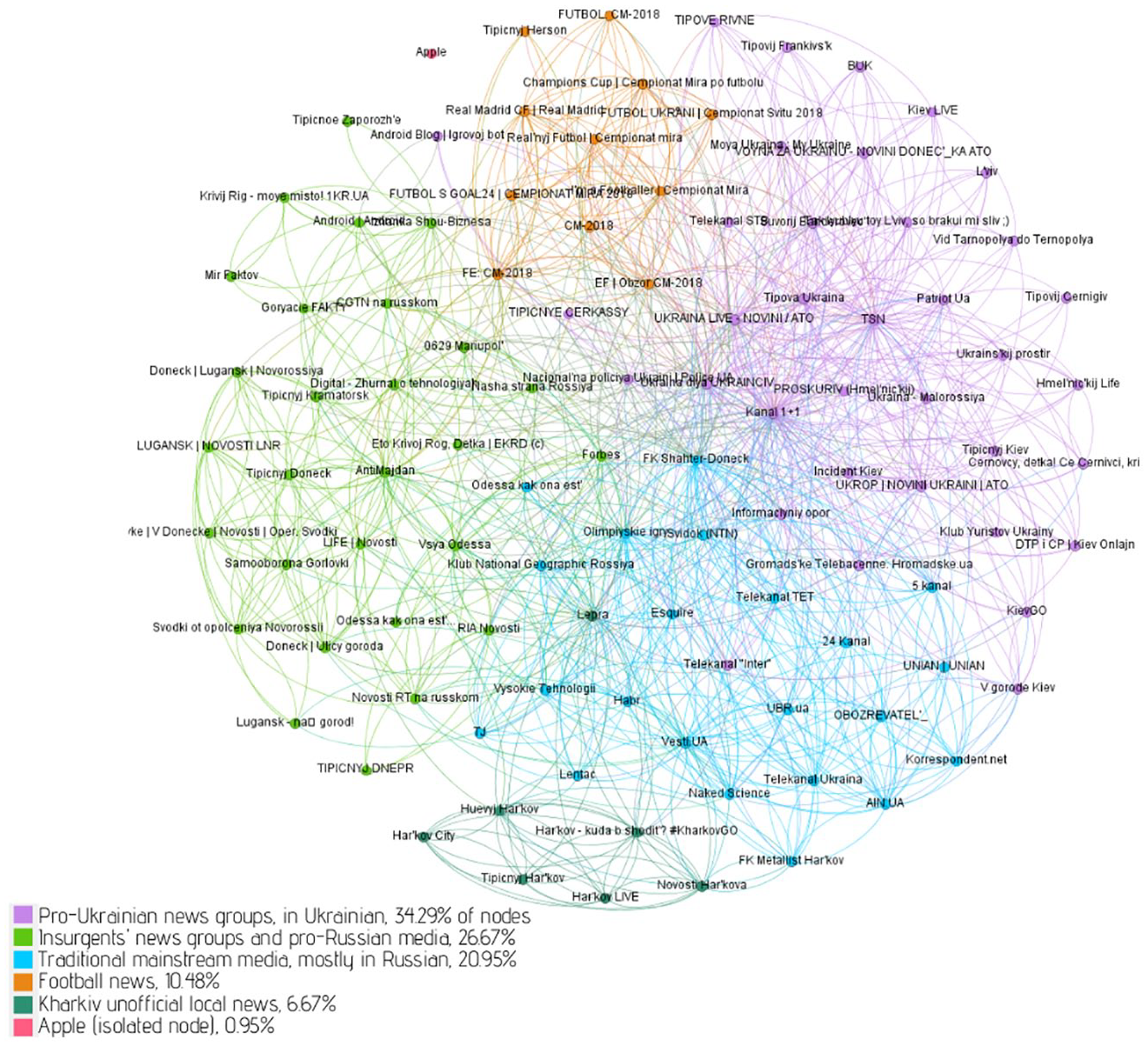
News groups’ audience duplication network.
The resulting graph shows clusters of pro-Russian and pro-Ukrainian partisan news communities located at opposite poles with an in-between cluster of communities related to legacy media outlets as well as some non-partisan news content (e.g. technology and sport). The output of the community detection algorithms other than the Louvain algorithm also emphasises the predominant presence of three major community clusters: pro-Ukrainian, pro-Russian and legacy media. These algorithms produced the following modularity scores: 0.443 for the Girvan-Newman (2002) algorithm and 0.46 for the fast greedy algorithm (Clauset et al., 2004). Similarities in the output of different algorithms prove that our observations concerning the polarisation between the subscribers of the partisan pro-Ukrainian, partisan pro-Russian and traditional media news communities are quite robust.
The findings in this section suggest that partisan news communities constitute less than half of the news communities in our sample. Pro-Ukrainian partisan communities attract more users on average as compared with non-partisan news communities as well as pro-Russian communities, with the latter having a rather marginal position in terms of the number of users from our sample subscribing to this type of communities. We also found that pro-Ukrainian and pro-Russian partisan communities have rather distinct positions within the user-communities network topography and their audiences show very limited overlap, thus contradicting Flaxman et al.’s argument (2016) about SNSs encouraging users’ exposure to views different from their own. A similar gap is present between the subscribers of communities associated with legacy media and alternative media; together, these observations suggest that Vkontakte does indeed enable ideological segregation and that partisan news communities function as isolated ‘echo chambers’ whose subscribers have limited possibilities for experiencing opposing points of view.
Determinants of partisan news consumption
After detecting the low audience overlap between partisan news communities, we looked at the factors which can explain users’ interest in partisan news content. Following earlier studies on partisan news consumption in Ukraine (Duvanova et al., 2016; Gruzd and Tsyganova, 2015), we assumed that the region in which users live can be an influential factor; the importance of this specific variable is connected to the long-term regional divide in the Ukrainian political sphere, where the western parts of the country tended to favour pro-Western politicians, whereas the eastern and southern regions gravitated towards pro-Russian candidates (Clem and Craumer, 2008). Additionally, we considered the self-reported language capabilities of users, their age and gender to see if linguistic and demographic factors influence partisan news consumption.
We used regression analysis to check the statistical significance of the variables mentioned above. We ran two separate logistic regressions to determine which demographic, geographic and linguistic variables can predict subscription to pro-Russian and pro-Ukrainian partisan news communities. As mentioned earlier, after removing all NAs, we were left with 5001 users who provided information about the required variables. Of these users, 2784 subscribed to pro-Ukrainian communities and only 625 to pro-Russian communities. This, along with the earlier observations about the discrepancies between the numbers of pro-Ukrainian and pro-Russian partisan communities (Table 3), puts the widespread statements about the spread of pro-Russian propaganda in Ukraine through Vkontakte (The Economist, 2017) under scrutiny.
The results of the regression analyses are summarised in Tables 4 and 5. We used different predictors for each logistic model: the choice of specific predictors in each case was determined by the level of model fit. We performed likelihood ratio tests and calculated McFadden’s r-squared (McFadden, 1973) to find the best fitting set of predictors. For the model where a subscription to pro-Ukrainian partisan news communities was taken as the dependent variable, the best fitting combination of independent variables was Ukrainian language-speaking (binary), gender (binary) and region of residence (categorical). The latter variable was taken with seven categories. Besides distinguishing between the four regions of Ukraine (West, East, Central and South), we also distinguished between Ukrainian-controlled and separatist-controlled regions in the East and Crimea, which was annexed by Russia in 2014. This division was taken because of the model fit. We also ran models where we did not distinguish between the separatist-controlled and Ukrainian-controlled regions in the East and Crimea, but they had a worse fit to the data. McFadden’s r-squared for the final model is 0.89, which indicates that the model fits the data decently.
Regression analysis results, predicting pro-Ukrainian partisanship.
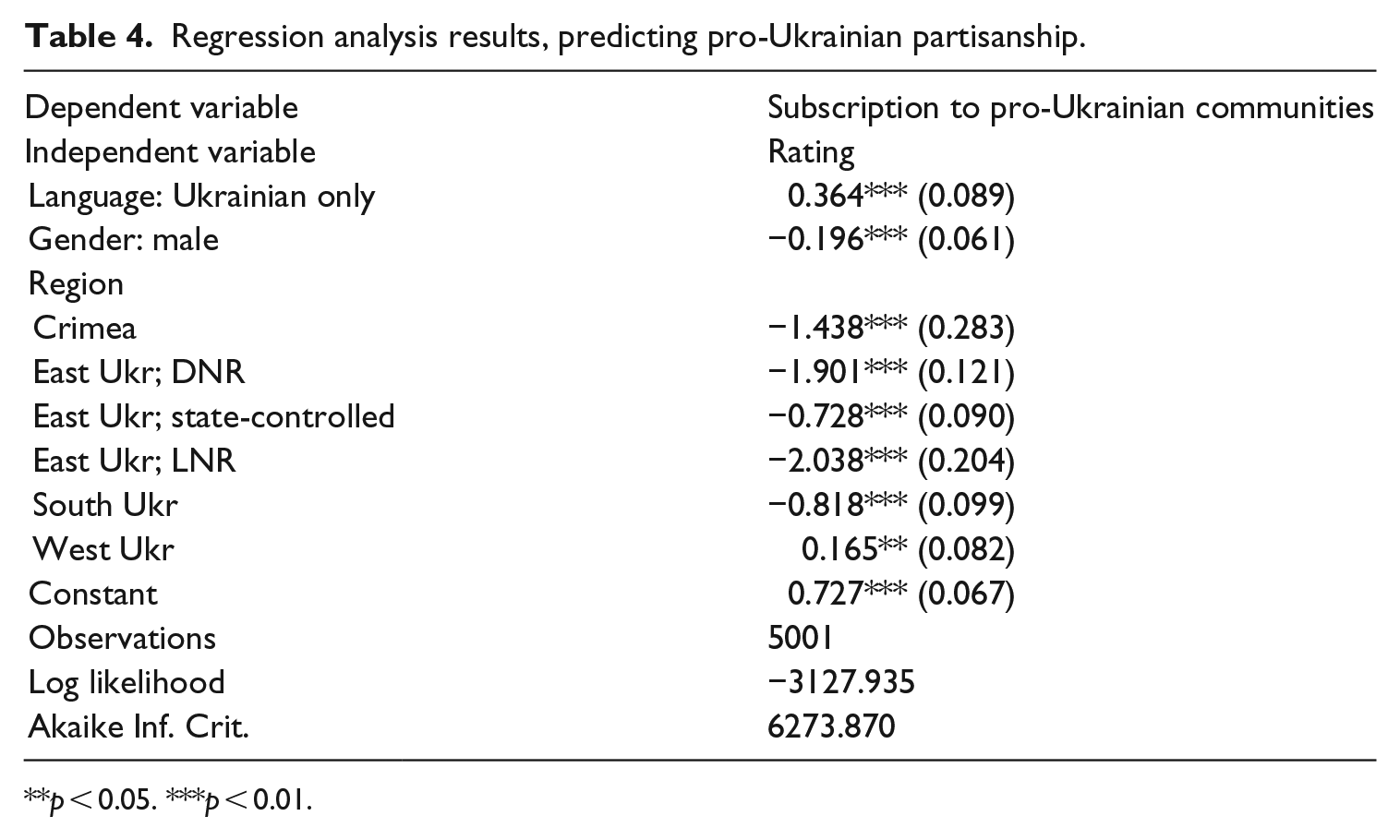
p < 0.05. ***p < 0.01.
Regression analysis results, predicting pro-Russian partisanship.
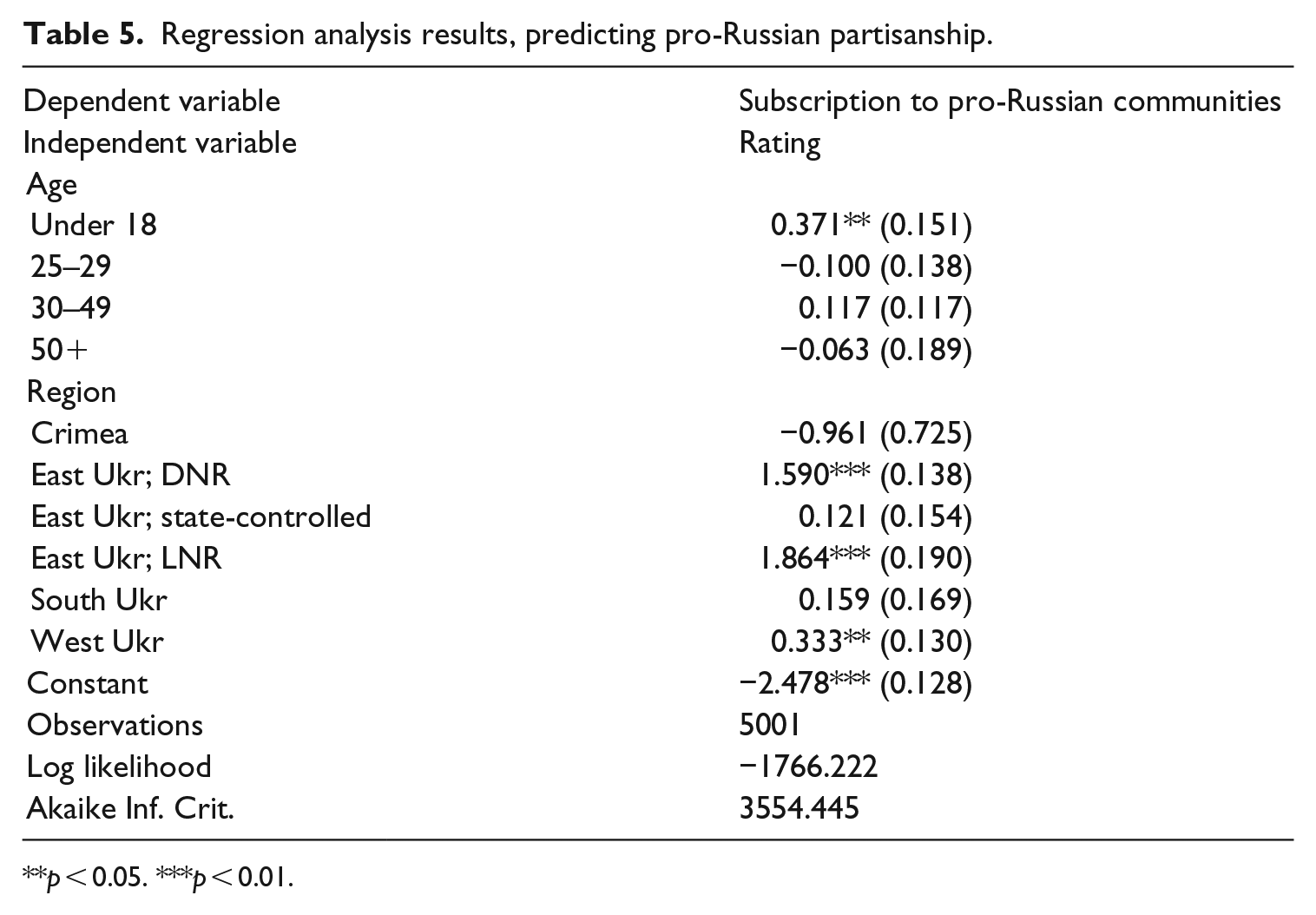
p < 0.05. ***p < 0.01.
Based on the results of the regression analysis, we can state that Ukrainian speakers (i.e. users who declare on Vkontakte that they speak Ukrainian) are more likely to follow pro-Ukrainian partisan communities; similarly, females are more likely to follow pro-Ukrainian communities than males. Finally, as expected, the declared residence in the separatist-controlled regions and Crimea is a very strong negative predictor of subscription to pro-Ukrainian communities. Residence in the Ukraine-controlled eastern regions and in the southern regions is also a strong negative predictor of subscription to pro-Ukrainian communities. The only positive regional predictor of interest in pro-Ukrainian partisan communities is residence in Western Ukraine. This observation supports earlier findings about a strong pro-Ukrainian regional partisanship in the western part of the country (Clem and Craumer, 2008). It also suggests that the online news consumption patterns of users from Western Ukraine are rather different from those of users from other parts of the country, who exhibit less interest in pro-Ukrainian partisan news content.
For the logistic model, where a subscription to pro-Russian partisan communities was taken as a dependent variable, we used age (categorical) and region of residence (categorical, similar to the model for pro-Ukrainian partisanship) as independent variables. The choice, in this case, was also determined by the model fit with the mentioned combination of variables providing the best results with McFadden’s r-squared equal to 0.63. This model did not fit as well as the one for pro-Ukrainian partisanship, but its performance is acceptable since McFadden’s r-squared is still closer to 1 than to 0. The model shows that young people aged less than 18 years are more likely to subscribe to pro-Russian partisan news communities than other age groups. The strongest predictors of interest in pro-Russian communities are, as expected, the declared residence in separatist-controlled regions in Eastern Ukraine. We also found that residence in Western Ukraine is a statistically significant predictor of subscription to pro-Russian communities. This finding might look counterintuitive, considering that the same factor is also a positive predictor of the subscription to pro-Ukrainian communities; however, it can be attributed to the higher partisanship among residents of Western Ukraine as well as possible internal divisions along the political lines. We plan to further investigate this issue in follow-up analysis.
Our findings do not provide support to the argument of Taneja et al. (2018) about the differences in partisan news consumption being attributed to demographic variables (e.g. different age categories). Instead, in the case of Ukrainian SNS users, geographical – in particular, the self-declared region of residence – and linguistic variables seem to be particularly significant, thus supporting earlier findings by Duvanova et al. (2016) about the importance of these variables for political partisanship. These observations suggest that the existing factors of ideological segregation in the case of Ukraine remain highly relevant for partisan news consumption in online spaces.
Conclusions
In our paper, we examined the ideological segregation among Ukrainian users in online news communities using as a case platform Vkontakte, the largest SNS in the post-socialist space. Specifically, we were interested in how significant the presence of (partisan) news content on SNSs is in the case of conflict-ridden societies experiencing transition towards datafied media industries. Additionally, we tried to assess to what degree partisan news communities enhance ideological segregation – that is, whether they entrap users within ‘filter bubbles’ (Pariser, 2011) or ‘echo chambers’ (Sunstein, 2017) – and what are the factors which can predict users’ interests towards partisan news content on SNSs.
Our findings partially align with a series of recent studies (Flaxman et al., 2016; Mukerjee et al., 2018; Zuiderveen Borgesius et al., 2016) which suggest that concerns about the potential of SNSs to undermine shared public agenda are overrated. News communities constitute just a small drop in the digital ocean of entertainment content – even in the case of Ukraine, where SNSs assumingly are a major source of information about the recent developments in the country, in particular in relation to the conflict in Eastern Ukraine.
At the same time, our observations point to the high degree of partisan news consumption on Vkontakte that contradicts the assumption that SNSs encourage exposure to different views, and thus counter ideological segregation (Flaxman et al., 2016). Despite the relatively few number of partisan news communities, almost two-thirds of users interested in online news on Vkontakte subscribe either to pro-Ukrainian or pro-Russian communities; in the former case, the average number of subscribers is higher as compared with non-partisan news communities. Our observations also indicate that the audiences of partisan news communities do not overlap; instead, their subscribers remain in self-chosen ‘echo chambers’ and have limited possibilities to expose themselves to opposing viewpoints. Such a selective exposure to a single ideological view increases ideological segregation and facilitates societal polarisation and potential radicalisation, which is a major concern for the already polarised Ukrainian society.
Finally, our investigation of factors which stimulate user subscription to partisan news content suggests that variables related to existing ideological divides – that is, geography or language-related ones – tend to be the strongest predictors of online partisanship. Unlike other studies (Taneja et al., 2018) which suggest that age tends to be a strong predictor of partisan news consumption online, we did not find evidence suggesting that younger Ukrainian users are more eager to subscribe to partisan news content. Instead, our observations suggest that divisions between news consumers on Vkontakte reproduce – and potentially reinforce – existing ideological divides between the various Ukrainian regions (Duvanova et al., 2015).
It is important to acknowledge the limitations of the study, in particular the use of self-reported user information on Vkontakte. Unlike traditional surveys, we have limited possibilities for verifying if the user’s declared age, gender or language abilities are true. This has limited impact on the detection of user overlap among audiences of partisan news communities; however, it has significant implications for the analysis of factors influencing users’ interest towards partisan content. In future research, we anticipate addressing this limitation by using profile cross-referencing.
Footnotes
Funding
The author(s) received no financial support for the research, authorship, and/or publication of this article.
