



Abstract
We examined whether sharing photos on social networking sites and, in particular, the approach to sharing photos online were associated with internalization of a tanned ideal and appearance comparisons. Adolescents and young adults (N = 587) completed measures of social networking site use, photo activities, internalization, and appearance comparisons. Regular photo-sharers internalized a tanned ideal to a greater extent and reported engaging in more frequent appearance comparisons to people in media than participants who did not regularly share photos online. Internalization was associated with editing photos prior to posting, whereas appearance comparisons were associated with investment, measured as the concern for the quality and effort expended in selecting photos (e.g., carefully selecting a photo, taking a photo specifically for posting) and editing photos prior to posting. Future interventions to reduce the risk of skin cancer should address users’ investment in the quality of photos they share online and the desire to manipulate photos to adhere to appearance ideals.
Skin cancer is the most commonly diagnosed cancer for Caucasian populations worldwide (Lomas, Leonardi-Bee, & Bath-Hextall, 2012). In Australia, melanoma is the most commonly diagnosed cancer for adolescents and young adults (Australian Institute of Health and Welfare [AIHW], 2011), and these groups are particularly at risk because they engage in more risky ultraviolet (UV) radiation exposure than other age groups (Hillhouse & Turrisi, 2005).
Perceived improvements in appearance and increased self-confidence associated with a darker skin tone are often cited as a driving force behind deliberate sun exposure and indoor tanning (Thomas & Peñas, 2017).
The tripartite influence model has been used to predict sun exposure behavior (Mingoia, Hutchinson, & Wilson, 2017) and posits that media norms promoting tanned skin as desirable lead to sun exposure through the internalization of a tanned ideal and promote appearance comparisons. Internalization occurs when media portrayals of events or people are accepted as personal goals and standards against which the self and others are judged (Thompson, Heinberg, Altabe, & Tantleff-Dunn, 1999). Consistent with this model, internalization has been found to predict sun exposure behavior (Mingoia et al., 2017).
Social networking sites (SNSs) have become prominent purveyors of social norms that define aspects of attractiveness and fashion. Facebook (2018), the most popular SNS, boasts over 1 billion daily users who upload over 10 million new photos to the website per hour (Mayer-Schönberger & Cukier, 2013). Adolescents and young adults are the largest consumers of social media, with adolescents in Australia spending over 3 hr per day using SNSs (Mingoia, Hutchinson, Gleaves, Corsini, & Wilson, 2017). Use of SNSs is correlated with factors including skin tone dissatisfaction, more frequent deliberate sun exposure, and less frequent use of sun protection (Mingoia, Hutchinson, Gleaves, et al., 2017); however, less is known about the relationship between SNS use and internalization of a tanned ideal and appearance comparisons.
SNSs allow users to interact with media by means not possible with traditional media, and many authors have argued that it is the appearance-related features on SNSs (e.g., photos that users share and interact with) that are important for body image disturbance (Cohen, Newton-John, & Slater, 2017). The photos that a user posts are critical to their online identity because of the emphasis on self-presentation. The active nature of social media content creates a need to assess specific features of SNS use (Sidani, Shensa, Hoffman, Hanmer, & Primack, 2016). Identifying the conditions that lead to people posting photos online may reveal processes that are associated with appearance concerns related to tanned skin and may, therefore, be suitable targets for online interventions.
One study has found that posting and viewing photos related to tanning on SNSs was associated with deliberate sun exposure and less frequent sun protection (Mingoia, Hutchinson, Gleaves, et al., 2017). Furthermore, the number of photos a user takes of him or herself, known as selfies, and sharing these on SNSs is positively associated with propensity to engage in social comparisons (Chae, 2017). Previous research has shown that regular sharers of selfies on SNSs also report higher internalization of a thin ideal than do users who do not share selfies as often (McLean, Paxton, Wertheim, & Masters, 2015).
Selfies posted on SNSs are used to build and maintain relationships online (Sung, Lee, Kim, & Choi, 2016), and the anticipation of positive reactions from friends or followers can lead to higher intentions to post selfies (Kim, Lee, Sung, & Choi, 2016). In particular, McLean et al. (2015) examined the social media activities related to taking selfies in adolescent girls and found a positive correlation linking the user’s level of photo investment (concern about the quality of their photos and the effort spent in selecting photos to share online) with higher internalization of a thin ideal, body dissatisfaction, overvaluation of shape and weight, and dietary restraint. This finding, in conjunction with other research exploring the nuances of SNS use (e.g., Meier & Gray, 2014) suggest that individuals who interact with photos online and are invested in the photos they share may have a heightened appearance focus that is associated with body image disturbance.
McLean et al. (2015) also assessed a related construct, photo manipulation, defined as the editing of a photo prior to posting it online and found this was also associated with internalization of a thin ideal and body-related concerns. Other research found editing SNS photos to be associated with appearance comparisons (Chae, 2017) with teenage girls describing their editing behavior as a method to gain approval from peers by adhering to beauty ideals (Chua & Chang, 2016). Unlike traditional media, social media are interactive and users have the ability to create content and control the management of their identity online, and as such, their level of investment in their photos and their desire to edit photos may affect the posting behaviors and health choices of that individual. Given the pursuit of tanned skin is theoretically similar to the pursuit for thinness assessed by McLean et al. (2015) and that beauty ideals are commonly portrayed together (Trekels, Eggermont, Koppen, & Vandenbosch, 2017), it is possible that investment in posted photos will be associated with the desire for tanned skin because of the appearance scrutiny applied to these photos.
Previous research indicated that both adolescents (Hutchinson, Prichard, Ettridge, & Wilson, 2015) and young adults are dissatisfied with their skin tone (Prichard, Kneebone, Hutchinson, & Wilson, 2013) and are frequent users of SNSs (Pew Research Center, 2018a, 2018b). Although differences in sun behaviors between adolescents and young adults have been assessed (Dobbinson et al., 2008), these differences have not been investigated in relation to SNS activities. There is evidence to suggest SNS use is correlated with sun exposure in adolescents (Mingoia, Hutchinson, Gleaves, et al., 2017); however, health interventions utilizing social media typically address adult samples (Maher et al., 2014) and the generalisability of the findings to a younger cohort remains to be addressed. Similarly, there is a paucity of data pertaining to gender differences in the relationships between SNS use and health behaviors. Interventions designed to address sun exposure or sun protection typically utilize female samples (e.g., Mingoia, Hutchinson, Gleaves, & Wilson, 2018) because other research has indicated that females deliberately tan more than males and use SNS more often than males. However, tanned skin is also a component of the ideal male appearance, and one study reported no significant difference in level of internalization of a tanned ideal between genders (Mingoia et al., 2017). Consequently, an aim of the present study was to analyze how SNS use differs among adolescents and young adults, as well as between males and females to determine how this usage relates to internalization of a tanned ideal and appearance comparisons. A better understanding of potential differences will enable the design of age and gender appropriate interventions.
The primary aim of the present study was to determine if the photo activities of SNS users, and in particular, the approach to sharing photos online were associated with internalization of a tanned ideal and appearance comparisons in relation to tanning among adolescents and young adults. We hypothesized that (a) SNS users who regularly share photos would internalize a tanned ideal to a greater extent and report engagement in more frequent appearance comparisons than SNS users who do not regularly share photos and (b) that photo investment and manipulation would be positively associated with internalization of a tanned ideal and appearance comparisons among SNS users who regularly share photos.
Method
Participants
A total of 587 participants completed the present study. Participants were 145 males and 442 females aged between 12 and 29 years (M = 21.68, SD = 6.07). There were 146 adolescents (aged 12–17; 31 males and 114 females) and 441 young adults (aged 18–29; 115 males and 327 females) in the study. The age range for young adulthood was consistent with previous cancer (AIHW, 2011) and social media research (Farber & Nitzburg, 2016). Participants represented low (29.8%), average (63.5%), and high (6.6%) socio-economic status, as well as rural (19.3%), city (51.6%), and coastal (29.1%) areas. Participants were Caucasian because this group presents the highest risk for skin cancer development and those most likely to actively seek tanned skin (Geller et al., 2002). Other ethnicities were allowed to participate; however, these data are not presented. Participants with a Fitzpatrick skin type of V and VI (n = 7) rarely develop skin cancers and were therefore excluded from further data analyses (Kennedy, Bajdik, Willemze, de Gruijl, & Bavinck, 2003). Participants with a reported history of skin cancer (n = 29) were excluded because this group engages in significantly lower sun exposure following diagnosis (Falk, Faresjo, & Faresjo, 2013).
Measures
Demographic Information
All participants were asked to indicate their age, gender, ethnicity, postcode (to determine socioeconomic status and region information), and history of skin cancer.
Fitzpatrick Skin Type
Participant skin type was assessed with the Fitzpatrick (1988) Skin Type Scale. The scale consists of 10 items that measure susceptibility to sunburn based on self-reported sun exposure behavior and sunburn history. An example item is, “How does your face react to the sun?” Participants responded on a 5-point scale from 0 to 4. A total score is calculated and corresponded to a Fitzpatrick (1988) skin type ranging from I (very fair; always burns and never tans) to VI (dark brown/Black; never burns always tans). Scores on the scale have good indices of validity and internal consistency for scores in the present study was α = .72.
SNS Use
Participants indicated how many minutes per day, on average, they had spent using SNSs in the past 14 days. Participants also indicated SNSs they had used in the past 14 days.
Photo Activities on SNSs
Photo activities on SNSs were assessed with the Photo Activities scale (McLean et al., 2015). This consists of three subscales: selfie taking and sharing (4 items), photo investment (8 items), and photo manipulation (11 items). One item was added to the photo manipulation subscale, “How often do you edit or use apps to darken your tan” to measure tanning specific photo activity.
Four items assessed selfie taking and sharing. Participants responded to the two selfie-taking items on an 8-point scale, ranging from 1, less than once a month, to 8, more than twice a day, and responded to the two selfie-sharing items on a 5-point scale, ranging from 1, never, to 5, always. One sharing item was reverse scored and a summated mean of the 4 items was calculated. Scores ranged between 1 and 6.5 with a high score indicating a higher frequency of taking and sharing photos on SNSs.
Participants responded to the photo investment subscale on a visual analog scale, ranging from 0 to 100 and were anchored by opposing statements such as, “I don’t take any notice of how many ‘Likes’ my photos get” and “I take notice of how many ‘Likes’ my photos get.” Three items were reverse scored and a summated mean was calculated. Scores ranged between 0.4 and 100 with a high score indicating more photo investment, that is, concern for whether other users will “like” their photos and more difficulty in selecting photos to post online.
Participants responded to the photo manipulation subscale on 5-point scale, ranging from 1, never, to 5, always. A summated mean was calculated and scores ranged between 1 and 4.64 with high scores indicating more frequent manipulation of photos prior to posting them online. An example item from the selfie taking and sharing subscale is, “Do you post photos of yourself online or share them through services like ‘Snapchat’ or ‘Instagram’?” McLean et al. (2015) reported high internal consistency for the subscale scores with alphas ranging from 0.82 to 0.86, and good to excellent test-rest reliability ranging from r = .74 to r = .96. Internal consistency in the current study ranged from α = 0.73 for the photo investment subscale, α = 0.77 for the selfie taking and sharing subscale, to α = 0.86 for the photo manipulation subscale.
Internalization of a Tanned Ideal
Internalization of a tanned ideal was measured using a modified version of the Skin Tone Rating Scale (Prichard et al., 2013) consistent with other tripartite model and tanning research (Mingoia et al., 2017). The modified version presented 12 male and 12 female figures featuring increasing levels of tanned skin tone from very pale to very tanned. The scale utilized was matched according to participant gender. Respondents are asked to select the figure best representing their ideal skin tone. Scores range from 1, lightest skin tone, to 12, darkest skin tone. A high score on the item indicated higher endorsement of a tanned ideal. Prichard et al. (2013) reported good test—retest reliability (r = .85) for scores on the scale.
Appearance Comparisons
Appearance comparisons to people viewed in media were assessed with a modified version of the 5-item Physical Appearance Comparison Scale (PACS) (Thompson, Heinberg, & Tantleff-Dunn, 1991). Participants responded on a 5-point scale from 1 = never to 5 = always. A mean was calculated and scores ranged from 1 to 4.6, with higher scores indicating higher frequency of appearance comparisons. Given the focus of comparisons during media use rather than social situations, three of the items were modified in line with previous SNS research (e.g., Fardouly & Vartanian, 2015) to state, “when using media (e.g., watching a film or using a social networking site)” instead of “in social situations.” An example item is, “When using media, I compare my physical appearance to the physical appearance of others.” Given the focus on skin tone rather than weight, two were modified to state, “I sometimes compare my tan to the tan of other people” instead of “I sometimes compare my figure to the figures of other people” and “When using media (e.g., watching a film or using a social networking site), I sometimes compare my tan to the tan of other people.” Schutz, Paxton, and Wertheim (2002) reported high internal consistency (α = .89) for scores on the PACS. Internal consistency in the current study was α = .64.
Sun Exposure
Sun exposure was assessed with two standardized core items from the Sun Habits Scale. This scale assesses sun exposure on weekdays and weekend days during summer (Glanz et al., 2008). Participants indicated the average number of hours spent outside per day between 10 am and 4 pm on weekdays and weekends during summer. They responded to each item on a 7-point scale, ranging from 30 min or less to 6 hr. An average daily sun exposure score ranging from 1 to 7 was generated by combining and weighting weekday and weekend scores ([5 × weekday sun exposure] + [2 x weekend sun exposure])/7, with higher scores indicating more frequent sun exposure. Cohen, Brown, Haukness, Walsh, and Robinson (2013) reported high internal consistency (α = .79) for scores on the Sun Habits Scale. Internal consistency in the current study was α = .77.
Procedure
Adolescents were recruited from secondary schools across Australia, randomly selected to cover all school sectors (i.e., Government, Catholic, and Independent) and a range of levels of socio-economic status, as indicated by the schools’ Index of Relative Socio-Economic Disadvantage (based on postcode; Australian Bureau of Statistics, 2013). Following application to the required ethics committees, Government Education Departments, Catholic, and the Independent Education systems all provided approval for this study. To recruit adolescents, letters were then sent to secondary school principals who forwarded parental information letters and consent forms home with the students. The adolescent participants also indicated participation consent.
Young adults were recruited from hard copy and online advertisements in randomly selected universities across Australia. Data collection was completed online and took approximately 20 min. Young adults completed the survey at the location of their choosing, and adolescents completed the survey under the supervision of teachers in class-time using school computer laboratories or through the use of personal laptops. Participation was confidential and data were collated and stored through online software. Young adults could provide an email address to be entered into a draw to win a $100 VISA debit card. This information was stored separately to the survey responses. Data were collected in February, November, and December 2016 (summer in the southern hemisphere).
Data Analyses
Data were analyzed using Statistical Package for the Social Sciences (SPSS) version 21. Hypothesis 1, that regular photo-sharers on SNSs would internalize a tanned ideal to a greater extent and report engagement in more frequent appearance comparisons than SNS users, who do not regularly share photos was assessed with independent samples t-tests. Participants who shared photos of themselves online at least sometimes (i.e., a score on the selfie-sharing items indicating photo sharing sometimes, often, or always) were identified as regular photo-sharers and included in the regression analyses. Multiple regression analyses were conducted to test hypothesis 2 that, among SNS users who regularly share photos, photo investment, and manipulation would be positively associated with internalization of a tanned ideal and appearance comparisons. Participant gender, skin type, and SNS use were included as control variables in the regression models because of statistically significant associations with the outcome variables (see Table 2). Independent samples t-tests were also used to assess differences between adolescents and young adults, as well as between males and females on key variables. Outliers were present for the independent samples t-tests; however, the analyses were run with and without the outliers and the significance testing was not affected, therefore the original data are presented. Extreme responses of SNS use over 720 min (12 hr per day) were transformed to 720 min (6%, n = 40).
Results
Characteristics of the Sample
The most common skin type was III (43.1%) on the Fitzpatrick Scale. Table 1 presents the average time adolescents and young adults spent using SNSs each day, and Table 2 presents bivariate correlations among key variables. The most commonly used SNSs were Facebook (84.8%), YouTube (82.6%), SnapChat (71.2%), and Instagram (66.8%). In the sample of participants who reported being regular photo-sharers, a total of 95.7% admitted to having edited a photo prior to posting to a SNS on at least one occasion. The most common editing technique was using filters (85.7%), and 23.1% reported using editing techniques to darken skin tone on at least one occasion. Overall, participants reported an average of 2 hr of sun exposure per day during peak UV hours across the week; however, sun exposure was significantly higher on weekends (M = 3.88, SD = 1.66) than weekdays (M = 2.99, SD = 1.44), t(586) = 15.13, p < .001, d = .60.
Descriptive Statistics and t-Tests for Differences in Age and Gender in Australian Adolescents and Young Adults.

Note. Sun exposure per day during peak UV radiation hours.
SNS = social networking site; M = mean; SD = standard deviation; CI = confidence intervals; UV = ultraviolet.
SNS use in minutes. df = degrees of freedom adjusted for heterogeneity of variances. d = Cohen’s d. 95% CI = 95% bias-corrected and accelerated upper and lower confidence intervals. Adolescent n = 146, young adult n = 441. Male n = 145, female n = 442.
Bivariate Correlations Linking Key Variables.
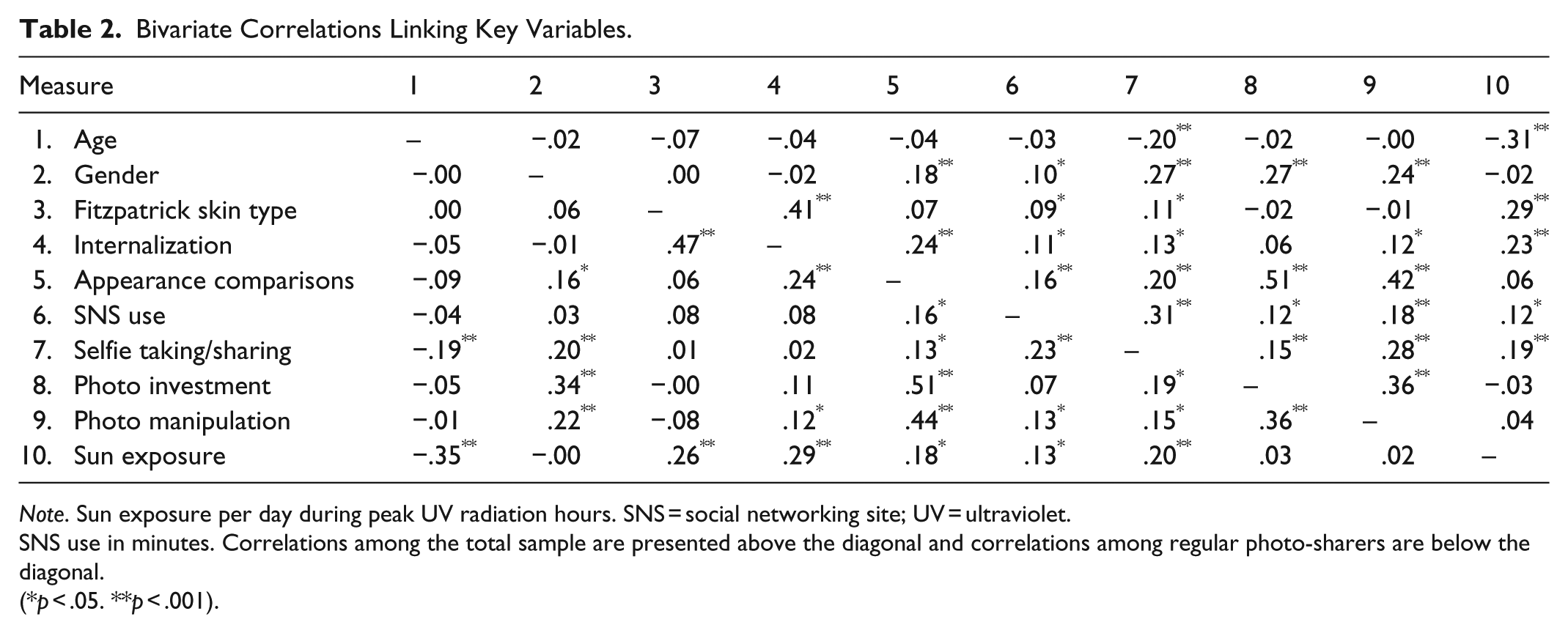
Note. Sun exposure per day during peak UV radiation hours. SNS = social networking site; UV = ultraviolet.
SNS use in minutes. Correlations among the total sample are presented above the diagonal and correlations among regular photo-sharers are below the diagonal.
(*p < .05. **p < .001).
Age Differences
Adolescents reported significantly more sun exposure than young adults; approximately 1 hr more per day (see Table 1). They also reported taking and sharing significantly more “selfies” (i.e., self-photos) on SNSs. The effect size was small according to Cohen (1992). There were no statistically significant differences between adolescents and young adults on internalization of a tanned ideal or appearance comparisons to media, nor were there significant differences in SNS use, photo investment, or photo manipulation.
Gender Differences
Females reported significantly more use of SNSs and more frequent appearance comparisons to people viewed in media than males. Females also reported taking and sharing more selfies, being more invested in their selfies, and editing their selfies more often than males (see Table 1). Effect sizes ranged from small to medium.
Associations Linking SNS Use, Internalization, and Appearance Comparisons
In support of hypothesis 1, SNS use was positively correlated with internalization of a tanned ideal and appearance comparisons to people viewed in media. The number of selfies that adolescents and young adults reported taking and sharing on SNSs was also positively correlated with internalization of a tanned ideal and appearance comparisons. Appearance comparisons were positively correlated with photo investment and manipulation. Internalization of a tanned ideal was positively correlated with editing of photographs before posting online. Effect sizes were mostly small to medium (see Table 2).
The Approach to Photo Sharing Among Regular Photo-Sharers
As predicted, regular photo-sharers, defined as participants who shared selfies at least sometimes, reported significantly greater internalization of a tanned ideal; t(585) = –4.13, p < .001, 95% confidence interval (CI) = [–107.67, –45.27], d = 0.35; more frequent appearance comparisons, t(585) = –3.45, p < .001, 95% CI = [–0.30, –0.08], d = 0.23; more time in SNS use t(585) = –4.81, p < .001, 95% CI = [–107.67, –45.27], d = 0.40; and more sun exposure, t(585) = –3.18, p = .003, 95% CI = [–0.59, –0.14], d = 0.27, than those who did not regularly share photos.
A multiple regression was conducted to determine if individual differences in attitude and approach to sharing photos on SNSs (i.e., photo investment and manipulation) were associated with internalization of a tanned ideal. The regression model was statistically significant, F(5, 316) = 21.63, p < .001; R2 = .25, adjusted R2 = .24. Skin type was positively associated with internalization. In support of hypothesis 2, manipulation of photos prior to posting online was significantly and positively associated with internalization of a tanned ideal; however, the level of investment in these photos and time spent using SNSs were not significantly associated with internalization of a tanned ideal (see Table 3).
Multiple Regression Analyses Linking the Approach to Photo Sharing on SNS With Internalization of a Tanned Ideal and Appearance Comparisons.

SNS = social networking site.
SNS use in minutes. β = standardized coefficients. N = 322.
A separate multiple regression analysis was also performed to determine photo investment and manipulation were associated with appearance comparisons to people in media. A significant regression equation was found, F(5, 316) = 34.78, p = < .001; R2 = .36, adjusted R2 = .35. As predicted, there were significant and positive relationships linking appearance comparisons with SNS use, photo investment, and photo manipulation (see Table 3).
Discussion
The purpose of the present study was to examine the associations linking SNS use, photo investment, and photo manipulation with internalization of a tanned ideal and appearance comparisons among adolescents and young adults. Regular photo-sharers reported more sun exposure, internalization, and appearance comparisons to people in media than SNS users who did not regularly share photos. Furthermore, photo investment and manipulation were positively associated with internalization of a tanned ideal and engagement in appearance comparisons.
The associations linking SNS use and the desire for tanned skin in the present study were consistent with previous research on SNS use and tanning outcomes (Mingoia, Hutchinson, Gleaves, et al., 2017), as well as the application of the tripartite model to tanning (Mingoia, Hutchinson, & Wilson, 2017). The tripartite model proposes that exposure to media messages conveying an ideal appearance can lead to the internalization of this ideal and the engagement in appearance comparisons based on this ideal. The associations in the present study indicated that not only is the exposure to these messages on SNS an important consideration in the desire for tanned skin, but photo editing and investment may also contribute to the development or maintenance of internalization of a tanned ideal and comparisons based on appearance.
Although adolescents reported more time in the sun during peak UV hours, adolescents and young adults internalized a tanned ideal and reported appearance comparisons to the same extent. It is possible that these factors remain constant across the two age groups because both groups are high consumers of media and subject to pressure that confirms appearance as a determining factor of self-worth and popularity (Harter, 2000; Patrick, Neighbors, & Knee, 2004). Other research has reported similar results, with no difference found in internalization of a thin ideal between adolescents and adults (Grabe, Ward, & Hyde, 2008). Given that there was no difference in SNS use, internalization of a tanned ideal, nor appearance comparisons, it is possible that the lower rate of sun exposure in young adults may be a function of lifestyle constraints rather than attitudinal differences. Young adults may be engaged in work duties during peak hours of UV radiation, which precludes their ability to sun expose. This may also indicate why weekend sun exposure was significantly higher than weekday sun exposure.
We also found no difference in internalization of a tanned ideal between genders, a finding consistent with other research (Mingoia et al., 2017) and that confirms tanned skin is an important component of the ideal appearance among males and females. However, future interventions should address SNS use by females, who shared photos more often and reported greater levels of investment and manipulation than males. Females may feel more pressure to edit their photos because they are subjected to greater peer scrutiny than males about their appearance. The online SNS environment may heighten this scrutiny, with de Vries, Peter, de Graaf, and Nikken (2016) reporting that SNS use predicted peer appearance-related feedback. Furthermore, females in that study experienced more peer appearance-related feedback than males.
We found that the number of photos that a user takes and shares on SNSs appears to be an associated risk factor for internalization and comparisons. Photo-sharing on SNSs had stronger associations with these factors than overall use of SNSs, consistent with other research that found posting photos related to tanning on SNSs was associated with deliberate sun exposure (Mingoia, Hutchinson, Gleaves, et al., 2017). SNS users experience pressure based on their appearance online and more frequent use of SNSs predicts increased investment in appearance (de Vries, Peter, Nikken, & de Graaf, 2014). Higher investment in appearance can result in greater appearance comparisons following exposure to idealized media (Hargreaves & Tiggemann, 2004), with SNSs offering users prolific opportunities for social comparison (Vogel, Rose, Roberts, & Eckles, 2014).
We found a large association between a user’s level of photo investment and propensity to engage in appearance comparisons. This may indicate that users who are highly invested in the outcome of the photos they post online and take longer to select these photos because of comparisons being made with others’ appearance. Comparisons made to others on SNSs are associated with lower appearance satisfaction and lower positive mood than comparisons made in person (Fardouly, Pinkus, & Vartanian, 2017). SNSs provide an ideal platform for individuals with a contingent self-worth based upon appearance to seek feedback and comparisons as validation of their self-worth from others (Crocker, 2002; Patrick et al., 2004). Further research is needed to determine if this may result in a higher level of investment in their uploaded photos.
Furthermore, photo manipulation was associated with internalization of a tanned ideal and appearance comparisons. Given the positive expectancies associated with tanning in media, and the observation that models on SNSs are often likeminded peers, SNS users may be digitally editing their photos in an attempt to create an idealized portrayal of the self. This constructed self-image is therefore one that maximizes attractiveness and adheres to the unrealistic ideals defining beauty held by similar peers. Although adolescents and young adults understand the risk of tanning, the emotional desirability of tanned skin portrayed by people on SNSs in the form of likes, feedback, and attractiveness may override the processing of health messages.
Interventions to reduce internalization of a tanned ideal and appearance comparisons among adolescents and young adults should target regular photo-sharers on SNSs and address the relationship between the approach to sharing photos with internalization of a tanned ideal and appearance comparisons. Online interventions may be promising because of the extended reach of SNSs to at-risk populations. Mingoia et al. (2018) pilot tested a media literacy intervention on Facebook to address the disparity between the perceived expectations of enhanced worth associated with tanned photos shared on SNSs compared with the realistic outcomes of sun damage. Participants reported decreased positive attitudes to tanning following the intervention, as well as less internalization, appearance comparisons, and tanning intentions at post-test compared with a wait-list control group. Future social media literacy interventions could also aim to reduce the level of investment users place on the photos they share online by reducing the perception that self-worth is determined by feedback on SNSs.
The present study was not without limitations. Data were mainly collected from female participants and were cross-sectional, preventing inferences of causation or directionality. It is possible that people with high appearance concerns both tan and engage in SNS use or that the relationship linking SNS use and sun exposure could occur in reverse, such that individuals who frequently tan are drawn to using SNSs. However, the results were consistent with experimental research that found exposure to images of models with tanned skin resulted in more positive attitudes toward tanning than participants who viewed images of models with pale skin (Mahler, Beckerley, & Vogel, 2010). Future experimental research is needed to confirm the correlational findings between SNS use and the outcomes presented in this study.
The higher number of female respondents compared with males may have contributed to the significance of gender differences reported in the present study; however, these findings were consistent with those taken from a representative sample of Australian adolescents (Mingoia, Hutchinson, Gleaves, et al., 2017). Future research should aim to recruit more representative samples of both adolescents and young adults to confirm the age and gender differences found in the present study. Furthermore, appearance comparisons were measured by reference to people in the general media, broadly defined, rather than to people specifically viewed on SNSs and not all items were specific to tanned skin. Given the nuance of SNS use compared with traditional media, it is recommended that future research measure comparisons specifically toward photos on SNSs.
In summary, regularly sharing photos on SNSs and the approach to sharing photos online were associated with internalization of a tanned ideal, appearance comparisons, and sun exposure. Adolescents were more likely to take and share photos on SNSs compared to young adults, and females were more invested in their photos and edited these photos more often than males. Future interventions to reduce skin cancer and the desire for tanned skin must target SNS users who regularly share photos online and aim to reduce the level of investment that these users place on the images they post online, as well as the perceived need to edit these photos.
Footnotes
Acknowledgements
We would like to acknowledge the cooperation of the Department for Education and Child Development South Australia, Department of Education and Training Victoria, NSW Department of Education, Catholic Education South Australia, Canberra and Goulburn Catholic Education Office, Catholic Education Diocese of Rockhampton, Catholic Education Melbourne, Catholic Education Western Australia, Brisbane Catholic Education, particularly their Research Committee, and the staff and students of the schools involved in the research project. This work was supported by the Commonwealth Government funding the first author received under the Research Training Program (RTP).
Declaration of Conflicting Interests
The author(s) declared no potential conflicts of interest with respect to the research, authorship, and/or publication of this article.
Funding
The author(s) received no financial support for the research, authorship, and/or publication of this article.
