




Abstract
Recent studies have explored how the US public responded to the March for Science protests that took place around the world on April 22, 2017, as well as why individuals participated in these protests. Yet, little research has examined how participants used social media and other channels to learn, communicate, and form behavioral intentions regarding the movement. In addressing these questions, the present study conceptualizes the March for Science as a “networked protest.” It then analyzes data from two surveys: one distributed through social media in the month preceding the March for Science events, and one conducted at the Washington, DC event. The results suggest that social media—particularly Facebook—played key roles in how respondents learned and communicated about the protest. At the same time, respondents also learned and communicated about it through other channels, including texting, email, and face-to-face conversations. Both social media respondents and in-person respondents reported that their experiences with the March had increased their likelihood of undertaking future online and offline actions. Furthermore, communicating through Facebook and Twitter predicted a range of self-reported effects of March experiences on intentions to undertake future actions, whereas learning through social media largely failed to do so. Thus, some—but not all—social media uses may have encouraged participants to sustain both online and offline engagement. Taken together, the findings carry potential implications for how the March for Science and other networked protests can use social media and other communication forms to mobilize supporters and facilitate long-term engagement.
In January 2017, a user on the social media site reddit posted a link to a news story about how the administration of the newly inaugurated US President Donald Trump had deleted all references to climate change from the White House website. In response, a second user wrote, “There needs to be a Scientists’ March on Washington.” This comment prompted other readers to create a Facebook page for just such a march. Within 4 months, the page had received more than half a million likes (Guarino, 2017). A Twitter account and website followed, along with hundreds of other social media sites devoted to planning events in cities around the world. On April 22, 2017, more than one million people participated in more than 600 March for Science events across the globe (Yong, 2017b). Even before these events took place, the developments surrounding them drew extensive media coverage and prompted considerable debate both inside and outside the scientific community (Yong, 2017c). Afterwards, organizers and participants worked to sustain their science-related advocacy in local, national, and global arenas (Matacic, 2017; Yong, 2017b).
Previous research has examined how the US public responded to the March for Science, finding that reactions split along party lines (Funk & Rainie, 2017). In addition, studies have explored what reasons drove March participants to support the movement, finding a mix of pro-science and anti-Trump motivations (Newman, 2017; Travis, 2017; Yong, 2017c). However, little research to date has examined how participants used social media to learn and communicate about the March, or how such uses shaped participants’ intentions to undertake future actions. Studying these topics is important given the role that social media played in facilitating the March for Science’s rapid transformation from a few informal conversations to a coordinated series of global protest events several months later. Addressing these questions also provides an opportunity to illuminate our understanding of how individuals use social media to participate in “networked protests” (Tufekci, 2017), especially given the “fragility” of such protests when it comes to their capacity to sustain political momentum and effect substantive change over time. Furthermore, our study offers a new context in which to extend previous research on how social media use predicts participation in protest movements (Macafee & De Simone, 2012; Tufekci & Wilson, 2012; Valenzuela, 2013; Valenzuela, Arriagada, & Scherman, 2012).
To these ends, the present study analyzes data from two surveys: one distributed through social media in the month preceding the March for Science, and one conducted at the Washington, DC March for Science event. First, it looks at what role social media and other communication channels played in how participants learned and communicated about the March. Next, it examines self-reported effects of engaging with the March on intentions to undertake a range of future online and offline actions. Finally, it analyzes how learning and communicating about the March for Science through social media predicted self-reported effects on pursuing different sorts of future actions.
The March for Science as a Networked Protest
According to Tufekci (2017), networked protests constitute a new form of citizen-driven political activism in which social media platforms, particularly Facebook and Twitter, play integral roles in helping to organize and mobilize large-scale actions, both online and offline. Although citizen-driven political protest is not a new phenomenon, the increasingly pervasive use of social media by citizens around the world provides low-cost tools for swiftly organizing and raising awareness about offline mass protests events (Tufekci, 2017; Tufekci & Wilson, 2012 see also Papacharissi, 2015). Citizens can now take “transmediated” approaches (Costanza-Chock, 2014) to protests through the creative and integrated use of social media platforms and other participatory media—often in conjunction with traditional media and face-to-face efforts—to organize actions and events. They can also use social media to shape public narratives regarding their reasons for protesting, signal their “capacity,” and garner media coverage from more established news outlets (Tufekci, 2017). Thus, networked protests produce a “choreography of assembly” for collective action in which social media “must be understood as complementing existing forms of face-to-face gatherings . . . but also as a vehicle for the creation of new forms of proximity and face-face interaction” (Gerbaudo, 2012, pp. 12-13).
In the same account, Tufekci (2017) highlights how the characteristics of these protests that make them so effective for quickly mobilizing mass protests may not be as well suited for sustaining longer-term activism. Such protests tend to emerge as immediate reactions against perceived wrongs rather than as vehicles for promoting well developed political visions and plans for change. In addition, the decentralized power structure of networked protests can make it difficult for them to cultivate the organized and institutional leadership typically needed to sustain a movement and make substantive gains over time.
Much of Tufekci’s research on networked protests focuses on the Arab Spring (2017; Tufekci & Wilson, 2012), as does a body of related research (Alaimo, 2015; Gerbaudo, 2012; Kamel, 2014; Murthy, 2018). Other examples of such protests from the past decade include the Iranian Green Movement (Kamalipour, 2010; Shirazi, 2012), the Tea Party Movement (Rohlinger & Bunnage, 2015, 2017; Tufekci, 2017), the 2010 G20 protests (Poell, 2014), the Occupy movement (Gerbaudo, 2012; Kavada, 2015; Penney & Dadas, 2014; Tufekci, 2017), Black Lives Matter (Carney, 2016; Cowart, Saunders, & Blackstone, 2016; Murthy, 2018; Tufekci, 2017), the North Dakota Pipeline Access Pipeline protest (McQueen, 2018; Murthy, 2018), and the 2017 Women’s March that directly preceded, and helped to inspire, the March for Science (Matacic, 2017).
As with other networked protests, the March for Science relied heavily on social media to organize and mobilize support in a short time span, as well as to structure a political narrative—in this instance, regarding threats to the valuable role of science in society. It also shared additional features that resonate with Tufekci’s (2017) concept, including a decentralized structure (Yong, 2017a) and an organizing focus that relied at least partly on challenging perceived wrongs—in this case, new cuts to science funding and attacks on science by the recently elected Trump administration (Travis, 2017; Yong, 2017c). Furthermore, activists have struggled with the issue of how to sustain the movement and foster action beyond participation in the March itself (Matacic, 2017; Yong, 2017b). Thus, the present study uses this movement as a case study for exploring the roles that social media can play in how participants learn about, communicate about, and form future behavioral intentions regarding a networked protest.
Learning and Communicating About the March for Science
As Tufekci and Wilson (2012; see also Tufekci, 2017) observe, the diffusion of social media such as Facebook and Twitter provides potential participants with new ways of learning and communicating about protests. Drawing on a survey of participants in the 2011 Tahrir Square protests in Egypt, they found that 48% of respondents used Facebook to communicate about the protests and that 11% used Twitter to do so. At the same time, a substantial proportion of respondents relied on more traditional media channels, including print and television, along with e-mail, text messages, and face-to-face communication.
Indeed, Tufekci (2017, pp. 55; see also Gerbaudo, 2012) points out that different platforms for communication—including, but not limited to, digital tools—each possess “a range of design affordances that facilitate different paths” for political organizing. For example, Facebook’s architecture facilitates communication between people who have mutually agreed to a conversation, whereas Twitter more readily facilitates communication between people with no prior connections (Tufekci, 2017). To understand the roles that social media play in networked protests, then, it is useful to explore not only which platforms participants use but also when participants use them, and for what ends.
Building on these insights, the following study asks a set of research questions about the ways in which March for Science participants used social media and other channels to learn and communicate about the protest. In particular, it focuses on how two different populations of participants from two different periods did so: those who participated in March-related social media sites in the period prior to the April 22, 2017 March events and those who attended an in-person event on the day of the March. Thus, the study asks,
RQ1A. How did social media participants learn about the March for Science?
RQ1B. How did in-person attendees learn about the March for Science?
RQ2A. How did social media participants communicate about the March for Science?
RQ2B. How did in-person attendees learn about the March for Science?
Effects of Social Media and In-Person Experiences on Future Actions
By highlighting the central role that social media have played in fueling networked protests, Tufekci (2017) counters the argument made by some scholars and activists that online political action tends to encourage “slacktivism” (Gladwell, 2010; Morozov, 2009)—i.e., quick, easy forms of “microactivism” (Schuster, 2013) such as signing online petitions, making online donations, writing posts, and sharing articles—while doing little to facilitate substantive change. Whereas some skeptics of online activism tend to privilege face-to-face activism as being more effective and valuable (see, for example, Gladwell, 2010; Schuster, 2013), Tufekci emphasizes not only the significant role that online actions can play in facilitating social and political change but also the ways in which online and offline actions often intertwine (see also Alaimo, 2015; Costanza-Chock, 2014; Gerbaudo, 2012; Murthy, 2018). At the same time, Tufekci acknowledges one of the key challenges facing social media-driven networked protests: that of sustaining action beyond the initial protest. “The expressive . . . style of networked protests attracts many participants and thrives both online and offline,” she writes, “but movements falter in the long term unless they create the capacity to navigate the inevitable challenges” (Tufekci, 2017, p. xxiii).
When it comes to the “fragility” of networked protests, Tufekci (2017) focuses mainly on its roots in organizational leadership, tactical choices, and external threats. Due to the decentralized leadership structure of such protests, as well as their tendency to form around a “no” and not a “go,” it can be difficult for them to develop policies, demands, and strategies to guide their transition to more sustained social movements. Repression by government authorities is another source of movement fragility. Yet another type of movement fragility may relate to the maintenance of citizen engagement following participation in networked protest events: the long-term success of a networked movement requires not only organized leadership, effective tactics, and political autonomy, but also sustained citizen participation after the initial protest(s).
Previous research has argued that both online and offline experiences can shape the extent to which participants sustain their involvement in protest and social movements (Bunnage, 2014; Gawerc, 2015; Rohlinger & Bunnage, 2015, 2017). However, this research also suggests that different sorts of online and offline experiences can exert different effects on long-term engagement. For example, Bunnage (2014) found that participant retention improves when movements can accommodate individual needs and motivations, cultivate a social network and collective sense of identity, and encourage members’ empowerment. Relatedly, Rohlinger and Bunnage (2015) found that though each has its limitations, both hierarchical and horizontal forms of online interaction can encourage member involvement over time, with the former best suited for fostering shorter-term mobilization and the latter for fostering political community. With all of this in mind, the present study asks how March for Science participants perceived both their social media-based activism and their offline activism as influencing their likelihood of undertaking future actions:
RQ3A. What effects on future actions did social media users report from joining or following a March for Science social media page, group, or hashtag?
RQ3B. What effects on future actions did attendees report from participation in the March for Science?
Explaining Intentions Regarding Future Participation
Previous research has found that social media use is positively related to various forms of political participation at the individual level (Gil de Zúñiga, Jung, & Valenzuela, 2012; Lane, Kim, Lee, Weeks, & Kwak, 2017; Pasek, More, & Romer, 2009 for a recent meta-analysis, see Boulianne, 2015). Of particular importance for the study at hand, a growing body of evidence demonstrates that social media use can predict participation in protest movements across a wide range of contexts (for a recent overview, see Valenzuela, Correa, & Gil de Zúñiga, 2017). For example, Tufekci and Wilson (2012) found that communicating about the Tahir Square protests through Facebook and Twitter predicted attendance in street protests.
Scholars have offered multiple explanations for such relationships, including the potential for social media to foster new contacts, provide mobilizing information, create group identities, and promote trust (Lee & Chan, 2016; Valenzuela, 2013). One study found that uses of social media to obtain news and to socialize were particularly important pathways for influencing protest involvement (Valenzuela et al., 2012). Another found that the use of social media for opinion expression and activism mediated the impact of social media use on protest behavior (Valenzuela, 2013). Yet another study found that expressive uses of social media predicted offline protest participation, whereas informational uses did not (Macafee & De Simone, 2012).
Given previous findings regarding the role of social media use in predicting protest participation, including the potential distinction between effects of informational and expressive uses, the present study tests two hypotheses about the relationships between social media use and intentions regarding future actions:
H1. Learning about the March for Science through social media will be positively related to self-reported effects of March experiences on future actions.
H2. Communicating about the March for Science through social media will be positively related to self-reported effects of March experiences on future actions.
Methods
The data for addressing the study’s research questions came from two surveys: an online survey distributed through social media before the March for Science and an in-person survey conducted at the Washington, DC March for Science event. Both surveys relied on convenience sampling—a point the conclusion revisits in considering the study’s potential limitations.
Social Media Survey
The social media survey took place from March 30 to April 20, 2017. Thus, it ran for the 3 weeks preceding the March for Science events on April 22 of that year. The researchers obtained the sample for this survey by distributing links to March for Science Facebook groups. One of the primary investigators and a research assistant compiled a list of such groups. The researchers then invited these groups to share the survey with their members. In the end, 81 different groups participated in the study (see the Appendix for a list). Taken together, these groups encompassed 37 states and territories in the United States as well as 28 other nations (including at least one on each continent except Antarctica). Furthermore, moderators for some of the groups distributed the survey link to other March for Science groups and pages through Facebook, Twitter, and other social media, thereby facilitating snowball sampling.
In all, 1200 respondents completed the social media survey. Of these, 71% said they “definitely” planned to attend a March for Science event and 20% said they would probably do so. Fully 80% identified as female, versus 19% for male and 1% for “other.” Half (50%) were between the ages of 18 and 44, and half (50%) were 45 years of age or older. Most identified as US residents: 84%, versus 16% identifying as non-US residents. Among US residents, the overwhelming majority identified as white (84%), with 5% identifying as Hispanic/Latino, 3% as Asian/Asian American, 2% as other, 1% as black/African American, and 1% as Native American/Alaska native (respondents could select more than one category or no categories). Half of all social media survey respondents (50%) identified as scientists, and half (50%) did not.
In-Person Survey
A team of five research assistants, led by one of the primary investigators, conducted the in-person survey at the April 22, 2017, March for Science in Washington, DC. The researchers administered the survey using tablet devices and pen-and-paper questionnaires. They obtained the sample by approaching as diverse a cross-section as possible of people waiting in line for entry into the main march area.
All told, 184 people completed the in-person survey. Of these, 59% of identified as female, 41% as male, and 1% as “other.” Fully 65% were between the ages of 18 and 44, whereas 35% were 45 years older. As in the social media survey, most respondents identified as white (84%), with 8% identifying as Asian/Asian American, 4% identifying as Hispanic/Latino, 4% as black/African American, 1% as Native American/Alaska native, 1% as Hawaiian/Pacific islander, and 1% as other. A majority (58%) identified as scientists.
Measures
Both surveys included a question asking respondents, “How did you learn about the March for Science?” Respondents could select all that applied from among a list of social media platforms (Facebook, Twitter, and Instagram) and other communication channels (websites, text messages, email, face-to-face conversations, and news stories), as well as “other.” Similarly, both surveys included a question asking respondents, “How have you communicated about the March for Science?” Here, options included the same social media platforms (Facebook, Twitter, and Instagram) along with text messages, email, face-to-face conversations, and “other.”
The social media survey also asked, “For each of the following, have your experiences with March for Science pages, groups, or hashtags made you more likely to do so, had no effect on whether you will do so, or made you less likely to do so?” Actions listed included “contact public officials about science,” “follow news about science,” “discuss science with people you know,” “write messages about science on social media,” “read messages about science on social media,” “like or share messages about science on social media,” “participate in future science-related advocacy or activism online,” and “participate in future science-related advocacy or activism offline.” The in-person survey included a parallel question asking about the effect of “your participation in the March for Science” on the likelihood of undertaking each action.
Results
The findings fall into three areas: (1) how respondents learned and communicated about the March, (2) what effects on future actions they reported from their experiences with the March, and (3) what factors predicted self-reported effects on future actions.
Learning and Communicating About the March
When asked how they learned about the March for Science (RQ1A), respondents in the social media survey were more likely to cite Facebook (88%) than any other communication channel (see Figure 1). This is not surprising, given that Facebook served as the distribution channel for the survey itself. More striking is the extent to which Facebook stood out as an information source. Only 25% of respondents cited news media, the second most-named channel. Face-to-face conversations (18%), websites (17%), Twitter (12%), and email lagged further behind. Few respondents cited text messages (3%), Instagram (1%), or “other” (5%).

How respondents learned about the March for Science.
Compared to the social media respondents, a significantly smaller proportion of in-person survey respondents (RQ1B) mentioned learning about the March from Facebook (χ2 = 82.56, p < .01). Even in this survey, however, a clear majority (61%) said they had done so (see Figure 1). Furthermore, Facebook dominated all other learning channels among the in-person respondents. Face-to-face conversations ranked second at 46%, followed by news media (30%), email (21%), websites (20%), Twitter, (13%), texting (7%), and Instagram (3%). In addition, 6% cited “other.” In-person respondents were significantly more likely than social media respondents to learn about the March through face-to-face conversations (χ2 = 68.88, p < .01), email (χ2 = 16.32, p < .01), and texting (χ2 = 8.77, p < .01).
Turning to how respondents communicated about the March, the social media survey found that Facebook was the top choice (see Figure 2) with 89% (RQ2A). However, a large majority (68%) also mentioned communicating through face-to-face conservations. Email came next (31%), following by texting (23%), Twitter (17%), and Instagram (4%); 8% cited “other.”

How respondents communicated about the March for Science.
A majority of in-person respondents (RQ2B) reported communicating about the March through Facebook (see Figure 2). Compared to social media respondents, however, these respondents were less likely to do so (62%; χ2 = 87.12, p < .01). At the same time, in-person respondents were more likely to communicate about the March through texting (57%; χ2 = 89.41, p < .01), email (42%; χ2 = 8.85, p < .01), and Instagram (14%; χ2 = 34.17, p < .01). Respondents did not differ across the two samples in the extent to which they communicated through face-to-face conversations (64% of in-person respondents), Twitter (9%), or “other” channels (10%).
Self-reported Effects of Experiences with the March
When asked how joining or following a March for Science page, group, or hashtag had influenced their likelihood of undertaking future actions (RQ3A), most social media survey respondents reported a range of effects (see Figure 3). Fully 71% said that joining or following such a page, group, or hashtag had made them more likely to “participate in future science-related advocacy or activism online.” A slightly smaller percentage (66%) said the same regarding “participat[ion] in future science-related advocacy or activism offline.” Furthermore, sizable majorities said that joining or following the March on social media had increased the likelihood that they would “like or share messages about science” (69%), “read or share messages about science” (64%), and “write messages about science” (59%) on social media. Majorities also reported positive effects on their probability of “contact[ing] public officials about science” (59%) and “discuss[ing] science with people that you know” (55%). Half of the respondents (50%) reported that joining or following the March on social media had made them more likely to “follow news about science.”
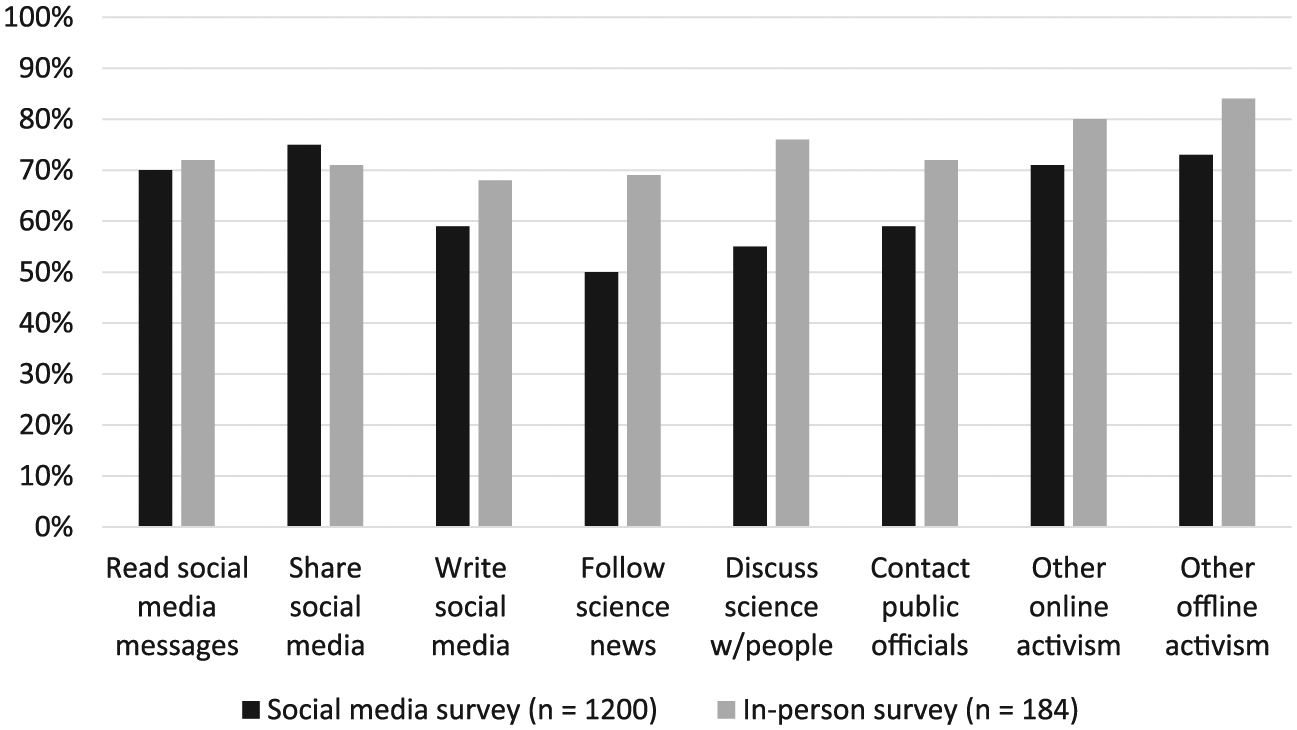
Experiences with the March for Science made respondents more likely to . . .
The in-person survey assessed the self-reported effects of participating in the March event among attendees (RQ3B). Relative to the social media survey results, the in-person survey produced roughly equivalent reported findings for online and social media actions (see Figure 3), including participation in online activism (84%), reading social media messages (72%), liking or sharing social media messages (71%), and writing social media messages (68%). However, in-person respondents were more likely to report positive effects on the likelihood of undertaking other sorts of actions, including participating in offline activism (84%; χ2 = 12.69, p < .01), discussing science (76%; χ2 = 22.64, p < .01), contacting public officials (72%; χ2 = 6.65, p < .01), and following science news (69%; χ2 = 17.28, p < .01).
Predicting Self-Reported Effects on Future Actions
A series of regression analyses tested how different forms of learning (H1) and communicating (H2) about the March were associated with self-reported effects of March experiences on future actions. These analyses used the pooled sample of social media and in-person respondents. The dependent variables captured whether the respondent reported an increased likelihood of undertaking each action, coded so that 1 indicated yes and 0 indicated no effect or a reduced likelihood (these two responses categories were combined given that very few respondents reported a negative effect for any type of action). Given that the eight measures of reported effects formed a reliable index (α = .80), an additional analysis treated the sum of reported effects (0–8) as the dependent variable. The independent variables included dichotomous measures for each form of learning and communicating about the March (see above; 1 = yes and = 0 no). The model for each dependent variable also included gender (1 = female, 0 = male), age (measured in six cohorts), self-identification as nonwhite or multiracial among US residents (1 = yes, 0 = no), self-identification as a US resident (1 = yes, 0 = no), self-identification as a scientist (1 = yes, 0 = no), and sample (1 = in-person survey, 0 = social media survey). The models predicting each action were estimated using logistic regression (given the dichotomous nature of these dependent variables), whereas the model predicting the index was estimated using Ordinary Least Squares regression (see Table 1).
Predicting self-reported effects of experiences with the March for Science on being more likely to . . .

p ⩽ .05. Table entries are logistic regression coefficients for individual items and ordinary least squared regression coefficients for the index, with standard errors in parentheses. Nagelkerke R2 is reported for the logistic results and adjusted R2 for the ordinary least squares results.
The results yielded little evidence that learning about the March through social media was distinctively related to self-reported effects on specific future actions or the index for such actions (H1). Learning about the March through Facebook was positively and significantly associated with reporting an increased likelihood of writing social media messages about science, but this was the exception rather than the rule. Nor were other forms of learning consistently related to self-reported effects on future actions.
In contrast, communicating about the March through social media predicted self-reports of effects on multiple forms of action (H2). Respondents who communicated about the March through Facebook were particularly likely to say that their March experiences increased their future probability of liking or sharing social media messages, writing social media messages, discussing science, participating in online activism, and participating in offline activism. Similarly, respondents who communicated about the March through Twitter were especially likely to report an increased probability of liking or sharing social media messages, writing social media messages, contacting public officials, and participating in online activism. Furthermore, both forms of communication significantly predicted the index of self-reported effects on future actions. Respondents who communicated about the March through Instagram reported an increased likelihood of writing social media messages, but this form of communication did not predict any other dependent variable of interest. Of the other forms of communication, texting emerged as the most consistent predictor of self-reported effects on future actions (six specific forms of action along with the index).
Among the control variables, four stood out for their relationships to self-reported effects on future actions. Women tended to report greater effects than did men (two specific actions and the index), as did US residents relative to non-residents (three specific actions and the index). Meanwhile, scientists tended to report weaker effects than did non-scientists (four specific actions and the index). Finally, in-person survey respondents tended to report greater effects than did social media survey respondents (six specific actions and the index).
Conclusion
Consistent with the premise that the March for Science fits Tufekci’s (2017) concept of a networked protest, the present study found that social media—particularly, Facebook—played a dominant role in how respondents from both the social media survey and the in-person survey learned about the movement. Similarly, an overwhelming majority of social media respondents and a clear majority of in-person respondents communicated about the March through Facebook—a result that parallels Tufekci and Wilson’s (2012) findings regarding the Tahir Square protests. Twitter and (to a much smaller extent) Instagram also played roles in raising awareness and facilitating communication about the March. Taken in conjunction with Tufekci and Wilson’s results from another context (a protest in the Middle East), our findings from the context at hand (a global protest originating in the United States) highlight the crucial role that Facebook can play as a platform through which participants learn and communicate about network protests around the world. This is not to say that Facebook serves as the dominant communication channel in all networked protests: for example, research indicates that Twitter has played a particularly important role in fostering engagement with other movements such as Black Lives Matter (Carney, 2016; Cowart et al., 2016; Gerbaudo, 2012; Murthy, 2018; Tufekci, 2017). Thus, different social media can serve different functions depending on the nature of the movement itself as well as the social, cultural, and political contexts that surround it.
Apart from using social media, respondents from our surveys learned and communicated about the March for Science through other channels, as well. These included texting, email, and, most notably, face-to-face communication. A substantial proportion of in-person respondents learned about the March through face-to-face communication, and a majority of respondents in both surveys reported engaging in face-to-face communication about it. These results dovetail with Tufekci and Wilson’s (2012; see also Tufekci, 2017) findings that both online and offline channels play key roles in facilitating awareness of and communication about networked protests. More broadly, the results here highlight the benefits to protest movements in taking a transmediated approach (Costanza-Chock, 2014) that uses a variety of platforms to meet the learning, communication, and engagement needs of its members and other constituents.
In addition to reinforcing the findings of previous studies regarding the heterogeneous roles that social media platforms and other communication channels can play in networked protests, the present study’s findings suggest that different social media platforms and communication channels can play different roles at different points of a networked protest. For example, Facebook seems to have played a particularly dominant role in how social media participants learned and communicated about the March for Science prior to the in-person events, but a less dominant role among in-person attendees. Meanwhile, in-person participants were more likely than their social media counterparts to use texting, email, and face-to-face conversations to learn and communicate about the March, as well as to use Instagram to communicate about it. All of this suggests that whereas the design affordances (Tufekci, 2017) of Facebook—especially through its Groups, Pages, and Events—may have been best suited for raising awareness about and organizing action for the March in the period leading up to it (e.g., by sharing relevant news articles and discussing political strategy), the affordances of other channels—particularly mobile platforms—may have been best suited for engaging with the March as it was taking place (e.g., by sending text messages about where to meet and using Instagram to post photographs taken at the event). Thus, networked protests may benefit from encouraging the strategic use of particular social media platforms and communication channels during different phases in the movement’s organizational and political trajectory.
In terms of behavioral intentions, social media and in-person survey respondents tended to say that their experiences with the March for Science increased their likelihood of undertaking a range of future actions. In line with previous research (Bunnage, 2014; Rohlinger & Bunnage, 2015, 2017), these findings suggest that both online and offline forms of engagement with the March for Science may contribute to the sustainability of participation in the movement. To be sure, respondents from the in-person survey reported greater effects on their likelihood of undertaking some actions, including contacting officials, discussing science, following science news, and engaging in offline activism. Even so, a majority of social media survey respondents indicated that their online March for Science experiences increased their likelihood of participating in future offline activism. In addition, a majority of in-person survey respondents said that their participation in a March for Science event increased their likelihood of participating in future online activism. Taken together, these findings reinforce Tufekci’s (2017) argument that concerns about social media-based activism being mere “slactivism” (Gladwell, 2010; Morozov, 2009; Schuster, 2013) are overstated—as well as her argument that online and offline forms of engagement are intertwined in the context of networked protests (see also Gerbaudo, 2012).
The results from the multivariate analyses show that communicating through Facebook and Twitter predicted a range of self-reported effects of March experiences on intentions to undertake future actions—another pattern consistent with Tufekci and Wilson’s (2012) findings regarding the Tahir Square protests. Meanwhile, learning about the March through social media did little to explain self-reported effects on future actions. The contrast here resonates with previous arguments that different forms of social media use can shape protest involvement in different ways. In particular, communication about the March may have reflected a more active form of engagement that went hand in hand with mobilization for future action (Macafee & De Simone, 2012; Valenzuela, 2013).
In short, the results here suggest that social media, especially Facebook, were central to mobilizing citizens to protest on behalf of science. Of particular note, communication through social media may have encouraged participants to sustain both their online and offline engagement with this networked protest. At the same time, other channels—such as face-to-face communication, texting, and email—also appeared to foster awareness, communication, and intentions for future actions. Put another way, organizing and mobilizing hundreds of March for Science events around the world in a relatively short time space was a truly transmediated effort (Costanza-Chock, 2014). Given the “fragility” of networked protests when it comes to sustaining their momentum and organizing efforts over time (Tufekci, 2017), the findings here suggest that the March for Science and other networked protests would benefit by continuing to embrace a range of social media platforms and other communication channels in both planning future actions and facilitating ongoing citizen engagement. To achieve both short-term mobilization and long-term persistence, such efforts may also need to incorporate both online and offline communication that follows both hierarchical and horizontal lines (Rohlinger & Bunnage, 2015, 2017).
In weighing these conclusions, it is important to bear in mind the limitations of the present study. To begin with, it relied on convenience samples of social media participants and attendees. Thus, the results are not necessarily representative of the populations of interest. In addition, the two surveys used different sampling methods and survey modes. As a consequence, contrasts in results across the surveys may reflect methodological differences instead of, or along with, differences in the populations themselves (by the same logic, however, one could argue that these same methodological differences bolster the case for the similarities observed across the surveys). The key measures, in turn, relied on self-reports. To the extent that respondents misperceived, misremembered, or misrepresented their behaviors and intentions, such measures may not fully capture the phenomena of interest. This concern may be particularly important for the measures related to future actions. More broadly, the present study focused on one networked protest, the March for Science, during a relatively brief time span before and during the protest itself. It did not examine citizen participation in the March for Science after the events of April 22, 2017; nor did it examine citizen participation in other networked protests.
Future studies could build on the present study in a number of ways. When it comes to studying the March for Science’s efforts at transitioning from a series to protests events to a sustained global movement, researchers could analyze its organizers’ uses of social media and other communication channels to encourage participant involvement over time. Going beyond the March for Science, researchers could collect panel survey data to allow for stronger causal tests of how social media use shapes longer-term protest involvement (see, for example, Gil de Zúñiga, Molyneux, & Zheng, 2014; Vissers & Stolle, 2014). Researchers could also conduct in-depth interviews and participant observation to develop more nuanced understandings of how and why participants in networked protests use a range of social media and other communication channels before, during, and after networked protest events (see, for example, Costanza-Chock, 2014; Gawerc, 2015; Murthy, 2018; Rohlinger & Bunnage, 2015, 2017). Relatedly, researchers could conduct textual and content analyses of social media pages, groups, and hashtags to analyze the ways in which individuals participate in different social media sites as part of their online and offline engagement for different purposes and at different points in time (see, for example, Alaimo, 2015; Carney, 2016; Cowart et al., 2016). Finally, researchers could use the results here as starting points for exploring similarities and differences in social media uses and effects across multiple networked protests (e.g., Tufekci, 2017).
Footnotes
Appendix
Acknowledgements
The authors would like to thank Justin Collier, Erin Drouin, Nina Freiberger, Lucy Obozintsev, and Alexandria Schaffer for research assistance. They would also like to thank all of the March for Science organizations that participated in the study.
Declaration of Conflicting Interests
The author(s) declared no potential conflicts of interest with respect to the research, authorship, and/or publication of this article.
Funding
The author(s) disclosed receipt of the following financial support for the research, authorship, and/or publication of this article: This work was supported by the University of Delaware Center for Political Communication.
