



Abstract
This article starts with a consideration of the different reasons academics might be interested in the detailed analysis of who interacts with whom on a social media platform such as Facebook. We then describe our analysis of the levels of interaction between Facebook friends for two populations, one based in South England and the other in South India. We first used statistical data analysis to identify those who interacted most with our informants. We then exploited our ethnographic grounding to elucidate who exactly these interactions were with upon returning to our informants. This allows us to characterize the nature of interactivity in the two sites, for example, the role of kinship as against friendship. In general, we found that the explanation for interactivity in the English fieldsite tended to depend on identifying specific genres of communication for particular social relations, while the Indian fieldsite reflected strong social parameters such as gender and class. We also comment on a few of the many general issues that arise, including the relationship between online and offline sociality, the importance of both reciprocity and asymmetry in interactivity, and the question of whether people are aware of who interacts most with them on their Facebook profiles.
Why Do We Want to Know About the Differential Intensity of Interactivity?
The focus of this article is an investigation of who most interacts with a given individual on Facebook. The study of intensive or core sociality in communication through phones and the Internet has been the subject of research for various different reasons in the past. A well-known example comes from Dunbar’s claim that there are biological predispositions given to us through evolution regarding the size of groups we interact with. Indeed, Dunbar (2016, 2012) has recently claimed to have demonstrated that social media networks conform to his claims to a universal basis for such sociality. This would imply that relational interactions observed in a study of Facebook are an example of certain human universals that derive from the evolution of the species.
A much more common concern has been to link evidence for interactivity to different versions of network analysis (e.g., Papacharissi [Ed.], 2011). Building upon Granovetter’s (1973, 1983) influential discussion on the different utility of strong and weak ties, for example, in seeking employment, Hampton (2016) has teased out the various levels of awareness and interactivity that build with increased usage of social media and how they relate to older ideas of community. By seeing how these networks complement prior forms of offline interactivity (Hampton & Wellman, 2003), such studies also expose the changing form and consequences of what they term as “core networks” (Hampton & Ling, 2013). Others have examined the implications of the overall size of the Facebook friend group, either as signs of popularity, as evidence of impression management (e.g., Scott, 2014; Tong, Van Der Heide, Langwell, and Walther, 2008), or of social capital (Ellison, Lampe, Steinfield, & Vitak, 2011), or have explored how these can be exploited for commercial purposes (Andrejevic, 2011).
An obvious research question would be whether social media reflects or transforms our patterns of interactivity, which for some, such as Dunbar, is understood in terms of network size. Several scholars have argued that new media may enhance the private sphere and the core group rather than being necessarily expansive (e.g., Broadbent, 2011; Hampton, Sessions, & Her, 2011; Ling, Bjelland, Sundsøy, & Campbell, 2014), while others argue for a more expansive effect increasing the core group of people that one routinely interacts with (Schrock, 2016).
A second obvious question is whether these patterns reflect universals, as argued by Dunbar, or local and cultural factors. On one hand, Ling, Canright, Bjelland, Engø-Monsen, and Sundsøy (2012) examine core social networks via phone call data, which suggests that people in developing countries have comparable sized networks to those in Scandinavia. By contrast, Horst and Miller (2005) argue for a specific pattern of “link-up” in cell phone usage that relates closely to Jamaican traditions of kinship. Many other studies try to engage with both local issues and wider generalities. For example, the analysis of localized phone usage in Norway (Ling, Bjelland, Sundsøy, & Campbell, 2014) or the implications of phones for weak ties in Kenya (Shrum et al., 2011) or expanding parent–child interactivity in the United States (Schrock, 2016) or victimization across four nations (Keipi, Kaakinen, Oksanen, & Räsänen, 2017).
Our Context and Method
These questions as to whether Facebook interactivity reflects more local or general processes and how transformative they appear to be compared to established patterns of sociality are the points of entry for the work described in this article. The evidence comes from the Why We Post project whose primary concern was to examine the extent to which the usage and consequences of social media varied with different populations. For this investigation, nine anthropologists each spent at least 15 months studying their respective populations across eight countries. The results have been published in a series of 11 volumes (e.g., Miller et al., 2016). As an anthropological study, our interest is less in measuring interactivity than in exploring the different implications and meanings of social media interactivity for each of our populations. For example, the key change for a population in rural China turned out to be the unprecedented incorporation of strangers into their QQ and WeChat interactions (McDonald, 2016). But that proved an exception to a more general cross-cultural conclusion, which was that social media use tends to be conservative. More typically, we found social media being used to repair the rupture to traditional groups (contra, for example, Rainie & Wellman, 2012). So, social media helped Kurdish populations to reconstruct groups that approximate traditional forms of kinship and tribal organization (Costa, 2016) or helped re-integrate caste and family interactivity in South India (Venkatraman, 2017).
In this article, we try and explore some of these issues in more detail by concentrating on just two examples, rather than all nine. We chose South England and South India because the ethnography suggested very different forms of kinship and other foundations for social interactivity and we wanted to see how this was, or was not, reflected when we examined interactivity on a specific platform, Facebook, that was used extensively in both sites. Our ethnography meant we had access to many Facebook profiles and the formal consent to carry out analytical work on these profiles with guarantees of anonymity. There is a long tradition of mixed methods in social science, which increasingly use measurements such as location data, or log data alongside qualitative work (Tashakkori & Teddlie,1998; Ørmen & Thorhauge, 2015), including work on social media (e.g., Robards & Lincoln, 2017), but the latter does not usually include such classic 15-month anthropological ethnographies. Our aim was to use statistical data analyses to determine who most interacted with whom, but then the ethnography to understand why these particular people were interacting with each other.
The South English site (Miller, 2016) is a rural area called The Glades. One of the Miller’s primary conclusions is that English people have repurposed Facebook to suit a form of sociality that is crucial to traditional English sociality, which he calls the Goldilocks strategy. A primary use of Facebook by adults in Miller’s fieldsite is to keep a wide group of people, both relatives and friends at the requisite distance. Such relationships should be neither too cold nor to warm. Having occasional interactions on Facebook obviates the need for more personal or frequent interactions offline. Venkatraman’s South Indian fieldsite, called Panchagrami, combined a huge IT complex, with the rural villages into which this complex had been set (Venkatraman, 2017). His main emphasis was on how social media transforms the relationship between work and non-work. He intended to contrast the IT and the village populations in terms of their usage of social media. In the event he found instead that both retained traditional concerns linked to caste, family, local politics, and the local film industry.
This article is based on 21 Facebook profiles from The Glades and 30 from Panchagrami where we conducted interviews after the analysis to identify the persons involved. This was but a small component of our overall ethnographies, which was based on our presence in these respective fieldsites for over 15 months. It was this which allowed us to develop a wider understanding of social media usage and consequence in the context of research which was mainly devoted to offline sociality and social relations. It was this long-term presence and our assurance of complete anonymity that allowed us to build up the trust between ourselves and our informants that was also important for the interviews that are discussed in this article. The fieldwork was quite extensive. For example, Miller recorded at least one interview with 380 different individuals over the course of 18 months. While Venkatraman built up many close friendships over 16 months that allowed him to contextualize his evidence with regard to many other fields of enquiry as well.
We hope this article reflects an ethos of anthropology that we try to study with people, rather than just study people. Our informants were just as interested as we were to use this opportunity to reflect upon their usage of Facebook and take part in its interpretation. In many cases, we were also present on our informants’ social media platforms, having first obtained formal signed consent from them for this participation. They could see the educational value in having better informed studies of the consequences of social media use. They also appreciated that if information could not be traced back to them as individuals, no harm could come to anyone from taking part. Accordingly, names and other details of informants have been changed in this article to ensure they could not be identified.
Analytical Results
Most people do not use the term interactors or seek to measure interactivity online. They are more concerned with the varied nature and depth of relationships. The term interactor and interactivity has been employed in this article for academic purposes. Although in discussion with our informants, the idea of greater or lesser interaction was an easily understood concept in relation to who most often liked or commented upon posts. The interactions measured here are based only on the comments and the posts that the informants and their contacts (friends and others on Facebook) shared on the informant’s Facebook timeline. The analysis draws on their entire timeline history up until the period of this ethnographic exercise rather than any specific time period. It therefore takes into account that people might have different friends over their Facebook membership history.
Furthermore, this analysis is also cognizant of the fact that the informant might not wish to share all posts that they are tagged in on their Facebook timeline. They were captured in multiple formats (pdf and as datasets), based on the privacy settings that the informants had set on their respective profiles. However, since Facebook does not allow application programming interfaces (APIs) to access all the people who might have liked particular posts of the informant, this analysis excludes “Likes.” The Chrome browser extension N-capture was used to gather the data which were then exported to NVivo, a qualitative data analysis software. To find and rank the interactors based on the number of interactions they had on each of our sample informants’ profiles, the final data set was then made ready for statistical analysis (which was a compilation of the profile and timeline information of all the informants) and then exported to SPSS, statistical software for social sciences, where further statistical analyses were carried out.
For each of our informant, a statistical aggregation of the number of interactions and the interactors who had these interactions with them on their profiles was mapped. This was followed by ranking the interactors based on their total number of interactions. Such aggregations were performed only within each informant’s profile and not across all profiles, since this would only add noise. Hence, each informant only had access to their own profile’s interaction history. The data that were presented to the informants did not segregate the interactions as being positive or negative.
The problem is that such data can only provide a map of the relative intensity of interactivity between individuals who appear as names or usernames and their relationship to the informant is largely unknown. Although methods that claim to identify the relationships between Facebook friends have been patented (Zuckerberg & Sittig, 2015), these may not include key elements such as whether these people are known to each other offline, the reason that they interact with each other, whether the relationship is instrumental or a form of fictive kinship. Many other facets which are all culturally relative and need to be contextually situated (as we will see in this article), also pose challenges to such methods. Hence, the next crucial step was to return to our informants with these data and ask them first to identify the names we had identified so that together with them we could account for these results.
Several points emerged from the analysis of these profiles. As shown in Table 1, both sites show a considerable range in the number of interactors.
Comparison of Interactors Between The Glades and Panchagrami.

Not surprisingly, a large number of interactors do not necessarily mean that the frequency of interactions on one’s profile is high. Profiles can be short or long tailed, that is based on a few high-intensity interactors or a more dispersed gradation from higher to lower intensity, and many include several “Facebook friends” who never interact at all. For example, Subadra 1 from Panchagrami has far less interactors but more interactions than Janet from The Glades (Figures 1–3).

Comparison of informant interactions between The Glades and Panchagrami.
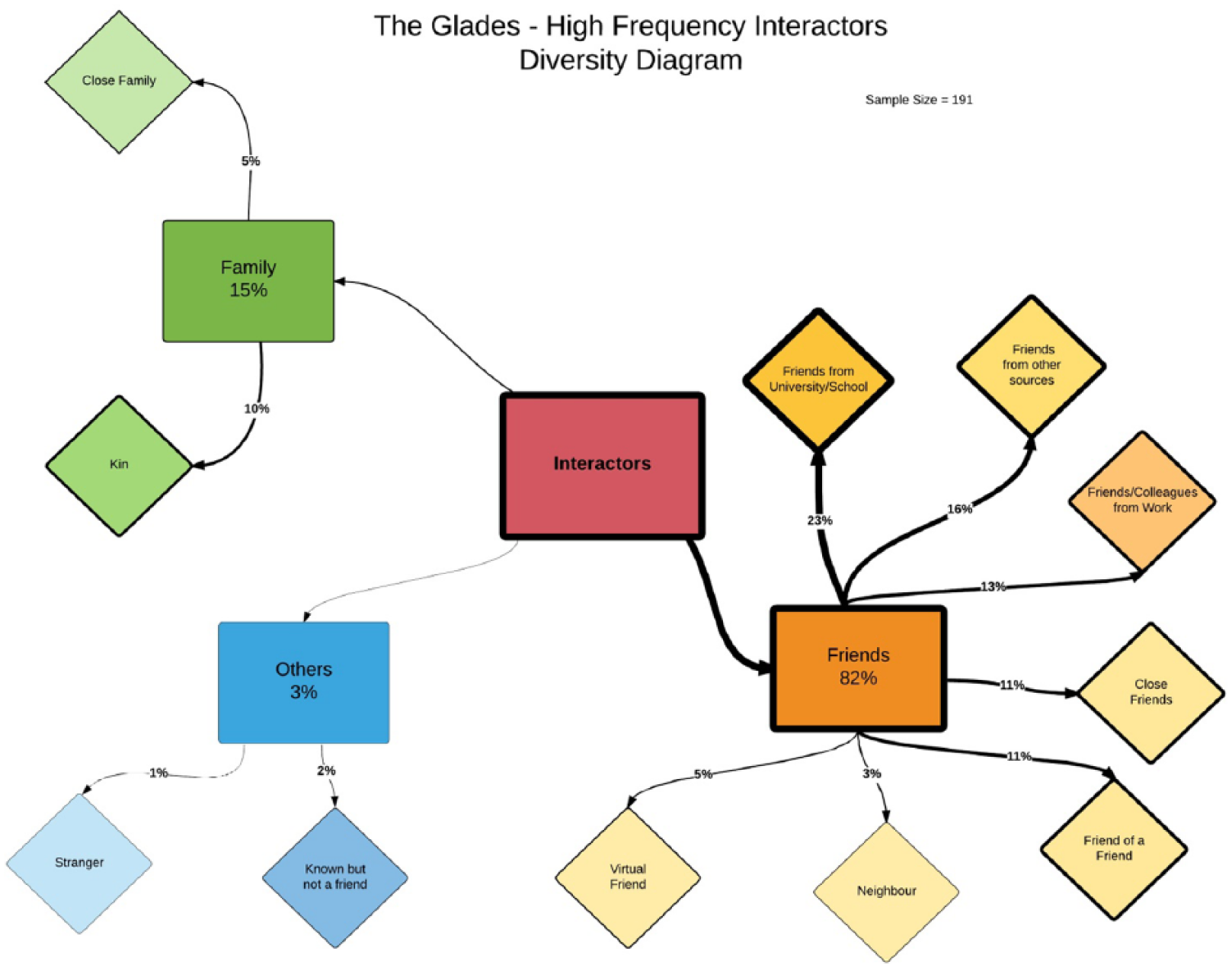
Main categories of interactors in The Glades.

Main categories of interactors in Panchagrami.
It is possible to do more fine-grained quantitative analysis. For example, using K-means clustering 2 (a statistical cluster analysis technique used to cluster data points on similarity of features and form groups organically) and a scree plot to determine the optimal number of clusters of frequent interactors produced four clusters for Sheila of The Glades. These range from one interactor with 356 interactions (13.8% of the total interactions) through to 594 (23% of the total interactions) with 11 interactors. However, without going back to the informant, it is hard to interpret such clusters or group them in accordance with the nature of relationships that the informant has with their interactors. This highlights a more general problem with such analytical evidence. One might be tempted to examine these data for comparing “Indian” and “English” patterns of interactivity. One might even conclude from these tables that there is so much overlap that we should see these patterns as similar rather than contrastive. But as we shall see, once we turn to the ethnographic evidence, it becomes clear that there is no such thing as “English” usage or even “The Glades” usage. These tables while partially disclosing information on interactivity has limitations as seen above. By returning to our informants with the data on their interaction history and using their knowledge and interpretations of their own data, there is a great deal that we can do with this material.
The Glades: Variegated Typicality
Consider first three of our informants from The Glades: Pearl is at secondary school and her first seven most common interactors are all at school with her. Apart from one, they seem to reflect the schoolgirl categories of “bestie” or best friends forever (BFF). For example, the one she describes as “literally inseparable,” with whom she says she texts all day when they are not actually together. Also in this list is the girl who lives opposite her residence, and other girls she went to primary school with. The exception, also the only male, is the fourth most common interactor, a boy who has been friends for a long time, but is high in the list mainly because he likes to argue and comment on other people’s postings. It is only when we reach the eighth interactor that we meet someone not at her school, her cousin. Then, there is her 10th interactor, who has left her school, but keeps in touch mainly through Instagram. By the 12th most common interactor, she is surprised because this is merely a friend of a friend. In short, this is the sort of pattern we might have expected for an English 17-year-old school girl.
Nicola recently gave birth to her second child. Her most intensive interactor is a woman she knew from ante-natal classes prior to the birth of her first child. They now mainly interact online since she only gets to see her face to face around once every 2 months. The second is a good friend from previous work she also hasn’t seen in person in 3 years, while the third lives locally and has a child the same age as hers and the fourth is her cousin. Most of her common interactors have children the same age as her child. But they seem equally divided between those who she also interacts with a good deal offline and those who she now finds difficulty in meeting face to face. Subsidiary categories would include some work colleagues and relatives. In short, this seems typical of what we might expect of an English mother looking after her children at home. Social media is commonly used to seek information and advice between parents (e.g., Duggan, Lenhart, & Ellison, 2015).
Andrew is a middle-aged gay male who has a quite specific usage of Facebook. About the first thing he says is that “Almost all the people I interact with most on Facebook, I’ve never met”. Paul is a witty and sophisticated individual who is very conscious about style and humor in his postings. He particularly enjoys postings that are quite outrageous and make fun of conventions or the establishment. Most of the people on his Facebook have noted his postings on their friend’s accounts and then asked to friend him in turn. They tend to be authors, journalists, editors, people in theater or comedy. What they have in common is that they all use Facebook to entertain each other.
Broadening from these three individuals we encounter a whole series of varied, but often quite specific genres of interaction. There is Anne whose interactions are almost entirely based on business connections with her Facebook contacts, in effect, an extension of LinkedIn. Alice tends to interact most with people she met when traveling in Australia. Miriam, also a young woman in work, is unusual in that her mum is her first interactor and her sister is second. Helen with two children showed a strong connection with fellow church members. Teenage Erica presents quite a different picture. She works in a pub, and she mainly friends fellow workers in the pub, or in the shops nearby, such as where she has her nails done. She also interacts with people who post selfies, since she is particularly keen on selfies.
We could call these findings “variegated typicality.” Each could be typical: typical business people, typical church goers, and typical university students. But each genre of which they are typical is different from the others that they are aggregated with when we take the fieldsite as a whole. We would argue that an awareness of this disaggregated level is always important as a caveat to other levels of discussion. Each such genre might be quite common across a large population but are unlikely to be present as more than one or two cases in this relatively small set of interviews.
Panchagrami: Gender and Class
In a book-length analysis of the visual postings on Facebook in our English and Trinidadian sites, there is clear evidence of stark distinctions in the content based on both class and gender (Miller & Sinanan, 2017). But while these social parameters certainly matter in The Glades, they do not dominate and subsume other genres to anything like the same degree as found in Panchagrami. Perhaps the most striking feature of the South Indian profiles is the close association between class and gender. Of the 30 profiles analyzed here, half came from lower socioeconomic classes and half were middle class. There was a higher proportion of females in the middle class (8) than in the lower class (4). This was because lower socioeconomic-class women were often prevented from accessing Facebook or indeed from access to phones (Doron and Jefferey, 2013; Venkatraman, 2017 p. 38), with social media considered, in essence, to be a masculine space (Venkatraman, 2017, p. 203). Where lower socioeconomic women did have access, interactions might be limited to only family, college friends, or neighbors who were well known.
For example, Malar, a 21-year-old from a lower class family, has 17 friends, out of whom, 5 were female college friends and 4 were neighbors, all were female other than a 12-year-old boy she knew since he was 4 years. She also had 8 “friends” who were family and in this case predominantly male. Both her 19-year-old brother and a 23-year-old male cousin keep a strict surveillance of her Facebook profile to ensure the absence of male strangers. As a result out of her 389 interactions, all but 13 are with men, all kin. While males undergo no such surveillance, their interactions with females are also limited as a consequence of the restrictions placed on females. Mostly, they too interact with relatives, close friends, and neighbors known offline. Although they will use private channels to flirt with female strangers if the opportunity arises, e.g., women from other regions within India or even other countries.
One way some women overcome these restrictions is through the use of fictive kinship. Fictive kinship is when, for example, you refer to your parent’s close friend as “aunty” or “uncle.” For example, Amudha, a 30-year-old housewife, who likes to post family pictures and home-made recipes, has 7 men in her top 15 interactors list. All of these are well known to her offline, for example, college friends or a friend’s husband. But they are never referred to as friends, but always through the use of Tamil kinship terms (Trawick, 1990).
Men from this lower socioeconomic class are far more likely than women to have Facebook friends they do not know offline. Ranjith’s Facebook comment on the need for security for women following the murder of an IT company employee received an unusual 200 comments, from people of whom Ranjith only knew around a quarter. More often comments would come from friends of friends. His top 10 interactors were all known to him, 7 of them being neighborhood friends.
The main reason for interactivity with strangers is the local Tamil film industry which is of central importance to many in the fieldsite. Sugitharaj, a 23-year-old business administration student only posts visuals of himself and of his favorite Tamil actress and actors alongside status updates. Most comments come from male friends, but his sixth and ninth most frequent interactors, who only appear as gender neutral cartoon figures in their profile pictures, are actually single women from the neighborhood, keeping their identity a secret. Sometimes, personal profiles acted more like fan clubs for a favorite Tamil movie actor or local politicians. These profiles would receive more comments from strangers. Indeed, Kannan, a 27-year-old truck driver, who posts mainly about a Tamil movie star “Ajith Kumar,” refers to 3 of his top 10 interactors as “Facebook friends” or with the fictive kin term “brothers,” even though he does not know them offline. Similarly, for 33-year-old Ponvannan who posts mainly about a local politician called Stalin (sic), 7 of his 10 top interactors are known only online.
The middle class offers a very different picture and represents a move toward gender neutrality. Several informants use social media to interact around particular interests, in one case pets, in another a famous author, but they were clear that they would not want these strangers to be among the top 10 interactors, which would feel “creepy” or like “stalking.” The preference is for social media to be an extension of established family interactivity or close friendships already established offline. They are more likely to make explicit a distinction between “friends” and “Facebook friends” who could be “acquaintances.” But then, Rajendran, a 43-year-old IT professional, would also have categories such as “cricket friends.” They are also more likely to use social media to keep people at a distance, though not to the same extent as the English Goldilocks strategy. The middle class are more inclined to simply delete friends following any instance of negative comments and generally to be more concerned with privacy and resentful of being tagged by their interactors. Swaminathan, a 61-year-old retired bank employee, mentioned that at least 4 of his top 10 interactors were only present because they tagged him on everything that concerned some news item on banking. He found this extremely irritating. Similarly, Ramasubbu, a 53-year-old Civil Engineer, was annoyed to find that three people he called “tagging idiots” appear on his list, as he thought he had unfriended them a while ago.
In summary, the middle class sought greater control over their personal interactions and, for that reason, were much more restrictive in their use of “fictive kinship,” as a means of incorporating friends, than were lower income groups. They had tighter rules over what they regarded as appropriate behavior. However, they were less controlling of other people’s usage, specifically female relatives (for another comparative examination of the relationship between core networks and class, see Hampton & Ling, 2013). So, in general, it is this alignment between class and gender that dominates the pattern of social media interactions.
Three Further Issues
There are of course a great many other issues that could arise from these discussions with our informants about who they most interact with. For example, informants comment in detail about what they regard as surprising absences or note that intensive commenting can arise from negative factors, such as someone who is quarrelsome or stalking, which certainly does not reflect on friendship. We also have evidence for the instrumental nature of some connections and the different ways people entertain each other through interactions. But for reasons of space, we will restrict discussion to three issues.
The first point is that this method allows us to consider the more general relationship between the intensity of offline and online friendship. In The Glades, there is a close relationship between the two in the case of the schoolchildren, since online is an extension of their constant interactivity with peers that often extends to using their phones in bed at night. Similarly, we find that Facebook had been another element within intense intra-family interaction in Panchagrami, though much of this is now migrating to the more private field of WhatsApp. But outside of those networks, there was often a poor relationship between offline and online interactivity. For adults in The Glades, there are many cases where the degree of Facebook interactivity, in effect, compensates for the lack of offline contact with the intention of providing for additional sociality rather than the desire to replace offline with online interactivity. For example, a work colleague you rarely see because you are at home with a baby or the school friend who left school and now mainly connects online; also, informants such as Andrew (discussed above), who has never met most of the people he interacts with online.
In Panchagrami, there were also marked discrepancies between online and offline interactivity, but as follows from our previous discussion, this might be for different reasons for say, a lower socioeconomic female than for a middle-class female. For Malar, of the former category, none of the people she placed as her closest offline friends were her interactors online, for example, her best friend from school who was also her neighbor; simply because they were not allowed access to social media, as was also true of her closest cousin. Among the middle class, Facebook interactivity might merely extend the closeness of family interactions. But there was often a clear distinction with regard to friendship. For Jaya, a 32-year-old, her closest communications were with a set of people who were on WhatsApp and not on Facebook. In Facebook, she had over 4300 interactions with 87 interactors, but these were dominated by intensive interaction with just five people. Yet none of them were listed as being close to her. For Balu, a 23-year-old college student, the situation was more like that of Malar in that his closest interactions were with his childhood friends who were not on Facebook. Importantly, when the middle-class informants were asked to identify who were they closest to in terms of communication circles, at least 30% of the respondents did not name anyone that appeared on their Facebook interactors list. They generally did not see the Facebook category of “friend” as particularly indicative of any kind of intimacy. Today, it is WhatsApp that was their preferred communication platform for close family interactions. This meant that Facebook was becoming more important for various categories of “others,” though this could include less close kin, and again this varied by class and gender.
A second major issue in both fieldsites is the degree to which interactivity online is understood in terms of reciprocity. In Panchagrami, this may include the weak reciprocity of exchanging birthday or anniversary wishes, keeping relationships cordial but no more. But in addition, more than half these informants could identify a leading interactor where reciprocity was crucial and this was true across class lines. For example, Indhuvasan, a 28-year-old, IT support staff, from a lower income family, makes sure to respond to all of one particular friend’s posts and expected the same. When they met every evening, they would remind each other if this etiquette had not been observed. Tamilvaanan, a 53-year-old government employee from the middle class, makes it a point to comment on all of his relatives’ posts and expects and reminds them to comment on or like his posts in turn. Helen, a young mother from The Glades, is also explicit about the role of reciprocity: “she puts photos of the kids, whenever I put a photo up of my child she always likes them. Sets up this whole thing of reciprocity doesn’t it.” Anyone who frequently comments on the photos of her child, Helen calls sweet and generous and says she comments back on theirs.
The Glades exposed the other side to this, which is an awareness of how asymmetries in posting reflect upon status. Rachel is a good-looking university student involved in local media. She is also good natured and tries hard not to claim status. But it is very clear from the interview just how many more people want to interact with her than she does with them. Charlotte, a young mother, notes that her second interactor is a neighbor in their late 60s, so the degree of interactivity reflects that she has “Nothing else to do with her life.” Susan, working in one of the professions, responds to one common interactor: “Uuurrrrgh yes. She’s hard work.” And about another, that “is my dad’s wife. All very boring.” In respect to Twitter the schoolchildren often note that status lies not just in the number of followers, but the degree to which the number of your followers outstrips the number of those you follow.
A third issue is significant because of its implications for methodology. Do people actually know who interacts the most with them? Several recent studies have noted the discrepancies between self-reporting and other evidence regarding mobile phones usage (Abeele, Beullens & Roe, 2013; Boase & Ling, 2013; De Reuver & Bouwman, 2015). Early on during fieldwork, Miller conducted a small survey which asked people to list their top three interactors on Facebook. The results are dominated by the nuclear family, who constituted 67 out of the 236 answers he received—28%. But in our subsequent identification of the actual top 10 interactors described in this article, only 5% were from the interviewee’s nuclear family. This suggests that the nuclear family had simply been an initial obvious and convenient guess. It also suggests that most people have only a limited and often inaccurate idea of who is actually interacting with them most on Facebook.
In confirmation of this, during interviews, informants were often surprised or even shocked by the results. Helen notes of her fifth most common interactor “Whose that? I’m gonna have a look (laughs). It says a lot about the quality of the friendship on Facebook if I don’t even know the woman.” Miriam notes of her ninth “But I haven’t seen them in person for nearly 5–6 years.” Liz of her fourth says “I haven’t spoken to her all this year.” Unlike Andrew, these informants had assumed there would be more continuity between online and offline sociality. Similarly, with regard to absences, Susan noted “I’m amazed you haven’t got Gina there as well. But I suppose that’s because I text or ring her. I see her 3 times this week.” A doctor was surprised that there was not a single medic on her list. But then reasoned that she lived far from work and it was the contact with other mothers that mattered more at this point. Several commented that they hadn’t expected such a high presence from friends of friends. Sam’s tone suggests surprise that her seventh most common interactor is her sister’s best friend, while her eighth is her dad’s ex-girlfriend. While they may evince some initial surprise, informants often quickly found a reason that explained the result. For example, Fiona, a schoolgirl, started by predicting that her top interactor would be her dad, but when she found he actually came 15th, she said “Yeah where my dad is makes sense. He’s funny on Facebook, he doesn’t quite get it. He’ll just comment on random things, or he’ll write a status to someone, rather than put it on their wall.”
Conclusion
The first conclusion from this article is that it illustrates the benefits that accrue from combining quantitative and qualitative approaches as advocated in mixed methods research more generally (Tashakkori & Teddlie, 1998). An approach based on only asking people who they most interact with will provide firm evidence of informant’s perceptions, but it is clear from The Glades that the answers may be far removed from the evidence that comes from the systematic analysis of actual interactions. However, the statistical data analysis while more robust as evidence for actual interaction provides no information as to either who these people actually are, do they know each other offline, or how to account for the patterns that are uncovered. Furthermore, allowing the informant to interpret their actual interaction data provided for a deeper and holistic understanding of the quality and nature of relationships that they had with the interactors.
Returning to our informants we can find out the precise relationship between those interacting. But even this is insufficient. It is only through the wider ethnography that we can come up with the more nuanced results that identify the many forms of what we have called variegated typicality—that is specific genres which relate a pattern of online interactivity with an offline context. For example, sometimes the intensity of interaction is persistent negative commenting, as between school girls. Or that interactivity can represent offline proximity or compensate for offline separation.
Though, almost all our work was traditional qualitative ethnography, the quantitative data was used only to help us understand the patterns of online interactions which when used in our ethnography provided for a deeper understanding of our informants perspectives of their own profiles. While we found the targeted statistical analysis outlined in this article and carried out for a precise purpose, insightful and useful for the reasons we have outlined, we were more skeptical about the more general surveys, because we found on many occasions that people in different fieldsites would interpret what had been intended as identical questions in different ways (see Miller et al., 2016, pp. 42–69). Our conclusions would be that mixed methods are best carried out, where as here, there is a clear idea of how the qualitative and quantitative materials complement each other.
We should not be surprised that online interactivity is just as variegated as the differentiated genres of sociality that exist offline. Lumping together work, family, friendship, status and neighborhood is a poor reflection of the rich field of practice that can emerge from an ethnographic encounter. We may find dominant parameters, but even then, as in Panchagrami, it is the relationship between gender and class that is crucial. Either of these alone would be a much weaker source of explanation. There are also quite specific local factors, such as the issues of caste and the massive influence of the local film industry. For these reasons, we prefer to work from the data that we can understand in relation to our ethnography, rather than just rely on quantitative results alone.
We would expect to find that both material specific to each fieldsite and potentially more generalizable data is subject to change. For example, our wider ethnography would suggest marked differences between the nuclear family characteristic of The Glades and the extended family found in Panchagrami. As we see in these two diagrams, these diagrams were drawn based on the relationship status that the 21 sample profiles from England and 30 from India have with their high-frequency interactors. In this case, 191 for the English fieldsite and 300 for the Indian fieldsite. The charts provide an overview of the diversity of interactors, while also taking into account the frequency of such interactions and thus for illustration purposes the line/box thickness of the relationship categories depend on them.
There are indeed differences between the two sites in the representation of kin within patterns of interactivity. Our wider evidence suggests that this discrepancy between The Glades and Panchagrami might have been even greater a year previous to our fieldwork. But we observed two trends: in Panchagrami WhatsApp is becoming the preferred communication platform for close family interactions, while Facebook then becomes viewed as more appropriate for “others.” This diminishes the relationship between kin and Facebook. By contrast, Facebook was previously used more for peer interactivity among young people in The Glades but now Twitter has taken over that role and Facebook is used for more family interactivity. So, the contrast between the two fieldsites has declined, but this is for entirely different reasons within each fieldsite.
There are, however, also generalizations that seem consistent with the evidence from several of our fieldsites. Many people assume that it is social media such as Facebook that has changed peoples’ understanding of the concept of “friend,” but Miller (2017b) has recently argued the opposite—that social media reflects a longer term and significant shift in the ideology of friendship and its relationship to kinship. He shows how the prevalence of fictive kinship—where friends are introduced as though they were kin, is shifting toward fictive friendship—where kin are being introduced as though they were friends. Fictive friendship is when someone says “meet my mother/sister/cousin—who is also my best friend.” It is this underlying historical shift which may help account for the success of this terminology of friendship found in platforms such as Friendster and Facebook. In both fieldsites, it is recognized that the use of the term friend in social media is not an indicator of intimacy but a category of online relationship. In a further study of media use by people with a terminal diagnosis, Miller (2017a) argues that while social media can enable people to share their experiences of dying with extended networks of people, it can also mask a lack of intimacy contributing to their loneliness and isolation.
The evidence from this article is consistent with the results of the larger Why We Post project. First, there is our treatment of platforms as polymedia, such that the use of Facebook is shifted in part by developments in other platforms such as WhatsApp. Also, our conclusion that social media is constituted largely by genres of content which can easily move between entirely different platforms, for example, from Facebook to Twitter or to WhatsApp. Finally, there is another way in which the article has attempted to further the project of mixed methods, which is through situating the complementarity of qualitative and quantitative analyses within the frame of comparative ethnography. It is only through that additional method that key findings such as the relative importance of class and gender in accounting for interactivity or the different relationship to kinship becomes evident. For this reason ultimately, this article represents an ethnographic perspective.
Footnotes
Acknowledgements
The authors would like to thank their respective informants who freely gave their time to the researchers, but who must remain anonymous, and also, Ciara Green the research assistant at The Glades and Laura Haapio-Kirk for a careful reading of this article.
Declaration of Conflicting Interests
The author(s) declared no potential conflicts of interest with respect to the research, authorship, and/or publication of this article.
Funding
The author(s) disclosed receipt of the following financial support for the research, authorship, and/or publication of this article: All the research reported in this article was funded by the European Research Council grant ERC 2011-AdG-295486 Socnet.
