



Abstract
While the centrality of Facebook as a political arena has been widely acknowledged, only scant attention has been given to what makes some political posts more successful than others. Addressing this gap, we analyzed a corpus of political posts written by diverse political actors in Israel. We explored, in particular, two main groups of factors that have been associated with major attributes of Facebook usage: content engagement and self-presentation. The analysis yielded a model of six features that promote the success of a political post: implied emotions, humor, first person, self-exposure, personal stance, and anger-evoking cues. We also identified differences in successful posts written by right-wing and left-wing actors; while humor was found to be a significant predictor of success only in left-wing posts, references to an out-group are associated with success only in right-wing ones. Overall, the findings showed that attributes of self-presentation are strongly linked to the success of political posts.
Introduction
On 17 March 2015, Tuesday, following a tumultuous campaign season, Israel was heading to the voting booths. The final polls indicated that Prime Minister Benjamin Netanyahu’s Likud party was about to lose. During the morning, the prime minister released the following message: The right-wing government is in danger. Arab voters are going in droves to the polls. Left-wing NGOs are bringing them on buses . . . Go to the polls, bring your friends and family. Vote Mahal [Likud] to close the gap between us and Labor. (Khoury, 2015)
This message, which was, according to some commentators, a major factor in Netanyahu’s eventual victory, was not aired on the radio, published in the newspapers, or screened on TV. It was not even uploaded on the party’s official website or its Facebook page but rather on Benjamin Netanyahu’s personal page.
Netanayahu’s post, as well as its alleged effect, demonstrates the centrality of Facebook as a political arena. A growing body of literature has addressed the ways in which Facebook is used by various political actors—from politicians and parties (Emruli, Zejneli, & Agai, 2011; Keat, 2012) to grassroots activists. The use of social media by protest movements across the globe, such as Occupy Wall Street (DeLuca, Lawson, & Sun, 2012) and the Arab Spring uprisings (Eltantawy & Wiest, 2011; Wolfsfeld, Segev, & Sheafer, 2013), have further boosted this research trajectory. Scholars have examined a wide range of issues related to the political workings of the platform, including motivations for political activity (Macafee, 2013; Vraga, Thorson, Kligler-Vilenchik, & Gee, 2015), effects on political knowledge (Dimnitrova, Shehata, Strömbäck, & Nord, 2014), and different modes of engagement (Bond et al., 2012; Vesnic-Alujevic, 2012; Zhang, Seltzer, & Bichard, 2013). Yet, the fundamental question of why some political posts receive more attention than others has received little attention so far.
The current exploratory study aims to address this gap by tracing the attributes that are common to successful political posts. We examined, in particular, two main groups of factors that are associated with major attributes of Facebook usage: content engagement and self-presentation. The literature on the former dimension includes a small group of studies which have focused on the “likability” of content (e.g., Cvijikj & Michahelles, 2013; Lee, Hosanagar, & Nair, 2014), as well as a larger body of works on virality (e.g., Berger & Milkman, 2012; Nahon & Hemsley, 2013). Zooming in from general success predictors to factors that relate more closely to Facebook and political personalization, we also examined characteristics that relate to self-presentation. Using these bodies of literature on engagement and self-presentation, we formed a pool of potential success enhancers, which we then analyzed in relation to a corpus of political posts from the period preceding the Israeli 2015 election. In addition to identifying general characteristics of highly “liked” posts, we also examined the elements predicting success in the posts of individuals with different political affiliations (i.e., right-wingers vs left-wingers).
Altogether, we aimed at tracing a set of features that goes beyond the specific political positions expressed in the text, yet have a significant contribution to political success in the digital sphere. Since performance in digital arenas is an essential component of shaping political discourses, perceptions and behaviors, the identification of such factors can shed light on the underlying dynamics of contemporary political cultures.
Engagement Enhancers
One of the defining affordances of social media is engagement with content. While still debated conceptually, engagement’s practical manifestations are displayed in a series of content-related actions facilitated by platforms which allow participants to “like,” “share,” and “comment” on items. Among these, “like” is probably the most central in the context of Facebook and will thus stand at the core of this study as a significant indicator of success. Clicking the Like button has a considerable influence: the item will be shown on the timeline of the one who liked it and on friends’ feeds, so every like given to an item promotes its distribution on the platform (Worley, 2013). Likes have thus become a method of spreading information, bolstering trust in campaigns and pressuring authorities (Crivellaro, Comber, Bowers, Wright, & Olivier, 2014) while serving a wide array of interpersonal purposes, spanning self-presentation and impression management, the facilitation of social ties, and meta-communication (Ozanne, Cueva Navas, Mattila, & Van Hoof, 2017; Sumner, Ruge-Jones & Alcorn, 2018). As “one of the most ubiquitous sociotechnical objects on the Web” (Peyton, 2014, p. 113), the Like button has also become the most common engagement feature on Facebook. In 2014, the time frame preceding our case study, 44% of American users liked content posted by their friends at least once a day and 29% several times a day (Smith, 2014). The centrality of the Like button on Facebook was maintained even after the introduction of additional response buttons in 2015 (such as “love” and “haha”)—data from 2017 demonstrate that this is the most used reaction on the platform (see Statista, 2018).
The centrality of the Like feature has been documented in political contexts as well. Among American users of social media, the most common way to express an opinion is clicking the Like button, with around 38% of all users utilizing it to express their support and promote political and social content (Rainie, Smith, Schlozman, Brady, & Verba, 2012; see also Gerodimos & Justinussen, 2015). Similar patterns were found in other countries; Larsson (2015), for example, found that “like” was the most common feedback to any kind of post in Norway during the 2013 election campaign.
While the far-reaching social, economic, and political implications of the Like button have been widely documented and discussed, there is surprisingly little research on what actually makes content likable. Within this small body of works, the vast majority (e.g., Tafesse, 2015) have focused on commercial rather than social or political aspects and on questions relating to the likability of profit-oriented brands (for a notable exception, see Xenos, Macafee, & Pole, 2017). More studies have looked into success factors that relate to other types of engagement, mainly sharing “viral” content (e.g., Berger & Milkman, 2012; Golan & Zaidner, 2008) and, to a lesser extent, transforming content creatively through processes relating to memes and mimesis (e.g., Knobel & Lankshear, 2007; Shifman, 2014). Yet, even here, the focus is on a relatively small number of genres: news articles, advertisements, YouTube videos, and online hoaxes (Berger & Milkman, 2012; Chielens & Heylighen, 2005; Golan & Zaidner, 2008; Shifman, 2012). Moreover, the number of studies that evaluate these processes on Facebook is particularly low, perhaps due to methodological (in)convenience in comparison with other platforms such as Twitter.
Given the scarcity of studies on likability and the existing research indicating a significant, positive correlation between likes and other modes of engagement (e.g., Chang, Yu, & Lu, 2015; Mauda & Kalman, 2016), we have, for the purpose of this exploratory study, conducted an integrative evaluation of the various “success enhancers” found in the body of literature on engagement with digital content. Our analysis yielded a distinction between three types of enhancers, relating to emotional, cognitive, and behavioral dimensions.
Emotional Factors
The triggering of emotion has consistently been found to enhance user engagement. The inclusion of emotions in a post has been shown to have a positive impact on engagement levels, with emotional content generating higher numbers of likes and comments (Lee et al., 2014). Beyond this general trend, positive and high-arousal emotions have been demonstrated to be particularly effective in increasing involvement.
Berger and Milkman (2010, 2012) found that news articles published with a positive message or content are more likely to go viral than their negative counterparts. This is linked to the social purposes of spreading content online: individuals usually prefer to be known as people who share upbeat stories or who make others feel good rather than upsetting them. This tendency toward positivity is also reflected in the dominance of humor in content that goes viral or is turned into a meme (Golan & Zaidner, 2008; Jenkins, Li, Krauskopf, & Grean, 2009; Knobel & Lankshear, 2007; Shifman, 2012). The inclusion of humor or entertaining content in Facebook posts was found to increase the engagement in likes, comments, and shares (Cvijikj & Michahelles, 2013; Malhotra, Malhotra, & See, 2013; Tafesse, 2015). Humor, in addition to being positive, tends to be surprising, thereby triggering emotional arousal.
Arising strong emotions has been found to be positively associated with content spreadability. Berger and Milkman’s (2010, 2012) aforementioned studies showed that even when the articles are negative in nature, if they trigger high-arousal emotions such as anger, they are more likely to go viral. Such strong emotions are channeled to immediate reactions such as content sharing.
Cognitive Factors
Studies demonstrate that users tend to engage with content that brings cognitive benefits but does not require extensive cognitive effort. Two main content characteristics are associated with this duality: novelty, on the one hand, and digestibility, on the other.
Novelty and relevance were found to enhance engagement in a number of studies, increasing the numbers of both shares (Berger & Milkman, 2012; Chielens & Heylighen, 2005) and likes (Cvijikj & Michahelles, 2013; Malhotra et al., 2013; Tafesse, 2015). This positive association between novelty and engagement relates to the interest such information sparks, its intrinsic reward, and its higher level of memorability (Tafesse, 2015).
A complementary cognitive dimension is what we label “digestibility”: features that are associated with the ease of decoding and consuming messages. Simplicity was found to be a central attribute of content spreadability (Chielens & Heylighen, 2005) as well as a characteristic of videos that turned into memes (Shifman, 2012). A high reading complexity of Facebook posts was found to decrease the number of likes (Lee et al., 2014). In the same vein, short posts and posts that include photos and videos were associated with a larger number of likes (Malhotra et al., 2013; Mauda & Kalman, 2016; Sabate, Berbegal-Mirabent, Cañabate, & Lebherz, 2014). In addition to reducing cognitive effort, visual imagery also helps in attracting attention to content. At the same time, a recent study found that in political campaigns, photos were negatively associated with the number of comments (Xenos et al., 2017).
Behavioral Factors
In addition to the emotional activation discussed above, direct calls for action in digital content have been associated with augmented engagement. By call for action, we refer to explicit requests to engage with the content through liking, commenting, or spreading it. Chielens and Heylighen (2005) dub this feature “proselytism”—a condition in which a meme “explicitly incites its hosts to spread it further” (p. 2). In their analysis of the factors that enhance the spreadability of virus hoaxes, they found that such direct requests significantly increase the likelihood of sharing content. In the context of Facebook, it was found that even a simple request to like a post increases both likes and comments (Lee et al., 2014; Malhotra et al., 2013).
Self-Presentation, Social Media, and the Political Sphere
Self-presentation refers to an individual’s attempt to control their impression on others and is thus also known as impression management. Erving Goffman (1959) described this process using a dramaturgical metaphor: people are constantly performing before audiences, namely, the other people they encounter. The ubiquity of the Internet, and social media in particular, has made it a pivotal tool for constructing and negotiating self-displays (boyd, 2014; Papacharissi, 2010). In this study, we examine the intersection of self-presentation and social media against the background of political personalization trends.
An extensive body of studies has been dedicated to exploring the ways in which people present themselves and disclose personal information in digital spheres (e.g., Christofides, Muise, & Desmarais, 2009; Gibbs, Ellison, & Heino, 2006). Early studies on personal websites and blogs found that they constitute an intimate, individualistic, means of self-expression, in which authors’ subjective perception of their subjects of interest is constantly revealed (Herring, Scheidt, Bonus, & Wright, 2004; Papacharissi, 2002). The rise of social media further enhanced the centrality of self-presentation. In most cases, identities presented on social media are consistent across platforms due to users’ fears of revealing false information that is not compatible with their offline modes of self-presentation (Hew, 2011). Several scholars studied the motivation behind Facebook activity and found self-presentation as one of the leading motives for any kind of activity (Baek, Holton, Harp, & Yaschur, 2011; Nadkarni & Hofmann, 2012), including political activity such as writing a political post, sharing links to news items, and liking a politician (Macafee, 2013).
In the political context, self-presentation is closely related to the personalization of politics—a process of growth in the prominence, power, and centrality of individual politicians at the expense of political parties and ideological identities (Balmas & Sheafer, 2016; Karvonen, 2007). A common definition for this shift was offered by Rahat and Sheafer (2007), who described political personalization as “a dynamic process that is expressed in an increase in the weight of the individual political actor and a decline in the weight of the group (i.e., political party) in politics over time” (p. 65).
As political personalization has become widespread in the western world, politicians are required to display and distinguish (or brand) themselves to potential voters. This has led to, among other things, the increasing use of digital media by politicians (Ross & Bürger, 2014; Vaccari & Nielsen, 2013). Such media, in general, and social media, in particular, allow for direct contact with citizens, unmediated by establishments or parties (Van Santen & Van Zoonen, 2010). This not only enables voters to build a clear image of specific politicians but also creates a sense of intimacy and emotional presence (Lee & Oh, 2012). Posts by politicians often reveal aspects of their private lives in the context of either a specific political issue or an effort to create a favorable image (Weiss Yaniv & Tenenboim-Weinblatt, 2016). While personalization and its consequent emphasis on self-presentation have been documented across the political spectrum, there is still need for a systematic analysis of the latter’s contribution to digital success. Furthermore, we are still in the dark when it comes to the relation between political orientation, elements of self-presentation, and success. Given the literature about value differences between right- and left-leaning actors in various political systems and contexts (e.g., Piurko, Schwartz, & Davidov, 2011; Thorisdottir, Jost, Liviatan, & Shrout, 2007), it is expected that success factors will vary across these groups.
In light of the pivotal role of self-presentation in social media and contemporary political culture, we expect that markers of self-presentation and disclosure will enhance the success of political posts. A review of the literature on online self-presentation has led to the identification of a set of textual cues that are associated with personal display in various media in both general and political contexts. These include posting photos of oneself (Ellison, Heino, & Gibbs, 2006; Mubarak & Mubarak, 2015), the use of first person pronouns (Hyland, 2003; Lyons, Mehl, & Pennebaker, 2006), self-disclosure or personal exposure (Mehdizadeh, 2010; Seidman, 2013), the expression of personal stance or opinion (Johansson, 2008), disclosing emotions (Seidman, 2013), and signaling affiliation toward an in-group as an extension of self-identity (Brewer, 1991).
Based on the two bodies of literature discussed above and the sets of possible success enhancers we identified within them, as well as the aforementioned gaps that still exist in this literature, we examined the following questions: (a) Which factors predict political posts’ “likability”? (b) Do the attributes of successful posts vary between actors with different political orientations?
Method
The sample we used for exploring these questions consists of political Facebook posts by Israeli political actors. Israeli use rates of Facebook are among the highest in the world, with 77% of Israeli Internet users reporting frequent active use (Epstein, 2013; Goldenberg, 2013). In addition, political personalization has become a significant phenomenon in Israel (Rahat & Sheafer, 2007). Israel’s political system has changed significantly in the last 50 years, with the power of political parties decreasing and the power and importance of individual politicians increasing. This trend was augmented in the 1990s, when many parties started electing Knesset candidates through primary elections (Livak, Lev-On & Doron, 2011). While not as high as in the United States, longitudinal studies have shown that all types of personalization are present and growing in Israel (Rahat & Sheafer, 2007).
The time frame chosen for the study was the period preceding the 2015 Israeli election (December 2014 to mid-March 2015). Since pre-election periods create a spike in political activity, discussions, and persuasion attempts by both politicians and the general public, they constitute fertile ground for the examination of political messages.
Sampling
Many past studies on political posts focused only on posts by politicians (Keat, 2012; Larsson, 2015). To examine the attributes of political posts in general, this study investigated posts by a variety of sources: politicians, public figures, and others who while not necessarily public figures make frequent use of their Facebook profiles to post political content.
Sampling directly through Facebook is problematic for obtaining an unbiased sample, given that its feed is designed to expose users mostly to content related to their friends. We thus followed a two-step sampling method focusing on public posts. First, we sampled profiles, and within them we sampled successful and unsuccessful posts.
Profile Sampling
The first step aimed to build a “profiles bank” from which relevant posts would be sampled in the second step. For this purpose, we used Google’s advanced search tool, which allows choosing detailed relevant criteria to filter results. The search was executed within the selected time frame, using the criteria of unpersonalized search and results exclusively from Facebook pages. We used the following politically related keywords, which cover a broad spectrum of issues and actors central to the 2015 elections, as well as to Israeli political sphere at large: elections, politics, left-wing, right-wing, polling station, Palestinians, and economy (in Hebrew), as well as names of politicians who were heads of political parties during the election campaign. This search yielded a total of 969 general results (profiles and posts). Each result was then examined and associated with a relevant profile.
In the second stage, the profiles were further filtered using two criteria: personal profiles (i.e., not a party or other organization) and a minimum of four political posts per profile in a random 2-week time frame. For the purpose of this study, we followed the conceptualization of Williams and Delli Carpini (2011) for identifying politically relevant content. A post was considered political when it dealt with (a) the institutions and processes of politics (e.g., governance-related actors, the party system, media-politics relations); (b) political issues (e.g., economics, immigration, international affairs); or (c) the foundational level, which is related to the core values and concepts that underlie political worldviews (e.g., social equality, justice, power, freedom). This process yielded a corpus of 20 profiles that represented both left-wing and right-wing participants, as well as different types of political actors (politicians, journalists, and other public figures). A full list of the profiles appears in Table 1.
Sampled Profiles.

Posts Sampling
The sampling time frame was from December 2014 to mid-March 2015. We selected the most and least successful posts on each profile, as indicated by the number of likes they received. 1 This sampling strategy was based on the long tail distribution of content in social media, characterized by an overwhelming portion of unsuccessful content and a few “hits” (Nahon & Hemsley, 2013). Since random sampling would have resulted in a very small number of successful posts, we sampled the top 10 most successful ones and contrasted them with a proportionate number of the least successful ones. This resulted in a final sample of 400 political posts, 200 successful, and 200 unsuccessful. The average number of likes per post varied greatly across the sampled profiles, depending on the general popularity of each actor. While for senior politicians, such as Naftali Bennett (head of a right-wing party), the number of likes for successful posts was very high (e.g., ranging between 16,667 and 32,944 in the case of Bennett), for less-prominent figures, such as John Brown (a left-wing activist), the number of likes for the most successful posts was lower (for Brown: 523–1,097). Similarly, there was variation in what counted as non-successful posts (e.g., 297–1,400 for Bennett; 89–296 for Brown). Overall, the mean was 3,762 for successful posts and 300 for unsuccessful ones.
Variables and Coding
The posts were coded using a codebook that included 20 variables relating to self-presentation and engagement (see Table 2). We examined whether or not each attribute existed in a post (i.e., binary variables). The tested variables were based on the personal display cues and the engagement indicators outlined above, modified in some cases to adjust to the platform. Thus, the simplicity category was divided into two variables: the language register and the number of subjects dealt with by the post. Positive message was divided into three variables: optimistic message, operational idea (since a call for change or improvement would be considered essentially positive), and positive message about others (a positive message about the author was coded under the self-presentation indicators). In addition, we examined negative message about others (the inverse of the previous, given the dominance of negative discourse in political communication). Finally, the attempt to trigger high-arousal emotions category focused on a specific emotion, anger, expected to be dominant during tumultuous election times.
Variables.

The codebook’s reliability was tested by two coders, with 20% of the posts double-coded. Inter-coder reliability test scores (using Krippendorff’s alpha) ranged between .72 and .95.
Findings
To examine the degree to which each textual characteristic is associated with the success of a post, we first conducted univariate binary logistic regressions, using the examined attributes as independent variables and the post’s success (or lack of success) as the dependent variable. As shown in Figure 1, 13 of the tested attributes were significant predictors of a post’s success: 11 of these attributes were positively associated with a post’s success and 2 significantly decreased it (i.e., were negatively associated with success).

Significant predictors of the success of political posts (univariate logistic regressions).
The variable that most stood out in the logistic regressions’ results (with the highest odds ratio) was implied emotions. Posts expressing subtle emotional cues were found 16 times more likely to succeed than posts lacking such cues, Exp(B) = 16.349, p < .001. Posts containing personal stance were found to be more than eight times more likely to succeed, Exp(B) = 8.28, p < .001. Explicit emotions make the posts containing them almost seven times more likely to succeed, Exp(B) = 6.882, p < .001, and posts containing personal exposure are more than five and a half times more likely to succeed, Exp(B) = 5.649, p < .001. Notably, all four of these attributes may be associated with self-presentation.
Seven additional variables—anger-evoking cues, use of first person, reference to the in-group, humor, operational idea, author’s appearance in visual means, and an out-group reference—increase a post’s chance of success less dramatically, ranging from 1.8 to 4.2 times. The two remaining variables—use of visual means and short posts—have an inverse relationship with the post’s chance of success, lowering it by about a half.
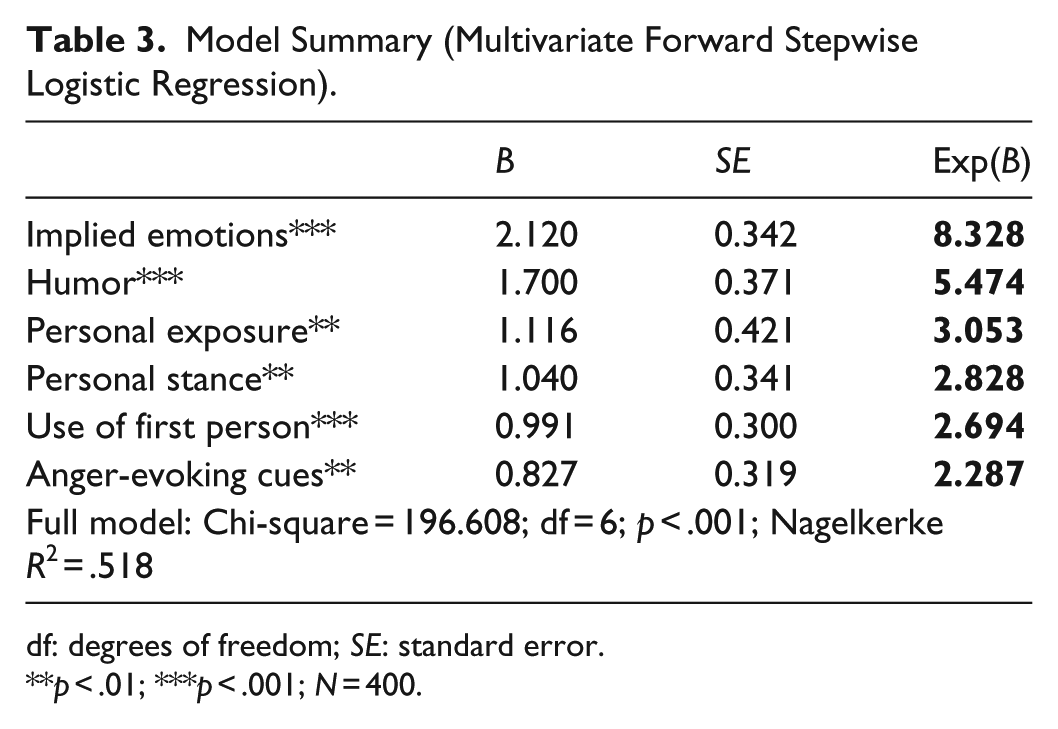
In the next stage, we examined the contribution of the different attributes when controlling for the other variables and looked for the combination of variables that would best predict a political post’s chance of success. Since this is an exploratory study, which lacks the prior knowledge that could provide a theoretical basis for such a model, we used forward stepwise logistic regression which incrementally adds variables to produce the best performing predictive model. As shown in Table 3, the resulting model consists of six variables: implied emotions, humor, personal exposure, personal stance, use of the first person, and anger-evoking cues.
Model Summary (Multivariate Forward Stepwise Logistic Regression).
df: degrees of freedom; SE: standard error.
p < .01; ***p < .001; N = 400.
The two most dominant variables in the model in terms of increasing the post’s chance of success are implied emotions, which makes a post 8.3 times more likely to succeed (p < .001) and humor, which makes the post 5.5 times more likely to succeed (p < .001).
The combination of attributes that produce a successful post can be demonstrated in a post by Naftali Bennett, head of the right-wing Jewish Home party (see Figure 2). It was posted in response to campaign ads by the Zionist Union (the largest center-left party), which showed a photo of Yigal Amir (the assassin of late prime minister Yitzhak Rabin) along with the writing “Yigal Amir votes Bennett.” In response, Bennett displayed a post with a photograph of himself in uniform during his army service, with the short text: “Bougie [nickname of the Zionist Union leader, Yitzhak Herzog], my November ‘95, a moment before I murdered Rabin. (End of operation, Southern Lebanon).” Despite the brevity of this post, it exemplifies all six variables identified in the model. (1) Personal exposure—Bennett shows a photo of himself in uniform and links it to an event from his personal biography (before becoming a politician). (2) Use of first person—“a moment before I murdered.” (3) Humor—the contrast between the photo showing Bennett, an officer in IDF uniform following combat activity in Lebanon, and the text, describing the photo as if it was taken close to the time when he himself murdered Rabin, creates clear irony. In this sense, the text is not classically humorous but is characterized as satirical ridicule. (4) Anger-evoking cues—there is no doubt that this post, which was posted shortly after the ad boards went up, was meant to stir anger among its readers for what the right-wing perceived as unjustified defamation of Bennett and his party. (5) Personal stance—the post’s personal nature and its message present Bennett’s personal opinion very clearly. (6) Implied emotions—the post and the messages it conveys can also be seen as expressing Bennett’s personal emotions, which might include anger, insult, and perhaps even mockery, expressed by using the nickname “Bougie” and by addressing Herzog personally, marking him as personally responsible for the ads and expressing contempt for his campaign style.

An example of a successful post.
Right-Wing Versus Left-Wing Political Actors
To examine whether there are differences in the characteristics of successful posts written by individuals with opposing political affiliations, we used a subsample of profiles, consisting of those profiles that could be clearly identified as left- or right-wing. In addition to professional politicians, whose political identity is clear, the subsample also included Facebook profiles of authors whose political identity is publicly known or is evident in the opinions they present through their Facebook profiles, as shown on Table 1. Overall, the subsample included eight profiles of right-wing actors (160 posts) and six profiles of left-wing actors (120 posts).
Next, we compared the attributes of successful right-wing posts (80) and successful left-wing posts (60) using chi-square tests. As summarized in Table 4, four attributes were found to differ significantly across the two groups: humor and optimistic message were found more typical of successful left-wing posts, whereas casual language and out-group reference were found more typical of successful right-wing posts. Of the four attributes, only two belong to the general predictors of success identified above (humor and out-group reference).
Significant Differences Between Successful Right-Wing and Left-Wing Posts.

p < .05; **p < .01; ***p < .001; N = 140.
To further examine these four variables, we used separate logistic regressions to examine the relationship between each attribute and the success within left- and right-wing posts. The findings suggest that casual language and optimistic message are not significant predictors of success in either group. In relation to humor and out-group reference, the findings showed that humor is a strong predictor of success in left-wing posts (odds ratio = 5.2; p < .001), while out-group reference is a similarly strong predictor of success in right-wing posts (odds ratio = 5.7; p < .001). At the same time, neither variable is significantly associated with success in the other group (i.e., humor is not associated with success in right-wing texts and out-group reference is not associated with success in left-wing posts). These findings therefore suggest that the features of humor and out-group reference are distinctive to left-wing and right-wing settings, respectively.
Discussion
An integrative evaluation of the results reveals that the vast majority of variables which are positively associated with likability relate to self-presentation. This tendency is also manifest in the six-variable model for explaining the success of political posts. Four of the variables—use of first person, implied emotions, personal exposure, and personal stance—relate clearly and directly to self-presentation. Furthermore, of the various variables derived from the body of literature that addresses enhancers of engagement with digital content, the two found as the strongest success predictors—humor and anger-evoking cues—can also be associated with self-presentation.
Humor is considered a positive and desired personality characteristic across many cultures (Martin, Kuiper, Olinger, & Dance, 1993). Studies have shown a strong correlation between recognizing another’s sense of humor and having a stronger appreciation for them, including seeing them as more pleasant, intelligent, confident, and even as better leaders (Decker, 1987; Priest & Swain, 2002). It can therefore be assumed that when an individual appreciates a post that includes humor, it is connected with the way they want to present themselves. This display of humor is particularly relevant in an increasingly personalized political sphere, which requires politicians to master new communicative styles which include wit and humor (Tolson, 2006).
While at first glance arousing anger may seem the direct opposite of invoking humor, both are actually displays of an individual’s personal standing and feelings toward people or issues. Indeed, in the majority of cases (76%), anger-evoking cues appear in posts alongside implied emotions. This finding indicates that, to a considerable extent, these posts tell us something about their authors: simply put, they convey the message that the author is angry. Notably, both humor and anger are associated with what we have classified as emotional participation enhancers.
Interestingly, the cognitive variables that have to do with “digestibility”—short posts and uses of visual means—showed a significant but inverse correlation with a post’s success, meaning that they were found significantly less in successful political posts. It could thus be said that in regard to political posts, the attributes that are usually considered beneficial to a post’s success on Facebook become a double-edged sword, while attributes pertaining to the author’s self-presentation are likely to promote success.
An analysis of the relationships between the variables showed a link between success and all the tested self-presentation variables. These results indicate that self-presentation is not only a prominent motivator of general (Nadkarni & Hofmann, 2012; Yang & Brown, 2013) and political (Macafee, 2013) Facebook activity but also a central criterion for others in appreciating a political post. Furthermore, the findings suggest that trends of political personalization (Balmas & Sheafer, 2016; Van Aelst, Sheafer, & Stanyer, 2012) are compatible with what makes political content likable .
A further finding pertains to the differences between the success factors of posts written by individuals with right-wing and left-wing orientations. While humor was proved a significant predictor of success only in left-wing posts, references to an out-group were associated with success only in right-wing ones. A partial explanation for these differences may be found in studies that examine the ties between values and political orientation (e.g., Caprara, Schwartz, Capanna, Vecchione, & Barbaranelli, 2006). Whereas values of universality and pleasantness (which may be associated with humor) are more characteristic of left-wing voters, power, security, and tradition (that can be linked to strong in-group orientation) tend to characterize right-wing voters. It is important to note that our results do not imply that those who hold right-wing ideas lack a sense of humor, or that left-wingers do not express in-group orientation; what they do suggest, however, is that these traits are part of these group’s perceived identities. When one “likes” a humorous left wing post, he or she simultaneously conveys a message about the post, and about her identity as a humorous person.
In sum, this study’s findings indicate that attributes of self-presentation have a significant correlation to the success of political posts. Attributes shown in previous studies to promote engagement with other content types but unconnected to personal presentation were negligible in their contribution to the likability of political posts. This trajectory is strongly evident when comparing two features: the inclusion of visual elements and self-photos in posts. While the former interacted negatively with successes, the latter enhanced it. In other words, what makes political photos likable is not their format but their function as a vessel of personal exposure.
An integrative evaluation of our findings leads us to conclude that in the political context, success is tied with a specific set of “imagined affordances.” Located between materiality and functionality, imagined affordances are dynamic composites of stances, expectations, and behaviors emerging around platforms (Nagy & Neff, 2015). Among the various affordances associated with Facebook, successful posts draw on the possibilities and practices related to one of its main features: an augmented presence of the individual that often blurs the boundaries between private and public communications (boyd, 2014; Thorson, Vraga, & Kligler-Vilenchik, 2014). This duality turns the personal presentation of political actors into a particularly potent means for enhancing engagement. The association between self-presentation and success cuts across ideologies and political roles: an emphasis on self-presentation characterized successful posts by left-wing and right-wing actors, by established politicians and grassroots activists. At the same time, our analysis suggests that specific dimensions of self-presentation vary across successful posts that target different ideological camps.
Limitations and Further Research
This study has several limitations that relate mainly to its scale and scope. First, the research examined political Facebook posts in Israel, where adoption and use rates are among the highest in the world and relatively high levels of political personalization have been noted (Lella, 2011; Rahat & Sheafer, 2007). While these characteristics render Israel a fertile ground for a study of this sort, results may be different in countries where Facebook is not as popular or politics is less personalized. Second, we traced political posts during an election campaign season. Such periods are marked by unique types of political discourse that do not necessarily characterize other points in time. Finally, due to the size of the sample, it was difficult to divide it into smaller sections that could shed light on the behavior of different stakeholders. This caveat is specifically relevant to our analysis of right- versus left-wing actors. Yet, while the number of posts for each of these groups was small, the statistically significant results suggest that this phenomenon merits further attention.
Future research may address these limitations by broadening the scope and perspectives of this study. Such studies could investigate comparatively varying periods and political phases (times of political rest, primaries season, war, etc.), different political regimes (countries with various political systems), and countries characterized by different social media use patterns. In addition, future studies could examine political success on other social media platforms (Twitter, Tumblr, and others). This latter line of research may also yield a better understanding of the workings of various success indicators in the political sphere; the features that we identified as generating the “likability” of posts may differ from those which generate other forms of engagement, such as commenting. While there is still much to discover, the findings of this study—and particularly the model it yielded—will hopefully serve as a useful infrastructure to deepen our knowledge of political success in social media.
Footnotes
Declaration of Conflicting Interests
The author(s) declared no potential conflicts of interest with respect to the research, authorship, and/or publication of this article.
Funding
The author(s) received no financial support for the research, authorship, and/or publication of this article.