



Abstract
In 2015, meeting in Paris for the Conference of the Parties (COP21), representatives of 195 nations set an ambitious goal to reach net zero greenhouse gas (GHG) emissions by mid-century. This research uses the Parties to the United Nations Framework Convention on Climate Change, which took place in Paris during 30 November to 11 December 2015, as a case study of Twitter coverage of the talks by mainstream and alternative media outlets and other climate stakeholders, including activists and fossil fuel industry groups. It compares the British Guardian with other media and climate stakeholders’ visual framing of climate change on Twitter during COP21, because the publication had launched an advocacy campaign in March 2015 promoting fossil fuel divestment in the lead-up to COP21. Findings show that individual activists and movement organizations functioned similarly in climate change visual framing in Twitter posts, as did individual and organizational multinational representatives and scientific experts. The news media categories varied by type of news organization. The major outliers were the fossil fuel industry and trade association accounts. Industry stakeholders largely focused on former US President Barack Obama’s climate policy, promoting the perception of a lack of domestic support for his climate policies in their visual Twitter postings.
In December 2015, representatives of 195 nations meeting in Paris for the Conference of the Parties (COP21) set an ambitious goal to reach net zero greenhouse gas (GHG) emissions by the mid-century. As mandated by the United Nations Framework Convention on Climate Change (UNFCCC), the United Nations holds annual gatherings of world leaders and their representatives to assess the world’s progress combatting climate change. From the mid-1990s onward, the conference has served as the forum where nations negotiate legally binding agreements to curb carbon emissions. Since 2011, world leaders, civil society, business leaders, and other climate stakeholders convened to negotiate what eventually became the Paris Agreement. The accord pledges nations to achieve carbon emission reductions that would keep global temperatures from rising more than 2°C during this century (UNFCCC, n.d.). During the talks, climate activists took to social media to spread their message of climate justice. Before the official summit kicked off, activists held more than 2,300 events in more than 175 countries in a Global Climate March, rallying around a shared goal: keep fossil fuels in the ground and finance a just transition to 100% renewable energy by 2050. At the same time, international media attention to climate issues was heightened leading up to, and during, the climate talks.
We center our analysis on climate change stakeholders, including news outlets, international organizations and activists who engaged on Twitter during COP21 to study climate change visual framing. Our focus in this study on how climate stakeholders framed the Paris climate talks in visual tweets stems from the conference’s own stated aims to generate broad-based cross-national public support for climate action, such as calling for “an effective and progressive response to the urgent threat of climate change” that takes account of the “specific needs and special situations of the least developed countries” while recognizing that Parties “may be affected not only by climate change, but also by the impacts of the measures taken in response to it” (UNFCCC, n.d.).
We have chosen to focus on visual social media because of the growing importance of imagery on social apps and platforms. Past scholarship has mostly dealt with textual representations of climate issues on social media. Wang and colleagues note that there is a lack of published research on climate visuals found in social media (Wang, Corner, Chapman, & Markowitz, 2018). We developed a sampling frame of Twitter users representing key climate stakeholder groups (e.g., climate activist organizations and individuals, multinational institutions and individual representatives, mainstream and alternative media). We collected tweets from their accounts over a 1-month period, encompassing the Paris climate summit, in 2015. We then investigated the extent to which they tweeted about the talks and climate issues during that time period, as well as how they framed COP21 and climate change in visual tweets. This research expands on past climate visuals scholarship through our focus on visuals in social media posts and our inclusion of fossil fuel industry and trade association Twitter accounts in our analysis.
As individuals around the world turn to hybrid digital spaces for news and information (Chadwick, 2017), social media have become critical pathways for them to engage for social good in their communities and beyond. The importance of this research is its contribution to a growing body of literature on the use of visuals in climate change communication, as well as the representation of UNFCCC processes in social media, and the conveyance of climate frames through social media. Our study adds to the past research on climate visuals during COP21 by concentrating on how climate stakeholders frame climate issues in visual Twitter posts.
Media Coverage of the United Nations Conference of the Parties
News media contribute to public understanding of climate change as a social, economic, and political problem through coverage of Intergovernmental Panel on Climate Change (IPCC) assessment reports, extreme weather events, and annual United Nations conferences (Brüggemann, 2017). But early press coverage of climate change, from the late 1980s to the early 2000s, by major US publications presented climate issues with a sense of what Boykoff and Boykoff (2004) termed “false balance.” They found that the journalistic norm of balance led to biased coverage of anthropogenic, or human-caused, climate change by giving credibility to climate deniers who were out of line with the overwhelming consensus among climate scientists (Boykoff & Boykoff, 2004). Since then, media coverage of climate change has improved, with a shift from occasional to routine coverage of climate issues and reporting that contextualizes opposing viewpoints (Brüggemann, 2017). Understandably, several studies of climate change media coverage have focused on how policy solutions are portrayed by the media (Doyle, 2011; Liu, Robinson, & Vedlitz, 2016).
Historically, UN Conference of Parties (COPs) meetings have caused significant spikes in media attention to climate change around the world (Schmidt, Ivanova, & Schäfer, 2013). In a study of press coverage of climate change in newspapers from 27 countries, one of the very highest peaks of attention coincided with the 2009 COP15, held in Copenhagen, which was the target of intense mobilizing efforts by civil society actors (Schmidt et al., 2013). Gurwitt, Malkki, and Mitra (2017) interpreted COP21 as a “focusing event” (Birkland, 1998; Schmidt et al., 2013) in their analysis of newspaper coverage of the conference, circumscribing their study to the 2 weeks during which the talks took place. Birkland (1998) defines focusing events as “sudden, attention-grabbing events” that hold out the possibility of future harms; events that are on the agendas of policymakers and the public alike (p. 53).
Past research shows that the left-leaning UK-based publication the Guardian gives more attention to climate change than other media outlets (Boykoff, 2012). Examining a decade of UK press coverage of climate change (1997–2007), Doulton and Brown (2009) find that the Guardian, along with the Independent (also included in our study), framed climate issues largely in terms of “crisis discourses” (p. 200). During the 2010 Cancun, Mexico COP16 the Guardian published more articles about climate change than all of the US media studied by Boykoff (2012) combined. While other international media cut back on environmental and climate reporting, the Guardian increased its investment in these subjects (Painter, 2010). In research on journalist–NGO interaction during three previous COPs, Lück and colleagues (2016) find the Guardian cited among journalists as an important information source. The Guardian’s climate campaign represented an instance of advocacy journalism, which assigns journalists the role of active interpreters and participants who speak on behalf of specific groups (Janowitz, 1975; Waisbord, 2009).
We were first interested in comparing the Guardian’s tweets about COP21 with those of other media and climate stakeholders for this study because of its siting at the juncture of mainstream press and advocacy journalism (Fahy, 2017). The publication launched a fossil fuel divestment campaign in partnership with 350.org, a prominent climate advocacy organization, in March 2015 (Abbruzzese, 2015). In the lead-up to COP21, the Guardian shifted its emphasis in October 2015 to a message of “hope for the future” highlighting clean energy innovations (Randerson, 2015; Guardian staff member, personal communication 15 July 2016).
In the 6-month lead-up to and during the COP21 climate talks, the Guardian was a driving force behind an editorial network of several dozen major national news publications from 25 countries, called the Climate Publishers Network (CPN) and organized through the Global Editors Network, that was putting resources into translating coverage (Burke, 2015; Guardian staff member, personal communication 15 July 2016). The Guardian approached covering the Paris climate talks “like it was the biggest story ever” with on-the-ground reporting from Paris, a live blog during the final days of the summit, and including multimedia elements in stories, according to an environmental editor at the publication (Guardian staff member, personal communication 15 July 2016).
Framing Climate Change
This study relies on framing as a conceptual framework to analyze the visual tweets of climate stakeholders during COP21. Frames are not neutral. Rather, they are definitional and assign causes for problems, as well as pass moral judgment (O’Neill, Williams, Kurz, Wiersma, & Boykoff, 2015). Policy issues are defined through such frames, which can be thought of as interpretive packages for understanding an issue (Gamson & Modigliani, 1989). For journalism scholars, perhaps the most useful definition of framing comes from Entman (1993): To frame is to select some aspects of a perceived reality and make them more salient in a communicating text, in such a way as to promote a particular problem definition, causal interpretation, moral evaluation, and/or treatment recommendation for the item described. (p. 52)
In this way, frames give meaning to events and issues (Entman, 1993; Goffman, 1974). We conceptualized our first two variables as follows: (1) Climate stakeholders: Mainstream and alternative media, multinational institutions, organizations, or prominent individuals who have demonstrated an interest in the outcome of the COP21 negotiations and (2) Climate frames: The visual and textual aspects of the COP21 debate that stakeholders choose to emphasize in their visual Twitter posts during COP21 (see Table 2).
Climate Change on Social Media
New media allow for climate stakeholders, most notably activists, to challenge and disrupt dominate narratives of mainstream media (Russell, 2018). Social media applications provide new modes for civic engagement by networked publics and outlets for political communication (Chadwick, 2017; Papacharissi & Trevey, 2018). The rise of digital media is causing a “chaotic transition” in political communication processes which is disrupting power relationships between media, political actors, and civil society (Chadwick, 2017). Chadwick (2017) refers to the new media ecology as a “hybrid media system,” characterized by actors competing with each other to gain prominence in an increasingly fragmented media environment.
Both media attention and civil society mobilization around climate change are now also manifested via social media, including the popular microblogging service Twitter. For example, prior climate related focusing events, such as the 2013 release of the Intergovernmental Panel on Climate Change’s Working Group 1 report, have garnered significant attention on Twitter from a variety of stakeholders (Pearce, Holmberg, Hellsten, & Nerlich, 2014). For activists, media organizations, and other actors, Twitter can act both as a cross-cutting networking mechanism that cuts across and connect diverse networks, and as a window into the broader protest ecology into which they are embedded (Segerberg & Bennett, 2011).
Because of its ease of use and ability to reach new and broad audiences, advocates routinely use Twitter to engage with audiences and promote their messages about issues they care about, including climate change (Guo & Saxton, 2014; Obar, Zube, & Lampe, 2012). In a study of Twitter traffic around the release of the IPCC Working Group 1 Summary for Policymakers, Newman (2017) found that a wide range of actors, including media outlets, independent bloggers, and activists, discussed the report and its implications, including policy solutions.
While there is a growing body of literature on climate change framing on digital and social media, the majority of studies have focused on traditional press coverage. Scholars who study climate change and environmental communication are still new to studying framing processes on social media platforms (Nisbet & Newman, 2015). Thus, to extend scholarship in the area of how climate change is framed during COP21 as a focusing event, we first ask:
RQ1) To what extent are climate stakeholders tweeting about COP21 compared with non-climate topics?
Climate Change Visuals
The study of how imagery is used in climate communication is important because of the communicative power of visuals. Images can engage audiences by evoking emotions, facilitating memory, and transmitting cultural meaning (O’Neill & Smith, 2014). While research on verbal and written climate communication has proliferated in recent years, research on visual climate communication has lagged (Chapman, Corner, Webster, & Markowitz, 2016; O’Neill & Smith, 2014). Such research has usually concentrated on images projected through traditional mass media, such as newspapers (DiFrancesco & Young, 2011; Duan, Zwickle, & Takahashi, 2017; Smith & Joffe, 2009; Wozniak, Wessler, & Lück, 2017). These studies have been characterized by the diversity of coding schemes employed by their authors. In a study of climate imagery in US newspapers, Duan et al. (2017) highlighted the remarkable diversity of coding approaches employed by recent studies on climate imagery.
In a study that combined qualitative structured group discussions with quantitative survey research, Chapman and colleagues (2016) found that respondents reacted most positively to authentic-seeming images while reacting negatively to images of protests and demonstrations. Most directly related to this study, respondents viewed images that depicted climate solutions positively, although these images did not motivate them to take action around climate change (Chapman et al., 2016).
Climate activists used visuals during COP21 to generate “image events” (see DeLuca, 2012), bringing attention to their concerns, including protecting the rights of indigenous populations (Russell, 2018). Such images “circulated widely” through social media during the negotiations, drawing attention to a climate justice frame (Russell, 2018). In a report on COP21 imagery sampled from press sources and Google Image Search, Corner (2016) finds that the majority of images either documented the workings of the COP (e.g., world leaders participating, delegates) or scenes from outside the conference venue (e.g., protesters, indigenous peoples).
Our study builds on previous scholarship in several ways. First, we examine climate change imagery specifically within the context of increasingly influential visual social media. Second, we investigate how different climate stakeholders framed climate change within the context of a focusing climate event—the Paris climate talks. Furthermore, we decided to focus our analysis on tweets with visuals because of the rapidly growing presence of visuals within Twitter streams, which is part of a growing trend in visual social media (Waters, 2016). This decision reflects the assumption that tweets with visuals generate significantly more interest and engagement than text-only units (Mawhinney, 2017).
Therefore, our final variable of interest, to build on the past literature on visualization of climate change and climate stakeholder framing of climate change during COP21, is visual social media. We conceptualize visual social media as social media posts that have images, videos, animations, or similar visual material embedded within them in a manner other than as simple links. Given the growing importance of visuals on Twitter, we hypothesized that the majority of climate stakeholder tweets about COP21 would include visuals:
H1: Climate stakeholder tweets about the COP21 Paris climate talks will consist of more visual tweets than nonvisual Twitter posts.
Visual Framing
Images and other types of visual content on social media applications are a form of “visual culture” (Rasmussen Pennington, 2017; Rose, 2012), with culture defined as processes of “production and exchange of meaning” (Hall, 1997, p. 2). The visuals found in social media do not function independently of the textual material they often accompany, nor of the technological affordances of the applications through which they are distributed and consumed. Together, in this way, visuals “interpret the world” (Rose, 2012, p. 2). Individuals engage with the world largely through images (Rose, 2012), what Jay (1993) termed “ocularcentrism” to describe the centrality of visuals in everyday life. In the realm of scientific inquiry, Stafford (1991) found that from the eighteenth century to the present, the development of scientific knowledge has prioritized imagery over textual representations.
In this study, we evaluated tweets holistically, as text and visual elements cannot be separated. We relied not only on traditional framing theory as it applies to texts but also on visual framing theory. Evaluating the framing power of images is important because images are less cognitively tasking (Rodriguez & Dimitrova, 2011). As Gamson and Stuart (1992) argued, images offer “condensing symbols” that embody the core frames of an issue (p. 60). It is imperative to analyze the visual content of tweets in conjunction with their textual material given the increasing importance of images in the age of social media (Seo, 2014).
Rodriguez and Dimitrova (2011) propose four levels at which visuals can be analyzed as: (1) denotative systems, (2) stylistic-semiotic systems, (3) connotative systems, and (4) ideological representations. To accurately reflect tweets as whole units and connect them to ongoing policy debates about climate policy, we analyzed images as connotative systems (see Rodriguez and Dimitrova, 2011). At this level of analysis, objects and individuals in images are representative of more than themselves, also transmitting general concepts and ideas (Rodriguez and Dimitrova, 2011). Thus, finally, we ask the following:
RQ2) How do climate stakeholders frame climate change in visual tweets during the COP21 summit focusing event?
Methods
In this study, we examine what Rose (2012) terms “found” images, with the visuals themselves as the site of inquiry. Visual social media, with the combination of images—and other forms of audiovisual material—and written text, fit into what Mitchell (1994) termed “image/text” to highlight the synergy of these two modalities, rather than as stand-alone objects of analysis. It is important to note, as does Rose (2012), that images are constructed through social practices, specific technologies, and bodies of knowledge and must be understood within this context.
Data Collection
We decided to focus our study of COP21 visual social media on Twitter because the application is preferred by influential actors, including journalists, activists, and politicians, for political communication (Chadwick, 2017; Himelboim, Hansen, & Bowser, 2013). Furthermore, research by the Pew Research Center indicates that, as of 2015 when the data for this study were collected, almost two out of every three US adult Twitter users utilized it as a way to get news (Barthel & Shearer, 2015). What is more, a majority of these Twitter users (59%) were getting news from the platform in real-time as news events were taking place, nearly two times that of Facebook users (Barthel, Shearer, Gottfried, & Mitchell, 2015). Twitter users were more likely than Facebook users to follow news organizations and to get news about politics, international affairs, and national government (Barthel et al., 2015). Thus, the platform serves as what technology journalist Farhad Manjoo (2015) has called a “global gathering space for live events” (para. 6).
Given that media are a way in which individuals often get information about climate change and that past research has shown climate change opinion leaders (e.g., former US Vice President Al Gore) play an influential role in opinion formation on climate issues, such as promoting pro-environmental behaviors through digital campaigning (see Nisbet & Kotcher, 2009), we chose to develop a sample which would allow us to compare visual framing across climate stakeholder categories during the climate talks. We built our sample of tweets for inclusion in this study around climate stakeholder categories, rather than hashtags or keywords, to study the relative prominence of posts about the climate summit, compared to non-COP21 or climate change posts, during the climate talks as a focusing event by these key actor types taking part in, or reporting on, the negotiations.
To create a sample of COP21 visual social media posts, we iteratively developed the parameters of our data collection, in terms of climate stakeholder categories and individual Twitter handles for inclusion (e.g., @guardianeco, @350, @COP21en, former UNFCCC Executive Secretary @CFigueres) through background research on key actors and English language media outlets, to represent a range of perspectives in the climate debate on the multinational level. In doing so, we built on the prior “contextual knowledge” of both researchers (Rose, 2012, p. 45).
We collected a sample of more than 150,000 Twitter posts from the user handles of the climate stakeholders (see Table 1) from 1 week prior to COP21 to 1 week following the conference’s closing, from 21 Nov. to 20 Dec. 2015 (N = 154,156), using the data analytic software DiscoverText, which pulled public tweets from the Twitter Standard Search API every 15 min (see Twitter, Inc., n.d.). We included 94 key Twitter accounts across 12 categories (see Table 1), including: Guardian accounts, major US publications, CPN, climate movement organizations, climate activists, multinational institutions and scientific organizations, and the fossil fuel industry. In terms of media outlets, given our research interest in comparing the Guardian to other leading publications, we focused on English-language publications. Given the centrality of China and India to the success of COP21 negotiations, in the CPN category we included the main Twitter handles of the English-language China Daily News and India Today, as well as publications from Australia, Ireland, Nigeria, New Zealand, Singapore, and South Africa (see Table 1).
COP21 Climate Stakeholder Twitter Handle Data Collection.

In terms of ethical considerations, we collected only publicly available tweets. All of the Twitter users we include in the study are either organizational accounts or those of public figures (e.g., elected officials, working journalists, well-known writers and climate activists). Unless individuals are public figures we do not identify any of the posts by individual author names, or Twitter user handles, to protect their identities. DePaul University’s Institutional Review Board deemed the Twitter research exempt from human subjects’ review. For a separate part of the research project, which included in-depth interviews, IRB approval was obtained from both DePaul University and the University of Texas at San Antonio. The climate frames in the data are discussed in aggregate, which provides an additional layer of de-identification in most cases. The two example tweets including images (Figures 5 and 6) are used with the written permission of the Twitter users who posted the material.
The Twitter Standard Search API pulls a sample of tweets from recent tweets published in the 7 days prior (Twitter, n.d.). In the DiscoverText program, we set up a separate data draw from the Twitter Standard Search API for each of our 94 Twitter handles (see Table 1). Each request to the Twitter Standard Search API was set to run every 15 min for the 1-month time period we studied, encompassing the 2-week climate talks, as well as 1 week prior and 1 week following the summit. This allowed us to collect a robust sample of tweets from our climate stakeholder categories for analysis. Retweets from these Twitter users are also included in our sample.
Data Analysis
We employed quantitative content analysis methods (see Rasmussen Pennington, 2017; Rose, 2012). The method is common in mass media research, having first been developed for textual material, later adapted to the study of imagery (Rose, 2012). Content analysis as an analytic method is well suited to larger sample sizes (Rose, 2012). We iteratively developed codebooks for both “visual social media” and “climate frames” to be exhaustive, exclusive, and enlightening (Rose, 2012). The unit of analysis is the individual tweet and retweets are included.
First, we narrowed the data using key term searches, including: “COP21,” “climate change” and “divest*.” This data sorting enabled us to gauge the level of discussion of these climate issues during the 1-month time period including the 2-week climate summit relative to media outlets’ and other stakeholders’ discussion of non-climate-related topics. This resulted in a dataset of 12,699 posts, or 8.24% of the total (see Figure 2).
Second, a goal of this analysis was to measure the relative frequency of visual Twitter posts across the 12 climate stakeholder categories (see Figure 1). We operationalized visual social media as “visual” tweets including images, videos, animations, or similar visual material embedded within them in a manner other than as simple links. “No visual” tweets were posts that did not include images, videos, animations, or other visual material embedded within them. Two measures of intercoder reliability were used to assess coder agreement on “visual” or “no visual” Twitter posts between three coders (the authors and a student assistant), with a “not applicable” code for non-English posts. The “visual” tweets dimension was operationalized as: posts that include any form of image material (e.g., infographic, chart or other data visualization, photograph, still or moving visuals, GIFs, textual-based quotations as graphics). The “no visuals” tweets dimension was operationalized as text-only posts that do not include any form of image material.

COP21 visual Twitter posts by climate stakeholder category, 21 Nov. to 20 Dec. 2015.
Intercoder reliability scores for visual tweets were within acceptable ranges, Krippendorff’s Alpha (.913) and Fleiss’ Kappa (.92). The lowest item was not applicable Krippendorff’s Alpha (.895). The first author then manually coded the COP21 Twitter posts for the presence or absence of visuals. Of the dataset of COP21 and climate-related Twitter posts, 9,477 included visuals, or 74.63% of the COP21 climate dataset. All climate stakeholder categories had a majority of posts including visuals (see Figure 3).
Third, our “climate frames” dimension identified 12 aspects of the COP21 debate that stakeholders choose to emphasize in their Twitter coverage of COP21, as well as a “not-applicable” code (see Table 2). Two coders independently coded the training set (the authors). The codebook was refined through four rounds of codebook development. After each round the coders discussed discrepancies and made modifications to work toward agreement. We randomly generated a training set (n = 200) of visual tweets in the combined dataset of all 12-climate stakeholder categories. Each tweet could be assigned only 1 of the 13 mutually exclusive codes (see Table 2). Posts were coded holistically, taking into account both textual and audiovisual material, similar to how audiences would have viewed them (Rasmussen Pennington, 2017). This method of “hand coding” allows for the coding categories to be developed through an “emergent” process (Murthy, 2017, p. 560).
COP21 Climate Frames Codebook.

Two measures of intercoder reliability were used to assess agreement on the final codebook. Scores for both were within acceptable ranges, Krippendorff’s Alpha (.886) and Fleiss’ Kappa (.83). The individual climate frames category with the lowest reliability score, measured in Krippendorff’s Alpha, was “no climate solution” (.772). After reaching an acceptable level of intercoder reliability, the two authors manually coded the visual Twitter posts. Each author manually coded approximately half of the data.
We conducted a chi-square test for independence using the statistical software package SPSS Version 24. We compared the independent variable of “climate stakeholder category” with the dependent variable of “climate frames.” We chose to use chi-square tests for independence because the variables are categorical and nominal measures (Babbie, 2008), thus not following a normal distribution (Hayes, 2005). The data were weighted by count. To test the strength of the relationships, we examined Cramer’s V test statistics. A higher value signifies a stronger association between the two variables (Hayes, 2005).
Results
Climate Stakeholder COP21 Twitter Posting
We wanted to know to what extent climate stakeholders were posting about COP21 and climate change during the 1-month period including the COP21 Paris summit, compared with non-COP21 topics. To answer our first research question, a chi-square test of independence was conducted. The results indicated there are statistically significant differences between the climate stakeholder categories in the extent to which they posted on Twitter about the COP21 climate talks and climate change topics versus non-climate-related topics during the COP21 summit, χ2 (df = 11, N = 154,156) = 39,139.535, p = .000. Cramer’s V = .504, p = .000 (see Figure 2). The only stakeholder group for which the majority of tweets dealt with COP21 was “multinational organizations and scientific organizations” (66%). A distant second was “movement organizations” (39%). These findings make sense given that these two categories include the Twitter handles of organizations which convened the COP and civil society actors most invested in having their voices heard during the proceedings.
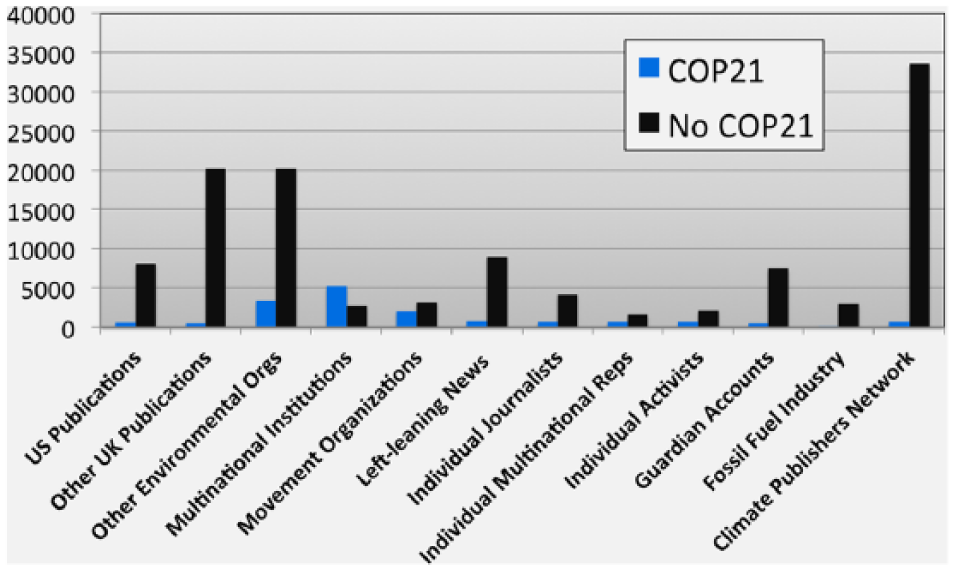
Volume of Twitter posts about COP21 by climate stakeholder category.
Among media categories, “left-leaning news” tweeted to the greatest degree about COP21 (7%). For the Guardian accounts, 5% of tweets dealt with COP21 and related topics, compared to 2% of tweets from other CPN members. Interestingly, the US publications devoted slightly more of their Twitter posting to COP21 than the Guardian (6%), while the Guardian posted about the summit at a rate more than double that of “other UK publications” (2%). Fossil fuel industry and trade group accounts largely bypassed discussion of COP21, with 3% of posts in this category mentioning the summit and related topics.
Climate Stakeholder COP21 Visual Tweets
The core question this study addressed was about the visual framing of climate change on Twitter during the Paris climate talks. Therefore, after isolating the tweets about COP21 and climate-related topics for each climate stakeholder category, we first investigated the extent to which these posts included visuals. A chi-square test of independence was conducted, showing a statistically significant relationship between the variables of “climate stakeholder category” and “visual social media,” χ2 (df = 11, N = 12,699) = 764.214, p = .000. Cramer’s V = .245, p = .000. For all climate stakeholder categories, the majority of COP21 tweets included visuals (see Figure 3). Thus, hypothesis one is supported.

Visual Twitter posts about COP21 by climate stakeholder category.
Our second research question dealt with how climate stakeholders framed climate change in visual tweets during the COP21 talks, which functioned as a focusing event on climate change. To address this research question, we tested whether or not there was a statistically significant difference in the discussion and visualization of climate framing across the 12 types of climate stakeholders (see Table 1). A chi-square test of independence was conducted. A significant relationship was found between climate stakeholder category and climate framing, χ2 (df = 121, N = 9,477) = 3,986.991, p = .000 (see Figure 4). The 54 tweets coded as not applicable, less than 1% of the total number of visual tweets, were excluded from the chi-square analysis. The relationship between climate stakeholder category and climate change framing is fairly strong (Pallant, 2013), indicating statistically significant differences in the proportions across the 12 categories (Cramer’s V = .196, p = .000).
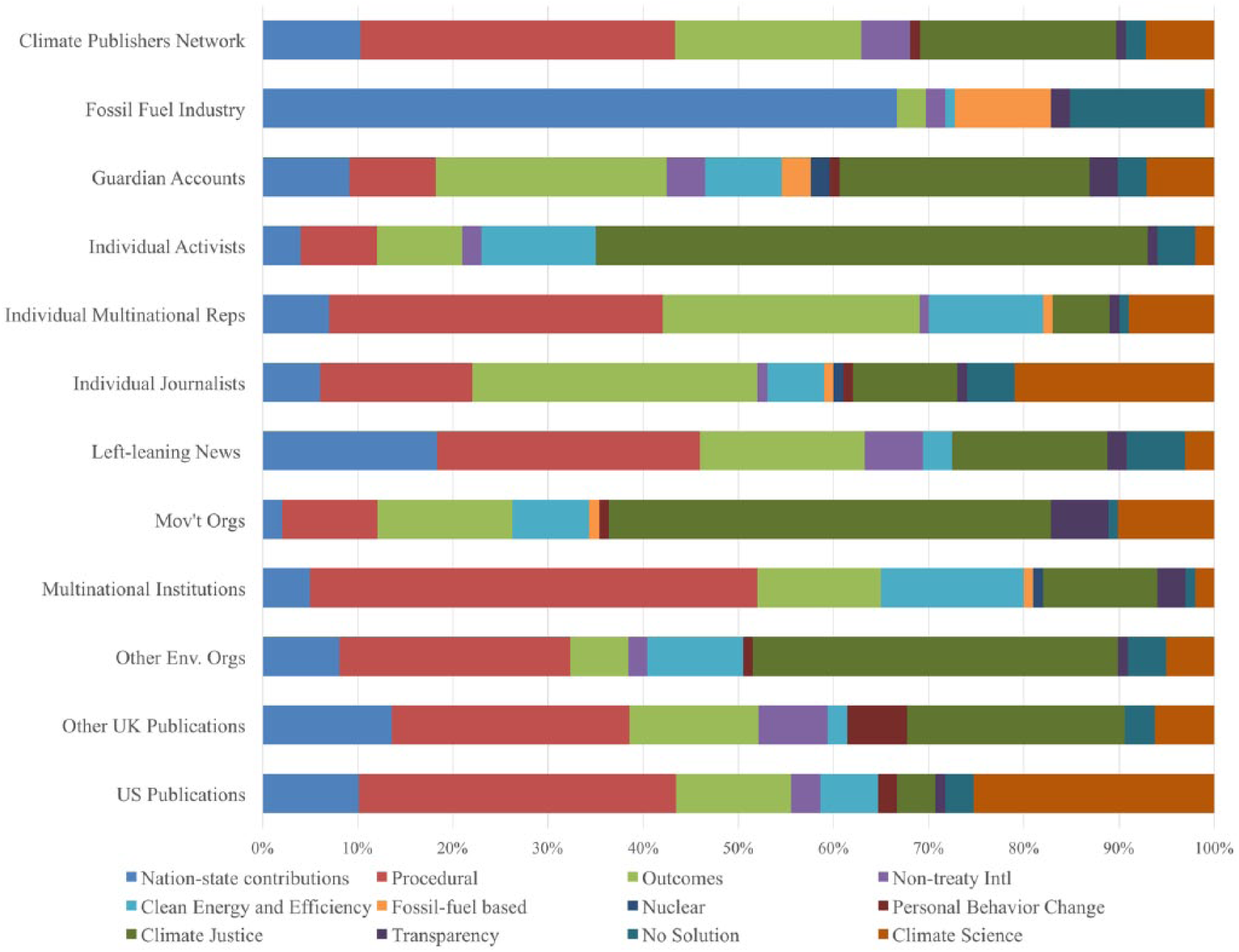
COP21 climate frames discussed by climate stakeholder category.
For the Guardian, the observed values of international treaty procedural and clean energy posts were lower than would be expected by chance and the proportions of international treaty nation-state contributions and outcomes, as well as non-treaty international, fossil fuel-based, nuclear, and climate justice posts are higher than would be expected by chance. Guardian posts about climate science, financial transparency, personal behavior change, and those with no solution were as expected by chance.
For the other news media categories (US publications, other UK publications, left-leaning news, and CPN), the proportions of international treaty nation-state contribution, procedural, and non-treaty international posts were higher than would be expected by chance. For these media categories, the observed values of climate justice tweets were lower than would be expected by chance alone. There were differences among the media categories in terms of discussion of climate science and research, with US publications being higher than expected, left-leaning publications being lower than expected, and other UK publications and CPN being about as expected by chance.
For multinational organizational accounts, nearly half (46.8%) of the posts in this category were international treaty procedural, nearly double the proportion that would be expected by chance. International treaty nation-state contributions, outcomes, non-treaty international, personal behavior change (none), climate justice, no climate solution, and climate science posts were lower than expected by chance. Posts about financial transparency, nuclear, fossil fuel-based, clean energy and efficiency were higher than expected by random chance. The majority of visual tweets from multinational organization accounts dealt with real-time updates of conference logistics and procedural matters related to the ongoing negotiations. Posts also conveyed a sense of hope that it is possible, and urgent, to act now on climate change mitigation and adaption. For example, in a visual tweet praising the successful outcome of the talks the official UNFCCC account (@UNFCCC) posted a tweet emphasizing collective responsibility and action to tackle climate change, as well as a sense of hope for the future for people globally with the Paris Agreement (see Figure 5).

@UNFCCC Paris climate talks “Outcomes—International Treaty” visual tweet.
For social movement organizational accounts and other environmental organizations, international treaty procedural and outcomes, as well as nuclear, were lower than expected by chance. Posts about climate justice were higher than expected by chance. Notably, the two categories differed on climate science, with movement organizations being higher than expected, while other environmental organizations were lower than expected. On clean energy and efficiency, other environmental organizations were higher than expected by chance, while movement organizations were lower.
For the individual climate stakeholder categories, individual journalists and activists were lower on international treaty procedural, while the individual multinational representatives category was higher than expected. Individual journalists and multinational representatives were higher on treaty outcomes, while the individual activists category was lower than expected by chance. For discussion of climate justice, individual activists were higher than expected by chance, while individual journalists and multinational representatives were lower. For an example of individual activists’ tweets about “climate justice,” refer to Figure 6 for a post from 350.org Strategic Communications Director and Co-Founder Jamie Henn’s (@Agent350) Twitter handle, of then-Greenpeace International Executive Director Kumi Naidoo pressing for urgent climate action at a protest during the ongoing Paris climate talks. The visual tweet conveys a sense of urgency to act on climate change, as well as climate change as an ethical and moral issue. In the picture embedded in the post, climate activists are holding signs calling for a lower 1.5°C target in the Paris Agreement, as well as other climate justice concerns. Many of the visual tweets from individual climate activists, as well as other climate stakeholder categories, included imagery of protests and demonstrations inside conference venues. Finally, individual activists were lower than expected on climate science, while individual journalists and multinational representatives were higher than expected by chance.

@Agent350 “Climate Justice” visual tweet of then-Greenpeace International Executive Director Kumi Naidoo addressing press during a protest at the Paris climate talks.
For fossil fuel industry and trade groups posts, the majority of posts were about nation-state contributions, specifically focused on then US President Barack Obama’s engagement with the international community on climate action and presenting perceived lack of support for his climate policies domestically. 1 In addition, “no climate solution” and “fossil fuel-based” frames are also higher than expected by chance. International treaty procedural (none), COP21 outcomes, clean energy, nuclear (none), personal behavior change (none), climate justice (none), and climate science were lower than expected by chance. Non-treaty international and financial transparency are about what is expected by chance.
Discussion
News media are important ways that individuals learn about climate change (Brüggemann, 2017), at the same time that opinion leaders hold sway over public sentiment on climate issues (Nisbet & Kotcher, 2009). Social media apps and platforms are increasingly the hybrid media spaces (see Chadwick, 2017) where individuals are encountering news and information on a diverse range of topics, including climate issues. The Pew Research Center has found that two out of three US adults get news through social media, while nearly three-quarters (74%) of Twitter users get news through the platform (Shearer & Gottfried, 2017).
While UNFCCC multinational negotiations on international climate policy function as “focusing events” (Birkland, 1998) to heighten attention to climate change, past research on the framing of climate change has been based largely on samples of traditional press coverage. Meanwhile, scholarship on climate visuals has looked at imagery removed from the textual context with which they are viewed. Images need to be studied along with the textual, contextual information that accompany them. In this study, we have chosen to address this gap in the literature.
We chose the climate stakeholder categories included in this study to represent varied perspectives about climate visual framing on social media during the Paris climate talks. Past research has shown that visuals are an important factor in how individuals perceive and are motivated (or not) to act on climate change (Chapman et al., 2016; Leiserowitz, 2006). Such perceptions underlie the ability of the international community to build a broad social and political consensus for climate action at the local, nation-state, and international policy levels. Effective climate action necessitates the buy-in of a range of stakeholders, from nation-states, multinational organizations, and civil society to business and industry. Our study was unique in that we included fossil fuel industry and trade association accounts in our sample, as part of a climate stakeholder category. Our findings show that these fossil fuel industry accounts were the major outliers, with implications for addressing global climate change. Fossil fuel-based frames, as well as nuclear technology and bilateral agreements between nation-states received little discussion overall in audiovisual Twitter posts during COP21.
Our conclusions add a holistic understanding of the framing of climate change through visual tweets during the COP21 Paris climate talks. They do not enable us to address how audiences at the time perceived those depictions. In addition, the visual tweets were studied apart from the fluid environment of a Twitter news stream and similar contexts through which they were originally viewed. This study is neither generalizable to all of Twitter nor to all posting happening about COP21 within the platform. What we provide is a close read, through iterative, manual coding of a purposeful sample of climate stakeholders during a significant focusing event that allows us to draw conclusions about their visual climate communication practices on Twitter.
Furthermore, this study builds on prior research about climate imagery in several ways. First, while most studies have focused on the visual depiction of climate change in traditional mass media, such as newspapers (DiFrancesco & Young, 2011; Duan et al., 2017; Smith & Joffe, 2009), our study focuses on the visual depiction of climate change via social media. Second, we do so in a holistic manner, taking into account the relationship between textual and visual information in social media posts. Third, as social media applications continue to gain prominence as spaces for the discussion of the social, political, and environmental consequences of climate change, our study extends research on climate framing in the media into the realm of visual social media. And fourth, we examined the ways in which influential stakeholders choose to frame climate change through visual social media in attempts “to make the significant interesting” (Painter, 2010).
The Paris Agreement went into effect on 4 November 2016 (UNFCCC, n.d.). On 1 June 2017, US President Donald Trump announced his decision to withdraw the United States from the agreement—a decision that now casts doubt on the ability of the international community to accomplish the agreement’s stated goals (Halper & Zavis, 2017). Looking forward, we foresee several directions for future research. It would be interesting to probe whether any novel narratives on climate change have arisen in the wake of President Trump’s announcement of his intention to withdraw the United States from the agreement. Anticipating this announcement by the executive branch, a broad coalition of US states, cities, business and industry leaders, as well as universities quickly reacted by announcing their intention to uphold the United States climate action commitments made under the 2015 Paris climate agreement. More than a dozen US states have joined the US Climate Alliance and more than 300 mayors of US cities have committed to upholding the Paris Agreement, joined by thousands of tribal, industry, and university leaders who have signed-on to the “We Are Still In” coalition committed to keeping global warming below 2°C. The coalition represents 120 million Americans and US$6.2 trillion of the US economy (Sheehan Perkins, 2017).
The climate stakeholder landscape may also be undergoing significant change as a result of Trump’s announcement. The emergence of this coalition is an example of how the visual rhetoric about climate may evolve in light of Trump’s announcement, at least in the United States. Such visual rhetoric may emphasize local efforts that aspire to meet the country’s Paris Agreement goals even as the country is slated to formally withdraw from it when eligible. Research into the visual framing of climate change should also expand to other social media platforms that rely heavily on visuals, such as Facebook or Instagram. Such studies would build on this research to give scholars, civil society actors, and policymakers a more holistic view of how climate change is being depicted.
Conclusion
The outcome of the COP21 summit, the Paris accord, was heralded as a landmark advancement in addressing climate change. Individual activists and movement organizations functioned similarly in their framing of climate change, as did individual and organizational multinational representatives and scientific experts. The visual tweets about climate justice on the part of climate stakeholders is noteworthy, given that a more ambitious target of limiting global warming to 1.5°C above pre-industrial levels gained traction during the Paris climate talks and was included as an aspirational target in the final text of the Paris Agreement.
This study contributes to ongoing climate policy conversations by deepening scholarly understanding of how media organizations and other climate stakeholders discussed and visualized climate frames as “condensing symbols” (Gamson & Stuart, 1992) on Twitter during the 2015 Paris climate negotiations. To draw attention to climate issues, climate change communicators using social media apps and platforms for social good need to move beyond imagery of protests and the logistical matters of international negotiations, such as the Paris climate talks, and tell visual stories of how people around the world are impacted by climate change, as well as provide concrete actions individuals can take in their daily lives to make a difference toward mitigation and adaptation (see Chapman et al., 2016; Corner, 2016). In short, visual climate change imagery on social media needs to connect climate impacts to the daily lives of billions of people around the world.
Footnotes
Acknowledgements
The authors would like to thank Ariel Wagner for assistance with coding and the anonymous reviewers for helping improve this article.
Declaration of Conflicting Interests
The author(s) declared no potential conflicts of interest with respect to the research, authorship, and/or publication of this article.
Funding
The author(s) disclosed receipt of the following financial support for the research, authorship, and/or publication of this article: This research was funded through research grants from DePaul University and the University of Texas at San Antonio.
