




Abstract
The aim of this study is to examine the relationship between Facebook use, appearance comparison with peers, and body image concerns among young Korean women. Focusing on two major types of social media activities (i.e., profile maintenance, social grooming), this study investigated whether these specific types of user activities would be significantly related to greater appearance comparison with peers, and in turn, would be linked to increased levels of body image concerns. An online survey (N = 305) was conducted among young Korean women (aged 18–29) in Korea. Results indicated that the frequency with which Korean female participants engaged in profile maintenance and social grooming activities on Facebook was positively associated with appearance comparison with peers, and the mediation analysis revealed that appearance comparison mediated the relationship between Facebook use variables and body image concerns, such as lower weight satisfaction and greater drive for thinness. Theoretical and practical implications for these findings are further discussed.
Keywords
Over the past decades, a substantial body of scholarship has emerged on the topic of body image. Body image is defined as the mental image that a person has of his or her body (Grogan, 2008). Because body image is based on one’s own perceptions or feelings, individuals often develop misconceptions of their bodies and perceive themselves as being unattractive regardless of their actual size or shape (Myers & Biocca, 1992). Negative body image poses a significant risk on both physical and mental health, involving low self-esteem, depression, anxiety, and eating disorders (Paxton, Neumark-Sztainer, Hannan, & Eisenberg, 2006).
The media have been generally accepted as one of the primary sociocultural sources reinforcing the thin-ideal and promoting body image problems (Grabe, Ward, & Hyde, 2008). While the prior literature mainly focused on exposure to traditional forms of media, notably television and magazines (e.g., Groesz, Levine, & Murnen, 2002; Harrison & Cantor, 1997), a growing number of studies have started to explore a link between social media use and body image concerns over the past few years. These studies have shown that the use of social media such as Facebook is significantly associated with body image concerns among adolescent girls and young women (e.g., Smith, Hames, & Joiner, 2013; Tiggemann & Slater, 2013).
Despite growing empirical evidence of the social media-body image relationship, there are several aspects that are relatively understudied. First, the specific types of social media use need to be identified when it comes to exploring the relationship between social media and body image concerns. In fact, the use of social media itself is not homogeneous, as it may vary widely from crafting one’s own profile (e.g., posting photos and status updates) to interacting with other users’ content (e.g., clicking “like,” and commenting on others’ posts). Moreover, the nature of social media use can be understood as a more interactive process of communication as compared to the passive consumption of traditional media content: different from the traditional media environment where people are exposed to content passively, the social media environment affords users greater interactivity that allows them to create and share their own media content and also respond to content created by others (Perloff, 2014). Therefore, in line with an increasing call for more nuanced measures of social media use (e.g., Manago, Ward, Lemm, Reed, & Seabrook, 2015; Santarossa & Woodruff, 2017), the current study aims to move away from measures of overall use and examine the distinctive attributes of social media use particularly relevant to body image perceptions.
Second, to date, it is relatively unknown whether and how social media use is associated with body image concerns among Asian women, as the majority of prior studies have focused on body image experiences in Western contexts, predominantly among Caucasian women. In particular, despite the fact that Facebook penetration rate has rapidly increased among young Koreans in their 20s (Korea Information Society Development Institute, 2016) and may have implications on their physical self-perceptions, to our knowledge, only a few studies have been conducted in this context. Moreover, studies examining the mechanism underlying the aforementioned relationship are comparatively lesser. Although some recent studies conducted in the sample of Korean women have suggested initial empirical evidence on the link between social media use and body image (e.g., Lee, Lee, Choi, Kim, & Han, 2014), little scholarly efforts have been made to identify the potential mediator explaining this link and investigate how specific types of Facebook activities are related to such mechanism. Therefore, the present study aims to focus on social comparison as the key underlying mechanism linking Facebook use with body image concerns, and explores whether engagement with the specific types of activities—profile maintenance and social grooming—would be associated with increased levels of appearance-related social comparison and consequently related to body image concerns among young Korean women.
Literature Review
Social Media Use and Body Image
With the proliferation of social media platforms, social media use has quickly become an integral part of many individuals’ lives around the world (Pew Research Center, 2016). Given the extensive use of social media, there have been growing concerns about the problematic implications of using social media. The focus group interview conducted by Fox and Moreland (2015), for example, uncovered the dark side of social media use that might increase the psychological distress and negative relational experiences.
An emerging body of literature has investigated the association between social media use and body image. Several recent studies have shown a significant link between Facebook use and body image concerns. Tiggemann and Slater (2013), for example, found that time spent on Facebook was positively correlated with body image concerns including the internalization of the thin ideal, body surveillance, and the drive for thinness among adolescent girls. Similarly, Mabe, Forney, and Keel (2014) found that the length of time spent on Facebook was associated with greater eating disorder symptoms among female undergraduate students. In addition, Fardouly and Vartanian (2015) suggested that overall Facebook use, involving the time spent on Facebook and the frequency of checking accounts, was related to increased levels of appearance comparison, body dissatisfaction, and the drive for thinness among female undergraduate students.
On the other hand, other studies have proposed different findings related to the measures of social media use and on how these measures are linked to body image. In their detailed examination of Facebook components, Meier and Gray (2014) found that engaging in photo-based activities on Facebook was related to body image concerns among adolescent girls, whereas overall time spent on this site was not. They found that the extent to which users engage in specific photo activities, for example, posting and sharing more photos of oneself and friends, was significantly associated with greater self-objectification, lower weight satisfaction, and higher drive for thinness (Meier & Gray, 2014). Another study by Kim and Chock (2015) also reported that specific aspects of Facebook usage could be more significantly related to body image perceptions than total exposure time, particularly showing that engagement in socializing behaviors, or “social grooming” (i.e., liking and making comments on friends’ profiles) predicted greater appearance comparison and drive for thinness.
This issue of measuring social media use is particularly important given that the nature of using social media may be more complex than that of traditional forms of media (Prieler & Choi, 2014). Compared to traditional mass media that only allow for the passive consumption, social media allow users to create their online profiles which they can utilize to portray themselves and cultivate connections with other users (Perloff, 2014). Moreover, social media facilitate active engagement with content created by other users, for instance, allowing users to give feedback to others’ posts (e.g., liking, commenting). In this respect, in the social media environment, users have the capacity to decide on how to present themselves and interact with others.
Given that social media enable users to play a more active role in the communication process and determine the nature and the extent of their own engagement in online interactions, measures of overall use may not adequately account for an array of interactive components existing on these platforms (Holland & Tiggemann, 2016). Therefore, to have a clearer understanding of how social media use is related to body image, it is important to examine more specific ways in which users participate in these sites.
Social Media Use for Profile Maintenance and Social Grooming
This study focuses on two major forms of social media activities profile maintenance and social grooming. First, profile maintenance refers to the activity of presenting oneself on social media. The unique affordances of computer-mediated communication—asynchronicity and editability—allow users to present themselves in selective, self-serving ways (Walther, 2007). Social media profiles, in particular, enable users to carefully craft their online portrayals (Zhao, Grasmuck, & Martin, 2008). The visual cues, such as photographs, are utilized for selective self-presentation, as those visual elements can be easily selected and edited (Toma & Hancock, 2010). It has been found that social media users are inclined to put a lot of efforts into the presentation of their best images, carefully selecting their photos and often enhancing those images (Manago, Graham, Greenfield, & Salimkhan, 2008).
This activity of profile maintenance may provoke body image concerns because it can increase the opportunity for an individual to scrutinize one’s own appearance. Chae (2017) found that engaging in photo activities (e.g., selfies) might lead young women to take a closer look into their own appearance and become more self-aware of how they look (i.e., high accessibility). This study claimed that greater exposure to self-image could provide more opportunity for women to examine their appearance with critical eyes, hence motivating them to evaluate themselves in comparison with other users for self-improvement (Chae, 2017). In this vein, it is possible to speculate that the frequency of posting photos and editing one’s own profile can be a significant factor linking to body image perceptions.
Another key aspect of social media use is social grooming. Social grooming refers to the activity of forging and maintaining relationships (Tufekci, 2008). According to Tufekci (2008), it can be understood as both a bonding and competitive activity—allowing individuals to not only affirm social ties but also verify and improve their own status. On social media, social grooming appears in the form of social engagement behaviors, such as checking other users’ profiles, liking, or leaving comments on their posts (Utz & Beukeboom, 2011).
At the core of these social grooming activities, there is a component of signaling attention to others (Ellison, Vitak, Gray, & Lampe, 2014). Ellison et al. (2014) argued that social grooming behaviors serve to signal attention to others, and especially, in the social media environment where nonverbal cues are unavailable, users typically respond to others by leaving “an observable marker of attention” (i.e., likes, comments) (p. 858). More importantly, engaging in such activity can create expectations of mutual attention (Ellison et al., 2014; Tufekci, 2008). For example, when users click the “like” button or leave comments on other users’ profiles, they might also want others to express reciprocal attention to their profiles.
This activity of social grooming may particularly stimulate body image concerns because it can increase the chance to encounter others’ profiles and their “ideal” images (Kim & Chock, 2015). Viewing others’ profiles and signaling attention to their attractive images may evoke individuals’ desire for mutual acknowledgment. In this respect, to construct more attractive images that can be approved by other users, individuals may be more likely to evaluate their appearance in comparison with others, which in turn may be significantly linked to their body image perceptions.
The Mediating Role of Social Comparison
A key underlying mechanism that accounts for the relationship between media use and body image is social comparison. Festinger’s (1954) social comparison theory posits that humans have a natural drive to compare themselves to others to evaluate where they stand. He stated that people are inclined to engage in a social comparison behavior, especially when objective means for self-evaluation are unavailable (Festinger, 1954). The direction of social comparison can be either upward or downward comparison: social comparison can be made with those who are perceived to be better off (upward comparison) or with those who are judged to be worse off (downward comparison) (Corcoran, Crusius, & Mussweiler, 2011).
Social media may increase the opportunity for engaging in social comparison processes due to the connectedness of the network and the visibility of other users’ profiles (Fox & Moreland, 2015). Particularly, given that social media enable selective and positive self-presentation (Zhao et al., 2008), individuals who are exposed to such online self-presentation may develop the perception that others are better off (Frison & Eggermont, 2016). In line with this, several studies have indeed indicated that the use of social media sites can trigger upward social comparison (Chou & Edge, 2012; Vogel, Rose, Roberts, & Eckles, 2014). Chou and Edge (2012) found that frequent Facebook users tended to believe that others were happier and they had better lives than themselves. Vogel et al. (2014) also supported this claim, showing that participants who were exposed to a social media profile that emphasizes the target user’s personal (e.g., photos and status updates conveying personal attributes) and social attractiveness (e.g., the number of likes and comments displaying social connections) reported greater tendency of engaging in upward comparison, in turn resulting in negative self-evaluations.
The process of social comparison triggered by social media use can be detrimental to individuals’ body image perceptions. Social media profiles usually feature the images of attractive peers (e.g., digitally retouched pictures, edited selfies), and making comparisons with such “ideal” images may lead to the negative evaluation of one’s own appearance (Perloff, 2014). Unlike the images of professional models or celebrities featured in the traditional forms of media, the images of peers encountered on social media can be seen as more attainable comparison targets (Fardouly, Diedrichs, Vartanian, & Halliwell, 2015). In support, some research has shown that comparison to peers may have a stronger association with body image than comparison to media models because of the perceived attainability of their appearance (Carey, Donaghue, & Broderick, 2014).
Recent studies have demonstrated that comparison with the images of peers on social media was significantly related to negative body image (Ho, Lee, & Liao, 2016), and particularly revealed that the effect of social media use on body image was mediated by upward comparison with peers (Fardouly & Vartanian, 2015; Kim & Chock, 2015). Fardouly and Vartanian (2015), for example, found that the frequency of social comparisons to close friends and distant peers on Facebook mediated the relationship between Facebook use and young women’s body image concerns (e.g., drive for thinness, body dissatisfaction). Similarly, Kim and Chock (2015) found that the propensity to engage in social comparison served as a mediator in linking Facebook use, particularly social grooming, and the drive for thinness among young adults. Taken together, these results indicate that social comparison can function as a key pathway through which social media use leads to negative body image and related outcomes.
Beyond Western Societies: The Importance of Korea
Prior research on the role of social media in body image has largely focused on Western contexts. A burgeoning literature has explored this link primarily in Western countries such as the United States, United Kingdom, Australia, and Netherlands (e.g., de Vries, Peter, Nikken, & de Graaf, 2014; Fardouly et al., 2015; Hummel & Smith, 2015), which predominantly focused on Caucasian women. However, thus far, relatively little research has investigated this topic in non-Western contexts, and especially there is a comparative deficiency of findings about the role of social media in Asian women’s body image, despite their growing concerns about body image and weight issues.
In fact, body image dissatisfaction and weight problems in Asian societies appear to be as nearly as common as they are in Western societies. It has long been considered that women from Asian societies are less likely to embrace the Western thin-ideal, as these societies traditionally associate thinness with poor health and poverty and tend to value round faces and mild plumpness as the female beauty (Han, 2003). However, this standard of attractiveness has considerably changed in Asian societies, while they have undergone rapid social change involving the growth of the market economy and the spread of Westernization (Jung & Forbes, 2007). Intense exposure to the Western media, portraying extremely thin female bodies and placing an emphasis on diet and weight control, played a vital role in instilling the thin body ideal into Asian women’s body image perceptions (Thompson, Heinberg, Altabe, & Tantleff-Dunn, 1999).
Body image dissatisfaction is also found to be prevalent in Korea. Western influences have begun to appear since the Korean conflict (1950–1953), and there were drastic changes in the social and economic life of Korea between 1980 and 2000 (Shin & Rutkowski, 2003). Due to the development of the market economy over the past several decades, Korea became a major economic and industrial powerhouse, which resulted in a sharp increase in real income and the rise of the consumerism (Shin & Rutkowski, 2003). What is noteworthy about changes in Korean society is that industrialization and modernization took place concurrently with the adoption of Western values and practices (Bissell & Chung, 2009; Park, 2007). The US media have functioned as a key source of transmitting Western norms into Koreans, and with the preponderance of the US media content depicting and praising thin female bodies, Koreans have assimilated their beauty standard into the Western thin-ideal (Bissell & Chung, 2009). Consequently, desire to be thin has become “a societal obsession” for Korean women (Han, 2003). Korean women, for example, reported the lowest body mass index (BMI) among the samples of 22 countries but expressed the greatest desire to lose weight (Wardle, Haase, & Steptoe, 2006). Jung and Lee’s (2006) study revealed that Korean women had greater importance on their appearance and were more critical of their bodies than US women. This phenomenon warrants more research attention on body image concerns among Korean women.
Moreover, in today’s media environment, where the ideal body images are made ubiquitous through social media, it is important to explore whether the growing body image concerns in Korea are possibly related to the increased use of social media. In Korea, often referred to as “the world’s most wired country” (Lankov, 2011), social media use has rapidly increased, and as of 2015, the penetration rate is 43.1%, which has risen more than twice as much as 16.8% in 2011 (Korea Information Society Development Institute, 2016). The list of popular social media platforms in Korea has increasingly become similar to the ones of Western countries, and the popularity of Facebook has continued to increase recently surpassing the usage of the local social media platform such as KakaoStory among young adults in their 20s (Nielsen Koreanclick, 2016). Compared to local platforms based on limited social networks with a few options of interfaces, Facebook’s technological affordance that expands social searching and provides an array of interactive features has appealed to the younger generation.
Along with the rapid growth of social media use in Korea, some recent studies have begun to explore what role social media may play in the development of Korean women’s body image. These earlier studies have found initial empirical evidence on the association between social media use and body image. Lee et al. (2014), for example, explored how the certain psychological needs for using social media—socializing, information seeking, and self-status seeking needs—are associated with body image evaluation among young Koreans. They found that information seeking was negatively related to body esteem, whereas self-status seeking was positively related to body esteem. More specific to the Facebook context, Lee, Taniguchi, Modica, and Park (2013) also found that Korean female participants who viewed the weight-related messages made by underweight peers on Facebook reported lower body image satisfaction than did those who viewed those messages made by overweight peers. Nevertheless, as yet, these studies conducted in Korea have not adequately accounted for the mechanism underlying the relationship between social media use and body image concerns. As discussed earlier, social comparison can be identified as the potential mechanism responsible for this relationship. In the context of Korean society, social comparison may function as a key factor because this tendency of social comparison is pronounced in Asian societies that value conformity to social norms (Chung & Mallery, 2000). Research has claimed that people who are in Asian societies are often motivated to meet the social standards (Markus & Kitayama, 1991), and they are hence likely to show a greater desire to make upward comparisons to ensure that they fit into those standards (Chung & Mallery, 2000). In line with this, this study focuses on social comparison as the key mediating mechanism, and attempts to examine how specific types of social media activities can be related to body image concerns through social comparison among young Korean women.
The Present Study
The present study conceptualizes the specific aspects of social media use—profile maintenance and social grooming—as distinct variables. Based on social comparison theory (Festinger, 1954) and in line with recent studies specific to the context of social media discussed earlier (e.g., Vogel et al., 2014), it was hypothesized that social media use for profile maintenance (H1a) and social grooming (H1b) would be significantly associated with greater tendency to compare one’s appearance to peers on social media. Also, aligned with prior research on the mediating process via social comparison (e.g., Fardouly & Vartanian, 2015), it was expected that appearance-related social comparison would be associated with heightened levels of body image concerns (H2), and appearance comparison would mediate the relationship between social media use variables and body image concerns (H3a for profile maintenance; H3b for social grooming).
Method
Participants and Procedure
An online survey was conducted among young women (aged 18–29) in Korea in July 2017. Participants were recruited by a Korean research company by using its registered online panels (N = 305). The average age of participants was 23.44 years (SD = 2.64). This study focused on young women in their 20s, because they are particularly vulnerable to appearance-related social pressure (Keel, Baxter, Heatherton, & Joiner, 2007), and they are frequent users of social media (Korea Information Society Development Institute, 2016). Participants’ reported mean BMI (kg/m2) was 20.95 (SD = 2.69). These values were within the normal healthy weight range. Of the participants, 56.1% of them answered that they completed college degree, 41.6% of them completed high school, and 2.3% of them completed graduate degree.
Among the survey company’s online panels (a total of 350,000 as of July 2017), the company randomly sent an email to 6,351 panel members, and 789 females checked the email. Finally, 305 female participants completed the online questionnaire. Participants were first asked to read the consent form, and after they agreed on participating in the study, they completed the questionnaire consisting of the four parts—social media use measures, appearance-related social comparison scale, body image scales, and demographic information.
Facebook was chosen for this study because this site has been reported to be the most popular social media platform among young Koreans in their 20s (Korea Information Society Development Institute, 2016). According to recent survey, it was found that there exists the stark generational divide in terms of social media usage in Korea, such that Facebook use has continued to grow and it is most used by the younger generation, whereas the locally based KakaoStory is mainly used by the older generation and its use has also declined in recent years (Nielsen Koreanclick, 2016). All participants had a Facebook account.
Measures
The questionnaire was administered in Korean. All the measures used in this survey were translated to Korean first by the bilingual investigator and then back translated by a bilingual research assistant to establish equivalence in meaning.
Facebook Use for Profile Maintenance
Participants were asked to report how often they engaged in self-presentation activities on Facebook (e.g., changing a profile, updating status, posting photos, editing profile photos) (1 = almost never, 7 = daily). Results of the exploratory factor analysis (EFA) showed that the six items were loaded on a single factor: one factor explained 72.26% of the variance (eigenvalue = 4.34). The items had high internal consistency reliability, and they were averaged to create a scale (α = .92, M = 2.23, SD = 1.18).
Facebook Use for Social Grooming
Participants reported how often they enacted social engagement behaviors on Facebook (e.g., clicking “like,” leaving messages, comments on the profiles of close friends/acquaintances) (1 = almost never, 7 = daily) (Kim & Chock, 2015). Results of the EFA showed that most of the items were loaded on the first factor (eigenvalue = 7.13), except for four items which are related to more passive ways of engaging with others on Facebook (i.e., visiting, browsing around profiles of people in or not in one’s network) (eigenvalue = 1.15). Given that prior research differentiated between passive and active Facebook use and suggested that those different types of Facebook use could lead to different perceptual outcomes (Frison & Eggermont, 2015), this result might have derived from the fact that participants could have viewed the items related to the passive use as the distinct construct. Moreover, the second factor explained much less variance than the first factor (10.49% vs. 64.82%), and its eigenvalue was only slightly larger than a single item. Thus, the four items were dropped, and the remaining seven items were averaged to create a scale (α = .93, M = 3.65, SD = 1.52).
Appearance Social Comparison
To assess participants’ tendency to compare their appearance to peers on Facebook, this study used the adapted version of Physical Appearance Comparison Scale (PACS) (Thompson, Heinberg, & Tantleff, 1991). While the original scale indicated general social situations such as events or parties, the wording of these items was revised to specify the Facebook context (Ho et al., 2016). Participants indicated the frequency with which they engaged in each of the following behaviors related to appearance comparison with peers on Facebook (1 = never, 7 = always); comparison target groups include close friends and acquaintances. Items for comparisons with close friends are “I tend to compare my physical appearance to the physical appearance of my close friends when I see new photos they share on Facebook,” “I sometimes compare my figure to the figures of my close friends when I see new photos they share on Facebook,” and “I compare how I am dressed to how my close friends are dressed when I see new photos they share on Facebook.” Comparisons with acquaintances were measured by similar statements which replaced “close friends” with “acquaintances.” The six items had high internal consistency reliability, and they were averaged to create a scale (α = .97, M = 2.91, SD = 1.61).
Body Image Concerns
Body image concerns were assessed by the two measures: weight satisfaction and the drive for thinness. The 8-item Weight Satisfaction subscale of the Body-Esteem Scale for Adolescents and Adults (BESAA) was used to assess how participants feel about their bodies and weights (Mendelson, Mendelson, & White, 2001). Participants rated how they feel about the statements on a 5-point Likert-type scale (1 = never, 5 = always) (e.g., “I really like what I weigh,” “Weighing myself depresses me (reverse-scored),” “I think I have a good body”]. Higher scores indicate greater weight satisfaction. The items for this subscale were averaged, with high internal consistency reliability (α = .86, M = 2.63, SD = 0.79). The 7-item Drive for Thinness subscale of the Eating Disorder Inventory (EDI; Garner, Olmstead, & Polivy, 1983) was also used to assess participants’ intense pursuit of thinness as well as their fears of being fat. Responses were measured on a 6-point scale (1 = never, 6 = always) (e.g., “I am terrified of gaining weight,” “I am preoccupied with the desire to be thinner”). Higher scores indicate greater drive for thinness. Internal consistency reliability for this subscale was high and the items were averaged (α = .89, M = 3.52, SD = 1.12).
Control Variables
Several variables—BMI, age, education, and overall Facebook use—were included as covariates. Since BMI was shown to be related to body image perceptions (Wilson, Latner, & Hayashi, 2013), it was incorporated as a control variable. Participants were asked to report their height and weight which were used to calculate BMI. In addition, demographic variables (i.e., age, education) were controlled because these variables have been found to be associated with social media use (Pew Research Center, 2015) and body image perceptions (Keel et al., 2007). Age was measured in years, and the level of education was measured with a question asking about the highest level of education completed (1 = middle school, 2 = high school, 3 = college degree, 4 = graduate degree) (M = 2.61, SD = 0.53). Finally, overall Facebook use was controlled, considering that it could be closely linked to the variables of interest, including the behaviors of profile maintenance and social grooming and body image variables; it was measured by asking two questions regarding the frequency of checking Facebook (1 = almost never, 2 = once a day, 3 = every few hr, 4 = every hr, 5 = every 30 min, 6 = every 10 min, 7 = every 5 min) and the time spent on Facebook (1 = 5 min or less, 2 = about 15 min, 3 = about 30 min, 4 = about 1 hr, 5 = about 2 hr, 6 = about 3 hr, 7 = 4 hr or more) (Fardouly & Vartanian, 2015). These indicators were highly correlated, so they were averaged to create a single measure (r = .66, p < .001, M = 2.82, SD = 1.26).
Results
The correlations between the measured variables, along with their means and standard deviations, are presented in Table 1. The preliminary correlation analyses showed that both Facebook use for profile maintenance (r = .40, p < .001) and Facebook use for social grooming (r = .44, p < .001) were significantly and positively correlated with appearance comparison with peers on Facebook, giving support for H1a and H1b. Consistent with H2, appearance-related social comparison on Facebook was also significantly correlated with body image concerns: it was negatively associated with weight satisfaction (r = –.18, p = .002), and was positively associated with the drive for thinness (r = .32, p < .001). Facebook use for social grooming was significantly associated with both weight satisfaction (r = –.15, p = .008) and the drive for thinness (r = .17, p = .002), whereas Facebook use for profile maintenance was not.
Correlations, means, and standard deviations of the variables (N = 305).
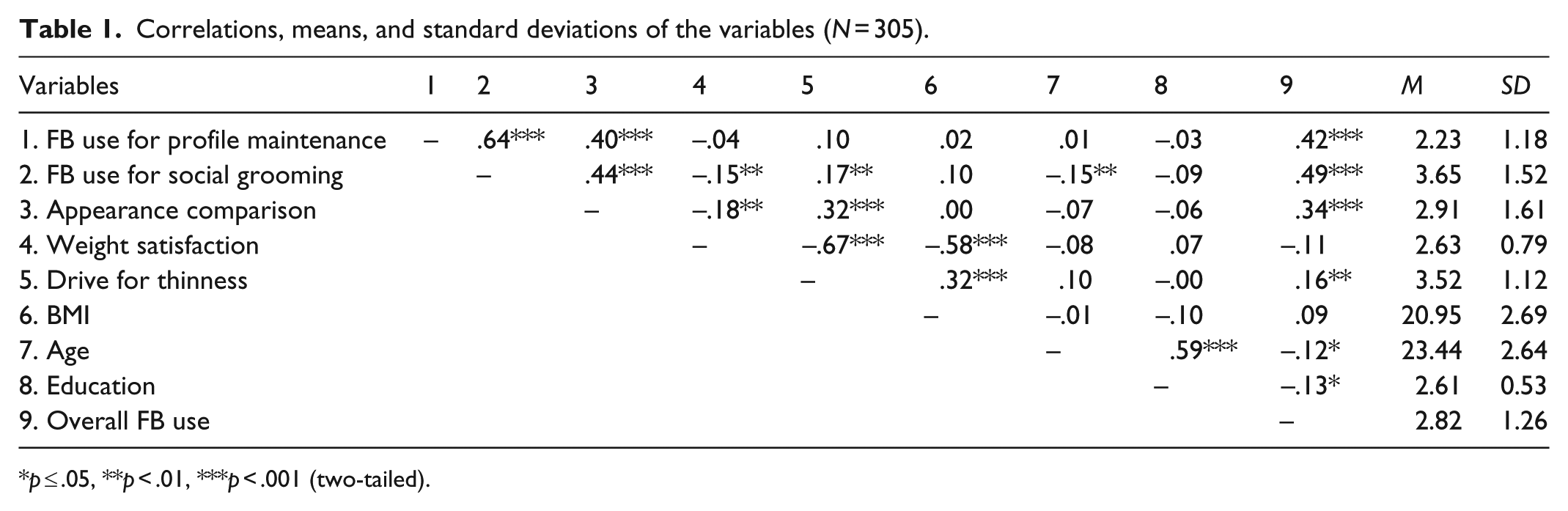
p ≤ .05, **p < .01, ***p < .001 (two-tailed).
Next, the present study tested the proposed mediated relationships using Model 4 of the PROCESS macro (Hayes, 2013) for SPSS with BMI, age, education, and overall Facebook use as covariates. The PROCESS macro uses the bootstrapping procedure which involves resampling and replacement “to generate an empirically derived representation of the sampling distribution of the indirect effect” (Hayes, 2013. p. 106). This mediation test makes it possible to yield inferences about an indirect effect without making assumptions about the shape of the sampling distribution (Hayes, 2013; Preacher & Hayes, 2004). Notably, in using this method, the initial correlation between the predictor variable and the outcome variable is not necessary for conducting the mediation analysis (Preacher & Hayes, 2004).
As illustrated in Figure 1, in line with H1a, the results showed that Facebook use for profile maintenance was positively associated with appearance comparison with peers on Facebook (b = .49, SE = .08, p < .001). In this model, appearance comparison with peers on Facebook was negatively associated with weight satisfaction (b = –.11, SE = .03, p < .001) and positively associated with the drive for thinness (b = .25, SE = .04, p < .001) (H2). The mediation analysis, using 95% bias-corrected confidence intervals with 10,000 bootstrap samples, revealed that appearance comparison with peers mediated the relationship between Facebook use for profile maintenance and weight satisfaction, b = –.06, SE = .02, 95% confidence interval (CI) = [–.092, –.028]; the CI did not include zero, indicating that the indirect path was considered significant. Appearance comparison also mediated the relationship between Facebook use for profile maintenance and the drive for thinness, b = .12, SE = .03, 95% CI = [.068, .184]. Thus, the data supported H3a.
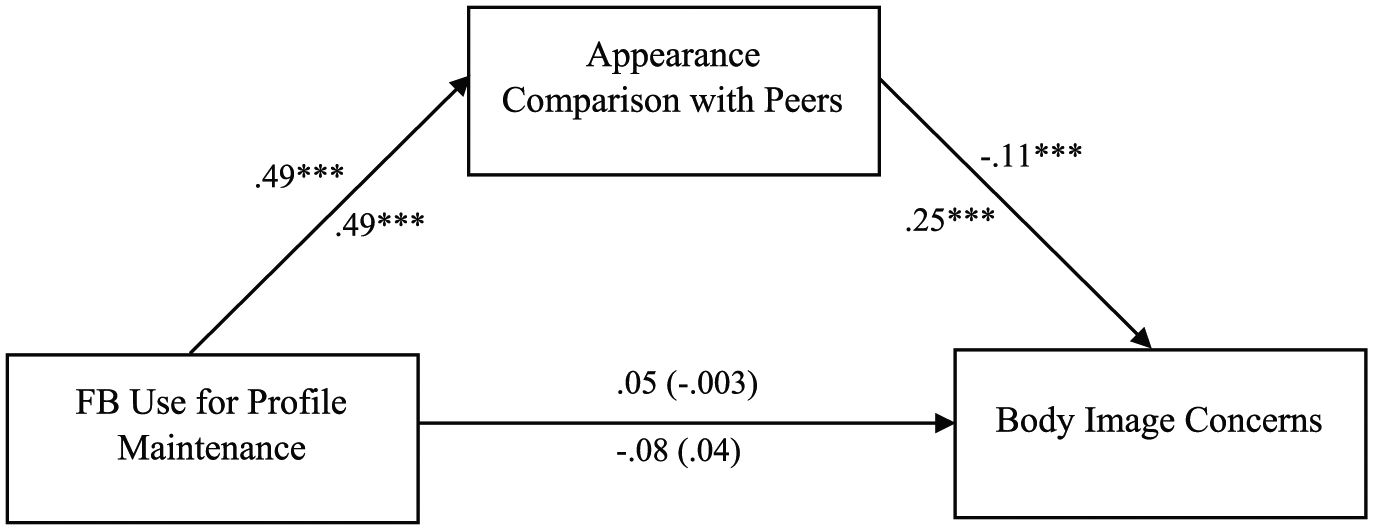
Mediational model for Facebook use for profile maintenance, appearance comparison, and body image concerns. All numbers represent standardized coefficients. Numbers inside parentheses are total effects of Facebook use for profile maintenance on body image concerns. Numbers above the arrows represent the coefficients for weight satisfaction, and numbers below the arrows represent the coefficients for the drive for thinness. *p ≤ .05, **p < .01, ***p < .001.
As Figure 2 shows, consistent with H1b, the results indicated that Facebook use for social grooming was positively associated with appearance comparison with peers on Facebook (b = .40, SE = .06, p < .001). In the model, appearance comparison with peers was negatively associated with weight satisfaction (b = -.10, SE = .03, p < .001), and positively associated with the drive for thinness (b = .22, SE = .04, p < .001) (H2). The mediation analysis revealed that appearance comparison mediated the relationship between Facebook use for social grooming and weight satisfaction, b = -.04, SE = .01, 95% CI = [–.066, –.018]. It was also found that appearance comparison mediated the relationship between Facebook use for social grooming and the drive for thinness, b = .09, SE = .02, 95% CI = [.051, .143]. The data supported H3b.
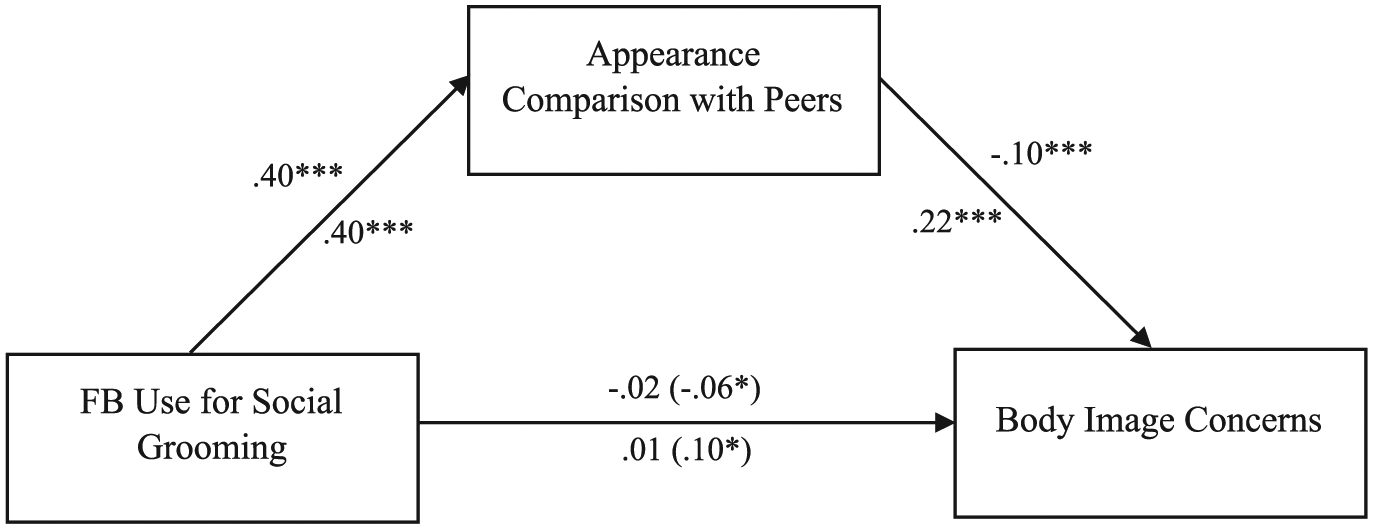
Mediational model for Facebook use for social grooming, appearance comparison, and body image concerns. All numbers represent standardized coefficients. Numbers inside parentheses are total effects of Facebook use for social grooming on body image concerns. Numbers above the arrows represent the coefficients for weight satisfaction, and numbers below the arrows represent the coefficients for the drive for thinness. *p ≤ .05, **p < .01, ***p < .001.
Discussion
The current study examined the relationship between social media use, appearance-related social comparison, and body image concerns among young Korean women. Specifically, considering the two types of social media activities (i.e., profile maintenance, social grooming), this study investigated whether engaging in those activities would be significantly related to greater appearance comparison with peers on social media and in turn, would be linked to increased body image concerns. As predicted, findings indicated that in the context of Facebook environment, the frequency with which female participants enacted these behaviors of self-presentation and social engagement was related to greater tendency to compare one’s appearance with peers on Facebook, and appearance comparison with peers was associated with lower weight satisfaction as well as greater drive for thinness. Furthermore, the mediation analysis confirmed that these relationships were mediated by appearance comparison.
These findings suggest that the examination of specific aspects of social media use helps provide clearer understanding of how social media use is linked to body image concerns. It is important to identify the particular types of activities because social media use can be more than just logging in. The use of social media involves a wide array of user activities from updating one’s own profile to responding to others’ posts. More importantly, it can be understood as a more complex, interactive process of communication: social media provide users with greater interactivity that enables them to not only become content sources but also engage with peer-generated content (Perloff, 2014). In other words, in the social media environment, users have the ability to decide on how they use and participate in this site. Given this nature of social media use, this study focused on more interactive components existing on the site and how they are related to body image perceptions.
The results of this study showed that engagement with two major forms of activities—profile maintenance and social grooming—was associated with greater tendency to compare one’s appearance with those of peers on Facebook, and in turn, linked to increased body image concerns such as lower weight satisfaction and greater drive for thinness. Findings indicated that those who frequently post photos and edit their profiles can have more opportunity to scrutinize their own appearance, which prompts them to engage in comparison with others for self-evaluation or improvement and thus contributes to negative perceptions of their own bodies. Enacting social grooming activities was also related to greater appearance comparison and body image concerns. Consistent with Kim and Chock (2015), findings suggested that those who often interact with others’ profiles (e.g., liking, leaving comments) can have the chance to encounter their peers’ idealized images. Moreover, signaling attention to those peer images can evoke the desire for mutual acknowledgment. Therefore, high levels of social engagement can drive women to seek greater appearance comparison to attractive peers and heighten their body image concerns.
In accordance with Festinger’s (1954) social comparison theory and prior research (e.g., Fardouly & Vartanian, 2015), the results demonstrated that appearance-related social comparison was the key mechanism underlying the relationship between social media use and body image: appearance comparison with peers on Facebook mediated the relationships between Facebook use variables and body image concerns. These results confirmed that peers served as salient comparison targets on Facebook, and such comparison to peers could have a significant association with women’s negative body image perceptions. As claimed by prior research (Fardouly et al., 2015), the images of peers can be seen as more relevant comparison targets than those of media models or celebrities. Peers are judged as having relatively similar attributes, and hence the level of their attractiveness may be perceived as more attainable compared to media models or celebrities. Moreover, unlike mass media depictions of thin models or glamorous celebrities which are substantially edited by professionals, women may ascribe a certain degree of realism to peers’ photos posted on social media, which may decrease persuasion defense mechanism (Ho et al., 2016). Therefore, peer comparison functions as a mediational pathway linking Facebook use with body image concerns among young women.
The findings of this study have implications for expanding scholarship on social media use and body image beyond Western contexts. Considering that prior research has predominantly focused on the samples of Caucasian women in Western societies, the current study examining the role of Facebook use in Korean women’s body image provides an important extension of findings in relation to the emerging body of literature. Importantly, this study further showed that the tendency of social comparison can be applicable to the exploration of Korean women’s body image experience on social media. Given that a few studies conducted in the sample of Koreans have not completely accounted for the mediating process (e.g., Lee et al., 2013; Lee et al., 2014), this study helps clarify the psychological mechanism underlying the relationship between social media use and Korean women’s body image and provides more detailed information about how specific types of user activities are related to such mechanism. But it is still necessary to make further exploration on the role of social comparison across Western and Asian societies. As previously mentioned, the tendency of social comparison may appear differently across cultural contexts, such that in comparison with people who are in Western societies, those who are in Asian societies that value social connectedness are more likely to consider fitting into shared social norms to be important (Markus & Kitayama, 1991) and show a higher tendency to engage in upward social comparison (Chung & Mallery, 2000). In this vein, it is possible to speculate that although the mediating role of social comparison may be universal, the degree to which social media use is linked to the social comparison process and accompanying body image concerns may vary across cultures. Therefore, future research needs to expand this research design into cross-cultural contexts and explore whether the mediating mechanism may differ by culture.
The limitations of this study should be recognized as well. First, given that this study is correlational in design, causal inferences cannot be ensured from the results. The relationship between engagement with Facebook activities, appearance comparison, and body image concerns may be bidirectional. For instance, women who have greater body image concerns may compare their appearance to peers on Facebook, and that may lead them to engage in more profile maintenance and social grooming behaviors. Future research needs to employ the longitudinal design to determine the causal direction of this relationship. Second, the examination of differences across various social media platforms warrants future research attention. Most of all, future research might consider examining more visual, image-focused social media sites, notably Instagram. Because Instagram is recently gaining popularity among young Korean women (Korea Information Society Development Institute, 2016) and the role of photo-based activities in influencing body image is evidenced by prior research (e.g., Meier & Gray, 2014), it is necessary to explore whether the use of Instagram contributes to the development of negative body image among Korean women. Furthermore, when it comes to examining Instagram use, various comparison targets including celebrities or social media influencers (i.e., ordinary users who present their images or lifestyles to a large number of followers) should be considered, because comparison to images of celebrities is particularly salient in this platform (Fardouly, Willburger, & Vartanian, 2018). It would be worthwhile to compare the differences among specific target groups (i.e., peers, celebrities, social media influencers) in terms of their relationships with body image concerns.
This study provides important insights into the role of Facebook use in intensifying appearance comparison with peers and the associated body image concerns among young Korean women. The current findings can have implications for not only stimulating the burgeoning line of research on social media and body image but also developing media literacy programs to combat negative body image and increase critical awareness of social media content and activities that may escalate appearance-related pressure.
Footnotes
Declaration of Conflicting Interests
The author(s) declared no potential conflicts of interest with respect to the research, authorship, and/or publication of this article.
Funding
The author(s) received no financial support for the research, authorship, and/or publication of this article.