




Abstract
The current debate about declining media trust is related not only to the disruptive changes in the media but also to the general decline of trust in institutions and politicians. This article combines the perspectives of media trust and political trust, by examining to what degree voters perceive politicians as “honest” in the contexts of various media and communication forms. Comparing the voters’ evaluation of politicians’ trustworthiness in talk shows, news interviews, speeches, flyers, social media, and opinion pieces makes it possible to measure the impact of media contexts on the level of trust. A key finding is that voters deem politicians as more honest in social media and opinion pieces, compared to talk shows and news interviews. Second, voters tend to evaluate politicians as more honest in the media formats they most often consume; a finding that confirms the virtuous circle theory; young people typically found politicians to be more dishonest in mainstream media compared to social media A third finding is that the voters tend to evaluate populist politicians as more authentic than traditional politicians and that female politicians were regarded as more authentic compared to male politicians. These findings have implications both for journalistic ideals for coverage of politics in and for political strategic communication.
Introduction
The current debate about declining trust in the media is related partly to the disruptive changes in the media and communication sector and partly to the general decline of trust in institutions and politicians. In the age of social media, access to information, commentaries, and opinions is not only more extensive but also more fragmented than before. The legitimacy of the media is contested from various perspectives and by various actors, including the president of the United States Donald Trump (2017), who has declared the media as the “enemy of the people.” The political leaders’ criticism of the media is nothing new and fairly paradoxical given their dependency of the media. However, social media represents a new arena for communicating directly with voters, which might reduce this dependency.
The established power of mainstream media is contested in light of new media platforms, new user patterns, and new economic models. To a degree, politicians have been provided with a new arena from which they can criticize the media, contest their power, and undermine their trust. Yet, politicians are still dependent on various—both editorial and user-generated—media formats to get their message across, and their images are constructed in a cross-media environment. In the so-called hybrid media system (Chadwick, 2013), voters are presented with politicians’ performances on various media platforms and across different genres, and they are thus able to evaluate the trustworthiness of the politicians in the context of various media environments.
While much of the research on trust in the media and politicians is based on studies from the United States, this article draws on a study conducted in Norway, a small Nordic country with a population of 5 million. Norway is an interesting case, because a relatively high level of social and political trust recognizes the country, and a media system based on institutionalized editorial freedom, and an active policy for the media (Syvertsen, Enli, Mjøs, & Moe, 2014).
This article examines voters’ trust in politicians and operationalizes trust as “honesty” and “authenticity,” aiming for conceptual clarity. The key research questions are to what degree do voters perceive politicians as honest and in what communicative format do they evaluate politicians as most dishonest/honest? What characterize the politicians whom voters’ perceive as most authentic, in the sense that they seem to perform “real,” and what are the implications for journalistic ideals for coverage of politics and for political strategic communication? These questions are analyzed on the basis of a survey conducted in Norway in June 2016, in which 1,013 citizens were asked about the trustworthiness of politicians in general and in specific communication contexts.
Trust, Honesty, and Authenticity
Tendencies such as globalization, digitalization, and individualization have increased the scholarly interest in trust across a wide range of disciplines, such as psychology, sociology, philosophy, management, marketing, communications, and journalism (see Jones, 2004; Kohring & Matthes, 2007; Livio & Cohen, 2016). In social sciences and media studies, research on trust can broadly be divided into three main realms: (a) media trust, the degree to which audiences trust or distrusts the media, particularly in light of the debate about fake news (Edelman, 2015; Jones, 2004; Mitchell, Gottfried, Barthel, & Shearer, 2016); (b) impact on political trust, the degree to which exposure to various media contents increases or decreases trust in politics and government (Avery, 2009; Bauman, 2000; Cappella & Jamieson, 1997; Moy & Scheufele, 2000; Putnam, 1995), and (c) performed politics, the degree to which politicians come across as authentic and trustworthy in the context of their media performances (Alexander, 2010; Craig, 2016; Enli, 2015; Parry-Giles, 2014; Seifert, 2012).
Media trust is generally hard to measure, not least because there is no agreed definition or measure of trust in the existing interdisciplinary literature on the topic. According to Fisher (2016), surveys of public trust in the media suffer from various definitional problems, of which the most common is that they do not provide a definition of trust to the informants (Edelman, 2015; Jones, 2004; Mitchell et al., 2016). Because there are plentiful of alternative definitions of trust, such as reliability, truthfulness, degree of bias, accuracy, and completeness, there is a risk that the informants interpret the questions differently. In a critical remark to these studies, Metzger, Flanagin, Eyal, Lemus, and McCann (2003) argue that the increasing measurement has perhaps come at the cost of developing clear conceptual definitions of media credibility that would be used to form a consistent operationalization of the concept.
Resulting in part from conceptual and methodological challenges, previous research failed to find consistent effects of demographic and political factors on audience trust in media. There is, for example, little consistency among existing studies of trust and the correlations between levels of trust and audience attributes, including demographic variables, ideological orientations, interpersonal characteristics, personal interest, and media consumption habits (Gronke & Cook, 2007; Livio & Cohen, 2016; Moehler & Singh, 2011). Particularly, inconsistent results have been found in studies of the impact of gender on media trust; according to Livio and Cohen (2016), studies have found that women trust the media more than men (Jones, 2004), that men trust the media more than women (Gronke & Cook, 2007), and that gender was insignificant (Bennett, Rhine, & Flickinger, 2001). Similarly, results have been inconsistent in studies measuring the impact of factors such as education and age on media trust (Bennett et al., 2001; Gronke & Cook, 2007).
Several studies have furthermore found that political interest, interpersonal trust, and exposure to television news and newspapers were positively correlated with trust in the media (Tsfati & Ariely, 2014). Media use have been investigated as a factor impacting the level of trust in the media, and a common finding is that exposure to the mainstream media was positively associated with trust in the media: The more people watch TV news and read newspapers, the more they trust the media (Jackob, 2010; Kiousis, 2001; Rimmer & Weaver, 1987; Tsfati & Ariely, 2014, p. 769; Tsfati & Cappella, 2003, 2005). Studies have demonstrated that many of the respondents who expressed low level of trust in public institutions, the government, and politicians also were equally skeptical of the media (Jones, 2004; Moy, Pfau, & Kahlor, 1999; Van Zoonen, 2012).
In the second strand of media research on trust, a dominant concern is the degree to which the media is responsible for the decline in public trust and civic engagement, and more specific, the degree to which exposure to specific media content increases or decreases trust in politicians, governments, and state institutions (Avery, 2009; Bauman, 2000; Cappella & Jamieson, 1997; Moy & Scheufele, 2000; Putnam, 1995). This research often refers to two contradictory positions: the videomalaise theory, arguing that the media contributes to increased cynicism and distrust in government (Robinson, 1975, 1976), and the virtuous circle theory, arguing that those who are politically engaged will use the media to gain more knowledge and, therefore, become even more engaged, while those who are not politically engaged will either avoid political news or mistrust the media to a degree that they are becoming even less engaged (Norris, 2000). Scholars have demonstrated that the impact of the media on political trust is relative, not only to demographics and their trust prior to media exposure but also to types of media and types of trust (Moy & Scheufele, 2000, p. 751). A key finding is that exposure to television had a more negative effect on trust and engagement, while exposure to newspapers had a more positive, or a neutral, effect (Avery, 2009; Moy & Scheufele, 2000; Putnam, 1995). More recent studies found that exposure to online news is positively associated with higher political trust, while exposure to news via social media content is related to lower degree of trust (Ceron, 2015). However, in social media, the politicians are also media producers, and the separation between media trust and political trust is no longer obvious; media trust studies have habitually divided between three distinct categories of trust: message credibility, referring to the trust in the information; source credibility, meaning the trust in the provider of the information; and media credibility, pointing to the medium or the channel through which the messages is communicated (Fisher, 2016; Kohring & Matthes, 2007). In social media, these three categories are increasingly dissolving; it is harder to separate the information, the source, and the medium; this is particularly evident in politicians’ social media accounts, in which the politicians provide information, serve as sources, and function as editors.
A third strand of research on trust is dealing with the trustworthiness of politicians as they engage in political communication and, in particular, their media performances. In media-saturated societies recognized by personalization of politics, a key criterion for being elected is to come across to the voters as a trustworthy and honest politician. The voters’ primary source of information about the candidates is the media performances to which they are exposed, and their opinions about politics are informed by how the politicians perform in various mediated contexts (Jamieson & Waldman, 2003; Sides & Vavreck, 2013; Vavreck, 2009). Given that voters get the majority of the information about politics and politicians through mediated communication, voters’ evaluation of politicians’ trustworthiness is an evaluation not solely of interpersonal trust but also of media trust as the politicians’ performances are framed and produced in accordance with media logics. According to philosopher Trilling (1972), being authentic is about being true to your inner self, while being genuine is being true to others. Drawing on this definition, Enli (2015) suggests the term performed authenticity, as a term describing how performing as an authentic politician is not (necessarily) about speaking the truth and being honest but about performance. Perhaps paradoxically, studies have identified rhetorical strategies which are often used by politicians who seemingly perform according to their inner self, such as spontaneity, intimacy, consistency, ordinariness, and amateurism (Enli, 2015, 2017). The role of authenticity as a measure of trust in politicians is disputed, not least in election campaigns, and, for example, Hillary Clinton (2017) writes in her post-election memoir What Happened:
In any case, this whole topic of ‘being real’ can feel very silly (. . .). Yet the issues of authenticity and likability had an impact on the most consequential election of our lifetime, and it will have impact on future ones. (p. 124)
Politicians adjust their image and agenda to appear more media friendly, and social media has provided politicians with a new platform to perform authenticity (Enli, 2015; Esser & Strömbäck, 2014). However, we know little about the degree to which voters think of politicians as authentic, in the meaning that they perform as themselves and in what mediated contexts they come across as most authentic.
Based on the above discussion, we operationalize the concept of trust as “honesty” and “realness.” While this operationalization of trust is not unproblematic, the ambition is to separate between “honesty,” referring to truthfulness of the politicians, and “realness,” as in the politicians’ performances as “themselves,” and thus examines two interrelated elements of how politicians are evaluated: how politicians relate to the truth and how they perform their role as politicians.
Data and Methods
Data for this study were collected from a web-based survey of a probability sample of 1,013 Norwegian citizens (response rate = 41.3%) and a representative sample of the population. The survey was conducted in June 2016, in collaboration with the research agency Kantar TNS. The respondents received an e-mail that provided a personalized link to an online questionnaire. Participants who had not already filled in the survey were reminded to do so after 5 days. As predictors for the measure of trust, the questionnaire included demographic variables such as gender (50.4% males), education (58% university educated or still in education, 14% vocational educated, and 23% high school diploma), and age (21% aged 18–29 years, 26% aged 30–44 years, 26% aged 45–59 years, 27% aged 60 years and above).
Trust was operationalized in two ways. First, the respondents were asked to evaluate politicians “honesty” in six different arenas for political communication on a 5-point scale, were 1 indicated “highly dishonest” and 5 indicated “very honest” (“How honest do you perceive politicians to be when they appear in . . .”). The six arenas of communication included talk shows, news interviews, opinion pieces, brochures/flyers, public speeches, and social media.
Second, the respondents were asked to evaluate politicians according to the notion of realness. This was done in two ways. An open question asked the respondents to mention the Norwegian politician whom they thought of as most “real” (“Which politician do you consider to be most real, meaning being themselves, regardless of your political sympathies?”). Then, we used a subsequent question, asking the respondents to rank 5 politicians out of a predefined list of 12 politician according to whom they thought of as most “real” (number 1 indicated “most real”). The list included party leaders in Norwegian parties, in addition to strategically selected profiled politicians. To measure this item, the first name mentioned was given 5 points, the second name 4 points, and so on. In the final question, the survey ask to what degree the informants thought of “realness” or “being themselves” as an important factor in the voting evaluating politicians (“How important is it that a politician come across as being themselves in order for you to vote for him/her?”), using a 5-point scale ranging from 1, “absolutely decisive,” to 5, “completely insignificant.”
Politicians Seem Most Honest in Social Media and Opinion Pieces
In this first part, we examine the general level of voters’ trust in politicians, meaning their performances and messages in different media genres. The respondents were asked to evaluate the politicians “honesty” in six different arenas for political communication: talk shows, public speeches, news interviews, flyers/brochures, social media, and opinion pieces. Among these communication forms, the largest percentage of the respondents evaluated politicians to be most honest in opinion pieces, flyers, and social media, while they were regarded as most dishonest in talk shows. Although more respondents view politicians to be “honest” in flyers than on social media (with a difference of 1%), fewer respondents view politicians as dishonest on social media than in flyers (with a difference of 9%). Since politicians, in general, were evaluated as more dishonest than honest, we will in the following analysis focus on opinion pieces and social media (Table 1).
Trust in Politicians in Various Communication Contexts.
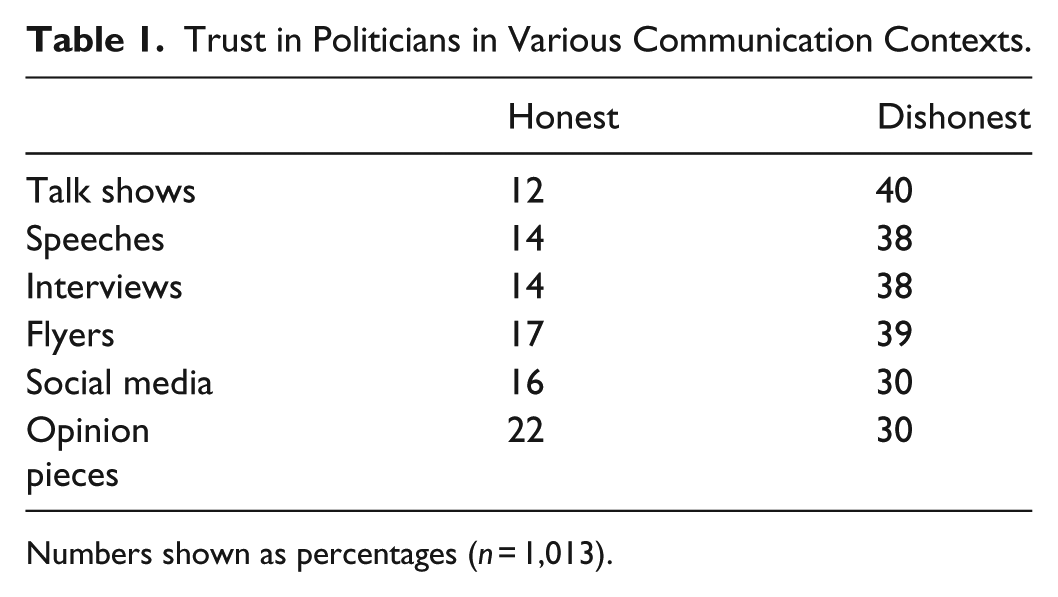
Numbers shown as percentages (n = 1,013).
There are several possible explanations for this finding. First, opinion pieces and social media have in common that the content can be classified as user generated, as they are not produced by media professionals but by individuals or groups who want to get their message across to a wider audience. Even though advisors often write opinion pieces signed by politicians, and communication staffers often update social media accounts of politicians, these media genres might give the impression that they are written by the politicians themselves. In contrast to the selected mainstream media formats (news interview and talk show), these user-generated contents provide the politicians with more control over the angle, framing, and rhetoric; for example, the news interview is more confrontational as the journalists often ask critical questions to which the politicians have to respond and defend themselves in ways that might seem dishonest. However, social media and opinion pieces are arenas where politicians can correct the mainstream media, and present their “honest” version of the story in a seemingly unmediated and unfiltered way. According to the Reuters Digital News Report 2017, a key motivation for news consumers to follow politicians on social media was that they preferred information that was unfiltered by journalists and the news media.
A second possible explanation is that social media are networked communication and that users contribute to the posts’ credibility through feedback and comments (Enli, 2015). People tend to trust their friends and relatives and thus also their online networks more than the corporate media; as demonstrated by Metzger, Flanagin, and Medders (2010, p. 420), social media networks often serve as verifiers of information, and media items that are recommended by known others—or by large aggregate of numbers of unknown others—are generally seen as more credible.
Third, social media is still “new media,” and the voters might be more likely to either trust or distrust politicians in the context of Facebook, Instagram, and Twitter. New media technologies challenge established trust relations and require new media literacy (Enli, 2015; Livingstone, 2005). Yet, after the first phase of uncertainty, there seems to be a shift in media trust, where users increasingly trust the new medium. Surveys have demonstrated higher trust in print media than electronic media in the United States until the 1960s when the dominance of television began to emerge (Abel & Wirth, 1977; Roper, 1969). The primacy of television as the most credible medium is often explained by the audio-visual medium’s indexical representation of reality, and the viewers’ experience as “seeing is believing.” The heydays of TV are iconic for the era of mass communication, in which the evening news gathered the nation, and the news anchors were among the nation’s most respected people (Newhagen & Nass, 1989; Spigel, 1992/2013). Since then, TV has dominated political communication, in which politicians are portrayed as not solely authoritative professionals but also celebrities (Brants, De Vreese, Möller, & Van Praag, 2010, p. 28). A factor that might explain the relative trust in politicians appearing on social media compared to classic genres such as the news interviews is that the authority of traditional media is contested in the context of the “hybrid media system.”
Among the alternatives presented for the respondents, the communication genre with least trustworthiness was the talk show, which from the 1990s onward became an arena for politicians to appeal to citizens with low or limited interest in politics by sharing private stories and acting informal, in the role as a celebrity politician (Lauerbach, 2007; Munson, 1993). Norwegian talk shows are not political talk shows or current affairs talk shows but general talk shows with a mix of guests, such as pop stars, actors, comedians, sports stars, and politicians. In these shows, the politicians are trying to come across as likable and authentic, but the format criteria demand an openhearted “backstage” persona, which is not always compatible with the role as a trustworthy politician. As such, the voters might find it hard to trust the performance of politicians in a highly staged setting, where the talk show host is controlling the conversation, and the politicians must deliver according to format criteria.
The process of political communication has been analyzed as three steps: “production” of politics, “self-presentation” of politics, and “media representation” of politics (see, for example, Esser, 2013). Related to these categories, flyers, speeches, opinion pieces, and social media belong to the second step, politicians’ self-presentation, while news interviews and talk shows would be seen as media representation. In the age of the hybrid media system, we would suggest to divide between the level of adaptation to a “media logic” also within the category of self-presentation: Speeches and flyers could be seen as more unmediated than social media and opinion pieces, because they do not require third party involvement, even though professionals often help political parties with speeches and flyers, they do not depend on the “media logic” in the same degree as opinion pieces and social media. The empirical findings demonstrate that voters do not deem the politicians as more trustworthy in self-presentation contexts, such as speeches and flyers, compared to media representation. In turn, this indicates that the trust in politicians is relatively parallel to the trust in the media. Moreover, the survey shows that flyers/brochures are deemed as more honest than speeches, which might indicate that the written formats are regarded as more authoritative and trustworthy than the spoken word.
Age Matters: Young People Are More Skeptical
The second research question we investigated relates to demographic factors and how they might influence on voters’ evaluations of politicians’ honesty in various mediated contexts. The most significant finding was that age seemed to be the most prominent factor; the voter segment of 60 years and above generally regarded the politicians as more honest compared to younger voters and, in particular, the segment of 30 years and below. The difference between age segments was also largest when they considered the honesty of politicians interviewed in the news, a finding that could be related to the fact that young people watch less TV news than the older age groups. Table 2 demonstrates that only 11% of voters younger than 45 years perceive politicians as honest in news interviews, while 21% of voters aged 60 years and above perceive politicians as honest in the same media format.
The Impact of Age on Trust in Politicians in Various Communication Contexts.
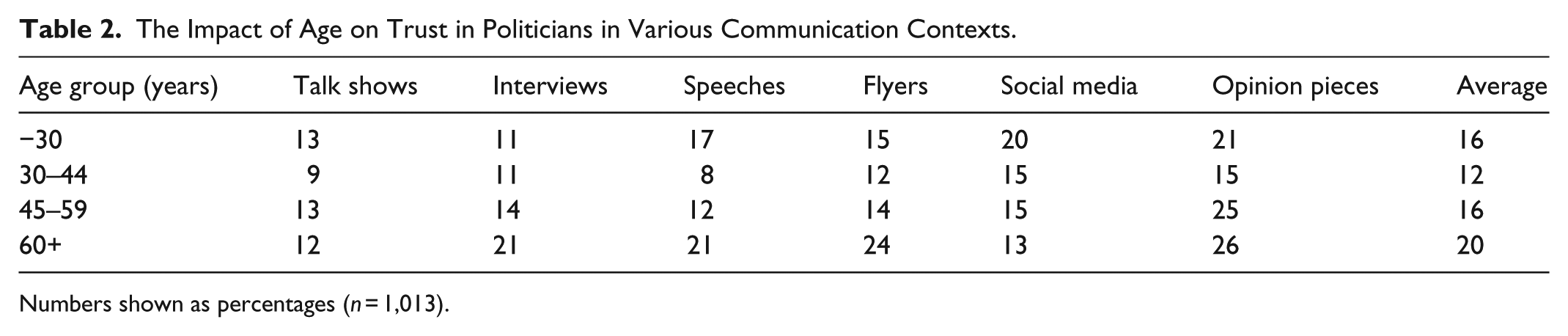
Numbers shown as percentages (n = 1,013).
The only media platform that is more trusted by voters in the age group 30 years and younger is social media, a finding that correlates with the comparatively higher social media usage in this demographic segment. However, even though the youngest voters are more likely to perceive politicians as honest when they appear on social media, this age group is also more likely to perceive politicians as dishonest on social media (Table 3). This paradox might be explained by the overall more skeptical attitude among the young voters and that the group is fairly polarized; they either trust politicians in social media or find them to be dishonest.
The Impact of Age on Distrust in Politicians in Various Contexts.

Numbers shown as percentages (n = 1,013).
As shown in Table 2, voters above 60 years are less likely to perceive politicians as dishonest, except when politicians appear in talk shows. This finding indicates that media consumption is a key factor in defining trust in the media; an explanation of why the younger age groups distrust the media more might be that they consume less political news, because, as argued by Tsfati and Ariely (2014, p. 769), the more people are exposed to mainstream media, the more they trust the media. As documented in a recent Norwegian study, voters who are 60 years or older are more loyal to evening news and newspapers than younger voters, and they generally consume a higher level of political news (Moe & Kleiven, 2016, p. 14). Similarly, a recent study of trust found while young Norwegian voters had high trust in a few specific news organizations, voters above 60 years had a significantly higher trust in the media in general (Trigger, 2016). These findings confirms international studies, such as the Reuters’ Digital News Report which found that, even after controlling for variables such as gender, income, education, and political beliefs, people over the age of 35 years had a higher trust in the news compared to younger citizens (Newman, Fletcher, Levy, & Nielsen, 2017).
Education Matters: Educated Voters Trust Politicians More
In addition to age, education is the second key factor impacting the voters’ trust in politician in the meaning of regarding them as honest when they communicate with voters in various media channels. Respondents with higher education are more likely to perceive politicians as honest; voters with more than 4 years of university or college education report more frequently that they consider politicians to be honest, compared to the voters without higher education.
The impact of education varies between different communication channels; while education is insignificant in voters’ evaluation of politicians’ performances in talk shows, education is highly significant in their evaluation of social media and opinion pieces. The most prominent trust gap between voters with higher education and voters with no education after primary school is found in the opinion piece; while 29% of the respondents with the highest university degree say they think politicians come across as honest in opinion pieces, only 5% of respondents with primary school as their highest completed education agree. A similar correlation between level of education and trust is found in the voters’ evaluation of politicians’ performance in news interviews; the higher the level of education, the higher trust the voter has in politicians interviewed by journalists. Even after we controlled for age, and the fact that some informants in the younger age groups are under education, the variable education was significant.
Voters with primary school as their highest completed education or vocational training seem to trust politicians when appearing in talk shows slightly more than when they appear in news interviews, but they find politicians to be most trustworthy in political speeches (Table 4). The preference of political speeches might be explained by the appeal of the spoken word above written texts and that these voters find politicians’ to be more trustworthy when they speak directly to a crowd.
The Impact of Education on Trust in Politicians in Various Contexts.

Numbers shown as percentages (n = 1,013).
As previously pointed out, the impact of gender on media trust has shown inconsistent results in previous studies (Livio & Cohen, 2016). Similarly, the study at hand found gender to be of limited importance as a demographic factor explaining the degree to which voters evaluate politicians as honest. Yet, a larger percentage of men evaluated politicians as dishonest in news interviews and on social media, while a larger share of women deemed politicians as dishonest in talk shows.
Populist Politicians Seem More Authentic
In this part of this article, we investigate voters’ evaluation of politicians as authentic or “real,” meaning the degree to which they think politicians come across as themselves. Consequently, the focus here is not on politicians’ honesty, as in their relation to the truth, but on politicians’ authenticity, as in their truthfulness to “their inner self” (see Enli, 2015; Trilling, 1972).
According to the literature on political communication, the political candidates’ authenticity has become an increasingly important factor in voting decisions (see, for example, Jamieson & Waldman, 2003). Therefore, we asked the respondents about how important the authenticity of the politicians was in terms of influencing their voting preferences. The survey findings were clearly supporting research literature; the large majority (67%) found it absolutely decisive (23%) or fairly important (53%) that the politicians come across as “themselves” and that this factor influence whom they voted for in elections.
Given the significance of politicians’ authenticity in their appeal to voters, it is relevant to investigate what kind of politicians the voters evaluate as most authentic and to what degree there are any key features defining these politicians. In turn, the respondents were asked to name one Norwegian politician they consider to be most “real,” meaning being themselves, regardless of political sympathies or antipathies. This open question resulted in 16 different names of politicians, all of whom were well-known representatives for their political parties, either as former or current party leaders or as former or current ministers (see Table 5). The politicians most frequently named were leading representatives of the three largest parties in Norway: the prime minister and leader of the Conservative Party (Solberg), the minister of migration and integration and representative for the Progress Party (Listhaug), and the leader of the Labour Party (Støre).
Politicians Whom Respondents Perceive as Authentic.

The respondents’ evaluation of the most “real” and “authentic” politicians did not simply reflect the formal hierarchy in politics or the opinion polls measuring parties popularity, because in some cases, politicians who are not party leaders were considered more “real” than the party leader, and party leaders of smaller parties were evaluated as more “real” than party leaders of larger parties. A similar discrepancy was found when we compared the list with the statistics of media coverage of the politicians mentioned by the respondents; although all of the politicians had a prominent media profile, there was no direct correlation between the amount of media coverage and the ranking of authentic politicians.
Party affiliation seems to be a more substantial factor than party size and media coverage, when explaining why some politicians come across as being more “themselves,” and thus also more “real” than others. When asked to mention the politician they think is most authentic, the respondents mentioned representatives from across the political spectrum, representing all parties represented in the parliament (except the Green Party) and the nonparliamentary Red Party. There was, however, no equal distribution between the parties, and as shown in Table 5, the list of “real” politicians is overrepresented by politicians from the populist right-wing party; 1 5 out of 16 selected names represent the Progress Party. 2 Definitions of populism as an ideology often include features such as anti-elitism, anti-immigration, the absolute sovereignty of the people, and common sense (e.g., Taggart, 2000), while definitions of populism as a communication strategy point to, for example, outspoken politicians and fragmented messages (Engesser, Ernst, Esser, & Büchel, 2016). As a result, populist politicians might come across as more “real” and “authentic” than traditional or moderate politicians.
Female Politicians Deemed as Most Authentic
A common argument in the literature on political communication is that female politicians come across as less authentic compared to male politicians, simply because the political leaders have traditionally been male, and thus, the expectations of voters will relate to this stereotype of a male political leader (Parry-Giles, 2014; Richie, 2013; see also Clinton, 2017). Accordingly, we might expect female politicians to be evaluated by the voters as less authentic than male politicians. In our survey data, however, we found that the respondents evaluate female politicians as more authentic than male politicians. When asked to mention the politician they thought of as most “real,” regardless of political orientation, the two most frequently mentioned politicians were female (Table 5). Moreover, the tendency that female politicians are considered as authentic more often than male politicians was confirmed when respondents were asked to rank the 5 politicians they considered to be most “real” out of a predefined list of 12 politicians. Confirming the evaluation of female politicians as “real,” the respondents select the identical two politicians most frequently when provided with alternatives, as when the question was open: Prime Minister Erna Solberg and Minister Sylvi Listhaug (Table 6).
Politicians Whom Respondents Perceive as Being Authentic.

In addition to gender, this could be explained on an individual level. Prime Minister Erna Solberg’s authenticity is constructed by a public profile as predictable, anti-elitist, and imperfect, for example, by exposing a messy kitchen in the tabloid press, writing her own tweets, and being open regarding her dyslexia when users commented on her misspellings on Twitter (Enli, 2015). Minister Sylvi Listhaug’s authenticity is constructed by a populist rhetoric of controversy, outspokenness, ordinariness, and anti-elitism, for example, by criticizing the mainstream media, and using social media as an arena to appeal directly to the voters, and by arguing that she is a “truth-teller,” while other politicians are politically correct (Fjærli, 2017).
A third female politician was ranked as the ninth most “real” Norwegian politician when the respondents were asked an open question, but her ranking improved to third place when they were presented with the predefined list: former minister and current representative Hadia Tajik (the Labour Party). The significant increase in respondents who evaluated her as “real” after being presented with her name might indicate that the respondents did not remember her as well as the other politicians but that they considered as “real” once she was mentioned. Representative Hadia Tajik’s authenticity is constructed by her role as an outsider; first, she was the first Norwegian politician to use social media as a way to enter national top-level politics, and she, in particular, used You Tube to present herself as a candidate (Bakøy & Kalnes, 2010). Second, she is among the few politicians with a non-Norwegian ethnic background, which in combination with a characteristic local dialect makes her distinct. The survey showed that, in particular, young voters found her to be “herself,” which might indicate that she is regarded as a representative for the next generation, characterized by a more multicultural population.
The top-three list of politicians regarded as most “real” includes three women, from three different parties, and who have different positions in formal politics. This finding contradicts previous studies, mainly conducted in the United States, indicating that male politicians are generally assessed as more “authentic” than female politicians. A key explanation is the high level of gender equality that characterizes the Norwegian society and that female political leaders are compatible with the political culture. Moreover, social media has provided politicians with a new arena to communicate directly with the voters, which might benefit female politicians, at least in societies with gender quality, as they can present themselves to voters in more nuanced ways.
Strengths and Limitations
The survey was conducted in Norway, and because of the characteristics of the media system and the political culture, the findings cannot necessarily be generalized to other countries. However, it is expected that the findings will be transferrable to countries with similar media systems and political cultures. Future research should expand the scope of this study by replicating the survey in other countries or by conducting cross-national comparative studies.
A limitation of the research was that the survey included concepts with multiple possible interpretations, even though partly defined in the questionnaire. The most flexible concepts were “honest” and “real,” and including these in a survey does involve a degree of risk, as respondents could have various interpretations of these concepts. However, this interpretative flexibility was intended from the outset of the study, as the goal was to measure the respondents’ evaluations of politicians based on their own interpretations of the concepts.
In hindsight, it would be useful to measure party-political preferences and voting history of the respondents. This would have strengthened the findings because it would make it possible to examine whether the respondents’ answers regarding the politicians “authenticity” was influenced by their political sympathies and antipathies. However, this limitation was partly compensated for by opinion polls indicating that the respondents not merely mentioned their favorite politicians but were evaluated them according to their “authenticity.” In addition, the respondents’ voting history would have provided insights about the degree to which distrust in politicians correlated with abstention. Future research should, therefore, include respondents’ voting history as a background variable in the survey.
Conclusion: Implications for Journalism and Public Relations Strategies
Media trust and political trust are essential for a well-functioning democracy. The media are often understood as a form of “social glue” and the main arena in which voters are exposed to political information. However, “the media” is an increasingly high-choice and diverse environment, and it is crucial to specify what media systems, communication forms, and media genres we are talking about when we talk about media trust. While the majority of studies on political trust and media trust are conducted in the United States, this article draws on a survey conducted in Norway, a Nordic country characterized by a high level of social and political trust, high and stable voting turnout 3 (Grönlund & Setälä, 2007; Syvertsen et al., 2014). Moreover, the survey is divided between the most prominent media and communication forms in which voters are exposed to politicians, such as social media, talk shows, news interviews, and public speeches, in order to investigate the interrelation between the mediated context and the voters’ evaluations of the politicians.
While previous research has been concerned with media trust and political trust as two separate phenomena which might impact each other (Avery, 2009; Jones, 2004; Moy & Scheufele, 2000), this study is concerned with the media trust and political trust as highly interrelated, because the voters are exposed to politicians mainly through the media. Theoretically, our analysis was based on an operationalization of trust as “honest,” describing the truthfulness of politicians’ messages, and “real,” referring to the performed personality of the politicians.
Related to the research questions, we pinpoint three main points. A key finding was that, in general, the segment of 60 years and above trusted the politicians more than the segment of 30 years and below, but that the most distrustful, young voters, tended to trust politicians more in social media than in other media and communication contexts. The finding confirms theories arguing that media use increases media trust, and, in part, the “virtuous circle” theory; voters tend to trust politics in media formats they consume more than media formats they avoid.
A second key point, related to the question of which politicians the voters deem as most authentic, was that populist right-wing politicians were overrepresented among those politicians mentioned by voters as being themselves. Although there might be an element of political bias among the respondents, this finding is relevant because it relates to populism as a communication strategy. Populism is characterized by anti-elitism, spontaneity, and outspokenness, which are also strategies to construct authenticity, and in a mediated environment which favors the authentic, populist politicians might get a strategic advantage (see also Enli, 2015).
A third point is the implications for journalistic ideals for coverage of politics and for strategic political communication. First, the implication for journalism is that the ideal of the news interview as being informative for the citizens might be questioned, because the citizens seem to deem politicians less honest in the news interview compared to user-generated media formats such as social media. Second, a key implication for strategic political communicattion is that they might benefit from reconsidering advising the politicians to participate in entertainment talk shows, because the voters tend to distrust politicians more in the context of the talk show compared to other media formats. Rather, the findings indicate that the media consultants would be more efficient advising politicians to prioritize social media and opinion pieces, in which the politicians seem more honest compared to any editorial media format. These implications might be problematic, given that they point in a direction where politicians become more independent of the news media by sidestepping editorial processes and more self-contained in their own communication platforms.
Footnotes
Declaration of Conflicting Interests
The author(s) declared no potential conflicts of interest with respect to the research, authorship, and/or publication of this article.
Funding
The author(s) received no financial support for the research, authorship, and/or publication of this article.