




Abstract
The movement to free Al Jazeera journalists (#FreeAJStaff), imprisoned by Egyptian authorities, utilized social media over almost 2 years, between 2013 and 2015. #FreeAJStaff movement emerged as a unique blend of social movement and news media, taking place primarily on Twitter. This study applied a social networks approach to examine patterns of information flow within the #FreeAJStaff movement on Twitter: the emergence of information siloes and social mediators, who bridge them. Twitter data of 22 months were collected, resulting in social networks created by 71,326 users who included the hashtag #FreeAJStaff in their tweets, and 149,650 social ties (mentions and replies) among them. Analysis found social mediators to be primarily core movement actors (e.g., Al Jazeera) or elites (e.g., politicians), rather than grassroots actors. Furthermore, core actors exhibited more reciprocal relationship with other users than elite actors. In contrast, elite actors evoked denser exchange of messages. Finally, this study identified the mechanism used to create a Spillover Effect between social movements (such as #FreeAJStaff and #FreeShawkan), finding that mediated content, which travels across clusters, was more likely to include non-FreeAJStaff movement hashtags, than siloed content, which remains within a cluster. Theoretical and practical implications are discussed.
Over the last two decades, social movements have been increasingly relying on new communication technologies, and more recently, social media, to mobilize their own members, reaching out to new ones, and engaging with key societal actors, such as news media and decision makers (Carty, 2014; Hussain & Howard, 2013; Hwang & Kim, 2015; Lindgren, 2013). Integral to human interaction (Lu & Hsiao, 2010) and a popular platform for creating and exchanging user-generated content (Kaplan & Haenlein, 2010), social media has become an effective tool for activists and social movements (Carty, 2014). A few high-profile examples include the Arab Spring (Hussain & Howard, 2013), Occupy Wall Street (Ranney, 2014), Iran’s Green Movement (Ansari, 2012), and Keystone XL pipeline movement (Hodges & Stocking, 2016).
Existing rich literature, examining the use of social media in a wide variety of social movements (e.g., Brym, Godbout, Hoffbauer, Menard, & Zhang, 2014; Hussain & Howard, 2013; Kumar & Thapa, 2015), often exhibits key limitations. First, although a few and important studies (e.g., Sajuria, vanHeerde-Hudson, Hudson, Dasandi, & Theocharis, 2015) found the presence of small groups bonded by social capital in online movements, existing scholarship tend to conceptualize an entire group of participating users as a single group of interconnected members. This approach may reflect the pre-social media era, where movements were smaller and more strongly interconnected (Giugni, 1998). However, it is less appropriate for social-media-based activity, which tends to be less interconnected, and often composed of distinct and often disconnected subgroups, and in essence, publics (Keib & Himelboim, 2016). Social media, then, challenge the assumption of a movement as a single interconnected component, calling for identifying subgroups within the movement. Second, literature indicates that social movements are driven by key actors who mobilize both ordinary and influential individuals (Diani, 1997; Lipsky, 1968; Rojas & Heaney, 2009). However, how movements strategically use these key users and post content, to reach out beyond their immediate group of members, remain understudied. Third, using social media to build relationship across different social movements, aiming to expand their reach and influence, is yet to be explored on social media.
This study takes a social networks approach to address these limitations, bridging key concepts in social movement literature with social networks’ conceptual approach. Conceptually, it defines key network clusters as publics, and users who play a role of cross-communities information flow as social mediators (Himelboim, Golan, Suto, & Moon, 2014), and the content that successfully travels across cluster-lines as mediated content (Himelboim, Jin, Reber, & Grant, 2015). Empirically, it maps the social network structure created by the movement, identifies clusters, and examines the key players and content type that made this social media movement successful. It paves the way for systematic research of future online social movements and illustrates a path for the practitioners to create successful social movements in future.
This study selected campaign to free Al Jazeera journalists (#FreeAJStaff), imprisoned in 2013 by Egyptian authorities, as a unique case study for social movements on social media, for several key reasons. On one hand, it makes a unique contribution to the literature, as the movement breaks the historically clear line between social activists and news organizations, as the leading social actor was Al Jazeera. This study aims to refine the classification of social actors and better understanding of its interaction with other activists, news media, and decision makers. On the other hand, it shares many of the characteristics of social movements on Twitter, allowing us to draw existing literature and contribute to it, by addressing some key limitations. Taking place on Twitter, where all users get equal chances of using the platform, the blurred lines between social actors’ types, perhaps, are only expected and highlight social inequalities, making this study valuable for future examination of social movements. Twenty-two months of data were collected from Twitter users posting messages that contained hashtag #FreeAJStaff (71,326 users and 149,650 social ties) and the network of relationships among these users. Network analysis is used to identify key clusters and key users in the network. The overarching research questions for this study are as follows: What structural and strategic elements are associated with the #FreeAJStaff movement? Can these elements lead us to better understanding of an online social movement’s success?
Literature Review
Social Movement
A social movement is an entity formed by a group of people who come together to protest against injustice and challenge the status quo (Ranney, 2014). Social movements can be local or international and may address various social issues. Traditional social movements are often characterized by massive mobilizations and street demonstrations (Giugni, 1998). Inequalities, injustice, and grievances are the key driving forces behind the social movements, which aim to challenge the power holders (Barnartt, 2014; Tilly, 1999) and other clearly defined opponents (Della Porta & Diani, 2009).
Social movement scholarship initially conceptualized grievance, injustice, panic, and other emotional aspects of human beings as the reasons of collective behavior (Blumer, 1951; Smelser, 1962). But as the new types of social movements emerged in 1960s and 1970s, collective behavior theories became inadequate to explain how social movements can be operated in the absence of a central leader like Mao or Gandhi (McCarthy & Zald, 1977). Scholars then proposed that the research should focus on the financial, labor, and other resources and consider activists’ participation in a movement as a rational choice (McCarthy & Zald, 1977). Although resource mobilization theory (McCarthy & Zald, 1977) has been criticized for overemphasizing economic aspects (Somerville, 1997), this theory along with the grievance-centered collective behavior theories (Blumer, 1951; Smelser, 1962) can help us understand the mobilization process and the protest cycle of a social movement.
Although several studies (e.g., Blumer, 1951) have addressed the issue of protest cycle, Christiansen’s (2009, p. 2) “four stages of social movements” perhaps is the most prominent one since the study took all previous work into consideration. These stages are as follows: “emergence,” “coalescence,” “bureaucratization,” and “decline.” During emergence period, movement actors play the role of agitators and take initiative to raise awareness. During the second stage, coalescence, actors become organized, leadership emerges, large numbers of people join the movement, and massive demonstration of strength or protests occur. In the third stage, bureaucratization, social movements reach out to political elites to achieve their goal. In the last stage, social movements decline either because of success or failure.
Key Social Movement Actors
Social movements are initiated by a group of actors who are the primary victims of a decision, action, or policy that drive them to protest and hold demonstrations. These actors play the leadership role throughout the movement’s life cycle to achieve their goals (Bauermeister, 2016; Domínguez, 2015; Melucci, 1996; Palmer, Simmons, & Mason, 2014). During the period of apparent less activity of the movement, core actors remain active by circulating information and interacting with each other to keep the movement running (Melucci, 1996; Yates, 2015). This study identifies these people as core actors because they begin the movements and stay active till the end.
The second category of social movement actors are elites who usually join the movements in the second phase either being influenced by the core actors or by observing the popularity of the movement (Cress & Snow, 2000; Soule & Olzak, 2004). Studies found that core actors reach out to political and social elites to have strategic advantage (Carty, 2014), leverage on policy-making (Skrentny, 2006), media attention (Brym et al., 2014), political influence (Giugni, 1998), and because they have the ability to decide the movements’ outcomes (Soule & Olzak, 2004). Policy change is one of the main goals of social movements that can be ensured through participation of elites such as political leaders, government officials, social activists, intellectuals, human rights groups, and journalists (Atton, 2003; Mattoni & Treré, 2014; Skrentny, 2006). Presence of these sympathetic elites strengthens the movements and drives mobilization (Cress & Snow, 2000; Soule & Olzak, 2004).
The third category of social movement actors are non-elites who are neither core actors nor elites. Although presence of non-elite actors is often uncommon in traditional social movement literature, they have emerged as key actors in the era of social media. Studies (e.g., Ansari, 2012; Brym et al., 2014; Hodges & Stocking, 2016; Lim, 2012; Ranney, 2014) have shown that ordinary people play significant roles in spreading information, mobilizing the audience, enlarging the movement, and keeping the movement active. This study will call them non-elite actors.
Spillover Effect
Spillover effect is one of the strategies to drive mobilization and enlarge social movements. When a social movement is joined by other existing movements, it creates a spillover effect (Meyer & Whittier, 1994). Social movements aim to reach out to sympathetic third parties because they enlarge, enrich, and strengthen the movements (King, 2011). Participation of these various groups makes social movement an entity of clusters who aim together to achieve specific goals. Because existing movements are already organized, their participation drives massive mobilization in a new movement (Barnartt, 2014).
Social Movement and Social Media
One of the great promises of the Internet is the possibility for individuals and grassroots organizations to overcome traditional media gatekeepers and government censorships to communicate directly with potential activists, specific groups, and the general public. The case of the Zapatista National Liberation Army overcoming the Mexican government’s censorship to communicate directly with foreign journalists (Martinez-Torres, 2001) and the use of websites and mailing lists in anti-globalization movements in the late 1990s (Kahn & Kellner, 2003) are two famous early examples of the use of Internet technologies to mobilize social movements. More recently, individuals and grassroots organizations in the Middle East used Facebook and Twitter to organize and disseminate information regarding protests that shook the region and toppled long-time leaders (Bruns, Highfield, & Burgess, 2013; Carty, 2014; Hussain & Howard, 2013). These movements successfully used social media to avoid government censorships, mobilize local and international support, reach out to elites and the media, and to communicate with the activists (Ansari, 2012).
Social media has greatly shaped social movement characteristics by making it more informal and virtual (Gerbaudo, 2012). This informal nature has created an opportunity for the non-elite actors to play an active role for the movements from anywhere in the world (Coretti, 2014). Social media has been most beneficial for core actors who needs to communicate with each other more frequently and regularly (Yates, 2015). Social media has enabled elite, non-elite, and core actors to freely contribute to the movement without any state regulations and restrictions (Bruns et al., 2013; Carty, 2014). However, not all social movement actors become prominent on social media. Some of the actors become influential as their posts become more popular and more shared than others. They play a mediating role by reaching out to both closely connected and less connected social media users.
Another contribution of social media is that it has made it easier for the social movements to reach out to other existing movements. For example, on Twitter or Facebook, individuals can use two different hashtags together in a post and make connection between two separate issues represented by those two hashtags (Wang, Liu, & Gao, 2016). This is how online social movements can create spillover effects by influencing activists of other movements. Although spillover effect is often an unintended consequence of social movements, it has the ability to widen and strengthen the movements (Juris et al., 2014).
Social Movement and Twitter
As a serious and public social networking site, Twitter has become more effective in social movements (Conway, Kenski, & Wang, 2015; Parmelee, 2013). Apart from being a platform of collective actions (Bimber, Flanagin, & Stohl, 2012), Twitter builds “transparency, privacy, security, and interpersonal trust” among the activists (Bennett & Segerberg, 2012, p. 753). Although some have questioned the potency of Twitter in protest movements (Segerberg & Bennett, 2011), others have found that it is a highly effective tool for dissemination of information (Ogan & Varol, 2017). Because Twitter is a public platform, information spread quickly on the site allowing activists to take prompt actions that drive quick mobilization (Hermida, Lewis, & Zamith, 2014).
One key technique to spread information is to use hashtags, which make the content searchable and more visible to others (Wang et al., 2016). Apart from hashtags, activists use Twitter’s @ (mention) option to directly reach out to elites (Hodges & Stocking, 2016). When elite actors such as political leaders, bureaucrats, human rights activists, and journalists themselves join the movement by tweeting or retweeting, it creates immediate widespread response as they have huge number of followers on Twitter (Tremayne, 2014). Elites can either initiate a network or join an existing one encouraging others to join the movement. Moreover, elites’ participation draws attention of the power holders. Participation of elites and activists of existing movements drive massive mobilization and thus enhance the movements’ reach (Conway et al., 2015).
Case Study: #FreeAJStaff
While much of the literature concentrates on grassroots-level movements (e.g., Ansari, 2012; Hussain & Howard, 2013; Ranney, 2014), few examined the intersection between the grassroots activists and the influential actors on social media and if this connection can inform us of a better way of using resources (McCarthy & Zald, 1977) and power together for mobilization. In line with this aim, this section will discuss four stages of #FreeAJStaff movement (Christiansen, 2009) and the role of core, elite, and non-elite actors based on the traditional social movement literature (e.g., Amenta, Carruthers, & Zylan, 1992; Brym et al., 2014; Cress & Snow, 2000; Melucci, 1996).
#FreeAJStaff movement began after Egypt arrested three Al Jazeera English journalists on 29 December 2013 following an Army coup that toppled the country’s first democratically elected president Mohammed Morsi of the Muslim Brotherhood party. The arrested journalists were Australian Peter Greste, Canadian-Egyptian Mohamed Fahmy, and Egyptian Baher Mohamed (Kirkpatrick, 2014). The arrests sparked uproar on social media, which was primarily triggered by the family members, friends, and the colleagues of the detained journalists (Viney, 2015). This study identifies these activists as core actors. This initial protests and mobilization mark the first stage of #FreeAJStaff social movement when much of the activities were undertaken by these core actors.
Second stage of the movement began when Al Jazeera Media Network felt the necessity to expand and run the movement in a more organized way as Egypt showed no interest in releasing the journalists. The network announced a Global Day of Action on 27 February 2014 and urged all to use #FreeAJStaff in all social media platforms to demand the journalists’ release. However, much of the movement activities occurred on Twitter because it is a public platform and is capable of reaching out to global audience (Parmelee, 2013). In this stage, #FreeAJStaff gained global popularity and the movement became more organized. During this time, core actors organized various protest programs, which drew huge global attention from both elite and non-elite social media users (Al Jazeera, 2014a). It is interesting that although Al Jazeera is an international broadcaster with a significant global influence (Seib, 2010), it took a grassroots approach to run the movement through social media.
However, the movement saw an end to initial excitement and the regular massive demonstrations within a few months, which essentially marked the beginning of its third stage. During this time, core actors paid more attention to reaching out to elites—particularly the influential world leaders. As the trial process went on, world leaders such as US President Barack Obama and Australian Prime Minister Tony Abbott demanded journalists’ release (Al Jazeera, 2014b; Kingsley, 2014). Under massive pressure from the elites (e.g., world leaders, human rights organizations, global media, and prominent journalists), Egypt changed its approach and released the journalists (Fahim, 2015). The #FreeAJStaff movement declined in its fourth stage. According to Christiansen (2009), success is one of the ways that a social movement can decline.
Social Movement as Social Networks
A social network is formed when social actors (nodes) form connections (links) among them (Wasserman & Faust, 1994). Twitter users construct social networks when they mention or reply one another (Hansen, Shneiderman, & Smith, 2011). Freely interacting with one another, social actors self-organize networks where clusters or subgroups in a network are created and where individuals are more interconnected with each other than with actors in other clusters (Carrington, Scott, & Wasserman, 2005). In Twitter network, sometimes users within a cluster tend to share common traits such as political ideology (Cunningham et al., 2012; Himelboim, 2014; Himelboim, Smith, & Shneiderman, 2013). Twitter users who stay in the same cluster are also exposed to each other’s tweets, where information flow from users in other clusters is limited. A network cluster, then, capture a user’s immediate network. However, clusters are not entirely disconnected from each other. Some key users often make bridging relationships between two clusters and thus help passing information across these two communities. Burt’s (1992, 2001) theory of structural holes describes these key users as brokers, who carry information across social boundaries. These key users control resources and information flow and thus are considered influential (Burt, 1992, 2001).
Beyond the emergence of clusters, self-organized networks are also characterized by a highly skewed distribution of links or ties among nodes, suggesting a network structure and dynamics that result in a few nodes with large and disproportionate number of connections: hubs (Newman, 2001). Himelboim et al. (2014), drawing from these unique characteristics, introduced the term social mediators who are highly effective in making bridging relationships and highly connected in their own clusters. Social mediators are influential key actors who attract more attention in their own clusters (defined by in-degree centrality) and act as a bridge between two clusters (defined by betweenness centrality). This unique position in the network allows them to spread information within their own clusters and to other clusters, which would otherwise be devoid of that information.
Interconnectedness is a major characteristic of clusters, which indicates how closely or loosely the users of a cluster are connected. Density is the measurement of clusters’ interconnectedness, where high density means tight interconnections and low density means loose interconnections (Hansen et al., 2011). Clusters with high density are more effective in sharing information among individuals than the low-density clusters (Burt, 2005). In addition, information spread quickly in a dense cluster than among the group of users who are loosely connected (Lerman & Ghosh, 2010).
Information flow in a cluster depends on the mutuality of relationships or reciprocity. High reciprocity indicates mutual connections among users, while low reciprocity means less mutual connections (Wasserman & Faust, 1994). In a cluster with low reciprocity, few individuals become the main sources of messages creating a one-way flow of information. High reciprocity indicates that individuals in that cluster depend on each other to exchange information and that information flow does not depend on a few individuals (Wasserman & Faust, 1994).
Key Publics in #FreeAJStaff Network
As discussed in above section, social media publics and the characteristics of clusters shape the overall nature of a social network, and in particular, its flow of information. In #FreeAJStaff Twitter network, three types of publics—core, elites, and non-elites and two types of cluster characteristics—density and reciprocity, were earlier discussed.
Social Mediators are Influential Social Media Actors
Social mediators are the key actors who receive more attention and their posts are shared more by users on Twitter. They are capable of maintaining cross-cluster information flow through establishing a bridging relationship between their own clusters and other distinct clusters (Himelboim et al., 2014). Social movements’ key goal is to reach out to new audiences (King, 2011), which can be implemented by social mediators on social media (Himelboim et al., 2014). Within the context of social movements, and in this #FreeAJStaff study in particular, three different types of social mediators are of key relevance: elite, non-elite, and core.
In #FreeAJStaff Twitter network, elite social mediators would be political leaders, bureaucrats, journalists, media, and human rights organizations (Atton, 2003; Brym et al., 2014; Carty, 2014; Giugni, 1998; Skrentny, 2006; Soule & Olzak, 2004). An ordinary individual can also appear as a social mediator on Twitter and this study will call them as non-elite social mediator. The third type of social mediators would be Al Jazeera media network, Al Jazeera journalists, imprisoned journalists, and the family members of the imprisoned journalists. This study will call them core social mediators. Our first research question is about the identity of these social mediators:
RQ1: Who are the social mediators in #FreeAJStaff Twitter network?
Literature suggests that core actors and elites play a key role in social movements by spreading information, drawing large audience, and fostering policy changes (Amenta et al., 1992; Melucci, 1996; Soule & Olzak, 2004). Thus, we hypothesize:
H1: Social mediators in #FreeAJStaff Twitter network are more likely to be core and elite than non-elite.
Reciprocity is the measurement of mutual relationships among the actors. Low reciprocity indicates one-way flow of information, while high reciprocity means an exchange of information. As literature suggests that core activists stay engaged with others throughout the movement’s life cycle and they consistently aim to bring new actors to the movement (Melucci, 1996; Yates, 2015), we propose that:
H2: Core social mediators will show higher level of reciprocity than elites and non-elites.
Cluster Structure Indicates Information Flow
As discussed earlier, clusters are subgroups of interconnected users. The network structure of clusters indicates the nature of information flow within these subgroups. In this study, researchers are interested in two types of cluster structures: (1) interconnectedness or density (Scott, 2012 and (2) mutuality of relationships or reciprocity (Wasserman & Faust, 1994). As discussed, social mediators are located in unique positions in the network and are influential both within and outside their own clusters. As they control the resources and information in their subgroups (Burt, 1992, 2001), the network structure of a cluster depends on these key actors.
This study examined clusters or subgroups based on their key social mediators (elite, non-elite, and core). Because clusters with high density are more interconnected and more effective in information sharing (Burt, 2005), clusters with low density means that either the individuals in that cluster rely on a few dominant users or are loosely connected. An analysis of density will therefore help us understand information flow in different types of clusters. Thus, we ask:
RQ2: Is the type of social mediators (core, elite, non-elite) in clusters associated with density?
As discussed earlier, reciprocity is the measurement of mutual relationships. Low reciprocity means one-way flow of information. Therefore, an analysis of reciprocity will indicate the information flow in different types of clusters (Wasserman & Faust, 1994). Thus, we ask:
RQ3: Is the type of social mediators (core, elite, non-elite) in clusters associated with reciprocity?
Cross-Public Information Flow
Himelboim et al. (2015) proposed the concepts of siloed content—content that remains within clusters—and mediated content—content that crosses clusters. Social movements, as noted earlier, often create spillover effects by using two or more hashtags together that represent different issues or movements. For example, if #FreeAJStaff and #FreeShawkan are used together in a single tweet, it creates spillover effects by mixing two causes. If the information remains within clusters, however, it is less likely to create such effect because users in other clusters will not be able to see that information (Carrington et al., 2005; González-Bailón, Borge-Holthoefer, & Moreno, 2013; Romero, Meeder, & Kleinberg, 2011). One social movement often influences other movements. The goal is to influence the strategies pursued by other movements, which is possible only if information reaches to other clusters (King, 2011; Meyer & Whittier, 1994). Thus, we hypothesize:
H3: Mediated content is more likely to include non #FreeAJStaff hashtags than siloed content.
A successful use of Twitter includes, as discussed earlier, reaching across community lines. Types of tweet conversation may also play a role in explaining cross-public information flow on Twitter (Himelboim, Reber, & Jin, 2016). In a social movement, activists and participants discuss issues such as grievance (Blumer, 1951), protests (Ansari, 2012; Hussain & Howard, 2013), strategies (McCarthy & Zald, 1977), day-to-day activities/news (Melucci, 1996), challenges (Ranney, 2014), and success (Amenta et al., 1992). We therefore ask if certain types of conversation draw more cross-cluster (mediated) attention and thus help social movements to expand their reach:
RQ4: Is conversation type associated with the content type (siloed or mediated)?
Method
Data
The study used the name of the movement and its only hashtag, “#FreeAJStaff,” to collect Twitter data about the movement, as the use of a hashtag, on Twitter, indicates self-association of a user with an issue (Gleason, 2013; Gruzd, Wellman, & Takhteyev, 2011). Data were downloaded from Crimson Hexagon, a commercial, Twitter Certified, social media analytic service that provides full access to Twitter data stream, current and historical. We collected all tweets and user information from 29 December 2013, the day Al Jazeera journalists were arrested to 31 October 2015. Although Al Jazeera journalists were finally pardoned by Egypt in September 2015, we extended our data collection till October, as Twitter users were still expressing reactions on Twitter using hashtag #FreeAJStaff. Twitter users’ usernames, tweets, domains, hashtags, follow relationships, and self-description were collected.
The data were converted into social network format by a computer programmer and then inserted into NodeXL software, an add-in of Microsoft Excel, that was used for social network analysis. In each tweet, an indication of dynamic ties was identified (mentions, retweets, quotes, and replies), as it captures empirical indicators of active attention giving and receiving within a defined time period. Specifically, NodeXL was used to calculate user-level and group-level metrics, to identify clusters, and visualize the results. The data set contains 22-week-long data sets, each containing all tweets that used hashtag FreeAJStaff from the first full week of each month (Sunday to Saturday). A total of 22 data sets were retrieved that contained 71,326 users (nodes), 192,367 edges (ties), and 149,650 unique ties.
Measurements
Identifying Clusters
Twitter users often form subgroups who are more interconnected among themselves than any other users in the network. This study identified clusters using Clauset–Newman–Moore algorithm (Clauset, Newman, & Moore, 2004) and examined cross-cluster links to explore density of connections among clusters. This algorithm identifies clusters in a large data set by putting users in a subgroup or cluster they best fit in based on their connectivity with other users. While clustering algorithm will result in clusters in any network, Modularity was calculated to evaluate the extent to which clusters are distinct from one another (ranges between 1—no connections between clusters—and 0—clusters completely overlap; Newman & Girvan, 2004). Modularity average was found to be .48 (SD = 0.08). Wang (2012) found 0.4 to be a sufficient threshold for accepting the results of a clustering algorithm.
Density between clusters is calculated as the sum of the existing following relationships between two clusters divided by total possible number of links or relationships between them. Reciprocity is calculated using NodeXL based on the mutuality of relationships (e.g., user x mentions user y, and user y mentions user x).
Identifying Social Mediators
As proposed by Himelboim et al. (2014), we consider those users as social mediators who had top 2.5% in-degree centrality in each cluster and top 10% betweenness centrality in the network. In-degree measures the number of relationships a user has with other users. So, it is a measurement of a user’s attention received through mentions and replies. If a Twitter user is successful in drawing high attention, that user will have high in-degree centrality. In-degree also indicates information flow since a user with high in-degree means that the user is a major source of information for others. Users with high betweenness centrality means higher number of people depend on that user to connect with other people. Without that user, those two groups of people would be much less connected. Users with high betweenness centrality act as a bridge between two clusters. This means, a social mediator draws attention of a large number of people and is also capable of connecting disconnected groups of people. This study found a total of 105 social mediators using this method.
Classification of Social Mediators
Three types of social mediators have been classified as follows: elite, non-elite, and core actors. Politicians, leaders, non-Al Jazeera journalists, non-Al Jazeera media, human rights organizations/activists, and celebrities are classified as elites who already have a large number of followers and connections on Twitter. Non-elite is classified as an ordinary individual who becomes a social mediator simply through his or her activities on Twitter. Core actors are Al Jazeera media network, Al Jazeera journalists, imprisoned journalists, and the family members of the imprisoned journalists. Two coders coded the social mediators for intercoder reliability (Cohen’s kappa was .95).
Classification of Content
This study classified content into two categories: siloed and mediated. For all tweets, we identified if the sender and the receiver belonged to the same cluster or different clusters. For example, user @kimfoxwosu posted “@MFFahmy11 Verdict postponed until August 29th The audacity & continuous disrespect to our rights is unprecedented! #FreeAJStaff #Judgenot #Egypt.” Here @kimfoxwosu is the sender and @MFFahmy11 is the receiver. If both belong to the same cluster, the tweet is considered as siloed and if they belong to two different clusters, the tweet is considered as mediated. It should be noted that only English-language tweets were analyzed here, as English was the dominant language for the movement: targeting westerns-international audience, the imprisoned journalists were from Al Jazeera English, and more than 90% of all posts were in English. Researchers conducted a content analysis of tweets and coded the presence of non-FreeAJStaff hashtags in both types of tweets. Based on approximately 10% content, two coders’ intercoder reliability was measured as .90 (Cohen’s kappa).
Findings
Network analysis was applied to 22 weekly data sets that contained 71,326 users and 149,650 unique relationships. A total of 105 social mediators were identified from 73 clusters. A stratified sample of 4,154 tweets—random samples of 10% of siloed tweets and 10% of mediated tweets in each data set —were coded for the type of content and the number of hashtags per tweet. For illustration, Figure 1 shows the volume of tweets that used #FreeAJStaff from 29 December 2013 to 31 October 2015.
RQ1: Who are the social mediators in #FreeAJStaff Twitter network?
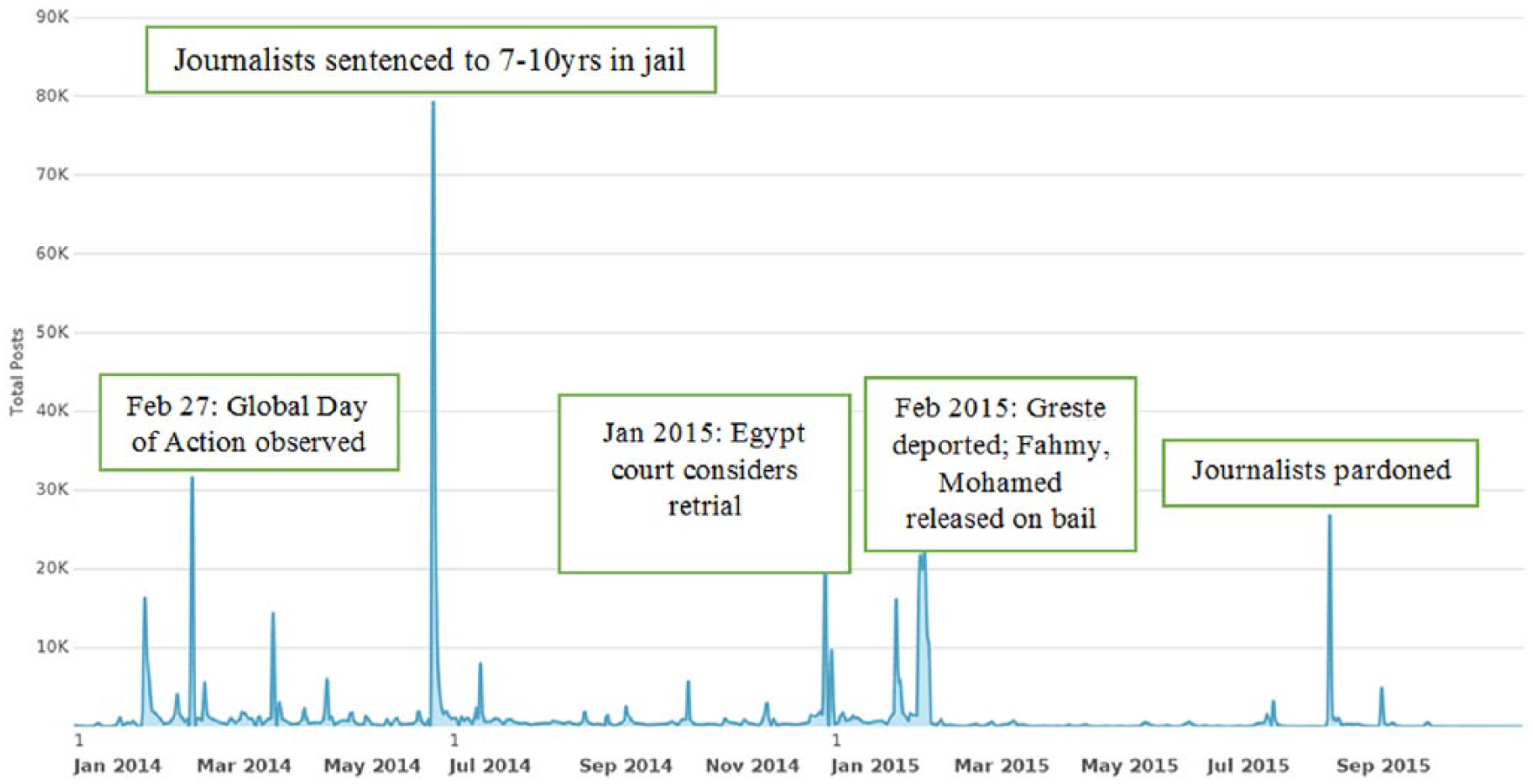
Volumes of #FreeAJStaff tweets per week.
Among core social mediators (n = 68), 39 were the Twitter accounts of imprisoned journalists (e.g., @petergreste, @mffahmy11, @bahrooz), seven were their family members (e.g., @repent11), 16 were Al Jazeera accounts (e.g., @AJEnglish, @aljazeera, @ajstream), and six were Al Jazeera journalists (e.g., @sueturtonaje, @abdallahelshamy, @baysontheroad, @hasanpatel). Elite social mediators (n = 26) included 12 non-Al Jazeera journalists (e.g., @camanpour, @millerc4, @lindseyhilsum, @robynleekriel), three politicians/leaders (e.g., @baird), three non-Al Jazeera media (e.g., @abcnews24), four human rights organizations/activists (e.g., @amnesty), and two non-governmental organizations (NGOs; e.g., @africamedia_cpj). Non-elite accounts included @freefakharany, @freeegyptpress, and @milesbredin. See Figure 2 for details.
H1: Social mediators in #FreeAJStaff Twitter network are more likely to be core and elite than non-elite.

Types of social mediators (N = 105).
Three types of social mediators emerged from Twitter users who tweeted posts, replied, and mentioned others using #FreeAJStaff. Core users (n = 68; 64.8%) accounted for almost two-thirds of all social mediators (N = 105), while elites (n = 26; 24.8%) had the second highest numbers, and the non-elites (n = 11; 10.5%) comprised the rest. Logistic regression was conducted to test the hypothesis, which was significant, Wald χ2(2, N = 105) = 45.33, p < .001, supporting H1.
H2: Core social mediators will show higher level of reciprocity than elites and non-elites.
Findings partially support the hypothesis. Judging by the descriptive statistics, it is evident that the non-elites (e.g., @ramisms, @freefakharany, @freeegyptpress, @milesbredin) showed higher levels of reciprocity (M = 0.04, SD = 0.03), than core social mediators (M = 0.02, SD = 0.03) and elite social mediators (M = 0.02, SD = 0.03). Therefore, this part of the hypothesis was not supported. Next, an ordinary least squares (OLS) regression test was conducted, examining the differences only between core (e.g., @petergreste, @AJEnglish, @repent11, @bahrooz, @baysontheroad) and elite (e.g., @camanpour, @millerc4, @pmharper, @amnesty, @robynleekriel) social mediators. In the test, core social mediators (M = 0.023, SD = 0.027, B = −.021) showed significantly (p < .05) higher reciprocity than elite social mediators (M = 0.017, SD = 0.033, B = −.031; see Table 1).
OLS Regression between type of social mediators and reciprocity.

p < .05; **p < .01; ***p < .001.
RQ2: Is the type of social mediators (core, elite, non-elite) in clusters associated with density?
Addressing RQ2, only clusters associated with a single type of social mediator were included, excluding clusters of mixed type of social mediators (n = 9). Clusters of non-elite social mediators (n = 3) were also excluded for their low frequency. A regression test between core clusters (M = 0.012, SD = 0.015) and elite clusters (M = 0.005, SD = 0.011) was not significant. Results did not indicate any significant differences between the types of social mediators in core and elite clusters and their level of interconnectedness.
RQ3: Is the type of social mediators (core, elite, non-elite) in clusters associated with reciprocity?
As mentioned above, only core and elite clusters were included in the analysis. An OLS regression test was conducted which was significant (p < .01). The results show that the elite clusters (M = 0.67, SD = 1.39, B = .65) exhibited higher level of reciprocity than core clusters (M = 0.02, SD = 0.02; see Table 2).
OLS regression between type of social mediators in clusters and reciprocity.

p < .01.
H3: Mediated content is more likely to include non #FreeAJStaff hashtags than siloed content.
A stratified sample of 4,154 tweets were coded and analyzed. Of those, 50.5% (n = 2,099) tweets included only #FreeAJStaff, 7.6% used (n = 316) other #FreeAJStaff-related hashtags (e.g., #AJretrial), 39.7% (n = 1,648) used non-FreeAJStaff hashtags (e.g., #FreeShawkan, #JournalismIsNotACrime, #Egypt), and 2.2% (n = 91) included other hashtags that do not belong to above three types. Logistic regression test was used, which included only the two largest categories (#FreeAJStaff hashtag and non-FreeAJStaff hashtag tweets). Results show that the tweets that include non-FreeAJStaff hashtags make higher portion of mediated content (44.9%) than that of siloed content (36.6%). About 49.5% of mediated content included a non-FreeAJstaff hashtag, compared to 40.7% of siloed content, Wald χ2(2, N = 4,154) = 27.48, marginal effect at the mean (MEM) = 0.08, p < .001.
RQ4: Is conversation type associated with the content type (siloed or mediated)?
Content analysis of a sample of 4,154 tweets revealed three main conversation themes. The most common theme was Grievance (49.21% of sampled tweets) containing tweets indicating that the detention and trial of the journalists are unjust and are against press freedom (e.g., @sarawatkins96 retweeted “because free speech is a right, and journalism is the closest thing to preserve it #JeSuisCharlie #FreeAJStaff”). News tweets (26.88%) included day-to-day news about the detention and trial (e.g., @profsarahj retweeted “10 minutes to go until our trial. #freeajstaff #ajretrial”). About 12.81% of the tweets was classified as Protest, as it included posts directly calling for protests and journalists’ release (e.g., @erinull retweeted “#AlJazeera demands the immediate and unconditional release of its staff currently detained in #Egypt #FreeAJstaff”); 11.09% of the sample were classified as Other.
A binary logistic regression was applied to examine the relationship between type of tweets (siloed and mediated) and content category. Within the model, only Protest was found to be significantly associated with tweet type (B = .65, MEM = 0.15, p < .001; see Table 3). Protest-related tweets made a larger portion of siloed tweets (14.66%) than the Mediated Tweets (9.63%), whereas the rest of the tweet themes made about the same portion of the tweets, across these two types of tweets (see Table 4).
Logistic regression between conversation themes and tweet types.
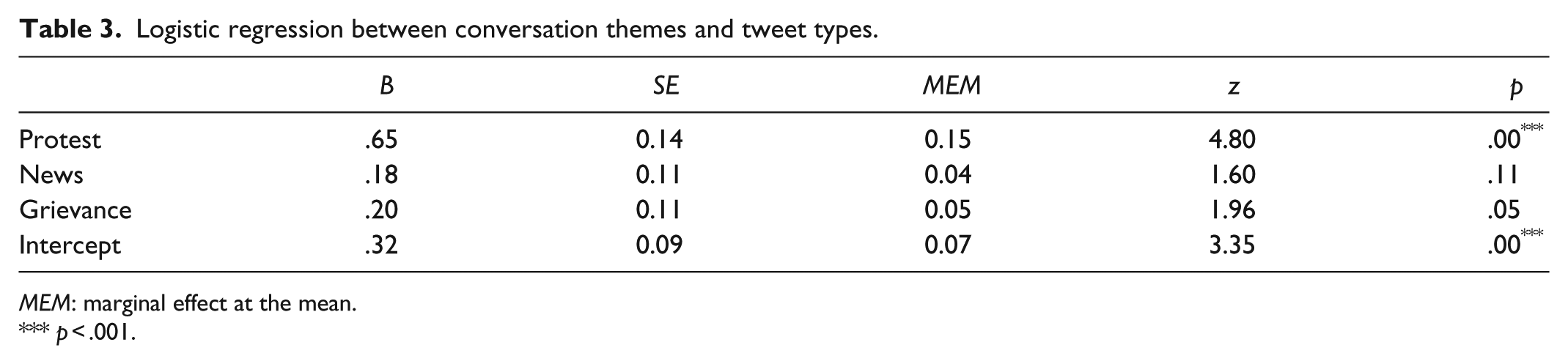
MEM: marginal effect at the mean.
p < .001.
Tweet types and conversation themes.

Figure 3 illustrates social mediators, clusters, and the structure of #FreeAJStaff Twitter network (2-8 March 2014 data). In the figure, circles represent users while connecting lines represent mentions and replies. As illustrated here, star-shaped clusters are the subgroups of users who are more interconnected among themselves than with users of other clusters. Social mediators are identified by their names and Twitter image. In the top left cluster, two social mediators are @aljazeera (Al Jazeera PR account) and @marcellehopkins (Al Jazeera journalist). In the bottom left cluster, @petergreste (account of imprisoned Al Jazeera journalist) emerged as the lone social mediator while in the middle top cluster, @AJEnglish (Al Jazeera English’s official account) is the key user. These three clusters contain most of the users and are more engaged with each other through four core social mediators (mentioned above), who bridge these clusters (see Figure 3).

An exemplary network of #FreeAJStaff Twitter Network (2-8 March 2014).
Discussion
The #FreeAJStaff movement, started in 2013 as a response to journalists’ arrests in Egypt and ended in 2015 with their release, is a unique case study of social movements. It took place primarily on social media and was largely steered by the traditional news organization, Al Jazeera. This study took a social networks approach to apply and examine patterns of information flow, key influential users, and community formation of the movement on Twitter. Findings suggest a community structure (Himelboim, Smith, Rainie, Shneiderman, & Espina, 2017), where each is formed around one or a few social mediators, who connect individuals to others in the movement. The nature of these key users—core, elite, and non-elite—determined patterns of information flow within each community.
Social Movement Information Leadership
On social media, grassroots and traditional social actors can become social mediators. This study shows, however, that traditional institutions—elite users—and the leaders of the movement—core users—remain the key influential users (Melucci, 1996; Palmer et al., 2014). In other words, social movement participants, for the most part, do not rise to their potential to become central to the movement, leaving the stage primarily to the traditional key individual organizations that social movements have relied upon for their offline activities. The two types of the leading social mediators, however, exhibited quite different behaviors. Core users in the movement, in an attempt to engage with and expand their publics (Bauermeister, 2016; Melucci, 1996), showed higher level of reciprocity than elite mediators, who communicated in a more traditional one-way, one-to-many, communication. In contrast, social media corresponding publics, showed an opposite pattern of engagement. Clusters centered around core users, such as @AJEnglish, showed lower level of reciprocity, relying primarily on its core social mediators. Clusters formed around elite users, such as @camanpour, exhibited higher level of reciprocity, suggesting user engagement. Because core social mediators stay active till the end (Palmer et al., 2014; Yates, 2015), they become consistent source of information for others who become heavily dependent on those core actors. On the other hand, elites become active mostly during the peak time of the movement when their participation draws massive mobilization and engagement (Amenta et al., 1992; Soule & Olzak, 2004).
Mediated Content
Classifying content based on their reach—siloed content that remains within a cluster and mediated content that crosses clusters—this study uses network analysis to identify spillover effects in Twitter conversations. Moreover, an analysis of the hashtags used in these two types of tweets suggests that the use of hashtags associated with other movements makes a good strategy for expanding inflation reach, beyond the boundaries of the core members of a social movement. Traditional social movement studies (e.g., King, 2011; Meyer & Whittier, 1994) found that social movements are benefited by spillover effects, a key phenomenon where social movements collaborate to expand their reach and mobilize their publics. On Twitter, activists may use this strategy using other movements’ hashtags. This study finds that this strategy is successful in reaching out beyond community lines. Further studies may examine whether it helps reaching out to new movements. Notably, no association was found between the types of conversation and the expansion of their reach (RQ4), which further validates the importance of hashtags in expansion of social movements.
Theoretical and Practical Implications
This study makes several key contributions to current scholarships. First, the findings appear to suggest similarities in patterns between traditional and online social movements. It reiterates relevance of traditional social movement literature in digital era. Second, the study identifies strategies (e.g., presence of social mediators, using hashtags of different causes together) important for a movement’s success, which may draw more attention of the researchers and help future activists. Third, the study identified the influential social media actors (social mediators) in the #FreeAJStaff movement, who were crucial in achieving the goals of this unique social movement, integrating grassroots activism with a media institution. These influential individuals and organizational actors include the media, journalists, human rights organizations, political leaders, and other political and social elites. Fourth, the study analyzed a social media movement in networked environments, which broadens our understanding of the online movements in digital age. Particularly, the analysis of siloed and mediated tweets helps to understand the role of hashtags in information flow and the context of conversation activists are engaged in an online movement.
The study has some implications for future social movements and their activists as well. From the findings, the activists can have better understanding of how to organize and operate a social movement and make it successful. They can learn the importance of active engagement with other actors and the elites. Future social movements can learn from #FreeAJStaff’s grassroots approach and understand that taking such approach on social media is as important as running a social movement offline.
Limitations and Future Directions
Because #FreeAJStaff movement was about freeing journalists of an influential international media, the analysis may not be generalizable to other social movements that are not connected to any influential media or organization. Another limitation of the study is that it has analyzed Twitter activities only and considered English-language posts only. How the movement operated offline or in other social media platforms were not studied. From a network structure standpoint, this study treats all dynamics connections as a single type of link. A more refined analysis of the networks, breaking down the data set into multiple networks, each based on a single tie (retweets vs. mentions networks, for instance), can further explicate the role of social mediators. Future studies may look into successful social media movements created and operated by non-elites to widen our understanding of grassroots social movements. In addition, future studies may analyze mediated and siloed tweets within and between clusters and explore the type of information social mediators spread across communities.
Footnotes
Declaration of Conflicting Interests
The author(s) declared no potential conflicts of interest with respect to the research, authorship, and/or publication of this article.
Funding
The author(s) received no financial support for the research, authorship, and/or publication of this article.
Author biographies
 .
.
.