



Abstract
The “Al-Jazeera Effect” posits that Al-Jazeera has reshaped global news flows while challenging the hegemony of Western news outlets. However, few studies to date have measured this “Effect” or offered a method for doing so. This study addressed this gap by conceptualizing news outlets’ online following as Clout and assessing Al-Jazeera’s ability to attract high-quality digital diplomacy followers on Twitter including Ministries of Foreign Affairs (MFAs) and UN Missions. Such an analysis is important as the Clout of international news outlets arises in part from their ability to impact foreign policy makers. Using a sample of 56 MFAs, and 132 UN Missions, the study analyzed Al-Jazeera’s digital diplomacy following on Twitter and compared it to that of CNN, BBC World and Reuters. Quality of digital diplomacy followers was assessed using an innovative model consisting of fifteen variables, including offline variables, online variables, and networked variables. Statistical analyses and network analyses demonstrate that Al-Jazeera attracts high-quality digital diplomacy followers, be it UN Missions of affluent states and world powers, or MFAs that are central to diplomatic networks on Twitter. The study also assessed diplomatic institutions’ engagement with Al-Jazeera Tweets, which was found to be quite low. By developing a unique model for assessing the quality of digital diplomacy followers, this study offers a method for measuring the impact of news outlets in the age of social media.
Introduction
In recent years, scholars have debated the “Al-Jazeera Effect” (Zhang 2022; Zingarelli 2010), questioning whether Al-Jazeera has challenged the Western dominance that characterizes the global news landscape. Scholars have asserted that Al-Jazeera has flattened the global news landscape and introduced non-Western perspectives (Miladi 2020; Volkmer 2003). While few studies to date have empirically examined Al-Jazeera’s ability to attract a sizable social media following that is comparable to that of leading international news outlets (Samuel-Azran and Manor 2023; Palloshi 2015), no study has examined the quality of Al-Jazeera social media followers, which may be indicative of its standing as a leading global news outlet. In this study, the first of its kind, we examined whether Al-Jazeera attracts diplomatic institutions on social media from leading global powers, as well as diplomatic institutions that are central to information exchanges online. Thus, this is the first study to conceptualize and measure the quality of Al-Jazeera’s diplomatic following while comparing it to the following of other leading news outlets in an attempt to identify a genuine “Al-Jazeera Effect.”
We advance the current literature by developing a model to empirically measure the digital Clout of Al-Jazeera, or its ability to attract high-quality followers from international political bodies on Twitter, namely Ministries of Foreign Affairs (MFAs) and UN Missions, as well as these bodies’ engagement with Al-Jazeera’s Twitter content. Using the method of factor analysis, we offer a new means for analyzing the quality of diplomatic followers on social media, while comparing Al-Jazeera’s digital clout to that of BBC World News, CNN, and Reuters. We conclude by demonstrating that our model may be applied to measure the digital clout of other international news outlets.
The empirical model developed in this article is inspired by Chadwick’s (2017) hybrid media flows prism, which asserts that political power lies in the hand of agents who are best at integrating old and new media. Accordingly, we posit that in the social media age, analyses should focus on how traditional international news outlets, which operate both offline and online, gain digital clout or are able to attract and be followed by important international political bodies. The term clout is used to describe power especially in social media contexts (Fox and Strafford 2021; Jarrar et al. 2020) and usually refers to the reach and engagement that social media influencers are able to amass. We suggest that in the case of news outlets and international political bodies, the focus should be on the quality of followers rather than just the quantity of followers. For instance, are news outlets followed online by major world powers or solely by peripheral states? Similarly, are news outlets followed by central political bodies that set the agenda for social media debates? Moreover, we contend that such an analysis should include engagement but treat it as a secondary measure since international political bodies, and specifically diplomatic bodies, often refrain from sharing news content which may include unverified information. In the following section, we review studies on the “Al-Jazeera Effect” and introduced our conceptualization of digital clout.
Literature Review
Global News Flows: Western Imperialism versus The Al-Jazeera Effect
Global news flows have undergone significant transformations evolving from what was once known as “media imperialism” (Boyd-Barrett and Rantanen 1998) to the emergence of a more diversified flow (Figenschou 2013). Media imperialism (Tomlinson 2001), a concept rooted in the idea of Western media dominance, suggests that global news flows are heavily skewed toward Western perspectives and interests. Scholars argue that this leads to the homogenization of news and cultural imperialism. Thussu (2022; see also Silberstein-Loeb 2014) notes that the 1851 inception of the Reuters news agency, which mirrored the expansion of the British Empire, illustrates that since its early days, international media has been set to promote its host country’s agenda. Thussu also notes that the Second World War was followed by a UK–US duopoly, as these two countries that share Western values dominated international media. In 1980, the Atlanta-based CNN began 24/7 news broadcasts to a global audience and was later joined by BBC World News, Sky News, and Fox News, cementing the dominance of Western perspectives for viewers of international news (Sparks 2003)
Various studies found that Western media consumption does facilitate the adoption of Western values such as consumerism and individualism across various regions (McQuail 1994; Schiller 1976; Tomlinson 1991), ages (Schor 2004) and genres (Condry 2006) as well as the promotion of English over the local languages (Thussu 2007). However, other studies found that audiences sometimes “localize” global shows or prefer content that reflects their local culture and language (Liebes and Katz 1990; Straubhaar 2007). The rise of Al-Jazeera, a Qatar-based news network founded in 1996, marked a significant shift in global news flows. Since its inception, Al-Jazeera’s motto was “The Opinion and the Other Opinion,” highlighting its aim to counter Western news hegemony. Its website notes that “Al Jazeera gives the voiceless a voice.” Examining these claims empirically, Figenschou (2010, 2013) found that Al-Jazeera airs more news from the Global South in comparison to the Global North and that the Global South is covered by more correspondents and in greater depth than the Western world. The article concludes that Al-Jazeera presents a similar bias as Western stations, only from the opposite perspective.
The advent of Al-Jazeera Arabic and its dominance in the post 9/11 era, with exclusive images from the battle zones in Afghanistan, which were re-aired on Western stations, and later exclusive interviews with Al-Qaeda leaders led to assertions that Al-Jazeera had reshaped the global news landscape, making it more horizontal (Volkmer 2003). In September 2006, Al-Jazeera launched its English news channel, leading scholars to further maintain that Al-Jazeera challenged Western narratives and became a voice for the Arab World and the Global South. These two assertions, that Al-Jazeera challenged both news flows and narratives (Volkmer 2003), came to be known as the “Al-Jazeera Effect” (Miles 2010).
The popularity of social media platforms in the 21st century further weakened the notion of “media imperialism” and complicated the flow of global news. Indeed, all international news outlets launched websites, established social media profiles across major networks (Facebook, Twitter) and created a synergy between them to maximize their clout in the spirit of Chadwick’s (2017) hybrid media systems theory. Here, Al-Jazeera proved to be a central player as it was quick to use online platforms to advance its presence including Facebook, Twitter, Instagram, and TikTok.
The “Al-Jazeera Effect” spawned a series of academic works arguing that the Qatar-based station reshaped the global news landscape, as evident in the titles of various books and articles from Al-Jazeera: How Arab TV news challenged the world (Miles 2010) through The Al-Jazeera effect: How the new global media are reshaping world politics (Seib 2008) to Al-Jazeera and the global media landscape: The South is talking back (Figenschou 2013). However, these works were all written from the authors’ perspective based on ethnographic observations rather than exhaustive empirical analyses. Importantly, few studies examined the “Al-Jazeera Effect” from an audience perspective. An exception can be found in Palloshi (2015) and Samuel-Azran and Manor (2023) who found that Al-Jazeera attracted more diplomatic institutions on Twitter than Western outlets. The authors note as their main limitation: “ . . . future studies should take a more quantitative approach and analyze the ‘quality’ of one’s followers” and not just the quantity. Addressing this limitation is the very goal of this study.
Political Followers as an Indicator of Clout
When examining the Al-Jazeera Effect, two important questions arise. First, has Al-Jazeera been able to counter the dominance of Western news outlets? Second, how can one measure Al-Jazeera’s digital clout? Smauel-Azran and Manor (2023) argued that the “Al-Jazeera Effect” may be approximated by measuring Al-Jazeera’s ability to attract political followers on Twitter, including Ambassadors, MFAs, and UN Missions. This is because international bodies such as MFAs are heavy consumers of news, they are the ones who shape the global diplomatic agenda, and they can impact national foreign policies.
Studies published over the past decade have found that 90 percent of UN member states have established some form of social media presence (Bjola and Manor 2024; Huang 2022), in a practice referred to as digital diplomacy (Adler-Nissen and Eggeling 2022; Bjola and Holmes 2015; Manor 2019). Crucially, studies suggest that diplomatic institutions are avid consumers of online news (Huang and Wang 2021; Manor 2016) for three reasons. First, MFAs and UN Missions follow news channels on social media given that practicing diplomacy demands that diplomats remain abreast of world affairs. Information is the currency of diplomacy and diplomats rely on timely and accurate information to obtain their policy goals (Hocking and Melissen 2015; Duncombe 2019). Second, MFAs and UN Missions use social media to monitor and frame world events as they unfold thus shaping how digital publics and journalists make sense of important events (Hallams 2010; Collins et al 2019; Xiguang and Jing 2010). Lastly, MFAs have learned that social media are competitive framing arenas in which numerous actors vie over the attention of online publics including news outlets and citizen journalists (Causey and Howard 2013; Hayden 2012). Narrating state policies online demands that MFAs and UN Missions craft messages that resonate with or negate the framing activities of global news outlets (Bjola and Manor 2024; Mazumdar 2021; Pamment 2013).
Moreover, studies indicate that diplomatic institutions rely on social media, and Twitter in particular, to interact with journalists and influence their coverage of world events (Bjola and Manor 2024; Bjola and Pamment 2019; Manor and Crilley 2019). Indeed, some MFAs migrated to Twitter with the explicit goal of interacting with journalists (Manor 2016; Manor 2019). These studies all suggest that the practice of digital diplomacy was and remains rooted in managing relations with news outlets. Yet news coverage can also influence the perceptions, beliefs, and actions of diplomats. As others assert, diplomats are not immune to the impact of framing and agenda setting (Samuel-Azran and Manor 2023). Diplomats’ decisions to follow certain news outlets on social media may ultimately impact the policies they pursue given that media frames can shape diplomats’ assessment of which issues are dominating global news cycles (Manor and Segev 2020).
Importantly, scholars have found that digital diplomacy is practiced differently in different venues. For example, the use of Twitter by Missions to the UN in NY (New York) may differ from Missions to the UN in Geneva. These differences emerge, among other, due to the fact that Twitter is more popular in the US than it is in Switzerland and due to differences in the remits of UN Missions. While Missions to NY focus on crisis management and mediation through the Security Council, Missions in Geneva deal with a host of international issues ranging from human rights to intellectual property and world health (Manor and Pamment 2019; Manor 2019).
Counting Followers on Twitter
In a 2023 study, Samuel-Azran and Manor (2023) compared the number of MFAs, UN Missions and Ambassadors that follow Al-Jazeera and other global news outlets and agencies on Twitter (e.g., AFP, BBC World, Bloomberg, CNN, Reuter, and Russia Today). This analysis yielded two important results. First, the most followed news channels on Twitter among Ambassadors, MFAs and UN Missions were BBC World, CNN, and Reuters. Second, Al-Jazeera was able to attract a sizable number of digital diplomacy followers. Among UN Missions in NY, Al-Jazeera was the fifth most followed news outlet trailing BBC World, CNN, Reuters, and AFP. Among UN Missions in Geneva, Al-Jazeera was the fourth most followed news outlet on Twitter, and it was the sixth most followed outlet among MFAs. Crucially, Al-Jazeera’s Twitter account attracted more MFAs, Ambassadors, and UN Missions than the accounts of established, Western news outlets (e.g., Bloomberg, CNBC, Sky News, and AFP). Although this analysis lent support to the “Al-Jazeera Effect,” it was limited to a quantitative comparison. A more significant analysis should focus on the quality of Al-Jazeera’s diplomatic following when compared to other news outlets.
Conceptual Approach
In this study, we assert that the quality of followers may stem from two sources—offline national attributes and online or networked attributes. Offline attributes relate to the nation state that a digital diplomacy account represents. Following past studies that examined the offline importance of nations to diplomacy (Kinne 2014; Neumayer 2008), our conceptual approach for measuring the quality of a digital diplomacy follower included six variables that relate to offline national attributes including: GDP, GDP Per Capita, Population Size, military budget, number of Embassies hosted in a capital and number of Embassies deployed abroad. Additional offline factors that were included in were a nation’s rank on the Good Country Index, its internet penetration rates, and Press Freedom rankings. Previous studies have found that Good Country Index scores, high levels of Press Freedom, and high rates of internet penetration all contribute to the online centrality of an MFA and to its ability to attract peers on Twitter (Manor and Segev 2020; Sevin and Manor 2019). This is because MFAs from nations with high internet penetration rates and high levels of Press Freedom are more likely to use Twitter to comment on world events (Manor and Segev 2023).
Additionally, the conceptual approach also included four online variables: the number of years an MFA or UN Mission was active on Twitter, the number of tweets the MFA or Mission had published, the number of accounts it followed on Twitter, and the number of followers the MFAs and UN Missions have amassed since joining Twitter. Digital diplomacy studies suggest that familiarity with Twitter, high levels of activity, and a tendency to follow other accounts all increase the number of followers that MFAs and UN Missions attract online (Manor and Segev 2020; Manor and Segev 2023). A recent study found that those UN Missions and MFAs that follow their peers on Twitter are most likely to attract peers in return (Manor and Segev 2023).
Finally, our conceptual approach included two networked variables, which measure the centrality of MFAs and UN Missions among a Twitter network of their peers (Maliniak and Plouffe 2011). The first variable is indegree, which measures the number of peers an MFA or UN Mission attract on Twitter, and the second variable is betweenness, which measures the centrality of an MFA or UN Mission in a network of its peers (Manor and Segev 2023).
Notably, a series of studies have also found that MFAs and UN Missions actively follow their peers to gather valuable information such as policy announcements, identify shifts to existing foreign policies, and map states’ positions on world affairs (Manor and Segev 2023). Equally important is the finding that Twitter networks do not mirror offline networks of Embassies. MFAs and UN Missions from nations with limited material resources that deploy few physical Embassies can become central among social media networks of their peers (Manor 2019). For instance, a 2022 study of the Twitter network of MFAs found that the ministries of Albania, Belarus, and Georgia were among the most followed by their peers on Twitter (Manor and Segev 2023). These findings illustrate why digital diplomacy accounts of nations with limited offline resources may still be high-quality followers—they are central to information exchanges among diplomatic institutions on Twitter and can shape the agenda of diplomatic actors.
Network centrality is of particular importance to news outlets such as Al-Jazeera. If an article by Al-Jazeera was commented on, rebuked, or re-tweeted by an MFA that was central to a Twitter network of its peers, the article would quickly be disseminated across a vast number of foreign policy makers. The same is true of central MFAs that may adopt Al-Jazeera’s framing of events or its narration of world events. Similarly, if an article by Al-Jazeera was shared by a UN Mission that was central to a network of its peers, the article would reach policy makers from Asia, Africa, and the Middle East.
Research Questions
To investigate the Al-Jazeera Effect, and evaluate the conceptual approach developed as part of this study, we formulated three research questions. Given the exploratory nature of this study, and the fact that no previous models exist for measuring the quality of digital diplomacy followers, we did not formulate specific hypotheses. As noted earlier, our goal was to compare the quality of Al-Jazeera’s digital diplomacy followers with that of CNN, BBC World, and Reuters. Our first research question focused on the offline attributes of digital diplomacy followers and asked:
RQ1: What are the offline attributes (GDP, GDP Per Capita, population size, military budget, number of Embassies in Capital, number of Embassies deployed abroad, Good Country Index Scores, internet penetration rates, and press freedom ranking) of MFAs and UN Missions following Al-Jazeera English, CNN, BBC World, and Reuters on Twitter?
Our second research question focused on the online attributes of digital diplomacy followers asking:
RQ2: What are the online attributes (number of years on Twitter, number of tweets published, number of accounts followed, and number of followers) of MFAs and UN Missions following Al-Jazeera English, CNN, BBC World, and Reuters on Twitter?
Our third research question focused on networked attributes of digital diplomacy followers asking:
RQ3: What are the networked attributes (indegree and betweenness scores) of MFAs and UN Missions following Al-Jazeera English, CNN, BBC World, and Reuters on Twitter?
Given the fact that we sought to measure the “Al-Jazeera Effect,” we assumed that MFAs and UN Missions that follow Al-Jazeera, and the other news outlets, would be of higher quality when compared to MFAs and Missions that do not follow Al-Jazeera. Finally, we focused on MFAs and UN Missions’ possible engagement with social media content published by news outlets. Engagement may take the form of re-tweeting a news story or linking to a news story shared on social media by a news outlet.
RQ4: To what extent do MFAs and UN Missions interact with tweets posted by news outlets?
Methods
To answer this study’s research questions, we examined Twitter accounts operated by MFAs, UN Missions in Geneva and UN Missions in NY resulting in three samples. We chose to focus on Twitter, as opposed to Facebook or Instagram for three reasons. First, studies suggest that diplomatic institutions are most active on Twitter and consider Twitter to be a source of valuable information for their work (Adesina 2017; Duncombe 2019; Manor 2016). Second, it is on Twitter that MFAs and UN Missions follow their peers creating dense networks of information (Sevin and Manor 2019). Moreover, studies have found that Twitter serves as an elite-to-elite communications tool through which diplomats interact with journalists, news outlets, and opinion makers (Manor 2016). Finally, scholars have found that diplomats employ Twitter to rebuke negative press coverage of their country and to narrate state action with the goal of influencing journalists’ reporting (Manor and Crilley 2018; Manor and Crilley 2019; Seib 2016). As such, it is through Twitter that diplomats gather information from news outlets, and it is on Twitter that diplomats interact with journalists. Other networks such as Facebook or Instagram are used for elite-to-public communications as diplomats interact with average social media users (Bjola 2018). In each sample, we compared the quality of the MFAs or UN Missions that follow the four news outlets with those MFA and UN Missions that do not follow them on Twitter. For each sample, we had to first identify which MFAs and UN Missions follow the four news outlets on Twitter and gather data related to all 15 variables in our conceptual approach for measuring the quality of digital diplomacy followers. The data gathering and factor analysis are elaborated on next.
Data Gathering
Our data gathering methodology followed a three-step process. In the first stage, we created a dedicated Twitter account for each sample. For instance, we created a dedicated “Geneva Missions” Twitter Account. Next, we used this account to follow Geneva Missions on Twitter. We relied on Twitter lists created by the Twiplomacy website which include links to the Twitter profiles of various diplomatic institutions including Geneva Missions. The Twiplomacy lists have been used in a series of other studies and are considered by scholars to be accurate (Manor and Pamment 2019; Manor and Segev 2023). We also searched for the Twitter accounts of Geneva Missions not listed by Twiplomacy to create a diverse and large sample. We soon ended up with a “Geneva Missions” Account that included 123 Geneva Missions that were active on Twitter. We then used this dedicated account to visit the Twitter profiles of the four news outlets. This enabled us to immediately identify which Geneva Missions followed Al-Jazeera, BBC World, CNN, and Reuters. For instance, we quickly found that Al-Jazeera was followed on Twitter by sixteen Geneva Missions. In total, we found that fifty Geneva Missions followed at least one of the four news outlets on Twitter (see supplemental file). It is true that according to this quick analysis, the majority of Geneva Missions do not follow global news outlets on Twitter. However, this article focuses not on the quantity of followers, but on their quality. Thus, an important question is which of the fifty Geneva Missions that follow Al-Jazeera on Twitter are high-quality followers such as UN Missions of world powers or UN Missions that are central to information exchanges on Twitter networks of diplomats. In other words, it is possible that these 50 Missions represent an influential following for Al-Jazeera, even if a relatively small one.
Next, for each Geneva Mission that followed one of the four news outlets, we gathered data in accordance with our 15-variable conceptual approach. For instance, we found that the UK’s Mission in Geneva followed Al-Jazeera’s Twitter account. We then proceeded to gather data on the UK’s offline variables (GDP, GDP Per Capita, population size, military budget, number of Embassies in capital, number of Embassies deployed abroad, and Good Country Index Scores), offline and online variables (Internet penetration rates and Press Freedom rankings), and online and networked variables (number of years the UK’s Geneva Mission was active on Twitter, number of tweets it had published, number of Twitter accounts it followed, number of followers it had amassed, and its indegree and betweenness scores). This information, gathered on every Geneva Mission, would later be used in the factor analysis.
GDP and GDP Per Capita were sourced from the World Bank website while population size and military budgets were sourced from the CIA Factbook. The number of Embassies hosted in capitals and deployed abroad was sourced from the Embassies.net website, which had been used in previous studies (Manor 2019). Internet penetration rates were sourced from the Internet World States website. Press Freedom rankings were collected from the Press Freedom Index published by Freedom House website while Good Country Index scores were collected from the Index’s website. By visiting the Twitter accounts of each Geneva Mission, we were able to record the number of years they were active on Twitter, the number of tweets they had published, and the number of accounts they attracted and followed.
Networked variables, or the centrality of each Geneva Mission among a Twitter network of its peers, were gathered using network analysis. As noted, we found that fifty Geneva Missions followed at least one of the four news outlets (Al-Jazeera, BBC World, CNN, or Reuters). To calculate the network centrality of these fifty Missions, we used a wider sample of seventy-six Missions to Geneva (see supplemental file). This was necessary in order to measure how central each Mission was to the Geneva Twitter network of UN Missions. The wider sample of seventy-six Missions was similar to that used in previous digital diplomacy studies (Manor and Segev 2023). Importantly, the sample was geographically diverse and included Geneva Missions from all world regions. Moreover, the sample was diverse in terms of economic strength, population size, and internet penetration rates. Using the Visone software (Brandes and Wagner 2004), we were able to calculate the indegree and betweenness scores of the fifty relevant Geneva Missions.
This three-step methodology was repeated for both the MFAs and NY Missions samples. The dedicated “MFAs” Twitter account listed 100 MFAs that were active on Twitter. The analysis found that fifty-seven MFAs followed at least one of the four news outlets on Twitter (see supplemental file). To calculate network centrality, or indegree and betweenness scores, we used a broader sample of 88 MFAs (see supplemental File), which was also used in a previous study (Manor and Segev 2023) and was diverse in terms of geography, economic robustness, population size, and internet penetration rates. The dedicated “NY Missions” Twitter account listed 144 NY Missions. The analysis found that eighty-two NY Missions followed at least one of the four news outlets on Twitter (see supplemental file). To calculate centrality scores for NY Missions, we used a broader sample of ninety-nine Missions to the UN in NY (see supplemental file), which was used in a previous study (Manor and Segev 2023) and was diverse in terms of geography, economic robustness, population size, and internet penetration rates.
In total, we gathered data on 147 nations whose MFA or UN Missions followed at least one of the four news outlets examined. All data were gathered between January and October of 2022. The network analyses were conducted in October of 2023, while the statistical analysis was conducted in November of 2023.
Factor Analysis
To assess the quality of digital diplomacy followers, we created summary measures for offline variables and for online/networked variables. The summary measures were created using the method of factor analysis. Factor analysis is a statistical technique that attempts to identify a small number of underlying variables, or factors, that can be used to represent a larger set of inter-correlated variables and explain most of the variance observed in this larger set of variables (Bartholomew et al. 2011). Hence, factor analysis is used to reduce a large number of variables into fewer numbers of factors. The derived factors can be considered as summary measures of the original set of variables, and their scores can be used for further analysis. Here, we have used factor analysis to characterize separately the set of offline variables (e.g., GDP and population size) and the set of online/networked variables (e.g., number of Twitter followers and indegree scores).
For factor extraction, we used principal components analysis with varimax rotation. The number of factors was determined by the data based on the contribution to the explained variance. Variables with factor loadings ≥0.4 were considered contributing variables to a given factor. Factors were constructed so that their scores are standardized with mean 0.0 and a standard deviation of 0.1. Higher scores represent higher followers’ quality. For offline variables, similar factors were constructed for all three samples (MFAs, NY Missions, and Geneva Missions) as these are related to the offline attributes of nations (e.g., GDP, population size, and internet penetration rates). For online/networked variables, specific factors were identified for each sample (e.g., sample of Geneva Missions) as these vary by location or venue (i.e., NY vs. Geneva). For instance, the French MFA and the French Mission to Geneva have different numbers of followers and different levels of centrality among networks of their peers.
Analysis of Offline, National Variables
Using the nine offline variables—GDP, GDP Per Capita, population size, military budget, number of Embassies in capital, number of Embassies deployed abroad, Internet penetration rates, Press Freedom ranking, and Good Country Index ranking—we extracted two factors, hence referred to as Offline_Factor_1 and Offline_Factor_2. Offline_Factor_1 explained 34.8 percent of the overall variability and integrated information from the following variables: GDP, Population size, number of Embassies in capital, and number of Embassies deployed abroad. Higher scores for this factor represent higher values of these variables. Offline_Factor_2 explained 22.6 percent of the overall variability and included the following variables: military budget, internet penetration rate, Press Freedom ranking, and Good Country Index rankings. Higher scores of this factor represent higher rates of internet penetration, lower military budget, and better ranking for Press Freedom and Good Country Index.
Offline_Factor_1 and Offline_Factor_2 together explained 57.4 percent of the overall variability. As mentioned above, the offline variables are country dependent and do not change from one sample to another (i.e., Geneva or NY). Hence, these two factors were used in all three samples. That is to say that Twitter profiles of both the French MFA and the French Mission to NY are digital representations of France and share the same offline attributes such as GDP or population size.
Notably, Offline_Factor_1 is comprised of GDP, population size, and number of Embassies in the capital and deployed abroad. These are all traditional hallmarks of power which attest to a state’s importance in world affairs. Offline_Factor_2 was comprised of Internet penetration rates, Press Freedom, and Good Country Index scores. These three components are related as they attest to a state’s democratic status and its willingness to share information online with citizens. Indeed, democracies rate higher on the Good Country Index. It is interesting to note that military budget was a component in the second factor. However, the smaller the military budget, the higher the score on this factor meaning that nations that spend less on their military budgets score higher in this factor.
Analysis of Online/Networked Attributes
The analysis was based on six variables and was conducted for each sample—MFAs, Geneva Missions, and NY Missions. These variables included: Time since joining Twitter, number of tweets published, number of followers, number of accounts followed, and indegree and betweenness scores.
MFA Sample
Using the six online/networked variables, we extracted two factors, hence referred to as MFA_Online_Factor_1 and MFA_Online_Factor_2. The first explained 39.8 percent of the overall variability and included information from the following variables: number of Twitter accounts followed, and indegree and betweenness scores. The second explained 23.0 percent of the overall variability and included the following variables: Time since joined Twitter, number of tweets published and number of followers on Twitter. These two factors together explained 62.8 percent of the overall variability.
MFA_Online_Factor_1 was comprised of number of Twitter accounts followed and the network centrality scores of indegree and betweenness, a finding that echoes previous studies, which found that those MFAs that follow more Twitter accounts in general attract more of their peers and are more central to Twitter networks of diplomacy (Manor and Segev 2020; Manor and Segev 2023). Moreover, all three components are related to the circulation of information in Twitter networks of diplomacy. MFA_Online_Factor_2 was comprised of time since joining Twitter, number of tweets, and number of overall Twitter followers. These components are indeed tied to one another. Digital diplomacy studies have found that Twitter activity breeds followers, while tenure on Twitter allows diplomats to create more engaging content that also breeds followers (Bjola and Holmes 2015; Bjola and Pamment 2019).
Missions to the UN in NY
Using the six online/networked variables, we extracted two factors, hence referred to as NY_Online_Factor_1 and NY_Online_Factor_2. The variables contributing to each factor were identical to those in the MFA sample. The first factor explained 50.0 percent of the overall variability and the second explained 16.9 percent of the overall variability. These two factors together explained 66.9 percent of the overall variability.
Missions to the UN in Geneva
Using the six online/networked variables, we extracted only one factor, hence referred to as Geneva_Online_Factor_1. This factor explained 55.6 percent of the overall variability and integrated information from all six variables.
Markedly, the fact that online factors 1 and 2 are identical in the MFA and NY samples, or are comprised of the same components, may be related to the fact that MFAs and NY Missions both have a global remit and both deal with a host of global issues unlike Geneva Missions which are focused on specific issues such as trade (WTO), health (WHO), and human rights.
Statistical Analysis
Using the factor scores (as summary measures of followers’ quality), we compared separately for each news outlet (Al-Jazeera English, CNN, BBC World, and Reuters) the factor scores of two groups: those missions that follow the news outlet versus those who do not. As we hypothesized that those following a news outlet are of higher quality, comparisons were based on a one-sided t-test, and p-value < .05 was considered statistically significant.
Results
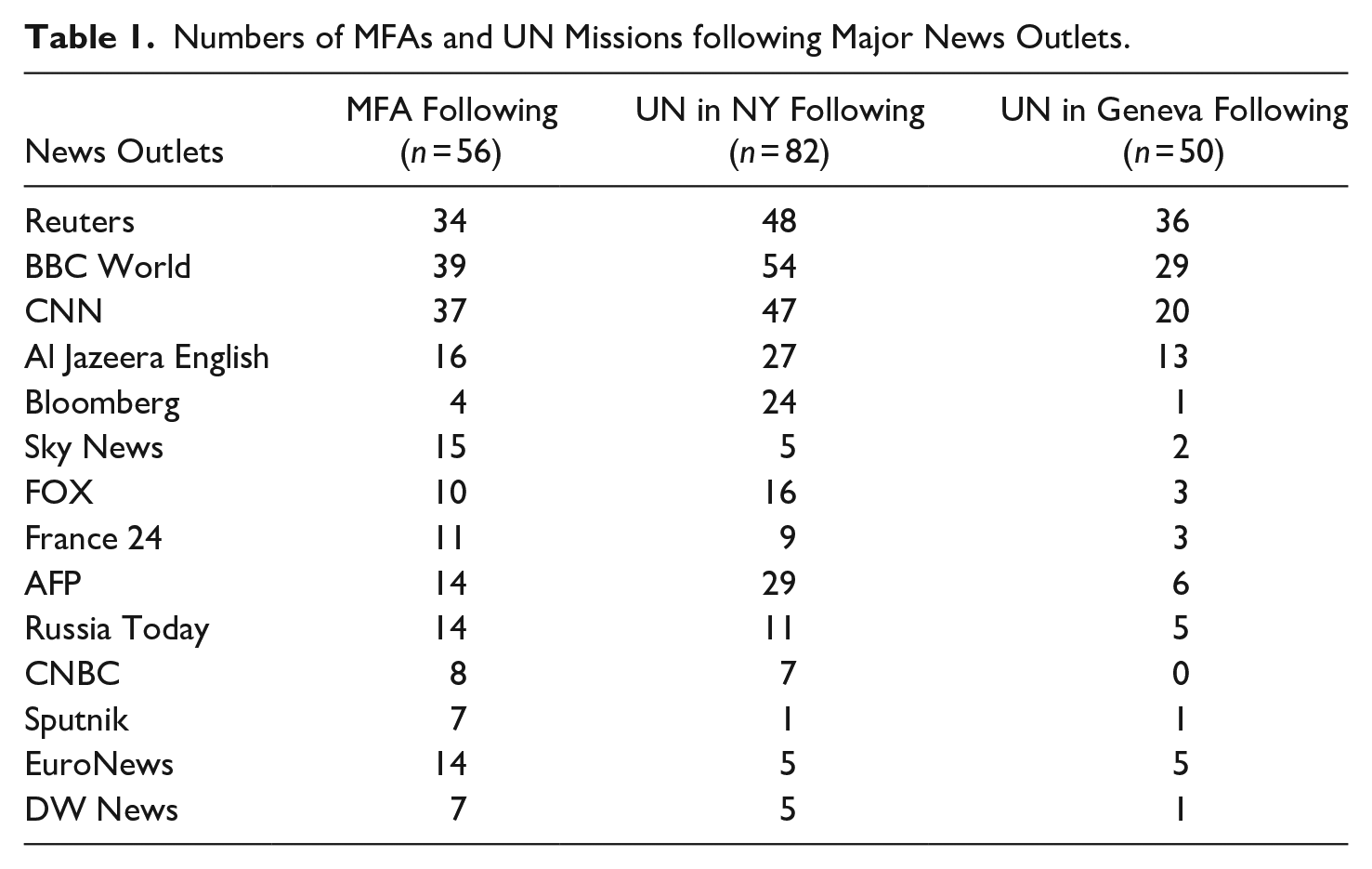
Table 1 demonstrates the enduring UK–US duopoly (Thussu 2022) and the Western dominance in global news flows. The news outlets that attract the most diplomatic followers are either British (Reuters, BBC World, and Sky News) or American (CNN and Bloomberg). However, Table 1 also clearly demonstrates that the only non-Western news outlet to attract a sizable following is Al-Jazeera. Among MFAs, Al-Jazeera is the fourth most followed news outlet surpassing Western news outlets such as Bloomberg, Sky News, and Fox News. In NY, Al-Jazeera is the fifth most followed news outlet, again surpassing Western news outlets, while in Geneva, Al-Jazeera is the fourth most followed news outlet and only one of four news outlets to attract more than ten UN Missions. Table 2 begins to assess Al-Jazeera’s digital clout focusing on quality versus quantity of followers.
Numbers of MFAs and UN Missions following Major News Outlets.
Quality a of Geneva Missions Following/Not Following Four News Outlets on Twitter, (n = 50) Means (SD).
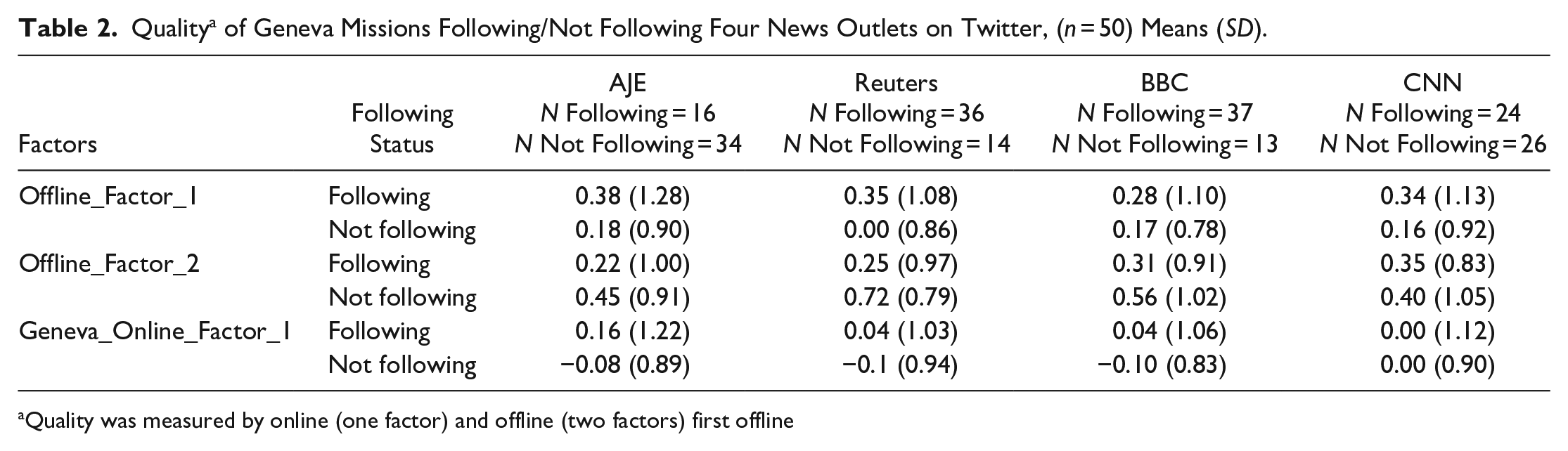
Quality was measured by online (one factor) and offline (two factors) first offline
In both Offline_Factors_1 and 2, and the Geneva_Online_Factor_1, no significant differences were detected between those Geneva Missions that follow news outlets and those that do not for each news outlet. As such, there was no difference in the quality of digital diplomacy followers that the four news outlets attract on Twitter (Tables 3 and 4).
Quality a of New York Missions Following/Not Following Four News Outlets on Twitter, (n = 82) Means (SD).
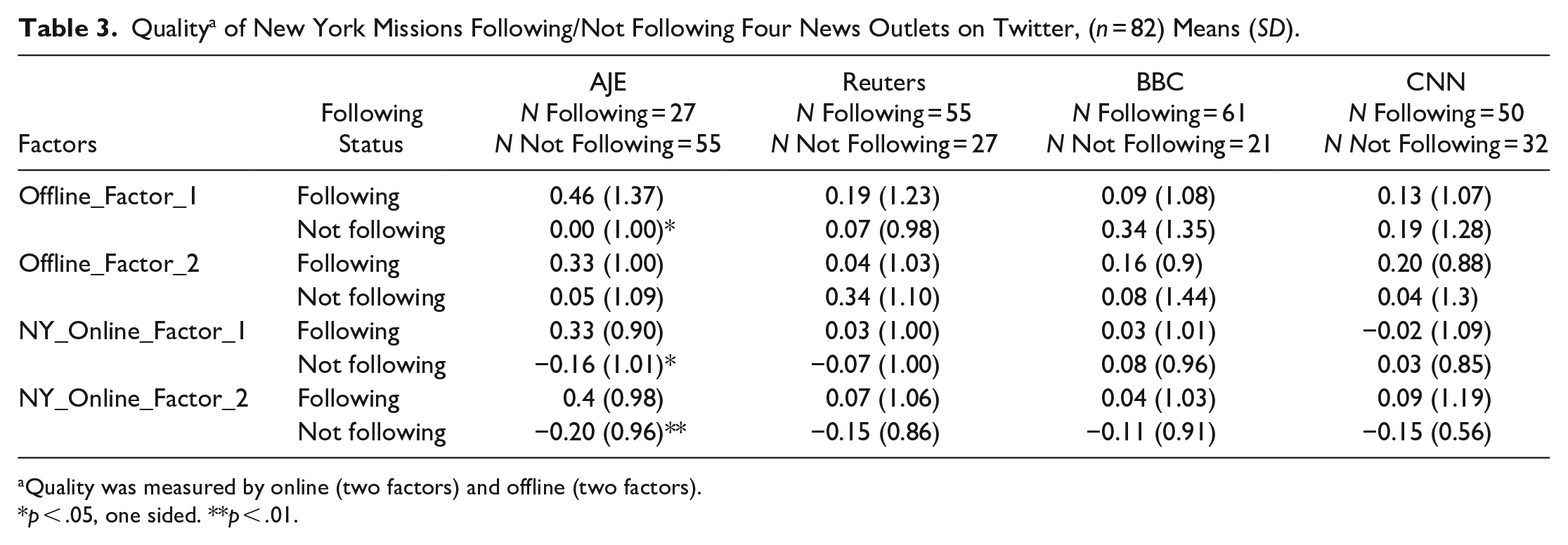
Quality was measured by online (two factors) and offline (two factors).
p < .05, one sided. **p < .01.
Quality a of MFAs Following/Not Following Four News Outlets on Twitter, (n = 56) Means (SD).
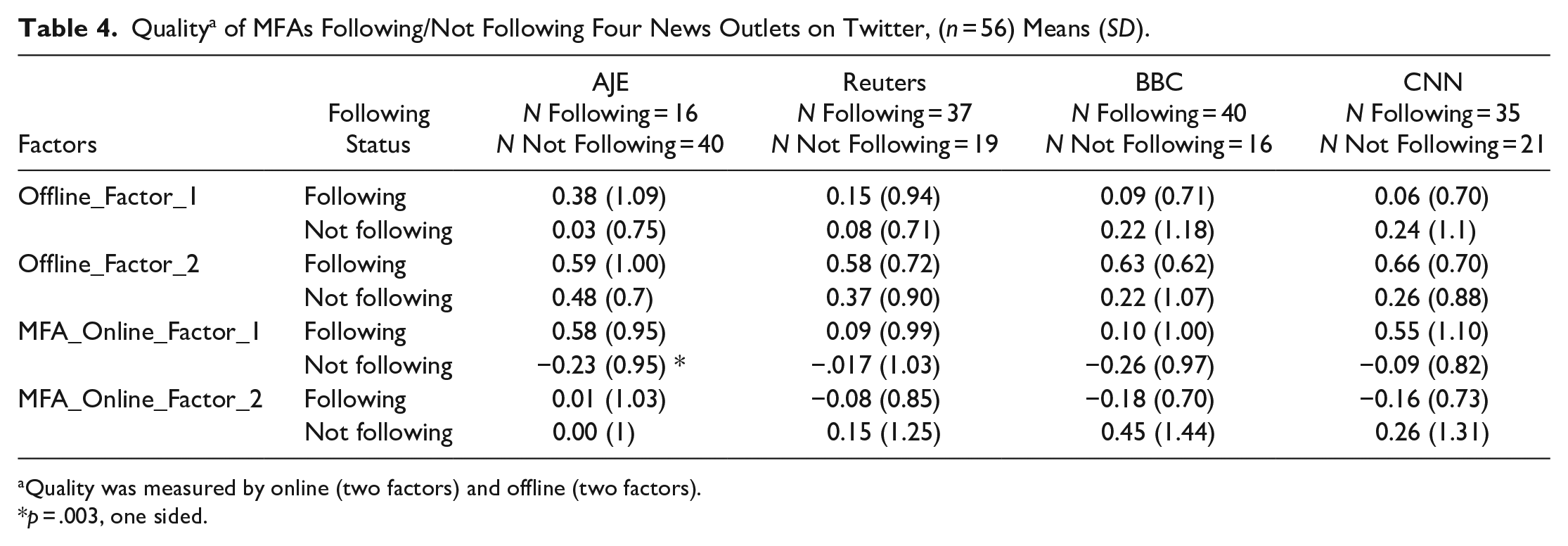
Quality was measured by online (two factors) and offline (two factors).
p = .003, one sided.
In Offline_Factor_1, there was a significant difference between those NY Missions that follow Al-Jazeera and those that do not. NY Missions following Al-Jazeera were characterized by higher means of Offline_Factor_1 (comprised of GDP, Population size, number of Embassies in capital, and number of Embassies deployed abroad). However, in Offline_Factor_2 (comprised of Military budget, Internet penetration rates, Press Freedom Rankings, and Good Country Index), no significant differences were detected between those Missions that follow Al-Jazeera and those that do not.
Moreover, in both NY_Online_Factor_1 and 2, there was a significant difference between those NY Missions that follow Al-Jazeera on Twitter and those that do not follow Al-Jazeera. NY Missions following Al-Jazeera were characterized by higher means of NY_Online_Factor_1 (comprised of Number of Twitter accounts followed, indegree and betweenness) and of NY_Online_Factor_2 (comprised of Time since joined Twitter, number of tweets, and number of followers).
Indeed, when examining those NY Missions that follow any news outlet, the Missions following Al-Jazeera have higher levels in Online Factor 1 (0.33 vs. 0.03, 0.03, −0.02), Online Factor 2(0.4 vs. 0.07, 0.04, 0.09) and Offline Factor 1 (0.46 vs 0.19, 0.09, 0.13) (see Figure 1).
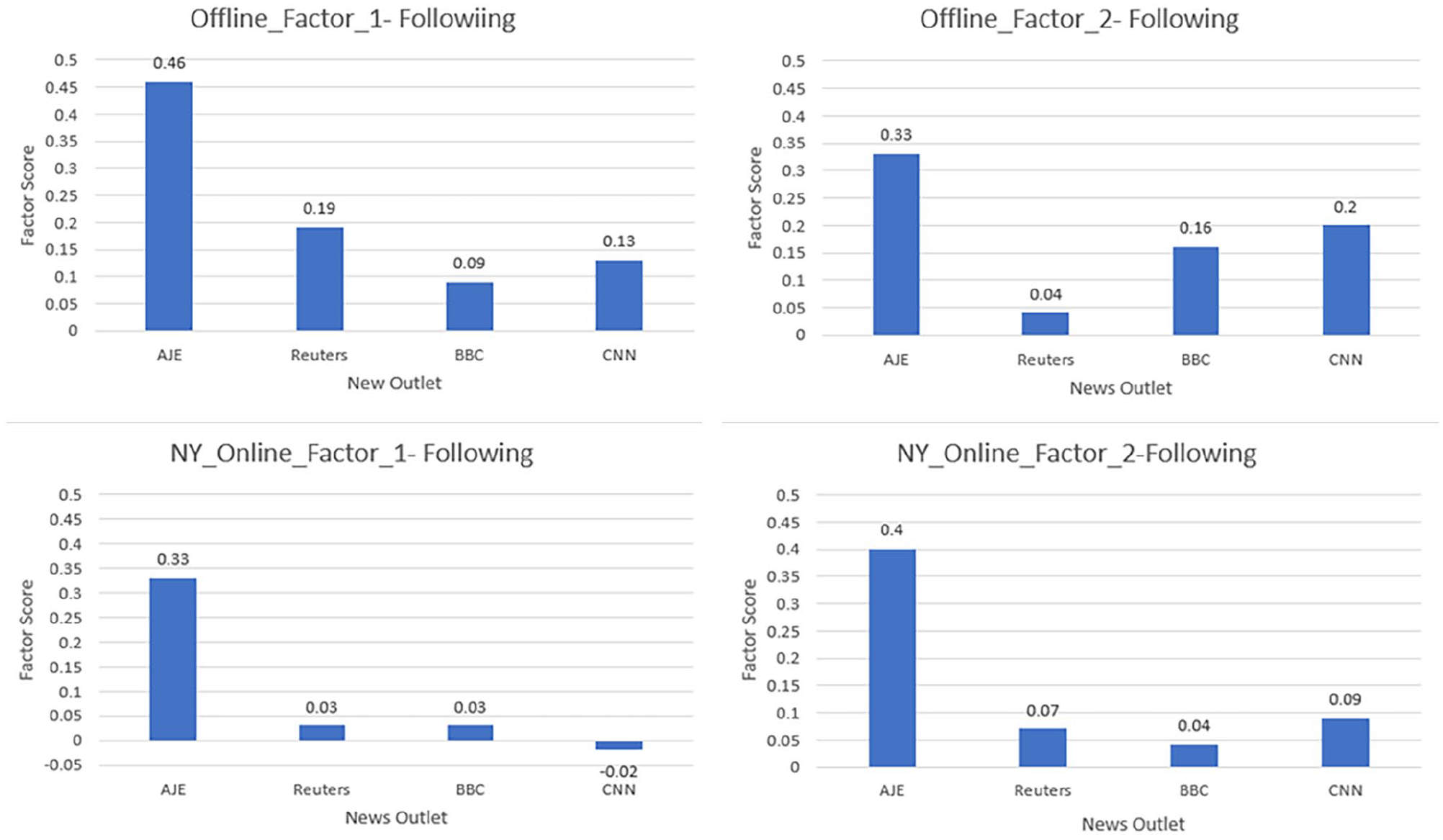
Factor Scores by News Outlets (offline scores for all samples, online factors for NY Missions).
To summarize, NY Missions following Al-Jazeera represented more affluent nations and nations that can be considered as influential in world affairs as measured through brick-and-mortar Embassies. Moreover, those NY Missions following Al-Jazeera were more active on Twitter, had larger numbers of followers, attracted many of their peers, and were central to the exchange of information in the Twitter network of NY Missions. When comparing the Missions following and those not following Reuters, BBC, and CNN, no significant differences were detected in any of the factors considered.
When examining Offline_Factors_1 and 2, no significant differences were detected between these MFA that follow new outlets and those that do not for each news outlet. In MFA_Online_Factor_1, those MFAs who follow Al-Jazeera are characterized by larger means indicating higher levels of following other Twitter accounts, indegree scores, and betweenness scores. No other significant differences were found. Moreover, in MFA_Online_Factor_1, among those MFAs that follow the news outlets, those following Al-Jazeera exhibit higher mean levels (0.58) when compared to Reuters and BBC respectively (0.09, 0.10) and similar to CNN (0.55). Similarly, in MFA_Online_Factor_2 (comprised of time since joined Twitter, number of tweets published, and number of followers), among those MFAs that follow news outlets, those following Al-Jazeera exhibit higher mean levels (0.01) when compared to Reuters, BBC, and CNN, respectively (−0.08, −0.18, −0.16).
To conclude, the components of MFA_Online_Factor_1, including number of Twitter accounts followed, indegree scores, and betweenness scores, all showed significant differences between those MFAs that follow Al-Jazeera and those that do not. As such, the MFAs following Al-Jazeera attracted more of their peers, were central to the exchange of information in the Twitter network of MFAs, and followed more Twitter accounts in general.
Assessing Engagement with New Outlets’ Content
An important question is whether diplomatic institutions also engage with news outlets’ content. MFAs and UN Missions may refrain from sharing news content as this might constitute a form of endorsement of the news outlet or serve to validate a news report. Yet MFAs and UN Missions cannot validate each news report. MFAs and UN Missions may also refrain sharing news reports from state-owned outlets such as Al-Jazeera, as this would mean endorsing both a news outlet and the state behind it. It is here that the interplay between news production and politics comes into play.
In order to address RQ4, we evaluated tweets published by the ten MFAs in our sample, which attracted the highest number of peers or had the highest indegree scores (UK, US, Belgium, EU, Poland, Turkey, Slovenia, Latvia, France, and Albania). We also evaluated tweets published by the ten most central UN Mission in the NY Twitter network, or those Missions with the highest centrality scores (Ireland, Sweden, Iceland, EU, Germany, Estonia, Belgium, Pakistan, UAE, and Kuwait). Due to limitations on Twitter’s API, we could only evaluate the 750 most recent tweets published by each diplomatic institution. As such, we reviewed 15,000 tweets.
The analysis found that all MFAs and NY Missions in the sample re-tweeted or shared links to content published by news outlets, yet to a low extent (see supplemental file for detailed table). The only exception was Sweden’s UN Mission which shared no links to news content. For example, an analysis of 750 tweets published by the British MFA found that it shared six news tweets, while the EU’s MFA shared 11. The most news tweets were shared by the MFAs of Poland (twenty-six tweets) and Latvia (nineteen tweets). The dominance of Western news outlets was evident as CNN, BBC News, The Guardian, and The Financial Times were the most prevalent news sources among MFAs trailed by FOX News, Sky News, and Bloomberg.
In the UN sample, we found similar variance, with the German Mission sharing only two news tweets, while the Estonian Mission shared twenty-four including two tweets that originated from Al-Jazeera. We argue that this finding is important as the Estonian Mission in NY is one of the most central in the Twitter network of NY Missions, meaning that Al-Jazeera’s tweets and news stories were disseminated across the NY network. It also demonstrates that diplomatic institutions both follow and share Al-Jazeera’s content on social media. Third, Al-Jazeera was the only non-Western news channel whose tweets were shared online by the Estonian Missions to NY. The same results were obtained in our analysis of Pakistan’s NY Mission which re-tweeted or linked to eighteen news tweets, three of which originated from Al-Jazeera.
Discussion and Conclusions
This study sought to provide the most comprehensive analysis of the “Al-Jazeera Effect.” The suggested model is the first to consider not only the number but also the quality of political bodies that follow Al-Jazeera on Twitter using objective international measures, as well as engagement with Al-Jazeera’s materials.
The quantitative analysis revealed that the Qatari station was the fourth most followed by MFAs and UN Missions trailing CNN, BBC World News, and Reuters, yet outperforming Western outlets including Fox News, AFP, Euro News, and Sky News. When analyzing quality of followers, the analysis of the UN Geneva Missions revealed no differences between those Missions that follow news outlets and those that do not for each news outlet. In the NY sample; however, those Missions that follow Al-Jazeera were of higher quality in terms of offline attributes. These NY Missions represented larger nations as well as nations with greater levels of economic affluence. Moreover, they represented nations that can be considered as influential in world affairs as they host more Embassies in capitals and deploy more Embassies abroad (Alger and Brams 1967; Small and Singer 1973). Yet these NY Missions were also of higher quality in online and networked attributes—they were more active on Twitter, had larger numbers of followers, attracted many of their peers, and were central to information exchanges in the Twitter network of NY Missions. Similarly, in the sample of MFAs, significant differences were also detected between those MFAs that follow Al-Jazeera on Twitter and those that do not. MFAs who follow Al-Jazeera on Twitter were of higher quality in online/networked attributes as they attracted more of their peers, were central information exchanges in the Twitter network of MFAs, and followed more Twitter accounts in general. However, the MFAs that follow Al-Jazeera were not of high offline quality.
Finally, analysis showed little engagement on the part of MFAs and UN Missions with news tweets, perhaps due to the diplomatic nature of the international political bodies analyzed. The analysis found that Western outlets gained more retweets than Al-Jazeera, illustrating a distinction between following and actually sharing Al-Jazeera materials. However, Al-Jazeera was the only non-Western global news outlet whose online content was shared by UN Missions in our sample.
To the best of our knowledge, this paper provides the most comprehensive empirical analysis of the “Al-Jazeera Effect” to date, mapping its unique position in the top five leading news outlets and the only non-Western outlet to attract both quantity and quality of followers.
For studies of the power dynamics between non-Western and Western media and its impact on global media flows, the analysis highlights that on the one hand, Western dominance of global news flow is maintained, and there is a near monopoly of Western outlets in the global news realm. On the other hand, the case of Al-Jazeera illustrates that this monopoly can be challenged and that non-Western networks can gain a competitive edge, at least in terms of their Clout. More importantly, this prominence is evident among the most important international political bodies, such as global powers, and not only among peripheral states.
Beyond its analysis of media dynamics, this article provides a novel model that emphasizes the need to combine quantitative, qualitative, and engagement analyses to provide a better and more vivid understanding of the standing of various news outlets. Specifically, we suggest the term digital Clout to illustrate the insights provided by our model, as it reflects the overarching effect of the examined news outlet in the social media era.
Finally, with respect to the findings that Al-Jazeera content garnered less engagement than Western counterparts, future studies should examine what considerations impact MFAs and UN Missions’ willingness to share news tweets online, specifically with respect to their relationship with host countries such as Qatar.
Supplemental Material
sj-docx-1-hij-10.1177_19401612251345974 – Supplemental material for Digital Diplomacy Followers as Indicator of Clout: Measuring the “Al-Jazeera Effect”
Supplemental material, sj-docx-1-hij-10.1177_19401612251345974 for Digital Diplomacy Followers as Indicator of Clout: Measuring the “Al-Jazeera Effect” by Ilan Manor and Tal Samuel-Azran in The International Journal of Press/Politics
Footnotes
Data Availability
Analysis was based on network and quantitative analyses of readily available information online such as Twitter accounts of Ministries of Foreign Affairs and UN Missions.
Declaration of Conflicting Interests
The author(s) declared no potential conflicts of interest with respect to the research, authorship, and/or publication of this article.
Funding
The author(s) received no financial support for the research, authorship, and/or publication of this article.

Supplemental Material
Supplemental material for this article is available online.
Author Biographies
References
Supplementary Material
Please find the following supplemental material available below.
For Open Access articles published under a Creative Commons License, all supplemental material carries the same license as the article it is associated with.
For non-Open Access articles published, all supplemental material carries a non-exclusive license, and permission requests for re-use of supplemental material or any part of supplemental material shall be sent directly to the copyright owner as specified in the copyright notice associated with the article.
