



Abstract
The increasing popularity of social media platforms creates new digital social networks in which individuals can interact and share information, news, and opinion. The use of these technologies appears to have the capacity to transform current social configurations and relations, not least within the public and civic spheres. Within the social sciences, much emphasis has been placed on conceptualizing social media’s role in modern society and the interrelationships between online and offline actors and events. In contrast, little attention has been paid to exploring user practices on social media and how individual posts respond to each other. To demonstrate the value of an interactional approach toward social media analysis, we performed a detailed analysis of Twitter-based online campaigns. After categorizing social media posts based on action(s), we developed a typology of user exchanges. We found these social media campaigns to be highly heterogeneous in content, with a wide range of actions performed and substantial numbers of tweets not engaged with the substance of the campaign. We argue that this interactional approach can form the basis for further work conceptualizing the broader impact of activist campaigns and the treatment of social media as “data” more generally. In this way, analytic focus on interactional practices on social media can provide empirical insight into the micro-transformational characteristics within “campaign communication.”
Introduction: New Digital Spaces and Activism
The increasing popularity of social media platforms creates new digital social networks in which individuals can interact and share information, news, and opinion with unprecedented speed and ease. Consequently, the use of such technologies appears to have the capacity to transform current social configurations and relations —not least within the public and civic spheres. In this article, we develop the notion of transformation in relation to the particular affordances and characteristics of micro-interaction within social media environments.
Social media are emerging as a new research topic across fields, including social science, web science, computer science, and psychology. Within the social sciences, much emphasis has been placed on conceptualizing social media’s role in modern society (Mossberger, Tolbert, & McNeal, 2008; Trottier, 2012) and the interrelationships between online and offline actors, institutions, events, and political and social change (Edwards et al., 2013; Harlow, 2012; Housley et al., 2014; Lupton, 2015; Murthy, 2012, 2013; Williams et al., 2013). Empirical work has given attention to categorizing types of content posted on social media (Diakopoulos & Shamma, 2010; Garcia Esparza, O’Mahony, & Smyth, 2010) and identifying the discursive practices employed by “trolls” and users posting inflammatory messages (Awan, 2014; Hardaker, 2010; McCosker, 2014). Social scientific work also benefits from the computational analysis of large aggregated data sets, for instance, to trace the spread of posts during times of societal tension and unease (Williams et al., 2013; Zubiaga, Liakata, Procter, Hoi, & Tolmie, 2016) and to explore effects such as a homophily, in which social media users follow and associate with others sharing the same opinions as themselves (Murthy, 2013), a tendency that some claim is now being amplified by personalization algorithms to create “echo chambers” (Pariser, 2011).
Thus, it is possible that networked digital technologies are disrupting and transforming mass public communications in various ways facilitating not only new forms of deliberation, debate, and civil participation but also antagonism and social fragmentation (Edwards et al., 2013; Housley et al., 2014; Russo, Watkins, Kelly, & Chan, 2008). In order to further understand the transformative capacity of these new digital spaces, it is first necessary to understand in detail how practices in these spaces are conducted. It is therefore crucial to observe the interconnections between social media and communication, both on a large scale and at micro levels. This includes observing the ways these interconnections transform the flow of communicative practices and content that surround topics and “trending items” as they are negotiated, discussed, debated, and refuted by social actors online.
Activism is one area in which social media have the capacity to facilitate the spread of relevant communicative content (Cox, 2015). By activism, we mean the organization of people around a particular issue or event in order to effect social, economic, cultural, or political change. Recent years have seen social media platforms play a key role in the emergence and/or growth of activist campaigns that are both highly distributed and centrally organized. For instance, the “Black Lives Matter” movement began in the United States (Frosch & Calvert, 2015) as a hashtag (#BlackLivesMatter) on Twitter and has grown to include rallies and protest marches, as well as local groups and organizations. Meanwhile, long-established civil society organizations such as the Red Cross now routinely use social media to spread campaign messages and fundraise (Briones, Kuch, Liu, & Jin, 2011). Advocates of social media use in activism have argued that the wide reach and fast pace of digital communications provide grassroots movements, charities, and humanitarian organizations with opportunities to galvanize support (Chadwick & Howard, 2008) and enable citizens to take action and “speak critically to power” (Elgot, 2015). However, others suggest (Davies, 2013; White, 2010) that social media reduce activism to mere “clicktivism” or “slacktivism” in which users “like” or forward some content to show their approval for a message, cause, and so on, but do nothing further. Also relevant are broader public debates over the capacity for rapidly propagating content on social media to cause harm through unverified claims and malicious campaigns (Starbird, Maddock, Orand, Achterman, & Mason, 2014; World Economic Forum, 2013). Throughout these public discourses, we observe a tendency toward implicit assumptions that social media content, in particular content posted within specific campaigns and movements, is homogeneous in character and comprises similar practices and tactics for digital communication.
Debates over the role of social media in activism raise a number of challenges for contemporary social research. It is necessary to conceptualize and identify means to explore activism in action on social media and to trace its interrelationships with offline actors and events. This article contributes to this work by taking as its focus the detailed examination of user interaction as part of activist campaigns. We report on the development of a novel methodological framework that identifies and visualizes the communicative actions occurring within conversational “threads” on Twitter (Housley, Webb, Edwards, Procter, & Jirotka, 2017). We illustrate this framework by reporting on the analysis of case studies of activist campaigns and describe its potential implications. We argue that a highly detailed interactional approach can deepen understanding of the practices of social media activism. For instance, it demonstrates the wide number of communicative actions that may be occurring within an apparently homogeneous campaign and highlights differing the levels of engagement that might occur.
Analyzing Activism in Action: Toward an Interactional Approach
A growing volume of research provides valuable insights into the interrelationships between new digital spaces and activist campaigning, for instance, by conceptualizing the role social media can play in the organized pursuit of societal change. Gerbaudo (2012, 2014) describes the ways that social media are used to re-appropriate the public sphere (Habermas, 1991), creating opportunities to mobilize citizens and reflecting features of traditional populism such as openness, directness, and democracy. The ability for users to post and propagate content on social media in real time ensures that critical incidents can be publicized rapidly and campaign messages built around them can reach wide audiences while they are still topical. Freelon, Mcllwain and Clark (2016) described social media posts as essential to publicizing the Michael Brown shooting and galvanizing the Black Lives Matter campaign. Opportunities for anonymous messaging can provide individuals in repressive environments with a safe space in which to promote dissent (Tufekci, 2011). In reference to the clicktivism debate, Tufekci and Wilson (2012) found that the use of social media greatly increased the probability that individuals attended the first day of the Egyptian Tahir Square protests.
Further work in this field helps us to understand the interconnections between activist practices and the affordances of specific social media sites. Focusing on Twitter, we can see how microblogging on this open platform can support activist goals. Poell and Rajagopalan (2015) and Segerberg and Bennett (2011) describe how Twitter can connect diverse users. The former studied tweets referring to a controversial gang rape incident in New Delhi in December 2012 and found that the popular activity of retweeting provided a low-effort means through which users could connect with each other and collate collective accounts. The hashtag can be a particularly powerful tool: Thrift (2014) describes how the #YesAllWomen hashtag was used to share stories of female harassment and formed a counterpoint to the defensive #NotAllMen. The responsive capacity of the hashtag is also described by Horeck (2014), who traces the repurposing of the commercial hashtag #AskThicke into a feminist one. Poell and Borra (2012) and Duguay (2016) highlight a limitation of Twitter in activism: tweets within a specific campaign can be dominated by a small number of, often high profile, users who seek to self-promote and avoid reference to potentially contentious issues.
One final area of insight relates to the conduct of communicative practices in and through the posting of social media content. This is a potentially highly fruitful area of work but one that remains underdeveloped. Analysis can illuminate how users communicate with each other in particular technological environments and thereby advance understanding of how online campaigns emerge and spread. This kind of analysis presents a number of methodological challenges (Driscoll & Thorson, 2015), such as the time-consuming nature of social media data collation, and ethical barriers to accessing content posted on private platforms (Webb et al., 2017). Nevertheless, existing work has begun to produce some valuable insights. For instance, Theocharis, Lowe, van Deth, and García-Albacete (2015) conducted a comparative content analysis of activist-related tweets from three case study data sets, with each post coded in terms of its purpose, sender “type,” and evaluation of the larger movement it referred to. They argued that while Twitter was used to discuss issues and advertise protests, only a small minority of posts concerned protest organization. Earl, Hurwitz, Mesinas, Tolan, and Arlotti (2013) described how Twitter’s real-time status enables protestors to share information about the whereabouts of law enforcement agencies and thus reduce police–protester asymmetries. Burgess and Matamoros-Fernández (2016) mapped posts that related to the GamerGate controversy across digital platforms during a particular time period. They produced a social network analysis of online activity and actor relationships, visualizing the associations among accounts and hashtags. A particular contribution of this approach was its ability to reveal the existence of minority perspectives which can sometimes be hidden within apparently binary debates online.
Unsurprisingly, given the newness of digital social spaces and the methodological challenges this kind of analysis creates, work in this particular area is currently underdeveloped. Nevertheless, there is great value in taking this strand of work forward in order to advance the detailed understanding of communication in the conduct of social media activism and thereby also add to broader knowledge about the social organization of online campaigns. We note that in much existing work, there is a tendency to analyze social media posts in isolation, treating them as a series of discrete items or as networks of users at a macro level. This risks overlooking the (potential) relationships between posts and the development of activism through the interconnected actions of different users. We propose a more granular, interactional approach to the study of social media communications (Housley et al., 2017). This type of approach has already been used, in part, by Procter, Vis and Voss (2013). When applied to the study of activism in action, it offers particular methodological benefits. As we describe further below, it facilitates the detailed description of how social media communications are organized, provides the means of understanding the transformation of interaction in terms of topics and relevant (or otherwise) everyday social categories and actions, and operationalizes a lens through which to consider both the organization and transformation of small-scale interactions in terms of a wider view of the organization of campaign activity on social media
Methodology
The analysis described in this article was conducted as part of a wider study on the spread of antagonistic content on social media (Webb et al., 2016). One of the aims of this study was to identify the interactional features of social media—specifically Twitter—threads that have “conversational” features, without assuming that interaction on tweeting is “just” conversation (Housley et al., 2017). This detailed qualitative analysis provides insight into the micro-organization of social media posts and also supports large-scale quantitative analyses.
We observed Twitter posts across the period April to May 2015 and identified occurrences of social media activism. 1 These occurrences were manifest as groups of tweets identified through the use of the Twitter web client “reply” facility and referencing actions or ideas designed to effect social, economic, cultural, or political change and were identified through a common hashtag. Observation was first undertaken through the monitoring of the official Twitter website to identify “trending,” popular hashtags. Subsequently, we used TweetDeck, a software tool that supports sophisticated and efficient keyword searching, plus the COSMOS platform (Burnap et al., 2015), which is designed to assist academic social scientists with the collection and analysis of Twitter data. Three campaigns were selected for analysis. These were chosen in order to represent activist campaigns pursuing different aims, and each involved a high volume of posting across the period of the observation:
#NotGuilty: Student Ione Wells was sexually assaulted in London in April 2015 (BBC Newsbeat, 2015). As a result of her attack, she established the #NotGuilty campaign, which looked to oppose victim-blaming in rape cases. Wells appeared in numerous newspapers (e.g., Wells, 2015) and by 6 May, her name was trending on UK Twitter.
#NepalEarthquake: Two devastating earthquakes struck Nepal in early 2015 (BBC News, 2015). Appeals for aid were quickly established through Twitter; US$17 million was donated through Facebook (Carey-Simos, 2015), and Google launched a People Finder Tool (Frizell, 2015). By 14 May, 30% of UK donations had been made online (Charities Aid Foundation, 2015).
#VoteYes: In the run-up to the Irish Gay Marriage Referendum in May 2015 (Reuters, 2015), there was strong social media support for a “yes” vote, with #VoteYes being the largest global Twitter trend before the event (BT Home, 2015).
We used the COSMOS tool to collect relevant tweets for each campaign during a set period of time. COSMOS collects tweets via the Twitter Application Programming Interface (API); this allows for the automatic extraction and processing of tweets and provides a faster and more systematic approach to data collection and management than manual methods. COSMOS captured tweets containing specific hashtags and we were then able to review the collected data and identify other frequently occurring hashtags and key phrases that might be relevant to the analysis. Using the API enables tweets to be collected in real time, and our data sets therefore included posts that were subsequently deleted by users themselves. This ensured the data did not include any omissions, which proved valuable when examining the detail of unfolding social media campaigns.
We collected between 9,000 and 25,000 tweets per campaign. Using TweetDeck, we conducted keyword searches bounded by size of engagement. This was specified by the number of retweets, likes, or replies that a tweet received and enabled us to identify and rank tweets by the degree of attention they attracted from other Twitter users. We discarded non-English tweets and selected a subset of 1,200 tweets for analysis based on rank and occurrence of appropriate keywords—for example, “Nepal” and “NotGuilty.” These “opening” tweets were then used to collect the conversational threads they initiated (Webb et al., 2016). Twitter does not provide an API end point to retrieve conversational threads; however, it is possible to collect them by scraping tweets through the web client interface. Using a customized Javascript tool ensured that the tweets within each thread could be observed in chronological posting order (Webb et al., 2016; Zubiaga et al., 2016). The tool also enabled the threads to be loaded into a spreadsheet that recorded the content, user details (@ handle and username), and timestamp of each tweet alongside other details such as the number of retweets, replies, and likes received. This spreadsheet served as the preliminary resource for analysis, the equivalent to an interview or conversation transcript.
We selected 20 threads for each campaign, each containing between 4 and 604 posts. This provided rich data to support in-depth analysis while also providing insight into the variety within and between campaign data sets.
Analysis drew on insights from the associated fields of ethnomethodology (Garfinkel, 1967), conversation analysis (Sacks, Schegloff, & Jefferson, 1974), membership categorization analysis (Housley & Fitzgerald, 2015; Sacks, 1992), and interactionism (Housley, 2003). These fields share an understanding of interaction as comprising taken-for-granted behaviors that are central to social order and as a form of social organization in and of itself. They share a methodological focus on the analysis of naturally occurring and sequentially unfolding interactions. Utilizing these approaches, we conducted the following analytic activities.
Identification of Conversational Actions in Twitter Posts
Taking an inductive approach, we began by identifying the “conversational” actions performed by each tweet in the thread. Beginning with the opening tweet and proceeding through it in order of posting, we viewed the content of the post to identify activities occurring such as information-giving, questioning, agreeing, and disagreeing. Particular attention was given to the ways that subsequent posts responded to prior ones and how interactions within the thread evolved as posting continued. We note that a more fine-grained sequential analysis of Twitter threads and multiparty interaction is salient (see Housley et al., 2017; Tolmie, Procter, Rouncefield, Liakata, & Zubiaga, 2017) and treated this focus on action as an important first step in the process of interactional feature identification of social media posts.
Examination of Accounts and Membership Categorization Practice
Each post in the thread was treated as a type of “account” (Housley & Fitzgerald, 2008; Scott & Lyman, 1968; Stokes & Hewitt, 1976) built up through the use of membership categorization devices and associated predicates (Housley & Fitzgerald, 2015). Accounts make visible the inherently moral character of interaction. They are to be understood as features of the “interaction order” and draw on Goffmanian analyses of remedial work and social repair in everyday encounters (Housley & Fitzgerald, 2008). Accounts are organized and patterned interactional moves that include practices such as justifications, apologies, acceptance and penitence for blame, and requests that place a moral obligation on the recipient (Housley & Fitzgerald, 2008).
The examination of membership categorization practices, combined with the identification of conversational actions, provided a means of describing the detail of social media posts as forms of accountable action(s) that are socially and morally constituted and occasioned but, within the context of Twitter threads, tied to particular “real-world events.”
Development of a Twitter Typology
Once we had analyzed individual threads, we compared across the data set to identify general patterns. We iteratively developed a typology to categorize the actions performed in individual tweets during an online campaign. We used this typology as a basis to annotate tweets within threads and identify the interactional features occurring as threads unfolded. This consolidated the earlier analysis and also paved the way to generate quantitative analyses of “Twitter interaction-as-data” at scale.
Findings
In this section, we describe some of the key findings resulting from the analysis. We begin by outlining the interactions occurring in two Twitter threads. These have been selected as they typify the kinds of interactions occurring in the wider data set. They are represented in the form of the spreadsheet used for analysis—here simplified to show account name, tweet content, and a line number for each tweet for easy identification. We illustrate the nuanced understandings of Twitter-based interactions that can be gained via focusing on action, accounts, and membership categorization. We then describe how this fine-grained analysis led to the development of our typology of interactions on Twitter.
Thread 1 comes from the #NepalEarthquake campaign (Figure 1). For reasons of space, we focus here on the tweets most salient to our analysis. The text and web link within Tweet 1 perform the action of information-giving and the hashtag frames the topic of the tweet, making it “discoverable” to other Twitter users.

Thread 1.
In the following tweets (2-26), a variety of users post tweets that engage with the topic of the natural disaster and orient to the humanitarian response as moral in character. A variety of actions occur. One kind is questions/requests for information. For instance, in Tweet 2, the poster asks whether there is an opportunity for nurses to go out and work and assist; in Tweet 5, another poster enquires about the possibility of sending “stuff” to Nepal via the Red Cross; in Tweet 6, the poster notes his or her availability and asks “how can I help?”; and in Tweet 10, the user notes his or her desire to help and asks “How can I be involved?” In making these requests, users satisfy the informational parameters of the opening tweet and engage directly with the topic at hand. They also position a humanitarian response—including their own suggested activities—as morally creditworthy.
Tweets 7-9 come from the same poster and perform a different kind of action. The poster generates a list of engaged action request formulations. These request formulations are morally constituted in terms of a range of supportive humanitarian activities that concludes on Tweet 9 with an appeal to prayer. A further kind of action is an “echo” which repeats available information without adding anything extra—for instance, the retweet in Tweet 4 and the tweets solely containing relevant @ handles in Tweet 3 and later in Tweet 19.
All the tweets described so far engage with the topic of the humanitarian response and align with it as appropriate. At Tweet 12, something different happens. The content questions the efficacy of prayer in helping “those who are demolished” and is concluded with the hashtag “#wakeupmorons.” While this post still engages with the topic of the humanitarian response, it adopts a critical and sarcastic tone rather than a supportive one. At Tweet 15, this critical account is contested and an appeal to respecting other people’s beliefs is posted. This can be understood as a reaction to provocation and an attempt to counter the earlier antagonistic post. The thread continues with further offers of support and use of the “@” function in relation to the Red Cross account, the instigator of this particular disaster appeal thread. Then at Tweet 23 a poster asks, “Are you trying to make a business out of this?” The post is contextualized by two hashtags one of which is the Red Cross. Once again, the post engages with the topic of humanitarian response and the “call for help” made in Tweet 1 but in a critical way. It questions the motive for the appeal—Is this a moral matter or one which is, through reference to business, driven by another set of motives? In membership category terms, the thread’s prior contributions (at Tweet 2, for example, through its reference to jobs and occupational categories) may have provided the categorical grounds for this form of reasoning and reframing. At the very least, it indicates some form of orientation to the content of the thread and previous postings as a sequentially relevant matter within a multiparty exchange. This engaged criticism does not receive any direct response in the remainder of the thread. It is followed by another critical response from a different poster (a complaint about lack of support following Hurricane Sandy), a response from an official account directly answering the request for information made in Tweet 10 and a further request formulation from the user who posted previously in Tweets 7-9.
Examination of this thread reveals several important interactional features relevant across our data. One is an opening tweet that sets up the topic parameters for subsequent posts, in terms of content, hashtag, and @ handle. Another is the engagement (or non-engagement) of other posters with this topic. Engagement may be supportive or critical and take the form of actions such as requests for information, requests for action, or echoes. We can also see that posters in the thread not only engage and interact with the opening post but at times also with subsequent posts made by others. As our analysis continued, the reoccurrence of these features helped us to identify patterns of interactions in the threads. We can see this develop in Thread 2.
This thread (Figure 2) comes from the #VoteYes campaign. The interactions occurring within it share similar features to Thread 1. Once again, an opening tweet (Tweet 1) sets up the topic parameters for subsequent posts; @revk posts, in paraphrase, that “not all Christians are against equal marriage” and concludes with the #VoteYes hashtag to express support for the campaign and frame the content of the post. Subsequent posts engage with this issue; they use the opening poster’s @ handle to mark direct responses to it and produce posts that are both supportive (for instance, Tweets 2, 3, 4, 5, 13, and 16) and critical (for instance, Tweets 8 and 14) of @revk’s expressed stance. In Thread 1, we highlighted the occurrence of posts that perform the action of asking questions about the information provided in the opening tweet. In this thread, many posts perform actions of agreeing or disagreeing with the opening post. Once again, users also interact with subsequent posts in the thread in addition to the opening one. In particular, a debate develops around the understanding of “Christians,” and this involves a range of category-identity work, which we discuss here.

Thread 2.
The opening poster’s account name and handle (shortened for anonymity) contain the word “rev”—often short for “reverend” and a title given to members of the clergy. This orientation to religion is accompanied by an explicit reference to it in Tweet 1. Tweet 1 deploys an “n-population device.” The population group “Christians” is tied to the category-bound association (or predicate) of anger from a general population device, in this case “people.” The reference to “people angry at Christians for being against equal marriage” is then followed by a predicate clause that not all Christians agree on the issue. This, in turn, carries the implication that some Christians may well agree with equal marriage. In this way, the membership category device of “Christians” is afforded alternative forms of opinion in relation to the issues raised by the forthcoming referendum. We might understand the account provided by the post as informational in terms of how different groups are being positioned in relation to lines of moral and social opinion. We can also see that through the use of “we” and “rev” @revk positions himself or herself as within the category of Christians and therefore someone who has credible knowledge about this issue. The poster also makes clear that, despite being within this category that includes some who are against “equal marriage,” he or she supports it.
Tweets 2 and 3 respond directly to the opening tweet through the presence of the @ handle and repetition of parts of @revk’s account name. Both tweets express explicit agreement with Tweet 1—and therefore the #VoteYes campaign—via affirmative (“yeah”) and supportive statements (“go Rev K” and “Thankfully Anglicans . . .”). Tweet 4 provides a positive receipt of the statement that some Christians support equal marriage (“That’s good to know”) and by extension marks support for the #VoteYes campaign. However, the positive stance toward Tweet 1 is qualified; the user positions being “confused” over whether Christians support equal marriage as reasonable (“you can see why”), giving as an example “Leviticus”—a book of the Bible that condemns homosexuality. At Tweet 5, further qualified agreement with Tweet 1 is exhibited. Reference is made to “All Christians” (rather than the “some” implied in Tweet 1) that the poster knows “sharing” the same views; this includes a member of the Irish clergy who, it is claimed, is going to vote for equal marriage. Here, the poster draws on apparent personal experience to legitimate and extend the claim made that not all Christians are against equal marriage. The post can be seen to imply that because all the Christians the user knows support equal marriage, many other Christians must therefore also support it; this is an operationalization of the “etcetera” principle and Sacks’ (1992) consistency rule.
In Tweet 8, the user directly addresses @revk: “You can’t disown the people of the religion you spread. You are complicit in their hatred.” This challenges the identity-category work that has been done so far and explicitly topicalizes the operationalization of the consistency rule in relation to previous posts describing the stance of Christians toward equal marriage. In essence, the post positions Christians (“the people of the religion you spread”) as sharing the same identity; this is not distinguishable by particular stance toward equal marriage because Christians are morally responsible for each other and the consequences of their religion (“complicit in the their hatred”). The poster invokes the economy rule (Sacks, 1992) that refers to the conversational process by which if a member uses a single category from any device, then he or she can be recognized to be doing adequate reference to a person. In doing so, the post problematizes the stance in Tweet 1 that some Christians are in favor of equal marriage.
This argument made by the poster of Tweet 8 is mocked and challenged by direct responses in Tweets 9 and 10, first from @revk (“faceplam”) and then by a new poster (User 10): “that is probably the silliest thing . . .”) entering into the discussion. The argument is then challenged in Tweet 11 through the (possibly) extreme application of this category logic to a separate issue: in this case, that “living in Britain” equals agreeing with the “Iraq War” with no space for difference of opinion, and so on. The post mirrors the design of Tweet 8, for instance, through the use of “complicit,” but is built as a response to @revk rather than User 9. It acts as a commentary on Tweet 8, rather than a response to it and thereby positions User 9 as outside the discussion. The rest of the thread elaborates on this “membership categorization” issue where the moral position and “accountability” of specific groups such as Christians in “owning opinions” are questioned, criticized, or supported.
This analysis highlights further features of Twitter interactions that were identified across our data set. In particular, posters draw on various rhetorical devices in their discussions regarding activist campaigns and invoke different kinds of normative concerns and categories when doing so. Threads 1 and 2 reveal the variety of actions and activities that can be found within Twitter threads. Detailed qualitative analysis of this kind is necessary to develop a nuanced understanding of these activities; however, there is also scope to move from the particular to the general, as discussed next.
From the Particular to the General: Developing a Typology
To visualize how threads transform interactionally, we produced a diagrammatic scheme. This marks the order and sequence of posts and the actions performed within them.
The typology shown in Figure 3 represents the different kinds of actions that might be performed by tweets in a thread. For instance, as described in our analysis of Threads 1 and 2, we observe actions such as information-giving, agreement, disagreement, requests, and criticisms. This typology also notes nuances of action such as whether an agreement is explicit or implicit or whether a request is engaged or unengaged with the topic of a prior post. We used the typology to label each tweet in a thread (Figure 4, box) and then to create a visualization of the thread as it developed tweet by tweet (Figure 4, circles).

Twitter thread typology.
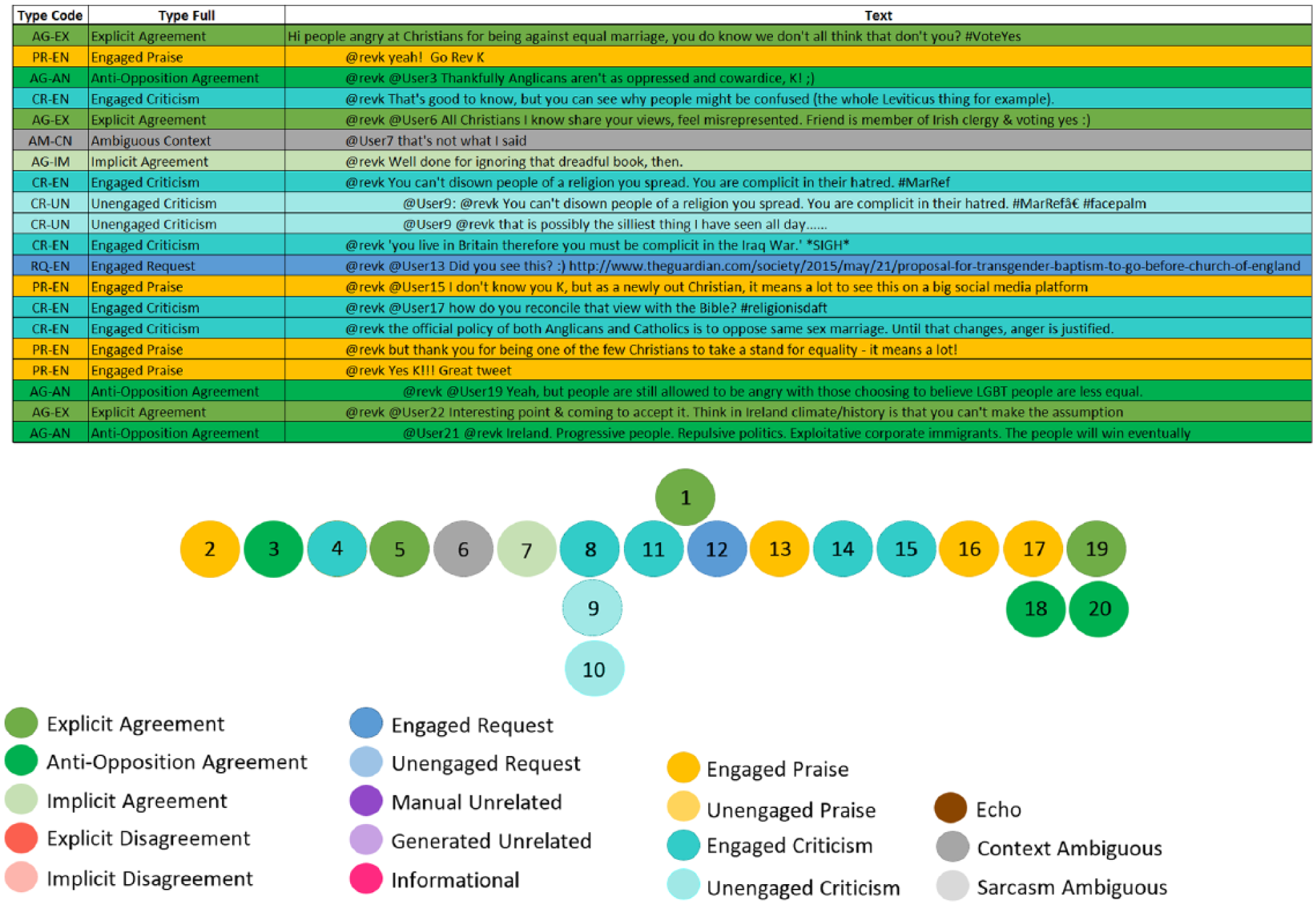
Thread visualization of tweet action.
The transposition of the detailed qualitative inspection of threads into the typology is not without its problems, not least through the level of interactional detail that is lost within an analytic process where complexity is reduced. Nevertheless, typologies of this kind allow for “drilling down” into the data to continually ground any quantitative analysis (including the identification of false positives) in the actual “ground truth” of Twitter interactions. The typology can act as a bridging instrument between small and big data that can be constantly refined in an iterative and recursive manner while helping to aid and discover points of interest in large data sets that enable repeated interaction-oriented sociological inspection across different cases. To demonstrate this, we discuss some of the patterns observed via the visualization of Twitter threads using the typology. These relate to engagement, retweets, and sub-conversations.
One consistent pattern was the recurrence of tweets characterized as unengaged with the opening tweet or topic in a thread (Figure 5). While engaged responses take up the topic at hand, for instance, through expressing agreement or requesting additional information, unengaged ones appear to do something different. For example, they might refer to an unrelated topic or praise the original poster without making reference to the campaign itself. The consistency of this pattern across our data indicates that while at an aggregate level a social media campaign might appear concordant, it is heterogeneous in nature, with a substantial number of posts deviating from the opening topic.

Engaged and unengaged actions.
Retweets, in which users forward on a prior tweet, were very frequent across the three campaigns studied. The most common retweets were of posts performing praise (of a user rather than the campaign) and echoes (which repeat or paraphrase earlier posts). Retweets therefore played a valuable role in spreading and amplifying “on message” content related to the campaign. It appears that the forwarding of content plays a key role in the propagation of a campaign across social media; this is confirmed by studies of information flow and “sentiment” across social media during digital public reaction to signal events (see Burnap et al., 2014, 2016). It is critical to continue to link this to qualitative inspection in order to understand the interaction that drives propagation and to help inform our understanding of the potential role of phenomena such as homophily.
Posters frequently responded to each other and thereby played a key role in extending a thread. While entire threads might contribute to one conversation, often individual conversations deviate from the main topic, resulting in sub-conversations between certain posters. As threads extend, tweets are increasingly likely to deviate from the topic of the original post and perform actions that do not relate to the campaign itself. For example, after posters exchange successive disagreements they may begin to trade personal criticisms rather than engage with the substance of the campaign (Figure 5). These might be seen to represent points where campaign communication meets more socially antagonistic and oppositional interactions on social media platforms. A more nuanced reading derived from the qualitative analysis suggests that matters of morality and accountability are embedded features of Twitter threads that are concerned with controversial topics of pressing humanitarian importance. This nuanced view is vital to analysis. Typologies are necessary for a “1,000-foot view” of social media in relation to critical events and the quantitative documentation of online activism. However, it remains important to return to the “manual inspection” of threads in order to augment macroscopic visualization and analysis with more granular detail. These interactions are subject to many of the ordinary and mundane rituals of everyday life, albeit within the particular confines and features of 140 characters.
Finally, platforms and their associated “functional affordances” configure the context in and through which social media in action takes place. For example, the process of “@”-ing a user in a thread can initiate forms of interaction that scale into antagonistic exchanges confined to the short form of 140 characters; further work needs to support cross-platform studies that empirically investigate how the length and detail of posts and “functional affordances” help shape and configure online discourse in different ways with possible implications for antagonism, deliberation, discussion, and the exchange of information online.
Discussion
We studied three online social media campaigns and analyzed them at an interactional level. We have illustrated our analysis here by presenting the findings of two of those campaigns. We iteratively developed a typology for categorizing the actions performed in social media posts, before constructing a diagrammatic scheme for studying user interaction. Through this we identified a large range of actions performed within single campaigns, with a substantial number of tweets appearing not to engage with the campaign at all. While threads often begin on a particular topic, they frequently deviate through the emergent voices of the participants as they unfold over time. Our analysis demonstrates the ways in which attention to interactional practices can provide empirical insight into the micro-transformational characteristics of social media posts within “campaign communication.”
We argue that social media activist campaigns should not be considered as homogeneous in content, but rather formed through individual posts that perform a wide range of accountable actions and respond to each other. Campaigns include actions that often do not appear to be engaged with the campaign itself, despite the use of a particular hashtag. Furthermore, these campaigns develop, at least in part, through interactions between posters, which, once again, might not directly engage with the campaign.
Our microlevel approach can complement computational analyses of Twitter interactions. For example, machine learning classifiers could be trained on existing data, enabling automated categorization of future messages. This could assist the real-time identification of uncivil behavior, which could then be defused by online moderators as well as informing additional computational approaches such as Natural Language Processing (NLP) that may enable the categorization of tweets in real time and at scale. The challenge, however, is integrating macro and micro levels of analysis and social and computational approaches into a coherent framework of interdisciplinary work.
In conclusion, we are mindful that our analyses suggest that social media “campaign” interaction forms an ecology of topics and associated actions that represent an emerging value base through which digital activism and related issues of stake and interest (Potter, Edwards, & Wetherell, 1993) might organize. They also inform an emerging understanding of how a continuum of inter-actions constitute a temporal and therefore transformational trajectory that may differentiate forms of online campaign—especially where certain claims, facts, the right to speak, or information are contested. Consequently, interactionist analyses may provide a set of concepts and techniques through which online campaigns can be seen to be processed, through the actions, in real time, of participants on social media, as legitimate, contested, malicious, or irrelevant to specific social groups. “Topic proliferation” through social media streams provides an opportunity to document the “norms-in-action” associated with online, activist Twitter campaigns, and trace the salience of core claims and aligned “stakes and interest” (or otherwise) displayed through members’ accounts through time. In this way, we respecify the transformation of social media campaign communications in and through interactional practices documented and discussed through the course of this article.
Footnotes
Declaration of Conflicting Interest
The author(s) declared no potential conflicts of interest with respect to the research, authorship, and/or publication of this article.
Funding
The author(s) disclosed receipt of the following financial support for the research, authorship, and/or publication of this article: Data collection and analysis in this paper were conducted as part of the ESRC sponsored project “Digital Wildfire: (mis)information flows, propagation, and responsible governance” (Ref. ES/LO13398/1). Meredydd Williams’ contribution was also supported by the Centre for Doctoral Training in Cyber Security at the University of Oxford. He is funded through an EPSRC studentship (Ref. EP/P00881X/1).