




Abstract
Scholars have become increasingly interested in the political work of Internet memes. While this research has delivered critical insights into how memes are implicated in both progressive and reactionary politics, there endures a lack of critical work on the ways in which Indigenous people engage with memes to deconstruct colonial power relations and produce alternative political arrangements. This article offers a reading of a set of memes produced and published by Australian Aboriginal activist Facebook page Blackfulla Revolution. We consider the ways in which memes are entangled in the achievement of an anti-colonial politics. More specifically, drawing Deleuze and Guattari’s notion of assemblage, this article offers two levels of analysis. The first analysis focuses on the memes as a text that works to challenge the founding national myth of “peaceful” British settlement. Through the careful narrative of the memes, we see how the colonial assemblage works through “making missing” Indigenous people. And while the material practices and expressive justifications of Australian colonialism might have varied over time, the assemblage has ultimately not changed in nature. For the second analysis, we read the subsequent user engagement with the memes. The sequence of memes, from this second view, contributes “to the invention of a people,” as Deleuze has said. Those excluded from the colonial assemblage and those who recognize it as violence are called forth to engage in movement against it.
Art [. . .] must take part in this task: not that of addressing a people, which is presupposed already there, but of contributing to the invention of a people. The moment the master, or the colonizer, proclaims “There have never been people here,” the missing people are a becoming, they invent themselves [. . .] in new conditions of struggle to which a necessarily political art must contribute.
Introduction
Recent literature has shifted our understanding of Internet memes from “a strange output of an Internet subculture” (Börzsei, 2013, p. 19) to a medium through which people may agitate for political change or more deeply engrain reactionary attitudes (Davis, Glantz, & Novak, 2015). Through memes, humor and politics often mix playfully in what Tay (2012) has called “LOLitics” (i.e. “laugh-out-loud politics”). Research emphasizing the political affordances of memetic content has shown that it can be a fruitful medium for “playing with meaning,” producing new narratives, subjectivities, and political groupings (Gal, Shifman, & Kampf, 2015). This work shows meme-making is always a meaning-making process (Tay, 2012), through which connections are made and remade.
Continuing this theme of taking memes seriously, this article offers a reading of a sequence of memes produced and published by Australian Aboriginal activist group Blackfulla Revolution (BFR). Within the body of existing critical work on Internet memes, Australian Indigenous 1 peoples’ production of and engagement with memes has received little attention—explored primarily as a medium through which racist hatred may proliferate (Herborn, 2013; Matamoros-Fernández, 2017; Oboler, 2012). This article offers an alternative lens. We consider the ways in which memes are entangled in the achievement of an anti-colonial politics.
More specifically, drawing on Deleuze and Guattari’s (1988) notion of assemblage, this article offers two levels of analysis of the memes.
First, while the memes we focus on are perhaps unusual in their narrative structure and ordered temporality, we discuss how the sequence functions as a critical analysis of colonialism in its own right. It does so through revealing Australian colonialism as an assemblage that works toward the erasure of Indigenous people by declaring, as Deleuze (2013, p. 217) explains, “There have never been people here.” The memes map the shifting ideological justifications and material practices of colonialism, demonstrating how colonialism has both varied over time but ultimately persisted in its being.
The second analysis looks toward Facebook users’ engagement with the memes. Across the 27 images, dozens of users generated hundreds of comments, discussing, debating, and creating meaning. The discussions were wide-ranging, including disappointment in the state-sanctioned and sanitized account of Australian colonial history, the sharing of historical and cultural knowledge, and engagement with overtly racist Facebook users. Here, we argue that the memes themselves function as an anti-colonial assemblage by “contributing to the invention of a people” (Deleuze, 2013, p. 217)—those who are excluded from Australian colonialism and those who recognize it as violence.
Australian Colonialism: Terra Nullius and Peaceful Settlement
The first fleet of British Royal Navy ships docked in Sydney’s Botany Bay on 26 January 1788. On board were seamen, marines, British government officials and over 1,000 convicts. Their arrival marked the first European settlement in Australia: a penal colony occupying terra nullius (nobody’s land). But standing ashore were people of the Eora nation, who had been living in the region for tens of thousands of years. Their presence was acknowledged readily in reports from the time (see, for example, Tench, 2009). There was frequent interaction between the people of the Eora nation and the new arrivals, with the British often actively seeking the Eora peoples’ intimate knowledge of land, flora, and fauna.
By and large, dominant discourses in Australia continue to perpetuate the idea that the arrival of the British was relatively peaceful. The ideological myth contends that British Europeans founded the nation of Australia, initially dividing the continent into states and territories, then federating these in 1901, marking the rise of a modern nation state. Embedded in this seamless narrative of nation-building is the idea that the nation was founded without conflict. Revisionist histories, commencing in the 1970s, challenged this account by providing abundant evidence that since 1788 Indigenous Australians have been subjected to ongoing violence and dispossession. For over two centuries, policies of “Protection,” Segregation, and Assimilation regulated the lives and movement of Indigenous people in Australia. In the past, regulation occurred through child removal, enforced miscegenation, the outlawing of culture and language, the destruction and theft of lands, and the breakdown of kinship relations through forced relocation; in effect, policies and practices were aimed toward the containment and annihilation of all Indigenous people and cultures.
Australia’s Indigenous people have survived despite the continued endurance of colonialism. They do so even with recent colonial policies and practices in more “enlightened” times, where forceful interventions into remote Indigenous communities by government bodies seek to “respond” to the devastating effects of colonialism marked by early mortality rates, addictions, and a range of other social ills.
Indigenous Australians have never been idle. Rather, movements to recognize Indigenous sovereignty began on that day in 1788 (Broome, 2010). As the British arrivals gradually encroached on Indigenous lands, violent exchanges became increasingly frequent. During the 18th century, “Frontier Wars” and resistance to the colonizers and colonization were commonplace (Connor, 2002). Through the mid-20th century, many resistance campaigns were launched, pushing for the civil rights of Australia’s original occupants, including the 1965 Freedom Ride campaign led by the late Charles Perkins that exposed widespread racism and racial segregation in rural New South Wales (Curthoy, 2002), and the 1967 referendum to remove discriminatory references to Indigenous Australians from the Australian Constitution (Broome, 2010).
The strategies deployed for subversion and political activism have transformed greatly over time to take advantage of technological developments: from the printing press to television to digital communication technologies. Today, social media such as Facebook and Twitter are key technologies in Indigenous political and anti-colonial movements globally (Carlson & Frazer, 2016). In Australia, the most visible social media–driven movements include the Recognise campaign, a largely online initiative that advocates the Constitutional Recognition of Indigenous Australians (Dreher, McCallum, & Waller, 2016); the popular IndigenousX rotating Twitter account, which celebrates and promotes the diversity of Indigenous people (Waller, Dreher, & McCallum, 2015); and the #SOSBlakAustralia campaign on Twitter and Facebook, which seeks to stop the forced closure of Indigenous communities in Western Australia (Carlson & Frazer, 2016; Cook, 2015). Although diverse in their objectives, each of these movements harnesses the affordances of new technologies to produce more progressive political arrangements.
Social Media and Political Participation
The rapid uptake of these social media technologies has prompted scholars to question the possible impact on democratic political participation. There has been growing interest in the new political arrangements that have been made possible by social media (Bennett & Segerberg, 2012). Although not initially designed for facilitating political activism, social media has become the most common entry point to activism for users (Brodock, Joyce, & Zaeck, 2009). However, it is unclear whether this shift has been for the better.
On the one hand, scholars have pointed toward cases such as the initial successes of the “Arab Spring,” where dictators were toppled at least partly through the mass online coordination and mobilization of regular citizens (Christenson, 2011). These “optimists” argue that social media encourages and facilitates democratic participation among users. New socio-material arrangements emerge online: information may be distributed, events coordinated, and bodies mobilized through mass, spontaneous, and digitally connected networks of people.
But Internet “skeptics” argue that the forms of participatory politics we see emerging online in fact embody a “declawing” of activism. Popular critic Evgeny Morozov (2009) dismisses the enthusiasm around “Twitter Revolution” as well-meaning but misguided hyperbole. Instead, he categorizes the dominant mode of online political participation as “slacktivism,” what he describes as “feel-good but useless Internet activism” (Morozov, 2009, p. 13). Ultimately, then, the argument is that social media sustains a conservative politics.
But while social media may not have been the only force behind the Arab Spring, it has clearly impacted the ways in which many of us engage politically. A meta-analysis of research on the impact of Internet technologies on civic engagement, for example, finds a “net positive” effect (Boulianne, 2009): more people are politically engaged now than they were only a couple of decades ago. Moreover, online activist skeptics tend to focus only on certain types of overt political acts, largely ignoring the proliferation of less material, and more performative, expressive, and creative forms of political engagement. Voting, petitioning, and demonstrating are not the only forms of political practice. Social media has instead become a wellspring of new forms of political expression and collective action, which complement rather than supplant more traditional forms of activism—what Bennett and Segerberg (2012) usefully describe as “connective action.”
To this end, Marichal (2013) argues for a more nuanced understanding of the ways in which social media users engage politically. He moves attention away from the more overt, instrumental and “macro” forms of political activity and instead emphasizes the political value of everyday, small-scale forms of activism. He defines this online “microactivism” as “one–to–several forms of politically oriented communication that reflect micro–level expressive political performances” (Marichal, 2013, np). In this way, we might remain alive to the impacts of small, mundane political expression online. While micropolitical practice “might not be intentionally designed to produce social change,” Marichal (2013, np) argues, it “still constitutes a political act and can have a mobilizing impact.” This is a politics that engages more with the production of meaning and new connections than the movement of bodies—although these are certainly not mutually exclusive.
The Politics of Internet Memes
Work on Internet memes has largely taken this less prescriptive and more performative approach to online political participation and activism. In recent years, Internet memes have become one of the most prevalent features of online culture (Shifman, 2013), attracting a significant amount of attention from social science and cultural studies scholars (see Nooney & Portwood-Stacer, 2014). These digital artifacts come in a range of mediums, including text, image, video, and performance. While there are an exponentially proliferating number of “genres” with often radically different characteristics, memes are generally identified by the ways in which they circulate: an idea, practice, or form of expression is produced and reproduced by many users, in many forms, and for many purposes. Recent work emphasizes the variegated nature of memes. Rather than offering some conclusive definition, Nooney and Portwood-Stacer (2014, p. 249) describe memes as “heterogeneous and divergent bundles of communicative and aesthetic practices.” For social media users, memes have become a ubiquitous part of the very fabric of visual and textual communication.
While in news media memes are often associated with reactionary politics—such as the alt-right icon “Pepe the Frog” popular during the 2016 US Presidential elections (see Serwer, 2016)—academic work tends to emphasize the implication of memes in progressive politics. One strand of research has explored memes as a form of political subversion. For instance, Davis et al. (2015) analyze an Internet-based media campaign launched by Greenpeace against the oil and gas company Shell. Drawing on “legitimacy theory,” they explore the political effects of this “culture jamming” campaign in undermining Shell’s justifications for commencing oil drilling projects in the Arctic. Greenpeace encouraged Internet users to generate memes in the form of fake Shell advertising, deploying humorous and ironic “corporate speak” to call into question the legitimacy of Shell’s actions. Similarly, Tay (2012, p. 47) coined the term “LOLitics” to describe the “combination of Internet memes and political humor.” She demonstrates that memes emerge at the “intersection between pleasure-driven ‘play’ and [. . .] genuine political discourse” (Tay, 2012, p. 46). Memes, she argues, encourage people to “play with the news” (Tay, 2012, p. 48). This means “treat[ing] the news as an open text, reinterpret[ing] it in a language that one can make sense of, and experiment[ing] with its meanings” (Tay, 2012, p. 46).
Another strand of work has examined the relationship between memes and the production of political subjects and collectives. Drawing on Butler’s (1993) notion of performativity, Gal, Shifman, and Kampf (2015, p. 2) conceptualize memes as performative acts that are complicit in “boundary work,” “which consists of the ongoing production, performance, and validation of values, codes, and norms through discourse.” In this way, they found that a video meme was entangled in the production of particular collective gay identities, which were often highly exclusionary. Likewise, Duerringer (2016, p. 9) examines the cultural politics of one popular memetic image—“Republican Jesus”—to demonstrate how memes “may function to build consciousness and interpellate subjects.” By emphasizing tensions between Republican and Christian ideologies (such as being an anti-welfare state Christian), these memes “[pried] open discursive space for alternative interpretations of a Christian politics” (Duerringer, 2016, p. 1).
Overall, this work has demonstrated that the meme-making process is always a meaning-making process that can provide genuine interventions into mainstream political discourse. Memes may become entangled in the achievement of new political arrangements and the production of new political subjects.
Indigenous Peoples, Social Media, and Memes
While, globally, Indigenous peoples constitute an extremely heterogeneous social group—that comprised radically different cultures, with diverse histories, living across every continent—they are connected through common experiences of colonial power. Often informed by static views of Indigenous culture, for a long time, scholarly research on Indigenous people focused on documenting what were seen as “authentic” or “traditional” forms of cultural practice: burial rites, structures of social organization, songs, and so on. Increasingly, however, attention is being paid to contemporary everyday cultural practices of Indigenous groups, such as hip hop (Morgan & Warren, 2011), skateboarding (Weaver, 2016), and country music (Carlson, 2016b). This is important, as Harris and Carlson (2016, p. 460) argue, “not simply because popular culture is a formative area for identity, but because popular culture is also an arena for political struggle.” This work has demonstrated that, through playful engagements with objects, practices and meanings, popular culture is a site of political subversion and transformation for many Indigenous peoples.
Social media has recently become a particular point of academic interest. Despite often being pejoratively stereotyped as “anti-technology,” it is estimated that Indigenous Australians’ use of social media is around 20% higher than the national average (Callinan, 2014). Although this field of research is still emerging, recent work demonstrates clearly Indigenous peoples’ complex engagement with social media for purposes of identity formation (Carlson, 2016a; Farrell, 2017), traditional cultural practices (Carlson & Frazer, 2015; Kral, 2011), help-seeking and help-giving (Carlson, Farrelly, Frazer, & Borthwick, 2015), and political activism (Berglund, 2017; Dreher et al., 2016; Petray, 2011, 2013). This research shows that social media technologies are politically ambivalent for Indigenous people.
On the one hand, social media often facilitates the political empowerment of Indigenous groups. Petray’s (2011, 2013) research on online Indigenous protests explores how social media enables the emergence of political subjectivities that may otherwise be marginalized in offline forums. She argues that “self-writing,” where Indigenous Australians perform their identities online, constitutes an everyday form of “microactivism,” where pejorative stereotypes of Indigenous people may be challenged (Petray, 2013). Likewise, Carlson and Frazer (2016) explore the role of social media in the recent #SOSBlakAustralia campaign—a movement against the government’s forced closure of remote Indigenous communities across Western Australia. In this case, they argue Internet technologies “afforded possibilities for Indigenous Australians to powerfully assert their presence through exercising their right to protest against government policy” (Carlson & Frazer, 2016, p. 126). Ultimately, this research shows Indigenous people are engaging in what Wilson, Carlson, and Sciasca (2017) call the “reterritorialization of social media,” whereby otherwise marginalized groups may voice opinions, develop collectives, and agitate for social change. Across this work, social media is evoked as a radically democratizing platform.
On the other hand, social media may reflect broader social inequalities, perpetuating rather than challenging the political marginalization of Indigenous Australians. Petray’s (2011) research demonstrates that while Internet technologies afford new potential for political agency, it may also work to produce a “digital subaltern”—a reference to those people who are not participating politically online and who already experience socio-political marginalization. Likewise, Dreher et al. (2016) analyze the mainstream and social media responses to two social media Indigenous political movements and argue that while there is “no doubt that Indigenous Australians are harnessing emerging technologies to voice opinions and share contributions on policy developments,” there is also the “uncertainty of being heard in the key spheres of influence—mainstream media and policy-makers” (Dreher et al., 2016, p. 34).
The small amount of research on Indigenous peoples and Internet memes mirrors these broader trends. A recent article by Aboriginal media website Welcome To Country (2017) that compiled the “Top 50 Aboriginal Resistance Memes” explains that memes have “played a huge role in awakening our collective consciousness over the last 3-6 years on social media” and worked as “catalysts for people to begin to engage and take a deeper look at Indigenous issues in Australia” (Welcome To Country, 2017, np). In North America, Lenhardt (2016) explores the politics of memes by focusing on the 40-year political movement to free the imprisoned Indian American activist Leonard Peltier. While activist practice has evolved greatly over the decades, Lenhardt (2016, p. 69) sees meme-making as an extension of “the rich tradition of American Indian grassroots activism” (Lenhardt, 2016, 69) and ultimately argues “that the digitalization of Peltier activism is a key instance of American Indian survivance strategies—online.”
But it is clear that the generally “humorous” intention of memes can also work to excuse racist attitudes. In 2012, for instance, a page under the name “Aboriginal Memes” went live on Facebook. Its purpose was to post images which featured Aboriginal Australians coupled with text, “depicting Aboriginal Australians as alcoholics, child molesters and welfare abusers” (Herborn, 2013, p. 17; see also Oboler, 2012). As the page grew in popularity, it became the center of a heated public debate around racism against Aboriginal Australians, free speech, and Facebook’s responsibility in mediating between the two. Matamoros-Fernández’s (2017) recent analysis of online racism against Indigenous Australian football star, Adam Goodes, likewise found that while humor may often be used for liberatory ends, it can also become a scapegoat for racist abuse. Because most social media platforms protect “humor” as a form of speech, offensive and racist messaging can very easily be legitimized through a guise of a joke. “On Twitter,” she writes, “attacks towards Goodes were articulated by means of sharing memes” (Matamoros-Fernández, 2017, p. 938). She argues that social media are not neutral platforms of social engagement, rather “they ‘intervene’ in public discourse and often contribute, as has happened with other technologies, to sustaining whiteness” (Matamoros-Fernández, 2017, p. 933)—what she describes as “platformed racism.”
It is clear, then, that social media and mimetic content can just as easily be used for reactionary ends as progressive ones. So while Internet technologies and memes may provide new avenues for political participation by Indigenous Australians, they can also work to perpetuate existing inequalities and marginalizations.
Assemblage Thinking
This article draws on Deleuze and Guattari’s (1988) notion of “assemblage” to consider the ways in which a series of Internet memes are entangled in the achievement of an anti-colonial politics in Australia.
In discussion with Claire Parnet, Deleuze explains that assemblage constitutes the thematic unity of his work with Guattari. “What is an assemblage?” Deleuze asks: It is a multiplicity which is made up of many heterogeneous terms and which establishes liaisons, relations between them, across ages, sexes and reigns—different natures. Thus, the assemblage’s only unity is that of co-functioning: it is a symbiosis, a “sympathy.” It is never filiations which are important, but alliances, alloys; these are not successions, lines of descent, but contagions, epidemics, the wind. (Deleuze & Parnet, 2002, p. 69)
Through focusing on “contagious” liaisons and relations between diverse things, rather than things in themselves, Deleuze and Guattari are less interested in the final product of assemblage than the processes through which socio-material order is provisionally achieved. They write that while the terms which compose an assemblage are highly heterogeneous, they are essentially constituted by “. . . two non-parallel formalizations, the formalization of expression and the formalization of content” (Deleuze & Guattari, 1988, p. 53). The formalization of content constitutes what they call the “machinic assemblage”: the non-discursive materialities and movements of the assemblage. Formalization of expression, on the other hand, is immaterial. It includes the discursive and performative aspects of the assemblage—what Deleuze and Guattari call the “collective assemblage of enunciation.” While the machinic assemblage is simply the actually existing state of affairs, the expressive assemblage works to make the arrangement appear “right and proper” (Buchanan, 2017, p. 473). Through these relations of co-functioning, then, a given state of affairs always contains its own justification.
Assemblage clearly has consequences for how we might understand the composition of the political. Rejecting notions of complete hegemony, or teleological accounts of the political, assemblages sustain only periods of relative stabilization (what Deleuze and Guattari (1988) call “reterritorialization”). Political arrangements can always be remade (what they call “deterritorialized”)—even those as socio-culturally embedded as colonialism.
The Case: BFR
Taking note of the politically ambivalent nature of social media for Indigenous people, this article draws on assemblage to critically analyze a sequence of memes produced and published by the Facebook page BFR (BFR, 2016). The group describes themselves as “Aboriginal Media in Aboriginal Hands” (BFR, 2016, np) and draws on a range of progressive ideologies. The page description states that BFR has two main objectives. First, it aims to spread awareness about “the discriminative powers and laws [. . .] that continue to desecrate and undermine Aboriginal land, people and culture” (BFR, 2016, np). Second, it advocates the building of “a mass movement of support from non-Indigenous brothers and sisters who value the knowledge, custodianship, spirituality, culture and perspectives of First Nations people” (BFR, 2016, np). BFR emphasizes the progressive potential of social media to circumvent a mainstream national media that either “boycott[s] or misrepresent[s] Aboriginal society and affairs” (BFR, 2016, np). It seeks to leverage social media in “building a national and international support network” (BFR, 2016, np) that, together, may push for progressive political change. BFR does not necessarily aim to mobilize people behind any one particular cause but instead seeks to spread awareness and foster new forms of political engagement that emphasize the experiences of Indigenous people.
In practice, the BFR page both shares and produces a large amount and range of politically charged content relating to Indigenous people in Australia and elsewhere. At over 130,000 “likes,” the page is one of the largest Facebook pages run for and by Indigenous Australians.
On 21 November 2015, the page published a series of 27 “image macros.” The BFR team explained to us that they were “put together as an educational tool for non-Aboriginal Australians” to offer “a snapshot of the past 230 years from our [Aboriginal] point of view” (BFR, personal communication, 16 December 2016). These were intended to be read together in a linear order. Like most “image macro” memes, they are very simple and of low production quality—as Börzsei (2013, p. 5) explains, image macros “are not meant to be beautiful or particularly realistic; the focus is on the message.” “Image macro” is a highly visible aesthetic form of Internet meme—aligning with what Douglas (2014) has called “Internet ugly.” With this sequence of images, BFR have appropriated this popular meme format, remixing it for their own political ends.
Together, the images offer a critical account of Australian colonialism, from the arrival of the British fleets until today. In aiming toward a broad postcolonial critique of Australia, the images are similar in function, content, and tone to much of the content BFR generally produces and shares on their Facebook page.
We selected these images as they constitute a relatively rich moment in the anti-colonial project of BFR. On the one hand, being collectively produced by the BFR team (rather than simply “shared” by the page) for a specific purpose, the images constitute a complex and compelling political text in their own right. On the other hand, as the BFR explained to us, the “response was huge” (BFR, personal communication, 16 December 2016)—setting off considerable engagement among the page’s followers. At the time of writing, the images were liked approximately 1,300 times and shared 137 times. A total of 269 comments from dozens of users were generated, ranging from 2 to 299 words in length. Discussions were broad, covering issues such as whether the content is historically accurate, the sharing of relevant personal stories, and fiery exchanges between those openly expressing racism and those in opposition to those views.
We draw on assemblage thinking to unpack this moment and the provisional achievement of an anti-colonial politics. We are interested in both how the BFR images are implicated in the meaning-making process and, importantly, how Facebook users engage with the texts and one another.
The first analysis focuses on the memes as a text that works to challenge the founding national myth of “peaceful” British settlement. Through the careful narrative of the memes, we see how the colonial assemblage works through “making missing” Indigenous people. And while the material practices and expressive justifications of Australian colonialism might have varied over time, the assemblage has ultimately not changed in nature.
For the second analysis, we read the subsequent user engagement with the memes and unpack the ways in which an anti-colonial politics was achieved, including through the discussion of Australia’s “true history,” the collective, spontaneous policing of racist sentiment, and through expressions of “fluidarity.” 2 Assemblage allows us to see how the formalization of colonialism necessarily creates an “outside”—those who excluded from the workings of the arrangement. The sequence of memes, from this second view, contributes “to the invention of a people,” as Deleuze (2013, p. 217) has said: those excluded from the colonial assemblage and those who recognize it as violence are called forth to engage in movement against it.
The Colonial Assemblage: “There Have Never Been People Here”
The nation state is the assemblage par excellence—a “living arrangement” (Buchanan, 2015) that is continuously being (re)made through contingent but enduring alliances and liaisons between things that are very different in kind. For many Indigenous people, however, Australia continues to be both understood and experienced as a colonial state. It operates in a way that perpetuates violence upon the continent’s original inhabitants, erasing their rights to land, culture, and community. As Deleuze writes, at its very core colonialism works by proclaiming: “There have never been people here” (Deleuze, 2013, p. 217).
In this section, we discuss how the BFR meme sequence offers a critical alternative history of Australia as an enduring colonial state, providing what the BFR authors describe as “a snapshot of the past 230 years from our [Aboriginal] point of view” (BFR, personal communication, 16 December 2016). Using a familiar meme format to weave together a collage of images and ideas—colonial paintings; archival photos of Indigenous people on reserves, on their own lands and in chains; media reports on Indigenous politics; and state-sanctioned discourses, ideologies, and events—the sequence offers a powerful critique of both past and present ideas and practices of Australian colonialism.
Through this analysis, we argue the memes make clear two aspects of colonialism. First, that colonialism is an assemblage that comprises the commingling of material practices and expressive justifications that works toward the erasure of Indigenous peoples. And second, that though colonialism may have varied over time, it has not changed. Any variations have only provided the appearance of actual change, while the assemblage itself remains intact.
Revealing the Workings of Australian Colonialism
BFR’s deliberate use of narrative distinguishes this sequence of memes from others that have so far been subject to scholarly analysis. Unlike most image macros, these have been produced not for lone consumption but to be read together and in a linear order. Across 27 memes, BFR reproduces an extensive history of Australia and its relationship to Indigenous peoples. The images document the many elements of the colonial assemblage as it has endured over time—setting out the dominant ideologies (forms of expression) reproduced to legitimize and effectuate the machinic, material practices of colonialism (forms of content). In chronological order, the sequence captures many of the most significant events, practices, and ideologies of Australia’s colonial history, including initial invasion/settlement; the “Frontier Wars”; the enslavement of Indigenous peoples; the “reservation era”; the eugenics era; the forced removal of Indigenous children from their families; Indigenous children’s forced entry into unpaid domestic work; the policing and outlawing of Indigenous languages and cultures; the lack of recognition of Indigenous returned servicemen; the significant overrepresentation of Indigenous people in rates of imprisonment, homelessness, and suicide; and the ongoing Indigenous resistance to colonization today. The memes themselves offer a critical analysis of the ends to which Australian colonialism operates.
The first two images, for instance, depict the initial arrival of the British colonialists on the shores of Sydney, confronted by the presence of Aboriginal peoples. Overlaid on a painting by artist Richard Caton Woodville II, which shows Captain James Cook approaching a group of Aboriginal men on the ocean shore, having just alighted from a boat, the text reads: “Well this is awkward. We weren’t expecting anyone to be here. Never mind. We’ll tell the folks back home it’s terra nullius” (Figure 1).

“Well this is awkward” (BFR, 2016).
As noted above, the legal ideology of terra nullius was premised upon the pseudo-science of Social Darwinism, which placed Indigenous people in an inferior evolutionary position to White Europeans (Broome, 2010) and allowed colonizers to lay claim to a land decreed as belonging to no one. According to this evolutionary logic, Indigenous people were grouped with animals, while White people were positioned at the top of the human racial and cultural hierarchy. Translated into law, this meant that Indigenous people were not permitted to own land because they were not considered people. It also “justified” the often extraordinarily cruel treatment of Indigenous people, as powerfully captured in the sixth image (Figure 2), where one particularly disturbing photo shows a group of Indigenous men sitting cross-legged on the ground, chained together by the neck, as a White man stands behind them holding the chain in his hand.
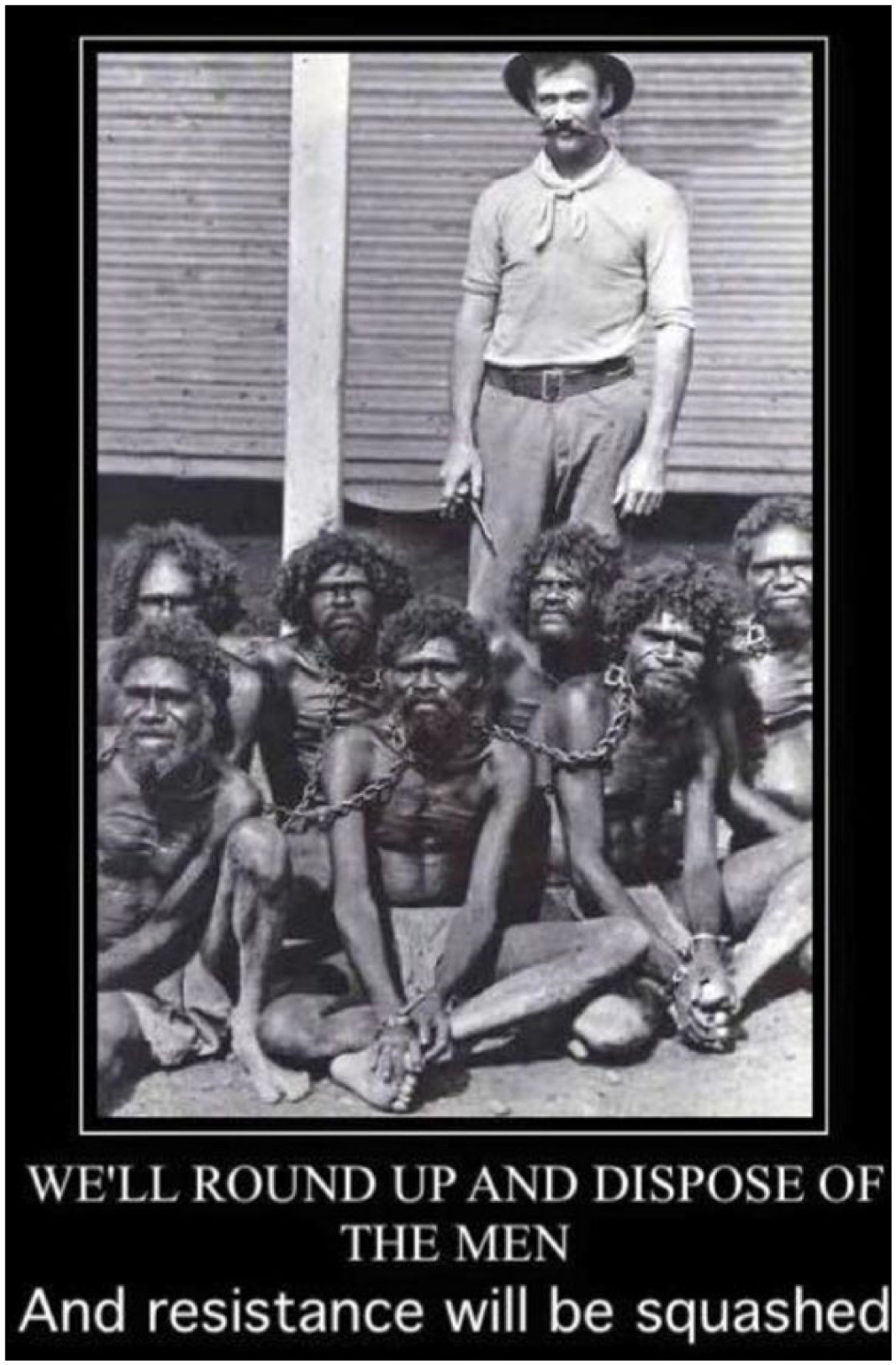
“We’ll round up and dispose of the men” (BFR, 2016).
Colonizers held the belief that eventually Indigenous people would “die out” as, per the logic of Social Darwinism, they could not adapt to change like White people could. In a later image, we see this discourse mobilized. At this point in history, a purportedly more “humane” approach was supported by the state. In this image, the narrator paternalistically suggests that there is a need to “move [Indigenous people] onto reserves. They can die out in peace that way.” The “doomed race theory” of the 1800s was used to justify the removal of Indigenous people from their homelands and placed them onto dedicated reserves. In the infamous words of anthropologist Daisy Bates, the government largely understood its role as simply “smoothing the pillow of a dying race” (Reece, 2007, p. 7).
When it became clear that numbers of Indigenous people were not decreasing, there was again a change in official government practice to assimilation, based on the ideological science of eugenics, popular in the early 20th century. This is captured in the ninth image, which reads: “Let’s shift from dying out to breeding out” (Figure 3). By forcibly removing “part-Aboriginal” children from their families and placing them into domestic servitude with White families, the hope was that their offspring would gradually become “Whiter” until Aboriginality was erased entirely from the lineage.

“Now we have a mixed-race ‘problem’” (BFR, 2016).
The Continuation of Australian Colonialism
Drawing on the familiar “image macro” meme format, the sequence demonstrates clearly the workings of colonialism as an assemblage. The simple form of the memes facilitates the communication of a complex and brutal history. A broad account of over 200 years of political history is covered in just 27 images and 360 words. The memes piece together Australian colonialism—both its machinic content and expressive justification—and, in doing so, work to trouble the political hegemony that remains either insensible or indifferent to past colonial violence and its contemporary presence. The sequence brings to the surface the continuity of colonial power relations and makes visible the violence that is carefully elided from mainstream discourse. We can see a range of powerful ideologies, such as Social Darwinism and assimilation, working in sympathy with violent the material practices of enslavement, segregation, and eugenics. As an assemblage, then, colonialism functions by establishing liaisons between these terms and achieving a living arrangement that excludes and erases Indigenous people.
Through the sequence, we can see that the ideologies and practices mobilized to contain and exclude Indigenous Australians during and beyond the formal colonial era have shifted greatly over the past two centuries. But it is also clear that, despite these variations, colonialism persists. As Buchanan (2017, p. 463) points out, as a rule, “assemblages always strive to persist in their being [. . .] they are subject to forces of change, but ultimately they would always prefer not to change.” While the expressive justifications and material practices of Australian colonialism have varied over time in response to forces of change, the assemblage remains. While we now recognize that people lived in Australia long before British colonialism, they are still missing from the founding document of the nation and they are not accorded the rights to land we would today accord other nation states. Rather, the various concessions made by the state—the end of undisguised genocide, physical containment, eugenics, and the forced removal of children—provide the semblance of actual change. Australian colonialism remains premised upon the notion of an empty land.
As we have discussed, assemblages work through processes of inclusion and exclusion—they act as “sorting mechanisms,” separating this from that to produce a living, working arrangement. In this way, assemblages are in a sense defined by those components they interiorize and those they exteriorize. As the memes demonstrate, the colonial assemblage works by “making missing” Indigenous Australians: through the legal concept of terra nullius, material practices of physical containment, the pseudo-scientific practice of eugenics, and so on. This is a politics where “the people are missing,” as Deleuze says (2013, p. 217). If Indigenous people are included at all—through the various concessions made over time—it is only insofar as the colonial assemblage may persist in its being.
Memes and the Invention of a People
The images were not just for consumption by Internet users; however, they also provided an opportunity for users themselves to engage in the production of meaning. The meme sequence became a site where Facebook users could engage in collective discussion provoked by the memes’ reproduction of the colonial assemblage. In this section, we offer an analysis of the memes as a site of connection—where users, their ideas, stories, and emotions may intersect to spontaneously produce new political arrangements. Through an analysis of users’ comments, we argue that the memes themselves work as an assemblage. We argue that the sequence of memes, from this second view, act as a pedagogical device and contribute to what Deleuze (2013, p. 217) describes as “the invention of a people.”
The “Real History” of Australia
Unsurprisingly—considering the content of the images—the users’ comments tended to focus on the colonial violence revealed throughout the meme sequence. Facebook users could interpret, support, expand on, or contradict the content of the memes. Many expressed disappointment over the very partial “official” account of Australia’s past, and there was much discussion about what was articulated as the “true history” of Australia: I never learned the true Australian history in school I guess [too] shocking and government [is] trying to shove under [it] the carpet as if it never happened[.] acknowledgement of what happened would be nice and kids at school should learn that it was wrong and never repeated again. I’m so sorry for what has happened to indigenous people of Australia, to your people, and that as a first generation growing up in Australia we were never told the true history. [. . .] Wish we could turn the clock back and change what happened. I never learnt the true history either. I was taught that Captain Cook came to Australia to set up a colony or a prison ( I can’t remember what the original plan was). Somewhere in this history indigenous Australians appear. I wish I was taught the truth in school.
Other users shared personal stories, both first-hand experiences of colonialism and those passed down through their families. For instance, one user, responding to another’s posted comment, told them: Yes because my Nana, My Mum and I were just like her . . . looking after wudjulah [clan] kids . . . I’m lucky I wasn’t taken away to facilitate that . . . but my Nana, great grandmother and great great grandmother were . . .
Likewise, a non-Indigenous man wrote, “My great great grandfather was harassed because he paid his aboriginal workers the same amount as English and Scottish workers on his farm.”
Here, the memes provoked users to make new connections with ideas, stories, and historical events that work to undo the colonial myth of a “peaceful settlement.” In one sense, the memes act as a pedagogical device, pulling apart this sanitized state account which perpetuates the myths of terra nullius and peaceful settlement and encouraging others to contribute to this deconstruction. As Duerringer’s (2016, p. 9) analysis showed, political memes “may function to build consciousness and interpellate subjects.” We can see the memes work like the authors intended: working to reveal both the existence of and violence toward the people “missing” in the workings of colonialism.
Fluidarity: The Expression of Togetherness
Most importantly, however, the memes worked to call forth a people that cut across national, cultural, and ethnic backgrounds, with self-identifying Indigenous Australians, non-Australian Indigenous people, and non-Indigenous Australians expressing a kind of unity. As users shared stories of past injustices, others extended sympathy, condolences, and emotional support. Many non-Australian Indigenous people, from New Zealand, North America, and Europe, drew parallels with their own experiences of colonialism. One user explained the violent history of colonialism in North America: I am Native American . . . meaning Indigenous to North America. It infuriates me when non native ppl [people] of the world make excuses and turn the blame on us and tell us what should and should not offend us. 100 MILLION NORTH AMERICAN NATIVES MASSACRED. Guess what . . . as hard as the Euros tried . . . they could not get rid of us just as they could not get rid of the Aborigines of Australia. They are still TRYING to colonize us . . . we still fight the stereotypes about us . . . we still fight against them polluting our lands.#WeAreStillHere #IdleNoMore.
A Māori user explained that his “grandfather and his brother and cousins fought in WW1. They got paid half that of their Pakeha [white] mates becauce [sic] they were maori.” A man from Ireland made comparisons with the British colonization of his homeland: “Conlonizarion [sic] is horrible to any peoples and being Irish when our nieghbours [sic] stole our land and wiped out [. . .] Our indigenous culture they called it progress they also called the Native Irish Aboriginals in 1820.” Likewise, a Canadian First Nations woman explained that the forced institutionalization of children “. . . happened to us in Canada too. By different institutions, until just very recently.”
Non-Indigenous Australians expressed a range of sympathetic responses. Most often, these included the articulation of anger, disgust, and shame at Australia’s history of colonial violence against Indigenous people: Why did my ancestors have to be such heartless murderers? I can’t say I’m in any way proud of my culture, if it entails colonisation and the brutal immorality that was attached with it. Wow that’s fkn awfully hard to look at Yet it’s the TRUTH . THE AWFUL TRUTH!! IM ASHAMED OF THIS!? As a Middle aged 3rd gen Irish Anglo Saxon!! I’m very ashamed. My grandfather did exactly as the photo above portrays, shooting two of the original owners because they stole his VEGETABLES! Can you begin to imagine that. That dreadful thing happened in or close to 1897. He buried these poor people on his property.
Looking closely at not only the memes BFR produced but also how users engage with this content, we can see a kind of politics of connection at play (see Bennett & Segerberg, 2012). Indigenous users could make connections between their experiences and the colonial assemblage depicted by the texts, seeing commonality across diverse histories. Likewise, through recognizing the past and present consequences of colonialism for Indigenous Australians, non-Indigenous users expressed shame and disgust at the history of a nation of which they are a part.
The memes’ function here is not necessarily to formalize some clearly articulable political position but to challenge the colonial arrangement and produce something new (which is essentially anti-colonial). But this is a politics without unity, in the traditional sense. It is closer to what Pindar and Sutton have usefully described as “fluidarity” rather than solidarity—“a plurality of disparate groups com[ing] together in a kind of unified disunity” (in Guattari, 2000, p. 11). It does not produce hierarchized relations that center around a single articulable cause but instead is a movement (or even just movement) that lacks any external unity. In this sense, the memes participate in “boundary work” (Gal, Shifman, & Kampf, 2015) by calling forth a people: those who are themselves externalized by the colonial assemblage and those who recognize the violence of this process.
Collective Policing and Consolidating Liaisons
This anti-colonial “fluidarity” was demonstrated clearly in spontaneous responses to the racist and pro-colonial discourse reproduced by some users. The content of the memes intentionally produced a discord with the dominant colonial narrative of “peaceful settlement” and provoked negative and often overtly racist responses from a minority of users who aimed to disturb the production of an anti-colonial politics.
One user, for instance, commenting on the distressing photo of a group of Indigenous men chained together by their necks (see Figure 2) wrote, “Not looking so DEADLY now are they hahha.” 3 This user’s vitriol continued in a torrent of highly offensive comments, which led to a long and lively exchange between the agitating user and a group of anti-racist Facebook users.
Rather than disrupting the anti-colonial politics achieved in this space, however, the intrusion of colonial discourse seemed to serve as an opportunity to consolidate sympathetic liaisons between users. It prompted a spontaneous collective policing of racism and, in doing so, intensified the anti-colonial politics. Anti-racist users collectively deployed a range of strategies that aimed to contain the racist intrusion—such as the expression of both genuine and condescending sympathy toward the racist user, suggestions of reporting them to the Online Hate Prevention Institute and suggestions of simply ignoring the “troll’s” provocations. Users also offered emotional support to those who clearly became distressed by the offensive comments.
We can say, then, that the memes act as their own assemblage insofar as they produce their own mechanism of inclusion and exclusion. They call forth a people who do not necessarily pre-exist the texts—those who are excluded from the colonial assemblage and those who recognize it as violence. The formalization of the assemblage calls for the exclusion of racist discourse, which we could see occurring spontaneously and which contributes to the achievement of an anti-colonial politics.
Closing Thoughts: Breaking Open New Vistas
Deleuze (2013, p. 217) writes that “The moment the master, or the colonizer, proclaims ‘There have never been people here’, the missing people are a becoming, they invent themselves . . . in new conditions of struggle to which a necessarily political art must contribute.” In this article, we have seen both sides of this double movement. On the one hand, the sequence of memes make clear the workings of Australian colonialism as an assemblage that operates through “making missing” Indigenous people. The expressive justifications and material practices that co-function to produce the colonial assemblage, while varying over time, continue to work toward the exclusion of Indigenous Australians.
On the other hand, the memes themselves work as an assemblage through calling forth these “missing people” and, in doing so, work to undo the continuity of the colonial assemblage. The memes both anticipate and produce an audience—they “contribut[e] to the invention of a people” (Deleuze, 2013, p. 217). While the sorting process of the colonial assemblage constitutes those excluded as “missing,” the memes interiorize those who are “missing” and produce movement that troubles the smooth and violent workings of Australian colonialism.
Looking at user engagement with the memes—through sharing historical, personal, and family stories of the “true” history of Australia; collectively policing anti-Black racism; and expressing shared experience and sympathy—we argue that their coming together constitutes a kind of “fluidarity.” It unfolds contingently, haphazardly, and without a transcendental plan. However, in this case, the messy, complex network of relations ultimately presents a challenge to the often taken-for-granted arrangement of colonial Australia. As Massumi writes, “Force arrives from outside to break constraints and open new vistas” (in Deleuze & Guattari, 1988, p. xiii). As those exteriorized from the colonial assemblage, the anti-colonial movement constitutes this force from “outside.” It produces a working arrangement that rejects the myth of peaceful settlement and seeks to achieve a future which is more hopeful and liberatory rather than violent and regulatory for Indigenous Australians.
Footnotes
Acknowledgements
The authors wish to thank Professor Ian Buchanan, whose feedback on an earlier version of this paper greatly improved its quality and deepened our understanding of Deleuze and Guattari’s work. They would also like to thank the anonymous reviewers for their thoughtful and constructive feedback on earlier versions of this paper. Finally, they wish to thank Blackfulla Revolution for their cooperation with this project and for fighting the good fight.
Declaration of Conflicting Interests
The author(s) declared no potential conflicts of interest with respect to the research, authorship, and/or publication of this article.
Funding
The author(s) disclosed receipt of the following financial support for the research, authorship, and/or publication of this article: This paper was supported by a grant from the Australian Research Council, Discovery Indigenous. Project ID IN130100036.