




Abstract
In this article, we present a cross-national comparative analysis of which online news users in practice engage with the participatory potential for sharing and commenting on news afforded by interactive features in news websites and social media technologies across a strategic sample of six different countries. Based on data from the 2016 Reuters Institute Digital News Report, and controlling for a range of factors, we find that (1) people who use social media for news and a high number of different social media platforms are more likely to also engage more actively with news outside social media by commenting on news sites and sharing news via email, (2) political partisans on both sides are more likely to engage in sharing and commenting particularly on news stories in social media, and (3) people with high interest in hard news are more likely to comment on news on both news sites and social media and share stores via social media (and people with high interest in any kind of news [hard or soft] are more likely to share stories via email). Our analysis suggests that the online environment reinforces some long-standing inequalities in participation while countering other long-standing inequalities. The findings indicate a self-reinforcing positive spiral where the already motivated are more likely in practice to engage with the potential for participation offered by digital media, and a negative spiral where those who are less engaged participate less.
Introduction
The development of digital media technologies and services offers media users all over the world a growing number of ways in which they can potentially actively participate in the news and information cycle by sharing the news and commenting on it. Who and with how many are the people engaging in practice, and how much participation varies country by country, are empirical questions. The technological potential for participation is largely similar across high-income countries, as the same tools and platforms are widely available. Participatory practices in turn are likely to vary for cultural, political, and social reasons (Hölig, Nielsen, & Schrøder, 2016; Nielsen & Schrøder, 2014; Vaccari, 2013). In this article, we present a cross-national comparative analysis of which online news users in practice engage with the participatory potential for sharing and commenting on news afforded by interactive features in news websites (commenting on news sites and sharing website links via email) and social media technologies (comment and/or sharing via social media sites) across a strategic sample of six different media systems. In contrast to previous studies that have often focused specifically on sharing practices and the content of comments and primarily looked at those who actively participate (often within a single country), we use survey data on the wider population of online news users from six different countries to better understand what sets those who comment and share apart from those who do not. We identify the characteristics associated with engagement and show that commenting on and sharing news in most countries are significantly more widespread than the so-called “1% rule” associated with Jakob Nielsen and Bradley Horowitz (the idea that only 1% of users will actively engage and 9% engage a little, while the remaining 90% simply lurk). 1 While the majority of online news users do not comment or share news regularly (despite the potential to do so), a significant minority of Internet users take a more active part in the news and information cycle than in a pre-digital environment (Chadwick, 2013; Jenkins, 2006). Particularly, commenting and sharing via social media are very widespread. Across the countries we cover here, between 16% (Denmark) and 34% (Spain) of online news users say they have commented on news via news sites and/or social media in the last week and between 21% (Denmark) and 43% (Spain) share news. Germany is the clearest outlier (as also found by Hölig, 2016)—there only 13% say they comment on news and 17% say they share news.
Our question is then, who are the people who comment and share? Based on a series of logistic regression analyses of survey data from the 2016 Reuters Institute Digital News Report, and controlling for a range of factors including socio-economic status (age, gender, income, education), trust in news, and national context, we find (1) that people who use a high number of different social media platforms and use social media for news are significantly more likely to also engage more actively with news outside social media by commenting on news sites and sharing news via email, (2) that political partisans on both the left and the right are significantly more likely to share and comment on news on social media, (3) that people with high interest in hard news are significantly more likely to comment on news on both news sites and social media. Furthermore, they are more likely to share stories via social media, while people with high interest in any kind of news (hard or soft) are more likely to share stories via email. The majority of these correlations are similar across all six countries, an important indication that similar interplays between technological and cultural, political, and social factors exist across countries, even as the specific outcomes vary. However, we find that ideological strength is only correlated to social media activities in countries of the liberal media system. In line with similar work focused on digital media and politics (e.g., Vaccari, 2013), we find that a large minority of Internet users in practice engage with the participatory potential afforded by digital media technologies and services. Our analysis of the profile of those who participate suggests that the online environment reinforces some long-standing inequalities in participation (political partisans and the highly interested are more active than others) while countering other long-standing inequalities: men and older people are more likely to engage in many forms of offline participation (Verba, Schlozman, & Brady, 1995), age seems to play little role in terms of online commenting and sharing, and women are in fact more likely to comment and share via social media than men. Digital media are, thus, in part what Schlozman, Verba, and Brady (2010) have called “weapons of the strong,” given that the already engaged get more opportunities to engage. But digital media also help partially ameliorate long-standing inequalities as younger people and women are more engaged here than elsewhere, especially via social media. In the concluding section, we discuss the implications of the self-reinforcing positive and negative circles between technological affordances and cultural, political, and social factors that our analysis suggests exist.
In the first and second parts of the article, we review ongoing discussions of the concept of participation in the media and develop our hypotheses on the basis of existing research on factors associated with commenting on and sharing news. We proceed to present the data and the rationale for the strategic sample of six different media systems we look at (Denmark, Germany, Italy, Spain, the United Kingdom, and the United States) as well as the measures we have used. This is followed by our results and a concluding discussion returning to the interplay between technology and other factors in a media environment characterized by more participatory cultures and the spread of what José van Dijck (2013) has called platformed forms of sociality.
A Closer Look at the Concept of Participation
Although the renewed research interest into participatory practices fanned by online media might suggest otherwise (Carpentier, 2016), participation has been considered an important notion in our conception of the role of journalism in a democratic society long before networked technologies (re)introduced interactivity to the practice of media use. As Butsch (2000) has shown, audience practices have historically been very actively engaged and communal, and only with the development of mass media and especially broadcast media in the 20th century were audiences “pacified and privatized.” It is against this backdrop of dominant forms of mass media use that the development and spread of digital media technologies offer new and easier forms of interaction, with potentials that may preface a wider shift from 20th-century practices of passive media spectatorship to new forms of “participatory culture” (Jenkins, 2006). As Jenkins (2006) has argued, the development of digital media is only in part about the development of technological affordances. It is also about the development of new cultural, political, and social practices where users seek out information and use it in new ways.
In the 1990s and early 2000s, technologies that enabled these more participatory forms of media use were primarily decentralized general purpose tools like email and html websites (Boczkowski & Mitchelstein, 2012). From the 2000s onwards, however, as José van Dijck (2013) explains, the relatively free-flowing technological and social practices associated with participatory culture were increasingly superseded by new forms of “platformed sociality” enabled by easy-to-use dedicated applications developed by individual for-profit companies for particular purposes. The development of such technologies simultaneously made digital media more appealing and convenient to use while also pointing toward a more controlled and commercial digital media environment. Therefore, while the practices under scrutiny in this article have been repeatedly approached as participatory practices (Jenkins, Ford, & Green, 2013) or participatory journalism (Singer et al., 2011), it is worth bearing in mind that engaging in those practices does not per definition lead to media users being more empowered toward the providers of many of these technologies (Picone, 2017).
Commenting and sharing news, like other forms of participatory practices, rely on both the primary infrastructure of relatively decentralized general purpose tools like email and websites and on more recent infrastructure of dedicated applications like social networking sites. As these tools and practices reliant on them spread, Sonia Livingstone (2013) argues, “the media environment becomes the infrastructure for all spheres of social life [and] to participate in society people must engage with the media” (p. 26). How they do so, however, is an empirical question.
User activities like sharing and commenting are in part important to understand intrinsically but also in part because of the effects of sharing and commenting both at the individual and the aggregate level. At the individual level, studies show that expressing political sentiment in social media via sharing news is affecting both offline and online political participation (Gil de Zúñiga, Molyneux, & Zheng, 2014). Expression can “motivate exposure, attention and elaboration of media messages” (Pingree, 2007, p. 447). Sharing news in social networking sites or being exposed to articles shared by friends in SNS also enhances exposure to discussion with heterogeneous others in social networks (Choi & Lee, 2015). At the aggregate level, studies focusing on the effects of reading comments on news stories show that the presence of comments underneath a news story can alter the participants’ perception about what the public thinks about the issue (Lee, 2012) or to decrease the perceived quality of a news article (Prochazka, Weber, & Schweiger, 2016).
The studies mentioned above reflect that sharing news and commenting on news articles can affect both the user who engages in these activities and those who encounter comments and links shared by their network. Our goal in this study is to understand who in practice engages with the news, what characteristics distinguish them from the majority who do not comment on and share news, and to examine variation by country.
Exploring Factors for Engaging in News Sharing and Commenting
When studying how content is distributed across social media platforms through sharing activities, Nahon and Hemsley (2013, p. 3) distinguish between a top-down and a bottom-up approach. The former is concerned with how information flows through social media and how users-as-gatekeepers circumvent editorial selection. The latter focuses on users’ ways of engaging in this process in terms of motivations and social connectedness. Most studies looking at sharing activities from a user perspective so far adopt a Uses and Gratifications or Diffusion of Innovation perspective to the matter (Kümpel, Karnowski, & Keyling, 2015). In their overview article of news sharing studies from 2004 to 2014, Kümpel et al. (2015, p. 6) identify three basic categories of motivations to share news: self-serving motives (gaining reputation and status among peers and other users), altruistic motives (inform others), and social motives (interact with others and get social approval). Picone and De Wolf Robijt (2016), in a survey study of Flemish news users, find that of these motives, connecting with others is a far more powerful motivation than showing off one’s knowledge or ambitions, concluding that sharing news is “mainly a way to connect with others by means of exchanging content that might appeal to, interest or entertain one’s social circle” (p. 929). Similarly, a recent study by Springer, Engelmann, and Pfaffinger (2015) showed that social-interactive motives (e.g., to be a part of the community) drive commenting in news and discussion with other users.
Studies focusing on news comments show similar motives, although with other accents. Looking at broad gratifications for interactivity in online news, Yoo (2011) associates participation in discussions with other readers and sharing one’s opinion via mail or comments to journalists with social-interaction motives. Interestingly, this kind of user–user interaction—as opposed to user–content interaction—underlying commenting seems to be driven also by a need for entertainment (Chung & Yoo, 2008; Yoo, 2011), while news sharing in general does not fulfill entertainment needs nor the need to escape from daily routines (Lee & Ma, 2012). Ksiazek, Peer, and Lessard (2014) in their study on comments on online news videos also differentiate between those news videos attracting lots of comments and those exhibiting more conversation between commenters. Their results show that popular videos in terms of exposure and recommendations attract more comments, while less popular ones attract more conversation. Weber (2014) further investigates this distinction by focusing on the link between Galtun and Ruge’s news factors and the amount of comments and the degree of interaction, respectively. His findings suggest that users are more likely to comment on and converse about news that is geographically closer to them, impactful, less factual and continuously in the news. On the other hand, news on powerful people, controversies, or negative events affect conversation but not commenting. Both studies show that news users’ motives to comment on an article can differ from those to react on other users’ comments.
In this study, we seek to go in a different direction from the Uses and Gratifications framework adopted in most of the studies on the matter so far. We do so by focusing less on intrinsic motivations and more on political (ideology on a left–right scale), and media (interest in soft or hard news, use of social media, trust in news) factors affecting sharing and/or commenting. We adopt this approach because it has been useful in understanding the dynamics of participation in other areas of digital media use, for example, political mobilization (see, for example, Vaccari, 2013, 2016). Also, we pay attention to contextual differences in sharing and commenting behavior by investigating these factors across a sample of high-income democracies with different media systems rather than limiting our focus to a single country (e.g., Blank, 2013). Below we develop the specific hypotheses we test.
Social Media Use and Commenting/Sharing
Different social networks and news sites themselves are used with different purposes in relation to sharing and commenting the news, with audiences choosing one or the other depending on the subject matter, and therefore creating different news agendas (Bright, 2016; Olsson & Almgren, 2016). Choi (2016) distinguished between two subdimensions in each of the dimensions involved in sharing news: “Browsing and personalizing for internalizing, and recontextualizing and endorsing for externalizing” (p. 816). The author found that “any SNS users, even those who were initially unwilling to participate in news externalizing activities, can be converted to those types of people who regularly post, forward, or endorse news, if they frequently read news content within SNSs” (p. 830). Liu, Zhou, and Zhao (2015) demonstrated that a “social media recommendation” plays an important role when predicting the number of readers’ comments on a different platform, the website of the news organization.
In addition, we know that people in social networks with strong ties (like Facebook where people are usually connecting based on real identities and offline connection) are more inclined to share news since they are more inclined to perceive that what they would share would influence their connections (Ma, Sian Lee, & Hoe-Lian Goh, 2014, p. 611). Based on this rationale, people using social networks could be more inclined to share news via email given that the ties via email are stronger than in “social networks.”
These findings suggest that a link might exist between the use of SNS and user engagement with the news not only in social media networks but also outside of them. In this study, we are interested in examining whether the use of social media platforms facilitates engagement in other environments. The argument is that familiarity with social media platforms where user engagement is encouraged will make people more likely to adopt engagement in the websites of news organizations or to share articles via email. This would indicate the development of the kind of “participatory culture” that Jenkins (2006) hypothesized would accompany the spread of interactive tools on news websites and the “culture of connectivity” that Van Dijck (2013) associated with social media. Van Dijck (2013) further suggested that social media have transformed the use of the word sharing: “In less than eight years, the meaning of “sharing,” once understood as user-to-user information exchange, has subtly been replaced by a meaning that naturalizes the sharing of personal data with anyone on the planet” (p. 66). In both cases, norms and practices developed via use of specific (participatory and interactive) tools and technologies gradually come to influence our engagement with media more widely. Thus, we hypothesize that (1) using social media for news and (2) using plenty of social media platforms will be associated with user engagement with the news:
H1a. Using social media for news is positively associated with commenting on news stories outside social media environments.
H1b. Using social media for news is positively associated with sharing news stories outside social media environments.
H2a. The number of social media platforms regularly used is positively associated with commenting on news stories outside social media environments.
H2b. The number of social media platforms regularly used is positively associated with sharing news stories outside social media environments.
Ideological Strength and User Engagement
During the past years, an increase in political polarization has been observed in the United States. A report from Pew Research Center (2014) shows that the levels of political polarization are at the highest point in 20 years. The same study shows that those who are more politically active tend to be more divided. Research has examined the links between news exposure and political polarization with no consensus on whether causal links exist (Arceneaux & Johnson, 2013; Iyengar & Hahn, 2009; Levendusky, 2013; Prior, 2013; Stroud, 2010). Nevertheless, while we do not examine this relationship in our study, we argue that it is important to examine the relationship between ideological strength with news engagement. As seen above, reading news comments can have effects in readers’ attitudes (Lee, 2012) and sharing is related to the news’ diffusion in the web (Bhattacharya & Ram, 2012). Thus, we argue that it is important to examine whether those who comment and share news stories are at either end of the political spectrum, or closer to the center ground.
When it comes to our expectations regarding the direction of the aforementioned relationship, there are indications from previous research that a positive relationship exists between ideological strength and participation with the news. From the spiral of silence theory, we know that under some circumstances, individuals who feel they hold a minority opinion would not speak out in public due to fear of isolation (Noelle-Neumann, 1974). However, more recent research has suggested that attitude certainty is a key moderator of the spiral of silence. People who are certain about their attitudes toward political issues are more likely to express their opinion regardless of the climate around them (Matthes, Morrison, & Schemer, 2010). Recently, findings from a study on online political behavior showed that the strength of partisanship is positively correlated with an index of online political participation, which includes “commenting on political blogs” (Valenzuela, Kim, & de Zúñiga, 2012). Based on the findings of these studies, we hypothesize that those with strong ideological predispositions will be more likely to comment on news:
H3a. Ideological strength is positively associated with commenting on news stories.
When it comes to sharing, Weeks and Holbert (2013) observed that partisans in the United States are more likely than non-partisans to disseminate news they receive: “Sharing news (which often focuses on political matters) is an online example of political mobilization and one that partisans engage in more frequently” (p. 227). Similarly, a recent study on Facebook users in South Korea showed that those with high levels of partisan strength were more likely to express their political opinion by posting or sharing political content on Facebook (Kim, 2016) than those with low levels of partisan strength. Thus, we hypothesize that the following:
H3b. Ideological strength is positively associated with sharing news stories.
Hard News, Soft News, and Participation
While many studies examine the prominence of soft news (e.g., Scott & Gobetz, 1992) and the effects of consuming them (e.g., Baum, 2005) in print outlets or television, there are few similar studies concerning digital outlets and social media. In one of them, online news was found to be “lighter” than print news of the same outlets (Benson, Blach-Ørsten, Powers, Willig, & Zambrano, 2012). During the early stages of social networking sites like Facebook and YouTube, Baumgartner and Morris (2009) claimed that while SNS can be considered news sources, they are soft news sources. The profile of users who use them, they argued, is more similar to soft news users who are less interested in politics. However, since then, the number of users of SNS grew drastically, as well as the number of those who use them for news purposes (Newman, Fletcher, Levy, & Nielsen, 2016). According to more recent studies, hard news stories tend to attract more attention than soft news ones in social media. A recent content analysis of the stories published in The Guardian’s and The New York Times’ social media pages showed that users engaged more with hard news stories than soft news even though the editors of these newspapers prioritized soft news content in social media (Bastos, 2015). Another study suggests that apart from receiving more comments in general, hard news also attracts more uncivil comments than soft news stories (apart from sports) (Coe, Kenski, & Rains, 2014).
In this study, we are interested in identifying whether people who are more interested in hard news (e.g., politics, economic news) or in soft news (e.g., lifestyle, entertainment news) are more likely to share and/or comment. There are indications from the aforementioned studies that hard news attracts more engagement than soft news. Thus, we argue that
H4a. The association between interest in hard news and commenting on news is positive and stronger than the association between interest in soft news and commenting on news.
H4b. The association between interest in hard news and sharing news is positive and stronger than the association between interest in soft news and sharing news.
Data and Country Selection
For the purposes of this study, we employ a comparative framework to understand how sharing and commenting are related to use of social media use for news (H1a/b) and more generally (H2a/b) ideological strength (H3a/b) and interest in hard and soft news (H4a/b). To test these relationships, we use data from the 2016 Reuters Institute Digital News Report. The survey was conducted by YouGov, with respondents from an online panel. The sample is representative of the online population of each country and is weighted according to targets on variables like age, gender, and region. Since the survey’s main goal is to examine news consumption patterns, users who claimed they have not consumed any news for month leading up to the survey were filtered out so that their responses would not affect data quality. The number of users who were filtered out is 3.5% on average in each country. The final sample sizes were larger than 2,000 respondents. The survey was conducted in every country from the end of January 2016 until early February 2016.
The main advantage of using Reuters Institute data is that it contains a series of questions about news consumption patterns, trust in news, ideological strength, and user activities. While the dependent variables are binary and thus respondents who share/comment one story per week are grouped with more frequent participators, the advantage of using single source data is that it allows us to look across different participatory practices rather than studying platforms such as Facebook and Twitter in isolation or commenting on websites in isolation. Another advantage is that all these questions were asked at the same small period of time and in a consistent fashion in every country covered. This enables us to compare the levels and the predictors of participation with the news in every country. The main disadvantage of the data is that it is cross-sectional and that it is based on an online panel, and thus underrepresents older, less affluent, less educated people. This is a limitation in terms of understanding media use more broadly but not in terms of our specific objective here, identifying who comment on and share news.
Furthermore, having consistent data across a range of different countries gives us the opportunity to systematically examine commenting and sharing across countries to avoid simply assuming results found in one country at one point in time are automatically generalizable. This way we can respond to Jensen’s (2013) call for “more international and comparative studies . . . to move beyond universalistic hype about ‘the internet’ as such, and to evaluate its specific potential in those local and regional contexts where citizenship and democracy must be accomplished in practice” (p. 338). For this specific analysis, we have selected six countries that represent a strategic sample of different media systems (Denmark, Germany, Italy, Spain, the United Kingdom, and the United States). Our design is a most-similar one in that all of these countries are high-income stable Western democracies with relatively high levels of Internet use compared to the global average (see Table 1). But it also allows for systematic comparison across different media systems that have historically had different levels of state involvement in the market, different degrees of political parallelism, and different levels of newspaper circulation, among other differences (Hallin & Mancini, 2004). Denmark and Germany belong in what Hallin and Mancini (2004) define as the “democratic corporatist” model characterized by strong newspaper circulation and strong presence of a public service broadcaster. Italy and Spain belong in the “polarized pluralist” model characterized by strong politicized media. The United Kingdom and the United States belong in the “liberal model” characterized by strong commercial media, though the United Kingdom has many elements bringing it close to the democratic corporatist countries (Brüggemann, Engesser, Büchel, Humprecht, & Castro, 2014).
Data on Countries Used.

Data: 2016 Digital News Report Survey (Newman et al., 2016), Hallin and Mancini (2004) on media systems, and Internet World Stats data for the share of Internet Users.
Measures
To measure online engagement with the news, we used items related to the propensity of sharing and commenting on news stories. Respondents were asked, “During an average week in which, if any, of the following ways do you share or participate in news coverage?” Among the responses were two items related to sharing news: “Share a news story via email” and “Share a news story via Social Network (e.g., Facebook, Twitter, Reddit).” In addition, there were two responses related to commenting on news stories: “Comment on a news story on a news website” and “Comment on a news story in a Social Network.” These four variables are the four dependent variables in this study.
To assess ideological strength, we used a typical political orientation scale used in the survey. Respondents had to place themselves in a 1–7, left–right wing axis. The question was the following: Some people talk about “left,” “right” and “centre” to describe parties and politicians. (Generally socialist parties would be considered “left wing” whilst conservative parties would be considered “right wing”). With this in mind, where would you place yourself on the following scale?
Respondents who answered “Very left wing,” “Fairly left wing,” “Very right wing,” and “Fairly right wing” were coded as 2, and the rest were coded as 1.
We included the use of both legacy (broadcast and print) news sources and newer digital-born ones. We employed measures of news provision via social media platforms, news outlets’ websites, print outlets, and TV broadcasters. We also included a count of social media platforms that respondents use in a weekly basis. The question was, “Which, if any, of the following have you used for any purpose in the last week? Please select all that apply.”
We further included two independent variables for preferences for “soft” and “hard” news topics. Respondents were asked to state their degree of interest in different news topics on a scale from 1 (not at all interested) to 5 (extremely interested). Then we collapsed some of these topics into interest for soft and hard news. We classified interest in entertainment or celebrity news, lifestyle news, and sports news, as interest in soft news. Interest in hard news was classified as interest for international news, political news, business and economic news, and science and technology news. A similar classification of soft/hard news topics was made in Curran, Iyengar, Lund, and Salovaara-Moring (2009). While there is no consensus on the definition of soft and hard news, the topic of a news story is the most widely used dimension when defining soft and hard news (Reinemann, Stanyer, Scherr, & Legnante, 2012).
A measure of trust in news was included as a control variable, since trust in news is associated with both sharing and commenting on news stories (Fletcher & Park, 2017). To measure trust, we used a question related to general trust toward the news: “Thinking about news in general, do you agree or disagree with the following statements?—I think you can trust most news most of the time.” Respondents could agree or disagree with the statement in a 1–5 scale.
Finally, we included demographic controls: age, gender, income, education, as well as a measure of frequency of Internet use, all previously shown to influence how people engage with the participatory potential of digital media (e.g., Vaccari, 2013). 2
Results
We first present descriptive results concerning the four user activities: commenting on news stories in social media, commenting on news stories in news websites, sharing news stories in social media, and sharing news stories via email. The percentage of online news users that report engaging in one of these activities in each country during an average week is reported below (Figure 1 and 2).
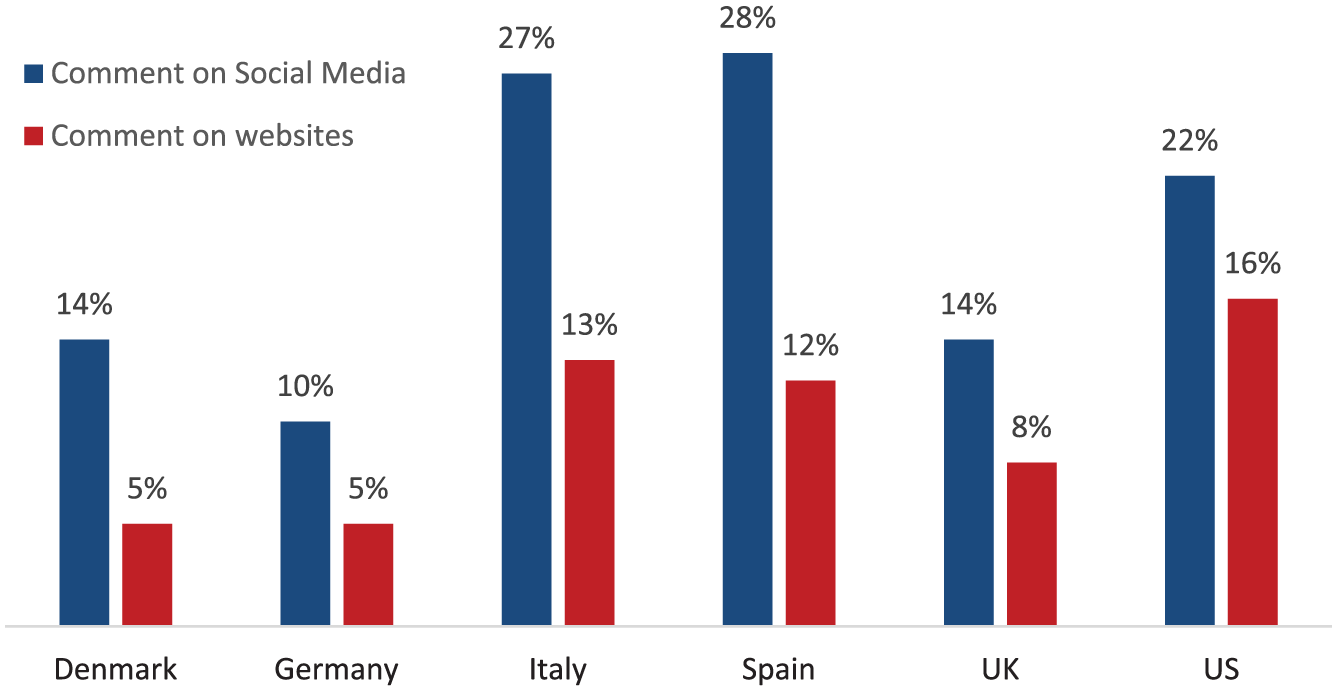
Comment on a News Story (%).

Share a News Story (%).
Τhe share of users who comment on news varies from country to country. Commenting (both on news websites and on social media) is most common in Italy, Spain, and the United States (see also Hölig, 2016; Hölig et al., 2016). In addition, the number of users commenting on news stories in social media is higher than the number of users commenting on news stories in the websites of news organizations in every country.
Similar to commenting, sharing is more common in Spain, Italy, and the United States than in the United Kingdom, Germany, and Denmark. As with the two commenting activities, sharing activities are more common via social media platforms than via email.
To test the hypotheses, we ran four logistic regressions, where each user activity was treated as a binary dependent variable (Table 2). The first set of hypotheses suggested that using social media for news as well as using many social media platforms will be positively associated with sharing and commenting activities outside social media environments. 3 These activities are commenting on news stories on news websites (Model 2) and sharing news via email (Model 4). Using social media for news and the number of social media platforms used weekly are positively associated with both activities, adding support to hypotheses H1a, H1b, H2a, and H2b. When looking at individual-country regressions (analysis not shown), the number of social media platforms used was significantly and positively associated with sharing news via email and commenting stories on news websites in every country of the sample. Similarly, using social media for news was positively and significantly associated with commenting on news websites in every country of the sample. Using social media for news was positively correlated with sharing news via email in Germany and Spain.
Logistic Regression Models.

Columns showing odds ratios with standard errors in parentheses.
p < .05; **p < .01; ***p < .001.
The second set of hypotheses (H3a and H3b) suggested that ideological strength (being at the either end of the political spectrum), will be associated with both sharing and commenting news stories. The results suggest that ideological strength is positively associated with commenting on social media (Model 1) and with commenting on news websites (Model 2), adding support to hypothesis H2a. When it comes to sharing, our results partly support hypothesis H2b. Being at the either end of the political spectrum is positively associated with sharing in social media networks as seen in Model 3, but not with sharing via email (as seen in Model 4). When examining individual-country regressions (analysis not shown), ideological strength was significantly and positively associated with commenting in social networks in the United Kingdom, United States, Germany, Italy, and Spain but not in Denmark. Sharing news in social networking sites was positively and significantly associated with ideological strength in the United Kingdom, the United States, and Denmark. Last, ideological strength is associated with commenting on news websites only in the United Kingdom.
The last set of hypotheses predicted that the relationship between interest in hard news and commenting/sharing news will be stronger than the relationship between interest in soft news and commenting/sharing news. The results supported the hypotheses. Interest in hard news was positively associated with commenting on news stories both in social media and on news websites. Interest in soft news was negatively associated with commenting on news stories in social media. The relationship between commenting on news websites and interest in soft news was not significant. These results support H4a. When it comes to hypothesis H4b, interest in hard news was positively associated with sharing news in social media, while interest in soft news was negatively associated with it. However, interest in both hard and soft news was positively associated with sharing news stories via email, suggesting that hypothesis H3b is partly supported. In the United Kingdom and the United States, interest in hard news was positively associated with all four user activities, while interest in soft news was not positively associated with any, apart from sharing news via email in the United Kingdom. In Denmark, interest in hard news was positively associated with all activities apart from commenting on news websites, while interest in soft news was not associated with any user activity. In Germany, interest in hard news was positively associated with sharing news via email and commenting on news websites, while interest in soft news was not positively associated with any activity. In Spain, interest in hard news was positively associated with sharing news via email, commenting in SNS and commenting on news websites, while interest in soft news was not positively associated with any activity. In Italy, interest in hard news was positively associated with commenting on news websites, while interest in soft news was not positively associated with any user activity.
Last, as seen in the table all types of engagement are associated with low levels of trust in news, as seen in Fletcher and Park (2017). The use of “traditional” news media for news (TV and print outlets) is also positively associated with sharing news and commenting on news stories.
Conclusion and Discussion
In this article, we have presented a cross-national comparative analysis of sharing and commenting on news using affordances of participation in news websites and tools found on social networking sites. Starting from the premise that the spread of digital media offers more and more people the potential to engage with news content relatively easily, we have analyzed the characteristics of the large minority of online news users (ranging from about 1 in 5 to over 40%) who in practice do participate across Denmark, Germany, Italy, Spain, the United Kingdom, and the United States. Testing hypotheses developed on the basis of existing research, we have specifically investigated the role of ideological strength, interest in news, and use of social media. Controlling for other factors, including age, gender, income, education, and frequency of Internet use, we find that (1) people who use a high number of different social media platforms generally but also for news purposes are significantly more likely to also engage more actively with news outside social media by commenting on news sites and sharing news via email, (2) partisans on both the left and the right are significantly more likely to comment on news and share news particularly on social media, and (3) those with high interest in hard news are significantly more likely to comment on news on both news sites and social media and share stories via social media, and that those with high interest in any kind of news (hard or soft) are more likely to share stories via email.
The findings suggest that the interplay between technological affordances and cultural, political, and social factors in part reinforce existing participatory inequalities by giving the already engaged yet more opportunities to engage (Schlozman et al., 2010). But the participatory potential offered by digital media also helps counter long-standing inequalities as younger people are more engaged here than elsewhere (similar to what has been found for online political mobilization, see, for example, Vaccari, 2013). It is particularly striking that women, who are less engaged with most forms of political participation (Schlozman et al., 2010), are significantly more likely to comment on news and share them on social media. The differences between general purpose “web 1.0” tools like email and news sites and more dedicated applications like social networking sites are also interesting. Tools from the 1990s and early 2000s may be less centralized and commercialized than those offered by platform companies behind the most broadly used social networking sites, but they are also less widely used for sharing and commenting on news and adopted more by the usual suspects. Furthermore, the finding that social media use is significantly correlated with commenting and sharing more outside social media environments suggests that ongoing use of more interactive technologies that enable more forms of participation may in fact socialize people to engage with opportunities for participation wherever they find them (Jenkins, 2006; Van Dijck, 2013). We further highlight that social media use was correlated with activities not related to social media in every country of the sample.
Our analysis is based on cross-sectional data from 2016 and thus does not allow us to investigate developments over time, but our results do indicate that sharing and commenting news online may be characterized by two different self-reinforcing spirals, one positive (in the sense of leading to more participation) and the other negative. The positive spiral consists of the interplay between ideological strength (people who are more partisan participate more), interest (those who are more interested in news comment and share more), and social media use (those who use social media more, both for news and generally across sites, participate more). Digital media make it easier for the already motivated to engage more, and they do just that. The negative spiral that one can infer from this is between political moderates (who participate less), the less interested (who share and comment less), and those who are less active online. Thus, the less motivated have equal access to the potential for participation, but in practice use it less. Especially as the amount and character of participation varies across countries and develops over time, we hope that future research will examine how the interplay between technological affordances and cultural, political, and social factors evolve over time. Future research can also go further in explaining the differences in participatory practices between countries.
Footnotes
Notes
Declaration of Conflicting Interests
The author(s) declared no potential conflicts of interest with respect to the research, authorship, and/or publication of this article.
Funding
The author(s) disclosed receipt of the following financial support for the research, authorship, and/or publication of this article: This work was supported by the Google UK as part of the Digital News Initiative (CTR00220), and the Digital News Report (CTR00150).
Author Biographies
 on social networking sites.