




Abstract
In recent years, several online social campaigns have encouraged individuals to change their Facebook profile pictures for a cause, such as the Human Rights Campaign’s red and pink equal sign in support of same-sex marriage. These “pictivism” campaigns allow individuals to express themselves and participate in a low effort campaign to raise awareness about an issue among their social network. Given the prevalence and potential impact of these campaigns, it is important to understand what predicts one’s participation. This study applies elements of the Theory of Reasoned Action and Technology Acceptance Model in an online survey (N = 300) of Facebook users to investigate which individual and social factors predict participation in these campaigns. Results indicate that attitudes toward participation are predicted by network norms about participation, ease of participation, and perceived usefulness of participation. In turn, these attitudes predict intention to participate and actual participation. These results imply that participation is influenced both by factors surrounding the message of the campaign and by the norms of the network itself. This work extends Theory of Reasoned Action and Technology Acceptance Model to understanding participation in online social campaigns, with considerations for key limitations in this context.
Keywords
Examining Predictors of Facebook Pictivism and Its Perceived Influence on Users
Several events in recent years have motivated Facebook users to change their profile pictures to raise awareness about an issue within their network (Cofff, Chapman, & Coffé, 2016). For instance, when the Human Rights Campaign urged people to change their profile photos to a pink equal sign in support of marriage equality in 2013, 120% more profile picture changes were made than usual (Bakshy, 2013). Then, within days of the US Supreme Court’s ruling to legalize same-sex marriage in 2015, over 26 million Facebook users updated their profile photos with a rainbow flag in support (Dewey, 2015). In fact, recent research discovered that approximately 39% of all adults engage in political or civic activities on social networking sites, such as posting or commenting on political content, encouraging others to vote, and encouraging others to take action on political or social issues that are important to them (Smith, 2013).
Changing one’s profile picture on Facebook allows an individual to participate in online social campaigns that are often centered on a contemporary social issue or charitable cause. Such participation has been termed clicktivism, but this contemporary means of civic engagement has also been referred to as slacktivism, defined as a “low-risk, low-cost activity via social media whose purpose is to raise awareness, produce change, or grant satisfaction to the person engaged in the activity” (Rotman et al., 2011, p. 821). Some examples of this can be liking pages on Facebook, sharing videos online, or signing online petitions (Y.-H. Lee & Hsieh, 2013). While some research indicates that such public tokens of support do not lead to more substantial contributions to the cause (Kristofferson, White, & Peloza, 2014), others argue that even small symbols of support, such as changing one’s Facebook profile photo, can spread awareness of issues in a network and lead to significant action (Cofff et al., 2016; Vie, 2014). In fact, individuals who frequently engage in promotional social activity were twice as likely to volunteer their time, four times as likely to encourage others to contact political representatives, and five times more likely to recruit others to sign petitions for a cause, than those who do not (Georgetown University & Ogilvy Public Relations Worldwide, 2011). Some social campaigns on Facebook have been particularly successful, such as the ALS Ice Bucket Challenge, which raised enough money to fund a recent research discovery (The ALS Association, 2016).
Given the prevalence of this behavior, and its potential impact, it is important to understand how both an individual’s perceptions of these campaigns and the norms of their online social networks may influence their decision to participate. Therefore, this study uses Theory of Reasoned Action (TRA; Ajzen & Fishbein, 1980; Fishbein & Ajzen, 1975) and a modified application of Technology Acceptance Model (TAM; Davis, 1989) to predict participation in social campaigns on Facebook. We focus specifically on campaigns that employed “pictivism” (Bentley, 2013), requiring users only to change their profile pictures to participate. Participation in these campaigns may be predictable by the five key variables from these two theories. From TRA, participation should depend on users’ attitudes toward participation, their perceived social norms about participation present in their Facebook network, and their intention to participate. From TAM, participation should be further predictable by users’ perceived effort required to participate and their perceived impact (usefulness) of participating.
The TRA (Ajzen & Fishbein, 1980; Fishbein & Ajzen, 1975) provides a useful framework for predicting participation in online social campaigns given its focus on both individual and social expectations. The theory states that attitude toward a behavior and subjective norms about that behavior predict behavioral intention, which ultimately predicts behavior. TRA has been applied in a wide variety of contexts to predict consumer behaviors such as coupon usage (Shimp & Kavas, 1984) and paying for renewable energy (Bang, Ellinger, Hadjimarcou, & Traichal, 2000). More recently, TRA has also been applied to online behaviors, such as sharing knowledge in virtual communities (Shu & Chuang, 2011), interacting with Facebook ads (Kim, Lee, & Yoon, 2015), and sharing one’s location on Facebook (Chang & Chen, 2014). Thus, TRA is applied in this study given its ability to successfully predict behavioral intentions based on a user’s attitudes and subjective norms regarding an online behavior.
Attitudes Toward Participation and Intent to Participate
The first element to predicting eventual behavior is an individual’s attitude, defined in the original model as “a learned disposition to respond in a consistently favorable or unfavorable manner with respect to a given object” (Fishbein & Ajzen, 1975, p. 6). TRA proposes that this attitude leads to behavioral intention, which is a type of belief, specifically an individual’s belief about the probability that they will perform a given behavior. Research on the link between attitudes and intent to participate in online social campaigns is currently limited, but there is evidence that individuals show greater intent to participate in an online community that provides more interactive messages (Wise, Hamman, & Thorson, 2006). Related research also indicates that positive attitudes about Facebook Page Like Ads—ads that encourage users to click that they “like” them, share them, or comment on them—is strongly linked to intention to interact with them (Kim et al., 2015).
Individuals also use social media platforms to engage in news and campaigns they encounter on the site, which can be linked to their involvement and participation in issues related to those stories (Gil de Zúñiga, Jung, & Valenzuela, 2012). For instance, online expression through social media platforms such as Twitter is linked to greater involvement in contemporary social issues (Kushin & Yamamoto, 2010). Reliance on social networking sites is also positively linked to increased civic participation or activities that address community concerns (Zhang, Johnson, Seltzer, & Bichard, 2010). Attitudes toward an overall campaign message typically play a significant role in that campaign’s ability to change one’s beliefs and/or behaviors (Booth-Butterfield & Reger, 2004). Therefore, if Facebook users respond favorably toward seeing these campaigns in their newsfeed, they should show greater intent to participate, given previous evidence for this relationship (Bock & Kim, 2002; Hing, Vitartas, & Lamont, 2013; Wang, 2016).
Perceived Social Norms About Participation
According to TRA, in addition to individual attitudes toward a behavior, behavior is also influenced by subjective norms, or beliefs that others think the individual should or should not perform the behavior in question. Participants’ perceptions of what is normative in their network also have an influence on their behavior. Online or offline, it has been found that if individuals perceive that others in their network intend to perform a behavior, the individual’s own behavioral intentions are strengthened. For instance, White, Hogg and Terry (2002) found that participants’ behaviors would match their own personal attitudes more frequently when they received normative support for the attitude from a relevant reference group. Varnali and Toker (2015) found that subjective norms positively influenced the disclosure of stigmatizing information on Facebook, while Kim et al. (2015) found that subjective norms influenced users’ decisions to interact with social media advertisements. In a longitudinal study about alcohol and social media, references or displays of college students’ alcohol use on Facebook was associated with their friends’ alcohol consumption, attitude toward alcohol use, and own references to or displays of alcohol on Facebook (Gannon-Loew, Eickhoff, & Moreno, 2016). Social media campaigns also take advantage of people’s desire for conformity, as it is commonly observed that people generally enact behaviors accepted within their social networks or groups (Gass & Seiter, 2014). In fact, social media campaigns that ignore the normative influence that networks can have are less likely to be successful (Henderson & Bowley, 2010). Therefore, we expect perceived social norms to influence a user’s attitude toward participation in social network campaigns.
Size of Facebook Network
On Facebook, such social norms may be partly influenced by the size of one’s network. As an individual’s network grows, it is likely that the social norms of their network will evolve to take into consideration the unique contributions of each new member. As a result, individuals with larger networks are more likely to have a stronger set of social norms that exert greater influence. Research on the influence of social networks shows that network size leads to more opinion expression (Shen et al., 2009) and greater intention to participate in a given behavior (Song & Walden, 2007). For example, recent research found that users were more likely to change their profile pictures depending on how many friends also changed their pictures (State & Adamic, 2015). Thus, a larger social network should have greater influence on perceived norms about campaign participation.
TAM (Davis, 1989) expands on TRA to determine the likelihood of individuals adopting a technology with the additional predictors of perceived usefulness and perceived ease of use. Perceived usefulness refers to “the degree to which a person believes that using a particular system would enhance his or her job performance,” while perceived ease of use refers to “the degree to which a person believes that using a particular system would be free of effort” (Davis, 1989, p. 320). Both factors influence a user’s attitude toward the new technology and thus, their behavioral intention to use it. TAM has also been applied to predicting use of technology in settings such as YouTube for learning (D. Y. Lee & Lehto, 2013), photo messaging in relationships (Hunt, Lin, & Atkin, 2014), and playing mobile social network games (Park, Baek, Ohm, & Chang, 2014)
Effort Required to Participate
Users weigh not only the characteristics of their network in deciding to engage in a certain behavior but also the effort they must exert in the process. Pinho and Soares (2011) found that TAM applied to social media use, with perceived ease of use having an effect on perceived usefulness as well as on attitude and intention. For example, clicktivist campaigns on Facebook have been considered an activity with a relatively high ease of use. In describing the characteristics of clicktivism, Halupka (2014) wrote that it “is an extension of the minimum skill set required to engage in a digital environment” (p. 10). Besides technical effort, users must expend some mental effort in determining whether the campaign is worth participating in, and this could vary by campaign. To the extent that this is an easy choice, and negative consequences seem minimal, ease of use in terms of mental effort should also predict more positive attitudes about participating.
Perceived Usefulness of Participation
Whether or not tangible results (e.g., donations, petition signatures) are available, it is important to discuss whether participants in social media campaigns actually view their participation as useful. Gismondi (2015) found that college students derived a great deal of civic value from their social media use. Thus, to the extent that individuals find these campaigns useful, they will have more positive attitudes toward participating. Y.-H. Lee and Hsieh (2013) designed an experiment in which participants had the opportunity to sign a petition either for or against gun rights (based on their personal beliefs). After the petition, participants were presented with the opportunity to donate part of their compensation to an organization supporting the same cause as the petition. Results show that participants who signed the online petition were significantly more likely to donate money to a related cause. Y.-H. Lee and Hsieh (2013) propose that this is the result of cognitive dissonance. Cognitive Dissonance Theory (Festinger, 1957) states that humans have the internal desire to make sure our beliefs and actions are in harmony. If a participant in the study signed the petition but did not donate to the cause, they might experience cognitive dissonance when their belief and action did not align. This also provides a potential explanation for the success that some clicktivist campaigns, such as the ALS Ice Bucket Challenge (Steel, 2014), have experienced.
Current Study
Building on the current body of knowledge which indicates that participation in clicktivism campaigns is shaped by individual attitudes, network norms, ease of participation, and perceived impact, this study applies the TRA framework with elements from TAM for a holistic approach to understanding why individuals participate in Facebook social campaigns. Specifically, we focus on four recent campaigns that most represent the idea of pictivism, by only requiring Facebook users to change their profile pictures. These include the November 2015 Paris terrorist attacks (Paris flag), the Human Rights Campaign support of same-sex marriage (equal sign), the Supreme Court same-sex marriage ruling (rainbow), and the campaign to end violence against children (cartoon characters).
The November 2015 Paris terrorist attacks killed 130 people and injured over 360 more (“Paris Attacks Death Toll Rises,” 2015). Facebook users showed their support for the victims of the attack by overlaying a French flag on their profile pictures. The Human Rights Campaign, which promotes civil rights for the LGBTQ (lesbian, gay, bisexual, transgender, and queer) community, promoted awareness for same-sex marriage rights beginning in March of 2013 using a red and pink equal sign image that is synonymous with their organization (Human Rights Campaign, n.d.). Following the June 2015 United States Supreme Court ruling on same-sex marriage, Facebook provided users with a rainbow overlay they could use to change their profile picture to show support for the Supreme Court ruling. Finally, the Childhood Cartoon Faces campaign was put forth in 2010 as part of a larger campaign to end violence against children. The campaign was not formally represented by a specific organization, but instead grew from a global interest concerning the rights of children who have been abused or neglected.
According to TRA, an individual’s intention to participate in the Facebook campaigns would be best predicted by their attitude toward participation. Based on TAM, attitudes toward participation would be best predicted by the perceived ease of participation as well as how useful the individual perceived the participation to be. TRA would predict that attitudes toward participation in a Facebook campaign are also predicted by the social norms presented in the individual’s social network, which is likely to be influenced by the size of the network. Based on the theoretical framework of TRA, the following hypotheses are presented and will be tested using path modeling techniques (see Figure 1):
H1. Perceived usefulness of participating in social campaigns positively predicts attitudes about participation.
H2. Ease of participation positively predicts attitudes about participation.
H3. Facebook network size positively predicts network sharing norms.
H4. Perceived network sharing norms about social campaign participation positively predicts attitudes about participation.
H5. Attitudes toward participating in social campaigns positively predict intent to participate.
H6. Intent to participate in social campaigns positively predicts actual participation.
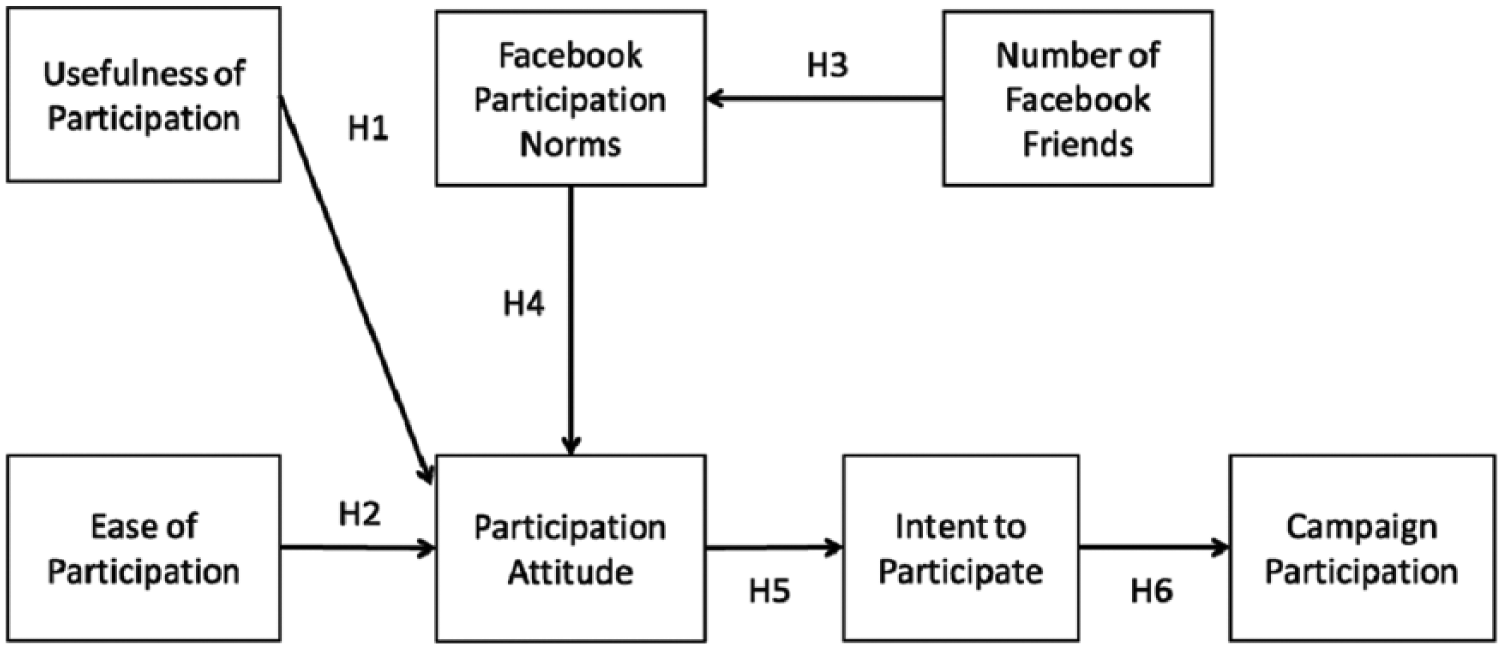
Theoretical model.
Methods
Participants
In order to collect data from current Facebook users, participants (N = 300) were recruited using a snowball sampling method on Facebook, which began with a link to the survey that was initially posted and shared by the researchers. The majority of participants (97%) were from the United States, with the remainder spread across various countries. The sample ranged in age from 18 to 71 years (M = 30, standard deviation [SD] = 11.71) and was mostly female (81%). Most of the sample (96%) was also college-educated. In total, 81% of the sample identified as White/Caucasian, 8% as Asian, 2% as Black/African American, 2% as Hispanic/Latino, 4% as multi-ethnic, and 3% as other ethnicities. Because the survey was distributed through Facebook, only current Facebook users were eligible to participate.
Procedure
Participants followed a link to a survey on the Qualtrics website, which took approximately 15 minutes to complete. They were provided with informed consent, which included the protection of their identity. Those who completed the survey were entered into a raffle to win one of two US$50 Amazon gift cards by entering their email address, which was not connected to their survey responses in any way.
Measures
Network size
Participants were asked to report the current number of friends they have on Facebook. The social network size of the sample ranged from 15 to 2,066 friends on Facebook (M = 573.55, SD = 371.05).
Facebook participation norms
Using an adapted scale from Shu and Chuang (2011), participants responded to four, 5-point Likert scale items (1 = strongly disagree, 5 = strongly agree) regarding their Facebook sharing norms (α = .86, M = 3.41, SD = .58, range = 2.00–5.00). Items included “Most of my close friends approve of me participating in social campaigns on Facebook,” “Most of my immediate family approves of me participating in social campaigns on Facebook,” “Most people like me approve of me participating in social campaigns on Facebook,” and “Most people in my Facebook network approve of me participating in social campaigns on Facebook.”
Perceived usefulness of participation
As an adaptation of TAM’s perceived usefulness concept, a single-item scale was created and used to assess the perceived usefulness of their campaign participation. Participants rated the perceived impact of their participation in each campaign they selected using a 5-point Likert scale (1 = strongly disagree, 5 = strongly agree). Participants responded to the statement, “I participated in this campaign because I felt it would make a significant difference in promoting the cause/campaign.” An average score was calculated across the four campaigns for each individual to create a variable of perceived average usefulness (M = 3.11, SD = .95, range = 1.00–5.00).
Perceived ease of participation
TAM’s perceived ease of use concept was adapted to account for the ease or difficulty of participating. Participants were asked to rank the amount of mental effort they had exerted related to their participation in each separate campaign, on a scale of 1–10 (1 = no thought at all, 10 = carefully weighed the pros and cons of participation). An average score was calculated across campaigns to create a variable of average effort required (M = 4.60, SD = 2.61, range = 1.00 = 10.00).
Attitudes toward campaign participation
Using an adapted scale from Shu and Chuang (2011), participants were asked to indicate their attitudes toward participating in social campaigns online by responding to five statements utilizing a 5-point Likert scale (1 = strongly disagree, 5 = strongly agree). Questions asked whether participants thought participating in online social campaigns was good, harmful (reverse coded), pleasant, valuable, and smart. A scale was created to capture participants’ attitudes toward campaign participation and was found to be reliable (α = .77, M = 3.3, SD = .57, range = 1.40–5.00).
Intent to participate in social campaigns on Facebook
A scale was adapted from the intention to share knowledge instrument created by Shu and Chuang (2011) for this study. Participants were asked to share their intention to participate in social campaigns on Facebook using four 5-point Likert scale items (1 = strongly disagree, 5 = strongly agree): “I try to participate in social campaigns on Facebook frequently,” “I am motivated to participate in social campaigns on Facebook,” “I will continue to participate in social campaigns on Facebook,” and “I will make use of the services provided by Facebook to participate in social campaigns.” The scale was found to be reliable (α = .92, M = 2.54, SD = .97, range = 1.00–5.00).
Campaign participation
Participants were asked to identify how many Facebook campaigns they had participated in from a list of four relatively recent and popular social campaigns on Facebook. Participants were asked to indicate (yes or no) whether they had filtered their profile picture with the French flag in recognition of the Paris Terror Attacks (November, 2015), filtered their profile picture with the rainbow in recognition of the Supreme Court decision on same-sex marriage equality (June, 2015), changed their profile to a pink equal sign on a red background in support of same-sex marriage equality (March, 2013), and/or changed their profile picture to a cartoon character as part of the Campaign to End Violence Against Children (December, 2010). Participants were also given the option to indicate that they did not participate in any of these social campaigns. The total number of campaigns participated in was summed for each individual, ranging from 0 to 4. A total of 49% participated in zero campaigns, 32% participated in one campaign, 11% participated in two campaigns, 7% participated in three campaigns, and 1% participated in all four campaigns. This sum was used as the dependent variable of campaign participation (M = .81, SD = .98). Descriptive statistics for each campaign are presented in Table 1.
Descriptive Statistics for Each Campaign.

SD: standard deviation.
Statistical Analyses
The hypothesized model (Figure 1) was tested using path analysis, performed by the AMOS v. 22 Statistical Package. The fit of the model was evaluated using pre-determined cut-offs which are noted in the “Results” section. Each hypothesis was tested by determining whether the path coefficient reached significance (p < .05) and was in the hypothesized direction. Table 2 contains zero-order correlations for the variables included in the tested model.
Correlation Matrix for Study Variables.

p < .05; **p < .01.
Results
Hypotheses 1–6 were tested using path modeling techniques. The hypothesized model provided a reasonable fit to the data (see Figure 2). The chi-square for the hypothesized model is significant, suggesting the model is not a good fit to the data, χ2(15) = 45.28, p < .001. However, the significant chi-square result most likely emerges from the large sample size (Bentler & Bonett, 1980). The root mean square error of approximation (RMSEA) for the model is .08 (pclose = .03), which is equal to the .08 cut-off for good fit as recommended by Browne and Cudeck (1993). The comparative fit index (CFI) for the hypothesized model is .90, which is also equal to the .90 criteria of good fit suggested by Bentler (1990). In addition to the fit indices, the model also identified that each of the hypothesized paths was significant and in the predicted direction. Given these results, the hypothesized model is accepted and the results from each path are reported below. Table 3 shows the direct, indirect, and total effects of each variable in the model on campaign participation.

Hypothesized model results. χ2(15) = 45.28, p < .001; RMSEA = .082, pclose = .026, CFI = .900, SRMR = .1076, TLI = .813.
Direct, Indirect, and Total Effects of Predictors on Campaign Participation.
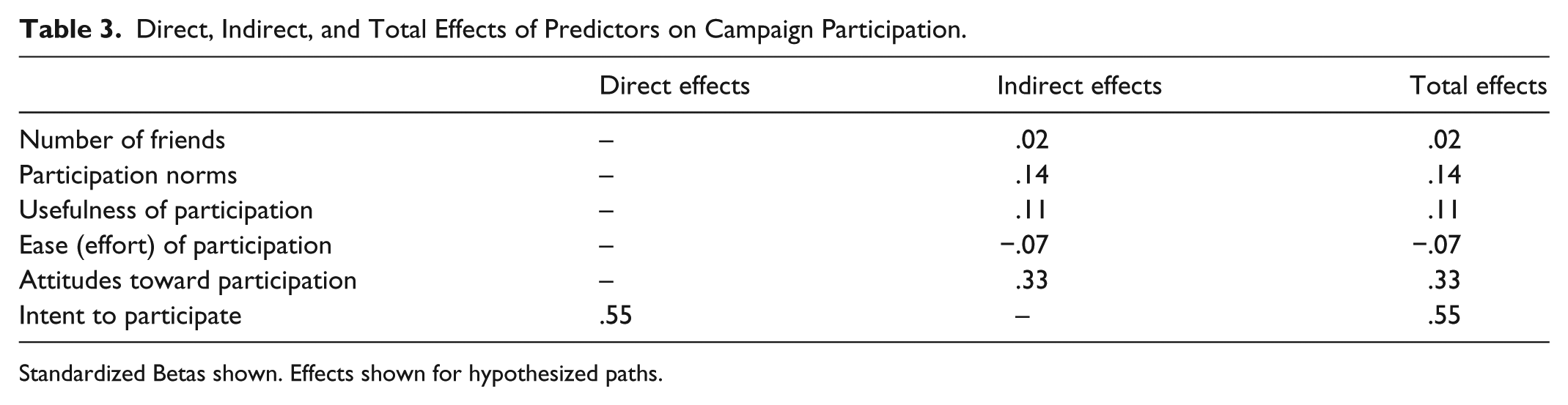
Standardized Betas shown. Effects shown for hypothesized paths.
Attitude about participating in the Facebook social campaigns was predicted to be related to the perceived usefulness of participating (H1) and ease of participation (H2). Perceived usefulness has a significant positive relationship with attitude, β = .34, p < .001, as does perceived ease (lower effort) of participating, β = −.21, p < .001, providing support for both hypotheses.
Hypothesis 3 stated that the size of one’s Facebook network (the number of Facebook friends) would positively predict norms about participating in online social campaigns within the network. This relationship is significant, β = .15, p = .05, supporting H3. Hypothesis 4 stated that these network norms would in turn predict individual attitude about social campaign participation. This relationship is also significant, β = .43, p < .001, supporting H4.
Hypothesis 5 stated that attitude toward participating in social campaigns would predict intention to participate, which is supported, β = .61, p < .001. Finally, Hypothesis 6 stated that intent to participate in social campaigns would predict actual participation, which is also supported, β = .55, p < .001.
Given that this study measured campaign participation, we wanted to determine whether a re-specified model would improve overall fit by removing intention to participate from the model. The intention variable was included in the hypothesized model given its importance to TRA. However, in an instance where behavior has already taken place, it was deemed appropriate to test a second model that included a path directly from sharing attitude to campaign participation.
The chi-square for the re-specified model was again significant, χ2(10) = 20.82, p = .05. However, the RMSEA for the model was .06 (pclose = .29), which is less than the .08 cut-off for good fit as recommended by Browne and Cudeck (1993). The CFI for the hypothesized model was .91, which exceeds the .90 criteria of good fit suggested by Bentler (1990). Each of the paths remained significant in the re-specified model, including the path from sharing attitude to campaign participation, β = .36, p < .001. Thus, the re-specified model that includes a path directly from attitude to campaign participation provided a better fit to the current data (Figure 3). This indicates that our model predicts actual behavior slightly better than it predicts behavioral intention. Therefore, while H5 and H6 were each supported, the final result indicates more succinctly that attitudes and norms predict behavior directly, without the need to account for behavioral intention in the event that the behavior has already taken place.

Re-specified model results. χ2(10) = 20.82, p < .05; RMSEA = .060, pclose = .285, CFI = .906, SRMR = .0974, TLI = .803.
To predict the likelihood of participating in campaigns, a binary logistic regression was conducted with participation (yes/no) as the dependent variable, and network size, participation norms, participation attitude, and participation intent as predictors. Ease of participation and usefulness of participation were not included because these were campaign-specific variables and those who did not participate in any campaigns did not complete the related measures. The final logistic regression model did not reach significance, χ2(8) = 7.19, p = .52. The model was able to correctly classify 73% of those who did not participate in campaigns and 76% of those who did. Once network size, norms, and attitudes were accounted for, only intent was a significant predictor of participation, β = 1.18, p < .001, odds ratio = 3.26. This finding suggests that for every one point increase in intention to participate, individuals were 3.26 times more likely to actually participate in the campaign.
Discussion
The results of this study indicate that the attitudes individuals hold about participating in online social campaigns is directly related not only to their intention to participate but also to their reported participation. Findings further indicate that these attitudes are shaped by three key variables: ease of participation, usefulness of participating, and social network norms regarding participation. Across the four campaigns studied, the less effort that was required, the more positive the attitude participants had about participating. While all campaigns were equal in technical effort—only requiring users to change their profile pictures—individuals perceived some campaigns to require more mental effort than others. It is possible that participants found some campaigns to be more politically charged or otherwise more controversial than others, which may have resulted in greater perceived effort regarding the decision to participate. While nearly one-third (32.7%) of all participants changed their profile picture to the French flag for the Paris attacks, less changed their pictures for the same-sex marriage ruling (21.3%) or the equal sign for marriage quality (17.7%). Because all participants did not take part in all of the campaigns included in this study, there was not enough data to statistically compare effort among participants across campaigns. However, it is worth noting that the means of reported effort for those who did participate in multiple campaigns are quite similar across the various causes (see Table 1). In addition to this, the more useful the campaigns were perceived to be, the more positive the attitudes were toward them. Therefore, despite critics raising questions about the actual impact of these campaigns (Kristofferson et al., 2014), individuals in this sample who participated in these “pictivism” campaigns were positively influenced by their belief that their participation would make a difference.
In an online social network setting such as Facebook, an individual’s behavior is potentially highly visible to others, meaning that their actions do not take place in isolation of others’ behaviors. Oftentimes, individuals participate in these types of campaigns after seeing a friend do so (State & Adamic, 2015), which suggests that the norms of their social network influence their own attitudes and behaviors. The results of this study support this phenomenon and suggest that the individual’s social network size had a positive influence on their social norms. The findings from this study also suggest that as an individual’s network size increases, it is likely to offer the user a broader set of social norms, which as a result may reinforce more popular norms that ultimately influence the user’s attitudes regarding their social media activity. For example, if participating in a pictivism campaign is perceived to be a norm within the individual’s social network, the individual forms a positive attitude toward this behavior, and these attitudes influence the user’s intention to also participate in the online social campaign.
As predicted by TRA, these attitudes were ultimately related to intention to participate, which positively predicted the level of participation. Furthermore, the results of this study went beyond intentions and identified a significant positive relationship between an individual’s attitudes regarding campaign participation and their participation in pictivism campaigns.
Theoretical Implications
This study provides support for the predictors of behavior proposed by the TRA (Ajzen & Fishbein, 1980; Fishbein & Ajzen, 1975), which were all found to be significantly related according to the theory. Additionally, this study supports the use of TRA within a social media context and also builds upon previous research with similar successful applications in which online behavior can be predicted by individual and social factors (Chang & Chen, 2014; Kim et al., 2015). Beyond this, the application of TRA is also extended in a few ways in this study. First, the measurement of social norms was focused on the norms of one’s whole social network—particularly their Facebook network—and as a result, a new measure was created to capture this concept. Next, as a result of studying multiple campaigns, we determined not only whether participants engaged in a behavior (i.e., whether individuals participated in the campaigns) but the magnitude of their engagement in these types of campaigns. Finally, this study measured actual behaviors, which cannot always be captured in studies of TRA. This provides further evidence that when behavior is captured, it can be predicted directly by attitudes, without intention as a necessary mediator, as suggested by previous analyses (Webb & Sheeran, 2006).
In addition to these implications, the results of this study also provide further support for the application of TAM (Davis, 1989) within social media contexts (Hunt et al., 2014; D. Y. Lee & Lehto, 2013; Park et al., 2014). Specifically, this study measured cognitive effort in deciding whether to participate in a campaign given that doing so would have a visible impact within one’s network. This is distinct from capturing technically how easy it is to participate, which in the case of pictivism campaigns is equal across various campaigns.
Limitations and Future Research
The findings of this research suggest that TRA and TAM can predict an individual’s participation in pictivism campaigns on Facebook. However, the generalizability of these findings may be limited by a few factors. First, this study only focused on four specific Facebook campaigns. If other campaigns had been included, this study may have produced different results. Furthermore, other factors about one’s regular Facebook use or what they see in their network could also influence participation in these and other campaigns. Future research should investigate more diverse campaigns in terms of their messages and what is required for participation. Additionally, the salience or personal importance of the campaign’s message or goal was not measured. Therefore, these results do not include the potential influence of personal involvement with regard to participation. Also, although we measured campaign participation, this item was still based on self-report, so actual campaign participation cannot be verified. Second, only single-item measures were used to capture the perceived ease and usefulness of participating in each campaign. The measures used in this study were adopted from TAM/TRA scales and were adjusted to capture the concepts of ease of use and usefulness in a Facebook campaign sharing context. Nevertheless, given the success of applying TRA/TAM in this study, future research should seek to expand upon these measures to create scales that are intended to measure these concepts in a social media setting. Third, the sample is limited and not necessarily representative of all Facebook users in terms of age and gender. Specifically, most respondents were female, and the sample overall is highly educated. Finally, future research must address whether online participation in these campaigns leads to offline engagement with the causes they support.
Conclusion
Social media, particularly Facebook, have transformed how individuals can participate in prosocial campaigns and social movements. The popularity of pictivism has grown over the last several years, and some campaigns have resulted in hundreds of millions of users changing their profile picture to demonstrate their support for a cause or message. Based on the results of this study, we may be able to better predict who will participate in these campaigns based on the effort required, perceptions of their importance, and the norms of their online networks.
Footnotes
Declaration of Conflicting Interests
The author(s) declared no potential conflicts of interest with respect to the research, authorship, and/or publication of this article.
Funding
The author(s) received no financial support for the research, authorship, and/or publication of this article.