




Abstract
Uses of social media for purposes of political campaigning have become widespread across several electoral contexts. However, as much of the research focused on these issues have dealt primarily with Twitter, relatively little is known regarding how parties make use of other, similar platforms. This article analyzes Twitter and Instagram use during the 2015 Norwegian elections. By adopting a comparative approach, the article suggests a novel approach for applying the often-used normalization and equalization hypotheses. While the former of these hypotheses suggests that larger parties will dominate online, the latter proposes that comparably smaller actors will utilize comparably novel services—such as Instagram in this case—to comparably larger extents than their more sizeable competitors. Contrary to the hypotheses, however, messages primarily relating to smaller actors tended to dominate on Twitter, while larger actors were found to be successful in terms of gaining traction on Instagram.
Introduction
While the degree to which social media are actually contributing to electoral success can be called into question (Aragón, Kappler, Kaltenbrunner, Laniado, & Volkovich, 2013), online services such as Twitter are nevertheless seen as integral parts of contemporary election campaigns. Plenty of attention has been devoted to the Twitter in particular (Jungherr, 2014b), leading to what must be considered as a dearth of research looking into the uses of other social media services. The article at hand seeks to remedy this apparent gap within the field of political communication by comparing what is perhaps the most frequently studied social media platform—the micro-blog Twitter—with a more recent contender, namely, the image-sharing service Instagram.
The specific empirical setting for studying the uses of these two services is the 2015 Norwegian municipal and regional elections. Norway, often understood as one of the Nordic welfare states (Hilson, 2008), features a party-centered political system (Karlsen, 2010) and advanced Internet users (Vaage, 2014) where social media have been used by political parties for a comparably long time (Kalnes, 2009). As such, the Norwegian context appears as a suitable one in which to analyze recent developments regarding the services under scrutiny.
While other studies have provided comparative insights between elections in the same country (e.g., Schweitzer, 2011) or across multiple countries (e.g., Lilleker et al., 2011; Vergeer, Hermans, & Cunha, 2012), it appears that rather few studies have made efforts to compare the uses of two or more social media platforms during times of heightened political activity (e.g., Kim, Chun, Kwak, & Nam, 2014; Larsson, 2017). By utilizing the competing normalization (in short suggesting that larger parties dominate online) and equalization (suggesting that smaller parties can gain traction through these services) hypotheses, the study makes a contribution by tracing the most active and the most popular political parties across both platforms, detailing the supposedly diverse priorities regarding digital communication held by those up for election. While previous scholarship has noted the routine aspect of simply having accounts on a plethora of online services (Gibson, 2004; Groshek & Al-Rawi, 2013), our current approach moves beyond the question of “has/has not” (e.g., Marcinkowski & Metag, 2014; Strandberg, 2013) and seeks to gauge the degree to which these services are actually used. Indeed, “having a social media icon on a webpage does not demonstrate usage” (Oliveira & Welch, 2013) and the study at hand seeks to provide novel insights regarding use across more than one platform. Are the most active users and most recurring themes different or similar across Twitter and Instagram? What groups of users—parties large or small—appear to have prioritized what service?
Literature Review
Beyond the oft-studied Twitter platform (e.g., Jungherr, 2014b), Instagram is arguably the latest in a long row of online services that are often described as social media—platforms that, with our current thematic interest in mind, can be defined as “a group of technologies that allow public agencies to foster engagement with citizens and other organizations” (Criado, Sandoval-Almazan, & Gil-Garcia, 2013, p. 320; see also boyd & Ellison, 2008) while also allowing citizens to act as “affective publics” (Papacharissi, 2015) in using those same technologies to make their voices heard regarding some political cause.
A series of different theoretical and conceptual perspectives have been employed to understand ramifications of social media in a number of contexts. In the field of online political communication, the dichotomous divide between what can be loosely labeled as “Internet-optimistic” and “Internet-pessimistic” approaches or perhaps interpretations is a well-rehearsed one. Depending on the specific research focus, the former of the two suggests a view that the Internet would help increase political participation by those previously unengaged, or that it would allow for comparably smaller political parties to gain a competitive edge toward their larger size opponents. The latter, then, proposes a “rich-get-richer”-type view where it primarily is the previously politically interested citizens who draw on the new possibilities for engagement and where large parties have the most to gain from the new technologies due to supposed abundant resources.
With our specific research context of political party activity online in mind, the “Internet-optimistic” label is often characterized as an equalizing perspective on these developments. Here, the Internet is seen as an “inherently democratizing technology” (Coleman & Blumler, 2009, p. 166) which provides actors previously marginalized from the public agenda with a mode of communication beyond the “mass media bottleneck” (Klinger, 2013, p. 720). Given the supposed low costs initially associated with campaigning activities on the novel medium (e.g., Vergeer, Hermans, & Sams, 2011), the equalization hypothesis found support primarily in comparably earlier studies. For example, Gibson and Ward (1998) studied political party use of early Internet applications such as websites and email, concluding that minor parties were indeed “leveling the communications field” (1998: 14) by making good use of the new technological opportunities. Novel online practices adopted by smaller party organizations were assumed to lead to success in terms of increased attention in new as well as old media formats—possibly leading to increased attention also at the ballots.
Remembering the claim made by Hansen and Kosiara-Pedersen (2014) that “even if new technologies require fewer resources, they still require both time and money” (p. 207), backers of the competing normalization hypothesis found support for claims that the Internet provides “politics as usual” (Margolis & Resnick, 2000) in a series of comparably later studies. Indeed, as electoral activity becomes increasingly professionalized (e.g., Hartleb, 2013; Lisi, 2013; Strömbäck, 2007), a suitable amount of resources is needed to keep up—an “online arms race” that might not be as easy to continue for comparably smaller actors. A case in point could be one of the services studied here, Twitter. Looking at developments regarding campaigning use of Twitter in Sweden, a country very similar to our current case country, studies from the 2010 and 2014 elections showed that while the former of the two showed some signs of smaller actors gaining traction on the service at hand, the latter suggested that while smaller actors were still present among those most active, a bigger role for larger political parties could be discerned (Larsson & Moe, 2012, 2016). For Norway, a comparison of political Twitter use during the 2011 regional and the 2013 national elections suggested that larger actors had come to play a more important role during the latter election, but that Twitter still clearly functioned as an arena for “underdog” parties (Larsson & Moe, 2014). While the results do not clearly point in one single direction, previous studies in the two Scandinavian countries nevertheless suggest an increased influence of comparably sizeable parties in this regard.
While a helpful heuristic tool, the divide described above has indeed been criticized—for instance, Wright (2011) suggests that the perspective at hand might lead researchers to be “too pessimistic in their analysis of the impacts of technology on politics” (p. 249). Relatedly, suggestions have been aired that a two-part interpretation scheme might lead our analyses astray in both directions—either too negative or indeed too positive (Larsson & Svensson, 2014). It follows from the observations above that the dichotomous perspective at hand is in need of differing applications, updates, or novel ways of employment, moving away from what can sometimes be discerned as traces of social or technological determinism (e.g., Heilbroner, 1967; Kling, 2000; Parvez & Ahmed, 2006). Our argument here is that by utilizing these hypotheses in a comparative setting—detailing Twitter and Instagram—we are able to provide new insights into the online prioritizations of party organizations.
Summing up findings from previous research, it would appear that comparably novel media platforms are first adopted by smaller political actors—after which their more affluent competitors often become more resolute in their employment. However, such a linear perspective on the development from equalized toward normalized findings has been questioned as scholars have suggested a “middle road” alternative. Sometimes discussed as the “ebb and flow thesis” (Lilleker et al., 2011), such a view discerns a cyclical perspective between the hypotheses, as novel platforms being introduced will feature increased use by smaller parties once again.
As for our current efforts, the literature presented above has suggested that Twitter has shown tendencies toward normalization due to the increased influx of larger, established actors. We would thus expect such tendencies to be visible also in the findings presented here, with larger parties supposedly dominating the Twitter traffic under study. Moreover, given the aforementioned tendency for smaller parties to make use of novel technologies at a comparably early stage, we would expect for the other platform under scrutiny—Instagram—to be dominated by such smaller actors. By utilizing the aforementioned hypotheses in a comparative fashion, tracing uses across more than one online service, the study at hand thus provides a novel way of approaching the study of online campaigning.
Methods
Comparing two services in the way proposed here carries with it certain opportunities—but also certain difficulties. For example, while image sharing is arguably central to the Instagram service and while images can and are certainly shared on Twitter as well, the latter of the two platforms is not uniquely geared toward distribution of visual content. Moreover, the platforms differ in terms of user base. To be precise, Twitter is largely understood as an elite medium, with influential users holding positions in politics, public relations (PR), and the media, in Scandinavia (Andersson Schwarz, 2015; Christensen, 2013; Rogstad, 2015) as well as beyond (Graham, Broersma, Hazelhoff, & van’t Haar, 2013; Hawthorne, Houston, & McKinney, 2013). Instagram use, then, is primarily associated with a comparably younger age group of users (Ipsos/MMI, 2016). As such, the two platforms under scrutiny would appear to appeal to different segments of the population—a point of interest to politicians on the campaign trail, as well as one to remember when assessing the results presented below. Nevertheless, Instagram and Twitter also share a number of commonalities. For example, the use of hashtags, keywords employed by users to thematically “tag” their posted content as relevant for a specific event, occurrence, or topic, is common on both Twitter and Instagram. As such, much like for previous, similar studies (e.g., Bruns & Burgess, 2011; Highfield, Bruns, & Harrington, 2012; Larsson, 2014; Larsson & Moe, 2013; Stieglitz and Dang-Xuan, 2012), hashtags dealing with the election at hand were utilized for the data collection undertaken. While such an approach risks excluding users below “a certain level of Twitter proficiency” (Jungherr, 2014a, p. 244), the selected approach was deemed suitable for practical (González-Bailón, 2013) as well as ethical (Larsson, 2015c) reasons. With this in mind, our focus was placed on the “short campaign” (Aardal, Krogstad, & Narud, 2004)—the final month of campaigning leading up to election day, which took place on 14 September 2015. As such, data collection was initiated on 14 August and was terminated 2 days after Election Day to catch some of the suspected electoral aftermath. Focus was placed on the two major hashtags related to the election—#valg2015 and #valg15 (Norwegian for #election2015 and #election15, respectively).
Data collection involved two separate approaches, one for each of the platforms under scrutiny. For Twitter, an installation of YourTwapperKeeper (YTK) was employed to track the hashtags as previously mentioned. YTK utilizes the Twitter Search and Streaming API (Application Programming Interface) to gather data (Bruns & Stieglitz, 2012). By accessing the APIs made freely available by Twitter, YTK and other services like it are able to gather about 1% of the total amount of Twitter activity at any given moment (e.g., Driscoll & Walker, 2014; Gerlitz & Rieder, 2013; Giglietto & Selva, 2014; Morstatter, Pfeffer, Liu, & Carley, 2013). As such, delimitations are necessary—and while events such as elections might cause problems related to data loss when studying larger contexts (e.g., Raynauld & Greenberg, 2014), the use of the open API to gather data related to the arguably smaller Norwegian context was deemed unproblematic. When data collection was aborted on 16 September, 21,526 Twitter messages had been gathered.
For Instagram, the Instagram Hashtag Explorer was utilized (Rieder, 2015). The service provides access to the Instagram API and allows for archiving of posts made to Instagram containing specified hashtags. Compared to the sometime complex matter of access and data quality related to the different Twitter APIs (Lomborg & Bechmann, 2014), Instagram appears as fairly straightforward. One API is offered, and access to data is not described as limited in the same ways as for Twitter. Nevertheless, remembering Karpf’s (2012) claim that “the glimmering promise of online data abundance too often proves to be fool’s gold” (Karpf, 2012, p. 652), measures were taken to assure the completeness of data. Specifically, a series of searches were made on the Instagram platform to see whether the data gathered matched the outcomes from the searches. As results of this procedure were satisfactory, the approach described above was deemed suitable. When data collection was completed, a total of 6,380 Instagram posts had been gathered.
Data analysis was undertaken with the questions raised by the literature review in mind. First, to gauge the apparent prioritizations made by political actors, we look specifically at the degree to which the services under scrutiny were employed by political parties as well as individual politicians. Second, moving beyond the uses by the political actors themselves, we assess their overall popularity on both services by focusing on hashtags related to specific parties. As such, we focus here on analyzing the “hashtags within the hashtags”—detailing thematic keywords used within #valg2015 and #valg15 that could be related to specific political actors.
Drawing on previous work (Larsson & Moe, 2014; Mahrt & Scharkow, 2013; Stieglitz & Dang-Xuan, 2012), our analyses are geared toward the most active users and most frequently employed hashtags as evident from our data. By approaching the data in this way, we are able not only to detail the top users of the hashtags at hand but also to assess the “long tail” of activity by testing for the most popular thematic keywords as employed within the election-related hashtags used as selection criteria. Similarly, by detailing the activities of all users within the hashtags studied, we are able to say something about the degree to which users beyond the political sphere employ the services at hand. Such a focus moves beyond the often-repeated approach of merely focusing on a series of accounts operated by political actors. In sum, then, the current approach not only provides an analysis of the most active users but also provides us with an overview of the topics made popular by a broader range of users on each of the two services.
Results
Providing an initial overview of the election-related activity undertaken on the platforms under study, Figure 1 features a timeline graph depicting a week-by-week outline of the online traffic under scrutiny.

Timeline graph of hashtagged activity on Twitter (black line) and Instagram (gray line). Number of posts shown.
Comparing the black line (representing Twitter activity) with its gray counterpart (denoting Instagram activity), the relative dominance of the former over the latter must be said to have been expected as Twitter has been featured in Norwegian politics since at least the 2009 national elections (Kalnes, 2009). Beyond volume of use, the shapes of the lines provide us with more detailed insights. While the pursuits on both services reach a highpoint on election day (much like for other similar studies, dealing primarily with Twitter, for example, Bruns & Burgess, 2011; Larsson & Moe, 2012; Moe & Larsson, 2012), the black line showing Twitter activity features a series of “spikes” that are not clearly matched by the gray line. For instance, during the final week leading up to the election (starting on 7 September), the Twitter line clearly shows two such upsurges in activity—increases that do not appear to be matched on the Instagram line. A closer look at the data reveals that these “spikes” in the Twitter data relate closely to media coverage of the election. Much like has been reported by previous scholarship focusing on other elections (e.g., Jungherr, 2014a; Larsson & Moe, 2014; Lilleker & Jackson, 2010), the increases under discussion are results of Twitter discussion during televised political debates. The first increase emerges on 9 September. This day features at least two mediated events that appear to have had impacts on the Twitter traffic—an interview with Prime Minister broadcasted on TV2, one of the main commercial broadcasters in Norway, and a debate featuring the youth party leaders hosted by the public service broadcaster, NRK. The second upsurge occurs 2 days later, on 11 September. A closer look at the data reveals that the increase in traffic is closely related to tweets concerning the final party leader debate before Election Day—broadcast on NRK. Much like for previous research, then, Twitter emerges as rather reactive relation to political content broadcast through more established media, while the engagement traced on Instagram does not appear to feature similar patterns.
Next, we move on to assess the most active users on the services under scrutiny. Figure 2, then, features the most active Twitter users, and Figure 3 depicts those accounts who were most active on Instagram. By visiting the Twitter profile pages of these most active users, they were identified as citizens (shown as white bars in Figures 2 and 3), media personnel or organizations (shown as light gray bars), politicians or party accounts (dark gray bars), and professionals or the organizations they work for (black bars). Striped bars are employed to depict activity undertaken by accounts that had been deactivated at the time of data analysis.
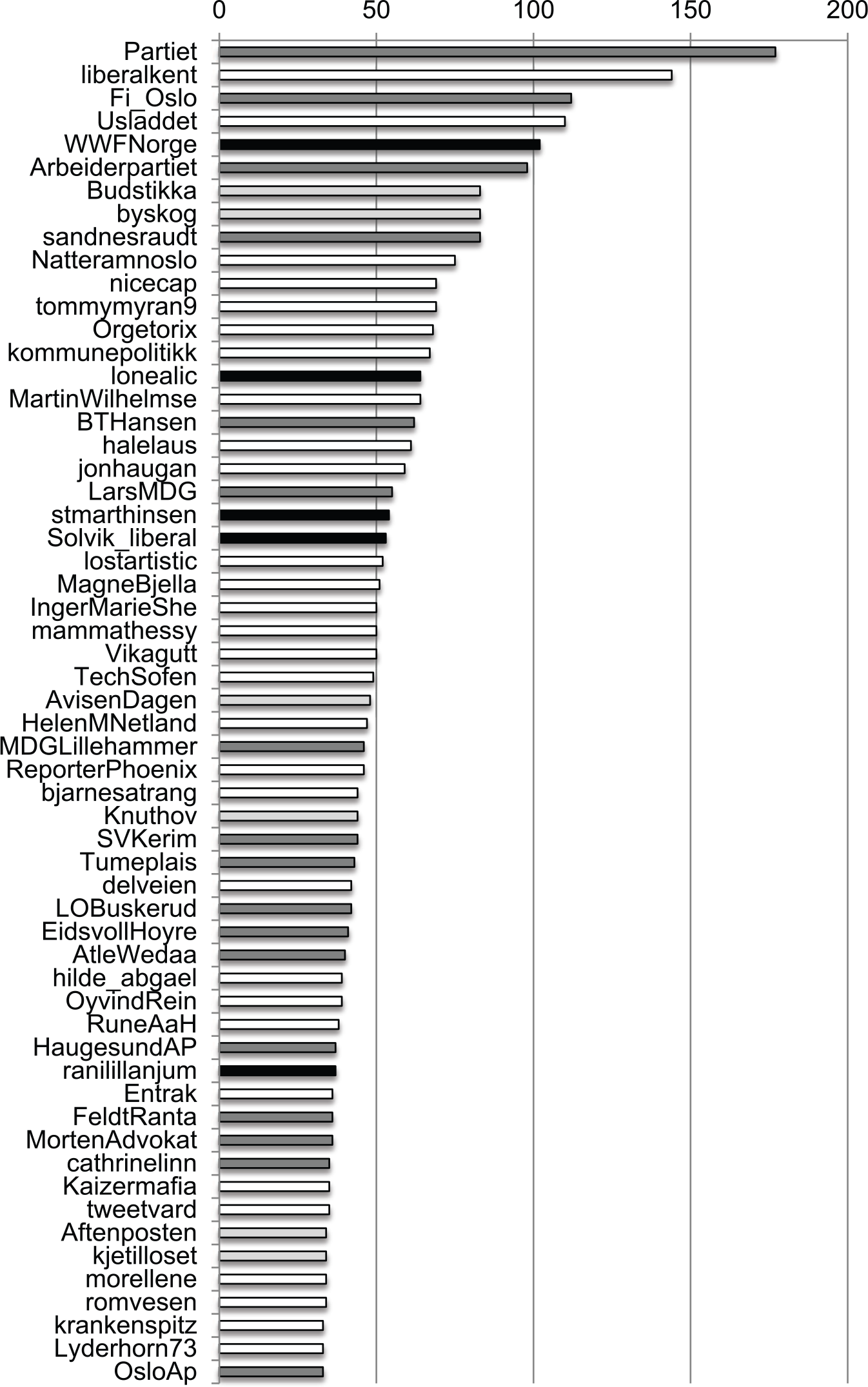
Users of election 2015 hashtags on Twitter accounting for more than 0.2% of the total number of tweets sent. Number of tweets sent shown.

Users of election 2015 hashtags on Instagram accounting for more than 0.2% of the total number of tweets sent. Number of Instagrams sent shown.
White bars appear to dominate Figure 2, suggesting that the most active Twitter users employing the election-related hashtags under scrutiny identified as regular citizens on their profile pages. Indeed, some of these users do air support for specific political parties on their self-authored profiled pages, but the relative lack of dark gray bars (indicating activity undertaken by parties or individual politicians) throughout the figure appears as somewhat surprising, given what could be expected from previous research as discussed earlier.
Granted, while white bars appear to dominate, their gray counterparts are not necessarily absent in Figure 2. Two comparably small parties appear to dominate the activities—Partiet, the account operated by the Environmental party, and Fi_Oslo, the official account for the Oslo and national branch of the Feminist Initiative party. Such high-end use of small, non-parliamentary actors like the latter party was mirrored also in a study dealing with the 2014 Swedish elections (Larsson, 2017), which suggests the apparent priority that such “underdog” actors place on communication channels like these. Related to the Environmental party, we find another account with obvious interests in environmental issues—the Norwegian World Wildlife Fund tweeting under the handle WWFNorge. While this study has not looked specifically into the content being posted, it would seem from the users active that a certain portion of the activities were devoted to environmental politics. This resonates well with findings from previous studies, where green or environmental parties and interest groups have been pointed to as being especially active on novel media platforms (e.g., Gibson, 2004; Larsson, 2015b; Vergeer et al., 2011)
While we also see the catch-all social democratic Arbeiderpartiet in the top section of Figure 2, the comparably frequent activity undertaken by comparably smaller parties speaks in favor of the equalization hypothesis as these actors are indeed utilizing these channels to higher degrees than their more sizeable opponents. Nevertheless, the popularity of these parties through the “long tail” of related hashtag use remains to be seen.
Before that, though, we move on to look at a similar display for the most active users of political hashtags on Instagram, featured in Figure 3.
While the Twitter traffic under scrutiny was clearly dominated by citizens, the comparative absence in Figure 3 of white bars, depicting activity undertaken by such users, is striking. Here, dark gray bars emerge as dominating, suggesting a much clearer presence of political actors on Instagram than on Twitter. The most active account is operated by the aforementioned catch-all party Arbeiderpartiet, and the account activity emerges as so extensive that it almost dwarfs that of their political competitors. Indeed, plenty of those competitors are present here—going down the list, we can identify a series of national (such as the union lonorge and the conservative party hoyre) as well as local and regional political organizations (such as the Haugesund branch of Arbeiderpartiet, haugesundap, or the Øyer municipality branch of the conservative party, oyer_hoyre).
Continuing our comparison of Instagram and Twitter, while accounts operated by comparably smaller parties were among the most active ones on Twitter, a platform mostly dominated by non-political actors, Instagram is clearly characterized by the undertakings of parties large and small alike. Another interesting difference between the two services concerns the activity of the Environmental party. On Twitter, the Partiet account, representing the national branch of the party, emerged as the most active. On Instagram, that same national branch (here known under the handle degronne) only employed the platform at hand to the degree that would place them in the middle of Figure 3. This suggests a clear prioritization of Twitter over Instagram for the Environmental party—at least for their national branch, as certain local and regional counterparts are found also in other parts of the figure—consider one of the local Oslo branches, gamle_oslo_mdg, visible in the top of Figure 4.

Most frequently used hashtags in the Twitter data set. Hashtags shown account for at least 0.1% of the total amount of hashtags used. Similar hashtags were merged (e.g., “arbeiderpartiet” and “Arbeiderpartiet”). Number of instances used shown.
Summing up the activity undertaken by users of Twitter and Instagram themselves, we can conclude that while Twitter was mainly used by citizens and comparably smaller parties, thereby suggesting tendencies in line with the equalization hypothesis, Instagram emerged as dominated by a variety of political actors, with the catch-all Arbeiderpartiet in the lead. This latter finding would suggest a lean toward the normalization hypothesis, as primarily established political players emerge as engaged in this comparably novel communication channel. Of course, the activity undertaken by the users themselves only provides us with one aspect of what parties and topics appear to have dominated the two services under scrutiny during the 2015 elections. To provide insights also into the activity undertaken beyond the top users, we now move to gauge what other hashtags were employed within the #valg2015 and #valg15 varieties on both services.
For the two figures detailing uses of hashtags, a color code scheme similar to the one employed earlier is employed. Here, white bars indicate hashtags with a more general theme related to the election (e.g., utterances like “election” or “go vote”). Much like for the previous figures, light gray bars denote hashtags related to specific media organizations, while dark gray bars indicate hashtags associated with political parties or individual politicians. With these guidelines for interpretation in mind, Figure 4 provides an overview of the most frequently used hashtags in the Twitter data set.
As shown in the timeline presented in Figure 1, Twitter activity was found to be related to broadcasted political events. Such a tendency is visible also when assessing the most popular thematic keywords employed by users—here, hashtags clearly related to election broadcasts featured by the Norwegian public service broadcaster (nrkvalg) and their main commercial competitor (2valg) emerge as very popular among those users tweeting in relation to the election. With regard to political actors, the most popular hashtag was found to be stemgront (Norwegian for “vote green’), signaling clear relationship to the activity undertaken by the environmentalist party account as shown earlier. Similarly, reminiscent of the results discussed previously, Figure 4 also sees a hashtag related to arbeiderpartiet emerge as quite popular. But while the Feminist Initiative party proved to be quite active on Twitter as previously disclosed, their undertakings do not appear to have yielded popularity beyond their own account. Indeed, while the activity undertaken with the hashtag at hand is comparable to the frequencies of keywords related to larger parties (frp for the Fremskrittspartiet as well as Høyre), the apparent spread of the stemfi hashtag cannot be said to match the activity undertaken by the Fi_Oslo account.
In sum, then, it would appear that the equalizing tendencies previously suggested when assessing the top Twitter users of hashtags related to the election are discernible also for the analysis presented in Figure 4, detailing the most popular “hashtags within the hashtags” as employed by users of Twitter. While both figures arguably featured activity related to one of the largest parties in the Norwegian context (e.g., Arbeiderpartiet), the results from Figures 2 and 4 clearly suggest the important role of the comparably smaller Environmental in this context—when it comes to their own activity, as well to the degree that they have apparently succeeded in raising interest through related hashtags.
Finally, we move on to perform a similar analysis for the hashtagged data collected from Instagram. The results are disclosed in Figure 5.
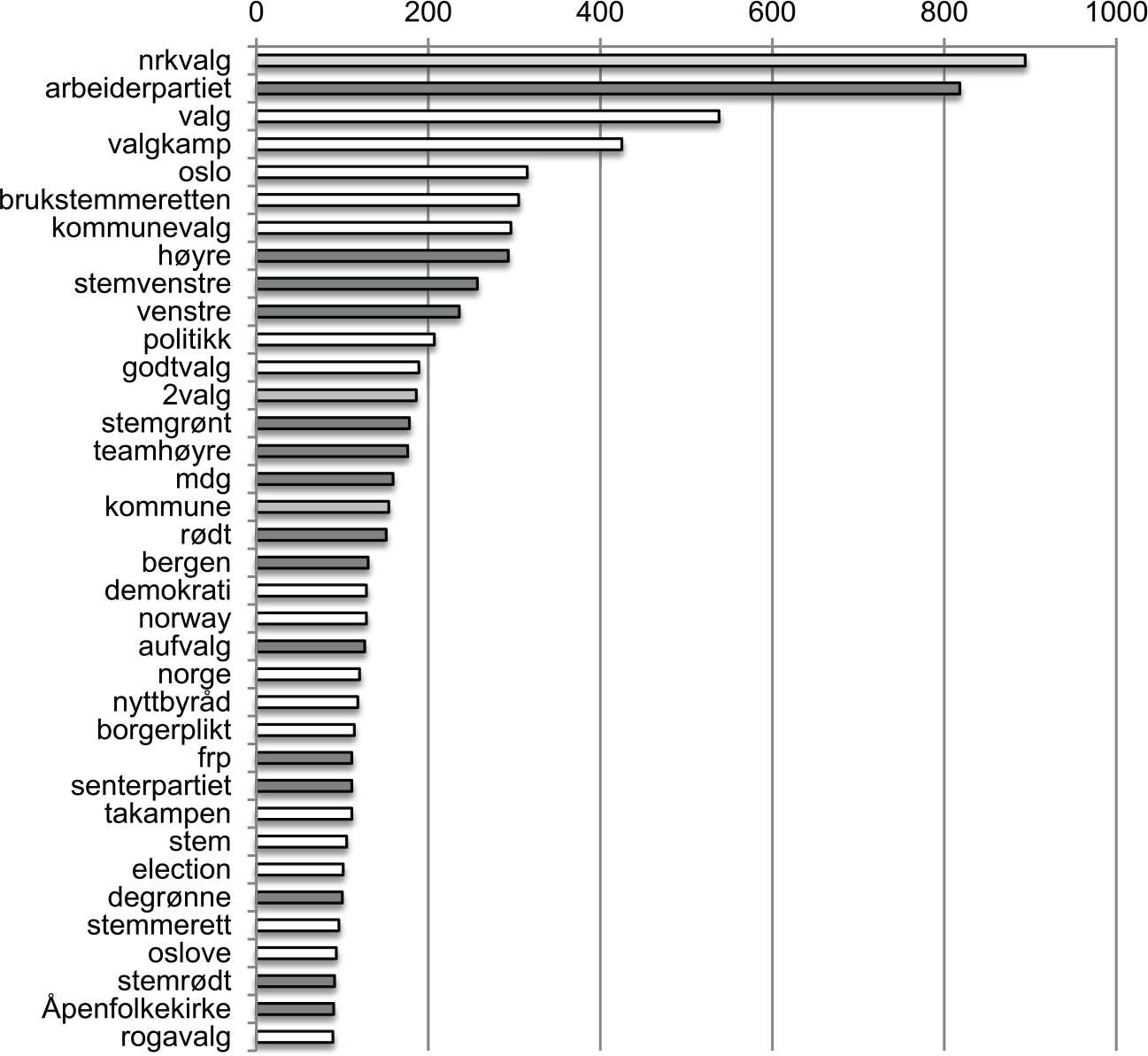
Most frequently used hashtags in the Instagram data set. Hashtags shown account for at least 0.1% of the total amount of hashtags used. Similar hashtags were merged (e.g., “arbeiderpartiet” and “Arbeiderpartiet”). Number of instances used shown.
While the scale for gauging hashtagged Instagram traffic is arguably smaller than for the one employed for Twitter analysis in Figure 4, the relative positioning of keywords relating to specific themes or political parties within the two figures can nevertheless tell us something about how the attention of politically inclined users of each was divided. Indeed, while the scale is smaller, the nrkvalg hashtag emerged at the top here as well—with the commercial 2valg variety following further down the list. As shown earlier, Instagram traffic does not appear to be as related to specific broadcasts—at least not in terms of real-time updates coinciding with televised debates. The use of the nrkvalg hashtag shown in Figure 5 nevertheless suggests that PSB coverage of the election remains popular among those users who chose to take part in election-based hashtagged activities—a finding reflective of the large role played by the NRK in the Norwegian context. Be that as it may, the relative difference from the most to the second most popular hashtag is arguably smaller for Instagram than for Twitter. Indeed, the runner up here is the hashtag related to arbeiderpartiet—the catch-all party that also emerged as the most active party by far on the platform at hand. While other party-related hashtags follow, they are essentially dwarfed in comparison to the arbeiderpartiet variety, suggesting the dominance of a large, clearly established political entity on what is the more novel of the two platforms under scrutiny. In comparison with Twitter, Instagram thus appears as characterized by tendencies toward normalization—while Arbeiderpartiet were indeed clearly visible on Twitter as well, their dominance seems unchallenged on Instagram.
Discussion
While possibilities to engage politically through the Internet were arguably present also in previous phases of online development, technologies such as the social media services under study here have sometimes been described as comparably easier to use than their digital predecessors—a not entirely unproblematic suggestion that has fed into the obvious hype surrounding online innovations (Larsson, 2013).
Our efforts in this article, then, were geared toward making sense of how two competing services—one comparably old, the other comparably new—were employed during the 2015 Norwegian elections. By employing a comparative approach, the study at hand provided an alternative way forward for those interested in the adoption and continued spread of online novelties at the hands of political actors and their potential supporters.
The reported findings did indeed suggest some interesting contrasts between the studied platforms. First, as evident from the timeline graph presented in Figure 1, Twitter emerged as having a reactive relationship to specific events taking place in established media. In comparison to the provided depiction of Instagram activity during the studied time period, the results suggest that political Twitter use was clearly tied to televised debates or interviews regarding the upcoming election. As previously disclosed, such tendencies of tie-ins with established media have been discerned from the very early stages of research into Twitter. The results presented here, then, suggests that Instagram use is taking a somewhat different route. While hashtags clearly relating to well-known, established Norwegian media actors were indeed popular on both services, Instagram does not appear to function as a “second screen” (e.g., Giglietto & Selva, 2014) for real-time discussion and commenting regarding televised events. While the data analyzed here cannot help us in making any firm claims about the reasons for Instagram users to employ media-related hashtags beyond those mediated events that arguably function as electoral milestones in the Norwegian context, one suggestion could be that these hashtags are used to further relate the content posted to the upcoming election. By combining the #valg2015 or #valg15 varieties with media-related alternatives, such as the aforementioned #nrkvalg or #2valg, Instagram users are making sure their content is seen in a multitude of political contexts—albeit in a different temporal fashion than as evident from the Twitter data presented. Future research should look into the use motivations of users of both services, perhaps focusing on tracing the reasons and rationales of users maintaining presences on each of them.
As for our specific focus on the competing normalization and equalization hypotheses, differing tendencies were reported for the two services studied. While previous scholarship had suggested that Twitter use would be characterized by normalizing tendencies, the results presented in Figures 2 and 4 contrarily showed the service to be characterized by activity undertaken by or related to comparably small political actors. Conversely, the suggestion from previous research that a comparably new service like Instagram would be characterized by equalizing tendencies—with a high presence of smaller political actors—proved to be erroneous. Much like for the relation of social media use in relation to established media discussed above, Instagram thus appears to be developing differently from Twitter.
The results are interesting with regard to the previously mentioned cyclical tendency in relation to the two hypotheses, where growing evidence of normalization as evident from studies focusing on older technologies was met with the influx of social media which supposedly “has provided some fresh impetus to expectations for an equalizing of power relations” (Gibson & McAllister, 2014, p. 3). For two regional elections in a row (please refer to Moe and Larsson, 2012, for details on the 2011 elections), Twitter has proven to be the medium of choice for comparably smaller actors—a tendency that differs from similar contexts (Larsson & Moe, 2016) and that most likely has to do with the aforementioned “elite” role that Twitter has come to play in a multitude of contexts. As such, by maintaining an active presence on Twitter, minor actors can try to gain attention from the established media. As suggested by scholars of journalism (Canter, 2013; Hermida, 2010), “trending” topics or keywords can function as starting points for news stories in mass media outlets. Given that comparably smaller political actors often lack access to such established newspapers or broadcasters, Twitter can thus function as a means to gain access through the gatekeepers of those publications (Gibson & McAllister, 2014)—hopefully resulting in increased attention through the agenda-setting functions of traditional media (Broersma & Graham, 2012; Bruns & Highfield, 2013).
This cyclical tendency between normalizing and equalizing tendencies is further strengthened by the apparent tendencies of comparably larger parties to establish clear presences on the more novel of the two services under scrutiny—Instagram. Granted, while smaller parties were also present, the catch-all social democratic Arbeiderpartiet proved dominant both in terms of their own activity and with regard to attention gained through hashtags. Findings from similar studies performed in different contexts should be able to show us whether such a break with the often-suggested linear developments from equalization to normalization appears also during other election campaigns. A more detailed account of the strategies adopted by campaign professionals could also be helpful in terms of future work to be performed.
In conclusion, while this study has contributed to the research community by detailing the use of comparably newer and older social media platforms during elections, it has limitations that need to be duly addressed. First, given the comparable lack of experience with Instagram within the research community, we are probably wise to approach the API at hand with caution. While this study was geared toward an election in a small northern European country, other studies, focusing on events on a larger scale, might find it useful to critically assess the approach utilized here due to risk of data loss for larger projects. For the study at hand, searches were made on the Instagram platform to compare the results with the data gathered as described in the “Methods” section. While these comparisons showed no data loss, we might suspect that comparably large amounts of traffic could place limits on the data gathered through free API access.
Second, while the focus on Norway seems like a reasonable starting point from which to study the uses of social media for parliamentary-political purposes, further insights can arguably be reached by assessing the dynamics studied here also in other contexts. Future research could, for instance, study the uses of these and other social media in countries that are characterized similarly (e.g., Jensen, Hoff, & Klastrup, 2016) differently from the one studied here in terms of political system or aspects relating to media use among the citizenry.
Third, while the argument is made here that the analysis of hashtags as a means to assess the themes and topics of interest to the “long tail” of users is a suitable way to combine findings regarding the identity of top users, the amount of hashtags for a specific theme is arguably inflated if proponents of that theme are among the more active users, thus supposedly skewing the results. However, this is not necessarily the case. Consider the example of Arbeiderpartiet on Instagram. While this specific account sent out 89 messages during our studied time period, the number of Instagram messages carrying the related hashtag was 818. As such, the hashtagged activity related to the party at hand clearly exceeds the amount of messages sent by the actor at hand. This is not to say that the method as demonstrated here should be considered the superior way of assessing issues like these. Hopefully, future research will build on and develop the selected approach to help us perfect our analyses.
Footnotes
Declaration of Conflicting Interests
The author(s) declared no potential conflicts of interest with respect to the research, authorship, and/or publication of this article.
Funding
The author(s) received no financial support for the research, authorship, and/or publication of this article.