




Abstract
This article reports on a study that explored users’ motives in using the Like feature on Facebook. Data were collected by means of in-depth interviews of daily Facebook users in two distinct cultures, the United States and Ecuador. The findings of the study reveal that the Like may be used (1) to acknowledge the gratifications obtained with the use of Facebook, (2) to share information with others, and (3) as a tool for impression management. Four categories of gratified usage motives influencing Liking behavior with distinctly different preferences in each culture, were found. The four categories that gratified usage motives are entertainment, information/discovery, bounding, and self-identification. Three types of underlying motives dominated the use of the Like to share information: presentation of the self, presentation of the extended-self, and social obligations. Finally, the Like can be used as a self-protective tool for impression management. The present findings lay the foundation for a grounded theory model that may guide future research efforts in this area.
In August 2015, Mark Zuckerberg, CEO of Facebook (FB), announced that a billion people had used FB in 1 day to connect with friends and family, a milestone that was reached about a decade after the launch of the social media platform in 2004 (facebook.com). This rapid growth of FB brought with it an increase in the use of its “social media buttons” such as the “Like” and “Share” features. In May 2013, FB estimated that 4.5 billion Likes were generated daily by its users, a 67% increase from August 2012 (facebook.com). Like and Share buttons are plugged into more than 10 million websites globally (facebook.com) at present, and many companies and organizations have integrated a FB platform into their websites. However, despite this dramatic increase in the use of the Like feature, research into user motivations to engage in Liking behavior is scarce.
Many studies have concentrated on the outcomes of the Like, such as purchase intentions and service quality (Egebark & Ekström, 2011; Harris & Dennis, 2011; John, Emrich, Gupta, & Norton, 2016; Schöndienst, Kulzer, & Günther, 2012), yet very few studies have examined its psychological antecedents. Similarly, research has focused on the motives behind general social media usage (Brandtzaeg & Heim, 2009; Kim, Sohn, & Choi, 2011; Raacke & Bonds-Raacke, 2008) but has largely ignored the motives behind the use of social media–specific features. It has been suggested that entertainment and social interaction are gratifications sought (GS) in the use of FB comments and that expressive information sharing is a motive for status updates (Smock, Ellison, Lampe, & Wohn, 2011). Yet, while research has explored the GS on social media, we propose that the Like is also used to acknowledge gratification obtained (GO).
This study is a first attempt to explore the different motives behind the use of the Like feature on FB. Specifically, we look into both the “gratified usage motives” and the “underlying motives” associated with Liking behavior. Gratified usage motives are the satisfying motives obtained with the use of FB. For example, when a FB user watches a video embedded in a post and finds it entertaining, this person may like the post in order to secure the satisfaction obtained. Conversely, underlying motives refer to the user’s inner motivations expressed indirectly and related to the concept of information sharing. a FB user who likes a post because of its entertainment value may also want to share information about the self with some FB friends. The post may highlight a personality trait (e.g., sarcasm or empathy) that the FB user wants to share with people in the network without necessarily sharing it in a more concrete or direct way (e.g., reposting on the wall). In this case, the FB user intentionally clicks on the Like to manipulate the readers’ impressions. Impression management theory suggests that people attempt to influence, either consciously or subconsciously, the perceptions of others about a person, an object, an event, or an idea (Leary & Kowalski, 1990; Piwinger & Ebert, 2001). However, these underlying motives only hold if the Like is used to share information with others. The theoretical rationale for this study lies in the idea that the Like is part of the online communication richness that provides more information on the one who likes than just the conceptual idea of “Liking.”
Our study is qualitative and exploratory in nature and surveyed FB users in two countries with greatly different cultural values (Hofstede, 1984), the United States and Ecuador. The reasons for comparing Ecuador and the United States are threefold. First, there is some evidence to suggest that the use of social network sites may be culturally bound (Berthon, Pitt, Plangger, & Shapiro, 2012), and examining Liking behavior across two very different cultures increases the robustness of our final proposed grounded model illustrating antecedents of Liking behavior. Second, comparing Liking behavior in these two countries contributes to the scarce literature on cross-cultural differences in social media usage. Finally, Ecuador has more than 16 million inhabitants, and as of June 2016, it was reported that 60% of the population used FB (internetworldstat.com). This penetration rate is equal to that in the United States, where 59% of the population is on FB (internetworldstat.com). However, despite the rapid growth of its social media usage, Ecuador has received no attention at all with regard to understanding its social media behavior. As such, this study not only helps in assessing cultural differences in Liking behavior but also adds to our understanding in each country individually. Consequently, each research question of this study applies to both the United States and Ecuador.
To better understand the use and value of the Like feature on FB, the literature review first focuses on the specifics of social media usage in different cultures. Then, the general motives of social media usage are discussed with an emphasis on the Like as an information-sharing tool. We then review major findings on impression management in social media and discuss the methodology and the findings of our study. Finally, a proposed grounded theory model is presented.
Literature Review
Cultural Differences in Social Media Usage
The shared perception of the social environment, defined as culture, shapes the way individuals interact and build relationships with others (Gudykunst et al., 1996; Hofstede & Hofstede, 2001). Hofstede (1984) is one of the pioneers in examining cross-cultural differences, and his individualism versus collectivism dichotomy has been widely used in consumer behavior research (Aaker & Maheswaran, 1997; Hofstede, 1984; Moon & Franke, 2000; Srite & Karahanna, 2006). While people in individualist cultures tend to be primarily concerned with their own interests and the interests of their immediate families (Mills & Clark, 1982; Triandis, 2001), collectivist cultures tend to emphasize “in-groups” such as the extended family or a larger organization (Vitell, Nwachukwu, & Barnes, 1993). Ecuador is a highly collectivist society, while the United States is highly individualistic in nature (Brady & Robertson, 1999; Hofstede, 1984; Vitell et al., 1993). Ecuadorians show solidarity with their in-groups, and their communication style is context-rich; people often speak profusely and write in an elaborate fashion (Hofstede & Hofstede, 2001). As opposed to this, the communication style in the United States is informal, direct, and participative only to a degree (Hofstede & Hofstede, 2001).
Previous research has begun to assess the impact of cultural values on the use of social network sites (Papacharissi & Rubin, 2000). Specifically, Internet users in Hong Kong, a collectivist culture, were found to view the Internet as a means of social interaction, whereas Americans were more likely to use it as a device for seeking and gaining information (Chau, Cole, Massey, Montoya-Weiss, & O’Keefe, 2002). A more recent study compared the major Internet uses-and-gratifications motives behind the use of social network sites (e.g., seeking friends, social support, and entertainment) in the United States and South Korea (Kim et al., 2011) and found that while the motives were similar, the weights placed on those motives were different. Specifically, South Koreans were found to be more motivated to seek social support and information than their American counterparts.
While past research into Internet uses-and-gratifications found a link between cultural values and behavioral outcomes, little is known about this relationship in the context of FB Likes. Furthermore, to the best of our knowledge, no comparison has been made between the United States and Ecuador in this area.
Use of Social Network Sites
The Use and Gratifications Theory (UGT) has been widely used to understand how and why users select media to address their personal needs and meet their goals (Blumler & Katz, 1974; Perse & Courtright, 1993; Rubin, 2009). Researchers have made clear a clear distinction between what media consumers seek in order to satisfy (or gratify) their needs and what gratification they actually receive. Concretely, this is a distinction between “(1) expectations about content formed in advance of exposure and (2) satisfactions subsequently secured from consumption of it” (Katz, Blumler, & Gurevitch, 1974, p. 27). This distinction was further clarified by differentiating between gratifications sought (GS) and gratifications obtained (GO) (Greenberg, 1974; Lometti, Reeves, & Bybee, 1977).
In terms of GS, the UGT holds that various media compete for the users’ attention and that they select the medium which best meets their needs (such as a desire for information, for an emotional connection, and for status; Tan, 1985). In recent years, the UGT has also been applied to the Internet environment in order to identify the wide range of motivations that drive traffic on various social network sites such as FB (Bumgarner, 2007; Joinson, 2008; Papacharissi & Gibson, 2011) and Twitter (Johnson & Yang, 2009). Some of the GS include keeping in touch with old and current friends, meeting new friends, or locating old friends (Papacharissi & Gibson, 2011; Raacke & Bonds-Raacke, 2008). Previous research has suggested that FB is mainly used to communicate with others (Ross et al., 2009) and to satisfy the basic human need of belongingness (Nadkarni & Hofmann, 2012). In other words, FB is used to accumulate social capital, which Bourdieu and Wacquant (1992) define as “the sum of the resources, actual or virtual, that accrue to an individual or a group by virtue of possessing a durable network of more or less institutionalized relationships of mutual acquaintance and recognition” (p. 14). FB is used to both “bond” (Ellison, Steinfield, & Lampe, 2007; Subrahmanyam, Reich, Waechter, & Espinoza, 2008) and “bridge” social capital (Ellison et al., 2007). Bonding social capital refers to the benefits that are derived from close personal relationships, such as emotional support, physical support, and other “large” benefits (Putnam, 2000). Bridging social capital is related to the “loose connections between individuals who may provide useful information or new perspectives for one another but that are typically not emotional support” (Ellison et al., 2007, p. 1146; Marsden, & Lin, 1982; Putnam, 2000).
Previous studies have also found that FB users are motivated to share information through posting on a FB wall or on a blog in order to satisfy their gratifying needs for information seeking, socializing, and status seeking (Hsi-Peng & Hsiao, 2007; Lee, Park, & Kim, 2013). However, those studies focused on the GS in using FB’s features and did not investigate how the gratifications obtained are secured. In this study, we propose that the Like is used as a tool to acknowledge the GO. In other words, we investigate whether there is a match between the previously found GS of using FB and the actual GO on FB. This idea is closely aligned with the definition of the Like as “an easy way to let people know that one enjoys the post without leaving a comment” (facebook.com). Hence, our first research question is as follows:
R1: What are the gratified usage motives displayed with the use of the Like?
The Like as a Sharing Tool
The Like, represented on FB by a thumb up, is an active component of the social network site. A Like on a post can be seen by other people, can be reposted by FB in an individual’s story, and the person who posted the content is notified that others Liked it (facebook.com). The Like is also part of social media analytics, and FB provides the number of daily “organic” and “paid” Likes to commercial fan pages. “Organic” Likes are those that people naturally place on a post, whereas “paid” Likes reflect a click on a Like after having been exposed to an ad.
In this research, we suggest that as the Like is seen by others, it has the potential to transmit information quickly to a large audience. For instance, it is not rare to see that viral posts on FB have millions of Likes and comments. One reason is that when driven by a common interest, enthusiasm, or concern, participants of “crowds” tend to imitate each other by remediating their perspective on an event or issue (Borch, 2012). Furthermore, the Like may also influence the number of positive comments on a post (de Vries, Gensler, & Leeflang, 2012), thus increasing the chances for the post to be seen. This is not surprising given the fact that “social buttons” such as the Like are an effective, direct means to stimulate the behavior of others in a network (e.g., Harris & Dennis, 2011).
Impression Management
While the Like has the power to make information go viral, we question the notion that FB users intentionally click on it to “share” information with others. Specifically, we want to examine the notion of online “behavioral residue” that people leave behind when browsing social network sites (Wallace, 2015, p. 37). This “residue” can be left intentionally by the sender or it may be left unintentionally. If the Like is intentional, it does not only express the reception of the content, but it is also a “signal” to present the self to others (Z. Chen & Berger, 2016). The Like as a signal parallels the concept of “expressions given off” in face-to-face communication (Goffman, 1959). While “expressions given” refer to verbal symbols in communication, “expressions given off” are nonverbal and contextual. In our study, we explore the Like as an “expression given off,” “whereby the impressions formed [of a person] become a result of his/her expertise in controlling the information given and given off” (Papacharissi, 2002, p. 644). This specific use of the Like is closely related to the general idea that what people share on social media is reflective of their identity (Berger, 2014). Therefore, our second research question is as follows:
R2: Is the Like used as an expression “given off”?
If a FB user intentionally clicks on the Like to share information, it suggests that this individual attempts to influence, either consciously or subconsciously, the perceptions of others about himself or herself and about the information the post conveys (Leary & Kowalski, 1990; Piwinger & Ebert, 2001). Goffman (1959) was one of the first to argue that personal interactions serve as a function of presenting an image of the self. He believed that individuals not only try to convince others to see them as just, respectable, and moral but also that they want to maintain positive impressions of themselves over time.
Multiple studies have investigated how social network sites are used to form impressions (Tong, Van Der Heide, Langwell, & Walther, 2008; Walther, Van Der Heide, Kim, Westerman, & Tong, 2008; S. Zhao, Grasmuck, & Martin, 2008). Rosenberg and Egbert (2011), for example, have demonstrated that interaction-oriented and self-oriented goals predict the use of various self-presentation tactics on FB. However, while it is generally assumed that the benefits of making a positive impression outweigh the costs of making a negative impression, it may not be true in some cases. In an online personal network such as FB, users may have hundreds of friends, and making a positive impression through self-promotion may be riskier than “playing it safe” and presenting the self in relatively neutral and noncommittal terms (Arkin, 1981). A recent study supports the idea that this type of behavior exists on FB, especially when the information is sensitive, such as disclosing political affiliation (Archer-Brown, 2015). Nevertheless, whether people use self-promotion or self-protection strategies, their ultimate goal is to maintain a desirable impression of themselves. Given that previous research has also suggested that liking a fan page is a form of self-presentation (Hollenbeck & Kaikati, 2012; S. Zhao et al., 2008), we posited the following research question, which together with the previous two framed our theoretically grounded model (see Figure 1):
R3: How is the Like used to maintain a desired impression on FB?
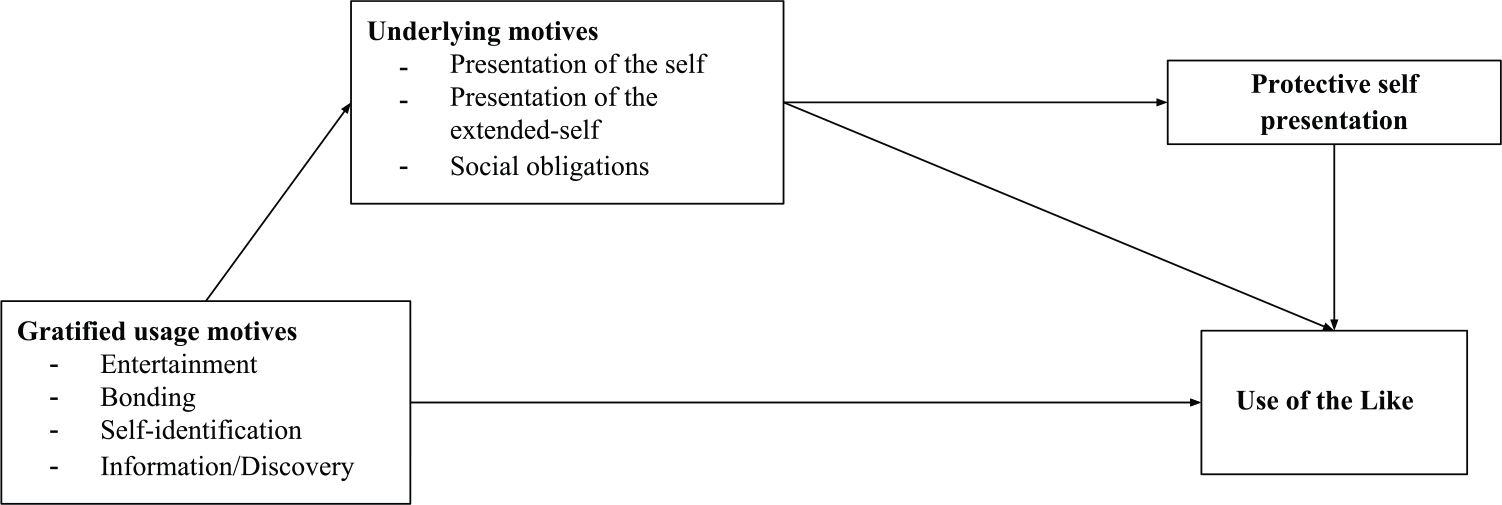
The grounded theory model.
Methodology
Study Design
This exploratory study used a grounded theory approach (Glaser, 1978) to develop a theoretical framework to predict Liking behavior. Grounded theory has been used to identify and explain ongoing behavior and to capture nuances in the behavioral patterns that people engage in (Glaser, 2002). Grounded theory is often used as an intermediate step between interview coding and the first draft of a more complete analysis (Bernard & Bernard, 2012). As a first step, we conducted open-ended interviews of 31 Ecuadorian and 17 US daily FB users that lasted between 30 and 60 min. This method was considered well suited to answer questions about the meanings, interpretations, and explanations that people associate with particular phenomena (Seale, 1999), in this case Liking behavior.
In Ecuador, third- and fourth-year tourism students volunteered to participate in the study. In the United States, the recruitment of student participants was done by means of an ad displayed in various hospitality management classes. We recruited students because these 18- to 29-year-olds are the online adult group that uses FB most heavily (www.pewinternet.org). The interviewers did not know the interviewees personally. Participants in Ecuador were mostly female (77.41%) and were 21 years of age on average. Participants in the United States were 23 years old on average with an almost equal split between males (53%) and females (47%). Interview questions were designed in English, translated into Spanish, and back translated into English (Brislin, 1970) to verify their accuracy. The same procedure was followed when interview notes were translated from Spanish to English.
This study was designed to discover causal explanations grounded in empirical data. We followed the step-by-step approach proposed by Bernard and Bernard (2012) and coded the responses for themes, linked the themes in a theoretical model, and then displayed the model. Two researchers conducted the first and second rounds of coding. For the first round, the “In Vivo” coding method was used, utilizing a word or a short phrase from the actual language in the qualitative data record as a code (Saldaña, 2009; Strauss, 1987). For the second round of coding, a focus coding approach was used (Saldaña, 2009) in which the two interview sets were coded independently from each other and with each coder coding both the US and Ecuadorian sets. An intercoder reliability Cohen’s kappa of .82 indicated a high degree of coder agreement (Gottschalk & Bechtel, 1993; Krippendorff, 2004). The two coders discussed further about their points of disagreement and reached a final consensus.
Interview Protocol
Interviews were conducted in a nonobtrusive environment. Participants had a computer in front of them and were asked to log onto their FB account and browse their “activity log,” which is a tool that permits users to see their past actions, such as Liking or commenting on posts. We asked participants to select posts they had liked and controlled for the privacy setting of the post. Participants had to choose two posts each that were (1) public from a public page, (2) public from a friend, and (3) private from a friend. Hence, participants had the possibility to discuss six posts. The interviewers asked the participants to describe why they had liked the selected posts, but they did not see the screen or the content of the posts. If, for some reason, a participant did not like any posts during the time period, the question was skipped. In total, 158 posts were discussed in the Ecuadorian sample (an average of 5.22 per participant) and 88 in the US sample (an average of 5.29 per participant).
Results
In this section, we present our findings related to each individual research question. We highlight the similarities and differences between the US and Ecuadorian cultures and lay the foundation for a grounded theory model (see Figure 1) that may guide future research efforts in this area.
The Gratified Usage Motives
The first research question focused on identifying the gratified usage motives displayed by the use of the Like. The coding of answers resulted in four main categories of gratified usage motives to like a post: entertainment, information/discovery, self-identification, and bonding (see Table 1). Interestingly, while three out these four categories were found in both countries, their weight of importance differed by country. For instance, while the weight of each motive varied slightly in Ecuador (between 21% and 29%), the disparity was more pronounced in the United States (between 19% and 56%).
The Gratified Usage Motives.

Entertainment
In Ecuador, being entertained was the primary motive to like posts and represented 30% of the motives. Entertainment contained codes describing fun, humor, and hobbies. For example, one user mentioned, “I liked it because my friends were teasing me and it was fun,” while another one stated, “I liked it because it was a joke about a football team.” Satirical humor was also mentioned as part of this category of responses, along with hobbies, such as fashion, music, food, electronics, and TV shows. In the United States, entertainment represented 25% of the gratified usage motives. The word “funny” was most commonly mentioned for this category, as expressed by a respondent: “It was really funny; it is probably the funniest thing I’ve seen on FB so far.” Another component revealed for the United States was the notion of “teasing,” as one respondent said, “It was funny; someone was making fun of me.” Entertainment as a motivation to like a post is consistent with previous research on fan-page behaviors. For instance, Jahn and Kunz (2012) developed a framework based on the gratification sought in using fan pages and showed that hedonic values such as fun and entertainment predict the intensity of fan page usage. Our findings showed that entertainment was not only a general predictor of FB usage but was also directly linked to Liking behavior.
Information/Discovery
The second emerging category in the Ecuadorian sample reflected news and community information. For instance, one respondent said, “The cultural events to celebrate the foundation of my city got my attention.” We also found that content related to world events and the current political situation in Ecuador was liked. There was a sense of patriotism in people’s motives to like a post, as exhibited in this comment: “I liked it because it was an information about the president of our country.” Posts were liked not only because of their informational values but also because their contents were important to the community. Interestingly, this category did not arise when coding the US respondents’ answers. One explanation is that US respondents used more words related to self-identification (another coded category) when discussing the news.
Self-identification
Self-identification occurs when one shares and understands the problems or experiences of others or identifies with a person or a topic. Posts were liked because the users could identify with their content or because they described the user’s past experiences. For example, one Ecuadorian respondent stated, “[The post’s content] represents something that I practice, and I identified with this activity.” In the United States, “personal connection to the post’s content” or “valuable information reflecting the self” reflected this category well. Self-identification represented 23% of the gratified usage motives in Ecuador and 19% in the United States. The self-concept value in Jahn and Kunz’s (2012) framework reflects people’s attempt to make a good impression on others. However, the use of the Like is different in that it reflects the connection between the content of the post and the users’ own lives. This self-identification motivation to like the post presents a novel finding.
Bonding
The concept of bonding is at the core of social capital theory and made up the fourth category of motivations. Interestingly, while this category represented 21% of the gratified motives in Ecuador, it represented more than 55% of the motives in the United States. Friends and family were the main reasons cited to like posts. The post issuers or people appearing in the content of the posts were the direct targets of the Like. In Ecuador, more than 20 posts were liked because they contained a picture of a friend or a family member. A few respondents mentioned that they had liked the post because it brought back good memories (e.g., high school or family events). In the United States, showing support by congratulating others or expressing compassion constitutes examples for this category. Some US respondents stated that “It was an accomplishment for her personal life, I wanted to support this person” or “I wanted to tell them that they did a good job, I support the job they’re doing.” Other respondents liked posts in order to acknowledge the cohesiveness of the group, as exemplified by a quote from one respondent: “I wanted to congratulate people, it is something that we do as a group. I support the group.” As belongingness is one of the main reasons for creating and joining a community (Gusfield, 1975), it is not surprising that the Like was used to maintain ties with friends and family.
The Use of the Like as an Expression “Given Off”
In addressing the second research question of the Like as an expression “given off,” we first needed to assess whether the Like was used to share information with others. Accordingly, we asked participants if they thought that their Likes would appear in their friends’ newsfeeds (for public posts) or their common friends’ newsfeeds (for private posts). If participants said yes, we asked them whether they wanted to share something with their friends through their Likes. We used the “pause” technique (Bernard, 2011) to let users explain what they wanted to share. Finally, we asked participants whether they had shared the information on their own wall or on their friends’ walls and why they did or did not do so.
In Ecuador, more than 32% of the private and public posts had been liked to share information. Similarly, it represented 37% in the United States (see Table 2). In other words, more than 3 out of 10 posts were liked to share information with others. The public posts from public pages in both countries were the primary vehicle to share information through the Like (42% of the posts in Ecuador and 54% in the United States). It was followed by private posts from friends (Ecuador, 31%; United States, 41%) and public posts from friends (Ecuador, 24%; United States, 21%). This finding raises the question if contents appeal is linked to post privacy settings. While we did not address this question in this study, we looked further into the motives behind people’s willingness to share a message through the Like (see Table 3). By doing so, we could assess whether the like was used as an expression “given off.” We called these motives the “underlying” motives. Three categories of underlying motives were found: presentation of the self, presentation of the extended-self, and social obligations.
The Share Information per Privacy Setting.

The Underlying Motives to Like FB Posts.

FB: Facebook.
Presentation of the Self
This category refers to the users’ willingness to share part of their own identities with others and is best represented by the quote from one respondent from Ecuador: “I want people to see what I like.” This user had initially liked the post because it related to fashion and style, but this individual also used the Like to present to others some personal interests regarding fashion. Other respondents used the Like to share their values with others. For example, one respondent said, “I wanted to show that studying is important to me.” This participant had initially liked the post because he or she identified with it. However, this participant also wanted to show to others what was important to him or her. This use of the Like as a form of self-presentation is consistent with recent research suggesting that individuals present an actual, but not an ideal, version of themselves on social network platforms (Back et al., 2010). By disclosing information, users provide an opportunity for their FB contacts to show interest in the topic, hoping to engage them in a conversation. Interestingly, the concept of self-presentation was dominant in both the United States (53% of the underlying motives) and Ecuador (41%), which shows that not only individualistic cultures are prone to use the like to present the self to others.
Presentation of the Extended-Self
The category “extended-self” also contributes to the presentation of the self. By definition, the extended-self means any sign of the self that presents the self, such as external objects and personal possessions, persons, places, or group (Belk, 1988, 2013) This is best illustrated in this respondent’s answer: “Yes, (I wanted to say) that I think in the same way as the person who originally created the post.” This participant had initially liked the post for entertainment purposes but also wanted to share his or her agreement with the other person’s idea and identify with him or her. Other participants wanted to express emotions: “I wanted to say to others that my family is important and I missed them a lot” or “I wanted to show that I appreciated this person a lot.” While the main motive to like this latter post was to maintain close ties (bonding) with another person, the respondent also wanted to express a personal connection with a particular individual to the rest of the FB friends. This category was equivalent in terms of importance in both countries.
Social Obligations
The category “social obligations” covers messages that respondents think are good for others and for the community and that gratify their morals. This category can be exemplified by one respondent in Ecuador who shared the following: “I wanted to share that we can all overcome difficult [political] situations.” In both countries, the respondents wanted to share something about themselves but also felt a sense of responsibility in spreading awareness to others. One respondent stated, “It was good for a lot of people, and could be good for my friends too.” Interestingly, social obligations were cited more frequently in Ecuador (31%) than in the United States (23%). This can be explained by the sense of community in collectivist cultures, where one feels responsible for spreading awareness and show solidarity to others (Hofstede & Hofstede, 2001).
To recap, the underlying motives found in both countries were similar, and the presentation of the self and extended-self represented more than 65% of the underlying motives to like posts. However, the Like was also used as a way to share information with the community. As such, the Like was used as an expression given “off” to present the self and to gratify the sense of moral obligation that FB users have toward the community.
The Use of the Like for Impression Management
The last research question emphasized the impression management style that could be associated with the Like. One question asked the respondents about the reasons for not sharing the post directly on their own walls or on their friends’ walls. Findings revealed that posting information on “walls” is something taken seriously, and many respondents expressed concerns about how the content of the post represented them. We found that the content of a post not only has to represent the FB user well, but it also has to be interesting to everyone else who has access to the wall. For instance, the Like was used when either the content of a post was not reflecting one’s identity well enough or when its content involved possible negative consequences. This impression management style is called protective self-presentation, which is the desire to (1) avoid significant losses in social approval or to (2) guard against social disapproval (Arkin, 1981). People refrain from actions that could instill negative impressions in the minds of others (Leary, 1996; Leary & Kowalski, 1995). Interestingly, both the desire to avoid loss in social approval and the desire to avoid social disapproval were found in the respondents’ answers. While the former refers to maintaining a desired impression toward others, the latter warns against deviance from standard norms. The desire to avoid loss in social approval is best represented by one respondent’s comment: “[The post] meant something to me, but it is only my way of thinking.” In this example, posting content that is too personal may result in losses in social approval by some friends. Similarly, another respondent stated, “The post was nice but it was not awesome enough to be shared on my wall.” Even when the post could present the self, reposting on the wall implied that the post should have reflected one’s identity much better.
Social disapproval avoidance was found in multiple answers. Some participants referred to copycat issues, such as this answer: “Reposting would mean stealing the content from another person.” Other respondents mentioned trying to avoid showing off, such as “[posting on my wall] would attract attention from other people.” Finally, participants mentioned the risk of getting in trouble, such as “The images posted belong to a local newspaper and I may get in trouble reposting them” or “not a lot of people would get it, it’s too controversial.” These three examples represent behaviors of norms deviance that may be judged severely by other users. Interestingly, norm deviance was particularly prominent in Ecuador, whereas maintaining a desired impression was more prominent in the United States.
Overall, we found four different gratified usage motives, three different underlying motives, and one self-presentation style as predictors of the use of the Like. More than 30% of the posts were also liked for sharing purposes, such as the presentation of the self, the extended-self, and the social obligations toward the community. While gratified usage motives and underlying motives for clicking on the Like were similar across the United States and Ecuador, the importance assigned to each motive was different. Finally, we found that the Like was also used as a protective self-presentation style when the post content was not interesting for the whole network, was not representing the self well enough, or when it was too controversial.
Grounded Theoretical Model
Based on the findings in the two distinct cultures, we created a grounded theoretical model of the antecedents of the FB Like (see Figure 1). The main predictors in the model are the gratified usage motives. The motives found in this study are congruent with previous research, such as entertainment (Smock et al., 2011), bonding (Ellison et al., 2007), information sharing (Kim et al., 2011). However, we add to the list of motives the concept of self-identification, we found that for approximately 32% of Ecuadorian posts and 37% of US posts, FB users liked posts for underlying motives that intervened between the stimulus (gratified usage motives) and the response (use of the Like) and that transformed the internal psychological mechanism to use the Like. Specifically, underlying motives were intentionally activated for self-presentation and social obligations purposes. Hence, we propose that these underlying motives may act as mediators between the gratified usage motives and the use of the Like feature.
Finally, we also propose that self-protective presentation may explain why the Like is used instead of the “Share” button. Respondents reported using the Like to protect themselves from social conflicts or because they were not involved enough in the content of the post to feature it on their own walls. This explains the link between the underlying motives to share information and the use of the Like and thereby functions as an additional mediator in the model.
Discussion
There is increasing interest in understanding how individuals reveal their identities in digital space (Schau & Gilly, 2003; X. Zhao & Belk, 2007). Through three research questions, this study shows that the Like could be used to share information about the self. The first research question of this study explored the gratified usage motives displayed with the use of the Like. The findings revealed four gratified usage motives: entertainment, information/discovery, self-identification, and bonding. While the motives to like were similar in nature in the United States and Ecuador, the importance attached to each of the motives was different. While over half of the US sample reported liking posts for bonding purposes, bonding was mentioned by fewer than one-fourth of the Ecuadorian participants. The category “information” represented one-fourth of the motives in Ecuador, but was not found in the United States. This category represented a sense of extended community that the other categories did not have. As such, US responses were more likely to emphasize the self or close family than the extended community. These differences in Liking behavior may be reflective of dominant cultural values (Hofstede, 1984). While people in individualist cultures are primarily concerned with their own interests and the interests of their immediate families, collectivist cultures tend to emphasize “in-groups” such as the extended family or a larger organization (Vitell et al., 1993). Consequently, it is not surprising that motives to like in the United States involved supporting close friends, whereas in Ecuador, this notion was extended to include the community at large. Finally, self-identification represented a new way of GO, mostly because it was a way to acknowledge identification with the content rather than attempting to make a good impression on others.
The second research question emphasized the use of the Like as expression “given off.” Our findings revealed that public posts were vehicles for a higher proportion of information sharing than those sent by friends (either publicly or privately). This finding could be explained by the notion of content acquisition as a way to share information (Chen & Berger, 2016). Content found directly leads to greater personal association than content found by others; a post from a friend may be considered as receiving information, whereas post on a public page may be considered as information found. Consequently, users might feel more connected to the public post and, thus, may be more willing to share it. When we asked what type of information respondents wanted to share through Likes, they reported in both countries that they wanted to signal who they were or what they thought was important for the community. Consequently, the Like seems to be an affording tool to share one’s personal values and interests in an “indirect” way, and hence the notion of expression “given off.”
Finally, the concept of image control became evident when respondents were asked why they did not repost content on their own walls when they wanted to share information. The findings indicated that the Like is used as a self-protective tool that helps showing information about the self to others without facing the possible negative consequences of a more direct repost. According to Trompenaars (1994), the United States is characterized by a neutral orientation to others, whereas Ecuadorians are more affectively oriented. As such, it is not surprising that Ecuadorians emphasized the avoidance of norms deviance more than respondents in the United States. The consequences of displaying an “image” to others that could be considered as “bad” or as incongruent with “group norms” may affect Ecuadorians more than users in the United States. Conversely, US respondents emphasized the self-protective style to avoid losses in approval (rather than avoiding disapproval). If the contents of a post were not reflecting an individual’s identity well enough, US FB users were less likely to share posts directly on their walls. Interestingly, both countries used the Like as a self-protective tool for impression management.
Limitations
This study has several limitations that open avenues for future research. First, due to the qualitative nature of the study and its use of a nonrandom and small sample, the results cannot be generalized beyond the scope of this study. There might be additional motives that were not captured in our coding, and future qualitative and quantitative research could build on our findings to capture a greater diversity of motives and presentation styles. The theoretical model presented here should only be considered as a base for future studies examining Liking behavior in either additional qualitative or quantitative fashions. Second, our Ecuadorian sample contained a relatively high number of women, which may have influenced their motivations to use the Like buttons as well as their presentation styles. Future research should collect data with a more balanced gender distribution. Third, the Like button is only one of many social media buttons, and it is possible that factors leading to liking a post might not apply to other platforms (e.g., the heart on Instagram or the Like on LinkedIn). Finally, our data were collected prior to the introduction of new FB “social buttons” such as “love,” “sad,” and “wow,” and future research should examine the use of these new buttons.
Implications
Theoretical Implications
The findings of this study revealed similar motives to like posts and similar reasons to share a post in the two cultures. What was different was the importance of each category. In drawing on our grounded theory model, we identified gratified usage motives and underlying motives for Liking behavior and propose that self-protective style influences the use of the Like.
This study advances social cognitive knowledge and helps in assessing the uses and gratifications of the Like on FB. It answers the call to action by Katz et al. (1974) to link the gratification of specific human needs with particular media usage and addresses Sundar and Limperos’ (2013) call to develop new lists of gratifications that capture the “nuanced gratifications obtained from newer media.” The findings of this study reinforce UGT idea that Liking behavior is goal directed and purposeful with the active user at its core. We also extend the application of Social Capital Theory and reinforce the idea that diverse types of FB usage may predict bonding social capital (Ellison et al., 2007; Subrahmanyam et al., 2008). Finally, we propose a new model of Liking behavior that may better explain how FB users manage impression formation.
Practical Implications
For social media managers, the findings of this research may enhance their understanding of the antecedents of the Like. Likes and Shares are often analyzed to compile key performance indicators (KPIs) regarding consumer preferences and are used to determine engagement within social media platforms (Hoffman & Fodor, 2010). However, despite the importance of such tools, more than half of the companies investing in social media have not yet been able to document their impact (Moorman, 2016). Based on our findings, it might be useful to develop brand-related content that leads US users to identify themselves, whereas content that induces information sharing might be more effective in enhancing brand visibility in cultures like Ecuador.
Footnotes
Declaration of Conflicting Interests
The author(s) declared no potential conflicts of interest with respect to the research, authorship, and/or publication of this article.
Funding
The author(s) received no financial support for the research, authorship, and/or publication of this article.