




Abstract
This article examines the constitutive role of mediated visibility in the emergence of contemporary vigilante initiatives. Here, visibility is conceptualized as a “heuristic device” to understand social phenomena, as well as a lever for organizations to acquire various forms of capital. The article uses the case of The Judge Beauce—a Canadian organization created in 2015 to fight against child abusers—to understand how vigilante collectives can lever mediated visibility, and online visibility in particular, to acquire specific forms of policing capital (economic, social, political, and cultural). Results show that mediated visibility was indeed crucial for raising funds, constituting vigilant/e publics, and defining vigilante identities, relations, and practices. Yet, as a “double-edged sword,” mediated visibility brought on public scrutiny that simultaneously resulted in a series of liabilities. Finally, this article contends that vigilantism in the digital age should be defined as the enactment of power im(balances) through the instrumentalization of mediated visibility rather than considering force or the threat of its use as its main feature.
In October 2015, the existence of a new vigilante organization called The Judge Beauce was relayed in Canadian newspapers. 1 Founded by Robert Lemieux in August 2015, the organization claimed to address Québec’s “flexible laws” for child protection by identifying potential pedophiles through field and online surveillance work. 2 In newspapers, television, and radio interviews, the founder publicly defended the legitimacy of his organization, stating that “nobody is helping the victims” of child abuse, that “sentences are not strong enough,” and that The Judge was an “extension of the law.” 3 Since its creation, The Judge has received significant criticisms within the public sphere. When asked about the nature of the organization’s activities, Lemieux insisted that their interventions were limited to tracking suspected child abusers and distributing leaflets that promote psychological counseling. As the founder stated, “we don’t beat [a suspect], but we strongly urge him to seek treatment.” The organization, which claims to possess its own set of ethical guidelines, recruits potential members on the Internet. These recruits need to be over 25 years old and undertake a judicial background check through their local police. Following the extensive 2015 media coverage, hundreds of people showed their support on The Judge’s Facebook page and expressed their desire to become contributing members. This augmented visibility boosted the Facebook page’s membership that went from 86 likes on 16 October to over 2,000 three days later, 4 to the point where The Judge’s organizers set up a website to address this wave of enthusiasm.
The Judge’s creation is part of a broader social context in which vigilante groups increasingly use the Internet to reach their objectives (Campbell, 2016; Huey, Nhan, & Broll, 2013). Vigilantism is traditionally understood as the performance of an active citizenship which relies on self-governing mentalities that redistribute responsibilities between the State and private citizens in terms of security provision, or “policing” (Johnston, 2001). If studies have examined the advent of online vigilantism in the past 15 years (Trottier, 2016a), few have specifically addressed how social media features that afford visibility (Bucher, 2012; Treem & Leonardi, 2012) partly reconfigure vigilante actions, relations, and identities. Yet, as reflected by Lemieux’s statement “We speak out, we make ourselves visible, and we act!”, 5 visibility management has become a key concept to understand emerging vigilante initiatives in the digital age. Using The Judge as a case study, this article discusses how the visibility granted by the Internet and social media in particular is used by modern vigilante organizations not only to direct public attention toward suspected wrongdoers but also to create, engage with, and solicit support from “affective publics” (Papacharissi, 2014) that become increasingly sensitized to child safety. To do so, we mobilize a theoretical framework which greatly relies on previous work on visibility (Brighenti, 2007; Thompson, 2005, 2011) which we conceptualize as both a “heuristic device” to apprehend contemporary social phenomena and a lever for “political efficacy” that allows organizations to gain capital (Yang, 2016). As per the nature of our case study, this article addresses specifically the relation between social media visibility and the gain of “policing capital” (Dupont, 2004, 2006; Huey et al., 2013). It shows that online visibility did allow new ways for The Judge to acquire various forms of policing capital (economic, social, cultural, and political). Yet it also demonstrates that as a double-edged sword, visibility was simultaneously linked to the public questioning of the organization’s intentions by concerned citizens.
Leveraging Online Visibility, Gaining Capital?
In recent years, policing networks have exploited social media data to monitor populations and solve criminal investigations, thus furthering their reach over their publics’ personal information (Trottier, 2016a). Social media platforms augment online visibility of their users through the implementation of numerous strategies encouraging self-disclosure, hence constituting invaluable centralized databases for intelligence gathering among policing agencies (Omand, Bartlett, & Miller, 2012). Inversely, these platforms also allow groups of citizens to augment the visibility of unlawful or unethical practices of individuals or institutions (Mann & Ferenbok, 2013) and take eventual vigilante actions (Trottier, 2016a). Visibility consists of a central value within a social media platform like Facebook which, by rendering the social life of its users visible for marketing purposes, “wants to be known as the predominant location for networked sociality” (Trottier, 2016a, p. 46). Indeed, Facebook can be understood as a “device for online publicity” through which users, and also commercial, policing, activist, and even academic entities, can acquire certain types of capital. Drawing from these observations, this article uses visibility as a “heuristic device” (Yang, 2016) to understand the dynamics of emerging vigilante initiatives and, by doing so, looks at social media and their features as spaces of “constructed visibility” (Bucher, 2012, p. 1170). Although mediated visibility has been the object of an increasing amount of research on social media (Duguay, 2016; McCosker, 2015; Uldam, 2016), its study certainly predates the development of these platforms. Its complexity has been well described by contemporary authors like Brighenti (2007, p. 335) and Thompson (2005, p. 35) who consider visibility as a double-edged sword, in the sense that the concept cannot be reduced as a characteristic that yields purely positive effects as this case study on vigilantism demonstrates. For Brighenti (2007), rather than being a local concept, visibility is “a real social process in itself” that can be “treated as a single field” (p. 325). Studying the reciprocity (or lack thereof) of visibility regimes is inherently linked to the study of power im(balances). As Brighenti (2007) argues,
[. . .] power does not rest univocally with seeing or with being seen. Rather, it is the style in which seeing and being seen occur that carries the most important consequences. The exercise of power is always an exercise in activating selective in/visibilities. (p. 339)
Hence, being visible, gaining visibility, or being given visibility can enable the acquisition of certain forms of capital, whereas being invisible, being denied visibility, or being unable to obtain it can indicate a position of oppression. Inversely, gaining or being given visibility can constitute a liability when unwarranted, whereas being invisible can also indicate a position of power. In Brighenti’s (2007) own words, this refers to the “paradoxical double-bind of visibility” (p. 330). Indeed, recent debates on the “right to be forgotten” online illustrate the tensions that occur when attempting to enact such abstract values surrounding online visibility into practice (Yang, Quan-Haase, & Rannenberg, 2016).
In political sciences, mediated visibility has been mobilized in the study of moral reactions in a way that appears highly relevant for the study of online vigilantism. In his work on political scandals, Thompson (2005) addresses most eloquently the consequences linked to visibility augmentation brought by media as early as the 19th century:
This modern phenomenon of mediated scandal had a distinctive structure and dynamic: it involved the disclosure through the media of some action or activity that was previously hidden from view, that involved the transgression of certain values and norms and that, on being disclosed, elicited public expressions of disapproval and outrage. Activities that were carried out clandestinely or in privacy were suddenly made visible in the public domain, and the disclosure and condemnation of these activities in the press served in part to constitute the event as a scandal. Mediated visibility was not a retrospective commentary on a scandalous event: rather, it was partly constitutive of the event as a scandal. (pp. 42-43)
In this excerpt, the author contends that moral scandals are inherently mediated, an argument that can also be made for citizen-led initiatives such as vigilantism that sometimes address such scandals. Indeed, the development of the Internet has given rise to new forms of mediated visibility which open not only new possibilities for vigilante organizations (and for all organizations for that matter) but also new potential liabilities that can be attributed to their unpredictability and the rapidity with which they can morph (Thompson, 2011). For example, online visibility participates in creating new mediated publics that evolve rapidly (Bruns & Burgess, 2015; Papacharissi & de Fatima Oliveira, 2012). These changes in scale and pace brought on by the Internet have been studied among public relations scholars in terms of “new public relations” (Phillips & Young, 2009) or “public relations 2.0” (Solis & Breakenridge, 2009). Within this literature, social media platforms are generally understood and used as a way for organizations to gain social and economic capital by engaging directly with their publics online, although it can also constitute a liability when organizations lose control over their own public image or brand (Verhoeven, Tench, Zerfass, Moreno, & Verčič, 2012). Among activists, the use of the Internet raises hopes and concerns as it allows for non-profit organizations to recruit donors, yet generally fails to increase journalistic interest and media coverage (Sommerfeldt, Kent, & Taylor, 2012). Excessive scrutiny for some, lack of media coverage for others; this demonstrates the complexities and asymmetries of online visibility regimes which must be understood as highly situated.
Consequently, the main objective of this article is to further our understanding of the relation between online visibility and capital acquisition, although within the particular context of a vigilante organization. In that sense, Dupont’s (2004, 2006) framework on the distribution of capital within policing networks allows us to address online visibility in a way that considers the specificities of security organizations. Indeed, this framework helps us to understand how vigilante collectives succeed—or fail—to obtain the symbolic capital required to penetrate policing networks (that include for-profit, public, and citizen-led organizations alike) by leveraging and eventually managing online visibility. Here, symbolic capital is defined as “the most general form of capital” and refers “to the mechanisms that confer legitimacy to an organization, and the power it holds to speak with authority to the other actors” (Dupont, 2004, p. 86). As such, other forms of capital are mediated by it. Today, the public police still hold significant symbolic capital within Western security networks, but as Dupont (2004) argues, that was not always the case. As the public police gained political and economic capital during the process of its professionalization, its symbolic capital and the legitimacy for action it granted were acquired progressively, although recent failures of the public police and the pluralization of security providers may point to a contemporary drop in symbolic capital (Shearing & Marks, 2011). After the description of our method, each section of this article will address a specific form of capital (in order, economic, social, political, and cultural) to highlight the constitutive role of online visibility within the vigilante activities undertaken by The Judge. Although our analysis is divided into formal sections, readers should keep in mind that these forms of capital are interdependent and overlapping. As such, this framework should generally be understood as a flexible tool to interpret how resources are acquired in the digital age, as well as to understand how these resources “appear to be influenced by, as much as they influence, the context of policing” (Dupont, 2006, p. 103).
The Judge Beauce: An Exploratory Case Study
Since there is still much to know about how vigilante organizations leverage online visibility to obtain policing capital, we consider The Judge as an exploratory case study. As argued by Flyvbjerg (2006), case studies should be read as narratives in their entirety which aim for “concrete, context-dependent knowledge” (p. 228) rather than being generalizable or universal, although we do believe that this article has the potential to guide future research. The case in question was built by using a “manual data collection approach” (Latzko-Toth, Bonneau, & Millette, 2017) inspired by online ethnography techniques (Hine, 2015). Online data were collected in a PDF format and analyzed manually. The dataset includes the following: (1) screen captures from an online blog called La Clique du Plateau (119 comments) and from the online forum Reddit (14 comments); (2) eight news articles, as well as one radio and one television interviews with The Judge’s founder that were all accessed online; (3) screen captures of The Judge’s official website; and (4) extracted content from The Judge’s Facebook page (the equivalent of 60 pages) which mostly contains user comments and photographs. Data acquired on The Judge’s Facebook page and website were extracted in two steps (November 2015 and January 2016). Although not all explicitly cited in this article, all data points were used to generate a detailed and contextualized understanding of our case study.
All data used in this article were found on publicly accessible online platforms. To ensure anonymity, all screen captures that were made during the collection phase have subsequently been reproduced in this article using a Facebook status generator to preserve the platform’s structure and appearance. As such, all usernames and profile pictures have been anonymized. Furthermore, all content has been manually translated from French into English. Although the process of translation can slightly change the meaning of origin, it reduces the risk of conferring unsolicited visibility to individuals whose online publications are quoted (Latzko-Toth & Pastinelli, 2014). Limits inherent to our method can already be formulated. As it is based on non-participant observation, it did not allow us to document effective vigilante practices, such as what The Judge members do on a day-to-day basis and how they use the funds they raise, nor understand how social media platforms might have been appropriated to track alleged child abusers. Since this study did not include interviews, we paid special attention to our own ethic of attribution to avoid assigning unsupported intentions to quoted individuals as much as possible. However, as this article’s framework deals with mediated visibility and keeps away from speculating on daily vigilante practices, we believe that these limits were avoided satisfactorily.
Four Types of Policing Capital
This section addresses the relationship between social media features that afford visibility and their role in the procurement of a specific form of capital within The Judge (in order, economic, social, political, and cultural). Readers should keep in mind that some elements included in this section do overlap and that these data could be organized in a different, yet equally meaningful order. For each section, key issues are identified for future research in the study of vigilantism in the digital age.
Economic Capital: Funding Through Online Visibility
In policing networks, economic capital refers to “the monetary resources possessed by a particular node or a node’s ability to procure” (Huey et al., 2013, p. 83). Economic capital is distributed among as well as accumulated and spent by policing entities. In public policing institutions, the acquisition of economic capital has been conceptualized as being “heavily dependent on their access to political capital” (Dupont, 2006, p. 98) and is often perceived as a way to legitimize the acquisition of other forms of capital, whereas “the accumulation of economic capital is an end in itself for private providers” (Dupont, 2004, p. 85). For The Judge, the accumulation of economic capital was assured through the online sales of merchandise bearing the logo and/or the name of the organization. As shown in Figure 1, The Judge sells t-shirts, sweatshirts, and stickers online to “gain visibility, discourage pedophiles by [the members’] presence, and to promote longevity for the movement,” as the organizers have claimed on the group’s Facebook page.
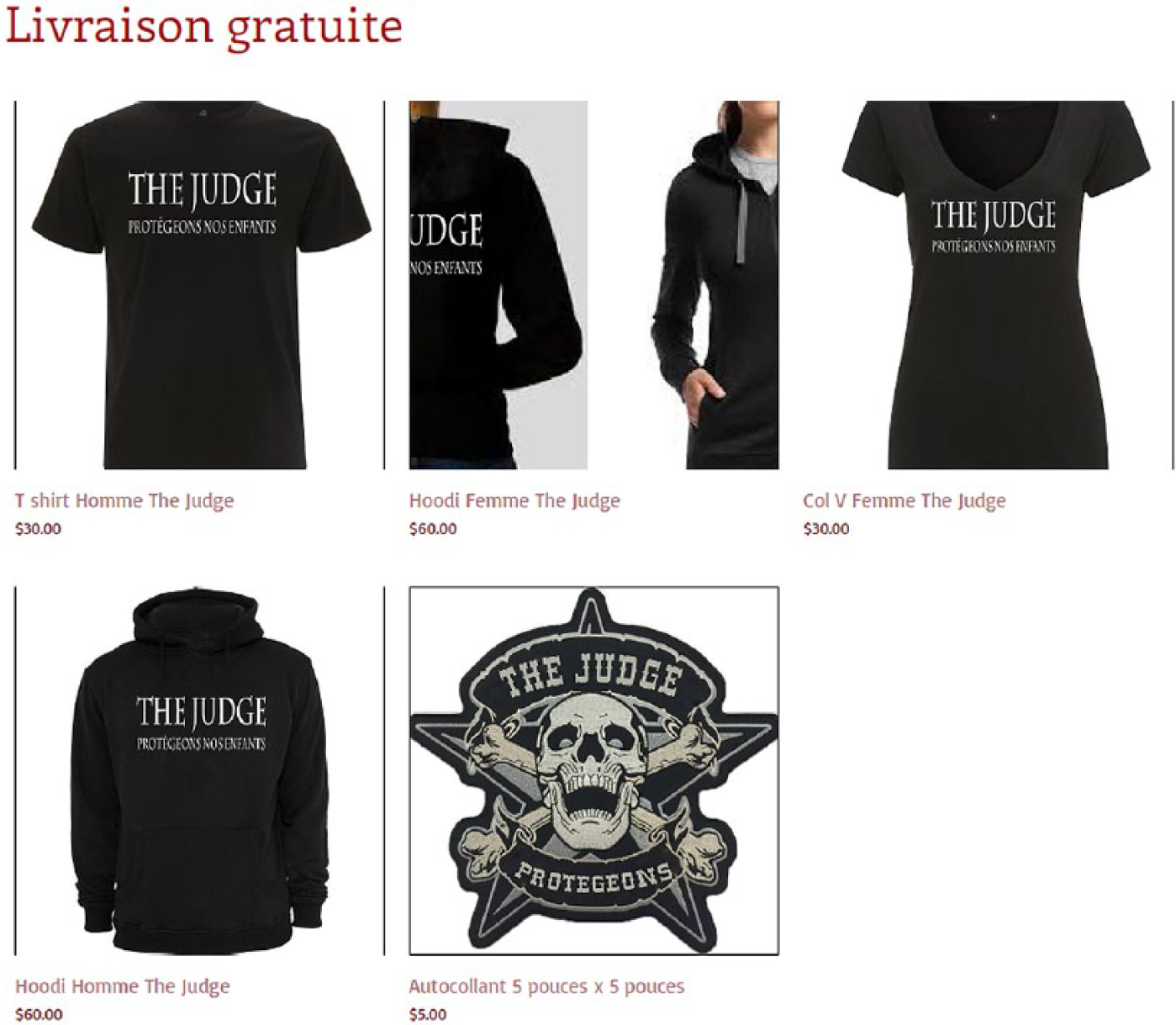
The Judge merchandise for sale.
This strategy is deeply rooted in the microeconomic model of crowdfunding. As described by Belleflamme, Lambert, and Schwienbacher (2014), crowdfunding “involves an open call, mostly through the Internet, for the provision of financial resources either in the form of a donation or in exchange for the future product or some form of reward to support initiatives for specific purposes” (p. 588). Unlike funding initiatives that seek out high amounts of money from potential investors, it aims the aggregation of small donations from a large number of individuals (Mollick, 2014). In this case, The Judge uses a “reward-base” crowdfunding model which implies a trade-off between an organization looking to raise liquidity in exchange for a recompense that can either be monetary or non-monetary (Mollick, 2014). Non-monetary rewards often refer to “community benefits” which are exclusive to contributing individuals and play on a shared “consumption experience” to create a sense of belonging (Belleflamme et al., 2014, p. 586). For The Judge’s contributors, buying merchandise allowed to gain at least three kinds of potential benefits: the actual item that was bought, the feeling of belonging to a collective (through the act of purchase per se and also because the items bear the organization’s name and/or logo), and the feeling of contributing to the social cause of child protection, although such claims would benefit from being substantiated through interviews.
Hence, the crowdfunding model points to a strong relation between economic and social forms of policing capital. Indeed, undertaking a crowdfunding initiative enables to fund policing activities all the while establishing a network of moral supporters who help legitimize the organization’s activities. The relation between social and economic capital has already been underlined in the crowdfunding literature which stipulates that this model is used by entrepreneurs not only to raise money for their operations but also as a marketing tool per se (Mollick, 2014). The increasing importance of the relation between economic and social capital consists somewhat of a novelty for policing studies, which have traditionally focused on public institutions and the relation between economic and political forms of capital, that is the relation between the ability of public policing institutions to procure financing in relation to their proximity to State representatives (Dupont, 2004, 2006). Although the relationships that the police maintain with their publics are indeed crucial, and particularly so among community-based policing models (Cordner, 2014), they usually have less to do with funding activities. Among for-profit security providers, having an extensive network of contacts is key in acquiring economic capital, although funding initiatives are usually covert. In the case of The Judge, the use of social media (whose visibility was augmented by traditional journalistic coverage) along with the creation of a small commercial website appeared to be significant strategies to procure financial resources. Yet, some Facebook users did not approve of The Judge’s overt funding strategy.
As demonstrated by Figure 2, some users perceived The Judge’s focus on the sales of merchandise as being of bad taste and argued that this overt commercial endeavor should remain a discreet objective out of respect for victims of child abuse. Indeed, if the crowdfunding model can be understood as a strategy to capitalize over online visibility to procure economic and social capital, it can also be perceived as a liability, in the sense that it requires vigilante groups to expose their fundraising activities to public criticism, an issue that is less likely to arise among public institutions and for-profit security providers whose activities procure benefit from higher secrecy. Most interestingly, vigilantism has been traditionally defined as being “invariably local” in nature (Johnston, 1996, p. 231). Yet, given the distributed nature of crowdfunding initiatives, donors can potentially live in dispersed geographic areas. As such, their needs and opinions can be very diversified, if even contradictory. What impact, if any, does the distributed nature of the crowdfunding model possess among vigilante groups over the identification of common goals as well as their capacity to remain answerable to donors? In that sense, can a crowdfunding model constitute a sustainable way to generate economic capital (in short, medium, and long terms)? Future research should document emerging vigilante crowdfunding initiatives and seek to understand the underlying dynamics at play in terms of commercial successes and failures. Research should also assess whether this funding model can effectively result in developing a cohesive sense of belonging among supporters and whether geography remains a relevant category for the contemporary study of vigilante practices.

Criticism of The Judge’s funding strategy.
Social Capital: Weaponizing Visibility
Closely linked to economic capital, social capital is defined as “the whole set of social relations that allow the constitution, maintenance and expansion of social networks” (Dupont, 2004, p. 86). As Dupont (2004) explains, when applied to the study of public policing institutions, social capital has been defined in terms of collusion with the political sphere, whereas for-profit security providers generally enjoy greater flexibility in their associations given their position in the free market. As we have seen in the previous section, the sales of merchandise bearing the group’s name and/or logo were used as both a strategy to fund operations and a way to create a network of supporters. As grassroots initiatives, emerging vigilante groups depend greatly on social capital, potentially more so than bureaucratic policing institutions. The notion of social capital has been addressed by countless authors in a variety of fields, so much so that this article cannot attempt a summary. Relevant to this case study, however, is that social capital has mostly been defined in positive terms (Portes, 2000). Yet, as Portes (1998) argues, “sociability cuts both ways” (p. 18), as it can be associated with the positive effects that the ability to mobilize social relationships into other forms of capital can bring, as well as with the negative effects that a network can have over an individual or organization. For The Judge, online visibility mainly appeared to be positively linked with social capital acquisition. Due to media attention, the organization’s membership on its Facebook page increased drastically in mid-October 2015. By then, some supporters started posting pictures of themselves with The Judge merchandise.
Figure 3 shows the picture that a woman posted of herself wearing a t-shirt bearing the organization’s name and the slogan “Protect our children.” She is also pointing at a The Judge sticker that was placed on the rear window of her car. In a similar fashion, a picture depicting a young couple wearing The Judge t-shirts was shared by the Facebook group’s administrator who stated, “Here’s a young couple who decided to go public!! 6 ” Here, online and offline visibilities are used by individuals to endorse The Judge openly. This “weaponization of visibility” has been inversely observed when vigilante groups leverage online visibility to punish or stigmatize actions perceived as morally or criminally deviant while enjoying their own anonymity (Trottier, 2016b). In this case, individuals chose to come out publicly in support of this vigilante initiative that seeks out child abusers. This inverse form of “weaponization of visibility” is particularly potent in Figure 4.

The Judge supporters demonstrating solidarity.

Weaponizing online visibility.
Responding to the post of another member who addresses her fear that the organization might encourage violence against suspected pedophiles, user Normand claims that The Judge’s goal is not to use violence, but rather to “control these pedophiles by being visible and to make sure that pedophiles know the existence of the squad.” As he argues, “the objective of coming out publicly is to protect the children.” The same user later claims that to avoid violence and establish “a reliable and professional squad” in his own city, member selection should be conducted rigorously and avoid “wannabes,” suggesting that people seeking to violently punish pedophiles weren’t legitimate members. At first glance, this might seem to contradict the traditional definition of vigilantism which considers use of force (or the threat of its use) as a main feature (Johnston, 1996). That being said, types of force other than violence need to be conceptualized for the study of vigilantism in the digital age. Indeed, the new dynamics of mediated vigilantism might be better understood as the instrumentalization of power imbalances rather than as the use of physical violence in a stricter sense. In this case, power imbalance has a lot to do with visibility management, as visibility is “weaponized” by The Judge supporters as an act of intimidation toward suspected pedophiles. Inversely, the systematic augmentation of the visibility of suspects can also be interpreted as a strategy to develop and exploit an asymmetrical power relation between vigilantes and their targets, a strategy that is facilitated by social media features that normalize visibility asymmetries and juxtapose “methods of information collection and sharing” about targeted individuals or social groups (Hatuka & Toch, 2016, p. 3).
In some cases, however, online visibility also appeared to be a liability. After the intensive 2015 media coverage, several Facebook users expressed their frustration having tried to contact the organization leaders to seek help or ask questions regarding the recruitment process, but failed to receive a response. As an administrator of the Facebook group explained, “you can imagine that the big media wave of the last 2 days has overburdened us, but we will answer each and everyone one of you.” On the same day, an administrator stated that The Judge’s founder “was taking some days off from media and requests,” that people should remember that “he is not a politician,” and that “receiving hundreds of messages a day, phone calls and dozens of invitations from the media was unexpected.” If media coverage has been identified as a valuable catalyzer by non-profit organizations (Sommerfeldt et al., 2012), assessing this type of public attention when it comes to emerging vigilante organizations is more complex. On one hand, media coverage has the potential to raise awareness about the organization’s social cause (here, the safety of children) and to allow the creation of vigilant/e publics. On the other hand, awareness can also make them more vulnerable to public criticism, as well as grant unwanted attention to daily surveillance activities, rendering them potentially less effective. Future research should take interest in the ways vigilante organizations manage their relationships with the media (and journalists more specifically), as well as how these relationships evolve over time as these groups increasingly formalize their surveillance and public relations practices. Future studies should also pay attention to the relationships established between vigilante organizations and other policing entities, may these relationships be “coercive, dominant, parasitic, [or] symbiotic” (Dupont, 2004, p. 88). Indeed, as the following section will show, our case study points to the paradoxical nature of the relationships established between vigilantes and State representatives.
Political Capital: Harnessing Affective Publics
In policing networks, political capital “relates to a node’s ability to influence public policy and use government resources” (Huey et al., 2013, p. 84) and “derives from the proximity of actors to the machinery of government and their capacity to influence or direct this machinery toward their own objectives” (Dupont, 2004, p. 85). In Western societies, political capital has been acquired and maintained by public institutions that enjoy the advantageous position of being mandated by the State (Shearing & Marks, 2011). Hence, “by comparison, private security providers are relatively poor in political capital” (Dupont, 2004, p. 85), although this has changed in recent years especially in the American political and economic context (Kinsey, 2016). Applied as is, Dupont’s (2004, 2006) definition of political capital could lead us to believe that vigilante groups, like The Judge, possess a low level of political capital. To this regard, when asked about The Judge, Canadian Senator Pierre-Hugues Boisvenu, a well-known Canadian advocacy figure for victims’ rights, clearly positioned himself against vigilante organizations that take direct action toward alleged child abusers:
7
That is police work. And if the police doesn’t do its job, we must denounce structures to improve them. But as long as we let that role to citizens, to ensure justice . . . Imagine, recruiting people on the street. That’s pretty much it! Without training, or at least without knowing their professional background. Telling them: “You people will now deal with this clientele.” Can you imagine what kind of episodes or events we could go through? It would undo everything we have done, us, victims, and relatives of victims, to improve the situation. I think it will turn these pedophiles, these assailants, into victims of the system. This is what I want to prevent especially. That a pedophile gets assaulted by someone of good will, but with no training. And that we say the following morning: “Poor pedophile, he was assaulted by a citizen.”
This radio interview excerpt underlines the State representative’s clear disapproval of The Judge and could be interpreted as a telling example of the vigilante organization’s lack of political capital. Yet, such a conclusion would lack nuance. Traditionally, a State representative’s open disapproval of a public or for-profit policing organization might reasonably be interpreted as a potential drop in political capital as it challenges its legitimacy for action and can eventually translate into a loss of economic capital. That being said, as grassroots initiatives, vigilante organizations operate under a logic that is more horizontal than vertical and more “bottom-up” than “top-down.” The way political capital has been defined so far tends to conceptualize the “political” as being exclusive to the State and its representatives and fails to recognize that citizens too can acquire and disseminate their own resources as well as influence policy (although policy change did not seem to be one of The Judge’s explicit objectives). As we have mentioned before, vigilante organizations rely on the performance of an active citizenship and promote governing mentalities that predominantly encourage self-sufficiency in citizens (Johnston, 2001). In this context, a State representative’s disapproval might therefore not only be unproblematic but even beneficiary as it can be instrumentalized to promote the beliefs that politicians only protect the establishment’s interests and that it’s up to citizens to act. In the case of The Judge, the acquisition of political capital was performed by positioning itself not so much as against the public police, but as a valid competitor in terms of security provision. As shown in Figure 5, some supporters asserted the organization’s legitimacy by undermining the police’s ability to protect children.

Rebuke of police ability to prevent child abuse.
Overall, our observations highlight an underlying ambivalence established between The Judge and its supporters, the police, and the political apparatus. A great number of the group’s supporters stated that The Judge should not replace the police, a position in line with the organization’s official stance. There was little doubt, however, that police inaction (perceived or real) was used as an incentive among Facebook users to defend the initiative’s legitimacy. Paradoxically, when interviewed by the media, The Judge’s founder assured that his organization worked closely with local authorities, most notably by promoting the use of police services to do background checks on potential recruits and in the event of a citizen’s arrest. Hence, the organization’s degree of proximity with the police appeared to be used by various actors as a way to legitimize The Judge’s relevance both in negative (by criticizing the police’s perceived inactivity) and in positive (by using the police’s own political capital) terms depending on the public being addressed. In that sense, this ambivalence might be more indicative of an adaptive branding strategy rather than representing a will to undermine or re-examine the current structural order of policing. In the end, as Dupont (2004) argues, if emerging policing organizations adopt “innovative and subversive strategies” that might clash with the “strategies of stability and conservation” (p. 85) that bureaucratic institutions adopt, both belong to the same policing networks. All “seek to monopolize capitals that are recognized as legitimate by all members of the network and delimit the parameters of the consensus holding the network together” (Dupont, 2004, p. 84). Therefore, if policing organizations are in competition with one another as “security providers,” they also represent important sources of mutual legitimization. Policing organizations might appear critical of each other’s work, but their mission ultimately converges into implementing additional security measures, may they be preventive or coercive. As such, vigilante, public, and for-profit policing entities can be conceived as “competitors” but hardly as “adversaries” in a way that policing institutions and left-wing (or libertarian) activist organizations fighting for less intrusive societal monitoring practices might be, for example.
Researchers should document how the activities undertaken by vigilante organizations to acquire political capital (and, by extension, to change policy and/or acquire resources) might differ from or resemble to the ones undertaken by other types of citizen-led initiatives like activist organizations. To that effect, The Judge was severely condemned in 2015 by a Canadian activist group that had been establishing an unofficial sex offender registry since 2004. The founder, Sophie Dupont, distanced herself from The Judge, 8 stating that direct vigilante action against child abusers could harm the cause of child protection. Moreover, she expressed hope that the potential re-election of the Conservative Party of Canada in 2015 might help her organization with the implementation of an official registry for child abusers, pointing to a more symbiotic relation with the political sphere. Finally, researchers should adopt a broader definition of political capital, as policy change might not always be an objective that is sought out by nodes of a policing network. As the case of The Judge shows us, resources might not only be acquired through proximity with the political sphere or their representatives but also by constituting “affective” publics (Papacharissi, 2014) that “operate through processes of ‘affective attunement’ at the edges of mainstream political of cultural discourse, and often in excess of rational dialogue” (McCosker, 2015, p. 2). In that sense, research would gain in considering the “political” as the overall study of “vitality effect” (McCosker, 2015), that is the bottom-up ability for collectives to animate crowds and harness their power.
Cultural Capital: Enacting a Habitus
Finally, cultural capital is defined among policing networks as “the specialized knowledge possessed by a node that can be mobilized for security” (Huey et al., 2013, p. 84). For Dupont (2004), this form of capital constitutes “the explanatory and actionable knowledge that an organization can mobilize, at the individual and collective levels” which also “incorporates tacit knowledge” (p. 86). For example, the tacit knowledge that is developed by police officers, which is sometimes referred as “cop culture,” can contradict formal knowledge passed down by bureaucratic organizations (Dupont, 2006). This definition introduces the idea that “explanatory and actionable knowledge” might not be scientific or professional in nature, an argument that resonates with this case study on vigilantism. Indeed, our observations have shown that the beliefs promoted by The Judge’s founder (and by most supporters) to orientate the group’s mission and activities relied heavily on popular beliefs surrounding child abuse rather than on evidence- or practice-based knowledge. As we contend below, this leads us to hypothesize that these vigilante actions could be understood as the promotion and enactment of a specific habitus—or set of cultural capital—shared among vigilante members and their supporters. Generally, the acquisition of cultural capital is linked to the capacity for identifying and understanding a specific conception of social reality based on shared beliefs (whether they come from science, religion, deontology, or everyday life), as well as having the capacity to identify the correct way to act upon these beliefs to attain a desired effect. Within the literature, creating and sharing cultural capital has been identified as a key motivation for participating in civilian policing initiatives. As Huey et al. (2013) argue,
Individuals who join online civilian policing groups assist in promoting collective security goals through mobilizing the forms of cultural capital to which they have access. Indeed, in the forum postings just discussed, a number of individuals stated that they believed they had valuable technical and other skills that could be utilized to catch online offenders. (p. 88)
In the case of The Judge, however, the possession of such technical expertise did not appear to be as central. Out of the hundreds of users who rushed to The Judge’s Facebook page, only one individual justified their candidacy publicly by stating their experience with child abusers. 9 In this sense, the possession of certain forms of expertise (with investigators, with victims of child abuse, with perpetrators, and so on) did not appear to be an asset. Obviously, the fact that The Judge’s supporters did not publicly demonstrate cultural capital based on technical expertise does not mean that they do not possess any. It does indicate, however, that the act of publicly claiming ownership over a form of technical expertise related to child abuse prevention and/or investigation was not mobilized as a way to ensure its own recruitment into the organization. Indeed, the “explanatory and actionable knowledge” that was mobilized on The Judge’s Facebook page mainly referred to beliefs surrounding two related issues: fear for children’s safety and the resulting importance of performing an active citizenship. Indeed, our observations showed that The Judge leaders and their supporters share the collective beliefs that Western societies have become too lenient toward pedophiles, that children are increasingly becoming targets of anonymous molesters who lurk in public settings, and that since politicians and police officers refused to address the issue, citizen action should be taken. While these beliefs might not draw from the latest scientific evidence that demonstrates that child abusers are adult males who are known from the family of the victim and who perpetrate the act of abuse in private settings (Hassan, Gary, Killion, Lewin, & Totten, 2015; Kloppen, Haugland, Svedin, Mæhle, & Breivik, 2016), they do represent a form of situated knowledge about crime (Girling, Loader, & Sparks, 1998; Walklate, 1998) that these citizens mobilize to make sense of society and act upon it, although such claim should be validated in future interviews. Arguably, these shared and situated cultural codes constitute a form of habitus, or “embodied cultural capital,” which is defined as the “cultural practices, knowledge, and demeanours learned through exposure to role models in the family and other environments” (Bourdieu, 1979; Portes, 1998, p. 5). This habitus materialized in a particularly telling way through the imagery used by The Judge (on stickers, t-shirts, and so on), as well as through the organization’s structure.
As shown in Figure 6, The Judge’s logo represents a star on which a human skull and intersecting bones are apposed. The Judge supporters identified the image as a “crest” which refers specifically to the imagery used by biker clubs. Our observations pointed to the further use of a lexicon by The Judge organizers and supporters that draws from this specific type of organization. For example, when showing interest in creating their own local branch of The Judge, some supporters use the word “chapter.” When referring to local chapter leaders, The Judge’s organizers use the word “lieutenants.” The organization also mentions categorizing “chapters” by colors. Here, the social media platform afforded a way to structure vigilante identities and relations by facilitating “open socialization processes” (Treem & Leonardi, 2012) that were rendered highly visible to all, supporters and detractors alike. Again, defining and promoting The Judge’s identity and mission on the Internet translated into forms of capital (social and economic in particular), yet also represented a form of liability. On one hand, the expression of this specific view of social life enacted through material and discursive elements made possible the creation of a network of like-minded individuals who are sympathetic to the cause of child safety and who consider vigilantism to be an adequate response. On the other hand, people who supported the initiative, but who did not relate to this specific habitus, were quick to associate it with organized crime.

The Judge Beauce’s logo.
This pejorative association is shown in Figure 7 as user Roberto expresses public support for the cause of child protection all the while criticizing the choice of The Judge’s logo. As he argues, the logo is too reminiscent of bikers’ culture, a critique that has been made by several other Facebook users who disapproved the organization’s decision of using skulls on their merchandise. The Judge’s founder explicitly addressed these critiques in interviews with journalists by assuring that they were not a “biker gang.” 10 Yet, for some supporters like Pierre, this association with biker clubs was not perceived negatively, but rather as a “striking” visual strategy.

Expression of criticism over The Judge’s visual identity
Hence, as shown in Figures 7 and 8, this case study underlines that leaders of vigilante organizations need to manage their mediated visibility at different levels while addressing different publics, such that the acquisition of social capital, as it attracts greater scrutiny to their own genesis, also generates internal—and increasingly visible—contradictions about what the organization should stand for. On a local level, using bikers’ cultural codes appeared to have played a big part in defining the organization’s visual identity in a way that would allow them to reach potential members who shared a similar habitus. On a provincial level, however, The Judge’s founder had to defend its organization’s cultural capital stating that they were, in fact, not a bikers’ club and did not engage in violent or criminal activities. Hence, future research should take an interest in the cultural capital mobilized (whether consciously or not) by vigilante organizations when undertaking policing activities and document how a specific habitus is managed in times of highly mediated and dislocated visibility. Researchers should also document through interviews and participant observation the forms of technical expertise that are developed by these groups as they evolve, as well as come to a better understanding of how vigilante organizations appropriate digital technologies as they undertake both overt (public relations, funding operations, recruitment strategies, and so on) and covert (members’ training, on/offline surveillance work, coercive measures, and so on) activities.

Expression of support for The Judge’s visual identity.
Concluding Remarks on Vigilantism and Visibility
This exploratory case study considers the emergence of an online vigilante group, with an emphasis on the acquisition of various forms of capital (economic, social, political, and cultural) in the context of a relatively fledgling stage of its emergence. Future research should study vigilante organizations that were able to integrate the existing policing networks by converging these forms of capital into greater symbolic strength, while also documenting the ones that failed to do so. In shifting our analytic lens away from the more conventional perspective of visibility as a form of harm for suspected targets, we begin to understand the more encompassing role that mediated visibility plays in both the sustainment of and the manifestation of liabilities within and against modern vigilante groups. We believe research would gain by apprehending vigilantism as the enactment of power im(balances) through mediated visibility rather than strictly considering force or the threat of its use as the main definitional tool. Thus, a broader definition of vigilance should call upon a wide range of actors that enact specific types of watching where, indeed, (prospective) members are called upon to watch out for child abusers, (potential) child abusers are called upon to watch their own behavior, and both groups (along with the police, journalists, politicians, scholars, and so on) are called upon to watch and de/legitimize these vigilante groups’ existence.
Footnotes
Declaration of Conflicting Interests
The author(s) declared no potential conflicts of interest with respect to the research, authorship, and/or publication of this article.
Funding
The author(s) received no financial support for the research, authorship, and/or publication of this article.