




Abstract
Online interaction through the use of social networking sites (SNS) continues to be a significant component of the socialization of young people today, yet little research exists toward linking various relational forms to prevalent and much-studied online risks cross-nationally. This article provides a link between relational dynamics and online risks identified in previous research toward a new perspective on how social tie strength is related to experiences of hate victimization and harassment online. The analysis is based on survey data of Finnish (n = 555), American (n = 1033), German (n = 978), and British (n = 999) young people aged 15–30 years. Variables, including age, gender, main activity, SNS use, quantity, and extent of online and offline social networks including social tie strength and online community identification, were analyzed toward finding their associations with online hate victimization and harassment. Results showed that experiences of hate victimization and harassment were similar cross-nationally and that those who were personally harassed online also reported high SNS activity. Furthermore, no association was found between social network size and negative experiences. Notable cross-national differences were also detected in the results. Findings emphasize the importance of understanding variables fostering online risks for young people while providing a new perspective on what aspects of social life may help negate negative effects online.
The Internet plays a central role in the lives of young people through its provision of various methods of relational maintenance and interactive access. The social lives of these users is increasingly mediated by social networking sites (SNS) (Völlink, Bolman, Dehue, & Jacobs, 2013) through tools provided in that setting, allowing for a higher degree of self-networking (Davidson & Martellozzo, 2013; Lehdonvirta & Räsänen, 2011). SNS use is a widespread phenomenon, accounting for approximately 25% of time spent online, with 80% of Internet users reporting regular SNS use (Panek, Nardis, & Konrath, 2013). Notably, young people continue to be the most significant consumers of the Internet in its relational forms through SNS (Chew, LaRose, Steinfield, & Velasquez, 2011). In this setting, the scope of potential new relational partners increases due to the growing popularity of SNS use and ease of access to those users (Holtz & Appel, 2011; Jones, Mitchell, & Finkelhor, 2011).
However, the enhancements of online interaction through SNS use can be applied to both positive and negative behaviors as the ease of access to others online can be taken advantage of in both beneficial and harmful ways. Increased opportunities bring with them increased risks (Livingstone & Brake, 2010), and those risks, such as damaging effects through online harassment or abuse (Livingstone, Haddon, Görzig, & Ólafsson, 2011), are raising concerns (Livingstone & Görzig, 2014; Livingstone & Helsper, 2010). In particular, the complex social setting of SNS brings with it the ability to control the depth of interaction in terms of trust, intimacy, and identifiability (Panek et al., 2013). This environmental complexity translates to young people operating with a nuanced classification of “friends” in the SNS setting, with some social ties kept stronger than others (Livingstone, 2008). However, although interacting partners can be effectively managed, risks of victimization through harassment or bullying remain prevalent (Byrne & Lee, 2011).
Notably, the study of the relationship between social tie strength and victimization online is quite new. There exists a strong base of research of the various forms and effects of victimization in terms of harassment and bullying among young people online today (e.g., Aboujaoude, Savage, Starcevic, & Salame, 2015; Näsi et al., 2014; Seiler & Navarro, 2014; Walrave & Heirman, 2011). However, the cross-national study of how those negative experiences are related to forms of social tie strength available through SNS and the offline setting and in terms of targeted hate victimization remains scarce. As such, this study analyzes the association between social tie strength and experiences of victimization in two primary forms in a cross-national context, namely, both harassment and hate victimization.
Furthermore, definitions of what constitutes online hate victimization and harassment have not been standardized, and as such, there exists room for alternative interpretations. On one hand, online hate is generally defined as material that degrades or threatens specific social groups or individuals in a racist or xenophobic manner (Council of Europe, 2015; Foxman & Wolf, 2013; Gagliardone, Gal, Alves, & Martinez, 2015; Näsi et al., 2014; Oksanen, Hawdon, Holkeri, Näsi, & Räsänen, 2014; Williams & Burnap, 2016). Here, hate victimization refers to experiences of being personally targeted by such content online. Harassment victimization, on the other hand, refers to experiences of being directly targeted online by broader social abuse or misrepresentation which resemble forms of offline peer victimization, such as bullying, that can be motivated by factors other than racism or xenophobia (Jones, Mitchell, & Finkelhor, 2013; Näsi et al., 2014; Priebe & Svedin, 2012; Ybarra & Mitchell, 2004).
There are both differences and similarities in the scope of online hate and harassment victimization, with hate victimization being a more specific form of victimization motivation compared to the motivations that can drive harassment. When studied together, these two offer better analytical tools for examining online victimization due to encompassing both general and specific forms of victimization used in past research. However, we believe that the differences between the two concepts (e.g., the xenophobic element of the online hate victimization) can only be properly addressed when they are examined as separate measures in empirical analysis. Thus, we aim to strengthen past work by comparing exposure to each separately. We measure these two forms of victimization using items on personal exposure to online hate and personal experiences of online harassment.
Research has recently been carried out concerning the relationship between cyberbullying and the strength of social ties through analyses of social networks (Festl & Quandt, 2013; Wegge, Vandebosch, & Eggermont, 2014; Wegge, Vandebosch, Eggermont, & Walrave, 2015). This past research has been valuable in its social network analysis approach, where links have been discovered between how relational reciprocity and closeness are related to the likelihood of harassment victimization online (DeSmet et al., 2014). Here, we continue the use of the theoretical framework of social ties (Berkowitz, 1982; Granovetter, 1973) in order to derive a potentially significant perspective in a cross-national context while also including the variable of hate victimization. The strength of social ties here is based on an assessment of the strength of identification with both online communities and offline friends in addition to the scale of personal social networks online and offline. As such, social ties are used to describe the data toward a deeper look into links between relational dynamics and victimization. We will address the assumptions based on the social ties approach by utilizing comparable cross-sectional data from the United States, Finland, Germany, and United Kingdom. The analysis will also include control variables of age, gender, main activity in terms of economic activity, living situation, offline friendships, and level of SNS activity.
This study will add a new comparative perspective to the significant area of online victimization through a discussion of how the relational aspects of one’s social ties affect the likelihood of negative experiences on the Internet in terms of both harassment and hate victimization. Furthermore, as information and communication technology (ICT) use has become increasingly global among young people, a secondary goal here is to assess associated variables through cross-national comparison in order to highlight areas of similarity and difference, toward a direct identification of wide-scale online risk phenomena from more localized effects. Notably, previous significant studies on young people’s Internet use have focused primarily on children and adolescents (e.g., Livingstone et al., 2011) under the age of 16. This study focuses on late adolescents (15–18) and emerging adults (up to age 30) as these two age phases were targeted in the data collection. This user group represents the highest use demographic for Internet consumption (Chew et al., 2011; Panek et al., 2013) along with a diverse set of experiences from which to extract data. During this period, young people face rapid life events and instability (Arnett, 2000) and the incidence of victimization both online and offline increases (Hinduja & Patchin, 2010; Sourander et al., 2010).
Social Networking and Victimization Experiences Online
The desire for effective communication and socialization is a central driving force in the popularity of SNS use among young people today, as the autonomy brought about by the enhanced capacity for social network creation empowers new forms of self-determination (Holtz & Appel, 2011; Jones et al., 2011; Wang & Stefanone, 2013). Notably, young people aged 15–30 are the most proficient users of these social tools online across Europe (Lehdonvirta & Räsänen, 2011). Personal expression and access to ideal contacts increase the appeal of SNS use for young people (Merchant, 2012), as validation, social support, or simply entertainment is sought to some degree (Livingstone, 2008). Furthermore, the ease of access to other SNS users allows for the creation of customized social networks made up of both intimate and distant relationships (Davidson & Martellozzo, 2013).
A significant component of the online socialization of young people related to SNS use is that of online group identification, where relationships are formed around common interests or shared identity characteristics. Young people are drawn to various forms of online community by their provision of reinforcing mechanisms related to identity and expressional strengthening (Lehdonvirta & Räsänen, 2011). Tied to this is the desire for peer confirmation among young users, where the online group can provide valuable encouragement toward developmental goals (Panek et al., 2013). Those users who are more autonomous tend to be less dependent upon the benefits of online group identification, a finding reflected in the offline setting as well (Merchant, 2012). Furthermore, those preferring a relative freedom from social constraints related to face-to-face interaction are more likely to seek out the benefits of online communities, enhancing identification through the tools exclusively available on the Internet (Keipi et al., 2014). Here, the online environment can facilitate interaction and social tie formation that might not otherwise occur due to mechanisms involving modification of the extent of self-presentation, identifiability, and visibility. For some, a degree of anonymity can be a socially encouraging tool.
Despite these benefits of SNS, Internet use can also involve various risks. Past research has focused on these risks in the areas of victimization to harassment and hate (Näsi et al., 2014; Oksanen et al., 2014; Sourander et al., 2010). As young people are most active in the relational components of the Internet, they naturally face potential risk in pursuing the fulfillment of social needs online (Lam, Cheng, & Liu, 2013; Landoll, La Greca, & Lai, 2013; Schneider, O’Donnell, Stueve, & Coulter, 2012). As such, the continual use of Internet-based interaction is related to an increase in the likelihood of experiencing various forms of unwanted and potentially damaging experiences (Helweg-Larsen, Schutti, & Larsen, 2012), especially among younger and more inexperienced users (Keipi & Oksanen, 2014; Oksanen & Keipi, 2013). The damaging aspect of SNS use in focus here is online interactive abuse made up of threats and other forms of negative behavior carried out in a computer-mediated fashion where the aggressor seeks to harm a user who is at a defensive disadvantage (Byrne & Lee, 2011; Lam et al., 2013).
Victimization online carries unique characteristics due to separation in terms of physical presence and shared location. Electronic communication also allows for aggressors to maintain distance from the victim through various forms of anonymity in addition to providing tools toward accessing a wider audience than would otherwise be available offline (Keipi & Oksanen, 2014; Tokunaga, 2010). In addition, the risk of online victimization is dependent on an individual’s online activities and interactions (Reyns, Henson, & Fisher, 2011). The various forms of online aggression have been linked to significant psychological harm in victims through increases in emotional distress, anxiety, insecurity, and depression (Baker & Tanrikulu, 2010; Hoff & Mitchell, 2009; Juvonen & Gross, 2008; Tynes & Giang, 2009). As such, online victimization carries equivalent effects compared to offline cases (Sourander et al., 2010).
Online Interaction as Categorized by Social Tie Theory
As the relational aspects relevant to a discussion of risks and benefits of SNS use involve a complex set of interactional modes and levels of intimacy and expectation (Keipi & Oksanen, 2014; Livingstone, 2008), it becomes useful to categorize social ties in order to more effectively approach the assessment of various effects therein. Furthermore, as the relationship between the strength of social ties and online victimization is central here, a relational delineation becomes necessary. The relationship-based framework of strong and weak social ties (Granovetter, 1973; Sproull & Kiesler, 1991; Wellman et al., 1996) provides a beneficial perspective from which to approach SNS use among young people in addition to the social sphere existing offline.
Here, a social tie is defined as the relationship existing between two or more interacting partners whose relationship involves some sharing or exchanging of resources having to do with information or social support (Subrahmanyam & Lin, 2007). The degree of reciprocity, duration of the relationship, level of intimacy, and frequency of contact all contribute to the determination of the strength of a social tie (Berkowitz, 1982; Granovetter, 1973). Young people navigate online with a combination of both strong and weak ties continually, through various forms of interaction and intimacy (Ahn, 2012)
The determination of a social tie as strong or weak is dependent on a number of characteristics. Narrow focus, superficiality, and infrequent contact are characteristics of weak ties, which do not provide any significant social support present in relationships built upon some level of intimacy (Wellman et al., 1996). These weak ties are instrumental, in that interacting partners are viewed as a means of need fulfillment rather than some determinant based on reciprocity (Granovetter, 1973). On the contrary, strong ties are made up of mutual interest and frequent interaction on a long-term timeline (Garton, Haythornthwaite, & Wellman, 1997). As such, the Internet can foster both forms of social ties through enhancements of communication and access to others (Panek et al., 2013). Here, young people use social tools online to maintain both strong ties already existing offline and those created online in addition to taking advantage of the scope of SNS partners to develop new weak ties on a desired scale (Davidson & Martellozzo, 2013; Keipi & Oksanen, 2014). As such, these online ties can be generalized into four categories, namely, offline strong ties maintained online, strong ties created and maintained online, offline weak ties maintained online, and weak ties created and maintained online.
Recent research has explored the relationship between harassment victimization and the strength of social ties through social network analysis. Here, social ties were central in the categorization of the likelihood of harassment victimization within the social hierarchy of school social networks; of particular importance were popularity and the balance between individual commitments to a relationship. (Festl & Quandt, 2013; Wegge et al., 2014, 2015). It was found that relational reciprocity and closeness are related to the likelihood of victimization through harassment online. Furthermore, past research has shown that strong ties are related to lessened victimization experience both online and offline (Adams, Bukowski, & Bagwell, 2005; Bollmer, Milich, Harris, & Maras, 2005; DeSmet et al., 2014). Finally, in terms of instrumental ties, those individuals having a large network of weak social ties have been shown to be more likely to experience harassment victimization online (Bastiaensens et al., 2014; Wegge et al., 2014).
Valuable research has been carried out concerning the study of social networks’ social tie strength and harassment victimization. However, those studies were focused on participants who were known to one another both online and offline, with clear categorizations of social hierarchy and popularity, for example. Furthermore, the variable of hate victimization has not been linked to social tie effects. As such, this study provides a new point of social tie strength comparison between those online and offline and their associations with both harassment and hate victimization. In addition, this study provides a wider context with which to test these previous findings carried out in a localized setting.
In terms of the international setting of the study, the nations involved in this study are global leaders in ICT use, with Internet user penetration rates ranging from 84% in Germany to 91.5% in Finland (Internet World Stats, 2015). While various online risks faced by young people have been studied cross-nationally (e.g., Durkee et al., 2012; Livingstone et al., 2011; Ortega et al., 2012), a comparison of how online and offline tie strengths associate with those risks remains unexplored. Thus, the cross-national comparison here allows for a novel look into how young people in nations leading in ICT use compare to one another in terms of social tie strength and victimization in addition to what risks are most widely experienced.
Research Questions and Hypotheses
Both the various findings of SNS use among young people and the framework of strong and weak social ties presented provide a baseline from which to approach the answering of the following research questions:
How does social tie strength online and offline associate with experiences of hate victimization and harassment online in the United States, Finland, Germany, and United Kingdom?
Do socio-demographic factors of age, gender, main activity, level of SNS activity, and number of online and offline friends associate with hate victimization and harassment online?
How do determined associations with hate victimization compare to those of harassment experiences?
Given previous research of SNS use among young people and the links between large weak social tie networks and victimization (Bastiaensens et al., 2014; Wegge et al., 2014), we hypothesize that increasing relational opportunities will increase risks. Namely, we expect that having a large network of friends online will be positively related to having experienced victimization. Furthermore, based on previous findings on the links between individuals who have experienced victimization and being particularly active in seeking validation through Internet-based groups (e.g., Holtz & Appel, 2011; Livingstone et al., 2011), we expect that those users who strongly identify with online communities will be more likely to have experienced hate victimization or harassment as well. However, this finding may be counteracted by the protective effect of strong ties against online harassment determined by past research (DeSmet et al., 2014). We also anticipate that respondent age will be negatively related to experiences of victimization due to previous findings on the positive relationship between risk and user naiveté.
Method
Participants
This study is based on two datasets of online survey responses from four countries. Finnish (n = 555) and American (n = 1,033) samples were collected in spring 2013, while data from the United Kingdom (n = 999) and Germany (n = 978) were collected in spring 2014. All respondents were young people aged 15–30. Survey Sample International (SSI) recruited the panel members through random digit dialing, banner ads, and other permission-based techniques. Email invitations were sent to a sample of panel members stratified to mirror the Finnish and US population aged 15–30 on age, gender, vocation, and living situation. Our sample quota was nationally representative on several important demographic factors, including age, gender, and region in all four countries (see Näsi, Räsänen, Hawdon, Holkeri, & Oksanen, 2015). The survey layout was optimized for both computers and mobile devices and included socio-demographic variables in addition to questions concerning online activity and various risks.
Measures
Participants were asked about their experiences of victimization to online hate and online harassment. Independent variables included degree of identification with online and offline communities, size of both online and offline social networks, level of SNS activity, age, gender, economic activity, residence, and living situation. Descriptive statistics of all dependent and independent variables by country are given in Table 1.
Descriptive Statistics by Country.
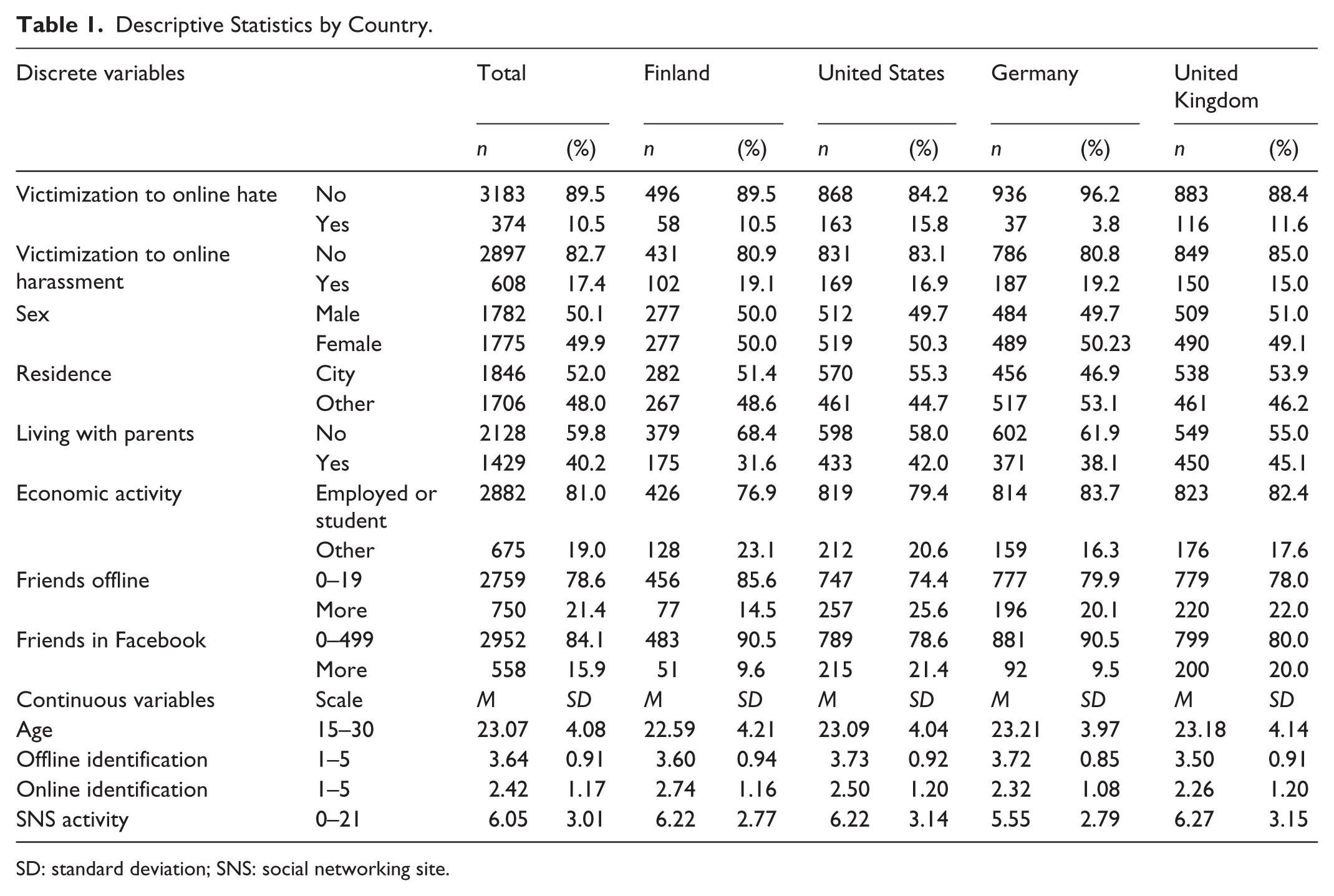
SD: standard deviation; SNS: social networking site.
Victimization to online hate was measured with the question, “I have personally been the target of hateful or degrading material online,” with response options “yes” and “no.” To measure victimization to online harassment, respondents were asked, “In your opinion, have you been a target of harassment online, for example, where people have spread private or groundless information about you or shared pictures of you without your permission?” Also this variable had two response options (“yes” and “no”). Both of the questions were formulated according to previous studies on online hate (Douglas, 2007) and online harassment (Bossler, Holt, & May, 2012; Jones et al., 2011). As such, these two questions together measure different aspects of online victimization that have been analyzed in previous research. In our samples, there was only a moderate correlation between these two variables (Spearman’s correlation coefficients ranging from .15 to .55 in different countries) indicating different dimensions of online victimization.
The primary independent variables included measures concerning perceived strength of social ties. Identifications with online and offline groups were measured with the question, “How close do you feel to the following groups?” followed by a list of different groups and options ranging from 1 (not at all) to 5 (very). Online identification was measured with a single item (“some online community?”). Offline identification was measured by combining three different items concerning respondents’ identification to family, friends, and school or work communities. The three-item composite variable had an acceptable internal consistency (α = .69). As such, respondents assessed the strength of their ties to both categories.
The size of offline social networks was addressed with the question, “How many friends do you have with whom you can discuss intimate and personal matters face to face?” This measure was dichotomized into 0–19 and 20 or more (indicating strong offline ties). Similarly, we also asked about the size of respondents’ online networks with the question, “How many friends do you have on Facebook?” This measure was categorized into 0–499 and 500 or more (see Table 1). The dichotomization of both offline friends and Facebook friends was done in order to create a comparison of offline and online networks along with the added focus of exploring social tie strength in both social environments.
SNS activity of the respondents was controlled for in the analysis. The respondents were given a list of the 21 most frequently used online platforms and services (e.g., Facebook, YouTube, Twitter, Tumblr, Instagram, blogs, discussion forums) and were asked about which online services they have used. A composite variable measuring SNS activity was created by summing up the number of services, here utilized as a continuous variable in the analysis.
Along with age and sex, residence (between city and other), living situation, and economic activity were used as socio-demographic variables controlling for aspects of social context. The variable indicating whether the respondent lived in a city or outside a city was constructed on the basis of a survey item in which respondents were asked to describe the area they were currently living in from a list of options (ranging from less densely populated countryside to capital area). The variable was dichotomized to indicate whether respondents lived in a city (more than 100,000 residents) or not. Living situation of the respondent was controlled for by relying on information concerning whether the respondent lived at home with parents or not (living with parent was coded as 1 and other arrangements as 0). Economic activity was based on a survey item inquiring about respondents’ main economic activity, which was controlled for by an indication of employed, full-time student or other. In the analysis, we treat this variable as dichotomous (between employed/student or other).
Analytical Techniques
The explanatory analyses are based on binary logit models, which we run separately for each country sample in order to provide cross-national points of comparison. Our results are reported using marginal effects coefficients (with standard errors) for each independent variable in the models. The marginal effects illustrate how much the dependent variable, in our case the probability of being in the category reporting hate victimization/harassment, is expected to increase or decrease for a unit change in the explanatory variables. Given that the effect size will differ across all independent variables in the models, we choose to report average marginal effects (AMEs). Generally, AMEs reliably summarize the effect size across observations in the sample (Morgan & Winship, 2014). In addition, we also report model fit (log-likelihoods) for each model.
Results
The results of our descriptive analysis, presented in Table 1, show that there is substantial cross-national variation in the case of both online hate and online harassment victimization experiences. The United States showed the highest proportion of online hate victimization, with 15.8% of respondents having had such experiences. Germany showed the lowest with only 3.8% having been targeted by hateful material online, with Finland (10.5%) and the United Kingdom (11.6%) falling in between. On the contrary, Germany (19.2%) together with Finland (19.1%) had the highest proportion of online harassment experiences followed by the United States (16.9%) and the United Kingdom (15.0%). Experiences of online harassment were more common than victimization through online hate in all samples.
In addition to victimization experiences, there are cross-national differences present in the case of our measures of social tie strength and size of social networks. The mean of offline group identification was highest in the United States (mean = 3.73) followed by Germany (mean = 3.72), Finland (mean = 3.6), and the United Kingdom (mean = 3.5). In the case of online group identification, the country average was highest in Finland (mean = 2.74) followed by the United States (mean = 2.50), Germany (mean = 2.32), and the United Kingdom (mean = 2.26). In general, the measures of identification with offline groups were higher than those with online groups. The proportion of respondents having at least 20 good friends (indicating offline strong ties) was 25.6% in the United States and 14.5% in Finland, with the United Kingdom (22%) and Germany (20.1%) falling in between. Accordingly, the United States had had the highest proportion (21.4%) of respondents having at least 500 Facebook friends followed by the United Kingdom (20%) and then Finland (9.6%) and Germany (9.5%).
In all of our samples, half of the respondents were female and the average age was 23 years. British respondents were the most active SNS users followed by the Americans, Finns, and finally Germans. More than half of the respondents lived in a capital or big city area in the United States, United Kingdom, and Finland, while in Germany the proportion was around 47%. In the United Kingdom, 45.1% of respondents were living with their parent(s) when the proportion was 42.0% in the United States, 38.1% in Germany, and 31.6% in Finland. The proportion of respondents not participating in education or employment was highest in Finland (23.1%) and lowest in Germany (16.3%), the United States (20.6%) and United Kingdom (17.6%) falling in between.
The aim of the explanatory analysis was to examine whether social tie measures and other behavioral and socio-demographic control variables are associated with hate-material exposure similarly in each country. Our analysis started from victimization to online hate. Table 2 shows the findings from the explanatory logit models for the United States, Germany, United Kingdom, and Finland. The identification to offline groups had a significant negative association with online hate victimization in all of our samples. The effect of offline identification was strongest in the United States where, according to our AME estimates, a one-unit increase in identification decreases the risk of online hate victimization by 4.6%. The effect is weakest, yet still statistically significant, in Germany where a unit increase in identification to offline groups decreases the probability of online hate victimization by 1.9%. Finland and United Kingdom fall in between with AME coefficients of −.038 and −.023, respectively. Online group identification was significantly associated with online hate victimization in the United Kingdom and United States, but unlike the case of offline identification, this association was positive. In other words, a one-point increase in online community identification increased the risk of online hate victimization by 3.9% in the United Kingdom and 3.6% in the United States. The size of offline or online networks was not significantly associated with online hate victimization in any of our samples.
Victimization to Online Hate.

SNS: social networking site.
Logistic regression (average marginal effects [AMEs] with standard errors [SEs], p-values [significant estimates on 95% confidence level bolded]).
Of our control variables, only SNS activity was significantly associated with online hate victimization in all samples. The association was positive and it was strongest in the case of the United States (AME coefficient = .018) and weakest in the case of Germany (AME coefficient = .004). Age had a significant negative association with online hate victimization in the United States and United Kingdom. In the case of the United Kingdom, living with parent(s) and living in a less densely populated area were also significantly negatively associated with online hate victimization. Respondents’ main activity was not significantly associated with online hate victimization in any of our samples.
Identification with offline groups was negatively associated with the risk of online harassment, and that association was statistically significant in the case of the United States, Germany, and Finland. The effect on offline identification was strongest in Finland, where a one-unit increase in offline identification decreased the probability of online harassment victimization by 6.3% (in Germany and the United States, AME coefficients were −.058 and −.036, respectively). Furthermore, like in the case of online hate victimization, online community identification had a significant positive association with online harassment in the United States and United Kingdom. A unit increase in online community identification increased the risk of online harassment by 3.6%, on average, in the United Kingdom, while the effect was 3.3% in the United States. Here again, the size of offline or online social networks did not have a significant association with the online harassment experiences in any of our populations.
SNS usage had a significant positive association with online harassment in the United States, Germany, and United Kingdom, which had AME coefficients of .012, .011, and .007, respectively. Age was negatively associated with online harassment in the United States, Germany, and United Kingdom. Living with parent(s) decreased the probability of online harassment in the United States and Germany, while in the United Kingdom, living in a less densely populated area had an equivalent effect. Finland was the only country where gender was significantly associated with the risk of online harassment, females being 9.8% more likely to be victims of online harassment. Main activity was not significantly associated with online harassment in any of the countries (Table 3).
Victimization to Online Harassment.

SNS: social networking site.
Logistic regression (average marginal effects [AMEs] with standard errors [SEs], p-values [significant estimates on 95% confidence level bolded]).
Discussion
The exploration of relational aspects available in the online setting through both enhanced communication and access to others brings both positive and negative effects to the lives of young people. Continual exposure to the online setting has been shown to increase both benefits and costs in the lives of young people. Furthermore, the associations between various dimensions of social ties both online and offline and experiences of harassment victimization online have been studied in a localized setting. Central here is the broadening of the scope of the population to a cross-national setting while also including the variable of hate victimization.
This study puts forth a new perspective in terms of how various user characteristics and social tie strengths are related to experiences of both harassment and hate victimization online through a survey of Finnish, American, German, and British young people between the age of 15 and 30 years. A variety of user variables were considered in the determination of associations between them and negative user experiences. As such, new linkages between previously studied aspects of online interaction were created, providing new insight into online risks and opportunities prevalent in the lives of young people.
The analysis showed a positive association between strong identification with online communities and experiences of both hate victimization and harassment in the United States and United Kingdom, a confirmation of our hypothesis in terms of the link between victimization and users who actively spend time investing in online social ties. Interestingly, this finding also goes against previous work where strong ties online have been found to protect against experiences of victimization (DeSmet et al., 2014). This may point to differences between strong ties created online and offline strong ties maintained online. As noted in previous work, offline popularity and strong ties are both linked to lessened victimization online (Adams et al., 2005; Bollmer et al., 2005; DeSmet et al., 2014; Wegge et al., 2014). This may point to either the difficulty of group protection enforcement of strong tie members online or, perhaps more likely, a misinterpretation of one’s social standing and social tie status within an online community.
Furthermore, higher SNS activity was linked to experiences of hate victimization in all countries. SNS use was also positively associated with experiences of harassment in the United States, United Kingdom, and Germany. This represents a partial confirmation of our hypothesis concerning risks and opportunities. Respondents in the United States and United Kingdom displayed a high number of both online and offline friends, highest SNS use, and significantly higher levels of hate victimization in addition to a positive association between younger age and hate victimization. These findings are in line with previous findings on the positive relationship between relational opportunities and risks online (Ortega et al., 2012; Livingstone & Helsper, 2010).
However, findings on strong tie associations add nuance to this partial confirmation of our hypothesis. Namely, the size of SNS and offline social networks was not associated with negative experiences online. This finding comes as a bit of a surprise, given past research on the dangers of SNS deviance and aggressor use of that social instrument toward taking advantage of harmful opportunities more readily available than in the offline setting (Keipi & Oksanen, 2014; Merchant, 2012), and negates our hypothesis. This also contradicts previous findings concerning weak tie networks, where users having many weak ties online were more likely to experience harassment victimization (Bastiaensens et al., 2014; Wegge et al., 2014). Part of the explanation here may be the age range of the study, as past work has focused on localized and younger populations. Users develop navigational prowess with age, with younger users being more likely to experience victimization (Keipi & Oksanen, 2014; Livingstone et al., 2011; Oksanen & Keipi, 2013). It is possible that our inclusion of older age groups offsets the damaging effects of large weak tie networks. Furthermore, it was found that the quality of users’ bonds, especially offline strong ties, might help to lessen susceptibility to negative online experiences. Here, strong tie identification offline was negatively associated with experiences of online hate victimization in all cases.
The findings of our study bring to light an interesting dynamic. Namely, strong online ties are linked to experiences of both hate and harassment victimization, yet strong offline ties are linked to lower hate victimization. Central here may be the source of individual validation. Offline, group dynamics may be more concrete in terms of inclusion and exclusion, whereas online users have easier access to social communities without necessarily having been accepted as strong ties despite holding that assumption. In the online setting, codes of conduct, concrete signals of acceptance or validation, and assurances of the strength of a social tie can differ compared to those in the offline setting due to a level of diminished physical interaction. Indeed, a relevant dynamic here may be the lessened social presence, or degree to which users are experienced physically, of the online setting combined with heightened accessibility. These can both work to blur more traditional social tie boundaries and determinants that can in turn affect victimization experiences.
Furthermore, protective offline strong ties cannot affect the way in which potentially dangerous others respond to the particular user online, but the validation offered offline might affect the social settings sought by that user online. However, it should also be noted that the strength of the offline social tie might not determine the likelihood of victimization experiences, as strong ties can also be sources of harassment, for example.
As such, SNS use was linked to risks, yet the size of SNS networks was not. Here, it seems risks in the setting may also be more incidental, accidental, or imposed from outside sources rather than rooted in already-established social ties. This may point to young people’s competence in creating social networks where risky interactions are minimized. Notably, despite harassment and hate not being linked to the size of users’ social spheres, aggressor intent through other channels had a significant effect, given the quantity of negative user experience cross-nationally. Thus, there seems to be a balance between user-generated risk behavior and risk created by aggressors targeting others with harassment or hate.
In the case of the United States and United Kingdom, stronger online community identification ties were linked to higher instances of hate victimization, which might point toward previous findings where relatively marginalized users seek social support online from like-minded interest groups. In these cases, victimization can seem less likely due to some level of available anonymity but which often occurs due to the instrumental nature of the relationships therein (Keipi & Oksanen, 2014; Keipi et al., 2014; Mehdizadeh, 2010). This would represent a second effect of lessened social presence in addition to the possibility of misinterpreting the strength of ties mentioned earlier. Given the opposite association between offline group identification and negative online experience, it seems reasonable to posit that the interactive conditions of the online setting, namely, potentially lessened visibility or identifiability, may self-select for participants who have either been hurt or are likely to hurt others. Our findings provide a potential point of departure for further research in this area.
Furthermore, the cross-national nature of the study brought out novel points of comparison in terms of key similarities and differences between participant groups. The United States and United Kingdom, often linked together in terms of cultural context, also shared similarities here that were not found in Finnish and German samples. First, they were similar in age-associated risk of hate victimization and high numbers of both online and offline friends. Furthermore, the two populations shared the significant association of online group identification being linked to harassment experiences in addition to high rates of online hate victimization.
Finns and Germans tended to have far smaller online networks with lower levels of SNS use. Whereas the United States and United Kingdom led in hate victimization, Finnish and German samples showed a propensity toward harassment victimization. Germans showed a particularly low rate of hate victimization compared to others. These findings may be associated with more general characteristics of social media use patterns between countries. The cultural sensibilities often attributed to Finns were reflected in the findings as well. They exhibited few online and offline social ties yet held a high level of offline group and online group identification. This seems to indicate an emphasis on few but valued social ties in both arenas. Furthermore, the positive effect of offline tie strength increase on lessening the likelihood of harassment was greatest in the Finnish sample—this, despite Finns being most prone to harassment experiences online. Finally, and surprisingly considering Finland’s level of societal equality noted in many comparative studies (e.g., Flavin, Pacek, & Radcliff, 2011; Kouvo & Räsänen, 2015), the Finnish sample was the only one where gender was associated with harassment, despite leading in egalitarianism culturally. Here, girls were more likely to experience harassment online. This finding is somewhat surprising, as it goes against the general notions of gender equality often associated with Nordic countries.
Despite the linkages to previous work and the new perspectives made possible by the data, our study consists of some limitations. Although the cross-national comparison yielded results, we are unable to interpret all of the differences effectively due to the lack of preceding research on possible macro-level impacts of the themes central here. Also, the theoretical framework used to categorize the social ties emerging from the data was developed before the wide-scale use of SNS and as such was meant for the offline setting. However, despite its development for a different environment, it was descriptively effective in approaching the various relational forms prevalent among young people, from strong offline friendships to weak SNS ties and strong online community identification links. Notably, our findings are made up of associations, and as such, a flow of causation cannot be determined between key variables. This opens the door for future research into how strengthened offline ties may alleviate negative experiences online and why strong online group identification is linked to higher levels of hate victimization and harassment.
The relationship between strong ties and victimization experiences is an important area requiring further research in assessing victimization that has its source in well-established strong ties. Finally, hate victimization and harassment experience questions were left relatively open to interpretation. Here, minimal guidance was provided in terms of definitions and descriptions of these two areas of interest, which reflected an emphasis on users’ subjective experience and a broadening of the research base that has focused on harassment and hate separately. As such, this study represents a novel step on which to build through a new comparison and determination that similar factors affect these two forms of victimization. Future research might approach these definitions more specifically toward gaining users’ insights into what constitutes online harassment, for example, along with more specific data on who is responsible for the damaging victimization. Furthermore, a more extensive approach taken in assessing social tie strength could yield more nuanced results than the set of questions applied here which were meant as an initial look into this area of research to be built upon later on.
Conclusion
This study represents a new perspective toward understanding hate victimization and harassment online among young people through an assessment of associations between social ties and negative experiences cross-nationally. Our approach allowed for findings that both affirm and challenge previous findings on online risks, all under a framework of cross-national comparison. As such, the findings add to the body of work already done in terms of the relationship between social ties and harassment victimization.
As SNS use continues to play a central role in the interactional patterns of young people, there is value in assessing the potential risks associated with that behavior in addition to delving into the motivations behind those carrying out the damaging actions. Although the online relational setting is complex, a mapping of relevant association along with reasons behind those associations can help to mitigate unnecessary risks and, consequently, provide empirically based justifications for relevant protections for young people online.
Footnotes
Declaration of Conflicting Interests
The author(s) declared no potential conflicts of interest with respect to the research, authorship, and/or publication of this article.
Funding
The author(s) disclosed receipt of the following financial support for the research, authorship, and/or publication of this article: Research was supported by funding from the Kone Foundation.