



Abstract
This study examines (1) the factor structure of social networking site relational behaviors (SNSRB), (2) the association between the behaviors and relational quality and breakup adjustment, and (3) whether behaviors vary as a function of relational status. Participants’ responses (N = 363) indicated that the majority of variance in SNSRB was accounted for by 10 factors—surveillance, managing impressions through photographs, regulating usage, maintaining shared networks/contacts, oversharing, communicating directly via private messages, posting about offline activity, relationship broadcasting, status management, and privacy. Additionally, each factor was associated with the participants’ romantic relationships such as quality of current relationships, adjustment to dissolved relationships, or relational status. This study extends understanding of how technology reflects the way people interact throughout the romantic relationship lifespan.
Keywords
Social networking sites (SNSs) have become a ubiquitous aspect of daily life. Millions of people log in on a daily basis to connect and share their lives through photos and posts (e.g., Duggan, 2015). The accessibility of information on SNS influences relationship development over time, aids in relationship maintenance, displays relationship dissolution, and reveals the multimodality of information between (online and offline) relationships (Dainton, 2013; Fox, Warber, & Makstaller, 2013; LeFebvre, Blackburn, & Brody, 2015). Indeed, researchers (e.g., Walther, 2011) have put forth a call to examine how online behaviors reflect different relationship stages.
Over the past few years, SNSs—particularly Facebook—have been used as an entry point for learning more about communication phenomena due to its wide adoption rate among various age groups. For instance, 72% of online adults use Facebook (Duggan, 2015). Previous relational researchers have investigated how individuals initiate and certify their relationships as “official” (Fox et al., 2013), how partners maintain their relationships (Dainton, 2013; Tong & Walther, 2011), and how individuals enact breakup processes (LeFebvre et al., 2015) all via Facebook. However, despite the proliferation of research into the link between SNS use and relational behaviors, little information is known about the specific behaviors individuals engage in throughout the relationship lifespan (i.e., escalation to de-escalation). Also, Ellison, Steinfield, and Lampe (2011) noted, “SNS researchers need to develop measures of specific SNS based communication practices, not just generic usage, in order to better discern usage patterns and their effects” (p. 2). This study heeds these calls and examines online behavior across the relational lifespan.
The majority of research on relational change has focused either on the initiation, maintenance, and dissolution stages of relational development (e.g., Baxter & Bullis, 1986; Metts, Cupach, & Bejlovec, 1989; Wilmot & Sillars, 1991) or on the overall development of relationships more holistically (e.g., Altman & Taylor, 1973; Berger & Calabrese, 1975; Knapp, 1978). However, relational researchers have long argued that relationships are dynamic—they constantly undergo change, and researchers have often grappled with the best methods and contexts in which to understand those changes (e.g., Baxter & Bullis, 1986; Koenig Kellas, Bean, Cunningham, & Cheng, 2008). Often stage theorists question, “When does a stage end?” and “How do people go from one stage to the next stage?” (Perlman, 2008, p. 519). There appears to be no commonly agreed-on point at which relationships begin or end, or moreover when relationships are undergoing maintenance and dissolution.
Thus, this study focuses on the entire relationship lifespan. Researchers have examined the relationship lifespan by tracking the life of a romantic relationship from courtship to marriage (Huston, McHale, & Crouter, 1986; Huston, Surra, Fitzgerald, & Cate, 1981; Karney, & Bradbury, 1995; Niehuis, Huston, & Rosenband, 2006). These studies investigated relationships across time and in various stages to help understand different factors that may influence relationship longevity and satisfaction.
In particular, the methodology applied in this study parallels a study completed by Avtgis, West, and Anderson (1998), who applied Knapp’s (1984) model to holistically examine the relational lifecycle, unlike other models and research domains that tend to focus on specific relationship stages or processes. A broader lifespan focus can be difficult to apply in the research context. Avtgis and colleagues (1998) argued that few studies have systematically examined behaviors across relational stages. This study addresses this gap by expanding on Knapp’s model and creating a measurement instrument to assess behaviors afforded by SNSs that occur across the relational lifespan.
Therefore, given the widespread use of SNSs, the purpose of this investigation is to examine the associations between SNS uses and the escalation, maintenance, and de-escalation of romantic relationships. Ultimately, our research seeks to address calls by Ellison et al. (2011) for the development of more SNS-specific communication measures, as well as Walther (2011) who challenged researchers to continually examine how mediated communication use reflects romantic relational development. Because of the aforementioned dynamic nature of relationships stages, this study examines communication across the entire relational lifespan.
Specifically, this study investigates how social networking site relational behaviors (SNSRB) reflect the romantic relationship lifespan by (a) developing a descriptive, empirically derived instrument of relational behaviors on Facebook; (b) validating the instrument by examining its concurrent validity with pre-established markers of relational adjustment (i.e., closeness, commitment, satisfaction, relational uncertainty, and post-breakup adjustment); and (c) determining whether individuals’ online behavior varies as a function of relational status.
Applying the Stage Models to SNSRB
Relational development and dissolution stage models provide frameworks for understanding behaviors and interaction patterns that occur over the full lifespan of the relationship from development to deterioration (Solomon & Vangelisti, 2010). The stage model put forth by Knapp (1984) and updated by Knapp and Vangelisti (2010) illustrated how relationship escalation occurs through five stages: initiating, experimenting, intensifying, integrating, and bonding. Initiating is where relational partners begin to instigate communication. Experimenting involves trying to uncover the unknown about the partner and relationship by reducing uncertainty. Intensifying depicts how partners integrate individual and relational identities as a couple through partners’ escalation. Partners begin to identify themselves as a couple intensifying their bond through more personal disclosures, private symbols, and facilitative behaviors. Integrating involves the further fusing of partners through interdependence. The final stage, bonding, is an extension of integration and serves to stabilize the relationship by gaining social and/or network support for the relationship.
Knapp and Vangelisti (2010) also delineated how relationship de-escalation, or coming apart, from intimacy takes place through five stages: differentiating, circumscribing, stagnating, avoiding, and terminating. Differentiating encompasses one or more partners attempting to reestablish or regain their individual, rather than relational identity, and where partners reassure more independence. Circumscribing finds the relationship communication deteriorating as partners constrict their communication, in both the quality and the quantity of communication. Stagnation represents that the relationship embodies a shell of the former relationship. Partners may share a similar space; instead, they do not share themselves with each other, but rather are closed off and communication is stilted. Avoiding removes the physical connection and closes off communication channels. Partners take active steps to refrain from contact with each other. Finally, terminating represents the end of the relationship and romantic communication. Most relationships do not experience all 10 stages of development and dissolution; moreover, all stages delineated in relational development and de-escalation do not always happen in sequential order.
Several studies have begun to connect romantic relationship models to SNSs. Initially, Fox and colleagues (2013) examined Knapp and Vangelisti’s (2010) stage model of relationships, specifically the relational escalation stages within the context of SNSs. Similarly, LeFebvre and colleagues (2015) mapped SNS behaviors to the various processes in the Rollie and Duck (2006) relational dissolution model. These two studies imply that behaviors on SNSs provide insight into the functioning of relationships. This study uses Knapp and Vangelisti’s (2010) model as an overarching lens to understand how various SNSRB operate in romantic relationships.
Most previous research (e.g., Dainton, 2013; Ellison, Vitak, Gray, & Lampe, 2014; McEwan, Fletcher, Eden, & Sumner, 2014; Sosik & Bazarova, 2014) focused on the quantitative measurement of relationship maintenance behaviors on Facebook. For instance, McEwan and colleagues (2014) created a measure designed to assess maintenance in a full range of relationships—from acquaintances to close friends to romantic partners. However, by focusing on a variety of relationship types in the creation of their measure, they do not (by design) address some of the behaviors used specifically by romantic partners. Recently, Dainton (2013) created a measure to focus specifically on romantic relationships. However, many of the items extend traditional maintenance strategies (e.g., Stafford & Canary, 1991), rather than incorporate the new strategies offered by Facebook.
In addition, Avtgis and colleagues (1998) applied the relational stage model to offline relational behaviors to examine the relational lifecycle since other models and research domains tended to focus on specific relationship stages or processes. Although a broader focus can be difficult to apply in the research context, Avtgis and colleagues (1998) argued that few studies have systematically examined behaviors across relational stages and that the relationship stage model offers a framework for creating measurement instruments. This study builds on this aforementioned research by examining a broader range of Facebook behavior and by focusing specifically on SNSRB across the lifespan of romantic relationships.
Social Networking Site Behavior Across the Lifespan of Romantic Relationships
Past studies have underscored the influence of technology on romantic relationships. More than 25% of American adults believe that technology impacted their relationship—10% of them believe the Internet has had a major impact (Lenhart & Duggan, 2014). For instance, people can use technology to seek out social information about their partners at the early relationship stages, which can accelerate progression through the traditional relationship stages (Fox et al., 2013; Knapp & Vangelisti, 2010). Contemporary relationship development research commonly incorporates use of contemporary technologies in development, maintenance, and dissolution to define, clarify, and communicate relationships (Stanley, Rhoades, & Fincham, 2011). Although the following review is far from exhaustive, numerous qualitative studies have shown a set of common factors related to technology use and romantic relationships (e.g., Fox et al., 2013; LeFebvre et al., 2015) that assist in creating a framework for understanding how SNSs influence the development, maintenance, and dissolution processes in romantic relationships. Common factors include impression management, multimodal relationships, and surveillance strategies. The following section reviews the literature relating to these themes in order to derive research question to further expand on this work.
Strategic self-presentation is a central concern in most interactions, particularly in online environments, such as Facebook (e.g., Hall, Pennington, & Lueders, 2013). When establishing relationships, individuals often use Facebook to publicly communicate their romantic relationship status. Fox et al. (2013) examined the use of public relational status indicators to dating relational partners. They asked people to explain what being “Facebook Official” (FBO) meant to their relationship and found that participants believed that FBO is a sign that signals to their online and offline social network that they are in a committed monogamous relationship. Additionally, individuals may alter their relational status when they terminate their relationships (LeFebvre et al., 2015) or check the relational status of their former partner to see whether they have begun a new relationship (Tong, 2013). Individuals may even unfriend or remove an individual from their network following a breakup (Peña & Brody, 2014).
Other communication research on online environments has emphasized the multimodal nature of relationships (e.g., Ramirez & Zhang, 2007). Multimodality, or communication via a variety of channels, has become the “primary channel characteristic of personal relationships” (Walther, 2011, p. 471). When considering online relational behaviors, the concept of multimodality relates to both the use of offline maintenance strategies in online environments (e.g., Dainton, 2013) and the process of switching between face-to-face (FtF) and computer-mediated communication (CMC) (e.g., Fox & Warber, 2013), or multiple CMC contexts (e.g., Ledbetter & Mazer, 2013) throughout the relational lifespan.
In general, the use of multiple online and offline channels for interaction in close relationships is associated with relational interdependence (e.g., Ledbetter, 2010; Ledbetter & Mazer, 2013). Within the realm of romantic relationships, Fox et al. (2013) investigated the initial strategies people use after they meet a potential romantic partner. They found that after people met FtF, individuals surveyed possible romantic partners’ profile in addition to sending friend requests or asking for their phone number.
More recently, Dainton (2013) examined how offline relational maintenance strategies manifest on Facebook, which supports prior literature used in FtF settings. However, there is a limitation in using FtF methodologies to measure online behaviors because questions may only be capturing FtF phenomena occurring in an online context. Furthermore, she argued that perhaps a more inductive approach might reveal the intricate ways people use their online environments to engage in relationship maintenance strategies. In addition, Vitak (2014) noted that traditional measures of offline communication behavior, specifically maintenance, should be adapted to better represent behavior in SNS settings. Specifically, offline measures often fail to capture the unique features of online settings and prioritize geographically close relationships. In summary, the research into multimodality indicated that while individuals’ offline behavior (e.g., maintenance) often influences their online behavior and various indicators or relational quality, more investigation is necessary to understand behaviors unique to the online environment.
Finally, the disclosure-oriented nature of SNS is ideal for engaging in interpersonal electronic surveillance (IES) of potential, current, and previous relationship partners. Tokunaga (2011) identified several reasons why SNSs are favorable venues for IES, particularly in romantic relationships. First, IES is often utilized because of the availability of information and its corresponding accessibility; people do not require special skills or knowledge to obtain the information present in their networks. Information is readily available after a simple member log-in. Second, the information present on SNSs comprises a diverse assortment of photos, wall postings, videos, location check-ins, and newsfeeds. These two features combine to create a trove of information that can be easily found. As Tokunaga (2011) concluded, the availability, accessibility, and assortment of information on SNSs, along with the low risk of detection, make IES very appealing for surveillance.
Researchers have documented the reasons for and manner in which people engage in SNS surveillance behaviors in their romantic relationships (e.g., getting back together with an ex, Lukacs & Quan-Haase, 2015; breakup initiator, Tong, 2013); few studies systematically examined the full breadth of behaviors. This study seeks to further validate a measure of SNSRB by assessing their association with various assessments of relationship quality and breakup adjustment. Finally, the behavior frequency is assessed at various relationship stage initiation and dissolution.
Research Questions
The aforementioned literature illustrates the current state of research into SNSRB in romantic relationships and considers how traditional models of relational development and dissolution might inform understanding of how and when individuals may experience these behaviors. Given that past research has mainly examined these processes using measures developed from FtF interactions, this study sets out to develop a measure to investigate SNSRB. The following research questions are posited:
RQ1. (a) What type of SNSRB do individuals enact in their romantic relationships, and (b) what is the factor structure of these behaviors?
Additionally, the concurrent validity of these factors is assessed by testing the association between the behaviors, relational quality, and breakup adjustment. Specifically, satisfaction, commitment, closeness, and relational uncertainty were assessed for intact relationships because they are common and theoretically grounded indicators of relational quality (e.g., Le & Agnew, 2003; Rusbult, 1980; Vangelisti, 2011). Scholars have acknowledged satisfaction—typically operationalized as partners’ feelings about their relationship at a given point in time—as one way to conceptualize relational success; however, other relationship indicators are now commonly utilized in addition to satisfaction (e.g., commitment, investment, uncertainty) as separate, albeit related variables (Vangelisti, 2011). Post-breakup adjustment is a commonly used measure of closure following a breakup (e.g., Koenig Kellas et al., 2008). Therefore, the following research question is proposed:
RQ2. How do the SNSRB relate to relational quality and post-breakup adjustment?
Finally, Knapp and Vangelisti (2010) argued that couples undertake unique behaviors illustrative of their stage of relational escalation and de-escalation. Applying this to this study, the preset study assesses how SNS behaviors vary based on the current status of their relationship (e.g., recently initiated, long-term, recently dissolved, or dissolved a long time ago):
RQ3. How do individuals’ SNSRB differ based on their stage of relational escalation or de-escalation?
Method
Instrumentation Development
The study’s instrumentation development began with unexamined data from a previous study on relational behaviors in which participants in an online survey (N = 226) were asked about their Facebook usage in relation to their current or most recent dissolved romantic relationship (Lefebvre, Blackburn, & Brody, 2015). Responses were analyzed inductively and were read multiple times by the first three authors, who employed the constant comparison method of qualitative analysis (e.g., Strauss & Corbin, 1998) to identify themes that represented the nature of SNS behavior in romantic relationships. Knapp and Vangelisti’s (2010) model was used as a sensitizing guide to analyze the inductive data to better understand SNS behaviors across the entire relationship lifespan. The process of multiple readers examining the data allowed for the grounding of individual interpretations on participants’ responses in their online environments. The authors engaged in evidence-based discussion of observations to ensure the validity and reliability of the analytic process (Baxter & Babbie, 2004).
The analysis revealed 12 themes, many of which mirrored previous research (i.e., Fox et al., 2013), used by relational partners of romantic relationships in SNS environments. The themes, listed alphabetically, addressed relational partners’ (1) account access regulation, (2) direct communication, (3) emotional disclosures, (4) Facebook-related offline activity, (5) flirting, (6) impression management, (7) online relational avoidance, (8) private information sharing, (9) public relational identity, (10) regulation from Facebook, (11) shared networks, and (12) surveillance. The authors developed an initial pool of 69 items based on the participants’ responses, related measures, and previous research. During this exploratory process, themes that were not aligned with the previous literature were removed. Although some participants’ responses indicated multiple behaviors, the authors examined and coded for only the most predominant behavior (see Vangelisti, Young, Carpenter-Theune, & Alexander, 2005). The initial themes observed in the unexamined data aided in the item development utilized in the Exploratory Factor Analysis (EFA). This analysis allowed for the creation of orthogonal (i.e., uncorrelated) categories of behavior (whereas some of the above categories overlap).
Participants
Data were then collected from 363 undergraduate students enrolled in communication courses at a large southwestern university. A majority of the sample was female (n = 268, 68.4%). Participants’ ages ranged from 18 to 48 years (M = 20.64, standard deviation [SD] = 2.78). Participants were 53.1% Caucasian, 16.5% Hispanic, 9.7% Asian, 5.1% multiracial, 4.6% African American, 3.9% other, and 0.8% Native American. Participants were offered course extra credit for their voluntary participation.
There were 189 participants currently in a romantic relationship and 174 participants who had recently (within 2 years) terminated a romantic relationship and had not yet begun a new relationship. On average, dissolved relationships had terminated 8.69 months ago (SD = 8.53). Individuals in romantic relationships indicated that they had been involved with their partner for an average of 21.42 months (SD = 28.70). A sample of collegiate students (or primarily emerging adults) was used because they are frequent users of Facebook, averaging approximately one to two hours on Facebook daily (Kalpidou, Costin, & Morris, 2011), which is consistent with this study’s sample’s average daily time spent on Facebook.
Participants completed the 69-item SNSRB measure as well as potential indicators of relational quality (i.e., closeness, commitment, satisfaction, relational uncertainty) and post-breakup adjustment (i.e., to assess convergent validity). Participants currently in relationships completed measurements on relational closeness, commitment, satisfaction, and uncertainty. Individuals reporting on dissolved relationships completed a measure of their post-breakup adjustment. All participants responded to items assessing relational uncertainty.
Instruments
SNSRB
Responses to the SNSRB were gauged using a 5-point Likert-type measure to assess how frequently they enacted the behaviors (1 = Never; 5 = Always). Participants either answered questions in regard to their current relationship or to their previous relationship. Participants reporting on broken-up relationships were told, “Think of your past romantic relationship. Please indicate the frequency with which you engage in the following Facebook behaviors in relation to your romantic partner.” Participants reporting on intact relationships were told, “Think of your current romantic relationship. Please indicate the frequency with which you engage in the following Facebook behaviors in relation to your romantic partner.” The “Results” section describes the EFA used to examine these items. Table 1 displays the factor loadings and Cronbach’s reliability coefficients.
Factors, Items, Means (and Standard Deviations [SDs]), and Alpha Reliability for the SNSRB Measure.

SNSRB: social networking site relational behaviors.
For individuals reporting on a dissolved relationship, items and instructions were reworded to reflect their “former partner” as applicable.
Reverse-coded item.
Closeness
Participants completed Vangelisti and Caughlin’s (1997) psychological closeness measure. Participants responded to the items (e.g., “How close are you to this person?”) on a 7-point Likert scale (1 = Not at all; 7 = Very much). The items were averaged (M = 6.32, SD = 0.90, α = .96); higher scores indicated more closeness.
Commitment
Participants answered statements about relationship commitment using the 7-item scale developed by Rusbult, Martz, and Agnew (1998). Items (e.g., “I want our relationship to last for a very long time”) were assessed on 7-point Likert-type scales (1 = Do not agree at all; 7 = Agree completely). The mean of the items was computed (M = 7.39, SD = 1.67, α = .92).
Satisfaction
Participants answered satisfaction questions from an adapted version of the marital opinion questionnaire from Huston et al. (1986) that was revised to refer to pre-marital relationship satisfaction. The measure consists of eight semantic differential items (e.g., miserable–enjoyable) measured on a 7-point scale. Additionally, a global indicator ranged from completely satisfied to completely dissatisfied. Consistent with previous research, the eight semantic differential items were averaged, and then that mean was averaged with the global satisfaction item (M = 5.84, SD = 1.12, α = .83).
Post-Breakup Adjustment
For individuals reporting on a dissolved relationship, post-breakup adjustment was measured using the six 7-point Likert-type items adapted by Koenig Kellas et al. (2008). The average of the items (e.g., “How difficult has it been for you to make an emotional adjustment to this breakup?”) was computed (M = 4.85, SD = 1.13, α = .79). Items were scored so that higher scores indicated more adjustment.
Relational Uncertainty
All participants answered questions about their uncertainty using the measure developed by Knobloch and Solomon (1999) to measure three sources of uncertainty: self (e.g., “How you feel about your relationship”), partner (e.g., “How your partner feels about your relationship”), and relationship (e.g., “The current status of your relationship”). Each source of uncertainty was measured with four items on a 6-point Likert scale (1 = Completely or almost completely uncertain; 6 = Completely or almost completely certain). The mean of each source of uncertainty was calculated for each self (M = 1.87, SD = 0.93, α = .96), partner (M = 1.97, SD = 1.05, α = .94), and relationship (M = 1.99, SD = 1.04, α = .90). All items were reversed so that higher scores indicated more uncertainty.
Facebook Intensity
This scale (Ellison, Steinfield, & Lampe, 2007) was utilized as a control variable and measures the importance of Facebook in individuals’ lives. Six questions were rated on a 5-point Likert scale (1 = Strongly disagree; 5 = Strongly agree). The average of the items (e.g., “Facebook is part of my everyday activity”) was computed (M = 3.30, SD = 0.87, α = .89). Higher scores indicated more Facebook intensity.
Results
EFA on the SNSRB Measurement
The 69 items of the SNSRB measure were analyzed with EFA using the method suggested by Johnson and Wichern (2002), who recommended conducting the EFA in two steps. First, items are submitted to an EFA using principal component extraction. The obtained factor structure is then compared to an EFA using maximum likelihood extraction with the varimax rotation. EFA was utilized (as opposed to Confirmatory Factor Analysis) because previous research and theory did not provide a basis for stipulating the number of factors a-priori (Fabrigar, Wegener, MacCallum, & Strahan, 1999).
Increased sample size improves the quality of factor recovery (MacCallum, Widaman, Preacher, & Hong, 2001). Thus, to maximize sample size, all participants were analyzed concurrently (i.e., whether they reported on a current or dissolved relationship). 1 The initial EFA, using principal components extraction and varimax rotation, revealed 16 components with eigenvalues greater than 1. The Kaiser–Meyer–Olkin (KMO) test and Bartlett’s test of sphericity were significant, KMO = .87, x2 = 14,895.63, p < .001, indicating significant multicollinearity to conduct the factor analysis.
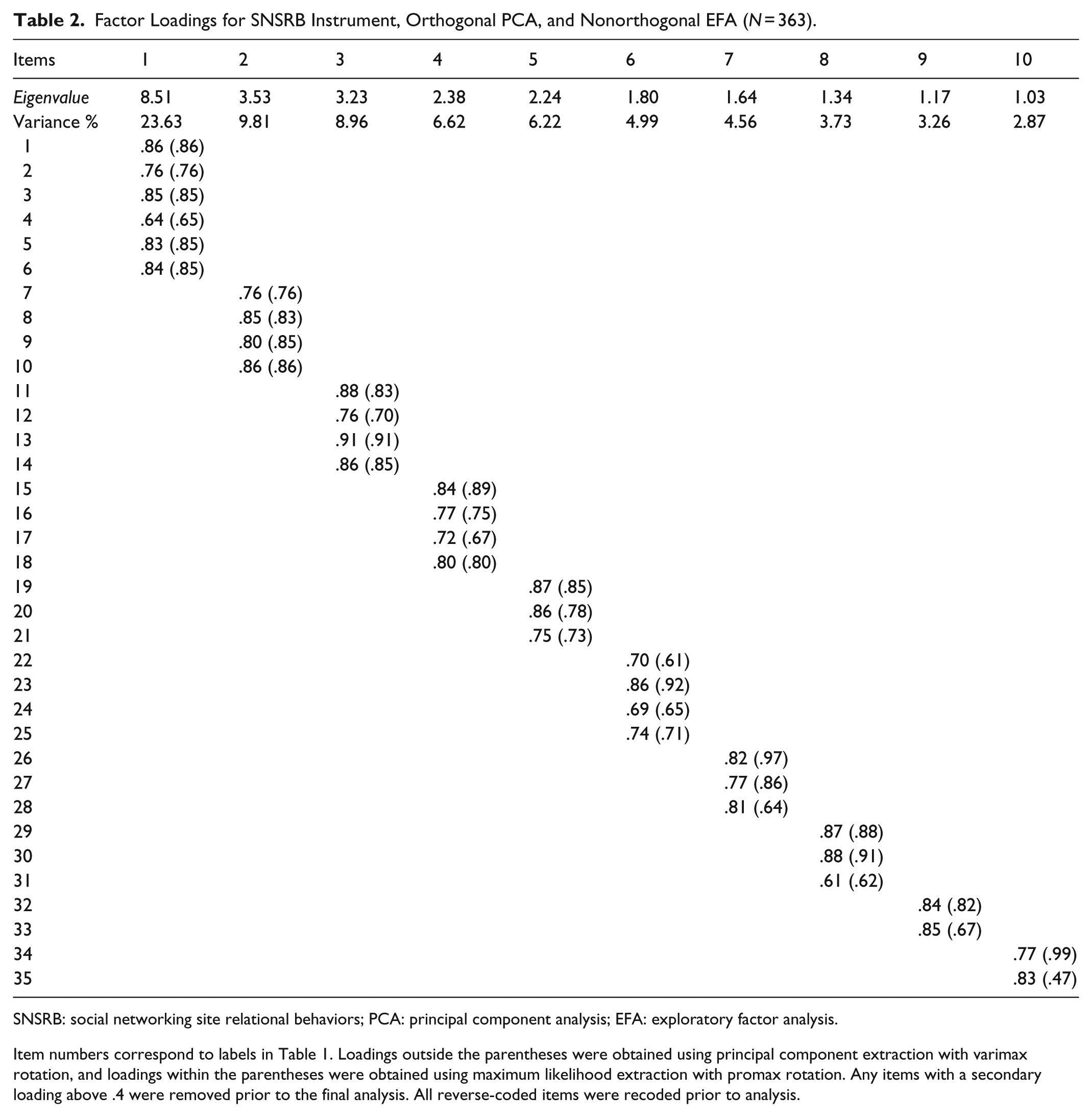
The analysis revealed several poorly loading items, as well as several items that loaded on multiple factors. Items were removed in accordance with a .60/.40 criterion. After 18 items were removed, the EFA was re-run, and items were continually removed when they no longer met the criterion. Ultimately, 35 items were removed after four iterations. The final solution included 10 factors with eigenvalues greater than 1, accounting for 75.11% of the variance. The scree plot revealed a clear drop-off after the 10th factor, as the 11th factor had an eigenvalue of only 0.75. Table 2 includes the eigenvalues and the variance accounted for by each factor. The follow-up EFA using maximum likelihood extraction revealed a similar solution. Only one item (35) loaded at less than the .60 criterion on the follow-up EFA, and it did not crossload onto any other factors. Thus, the initial solution was maintained. Items, factor labels, means, SDs, variance accounted for, and alpha reliability scores for each factor are reported in Table 1. Factor loadings for each EFA are displayed in Table 2.
Factor Loadings for SNSRB Instrument, Orthogonal PCA, and Nonorthogonal EFA (N = 363).
SNSRB: social networking site relational behaviors; PCA: principal component analysis; EFA: exploratory factor analysis.
Item numbers correspond to labels in Table 1. Loadings outside the parentheses were obtained using principal component extraction with varimax rotation, and loadings within the parentheses were obtained using maximum likelihood extraction with promax rotation. Any items with a secondary loading above .4 were removed prior to the final analysis. All reverse-coded items were recoded prior to analysis.
Surveillance
The first factor contained six items relating to viewing a partner’s profile. Higher scores on this factor indicated that individuals were more likely to conduct surveillance on their current or dissolved partner.
Photo Impression Management
The second factor contained four items associated with managing photos, particularly photos of the participant and their current/dissolved partner. Participants who scored high on this factor spent time actively managing their photos.
Regulation From Facebook
The third factor contained four items relating to purposefully avoiding the use of Facebook. Higher scores on this factor imply that participants made an active effort to avoid or stay away from Facebook.
Shared Contacts/Network Management
The fourth factor contained four items. Participants who scored high on this factor reported that they connected with their current or dissolved partners’ friends and family members on Facebook.
Oversharing
The fifth factor contained three items associated with sharing/revealing things about the participants’ current or dissolved partner. Higher scores on this factor indicated that participants frequently revealed private things about their partner via Facebook.
Direct Communication
The sixth factor contained four items that indicated participants’ use of Facebook for direct communication. Higher scores on this factor indicated that participants used the chat/messenger functions of Facebook to communicate with their current or dissolved partner.
Offline Activity
The seventh factor contained three items relating to the use of Facebook to indicate offline activity. Participants who scored highly on this factor frequently “checked-in” to locations with their current or dissolved partner.
Relationship Broadcasting
Higher scores on the eighth factor indicated that participants “broadcasted” information about their relationship (including albums and status updates) via Facebook.
Status Management
The ninth factor contained two items and indicated participants updated and maintained their “relationship status.”
Privacy
The final (10th) factor contained two items. Participants who scored high on this factor reported using the privacy features of Facebook to limit who can view their activity.
Concurrent Validity of the SNSRB Measure
An additional goal of this study was to assess the concurrent validity of the SNSRB measures. In other words, this investigation sought to determine whether the final SNSRB instrument items correlated with commonly utilized measures of relational components. Moreover, based on the Knapp and Vangelisti (2010) relational stage model, individuals should differ in their scores on SNSRB factors based on whether they are reporting on a current or dissolved relationship.
Relational Quality, Post-Breakup Adjustment, and SNSRB
To assess convergent validity, the relationship between the SNSRB measures and various assessments of relational quality and adjustment was assessed using Pearson product-moment partial correlation coefficients. For individuals currently in relationships, relational quality was assessed with the previously described measures of relational closeness, commitment, and satisfaction, in addition to the three sources of relational uncertainty (e.g., self, partner, and relationship). The relationship length was also included in the correlation. For individuals reporting on dissolved relationships, adjustment to the breakup was measured with the post-breakup adjustment scale as well as the three sources of uncertainty and the length of time since the breakup occurred. Because it was significantly correlated with seven of the SNSRB factors, the Facebook Intensity measure was used as a covariate, to ensure that all correlations indicated behaviors above and beyond mere frequency/intensity of overall Facebook use.
Table 3 displays the partial correlation coefficients for participants reporting on current relationships. Table 4 displays the partial correlation coefficients for participants reporting on dissolved relationships.
Partial correlations between SNSRB factors and measures of relational quality for current relationships, controlling for FB Intensity (N = 189).

SNSRB: social networking site relational behaviors; FB: Facebook.
p < .10; *p < .05; **p < .01; ***p < .001.
Partial correlations between SNSRB factors and post-breakup adjustment, relational uncertainty, and time since breakup for dissolved relationships, controlling for FB Intensity (N = 174).

SNSRB: social networking site relational behaviors; FB: Facebook.
p < .10; *p < .05; **p < .01; ***p < .001.
Current Relationship
For individuals reporting on current relationships, managing photographs, oversharing, and engaging in relationship broadcasting behaviors (e.g., talking about the relationship via status updates) tended to be negatively related to satisfaction, commitment, and closeness and positively related to self and relational uncertainty. Status management was positively associated with measures of relational quality and negatively related to uncertainty. Participants who reported a high level of partner uncertainty tended to use Facebook for surveillance purposes. Relationship length was positively correlated with network management, status management, and relationship broadcasting behaviors.
Dissolved Relationships
For individuals reporting on dissolved relationships, post-breakup adjustment was negatively associated with using Facebook for surveillance, managing photographs, network management, oversharing, checking in to offline locations, and engaging in relationship broadcasting behaviors. Likewise, regulation from Facebook and using privacy features were negatively related to post-breakup adjustment. The time since the breakup occurred was negatively correlated with surveillance, managing photographs, and regulation from Facebook.
Overall, the partial correlation supported the concurrent validity of the SNSRB measure, as each of the factors (except for direct communication) was significantly correlated with at least one measure of relational quality, post-breakup adjustment, or uncertainty.
Differences Between Current and Dissolved Relationships
To determine the difference between current and dissolved romantic relationships in regard to how they behave on Facebook (i.e., RQ3), groups were created by combining the breakup status variable (current or dissolved) with trichomized versions of the months in relationship and months since the partners dissolved variables. In other words, individuals were split into groups based on whether their relationship was 1 = current for 9 months or less (n = 66); 2 = current for between 9 and 24 months (n = 57); 3 = current for more than 24 months (n = 60); 4 = dissolved for 4 months or less (n = 65); 5 = dissolved for between 4 and 11 months (n = 55); and 6 = dissolved for more than 11 months (n = 51). Although trichotomizing should be used sparingly due to its effect on statistical power, in this exploratory study this methodology was chosen for parsimony and interpretability of results (versus a series of regressions). In addition, Iacobucci, Posavac, Kardes, Schneider, and Popovich (2015) provided evidence that, in some situations, the benefits provided by parsimony of results outweigh the drawbacks of converting a continuous variable into a categorical variable.
To assess the research question, a one-way multivariate analysis of covariance (MANCOVA) was carried out with the previously described relational status variable as the between-subjects factor and Facebook intensity as the control variable. The 10 SNSRB factors were used as the dependent variables. Bartlett’s test of sphericity was significant, χ2(54) = 865.86, p < .001, indicating that the dependent variables were empirically interrelated, and thus the use of MANCOVA was appropriate.
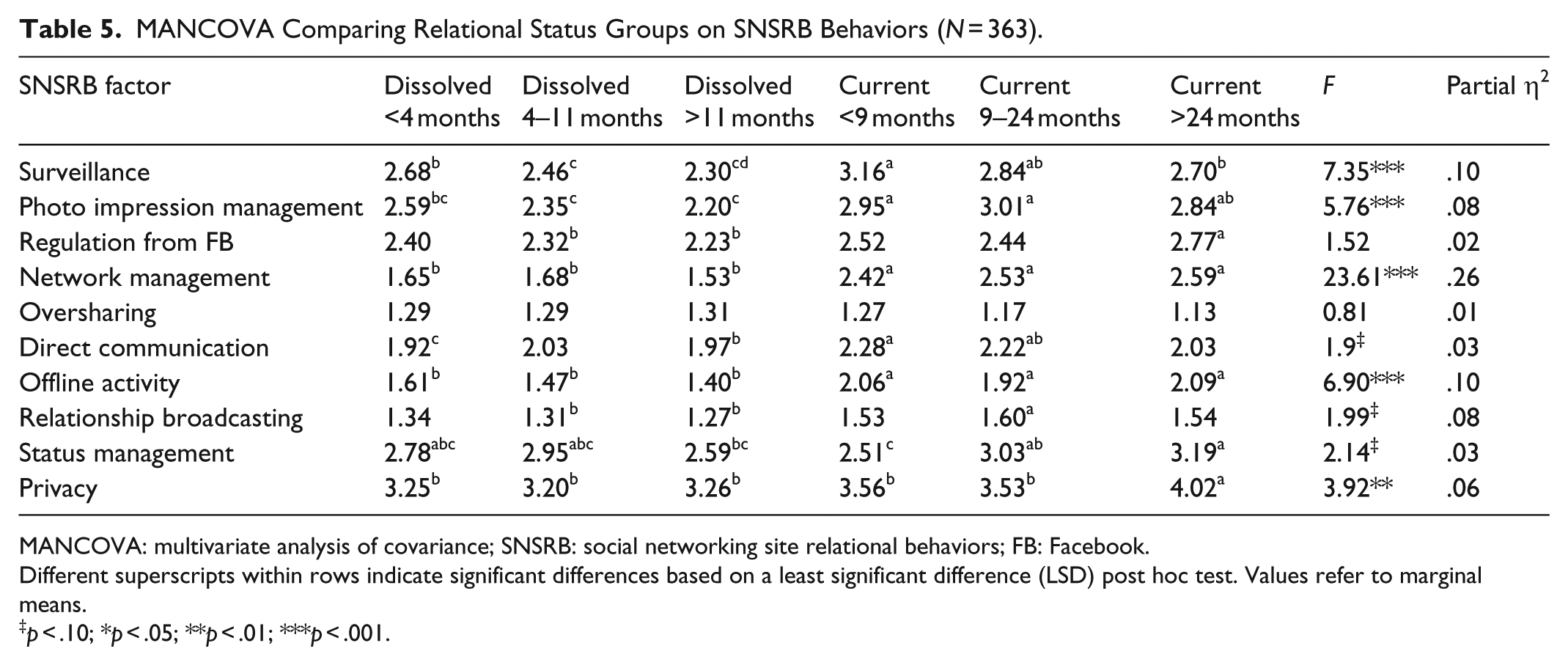
The MANCOVA revealed significant multivariate effects for relational status, F(50, 1,467.35) = 3.91, p < .001, Wilks’ Λ = .57. The follow-up analyses of covariance (ANCOVAs) revealed significant differences between relational status and most of the dependent variables (see Table 5).
MANCOVA Comparing Relational Status Groups on SNSRB Behaviors (N = 363).
MANCOVA: multivariate analysis of covariance; SNSRB: social networking site relational behaviors; FB: Facebook.
Different superscripts within rows indicate significant differences based on a least significant difference (LSD) post hoc test. Values refer to marginal means.
p < .10; *p < .05; **p < .01; ***p < .001.
Individuals reported differing frequencies of behaviors based on the status of their relationship. For instance, individuals in recently formed relationships reported the highest levels of surveillance behavior, and individuals who had been dissolved for more than 11 months reported the lowest frequency of surveillance. Also, individuals reporting on current, relatively long-term relationships reported the highest levels of status and privacy management. Overall, individuals reporting on current relationships generally reported more frequent photographic impression management, network management, and offline activities.
Discussion
This study had three goals: (1) examining the factor structure of SNSRB, (2) confirming the validity of the factors by testing the relationship between behaviors and relational quality/adjustment, and (3) exploring whether behaviors vary as a function of relational status. Results showed that SNSRB can be categorized into 10 factors including surveillance, photo impression management, regulation from Facebook, shared contact/networks management, oversharing, direct communication, relationship broadcasting, offline activity, status management, and privacy. Each factor also related to the quality of current relationships, adjustment to dissolved relationships, or the relational status. The SNSRB allow researchers to quantitatively measure these behaviors. In turn, future research can use this tool to investigate the romantic relationship lifespan and relational outcomes in online contexts, further augmenting the findings of previous research (e.g., Dainton, 2013; Fox & Warber, 2013; Tokunaga, 2011). The following sections showcase how the SNSRB may help extend theoretical frameworks related to the lifespan of romantic relationships. Relationship development is broadly conceived as relationship initiation, escalation, maintenance, de-escalation, repair, and termination (Canary & Dainton, 2003), and the associated behaviors are applicable to all stages of development included in the staircase model. Specifically, relationship developmental strategies and behaviors are multiphasic rather than uniphasic (e.g., Dindia, 2003). Thus, the same strategies can be utilized throughout the relationship. Although many of these behaviors occurred at multiple stages of relationships, we organize the patterns based on stages to illustrate how the behaviors correspond with Knapp and Vangelisti’s (2010) perspective on the development, maintenance, and dissolution of relationships.
SNSRB Across the Romantic Lifespan: The Coming Together Stages
Knapp and Vangelisti (2010) illustrated how relationship escalation occurs through five stages: initiating, experimenting, intensifying, integrating, and bonding. Initiating and experimenting accompany uncertainty, since individuals experiencing uncertainty often exhibit difficulty in deciding how to behave, anticipating their partner’s responses, and predicting what is going to happen next (Berger & Bradac, 1982). Relationship escalation is rife with uncertainty as both relationship partners try to discern romantic intentions (Knobloch & Solomon, 1999).
Technologies such as SNSs enable people to use surveillance to discern romantic intentions. In the earlier relationship stages, people engaged in more online surveillance (e.g., viewed photos, wall postings, mutual Facebook friends) as compared to more established relationship stages. Surveillance appears to be a relevant online activity during the early relationship stages. Online surveillance offers people a way to reduce or manage uncertainty by gathering information. In fact, Tong (2013) demonstrated that people who feel more uncertain about their partner also engage in more surveillance on Facebook. Indeed, this study showed that surveillance was also negatively related to partner uncertainty, indicating that individuals who were more uncertain about their partner were more likely to undertake these behaviors. People who engage in surveillance may naturally be inclined to question their relationship and have a higher chance of dissolving compared to people who engage in surveillance less often. The SNSRB offer a way to further explore how surveillance changes as relationships develop and how surveillance affects overall relational quality. Although the present discussion focuses on surveillance during the early period of the relationship, it should be noted that there is opportunity for people to engage in these types of relationship activities throughout and after dissolution.
Additionally, the SNSRB scale captured information about how people engage in impression management online and how this management may influence their romantic relationships. The results showed that managing impressions was related to lower relationship quality, although whether impression management is a symptom of the lower quality relationship (e.g., satisfaction) or both are related to a third variable is not clear from this study. As new partners begin to negotiate their shared relational identity, the present results suggest they should carefully consider how these Facebook impression management behaviors might relate to relationship quality and uncertainty.
This study demonstrates how relationship behaviors can be measured and how that may inform researchers about relational development stages. The SNSRB, surveillance, photo management, oversharing, and relationship broadcasting were all negatively associated with one or more relationship quality indicator.
SNSRB Across the Romantic Lifespan: The Integrating Stage and Beyond
People in current relationships spent more time including their partners’ friends and family members and interacting with them in their online networks than people in dissolved relationships. This behavior mirrors Knapp and Vangelisti’s (2010) integrating stage, in which partners work to fuse their lives and friends with that of their partner and their partners’ social networks. SNS research found that friends, family members, and other SNS connections have a sizeable influence on the romantic relationship’s success (e.g., Felmlee, 2001; Parks, Stan, & Eggert, 1983). Moreover, the infrequent behavior use by partners reporting on dissolved relationships matches the avoiding stage. In this stage, partners work to actively avoid their dissolved partner. This study found that people use Facebook to facilitate these network connections in their relationships.
In particular, management of Facebook relationship status was a sign of relationship connectedness in terms of closeness, commitment, and satisfaction. When comparing short- and long-term relationships, the latter reported higher status management. In addition, the relationship length was positively associated with status management. These results may reflect the significance of going “Facebook official” (Fox et al., 2013). People who manage their status may be attempting to demonstrate their commitment and a belief that the relationship will endure—which is a critical turning point in developing relationships (e.g., Baxter & Bullis, 1986). Hesitance to update a Facebook relationship status may represent uncertainty about the relationship state, and indeed status management is negatively related to relationship uncertainty in this study.
SNSRB Across the Romantic Lifespan: Coming Apart
Technology provides an additional means for people to display their breakup experiences to their social networks, and this study shows both the nature of those social behaviors and how those behaviors relate to adjustment. Several SNS behaviors were negatively related to post-breakup adjustment. Similar to Lukacs and Quan-Haase’s (2015) findings, people who undertook surveillance of their ex-partner tended to have a difficult time recovering from their breakup. Additionally, frequent use of photo management behaviors negatively related to post-breakup adjustment. People may still be trying to make sense of why the breakup occurred and the management of photos may reflect this process. Behaviors such as the removal of wall photos with partners help shift identity back to a state of singlehood rather than couplehood (LeFebvre et al., 2015). During the breakup, people may remove or manage photos to indicate that their identity or connection to their relational partner has changed. Similarly, Knapp and Vangelisti’s (2010) model articulated that people engaged in differentiating to deemphasize the similarities between themselves and their dissolved partner. The removal of photos may function as a way to clean up memories of the partnerships and make way for new relationships to develop. Overall, the decision to include or not include photos on SNS provides researchers a snapshot of the process of coming apart.
Additionally, this study revealed a negative relationship between oversharing and breakup adjustment. The de-escalation stage model posits that during breakups individuals work to actively emphasize the differences between themselves and their partners. Posting negative information about their partner or relationship in a public or semi-public context serves as an online example of differentiating, and the relationship between lower breakup adjustment and oversharing may be indicative of individuals moving through the differentiating stage.
Theoretical Implications
Relationships tend to progress and deteriorate in stages. Although the extant research on relational stage models (e.g., Knapp, 1984; Rollie & Duck, 2006) has outlined the processes that individuals progress through as they enter into and exit out of romantic relationships, few studies have derived or empirically measured specific behaviors based on these models (see Atvgis et al., 1998, for one exception) to enable prediction. Researchers have recently begun to extend these models to understand online behavior using qualitative methods (e.g., Fox et al., 2013; LeFebvre et al., 2015), and this study initiates the first step in quantitatively measuring relational behaviors in the SNS contexts.
In particular, this study highlights that SNS behaviors differ as relationships progress through different stages. The derived behaviors linked to the overall quality of current relationships, as well as the individuals’ adjustment to ending their dissolved relationships. Additionally, this study offers a lens for how SNSs operate across the relationship lifespan. That is, by looking at all of the stages, these findings provide a better sense of how these behaviors might be differentially beneficial or obstructive depending on the stage of the relationship. Ultimately, this study looks at the relational lifespan holistically, which reveals that online behaviors have the opportunity to happen at multiple stages of the relationship.
Limitations and Future Directions
Although the Knapp and Vangelisti (2010) relational stage model examines communication and relationship change over time, this study did not directly measure the current relationship stage. Indeed, Knapp and Vangelisti (2010) asserted that few studies have directly measured relational stages (or, subsequently, categorized participants based on their relational stage). Performing a longitudinal study would expand the direction of this current research to include a more intricate look into how technology is used by people over the lifetime of their relationships.
Direct communication, such as using the Facebook chat functions or messaging features, was the only factor that did not relate to some aspect of relational quality or post-breakup adjustment. However, these findings are consistent with previous work by Vitak (2014), who found that directed communication via Facebook was more beneficial for weak-tie connections (such as casual friends) than strong-tie connections (such as the romantic relationships examined in this study). In examining logs of actual Facebook behavior, Burke and Kraut (2014) revealed that passive consumption of social information within the site was just as strong a predictor of relational closeness as direct communication. Although this study and the aforementioned research call into question the role of direct communication via Facebook in close relationships, future work should apply the SNSRB measurement to examine casual friendships and acquaintanceships to further assess the direct communication factor’s overall applicability and relevance.
The exploratory nature of this work should also be considered carefully. The measures employed capture broad connections between types of Facebook experiences and relationship variables. Future research that expands and explicates each of the factors uncovered in this study will allow a clearer picture of how specific behaviors contribute to relational factors not examined in this study.
Additionally, this study focused on behaviors that occurred on Facebook. However, since many behaviors also occur on other SNSs, such as Twitter and Instagram, future research can utilize and adapt the items created for this study when investigating other SNSs. Additionally, this study only investigated correlations between relational outcomes and the SNSRB items as a method for assessing convergent validity. Future research can build on this work by using either the entire SNSRB measure or select factors from within the SNSRB for assessing other aspects of relational development, maintenance, and dissolution.
Moreover, the relationships uncovered between the SNSRB items and relational outcomes are likely moderated by other factors, such as attitudes toward online communication (e.g., Ledbetter & Mazer, 2013). Future studies should further investigate how individual dispositions and beliefs might interact with online behaviors to affect relational outcomes.
The exploratory nature of this work should also be considered carefully. The measures employed capture broad connections between types of Facebook experiences and relationship variables. Research that expands and explicates each of the factors uncovered in this study will allow a clearer picture of how specific behaviors contribute to relational factors not examined in this study. For instance, one important line of research would be to use the SNSRB items to strengthen knowledge about different age groups experiencing the development of a relationship and the SNS-related behaviors that take place during those stages. This study focused on a collegiate sample, which is consistent with most of the samples cited in the literature review; however, this choice limits the overall applicability of the findings.
Conclusion
Researchers have long acknowledged that romantic relationships are dynamic, constantly undergoing changes and transitions that reflect the underlying behavioral and communicative dynamics of the relationship. While much work has examined these processes in the offline environment, this study sought to address recent calls for more empirical, descriptive research into communication across the relational lifespan (i.e., relational development, maintenance, and dissolution) in online environments (Parks, 2009; Walther, 2011). People engage in a wide array of online behaviors as part of their current and dissolved relationships, and those behaviors are tied to the quality and adjustment as well as stage of romantic relationships. By their very nature, relationships evolve over time, and this study uses existing models to more explicitly illustrate the intersection between interpersonal communication theory and SNS relational activity.
Footnotes
Acknowledgements
The authors would like to thank Nicholas Merola for his assistance on an earlier version of this manuscript.
Declaration of Conflicting Interests
The author(s) declared no potential conflicts of interest with respect to the research, authorship, and/or publication of this article.
Funding
The author(s) received no financial support for the research, authorship, and/or publication of this article.