




Abstract
This article examines current appropriations of social media by activists of the radical left in Greece and Sweden. Previous research has shown that the discourse concerning social media’s empowering potential is embedded in commercial values that contradict the value systems of many activists who engage in struggles against the current economic system. We employ the notion of détournement, which describes how social movements turn something aside from its normal course or purpose. Based on interviews and online ethnographic observations, we seek to understand how and with what consequences social media facilitate and limit collective action. The article enhances our understanding of activists’ social media use by turning our attention to the sociotechnical impact of social media on collective action initiated by leftist groups as well as the relationship between ideological loyalties and the political economy of corporate social media.
Introduction
Activists on the radical left have a long tradition of appropriating media technologies, divorcing them from their corporate originators, and reinventing media’s uses in ways not intended by their designers (Croeser, 2014; Rodríguez, Ferron, & Shamas, 2014). They make intensive use of media technologies to mobilize civil society across the political spectrum, organize protest, enable counter-information, and communicate a cause. The use of technology in radical action can nevertheless prove contradictory, particularly when acting in civil disobedience. A scene from a street protest in Sweden (see Figure 1) provides us with a good example: Policemen are acting violently toward a young woman. Several activists are standing nearby, filming and photographing the scene on their mobile phones but not helping their fellow activist. They are more inclined to become part of the media “spectacle” (Debord, 1983) by uploading scenes of police violence on social media than they are to seek to rescue their comrade. Nevertheless, making police violence visible online via mobile phones can facilitate an alternative perspective that mainstream media might not broadcast. Using media technologies alters the ontology of protest in controversial ways.

Video still of protest scene in Sweden.
Activists’ social media use can result in digitized acts of dissidence as well as (im)material alliances of humans and nonhumans against injustice (cf. Papadopoulos, 2011). Using empirical examples and previous research (such as Metropolitan Sirens, 2011), this article conceptually explores potentials to and limits of activists’ tactics for appropriating and configuring corporate social media. Social media are understood as online media in general (since all media can be considered social; see Papacharissi, 2015), but the problematic relationship emerges due to their corporate influence, through which the term “social” “obscures the unpleasant truth that ‘social media’ is the takeover of the social by the corporate” (Baym, 2015, p. 1). Activists’ extensive use of corporate social media (such as Twitter, Facebook, and YouTube) has controversial consequences for collective action. How does the cyber-materiality of social media facilitate as well as limit collective action? How can activists avoid their message being hijacked by corporate social media and instead lay claim to these media in acts of resistance?
We conceptualize activist claims to social media by employing the notion of détournement. Détournement derives from the work of the Situationists International and describes the process of turning something aside from its normal course or purpose (Knabb, 2006) and turning “expressions of the capitalist system and its media culture against itself” (Holt & Cameron, 2012, p. 252). Détournement does not refer to a holistic idea that can only be effectively performed on a macro-scale. In this article, activists mobilize détournement to research provisional (re-) appropriations of social media. Based on the concept of détournement and Debord’s (1983) notion of the “spectacle,” we advance an analytical framework of cyber-material détournement that takes into account the underlying normative perspective on social media, the political economy of social media, and social media’s relevance as a nonhuman agent in political resistance. We define the latter as “cyber-material agency,” that is, sociomaterial alliances between activists, computers, the Internet, transmitters, and receivers of information, web platforms, and mobile phones. The concept of cyber-material agency not only deepens our understanding of the complex interactions between human and nonhuman entities in the performance of (material–digital) resistance but also captures how this hybridity re-orders (detournér) activism, the spatiality of protest, and the political economy of corporate social media.
A Short Note on Epistemology and Methods
Conceptual inquiry based on détournement transcends mere academic interest or representational logic regarding research. This article’s epistemological tenets aim to radically reinterpret, destabilize, and circumvent forms of state repression and economic power through use of social media. Inspired by Haraway’s (1988) “situated knowledges” and May’s (1994) “situated freedom,” the researcher’s task is to be neither an avant-garde translator, a representative of activists, nor the producer of a standpoint theory or hierarchy of truths. We advocate scholarship that supports or stimulates social action and change (Woodhouse, 2005). Through politically engaged research, the researcher provides analyses to the social groups alongside which they struggle (May, 1994).
This kind of scholarship is intended as part of the struggle that activists perform and the alternative created through the conceptual lens of détournement. There is a methodological logic to studying activism in close cooperation with activists and building upon a participatory approach to avoid reinventing the wheel (Rodríguez et al., 2014). Nevertheless, following Galis and Hansson (2012), cooperating with activists does not imply dogmatism or uncritical acceptance of activists’ beliefs and social media practices (see Gillan & Pickerill, 2012). Instead, it entails applying a methodology that spurs reflection concerning the media themselves relative to the established practices under investigation.
Accordingly, this article’s empirical examples involve web-based observations of specific social media sites and platforms (Facebook, Twitter, Indymedia), discussions with activist collectives, and online interviews (three with activists from Greece and two with activists from Sweden) conducted between 2013 and 2015. 1 Seeking interventions methodologically compatible with our epistemology, we employ data from web-based interviews with activists who participated in both configuring the research questions and reflecting upon their experiences. We have sought empirical evidence from a “ground-level” view of the activists (Gerbaudo, 2012). Interviews were conducted by sending written, reflection-oriented questions to activists who had been identified through one author’s previous engagements with social movements and online activist collectives. Activists submitted their responses by e-mail, and the contents of these responses were then anonymized and analyzed. Similarly, we gained access to web-based platforms and conducted observations with the consent and feedback of activists. The presentation and analysis of interview and online ethnographic data are supported by previous research (such as Giovanopoulos, 2011; Metropolitan Sirens, 2011; Schierup & Ålund, 2011; Schierup, Ålund, & Kings, 2014).
Resistance and Social Media: A Complicated Marriage
Activists have always built alternative media in hopes of counteracting the commercial influence of mainstream media and creating a space for civil society (Atton, 2004; Downing, Villarreal, Gil, & Stein, 2001; Fuchs, 2010). There are, however, many challenges involved in building these alternative spaces using corporate social media. Poell and Borra (2011) note that for “crowd-sourcing alternative reporting,” the content of tweets is framed by mainstream news reporting to produce visibility. Similarly, scholars have argued that violent action frames often dominate not only the news media but also social media reporting by activists to produce visibility (Cammaerts, 2012; Truscello, 2012). Leistert (2015) notes that corporate social media have become “algorithmic mass media,” using censorship through algorithms as a normalization and standardization tool for activists’ communicative action. This silencing of critical voices beyond the dominant violent action frames reinforces the neoliberal values in which both mainstream and corporate social media are embedded (Couldry, 2010). The shaping of activist communication around spectacular, news-oriented reporting shifts focus from the actual protest (Poell & van Dijck, 2015).
Media presence has an effect on “virtually every aspect of a challenger’s experience—recruitment efforts, organisation, strategy, and tactics” (Gamson, 1992, p. 147). While social media may play an important role in creating visibility for counter-information, this visibility could also become subject to surveillance and control by hostile authorities (Mercea, 2011; Neumayer & Stald, 2014; Zajácz, 2013). The ambiguity of being in the spotlight to create awareness and being exposed to a high level of risk is one aspect of a gray zone between radical forms of collective action and social media.
Moreover, the liberatory technological discourses, which became embedded in the corporate identities of social media companies such as Google and Facebook (Turner, 2006), create contradictions for activists. Social media and other tech companies recuperated ideas of the radical left, such as participation, decentralization, spontaneous interaction, and lack of discipline and hierarchy (Žižek, 2009). The discourse about the empowering potential of social media embedded in commercial values, however, contradicts the value systems of many radical left activists, who struggle against the current economic system. This creates a paradox for activists’ radical identity when using social media in their struggle and can create frictions within radical groups. This contradiction leads to an ambiguous attitude among activists toward the technology, which can outweigh the advantages of enabling rapid dissemination of alternative political perspectives and mobilization of civil society (Rodríguez et al., 2014; Svensson, Neumayer, Banfield-Mumb, & Schossböck, 2015).
Based on an analysis of the political economy of the media industry, Sandoval (2014) argues that rather than being social (as asserted in their corporate social responsibility statements), social media companies exploit labor and “are feeding on the commons of society” (p. 252). From a political economy perspective, social media recuperate activists’ ideas as well as their production of social media content, which contributes to the social media industry’s corporate power instead of challenging it. Consequently, radical and anti-hierarchical political projects demand creative and inventive appropriation of social media to turn them into agents of political change.
In this study, we employ the concept of cyber-material détournement to inquire into the creative and inventive appropriation of corporate social media in combination with alternative social media to counteract the media spectacle and struggle against authorities. This article seeks to depict instances of media, urban, political, and discursive appropriations stemming from the interaction of social media and activists’ practices. Cyber-material détournement describes self-organized assemblages of humans and nonhumans, which not only participate in politics of justice but also contribute to their making by appropriating corporate social media. Rather than inquiring into large-scale effect, the notion of cyber-material détournement addresses activists’ situated social media tactics, bearing in mind the aforementioned contradictions.
Becoming Part of the Spectacle?
How can activists avoid contributing to a shallow aesthetization of radical struggle and recuperation by the (social) media spectacle they seek to resist? The media spectacle, Debord (1983) argues, results from the replacement of social life by its representation, mediated by images:
It [the spectacle] is not a mere supplement or decoration added to the real world, it is the heart of this real society’s unreality. In all of its particular manifestations—news, propaganda, advertising, entertainment—the spectacle is the model of the prevailing way of life. (Debord, 1983, Thesis 6)
Subversive ideas have no direct access to the public but must pass through the spectacle, where they—through the process of “recuperation”—are trivialized, de-radicalized, and communicated back into society as mainstream. Critical theorists of media further argue that news broadcasting manipulates citizens by determining what is important and newsworthy (Herman & Chomsky, 2002). This perspective goes beyond cultural hegemony and instead stresses the political economy of media as an important analytical element. Consequently (based on the previous section), activists can be recuperated by the spectacle in two ways: from a cultural perspective, in the form of their radical ideas, and from a political economic perspective, as unpaid labor for the social media industry through the content that they produce. Despite the risk of being recuperated by the spectacle, we argue that social theory, action research, and activists themselves need to be able to analytically grasp and conceptualize social media’s potential for radical action.
A Cyber-Material Détournement
What role do social media play in our initial example of activists recording police violence? A linear approach, which ignores relationships between human actors and technology (both material and digital), creates important gaps in the analysis. In his critical theory of technology, Feenberg (2002) focuses on human agency, arguing that technology reinforces the prevailing political system’s hierarchies and power relations. However, Feenberg argues, technological invention also provides new possibilities for subversive actors, who can challenge the system by appropriating new media technology for their cause. A critical analysis of technology must “be balanced by description of what people actually do in practice” (Mackenzie, 2006, p. 458), requiring us to open the black box of the materiality of social media “as active agents shaping the symbolic and organizational processes of social actors” (Milan, 2015, p. 897).
A key theoretical and methodological tenet of this article is the ascription of analytical symmetry to human and nonhuman actors, recognizing the role of technological systems and artifacts in constituting action (Latour, 1988). After all, humans often delegate their actions, decisions, images, and propaganda to (im)material technologies, which act as mediators, contributing to and participating in cyber-material activity (Hands, 2011). This results in complex relationships, negotiations, interactions, and effects between human and nonhuman entities (Callon & Law, 1995), necessitating an analytical space in which nonhumans (including particular technologies and technological systems) influence the performance of activism and vice versa. While activists are endowed with ideologies, strategies, and intentions, digital activism would be impossible without the existence of information and communications technologies (ICTs) since social media configure and perform activism.
We treat social media as political machines (Barry, 2001), which not only constitute an alternative to corporate media but also perform techno-political activism. Our approach differs from the agnostic Latourian thesis inasmuch as there is always a source and intention behind any broader action, agency, and principle (cf. Hands, 2011, p. 94). That is, by engaging with social media, activist collectives of the political left contribute to reweaving the political and the material by creating common spaces in which action can take place to confront injustice and repression as well as to establish alternative lifeworlds of material justice (cf. Papadopoulos, 2011). Consequently, we pay both epistemological and ontological attention to the structural hindrances to and enablers of social media, their political economies, and their cyber-material agencies.
We introduce the concept of “cyber-material détournement” in order to conceptually portray the situations in which social media are effectively used by activists of the radical left and to acknowledge the role of nonhuman agency in constituting political activism. As the revolutionary counterpart to recuperation, détournement aims to divert “the spectacle’s language and imagery from its intended use” (Downing et al., 2001, p. 59) and turn the capitalist system’s popular expressions against itself (Knabb, 2006). Détournement is thus the subversion of mediated images, texts, and symbols of the commodified and over-mediated spectacle. In social media, we argue, this process transcends images and texts, including algorithms and the logic of social media platforms as well as the materiality of protest. Cyber-material détournement refers to alliances and conglomerations of activists and cyber-material actors that not only perform radical politics but also reconstitute the ontologies of political participation and organization. Activists’ social media tactics alter the materiality of protest in terms of activists’ communication and mobility patterns and the performance of activism in urban settings. As the empirical examples show, social media provide for exchange of important information among activists, facilitation of discussions regarding ideological questions as well as purely practical issues, and coordination of action on the streets.
Narratives From Greece and Sweden
This article’s empirical examples cover two cases of activist social media use. First, Greece has been in the eye of the global financial storm since 2008 and has become a site of violent protest events and solidarity actions. Radical left groups and collectives have organized and covered major propaganda campaigns, mobilizations, and anti-austerity protests between 2008 and the present through corporate social media such as Facebook and Twitter as well as alternative social media such as Athens Indymedia. Second, the “Legal and Effective Execution of Policy” (Rättssäkert och Effektivt VerkställighetsArbete (REVA)) is a Swedish police project to check citizenship identification at subway stations and other transport hubs, with the aim of arresting and deporting undocumented immigrants. Local activist movements used social media to spread awareness of urban injustice and structural explanations of the REVA project’s controversial nature. Sweden came out of the 2008 recession more favorably than most other European countries (Schierup et al., 2014), yet despite its relative financial stability, Sweden’s economic and migration policies have undergone a radical transformation, leading to a deep crisis for the Swedish socioeconomic model (Schierup et al., 2014). Unlike the lengthy chain of actions in Greece, the Swedish case can be illustrated through specific events.
The tactical resistance to police power through social media in Sweden thus complements our findings from the ongoing use of social media in anti-austerity protests in Greece. Various studies have considered how social movements mobilize against austerity and perform extra-parliamentary politics through social media (see della Porta & Andretta, 2013; Postill, 2013), usually focusing on Europe’s crisis-ridden south. This article’s empirical examples provide insight into social media use by European social movements in locations under various socioeconomic conditions and political trajectories before, during, and after the crisis. This allows us to build a rigorous understanding of the particularities and commonalities of how social movements use social media across national contexts and across consequences of the crisis. The two cases provide us with both perspectives: long-term social media use for identity formation, documentation, organization, and coordination in a large wave of protest events and a particular action based on social media platforms, such as Twitter, Facebook, and blogs.
In the following, we trace the narratives of activist collective social media use for resisting the consequences of anti-austerity measures in Greece and the REVA project in Sweden. The narratives are introduced with the potential that social media offer for radical collective action, reach their turning point by outlining the risk and appropriation of social media, and conclude with the possibility of détournement for conceptualizing controversial social media use by activists of the political left.
Greece: From Alternative to Corporate Social Media
Leftist groups in Greece are familiar with the use of social media. This is due to two major incidents: the launch of Athens Indymedia in the early 2000s and the events following the assassination of Alexandros Grigoropoulos in 2008. The Indymedia project originates from the broad mobilizations against the World Trade Organization (WTO) in Seattle in autumn 1999, in which activists aimed to provide a physical work area and a corresponding website from which media makers could cover the planned demonstrations. Since the mobilizations against the WTO in Seattle, the Indymedia project has spread to over 130 locations (Halleck, 2003). In Greece, the idea of creating a local Indymedia website dates back to 2001, when a group of Greek activists traveled to Genoa, Italy, to join the demonstrations against the 27th G8 summit. On their way back to Greece, they conceived the idea of starting a similar project (interviews with activists in Greece, January 2015 and July 2015).
In November 2001, Indymedia websites were launched in Athens and Thessaloniki (see Figure 2). The first years of Athens Indymedia were experimental. As the site gained increasing attention from anarchists and leftists, mobile phones, cameras, and computers turned into informal counter-information weapons. Internationally, activist practices have become dependent on mobile communication (Hands, 2011). By uploading texts, videos, and images to Indymedia, activists integrated all of these devices into the hybrid arsenal of political activism. Indymedia became a platform that instantly mediatized radical left activity, altering the media norms in Greece. Breaking the mainstream media vow of silence regarding police brutality, racist attacks against immigrants, and the actions of leftist groups, Indymedia became a point of reference not only for activists but also for a broader audience with little or no connection to activism (Metropolitan Sirens, 2011).
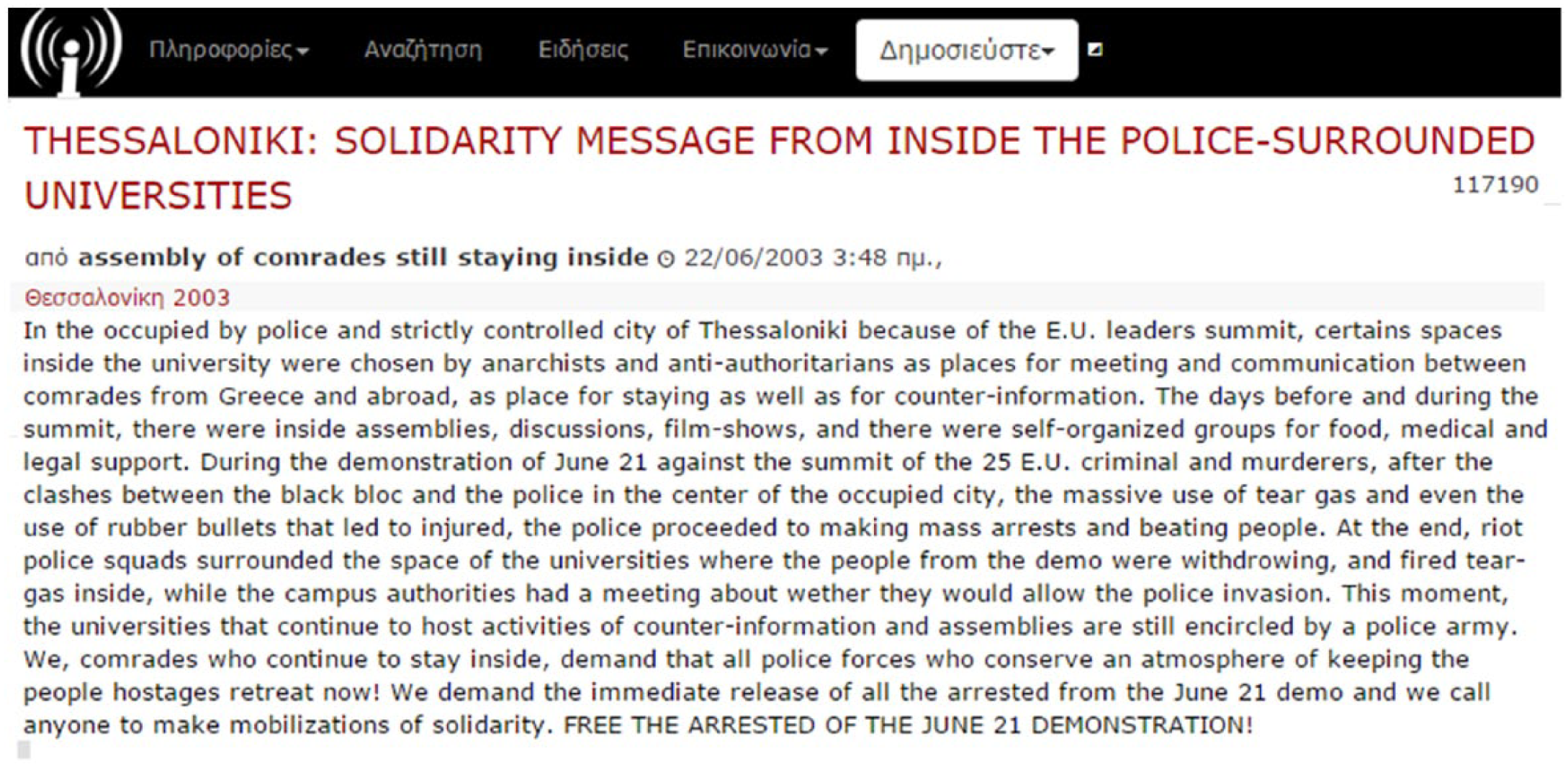
Solidarity call on Indymedia during the Thessaloniki EU summit in 2003.
Although the use of alternative online media platforms did not transform social movements, corporate social media started to enter into the material practices of activist collectives and helped diffuse new subtleties of activism (Juris, 2012, p. 260). In December 2008, the killing of a 15-year-old boy by a Greek police officer set off forceful social unrest across the country for almost a month. With Athens as the epicenter of the revolt, thousands of youngsters and activists participated in mass demonstrations, which in many cases turned into violent clashes (Milioni, 2012). These mobilizations disturbed the normalcy of urban life and altered the media coverage of protest in Greece. Social media, including Indymedia as well as corporate social media such as Twitter (see Figure 3) and Facebook, became important as sources of (counter-)information and challenges to the “in-line-with-the-state” mass media, as a new antagonistic subject:
School students would mainly text each other or use Twitter and Facebook, sending messages from friend to friend as if it were from mouth to ear. Social network platforms, which are mainly associated with the abuse of privacy, served as political communication nodes. Mobile phones also proved to be a powerful tool since they connect separate networks of people (i.e. contact lists) quickly and with no outsider intervention [. . .] The ventures that sprang up back in those days—regardless of how long they lasted—would set up a blog and an e-communication channel (email, forum) and quickly network with “sibling” e-ventures. Counter-information in December was decentralized and helped decentralize action in return. Each occupation became a counter-information hub and all these initiatives came together both on the streets and on the internet, in the form of links. This enabled networking and the possibility for a massive exchange of information. (Metropolitan Sirens, 2011)

First tweet about Alexis Grigoropoulos’ assassination in Athens.
The December 2008 revolt left an important legacy for the use of alternative and corporate social media in Greece. The digital alternative media structures significantly questioned and degraded the monopoly of mainstream media as news broadcasters (interview with activist in Greece, January 2015). A wide segment of the population, including non-activists, came in contact with activist media and counter-information practices at the dawn of the financial crisis. Before and during the revolt, Indymedia was key not only to the radicalization of the media landscape but also to a concrete cyber-material shift (détournement) in the performance of the protest. Digital practices established in Indymedia (such as counter-information about demonstrations, warning systems for police movements, and calls for action) were disseminated across corporate social media and had a direct impact on material and spatial practices. By appropriating corporate social media, protesters created temporary autonomous islands in an urban sea of police repression.
This development was a catalyst for media visibility, the operation of anti-austerity mobilizations, and the dialectic of information/footage production and urban protest events. The financial crisis challenged the foundations of the sociopolitical system, pushed the country into one of the deepest post-war recessions, and ignited widespread street protests against the political establishment. The crisis also marked an intense cyber-material struggle on both alternative and corporate social media as well as the launching of novel forms of political action (cf. Cammaerts, Mattoni, & McCurdy, 2013): recording police action, spreading tactical information, and calling for international solidarity through corporate social media. Giovanopoulos (2011) claims that the appropriation of corporate social media by activists during Greece’s anti-austerity protests in 2010–2012 shaped a new era of social movements’ political communication and influenced mobilizations for subversive social change across Europe.
From May 2010 to the present, a number of general strikes have taken place in Greece, and the indignados movement that occupied Syntagma Square in front of the Greek parliament in central Athens emerged. Similar to the indignados movement in Spain, horizontal communication through corporate and alternative social media turned the movement into a cyber-material event (Postill, 2013). Appropriation of social media played an essential role in organizing strikes, protests, and occupation of squares by indignados (which was the product of a spontaneous Facebook call; see Sotirakopoulos & Sotiropoulos, 2013). The indignados movement and the occupation of squares aimed to build political justice, both digitally in corporate social media (which up to that point had been dominated by right-wing rhetoric) and materially into the fabric of the city (see also Sotirakopoulos & Ntalaka, 2015).
A number of corporate social media, such as Facebook groups (General Strike Now!, indignados in Syntagma Square, Direct Democracy Now!, Europeans Against the Political System, Sunday School for Migrants); Twitter accounts and hashtags (@dromografos, @antireport, @98fm, #rbnews, #Syntagma, #antireport); alternative blogs and media collectives (Athens Indymedia, Radiobubble, Occupied London—irregular updates from the streets of Athens); and the official website of Syntagma Square combined to form a hybrid cyber-material landscape that performed subversive politics, spread resistance through police movement warning systems, coordinated actions, and spread information, images of struggle, and calls for international solidarity.
The anti-austerity mobilizations during this period represented the most recorded protests in the history of civil action in Greece (Giovanopoulos, 2011) due to activists’ use of corporate and alternative media. Suggestively, according to trending.gr and Monitor (a social media monitoring search engine), 6 out of the 10 most popular hashtags in the Greek Twittersphere for the year 2014 were activist hashtags. Twitter in particular reflected the Greek situation, with tweets addressing the austerity measures imposed by the Troika and calls to boycott the state-censored mainstream media (Theocharis, Lowe, van Deth, & García-Albacete, 2015). The indignados movement in Greece connects to a larger movement across Europe, which shows grievance and resistance to crisis politics, austerity measures, and general dissatisfaction with the corrupt political system (Hughes, 2011) as well as to the global wave of struggles, including the so-called Arab Spring and the Occupy Movement (della Porta & Andretta, 2013; Sotirakopoulos & Sotiropoulos, 2013; Theocharis et al., 2015). This appropriation of corporate social media was accompanied by a strong presence of subjects of resistance in the material urban environment, resulting in cyber-material struggles such as class wars, protests of the precariat, and anti-austerity mobilizations.
Sweden: The Fallen Paradise
The Scandinavian periphery of the crisis has been relatively spared (Lapavitsas, 2010). In Sweden, however, the crisis occasioned major political struggles over the meaning and future of the so-called “Nordic welfare model.” The crisis served as a pretext for rolling back public spending and privatizing social services. While Sweden may not have experienced openly violent manifestations similar to those ravaging the streets of major cities in Greece, the Scandinavian countries have in recent years become an important propaganda base for online political organization (Boréus & Hübinette, 2012). Sweden has undergone a comprehensive restructuring of its economic and social migration policy.
The country shifted from an exceptionally positive brand of a liberal multicultural welfare state to a neoliberal experiment focusing on urban policing (mainly targeting immigrants), the corrosion of citizenship, and the structuring of inequality in society (Schierup & Ålund, 2011). This was also made visible through a landmark: the launch of the Legal and Effective Execution of Policy (REVA), a police project to check citizenship identification at transport hubs with the aim of deporting undocumented immigrants. The broadening of REVA’s regional range to Stockholm in January 2013 was seen by some as a step toward setting up a “police state” and gave the impression of a country in crisis, which was more about economics than immigration and more about social inequality than culture (Schierup et al., 2014).
A combination of these tensions provoked widespread mobilization and networking, which even in this case have linked urban protests with corporate social media practices and groups (Facebook: REVAspotter, Riv Ner REVA, Gröna Linjen mot REVA, Motaktioner mot inre gränskontroller i tunnelbanan, Ta tillbaka välfärden; Twitter: REVAspotter, @Researchgruppen, @AMDStockholm, #svpol; blogs of local and national political organizations: Gröna linjen mot REVA, Aktion Mot Deportation) and national alternative digital media (motkraft.net, socialism.nu).
Use of corporate social media as virtual platforms represented a core element of activists’ practices in enacting resistance to the implementation of the REVA identity checks in Stockholm. These platforms included both open virtual platforms that were publicly accessible (REVA Spotter Stoppa T-banepolisen [Figure 4], Riv Ner REVA, Gröna Linjen mot REVA [Figure 5], Motaktioner mot inre gränskontroller i tunnelbanan) and closed 2 virtual platforms with restricted access. Some of these platforms were organized in ways that followed the configuration of metro routes, using these routes as an organizing principle for mobilizing specific groups of travelers, as in the Facebook accounts “Red Metro Line against REVA—stop hunting immigrants without papers,” “Green Metro Line against REVA,” and “Blue Line against REVA.”

Screenshot of REVA Spotter Stoppa T-banepolisen Facebook page.

Screenshot of Green Metro Line against REVA Facebook page.
The platforms explicitly targeted people who lived or worked along these routes. Activists appropriated corporate social media perhaps most strikingly as virtual tools to configure and spread real-time warning systems about the whereabouts of police controls as a means of alerting travelers as to when, where, and how the police were conducting identity checks in Stockholm’s urban environment. Activists appropriated corporate social media (détournement) to create unregulated alternatives within an authoritative polity and a heavily surveyed transport infrastructure, configuring emergent hybrid assemblies of both cyber and material entities. Examples of appropriated platforms that were primarily used for this purpose were the Facebook account “Reva Spotter stop the metro police” and #REVAspotter on Twitter (Figure 6). The Facebook account describes its focus and activities as follows:
Report on the location and time for the police ID check and help save people from persecution. [We are] (a) tool, a manifesto, a network, and a peaceful resistance against a police method that is a result of the REVA project. Even if the police leave the public transport system, the police patrols still have their shameful task of persecuting and taking the freedom of undocumented migrants. Through joint efforts, we try to facilitate the public’s ability to intervene and challenge/question as well as to warn about these controls. (REVAspotter, 2015)

Screenshot of REVAspotter Twitter account.
The counter-surveillance movement against REVA demonstrates a concrete appropriation of social media to resist anti-immigrant policing. This movement appropriates the pre-emptive social media surveillance techniques of authorities to turn them against police by employing pre-emptive counter-surveillance of police strategies (see Elmer & Opel, 2008). To fully understand these appropriations, including their limitations, we must consider the cyber-materiality and political economy of corporate social media and how these affect activists’ struggles.
The Limits of Appropriation: Materiality and Struggle
Despite extensive use of digital platforms, several activists express a reflexive and sober stance toward corporate social media, noting the limitations, risks, and dangers that these media imply. Discussions within activist collectives address the use of corporate social media versus empowering alternative digital media (such as Athens Indymedia). A number of activists are skeptical of the creation of both symbolic and actual surplus value for corporations such as Facebook and Twitter (interviews with activists in Greece; June 2014, January 2015, July 2015) through their use of these products. They consider the use of corporate social media to be a trap for social movements. According to this view, the act of using “expressions of the capitalist system and its media culture against itself” constitutes an illusion that eventually increases social media consumption since “bad publicity is also publicity.” This has cyber-material consequences: The exposure of activists to unsafe digital environments weakens the role and impact of self-organized and decentralized activist media, such as several counter-information projects that arose following the December 2008 revolt (interviews with activists in Greece; June 2014, January 2015). There are recorded cases of activists being arrested due to poor digital safety measures (Kathimerini, 2013), which shows that cyber détournement can turn into a material nightmare for detained activists.
Even in the case of REVA in Stockholm, where corporate social media played a crucial role in countering spatial surveillance, activists maintain a critical perspective:
I am rather skeptical of the perspective that technology gives power and undermines power structures. It depends on how the technology is used, in what context, and for what purpose. (Interview with Khalifa, June 2013) I wouldn’t say that our use of technical tools gives us a power advantage. There’s a danger in relying on these tools, which can also lead to passivity [. . .]. We also need to be aware of the risks of using them—it’s unnecessary to exchange sensitive information in open networks. (Interview with Maria, June 2013)
The activists Khalifa and Maria express major concerns regarding safety and accessibility. Corporate social media, despite extensive détournement by activists, remain embedded in corporate structures and through their inherent algorithmic logic follow a mainstream form of reporting (Milan, 2015; Poell & van Dijck, 2015) that is under the full control of state authorities and corporations. Activists express fear as to how the cyber-material infrastructures of corporate social media recuperate their lives, as they can constrain and enable, formulate and challenge hierarchies, and shape and be shaped by political action (cf. Beer, 2009). Moreover, appropriations of cyber-material networks (such as activist Facebook pages or Twitter accounts) are never stabilized or standardized (cf. Star, 1991). Do immigrants without papers have access to smartphones or ICTs in general, allowing them to acquire information by activist digital media warning systems? How does the essential need for secrecy among activists influence the impact and spread of solidarity actions for immigrants without papers? These are only some of the critical questions that we need to ask about the cyber-material détournement of social media technologies in political resistance.
Additional critical questions by activists deal with the prohibition of anonymity on corporate social media, new policing practices through technologies, campaigns by authorities, and tactics that work against advocates of democracy due to the design and governance of corporate and profit-seeking social media (cf. Youmans & York, 2012). The interviews in Greece and Sweden suggest that it is crucial for alternative media to maintain a critical stance in order to provide a genuine alternative to the mainstream in interaction with social media reporting on their struggles. We need to understand social media as complex assemblages, “deeply entangled in on-and offline techno-cultural and political economic configurations” (Poell, 2015, p. 228) to understand their appropriation in activists’ struggles. Although cyber-material détournement does not occur in a political vacuum, there is no guarantee that it leads to policy changes or large-scale societal change. To draw upon the Situationists’ concepts, alternative media can be subject to recuperation, the digital resistance commoditized (Debord, 1983). Bastani (2011) warns of the “recuperation of the internet by capital,” arguing that the consequences of persistent cyber-material struggle between corporate media recuperation and activists’ détournement include a reinforcement of status quo and repression of dissent and artistic expression.
Social Media Tactics: Footage and Communicative Vessels
At the same time, activists from Greece argue that they see major potential and complementarities between corporate social and self-organized alternative media. They point out how counter-information broadcasted on alternative media is widely and digitally disseminated through Twitter accounts and hashtags (such as @antireport and #antireport) as well as major international activist Facebook sites (such as Europeans Against the Political System) and materialized in the urban environment (interviews with activists in Greece; June 2014, January 2015, July 2015) (Figure 7). Proponents of this view argue that activist and corporate social media act as communicating vessels, which feed each other and contribute to a reinterpretation of mainstream news broadcasting by establishing a counter-discursive set of communication standards and promoting a different visual order. Activists are able to promote their visual narrative of protest by publishing images and footage (Cammaerts, 2012; Poell & van Dijck, 2015). This is cyber-material détournement in action.

Screenshot of Facebook post that combines info from Twitter and other sources.
The production of protest footage by activists, however, goes beyond the mere production of visibility for an alternative perspective on the events. The dissemination of multimedia footage of police brutality or arbitrariness through social media platforms can place political pressure on state authorities, and images and videos can be used as evidence in court. A video 3 produced on a mobile phone in an anti-austerity protest in Athens in June 2011 shows a team of the Delta squad of Greek police arresting a demonstrator (Figure 8). The video was filmed during the 2 days of mobilizations for a general strike against the new austerity measures that the Greek parliament was to enact on 29 June 2011. Footage shows two members of the police squad moving toward the arrestee, carrying bottles of Molotov cocktails, and placing the bottles in the detainee’s bag. The video was uploaded onto the official YouTube page of Occupied Syntagma Square and went viral almost immediately. Apart from its symbolic power, the video could potentially be part of the case file of this specific arrest, turning corporate media products against the pretorians of the liberal state.

Video still of anti-austerity protest scene in Athens, 2011.
In this case, the combination of the activist and corporate social media disseminating footage of police arbitrariness marks the online/offline dynamics of cyber-material activism (cf. Cammaerts et al., 2013) and temporarily inactivates the dilemma of détournement or recuperation. The mediation of an arrest and the potential false incrimination of a demonstrator became a spectacle that bridged the material with the digital world and performed urban justice and solidarity. Following Holloway (2002), the video constitutes a form of “anti-power,” enabling a new alliance between people and digital platforms to struggle against repressive state structures (cf. Hands, 2011).
To counter the material, REVA (in the Swedish example) is tightly aligned with the material configuration of the metro system itself. The cyber-material détournement not only detaches social media from the logic of capital but also decolonizes the urban environment from repressive policing methods, as they are performed through border controls and the development of a flexible migration policy that is in line with the needs of the job market (Europa, 2009). Considering materiality in the notion of détournement reconstitutes the role of social media in relation to activists’ struggles. It also makes vividly visible the limitations of social media for activism due to their political economy, governance, architecture, and codes.
The Possibility of a Cyber-Material Détournement
This article has shown that social media do not exist in a contextual or political vacuum. They have a material positionality in the political economy of information and communication (Rodríguez et al., 2014). The use of digital media by leftist groups is a form of mediated collective action and political participation in contemporary Europe. The cases we presented from Greece and Sweden illustrate the potentials and limitations of digital media for political groups. The intersection between urban materiality and the Internet has become the place where new forms of news production and social mobilization have emerged (Milioni, 2012). Corporate and alternative social media have become platforms on which leftist movements have applied and tested their practices, propaganda, and organizational schemes—with uncertain results. We have studied a cyber-material struggle that reconstitutes the ordering of the social, the urban, the technical, and the political. Focusing on cyber-material détournement in both cases has enabled our analysis to reveal how complex entanglements of activists, the urban environment, and digital platforms constitute new expressions of political resistance. As Latour (1987) reminds us, “in order to spread in space and to become long-lasting they all need (we all need) the actions of others” (p. 108). Our empirical examples constitute glimpses of activist media practices. From a micro- and meso-perspective, these suggest temporary appropriations of corporate products by leftist groups situated in specific historical, political, and technological contexts.
Following Katsiaficas (2006), in the cases presented here, in contrast with the centralized and controlled news broadcasting of mainstream media, social media use by activist collectives in Greece and Sweden seeks to emancipate individuals from media cultures and structures imposed by the system they attempt to resist. Détournement seeks to decolonize corporate social media from corporate and state influence. Organizations such as Green Metro Line against REVA in Sweden and Athens Indymedia in Greece have become important mediators of information in times of tension and have reinterpreted public discourse as well as reconfigured the urban web in terms of immigration flows, police atrocities, and politics in general. Mainstream media, such as commercial news sites and TV stations, quote directly from grassroots movements’ media; otherwise-marginalized voices gain visibility on the evening news; and the political communication landscape has been temporarily altered.
Corporate social media accounts and web pages of the radical left provisionally break with the established norms of the mainstream media’s political communication and provide critical alternatives for activists. Digitally organized collectives oppose the traditional, hierarchically organized newsrooms; self-organized counter-information websites oppose mainstream media culture; and an international community defined by its radical actions and propaganda create a contrast to patriotic media archetypes. The way in which (shocking) images circulate in corporate social media, following their inherent logics (Milan, 2015; Poell, 2014), and these images’ credibility and newsworthiness have been used tactically to produce a counter-narrative and to protect activists from unjustified prosecution. From a cultural perspective, images that adhere to the social media logic have been used against the system; from a political economy perspective, free labor through content production on social media has been appropriated (detourné) and materialized as an act of resistance.
As the empirical material has shown, however, there is no room for naive optimism or complacency regarding the use of corporate social media by leftist groups. There is a sensitive balance between ideological loyalties on the part of activists and the political economy of corporate social media, as our informants clearly stress. Activists express serious skepticism regarding the use of commercial media. Some would argue that détournement is an illusion and cannot be turned into activist practice. They doubt that corporate social media can become tools of direct action or adjust to an anti-authoritarian, horizontal, self-managed political praxis. In this context, the use of corporate social media by activist collectives is exposed to a continuous recuperation, in which capitalist institutions produce surplus value at the expense of activists. According to their critique, the only way to confront involuntary exploitation of activist use of social media is by developing methods, structures, and media directly and solely from the movements. The ambiguities, controversies, and insecurities of détournement and recuperation constantly redefine and renegotiate situations in which leftist activists use social media.
A number of activists and researchers note that social media may materially undermine activism (Hill, 2013). Our interview data and observations show that there is a crucial moment when one must make the deliberate choice to “immortalize” through recording a protest event or being part of it, as it is impossible to accomplish both simultaneously. This reveals important cyber/spatial/material issues. Lamenting cyber action in form of tweeting, liking, and sharing as slacktivism (Morozov, 2011) and leaving the social media arena to mainstream media would be counterproductive, but we must ask whether these online actions can go in hand with activists’ material struggles.
The aestheticization of activism might be a relevant weapon in the mediated struggle for attention, but there is a thin line between this and voyeurism and inertia. Does the cyber-material pendulum swing at the expense of street action and critical mass? Activists are at risk of becoming increasingly dependent on remote artifacts and hindered from actively participating in material street protest. Again, the incident in Sweden of activists taking pictures of unjustified arrests or acts of police brutality instead of actively reacting to police violence provides a vivid example. A similar incident of documenting police action, however, shows how footage can be translated into supportive legal evidence for activists in court. What is certain from both examples is that the involvement of social media reconstitutes the material conditions for protest.
Conclusion
Studies concerning social media and activism have not placed particular focus on methodologically and conceptually understanding the role of nonhuman agency (for exceptions, see Milan, 2015) in “materializing relations of justice” (Papadopoulos, 2011). This article, by ascribing analytical symmetry to human and nonhuman actors, takes into account cyber-material aspects of protest events that not only focus on activist social subjects but also on political social media objects. It is impossible to unpack all of the intricacies of cyber-material détournment and identify scalable change in social attitudes within the scope of this article. Remaining faithful to our epistemological choice, this article provides conceptual tools and empirical narratives that can assist cyber-material resistance against state repression and economic power. There are several points of departure that can be understood as invitations to further develop the concept. Analytically, for instance, we need to further investigate the complex and intertwined agentic role of technology and activists. Epistemologically, we need to delve deeper into the symmetry of activists and researchers and their shared ideological interests. And critically, we need to further evaluate the situations of cyber-material détournement, as it might include great potential and also negative consequences for the appropriation of technology in resistance.
Footnotes
Declaration of Conflicting Interests
The author(s) declared no potential conflicts of interest with respect to the research, authorship, and/or publication of this article.
Funding
The author(s) received no financial support for the research, authorship, and/or publication of this article.