



Abstract
The article explores how the mobile app Tinder complements dating practices and the wider app ecosystem gay men use in London. Within the local gay community discourse, Tinder is said to be a site where the gay “nice guys” go, rendering the platform as a socially constructed environment where gay men behave in a diametrically opposed way to the normative hyper-sexualized behavior of widespread gay hook-up apps. The research question, therefore, is whether Tinder is in fact a place where these “nice guys” go and where one would find them. Through an ethnographic methodology conducted both online and offline, a case is built on how initial conceptions about the app cannot be fully studied or interpreted without understanding the place it holds among other social networks. Evidence is presented to support the case that gay users of Tinder do, in fact, curate the portrayal of their digital identity to present a considerably less sexualized persona with the hopes of finding dates or a relationship. This, however, does not mean that users refrain from using other platforms in parallel as a way of exploring different subject positions and motivations. Behavior and normativity on Tinder are largely explained both by context and also by the design of the platform, which imports and displays personal data from other social networks. Findings should be limited to the population and location proposed as the fieldsite.
Introduction
I feel it’s important that we have a place where we can engage with others and just be slutty, you know? And also have a place where we can go and make the effort to get a real date. (Mark, 31)
In 2015, a narrative on gay life and romance appeared in London: if one wanted to meet “quality” gay men 1 interested in a romantic relationship, one would have to look for them on Tinder, a hook-up application used primarily by a heterosexual customer base. This local statement is surprising since the exact opposite is commonly said by the “straight” 2 counterpart, and it prompts the research explored in this article. Now that cybersociality is part of our daily lives, and that it continues to change along technological advances such as the mobile Internet and a plethora of smartphone apps, there is enough room to analyze cultural beliefs and attitudes toward them. Mowlabocus (2010) states of gay male culture in general that the “communication practices generated by digital technologies might now in fact be understood as mundane and ordinary themselves” (p. 184). While 5 years ago a gay “hook-up” app such as Grindr was seen as an emerging trend, hook-up apps have now become commonplace and normative, which in turn leads us to the need of revising gay sociality from the perspective of not just one single app or affordance, 3 but as a complex environment of tools and subject positions that coexist simultaneously in one’s device and in one’s own construction of the self.
Given the breadth of the project of researching gay cybersociality, this article has been narrowed down to one simple research question: is Tinder really the ideal place where the gay “nice guys” go, and where one would find them? If such a place exists, then it would be interesting to understand how it emerges and what are the rules to this socially constructed place.
This article is written from the perspective of Digital Anthropology, a sub-field of anthropology that explores the impact of technology on different social groups, and how these groups adapt and reappropriate available technologies (Horst and Miller, 2012). Boellstorff (2012) defines it as analyzing “the relationship between the virtual (the online) and the actual (the physical or offline)” (p. 39), which is why this project is not just a simple analysis of online interactions and it seeks an in-depth knowledge of the proposed population. This article also incorporates views from “gay Internet studies,” a field that has been influenced and shaped mainly by the authors Campbell (2004), Mowlabocus (2010), and more recently Race (2014, 2015). Cybersociality trends are constantly evolving, and a piece of work such as this one generates space to reflect on current academic positions on gay men and technology, and also make a historical registry of the proposed social group. In this context, Tinder and the research question are the starting point for this research and not the delimiting boundary.
Through ethnographic accounts, we will see that Tinder has been culturally constructed as a specific place of sociality with its own rules, but this construction depends on the context of other social media 4 platforms as well. This is why I address the theory of “polymedia” first proposed by Madianou and Miller (2012), who define the term as “a constellation of different media as an integrated environment in which each medium finds its niche in relation to the others” (p. 3). During my research, I have found it impossible to try to understand one platform in isolation, since the medium itself is bound to other media in the same way that the practices of the users themselves are “polymediatic.” Through this project, the reader will grasp how Tinder needs to be considered alongside the practices associated with Grindr, Facebook, Whatsapp, to name a few. Furthermore, the issue of design is explored as one of the contributing factors of why this platform is rendered as a space that is better suitable for dating and romance when compared to other gay platforms and their affordances.
This research explores the views on social media of gay men who live in London from all walks of life—doctors, marketers, plumbers, actors, teachers, engineers, marines, baristas, designers. From men who were once homeless to those who are now high-profile politicians in London, this work is the result of the endeavor of exploring gay sexuality and romance as a lived experience that goes hand in hand with technology.
Methodology
The methods of research are ethnographic, understanding this as participant observation, “deep hanging-out,” and interviews. This means interacting with people on platforms that constitute the media ecosystem of the gay sub-culture in London. Data have also been extracted from my personal experience of chatting and meeting up with people who could become romantic or sexual partners. Correspondingly, a considerable group of informants interacted with me for purposes that went beyond the sole purpose of contributing to this study from their perspective, despite being fully aware of my status as a researcher. 5 This means that several of my interviews were indeed seen as “dates” or as opportunities to start a romantic relationship, or simply as situations that could lead to casual sex. This does not undermine the findings of this research; rather, it has given me access to first-hand accounts that are complementary to the disclosure of personal anecdotes and stories that my informants would recount.
Given the fact that a considerable quantity of informants had been contacted in a sexually tense environment, I have also conducted semi-structured interviews of gay men living in London who have not been recruited through gay apps. This additional group allows me to gain access to insights and reflections of people who did not have sexual or romantic intentions toward myself as an individual, and who otherwise would not have been included in my research.
Most of the ethnographic data come from the interactions with around 400 gay men on different online platforms, most of them from Tinder, which is the main platform this research is focused on. A second type of ethnographic data comprises about 80 face-to-face interactions. Within this second cohort of offline interactions, 41 of these 80 encounters were first-dates with men who were previously contacted through different dating or hook-up platforms. Interactions happening online and interactions happening offline—whether as dates or “hanging out”—should be considered as the two main types of ethnographic data for this research project. 6 The dates of fieldwork for this research should be considered as January through August 2015.
All identities have been anonymized and blurred accordingly, and some facts have been distorted without compromising the insights and contexts that are being portrayed. This project has been approved by the University College London (UCL) Research Ethics Committee and is covered by the UCL Data Protection Registration, reference no. Z6364106/2015/03/37.
Limitations
The men interviewed for this research came from very different social and ethnic groups, and it also reflects the high proportion of Londoners who were born outside Britain. However, the sample may have an under-representation of Black and East-Asian voices, with just a handful of informants belonging to these ethnic groups. This is not a planned result of the fieldwork, and it may be explained by the relative ease that I have found to reach out to some ethnic groups compared to others.
Tinder
Tinder was originally launched in the mobile applications market in 2012 in the United States. The app was developed as an application to meet people, and it was oriented for the heterosexual market with the intention of becoming a popular app to ease casual encounters between men and women. It is very important to clarify that Tinder—as an app, or product—is not presented as a “dating app” or a “hook-up app” by its developers; rather, it is presented as “a fun way to connect with new and interesting people around you.” 7
The company claims to have a worldwide presence, with the top three countries in terms of users being the United States, Brazil, and the United Kingdom. Other interesting facts from their corporate site are that the app generates 25 million matches daily worldwide and that the company has a team of only 60 employees. 8
Since its launch, the design of Tinder stood out by having a unique architecture by which the users would have to express mutual interest to be able to contact one another. The app presents pictures of other users that one has to swipe left or right. A swipe to the right means that the user is interested in the person presented and that he wants to establish a connection; a swipe to the left means that he is not (see Figure 1). Only in the event that two users swipe each other to the right the possibility of private messaging is cleared for both parties to contact each other directly. This architectural design is considerably different to the common way in which most gay dating applications work, which is by displaying a grid of nearby users, ordered by proximity. If assessed solely by its structure, Tinder would constitute a very different type of digital space when compared to other digital venues where gay men gather.
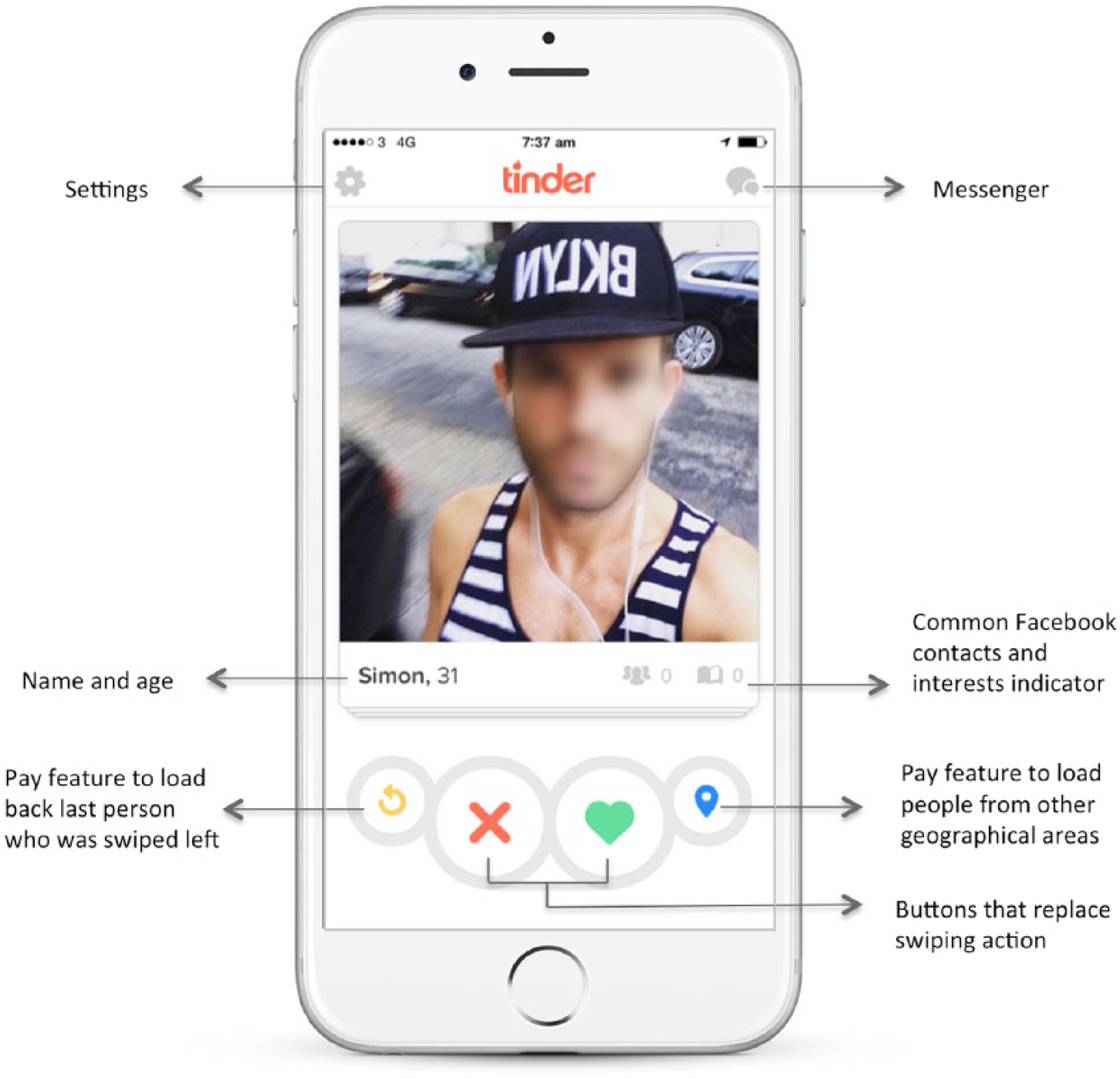
The user interface.
Another relevant aspect of Tinder is that it is integrated to other popular platforms and apps the user may have. Specifically, when creating a new account, Tinder prompts users to load pictures from their Facebook accounts to build their profile. The app also extracts personal information automatically from Facebook, such as the user’s name, and it also displays common likes, and their associates or “friends.” Tinder can also be optionally linked to Instagram, as an additional way to share pictures and content. All this information is made public to other users before making the decision of swiping left or right, which constitutes considerably more personal data than that found in traditional gay hook-up apps.
The rise of the popularity of Tinder among gay men in London seems to be a fairly recent phenomenon. Very few people to whom I spoke had been using it for more than 6 months, signaling that gay men started using it in London in increasing numbers in the second half of 2014. Most informants told me that it was a friend who had suggested them to start using Tinder, as a reaction to the common complaints gay men express among their close friends that it is impossible to find a partner since “everyone in London is just looking for sex”:
I started using Tinder because my friends recommended it. They said you can meet people who are genuinely interested in making friends. (Vishal, 33) . . . a friend told me the boys on here [Tinder] are looking to date and find relationships. (Peter, 45)
Tinder has been constructed as a gay haven for connecting with men who are not looking for a casual sex partner and who, in fact, may be open to the possibility of finding romance. Thus, this environment is presented in the public narrative as an ideal place for finding people who would be prone to invest time and effort for a connection that could be the start of a relationship:
Tinder seems to be a proper dating app. (Christopher, 42) The nicest people are on Tinder, that’s where I met my boyfriend. (Liam, 47) Tinder is less superficial than other platforms. You meet people who want to go on a date, have drinks, lunch, or dinner . . . so it’s nicer. (Suresh, 29)
When talking to gay men on the platform, as part of the research—and also following a common practice in this type of environment—I would ask all of the people I contacted what they were looking for on the platform. The usual wording of the question was “what brings you to Tinder?” and consistently, the answer was that they were looking for “dates” or a slightly less definitive “mates and dates.”
9
In very rare occasions, I would get the typical answer of “fun and mates”
10
that is common to most interactions in gay apps. Examples of these answers on the platform follow below:
I’m on here for dates . . . How about u Mr? (Martin, 29) Dates for sure. You? (Patrick, 32) I’m open to anything really. But dates are always good. (Robert, 25)
Tinder seems to have been socially constructed in opposition to what gay apps represent. When talking to informants, it is difficult to discern a difference between the concept of a “gay app”—understood as an app directed to a gay public—and a “hook-up app”—understood as an app used to look for casual sex partners—because the majority of gay apps fall in the category of “hook-up apps.”
11
The abundance of gay apps
12
in the market is remarkable, and the different kinds of apps that have been developed in the past 6 years usually imitate the basic design of Grindr, which is by far the most used gay app in London. The fact that gay apps are usually understood as hyper-sexualized spaces where sex-driven desires are the norm and romantic intentions are exceptional has contributed to a rather negative narrative of what one can find in them. Even among men who speak of gay apps in less stigmatizing terms, the general understanding is that, realistically, one should not expect serious relationships from them:
This virtual world is full of sex, for me it’s okay—when I want to fuck—but I don’t think you get much out of that. (Giacomo, 27) Grindr is an app that is basically for people to have sex. It’s not that I haven’t had hook-ups before, but sometimes you just get tired of that. (Vishal, 33) You should just assume that people logging on to Grindr are looking for sex. (Darren, 27)
In this context, the “gay app” category—of which Grindr is the best representative—has a very well-defined interpretation. Tinder, therefore, enters this stage as “not a gay app” and “not Grindr.” This reading of Tinder as an opposite to a whole category of social networking spaces is extremely important because, ultimately, it affects the expectations with which gay men enter this space; it also affects how they portray themselves and, of course, how they interact:
There’s a stark difference between Tinder and Grindr, and all the other apps. Tinder is definitely not centred in the search of sex. (Anthony, 35) Even if someone has both Grindr and Tinder, it is better to meet that person on Tinder. On Grindr people are just looking for sex. The quality and attitude of dates that originated on Tinder is better. (Michael, 30) These views are also expressed openly in profile descriptions on the platform: Do NOT ask me for NSA
13
. . . find me on grindr for that. (Nick, 35) Looking for my man. This isn’t Grindr- this is a dating app. Masculine, confident lads swipe to the right. (Michael, 35)
It would be simplistic to try to explain that the gay subject desexualizes himself in a “straight” platform in an analogous way to how gay men would interact among themselves in offline spaces that are not exclusively gay gathering venues. While this could be a partial explanation on how these practices emerge, it is interesting to take into account that several of my informants were not aware that the larger user-base comprises mainly straight men and women and, furthermore, that Tinder tends to be viewed as a hook-up application in the heterosexual context.
Portrayal of the Digital Identity
Identity—or identities—comes into being when it is disclosed and presented to others in the moments and locations when and where the self deems it appropriate (Jackson, 2001; Boellstorff, 2005). These different identities can also be put into practice in online spaces, and that is why the construction of the profile is important as an expression of the digital self. Just as people mediate their identities offline through clothing, make-up, and accessories, on a social networking platform like Tinder, mediation happens through pictures, the statement of interests, common contacts in shared networks, and the writing of a profile description. All of these elements constitute the identities that users decide to portray through the profile crafted on any given platform (Baym, 2010).
Not all of these elements are in control of the user on Tinder. Initially, the account is linked to one’s Facebook contacts, and it forces the user to pick photos from the set of profile pictures one has in that social network. The name is also automatically copied, and it cannot be altered or edited. Tinder also discloses common Facebook interests and contacts with other users of the platform, and if one chooses to link Tinder to an Instagram account, little vignettes will show pictures from that platform as well. Given the variety of information that seems to be taken directly from Facebook and third-party platforms, the agency one has to modify one’s own representation directly on Tinder is limited. When compared to Tinder, other gay apps seem to be a white canvas, where almost any picture can be uploaded, and anonymity could be kept if the user wished so:
Your Tinder profile is something that—theoretically—you could show your mother, because it pulls things from Facebook, right? But your GRINDR profile . . . hahaha! (Adam, 38)
An interesting exercise for exploring what is expected of a Tinder profile is to compare the profiles one specific user has in two different apps. The following pair of images (see Figure 2) depicts the duality of people on Tinder compared to profiles they elaborate for Grindr. The profile on the left (white phone) corresponds to Tinder and the image on the right (black phone) belongs to Grindr. 14 In this example, “Warren” is a Scotsman, who lives in Haringey and works as a bartender in Hackney, and presents himself on Tinder as an easy-going person who enjoys banter. When one actually talks to him, it is easy to confirm he has several interests regarding performing arts and culture in general. He also takes his bartending job very seriously and proudly, but he is aware that he will have to pursue additional studies to have access to better jobs and standards of living in London. In contrast, when it comes to portraying himself on Grindr, he does not hesitate to showcase his sexual preferences as a “hard top.” 15 He also classifies himself publicly as an “otter,” 16 and his profile description is that he is open to “exploring all possibilities.” When asked about what was the kind of possibilities he was referring to, he clarified that he meant different types of sexual practices in which he would “top.” A highly sexualized portrayal on Grindr does not negate the coexistence of different identities and subject positions within one same individual.
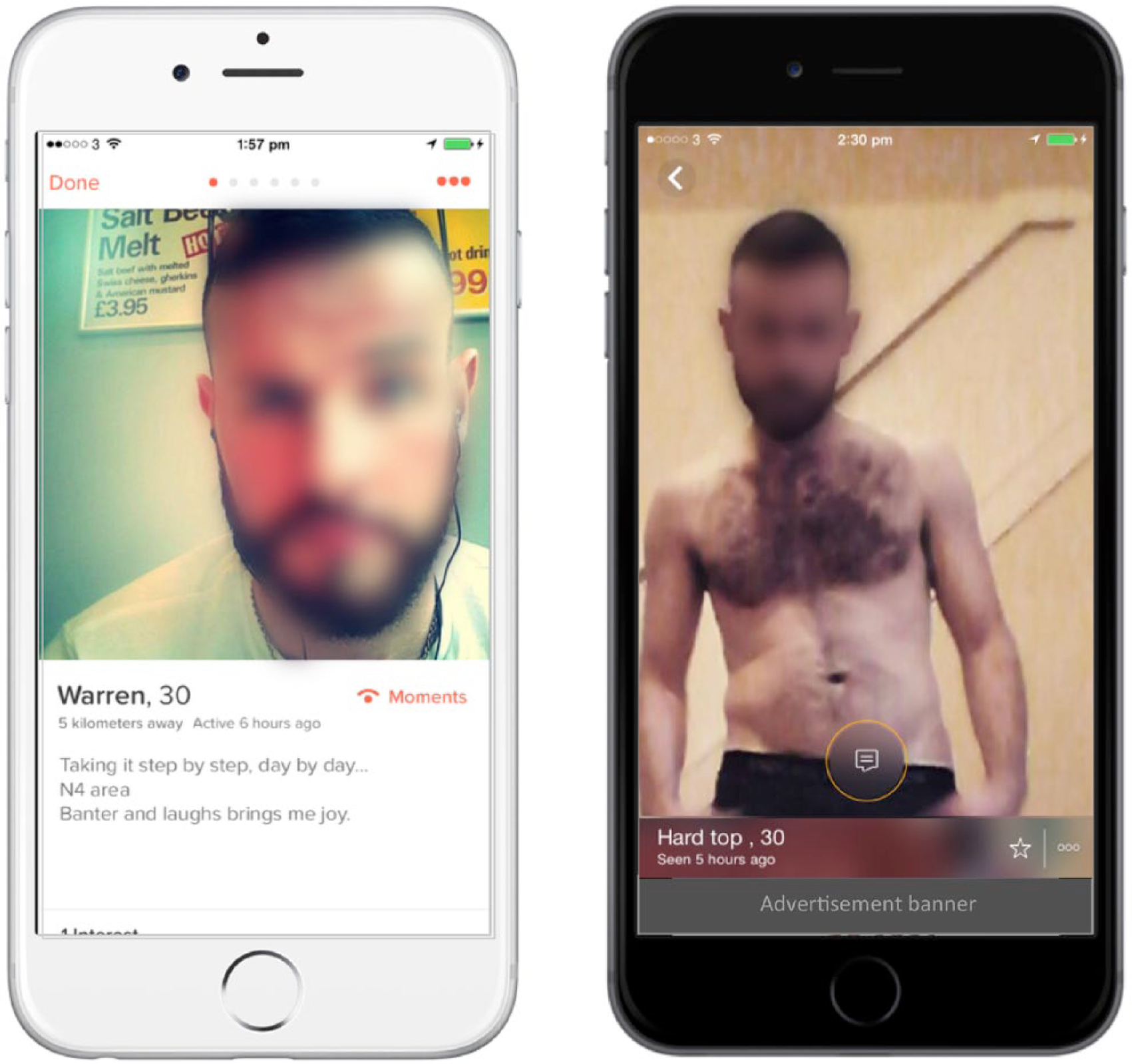
Example of Tinder and Grindr user.
Other common patterns are finding men who are looking for “mates and dates” on Tinder, and later seeing them on Grindr with somewhat different self-reported data, particularly in terms of age, which are data extracted from Facebook. Woo (2013) made a detailed assessment on how gay men tend to reduce their real age and weight, increase their height, and overestimate their penises’ length and girth when disclosing them on gay hook-up apps. This was proposed as so widely practiced that not doing it would be a counter-intuitive decision of putting oneself at a disadvantage.
In one occasion during fieldwork, I noticed a Tinder profile that had a very sexualized and explicit description. It read,
Nice friendly, geeky guy. After mates and, dates, but fun is fine too. Like to be naughty in the bedroom (vanilla
17
to kinky)
About 15 min later, a match occurred between the two of us and I noticed that his profile description had been toned down in a very blatant way when compared to the one I had previously seen:
Nice, friendly, geeky professional guy. Like Boardgames, video games, cooking dinner, wine.
It is interesting to note that his Tinder identity had been edited to include a reference to being a professional man; he then eliminated all references to sexual preferences or practices and added extra information on activities he liked to engage with on his free time. When I asked him why he had done those changes so quickly, he explained,
Well I copied it from my Grindr profile, but then noticed people seemed a bit nicer on here, so I tweaked it. It’s still me, just a different focus. (Matt, 29)
Another relevant way in which desexualization occurs on Tinder is related to the disclosure of preferences regarding sexual roles, which are not usually included in profile descriptions or rarely talked about. The fact that very few people with whom I spoke on Tinder asked my sexual preferences in terms of being a top, bottom, or versatile—penetrative party, receptive party, or both respectively—has to be highlighted. The quintessential question of “are you a top, bttm or vers?” 18 that arises very early on during interactions in other apps such as Grindr are rare events during conversations within Tinder.
Interestingly, the practice of not asking one’s preferred role on Tinder also crosses over when interactions lead to a face-to-face meeting. This could be explained by the fact that an actual date that has originated on Tinder is supposed to keep the same standard of appropriateness when meeting offline. In only one occasion I was asked about my role preferences, and when this happened, it was done by using euphemisms and joking around instead of using the actual words “top” or “bottom” in a straightforward fashion. Sexual compatibility of preferences is a topic that is not taken lightly in different ways. The fact that Tinder is thought of as an environment where it is not appropriate to board this topic in a straightforward fashion—as it is done on almost every other platform—is a clear indicator of how this space is interpreted.
Regarding the construction of the digital self, Campbell (2004) states that the body and its representation are central to establishing connections with others; in his words, “the body is both a shared reference for online communication and a primary component of online identity” (p. 17). When faster Internet connections and digital photography became the standard of available technology, the exchange of pictures in dating websites and apps became normative and constituted a typical requirement to engage with others (Mowlabocus, 2010). The analysis of the images and bodily representations of gay men on Tinder could be an entire topic of research in itself; therefore, this is a brief overview of the main insights found related to them.
On gay social media, the type of pictures exchanged is associated with the purposes of the conversation, and sexualized images correspond to conversations and platforms used for purposes of engaging in casual sex. For example, conversations on a hook-up app such as Grindr are usually accompanied by the exchange of pictures in different states of undress or pictures of genitals, commonly referred to as “dickpics.” Kane Race (2015) says of these practices on gay online environments that “familiarity with a person’s genital images and sexual self-presentation now occurs well before—if not entirely independently of—any other mode of social acquaintance” (p. 9). Similarly, interactions that do not seek sexual encounters are usually accompanied by pictures that are not highly sexualized, maintaining a certain level of appropriateness. It is in this context that not posting or publishing pictures of genitals or fully nude bodies on Tinder are norms that have to be interpreted as important reflections of how this place is socially constructed.
However, the normative lack of eroticized pictures has to be understood also within the features of the app and its architecture. Tinder, unlike most social networking apps, does not have a feature that allows users to exchange pictures as files that can be sent to one another for download during a private messaging conversation. Furthermore, profiles are constructed mostly by using pictures from Facebook, or by using pictures that could be deemed as suitable for any type of audience. Self-photographic portraits—commonly referred to as “selfies”—travel pictures, or day-to-day activities are the type of images that are usually used, and the overarching pattern in these images should be interpreted as generally desexualized. In the case of people using pictures where they are wearing revealing clothes, such as swimwear, the norm tends to be that this should be done within a context that is not eroticizing. Again, it has to be highlighted that most of these pictures may be coming from albums users keep on Facebook; therefore, these images are being exported from a more open and exposed digital environment.
The social norms presented above can change when stepping outside the platform; in other words, users can find ways to circumvent normativity (McDonald, 2016, in press; Costa et al., 2016). For example, a typical progression in interactions is to migrate conversations from Tinder to Whatsapp in a polymediatic decision when a certain degree of intimacy has been reached. Ilana Gershon (2010) says that these decisions of switching platforms or media are ways people have of “signalling the stage of a flirtation or someone’s interest” (p. 109). Conversations in these “next-level” platforms sometimes relaxed the norms of appropriateness in a minority of cases, but this fact serves as further evidence of normativity because we are addressing exceptions. My experience on the field, as well as what was reported by my informants, was that people would generally ask for additional pictures right after migrating to Whatsapp, where the exchange of pictures as files is possible and easy. In these cases, users rarely asked for nude pictures directly if the conversation was migrating from Tinder. Usually, pictures exchanged on this other platform tended to be slightly more eroticized compared to the ones they had uploaded on their Tinder profiles, or less carefully selected since Whatsapp gives full access to the photographic library in one’s smartphone. However, it is important to mention that the main purpose of these conversations was usually coordinating a face-to-face encounter, rather than gaining access to further graphic material.
The Impact of Design
Having presented and explored all these practices and experiences on and off Tinder, it seems unavoidable to question to what extent the platform, as a technological tool, impacts behaviors. It is important to consider that Tinder was not designed with a gay user in mind; therefore, its architecture comes from a different context. Grindr, and most of the gay hook-up apps launched after it, are heavily dependent on geolocative affordances, showing a large quantity of possible matches prioritized in terms of distance. Urgency to meet potential partners and their proximity are the main issues around which gay apps usually revolve. Race (2015) describes this pattern saying that “the default logic of hook-up devices is evident in the rationale that governs certain key features such as location based searching, which isolates proximity over other determinations as a primary reason for initiating contact” (p. 6). In contrast, Tinder’s architecture depends primarily on the dynamics of mutual attraction and consent. Given the fact that it is necessary that two persons show mutual interest by swiping each other to the right to be able to start a conversation, the design of the platform itself tries to lead to a reduced sense of rejection that should encompass all interactions.
However, when discussing with my informants why they thought Tinder was different, or why they thought people acted differently, they never pointed to the obvious fact that the app itself has a different architecture to all other gay apps.
19
Rather, they would immediately highlight the fact that their Tinder profile was linked to their Facebook account:
I don’t think on Grindr people look for a relationship but here [on Tinder] Facebook accounts lead you to more real life base meeting. (Yoshi, 30)
The user’s Facebook identity, then, becomes a major factor into how Tinder is interpreted by its gay users. As seen previously, data and pictures are imported from Facebook accounts, which in turn act as an identity verification mechanism. As mentioned by my informants, verifiability is an important safety feature that impacts how gay men behave. While verifiability is not new to gay platforms, the way in which Tinder handles this matter is indeed something novel. First, it has to be highlighted that verifiability on Tinder is compulsory, something that traditionally has only been optional in gay apps. Using Facebook accounts as a verification method is also new in this context, relying on the disclosure of self-reported data such as common contacts and social circles that users may share there. An informant expressed his view on this topic as follows:
You can see who is a friend of a friend, and then you go, ooh, he knows such and such. I better act like a “decent person.” Not that I care about gossip or what they may say, but still. (James, 30)
How images themselves are connected to Facebook also has an impact. When one first uses Tinder, it prompts the user to pick profile pictures from the set of pictures one already has on Facebook. In general, the set of pictures gay men usually have on their Facebook accounts tends to be less sexualized than those used on gay platforms:
The fact that Tinder is linked to Facebook and that you can only build your profile from Facebook pics
20
makes it more formal or serious, I think. (Christopher, 40)
Design, therefore, does have an impact on how people act on Tinder and how it is interpreted as a socially constructed space. However, it is important to consider that this design and architecture is the same for all social groups who use it, and it cannot be rendered as the sole factor of why these practices emerge within the gay community. Analyzing context and the media ecosystem of platforms with their own affordances is crucial to understand why Tinder is interpreted as a less sexually demanding space for gay men.
For example, when my informants explained how information imported from Facebook would make it seem more “formal,” they were expressing this view within the context of the easy availability of hook-up apps that are used without disclosure of much personal data. Other factors, like having a more complex design to upload pictures and the lack of a feature to send private images to others, have to be interpreted in the context of gay apps that facilitate an easy, private, and fast exchange of pictures among users.
Winner (1980) says that some of the most interesting research on technology stems from rather innocuous features that end up having a deep impact in the people who use it. Yet, he positions these observations on features that need a particular context to have real power. In his own words, we should keep in mind that “what matters is not technology itself, but the social or economic system in which it is embedded” (p. 122). This is linked to the fact that the design features mentioned above indeed matter in how Tinder is interpreted and used by the proposed population.
However, the impact and relevance of technology and design itself can also be challenged. For example, the work of Costa et al. (2016) researching social media in different sites around the world questions what would happen if Facebook had never existed, or had it never been invented as we know it today. They propose that cybersociality may appear in alternative platforms—that are not Facebook per se—as it happens in China, pointing to the fact that in an environment of polymedia, the cultural context in which a platform resides “matters far more to our informants than a platform’s technical properties” (p. 90). From this perspective, Tinder may be considered as being in the right place, at the right time. Had it not been that way, these practices and needs for digital spaces where gay men could engage in a less sexualized way could have appeared in another platform, which within its context could give way to practices that could be similar to the ones discussed. This, in turn, points toward views of the arbitrary nature behind the social construction of digital spaces.
This research project has contested popular culture views that render Tinder as a hook-up app when we analyze it in the context of non-normative sexualities. Tom McDonald (2016, in press) says that “we look at tweets in one place and think we can write about ‘Twitter’ in general,” as way of noting the inner multiplicity of social groups that use social media platforms in their own particular ways. The same can be said of how people behave on Tinder, and how gay men constitute a group with its own set of cultural and social practices on the platform. This project also contests the views of the generalized conception of the hyper-sexualized gay man in digital spaces. This is aligned to Roy Dilley’s (1999) assertion that “context as a concept, it would seem, is often invoked as part of an analytical strategy that stands in opposition to universalist, formalist or other generalising tendencies” (p. 6). Thus, the behaviors and evidence presented depend both on the grander context of gay male digital culture and also the specific affordances of Tinder as a platform that constitutes a digital space.
Conclusion
The initial question that this research is trying to answer is whether there is an online place where “nice gay men” gather to meet new people and hopefully start a serious relationship. The data collected on this project show that most of the people trying to engage into a conversation with another gay man on Tinder claim that they are looking for dates. They also make deliberate efforts to constrain overtly sexualized demeanors, self-representations, and topics. Engaging with people through this platform therefore does yield a pool of people who generally are either actively seeking a relationship, or at least open to the possibility of one, as the public narrative states.
However, a deeper knowledge of the field reveals that the identities portrayed on this platform are highly curated versions of the self that convey a specific subject position or identity that complies with the norms of decency and proper behavior that has been socially constructed on this digital space. Many of the men who gather on Tinder also have other accounts on other platforms where they act correspondingly to what is expected of them in the context of those other online spaces. Therefore, the concept of “nice gay men” can be challenged in light of the evidence that shows that the men of Tinder are perfectly capable of hooking up and of detaching their feelings in the search of sex in other environments and social media platforms as well. What we are actually seeing is the exercise and exploration of multiple subject positions, or selves, with the help of something as simple and commonplace as dating and hook-up apps.
In terms of Digital Anthropology as a sub-discipline, this work is a reminder that it is not necessary to go too far to find interesting cases of how different social groups use platforms in their own particular ways. A widely used and highly stereotyped platform like Tinder can be completely reinterpreted by gay men in their own context and used to explore different identities. This project is also an interesting exercise of selecting a social media platform as an object of study, but more importantly as a starting point. Practices that are observed in social media platforms are highly permeable to other platforms as well, and everything that can be interpreted as “digital.” This is why the theory of polymedia has been fundamental for this research project. Different social networking platforms become venues where the fluidity of identities can be explored and exercised, but these online spaces are socially constructed and interpreted as an interdependent set of spaces. This piece has shown how, specifically, gay men in London have appropriated Tinder has a space suitable for romantic quests, while maintaining more traditionally hyper-sexualized online platforms, such as Grindr, as venues appropriate for the exploration of their sexual desires. Furthermore, why this happens is tightly linked to other platforms that are not directly related to gay cybersociality. The fact that the architectural design of the platform compulsorily matches Facebook identities to Tinder accounts can be proposed as the most relevant factor contributing to the rendering of this online space as a venue for desexualized demeanors, something that has been socially constructed among gay men, and seems to be unique to this group.
Finally, I want to point out that all the practices and experiences in the digital realm proposed for this study could not be contained there as well. Research—and fieldwork—was a constant fluctuation between the online and the offline, and the research question has taken my project through different platforms, exciting offline spaces, and it has also allowed me to meet people who have kindly shared their lived experiences.
Footnotes
Acknowledgements
I thank the guidance Hannah Knox provided during all stages of this research, and also the support and feedback of Victor Buchli, Ludovic Coupaye, Nicholas Hill, Jacek Kormak, Tom McDonald, and Daniel Miller.
Declaration of Conflicting Interests
The author(s) declared no potential conflicts of interest with respect to the research, authorship, and/or publication of this article.
Funding
The author(s) received no financial support for the research, authorship, and/or publication of this article.