



Abstract
This article explores how Athenian university students “manage” their privacy on Facebook while socially interacting with other users. Survey data of undergraduate students in Athens reveal that the social network site use “validates” and enhances the pre-existing social context and that the relationship level has an impact on the way users contact other users on it. We find that Facebook users feel that they are able to use most of the privacy settings to protect their personal data. Yet, they are concerned about the disclosure of their personal information which is perceived to be their primary responsibility. Despite these concerns, they appear to feel in control of their privacy through the abilities they are offered by the social networking site (SNS). We also argue that even if they realize that they are disclosing their personal information, this doesn’t cause a great deal of insecurity.
Introduction
Although privacy is a very much talked-about issue in our multi-mediated and data-driven societies, its conceptualization has always been a difficult task (see Weintraub, 1997, pp. 1–2). J. J. Thomson (1975), for instance, emphasized as early as in 1975 that “the most striking thing about privacy is that nobody seems to have any very clear idea what it is” (p. 295). In the same vein, Solove (2007) argued that “the quest for a traditional definition of privacy has led to a rather fruitless and unresolved debate” (p. 759). Yet, it should be highlighted that “the foundation of the privacy concept itself is traced in Aristotle’s distinction between polis (the public sphere of political activity) and oikos (the private sphere associated with family and domestic life)” (Papathanassopoulos, Xenophontos, Karadimitriou, Daga, & Athanasiadis, 2015).
The origins of privacy in modern societies can be detected “in the political thinking of Thomas Hobbes and John Locke and the form of liberal democratic government that derived from that thinking” (Regan, 1995, p. 43). In their discussion of one of the “grand dichotomies” of the Western thought (Bobbio, 1989), Habermas and McCarthy (1985) explained that “the institutional core of the private sphere is the nuclear family” while “that of the public sphere comprises communicative networks amplified by a cultural complex, a press and, later, mass media” (pp. 318–319).
In this context, Arendt (1958) maps out the public–private dichotomy as “the distinction between things that should be shown and things that should be hidden” (p. 72) and privacy “a sphere of intimacy” (p. 52). A pluralistic view of the privacy concept is delineated by Solove (2007) who asserts that “there are no clear boundaries for what we should or should not refer to as ‘privacy’” (p. 759) and provides several definitions in which privacy is considered as the right to be left alone, limited access to the self, secrecy, control over personal information, personhood, and intimacy (Solove, 2008, p. 98).
1
More recently, given the technological advances and the rise of Web 2.0,
the public and the private have been reconstituted as spheres of information and symbolic content [. . .] creating a very fluid situation in which the boundaries between [them] are blurred, porous, contestable and subject to constant negotiation and struggle. (Thompson, 2011, p. 49)
Several scholars have recognized that privacy is “constitutive” of society. DeCew (2013) acknowledges “the consensus for the significance of privacy which is almost always justified for the individual interests it protects: personal information, personal spaces, and personal choices, protection of freedom and autonomy in a liberal democratic society.” For some theorists, though, the notion of privacy is even conceived as an outmoded value. Thus, Cohen (2013) notes that “privacy is cast as old-fashioned at best and downright harmful at worst” and what is more that “privacy advocates seem unable either to displace this framing or to articulate a comparably urgent description of privacy’s importance” (p. 1904). 2
All in all, in today’s liquid society (see Bauman, 2005 and Giddens, 1990) of digital intimacy, where our experiences are mediated by search engines, social networking platforms, and content formats (Cohen, 2013), there is a constant remix of the public and the private (Deuze, 2011, p. 137) or, as Papacharissi (2009) expresses, “a confluence of public and private which is particularly relevant to interaction developing in online social networks” 3 (p. 207).
Literature Review
The rapidly evolving online ecosystem seems to be ideal for presenting a performance of the self (Donath & boyd, 2004; Papacharissi, 2002a, 2002b). Papacharissi (2009, p. 207) reports that within these spaces of variable publicity and privacy, people disclose their likes, dislikes, affiliations, relationships, and their personality, in general, to a variety of interconnected audiences allowing vicarious participation in friends’ lives at a distance (see also Papacharissi & Mendelson, 2011). More particularly, social network(ing) sites’ (SNSs) 4 ubiquitous presence in our daily lives have brought many opportunities for self-presentation (see Goffman, 1959, 1967) to despatialized audiences and thus uploading of personal information (Lohr, 2010).
Facebook remains the most popular SNS being closely integrated into the daily experience of millions of young people. 5 Some of the questions that have been raised regard the nature of these self-presentations online in relation to social capital gains (Ellison, Lampe, Steinfield, & Vitak, 2011), the privacy concerns, and the blurring of public and private (Ellison & boyd, 2007).
Previous work has established a relationship between Facebook use and social capital levels among undergraduate students (Ellison, Steinfield, & Lampe, 2007; Steinfield et al., 2008; Valenzuela, Park, & Kee, 2009). More specifically, Ellison, Steinfield and Lampe (2011) explain that it is not clear whether there are particular uses of Facebook that are more likely to result in positive social capital outcomes. Ellison, Steinfield, and Lampe (2011, p. 16) point out that the concept of social capital traces its roots to the work of Bourdieu (1986) and Coleman (1988), with subsequent extension by Burt (1992) and Lin (2001). Actually, Putnam (2000) described two basic forms of social capital: bonding (or exclusive), which is “good for undergirding specific reciprocity and mobilizing specific solidarity,” and bridging (or inclusive), which is “better for external assets and linkage to information diffusion” (p. 22).
The extant literature on this topic suggests, also, that Facebook is used more for communication among acquaintances and offline contacts than it is for connecting with strangers (Ellison et al., 2007; Lampe, Ellison, & Steinfield, 2006) and that most Facebook “Friend” connections represent “in-person” relationships (Mayer and Puller, 2008; Subrahmanyam, Reich, Waechter, & Espinoza, 2008). Importantly, a recent study by Ellison, Vitak, Gray, and Lampe (2014) showed that “actively engaging with one’s Facebook network [. . .] is positively linked to higher levels of bridging social capital” (p. 867).
Additionally, Nosko, Wood, and Molema (2010) contend that Facebook users disclose highly personal, sensitive, and potentially stigmatizing information through their profiles (see also Tufekci, 2008). In another study, Krasnova, Spiekermann, Koroleva, and Hildebrand (2010) noted that users make these disclosures in large part because SNSs’ technical features simplify the process of maintaining existing relationships. Moreover, Krasnova et al. (2010) as well as Stutzman, Capra, and Thompson (2011) observed that privacy attitudes impacted self-disclosures, such that concerns about privacy-based threats led to fewer profile-based disclosures on SNSs.
Given that early research in the area of privacy on SNSs—and particularly Facebook—concerned a relatively homogeneous population of university students, Gross and Acquisti (2005) reported that few modify their default privacy settings for increased protection. Furthermore, Acquisti and Gross conducted a study with students, staff, and faculty at Carnegie Melon University with about 300 survey respondents (mainly with a profile on Facebook) that indicated, on one hand, that the majority of Facebook members “claim to know about ways to control visibility and searchability of their profiles,” but, on the other hand, “a significant minority of members is unaware of those tools and options” (Acquisti & Gross, 2006). In a study of undergraduate students’ Facebook use, boyd and Hargittai (2010) identified few gender differences related to self-reported use, skills, and privacy practices. Additionally, concern about privacy has been found to have little or no association with online information disclosure (Taddicken, 2014). Blank, Bolsover, and Dubois (2014) argue that “computer skills and ability is often hypothesized to be related to online privacy perceptions and practices” (p. 10).
6
What is more—and in contrast to Barnes’ (2006) original privacy paradox—Blank et al. (2014) also suggest that
The new privacy paradox is not about young people over-sharing online with little understanding of the risks, but that social life is now conducted online and SNSs do not provide users with the tools that would adequately enable them to manage their privacy in a way that is appropriate for them. (pp. 24–25)
Having outlined some of the most relevant findings in the field of privacy management on Facebook that contribute to the “framing” of our main focus, this article attempts to address how students in the capital of Greece, Athens, manage their privacy on Facebook while socially interacting with other users. Furthermore, it sheds light on the students’ concerns/expectations regarding the “regulated” disclosure of their personal data on the SNS.
Internet Use and Social Media Behaviors in Greece
According to the Hellenic Statistical Authority (2014), the penetration of Internet use in Greece is about 60%. 7 In particular, 60.3% of Internet users reported that they use the Internet to participate in SNSs. In a survey by Electronic Commerce and e-Business Laboratory of the Athens University of Economics and Business (ELTRUN, 2013), Facebook (82%) was found the most popular SNS in Greece. Most users are active (61%), by expressing their opinions and views, interacting, and playing games. Interestingly, in 2015, ELTRUN found that 62% of Internet users in Greece have even installed the Facebook application on their smartphone and log in the SNS daily. It should also be noted here that according to data presented by Monitor, a platform that records publications from Greek news websites, blogs, forums, and Greek users of social media in real time, most of the population already has a Facebook account: Facebook was enhanced by 1.1 million new accounts last month, reaching 6.7 million accounts in total (Kassimi, 2015). 8
Previous surveys (Papathanassopoulos et al., 2013) showed that Greek Facebook users are signing in daily, five times on average, while a large percentage of them reported that they spend about 3 hr daily on the SNS. The most popular activities that were observed were the private messages, writing on their friends’ walls, playing games, tagging, and posting photos. Moreover, Facebook users in Greece are concerned about the privacy and the disclosure of personal information (Papathanassopoulos et al., 2013). They are “offended” by the public character of Facebook, which gives the opportunity to strangers to watch their accounts, monitor their lives, and then disclose personal information like photos, without the user’s prior consent. Furthermore, users believe that Facebook is “filing,” exploiting, or monitoring their personal data for other purposes. Finally, users are suspicious of the privacy settings and worried about the potential security risks and the low levels of protection for their personal data. Quite paradoxically, users, also, reported a lack of awareness for how their data are used and which of these data are used by third parties.
According to the Special Eurobarometer (European Commission, 2011), the Greeks support very strongly (88%) the view that disclosing personal information is an increasing part of modern life (p. 23) while, at the same time, only one-fourth (23%) think that disclosing personal information “is not a big issue” (p. 30). The respondents in Greece also usually read the privacy statements on the Internet (70%; EU27: 58%; p. 113).The most important reasons the Greeks disclose such information on SNSs and/or sharing sites (p. 47) are to connect with others (57%; EU27: 52%), to access the service (55%; EU27: 61%), and for fun (only 6%; EU27: 22%). A recent Eurobarometer (European Commission, 2015) reported that one of the negative impacts of scientific and technological innovations observed over recent years for Greeks regarding the social media is the exposure of personal data. More specifically, a fear of having no privacy in the future or having their privacy violated was reported in this research (European Commission, 2015). Additionally, according to the Special Eurobarometer on “Data Protection,” 58% of people in Greece use an online social network at least once a week (EU28: 58%). One of the main reasons that Greeks provide personal information online is “Connecting with others” (29% while the EU28 is 18% and the highest proportion is observed in Romania [30%]). Over 80% of Greeks agree that providing personal information is an increasing part of modern life (average in EU28: 71%).
Research Questions
We know that web users, especially the youth, express considerable concern about the release of personal information in the Internet environment (Leigh-Young & Quan-Haase, 2013). This article addresses mainly the question in the Greek case: how do young Facebook users in Greece, in effect, university students, manage their privacy while sharing and interacting with other users? In more specific terms, the research questions of the study were as follows:
RQ1. Which Facebook-related communication behaviors, if any, characterize the users depending on the preexisting relationship level?
RQ1a. What do Facebook users do to protect their online privacy?
RQ1b. What kind of personal information do they disclose on Facebook?
RQ2. Which privacy concerns, if any, appear mostly?
Method
Participants and Procedure
The study is based on a survey through personal interviews using a structured questionnaire over a total sample of 291 undergraduate university students aged 18–26 years in February 2014. The sample breakdown was 47% male students (n=137) and 53% female students (n=154). In total, 98% (n=285) of them have a Facebook account. Each questionnaire took approximately 20 min to complete. The total number of question items was 33. Initially, the questionnaire had 50 questions, but after a trial we realized we had to reduce them since the students were unwilling to reply for more than 20 min. The questionnaire was based on relevant research (Gross & Acquisti, 2005; Leigh-Young & Quan-Haase, 2013; Papacharissi & Mendelson, 2011), and in particular, it aimed to examine how the university students in the Greater Athens region disclose information and protect their privacy on Facebook, whether they share personal information openly or modify their privacy settings for increased protection, how often they change their privacy settings or how often they change their settings in order to be viewed by some friends or view specific types of content, how often do they post their news and photos on Facebook and make comments on posts and photos on the Facebook, or how often they regret posting something on Facebook. Another set of questions was on whether they concern about the potential privacy risks (such as identity theft, account hacked, cyberstalking, private messages made public) that arise when they share their personal information on Facebook, whether they have contacted Facebook administrators or in other cases the Authorities to report insulting content related to the aforementioned issues. We also asked them to tell us what kind of personal information they reveal and the reasons they do, as well as to tell us what personal data they consider as sensible and whether they read privacy statements when they visit webpages.
Aiming to achieve the highest possible degree of student representativeness, the questionnaires were completed by undergraduates from five different university institutions (National and Kapodistrian University of Athens, National Technical University of Athens, Panteion University, Harokopio University, Athens University of Economics and Business, Agricultural University of Athens, University of Piraeus)—all located in the Athens greater region. 9
Results
Facebook Usage
On average, these emerging adults have responded that they spend 2 hr surfing the Web during an ordinary day. Moreover, during a week, on average, they are on Facebook for 3 hr. Overall, 51.2% of them mentioned that they use the SNS 1–3 times a day, while 28.9% do so 4–8 times a day.
“Friends” 10 on Facebook
As far as their activity on Facebook is concerned, 93.1% of the participants responded that they have more than 51 “friends.” Overall, 73.9% of users receive 1–10 “friend requests” per week and 55% initiate a similar number of requests. Despite the fact that on Facebook all contacts are called “friends,” 11 the Athenian university users tend to separate actual friends—with whom they have a more meaningful relationship—from “friends” on the SNS: 28.2% reported that they feel that only 1–15 from their online “friends” are true friends, while 24.4% responded that they have approximately 16–30 true friends on the site.
To answer RQ1, we first asked the respondents to categorize their Facebook “friends” according to the period of life during which they had met and the nature of their social relationships; the participants answered that an average of 37.2% comes from their school years, 32% from the university, and 24% from other categories as family, acquaintances with whom they share common activities and the same broader social context (“friends of friends”). Taking these categories into account, it can be concluded that the specific category of users, above all, makes the most of the ability to preserve the social capital, that is, to safeguard the bond with teams that come from the past—that is, from their school years.
Correspondingly, it was found that it is also important to retain the current social capital—that is, the student community, friends, relatives, or individuals with whom they share common interests. Building on previous research (Mayer & Puller, 2008; Papacharissi & Mendelson, 2011), our study showed that there was no sign of bridging social capital from the classification of “friends” since the respondents are not referring at all to strictly “online friends.” Thus, even if bridging social capital could be considered dormant and the users are attracted by the idea of global connectivity, they don’t use the SNS in order to connect to strangers. At the same time, the majority of respondents say that they rarely (34%) or never (39%) use the “find friend” option in order to easily connect with others.
Social Capital
We also asked participants when they accept a “friend request” from strangers and when they send “friend requests” to friends: only one in five respondents admit that they accept “friend requests” they receive from people they don’t know, while they more frequently (39.5%) send “friend requests” to strangers (see Graph 1). Additionally, the majority of users receive and send “friend requests” when they have common “friends” (40.9% and 39.5%, respectively), which shows that they prefer to be in a “safer” environment/context as far as the extension of their social circle on the Internet is concerned. Additionally, the formation of a romantic relationship is a less important motive for a “friend request” to become accepted (17.9%).

Reasons for accepting and sending friend requests from and to strangers (n = 291).
The nature of the interpersonal relationship appears to have an effect on the way the respondents of this study contact other users on Facebook: in particular, the stronger the ties in the pre-existing social context, the more possible it is for the users to try to reinforce these social acquaintances online. The possibilities for bridging are less when these social ties are actually in the form of weak or short-lived relations. On the contrary, it is more possible for the users to add a close friend as a Facebook “friend,” to contact him or her via a SNS, or to search on their profile than a fellow student with whom they have never talked to and even less possible to do so on their professor’s or employer’s profile. The nature and level of acquaintance do not have a significant impact on the inclination of the respondents to connect online after creating a fake account. In this regard, 71% consider that it is unlikely to create a fake account and send a “friend request” to one of their close friends, while 78% report that it is unlikely to create a fake account and send a “friend request” to a fellow student and similarly 82% to a professor or an employer.
Furthermore, the majority of Facebook users think that there are almost equal chances to meet a close friend, an employer, or professor offline (92%, 82%, and 73%, respectively) as well as add her or him on the SNS (92%, 74%, and 81% similarly). This fact enhances the argument that the SNS tends to support the pre-existing social context.
“Private” and Public
Most of the participants reported that they have semi-public profiles with 41% of them having adjusted the privacy settings so that their profile is only visible to “friends” and “friends of friends” (see Graph 2). A significant percent of users—39%—appears to have also their profiles in a “restricted” access mode so that they are only visible to “friends.” Very small—10%—percentages of users choose to have their profile visible to everyone (“public”), and even smaller are the percentages of those who don’t know at all what privacy settings they have at the moment (5%).

Regarding the privacy settings of your account, your profile is visible to . . . (share of answers %; n=291).
Users rarely (39%) adjust these settings—depending on the content they post—while they admit that they sometimes change them (21%). It should be noted that Facebook provides the ability of adjusting the privacy settings according to these classifications so that the users adapt the visibility of this information depending on the social relationship they have with their SNS “friends” in the actual life.
Uses of Privacy Settings
Facebook users tend to modify their privacy settings on a frequent basis (boyd & Hargittai, 2010). One of the reasons is to protect their personal data. In our study, the university students, surprisingly, almost all agree that the most popular are the settings of untagging their names from photos they were tagged, adjusting the privacy settings in the profile, and hiding information that they don’t want to appear in their profile. Moreover, their overwhelming majority (approximately 8 of 10 users) responded they feel able to report someone who might have created a fake account, to change the privacy settings in order to prevent a friend on Facebook from seeing several characteristics of their profile, to use the “report” option also when their account is violated, and to deactivate their account.
To address RQ2, we asked the participants to specify the level of agreement regarding the degree of concern for the potential privacy risk (see Graph 3) and found the following: more concern is caused by the fact that users’ personal data are in the hands of the site administrators (79%), which shows that there is a lack of trust toward the medium. The concern is possibly rooted in the news for the use of personal data by the SNSs for commercial purposes or for national security causes. 12 Additionally, the users express their concern (73%) for the degree to which their personal data are safe when they are asked to install an application. Users are also worrying about how their personal data are used by others without their consent (65%) or when they feel that some people are monitoring their life on Facebook. Surprisingly—and in contrast to our findings regarding the high popularity of untagging—less concern is caused if somebody has tagged them on a photograph (57%), if a professor has learnt some negative things about them (68%), and if their private messages are disclosed (56%). At the same time, they worry very little if somebody they don’t want does actually find them (42%) using “Facebook search” or if a preference of theirs (“Like” or content) that they have posted on Facebook appears somewhere else (48%).

Please specify the level of agreement with the following statements (n=291).
The issue of copying content (e.g., photograph) seems to divide the users—half of them express their concern and the other half don’t express any concern. The degree of concern for the potential privacy setting was measured using 14 items. 13 The mean of this scale was 2.06 on a 4-point Likert scale (1 = Strongly disagree to 4 = Strongly agree), with a standard deviation of 0.76, and the scale was reliable (Cronbach’s α = .88).
Moreover, the users don’t seem to be interested or care about the privacy statement of the Internet pages they visit: a significant number of them (30.9%) state that they don’t read the privacy policy of the pages they visit and 21.3% say that they often don’t care, while, at the same time, only 25.8% say that they read and comprehend it.
Other proactive measures that the users appear to take in order to safeguard their personal data—beyond the privacy settings—are the careful control and the attention they pay to the data they post. The information the respondents most often share is their birthday (80.4%) and age (64.6%). Less often they disclose their city of origin (50.5%), their profession (44.3%), and their interests. They rarely refer to the relationship status (23%) as well as their religious (13.7%) and political beliefs (11.7%). As for the nature of personal data the users disclose, they often post audiovisual content. More frequently (33.7%), they make comments on other users’ posts, and sometimes (45.7%) they have regretted for something they have posted on the SNS.
Almost one of two users has faced problems that are related to his or her secure navigation on Facebook. A relatively significant percentage of users (17%) say that they haven’t contacted the administrators even if they have faced problems. Overall, 15% have contacted Facebook administrators in order to inform them about fake accounts and a small percent for offensive/inappropriate content that other users post on the profile of another user (7%). Less frequently, users contacted the administrators for content that other users posted on their profile (4%). Moreover, very few users reported cases of cyber-bullying (3%), ID theft, or disclosure of personal data (1%).
Despite the big percentage who stated that they have never come across problems that are related to their personal data or security (22%), only a few users have actually contacted the competent authorities: 4.5% say that they contacted the Authorities (“safer internet.gr”), 4.1% the police, and 1.4% the national data protection authority. Additionally, it is noteworthy that the majority of users (66%) believe that it is their responsibility to protect their personal data, while a quite smaller percentage (18%) believes that Facebook ought to process the information in an ethical and secure manner (see Graph 4).

In your opinion, who should ensure that your personal information is collected, stored, and shared safely in Facebook? (n=291).
Overall, 60% of the respondents consider that Facebook does inform them in a sufficient manner for the potential consequences of the personal data disclosure. However, the majority admit that they only have partial control of the information they disclose (58%), while a significant percentage (30%) feel that they have complete control of this information.
The information which most of the users post (76.3%) is photographs and also their list of “friends” (60.5%). Photos play a key role in the construction of identity for the users, while the disclosure of “friends” seems to be a way in which they expand their network or because in this way they show to which “community” they are a part of. A significant percentage of users (40.5%) post information that involves their activities or the places they visit. Less often they post/disclose information that has to do with their profession (33.3%), their nationality (28.9%), the pages they visit (25.4%), and their preferences or attitudes/opinions (22%). This reinforces the argument concerning the communicative and social nature of the medium. Less often is the disclosure of data as home address (12.7%).
Furthermore, the way the participants in the survey manage the privacy settings is not uniform. This indicates that there is a scale in the degree of personal data protection or that certain information is considered to be more personal than others (see Table 1). More specifically, users through a procedure of excluding and/or blocking friends customize the exposure of personal data and limit them depending on the information. Thus, the majority of users choose information, such as birthday (91%), age (84%), and profession (69%), to be visible only to friends and/or to all. On the contrary, very few share with anyone information such as religious (15%) and political beliefs (14%). However, the latter were considered to be sensitive data (31% consider religion as sensitive data and similarly 33% the political beliefs).
Visibility Adjustments Depending on Type of Data (n=291).
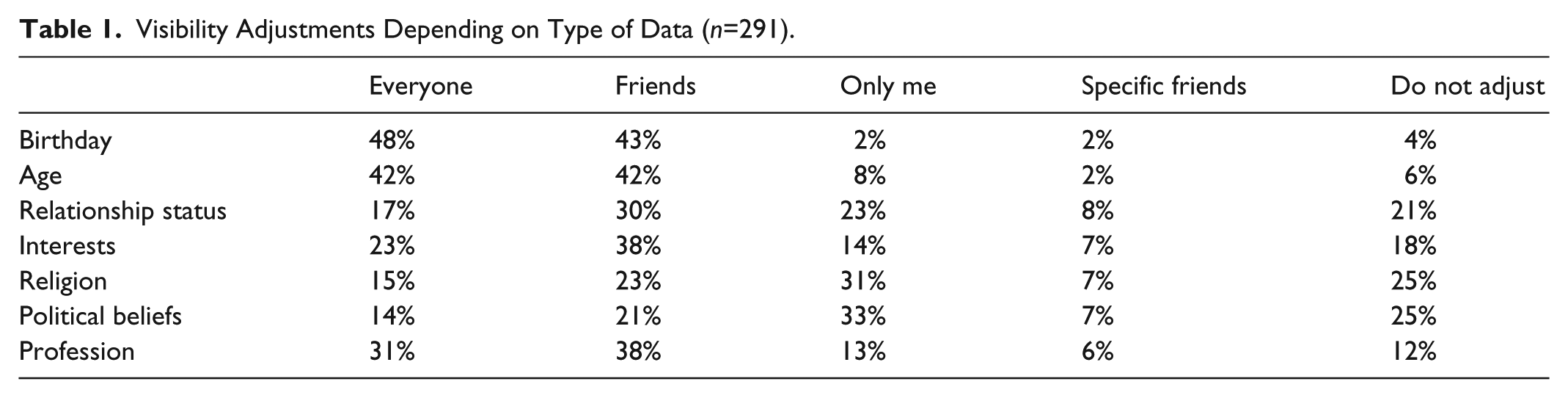
As for the reasons the users choose to disclose this information, according to the extraction from answers in the open-ended question “Please, define the reason you choose to disclose your personal data,” we identified 11 general categories of reasons: (1) the sense of security/self-security, (2) for entertainment, (3) for social interaction/communication, (4) for professional or academic reasons, (5) lack of interest about personal data, (6) the sense that is prerequisite, (7) self-seeking status (build identity), (8) self-expression, (9) personal reasons, (10) following the trends, and (11) political reasons. Self-confidence, interaction, and entertainment appear to be the most important motives (43%). The users stated that they feel “secure” with the publication of personal data since they take proactive measures for their disclosure. As they say, “they have made sure that there are restrictions in this exposure.” Some respondents state that they simply feel secure in their surfing the net or “they don’t consider the information important.”
The disclosure of personal data is also related to the motives of using the medium, those of interaction/communication and entertainment, which were reported in a recent survey about the uses and gratifications of social media in Greece (Papathanassopoulos et al., 2013). As the participants pointed out, by disclosing their personal data, “they get more socialized,” they “share this information with their friends,” and it makes it “easier for a friend or acquaintance from the actual social context to locate them or to expand their circle with individuals that have common interests.” Disclosing their personal data is also a way to keep their strong ties/relationships updated about their life. As they stated, this way they “feel that they enhance their relationships with friends that are far away.” Furthermore, users find these actions as part of the entertainment they shared with their friends online. They find it entertaining and consider that when posting personal information they are “having fun” with their friends.
Discussion
Our findings show that despite the concerns about the way Facebook is managing their personal data, the Athenian students feel that they are in control of safeguarding their privacy through the abilities they are offered by the SNS itself via the privacy settings and at the same time because they feel that they are in control of the content they post. Even if they realize they are disclosing their personal information, this doesn’t seem to create a great deal of insecurity. This might be happening because the respondents feel they are in a familiar context or because they consider themselves able to manage and control their personal data. What is more, the motive of interpersonal communication combined with the grammar of the medium prevails over the users’ insecurities regarding where these data actually end up to or how they are utilized by the web administrators. From the answers in the open question “why they choose to disclose this information,” it can be concluded that the respondents associate the disclosure of personal data with their sociability, their online identity, and their communication with friends. The disclosure of personal data becomes their “presence” on the social network, their voice, their image, and their identity. Another strong motive is the creation of identity and social image, for which the photographs and the interaction are considered to be of critical importance.
Additionally, the specific Facebook community of Athenian students seems to have created their own rules of social behavior (netiquette). The participants in our survey feel that they socialize on Facebook as they socialize offline and thus attempt to control the information they consider personal as well as “handle” their network of “friends.” Despite the fact that they realize most of them are not real friends, this doesn’t prevent them from disclosing their personal information. Users “correlate” the disclosure of personal data with the reinforcement of their sociability, their online image, and their communication. For some, non-disclosure means that they are off or not included.
Moreover, the creation of an online identity and profile is an important motive for the Facebook users of our study. In this way, they consider that they reinforce their reputation constructing a “more complete” profile, a “better image,” become “known,” feel that they have an actual profile that is realistic enough, and something that offers them trust. As the respondents explain, the disclosure of information allows them to construct a different identity from the actual one. Similarly, for them it is a way of showing off since in this manner they can impress their friends.
Imitation is also a reason since users in this way believe that they are part of their social environment. They report that they are influenced by their “friends” who post similar information or they do it because it is considered to be a trend. Some of the users say that the disclosure of personal data is a prerequisite to retain their account. It should be noted that from time to time the SNS informs the users who do not have a complete profile to add information (country, education), motivating them to broaden/expand their network of friends. The SNS itself motivates the participants in the study to complete their profile sometimes, indicating that a friend has done so or evaluating the completeness in a quantitative manner. The lack of interest about their personal data was also one of the reasons referred by some users. Other SNS users declared that they considered this disclosure as a way of personal expression and a way to “promote” their political and ideological positions.
In summary, it can be argued that privacy on SNSs is in a process of reconceptualization since the way in which the individuals prioritize the importance of their personal information in a fractured, dynamic world is undergoing transformation. This doesn’t mean that the young and social media–savvy Athenian students are not any more interested in the control of their information or their visibility. It becomes clear that the potential which appears in the context of their online social circle—that includes “friends,” “friends of friends,” “acquaintances”—is much more complex as far as the classification per se is concerned and the information that is visible to them, in comparison with the offline social interaction. In that sense, the public and private are not apparently defined in the same manner as in the offline world. The SNSs provide by default extensive—yet more and more adjustable—visibility since they allow individuals who are not in their close environment or even strangers to learn information about other users who they would not know otherwise.
Footnotes
Declaration of Conflicting Interests
The author(s) declared no potential conflicts of interest with respect to the research, authorship, and/or publication of this article.
Funding
The author(s) disclosed receipt of the following financial support for the research, authorship, and/or publication of this article: This study was supported by the Special Account for Research Grants of the National and Kapodistrian University of Athens.