




Abstract
When people construct and share posts on social network sites like Facebook and Twitter, whom do they imagine as their audience? How do users describe this imagined audience? Do they have a sub-audience in mind (e.g., “friends who like reality television”)? Do they share more broadly and abstractly (e.g., “the public”)? Do such imaginings fluctuate each time a person posts? Using a mixed-methods approach involving a 2-month-long diary study of 119 diverse American adults and their 1,200 social network site posts, supplemented with follow-up interviews (N = 30), this study explores the imagined audience on social network sites. The findings reveal that even though users often interacted with large diverse audiences as they posted, they coped by envisioning either very broad abstract imagined audiences or more targeted specific imagined audiences composed of personal ties, professional ties, communal ties, and/or phantasmal ties. When people had target imagined audiences in mind, they were most often homogeneous and composed of people’s friends and family. Users’ imaginings typically fluctuated among these audience types as they posted even though the potential audience as per their posts’ privacy settings often did not change. The findings provide a list of audience types, as well as detailed descriptions, examples, and frequencies on which future research can build. With people’s online presence playing an important role for their reputations, these findings provide more insight into for whom people are managing their privacy and whom they have in mind as they share.
Introduction
While scholars have theorized about the imagined audience in detail, and recent empirical work has explored the construct in some contexts, using a mixed-methods approach, this study explores people’s audience perceptions on social network sites. The imagined audience is a “mental conceptualization of the people with whom we are communicating” (Litt, 2012, p. 331), and it serves as a guide for what is appropriate and relevant to share when an actual audience is unknown or not physically present (Freud, 1922; Fridlund, 1991; Marwick & boyd, 2011; Ong, 1975). Although scholars have discussed the imagined audience construct for decades regarding its association with writing, acting, reading, and fantasizing (Anderson, 2006; Cooley, 1902; Freud, 1922; Ong, 1975), social network sites have catapulted the imagined audience construct to the fore because of people’s dependence on their imagination during everyday online interactions (boyd, 2008; Brake, 2012; Marwick & boyd, 2011).
Users are heavily reliant on an imagined audience while sharing a status update because they often navigate through “context collapse” (boyd, 2008; Davis & Jurgenson, 2014; Marwick & boyd, 2011; Meyrowitz, 1985; Vitak, 2012), in which they interact with and broadcast to large audiences filled with people from a variety of life spheres (e.g., Hampton, Goulet, Marlow, & Rainie, 2012; Marwick & boyd, 2011; Quinn, 2014). This audience composition may lead to a dependence on an imagined audience as it may be difficult cognitively to attend to so many different people at once (Dunbar, 1992). Additionally, the social network site technology itself adds challenges to people’s audience understanding (Marwick & boyd, 2014; Papacharissi, 2013) as cues are often less abundant (boyd, 2010; Walther, 1996), algorithms and preferences play into actual audience compositions (Bernstein, Bakshy, Burke, & Karrer, 2013; Eslamimehdiabadi et al., 2015; Hogan, 2010; Moll, Pieschl, & Bromme, 2014), and in comparison to offline interactions, communication tends to be more persistent, searchable, archivable, and shareable (boyd, 2010; Quinn, 2014).
While users may depend on the imagined audience to help navigate through a situation, the difficulty is that on the other side of the screen, there are actual people forming impressions—and the imagined audience may not always align with the actual audience. A person may have work colleagues in mind as he or she shares a post on Twitter and may alter his or her content for this now-targeted audience. Once posted, however, the actual audience may consist of his or her colleagues as well as friends, family, and fellow hobbyists. Because each sphere or audience type may have different expectations for what is appropriate and relevant (Arkin, 1981; Burgoon et al., 1989; Farnham & Churchill, 2011; Nissenbaum, 2009), a misalignment between an imagined audience and an actual audience may lead to challenges and consequences (Litt & Hargittai, 2014; Petronio, 2002; Stern, 2015). People’s friends may want and expect posters to share intimate details about their lives whereas coworkers may find such content inappropriate or may criticize or feel uncomfortable seeing such details (Arkin, 1981; Bazarova, 2012; Ollier-Malaterre, Rothbard, & Berg, 2013).
So when people post, whom are they thinking about? Are they thinking about anyone in particular? Do they pick a sub-audience and cater to its interests? Do they share much more abstractly and generally? Media professionals and public figures have dealt with these audience challenges for decades (Meyrowitz, 1985; Ong, 1975); however, now people more generally must confront them as well, as they interact with and maintain their everyday relationships (boyd, 2008; Litt, 2012; Marwick & boyd, 2011). Given the importance of our online presence in reputation assessments and future opportunities (e.g., Acquisti & Fong, 2012; DeAndrea & Walther, 2011; Walther, Van Der Heide, Hamel, & Shulman, 2009), it is important to understand better the role of the imagined audience during the content-sharing process. Garnering a better understanding of the imagined audience will provide more insight into people’s audience perceptions, why they share what they do, and why sometimes there may be breakdowns in the sharing process. Such insights may then go on to help improve the design and affordances of social network sites as well as the education and training related to online reputation, so that ultimately people can reap the benefits of social media (Burke & Kraut, 2013; Ellison, Gray, Lampe, & Fiore, 2014; Kumar & Schoenebeck, 2015), while avoiding the potential negative repercussions (Litt & Hargittai, 2014).
The Imagined Audience Composition
With the increase of social network site use, and the imagined audience taking on a growing role in daily privacy management, researchers have increasingly focused on the imagined audience construct. Scholars have studied the imagined audience on different platforms like Facebook and Twitter (Marwick & boyd, 2011; Murumaa & Siibak, 2012; Papacharissi, 2012; Semaan, Faucett, Robertson, Maruyama, & Douglas, 2015; Vitak, Blasiola, Patil, & Litt, 2015), and explored various aspects of the construct including its size (Bernstein et al., 2013; Leavitt, 2015; Oolo & Siibak, 2013). However, limited work has explored who makes up people’s imagined audiences, or whom people think about as they post. When people post to their networks, whom are they thinking about? Who is in their imagined audience?
A few studies have highlighted people’s general or overarching imagined audiences. For example, Marwick and boyd (2011) asked a group of Twitter users, “Who do you imagine reading your tweets?” and “Who do you tweet to?” (p. 118). When reflecting on their general imagined audiences, some users answered with abstract-sounding imagined audiences such as the “public” or “a broad audience with disparate tastes,” while others noted more targeted imagined audiences involving friends or co-workers—even though all of the studied accounts were technically accessible by anyone (pp. 120–121). Interviews and observations with users who share photographs on sites like Facebook and Flickr also revealed some people thought about a more “generalized audience of the Internet” when they shared their photos (Cook & Teasley, 2011, p. 44). However, some also thought about more targeted imagined audiences like friends and family as well as those with similar interests (e.g., cooking) (Cook & Teasley, 2011). Some tangentially related work also provides ideas to consider when it comes to imagined audience compositions, such as who is in users’ potential audience and for whom do they manage their privacy. Such work suggests categories like friends and family, professional colleagues, and people connected by communities all may play important roles in people’s audience perceptions (De Wolf & Pierson, 2014; Farnham & Churchill, 2011; Kairam, Brzozowski, Huffaker, & Chi, 2012; Kelley, Brewer, Mayer, Cranor, & Sadeh, 2011; Rader, Velasquez, Hales, & Kwok, 2012; Stutzman & Kramer-Duffield, 2010).
While theoretically the imagined audience plays an important role in what people post on social media and prior research has created a foundation to build on, many questions remain. For instance, we know little about whom people think about as they share individual posts, with what frequency people envision various imagined audience compositions, and whether or not people have multiple imagined audiences. Do people think about their audiences as abstract and general or targeted and specific? Which imagined audience compositions are the most common? Are people’s imagined audiences on social network sites the same each time they post or are they “tweet-dependent” (Marwick & boyd, 2011, p. 120), changing for each post? Do people sometimes think about their audiences broadly? Do they sometimes think about their friends and family but other times their professional colleagues? Answers to these questions will provide insight into the types of people with whom users intend to share their posts as well as for whom people manage their privacy. Such findings may be helpful in understanding and preventing turbulence on social network sites better as well as provide suggestions for improving social network site technology so that users are able to achieve their audience goals. Using a mixed-methods study following a diverse group of adults as they shared their status updates over several weeks, this research explores the following questions:
RQ1. When users post on a social network site, who is in their imagined audience? Is it abstract and general or targeted and specific? RQ1a. If they envision a target imagined audience as they post, whom in particular do they think about? RQ1b. Does their imagined audience vary among their posts?
RQ2. How do users describe the imagined audience more generally?
Methods and Data
We collected data in 2014 on adult social network site users across the United States using a diary study (N = 119) and follow-up interviews (N = 30).
Recruitment
We recruited participants from across the United States through flyers, Craigslist postings, and word of mouth. Participants were eligible if they met the following criteria: (1) 18 years old or older and lived in the United States; (2) used Facebook, Twitter, and/or LinkedIn for at least 2 years and were willing to connect on at least one of these spaces with the research team; (3) posted primarily in English; and (4) passed an attention verification check. 1 Prior to the study, prospective participants filled out a screening survey. We used this information to check eligibility. If participants were eligible, we then used Trost’s (1986) statistically nonrepresentative stratified sampling technique focusing on age and gender, to invite prospective participants into the study. We selected these factors because they often associate with people’s privacy behaviors (e.g., boyd & Hargittai, 2010; Stutzman & Kramer-Duffield, 2010; Thelwall, 2011). If prospective participants passed the screening process, we sent them an introductory survey where we collected their Facebook, Twitter, and LinkedIn profile information. 2 The first author then connected to participants’ Facebook and LinkedIn accounts, when applicable, and made such contact lists private. We only studied public Twitter accounts, and did not connect to these accounts. To incentivize survey submissions, we compensated for each survey submitted. Participants could receive up to US$30. To further incentivize submitting surveys, each submission also counted as a chance to win an iPad mini in a drawing at the end of the study. Participants received an additional US$20 for the follow-up interview.
Diary Study
The 2-month diary study consisted of observations and recordings of participants’ social network site posts as well as four diary surveys sent every other week via email. The main goal of the surveys was to capture the imagined audience for the three most recent items participants had shared on Facebook, Twitter, and/or LinkedIn. In order to do this, we recorded participants’ three most recent posts in a spreadsheet every other week, and then used this information to create tailored diary surveys manually. Thus, if a person posted twice on Facebook and once on Twitter the prior week, their survey contained their recorded social network site posts along with imagined audience questions for their two Facebook posts and one Twitter post. We selected the three most recent updates to help capture the imagined audience close in time to the original posting (without disruptions to the posting process) as well as aid with memory recall. To prevent participants from becoming hypersensitive to their sharing habits, we interspersed these audience-related questions with other questions. Some of these were still relevant to the study, such as questions about their online skills, while others were less relevant, such as a question about their computer backup habits. We conducted the diary study over 2 months so that we could garner some data on the majority of participants (Hampton et al., 2012). The time in between surveys also helped mitigate potential observer effects. To help increase completion rates, we sent the surveys out at the same time every other week, selecting the timing based on previous research on response rates. 3 We also sent email reminders.
You posted the following on [social network site]: [Post] As you were writing this post, did you have anyone in mind? If yes, who?
The survey then listed options “yes” and “no.” If people selected “yes,” they were considered to have a target imagined audience, and had a text box to fill in the details of the audience. If they selected “no,” they were considered to have an abstract imagined audience (see section “Methods of Analysis” for more on coding).
Follow-Up Interviews
To collect additional imagined audience information, we conducted follow-up semi-structured interviews with some participants (N = 30). We selected interviewees from the original sample using Trost’s (1986) statistically nonrepresentative stratified sampling technique focused again on age and gender. The first author conducted the interviews via a voice call during May and June of 2014. Each interview was approximately 50 min. The interviews gave the opportunity to ask questions we had avoided during the diary surveys in an effort to avoid biasing the data (e.g., why they thought about a particular imagined audience). During interviews, participants elaborated on two to six of their posts, and their associated imagined audiences.
Response Rates
Introductory and diary surveys
In total, 256 people emailed with interest and completed the screening survey. Of those, 164 individuals were eligible and were sent the introductory survey. Of this group, 121 completed the introductory survey and connected on at least one social network site (and/or provided a public Twitter handle). For the first diary survey, 120 of the 121 participants submitted the survey. For the second, third, and fourth diary surveys, 118 out of the original 121 participants submitted the remaining three surveys. All participants passed the verification checks except for 1 participant on one survey; these survey data were excluded from the analyses.
Follow-up interviews
We invited just over a third of the participants (N = 47) for a follow-up interview. Of these, 5 were unavailable, 2 canceled, and 10 did not respond. In total, 30 people had a follow-up interview.
Methods of Analysis
Diary survey imagined audience data
A trained research assistant and the first author coded the targeted imagined audience responses. The two researchers used grounded theory techniques involving open coding and memoing (Strauss & Corbin, 1990) on a random subset accounting for 10% of the imagined audience data. From these data, we created the initial coding scheme. With this initial coding scheme, we recoded the original subset of data comparing our categorizations, identifying and resolving discrepancies, and refining the coding scheme as necessary. We then coded more than 20% of the imagined audience data. After comparing our coded data, we had reached more than 90% agreement on 20% of the data. We resolved any remaining discrepancies together. The first author then coded the remaining imagined audience responses. If it was unclear whom individuals described as an imagined audience (e.g., they used initials or there was not enough information given about the relationship to categorize it), the imagined audience was marked as missing, and we did not include it in the analyses (this concerned just 2% of the data). If participants listed their target imagined audience as something more general (e.g., “everyone” or “the public”), it was recoded as an abstract imagined audience. After all data were coded, the first author combined related codes and analyzed the data. Univariate statistics were calculated in Stata.
Interview imagined audience data
After all audio files were transcribed, and personally identifiable information removed or substituted, the researchers spent time reading through the transcripts multiple times. The first author and the research assistant coded a third of the data individually using grounded theory approaches (Strauss & Corbin, 1990). They met to review their memos, as well as identify problems and emerging codes. They adjusted the developing coding scheme as necessary. Using the coding scheme, the researchers double-coded a third of the data, and the first author coded the remaining two-thirds. To aid with coding, we used Dedoose. The first author pulled all excerpts into matrices for analysis (Miles & Huberman, 1994).
Sample Descriptives
The following section details the background of the 119 participants who filled out at least one diary survey and provided at least one imagined audience response (see Table 1 for participants’ social background and Table 2 for participants’ technological background; see Table 3 for more information on those who participated in the follow-up interview portion). Just over half identified as female (58.8%). They ranged in age from 19 to 75 years (M = 36.4, standard deviation [SD] = 14.0). Among participants, 28.8% had less than a college degree, 40.7% had only a college degree, and 30.5% had an advanced degree. They also had a diversity of Internet and social network site experiences (see Table 3). The overwhelming majority of participants used Facebook (98.3%), more than half used LinkedIn (61.3%) and Twitter (54.6%). Participants’ Internet skills ranged from 1.5 to 5 (M = 3.8, SD = 0.9) (α = .9) on a 1–5 scale (Hargittai & Hsieh, 2012), and their online privacy skills ranged from 1.8 to 5 (M = 3.9, SD = 0.8) (α = .9) on a 1–5 scale (Hargittai & Litt, 2013). In total, we collected between 2 and 24 posts per person during the study, with an average of just over 10 posts per person (SD = 5.09). There were no systematic differences detected based on age and gender and the number of posts shared. The majority of imagined audience responses came from Facebook (80.8%); however, nearly a fifth came from Twitter (18.4%), while less than 1% came from LinkedIn (0.8%).
Participant Social Background.

Mean (standard deviation).
Participant Technological Background.
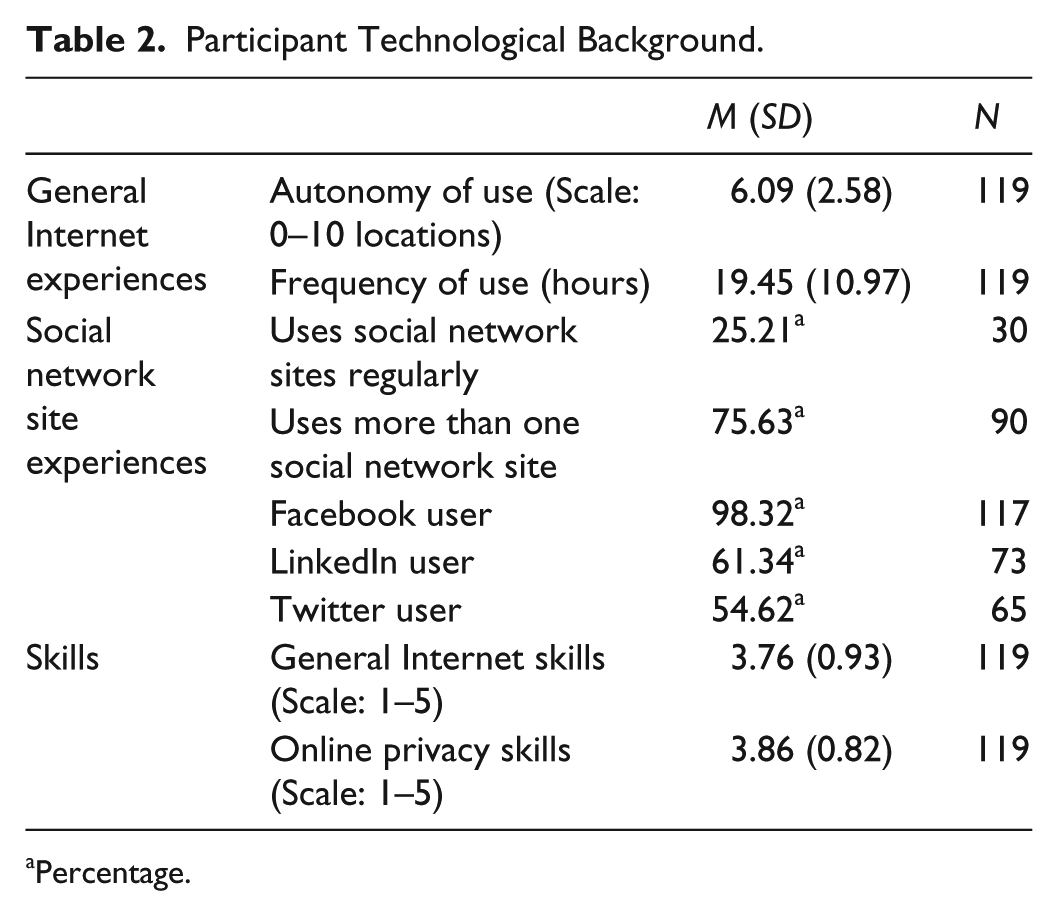
Percentage.
Interviewee Background.
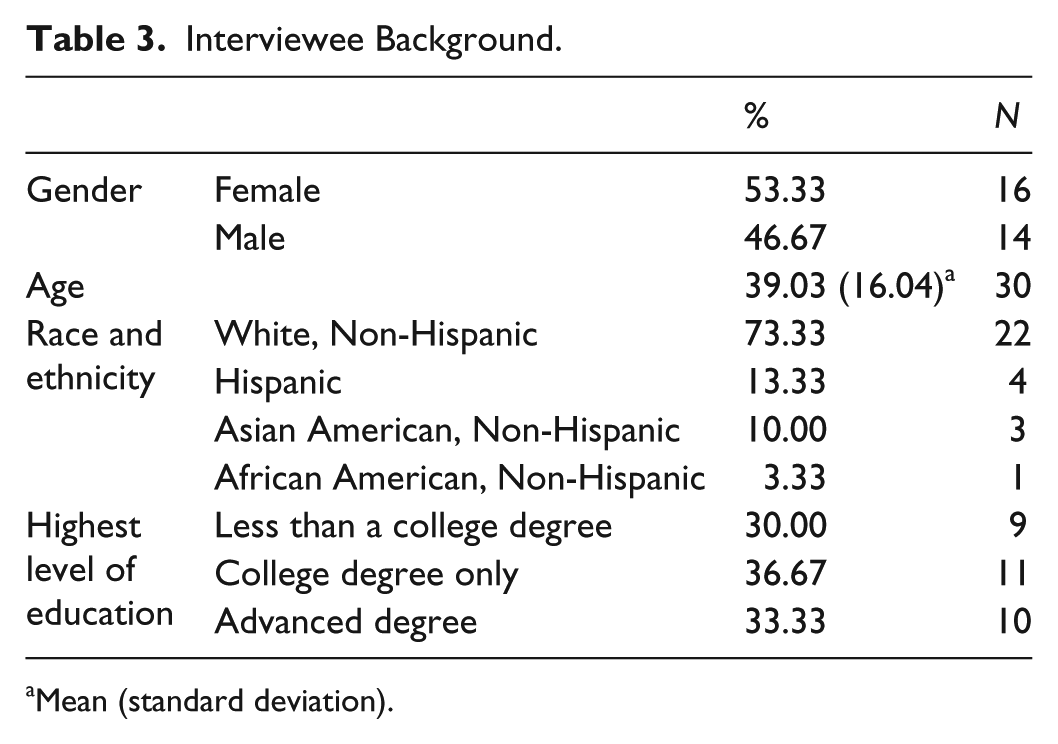
Mean (standard deviation).
Results
The first research question (RQ1) asked about whom people think about as they post on social network sites. Do people think about abstract audiences, target audiences, or both? Using the post as the unit of analysis, the following results reflect people’s imagined audiences as they shared individual posts (see Table 4 for a breakdown).
Imagined Audience Compositions Overall.

These figures were calculated using the post as the unit of analysis. Relationship type percentages are reflective of the Target imagined audience only. Relationship type categories were not mutually exclusive.
The Abstract Imagined Audience
In just over half the posts recorded in the study (51.7%), users envisioned abstract imagined audiences. That is, they indicated on the survey that they were not thinking of anyone specifically as they shared a post on a social network site.
The Target Imagined Audience
In comparison, in just under half of the social network site posts collected in this study (48.3%), as users shared, they had more targeted audiences in mind. That is, they indicated on the survey that they were thinking of a more nuanced audience as they shared. Although we have labeled this imagined audience type as something with more specificity, even such imagined audiences ranged from very specific people (e.g., “My cousin”) to more ambiguous groupings (e.g., “anyone that has a collie”). The types of people users described as their imagined audiences can be grouped in the following four categories: personal ties, communal ties, professional ties, and phantasmal ties (Figure 1; see Table 4 for percentages of these relationship types among the target imagined audience posts). Target imagined audience categories were not mutually exclusive. However, the overwhelming majority of imagined audience responses were homogeneous consisting of only one imagined audience type, such as only personal ties (e.g., “Close friends”) or only professional ties (e.g., “My coworkers”). In less than a quarter of target imagined audiences, people described an imagined audience using multiple relationship types, such as two distinct audiences (e.g., “LSU Tiger Fans and Friends”), or they labeled one audience using different relationship types (e.g., “Christian friends” or “Admissions professionals who are also sports fans”). When describing their imagined audience with multiple relationship types, participants most often discussed communal ties and personal ties together (e.g., “Fellow runners and my Boston friends”).
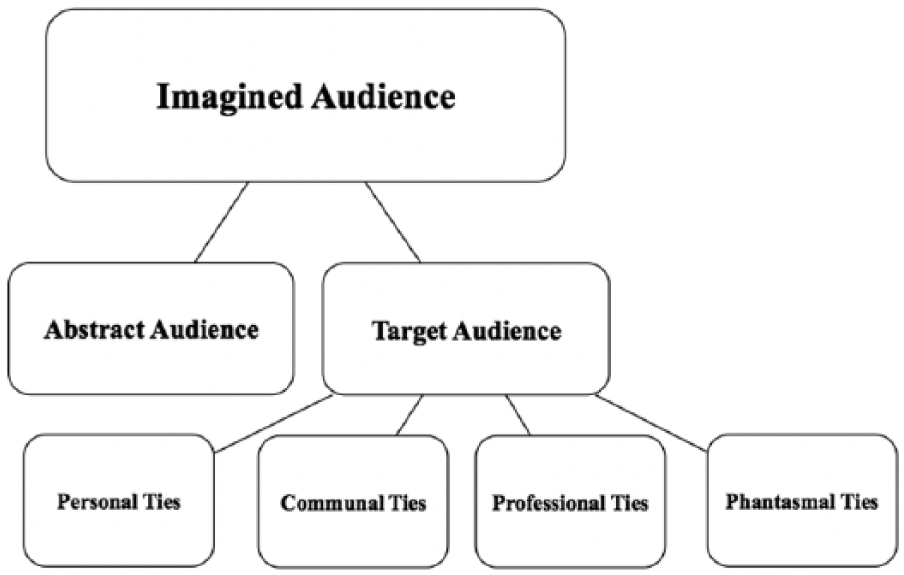
The different imagined audience compositions participants tended to think about–and fluctuate among–as they posted on social network sites.
Personal ties
When people thought about target imagined audiences, they most often listed their personal ties (70.2%) including themselves, their friends, and/or their family. People listed imagined audiences, including “Family,” “Friends and family,” “Close friends,” and “Good Friends,” as well as more specific individuals such as siblings (“My brother”), parents (“My mom”), children (“My daughter”), and significant others (“My wife”).
Communal ties
People’s imagined audiences sometimes focused on people from a community (28.2%). Such communities were broad in scope, but fell into one of four categories: hobbies/interests (“all who were interested in good cleaning tips” and “Local art community”), experiences (“Everyone with kids or works in a sxhool [sic]” and “Males my age”), locations (“anyone based in Portland” and “everyone in Michigan!”), and political ideology and religion (“all the people I know who are prolife [sic]” and “Christians”).
Professional ties
People’s target imagined audiences also sometimes consisted of their professional ties including their coworkers, colleagues, clients, potential employers, and/or peers (17.4%). For instance, people listed imagined audiences such as: “My coworkers,” “My classmates,” “My radio show audience,” “lab colleagues,” “My business associates,” and “The person who had the job opening.”
Phantasmal ties
Finally, sometimes people thought about phantasmal ties as their imagined audiences, or people or entities with whom they had an illusionary relationship such as famous individuals, brands, animals, and the deceased (6.9%). For instance, some thought about politicians, like “mitt romney [sic]” and “Obama.” Others imagined entities, like “blue cross blue shield [sic]” and “Microsoft’s Outlook.com twitter.” Some thought of their deceased loved ones, “my deceased father,” as well as their pets, “My dog.” Users thought about these entities and individuals even at times when they knew it was unlikely or in some cases impossible for such entities to see or respond to the post.
Fluctuations between Abstract and Target Imagined Audiences
RQ1b asked whether people’s imagined audiences fluctuated by post. That is, each time a person posted, did he or she think of a different imagined audience? Analyzing the imagined audience responses by individual, the findings suggest that the imagined audience is not a stable construct (see Table 5 for a breakdown of the average imagined audiences by participant). Less than an 8th of the sample always thought about abstract imagined audiences each time they posted and only about a 10th of the sample always had a targeted imagined audience as they shared a post during the study. However, the majority of participants fluctuated between imagined audiences that were abstract and targeted. Most people (88.2%) had an abstract audience in mind at least once during the study and most (90.8%) had a target audience in mind at least once during the study as well. Those who had target imagined audiences also altered whom they thought about as they posted. People thought about their personal ties in just over 1 in 3 posts, their communal ties in roughly 1 in 7 posts, their professional ties in 1 out of 15 posts, and phantasmal ties in less than 1 out of 36 of their posts. For instance, during the study, a 61-year-old woman had an abstract imagined audience for 6 different posts she shared, but she also thought about her personal ties in 5 other posts she shared (e.g., her grown children), and a professional audience for 1 post (e.g., former schoolmates). Similarly, a 28-year-old man had abstract imagined audiences for 6 posts he shared. During the times he had a target imagined audience, he thought about an audience consisting of personal and communal ties for 3 different posts (e.g., friends from his co-op), his communal ties during another post (e.g., running club), and his professional ties during his final 2 posts (e.g., coworkers).
Average Number of Imagined Audiences by Individual.

These figures were calculated using the individual as the unit of analysis.
Users’ Reflections on Abstract versus Target Imagined Audiences
During the interviews, participants reflected on the composition of their abstract imagined audiences and target imagined audiences (RQ2). How did people describe an abstract imagined audience versus a target imagined audience in their own words? When people thought about an abstract imagined audience, it was typically at times when they had an “urge” to share something, however they were not focused on nor did they always care with whom they shared. They typically just wanted to share it with “everyone”/”everybody,” “people,” “the public,” “the general public”/“general populous,” “anyone,” “the world,” or “whoever came across it.” They described this abstract imagined audience as something “general,” “abstract,” “vague,” or “nondescript.”
When users had an abstract imagined audience in mind, they at times were more focused on the act of self-presentation and their rationales for sharing the content, rather than on the receiving audience. A 28-year-old stated he was “more absorbed in the process rather than acknowledging individual people.” Similarly, when a 75-year-old woman was asked to elaborate about what she was thinking when she said “everyone,” and whether she was thinking about specific people, she responded, “I probably wasn’t. It was probably just to put up.” Many participants recounted these posts as acts of self-presentation in which they were focused on the sharing. They were “just kind of thinking out loud,” “just sort of throwing it out there,” “just saying it just to say it,” “letting it out,” “wearing my heart on my sleeve.” As a 49-year-old man stated, “it was just like me saying, hey, this is what’s on my mind” or “hey, this is how I feel at the moment.” With such posts, they viewed the platform as a space to “broadcast” and “put it out there,” and for “casting the net wide.” A 38-year-old man said, “I just thought it was fun so I figured I’d share it, and if somebody saw it, and enjoyed it then that was good enough.”
A 23-year-old man articulated it in the following way: If there’s something I think of and there’s nobody to share that with at the moment, I’ll just put it on Facebook so it feels like I shared it with someone. But that’s it. After I get that gratification I’m done. . . . I like to talk to an imaginary audience.
In contrast, when people had a more targeted imagined audience, they tended to have audience goals, and were more focused on an end-receiving audience. They often thought about the individuals they were “speaking to” or “trying to get through to.” This was at whom the post was “directed” at and “meant for.” It was at whom they were “targeting” or “aiming” it at. This was their “intended audience.” It was the people who they “wanted,” and “[looked] forward to” seeing the post. A small minority thought about their target imagined audiences as people who would criticize whatever it was they shared, but the majority of people thought about the most relevant audiences for a post as well as those who they felt would be most likely to see their posts. In their own words, they thought about “the crowd of people who would be interested,” “the audience that is going to be most impacted,” as well as the people who would “enjoy” the post, get a “kick out of” it, find it “useful,” and sometimes who they expected to “see it” and interact with it.
Some participants reflected on having both abstract and target imagined audiences. A 61-year-old woman recounted her abstract imagined audiences as “times I’m just throwing stuff up because I want to,” and the target imagined audiences as times she’s “posting for other people.” Similarly, a 50-year-old man described the two different audiences using rhetorical questions. In instances of an abstract imagined audience he questioned, “am I just saying it just to say it?” in contrast to scenarios where he had a target imagined audience, “who do I want to make sure sees this or who am I directing this at?” A 31-year-old man highlighted an abstract imagined audience for his posts as times when he “wasn’t really considering who’s seeing it or it’s kind of a general thing” while he described the target imagined audience as times when he was “intending certain people to see” his posts. A 34-year-old man described it like this: I guess if I’m just quickly reading an article and I find it interesting, I don’t really stop to think whether someone else will find it interesting. I’ll put it out there just because I think it’s something people should know, and if someone runs past it, that’s great. Other times, if I’m reading something and as I’m reading it, people come to mind then I would say, yes, it probably has a directed audience.
A 25-year-old man compared an abstract and target imagined audience using posts from the study: . . . a lot of it has to do with the purpose of the posts, you know, and so for this one in particular, the purpose was literally just to like increase the visibility of what we were doing, and so because of that, there’s no specific target person . . . or like a type of person that I’m trying to reach and so that’s I guess what I would describe as the wide-net casting strategy, but for the other posts they’re a little more personal to me and it wasn’t just to like increase the visibility . . . it was less of a tool than it was for this one I guess, and so there are specific people that I’m like, oh yeah, like, I want them to like congratulate John on his birthday. Yeah, or like I want to connect with like old college friends, you know, would be the sentiment in the first example that you brought up . . . there’s a different purpose to each post or there can be, and so the audience is different.
Blanking out on the audience during the performance
There were several instances where an abstract imagined audience shifted into a target imagined audience alluding to a potential cognizance or articulation issue. There may have been a more specific imagined audience in mind at the time, but the participant was not aware of it, could not articulate more details, or chose not to understand more about it during the posting or survey. For instance, during his interview, a 34-year-old began to describe his target imagined audience of “friends who also follow sports,” for one of his posts about a hockey game; however, on the survey, he had indicated he had an abstract imagined audience in mind. After he finished describing details of the post and his imagined audience, the interviewer asked him why on the survey he had indicated the abstract imagined audience response when it seemed he had a more targeted audience in mind. He responded, “probably just the time that’s elapsed and also just like the process of these questions. Like now it’s making me think a little bit more in depth about whom I was intending it for.” Similarly, a 64-year-old reflected on her abstract imagined audience stating, “Yeah, I probably meant more fr—you know my friends.” When another participant, a 34-year-old, reflected on his abstract imagined audience during the diary survey, he stated, “I guess thinking back on it now, it is kind of meant for, it was meant for, maybe some of my closer friends who knew me, and maybe a few of my friends that I had studied French with.”
While it is possible the actual audience ended up influencing the imagined audience survey response through visible interactions after the posting, it may also have been a consciousness or articulation issue. The user may have had a more targeted audience in mind; however, he or she was not attuned to it or could not articulate its details. While the study design aimed to avoid making participants more imagined-audience-aware, these scenarios suggest that the more users were probed to think about their imagined audiences in depth, details of their nuance and whom they addressed may have become clearer.
Discussion
Although people have long relied on the imagined audience as a cognitive guide, and scholars have long theorized its role (Anderson, 2006; Cooley, 1902; Freud, 1922; Ong, 1975), social network sites have brought the construct to the research fore because of everyday users’ reliance on it for day-to-day interactions with large, diverse, and invisible actual audiences (boyd, 2008; Brake, 2012; Marwick & boyd, 2011). While recent research has begun to focus on the imagined audience creating a helpful foundation (Cook & Teasley, 2011; Marwick & boyd, 2011; Murumaa & Siibak, 2012; Vitak et al., 2015), little research has understood many nuances of whom people think about as they post on social network sites, including what such imagined audiences look like, how often they come to mind, and how they may fluctuate. Using a mixed-methods study involving diary surveys and interviews, this study set out to explore such topics.
So whom do people think about as they post on social network sites? With whom do they share and for whom do they manage their privacy? Do they think about specific sub-audiences? Do they share much more abstractly and broadly? The answer is complex as this study found most people’s imagined audiences were not stable and instead fluctuated among different types, as prior work theorized (Litt, 2012; Marwick & boyd, 2011). Ultimately, these imagined audiences could be categorized into two main types: (1) an abstract imagined audience, which was vague and general and (2) a target imagined audience, which was more specific and directed, and comprised of personal, communal, professional, and/or phantasmal ties. Although previous research studying overarching imagined audiences has identified similar conceptualizations (Cook & Teasley, 2011; Marwick & boyd, 2011; Semaan et al., 2015), this work details these conceptualizations, and highlights that people have multiple imagined audiences, which may change each post.
While this study sheds more light on the various imagined audience compositions, we see both strengths and weaknesses of the main audience types. For instance, having an abstract imagined audience may be a strategy people use in an effort to appease and/or avoid trouble from their potentially broad and diverse audiences. Why would users broadcast to diverse audiences if their posts are only relevant to specific audience members? However, our findings reveal weaknesses with this imagining as well. When exploring participants’ abstract imagined audiences during the interviews, many did not describe their abstract imagined audiences as “a heterogeneous collection of individuals” (Webster & Phalen, 1997, p. 7). Instead, they often described these instances as times when they were more focused on what they were sharing than with whom they were sharing. The sharing may have been the “end in itself” (Brake, 2012, p. 1062). The abstract audience may have come at times when people used the platforms primarily for self-expression. Focusing on their self-presentation, they may have gotten lost in their imagination and blurred out the audience on the other side of the screen. Furthermore, there was some evidence that an abstract imagined audience may have been the default audience and could have been linked with an articulation or awareness issue.
However, there are also signs of strengths and weaknesses for the target imagined audience. In support of its strengths is the adage “Know thy audience,” which is often the basis for successful communication. As Marwick and boyd (2011) noted, “While anyone can potentially read or view a digital artifact, we need a more specific conception of audience than ‘anyone’ to choose the language, cultural referents, style, and so on that comprise online identity presentation” (p. 115). Our findings highlight a target audience often came to mind when people utilized social network sites as a tool when they wanted to reach specific audiences. These were times they were focused on an end-receiving audience that had preferences and reactions. However, we found weaknesses in some participants’ target audience conceptualizations as well—just because someone thought about an audience with specificity, did not indicate the target imagined audience aligned with the actual audience. For instance, many participants’ target imagined audiences were sub-audiences of their networks, even though they broadcasted to their networks and sometimes beyond. Given that different audiences may have different expectations for appropriateness and relevance (Arkin, 1981; Burgoon et al., 1989; Farnham & Churchill, 2011; Nissenbaum, 2009), imagining specific sub-audiences may lead to disclosures on social network sites that are irrelevant or inappropriate for those outside of the specific sub-audience that also may see the posts. Furthermore, the most common sub-audiences people imagined tended to be people who would likely be the least judgmental such as friends and family, and people who they thought would like or agree with their posts, perhaps neglecting those who may be less forgiving. If people most often post for their friends and family, how do others perceive their posts, such as their professional ties? What about the potential audience members not even mentioned in the study, such as law enforcement, acquaintances, enemies, and strangers, who may have been part of some of participants’ actual audiences? If some users do not have such audiences at the fore when they share, this could explain why they do not alter their content or engage in privacy behaviors for these groups as other research has found (Young & Quan-Haase, 2013), as well as why sometimes there may be breakdowns in the sharing process when such audience members make themselves known (Litt & Hargittai, 2014; Petronio, 2002; Stern, 2015). Ultimately, the most socially advantageous imagined audience is likely dependent on many factors including peoples’ goals and their potential audience compositions.
The strengths and weaknesses surrounding audience conceptions found in this study highlight the technological challenges, context collapse, and cognitive limitations, everyday users face (boyd, 2010; Dunbar, 1992; Marwick & boyd, 2014; Papacharissi, 2013; Walther, 1996). Although we found evidence of many people giving their audiences strong consideration, we also saw issues around audience consciousness, or lack thereof. There were instances when participants had not thought about their networks as an audience judging their performance, and times when they only thought about a specific sub-audience as they broadcasted to a diverse network. The average everyday user has likely not received any audience training so their strategies and cognizance may be somewhat happenstance and spontaneous. Although many media professionals in broadcasting may have developed a routine, a voice, and a successful targeted audience as they have dealt with similar challenges over the past decades (Meyrowitz, 1985; Ong, 1975), everyday people seem to be learning about balancing their sharing urges, self-presentational goals, and the end-receiving audience’s reactions. While there are still many unanswered questions regarding the target and abstract audiences, these findings shed some light on with whom people share and for whom they manage their privacy, ultimately highlighting the complexity surrounding these activities.
Study Limitations
Although this study provides novel findings regarding the imagined audience, it has limitations. While we included a diverse sample in terms of gender and age, our sample was limited in other ways. For example, our participants had more social network site experience in comparison to most American adults online (Duggan, Ellison, Lampe, Lenhart, & Madden, 2015). Additionally, this study only focused on posts people shared with their networks systematically excluding posts people shared with specific lists that the researchers were not included on as well as posts people chose not to share altogether. Future research should continue to study the topic more holistically as other research suggests the imagined audience may be an influential reason for not sharing (Das & Kramer, 2013; Sleeper et al., 2013). Finally, many questions were dependent on self-reported responses, and thus there can be issues with social desirability, memory, and recall biases that need to be taken into account. For instance, at times, people may have had trouble remembering their imagined audience or some may have been reluctant to share their imagined audience.
Future Research Directions
Given the limited empirical research on the imagined audience topic, this study mainly focused on describing the imagined audience in detail. We hope future research will continue to build on this by exploring the relationship between the imagined audience and other factors. For example, although people fluctuated among imagined audiences, people likely tended to think about certain types of imagined audiences more than others, and this may have been influenced by individual factors like their goals and skills as well as more situational factors like on which site they posted (Litt, 2012). Given the importance of people’s self-presentation online (e.g., Acquisti & Fong, 2012; DeAndrea & Walther, 2011; Walther et al., 2009), future research should also explore more about the relationship between the imagined and actual audience, including more from the perspective of the actual audience. Future work may explore other ways of measuring the imagined audience, and tease apart the spectrum of imagined audiences from very abstract to very specific. Research may also look at improving social network site technology and algorithms to help users reach their most desired audiences as well as push users to think critically about their audiences. Finally, future research should also focus on audience training for everyday users potentially turning to professions (e.g., broadcasting), which have long relied on the imagined audience, for strategies.
Conclusion
In order to understand what users share and why, as well as how they manage their privacy, and when such processes break down, we need a better understanding of the imagined audience, or whom everyday people think about as they share on social network sites. Using a mixed-methods approach learning about the everyday practices of a diverse group of American adults, this study explored the imagined audience construct. Even though users often interacted with large, diverse, and invisible audiences, they coped with the audience challenges by thinking about a general abstract audience or by thinking about a more targeted audience as they posted. By studying the imagined audience while people share individual posts, the findings were able to highlight that people have multiple imagined audiences. Participants in this study fluctuated not only between abstract and target imagined audiences as they posted, but even their targeted imagined audiences sometimes varied. That is, sometimes participants thought about an abstract imagined audience, while at other times they thought about a more targeted audience filled with personal ties, and at yet other times they thought about a target imagined audience made up of professional ties. When people thought about target imagined audiences, they most often thought about homogeneous groups of people made up of those who would find their content interesting, and These were often their personal ties. While the study brings to light several theoretical, design, and education implications, it also opens new potential avenues for researchers studying privacy and audiences.
Footnotes
Acknowledgements
We are grateful to Darren Gergle and Jeremy Birnholtz who provided integral feedback on previous versions of this project as members of the first author’s dissertation committee. We are very thankful for the research support provided by Karina Sirota. Many people offered support and resources for this project including Brooke Foucault Welles, David Dworin, Deen Freelon, Ericka Menchen-Trevino, Jeffrey Boase, Jens-Erik Mai, James G. Webster, Kelly Garrett, Luke Hutton, Miriam Metzger, Rachel Magee, and Sonja Utz. The first author is grateful for the time and resources made possible thanks to the Facebook Graduate Fellowship; the second author acknowledges Facebook’s support through a research gift. We also give a big thank you to the reviewers, Zizi Papacharissi, Stacy Blasiola, and the publications staff for their support, time, and thoughtful feedback.
Declaration of Conflicting Interests
The author(s) declared no potential conflicts of interest with respect to the research, authorship, and/or publication of this article.
Funding
We acknowledge the generous support to the first author from Northwestern University’s School of Communication Graduate Research Ignition Grant, Department of Communication Studies Graduate Dissertation Research Award, and the The Graduate School (TGS) Graduate Research Grant from the Northwestern University Research Grants Committee.