



Abstract
Research on online political participation highlights how online platforms may facilitate or encumber political participation. In this contribution, we add to existing research on digital inequalities in online political participation by focusing on privacy concerns as a critical construct. We follow a contextual understanding of online privacy and examine a variety of online political behaviours to differentiate the distinctive roles privacy concerns play in higher- and lower-threshold forms of participation. Based on a survey of German Internet users, we find that social media use exerts a strong positive effect on political participation, especially lower-threshold forms of participation. As privacy concerns are spread quite evenly throughout the population, they contribute little to the socioeconomic stratification of online political participation. Privacy concerns relate positively to higher-threshold forms of political participation. We discuss how higher- and lower-threshold participation constitute distinct contexts for users’ considerations of privacy risks.
Introduction
New media can foster political participation through different mechanisms, for example, by offering low-threshold forms of engagement. Expressing one's political opinion online can be as easy as clicking a like button on Facebook or retweeting someone else's tweet. Signing e-petitions, posting videos, and commenting on online news are other activities that require limited effort for political participation. Social media, in particular, have facilitated political online engagement due to their affordances (Boulianne, 2020; Vitak and Kim, 2014). However, online political participation is not evenly distributed throughout the population. Younger, male, and highly educated citizens tend to be more politically active online (Lutz et al., 2014). Accordingly, some authors have pointed out a divide in online political participation (Bode, 2017; Hoffmann and Lutz, 2021; Vochocova et al., 2016).
Given the unequal distribution of political participation, a critical question today is whether the sociodemographic stratification of online political participation merely replicates offline dynamics, or whether online media provide specific obstacles to political participation that shape the online divide. One such obstacle is privacy concerns. While privacy concerns, generally, can be seen as a deterrent from online engagement (Smith et al., 2011), they may pose specific challenges to online political participation (Bode, 2017; Hampton et al., 2014; Zerback and Fawzi, 2017). Political participation has variously been described as performative, as it is geared towards others and exposes the participant to the scrutiny of fellow citizens (Scheufele and Eveland, 2001). From publicly expressing a political opinion, trying to persuade others, to displaying a political position in the form of T-shirts or memes – by participating politically, citizens share personal information (Endersby and Towle, 1996; Kann et al., 2007).
Previous findings on the role of privacy concerns in online political participation hint at a form of ‘privacy paradox’, finding no significant effect (Blank, 2013), or in some instances even a positive relationship between privacy concerns and online political engagement (Hoffmann et al., 2015; Lutz and Hoffmann, 2021). At the same time, the privacy literature highlights the contextual nature of the phenomenon (Nissenbaum, 2004), as the desired level of privacy varies according to the norms of a given social context. Applying such a contextual lens, it is important to acknowledge that online political participation is not a contextually homogeneous concept. It encompasses activities as distinctive as contacting elected officials, liking and posting political comments, signing petitions, organizing and other forms of activism, or engaging in online discussions (Gibson and Cantijoch, 2013).
To summarise, empirical findings confirm that online media constitute an environment providing specific incentives, but also obstacles to political participation. In particular, the opportunity to easily share information online, while rendering political participation more convenient, necessitates careful consideration of the associated risks. To date, privacy and online political participation stand apart as two largely separate streams in Internet and social media research (Wilson et al., 2012; Zhang and Leung, 2015). In this study, we combine insights on online political participation and online privacy to explore the contextual relationship between privacy concerns and various acts of online political participation. Based on a survey of 1063 individuals in Germany, our study addresses the following research question: ‘How do privacy concerns affect users’ online political participation?’
Literature review
Online political participation
Verba et al. (1995: 7) define political participation as an ‘activity that is intended or has the consequence of affecting, either directly or indirectly, government action’. While traditionally, political participation is conceptualised as voting behaviour or engagement in party politics (Gil de Zúñiga et al., 2012; Moy et al., 2005; Smith et al., 2009), the concept of online political participation is more fluid and complex. It may entail communicative action, such as posting, liking, or commenting on content, networking activities in the vein of ‘connective action’ (Bennett and Segerberg, 2012), and various forms of organising and activism (Lutz et al., 2014).
Some have argued that this complexity or fluidity would make online political participation especially attractive to citizens who may be unfamiliar with, intimidated, frustrated by or simply excluded from rigid (offline) political institutions and processes (Collin, 2008). Empirical examinations indicate that online political participation is indeed especially attractive to younger citizens (Vraga et al., 2015) – and may therefore contribute to narrowing the age gap in political participation. Yet, even online, political participation remains socially stratified, with characteristics such as gender or education predicting online engagement (Hoffmann and Lutz, 2021; Oser and Boulianne, 2020).
Various authors have highlighted the expressive and performative nature of political participation. Not all, but many acts of political participation are directed at the attention of others (Scheufele and Eveland, 2001). By participating politically – for example, by publicly expressing a political opinion or stance – citizens affect their impressions on others (Endersby and Towle, 1996; Kann et al., 2007). This holds especially true for online political participation in social media, where citizens address their social environment or even the general public through sharing content on personalized web platforms.
Online privacy
In the following, we are focusing on informational privacy (Smith, et al., 2011; Solove, 2008), which has been of specific interest to Internet research as sharing personal data makes users vulnerable to the potential loss of control over these data (Culnan and Armstrong, 1999). In this context, privacy concerns are based on the assessment of the likelihood and extent of adverse consequences from information disclosure (Dinev and Hart, 2004; Malhotra et al., 2004). Yet, the provision of personal data is often a precondition for the use of online services (Rust et al., 2002). This holds especially true for social media, which are associated with a puzzling variety of privacy threats, resulting in privacy concerns (Dienlin and Trepte, 2015).
Accordingly, numerous empirical studies have shown that a large proportion of Internet users are concerned about their online privacy (Eurobarometer, 2015; Madden and Rainie, 2015). This is seen as a potential impediment to the expansion of online transactions (McKnight et al., 2002). The higher users’ concerns about their online privacy, the less likely they are to engage in an online transaction (Olivero and Lunt, 2004). At the same time, privacy concerns do not preclude the sharing of personal data online. Lanier and Saini (2008) find that humans feel a need for seclusion, autonomy, and self-control. Yet, as social beings, they also wish to interact with each other. So, while privacy concerns affect human behaviour and limit self-disclosure, they do not prevent it (Dinev and Hart, 2006).
The divergence between online privacy attitudes and privacy protection behaviour has been termed the ‘privacy paradox’ (Barnes, 2006). The concept was initially formulated to define the perplexing divide between privacy-concerned adults and self-disclosing digital teenagers, but has evolved to incorporate discrepancies between individual attitudes and behaviour when it comes to (online) privacy (Tufekci, 2008). A number of studies have found privacy concerns to exert only a weak, if any, effect on online self-disclosure and protection behaviour (Dienlin and Trepte, 2015). To date, a substantial number of studies exist on the phenomenon, sowing mixed empirical evidence (Baruh et al., 2017).
Mixed results on the ‘privacy paradox’ also highlight the importance of a contextual understanding of privacy. Analysing cases of public surveillance, Nissenbaum (2004) points out that requirements of privacy protection vary by the normative implications of specific social contexts. ‘A central tenet of contextual integrity is that there are no arenas of life not governed by norms of information flow, no information or spheres of life for which “anything goes.” Almost everything – things that we do, events that occur, transactions that take place – happens in a context not only of place but of politics, convention, and cultural expectation’ (Nissenbaum, 2004: 137). Users take the specific norms embedded in social contexts into consideration when assessing the appropriate level of privacy versus self-disclosure (Acquisti et al., 2013; Nissenbaum, 2011). Some contexts, such as political engagement, may require heightened levels of self-disclosure, rendering privacy protection less of a salient concern.
The intersection of online privacy and online political participation
Online political participation is motivated by a wish not only to be heard by others, but to be perceived by others as politically engaged (Morozov, 2009). When citizens take a political stance online or reach out through online media to influence others politically, they unavoidably share personal information (Puig-i-Abril and Rojas, 2007). Thereby, online political participation is associated with privacy risks. These risks encompass privacy infringements by both online service providers and other users (Raynes-Goldie, 2010; Young and Quan-Haase, 2013). In fact, previous research has shown that social privacy concerns (i.e. fear of being ostracized or harassed) lead to political self-censoring and a reduction in online political engagement (Fox and Warber, 2015; Gearhart and Zhang, 2015; Hampton et al., 2014; Hoffmann and Lutz, 2017; Matthes et al., 2018; Sheehan, 2015; Stoycheff, 2016; Zerback and Fawzi, 2017).
Little is known about the intersection of privacy concerns and political participation. Both political engagement and privacy literacy tend to be associated with a higher socioeconomic status (Hoffmann and Lutz, 2021; Oser and Boulianne, 2020; Park, 2013; Taddicken, 2011). Privacy literacy positively relates to protection behaviour (Baruh et al., 2017). Possibly, politically engaged individuals take on the privacy risk of online participation because they are more skilled at protecting their privacy online. Due to their political awareness and higher levels of news consumption, politically engaged individuals may also better be able to estimate their privacy risks (Boulianne, 2011; Trepte et al., 2015). Dissatisfaction with the state of privacy policies could even motivate political engagement (Draper and Turow, 2019).
In one of few studies touching on the role of privacy concerns in online political participation, Blank (2013) investigates how demographic, socioeconomic, and attitudinal variables affect the creation of political content. Based on a representative survey of 1498 Internet users in Great Britain, he finds that ‘personal data comfort’ has no significant effect on political content creation. Using a sample of 1488 Internet users in Germany and replicating Blank's (2013) structure of content types, Hoffmann et al. (2015) find that privacy concerns even exert a positive but weak effect on political content creation (cf. Lutz and Hoffmann, 2021). In the context of government surveillance in the US, Best and Krueger (2011) state that ‘[r]ather than chilling activity and expression, […] government monitoring in the United States seems to motivate individuals to act politically’ (87).
These findings indicate that the effect of privacy concerns on online political participation may be contingent upon the norms embedded in the context of political engagement. In Germany, where this study is situated, trust in government institutions tends to be higher than trust in large corporations (Edelman, 2021; Enste and Suling, 2020). Vertical privacy concerns towards online platforms may therefore be especially salient in the context of online participation. On the other hand, trust in political institutions varies by political orientation, with supporters of more populist or radical parties exhibiting lower trust and higher levels of political cynicism (Van Hauwaert and Van Kessel, 2018). For these users, concerns towards online platforms may be less salient than state surveillance concerns. Previous studies also found that political trust bolsters institutionalized participation, while a lack of trust tends to fuel non-institutionalized participation (Hooghe and Marien, 2013) – both of which can occur online. Some modes of political participation (Gibson and Cantijoch, 2013), such as political discussion and expression, may also require heightened levels of self-disclosure, particularly in the context of political campaigning and activism.
To explore the contextual role of privacy concerns in online political participation, it is necessary to account for the complexity of the political participation concept. The present study, based on survey data collected in Germany, examines both a variety of socio-demographic and political user characteristics to analyse inequalities in political participation due to privacy concerns, and a variety of political behaviours, to differentiate how privacy concerns may exert distinctive influences in the social contexts of different forms of online political participation. To that end, we build on Gibson and Cantijoch's (2013) work to distinguish political online behaviours, and on Nissenbaum's (2004, 2011) theoretical lens of contextual privacy.
Methods
Sample
We use data collected from an online survey in Germany to address the research question. The survey was in the field in May 2018. A certified market research institute provided access to the participants and 1079 respondents completed the survey. However, 16 of them were minors (either 16 or 17 years old) and subsequently excluded, leaving us with a sample of 1063 respondents. About 50.4% of these respondents are male and 49.6 are female. The average age was 51.7 years (SD = 17.6 years). Educational levels varied, with 1% still in education, 1% with no formal degree, 7% with a lower secondary degree, 21% with an intermediary secondary degree, 14% with an upper secondary degree, 31% having completed an apprenticeship, 6% a Bachelor, 18% a Master, and 1% a Doctorate. Compared to the German population, the sample is slightly skewed towards older and more educated individuals.
Measures
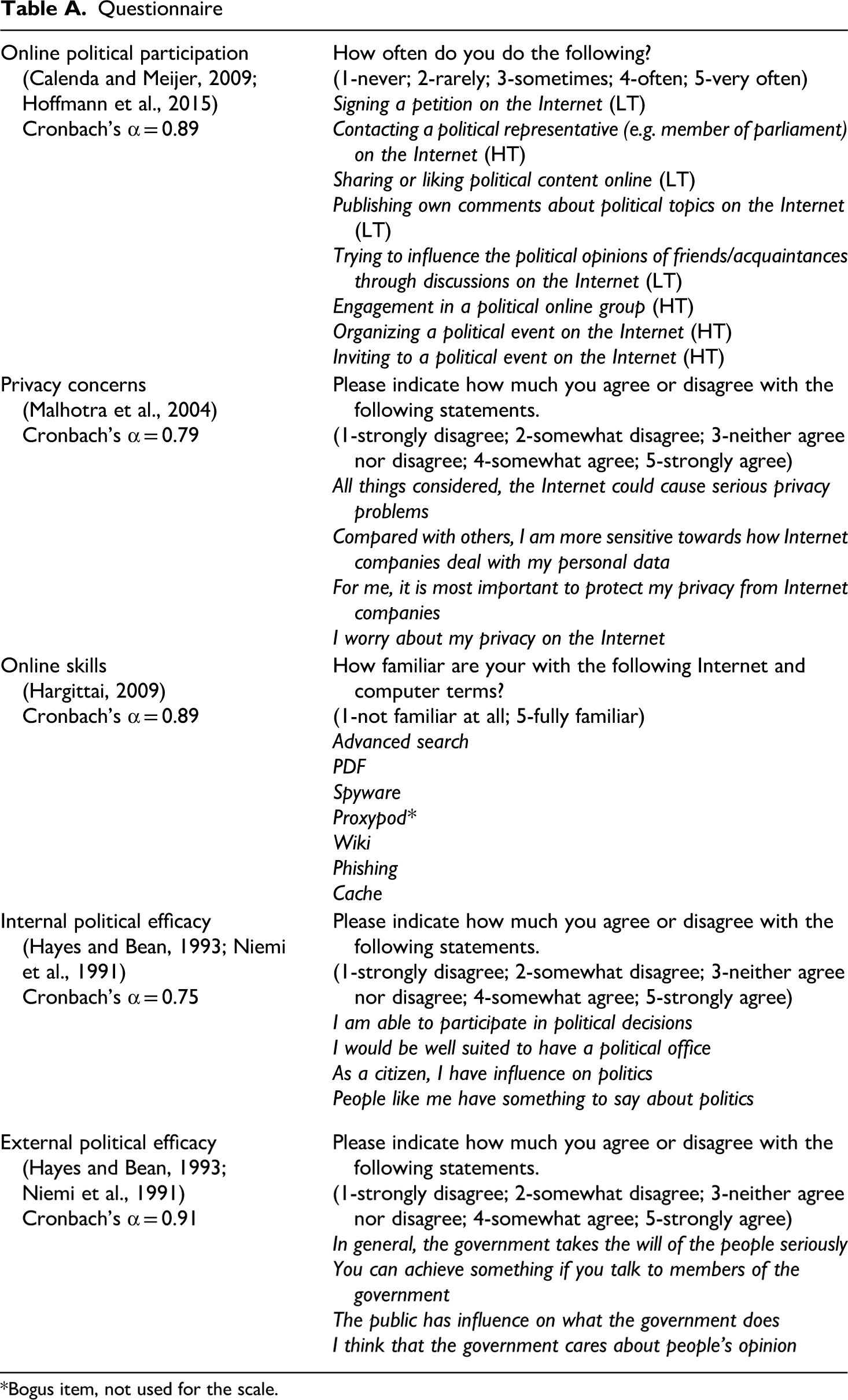
The questionnaire first queried participants on their sociodemographic data. It then included eight items on their online political participation, asking respondents about their frequency of participatory activities, such as signing a petition, contacting a political representative, sharing or liking political content online, posting political comments, or organizing and inviting to a political event (Table A in the Appendix). These measures were translated into German from existing studies on online political participation (Calenda and Meijer, 2009; Hoffmann et al., 2015). The chosen activities were intended to cover a variety of participatory modes (cf. Gibson and Cantijoch, 2013). Participants were asked how often they performed the activities on a 5-point Likert scale (1 – never, 2 – rarely, 3 – sometimes, 4 – frequently, 5 – very frequently).
Principal component analysis (PCA) showed that the items loaded on two components, both of which had four items. We interpret these components based on Gibson and Cantijoch's (2013) distinction of ‘active participation’ versus ‘passive engagement’. The first component explained 61% of the variance and had an eigenvalue of 4.91. The second component explained 13% of the variance and had an eigenvalue of 1.05. The first component captures higher-threshold political activities, including (a) organising a political event on the Internet, (b) inviting to a political event on the Internet, (c) engagement in a political online group, and (d) contacting a political representative (e.g. member of parliament) on the Internet. The second component captures lower-threshold political activities, including (a) sharing or liking political content online, (b) signing a petition on the Internet, (c) publishing own comments about political topics on the Internet, and (d) trying to influence the political opinions of friends/acquaintances through discussions on the Internet. We saved these components with the ‘Regression’ method and used as the component scores as the dependent variables in our regression models.
Privacy concerns were measured with four items, which were slightly adapted from Malhotra and colleagues (2004). Participants were asked to rate their agreement with statements such as ‘All things considered, the Internet could cause serious privacy problems’ or ‘I worry about my privacy on the Internet’ on a 5-point Likert scale (see Appendix A for all items). The measure addresses general online privacy concerns, focusing on vertical concerns towards Internet companies. The items had sufficient reliability, with a Cronbach's Alpha α of 0.79. Respondents overall showed moderate to high privacy concerns with an arithmetic mean of 3.26 (SD = 1.02).
We included the following variables as controls: demographics (age in years, gender with the reference category female, education as coded per the description above, income as monthly household income in Euros), Internet use frequency with a 1–6 frequency scale, online skills based on a reduced version of Hargittai (2009) with six items, political interest with one item on a 1–5 scale, internal and external political efficacy based on Hayes and Bean (1993) and Niemi et al. (1991) with four items each, political orientation based on party preference, and social media use of five major platforms (Facebook, Twitter, Instagram, Snapchat, and YouTube). The items for all constructs that were measured with more than one item are displayed in Appendix A. All of them had high internal consistency, with all Cronbach's α between 0.75 (internal political efficacy) and 0.91 (external political efficacy).
We relied on linear regression analysis to answer the research question, using Stata (v.15) and robust standard errors due to the skewed dependent variable. We also checked for multicollinearity but did not find variance inflation factors exceeding 5, thus ruling out severe multicollinearity.
Results
Before we turn to the results of the regression analysis, we report demographic differences in the key variables of privacy concerns and online political participation.
As shown in Table 1, demographic characteristics do not differentiate privacy concerns strongly. We find some differences in education as those with higher education levels tend to reveal slightly higher privacy concerns, except for those with a PhD. However, there are some notable differences in political participation between users of different education, age, and income levels. Except for age, where both higher- and lower-threshold participation are equally negatively correlated, the social structuration of higher-threshold participation is more pronounced than that of lower-threshold participation. In terms of education, online political participation seems to increase with higher degrees, especially for higher-threshold participation, but respondents with lower secondary education report comparatively high values. Income is positively correlated with higher-threshold participation but not significantly correlated with lower-threshold participation. Overall, the descriptive results indicate that among German Internet users, there are demographic divides in online political participation – and especially higher-threshold participation – but not so much in privacy concerns.
Demographic differences in privacy concerns and online political participation.
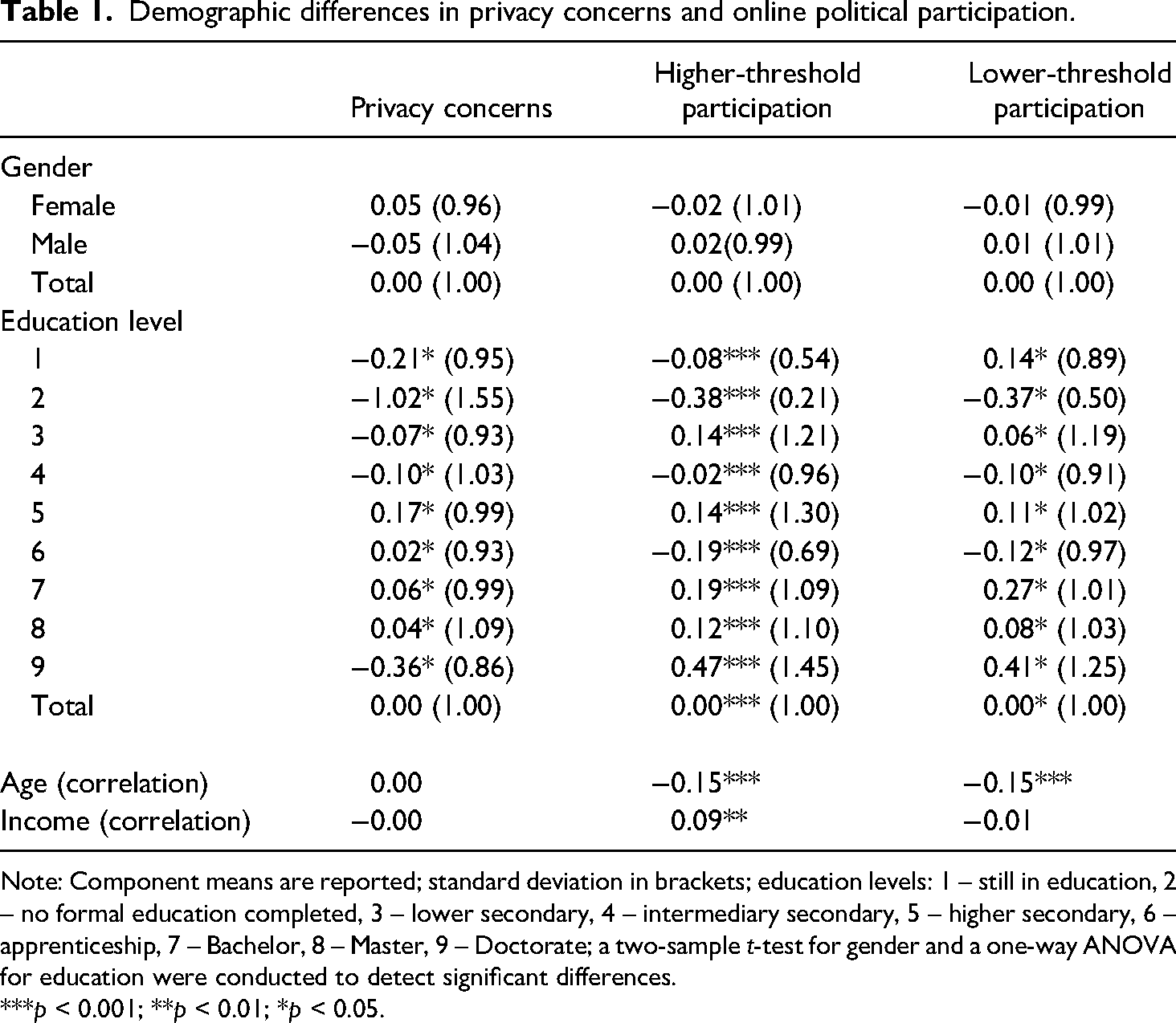
Note: Component means are reported; standard deviation in brackets; education levels: 1 – still in education, 2 – no formal education completed, 3 – lower secondary, 4 – intermediary secondary, 5 – higher secondary, 6 – apprenticeship, 7 – Bachelor, 8 – Master, 9 – Doctorate; a two-sample t-test for gender and a one-way ANOVA for education were conducted to detect significant differences.
***p < 0.001; **p < 0.01; *p < 0.05.
Table 2 shows the results of the linear regression analysis, with the model where higher-threshold participation is the dependent variable on the left and the model where lower-threshold participation is the dependent variable on the right.
Linear regression of online political participation on privacy concerns and control variables.
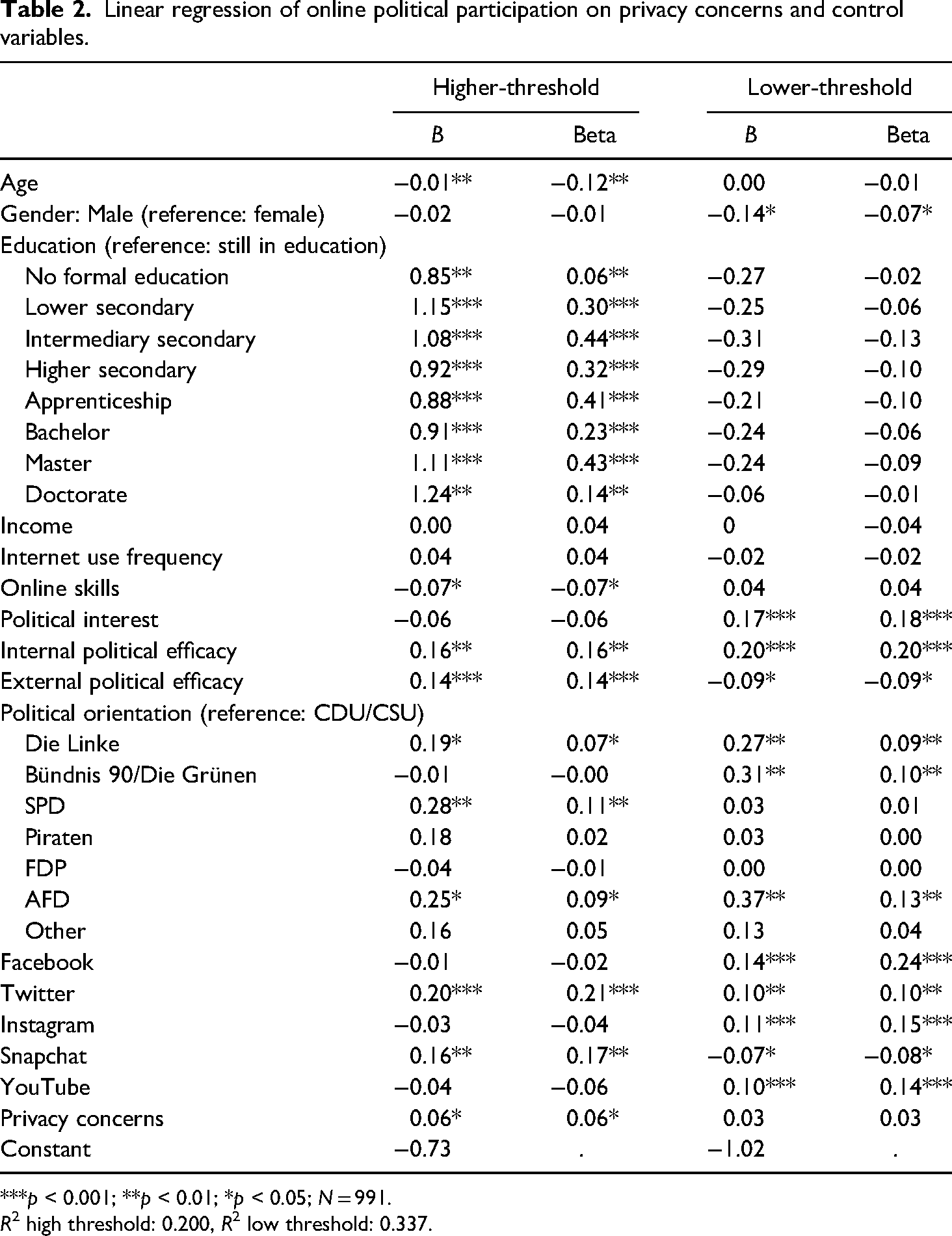
***p < 0.001; **p < 0.01; *p < 0.05; N = 991.
R2 high threshold: 0.200, R2 low threshold: 0.337.
For higher-threshold participation, we see that age and education are significant predictors, but gender differences are insignificant. Compared to those still in education, all other educational groups score significantly higher in online political participation. The difference is particularly pronounced for those with a Master's degree, apprenticeship, and intermediary secondary degrees. Age has a significant effect and influences higher-threshold participation negatively, with younger respondents being more politically active online. Online skills have a small negative effect. Internal and external political influence higher-threshold participation significantly and positively. Three party orientations are significantly related to higher-threshold participation: Those who affiliate more strongly with the radical left The Left party (Die Linke), the Social Democrats (SPD), and the radical right Alternative für Deutschland (AFD) score higher than the reference conservative party Christian Democrats (CDU/CSU) which at the time of the survey was the largest party by voting share (the Social Democrats emerged as the strongest party at the ensuing federal elections). Twitter and Snapchat use are positively related to higher-threshold participation. Finally, privacy concerns have a significant and positive, but relatively weak, effect on higher-threshold participation. We are able to explain 20% of the variance in higher-threshold participation with our independent variables.
Turning to lower-threshold participation, distinctive effects emerge: Privacy concerns do not have a significant influence on this type of online political participation. Among the demographic predictors, only gender has a significant effect, with women scoring slightly higher than men. In particular, women are slightly more likely to sign petitions and to like and share political content in SNS, but men are more likely to comment on political content and engage in online discussion. However, the effects of age, education, and income are all insignificant. Unlike higher-threshold participation, lower-threshold participation is positively influenced by political interest, while external political efficacy has a negative, but small, effect. However, in line with higher-threshold participation, internal political efficacy affects lower-threshold participation positively. As for political orientation, we find more pronounced effects: Lower-threshold participation is significantly and positively affected by political orientation towards The Left (Die Linke), the Green Party (Bündnis 90/Die Grünen), and the Alternative für Deutschland (AFD). The use of different social media platforms has a relatively pronounced effect on lower-threshold participation, with all platforms being statistically significant. Except for Snapchat, all effects are positive, so that the use of these platforms fosters lower-threshold participation. The independent variables together account 34% of the variance in lower-threshold participation. Thus, we are better able to explain lower-threshold than higher-threshold online political participation.
Discussion and conclusion
Based on an empirical analysis of German Internet users, we derive a number of insights into the role of privacy concerns in online political participation. First, by considering several distinct political online behaviours, we distinguish higher- and lower-threshold forms of participation: Lower-threshold participation encompasses behaviours such as political discussion and expression, sharing and liking content. These are behaviours facilitated by the affordances of social networking platforms. They require relatively little effort and come closest to the behaviours criticized by the ‘slacktivism’ thesis (Morozov, 2009). Gibson and Cantijoch (2013) characterize lower-threshold forms of participation as ‘passive engagement’. Higher-threshold participation, on the other hand is characterized by higher resource requirements (especially time and cognitive resources) such as engagement in online groups, organizing events or contacting elected officials (‘active participation’ according to Gibson and Cantijoch, 2013).
Second, we find that online political participation is socially stratified, with age, gender, education, and income relating to users’ levels of participation. Privacy concerns, instead, appear quite evenly distributed throughout the population, as we did not identify a strong sociodemographic stratification of general privacy concerns. This finding alone indicates that privacy concerns do not play a major role in the social stratification of online political behaviour (cf. Blank, 2013).
Third, we find that the role of privacy concerns differs according to the contextual specificities of higher- versus lower-threshold participation. We do not find a significant effect of privacy concerns in the context of lower-threshold online political participation. In line with some previous findings, however, we find a weak statistically significant positive effect of privacy concerns on higher-threshold participation (Best and Krueger, 2011; Hoffmann et al., 2015). In neither context do informational privacy concerns deter users from online political engagement. We interpret these findings in the light of what our analysis reveals about the predictors of higher- versus lower-threshold online political participation.
We find little evidence of social stratification in the context of lower-threshold participation, neither age, education, nor income show significant effects; only gender plays a role in these lower-effort forms of political participation. Lower-threshold participation appears especially prevalent among politically interested users, with a preference for more radical or less centrist political parties (the socialist Left/Linke and the right-wing populist AfD), and low external political efficacy. Lower-threshold participation is closely related to SNS use, which is unsurprising as many of the political activities in this category build on the affordances of social media.
Overall, this paints the picture of politically more radical, possibly more disaffected, citizens being drawn to lower-threshold participation in SNS to express their political concerns. Previous research has indicated that low political trust is associated with support for radical or populist parties and non-institutionalized political participation (Hooghe and Marien, 2013; Van Hauwaert and Van Kessel, 2018). Low external efficacy may also detract from institutionalized participation and divert political dissatisfaction towards ‘mere’ online expression. While we did not analyse political mis- or disinformation, this emerging profile does resemble the demographic highlighted specifically in the context of disinformation sharing (cf. Davis and Dunaway, 2016; Rogowski and Sutherland, 2016). Our data imply that in this context, privacy concerns simply do not play a significant role, they neither deter from nor fuel lower-threshold participation. This may be due to habituation effect given intensive social media usage. Also, privacy concerns may simply be secondary to a desire for political expression – possibly of political dissatisfaction – in this context (cf. Dinev and Hart, 2006).
Higher-threshold online political participation, in turn, appears to be more of an elite phenomenon. Younger, more educated individuals, high in internal and external political efficacy, and users of Twitter, a platform for elite political discourse and popular tool of online activism (Blank and Lutz, 2017; Jackson et al., 2020), are especially likely to engage in these political behaviours. In this context, more akin to political activism, privacy concerns are actually positively, albeit weakly, associated with political participation. This may be due to higher levels of critical consciousness, surveillance awareness or privacy literacy among those engaging in higher-threshold participation. This interpretation also speaks to a contextual understanding of privacy, as the norms associated with activism among young, educated, efficacious users may increase the salience of privacy challenges, but also bolster political engagement. This also speaks to hope that critical awareness of surveillance practices may actually encourage political engagement (Draper and Turow, 2019). Applying a social milieu perspective to the study of these relationships may provide fruitful to further disentangle the – at first glance – puzzling positive effect of privacy concerns on higher-threshold political participation (Lutz, 2016).
Our study has several limitations. First, we conducted a cross-sectional survey. Future research might use longitudinal surveys to investigate changes over time or experimental designs to identify clear causal effects of how privacy concerns might (or might not) affect online political participation. Second, we only collected data in one country. Future research should use comparative research designs to isolate the role the political and cultural system plays in shaping online political participation. Third, future studies could take further explanatory variables, such as users’ personal networks and social capital (both online and offline) and their engagement in traditional politics, into consideration. We also did not measure privacy protection behaviour, which would be necessary to further explore if there is a ‘privacy paradox’ in the context of online political participation. Fourth, this is a study of informational privacy concerns. Previous studies indicated that social privacy concerns interact with political expression online. Especially given the contextual approach applied in this study, it would be worthwhile to explore the distinctive role of social privacy considerations in online political participation. Moreover, future studies should disentangle vertical privacy concerns towards online platforms versus state surveillance, which may be especially important for a differentiated contextual understanding of privacy in a political context. Fifth and finally, since our approach is quantitative and little previous research exists on the intersection of privacy and online political participation, we could not study the reasons why the effect of privacy concerns is only significant for higher-threshold participation, and why it is positive rather than negative. Future qualitative research could follow up on this insight by focusing on highly politically-engaged users, assessing how they negotiate privacy considerations with political activity or activism, for example, in the context of call-out culture (Clark, 2020).
Despite these limitations, the present study contributes to our understanding of the scarcely researched nexus of privacy concerns and online political participation. It highlights both the complexity of the online political participation concept, and speaks to the explanatory value of a contextual understanding of privacy. While privacy concerns are not a strong predictor of online political engagement, and also do not appear to contribute to its social stratification, it does play a differentiated role in the specific contexts of distinguishable forms of political participation, which are characterized by distinct predictors. Thereby, these findings can inform future research into online activism, ‘slacktivism’, but also more socially challenging forms of political engagement, such as disinformation, hate speech, or populist communication.
Footnotes
Declaration of conflicting interests
The author(s) declared no potential conflicts of interest with respect to the research, authorship, and/or publication of this article.
Funding
The author(s) disclosed receipt of the following financial support for the research, authorship, and/or publication of this article: Christoph Lutz is currently partly funded through a project by the Research Council of Norway (Grant 274347 Future Ways of Working in the Digital Economy).

Appendix
Questionnaire
| Online political participation (Calenda and Meijer, 2009; Hoffmann et al., 2015) Cronbach's α = 0.89 |
| How often do you do the following? |
| (1-never; 2-rarely; 3-sometimes; 4-often; 5-very often) |
| Signing a petition on the Internet (LT) |
| Contacting a political representative (e.g. member of parliament) on the Internet (HT) |
| Sharing or liking political content online (LT) |
| Publishing own comments about political topics on the Internet (LT) |
| Trying to influence the political opinions of friends/acquaintances through discussions on the Internet (LT) |
| Engagement in a political online group (HT) |
| Organizing a political event on the Internet (HT) |
| Inviting to a political event on the Internet (HT) |
| Privacy concerns (Malhotra et al., 2004) Cronbach's α = 0.79 |
| Please indicate how much you agree or disagree with the following statements. |
| (1-strongly disagree; 2-somewhat disagree; 3-neither agree nor disagree; 4-somewhat agree; 5-strongly agree) |
| All things considered, the Internet could cause serious privacy problems |
| Compared with others, I am more sensitive towards how Internet companies deal with my personal data |
| For me, it is most important to protect my privacy from Internet companies |
| I worry about my privacy on the Internet |
| Online skills (Hargittai, 2009) Cronbach's α = 0.89 |
| How familiar are your with the following Internet and computer terms? |
| (1-not familiar at all; 5-fully familiar) |
| Advanced search |
| Spyware |
| Proxypod* |
| Wiki |
| Phishing |
| Cache |
| Internal political efficacy (Hayes and Bean, 1993; Niemi et al., 1991) Cronbach's α = 0.75 |
| Please indicate how much you agree or disagree with the following statements. |
| (1-strongly disagree; 2-somewhat disagree; 3-neither agree nor disagree; 4-somewhat agree; 5-strongly agree) |
| I am able to participate in political decisions |
| I would be well suited to have a political office |
| As a citizen, I have influence on politics |
| People like me have something to say about politics |
| External political efficacy (Hayes and Bean, 1993; Niemi et al., 1991) Cronbach's α = 0.91 |
| Please indicate how much you agree or disagree with the following statements. |
| (1-strongly disagree; 2-somewhat disagree; 3-neither agree nor disagree; 4-somewhat agree; 5-strongly agree) |
| In general, the government takes the will of the people seriously |
| You can achieve something if you talk to members of the government |
| The public has influence on what the government does |
| I think that the government cares about people's opinion |
*Bogus item, not used for the scale.