



Abstract
Social media platforms provide the key affordance of “communicative fluidity”, where communication can be more seamless because of the multiple channels users can tap to express themselves. Besides just text therefore, users can communicate via photographs, videos, emoji, and stickers, on top of voice and video calls. The visual richness of social media enables users to make explicit feelings that cannot be articulated in words, while graphical representations such as stickers can lend messages an air of interpretability. Users can strategically and dynamically choose the best means by which to express their emotions, opinions, and intentions to attain communicative fluidity. However, the rigid scripting that underpins the vocabulary of social media can also compel users to communicate in ways that they find forced and inauthentic.
Before I contemplate the state of stickers in social media, let me recount a conversation that I conducted over LINE while I was planning my holiday to Taiwan last year. LINE is to date, the fastest-growing social media platform that is widely used by people in countries such as Indonesia, Japan, Korea, Spain, and Thailand. Now I call it a conversation because it felt like one, although if you wanted to be very specific, it was a long exchange of messages over the LINE messaging app that stretched across 4 months. Party to this exchange were three people—a tour guide who offered personalized tours, a travel agent who made hotel bookings, and me, the customer. In the first instance, I communicated with the tour guide over email in June. Back then, he had assured me that he could take me around Taiwan. After I booked my plane tickets, I emailed him again but this time, he urged me to contact him on LINE because he found it more convenient. Over LINE, he informed me that he could not personally take me around but would find me a reliable substitute, while drawing into the conversation the travel agent who would make the hotel reservations. In a “conversation” that now simultaneously involved the tour guide, the travel agent, and me, I expressed my disappointment that he had reneged on his earlier promise to me. Our exchange of messages then took an interesting turn.
The travel agent declared “I’ll punch him,” whereupon the tour guide apologized, saying “I’m sorry. I deserve to be spanked.” The travel agent then responded with a sticker depicting a furious dog flinging a phone in frustration, clearly to express moral support for me! To keep things on an even keel, since I still required their services, I sent my own meek smiley emoji to say “it’s okay” since I was then new to the rhythm and language of LINE, and somewhat unfamiliar with stickers (Figure 1).
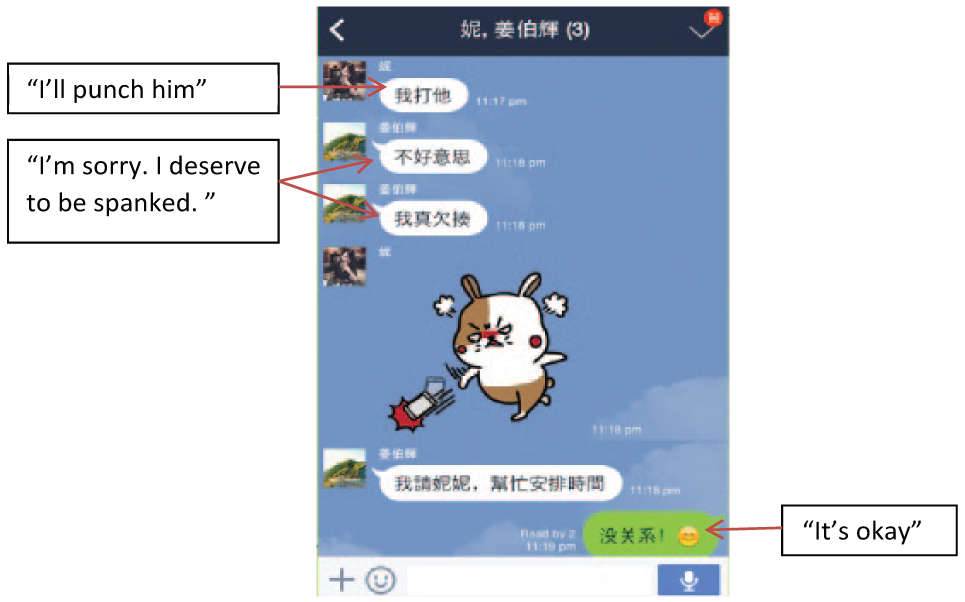
LINE conversation.
What would otherwise have been a clinical discussion of logistical matters immediately began to assume warmth and heart. And the speed with which the messages were being lobbed back and forth only made those feelings so much more palpable. In the months leading up to my holiday, I would receive many more messages that involved these emphatic and delightful stickers that were used to paper over situations that were more crass, such as when we negotiated over payment, or more awkward, such as when we requested complicated changes in the itinerary. We used stickers to signal appreciation or to indicate moments of genuine doubt (Figure 2).

LINE exchanges.
Throughout my trip in Taiwan, the tour guide and travel agent, neither of whom I eventually met and will likely never meet, continued to message me over LINE to welcome me, inquire about my well-being, and wish me a safe journey home. In the course of which, I experienced care, while they received affirmation.
This LINE conversation, as frivolous as it seems, embodies much of what is powerful about social media today. Without so much as a handshake, the tour guide in Taichung, the travel agent in Kaohsiung, and me in Singapore, engaged in an intimate exchange of words and feelings that lubricated the successful transaction of a commercial deal. I daresay that if we had persisted in using email, our entire discussion would not have been half as successful. Critically, LINE and other social media of its ilk provide a key affordance that I call communicative fluidity, where communication can be smoother and more seamless because of the multiple channels we can tap to express ourselves. Besides just text therefore, we now have photographs, videos, emoji, and stickers, on top of voice and video calls. And we can strategically choose the best means by which to express our feelings, opinions, and intentions to attain communicative fluidity.
On LINE, the graphical richness of the medium and the emotional language that could be conveyed gave us the tools to iron out kinks in our mediated communication. The strong visual impact of the stickers helped us make explicit feelings that could not be articulated in words. At the same time although, the interpretability of the stickers also lent our messages an air of equivocation, allowing the conversation to be shaped by the different parties as it went along. The fact that LINE has a powerful innovation that suggests relevant emoji and stickers as you type further enhanced our communicative fluidity. Type “happy” and cheerful faces adorn your screen, enabling you to select the state of felicity that you wish to emote (Figure 3).

LINE’s sticker suggestion feature.
Geert Hofstede (1980) observed that some societies are characterized by high context communication where much is unsaid but left to be tacitly imbibed. The success of LINE lies in its defiance of high context communication because it provides vivid pictorial representations of emotions that are often kept hidden. Paradoxically though, LINE also succeeds through its conformance with high context communication by offering emotive stickers that help to forge social bonds on which high context communication can best flourish. As Philippine anthropologist Raul Pertierra (2014) noted, “… the new communication media mirror and reproduce existing cultural orientations.”
Of course, I do not mean to suggest that social media is a panacea for all communication issues and that stickers are their magic bullet. Indeed, like their physical counterparts that stubbornly adhere to surfaces where we least want them, stickers and the social media on which they appear can also be problematic. Undoubtedly, the language and cadences of social media do not always resonate with our daily rhythms but can introduce unwelcome, discordant notes. The rigid scripting that underpins the vocabulary of social media, what they can and do represent and how they are (re)produced, can compel us to communicate in ways that we find forced and inauthentic. As the Facebook Year in Review-movie debacle demonstrated, algorithms are poor at nuance, even if adept at generating reaction gifs. And as WhatsApp’s blue tick backlash revealed, just because something can be done does not mean that it should be. Ultimately, even as the likes of Facebook, LINE, and Viber compete for global domination, they must recognize and furnish the one affordance that social media users most cherish—agency.
Footnotes
Acknowledgements
An earlier version of this article was presented as a keynote at Monash University’s Interactive Futures Conference 2014. The author thanks the audience for their questions and feedback.
Declaration of Conflicting Interests
The author declared the following potential conflicts of interest with respect to the research, authorship, and/or publication of this article: An earlier version of this article was presented as a keynote at Monash University’s Interactive Futures Conference 2014.
Funding
The author received no financial support for the research, authorship, and/or publication of this article.