




Abstract
Introduction
We report findings from two feasibility studies with persons with SCI that aimed to leverage social support to increase PA: a two-week study with nine participants and a four-week study with six participants.
Method
We recruited a total of 17 participants across two phases (10 participants in Phase 1 and seven participants in Phase 2). In dyads, participants used a smartphone-smartwatch application that we iteratively developed based on participant feedback. The application delivered just-in-time support based on measured PA and encouraged reciprocal self-disclosure to increase closeness within dyads.
Results
Participants found the delivery of messages during detected PA to be motivational. Some liked automatically sharing tracked PA with others and did not have privacy concerns about doing so, and most preferred exchanging real-time messages more than context- or activity-triggered messages. Participants also expressed that feeling connected to their partner increased motivation to engage in PA.
Conclusion
Participants expressed that they liked being able to connect with individuals with shared life experience to exchange encouraging messages. There are, however, challenges that need to be addressed before a large-scale deployment of this technology, including user concerns about automatically detected activity.
Keywords
Introduction
Spinal cord injury (SCI) is a neurologic condition that limits the autonomy and mobility of over 250,000 individuals worldwide every year. 1 Individuals with SCI are at a higher risk than the general population for secondary conditions such as pressure ulcers, diabetes, cardiovascular disease, obesity, and depression.2,3 Researchers have shown that PA in individuals with SCI improves the health-related quality of life 4 and reduces risk factors for secondary conditions such as cardiovascular diseases. 5 Thus, research-backed guidelines for adults with SCI recommend they engage in at least 20 minutes of moderate-to-vigorous intensity aerobic exercise twice per week and three sets of strength exercises for each major functioning muscle group at a moderate-to-vigorous intensity twice per week, 6 similar to PA guidelines for the general population. 7 In a study conducted with a sample of 73 individuals with SCI in Canada, however, researchers found that less than 12% of participants were performing the recommended amount of PA. 8 In addition to challenges faced by the general population, individuals with SCI face further challenges to safely engage in PA including physiological changes, limited mobility, accessibility of spaces, and fatigue.9,10 Given the importance of PA for preventative healthcare for individuals with SCI, researchers should focus on developing new strategies to increase PA levels in this population.
Having adequate social support can lead to an increase in an individual’s PA levels in both the general population and individuals with SCI.10,11 Many individuals with SCI do not, however, have adequate social support from people in their daily lives. 12 Thus, we propose combining peer support in health-based interventions, just-in-time-adaptive interventions (JITAIs), and strategies in psychology to rapidly increase closeness between strangers11,13,10,14–16 and increase motivation to engage in PA. In a peer-mediated intervention to increase PA levels in individuals with SCI, significant increases were observed. 17 In prior work,12,18 researchers found that the timely exchange of digitally mediated social support may increase motivation for PA in individuals with SCI.
JITAIs are used in mobile health applications to detect the ‘right moment’ to deliver an intervention based on sensor data and/or user input to infer an individual’s context and receptivity to an intervention. 19 HeartSteps 20 and MotiFit 21 applications are JITAIs intended to increase PA by delivering contextually tailored suggestions using push notifications when the applications detect sedentary behavior. The PHIRE 22 application estimated PA levels in wheelchair users with SCI and provided real-time feedback that increased PA in 11 of 20 participants. JITAIs can be tailored to the needs of wheelchair users to provide accurate real-time measurement and feedback on PA.
Strategies that are intended to increase closeness and liking between individuals include reciprocal self-disclosure, 23 shared humor, 24 sharing painful or distressing memories with each other, 25 sharing novel experiences together, 26 mutual gaze, 27 and sharing gratitude with someone who has positively impacted one’s life. 28 Our research incorporates the reciprocal self-disclosure strategy because it aligns best with the features of our application.
To our knowledge, little literature evaluates the feasibility of JITAIs that incorporate social support to increase PA levels in individuals with SCI. To address this gap and develop strategies to ensure individuals with SCI who use manual wheelchairs benefit from emerging JITAI technologies, we conducted two exploratory studies where we tested concepts for applications with a sample population of individuals with SCI to explore the following research questions: (1) How might a group of individuals with SCI perceive just-in-time support to increase PA levels through real-time feedback and message scheduling?; and (2) What impact does a participant’s perception of closeness with their partner have on motivation to engage in PA?
Overview of studies
We conducted two phases of evaluation to test our concepts with a sample population of individuals with SCI. In Phase 1, we conducted a two-week study with nine participants exploring the feasibility of a smartphone- and smartwatch-based mobile health (mHealth) application where participants in dyads could use context-aware messaging and encourage each other to be physically active, with a researcher providing nudges to encourage communication. We iteratively developed the system to track PA and provide just-in-time support for individuals with SCI in Phase 1. Based on participant feedback from Phase 1, we designed a four-week feasibility study for Phase 2, with six participants in dyads using a cross-platform mobile application on their personal smartphones. In Phase 2, we explored how a deliberate strategy to quickly establish closeness between individuals in a dyad might impact motivation to communicate with each other to help encourage physical activity. Throughout the application development and content creation process for both phases, we consulted with a consumer advocate for SCI—a research partner on our team—to receive feedback on our goals and preliminary technology. The National Institute on Disability, Independent Living, and Rehabilitation Research (NIDILRR) Logic Model 29 recommends including a consumer/peer advocate with lived experience in research intended to inform development of technologies for persons with disabilities.
Phase 1: JUST-IN-TIME social support in dyads to increase PA levels
In Phase 1, we conducted a two week-field study with participant dyads using a mobile application (app) we developed. We iteratively made changes to the app based on feedback from early participants to improve experiences on the app for later participants as part of a co-design process. We call the first intervention tested SJITAI Messaging v1 and refer to this first study that we conducted for a two-week period as Phase 1. We ran all code for SJITAI Messaging v1 on a Moto G Play 2021 smartphone (running Android 11) and a Fossil Gen 6 smartwatch (running Android 9). The phone application contained a messaging interface that allowed participants to exchange messages with their partners for the study. All messaging was conducted using the phone application, with real-time PA data detected by the smartwatch being sent to the phone over Bluetooth with less than 0.5 s latency. Participants were instructed to carry both the smartwatch and smartphone with them during the study in addition to their personal phone. We developed the phone and watch applications for the Android ecosystem to ensure that our application could always collect sensor data in the background, which is restricted by iPhones. To encourage participants using iPhones as their personal smartphones to check their study phones for messages, we sent a text message to a participant’s personal phone each time the participant received a new message on the SJITAI v1 application on a loaned research phone we provided to participants. The smartwatch tracked the participant’s PA continuously but could only send data to the phone when both devices had a Bluetooth connection.
The SJITAI Messaging v1 application supported two types of message exchanges: (1) real-time messages and (2) scheduled/event-based messages (Figure 1). Real-time messages worked like typical text messages—they were delivered to the recipient as soon as the sender sent the message. Scheduled/event-based messages allowed users to schedule messages to be delivered based on the following events detected by the recipient’s phone or smartwatch: (a) time of day; (b) day of week; (c) PA status (moderate PA or vigorous PA); and (d) location. We referred to these events as ‘triggers’ in our application. We included the feature of message scheduling based on feedback from storyboarding concepts with participants in our prior work, with participants mentioning that they might find it motivating to receive the contextually-aware scheduled messages.
12
Scheduled messages were sent to the recipient’s phone when created by the message sender, but they remained invisible to the message recipient until their phone or smartwatch detected the triggering event (or events) specified by the pending message occurred. Sending real-time and scheduled messages using the SJITAI Messaging app: (A) tapping on ‘Send now’ after typing a message sent the message in real-time; (B) tapping on the ‘Deliver when Em is…’ button on screen A and adding a ‘Moderate PA’ trigger scheduled the message to be delivered when Em’s smartwatch detected moderate PA. All names used are pseudonyms.
Users could specify more than one event to trigger message scheduling, in which case the recipient’s phone would have to detect all the specified events before delivering the message. For example, scheduling the message, “It’s Wednesday today, don’t forget that we are planning to go to the park together and exercise” with a location trigger (‘Home’) and a day of week trigger (‘Wednesday’) would mean that the message would be delivered to the recipient when the phone detected that the recipient was at the location previously labeled as ‘Home,’ on the closest following Wednesday. We present additional details of how the locations were identified in Appendix A3.
We designed the messaging interface to resemble a typical text messaging application already familiar to people, with one key extension. While typing a message, users could decide to either send the message in real-time or choose from the events mentioned above to schedule a message. Real-time messages showed up in the conversation tab of the chat, and scheduled messages showed up in the scheduled tab of the chat until the message was delivered to the recipient. Based on feedback from early participants, we developed a message-assist feature for the last two participants to help them write messages, including triggered messages, by displaying suggestions of messages that they could send (Figure 2). The research team generated 51 pre-written messages designed to start conversations, including event-based messages. Screenshots of the message-assist feature to help users create and edit messages. Pre-written, editable text was available for both real-time and scheduled messages. The “MESSAGE ASSIST” button collapses to only include the icon when a pre-written message is displayed. Tapping the message-assist icon again populates the text field with a new pre-written message. All names used are pseudonyms.
Methods
We recruited participants with SCI who used manual wheelchairs and were interested in increasing their PA levels; we paired the participants as dyads for a two-week pilot study. We originally planned to recruit participants with SCI along with a friend or family member they could be paired with for personalized support. However, in our prior work we found that participants with SCI preferred being paired with another person with similar mobility levels who would understand the challenges and life experiences of individuals with SCI. 12 At the beginning of the study, dyad participants were instructed to exchange messages every day to support each other in being more physically active. In addition to an initial meeting to set up equipment for the study, participants also met with a researcher for an intermediate assessment interview at the end of the first week of application use and for an exit interview at the conclusion of the two-week period. To ensure that we incorporated feedback and design suggestions from early participants in our iterative development process, we showed later participants concept screens for new features based on suggestions from earlier participants. This study was approved by the Temple University IRB.
Participant recruitment
Participants with SCI were recruited using mailing lists of prior research participants at Temple University who had completed previous studies with our research group. Individuals with SCI were eligible to participate if they: (1) were between 18 and 75 years of age, (2) had history of traumatic or non-traumatic SCI, (3) used a manual wheelchair as their primary means of mobility (>80% of time), (4) were interested in increasing their PA, and (5) could use a smartphone and a smartwatch independently. Participants with SCI were excluded if they: (1) had health conditions that made PA medically contraindicated or unsafe, (2) had a history of traumatic brain injury, or (3) were currently pregnant. Participants were recruited individually and paired as dyads in the order that they contacted us. Participants did not know each other before the start of the study. All participants provided informed consent and were compensated $75 for completing an intermediate assessment interview a week after enrollment and an exit interview at the end of the two-week data collection period. Participant selection was based on eligibility of interested participants from a convenience sample. In Phase 1, new participants were randomly paired with each other based on the time of enrollment.
Data collection
Participants individually consented to participate in our study and then were loaned an Android smartphone and smartwatch. The same PA tracking algorithm ran on the smartwatch to measure overall wheelchair-based PA for both phases; the algorithm is described in Appendix A2. Over a video call, participants were administered a demographic survey and instructed on how to set up the SJITAI application installed on the devices we provided them. Because they had never met the person they were paired with for the study, a researcher helped participants write a short bio about themselves that could be viewed by their partner in the study so that the partner would have background information that could be used when constructing meaningful messages. Dyad partners were not introduced to each other otherwise, because partners using a future deployed application would not have previously been introduced. Participants were instructed to send messages to support their partner in increasing amount of PA; they were also instructed to respond to the messages sent from a member of the research team (referred to as ‘the researcher’ henceforth) sent every day. The application recorded interactions participants had with all components of the app.
The researcher scheduled one time-based message and one PA-based message to be delivered each day to each participant. The contents of these messages were meant to encourage participants to send real-time and scheduled messages to their partners, and to check in with participants about how they were feeling about the study. The two messages sent by the researcher to participants each day were standardized for all participants and were based on the individual, interpersonal, and community levels of influence of the social ecological model and intended to increase interactions about PA. 30 Examples of messages sent by the researcher included (1) “Hope you have a fantastic day! Have you sent a message to your peer yet?”, and (2) “Great job wheeling! How are you feeling?” (scheduled to be delivered when PA was detected). Scheduled messages sent by the researcher were intended to (1) send timely messages to increase motivation and (2) start conversations about PA.
During the intermediate assessment interviews, participants were asked if they had any issues running the application. They were also asked about their overall impressions of the application up to that point. In the semi-structured exit interviews, participants were asked about their overall impressions of the application and probed about their impressions of each application component. During the exit interview, a researcher also prompted participants to reflect on how often they sent and received each type of scheduled message (time-based, PA-based, location-based), and what type of scheduling they found the most useful from the perspectives of both a message sender and a message recipient. The researcher reviewed application usage data before the interview session and was thus able to probe participants about why they did or did not use certain features.
Data analysis
Nine hours and 14 min of recorded audio from 17 interviews was transcribed using Zoom. The mean interview length was 32.6 min (SD = 22.0 min). A member of the research team reviewed the automatically transcribed transcripts, ensuring accuracy and anonymity, and correcting errors as needed. We conducted an inductive thematic analysis of the semi-structured interview content guided by our research question. In our analysis, we used elements of the grounded theory method, including open coding, axial and selective coding, and memo writing. 31 Using Quirkos 2.5.3 (Quirkos Limited), two researchers independently coded all the transcripts, labeling emergent phenomena to arrive at a codebook. The researchers met regularly with each other during the analysis process to discuss discrepancies in code application, review memos, and to reflect on themes.
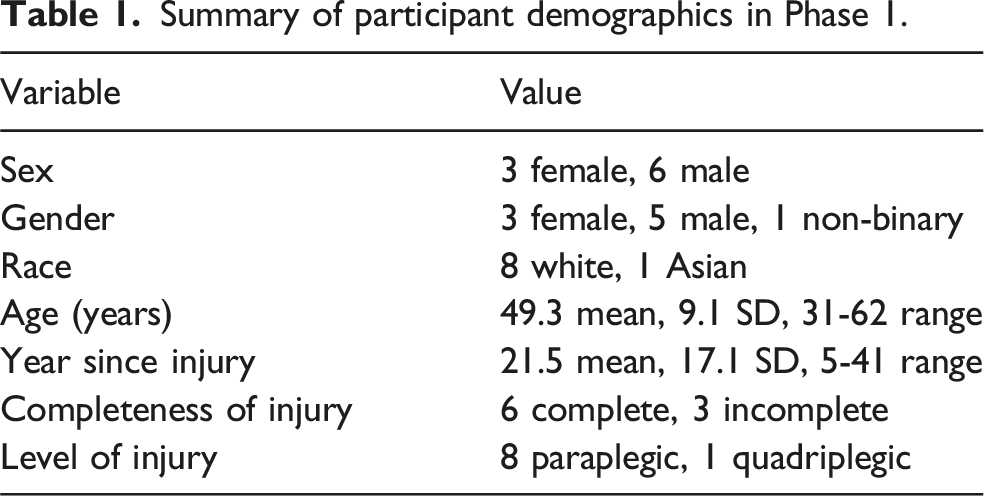
Participant overview
Summary of participant demographics in Phase 1.
Results
Overall message-sent/received statistics for the nine participants.

Four participants reported that their PA levels were higher than usual because they felt a sense of accountability towards their partner. Exchanging messages every day about PA goals, and sending supportive messages to increase PA levels, combined with being able to view real-time feedback from the application on minutes of PA made participants more aware of how active they were. On being asked what the most valuable part of the application was, P4 stated: “The visual feedback that I was active and doing something… it’s hard to be motivating for someone else too unless I’m getting out there and doing some activity myself and be more engaged to set the example for other people.”
We received feedback from the first five participants that they were sometimes unsure what they should write in a message. To alleviate this barrier, participants P7 and P8 mentioned that sending photos may supplement constructing messages, and P5 suggested: “Maybe a tutorial or something to show the examples?” We designed concept screens for a message-assist feature that would allow users to edit pre-written messages and send them; the intent was two-fold: (1) to gradually introduce users the notion of triggered messages via examples, and to (2) reduce the cognitive load required to create messages. We included both pre-written real-time messages as well as scheduled messages with event triggers (PA-based and time-based). We showed these concept screens to P7 and P8 to get their thoughts on incorporating a message assist feature. Both participants indicated that they would find the feature useful, especially when they were unsure of how to initiate a conversation. P8 explained: “That'll be helpful when you can't think of something to say. I mean, the prompts would be great. […] I do start repeating myself a lot, so this would be extremely helpful, especially if you're getting a trigger that the person is now being active.”
Additional themes identified in Phase 1.

Observations
Based on feedback from participants in Phase 1, we observed the following that helped us design the application for Phase 2: (1) The uncertainty of future context related to scheduled messages may outweigh the perceived value of receiving scheduled messages. Additionally, message scheduling may not be intuitive to use given the general expectation of immediate replies to a text message.
32
(2) Being able to view a partner’s PA summary for the day (in minutes) may make it less cognitively burdensome to create supportive messages and may provide additional context on what type of support one may need to improve their PA levels. (3) Participants were sometimes unsure what to write in a message while initiating conversation with a stranger, leading to fewer messages exchanged. A framework that could help individuals rapidly get to know each other might increase messages exchanged and add value to the messaging.
Phase 2: Increasing closeness in dyads of strangers interested in improving PA
Summary of features present in each phase of the SJITAI Messaging application.

Each day, users were presented with up to three question prompts from the application that they would answer to get to know their partner better (Figure 3). The questions were designed to be increasingly more intimate based on the Fast Friends protocol by Aron et al.,
23
henceforth referred to as the closeness questions; all questions are listed in Appendix A1. Before presenting the closeness questions, we presented short answer questions to familiarize users with answering questions on the application interface (e.g., ‘Would you rather go to the ocean or the mountains?’). Once a user answered a prompted question, the answer was saved, and the user’s partner was reminded to answer the question if they had not yet done so. Answers were shared after both partners answered the question, to promote reciprocal self-disclosure. Screenshots of the cross-platform SJITAI Messaging v2 application. From left to right: (a) An example of a question prompt presented to participants up to three times a day from the system; (b) A fictional example of answers submitted by partners in response to a question prompt; (c) Automatic PA sharing through the status bar on top for a user. All names used are pseudonyms and messages are fictional.
Users could view their own PA summary for the day on their personal smartphone. The study smartwatch used the Android study phone as a bridge to send data to the research server and then to the user’s personal smartphone. The study phone was required because all participants used iPhones as their personal phones and iPhones could not reliably communicate with the Android smartwatch directly. However, because the research phone bridge was required, if a user was outside the house, the smartwatch would not be able to communicate with the study smartphone until the user was back home, resulting in delays in PA levels displayed within the SJITAI Messaging v2 cross platform application.
PA summaries were automatically shared with partners as follows: (1) a status bar within the application that could be viewed on demand (Figure 3(c)); and (2) a push notification sent out when a user had engaged in more than 10 min of PA for the day (up to three push notifications a day). In addition to answering the closeness questions and viewing automatically shared PA, users could also exchange real-time messages at any time, like they would using a typical text messaging application like iMessage.
Methods
We recruited participants with SCI who use manual wheelchairs and were interested in increasing their PA levels; we paired the participants as dyads for a four-week feasibility study. We originally planned to recruit people who had participated in Phase 1 of our study, and to pair them with a new person for Phase 2. However, four participants from Phase 1 were ineligible to participate in Phase 2 due to health complications, and two were unable to participate due to other reasons. We recruited three individuals who had participated in Phase 1, and three new individuals. At the beginning of the study, dyad participants were instructed to exchange messages and answer question prompts every day to support each other in being more physically active. In addition to an initial meeting to set up equipment for the study, participants met with a researcher for an exit interview at the conclusion of the four-week period. This study was approved by Temple University IRB.
Participant recruitment
Participants were recruited using the same criteria as Phase 1. All participants provided informed consent and were compensated $100 for completing an interview after enrollment, and the exit interview after the four-week data collection. In Phase 2, participants from prior phases were paired based on similar activity levels or expressed preferences (e.g., two most active participants paired together, one female participant stated preference to be paired with female).
Data collection
Participants individually consented to participate in our study and were then sent a smartwatch and smartphone with our application installed. Over a video call, participants were administered a demographic survey and instructed on how to install and set up the SJITAI Messaging v2 application on their personal devices. Dyad partners were not introduced to each other, because partners using a future deployed application would not have previously been introduced. Participants were instructed to send messages to support their partner in increasing amount of PA. We recorded all interactions participants had within the application.
In the semi-structured exit interviews, we asked participants about their overall impressions of the app and probed their impressions of each application component. We also asked participants to indicate how close they felt to their partner at the end of the study using the Inclusion of Other in the Self (IOS) Scale. 33
Data analysis
Three hours and 7 minutes of recorded audio from six interviews was transcribed using Zoom. The mean interview length was 27.1 min (SD = 10.2). The inductive thematic analysis performed for Phase 2 was same as Phase 1 (see Section 2.1.3). 31
Participant overview
Summary of participant demographics in Phase 2.

Results
Participants exchanged a total of 671 messages (mean 4.0 messages per person per day) and answered a total of 115 prompted questions over the four-week period. At the beginning of the study, participants all selected a score of 1 on the IOS scale to indicate closeness to their partner, indicating that the partner was a stranger to them. The average number of messages sent by a participant per day in Phase 2 was almost double the average number of messages sent per participant per day in Phase 1. Overall, all participants expressed that the SJITAI Messaging v2 application helped them feel more connected to others with SCI, with P4 saying: “[The purpose of the application is] to be connected,” and P2 saying: “[I liked] the companionship and … and the way it made me want to do more [physical activity].” Participants explained that the way the application was set up to be used in dyads made some participants feel more accountable to their partners, with P1 expressing: “I feel that I was more regularly exercising just to… You know, because there was someone watching or monitoring as well so. Just that outside pressure adds a little more pressure to yourself, which is good sometimes to persuade you to exercise every time.”
Four participants expressed that they liked being able to see automatically shared PA data from their partners, with P2 saying that he enjoyed the social reinforcement he received from his partner: “I liked seeing the… when we had the watches on... the activity levels to see if he was working out and I was looking for him. This talking to him about my workout. So, it was… it was. It was fun because, you know, we were interested in the same things.” One participant, P7, was disappointed by the infrequency of interactions through the application: “I'd rather have the question there waiting for me, I say rather than you waiting. And [during this study] I had to wait more than an hour to get [P6]’s response or a new question.”
Overall, participants reported liking the closeness questions prompted by the application to promote reciprocal self-disclosure, with participants reporting a mean score of 4.5 out of 7.0 (SD 1.04, 3.0-6.0 range) on the IOS scale to measure interpersonal closeness. P7 expressed: “It seemed like. It seemed like I knew the person, [who] I don’t know, better in the way... in this case, when [P6] answered the questions.” P1 explained that the closeness questions helped both individuals in the pair to be more vulnerable: “With any new relationship or friendships just being vulnerable at first, but realizing you're in the same situation so you don’t feel as vulnerable sharing what might be sensitive information because the person on the other end has gone or is going to the same thing.”
Additional themes identified in Phase 2.

Observations
We observed the following based on participant feedback from Phase 2: (1) Incorporating closeness questions to promote reciprocal self-disclosure may have helped these pairs of strangers feel more connected, which in turn increased motivation to engage in PA. (2) Receiving push notifications when a partner was active was preferred to viewing real-time PA levels of the partner within the application. (3) Enabling automatic sharing of PA summaries for the day was not a privacy concern for these participants. Four participants were motivated by a sense of competition to engage in PA when they saw their partner’s automatically shared PA.
Discussion
Meeting the recommended PA guidelines for individuals with SCI can reduce the risk of developing secondary conditions associated with SCI. Through the two feasibility studies, we found that (1) tailoring applications to connect individuals with SCI may help increase motivation to be physically active; (2) scheduling a triggered message may cause hesitation due to concerns about uncertainty of future context; and (3) promoting reciprocal self-disclosure between pairs of strangers could increase connectedness and lead to more conversations.
We received feedback from participants across both phases that the SJITAI Messaging application helped connect participants with shared life experience, which increased motivation to converse with others on the application. This feedback is in line with the social cognitive theory of behavior change, 34 which theorizes that a user’s behavior is more likely to be influenced by similar social models, and prior work on storytelling between peers to increase motivation to engage in healthy behaviors.35,36 Participants were unacquainted prior to enrolling in the study, and the closeness questions promoted communication and increasing feelings of connection. Reciprocal self-disclosure helps participants overcome the vulnerability of sharing personal thoughts and experiences, 37 but participants also expressed the combined importance of connecting to other individuals with SCI. This finding is similar to findings from other studies where participants felt a deeper sense of connection to others with similar shared life experinces. 38 Some barriers to PA are also specific to individuals with SCI. For example, health concerns for individuals with SCI pose a barrier to PA, and several participants in this study experienced limitations in consistently using the application during the study period due to hospitalization or medical conditions.
From user interviews in Phase 1, we found that (1) although receiving scheduled messages positively influenced motivation to be physically active, the number of scheduled messages sent by participants was limited; and (2) receiving real-time feedback on PA and being able to see a PA summary on demand was useful, but participants also wanted to know how active their partners were. Phase 2 allowed participants to view PA summaries, which may help mitigate the uncertainty related to PA levels. Automatically tracked PA, however, does not account for user context. One way to address the uncertainty of future context could be to give participants more options and finer control of triggers they can select while scheduling a message. For example, allowing participants to schedule a message to be sent when a user has been idle for a given duration (‘idle’ for 10 min), or encouraging participants to combine triggers such as time, location, and PA (‘idle’ after 5 PM at home) may help reduce chances of a scheduled message being delivered in an unintended situation.
Participants in Phase 2 reported liking the closeness questions that promoted reciprocal self-disclosure and helped pairs of participants get to know each other. At the beginning of the study, all participants reported that their partners were strangers, with a score of 1 on the IOS scale. By the end of the four-week period, participants reported a mean score of 4.5 out of 7.0 (SD 1.04, 3.0-6.0 range) on the IOS scale. Other studies that used the IOS scale to evaluate interpersonal closeness between strangers typically ranged from a duration of one 45-min session 23 to three hour-long sessions, 39 preventing direct comparison to our four-week long study. Short studies have increased IOS-measured closeness. For instance, the original Fast Friends protocol—a 45-min in-person procedure between pairs of strangers— resulted in a mean IOS score of 3.82. 23 In another study where researchers ran three hour-long sessions, participants reported a mean score of 3.27 on the IOS scale. 39 In addition to reporting a 4.5 IOS score, our participants indicated that they liked the closeness questions, and that exchanging answers to the questions helped pairs feel like they knew each other well within a short time. The questions encouraged pairs to be vulnerable with each other, which was appreciated by participants. Additionally, participants mentioned that the closeness questions in conjunction with the automatically shared partner’s PA led to longer conversations and increased motivation to be physically active.
Limitations
Given the limited number of participants who participated in our pilot studies, caution must be exercised when generalizing these findings to the larger community. Out of our 17 initial participants (combined across both studies), two of our participants had to drop out of the study due to health-related problems. Not all participants had appropriate phones for the study, because it was not viable to recruit only persons with SCI who did. Therefore, participants we recruited were provided with Android phones and smartwatches; they were asked to carry/wear these devices along with their own personal phones. These secondary devices were sometimes forgotten by our participants, resulting in lost data on days that these devices were not carried. Due to the short study period of two weeks in Phase 1, the novelty of the intervention may have remained high. We also did not measure if the increase in feelings of closeness would remain beyond the four-week application usage period in Phase 2, or how the level of closeness changed during the study.
We did not collect a baseline PA measure for participants in either phase of the study, because the goal of our study was to iterate towards a technology that might increase motivation to engage in PA. Achieving a true baseline measurement of PA that would minimize observer and novelty bias using the smartwatch technology would have required a long lead-in phase, and we did not want to introduce more burden for participants when our primary goal was to explore new interaction possibilities using participatory design. Additionally, the PA tracking algorithm on the smartwatch approximated the overall level of wheelchair-based activity for the day. Although we tuned the thresholds used by the algorithm to each individual (given the varied levels of mobility), our algorithm sometimes will fail to detect short bouts of activity and some resistance training exercises with limited hand movement. Although we did not receive any complaints about the accuracy of the PA algorithm in interviews, the failure to record such bouts as meaningful PA could lead to a loss of trust in the application.
Conclusion
We conducted two feasibility studies focused on how we might leverage social support to empower individuals with SCI to increase their PA levels. Although participants in Phase 1 reported liking receiving context-aware messages when they were in the middle of a workout, participants did not schedule many such messages, largely due to the uncertainty of future context of the recipient and how that might impact the nature/tone of the sender’s message. Additionally, participant pairs were unsure of what to say in a message, also likely reducing communication. Based on feedback from Phase 1, we removed the message scheduling feature in Phase 2 and focused instead on real-time messaging and attempting to rapidly increase feelings of closeness within dyads. The average number of messages exchanged per day per participant increased from Phase 1 to Phase 2. Based on our observations from these two feasibility studies, we discuss tailoring applications to individuals with SCI to increase engagement, address the uncertainty associated with scheduling event-based messages, and use of reciprocal self-disclosure to increase closeness within pairs to support each other with increasing PA levels.
Supplemental Material
Supplemental Material - Harnessing social support to empower individuals with spinal cord injury to increase physical activity levels: Observations from feasibility studies
Supplemental Material for Harnessing social support to empower individuals with spinal cord injury to increase physical activity levels: Observations from feasibility studies by Rithika Lakshminarayanan, Alexandra Canori, Melissa Nunn, Shivayogi V. Hiremath, and Stephen Intille in Journal of Rehabilitation and Assistive Technologies Engineering.
Supplemental Material
Supplemental Material - Harnessing social support to empower individuals with spinal cord injury to increase physical activity levels: Observations from feasibility studies
Supplemental Material for Harnessing social support to empower individuals with spinal cord injury to increase physical activity levels: Observations from feasibility studies by Rithika Lakshminarayanan, Alexandra Canori, Melissa Nunn, Shivayogi V. Hiremath, and Stephen Intille in Journal of Rehabilitation and Assistive Technologies Engineering.
Footnotes

Ethical considerations
We obtained permission from Temple University and Northeastern University IRBs prior to conducting this research.
Consent to participate
Participants had to provide their written informed consent before participating in this research.
Funding
The author(s) disclosed receipt of the following financial support for the research, authorship, and/or publication of this article: This work was supported by the National Institute on Disability, Independent Living, and Rehabilitation Research. This research is funded by a research grant (90IFDV0018) from the National Institute on Disability, Independent Living, and Rehabilitation Research (NIDILRR), Administration of Community Living (ACL), US Department of Health and Human Services.
Declaration of conflicting interests
The author(s) declared no potential conflicts of interest with respect to the research, authorship, and/or publication of this article.
Data Availability Statement
Synthesized information from the data is included in the manuscript and has been provided in the results section of the manuscript.
Supplemental Material
Supplemental material for this article is available online.
Appendix
References
Supplementary Material
Please find the following supplemental material available below.
For Open Access articles published under a Creative Commons License, all supplemental material carries the same license as the article it is associated with.
For non-Open Access articles published, all supplemental material carries a non-exclusive license, and permission requests for re-use of supplemental material or any part of supplemental material shall be sent directly to the copyright owner as specified in the copyright notice associated with the article.
