




Abstract
Introduction
Promoting active lifestyles among older adults can bring drastic benefits for their quality of life. The innovative mechanics of pervasive games – that mix real and virtual worlds – can further engage and motivate elderly people into that goal. Using social interaction as a study case, we designed and evaluated the feasibility of a pervasive game to investigate how game design elements can affect the levels of physical activity of older adults.
Methods
A mobile, location-based pervasive game was developed, and a study with community dwelling elderly volunteers from Kyoto, Japan was performed to evaluate its feasibility as an experiment system.
Results
Participants reported that the theme and visual style of the game was adequate, and that game rules and goals could be easily understood. The game was considered enjoyably challenging and engaging. Further analysis showed that next iterations of the system must pay special attention to the level of complexity of controls, and that new ways to connect players when there are few people playing or when they are too far apart are necessary.
Conclusions
The design allowed to test for variations on pervasive mechanics and was effective to engage elderly people, encouraging further investigation.
Introduction
As all countries in the world experience the aging of their population, 1 different strategies become necessary in the pursuit of promoting quality of life among elderly citizens. Over the last two decades, there was a crescent interest on games and gamification processes 2 for that end. An intimate, indissoluble relationship with play and fun is one of the most fundamental aspects of human condition, 3 and elderly people are obviously no exception to this rule. Based on that premise, new lines of research have surged, advocating that games for the elderly should first be fun, and all additional benefits will come as a natural consequence of playing. Indeed, this has been repeatedly observed in previous works. 4
In this context, an emerging genre that is not yet fully explored as a tool to create fun and engaging experiences for elderly people is the so-called pervasive games. There are several definitions to the term, but the common element is the requirement that these games offer a set of mechanics (game rules) that blends aspects of the real world – for instance, locations, people, objects, etc. – with a virtual world – i.e. the world of the game, 5 thus blurring the edges of the ‘magic circle’ that surrounds the player. 6 For that reason, games in this category have also been referred to as ubiquitous, 7 context aware, 8 mixed reality 9 or even trans-reality. 10
By mixing realities, these games aim at deeper player immersion, having the potential to be highly engaging. This can be noticed on popular titles, such as Pokémon GO, 11 Ingress 12 and Dead Rising 3. 13 Particularly, since many pervasive games incorporate physical location into their design and stimulate people to walk around, they are specially fit to promote quality of life, since it is strongly correlated with physical activity.14–16 These games also focus on more casual experiences, thus reducing the cognitive load and establishing a smoother transition to introduce novice users to unfamiliar technologies. 17
Taking these factors into consideration, the general goal of this study is to investigate, from a design perspective, which strategies are more adequate when developing pervasive games for older adults – i.e. we want to find out if there are specific design elements or principles that can be effectively used to create fun, engaging experiences for elderly people, and promote their quality of life.
As any design problem, this is an ill-structured or wicked problem. 18 For that reason, our approach was to design and implement an experiment system – i.e. a system used to understand a problem, not to solve it. Specifically, we used social interaction as a case study to develop a pervasive game that allows testing and experimentation, being adaptable and expandable if necessary, allowing for further investigations. We performed a feasibility study to evaluate our system and its suitability for further experiments, such as randomized controlled trials.
Related work
Game design, i.e. design of player experience, 19 is a relatively recent discipline, even though it applies to any kind of game, not being restricted to electronic systems. Pervasive games, specifically, have been emerging as a research topic in the last decade, with several games made 5 and some recent works focusing particularly on design.20–22
Games for elderly became a research topic on its own in the context of serious games for health.23,24 Early works investigating possible challenges when designing for older audiences25–27 identified common physical and cognitive limitations that should be taken into consideration; however, when it comes to game content and motivation to play, there is excessive focus on perceived benefits, without a deeper analysis of potential experiences and emotions sought by the players.
De Schutter et al. point out the self-evident, nonetheless often ignored fact that older players of electronic games do not form an homogenous group, but instead, like any other demographic, show highly varied behaviours and preferences deeply influenced by culture, background and both intrinsic and extrinsic motivations. 4 The authors performed an ethnographic study and combined the Uses and Gratifications Theory 28 and the Self-Determination Theory, 29 to propose five basic profiles of older players, 30 generally observing individual adherence predominantly to one of the profiles, with aspects of the others appearing to a lower degree.
Different studies attempted to identify possible preferences of elderly people regarding content and/or genre of the games, primarily using surveys.31–33 These works, however, can offer still only a limited perspective due to varied factors, such as the restriction imposed by the fixed choice of genres – including the definition of game genre itself, which is a disputed topic in the literature – and some of the subjects’ answers being based on game descriptions only, not actual gameplay.
More recent studies asked senior citizens to play different kinds of games and then evaluate their experience, focusing on specific styles of game, such as casual games. 34 One group of games that is commonly evaluated in research targeting older adults is the class of the so-called exergames, games in which the player must perform specific kinds of coordinated movements to control the input, sometimes in association with other cognitive tasks. 35 Many studies have used different kinds of interfaces for such games, and evaluated the user acceptance of the technology and/or motivation to play.36,37 There are also some examples of pervasive games targeting older adults, usually focusing on specific goals, such as cognitive training 38 and promotion of physical activity using social incentives. 39 Some gamified apps targeting elderly people have also incorporated real-world elements, such as group-based incentives and social rewards to promote physical activity 40 or inter-generation interactions to teach technology. 41
Methods
Previous works used games to address specific issues in terms of older adults’ health – physical activity, social interactions, cognitive skills, etc. Those studies focused on solving specific problems; thus, the main object of evaluation was how the presence or not of the game changed the output. The final goal in this research, however, is to evaluate design, i.e. the focus is on understanding the problem, and evaluate how specific design elements can change the outcome; thus, the game itself is changed to test for those effects. As a first step to achieve that goal, we need a game that can be used by the target audience and adapted in the future for further investigation.
Several design aspects of pervasive games could be investigated; however, we chose social interaction, because it has a particularly strong effect on the wellbeing of senior citizens 42 and is a specially flexible and interesting aspect that can be used to propose pervasive mechanics. To evaluate user behaviour, we chose physical activity levels, since, as described in the Introduction section, this metric is one of the major factors that can directly affect elderly people’s quality of life. Specifically, we are interested on player’s average number of steps.
Taking these factors into consideration, we designed and implemented a pervasive game to act as our experiment system and performed a feasibility study to evaluate if the system can be successfully used by the target audience, and if it affects their behaviour. The next sections describe the game design and the study protocol.
Game design
The game design process was inspired by Schell’s elemental tetrad, 19 that analyses a game based on its technology (i.e. the media or devices that enable the game to be played), its mechanics (i.e. the rules and possible actions inside the game), its story (i.e. the game theme, characters, narrative, etc.) and its aesthetics (i.e. the elements accessible to the player, such as graphics and sounds). A pervasive game is one that incorporates real-world elements into one or more of these attributes, in such a way that they actively influence the player’s experience. 21 Thus, our designed process aimed at a game that ideally could have any of these four elements changed and controlled to test how they affect the player.
Based on a compilation of existing games,
43
and with the advice of experts who work with elderly people and elderly people themselves, we used an iterative design process to create a pervasive mobile game called Shinpo – in Japanese, Examples of cards from Shinpo. , meaning ‘sacred step(s)’ – to be initially played by elderly people in Japan. The basic premise of the game is that the player must collect cards, each of them having an animal and being of certain colour that indicates the level (Figure 1). Different animals from the Japanese fauna (or folklore) were used. There is no hierarchy between animals, but levels vary from 1 (violet) to 4 (gold). The goal of the game is to obtain at least one gold card for each animal.

The game stimulates players to walk around by asking them to collect the cards while visiting locations in the real-world – in this case, shrines around Kyoto city (Figure 2(a)). Players receive some cards when they enter a shrine for the first time, and, after that, they periodically receive more cards, the quantity and level of which are determined by how much they walked and how many hotspots they visited on the previous days. Once inside a hotspot, a player can see their current cards (Figure 2(b)) and also trade a certain number of cards of one level for one card of the next level. Because there are four levels, it takes a long time to achieve the game's goal of having all the possible gold cards. By design, players with higher levels of physical activity can win the game faster.
Screens from Shinpo: (a) world map and (b) hotspot.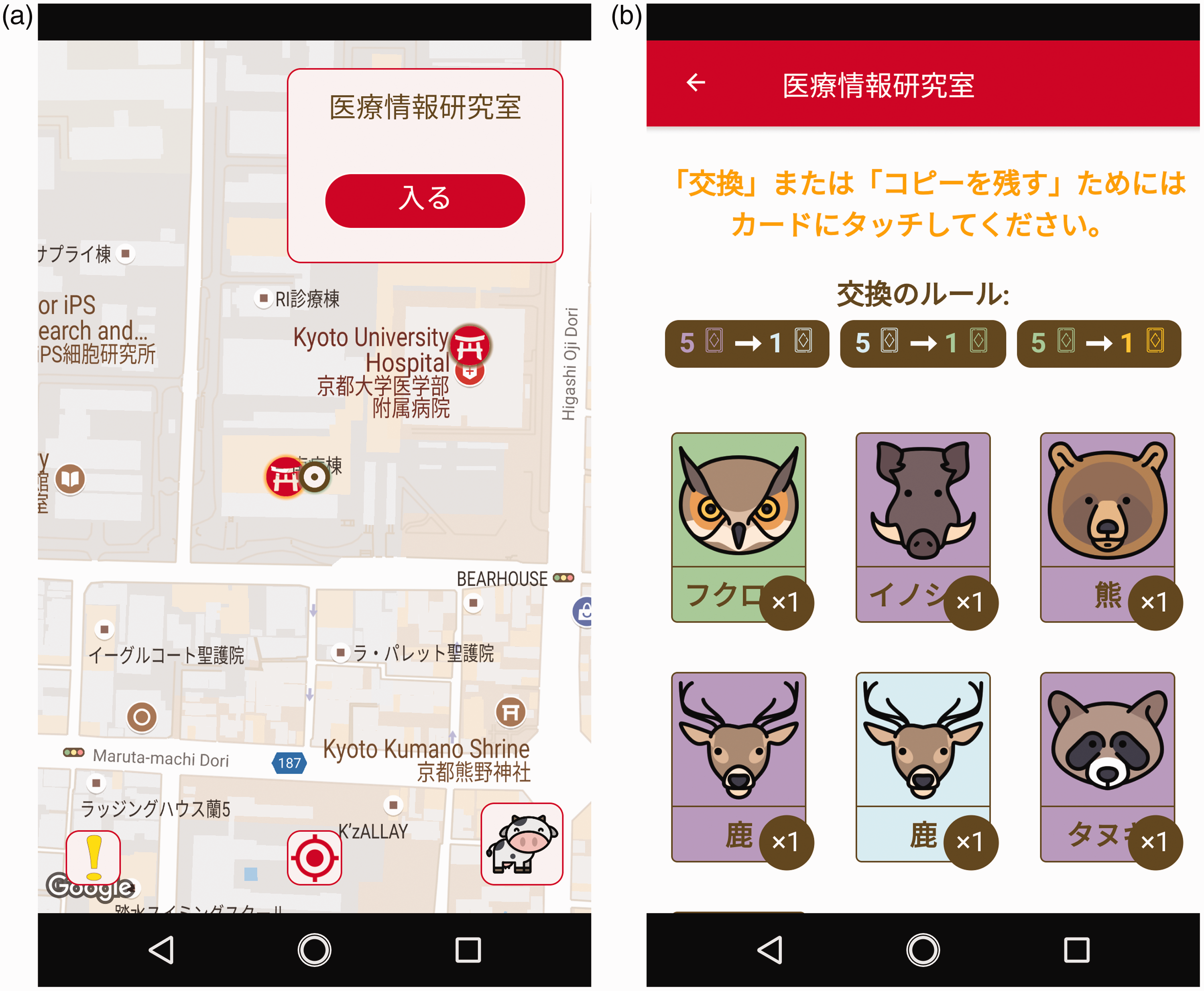
Since the game targets elderly people, special safety concerns were also considered. Players do not need to look at their smartphones while moving between shrines and are explicitly warned not to do so: if the game detects that the player is moving above a certain speed threshold, a flashy notification is shown, reminding them not to walk while playing.
Even though Shinpo deliberately uses specific thematic and abstractions – shrines and card game references – hoping to appeal to Japanese (elderly) people, the rationale behind the design is that collecting items is a widely enjoyed activity by people of different cultures, especially seniors. More importantly, this basic mechanism can be adapted in all elements of the tetrad, since it can be easily transported to different cultural contexts (e.g. zodiac signs instead of animals or coins instead of cards); different rules and interaction strategies (e.g. cooperation, competition, challenges, hierarchies); different visual styles (e.g. traditional, cute, cartoonish) and different technologies (e.g. physical objects, IoT devices). These adaptations, when limited within a closed context, could also be presented simultaneously to different groups of players to control for their specific experience. For instance, the colour schemes or the illustration style could be changed and evaluated for their appeal to different audiences: different players could see different colour schemes or different styles, either statically, based on profiles set a priori, or dynamically, based on information such as location, time or weather.
According to our choice for the initial evaluation, a variation of the game was created to include social interaction. Since the nature of the social interaction could also generate different effects on people's experiences, or even on their willingness to interact at all, the proposed mechanisms also account for two types of interactions: those that happen in person and those that happen exclusively through virtual means. One additional design choice was to focus only on cooperation on this first step (i.e. there’s no competitive element), since it is more prone to engage people than competition and is more aligned to the Japanese culture in general. The proposed variation includes these additional rules: players have customized profiles to identify them to other players; players can see and ``like'' other players’ actions; players can, once per day, leave a card at a hotspot; other players will be notified about it and will receive a copy when they enter that hotspot; the owner is rewarded with additional random cards of same level based on the number of total copies distributed this way; hotspots offer challenges that players can join, groups of players must visit certain hotspots within the day to win additional cards; in example of direct personal social interaction, if nearby players meet in person, they also receive cards.
Feasibility study
To evaluate the game, we performed a feasibility study with volunteer community dwelling senior citizens who attend a program run by Kyoto University Graduate School of Medicine that offers weekly sessions of exercise-based cognitive training at a local community centre. This study received ethical approval from the Kyoto University Hospital Ethical Committee (Proc. N. C1329), in conformity with the World Medical Association Declaration of Helsinki. The protocol shown in Figure 3 was used.
Feasibility study protocol.
At the beginning of the research, participants answered questionnaires regarding their previous experience with technology (if they have and use smartphones and/or personal computers, how often they use them and what kind of tasks they use them for) and with games in general and electronic games specifically (what kinds of games they play, how often, using which devices and with whom). No previous experience was required to join the experiment; volunteers received a pre-configured smartphone and were given an explanation about its basic operation.
For the first week, they were asked to simply carry the smartphone around, so we could measure the baseline level of physical activity. On the following two weeks, the subjects were asked to play the game (social interaction version). Throughout all this period, participants had access to a support desk to clarify any doubts or solve technical problems. For safety reasons, volunteers were instructed to play the game only during daylight, to walk only through public open spaces and paved streets, to pay special attention to their surroundings and to abstain from walking while looking at the game screen.
At the end of the study, all remaining participants were asked to answer questionnaires to assess the usability of the game and the smartphone and to report their experience during the game as well as their sense of social presence. The questions were based and/or adapted from the Game Experience Questionnaire 44 (GEQ) and translated to Japanese by the researchers. The order of the questions was randomized for each participant and all objective items used 5-level Likert scales of one of two types: agreement level (0 = strongly disagree, 4 = strongly agree) and frequency (0 = never, 4 = always). Positively and negatively phrased questions evaluating the same aspects were included and, in that case of negative questions, the answers were used with the weight of the items inverted. Finally, free answer questions were also included at the end of each questionnaire, so users could report problems and/or difficulties using the game/smartphone and give their feedback about positive/negative aspects of the game.
Results
The next sections report the results of the feasibility study.
Participants
The study successfully recruited 12 participants (F = 9) with average age 75 (SD = 3.37) and 3 of them (F = 2) dropped out after the first week – 1 person said they had back problems that prevented them from walking frequently and 2 people said they thought they would not be able to use the smartphone. The step count data for these players were excluded from the dataset (and they did not answer the post-intervention questionnaires), but the demographic and previous experience report below include them.
Of the answerers, seven (58%) had used a smartphone before. Among the people who used a smartphone before, six (86%) use it for basic tasks (calls, e-mail, internet browsing) and 3 (43%) access social networks. Also, seven people (58%) reported using personal computers. Of those, six (86%) use it at least two to three times/week. Of the participants who use computers, seven (100%) access their e-mail and browse the internet, five (71%) edit documents, four (57%) edit photos, and two (29%) play games.
For the questionnaire that assessed previous experience with games, one person reported playing only non-electronic games, one person reported playing only electronic games, and two people said they play both types of games. Cited games included Japanese chess, Go, solitaire and mental training games. The respondents use either the PC or a portable console (e.g. Nintendo 3DS) to play. All respondents played at least once a week. As for playing with other people (i.e. other than playing only by themselves), one person reported playing with adult family members, while no respondent reported playing with grandchildren, with friends or with strangers.
Steps and in-game actions
Average number of steps for all participants during the study.

Total in-game actions successfully performed by players during the study.

Usability and game experience
According to the questionnaires answered at the end of the study (Max. Score = 4), users remembered to carry the smartphone around most of the time (3.2) and to charge it at night (3.2); they were also able to learn its basic operation (2.6). Players were able to understand the game rules and goals (2.1–2.2) and liked its visual style (2.1), but there were mixed results about learning the game controls (1.1–2.1). The game music was disliked by most players (1.4).
Players enjoyed the challenge level of the game (2.0–2.2); this impression was corroborated by some comments on the open questions. Players also report engagement and satisfaction/motivation to play (2.2–2.8) and enjoyment/fulfilment (2.2–2.6). There was a general sense that the game stimulates players to explore their surroundings and discover new things (2.2–2.7), which was also corroborated by some comments at the open questions. There was strong approval of the game theme (Japanese shrines) (2.7–2.8). The answers show mixed results for the sense of immersion (1.8–2.2) and for originality of the game (1.9–2.4). Finally, as expected, since the game has simple rules, there was not much sense of creative freedom (0.8–1.8), i.e. of allowing the player to create their own experience.
Answers to the ‘Social Presence’ section from GEQ produced low scores for all items (0.0–1.1), indicating a weak sense of social presence and involvement with other people. This is coherent with the proportionally very small amount of social interaction related actions (Table 2).
Discussion
The results of the feasibility study show that the choice of theme and visual style for the proposed game was adequate and that elderly people can understand the game rules and their goals while playing. Participants also felt challenged and engaged, enjoying the chance to explore their surroundings. On the other hand, there might be difficulties when it comes to learning complex controls. Since a significant proportion of the participants had some level of previous experience with technology, and recent evidence shows that this number will continue to grow, we believe that recruiting only people with experience using smartphones may be a good strategy to allow for more complex interactions and motivation mechanisms inside the game.
The weakest point of the design was the proposed social interaction mechanics that were very rarely used by the participants. We believe this happened because the proposed mechanics require a large number of simultaneous players to be effective; thus, a revision of such mechanics taking these findings into account will be necessary for the next steps of this research.
All data reported in this section are publicly available in anonymized form at https://github.com/lhsantos/shinpo-public.git.
Conclusion
A deeper understanding of how pervasive mechanics affect older audiences would provide an invaluable tool for researchers and designers aiming at using pervasive games to promote the wellbeing of elderly people, possibly increasing even further both the scope and the effectiveness of such interventions.
In this paper, we use social interaction as a case study to design and implement a pervasive game that allows for such investigation. The game was evaluated for its feasibility and results show that the game was successful in engaging and motivating people, but it must be improved in other aspects. Nonetheless, even though this work focused on social interaction, the proposed design can be adapted in all aspects of the elemental tetrad, and allows for testing of other design elements, not being restricted to this specific domain.
In our future steps, we will improve our design to address the issues identified in our study, and investigate other variations on design, aiming at further expanding our understanding of how design choices can affect player experience and behaviour.
Footnotes
Declaration of conflicting interests
The author(s) declared no potential conflicts of interest with respect to the research, authorship, and/or publication of this article.
Funding
The author(s) disclosed receipt of the following financial support for the research, authorship, and/or publication of this article: This study was partially supported by the Hayao Nakayama Foundation for Science & Technology and Culture and by Kyoto University’s Collaborative Graduate Program in Design.
Guarantor
LHOS.
Contributorship
LHOS, KO, GY, OS and TK contributed with the research methodology and the game design, and LHOS implemented the game. LHOS, KO, SH, and TA defined the experimental settings and wrote the ethical committee document. LHOS wrote the first draft; all authors contributed to and approved the final version.
Acknowledgements
This contribution was originally presented at the 12th International Conference on Disability, Virtual Reality & Associated Technologies, ICDVRAT 2018, in Nottingham, UK.