




Abstract
The American School Counsellor Association’s Recognized ASCA Model Program (RAMP) designation promotes data-driven, comprehensive school counselling programs addressing K-12 students’ needs. In a cross-sectional survey of a national sample of 265 school counsellors in the United States, we conducted a 2 × 4 two-way multivariate analysis of variance, with RAMP designation (RAMP vs. non-RAMP schools) and school level (elementary, middle, high, and multi-level schools) as factors, to examine differences in school counsellors’ motivation, role stress, transformational leadership, self-advocacy, and perceived organisational support by schools’ RAMP designation and school level. Findings revealed a significant multivariate effect for RAMP designation (p < .001) and school level (p < .01), indicating medium and small effect sizes, respectively. School counsellors from RAMP-designated schools reported higher motivation (p < .05) and transformational leadership (p < .001), and lower role stress (p < .05) than those from non-RAMP schools. High school counsellors reported greater role stress (p < .001) and lower self-advocacy (p < .01) and organisational support (p < .01). Interaction effects between RAMP designation and school level on the combined dependent variables were not statistically significant. Implications address how pursuing RAMP designation can help clarify school counsellors’ role expectations and how local, state, and national educational partners can assist in this process.
Keywords
Introduction
The American School Counsellor Association (ASCA, 2019) established the National Model as a comprehensive framework defining school counsellor roles and responsibilities. The overarching goal of the model is to standardise school counselling programs while allowing flexibility in how counsellors implement a program that is “comprehensive in scope, results-oriented in design and developmental in nature” to facilitate optimal student outcomes (ASCA, 2019, p. x). To promote and recognise the implementation of high-quality, data-driven comprehensive school counselling programs (CSCPs), ASCA (2019) originally introduced the Recognized ASCA Model Program (RAMP) designation in 2003. Since its inception, the ASCA National Model has gone through various changes to reflect the evolving landscape of education, ranging from changes to terminology to the addition of subcomponents (e.g., annual and weekly calendars) within each of the model’s four components (i.e., Define, Manage, Deliver, Assess).
Beyond serving as a recognition mechanism, a school’s RAMP designation reflects the presence of a well-established CSCP aligned with the ASCA National Model, including clearly articulated goals and systematic planning and accountability processes (ASCA, 2019). Documentation required for the RAMP application includes the completion of use-of-time analyses, an annual administrator conference, and an ASCA Student Standards delivery plan, all of which may support school counsellors with explicitly delineating appropriate duties and expectations. As such, RAMP designation may shape school counsellors’ day-to-day experiences by clarifying their roles and legitimizing the impact they can have on students and the broader school community.
Schools with the RAMP designation deliver CSCPs that are committed to advancing the mission of both the school and district, while demonstrating exemplary implementation of current best practices in school counselling within the U.S. context (ASCA, 2019, 2025). These schools effectively answer the question, “How are students different as a result of the school counselling program?” (ASCA, 2012, p. 39). RAMP applications are evaluated by trained RAMP® reviewers from ASCA. It includes 10 components, each typically scored on a scale from 3 to 9 points. For instance, Section 2 focuses on Annual Student Outcome Goals (worth 8 points). A full description of each component is available on ASCA’s website: https://www.schoolcounsellor.org/Recognition/RAMP/Apply-for-RAMP.
In addition to alignment with the ASCA National Model, RAMP can be positioned in an ecological school counselling (ESC) framework linking factors across ecological levels. One of the core assumptions of ESC is that “meaning is both constructed and experienced within schools and their subsystems” (McMahon et al., 2014, p. 463). Within this ecological context, RAMP designation status and school level represent distinct institutional and structural environments through which school counsellors interpret professional expectations and experience their work roles. Accordingly, prior research suggests that both the attainment of RAMP status (Randick et al., 2018) and school-level contexts (Culbreth et al., 2005) may contribute to school counsellors’ professional self-perceptions, role experiences, and relational functioning within the school system. Despite the growing number of RAMP-designated schools (ASCA, 2025) and evidence linking RAMP to positive student outcomes (Akos et al., 2019; Hilts et al., 2026), research on how RAMP designation may relate to school counsellor’s functioning remains limited. While prior studies have explored school counsellors’ experiences with RAMP application (Goodman-Scott et al., 2022; Taylor et al., 2022), barriers to implementing RAMP (Hilts et al., 2019), and the influence of RAMP-designation on the frequency of counselling-related duties (Randick et al., 2018), few have examined its potential associations with their functioning and organisational support. To date, only one study (i.e., Hilts et al., 2019) has investigated differences in perceived organisational support between RAMP-designated and non-RAMP designated schools.
Furthermore, while existing literature suggests that school level can significantly shape counsellors’ roles and responsibilities (Perera-Diltz & Mason, 2008), research on its possible relationships with school counsellors’ professional functioning remains scarce. Although Culbreth et al. (2005) found that elementary school counsellors experience lower levels of role conflict and role incongruence compared to their high school counterparts, mechanisms between school level and other aspects of school counselling practice and perceived organisational support remain underexplored.
Importantly, school counsellors’ roles and responsibilities are not uniformly structured across school levels, with certain contexts, particularly secondary school settings, requiring substantial time devoted to non-counselling responsibilities such as scheduling and test administration (Burnham et al., 2024; Perera-Diltz & Mason, 2008). At the same time, RAMP designation operates as a formalized institutional mechanism that shapes professional roles and legitimizes appropriate counselling practice (ASCA, 2019, 2025). Taken together, these structural differences suggest that the influence of RAMP designation on school counsellors’ functioning and perceived organisational support may not be uniform across school levels, but may instead vary as a function of school-level context. Accordingly, examining the interaction between RAMP designation and school level is critical for understanding how institutional structures and educational contexts jointly shape school counsellors’ professional functioning and organisational experiences.
School Counsellor Roles Across School Levels
Across school levels, school counsellors play a vital role in promoting students’ academic success, college and career readiness, and social-emotional development (ASCA, 2019). Their specific roles and responsibilities may vary by school level, as counsellors adapt their practices to meet students’ developmental needs and needs of their school settings (Perera-Diltz & Mason, 2008). According to the ESC framework, school level is part of “a multitude of subsystems” which may be interconnected with other subsystems; and changes within any subsystem can introduce interdependent relationship with the larger school ecosystem (McMahon et al., 2014, p. 462). Examining potential differences across school level and its interaction with RAMP can provide valuable insights and help inform strategies for tailoring support to school counsellors based on their school level and respective CSCPs.
For example, Burnham et al. (2024) surveyed 291 school counsellors across school levels to examine the status of school counsellor roles as reflected in their time allocation. Their study provided a descriptive breakdown of the percentage of time school counsellors spent on appropriate and inappropriate activities, as defined by the ASCA National Model, for each grade level. High school counsellors reported the highest percentage (42.2%) of time spent on inappropriate activities (elementary: 28.0%, middle: 37.4%, mixed: 38.1%). When considered within the ESC framework, which highlights the contextual construction of meaning within interconnected school subsystems (McMahon et al., 2014), these findings suggest that counsellors across school levels may navigate distinct role expectations and task demands, which may, in turn, differentially influence their professional functioning and perceived organisational support.
Moreover, these school-level differences in role-related time allocation may function as structural conditions that either constrain or facilitate the implementation of CSCPs. Because time spent on duties deemed inappropriate by ASCA has been identified as an impediment to implementing a RAMP-designated school counselling program (Hilts et al., 2019), school level may influence the potential impact of RAMP designation on school counsellors’ experiences. For instance, at the high school level where counsellors devote substantial time to non-counselling responsibilities such as scheduling and test administration (Burnham et al., 2024; Perera-Diltz & Mason, 2008), pursuing RAMP designation may have a greater effect on clarifying and strengthening counsellors’ roles than at levels where counsellors spend relatively more time on appropriate counselling duties. Accordingly, school-level differences in role-related time allocation suggest that school level may moderate the relationship between RAMP designation and school counsellors’ professional experiences, warranting an examination of their interaction.
RAMP and School Counsellors’ Functioning
Over the past decade, researchers have examined various intra- and interpersonal functioning that may be associated with school counsellors’ implementation of CSCPs (e.g., Hilts et al., 2025; Taylor et al., 2022). Intrapersonal functioning encompasses internal characteristics and processes that influence school counsellors’ thoughts, feelings, and behaviours (Cook, 2012). Whereas, interpersonal functioning refers to the relational interactions between school counsellors and other educational partners (Cook, 2012). Motivation, role stress, self-advocacy, and transformational leadership, the key constructs examined in the present study, are categorized as intrapersonal and interpersonal factors based on an ecological perspective (Hilts et al., 2025), informed by ESC (McMahon et al., 2014). These school counsellors’ intrapersonal characteristics and relational dynamics with constituent educational partners have been found to be associated with both a school’s pursuit of RAMP designation status (Goodman-Scott et al., 2022; Taylor et al., 2022) or the attainment of RAMP status itself (Randick et al., 2018).
Motivation
In the present study, we focused on school counsellors’ situational motivation which refers to the current, context-specific regulatory processes guiding their behaviour and their underlying reasons in implementing a CSCP (Guay et al., 2000). Prior quantitative (Young & Kaffenberger, 2011) and qualitative research (e.g., Goodman-Scott et al., 2022; Taylor et al., 2022) suggest that pursuing the RAMP-designation may be associated with school counsellors’ motivational orientations toward CSCP implementation. For instance, Young and Kaffenberger (2011) examined the beliefs and practices of 114 school counsellors from RAMP-designated schools. Their findings suggested that the RAMP application process resulted in school counsellors’ using data more often to inform their services and programming, driven by various factors such as meeting students’ needs, advocating for the profession, and other external (e.g., school or district requirement) and internal (e.g., personal interests) motivations.
Similarly, Duquette (2021) employed a narrative inquiry to better understand eight elementary school counsellors’ experiences with the RAMP process. The researcher found that factors contributing to school counsellors’ pursuit of the RAMP designation included motivation, professional goals, and their desire to advocate for their school communities. Taken together, this limited body of literature offers preliminary and descriptive evidence that pursuit of and securing the RAMP designation may foster school counsellor’s situational motivational experiences. In the current study, the Situational Motivation Scale (SIMS; Guay et al., 2000) was used which aimed to capture motivational dimensions of school counsellors including intrinsic motivation, identified regulation, external regulation, and amotivation. Considering that pursuing RAMP-designation may encourage sustained commitment and professional growth (Goodman-Scott et al., 2022), understanding how motivation to implement a CSCP may differ for school counsellors based on schools’ RAMP designation could be valuable.
Role Stress and Self-Advocacy
There are bourgeoning interests in understanding role stress and self-advocacy in relation to school counsellors’ service delivery and CSCP implementation (e.g., Burnham et al., 2024; Hilts et al., 2025). Role stress has been a longstanding issue in the school counselling field, with school counsellors often spending more time on inappropriate duties such as managing testing materials. Instead, school counsellors’ time would be better spent in role-appropriate tasks that school counsellors are trained to perform and have established expertise, such as conducting small-group counselling and delivering school counselling curriculum lessons (Burnham et al., 2024). Conceptually, role stress is a multidimensional construct comprising role conflict (e.g., “conflict between the focal person’s internal standards or values. . .time, resources, or capabilities and defined role behaviour;” Rizzo et al., 1970, p. 155) and role ambiguity (e.g., “certainty about duties, authority, allocation of time, and relationships with others. . .the clarity and existence of guides, directives, policies”, p. 156). For school counsellors, role stress may emerge when expectations of their work is unclear, inconsistent, or misaligned with their professional training.
Self-advocacy has been identified as one process through which school counsellors may grapple with and address role stress. Consistent with Clemens et al. (2011), “self-advocacy is the ability to effectively and appropriately communicate, convey, negotiate, or assert information about ideal school counsellors’ roles” to those in positions of influence (p. 34). Using a mixed-methods approach, Havlik et al. (2019) examined school counsellors’ experiences engaging in advocacy to align their duties with the ASCA National Model (ASCA, 2019). Despite challenges associated with advocacy, the participants reported that engaging in self-advocacy efforts helped to reduce role stress, leading the researchers to suggest that advocacy may support the sustainability of CSCPs.
Emerging literature further suggests that attainment of RAMP may have implications on engagement in advocacy and role-appropriate school counselling activities (Randick et al., 2018; Taylor et al., 2022). For instance, Taylor et al. (2022) explored how 18 school counsellors navigated challenges associated with applying for and implementing a RAMP. Participants highlighted various systemic factors that hindered their abilities to perform role-appropriate duties, such as staff turnover and educational partners’ lack of understanding of the school counsellor role. Nevertheless, participants reported that pursuit of RAMP fostered their increased confidence advocating for CSCP implementation and enabled them to engage in more intentional and meaningful work. While inappropriate duties remain persistent (Burnham et al., 2024), existing evidence suggests that RAMP may be positively associated with self-advocacy and role negotiation efforts; however, further empirical research is warranted.
Transformational Leadership
Transformational leadership captures the ability to inspire and motivate others through a common vision, foster innovation and collaboration, model professional behaviour, and recognise others’ contributions (Kouzes & Posner, 2017). Growing evidence suggests that school counsellors’ transformational leadership practices are associated with CSCP implementation (Hilts et al., 2022; Hilts et al., 2025). For example, Hilts and colleagues (2022) found that transformational leadership was a mediator between school counsellors’ emotional intelligence and their CSCP implementation. Similarly, Mason et al. (2023) found that transformational leadership behaviours, such as systemic collaboration and modelling the way, explained 35% of the variance in school counsellors’ CSCP implementation.
Less is known, however, about whether and why transformational leadership may differ between school counsellors’ practice in RAMP-designated and non-RAMP schools. Because implementing the ASCA National Model requires a data-driven and collaborative approach, transformational leadership behaviours may be more commonly observed in contexts where program implementation is emphasised. In practice, expectations required for RAMP may reflect school counsellor behaviours consistent with dimensions of transformational leadership, such as articulating a vision for their school counselling program and modelling role-aligned professional practices through documented activities. In this way, transformational leadership behaviour may transpire within school counsellors’ efforts to work with educational partners through systematic changes involved in implementing a RAMP-designated program. Consistent with this perspective, Goodman-Scott et al. (2022) used a descriptive case study approach to examine school counsellors’ experiences in applying for the RAMP-designation and found that participants described increased engagement in leadership-related behaviours in their pursuit of RAMP. Building on this emerging evidence, the current study sought to examine potential differences in transformational leadership between school counsellors from RAMP and non-RAMP schools.
Although role stress, self-advocacy, situational motivation, and transformational leadership are discussed as distinct functionalities, they are conceptually related within the context of school counselling practice grounded in the ASCA National Model (e.g., ASCA, 2019; Hilts et al., 2025). Further, interactional effects between RAMP and school level on these functionalities may exist as informed by the ESC framework (McMahon et al., 2014). Accordingly, these constructs are examined in the present study as interrelated aspects of school counsellor functioning rather than through sequential or causal processes.
Organisational Support
Perceived organisational support, characterized as employees’ sense of support when organisations acknowledge their contributions and prioritize their well-being (Eisenberger et al., 1986) is widely recognised as a critical job resource (e.g., Kurtessis et al., 2017). It may not only enhance employee retention but also foster engagement, commitment, and job satisfaction (e.g., Kim et al., 2016; Kurtessis et al., 2017). Conversely, low perceived support from colleagues and supervisors were associated with greater exhaustion and burnout amongst school counsellors (Holman et al., 2019). In the context of school counselling, we only identified one study that explored organisational support in relation to schools’ RAMP designation (Hilts et al., 2019). Hilts and colleagues (2019) found that school counsellors in non-RAMP-designated schools reported limited support from educational partners as a key barrier to implementing a CSCP. However, the study only relied on eight literature-driven statements rather than validated organisational support measures. While it laid an important foundation, further research is needed.
Other researchers (e.g., Blake, 2024; Pérusse et al., 2004) have explored the impact of organisational support on school counselling practices across different school levels. Pérusse et al. (2004) found that principals’ perceptions significantly influence the tasks school counsellors perform. Blake (2024) highlighted high school counsellors’ tension as they navigated school leaders’ expectations for efficiency in management tasks within a bureaucratic system, while also striving to uphold their identities as student-centered professionals. These pressures suggest that school environments and expectations—both of which can be influenced by school level—may impact school counsellors’ perceptions of organisational support.
Purpose of Study
While the positive associations between RAMP designation and student outcomes have been documented (Akos et al., 2019; Wilkerson et al., 2013), relatively little is known about how a school’s RAMP designation status relates to school counsellors’ professional functioning and perceptions of organisational support. Moreover, to our knowledge, no study has examined counsellors’ subjective professional experiences across school levels beyond the descriptive differences in duties and roles typically associated with each level (Burnham et al., 2024; Perera-Diltz & Mason, 2008). Given that school counsellors operate within complex ecological contexts (McMahon et al., 2014), it is important to examine how contextual factors such as RAMP designation and school level may interact in association with their intrapersonal and interpersonal functioning (i.e., motivation, role stress, transformational leadership, self-advocacy) and perceptions of organisational support. Such inquiry may offer meaningful insights into how school counsellors themselves, schools, and related educational partners can better support counsellors’ professional commitment and growth.
Moreover, existing studies that have provided preliminary evidence of a positive association between RAMP designation and school counsellors’ intrapersonal and interpersonal experiences have primarily employed qualitative methods (Duquette, 2021; Goodman-Scott et al., 2022; Taylor et al., 2022). Therefore, the present study sought to extend the existing literature by offering quantitative evidence of differences in school counsellors’ professional functioning between RAMP and non-RAMP schools. Based on the ESC framework (McMahon et al., 2014), prior research on RAMP implementation, and literature on school-level contextual influences, we proposed the following hypotheses:
Method
Participants
The study received Institutional Review Board (IRB) approval from Niagara University (IRB #2024-044) prior to data collection. Subsequently, we obtained a national sample (n = 265) of school counsellors in the U.S. for the final analysis. The dataset was utilized for another study with distinct RQs and analytical approach (Hilts et al., 2025). School counsellors were recruited through a one-time email invitation, including details about the study, informed consent form, and questionnaire hosted on Qualtrics. We recruited school counsellors via publicly available directories from Department of Education of 14 states. This recruitment strategy resulted in a convenience-based, state-restricted sample, as participation was limited to states that permitted public access to school counsellor contact information. All 50 states were considered; however, only 14 state departments of education permitted access to school counsellor contact information at the time of the study. A total of 557 participants started the survey.
Following the approach used in previous studies (Hess & Tracey, 2013; Carney et al., 2018), participants who completed at least 50% of the items within each multi-item variable were retained, yielding 265 usable responses (47.6% retention rate). This threshold was selected to ensure that retained cases contained sufficient item-level information for each multi-item variable while minimizing unnecessary case deletion, consistent with methodological recommendations for handling missing data in multivariate analyses (Enders, 2010; Tabachnick & Fidell, 2019). Among the remaining 265 cases, the overall percentage of missing values was 0.281%. Multiple imputation was performed to address the remaining missing data, appropriately adjust standard errors, retain sampling variability, and yield a more complete data set (Enders, 2010; Tabachnick & Fidell, 2019).
In terms of demographics, most participants identified as female (n = 227, 85.7%), followed by male (n = 35, 13.2%), non-binary/transgender/third gender (n = 1, 0.4%), and those who preferred not to disclose their gender (n = 2, 0.8%). The majority of participants identified as White (n = 214, 80.8%), whereas 19.2% (n = 51) identified as school counsellors of color. In terms of region of the country where participants served as school counsellors, 34.0% (n = 90) resided in the South, 26.8% (n = 71) in the Northeast, 26.8% (n = 71) in the Midwest, and 12.5% (n = 33) in the West. Regarding school level, 32.5% (n = 86) worked at the elementary level, 23.4% (n = 62) at the middle school level, 31.7% (n = 84) at the high school level, and 12.5% (n = 33) at multiple school levels. By school location, 43.0% (n = 114) were from suburban schools, 29.4% (n = 78) from rural schools, and 27.5% (n = 73) from urban schools. Most participants (71.3%; n = 189) were employed in non-RAMP schools, while 28.7% (n = 76) worked in RAMP-designated schools.
Instruments
RAMP Designation
We used a single item, “Do you currently work in a school that has a Recognized American School Counsellor Association [ASCA] Model Program (RAMP)-designated school counselling program?” to assess RAMP-designation. RAMP-designation was dummy coded as 1 for RAMP-designated school and 0 for non-RAMP-designated school. This binary operationalization aligns with prior research that has distinguished school counsellors from RAMP and non-RAMP schools (e.g., Mason et al., 2023; Randick et al., 2018).
School Level
We asked participants, “What grade levels do you serve?” Responses were coded as 1 for elementary school, 2 for middle school, 3 for high school, and 4 for multi-level school. Given this study’s focus on exploring school counsellors’ experiences across different environmental contexts, the multi-level category was included as a distinct group. Although the number of school counsellors in this category was relatively small in a prior nationwide study (Perera-Diltz & Mason, 2008), they still represented a notable proportion (15.38%) of respondents. This inclusion acknowledges that some school counsellors work across multiple school levels (e.g., K–8, K–12), unlike those who serve exclusively at a single level (i.e., elementary, middle, or high school).
Motivation
We used the SIMS (Guay et al., 2000) to assess situational motivation toward CSCP implementation, which consisted of four subscales: intrinsic motivation, identified regulation, external regulation, and amotivation. This 16-item Likert-type scale (1 = not at all to 7 = exactly) asked participants to indicate the reason why they implement a CSCP given their current context. Total scores on the scale range from 16 to 112, with higher scores reflecting stronger motivation to implement CSCP. Example item includes “because I believe that this activity is important for me.” Situational motivation was assessed because participants were instructed to respond to questions with reference to their current motivations for implementing a CSCP; this framing allowed the measure to capture school counsellors’ immediate, context-specific reasons for implementing a CSCP rather than more global motivational orientations. In the original study, the SIMS subscales showed Cronbach’s alpha coefficients between .75 and .95 (Guay et al., 2000). Cronbach alpha for the present study was .75.
Role Stress
We used the 14-item Role Questionnaire (RQ; Rizzo et al., 1970) to measure role stress, which originally consisted of two factors: role ambiguity and role conflict. The questionnaire is based on a 7-point Likert-type scale ranging from 1 (Very untrue) to 7 (Very true). Scores on the scale range from 14 to 98, with elevated scores indicating greater levels of role stress. Example item includes “I have to do things that should be done differently.” In the initial study, Cronbach’s alpha values ranged from .78 to .82. Cronbach’s alpha for the present study was .89.
Transformational Leadership
To assess school counsellors’ transformational leadership, we utilized the Leadership Practices Inventory (LPI; Kouzes & Posner, 2017). This 30-item instrument comprises five subscales: model the way, inspire a shared vision, challenge the process, enable others to act, and encourage the heart. Participants rated how often they engaged in these behaviours on a 10-point scale (1 = almost never to 10 = almost always). Composite scores range from 30 to 300, with higher scores reflecting greater levels of transformational leadership. Sample item includes “I seek out challenging opportunities that test my confidence in my skills and abilities.” The LPI has demonstrated robust reliability across populations, including school counsellors, with Cronbach’s alpha values exceeding .80 (Posner, 2016). In the current study, Cronbach’s alpha was .96.
Self-Advocacy
Self-advocacy was measured using the School Counsellor Self-Advocacy Questionnaire (SCSAQ; Clemens et al., 2011). This unidimensional, 9-item scale utilizes a 4-point Likert-type scale, ranging from 1 (Strongly disagree) to 4 (Strongly agree). Total scores range from 9 to 36, with higher scores denoting greater engagement in self-advocacy skills related to school counsellors’ professional role advocacy. An example item is “I share data with my principal to support or to make changes to my role as a school counsellor.” In the original study, the SCSAQ demonstrated Cronbach’s alpha of .84 (Clemens et al., 2011), while in the current study, Cronbach’s alpha was .83.
Organisational Support
Organisational support was assessed using the Survey of Perceived Organisational Support-short version (SPOS-8; Eisenberger et al., 1997). It is unidimensional, 8-item scale employs a 7-point Likert-type format, ranging from 1 (totally disagree) to 7 (totally agree). The scoring range is 8 to 56, with higher scores suggesting increased level of perceived organisational support. This scale has been tested and validated using school counsellors, with strong internal consistency of .92 (Bardhoshi et al., 2023). An example item from the measure is “The school takes pride in my accomplishments at work.” In the present study, the Cronbach’s alpha was .95.
Research Design and Data Analysis
We employed a cross-sectional survey design and conducted an exploratory two-way multivariate analysis of variance (MANOVA; 2 [RAMP designation] × 4 [school levels]) using SPSS Statistics Version 29.0 to examine multivariate group differences across five dependent variables (i.e., motivation, role stress, transformational leadership, self-advocacy, and organisational support). A two-way MANOVA was selected as it effectively evaluates the main and interaction effects of two independent variables on multiple continuous dependent variables, providing a comprehensive understanding of how both factors jointly influence the dependent variables (Tabachnick & Fidell, 2019; Zhang, 2011). MANOVA was chosen over separate univariate ANOVAs because conducting multiple ANOVAs increases the risk of Type I error inflation, MANOVA can detect combined multivariate differences that may not be found in multiple separate ANOVAs, and when the number of dependent variables is five or fewer, the statistical power of MANOVA can equal or exceed that obtained from a single ANOVA (Cole et al., 1994; Hair et al., 2019; Warne, 2014). Effect sizes were evaluated using partial η2 values, with .01, .06, and .14 representing small, medium, and large effects, respectively (Cohen, 1988)
Given the absence of a standardised priori analysis procedure for factorial MANOVA designs and the difficulty of justifying multivariate effect size assumptions without prior estimates (e.g., Pillai’s trace), we conducted a sensitivity analysis to evaluate the minimum detectable multivariate effect size. Using G*Power 3.1 (MANOVA: special effects and interactions), we specified the factorial design (2 × 4; eight groups), five dependent variables, α = .05, and power = .95, with a total sample size of N = 265. The sensitivity analysis indicated that the present study was sufficiently powered to detect a minimum multivariate effect size of f 2 (V) = 0.0356 for the RAMP × school level interaction effect. To assess normality, we examined the skewness and kurtosis values. The descriptive statistics showed that skewness values ranged from -0.667 to 0.015 and kurtosis values from −0.798 to 0.643 for the dependent variables, indicating normality (Orcan, 2020). To test homogeneity of variance-covariance matrices, Box’s M test was conducted. The test was nonsignificant, F(105, 10,075.494) = 1.027, p = .405, indicating that the assumption of homogeneity of covariance was met. Additionally, we conducted Levene’s test of equality of variances, which generated nonsignificant results for all dependent variables, confirming that the assumption of homogeneity of variance was met. Linearity and homoscedasticity were evaluated using scatterplots. Lastly, multicollinearity was assessed through the correlation matrix (see Table 1) and the Variance Inflation Factor (VIF) values. In this study, VIF values ranged from 1.296 to 1.760, suggesting no significant multicollinearity issues (Tabachnick & Fidell, 2019). Descriptive statistics for the dependent variables across the eight groups are presented in Table 2.
Means, Standard Deviations, and Pearson’s Correlation for Dependent Variables.
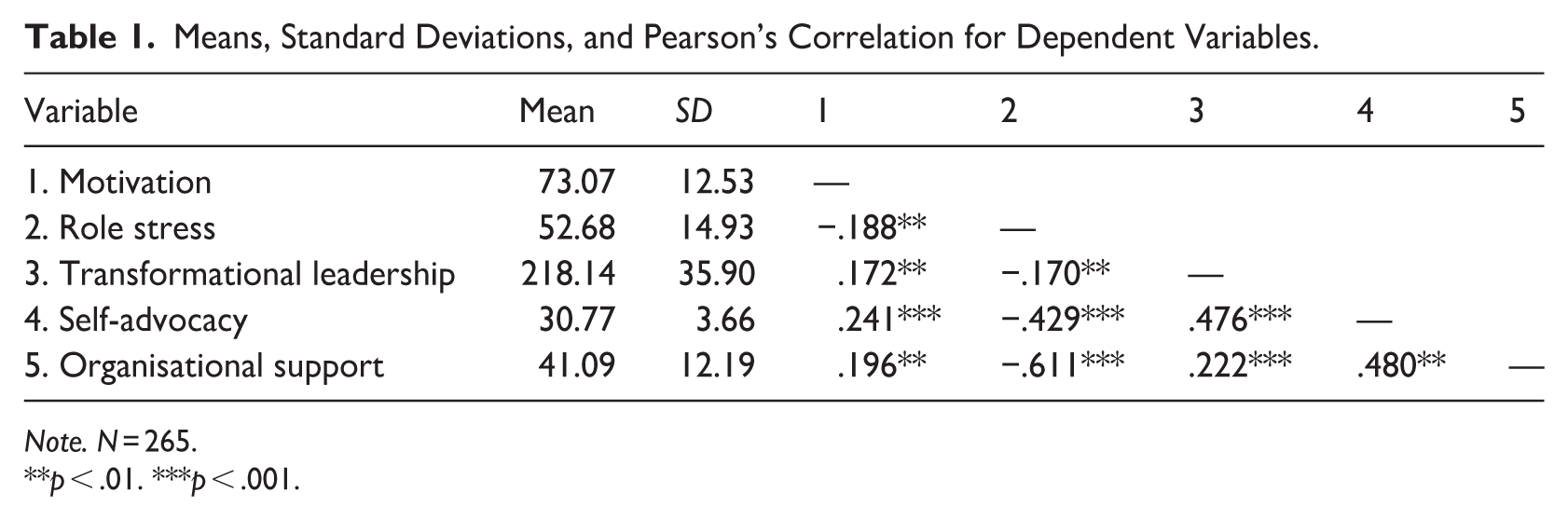
Note. N = 265.
p < .01. ***p < .001.
Descriptive Statistics for Dependent Variables by RAMP Designation and School Level.
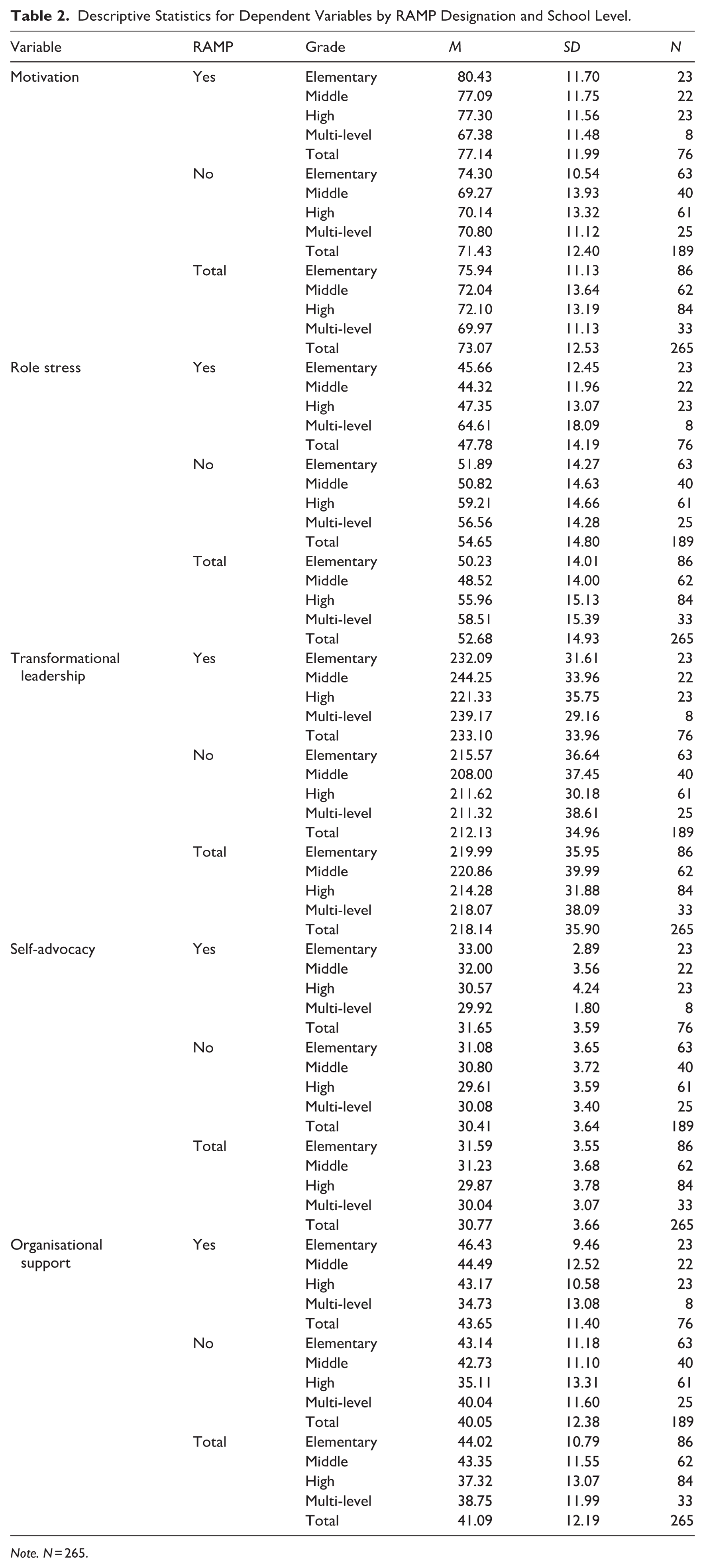
Note. N = 265.
Results
Our MANOVA revealed a statistically significant difference between participants from RAMP and non-RAMP schools on the combined dependent variables, F (5, 253) = 5.064, p < .001, Pillai’s Trace = .091, partial η2 = .091, indicating a medium effect size (Cohen, 1988). Accordingly, follow-up univariate analyses were conducted to determine which specific dependent variables contributed to this overall multivariate effect. When the results for the five dependent variables were considered separately, statistically significant results were found in: (a) motivation, F (1, 257) = 5.996, p < .05, partial η2 = .023; (b) role stress, F (1, 257) = 3.879, p < .05, partial η2 = .015; and (c) transformational leadership, F (1, 257) = 19.157, p < .001, partial η2 = .069. Mean differences in the other two outcome variables were nonsignificant, including (a) self-advocacy, F (1, 257) = 3.394, p = .067, partial η2 = .013; and (b) organisational support, F (1, 257) = 1.250, p = .265. In other words, participants in RAMP-designated schools had significantly higher scores in motivation and transformational leadership while exhibiting significantly lower scores in role stress, compared to those from non-RAMP schools.
Similarly, the model indicated a statistically significant difference based on the school level in which participants work as school counsellors, F (15, 765) = 2.325, p < .01, Pillai’s Trace = .131, partial η2 = .044, indicating a small effect size (Cohen, 1988). To clarify the source of the multivariate effect, each dependent variable was examined separately. When each dependent variable was analyzed separately, we detected significant effects in: (a) motivation, F (3, 257) = 3.133, p < .05, partial η2 = .035; (b) role stress, F (3, 257) = 5.965, p < .001, partial η2 = .065; (c) self-advocacy, F (3, 257) = 4.215, p < .01, partial η2 = .047; and (d) organisational support, F (3, 257) = 4.191, p < .01, partial η2 = .047. The difference in transformational leadership was nonsignificant: F (3, 257) = .962, p = .411, partial η2 = 011.
Because school level included more than two categories, post hoc comparisons were conducted to identify specific group differences. Tukey’s HSD test indicated that, for motivation, no specific pairwise comparisons reached statistical significance (p > .05). For role stress, statistically significant mean differences were observed between elementary school and high school (Mdiff = −5.74, p = .042), elementary school and multi-level school (Mdiff = −8.28, p = .023), middle school and high school (Mdiff = −7.45, p = .010), and middle school and multi-level school (Mdiff = −9.99, p = .006). For self-advocacy, the mean difference between elementary school and high school (Mdiff = 1.72, p = .010) was significant. For organisational support, significant mean differences were observed between elementary school and high school (Mdiff = 6.70, p = .001), and between middle school and high school (Mdiff = 6.03, p = .013).
The interaction effect between RAMP designation and school level on the combined dependent variables was not statistically significant, F (15, 765) = 1.518, p = .092, Pillai’s Trace = .087, partial η2 = .029.
Discussion
Overall, the MANOVA results suggested statistically significant differences in the multivariate means of the combined outcome variables, including motivation, role stress, self-advocacy, transformational leadership, and perceived organisational support, between school counsellors in RAMP and non-RAMP schools, as well as across school levels. The magnitude of these multivariate effects differed by grouping variable. Specifically, the effect associated with RAMP designation was in the medium range, whereas the effect associated with school level was small in magnitude (Cohen, 1988). These findings suggest that RAMP designation is associated with a more substantial multivariate pattern of differences across outcomes than school level alone. The interaction effect between RAMP designation and school level was not statistically significant for the combined dependent variables. Our study extended the literature on differences in school counsellors’ experience in multiple intra- and interpersonal competencies by focusing on situational motivation, role stress, self-advocacy, and transformational leadership between RAMP- and non-RAMP schools and across school levels as informed by McMahon et al.’s (2014) ESC framework. In doing so, this study contributes to the literature by locating variations in school counsellors’ functioning and their associations with RAMP recognition while also accounting for differences across school levels.
Hypothesis 1: School Counsellors’ Functioning by RAMP-Designation
Our MANOVA results supported statistically significant differences in the multivariate means of school counsellors’ functioning across role stress, motivation, self-advocacy, and transformational leadership, as well as their perceived organisational support by RAMP designation, with the overall multivariate effect in the medium range. The existing literature has demonstrated a positive relationship between RAMP designation and student achievement in Math and English Language Arts (e.g., Wilkerson et al., 2013) and achievement-related outcomes such as attendance (e.g., Akos et al., 2019). However, relatively little is known about the relationship between schools’ RAMP status and school counsellors’ professional functioning. Prior studies have offered preliminary support for a positive association between RAMP designation and certain areas of school counsellors’ practice (e.g., Hilts et al., 2019; Young & Kaffenberger, 2011). Most of this research, however, relied on qualitative inquiries, focusing on school counsellors’ experiences applying for or navigating RAMP-designation (e.g., Duquette, 2021; Goodman-Scott et al., 2022; Taylor et al., 2022).
Our study contributes to this body of knowledge with quantitative evidence of multivariate differences in school counsellors’ intrapersonal and interpersonal functioning between RAMP and non-RAMP schools, as well as mean differences in the specific domains of motivation, role stress, and transformational leadership shown in follow-up univariate analyses. Specifically, school counsellors from RAMP-designated schools exhibited higher mean scores in motivation, higher levels of transformational leadership, and lower role stress than their non-RAMP counterparts, with the most pronounced difference observed in transformational leadership.
Transformational leadership among school counsellors emphasises shared decision-making, a collective vision, and the capacity to inspire positive change (Lowe et al., 2017), which may help explain more pronounced differences observed in this domain, as these behaviours closely align with expectations associated with RAMP designation. Similarly, because RAMP designation reflects the implementation of a comprehensive school counselling program aligned with the ASCA National Model (ASCA, 2019), this structural emphasis on CSCP implementation may support higher levels of situational motivation among school counsellors embedded in this context. In addition, the observed lower levels of role stress are consistent with the role clarity framework commonly referenced in organisational literature, which suggests that individuals with clearer role expectations tend to be more efficacious and outperform those with less role clarity (Bray & Brawley, 2002). However, given the correlational nature of this study, the observed significant mean differences should be interpreted as indicating associations among school counsellor functioning domains (i.e., motivation, role stress, self-advocacy, transformational leadership), perceived organisational support, RAMP status, and school level, rather than causal effects. Accordingly, alternative explanations, such as preexisting differences between schools, cannot be ruled out.
Hypothesis 2: School Counsellors’ Functioning by School Level
As informed by the ESC framework (McMahon et al., 2014), coupled with different emphases on student development and needs across school levels, we hypothesized differences in school counsellors’ functioning across school levels. Our results supported statistically significant multivariate mean differences in school counsellors’ professional functioning across school levels, with the overall multivariate effect being small in magnitude. Follow-up tests showed small effects across multiple domains, including motivation, self-advocacy, and perceived organisational support, alongside a comparatively stronger effect for role stress, which fell within the medium range (Cohen, 1988). Specifically, elementary school counsellors in our study demonstrated a significantly lower mean score in role stress compared with those in high- and multi-level schools. Our results also showed lower role stress in middle school counsellors compared with their high school and multi-level counterparts. These results align broadly with prior research suggesting that elementary school counsellors experience less role conflict and role incongruence than high school counsellors (Culbreth et al., 2005). They also echo findings from Burnham et al.’s (2024) study, which reported the lowest percentage (28%) of elementary school counsellors engaging in inappropriate duties, compared to the highest percentage (more than 42%) reported among high school counsellors. Additionally, the higher role stress in high school counsellors may reflect the distinctive demands of their roles in addressing the unique developmental needs of their students, particularly given their extensive involvement in high-stakes testing and responsibilities related to career and college readiness.
School counsellors at the elementary level scored significantly higher in self-advocacy compared to their high school counterparts. Likewise, this difference may be influenced by developmental priorities at the elementary level—particularly the emphasis on students’ social-emotional growth—as well as role clarity among elementary school counsellors. Promoting students’ social-emotional development aligns closely with the fundamental goals of the counselling profession, as outlined in both general counselling frameworks (e.g., ASCA, 2019) and the more specific standards of school counselling practice. These standards emphasise the counsellor’s role in fostering students’ well-being, including their emotional resilience, interpersonal skills, and readiness for postsecondary life. However, at the high school level, school counsellors are frequently tasked with a wide range of administrative responsibilities, which can dilute their ability to focus exclusively on student-centered support and likely create challenges to maintain professional boundaries and advocate for their role. As noted in a multi-state survey study, Chandler et al. (2018) found that elementary school counsellors reported engaging in more counselling-related duties and fewer non-counselling tasks than high school counsellors. Additionally, our findings revealed significantly lower perceived organisational support in high school counsellors, compared with their counterparts in elementary school and middle schools. This lower perceived organisational support may stem from the increased administrative responsibilities often placed on high school counsellors, alongside the demands of implementing a CSCP and addressing students’ college and career needs (Blake, 2024).
Hypothesis 3: RAMP-School Level Interaction
Our two-way MANOVA testing did not show a significant interaction effect between RAMP designation and school level on the combined dependent variables of school counsellor functioning and perceived organisational support. Although significant main effects of RAMP designation and school level were observed across several outcome variables, the absence of a significant interaction suggests that the patterns associated with RAMP designation were largely consistent across school levels.
One possible explanation for the nonsignificant interaction is that RAMP designation and school level appear to influence different domains of school counsellors’ functioning. Specifically, RAMP designation was primarily associated with transformational leadership, motivation, and role stress, whereas school level was more consistently associated with motivation, role stress, self-advocacy, and perceived organisational support. Although motivation and role stress were influenced by both factors, the direction and magnitude of these effects remained largely consistent across school levels, which may help explain the absence of a significant interaction. From a practical standpoint, this suggests that RAMP designation may not operate as a context-specific institutional condition whose impact varies significantly by school level, but rather as a broadly applicable context within the school system that facilitates school counsellors’ professional functioning and perceived organisational support.
Limitations and Future Research Recommendations
The results should be interpreted in light of the study’s limitations. First, our participants were school counsellors working in the U.S.; thus, the study findings provide valuable insights into how acquiring RAMP recognition may influence counsellors’ functioning and perceived organisational support within the U.S. context. It is important to acknowledge that these findings may not be generalizable to school counselling practices outside of the U.S.
Additionally, while this demographic distribution of the study sample reflects broader workforce trends within the school counselling profession in terms of race/ethnicity, school level, and school location (ASCA, 2021), the inherent limitations of survey-based, self-selected sampling mean that the sample may not be fully representative of the broader population of school counsellors in the U.S., particularly counsellors from marginalized or underrepresented identity groups whose professional experiences may differ in meaningful ways.
Another limitation concerns that all measures used in the study were based on self-report. This approach may have introduced social desirability bias, with participants potentially overreporting positive behaviours and underreporting negative ones, as well as common method bias, which may have inflated the observed associations among variables. In addition, the use of a cross-sectional design limits the ability to understand how time may have influenced the observed relationships between RAMP designation, counsellors’ functioning, and perceived organisational support. The use of single-item, self-reported measures for RAMP status and school level may also introduce misclassification and measurement error. Namely, the binary RAMP indicator, although common in RAMP research (e.g., Mason et al., 2023; Randick et al., 2018), may obscure variation in CSCP implementation, and broader school-level categories may mask meaningful structural and cultural differences across grade levels (e.g., distinctions between 11th and 12th grade contexts).
Finally, although differences were observed across school levels and schools’ RAMP designation status, these patterns should be interpreted with caution due to unequal and, in some cases, small subgroup sizes (e.g., RAMP–multi-level). That said, the smallest subgroup, school counsellors working in RAMP-designated schools across multiple school levels, included greater than five cases per group, which meets the minimum recommendation relative to the number of dependent variables (Hair et al., 2019). Nevertheless, small cell sizes may compromise statistical power and increase sampling variability, limiting the stability and generalizability of these group comparisons (Hair et al., 2019; Tabachnick & Fidell, 2019). Moreover, the present study did not test measurement invariance across RAMP and non-RAMP schools. Because the analyses were conducted using composite scale scores within a MANOVA framework rather than latent variable modeling, it was not possible to evaluate whether the measurement models function equivalently across institutional contexts.
Future studies could employ a longitudinal design to examine potential causal relationships, which require temporal precedence, between RAMP designation and relevant outcomes. This may better situate the profession’s understanding of the potential impact of RAMP beyond student outcomes but also on school counsellors’ functioning and the school environment. In addition, future studies could consider using multi-method assessment approaches for key constructs in this study, such as transformational leadership and perceived organisational support. For example, triangulating self-report data with peer, supervisor, or administrator ratings would strengthen the validity of measurement and provide more comprehensive insights from multiple school stakeholder perspectives. Future research may also account for other school characteristics that could further explain possible inherent outcome differences between RAMP and non-RAMP schools, such as school funding, geographic location, and school climate.
Implications
The results from the study offer several implications for school counselling and educational partner practice, and ASCA and state-level school counselling associations. The observed differences between school counsellors in RAMP-designated and non-RAMP schools suggest that RAMP designation may be associated with distinct patterns of school counsellor functioning. For practicing school counsellors, these findings highlight the potential utility of RAMP-related processes that emphasise program goal setting, documentation, and reflection. For example, the RAMP application requires school counsellors to articulate an annual student outcome goal and share program data with their advisory council and administrator (ASCA, 2019). These practices may contribute to the development of transformational leadership, among school counsellors, consistent with prior research suggesting that school counsellors’ pursuit of RAMP may be associated with increased confidence in advocating for their engagement in roles aligned with professional standards (Taylor et al., 2022). Moreover, such practices may enhance increased understanding of school counsellors’ roles and responsibilities which could reduce role stress. Thus, school counsellors may benefit from adopting these practices, even in part, where role expectations are unclear or misaligned with ASCA’s recommended scope of practice.
Additionally, the significant differences in role stress across school levels suggest that role expectations may be particularly sensitive to contextual features of the school. School counsellors working in secondary or multi-level settings may experience heightened role stress and may therefore require more intentional, targeted advocacy strategies and communication with those with power and influence. For educational partners, such as school administrators, our results underscore the need to carefully consider how school counsellors’ roles are communicated and supported across school levels. Taken together, our findings suggest that efforts to support school counsellors may be tailored to school-level contexts rather than applied uniformly across all school levels.
ASCA and State-Level School Counselling Associations
Professional school counselling associations may use these findings to inform professional development focused on CSCP implementation. Such initiatives may serve as meaningful opportunities to cultivate shared learning, peer support, and reflection on role expectations and program practices. For example, associations might partner with state departments of education to establish peer learning groups or RAMP cohorts, based on school levels, that allow school counsellors to exchange strategies for navigating implementation challenges, clarifying role expectations, and managing role-related stress (Goodman-Scott et al., 2022; Taylor et al., 2022). School counsellors who have participated in RAMP-based cohorts have described increased confidence in understanding and implementing components of a RAMP-designated program. Additionally, state-level school counselling mandates may not always be enforced and may have limited association on actual CSCP implementation (Hilts et al., 2025; Savitz-Romer et al., 2023). Therefore, creating opportunities for school counsellors and other educational partners, such as administrators, to connect with peers across their region may serve as a medium to cultivate professional growth and support their school’s pursuit of the RAMP designation.
Educational Partners
The observed association between RAMP-designation and higher reported transformational leadership also offers practical implications for educational partners. While causal conclusions cannot be made, our findings suggest that school counsellors working in RAMP-designated schools may report greater engagement in transformational leadership behaviours. Given that CSCP implementation emphasises data-informed practice, collaboration, and goal setting, educational partners may consider the extent to which school counsellors are typically included in other school-based committees and initiatives that involve leadership behaviours reported by school counsellors in the present study. Supporting school counsellors’ participation in program planning, data interpretation, and collaborative decision-making – all features of a RAMP-designated school – may contribute to enhancing their transformational leadership behaviours and meaningful contributions to school improvement process (Mayes et al., 2018).
Additionally, school counsellors from RAMP-designated schools reported higher motivation scores than their counterparts from non-RAMP designated schools, indicating that motivational experiences may vary across organisational contexts. Educational partners may therefore consider how school counsellors’ access to time, resources, and professional development learning opportunities related to ASCA-aligned CSCP implementation may contribute to their motivation to implement a CSCP. Given the observed school-level differences, these supports may need to be tailored to the demands of the specific school context rather than applied uniformly.
Conclusion
This study examined differences in school counsellors’ functioning based on RAMP designation and school level. Counsellors in RAMP-designated schools reported higher motivation and transformational leadership, and lower role stress. Role stress, self-advocacy, and perceived organisational support also varied by school level, with high school counsellors reporting higher stress, lower self-advocacy, and less perceived support. These findings provide empirical evidence that school contextual factors, such as program recognition, as measured by RAMP designation status, and school level contribute to school counsellors’ professional functioning and perceived organisational support. Given that school counsellors operate within multiple layers of environmental influence involving diverse educational partners (McMahon et al., 2014), initiatives at the individual, school, and state levels (e.g., professional association, departments of education) are essential to support school counselling practices. Future research examining systemic factors, including school characteristics, may further expand our understanding of the setting-specific dynamics that influence school counsellors’ professional practice.
Footnotes

Funding
The authors received no financial support for the research, authorship, and/or publication of this article.
Declaration of Conflicting Interests
The authors declared no potential conflicts of interest with respect to the research, authorship, and/or publication of this article.