




Abstract
The increasing integration of digital tools into school counselling has transformed how counsellors engage with students, particularly following the COVID-19 pandemic. While online counselling was adopted out of necessity during a period of social distancing, its continued use raises questions regarding its role in contemporary school counselling practices. This study examines how school counsellors utilise digital tools (e.g. WhatsApp and Zoom) in their work beyond crisis contexts, with a focus on their potential to enhance the counselling relationship. A qualitative research design was used to analyse in-depth interviews with 20 school counsellors from Israel. A manifest content analysis was employed to identify key themes related to integrating online counselling tools, the benefits they provide, and the challenges they pose. Findings indicated that school counsellors perceive online counselling as a valuable complement to face-to-face interactions, particularly in maintaining continuous student engagement. Digital tools facilitate ongoing communication, strengthen trust, and provide accessibility outside school hours. Challenges identified were blurred professional boundaries, disparities in student access to technology, and concerns regarding confidentiality and ethical regulation. The study concludes that while online counselling enhances the availability and flexibility of school counselling services, structured guidelines and professional training are necessary to address ethical and logistical concerns.
Introduction
The primary roles of school counselling are to assist both students and the school system in achieving optimal functioning and maximising their potential in a supportive and accepting environment (American School Counselor Association [ASCA], 2019a). School counselling activities encompass the following areas: promoting cohesion and cooperation for the benefit of the student among the school staff; designing and implementing developmental, intervention, and prevention programmes; providing counselling to individual students, as well as to the school administration and teaching staff; and offering emotional support during times of stress and crisis (Green & Lloyd, 2021). School counsellors operate based on a systemic approach, promoting the students’ mental well-being within the school while supporting all other system elements. Therefore, school counsellors work with target audiences both within and outside the school ( ASCA, 2019b).
In recent years, digital tools (i.e. instant messaging like WhatsApp, and camera-based communication like Zoom) have rapidly permeated school counselling, underpinned by three primary factors: First, schools have increasingly adopted technological systems that facilitate information sharing amongst staff, parents, and students. Accordingly, the school counsellors also use various digital tools to receive information, transfer information, and provide consultations (Roberts et al., 2023). Second, having grown up in the digital era, most of today’s students are comfortable using digital platforms for communicating, learning, and seeking support (Steele et al., 2018). This digital familiarity makes online counselling an effective method for reaching students who may be reluctant to engage face-to-face; indeed, studies demonstrate a preference for online help-seeking (Glasheen et al., 2016). Third, the COVID-19 pandemic accelerated the shift to remote communication, relying heavily on digital tools such as phone calls, WhatsApp, emails, and videoconferencing platforms such as Zoom (Roberts et al., 2023). This shift has significantly expanded the use and development of online counselling platforms, allowing school counsellors to maintain essential connections with students, parents, and staff, thereby enhancing the accessibility and continuity of counselling services in schools.
It is also increasingly recognised that many of the presenting issues raised by adolescents in counselling are themselves closely intertwined with digital technologies and online environments (Abi-Jaoude et al., 2020). For instance, youth self-presentation on social media has been associated with elevated levels of depression and anxiety, particularly among those engaging in frequent upward social comparison or seeking feedback in online settings (Azem et al., 2023). Moreover, school-based interventions have begun to address not just screen time, but critical themes such as digital self-image, coping with cyberbullying, and fostering awareness and reflection about social media use (Andersen et al., 2024). Given that adolescents’ emotional, interpersonal, and identity-related challenges increasingly emerge within technologised spaces, integrating digital tools into school counselling is not only a matter of modality (i.e. online vs face-to-face), but a response to the lived, technologised contexts in which students’ needs are forming.
Benefits of Using Digital Tools in the Counselling Process
Digital tools offer several benefits to the education system, particularly with regard to accessibility and integrating innovative approaches. Studies on higher education have revealed positive findings related to integrating online counselling with the face-to-face counselling (e.g. Daulay et al., 2024; Haling et al., 2023). By eliminating barriers of distance and time, online counselling allows students to seek support whenever needed, thereby increasing accessibility (Colì et al., 2024). However, alongside the accessibility advantages, combining digital tools in counselling also creates a workload and an encroachment upon the work-home balance (Armitage et al., 2020; Vera et al., 2022).
Research also indicates that online counselling can effectively reduce academic stress amongst students, showing significant improvements compared to traditional methods (Daulay et al., 2024). In addition, research indicates that online counselling interventions in higher education effectively reduce mental distress and anxiety, significantly improving student well-being (Celia et al., 2022). In their meta-analysis, Bolinski et al. (2020) analysed six randomised controlled trials of e-mental health interventions for university and college students, focusing on programmes targeting mood, anxiety, and substance use, and examining their effects on academic performance indicators. The results indicated statistically significant improvements in depression and anxiety symptoms.
While much of the existing literature on online counselling focuses on its implementation in higher education (e.g. Gbollie et al., 2023; Tinella et al., 2025), there is relatively limited discussion on its application within K-12 settings. Integrating digital tools in school counselling for younger students presents unique opportunities and challenges that differ significantly from those encountered in post-secondary institutions. One of the primary distinctions between higher education and K-12 counselling is the level of student autonomy in accessing and utilising online counselling services (Glasheen et al., 2018).
A 5-week intervention, featuring weekly online modules based on Acceptance and Commitment Therapy, yielded significant outcomes; participants in the intervention exhibited reductions in depression and anxiety symptoms amongst adolescents, suggesting that technology-based approaches can effectively support mental health (Keinonen et al., 2024). A recent meta-analysis of 17 studies on the effectiveness of online interventions for psychological symptoms and disorders in children, adolescents, and young adults (age range: 9–26) at the beginning of the COVID-19 pandemic revealed a significant medium effect size for anxiety and social functioning and a large, significant effect for depression (Fischer-Grote et al., 2024).
There appears to be scarce research on the provision of online counselling by school counsellors. Studies examining school counsellors’ use of digital tools focused mainly on the challenges following the transition from face-to-face to online counselling during the COVID-19 pandemic (Fischer-Grote et al., 2024; Roberts et al., 2023). This highlights a notable paucity of empirical research regarding the sustained benefits and challenges of integrating digital tools into school counselling, particularly within the post-pandemic landscape.
Challenges in Integrating Digital Tools Into the Counsellor’s Work Within the School
Along with the advantages presented in the incorporation of digital technology in counselling work in higher education (e.g. Bolinski et al., 2020) and for adolescents (e.g. Fischer-Grote et al., 2024), it may, nonetheless, prove to be challenging when it comes to the school system. In contrast to private psychotherapy, which is typically provided for a fee, school counselling is a non-chargeable public service embedded within the state educational framework, ensuring that support is accessible to all students at no cost. However, some students face unstable internet connections, thus hindering their access to counselling services (Arrieta et al., 2021). In addition, while college students can be expected to own a personal computer, not all middle- and high-school students, and sometimes not even all school counsellors, have access to one, as some share the computer with other family members (Roberts et al., 2023).
Regarding professional development, although training for school counsellors is frequently provided during school hours, these sessions often prioritise urgent pedagogical or crisis-management needs, meaning that specialised training focused on the technical and ethical integration of digital tools remains insufficient. Consequently, school counsellors may feel ill-equipped to navigate the complexities of virtual practice. In addition, the traditional perception of the school counsellor as a formal institutional figure can lead to role ambiguity for both students and parents when interactions occur via remote platforms outside regular hours. This confusion arises because the absence of the physical school office disrupts the formal therapeutic frame, making it difficult for families to distinguish between a professional counselling intervention and an informal, social digital interaction (Sanchez-Maddela & Cruz-Cada, 2024).
To further frame the adoption of digital tools in counselling, the Technology Acceptance Model (TAM; Davis, 1989) offers a relevant theoretical perspective. According to TAM, individuals’ use of technology is influenced primarily by their perceptions of its usefulness and ease of use (Davis, 1989; Marangunić & Granić, 2015). In the context of school counselling, perceived usefulness may include the potential of digital tools to enhance accessibility, flexibility, and continuity of the counselling relationship, while perceived ease of use relates to the user-friendliness of platforms such as WhatsApp and Zoom. This model provides a conceptual basis for examining the personal, attitudinal, and systemic factors that shape counsellors’ willingness to integrate digital tools into their practice.
The Present Study
Evidence for the benefits of integrating digital tools into mental health services was established prior to the COVID-19 pandemic. During the crisis, the requirement for social distancing necessitated a rapid transition from traditional face-to-face services to remote modalities. School counsellors were similarly compelled to adapt their practice to these emergency conditions. Empirical observations from this period suggest that the intensive use of digital tools significantly augmented the technological proficiency of school counsellors, while simultaneously validating these platforms as legitimate media for student support. This shift has prompted a critical inquiry within the field as to whether school counsellors would choose to sustain these digital practices once the immediate necessity for social distancing had subsided (Greenidge, 2023; Kaznosky et al., 2021).
Despite growing literature on online counselling during periods of crisis (e.g. Greenidge, 2023), less is known about how digital tools are integrated into routine school counselling practice once emergency conditions subside. This study addresses this gap by examining school counsellors’ experiences of integrating digital tools alongside face-to-face counselling in everyday school contexts.
While existing literature predominantly evaluates the effectiveness of online interventions, this study examines the personal, attitudinal, and systemic factors influencing the integration of digital tools within school counselling. Addressing these dimensions is vital for understanding how digital modalities become embedded in the daily professional practice of school counsellors. Furthermore, the study investigates whether technological skills acquired during the pandemic have facilitated a more prevalent hybrid model, exploring the strategies, benefits, and challenges inherent in combining face-to-face and online support.
The research aims were: (1) to determine whether online counselling has been implemented for ongoing use beyond periods of crisis and social distancing; (2) to explore how school counsellors integrate digital tools alongside face-to-face counselling in their routine practice; and (3) to explore the challenges and limitations faced by school counsellors in the implementation of school online counselling. Therefore, the research question was: What benefits, challenges, and strategies do school counsellors perceive when integrating online and face-to-face counselling? To address this research question, the current study employed a qualitative approach. It was conducted in Jewish secular middle and high schools in Israel. Participants were practising school counsellors working within the public education system.
Methodology
The instruments included a demographic questionnaire and semi-structured interviews to capture both background information and in-depth perspectives.
A qualitative research design was selected to capture school counsellors’ subjective experiences, meanings, and interpretations regarding the integration of digital tools into their professional practice. Specifically, a manifest content analysis was employed to ensure a faithful and objective representation of the school counsellors’ explicit descriptions and strategies. This approach prioritises the visible surface of the data over the more interpretative and latent meanings typically sought in thematic analysis (Kleinheksel et al., 2020; Krippendorff, 2019). By focusing on manifest content, the study ensures that the generated themes remain strictly grounded in the participants’ actual professional accounts. This methodological choice is particularly appropriate for this study, as it facilitates a clear and descriptive mapping of practical strategies and structural challenges without the risk of over-interpretation inherent in more latent qualitative frameworks.
Participants
The participants were twenty school counsellors, all women, half employed in middle schools (13- to 15-year-old students) and the other half in high schools (16- to 18-year-old students) in the secular Jewish sector in Israel (native speakers of Hebrew). Their mean age was 44.22 years (range: 30–60; SD = 9.09), and their seniority (number of years of professional experience as a school counsellor) ranged between 2 and 19 years (mean = 9.35; SD = 6.25). All the study participants worked in public schools (Table 1).
Participants in the study.
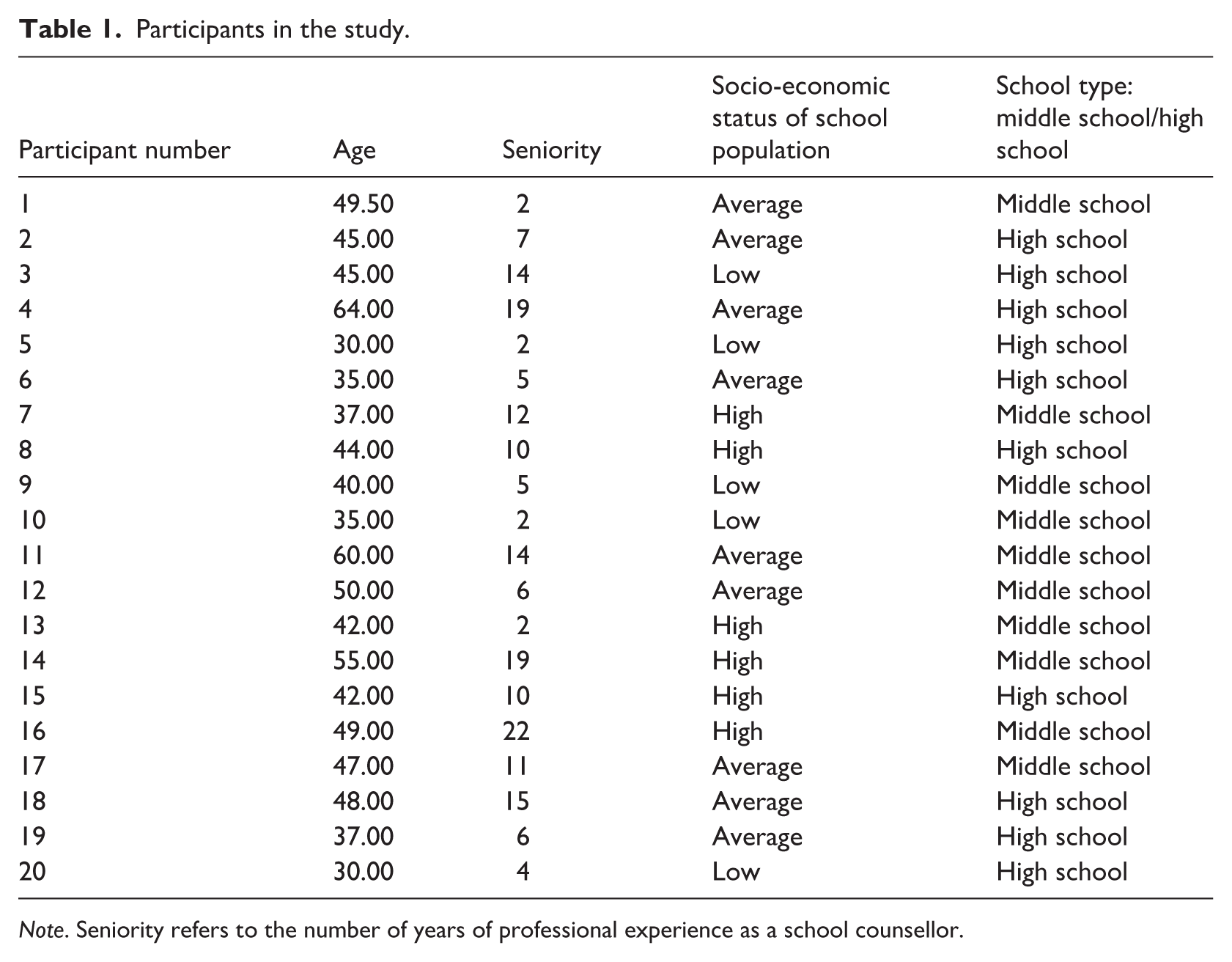
Note. Seniority refers to the number of years of professional experience as a school counsellor.
Measures
Demographic Questionnaire
The questionnaire for the school counsellors included questions about age, gender (female / male / don’t want to answer), seniority (number of years as a school counsellor), type of school (middle school/high school), the student age groups they are responsible for at school, and the socio-economic status of the school community (low/average/high). The socio-economic status of the school community was determined based on the school counsellors’ professional assessment, reflecting their comprehensive systemic and individual familiarity with the student population. In addition, they were asked to rank, on a 5-point scale, to what extent they use digital tools (e.g. Zoom, WhatsApp, email, and social networks) for their daily work (1 = rarely to 5 = most of the time) and to what extent they use digital tools (e.g. Zoom, WhatsApp, email, and school website) for professional matters in their capacity as school counsellor (1 = rarely to 5 = most of the time).
A Semi-Structured Interview Guide
The author developed an interview guide with seven open-ended questions in Hebrew, designed to investigate how school counsellors provide online counselling along with the associated benefits and challenges. To ensure the instrument’s validity and practical relevance, the guide was piloted with an experienced school counsellor who was not included in the final data analysis. This pilot process served two primary purposes: first, to verify that the linguistic phrasing was clear and utilised professional terminology familiar to practitioners; and second, to ensure the questions accurately reflected the ecological reality of the school environment, such as the specific systemic constraints and student engagement patterns encountered by school counsellors.
During the interviews, school counsellors were provided with a consistent definition of online counselling, referring to counselling-related interactions conducted through digital tools, such as messaging applications and video calls, which are integrated into predominantly face-to-face school counselling practice. Sample questions included: “In what ways do you combine online counselling and/or digital tools in the counselling work done face-to-face?”; “What are the necessary elements in online counselling to strengthen the counselling relationship within the school?”; and “What are the present challenges you face in combining traditional-frontal counselling with online counselling at school?”.
Procedure
Following the approval of the Ethics Committee from the Institutional Review Board at the College [202180YVCEMEK], the author, who specialises in school counselling, with research assistants (master’s students in school counselling), approached school counsellors via social networks, contacted school principals, as well as personal acquaintances, offering them the opportunity to participate in the study. Three graduate students in school counselling (native speakers of Hebrew) conducted interviews via Zoom between January and April 2022. Interviews lasted between 35 and 45 min and were recorded verbatim. At the beginning of each interview, the participants received a link on their phone for the informed consent form. After being digitally signed, they went on to complete the demographic questionnaire. After completion, the participants entered the Zoom link to start the recorded interview.
Data Analysis
The qualitative data were analysed using manifest content analysis (Kleinheksel et al., 2020; Krippendorff, 2019), which provided a systematic framework for interpreting the experiences of the school counsellors. The analysis followed four rigorous stages to ensure depth and accuracy. First, decontextualisation involved breaking down the interview transcripts into discrete units of meaning. Second, during re-contextualisation, these units were verified against the original text to ensure context was maintained and were subsequently labelled with descriptive codes. Third, categorisation was performed by organising similar codes into broader, more abstract categories. Finally, compilation involved synthesising these categories into overarching themes to provide a coherent understanding of the transition to hybrid school counselling.
The transcripts were analysed manually, without the use of software, by a team consisting of the author and a graduate student in educational psychology who was not involved in the collection process. At the outset, each analyst coded one transcript independently, after which the team met to compare codes, discuss divergent interpretations, and achieve consensus. This iterative process continued with each analyst coding an additional five interviews, followed by further comparative meetings to refine the coding scheme until all interviews were fully processed. No substantial disagreements emerged that could not be resolved through discussion. Following the analysis, the findings were initially drafted in Hebrew and then translated into English by the author. To ensure linguistic and conceptual accuracy, this version was compared with a parallel translation produced by a professional linguistic editor fluent in both Hebrew and English.
Reflexivity and Trustworthiness
The author is a qualified school counsellor with extensive experience in supervising school counsellors across diverse sectors and age groups in Israel. Furthermore, she serves as an academic researcher within a department dedicated to the training of school counsellors. In qualitative inquiry, acknowledging the researcher’s background is essential for reflexivity, as it accounts for the potential influence of professional preconceptions on data interpretation (Finlay, 2022; Korstjens & Moser, 2018).
To ensure the trustworthiness of the findings, the study employed investigator triangulation during the data analysis phase (Lincoln & Guba, 1985). The analysis team comprised the first author and two research assistants (graduate students in school counselling and educational psychology). The inclusion of a researcher who was not involved in the data collection process provided a critical external perspective, helping to maintain objectivity and bracket potential preconceptions (Nowell et al., 2017). This collaborative and iterative process of independent coding, followed by consensus-seeking meetings, ensured that the final themes remained strictly grounded in the participants’ explicit accounts, thereby enhancing the credibility and confirmability of the study (Braun & Clarke, 2021).
Results
The study participants reported widespread use of digital tools for personal needs (mean = 3.90; SD = 1.07) and in their professional capacity as school counsellors (mean = 3.81; SD = 1.01). All participants reported combining WhatsApp and Zoom meetings in the face-to-face counselling process within the school. Prior to the detailed thematic analysis, the following observation highlights the overarching digital transformation within school counselling, providing a foundational context for the specific professional experiences discussed thereafter. As one participant explained:
In the last 6-7 years, in my experience, I can genuinely say that there has been a tremendous change in how we communicate with and support the students. For instance, WhatsApp has included the ability to schedule appointments, which is very easy. Zoom allows me to make an appointment at any time. I can message students to stay in touch and encourage them. Zoom certainly facilitates continuous counselling at a time that is better for them and not necessarily during school hours (P3).
The analytical process generated two central themes that encapsulate the professional experiences of school counsellors regarding the integration of digital tools into their practice. The first theme, “Integrating digital tools to strengthen trust in counselling relationships,” examines how digital platforms serve as catalysts for strengthening the therapeutic alliance and facilitating the expansion of accessibility and continuity of support beyond the temporal and spatial constraints of the school day. The second theme, “Challenges in integrating digital tools in school counselling,” delineates identified professional, ethical, and systemic obstacles, such as the blurring of professional boundaries, the encroachment upon work-home balance, difficulties in decoding emotional cues within the virtual space, and the absence of adequate regulatory and ethical protection. Furthermore, challenges related to parental resistance and digital inequities impacting the parity of service provision emerged. Collectively, these themes provide a comprehensive understanding of the transition towards a sustainable hybrid model in school counselling. The analytical process generated two central themes:
Theme 1: Integrating Digital Tools to Strengthen Trust in Counselling Relationships
Sub-Theme 1.1: Strengthening the Therapeutic Alliance and Relational Bonding
The integration of digital tools was perceived not merely as a technical addition but as a catalyst for trust and emotional closeness. Counsellors emphasised that communicating through platforms familiar to students “speaking their language” (P3, P14), demonstrated a genuine desire to enter the student’s world, thereby reducing relational barriers. This sense of caring was often reinforced through deliberate follow-up messages aimed at maintaining the emotional “bond” created during face-to-face sessions. As one participant explained, “If I see that the student is upset . . . I always send a follow-up that evening . . . to keep our bonding and sense of caring” (P8). Furthermore, digital tools allowed school counsellors to provide immediate reassurance, which strengthened the student’s perception of the counsellor as a reliable source of support. This was particularly evident when school counsellors used messaging to summarise key points from a meeting or provide “homework,” which one participant noted “can strengthen trust” by showing that the relationship is active and vital even between sessions (P10).
Sub-Theme 1.2: Expanding Accessibility and Continuity of Support Beyond School Walls
A second dimension of alliance-building involved the expansion of the counsellor’s presence beyond the physical and temporal limits of the school day. By offering accessibility after school hours, school counsellors conveyed a message that support is not “ended at the school gate” or restricted by “school walls” (P16). This logistical flexibility allowed students to initiate contact or schedule Zoom meetings when they felt most in need, rather than waiting for a pre-scheduled appointment during the busy school day. One counsellor highlighted how this convenience addresses the practical constraints of the school environment: “I don’t have time to see all the students . . . emergencies pop up . . . so, it’s convenient to send a message . . . if you want, I’m here to talk” (P20). Another participant noted that being reachable during the hours students are at home fosters a sense of security, as it “can also increase the student’s level of trust in me . . . they will see that I am interested in them” (P3). Thus, the ability to maintain continuous contact outside regular hours served as a practical proof of the counsellor’s commitment to the student’s well-being.
Theme 2: Challenges in Integrating Digital Tools in School Counselling
Physical distance lends legitimacy to the use of digital tools for school counselling. They are used in times of crisis that require remote communication, for example, when a student is hospitalised or during the COVID-19 pandemic. However, some challenges should be considered when digital tools are part of the face-to-face counselling process in school.
Sub-Theme 2.1: Obscuring of Professional Boundaries
The most prevalent challenge, mentioned by 18 participants, was the blurring of professional boundaries facilitated by the informal nature of digital communication. This obscuring of boundaries often manifested in the domesticity of the virtual space, where the lack of a formal setting led to inappropriate conduct; for instance, Participant 2 described the discomfort of conducting a professional session while the student was “lying in bed in her pyjamas,” illustrating a loss of the traditional counselling frame. Furthermore, the perceived constant accessibility of digital tools led to the erosion of temporal boundaries. School counsellors reported being “shocked” by students disregarding standard hours, with Participant 5 recounting a situation where she received a “WhatsApp message at 11 p.m.” for a non-urgent query, thereby forcing a professional presence into the counsellor’s private time.
Sub-Theme 2.2: Violation of the Work-Home Balance
The second sub-theme, reported by 15 participants, concerns the significant violation of the work-home balance, as the expectation for digital support often exceeds formal working hours. School counsellors noted that while they have always been invested in their roles, the current digital environment has rendered the workload “really excessive.” Participant 14 observed that the “ease of sending a message” means that parents and students no longer wait for school hours but “send it straight away,” creating a relentless demand where “everything requires a response and attention.” This intrusion into the private sphere is particularly challenging for school counsellors balancing professional and domestic roles; for instance, Participant 20 highlighted the difficulty of managing a phone “full of messages from work” while simultaneously caring for “small children” in the evenings.
Sub-Theme 2.3: Difficulties in Decoding Cues in the Virtual Space
Fourteen participants described the challenge of decoding emotional cues within the virtual environment, often due to the ambiguity of written text or the restricted visual field in video calls. The absence of non-verbal information in digital messaging can lead to significant misinterpretations and heightened counsellor stress; for instance, Participant 16 recounted how a “crying emoji” sent by a student triggered an immediate, anxious phone call, only to discover the student was merely frustrated and not in acute distress. This led the counsellor to conclude that “each of us interpreted the emoji completely differently.” Similarly, the physical dynamics of Zoom sessions can impede the observation of vital cues. Participant 8 described a case where the student’s movement outdoors meant she “could barely see her clearly,’ noting that the constant motion of the mobile phone further compromised the ability to maintain a stable and observant therapeutic gaze.
Sub-Theme 2.4: Absence of Robust Ethical Frameworks and Professional Safeguards
Fourteen participants highlighted a profound sense of professional vulnerability stemming from the absence of clear ethical guidelines and protective regulations in the digital sphere. This regulatory vacuum led to significant anxiety that written messages could be misinterpreted or subsequently “used against” the school counsellors. Moreover, the ease of recording or sharing digital content created fears regarding the breach of the counselling space, such as students surreptitiously recording Zoom sessions or distributing WhatsApp exchanges.
The most salient illustration of this risk was provided by Participant 11, who experienced a severe violation of professional dignity when a student took a screenshot during a Zoom meeting to create and distribute “various stickers” across school social media groups. This incident underscored a critical gap in institutional preparedness; as the counsellor reflected, she was “so offended” and realised that, until that moment, she “wasn’t even aware” of the personal exposure inherent in these platforms. Crucially, the lack of a formal protocol meant that even the “school didn’t know how to handle it,” leaving the counsellor to navigate the ethical and emotional fallout without systemic support.
Sub-Theme 2.5: Parental Concerns and Resistance to Digital Communication
Ten participants identified parental resistance as a significant hurdle, often rooted in a lack of understanding regarding the purpose of after-hours digital communication. This lack of clarity frequently triggered parental anxiety or suspicion, leading to “interrogations” of the counsellor; for instance, Participant 19 recounted a mother’s demand to know if “something had happened” after discovering her daughter’s WhatsApp correspondence. Beyond anxiety, the intrusion of digital counselling into the home space can evoke direct resistance or interference from family members, particularly when sessions occur during non-school hours. Participant 3 illustrated this through a Zoom session that was abruptly interrupted by the student’s father, who “burst into the room” to question why they were talking. Such incidents underscore the difficulty of maintaining a safe, private space for the student, whose visible distress, such as “cringing” in front of the camera, highlights the conflict between digital accessibility and parental oversight.
Sub-Theme 2.6: Digital Inequities and Disparities in Service Provision
The final sub-theme, discussed by seven participants, addresses the ethical concern that digital integration may exacerbate existing inequalities. School counsellors expressed concern that they cannot provide the same service to all students equally because not every student has access to a personal computer, a high-quality camera, or a stable internet connection. Participant 5 noted that while Zoom “works great” for students with proper equipment, the experience “feels less professional” and is often inconvenient when students are forced to connect via mobile phones due to a lack of better infrastructure. As Participant 10 shared, “I tried to schedule a Zoom meeting with a student without success. In the end, I realised that there is one computer for four children at home and he has no way of knowing when he will be able to get it.” This technological gap suggests that a reliance on digital tools may inadvertently disadvantage students from lower socio-economic backgrounds.
Discussion
This study sought to explore how school counsellors integrate digital tools into routine practice following the transition from crisis-driven remote communication to hybrid educational environments. The findings indicate that school counsellors perceive online counselling as a valuable complement to face-to-face interactions, particularly for maintaining continuous student engagement. All participants reported the widespread and ongoing use of digital tools to promote advisory processes, confirming that school counsellors continue to embed these technologies in their everyday practice beyond the initial necessity of the pandemic.
The findings regarding the enhancement of trust and accessibility through digital tools can be further examined through the lens of TAM (Davis, 1989; Venkatesh & Davis, 2000; Venkatesh et al., 2003), which suggests that technology adoption is primarily driven by perceptions of usefulness and ease of use. In the present study, school counsellors demonstrated high levels of perceived usefulness, as they consistently described how digital tools facilitate the continuity of contact and strengthen the therapeutic alliance. This integration is not merely a logistical shift but serves as a relational bridge, as communicating through platforms familiar to students demonstrates a desire to “speak their language” (P3, P14) and enter their world, thereby reducing relational barriers. By adopting user-friendly tools such as WhatsApp and Zoom, school counsellors exhibit a high level of perceived ease of use, which has facilitated the transition of these skills from the emergency context of the pandemic into routine, everyday practice. Furthermore, the ongoing availability provided by these tools offers a sense of security and reassurance, as students can reach out for support between formal sessions, feeling a continuous presence that transcends the physical walls of the school. Consequently, the alignment between the perceived utility of these tools in relationship building and their ease of implementation explains why school counsellors have embraced hybrid models to enhance the accessibility and responsiveness of their services in the post-pandemic era. This reflects a shift where digital tools are no longer viewed as temporary emergency measures but as essential components of contemporary school counselling practices.
While the perceived usefulness of digital tools facilitates adoption, the findings highlight significant conceptual tensions regarding professional boundaries and ethical regulations. Consistent with previous literature, school counsellors in this study identified challenges such as the obscuring of professional boundaries (Hochgerner et al., 2021), digital inequality in service provision (Kaznosky et al., 2021), and difficulties in decoding vital emotional cues in virtual spaces (Roberts et al., 2023). Furthermore, the lack of an updated ethical guide for routine digital interactions remains a primary concern (Sanchez-Maddela & Cruz-Cada, 2024). In the current study, new complexities emerged regarding parental involvement, which is typically required for younger students but adds layers of complexity to confidentiality and scheduling (Roberts et al., 2023). The shift to digital communication has also fostered the perpetual availability phenomenon, where school counsellors struggle to delineate clear limits between their professional responsibilities and personal time (Arrieta et al., 2021). This lack of physical separation from the workplace often exacerbates professional fatigue and exhaustion (Roberts et al., 2023). Current professional frameworks, such as the ethical standards of the American School Counselors’ Association (ASCA, 2022), emphasise the importance of clarifying the limitations of technological applications. However, there is a pressing need for institutional policies that define clear work-hour boundaries and encourage the adoption of structured communication policies to protect the well-being of school counsellors (Armitage et al., 2020; Vera et al., 2022).
The primary contribution of this study is the shift in focus from the emergency adoption of technology during the COVID-19 pandemic to its sustainable integration into routine school counselling. While previous research primarily addressed crisis-driven transitions (e.g., Kaznosky et al., 2021), this study provides empirical evidence of how digital tools remain embedded in everyday educational contexts. By examining the personal and systemic factors that shape this adoption, the findings suggest that digital tools serve as a permanent complement to face-to-face interactions rather than a temporary substitute. This research advances the understanding of hybrid counselling models, indicating that their long-term effectiveness depends on resolving the tensions between increased accessibility and the potential deterioration of work-life balance (Armitage et al., 2020; Vera et al., 2022). These insights provide a basis for ensuring that the digital skills acquired during the pandemic are purposefully leveraged to meet the evolving needs of students in a post-crisis reality.
Implication for School Counselling
The findings of this study provide several practical implications for the integration of digital tools into school counselling. These recommendations are offered to be adaptable for educational systems with comparable public-service frameworks and can be implemented in alignment with the overarching policies of respective national educational authorities. Specifically, within the context of Israel, where this research was conducted, these strategies are suggested to be applied in accordance with the regulations of the Ministry of Education and individual school protocols.
Individual Strategies for School Counsellors
It is suggested that school counsellors proactively establish clear digital boundaries to manage the challenges of perpetual availability. This includes defining specific hours for online responsiveness and communicating these limits clearly to students and parents at the beginning of the school year. To maintain professional integrity and prevent the obscuring of boundaries, Zoom sessions should be conducted within a formal framework, requiring students to engage from an appropriate environment. Furthermore, school counsellors should categorise their communication methods, reserving digital messaging for brief follow-ups or technical coordination while prioritising face-to-face meetings for complex emotional interventions.
Institutional Recommendations for Schools and Policy Makers
Educational institutions must develop formalised protocols for digital communication to protect both students and staff. Schools should implement training programmes that enhance the digital literacy of school counsellors, specifically regarding the ethical use of platforms and the decoding of emotional cues in virtual spaces. To address disparities in service provision, schools and the Ministry of Education should ensure that students from lower socio-economic backgrounds have equitable access to the necessary hardware and stable internet connections. Additionally, schools should facilitate transparent dialogue with parents to clarify the purpose of digital counselling, potentially using formal consent forms that outline the scope and limitations of after-hours support. Finally, institutional policies should address the protection of school counsellors from digital misuse, such as unauthorised recordings or the distribution of session content, by establishing clear disciplinary consequences for such actions.
Theoretical Implications
This study offers several theoretical contributions to the field of school counselling and technology adoption. First, it extends the Technology Acceptance Model (TAM; Venkatesh & Davis, 2000; Venkatesh et al., 2003) by identifying “relational utility” as a critical driver for technology integration in therapeutic settings. While traditional TAM frameworks primarily focus on productivity and task efficiency, our findings suggest that school counsellors adopt digital tools based on their perceived ability to enhance the therapeutic alliance and maintain continuity of support (Roberts et al., 2023). This suggests that in helping professions, the ‘perceived usefulness” of a tool is intrinsically linked to its capacity for relational bonding rather than mere logistical ease.
Second, the research contributes to the conceptualisation of professional boundaries in the digital age. The findings provide empirical weight to the “perpetual availability” phenomenon (Arrieta et al., 2021), suggesting that existing boundary theories must be updated to account for the unique emotional and ethical demands placed on school counsellors within hybrid environments. By documenting the shift from crisis-driven usage to routine, sustainable integration, this study provides a theoretical basis for moving beyond emergency frameworks (Hochgerner et al., 2021) towards a grounded understanding of the long-term professionalisation of online school counselling.
Limitations and Directions for Further Research
While this study provides insights into incorporating digital tools in school counselling, several limitations should be acknowledged. First, the sample consisted exclusively of female school counsellors working in Jewish secular middle and high schools, which may limit the generalisability of the findings to other educational settings, such as religious, Arab (Muslim, Christian, or Druze denominations), or special education schools. Future research should explore the perspectives of a more diverse group of school counsellors to better understand variations across different cultural and educational contexts. Second, the study relied on qualitative, self-reported data obtained through interviews, which may be subject to recall bias or social desirability effects. Observational studies or the inclusion of student perspectives could provide a more comprehensive understanding of the impact of online counselling. Third, the research focused on the perceptions and experiences of school counsellors rather than on measurable student outcomes. Further studies should investigate how online counselling affects student well-being, academic performance, and emotional resilience. Finally, as technology continues to evolve rapidly, the findings may not fully capture emerging digital trends and tools that could further shape counselling practices in the near future. Longitudinal studies are needed to examine how school counsellors adapt to ongoing technological advancements and whether the integration of digital tools in counselling remains sustainable and effective over time. In addition, future research should also consider the implications of artificial intelligence (AI) in school counselling. As AI-driven tools for mental health support and chat-based interventions expand, questions arise regarding their integration alongside counsellors, ethical considerations, and effects on the counselling relationship (Chan, 2025).
Conclusion
This study contributes to the growing body of research on the integration of digital tools in school counselling by demonstrating how school counsellors adopt and adapt online communication within predominantly face-to-face practice. By focusing on experiences beyond the COVID-19 crisis, it provides new insights into how online counselling becomes embedded in everyday educational contexts. Practically, the findings highlight that digital tools can complement, rather than replace, in-person counselling by strengthening trust, increasing accessibility, and supporting continuity of care. At the same time, challenges such as blurred boundaries, unequal access, and ethical concerns underscore the need for clear guidelines, training, and systemic support to ensure responsible and sustainable hybrid counselling practices. Addressing these issues will be essential for developing counselling practices that remain both effective and responsive in the digital age.
Footnotes
Acknowledgements
I would like to thank Sira Golani for her contribution to the analysis and Marianne Steinmetz for her editing and proofreading in English.

Ethical Considerations
Following the approval of the Ethics Committee from the IRB College [202180YVCEMEK], research assistants (master’s students in educational counselling) approached school counsellors via social networks, contacted school principals, as well as personal acquaintances, offering them the opportunity to participate in the study.
Consent to Participate
All study participants signed an informed consent form and completed the demographic questionnaire.
Funding
The author disclosed receipt of the following financial support for the research, authorship, and/or publication of this article: The author received financial support for publishing this article from The Max Stern Academic College of Emek Yezreel’s research authority.
Declaration of Conflicting Interests
The author declared no potential conflicts of interest with respect to the research, authorship, and/or publication of this article.
Data Availability Statement
Please email the corresponding author* for the data.