




Abstract
By working in partnership with parents, school counsellors can assist in the early identification of mental health and wellbeing issues and facilitate timely access to professional support. However, very little is known about parents’ understanding of the role of school counsellors and the barriers and enablers influencing the relationship between parents and school counsellors. Therefore, this qualitative study employed one-on-one interviews of 10 parents and employed a reflexive thematic analysis approach. Results revealed that parents expect school counsellors to provide a safe and supportive environment for students. Parents believe the school counsellor should be offering curriculum and behaviour support to teachers, individual and group work to students, and career counselling. In terms of the barriers and enablers influencing collaboration between school counsellors and parents, participants overwhelmingly felt that the role was hidden away and ill-defined. Advertising services more and getting the counsellor out into the school community at times suitable to working parents were seen as important considerations. Parents value the role of school counsellors. Future research on parental attitudes towards school counsellors could gain insights by diversifying participant profiles, including various genders, socio-economic backgrounds and occupations, to capture a wider range of perspectives.
Introduction
Student mental health is a significant public health concern in Australia. Approximately 1 in 7 Australian school students (aged 4–17 years) were estimated to experience a mental illness in the past 12 months (Australian Institute of Health and Welfare, 2021, 2023), with international research suggesting that the peak age of onset for mental illness is 14 years (Solmi et al., 2022). The Australian National Children’s Mental Health and Wellbeing Strategy (National Mental Health Commission, 2021) highlights education settings as a critical context for building student wellbeing and resilience and for identifying and intervening early when addressing mental health difficulties. This important role in mental health promotion is well-recognised in most schools, with the relationships that students form with key school personnel, including teachers and counsellors (Martin & Collie, 2019; White, 2020), providing the basis for informal and formal support for students with mental health concerns. These concerns may include internalising (e.g. depression, anxiety) and externalising problems (e.g. conduct problems, oppositional behaviour, aggression) problems (Johnson et al., 2016).
Studies consistently show that when student support staff roles (i.e. staff in schools dedicated to wellbeing and mental health promotion) are clearly communicated to students, and evidence-based wellbeing programmes are implemented with fidelity, positive outcomes can be achieved of addressing the mental health needs of students (Beames et al., 2022; Collins, 2014; Franklin et al., 2012; Sanchez, 2018). In Australia, mental health stigma is still prevalent, with a recent national survey finding that mental health-related stigma most commonly comes from family and friends (Commonwealth of Australia, 2022). As such, while mental health stigma may prevent a student from seeking support (Townsend et al., 2017), students are more likely to disclose mental health concerns at school in preference to their home environment, particularly when they experience strong, positive relationships with key support personnel (Dimitropoulos et al., 2022). Thus, the presence of well-trained and well-resourced student support staff, including school counsellors, guidance officers, psychologists and wellbeing officers, is essential to the promotion of student wellbeing. This is being increasingly recognised across state education departments in Australia, such as through Victoria’s Mental Health in Primary Schools Pilot (Darling et al., 2021) and Queensland’s Student Wellbeing Package (Queensland Department of Education, 2023a). In Queensland government schools, mental health and wellbeing services are currently primarily provided by guidance officers, herein referred to as school counsellors, who are registered teachers with postgraduate qualifications in guidance and counselling (Queensland Department of Education, 2023b). These professionals provide advice and counselling on a variety of issues including educational, behavioural, vocational, social, family, mental health and wellbeing matters (Queensland Department of Education, 2023b).
Engaging with parents is seen by school counsellors as important for supporting a student’s mental health and wellbeing, and ultimately their capacity to engage effectively in education (Christenson, 2004). The value of these home-school partnerships for students can be conceptualised within a bioecological framework, which acknowledges that student mental health is a function of contributions from their immediate environment (i.e. microsystems including home and school) and broader contexts (i.e. mesosystems, exosystems, macrosystems) (Bronfenbrenner, 2005). Reciprocal interactions between parents and school staff that occur within an effective home-school partnership fit within the mesosystem of the bioecological model. The importance of the home-school mesosystem for supporting student learning is well-acknowledged, and studies show that schools are effective in forming productive partnerships with parents, particularly for curriculum and school management matters (Peter et al., 2019; Povey et al., 2016).
Systems approaches also apply to the work of school counsellors. Home-school collaboration approaches recognise that gains in student learning and behaviour outcomes are greatest when interventions focus on the reciprocal interactions between home and school, rather than focusing on only the home or school system (Christenson, 2004; Cox, 2005). In spite of the importance of working alongside parents, school counsellors can face challenges engaging parents in interventions to support children’s mental health and wellbeing, which highlights the need to provide insight into parents’ understanding of the role of the school counsellor and their willingness to work in partnership with them (Bignold & Anderson, 2023; Copeland et al., 2024; Vaishnavi & Kumar, 2018). Qualitative studies have indicated that parents view school counselling as beneficial, noting improvements in their children’s emotional competence, relationships and coping with challenges (Copeland et al., 2024; Harrison et al., 2023), and that young people value school counsellors as an advocate for them and their needs when working with their parents (Knight et al., 2018). In comparison, challenges in parent-counsellor relationships may stem from parents’ limited awareness or understanding of the counsellor’s role in fostering a student’s mental health, underscoring the importance of communication and education in this partnership (Harrison et al., 2023). In one study, school counsellors in India reported that parental attitudes, such as expectations and reactions towards their child’s problem, presented significant challenges (Vaishnavi & Kumar, 2018), while a study with parents in Hong Kong emphasised parental concerns about mental health stigma and the limits of student confidentiality in a school environment as being barriers to an effective counsellor-parent relationship (Harrison et al., 2023). Parents in this study also highlighted the importance of school counselling being embedded within broader school climate that was supportive of student mental health.
Overall, the available research indicates that there are benefits to school counsellors working alongside parents, but that there are also some barriers to building an effective counsellor-parent partnership. The aim of the current study was to explore parental expectations of school counsellors in the Australian context – specifically in Queensland – both in terms of the support offered to address student mental health and wellbeing difficulties, and strategies for enhancing parental collaboration. The study aimed to address the following questions:
What do parents perceive as the primary responsibilities of the school counsellor in addressing mental health and wellbeing amongst students?
Which specific interventions or supports do parents expect from school counsellors to address the mental health and wellbeing needs of students?
According to parents, what are the perceived barriers and enablers influencing the collaboration between them and school counsellors in supporting student mental health and wellbeing?
Method
Design
The study was of a qualitative design using reflexive thematic analysis (Braun & Clarke, 2019, 2021, 2022) and involved interviews with parents of school-aged children. The current study took a constructivist approach to epistemology. The constructivist approach seeks to gather and analyse data through processes that seek to understand not only how an individual person states and perceives their knowledge constructs but how these constructs are influenced and shaped by their context (Boyland, 2019). This meant that participants’ responses did not go uninterrogated. Instead, the analysis focused on the social, cultural and structural contexts that shape individuals’ experiences and the language they use to describe them (Kiger & Varpio, 2020). As a result, themes were developed not only based on the recurrence of ideas but also on what held significance for both the participants and the researchers (Byrne, 2022). An experiential orientation to data interpretation was adopted for the current study. Data analysis aimed to make sense of how the world is seen, understood and experienced from participants’ perspectives (Braun & Clarke, 2013). This approach aligns with the aims of the study to uncover parents’ lived experiences and ideas for change in relation to school counselling practices.
Reflexive thematic analysis was chosen as an effective technique for understanding shared experiences, thoughts and behaviours; precisely what the current study aims to uncover within parent groups (Kiger & Varpio, 2020). It is also an approach that embraces subjectivity and uncertainty in terms of data analysis and is not bound by any theoretical paradigms (Braun & Clarke, 2006, 2021, 2022; Byrne, 2022). Positionality statement: The lead researcher (GC) has over 15 years of experience as a practising guidance counsellor. Acknowledging this professional background and personal connection to the topic, steps were taken to maintain the integrity of the data, such as excluding staff and parents from the school where the researcher (GC) currently works. Given the nature of reflexive thematic analysis, the researcher’s perspectives inevitably shaped some deductive aspects of the analysis. Reflexivity was practiced throughout to ensure transparency and rigour in the interpretation of parents’ understanding of school counsellors and their collaborative role
Participants
Ten participants were recruited to the study (see Table 1). To be eligible, parents had to be over 18 years of age with a child currently attending a private or state Queensland primary or secondary school (primary school aged 5–12 years; secondary school aged 13–18 years). No prior or recent experience with a school counsellor was required for participation. To ensure the integrity of the data, staff and parents associated with the school where the researcher currently worked were ineligible to participate in the study. Of the 10 participants, 9 were female and 1 was male. In terms of educational background, nine of the participants were university educated with (n = 4) holding a postgraduate qualification. Participant occupations ranged from teachers (n = 5), full-time students (n = 2), a small business owner (n = 1), a drug and alcohol counsellor (n = 1), and a human resources manager (n = 1). Of all the participants, seven described themselves as being the primary parent responsible for maintaining contact with their children’s school. The remaining three regarded school matters as a shared responsibility with their partner. Five participants had a child/children in a high school setting only, one in a primary school setting, and four in both a primary and secondary school setting. Three participants had a child in a private school and six participants had children in a public school. One participant had children at both private and public high schools. Regarding the ability to identify a mental illness in one of their children, six participants felt that they could do this confidently, while the remaining four felt that they were reasonably confident.
Participant demographics (pseudonyms included).

Measures
All participants were interviewed using a semi-structured interview technique. An interview guide was prepared in advance (by GC, GV, GR and KK; see S1 of Supplemental Material), piloted on five volunteers to ensure clarity and organisation of the questions, and amended in response to their feedback. The pilot responses were used solely for refining the guide and were not included in the main study analysis. While participants were asked similar questions, the researcher exercised some flexibility in terms of the order and wording of questions. This was important to ensure that participants fully understood what they were being asked and were free to discuss issues important to them and unanticipated by the researcher (Braun & Clarke, 2013). Equally important was the use of open-ended, non-leading, short, precise questions. These helped the interviewee to provide unambiguous responses that reflected content important to them and the study overall (Braun & Clarke, 2013).
Procedure
This study was approved by the CQUniversity Human Research Ethics Committee (Approval Number 2023-059). A convenience sampling technique was used to recruit participants incorporating online and paper advertising campaigns. Participants were recruited through social media, university public online forums and bulletin boards in public spaces (e.g. office spaces). Prospective participants were asked to email the researchers expressing their interest to participate in the study. Following receipt of this email, the lead researcher forwarded to the prospective participant an information sheet and consent form. They were asked to read all material carefully before signing the consent form and returning it to the researcher via email.
Interviews were conducted through Microsoft Teams. The researcher conducted no more than two interviews a day to reduce errors associated with fatigue. Interview times ranged from 20 min, 6 s to 37 min, 35 s, with a mean recording time of 25 min 54 s. As an incentive to participate, respondents were offered the opportunity to go into a prize draw for a $50(AUD) shopping voucher drawn at the end of the data collection period.
All interviews were video and audio recorded and transcribed in full using standard conventions (e.g. standardised symbols and annotations to transcribe interviews) outlined by Braun and Clarke (2013). Transcriptions of each interview were prepared soon after the initial interview, and before subsequent ones, to ensure that the quantity of data collected over the course of the study was well managed. Once all interviews had been completed and transcribed in full, transcripts were uploaded to the NVivo 14 software package (Lumivero, 2023) for analysis.
Data analysis
The six-phase process for conducting a reflexive thematic analysis by Braun and Clarke (2022) was followed and implemented throughout the study to identify and report patterns or themes within the data (see S2 of Supplemental Material for further details of the process). Items aligned to the research questions were coded, and codes conducive to generating themes were used to produce a narrative of the data. The current study primarily used an inductive approach to analyse the data. Themes were strongly linked to the data themselves rather than pre-existing theories. Given little research exists on parents’ understanding of the role of school counsellors and the ways in which they can work collaboratively together, an inductive approach was used to identify unique insights into these areas. Themes were identified at both the semantic and latent level. That is, they were identified within the explicit or surface meanings of the data, as well as the underlying assumptions, ideas and ideologies residing within participant responses. This approach honours the principles of reflexive thematic analysis, whereby the researcher plays an active role in interpreting codes and themes and identifying which are relevant to the research questions (Byrne, 2022).
To ensure the validity and trustworthiness of the process several strategies were employed in line with established qualitative principles (Shenton, 2004). Credibility was maintained through the in-depth engagement the lead author (GC) had with the data. This allowed for a deep understanding of participant responses and ensured that themes were developed from participants’ experiences. The semi-structured interview technique also allowed for flexibility in questioning to ensure clarity and relevance of participant responses. Themes were reviewed and refined with the support of the research team (GR, KK, GV), which enhanced the theoretical framework. Dependability was ensured by documenting the research process, which included a consistent data collection and coding approach and regular meetings (fortnightly) with the research team to discuss and review the theoretical framework and coding structure. This debriefing process ensured consistency in theme identification. Confirmability was addressed through a reflexive process in which the lead author (GC) examined their own role and potential biases. Reflexive statement: Due to GC’s experience as a practising guidance counsellor, reflexivity was crucial to ensure that personal experiences did not unduly influence data interpretation. Throughout the research process, GC documented thoughts, feelings and decisions made during data collection and analysis. Regular discussions with the research team, helped maintain awareness of potential biases, ensuring that the data were shaped by participants’ perspectives rather than the researcher’s assumptions or preconceptions. Transferability was supported by descriptions of the participants, allowing readers to assess the relevance of the findings as they relate to other contexts or populations.
Results
Five themes were identified as being significant in terms of the research questions guiding this study. Table 2 provides an overview of these themes together with a brief description of each.
Summary of key themes.

The concept map shown in Figure 1 provides an overview of the key themes, together with supporting details and research questions they specifically addressed. The supporting details represented the collective views of participants and are used to build a narrative of the data in terms of the overarching theme. Participants were assigned pseudonyms, and these were used in the reporting of results.
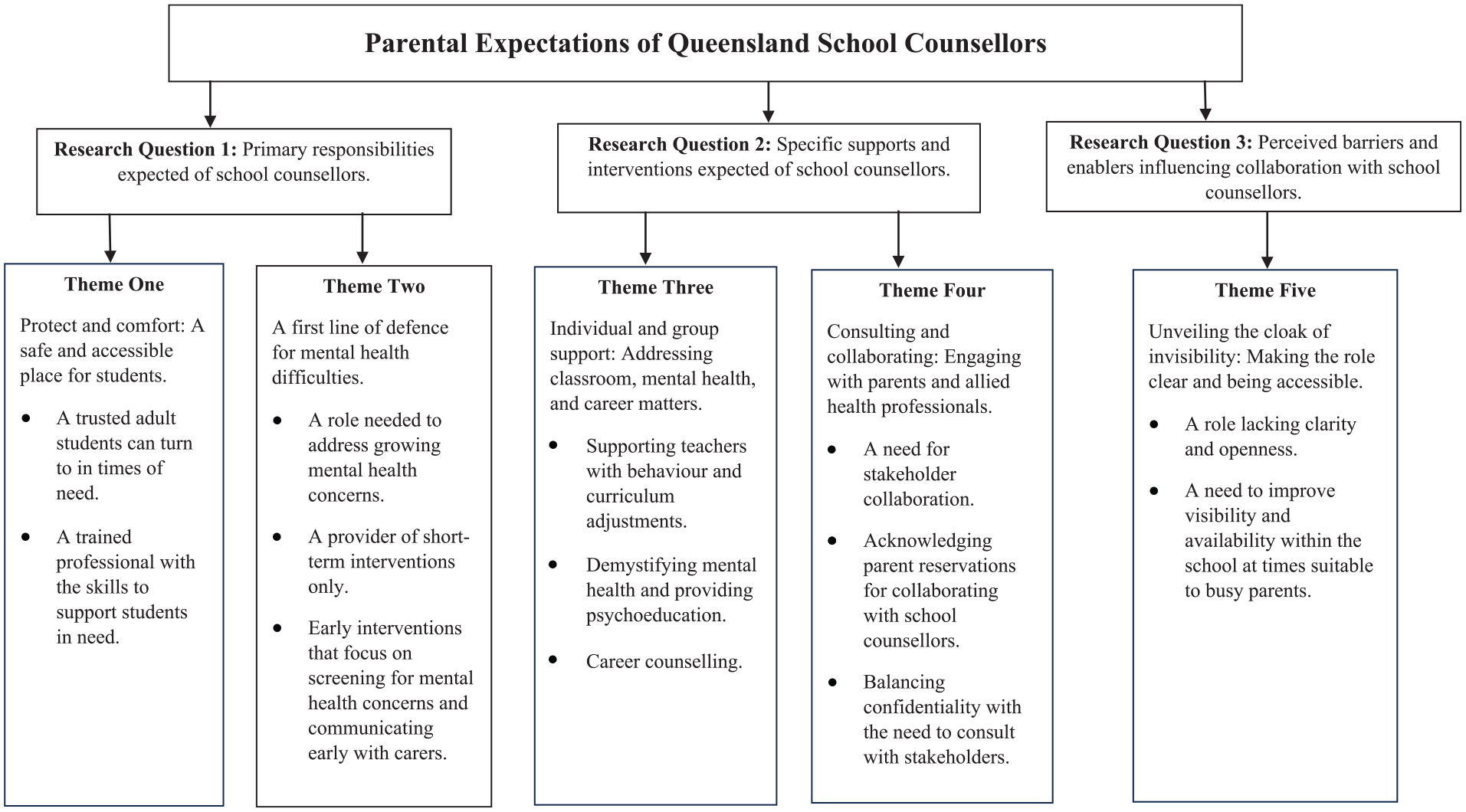
Concept map of research questions, key themes and supporting details.
Theme 1: Protect and comfort: A safe and accessible place for students
Overwhelmingly, parents pointed to the importance of school counsellors providing a safe space to which students can turn in times of need. Having someone students can talk to about matters of significance to them was seen as an important responsibility of the school counsellor, ‘So, I guess their main thing is just that support and having that space for them to be able to talk to somebody’ (Julie). Participants reflected on the importance of trust for students to feel safe to ‘get things off their chest’ (Sandie) and to feel that they ‘could talk about anything’ (Lucy).
Issues of a particularly sensitive nature were seen by some participants as requiring the expertise of the school counsellor. Indeed, the school counsellor in these situations was seen as an important individual students could turn to when the home environment is deemed unsuitable. One participant summed up this responsibility succinctly by declaring that big issues, such as sexual identity, can be spoken about openly with the school counsellor ‘that young people probably can’t safely talk about at home’ (Kate). Essentially, school counsellors were viewed as having the training and role delegation necessary to provide this level of support.
Theme 2: A first line of defence for mental health difficulties
All participants viewed the role of the school counsellor as being critical for the provision of short-term initial support for students with mental health and wellbeing concerns. Many participants acknowledged that mental health difficulties are on the rise – ‘I think that they’re very much needed for the mental health concerns because it just seems to be growing area’ (Candice) – and that school counsellors play an important role in responding to mental distress in students. In their role, the school counsellor was seen as ‘like triage, I suppose, first port of call and then . . .[they] can . . . advise where to go next’ (Jack). Early intervention tasks largely included mental health screening (e.g. for depression and anxiety) and communicating promptly with parents at the first signs of concern: ‘I don’t think that a guidance officer can diagnose depression or anxiety, but they can certainly use their expertise to . . . look at a child and say you’re demonstrating anxiety about going into the classroom . . . why not pursue this further? So, I think a basic wellbeing check’ (Kate).
In keeping with the idea of counsellors being a first-line response, all participants viewed their responsibilities as being short-term. Long-term therapies and specialised interventions were seen as the role of external agencies, and certainly not the domain of the school counsellor. Instead, the counsellor could provide information regarding referral pathways when more help was needed: ‘I think they also need to offer . . . like resources. So, like . . . where to go to from here. . . . So, I would have liked them to say well, like this has been identified here. This is where you go off to . . . get more specific help. Um, so I think they should offer things like that’ (Candice).
Theme 3: Individual and group support: Addressing classroom, mental health and career matters
Many participants identified classroom interventions that are preventative (e.g. psychoeducation) and responses to broader classroom level issues as being a key part of the role of the school counsellor. The counsellor was seen to be able to provide advice and assist teachers with behaviour management issues, ‘And any challenging classroom behaviour, . . .trying to touch base with them and seeing what they could help out with in the classroom or help the teachers’ (Sally). More widely, owing to their experience, the school counsellors could engage in proactive classroom ‘psychoeducation, around mental health and then the strategies to support that’ (Julie), including topics such as demystifying mental health and managing emotions. Teaching students about building positive psychological characteristics such as resilience and self-esteem was also highlighted, ‘I imagine like bullying, depression, sort of self-worth respect and all that sort of, you know, sort of falls in under that sort of banner I’m guessing’ (Lucy). Participants believed that the school counsellor could deliver this psychoeducation within a classroom setting, or they could organise and run support groups on specific topics that are requested by their students. When issues were identified with individual students that could impact their learning, school counsellors were also seen as being able to provide guidance on curriculum adjustments.
A final responsibility identified by participants as being essential to the role of school counsellors was career counselling. While not typically viewed as a mental health or wellbeing strategy, many participants acknowledged career counselling as being an important part of the school counsellor’s responsibilities: ‘And definitely, definitely career stuff. So always accessing the guidance officer as like that final career chat. You know you’ve had that conversation with your family, you’ve . . .talked to your parents, you’ve talked to, like your subject teachers, but you just want to have that one, that last conversation’ (Kate).
Theme 4: Consulting and collaborating: Engaging with parents and allied health professionals
As well as the practical support provided to students and teachers in managing mental health, consultation and collaboration were identified by parents as crucial functions of the school counsellor’s role. Working with parents and allied health professionals was seen as important to managing a student’s mental health and wellbeing within the school setting. This included making appropriate referrals to outside agencies when required: ‘So, who should they be referring to? Doctors, psychologists, drug and alcohol counsellors, family counsellors, whatever the support is . . . you know, like if it’s going to help to support them and give us as parents . . . either more understanding into the child, more support around that child and their mental health so that they can then grow into their best selves, then . . . that’s fantastic’ (Julie).
Consultation and collaboration involved open communication. This could be between the counsellor and parent, and provide a way for the parent to feel concerns were being addressed: ‘Parents have that stress and worry, even if it’s just that reply to say, like I met such and such today, you know, they don’t have to provide . . . anything like in particular, but maybe knowing that they’ve attended and that they’re following up with your child. It would be very important to me because I found that I was chasing them. And yeah, not everyone’s as proactive as some people’ (Candice).
Participants also thought that even when other health professionals were brought in to help, the school counsellor would still have a role given their day-to-day contact with the student: ‘If a child is seeing a mental health professional, then they should be able to come back to the . . . counsellor and work out a plan with them. So, I think an open line of communication between professionals is always a good idea because the school counsellors are the ones that are there during the day’ (Kathy).
Although participants acknowledged the importance of parents collaborating closely with the school counsellor, there could be barriers to engaging and a few recognised that they or others would be reluctant to do so. They believed that some parents would feel judged for missing something significant if their child was found to have a mental health issue: ‘Sometimes I think parents would shy away from . . .counsellors, cause . . . they might think they’re gonna be judged . . . if their child’s got big issues. They might . . . see it as their fault as a parent that they haven’t responded earlier, and so I do think that’s a big barrier’ (Jack).
Real or perceived judgement was associated with more reluctance to collaborate with the counsellor or seeking out their expertise: ‘I’ve never really felt comfortable approaching [the school counsellor]. When I approached that time, I was sort of made to feel like, well, are you providing a safe home? Like it was, as a parent, I felt a little bit, oh, gee, I’m being judged here’ (Sally).
A final concern expressed by participants in terms of collaborating and consulting with parents and allied health professionals related to the issue of confidentiality. This was particularly apparent with participants with older children who recognised the balancing act between the right to confidentiality between the student and the counsellor, but also the parent’s right to know about important issues facing the young person: ‘Once you get into the teenage years, kids are starting to set their boundaries and they want a bit more privacy, and so, you know, you have to measure the importance of the health and wellbeing versus autonomy. And . . . I think that’s hard too, because, you know, you’re inclined to want to know everything’ (Kate).
Theme 5: Unveiling the cloak of invisibility: Making the role clear and being accessible
When participants were asked about the perceived barriers to collaboration with school counsellors, a lack of transparency was identified as the most significant factor limiting parents’ understanding of the role and working with the counsellor. Participants felt that school counsellors were not visible, and some also suggested that they were hidden away from parents’ view: ‘It’s sort of like they’re behind closed doors almost and . . . yeah, I mean, I know if I delve, I could find the, you know, the pathway to reach them, but they are very much a protected species and . . . hidden within the school’ (Sally). ‘They’re not visible, sounds terrible, but they’re not visible to the parents and the outside community’ (Candice).
Participants identified a variety of strategies that could increase parental engagement with school counsellors. These suggestions mainly centred around increased advertising of the role through regular communication, newsletters and social media: ‘Being more visible, whether that’s through school social media or at school events or, you know, sending out posts on, you know, messages about what’s happening in the school and what they’re available for, just to keep in touch with. I couldn’t tell you the name of . . . my kids’ guidance officer at school’ (Kim). ‘I guess increasing awareness so people are aware that they can be contacted and, and letting them know what services you provide’ (Sandie) ‘Having information sessions, but not just face to face, cause we’ve gotta realise we’re in a new world now. Having resources online, like even a, you know, a page, a website page’ (Candice).
Other suggestions were about making school counsellors more accessible to parents during times convenient to working families.
‘I mean, it’s about addressing barriers for a start. So if you think of the barriers that might come up is . . . with working parents, so I guess, um (.) the times that they’re available, so I, I . . . if it’s kind of during school hours, quite often parents are working during those school hours, so maybe having availability outside of school hours, which may not be very desirable’ (Sandie) ‘It’s, you know it’s school hours and a lot of parents are working. So the hours that they work and that they’re available’ (Candice)
Discussion
The aim of the present study was to explore parental expectations of school counsellors, both in terms of the support offered to address student mental health and wellbeing difficulties, and strategies for enhancing parental collaboration. School counsellors were seen by participants as occupying a unique position within a school, that is, one of a nurturing, caring individual, whom students can turn to in times of need. From the participants’ perspective, the school counsellor is a professional who has the skill to intervene when a student is in crisis, needs a safe environment to share personal sensitive information (e.g. sexual identity), or simply wants someone to go to when needing to be heard and validated. These responsibilities reflect a protect and comfort role and align with similar findings from a study conducted by Knight et al. (2018) in which acceptance, understanding and safety were reported by young people as being highly desirable traits in a school counsellor.
A novel finding of the current study was that, although acknowledging the important role school counsellors play in supporting student mental health and wellbeing, participants were clear that these professionals should be seen as a first response agent rather than an ongoing therapy-based service. Primary responsibilities identified by participants included screening for mental health concerns and alerting parents at the earliest opportunity of any concerns so that specialised support can be provided to their child. Importantly, there was an explicit understanding amongst most participants that the role should focus primarily on early intervention supports (e.g. check-ins and referrals), and anything beyond this (in terms of additional services or clinical diagnoses), was deemed the domain of external agencies. Championing the role of school counsellors as early response providers has been emphasised and studied since the early 1990s (Ritchie & Partin, 1994). School counsellors are ideally placed to identify emerging mental health difficulties and to refer on to more specialised support when needed (Beames et al., 2022). Indeed, the Queensland Department of Education (n.d.) recognises this function within its role description for Guidance Officers. This does, however, raise the question of whether school counsellors could be more involved in promoting wellbeing in students, as well as implementing such proactive wellbeing approaches across the school community (Green & Lloyd, 2021).
In terms of specific interventions and supports parents expect of school counsellors in addressing mental health and wellbeing among students. these ranged from classroom interventions to organising and running groups for students around topics of significance to them (e.g. dealing with stress). Of most importance, however, was the need to provide practical support in terms of anxiety, depression and general mental health support for students in need. These findings are not dissimilar to those reported by Levy and Lemberger-Truelove (2021) in which they emphasised the unique dual role that school counsellors occupy within a school setting. By supporting both curriculum and mental health concerns within students, overall improvements in general wellbeing may be achieved for students and the school community as a whole (Allen et al., 2017). A final responsibility identified by participants as being important to the school counsellor’s role was career counselling. While this might appear an unusual intervention to include as a support mechanism for addressing student mental health and wellbeing, it is not without merit. Career uncertainty remains a high stress point amongst students, and career counselling, when implemented by a school counsellor with training in career development, has been shown to be effective in reducing a range of mental health concerns in students (Milot-Lapointe et al., 2020; Ulrich et al., 2021).
Several findings from the current study support a bioecological approach to supporting student mental health (Christenson, 2004), particularly in terms of strengthening the home-school mesosystem by improving interactions between parents and school counsellors. A particularly strong message to come from participants was the expectation that school counsellors would consult and collaborate with a range of stakeholders, including parents and allied health professionals. In line with the previous discussion on short-term interventions, participants recognised the need for school counsellors to refer students on to specialised agencies when a need is identified. Unsurprisingly, they expect to be part of this process. However, many participants feared that collaborative efforts could be stifled due to confidentiality issues and parents feeling judged in terms of their parenting skills or being seen as neglectful of their responsibilities by missing something that they should have picked up earlier. This finding provides an important contribution to the literature and is consistent with prior work conducted with families and school counsellors in Hong Kong (Harrison et al., 2023). It is recognised that walking the line between information sharing and protecting the privacy of the individual is a challenging task most school counsellors deal with on daily basis (Thielking et al., 2018). Novel findings from the current study indicate that parents expect some level of communication from the school counsellor regarding any interactions they have had with their child. The challenge for school counsellors is to manage this in a way that honours their ethical obligations.
Another important novel contribution of the current study was that overwhelmingly, all participants identified a lack of transparency regarding the school counsellor role as impacting their ability to collaborate with counsellors to improve the mental health and wellbeing of their child. This represents a potential failure in school counsellors’ capacity to work effectively within a student’s mesosystem to promote their mental health (Christenson, 2004; Savitz-Romer & Nicola, 2022). Many parents viewed the school counsellor as an unknown identity, hidden away from the school community. Efforts to advertise and promote their service through online and paper campaigns (such as school newsletters) were stressed, as well as making school counsellors available at times when working parents can access them. Each of these suggestions has significant implications for the school counsellor, particularly in terms of their time, existing workloads, and the fact that there are very few of them to share the load (Thielking et al., 2018). Indeed, studies show that increasing school counsellor workloads and extending their duties beyond the school day can lead to high rates of burnout amongst the profession (King et al., 2018). While acknowledging this concern, it is important to note that counsellor visibility and accessibility were key expectations voiced by participants in the current study, and aspects of the role currently lacking in many schools.
Implications
The results from the current study have important implications for schools. Indeed, the current study has shown that parents are not passive consumers of education. Rather, parents have firm beliefs about what they expect of schools in terms of supporting their children’s mental health and wellbeing. They also want to be more involved with school counsellors but are frustrated by some of the current practices that make this difficult. By listening to the views of parents, and empowering parents to collaborate with counsellors, school counsellors can gain valuable insight into ways of enhancing their processes so that productive partnerships are forged with caregivers, and mental health and wellbeing outcomes are enhanced for all students (Bignold & Anderson, 2023).
The current study highlights the theoretical implications for the bioecological model by illustrating how the lack of transparency regarding the school counsellor’s role can weaken the home-school mesosystem, ultimately impacting the support available for students. By focusing on improving interactions between parents and school counsellors, the findings suggest ways that this mesosystem can be strengthened for more effective collaboration and, consequently, better responding to student mental health difficulties. Gaining insight into parents’ views on the responsibilities of school counsellors also allows schools to check for any misconceptions and gaps in terms of parents’ understanding of the role. Misconceptions around work-related responsibilities can lead to conflict and mistrust, and ultimately, the breakdown of positive relationships between key stakeholders (Bettman & Digiacomo, 2022). By improving knowledge around the role of the school counsellor, schools are better placed to build effective partnerships with parents by establishing a shared understanding of key roles and responsibilities (Garbacz, 2019; Savitz-Romer & Nicola, 2022).
The current study also has implications for the potential role school counsellors might play in developing whole of school approaches (Hoare et al., 2017) and wellbeing-responsive communities (Raymond et al., 2023) in schools. Positive education, the application of positive psychology theory to the educational setting, examines ways to build wellbeing in school communities (Waters & Loton, 2019). Within positive education, there is an emerging call for school counsellors to be at the forefront of building wellbeing-responsive school communities through coaching (both proactive and reactive responses to mental health and wellbeing concerns), consultancy (providing expertise to the school community), and by acting as change agents to promote a school’s wellbeing strategy to the whole school community, including leadership, teachers and families (Green & Lloyd, 2021). The current study provides insight into the expectations of the key stakeholder of parents regarding the counsellor’s role (e.g. reactive response to issues, educational counselling), but also highlights areas where there is potential for the counsellor to advocate for and lead a school community’s approach to mental health and wellbeing, such as taking a proactive approach to wellbeing and connecting members of the school community.
Strengths and limitations
The current study has filled a gap in the current literature. Previously, limited research existed into parents’ understanding of the role of school counsellors in supporting the mental health and wellbeing of students. Through detailed interviews with 10 parents directly associated with the Queensland education system, the current study has revealed important insights into what parents expect of schools in terms of supporting their children’s wellbeing. It has also shed light on some of the barriers currently hindering parental collaboration with school counsellors and offered practical insights into ways of overcoming these obstacles to benefit student mental health and wellbeing.
The study is not without its limitations. Most participants interviewed (80%) were university educated females. Mental health literacy levels are highest amongst this population (Bignold & Anderson, 2023). Therefore, it is unclear if other parent groups would have responded in similar ways to this sample or provided more unique perspectives into the roles and responsibilities of school counsellors. Furthermore, half of the participants recruited to the study were from the teaching workforce. Given that teachers have close contact with school counsellors and are more likely to understand their role, this may have narrowed the range of perspectives reported in the study. In view of these limitations, future research into parental attitudes towards Queensland school counsellors may benefit from broadening participant characteristics. Specifically, recruiting parents from different gender, socio-economic and occupational groups may assist in providing a more diverse set of participant views. A final limitation worth noting is that the current study was restricted to Queensland school counsellors. School counsellors across Australian jurisdictions differ in terms of their qualifications and role descriptions (Edith Cowan University, 2022). Future studies would benefit from capturing participant views across Australia. Providing a national picture of parental attitudes towards school counsellors would give deeper insights into the role and shed light on those practices needing to be consistent within schools across Australia.
Conclusion
The current study underscores the importance of school counsellors in supporting students with mental health concerns, highlighting parental expectations and experiences. It reveals that while parents value the safe space counsellors provide for students, they do not expect them to handle long-term mental health interventions but do see a need for increased visibility and transparency in the counsellor’s role. By enhancing the accessibility and community presence of school counsellors, especially for working families, and addressing identified gaps such as the need for better advertising of their role, schools can foster stronger partnerships that promote improved mental health and wellbeing outcomes for students.
Supplemental Material
sj-docx-1-spc-10.1177_20556365241298071 – Supplemental material for Parental expectations of school counsellors and their role in supporting student mental health and wellbeing: A qualitative study
Supplemental material, sj-docx-1-spc-10.1177_20556365241298071 for Parental expectations of school counsellors and their role in supporting student mental health and wellbeing: A qualitative study by Glenn Collins, Katya Kovac, Gabrielle Rigney, Tessa Benveniste, Adam Gerace, Cassandra K. Dittman and Grace E Vincent in Journal of Psychologists and Counsellors in Schools
Footnotes
Declaration of conflicting interests
The author(s) declared no potential conflicts of interest with respect to the research, authorship, and/or publication of this article.
Funding
The author(s) received no financial support for the research, authorship, and/or publication of this article.

Supplemental material
Supplemental material for this article is available online.
References
Supplementary Material
Please find the following supplemental material available below.
For Open Access articles published under a Creative Commons License, all supplemental material carries the same license as the article it is associated with.
For non-Open Access articles published, all supplemental material carries a non-exclusive license, and permission requests for re-use of supplemental material or any part of supplemental material shall be sent directly to the copyright owner as specified in the copyright notice associated with the article.
