



Abstract
This longitudinal study examined the mediating role of teacher support in the relationship between academic burnout and self-esteem among adolescents in Korea. A total of 154 adolescents (13 years old) were followed up for 4 years at 1-year intervals. Path analysis indicated that the developmental trajectory of academic burnout (i.e. the intercept and slope) leads to a lower level of teacher support (T4) and self-esteem (T4) after controlling for the effect of gender and self-worth. Moreover, teacher support mediated the relationship between development of academic burnout and self-esteem. The rate of change of academic burnout, as well as its initial value, exerted an indirect negative effect on self-esteem through the mediator of teacher support. It has been generally accepted that low self-esteem is the cause of academic burnout. However, our findings indicate that academic burnout might be an influencing factor of self-esteem, implying that the causal relationship between self-esteem and academic burnout should be reconsidered.
Introduction
Self-esteem is the self-appraisal of one’s competence and worth (Gecas & Schwalbe, 1983), which is formed and developed throughout life (Orth et al., 2018). As adolescence is a time of immense changes, adolescents’ self-esteem can be significantly impacted by interpersonal relationships (Marshall et al., 2014) and stressful events (Besser & Zeigler-Hill, 2012). Struggling with self-esteem during adolescence can result in serious emotional and behavioral issues such as depression (Orth et al., 2008), or juvenile delinquency (Trzesniewski et al., 2006). Korean adolescents face tremendous academic stress, which can have a negative effect on their self-esteem (Phosaly et al., 2019). The fierce competition and zeal for education have long been recognized as a social problem in South Korea (Javis et al, 2020). Many parents want their children to enter socially renowned universities, and secondary schools also boast of how many students they have sent to universities with social reputations (Kim, 2022). Such an atmosphere, which would increase the burden of schoolwork, has affected the mental health of Korean adolescents. According to the 2021 OECD International Comparative Study, subjective well-being index of adolescents in South Korea was the lowest among the 22 countries (OECD, 2021).
Academic burnout
Excessive and prolonged academic stress leads to academic burnout, which is a state of emotional and physical exhaustion (Schaufeli & Greenglass, 2001). From elementary school and beyond, South Korean students often struggle with academic burnout, which often increases as they progress through secondary school (Lee et al., 2013). The transition from elementary school to secondary school brings a great academic change on students’ lives. For example, the amount of schoolwork increases, and the difficulty intensifies (Lee et al., 2013). These changes not only demand a new adaptation in school life for adolescents but can also lead to academic burnout.
Academic burnout consists of three constructs—emotional exhaustion, cynicism, and inefficacy—and emotional exhaustion is regarded as the central dimension as the first stage of academic burnout (Lee & Ashforth, 1993). Emotional exhaustion (EE) indicates “feelings of being overextended and depleted of one’s emotional and physical resources” (Maslach et al., 2001, p. 399). The present study focused on EE as the basic construct of academic burnout. In addition, based on previous studies that academic burnout of Korean adolescents develops over time (Lee et al., 2013), the current study investigated the developmental trajectory of academic burnout (i.e. EE).
Academic burnout and self-esteem
Besser and Zeigler-Hill (2012) conducted a three-wave longitudinal study showing that psychological distress is owing to the changes in life, such as transitioning from secondary school to college, lowered self-esteem. They found that during a semester, distress symptoms of freshman college students increased, and the psychological distress at Time-2 was associated with lower self-esteem at Time-3. Similarly, Wilburn and Smith (2005) discovered that self-esteem became extremely taxed when dealing with a life stressor over the years, which can result in impeding the ability to cope with the particular stressor. They found that college students who had experienced negative life events within the past 6 to 12 months, prior to participating in the study, had lower self-esteem than those who had similar stresses during the past 6 months. Besser and Zeigler-Hill’s (2012) and Wilburn and Smith’s (2005) studies suggested that burnout caused by long-term stress may lower self-esteem in the same way as acute stress. It is possible that transitioning from elementary school to secondary school may represent a similar kind of acute stressor as transitioning from secondary school to college, and therefore have the same negative impact on self-esteem; however, research in this context is limited.
Teacher support, academic burnout, and self-esteem
Harter (2003) suggests that social support plays an important role in the development and maintenance of self-esteem in adolescents. The source of social support for adolescents includes parents, peers, and teachers. Among them, support from teachers can be crucial for successful school life, as they are the significant figures relevant to classroom activities (Hui & Sun, 2010). Teachers serve as mentors and a secure base for adolescents who seek to gain independence from their parents. In a longitudinal study of adolescent self-esteem conducted by Shin and Choi (2016), teacher support was shown to improve the self-esteem of middle school students in South Korea. In other studies, perceived teacher support significantly predicted self-esteem (Hui & Sun, 2010) and school satisfaction (Jiang et al., 2013).
It is plausible that teacher support may mediate the relationship between academic burnout and self-esteem in adolescents. According to burnout studies, people with a high level of burnout often produce a self-defeating cycle, which ultimately produces depletion in social support (Innstrand et al., 2008). This phenomenon is addressed as the principle of loss spirals (Hobfoll, 2001), which means that individuals who perceive a loss of resources in one domain are more likely to experience subsequent resource losses in other domains. In one study, Rehman et al. (2020) verified that social support mediated the relationship between burnout and psychological well-being in a sample of Chinese university students. That is, burnout reduced the level of social support, which in turn decreased the level of psychological well-being (e.g. autonomy and self-acceptance). According to their findings, burnout may adversely affect internal resources by limiting support from others. In adolescents, for example, it is possible that a lack of resources (e.g. self-esteem) may cause burnout, and increased burnout may lead to a depletion of other resources such as teacher support.
The current study
The current study investigated the impact of academic burnout on self-esteem among Korean adolescents, specifically the longitudinal influence of academic burnout (operationalized as emotional exhaustion). Confounding variables, such as gender and self-worth of adolescents, that can influence self-esteem and academic burnout were controlled. Gender has been shown to be related to self-esteem of adolescents. In a longitudinal study of Block and Robins (1993), self-esteem increased in a sample of boys’ group during the adolescence, while self-esteem decreased in a sample of girls’ group. Similarly, Quatman and Watson (2001) found that boys had higher self-esteem than girls. Gender has also been shown to relate to academic burnout (Purvanova & Muros, 2010); studies reported that girls experienced higher level of burnout than boys (e.g. Weckwert & Flynn, 2006; Yang, 2004). Self-worth is another contextual factor that strongly related to both self-esteem and academic burnout. Self-worth, the internal belief that one is being good enough and worthy of love, is a positive self-evaluation of self-esteem (Owens, 1994). Elevated self-worth is associated with high self-esteem. Furthermore, self-worth can act as a buffer against psychological distress by alleviating or mediating environmental stress (Harter & Jackson, 1993). In this regard, the present study considered gender and self-worth as control variables.
To sum up, the cultural context in South Korea contributes to adolescent vulnerability to academic burnout. Burned-out adolescents may experience a lack of social and/or teacher support, which can cause them to lose their internal resources like self-esteem, in accordance with the theory of loss spirals (Hobfoll, 2001). To our knowledge, this is the first study to examine the effect of academic burnout on teacher support and self-esteem, after controlling for variability of gender and self-worth. We proposed the following hypotheses.
H1: Academic burnout will develop over time (Time-1–Time-4).
H2: The developmental trajectory of academic burnout (i.e. intercept and slope; Time-1–Time-4) will be negatively associated with teacher support (Time-4) and self-esteem (Time-4).
H3: The developmental trajectory of academic burnout (i.e. intercept and slope; Time-1–Time-4) will have an indirect negative effect on self-esteem (Time-4) via teacher support (Time-4).
Method
Participants and procedure
Participants were students from a middle school in Seoul, affiliated with the researcher’s institution and a private co-educational school with 12 classes per grade level. The population of the area around this school was ranked 8th out of 25 Seoul districts, and the gross regional domestic product per capita was ranked 19th out of 25 Seoul districts. To conduct a four-wave longitudinal study, researchers recruited seventh grade students and collected data from them for 4 years.
At Time-1, participants completed demographic information (e.g. age and gender) and self-reported self-worth and academic burnout (n = 367). At Time-2 (n = 375) and Time-3 (n = 389), only self-reported academic burnout was collected to identify the developmental trajectory. The higher numbers of participants in Time-2 and Time-3, than Time-1, was because of the students who got added to the participant pool later. At Time-4, participants were asked to answer the same demographic information (e.g. age and gender) which had completed at Time-1, as well as survey items about self-reported academic burnout, teacher support, and self-esteem (n = 154). The number of participants at Time-4 decreased by 42% compared to Time-1, because, between Time-3 and Time-4, participants graduated from the middle school where all of them were attending and entered different high schools. It was challenging to collaborate with all of the high schools because many of them were not affiliated with the researcher’s institution. Because the number of participants decreased a lot, demographic background (gender, SES, burnout, and grade-point average, or GPA) were investigated to ensure the homogeneity between participants at Time-4 and the original sample. The results indicated that there were no significant differences between the 154 adolescents (81 were female) and the original sample. In the final analysis, only the data from the adolescents who participated in all surveys from Time-1 to Time-4 were used.
Concerning ethical issue, the approval from IRB of one of universities in South Korea was obtained (1040548-KU-IRB-15-170-A-1). This study was carried out in accordance with Code of Ethics of the Korean Counseling Psychological Association. Informed consent was obtained from all participants included in the study. Furthermore, the participants were given the researchers’ email address and phone number to allow them to ask questions related to the research process.
Measures
Academic burnout
The Korean version of Maslach Burnout Inventory—Student Survey (Shin et al., 2011) was used to measure academic burnout. This scale consists of three dimensions, however only the Emotional Exhaustion subscale was used in the present study (five items, e.g. I feel emotionally drained by my schoolwork). Participants rated the statements on a five-point Likert scale (1 = strongly disagree; 5 = strongly agree). A high score indicated a high level of emotional exhaustion. Cronbach’s alpha of the Emotional Exhaustion subscale in the original version was 0.86 (Shin et al., 2011) and in the present study, as follows: Time-1 = 0.83, Time-2 = 0.87, Time-3 = 0.87, Time-4 = 0.88.
Teacher support
The Social Support Scale (Caplan et al., 1980) was used to measure the perceived teacher support. This scale is composed of three dimensions however only the Supervisor Support subscale was used in the current study, changing the term “supervisor” to “teacher.” The revised scale included six items: My teachers totally put me at ease; My teachers are comfortable to talk with; I can count on my teachers when things go wrong at school; My teachers are willing to listen my personal problems; My teachers respect me; My teachers recognize my accomplishment. Participants were asked to rate items on a five-point Likert scale (1 = strongly disagree; 5 = strongly agree). A high score on this scale indicated a high level of perceived teacher support. Cronbach’s alpha for the Supervisor (i.e. Teacher) Support subscale in the original study was .89 and in the current study was .92.
Self-esteem
Self-esteem was measured by the Korean version of Rosenberg Self-Esteem Scale (Jon, 1974; Rosenberg, 1965). It is composed of ten items (e.g. On the whole, I am satisfied with myself) and responses are captured on a 6-point Likert scale (1 = strongly disagree; 6 = strongly agree). High scores indicated a high level of self-esteem. Cronbach’s alpha in the original study was .77 and in the current study was .88.
Self-worth
Self-worth was measured using the General Self-Worth Competence Scale (Matsui & Murata, 1997) which was developed based on Harter’s (1982) Competence Scale. It consists of ten items (e.g. I feel that I’m a person of worth) and respondents use a 5-point Likert scale (1 = strongly disagree; 5 = strongly agree). High scores indicated a high level of self-worth competence. Cronbach’s alpha in the original study was .86 (Matsui & Murata) and .94 in the current study.
Data analysis
The descriptive statistics and inter-correlations of study variables were reviewed to check statistical assumptions. The missing data were handled using the expectation maximization method using SPSS 21. To examine H1 (i.e. academic burnout will develop over time), Latent Growth Modeling (Duncan et al., 1999) was employed using AMOS 21. The developmental trajectory of academic burnout was identified by examining the linearity of growth. Several fit indices were considered to find out the best model: the chi-square (χ2) test, the Tucker-Lewis Index (TLI), the Comparative Fit Index (CFI), and the Root Mean Squared Error of Approximation (RMSEA). TLI and CFI are recommended to reach .90 and above, while RMSEA is recommended to be less than .08 to be an acceptable fit between observed data and the hypothesized model (Hair et al., 2010). To examine H2 (i.e. the developmental trajectory of academic burnout will be negatively associated with teacher support and self-esteem) and H3 (i.e. the developmental trajectory of academic burnout will have an indirect negative effect on self-esteem via teacher support), the Structural Equation Modeling was applied. Gender and self-worth were included in the models as control variables. The unmediated and mediated models were compared by the chi-square (χ2) difference test. The mediating effect of teacher support was examined by a bootstrapping method. The number of bootstrap samples was 1,000 and bias-corrected confidence intervals were calculated using 95% confidence intervals.
Results
Descriptive statistics
The means, standard deviations, and correlations of study variables are shown in Table 1. The means of academic burnout was the lowest at Time-1 (M = 2.53, SD = 0.79) and increased dramatically at Time-2 (M = 2.80, SD = 0.85). It slightly decreased after participants entered high school (i.e. Time-4, M = 2.77, SD = 0.74). The mean of perceived teacher support was 3.17 (SD = 0.88) and self-esteem was 3.9 (SD = 0.87). Absolute values of skewness less than two and kurtosis less than seven indicate that the normal distribution was achieved (West et al., 1995). The skewness and kurtosis of our study variables were thus considered as satisfying the normal distribution assumption for statistical analysis. As for inter-correlation among variables, teacher support had a significant negative correlation with academic burnout in Time-3 (r = −.21, p < .01) and Time-4 (r = −0.32, p < .001). Self-esteem and academic burnout showed a negative correlation (r = −0.46 to −0.23) except in Time-3 (r = −.15, p > .05).
Descriptive statistics and correlations among study variables.
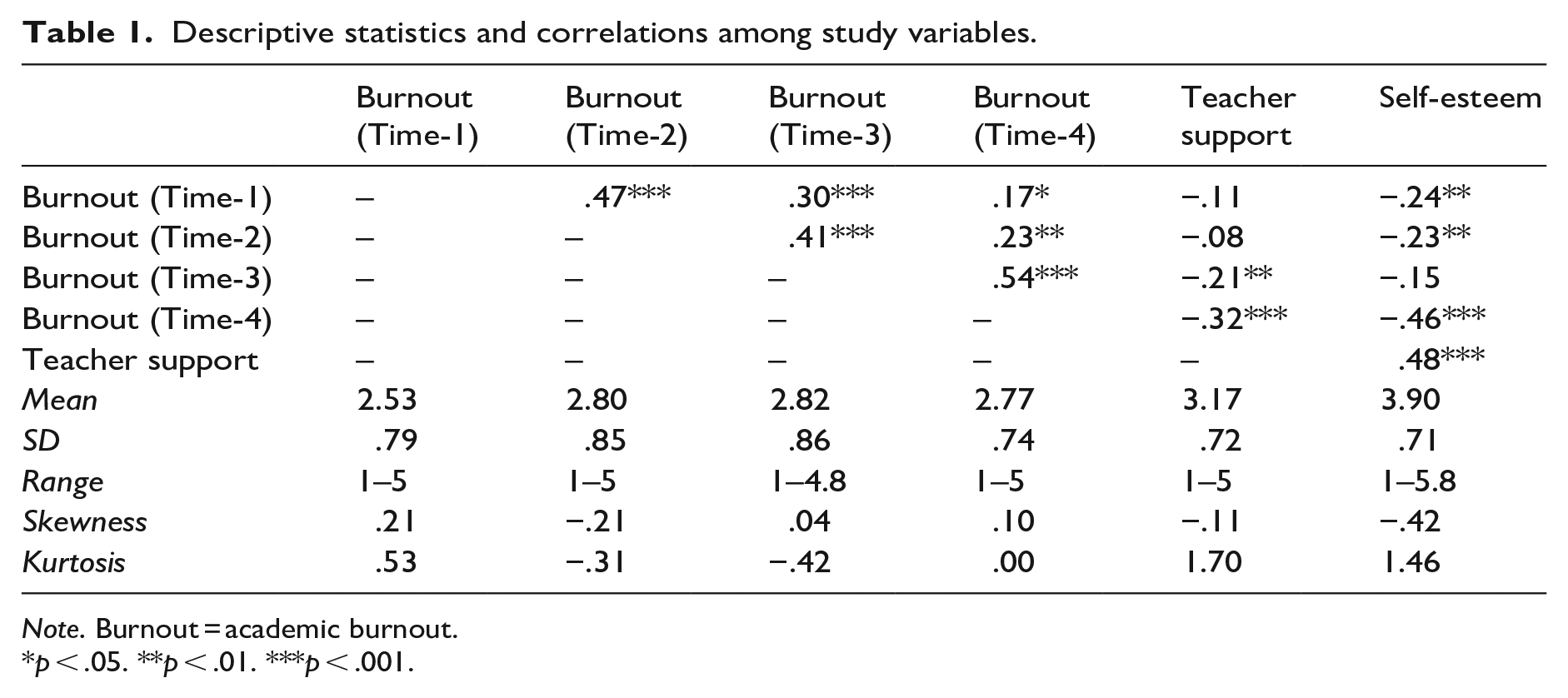
Note. Burnout = academic burnout.
p < .05. **p < .01. ***p < .001.
H1. Academic burnout will develop over time (Time-1–Time-4)
To identify the developmental trajectory of academic burnout, the linear and non-linear growth models were compared in terms of several fit indices. In the linear model, values of factor loadings for slope were set according to time (i.e. 0, 0.33, 0.67, and 1, respectively). In the non-linear model, only the first two values were fixed (i.e. 0 and 0.33). The estimated third slope was 0.27 (p < .001), and the fourth was 0.16 (p < .001). As shown in Table 2, every model fit indices in the non-linear model (TLI = 0.974; CFI = 0.987; RMSEA = 0.057) was within the required range for acceptable model fit, and better than in the linear model (TLI = 0.732; CFI = 0.642; RMSEA = 0.183). In support of H1, the results showed that the academic burnout increased over time (mean slope = 1.02, p < .001), but the growth rate tended to decrease as time passed.
Model comparisons.
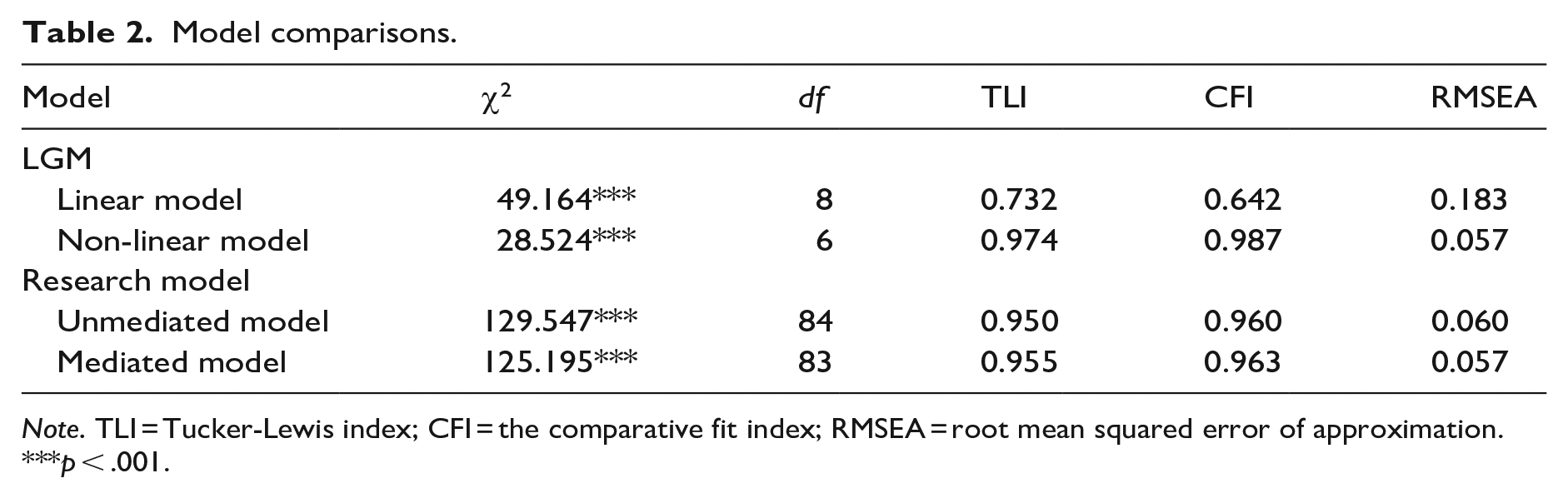
Note. TLI = Tucker-Lewis index; CFI = the comparative fit index; RMSEA = root mean squared error of approximation.
p < .001.
H2. The developmental trajectory of academic burnout (i.e. intercept and slope; Time-1–Time-4) will be negatively associated with teacher support (Time-4) and self-esteem (Time-4)
To identify the relationship among the development of academic burnout, teacher support, and self-esteem, the unmediated and mediated models were compared in terms of chi-square difference test. The unmediated model was specified as two kinds of paths, that is, (a) the developmental trajectory of academic burnout → teacher support, and (b) the developmental trajectory of academic burnout → self-esteem. On the other hand, the mediated model included the mediating role of teacher support (i.e. the development of academic burnout → teacher support → self-esteem). The result of the chi-square difference test showed that the mediated model provided a significantly better fit than the unmediated model (∆χ2 = 4.352, ∆df = 1, p < .05). All the fit-indices of the mediated model were acceptable as well (TLI = 0.955; CFI = 0.963; RMSEA = 0.057; Table 2). Based on these results, a final research model was identified (Figure 1).
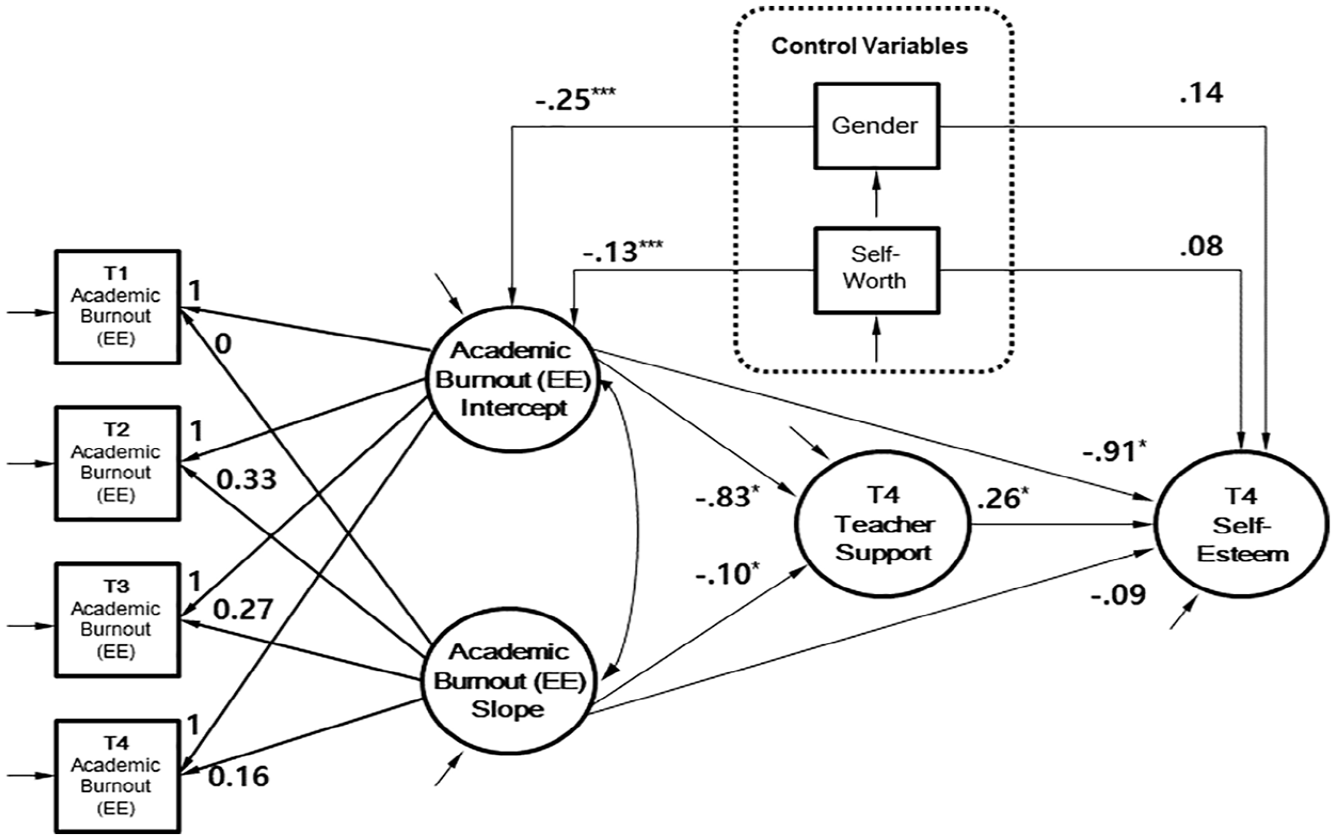
Final research model.
The results of the final research model are presented in Table 3. The path from the developmental trajectory (i.e. intercept and slope) of academic burnout to teacher support was all significant. The higher level of the intercept (b = −0.83, p < .05) and slope (b = −0.10, p < .05) of academic burnout were linked to a lower level of teacher support. As for self-esteem, the path from the intercept of academic burnout was significant (b = −0.91, p < .05), but the path from the slope of academic burnout was not significant (b = −0.09, p > .05). It indicates that H2 was partially confirmed.
The estimates of the final research model.
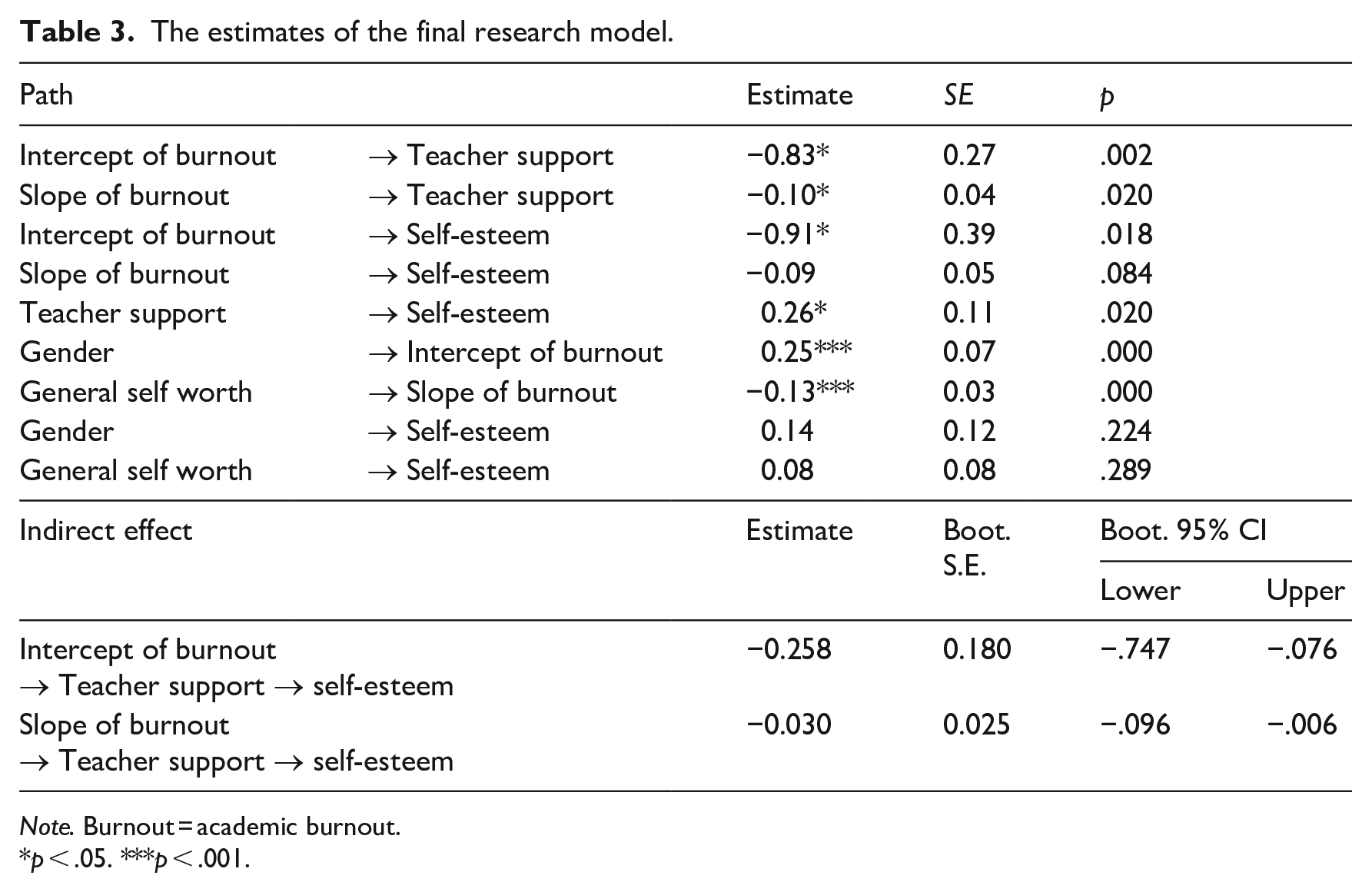
Note. Burnout = academic burnout.
p < .05. ***p < .001.
H3. The developmental trajectory of academic burnout (i.e. intercept and slope; Time-1–Time-4) will have an indirect negative effect on self-esteem (Time-4) via teacher support (Time-4)
The result of the bootstrap method supported the mediating effect of teacher support, which means that H3 was confirmed. As shown in Table 3, the mediating effect in the path from intercept of academic burnout to self-esteem via teacher support was statistically significant (−0.258, 95% CI [−0.747, −0.076]). It suggests that academic burnout at Time-1 would lead to a lower level of teacher support at T4, and in turn it would be linked to a lower level of self-esteem at Time-4. The mediating effect in the path from slope of academic burnout to self-esteem via teacher support was statistically significant as well (−0.030, 95% CI [−0.096, −0.006]). It indicates that the increase of academic burnout during adolescence would lead to a lower level of teacher support, and consequently it would undermine the level of self-esteem. That is, the more exhausted adolescents are, the less teacher support they perceive, and the less self-esteem they have.
Discussion
Research suggested that teacher support can positively impact adolescents’ self-esteem (Hui & Sun, 2010). However, in a situation where academic stress is prevalent, such as in Korea, students are frequently exposed to the risk of burnout. Burned-out students believe that they are not supported enough by teachers, which can result in lower self-esteem. In this context, the present study hypothesized that the developmental trajectory of academic burnout would be negatively associated with teacher support and self-esteem. In specific, teacher support was expected to mediate the relationship between the developmental trajectory of academic burnout and self-esteem. The participants showed low levels of academic burnout. Because academic burnout tends to rise nonlinearly over time, it did not correspond with previous research that showed high levels of academic burnout among Korean secondary school students (Lee et al., 2013). Participants in the present study reported moderate levels of self-esteem and teacher support and it was consistent with previous studies (Park & Suh, 2020; Yoo, 2017).
Burned-out adolescents perceive less teacher support
Findings of the current study indicated that as adolescents show higher levels of burnout, they perceive less support from teachers. It could be explained in two perspectives. First, there may not be enough support for burnt-out adolescents. Academic stress is prevalent in Korea, and many adolescents experience psychological distress, such as depression and suicidal ideation (OECD, 2021). Nevertheless, there has been a scarcity of mental health professionals in Korea who can emotionally support adolescents; for example, the ratio of one professional counselor and the number of students they should take care of is 1:1,500 (Choung & Yang, 2018). In chronic stress situations, people often believe that support would not be sufficient and helpful enough (Dunkel-Schetter & Bennett, 1990; Gable et al., 2012). Long-term efforts should be made to create a social and cultural environment that lessens the strain of academics for adolescents, and short- and mid-term efforts will be necessary to increase the number of professional counselors to serve students’ psychological and emotional needs.
Second, support providers (teachers) may have had incorrect assumptions about the recipients of support (burned-out students). According to the self-verification theory, people tend to interact with partners whose encouraging messages are consistent with their view of self (Swann, 2011). If teachers’ encouragement does not resonate with how the burned-out students view themselves, the encouragement can be perceived not as intended. For example, Swann (2011) found providers tended to encourage distressed individuals to be cheerful and optimistic; however, the recipients felt uncomfortable about such encouragement because their focus was more on their negative emotions. To support burned-out adolescents, it would be important to precisely understand the difficulties that burned-out adolescents have.
Teacher support mediates the relationship between academic burnout and self-esteem
The current study found that teacher support had a mediating effect on the developmental trajectory of academic burnout and self-esteem. That is, academic burnout is negatively associated with the level of teacher support, which in turn decreases the level of self-esteem. The finding indicates burnout can lead to lower self-esteem through perceiving less support from teachers. This result is in line with Rehman et al., (2020) who found a mediation effect of social support in the relationship between burnout and psychological well-being. It is not surprising that less teacher support leads to low self-esteem (Hui & Sun, 2010; Jiang et al., 2013); however, it is noteworthy that burnout also can lead to low self-esteem. It is partially consistent with the theory of loss spirals (Hobfoll, 2001) and supports the notion that individuals who perceive a loss of resources in one domain are more likely to experience subsequent resource losses in other domains. In this context, adolescents who perceive a lack of resources may experience academic burnout, and increased burnout can deplete other resources such as teacher support and self-esteem. The scar model (Shahar & Davidson, 2003) also provides a useful explanation for this pattern of data. The scar model suggests that sad feelings, if characteristic of daily moods, eventually wear away at one’s self-esteem. As the scar effect caused by depression weakens relevant social relationships (Orth et al., 2008) or alters one’s self-image, individuals become more sensitive to negative information as opposed to positive information about the self. The scar effect also means that burnout in adolescence could have lifelong effect throughout a person’s life and helps shed light on a confusing aspect of the causality between burnout and low self-esteem.
Implications for school psychologists and counselors
Several practical suggestions are drawn from the outcomes of the current study. To date, interventions for academic burnout have primarily focused on programs that reduce stress or improve stress coping skills (Williams et al., 2015). However, the present findings indicate that teachers play a crucial role in preventing the drop in self-esteem caused by academic burnout. It is therefore necessary to enhance the teacher-student relationship so that exhausted students can feel that they are fully supported by teachers. This can be facilitated by creating an emotionally safe classroom (Wentzel, 2010). An emotional safety environment is one in which students are free to express their emotions (Frazier et al., 2017). To provide emotional safety, teachers must be responsive to students’ needs. It is advised to conduct regular surveys to determine what needs students have and to solicit input. Additionally, it’s important to have one-on-one conversations with students to hear about their emotional struggles and to show empathy and support. When teachers recognize and positively affirm students, they can restore confidence and focus on their studies (Miller & Moran, 2012). It is likely that burned-out students will be able to improve their self-esteem if teachers genuinely care about and respect them.
Limitations and suggestions for future research
The present study leaves several questions unanswered. First, teacher support and self-esteem may be influenced by a myriad of developmental and contextual factors. More factors, such as socioeconomic status or characteristics of teacher (e.g. year of experience and teacher burnout), need to be considered for future study. Second, this study considered only emotional exhaustion among three burnout subscales. The other subscales (cynicism and inefficacy) need to be examined in terms of a final research model. Third, the current study recruited participants from only one middle school. The final research model should be replicated in various school contexts to confirm generalizability of the present findings.
Footnotes
Availability of data
The dataset analyzed for the current study is available from the corresponding author on reasonable request.
Consent to participate
Informed consent was obtained from all individual participants included in the study.
Declaration of conflicting interests
The author(s) declared no potential conflicts of interest with respect to the research, authorship, and/or publication of this article.
Funding
The author(s) received no financial support for the research, authorship, and/or publication of this article.
Ethics approval
The questionnaire and methodology for this study was approved by the Korea University Institutional Review Board (1040548-KU-IRB-15-170-A-1).