




Abstract
With the European Union having set ambitious environmental policy targets, company executives face mounting pressure to reach their sustainability goals. While expanding the contract-management process's utilization may hold promise for accelerating sustainable development throughout the contract lifecycle (from the pre-award through the post-award phase), the literature has afforded it little attention. Building on contingency theory and a qualitative multiple-case-study method, the paper examines how the contract-management process could proactively enhance the necessary shift to environmentally sustainable supply chains. Further, the authors explore whether contract management as a contingency variable could exert a positive influence on the sustainability practices followed in supply-chain relationships and, thereby, on sustainability performance. The preliminary findings indicate that, while expanded utilization of contract management remains modest, it already shows potential as a future success factor for companies on their journey of transformation in pursuit of sustainable supply-chain relationships. As a contingency factor, contract management might be able to make an impact by embedding sustainability in the contract process from the supplier-selection phase onward while also contributing to the final contract's solid inclusion of sustainability-related duties for the parties, whether in the main contract or via appendices. Accordingly, the authors suggest multiple, parallel avenues for future development.
Keywords
Introduction
Even though environmental sustainability in supply chains is of undisputed importance, progress toward effective, comprehensive response to environmental challenges such as climate change is lagging. While many companies genuinely strive to meet both their business targets and environmental-sustainability goals, they may find it challenging to translate their practices intended for sustainability (Govindan and Hasanagic 2018; Yu et al. 2022) into sustainability results (Dow, Samson and Ford 1999; Pislaru, Herghiligiu and Robu 2019; Powell 1995). With contracts being crucial managerial and strategic instruments in all trading relationships (Cummins 2015), in both purchase and sales contracts (Böhm et al. 2016), not least supply-chain relationships (Cachon 2003; Handfield, Primo and Oliveira 2015), their role as an important link unifying the supply chain (Conte 2015) merits greater attention in this regard. Could enhanced utilization of a commercial- and contract-management approach link economy and ecology, thus impelling sustainability practices toward yielding strong environmental-sustainability performance?
Contract management is a process of systematic and efficient management of contract creation, execution and analysis that is designed to maximize operational and financial performance and to mitigate risk (Aberdeen Group 2007). Extensive surveys attest that poor contract management costs companies, on average, the equivalent of 9.2% of their annual revenue (IACCM 2012; World Commerce & Contracting 2021). If contract-related practices fail to evolve apace with ever-changing business, value erosion, conflict and loss follow, much of the trading relationships’ value goes to waste (Cummins 2015). Recent reports show that executive attention to commercial and contract management is increasing, accordingly; business leaders understand that focusing on this brings advantage, whereas ignorance of the subject accumulates costs, with the differential between the leaders and laggards being high, even 80% (WorldCC 2021, 12).
Despite the magnitude of the impact on global business, academia has not devoted significant attention to contract management (Kähler 2013). A comprehensive theoretical approach has not yet developed, while business practice meanwhile has surged ahead (Schuhmann and Eichhorn 2015). Scholarly interest in contract management is growing, though, and the subject, alongside tangential elements, has received at least some mention at the academic-dissertation level, in which the focus is on the associated liability, mainly from a risk-management perspective (Keskitalo 2000), on contract design and the visualization point of view (Haapio 2013), on functional contracting (Hurmerinta-Haanpää 2021), on simplification and user-centred design approaches (Finnegan 2021), and on a holistic mode of operation for contract management (Hirvonen-Ere 2021). The sustainability implications of contract management may be an interesting area for novel work (Dubey, Chavas and Veeramani 2018; Gatari, Shale and Osoro 2022; Hirvonen-Ere 2019; Zhao, Pan and Song 2018). Specifically, we require greater understanding of whether and how utilizing a contract-management approach in an enhanced manner to increase sustainability could support companies’ journey of transformation into entities with environmentally sustainable supply chains and equip them to reach not only their monetary business targets but also the environmental-sustainability goals set.
Contingency theory is a form of organizational theory articulating the notion that no single best way to operate a business exists and that efficiency is better achieved via contingencies (or dependencies) reflecting the company's situation, with the relationship between practice and performance being affected by “contingency variables” (Donaldson 2001). The inherent acknowledgement of multiple possible ideal ways to operate resonates well with the variations in contract management among businesses. In contract management, there is no uniform code of operation (Kähler 2013) and attempts to develop a universal approach (Schuhmann and Eichhorn 2015, 2020); notwithstanding, this may not be possible or even a suitable goal (Hirvonen-Ere 2021). After all, immense variety flourishes under the global contract-management umbrella, which is fruit of the multiplicity of fields represented (in the private, public and third sector), geographical regions, company sizes involved, company roles (seller vs buyer), company-specific general approaches (to values, reaching the objectives set, best practice, processes and policies) and overall company maturity level (Hirvonen-Ere 2019).
Our study examines contract management as a contingency variable, affecting the linkage between sustainability-oriented practices and sustainable performance.
While a recently developing supply-chain management stratagem has stimulated interest in the impact of ‘green’ supply-chain management practices on environmental performance (Çankaya and Sezen 2019; García Alcaraz et al. 2022), there are obstacles to making this relationship successful. For instance, some business executives may suspect a high-cost, low-benefit scenario and not be willing to invest in strengthening it (Batrazovna et al. 2020).
Therefore, this article is focused on exploring whether reaching sustainability goals and influencing the environmental sustainability of supply chains can be accentuated via companies’ enhanced utilization of the contract-management process. With research in the context of Nordic-region manufacturing companies that have some level of established professional contract-management presence, we ask two key questions. The first is this:
To answer these questions, we frame our thinking in contingency theory (Donaldson 2001), with a three-part theoretical structure involving contract management as the contingency variable, environmental-sustainability practices as the practice in question and environmental performance as the performance of interest in the context of supply-chain relationships. That is, with contract management as the contingency variable, we explore how it could influence the relation between environmental-sustainability practices and the ultimate environmental-sustainability performance in supply-chain relationships. We employ a qualitative multiple-case-study approach, a method suitable for small samples and for exploratory work on little-understood research topics (Eisenhardt and Graebner 2007; Ketokivi and Choi 2014; Stewart 2012).
Our study, aimed at enriching knowledge of the contract-management process's expanded utilization as an accelerator of sustainable development over the entire contract lifecycle, contributes to theory and practice alike – by expanding horizons not only in the academic domain but also by giving businesses and the companies’ executives means to reach their business goals, including the sustainability targets, in the form of commercial and contract management as a driver and expediter leading the way on the path to environmentally sustainable supply chains.
The article is structured to explain the theoretical underpinnings of the research next, elaborating on the concept of contract management for the purposes of this report and introducing both contingency theory and examples of certain prior studies carried out from the sustainability point of view. Section 2 also discusses green supply-chain management practices and environmental-sustainability performance. Then, we introduce the method applied in the study, before presenting our analyses of the case-study results, followed by discussion of the results. The article concludes by identifying several proposed avenues for future research.
Theoretical underpinnings
Contingency theory
Contingency theory is a form of organizational theory that maintains that there is no single superior way to organize a corporation, run a business or make decisions (Donaldson 2001). Rather, the optimal course of action is dependent, or contingent, upon both organization-internal and organization-external circumstances/situations. In the scenario envisioned under contingency theory and in today's context of an ever-changing business world, executives are empowered to choose from among several options. The contingency-theory paradigm coheres around the notion that an organization's effectiveness arises from the fit of the characteristics manifested in that organization to contingencies concordant with circumstances in the given organization (Burns and Stalker 2006; Donaldson 2001; Lawrence and Lorsch 1967). Among the contingencies that have been deemed important are the environment, organization size and strategy (Donaldson 2001). Operations-management scholars have tended to conclude that contingency theory improves operational performance; practitioners benefit from guidelines to implement improvement programmes (Sousa and Voss 2008). For these and other reasons, underpinnings from contingency theory form an appropriate theoretical backdrop for this paper's discussion of contract management.
Per Donaldson (2001), a proponent of contingency theory, its three cornerstones are performance, practice and contingency variable, with the relationship between the first two being affected by the third member of the trinity, the contingency variable. In other words, the central theme of contingency theory is that the relationship between A (practice) and B (performance) features an inherent factor, or variable, that affects it and must be taken into account (Donaldson 2001). A stand-out example of contingency theory's application in the supply-chain management field has been presented by Kauppi et al. (2013), who examined the way in which the relation between e-purchasing tools and category performance is affected by particular contingency variables.
Accordingly, our study entailed examining contract management as a contingency variable in the connection between sustainability-oriented practices (A) and sustainability performance (B). Because, as Donaldson (2001) noted, good fit between organizational characteristics and contingencies results in high performance, fit is precisely what organizations seek.
The lens of the contingency variable provides a powerful window on our research phenomenon: we examine how contract management as a contingency variable influences the relationship between practice associated with sustainable supply-chain relationships and sustainability performance, as measured via sustainability key performance indicators (KPIs) in our study. Having introduced the contingency part of the picture, we next consider the (sustainability-related) practice and the (KPI-proxied sustainability) performance in connection with contract management, presenting background on the potential for the contingency variable to exert effects.
Green supply-chain management practices and environmental-sustainability performance
The most widely cited definition for “green supply chain management” (GSCM) found in the broad-based literature review by de Oliveira et al. (2018) was originally put forth by Srivastava (2007, 538): ‘Integrating environmental thinking into supply-chain management, including product design, material sourcing and selection, manufacturing processes, delivery of the final product to the consumers as well as the end-of-life management of the product after its useful life’. Hence, GSCM means integrating environmental concerns into the practice of supply-chain management (Sarkis 2012; Tseng et al. 2019).
Regarding environmental-sustainability factors, Lee and Klassen (2008) found that an organization's environmental-management capability (its ability to integrate handling of environmental issues into daily business routines by building an environmental management system, or EMS) gives employees, via the EMS, effective training and education, alongside clear assignment of responsibilities to particular departments.
As for adoption of low-carbon operations practices (Böttcher and Müller 2015; Furlan Matos Alves et al. 2017), one example is design of processes for minimization of waste (Zhu, Sarkis and Lai 2012). With particular regard to supplier selection, aligning objectives and targets to reduce CO2 emissions is a further example in supply-chain context (Furlan Matos Alves et al. 2017).
Perhaps an outcome the same as that from the aforementioned EMS could coalesce via contract management through embedding of environmental sustainability at the core of the contract-management process (Hirvonen-Ere 2019). Other examples of sustainability-oriented practices are policies and targets for reduced CO2 emissions and initiatives for controlling and monitoring carbon emissions (Furlan Matos Alves et al. 2017). Zhu et al.'s work (2012) on commitment to green supply-chain management among senior managers, cross-function cooperation for environment-related improvements and collaboration among internal units identified key elements for the practice-related questions we posed to the interviewees in our study.
Further, in the field of GSCM, Maletič, Maletič and Gomišček (2018) found evidence of a contingency relation between sustainability-related practices and organization performance, as opposed to the ‘universal’ view of sustainability practices. It supports their earlier grouping of sustainability practices into sustainability exploitation (efficient implementation of existing practices) and sustainability exploration (innovating and creating new concepts/capabilities) (Maletič et al. 2014). This resonates well with contract management, which one can regard as creating new concepts and capabilities.
An emerging novel stratagem in supply-chain management inspired our interest in the impact of green supply-chain management practices on environmental performance (García Alcaraz et al. 2022; Seman et al. 2019; Silva, Gomes and Sarkis 2019). Because making this relationship successful involves challenges, such as possible unwillingness to gamble on investing in it (Batrazovna et al. 2020), it is worthy of deeper study.
Environmental-sustainability practices are important means of supporting sustainable development; however, identifying KPIs for sustainability can improve companies’ competitive stance. Development of indicators for sustainability helps managers evaluate the sustainability of supply chains and adoption of sustainable supply-chain practices (Bai and Sarkis 2014). Moreover, KPIs assist in measuring the influence on supply chains’ performance (Cabral, Grilo and Cruz-Machado 2012).
Contract management as a contingency variable
This article examines whether contract management could be viewed as a contingency variable, one that could have a beneficial influence on sustainability practices in supply-chain relationships and, through this, on sustainability performance.
Contracts are crucial to all trading relationships (Cummins 2015), so it may be unsurprising that the contract-management approach stems from the same source as several other approaches and expresses similar views, having roots in, inter alia, the preventive-law approach, the proactive-law approach and relational contracting theory. These accord importance to such facets of the relationship as understanding the balance of the relationship between the parties to long-term contracts (Nystén-Haarala 1998), basing contracts on the proactive-law approach and understanding them as business instruments first and foremost (Haapio 2013), regarding contracts as part of trading relationships – as managerial instruments (Cummins 2015; Haapio 2013; Keskitalo 2000) and strategic tools rather than weapons to threaten (Cummins 2015) – and functional contracting wherein functions other than the safeguarding one (such as relationships) become important (Hurmerinta-Haanpää 2021; Hurmerinta and Viding 2018; Nuottila, Kauppila and Nystén-Haarala 2016).
Considering relationship management especially from the supply-chain perspective, Handfield, Primo and Oliveira (2015) stressed its importance as a success factor in large oil and gas projects particularly. Supplementing this view, Nousiainen (2021) took a law/economics and legal design track favouring friendly and mutually beneficial relations over an opportunistic focus. Hirvonen-Ere (2021), in turn, has defined contract management as, at its core, aiming to improve the quality, efficiency and risk/reward balance of a company's business contracts and decrease the amount of lost money, time, other resources and quality, with a better relationship between the parties emerging accordingly and manifesting itself in reduction of disputes, among other things. In particular, contract-related conflicts should decline (Lumineau, Eckerd and Handley 2015). Contract management offers the parties, inter alia, a flexible contracting framework. This is achieved via utilization of so-called war stories and lessons learnt, coupled with their further development to inform the best practice, processes and policies, and by means of tools, such as software systems (Hirvonen-Ere 2021). Without a systematic contract-management approach to follow, an organization may have merely a process document, not a process (Cummins 2016). In addition to central targets for contract management, there has been preliminary attention to contract management's sustainability implications and how the company itself can manage its supply chain sustainably via contract management (Hirvonen-Ere 2019). Such efforts have laid some groundwork for our study.
Methodology
A multiple-case-study method is highly suitable for work with small samples, little-understood research topics and studies of an exploratory nature (Eisenhardt and Graebner 2007; Ketokivi and Choi 2014; Stewart 2012). Our project to increase understanding of how expanded contract management might serve to impel sustainable development throughout the contract lifecycle was precisely such an endeavour. In-depth case studies allow exploring the ‘how’ question (Yin 2017) and engaging in theory development (Voss, Tsikriktsis and Frohlich 2002). With contract management as the contingency factor, we selected companies at the forefront of contract management in the Nordic countries, which we hoped could provide a window on the phenomenon of interest, for fruitful learning (Eisenhardt 1989; Yin 2017). Within each unit of analysis (the company), the key contexts studied were (1) the contract-management process, (2) the environmental-sustainability practices applied in the case company's supply chains and (3) environmental-sustainability performance as proxied by KPIs.
For our purposeful sampling (Patton 1990), we approached the association World Commerce & Contracting (WorldCC), the leading global organization for commercial and contract management, to obtain access to member companies with knowledge of contract management that operate in the manufacturing field. The association obliged by forwarding our invitation to potential key respondents handling contract management in the Nordic countries. This led to three responses. Contact with an additional company was established via the 2022 WorldCC congress.
For interviews, a semi-structured protocol with open-ended questions was designed. The interviewees received a list of the main question categories (see Appendix) before the interviews, which took place between March and September 2022. The data was collected from, in all, seven respondents at the four companies in the Nordic countries (see Table 1; note that the numeric portion of the code in the first column denotes the company, and the alphabetic portion denotes individual interviewees within the company). Interviewees represent several supply-chain functions at the companies (the selling side, the buying side and sustainability operations), and the set of respondents covered contract-management leaders and professionals involved in supply-chain operations. We used snowballing sampling within the companies by asking about possible further potential key respondents. All interviews were carried out via Zoom and lasted between 45 and 107 min, for 9.6 h in total. Except in one case, the interview was recorded, transcribed verbatim in line with an established transcription protocol and, if necessary, submitted to the respondent for clarification. For the one who did not permit recording, the interviewer took notes, which were later sent to the respondent for feedback and clarification.
An overview of the case companies and respondents.
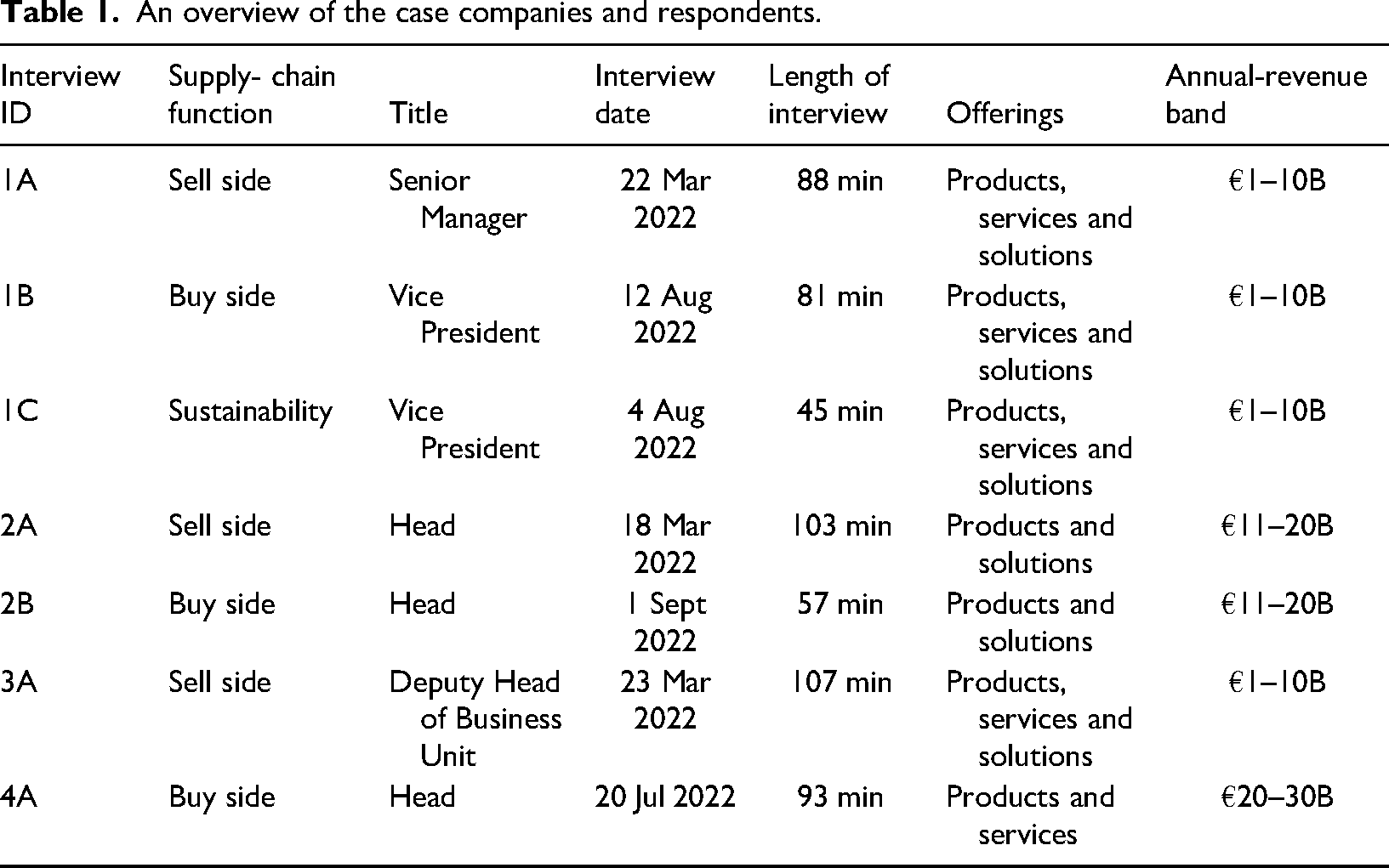
The data were coded in line with the key contexts mentioned above, and subcategories for key concepts were created via an iterative process. Standard data-collection protocols were employed throughout, to guarantee reliability (Beverland and Lindgreen 2010). We strengthened the study via secondary data sources, which included information from the case companies’ websites and additional material obtained from the companies. Both within- and cross-case analysis (Eisenhardt 1989) were applied in the analysis.
Thus, we studied contract management as a contingency variable in the theoretical context of contingency theory. Sampling from among WorldCC Nordic corporate members assured of a certain contract management establishment at each company. With this setting, we studied an environment that was homogenous within the European Union and the Nordic regulatory framework, manifested similarity of operation context within the Nordic region's stable societal and business conditions and represented a consistent field of industry. By limiting the variation in external contingency factors, this afforded better evaluation of the impact of contract management as a contingency variable on the relationship between the (environmental-sustainability) practice and (environmental-sustainability) performance.
Analysis and findings
Contract management
We found that not all of the case companies appeared to have a dedicated contract-management function. In addition, they seemed to lack a department specific to contract management. That said, one respondent held explicit responsibility for contract management for larger contracts on the selling side. Our findings indicate also that some companies (numbers 2 and 3) were handling their buy- and sell-side contract operations independently, for compliance reasons. The companies’ contract management was organized in various ways, as the following comments attest: “I will say contract management is […] a process that follows and flows with the sales process […]. We do everything together.” (2A)
“We have a matrix organization, where we have business lines and units who are responsible for the content, for what we sell, and have a position as product-owners. Then we have regional organizations that are responsible for sales and execution tasks. With collaboration between these, we [handle the various] process phases.” (1A)
“Functions have persons in charge […] or at headquarters there are people who follow up on overall-level coherency of processes both in management of the contract process and in sourcing […] and then on local level persons who are responsible for management of contracts, but we also have so-called supplier managers, who are [managers of] key accounts toward suppliers, who take care that this whole customer- or supplier-management process follows the company's guidelines. The supplier manager has operational responsibility in all contract phases.” (1C)
“What we have done now, what we have just implemented [is that] we have implemented a specific contract-management role, which is a dedicated resource that is working on the largest contracts that we have and execution of those, if you like […]. In recent years, we've won some significant contracts, which are… They demand a level of contract management that needs dedicated resources; you cannot have enough time [is] what we found […]. And, as part of that growth process, we’ve seen that the time requirements for managing…” (3A)
“We are totally separating sourcing and contract management, but you can also see that contract management from our perspective; they are two sides of the same coin, so they are doing a very similar job, but our sourcing-contract managers are working with our suppliers in the same way we are working with our customers, which means that they need to be sure that they are delivering in the same way and there is no issue in the supply flow from our suppliers.” (2A)
“[W]e’re normally talking about the sourcing process, and then that consists of different steps. […] [Y]ou could say it's contract management […]. And we’re also, of course, then following up, having regular governance meetings with the most important suppliers.” (2B)
Contract-management processes were arranged in a decentralized manner at all the companies at the time of our study, on both the buying and selling sides. Interestingly, two of the companies (2 and 4) had just moved over to this approach from a centralized one, bringing in disparate smaller organizations with separate, parallel leaders and their own sets of processes. Reporting lines seem to have been integrated only at a high level overall, that of the board. The other two companies (1 and 3) seemed to be striving for centralized processes. The on-going large-scale restructuring within some participating companies had led in some cases to a situation wherein roles and responsibilities in the company-internal departments, their areas of responsibility, titles and positions were subject to change – sometimes even constantly – such that shifts were visible also in the definitions and terms dictating what each department, role title and position might cover. Simultaneously, the move toward decentralization seems to have caused greater instability and lack of clarity as to who is responsible for what or how things are to be carried out. It seems, therefore, most companies currently lack an integrated, harmonized contract-management process that could improve process efficiency. The respondents’ remarks lend support to this conclusion: “A kind of harmonized common process that takes into account contract management – [with its] special requirements – we don’t have yet. We are currently working on a canvas for this kind of process, and maybe there will be changes to it in the future.” (1A)
“On the top level in [the company], there is a very strict, I would say, process for sourcing, with a lot of mandatory steps.” (2B)
“I think we have a lot of good- a lot of best practice in what we do, but it's not… It's lacking; it's not formalized in a formal process. But I think that, for us, one of the key things in successful contract management is involvement […], involvement of many functions, in the contract-management process.” (3A)
“Then that's the downside that I see: that we are not super-efficient when it comes to then pushing the whole picture together and getting efficiency. I guess there are pros and cons of that category specialization […], and the downside that I see is that we are getting a bit too siloed and a bit too focused on our own things.” (2B)
As for the future of contract management, some respondents stated that development of a dedicated contract-management function could improve efficiency. In this scenario, benefits would arise also through better coordination and collaboration among the parties involved, with increased communication and information flow between the various departments and stakeholders being prerequisites for this: “[Company name] would benefit if a [contract-management] function were in place. We do not have it; now those tasks that we have around it are fragmented to other functions and to these process phases. It could work as an integrating function securing that these tasks proceed as defined in the process and some people would have designated responsibility directly for this […] it could bring efficiency in operations and [something] more like a harmonized way.” (1A)
“I think what we need here is to come to an understanding of how to cooperate between the teams better, to have […] a bit more responsibility by the persons then, understanding that they’re not only working with their respective categories [but] there is also a responsibility for the full deal and for the full outcome here. And perhaps… Yeah, we are here to bridge that gap, surely, but that's part of the challenges that we have [with being] quite category-focused. It's something that we’re working with, but, still, we have some way to go there.” (2B)
While not all of the companies studied seemed to have a contract-management-specific function in place and much space remained for future work toward an integrated, harmonized process along their transformation journey, two participants assigned the entity's maturity level the maximum score of 5 (two gave it a score of 4 and one a 2). One participant gave it a score of 4 specifically from the perspective of assurance of similar ways of working, meeting of minimum requirements and guaranteed compliance, and the other same for their global operations. One gave the company's commercial management a 2. The responses clearly differed.
Environmental-sustainability practices and performance
Most participating companies had devoted considerable effort to sustainability within the company, had maintained high sustainability standards, had articulated a sustainability vision and associated strategies/goals, prepared reports on sustainability and had set up company-level environmental-sustainability KPIs whose fulfilment was monitored. Our findings indicate that each participating company's contract-management process applied several distinct sustainability practices. For instance, interviewees stated that their request for quotation covers several environmental-sustainability issues, and a potential supplier must fulfil the criteria set by the company before becoming added to the approved supplier list. One company indicated that when two entities quote the same price, the one with lower CO2 emissions might be preferred to act as the supplier. In the contract process, companies might expect a supplier to agree to, for example, the buyer's sustainability policy, code of conduct and use of audits: “Our sustainable-supply-chain policy states things that we expect from our suppliers […]; then from our global supplier master data we see with whom we have contracts and who has approved/accepted our sustainable supply-chain policy.” (1B)
“So today the environmental-sustainability aspects are requirements, part of the code of conduct, and that is mandatory for all supplier contracts and part of all of the supplier contracts, irrespective of category. It's a generic appendix for sourcing.” (2B)
“[Company name] is responsible [for making sure our] suppliers fulfil the same requirements as our own employees […] when we make a contract with a supplier, we expect that they attend and pass the same courses, and they also fill in a document […] for sustainability or proof of sustainability so that they comply with a set of specific criteria […], which is mandatory.” (1B)
“[I]t's initially being set as a target to identify a number of suppliers who have set themselves clear environmental targets in their companies and included that in their annual reports. So we haven’t yet set any formal standards that all the suppliers need to meet […]. So we are welcoming and pushing suppliers, then, to have targets themselves in this area, and then we are following up on how they are doing on their own targets, but [company name] is not pushing certain environmental levels yet for our suppliers.” (2B)
“We can include an element in the contract if there is a co-development theme involved.” (1A)
The case companies put a vast amount of effort into practices intended for environmental sustainability, both company-internally and company-externally with their supply chains. Regarding internal practices, most respondents cited sustainable development as integral to the work with all employees. One interviewee highlighted that the company's sustainability efforts have been acknowledged on several occasions, and others mentioned a specific industry-driven initiative. Code-of-conduct training seems to be one typical way of engaging employees with the company's sustainability-related values and practices, and some case companies involved suppliers too in the code-of-conduct training. There are several other external practices that the companies were using to boost sustainability further in their supply-chain relationships. These encompass training of various types, face-to-face meetings, meeting in aims of sharing best practice, encouraging suppliers to engage in co-development and show innovation in sustainability and others. One participant mentioned having developed a CO2 calculator that suppliers can use. The following extracts exemplify the references to practices: “Sustainability audits. In them we try to help our suppliers. And now, when we have started to integrate our suppliers into our climate program, we help them to find which way could be the right and reasonable way of reducing CO2 emissions.” (1B)
“We try to involve our suppliers to innovate on improvements, rather win–win-type so that they and we save on costs, and both reduce emissions and so on.” (1B)
“We have identified so-called high-CO2-intensive suppliers […] we have recognized those who might need help, and who would be good ones to collaborate with, with whom we could share information and tools for CO2 reduction.” (1C)
“We have a couple of ‘e-learnings’ for our suppliers. One of them is [about] sustainability at [company name], where we share what we think about sustainable development. Then we have also training regarding practical guidelines, where we talk about sustainable development in a more concrete way. And now we are launching […] climate e-learning for our suppliers. In addition, suppliers are trained – especially new ones – face-to-face in the beginning.” (1B)
“As a global firm, we can share best practices with our suppliers.” (1B)
“We expect the supplier to forward our policy practices further to their suppliers.” (1B)
Even though various organizations examined had set up company-level environmental-sustainability KPIs whose fulfilment was monitored, environmental-sustainability KPIs had not yet been established for supply-chain contracts, whether on the sell side or on the buy side. One interviewee (1A) stated that the company used the number of supplier audits as a KPI, alongside whether improvements are expected, response time and the extent to which improvements had been made. Some companies had acknowledged that room exists for environmental KPIs under the contracts – KPIs will be there in the future: “Not yet. This is being developed. But nothing in place yet.” (4A)
“We do not have any KPIs, but I can say that when it comes to the sustainability, our company has extremely high standards.” (2A)
“[W]e need to start developing some additional KPIs, actually […]; I think […], over time, we are going to see these requirements coming into contracts.” (3A)
“[T]o be able to design a contract model that boosts further sustainability requires a setup where [handling of the] agreed issues can be, on a continuous basis, measured.” (1B)
“Regarding contracts: a contract [that] includes the sustainability theme is in the development phase; […], however, we have recognized that this has become more and more important, such that a specific contract model could be developed for this.” (1A)
In conclusion, even though environmental-sustainability KPIs were not yet set forth in the companies’ contracts, the contracts addressed several environmental-sustainability practices having a positive impact on sustainability performance, and the contract-management process was employed to support (especially the buy side) sustainability. Although the importance of sustainability is acknowledged and is a priority for some companies, more time will pass before sustainability KPIs’ breakthrough in contracts at the contract-clause level and in the pre- and post-award phases of the contract-management process. Even though the case companies had established environmental-sustainability KPIs internally, further work is needed such that these percolate into the contracts. As our data demonstrate, companies in the context considered already utilize various sustainability practices in their supply chains. These constitute a starting point, with potential to pave the way toward measurement and, thereby, accountability in relation to sustainability issues.
Results and conclusions
Our contingency-theory-grounded multiple-case-study research shed light on how the contract-management process could proactively enhance the necessary shift to environmentally sustainable supply chains, with special regard to whether contract management as a contingency variable could exert a positive influence on the sustainability practices followed in supply-chain relationships and hence on ultimate sustainability. Our preliminary conclusion from the four companies’ and seven respondents’ data is that, while expanded utilization of contract management is modest at present, it shows potential as a future success factor for companies on their journey toward sustainable supply-chain relationships. The level of utilization we observed might be related to selecting a set of companies from the Nordic region, which has not yet reached full scale in its deployment of a commercial- and contract-management-oriented mode of operation (on account of the smaller magnitude of the business and of the investment pool available for the expensive labours of full-time-equivalent dedicated contract managers and the like; however the acknowledgement of the need for development, which remains a work in progress, may be great). Nonetheless, Nordic companies are well known for their sustainable development, exhibiting developments that may be indicative of larger trends on the way.
We found that this contingency factor holds potential: contract management is able to make an impact by embedding sustainability in the contract process from its supplier-selection phase onwards while also contributing to the final contract's explicit inclusion of sustainability-related duties for the parties. The data show that several aspects of environmental sustainability are covered in both the request-for-quotations phase and further along – for example, in agreeing to operate in line with the buyer's sustainability policy, follow its code of conduct, and perhaps even submit to sustainability audits. Companies employ varied internally and externally facing practices for environment-related sustainable development, though the most substantial effort remains directed to the internal ones – connected, for instance, to sustainability visions and strategies, goals, written policies, codes of conduct, reporting on sustainability, management and employee commitment and work with associated company-level KPIs and corresponding monitoring. This is consistent with prior findings – for example, of Zhu, Sarkis and Lai (2012) on commitment and Furlan Matos Alves et al. (2017) on written policies/targets and reporting. But it is only part of the story. While most respondents cited sustainable development as a vital part of their work with all employees, many also brought up several external practices followed with supply-chain partners, e.g., code-of-conduct training is used to integrate suppliers’ activities with the buyer's sustainability values and practices, training of various kinds is provided, the companies share the best practice and other information and they encourage suppliers’ sustainability innovation. These findings are consistent with the two aforementioned reports and others (e.g., Lee and Klassen 2008). We have categorized findings regarding sustainability practices to internal (within the company) and external (with suppliers and/or customers) sustainability practices (see e.g., Zhu, Sarkis and Lai 2012) with subcategories (see Table 2).
An overview of the categories on sustainability practices adopted by the surveyed case companies.
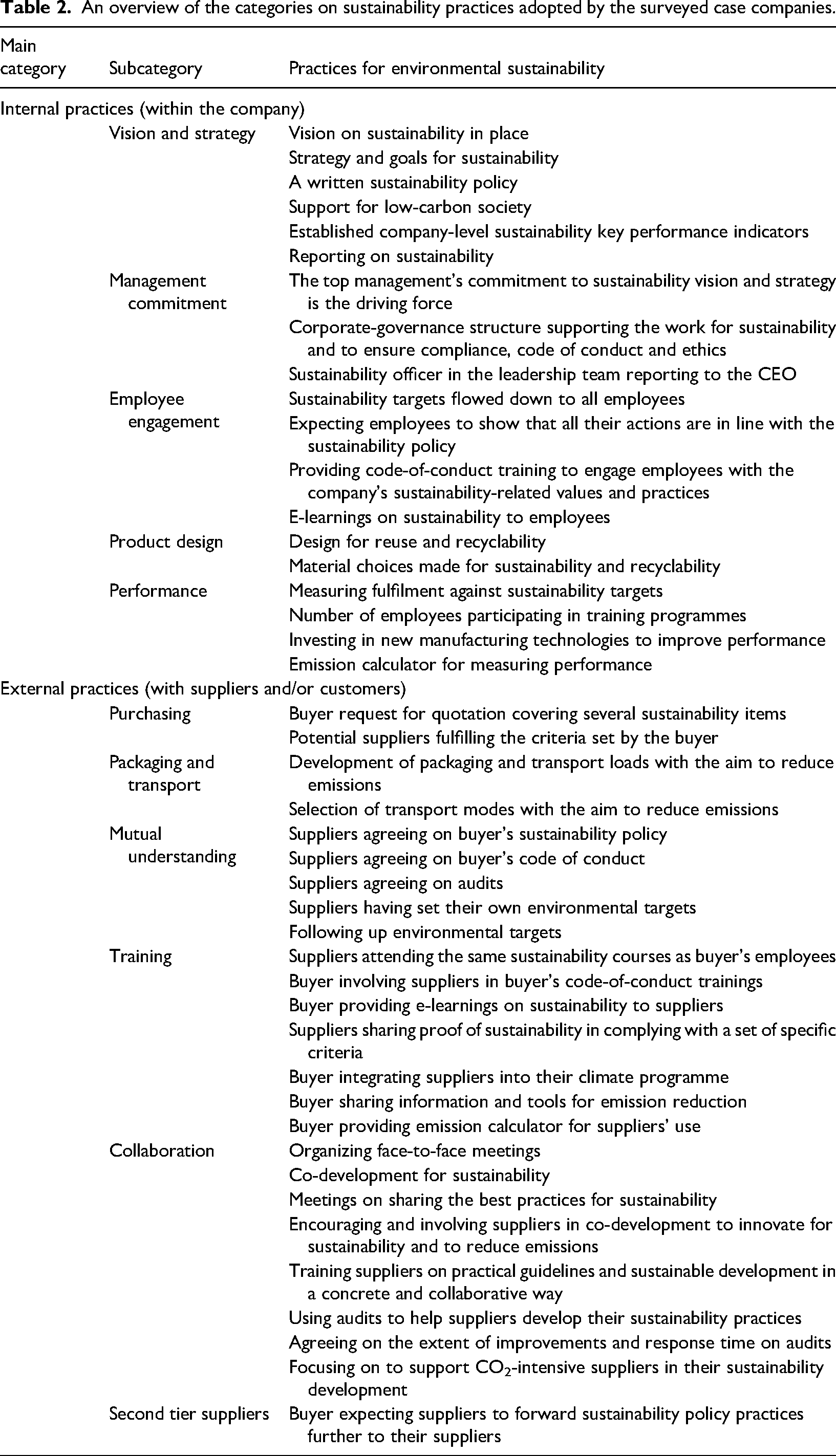
While numerous practices identified afford transition toward sustainable development, among our study's most important findings is that the contracts do not yet cover KPIs that support environmental-sustainability performance. This finding is in line with the work of Bask et al. (2018), whose research into environmental sustainability in relation to shippers and logistics service providers revealed preliminary-phase (i.e., request-for-quotation stage) queries about environmental-sustainability matters and sometimes associated practices (such as inclusion of codes of conduct in the contracts) but also KPIs’ absence from contract documents. We can conclude that, even though companies recognize the importance of sustainability and denote it as a priority, a sustainability breakthrough via contract management and at the contract-clause level is not yet on the horizon. We recommend showing the way by developing sustainability KPIs and including them via contract management, since these aid in measuring sustainable supply-chain practices’ influence on performance, as Cabral, Grilo and Cruz-Machado (2012) have noted.
One impediment visible in some participating companies seems to be continuing large-scale change in organizational structure. One unexpected phenomenon was the tendency to move from centralization, with central-function heads and processes, to decentralized, fragmented smaller organizations with their own individual leaders and distinct processes. Reporting lines may connect only at the highest levels. This trend seems at odds with a contract-management-based understanding, wherein efficiency often stems from centralized, streamlined processes aligned so as to avoid reinventing the wheel or bringing in extra costs related to money, time and other resources and to quality (Cummins 2016; Hirvonen-Ere 2021). Decentralized process organization demands increased communication and information flow between various departments and with stakeholders, in light of phenomena such as what some have called “intellectual silos” (Lumineau, Eckerd and Handley 2015, 58) in contexts of inter-organizational relationships and conflict, where there has been little focus on integration between silos.
In summary, we can offer an affirmative answer to the first research question: contract management could operate as a contingency variable influencing sustainability-linked practices and, thereby, actual sustainability performance. However, the results show also that the time may not be ripe for full-scale utilization; a stronger positive impact might become visible after a couple of years. The answer to the second question too is ‘yes’. The contract-management process may – in several ways – enhance the shift toward environmentally sustainable supply chains. We found that there is a need and room for contract management's further utilization.
Finally, it is abundantly clear that companies are still on their transformation journey and in markedly different phases of it: some are taking only the first steps, while others have advanced further. Although promising developments have begun and contract management can help accelerate it, much must be done before full-scale opportunities for environmental sustainability coupled with prospering supply chains blossom.
Theoretical contributions
Even though the importance of contract management is recognized in the world of international business, scholarly attention has not caught up. Our early study adds to the academic discussion and functions as a call for greater focus and rigor in academically oriented contract-management research. Secondly, we have introduced the contingency-theory perspective in the contract-management context, taking it as a contingency variable. Ours is one of the first studies to consider contract management and contingency theory with particular reference to both sustainability practices and performance.
Limitations and future research
This exploratory research had several limitations. Firstly, we confined our attention to companies that have established a contract-management presence as evidenced through corporate membership in the WorldCC, the leading global association focused on commercial and contract management. Membership is a strong indication that a company views such management as worth investing in and of commitment to further developing its contract- and commercial-management function through education, professional certification programmes and other tools that the association offers to their corporate members. Selecting members of the WorldCC gave us a set of companies that exercise at least some level of contract management in their modus operandi. While the quantity of these in the Nordic manufacturing industry is fairly small, with the number of interview participants limited accordingly, the companies’ similarities in certain relevant answers may point to theoretical saturation (Eisenhardt 1989); hence, increasing the quantity of data might, perhaps, not have led to greater knowledge of the subject. Accordingly, our study could be viewed as a pilot project, stimulating further work. Secondly, the companies involved in our interviews were drawn from a geographically limited area, the Nordic region. While this afforded mutual comparability, it might constitute a limiting factor. For the same reason, the field of operation was limited to manufacturers. This and the small sample naturally limit the results’ generalization. However, the interviewees’ wide spectrum of positions and the interview protocol support the reliability of the study.
Our work offers a jumping-off point for further work addressing the gap between the importance of contract management in the business world and academic interest in it, which has not grown in tandem with the business interest (Kähler 2013). Contract management is a very wide topic. Therefore, immense research opportunities exist for scaling up the research in the future. Examples are:
First, a longitudinal study with follow-up interviews with the same set of questions among the same companies in the next couple of years would reveal developments. Some of the case companies were clearly of the opinion that enhanced utilization of contract management could assist with their transformation journey, so examining the progress toward more environmentally sustainable supply chains via contracts should prove illuminating. This future research path looks promising as respondents appeared willing to respond to a follow-up research after some years have elapsed. Second, this pilot study can be extended with interviews via a larger number of companies, spanning of various branches of industry in the Nordic countries. Third, broadening of the geographical domain from the Nordic countries to a larger geographical area provides one more opportunity to scale up the study. Comparative qualitative studies might offer intriguing perspectives. To remain within the same regulatory framework and policy development targets in the European Union proves promising, also from the perspective of the European Green Deal. Further, this provides an opportunity for a comparative study between companies located in different EU countries to explore whether there are differences between them. Furthermore, an alternative is a comparison between the Nordic countries versus others in the EU region to explore differences between Nordic countries with a more ambitious environmental policy compared to other EU countries. Fourth, an opportunity is arising from the extension to companies governed by another regulatory framework, such as the Anglo-American legal system. This offers one more interesting path for extending the current reach to compare between the EU countries and the Anglo-American sphere. This could cover respondents from both WorldCC corporate members in the EU, as well as the National Contract Management Association members in the United States. Choosing from these memberships safeguard the respondent companies to have a certain level of contract management establishment and understanding. The other alternative is to select companies that are acknowledged for their sustainability development. Fifth, in our findings, we expected progress toward centralization of contract management with benefits that implies, such as better coordination throughout the contract lifecycle (from the pre-award through the post-award phase). Therefore, an unexpected finding was decentralization of team structures, processes and reporting lines. This definitely presents an interesting avenue for future research; to seek answers to the questions regarding to what lies behind the decision to move (back in some cases) from centralization to decentralization; and how does this impact the performance during the contract lifecycle?
Finally, though no less importantly, contract management's potential for use in an expanded manner beyond its core functions (Hirvonen-Ere 2019, 2022) leaves us with a fascinating trajectory to follow: what might the future areas for contract and commercial management's even further evolution be? For instance, it may not be possible to consider the future of sustainability management and contracting without taking into account the development of Contract Lifecycle Management systems and technologies that hold potential to increase transparency and automation radically, such as blockchain (Bailey 2018; Robey 2018; Sulkowski 2018). It will be intriguing to explore how a given company's point on its journey toward environmental sustainability – in other words, the maturity of the values, policies, processes, best practice and tools utilized – affects its choices. Consequently, and the other way round, can contract management help companies not only achieve transformation but also increase their maturity with regard to the topic of this article? If so, how?
Footnotes
Acknowledgements
Suvi Hirvonen-Ere would like to acknowledge the HSE Support Foundation and Jenny and Antti Wihuri Foundation for their support for her doctoral dissertation work. The authors would like to acknowledge the reviewers for their comments.
Declaration of conflicting interests
The authors declared no potential conflicts of interest with respect to the research, authorship and/or publication of this article.
Funding
The authors received no financial support for the research, authorship and/or publication of this article.

Author biographies
Appendix
List of the main question categories
How is the contract-management process organized in your company (pre-award–contract award–post-award process phases)? (Internal) How do you manage the contract-management process? (Internal) What KPIs do you have for contract-management process (phases) and how do you follow up the performance in general? (Internal) What kind of goals and objectives your company has for environmental sustainability? (Internal) What are your company's KPIs for environmental sustainability? (Internal and external) How is contract-management process used to support in reaching environmental-sustainability performance (KPIs)? (Internal and external) What kind of environmental-sustainability practices do you use to reach KPIs? (Internal and external)