



Abstract
This paper presents a bargaining model of contract outcomes as a function of contract uncertainties associated with critical supply purchasing after a crisis. It examines contract modifications and termination. The model yields the following results: (1) contract modification by the government alone (unilateral modification) does not change the optimal contract; (2) contract modification by mutual agreement (bilateral modification) makes the optimal contract dependent on product price, acquisition costs, transaction costs, and uncertainty; (3) mutual contract modifications are affected negatively by government costs of contract modification and are affected positively by supplier's costs of contract modification; (4) the government may find it necessary to terminate a contract if the contract elasticity of government utility is zero, and the contractor may want to terminate the contract when its supply price equals the acquisition price.
The acquisition of critical supplies is fundamental to the government's response to a crisis, providing the products required to stem the loss of life and to regain some level of normality (Day, 2014; Maon et al., 2009; Rao and Goldsby, 2009; Sheu, 2010). Securing critical products in the aftermath of a crisis is often problematic, however, as contracted orders may not be fulfilled as expected (Chakravarty, 2011; Fahimnia et al., 2017; Papadopoulos et al., 2017). In the early months of the COVID-19 crisis, procurement officials sought to purchase personal protective equipment (PPE) as such products offered the primary means for slowing the spread of the virus. Yet, the resulting global surge in demand for PPE early in the pandemic created enormous obstacles for securing such products reliably (Vecchi et al., 2020). Eisenhardt (1989) explains how the development of any contract constitutes an attempt to purchase the future behavior of an individual or a firm. Decisions surrounding which contractor to work with, and what terms to establish with that contractor, ultimately affect the potential for contracted orders to provide the supplies so desperately needed in the aftermath of a crisis.
Two factors primarily explain why contractors fail to deliver on their expectations: firstly, the inclination for a contractor to prove deceptive in the fulfillment of their contract (behavioral uncertainty) or secondly, the prevalence of environmental factors that disrupt delivery (environmental uncertainty) (Handley and Benton, 2012; Inman and Green, 2021; Kauppi and van Raaij, 2015; Vecchiato, 2012; Wang et al., 2011; Williamson, 1985). Contractors also have different incentives than the government when engaging in government contracts (Kivleniece and Quelin, 2012), with the government seeking to protect the public interest (securing products or services at a reasonable price) and contractors seeking profitability from contracts and their access to future government contracts.
Dealing with contract delivery failures is all the more challenging in the immediate aftermath of a crisis, given the pressure to rapidly secure products (Manuj and Mentzer, 2008), relaxed regulations governing how contracts are established (OMB, 2011; Ranney et al., 2020), and the prevalence of fraudulent suppliers. Contract managers are therefore even more boundedly constrained in assessing a contractor's potential reliability when they select them (Bernheim and Whinston, 1998; March, 1978; Williamson, 1985) and in designing contracts that minimize the costs of such uncertainties (Balakrishnan and Koza, 1993; Brown and Potoski, 2005; de la Cruz et al., 2020; John and Reve, 2010; Williamson, 1979, 1993).
An unexplored question is how contract managers utilize modifications as a bargaining tool to affect contract delivery. Prior research explains how contracting risks can be mitigated by designing the terms of contracts to reward contractors for carrying through with their obligations (Brown and Potoski, 2003a; Coase, 1998; Kim and Brown, 2012; Williamson, 1979, 1993). While much of this focus is on the initial design of contractual relationships, not as much is known about how changes to existing contracts affect the parties to the contract.
Our focus is on the ways that U.S. federal procurement officials may alter contract designs after they have been awarded, in an effort to secure critical supplies such as PPE. The Federal Acquisition Regulation (FAR) defines contract modifications as any structural change to a contract after it has been issued, which is specified in writing (FAR, 2021). Contract modifications may be initiated and signed off on by the government alone, or developed through mutual agreement with contractors (Aivazian et al., 1982; Gatchalian, 1990; Hviid, 1998; Jolls, 1997; Phillips et al., 2021). Mutually agreed-upon terms of modifications deserve attention as they can reposition the influence of parties to the contract (Aivazian et al., 1982), providing avenues for the parties of the contract to bargain with one another. The resulting bargaining can influence the potential for the contract to be fulfilled as expected and the expected earnings of the contractor.
The objective of this paper is to analyze the theoretical impacts of contract modifications on the purchasing of critical supplies after a crisis like COVID-19 in the context of U.S. federal procurement and to explain how each modification type can benefit the parties to the contract. We develop a bargaining model to specify the expected theoretical relationships, as both parties depend on one another to achieve their respective interests—the government relies on a contractor to provide the products or services that it cannot produce on its own, and the contractor relies on purchases from the government for revenue. The model also explains how the interactions among the parties to the contract constitute bargaining, where each party seeks to improve what they can gain from the contract. The model indicates the factors that are likely to lead to modifications that necessitate bargaining from both parties and the implications of those modifications. A range of factors are expected to affect the optimization of benefits for each party to the contract, and bilateral modifications are expected to be discouraged by the government but encouraged by the contractor.
The following sections review academic literature to develop our framework, including an explanation of the factors likely to necessitate modifications, the characteristics of the modifications, and their potential implications.
Prior literature—a brief review
Our review of prior literature focuses mainly on issues concerned with the components of our bargaining model. The first section explains the extent of uncertainties framing purchasing of PPE following the onset of COVID-19 and how such challenges relate to agency problems for contract managers. The second section explains the types of modifications that contract managers may pursue and their implications for bargaining between parties to the contract.
Contract managers face enormous risks that contracts will not be fulfilled as expected when purchasing highly sought-after goods after a crisis—meaning that even well-developed contracts may fail to facilitate the acquisition of critical products (Falasca and Zobel, 2011; Manuj and Mentzer, 2008; Mustaffa and Potter, 2009; Pelling and Dill, 2010; Torabi et al., 2018). Following the onset of COVID-19 in the Spring of 2020, global demand for PPE skyrocketed, with government agencies often competing with one another—and the private sector—for the same products. To make matters worse, the U.S. federal government failed to adequately supply the national stockpile of PPE before the crisis (FDA, 2020; Wang et al., 2020), as they did not recognize the importance of such products in advance (Phillips et al., 2021). The resulting market shortage, coupled with a lack of inventory, forced contract managers to rely even more on securing new supplies of PPE, which led many of them to purchase from contractors they had never worked with before.
Contract managers were thus confronted with enormous uncertainties in purchasing PPE in the aftermath of COVID-19—an issue all the more relevant when purchasing products that require adherence to stringent regulations in medical settings (Atkinson et al., 2020). Some contracts failed to be fulfilled simply because the products purchased could not meet public health standards.
Williamson (1985) identifies two broad categories of uncertainties that pose risks to contract managers: behavioral uncertainties (uncertainties related to potential opportunistic, strategic behavior on behalf of the contractor) and environmental uncertainties (uncertainties surrounding the market for contracting, and potential disruptions in supplies that could limit a contractor's ability to carry through on their obligations).
Behavioral uncertainties refer to the potential for one of the parties to the contract to act in ways that benefit oneself at the cost of others (Krishnan et al., 2016; Poppo and Zenger, 2002; Son et al., 2021; Weed and Mitchell, 1980; Williamson, 1985). This is apparent when a contractor misrepresents what they are capable of providing, when one reneges on commitments, or when one fails to fulfill their obligations. There were numerous accounts of behavioral uncertainty plaguing the acquisition of PPE following COVID-19, with many first-time contractors entering the market who were never able to adequately supply PPE to purchasers (Vecchi et al., 2020; Huang et al., 2004). As a case in point, a medical supply company named Blue Flame Medical LLC was established in the weeks after President Trump declared the COVID-19 outbreak a national emergency in March 2020. Despite the company being awarded a PPE contract from the state of Maryland for $12.5 million and another multi-million-dollar contract with the State of California, the company was unable to deliver any of the products and the company faced legal action from both of the state governments who issued it contracts. The situation is made all the worse by repeated solicitations for contracts from such “unknown contractors.” Contract managers, for example, reported receiving thousands of emails and phone calls from such unknown or grey market vendors in the early stages of the crisis (Vecchi et al., 2020).
Environmental uncertainties refer to changes in economic conditions that can disrupt the work of a contractor, such as changes in prices, changes in manufacturing or raw materials that affect the supply chains that they purchase from, or changes in public policies (Dess and Beard, 1984; Duncan, 1979; Krishnan et al., 2016; Weed and Mitchell, 1980; Wholey and Brittain, 1989). Given that organizations depend on resources from the wider environment to conduct their work (Aldrich, 1979; Pfeffer and Salancik, 1978), contractors who rely on complex supply chains to fulfill orders are more susceptible to disruptions within their environment. The purchasing of PPE also occurred against a backdrop of decades of cost-cutting in the healthcare industry, reducing inventory in supply chains and creating a reliance on foreign manufactured products (Bhakoo and Choi, 2013; Chen et al., 2013; Dobrzykowski et al., 2014; Hussain et al., 2018; Kumar et al., 2005; Kwon et al., 2016; Lee Sang, Lee, and Schniederjans Marc, 2011; Pishvaee et al., 2014; Rego et al., 2014). Reliance on global supply chains increases the risk that political or economic change abroad could disrupt product acquisition, as most of the world's PPE is produced in four countries: China, Malaysia, Thailand, and Indonesia. Similar pressures to increase just-in-time delivery increase reliance on the original sources of manufacturing (Aronsson et al., 2011; Chen et al., 2013; Mete and Zabinsky, 2010; Mustaffa and Potter, 2009).
If parties to a contract had complete information when developing a contract, there would be little need for changes in the terms of contracts after they were issued. The reality, of course, is that parties to the contract face enormous asymmetries in forecasting one another's behavior and, as a result, some amount of bargaining and renegotiation at later stages of delivery is inevitable (Williamson, 1985).
The study of transaction cost economics explains how the structure of the contract can be designed to reduce the risks associated with information asymmetries and related uncertainties (Dyer and Chu, 2003; Brown et al., 2013; Brown and Potoski, 2003b; Williamson, 1985). The options for contract design fall upon a spectrum, with one set of options highly specifying the expectations for a contractor and the other leaving the terms of contractor behavior more open-ended. To deal with the many unforeseen consequences surrounding emergency contracting, more open-ended expectations are often recommended so as to allow for later negotiations and to help to create conditions where social norms, rather than written, legal terms determine how parties to a contract work together (Erridge and Greer, 2002; Poppo and Zenger, 2002; Van Slyke and Hammonds, 2003; Walker et al., 2013). The challenge for contract managers seeking PPE in the immediate aftermath of COVID-19 was that there was a cultural and institutional focus on more transactional, highly specified contractual designs (Atkinson et al., 2020). Such emphasis on less flexible designs in the initial development of contracts increases the likelihood of contract modifications, as changes after the fact are needed to provide the flexibility that was absent in the initial design.
Contract modifications are “changes in contractual terms made subsequent to the formation of the primary contract” (Aivazian et al., 1982: 173). Modifications represent changes in the structural design of the contract, which may or may not require written acceptance by both parties. The changes provide the exchange partners with avenues for altering their obligations to one another, without involving the courts (Hviid, 1998; Jolls, 1997). Modifications also allow for dealing with unforeseen circumstances or contingencies that were not anticipated in the initial development of the contract such as changes in prices for input goods or changes in access to products or raw materials further upstream in a contractor's supply chain (Phillips et al., 2021).
It is important to stress that the possibility of a contract modification presents an opportunity for bargaining between the exchange partners, extending the negotiations about contractual terms beyond their initial development (Williamson, 1985). This bargaining at later stages in the contract's development deserves attention as the negotiating positions of the exchange partners are likely to vary from the positions they each held when the contract was initially developed (Aivazian et al., 1982). In other words, modifications may be pursued to increase one of the party's negotiating positions.
Presuming that each party enters the contract with the intent to serve their own interests, which often conflict with those of the other party (Kivleniece and Quelin, 2012; Roehrich et al., 2014), the decision to adopt a contract modification could benefit the government contract manager or the contracted vendor. Aivazian et al. (1982) explain the potential for reallocation of contracting risk resulting from a modification in the following way: why would any party to a contract agree, by way of modification, to pay more or accept less than originally contracted for…unless the other party had obtained bargaining power in the course of the relationship that he/she did not possess at the time of the contract formation? (p. 174)
The interests that either party seeks in the contract are likely to be different, as the priorities for the public sector (the contracting official) are likely to be different from those of the contractor (Kivleniece and Quelin, 2012; Roehrich et al., 2014), with the government seeking to advance the public's interests (securing critical products for a reasonable price after a crisis), and the contractor seeking to maximize their earnings from the contract and their potential to secure future contracts (Boyer and Newcomer, 2015). The use of any form of contract modification can therefore affect the potential for either party to achieve their own aims, as the modification may reallocate the distribution of rewards to either party. The potential redistribution of what either party “wants” out of the contract will ultimately be determined by the bargaining power of the contracting official (government) or the contractor (private sector party) at the point of time when the modification is implemented.
There are two types of contract modifications: unilateral and bilateral.
Unilateral modifications. Unilateral contract modifications are classified by the FAR as those initiated by the government which are not expected to affect contractors materially. The actions are often used to direct the other's party's actions or to address clerical mistakes and since the contractor is not required to sign off on such changes, unilateral modifications do not require negotiation between parties to the contract. Such actions may include change orders, exercising an option, funding actions, or other administrative actions. This form of modification is not likely to affect the reliability of securing PPE nor to bear much impact on the bargaining position of either party to the contract. Unilateral modifications may cause minor delays in delivery, but do not affect the terms of payment or standards of products agreed upon in advance. More often, unilateral contract modifications demonstrate a response to a change in personnel or to add additional orders for a contractor, with respect to terms already agreed upon in advance.
Bilateral modifications. Bilateral contract modifications materially influence the costs for the parties to the contract and require approval from both contract managers and contractors (FAR, 2021). The need for both parties to the contract to agree upon such changes fosters negotiation and mutual agreement. In this way, bilateral modifications applied to a contract initially designed in more highly specified, transaction terms, can transform the relationship into one that is more open-ended and collaborative (Aivazian et al., 1982). Examples could include agreeing to a different standard of PPE (such as allowing KN95 masks to substitute N95 masks) or changing the prices paid for contracted PPE. Such modifications are likely to improve the reliability of product delivery, as they provide avenues for adjusting to changes in policy, supply chains, or other issues affecting contract delivery. More collaborative modifications can also provide opportunities for social expectations and modeled behaviors to influence expectations for contractors, providing an alternative to expectations only articulated in writing (Girth, 2017; Poppo and Zenger, 2002). Such social relations can foster greater trust and reduce the need for monitoring contractor performance (Wathne et al., 2018; Wathne and Heide, 2000), and improve adaptability (Jap and Anderson, 2003; Yang et al., 2009). The negotiation and agreement required for bilateral modifications are likely to increase the administrative costs of contracting, due to the high levels of negotiation and contract adjustment required. Bilateral modifications are also expected to improve the achievement of contract outcomes, due to the factors indicated above, and the potential for ultimately reducing the costs required of purchasing PPE.
Of course, when contract modifications fail to meet the needs of the parties to the contract, the contracts may instead conclude prematurely through termination.
Contract terminations. Terminations are generally initiated by the government and the FAR provides broad discretion for the government to cancel contracts that are deemed to no longer “serve the public interest.” There are reasons that contractors may also wish to exit contracts prematurely. Terminations are one additional tool for contracting officials or contractors to respond to unforeseen circumstances.
In the aftermath of COVID-19, terminations offered contract managers another tool to reduce their risk of purchasing from unreliable contractors. One of the long-standing arguments in favor of contracting is the flexibility offered to public managers to start or stop contractor relationships to adjust to changes in a given market (Lamothe and Lamothe, 2016). While terminations are often adopted for a variety of reasons (Albalate et al., 2021; Blomqvist and Winblad, 2022; Zeemering, 2018), they provide mechanisms for safeguarding the government, to discontinue business relationships that are not perceived to benefit the public interest. This threat of termination provides the government with a means for mitigating risks when initially developing contracts as they can unilaterally dismiss the contract in the case of poor contractor performance. The potential use of termination also provides the government with leverage for holding contractors to account. The possibility of termination initiated by the government also increases the costs for the contractor, as they must factor in the possibility of the government prematurely canceling their agreement and them failing to receive their projected earnings. 1
Terminations are generally a modification of last resort, as contract managers are more likely to seek other ways to influence contractor performance, such as informal counseling or explanations of eligibility for future awards (Girth, 2017), or to simply allow contracts to expire (Albalate et al., 2021). There is some evidence that contract terminations are avoided altogether when private contractors have sufficient legal support to dispute them (Blomqvist and Winblad, 2022). Terminations are rare, and demonstrate the highest administrative costs among modification options, as they require detailed justifications for their use. Terminations also offer little potential for improving the reliability of PPE purchasing, as such agreements are dissolved before products are required. They therefore offer little potential for improving on-time or on-budget delivery as there are often few, if any products provided by the time of termination.
Bargaining model for contract modifications
Baseline model
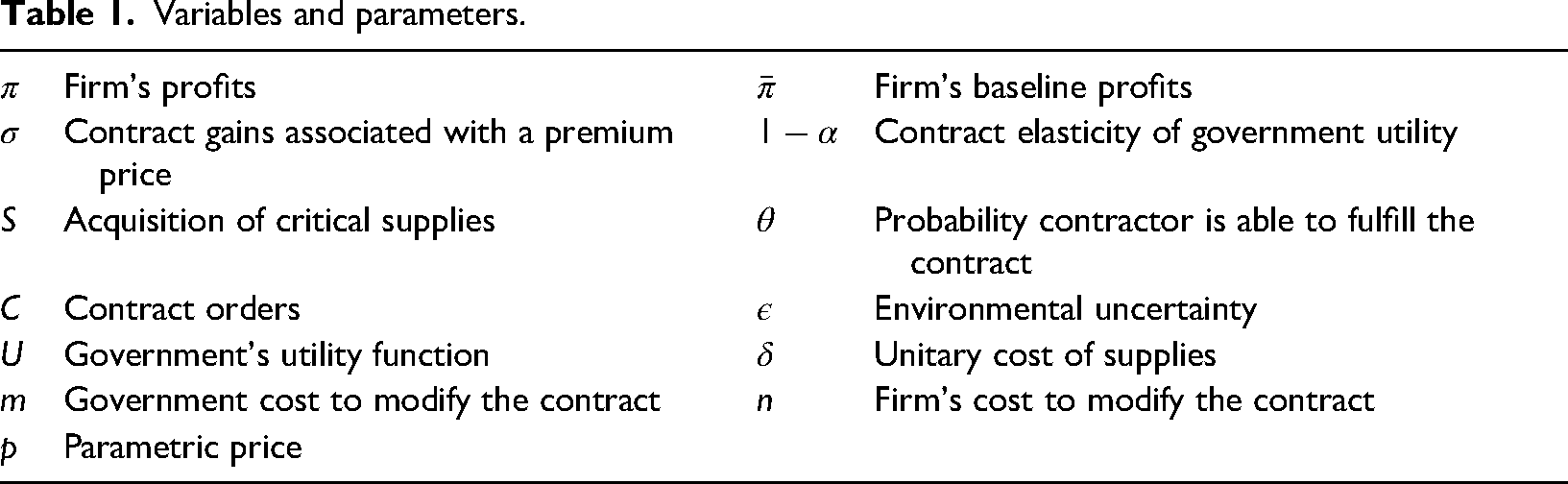
In this paper, we are concerned with the question of how contract managers utilize modifications as a bargaining tool to affect contract delivery (Table 1). We start the analysis with a baseline model which is a common Nash bargaining model (e.g., Muthoo, 1999; Nash, 1950).
Variables and parameters.
In this model, we assume the government negotiates with a representative supplier. The representative supplier is a firm that maximizes profits
The government utility function U is a strictly concave increasing function of C, U(C).
The efficient bargain model (e.g. Carruth and Oswald, 1987; McDonald and Solow, 1981) is a Pareto optimal bargain negotiated by both agents:


Assume the following explicit utility function:

Assuming that the binding level of profit holds we substitute equation (2) into equation (4) yielding C as a function of S:



Given (8) it is easy to find by equation (4) that the firm's optimal profit is:
In what follow we examine two scenarios of contract modification, one with the government and another with a mutual agreement between the government and the contractor.
Contract modification by the government alone (unilateral modification)
Assume that the utility function of the government changes with contract modification in the following manner:
Using the same steps above we can rewrite S as:
Maximizing S with respect to C yields the optimal contract with government modification:
This is the
Contract modification by mutual agreement between the government and the contractor (bilateral modification)
The representative firm profits now reflect the contract modification costs given by parameter n:



The comparative static analysis of the optimal contract with mutual agreement modification with respect to the contract modification parameters m and n are, respectively:



Contract termination by the government or the contractor
An important issue is that even with contract modifications the government and the firm may find it necessary to terminate the contract. Contract termination formally means that the optimal contract is zero, C* = 0.
In the case of the baseline model or with unilateral contract modification this implies:
With regard to the mutual contract modifications case, we have:
Considerations for future research
This paper analyzed a bargaining model, between a government and a contractor, as a model of the actual characteristics surrounding a government contracting relationship. The government may elect to implement two types of contract modifications to improve their acquisition, unilateral or bilateral contract modifications. Two scenarios were considered to examine the potential impacts of each modification type. A comparison between the two scenarios reveals the extent that bilateral contract modifications expose the government to far more risk than unilateral modifications. Unilateral modifications are not expected to influence the government's potential to acquire critical products, but bilateral or collaborative modifications can affect those goals—as well as the goals of the contractor to maximize profits. In this way, the model provides a more nuanced view of the potential risks of a bilateral or collaborative modification, which is useful considering the often normative arguments suggesting greater use of collaborative, mutually agreed-upon contractual relations in uncertain settings (Campbell, 2018; Meehan et al., 2016).
The negotiation of public and private interests in contracting is akin to bargaining—with each party seeking to exert influence on the other to increase the achievement of their respective goals (Kivleniece and Quelin, 2012; Roehrich et al., 2014; Williamson, 1985). The overarching goal for the government when purchasing in the aftermath of a crisis is to secure products in a timely fashion and, to the extent possible, at a reasonable price (Atkinson et al., 2020; Georgiadis et al., 2005; Kaur and Singh, 2019). The contracting factors identified in the model (uncertainties, etc.) provide a basis for anticipating the extent that modifications to existing contracts that increase collaborative relations (bilateral modifications) may actually affect the goals of the government. The model can therefore inform empirical analyses of the ways that collaborative contractual terms implemented during contract delivery may improve contracting outcomes.
The theoretical model developed here provides informative, structured hypotheses, to examine the contract characteristics that affect the bargaining outcomes resulting from contract modifications. By incorporating uncertainties particularly prevalent in purchasing critical supplies after a crisis, the model provides a framework for examining the prevalence and implications of modifications used in critical supply purchases (e.g. PPE) after an adverse event. The results from the model indicate that unilateral modifications present rather low stakes for the contracting parties, as they are not likely to influence the benefits for either party to the contract. In other words, unilateral modifications offer the little potential to alter the government's potential to acquire critical products as desired. Bilateral modifications, however, present the potential to alter the gains that either party receives from the contracting relationship. The extent that the gains for either party change as a result of a bilateral modification is expected to depend on all specified factors surrounding the contract's development: product price, acquisition costs, transaction costs, and uncertainty. These factors can specifically inform future empirical research on contract modifications in uncertain conditions.
The model also proposes the relationship between administrative costs of modifications (transaction costs) and the incentives that the parties to the contract have in adopting mutually agreed-upon, bilateral modifications. The government is expected to prove responsive to such administrative costs, reducing their inclination to adopt bilateral modifications while the opposite is expected of contractors. In other words, the model suggests that the public sector will prove more responsive to such administrative costs than their private sector counterparts when considering the implementation of bilateral modifications.
The proposed theoretical relationships in the model can inform the study of transaction cost economics and contract design in the study of government contracting (Brown and Potoski, 2003a; de la Cruz et al., 2020; Faria et al., 2022; Williamson, 1981), by framing studies of how more collaborative structural designs may impact contracting outcomes and uncertainty (Ryall and Sampson, 2016). More recent studies of government contracting have identified the potential for collaborative contractual designs to improve product acquisition (Brunjes, 2020; Girth, 2017), especially when dealing with high levels of information asymmetries and uncertain conditions (Malatesta and Smith, 2011; Kim and Brown, 2012) or when purchasing from markets with a limited number of available contractors (Girth, 2017; Hefetz and Warner, 2012; Witko, 2011). The framework developed here provides a basis for examining the impacts of such designs when they are implemented after the contract has begun, and provides theory-derived expectations of the types of contracting conditions that are likely to inform each of the modification types. The framework also provides a basis for examining the potential shortfalls and risks associated with implementing more collaborative structural designs in environments with high uncertainties.
One limitation of this research is the focus on terms for contract modification that are unique to laws governing U.S. federal procurement, and further research can better inform models that explain contract changes in other countries, where different statutory standards regulate options for ex-post changes in public procurement. Yet, around the world, procurement officials faced similar behavioral and environmental uncertainties in securing PPE in the early months of the COVID-19 crisis and this model can inform studies of contract changes made to secure such products in other country contexts. Attempts to acquire PPE in the immediate aftermath of COVID-19 revealed the challenges associated with securing critical supplies when public and private parties from across the world sought the same products (Ahmad et al., 2021; Atkinson et al., 2020; UNICEF, 2020). The U.S. federal government increasingly relies upon the purchase of goods and services that are deemed “critical” (GAO, 2022), and further attention is required to identify the products that could face challenges in purchasing in an emergency. The framework outlined here can inform the study of critical product acquisition for products required in the aftermath of a large-scale adverse event.
Footnotes
Declaration of conflicting interests
The authors declared no potential conflicts of interest with respect to the research, authorship, and/or publication of this article.
Funding
The authors received no financial support for the research, authorship, and/or publication of this article
