



Abstract
Digital transformation drives sustained business value through the use of digital technology. However, there is often confusion regarding what steps organisations should follow to achieve digital transformation, including to benefit innovation processes. In this study, we outline seven steps in a conceptual model – the digital transformation loop – which organisations can adopt for what we call ‘agile digital transformation’. We use the UK health care sector as a case example, which is central to social and economic infrastructures, yet faces continued innovation challenges. Our aim is to offer a compelling and accessible conceptualisation that illustrates challenges faced by the health care sector and poses questions that all organisations need to reflect upon to realise innovation benefits that arise from the agile adoption of digital technology. We argue that agile digital transformation must be part of achieving a clear strategic vision and should drive sustained and demonstrable business value.
Introduction
In this conceptual paper, we focus on the benefits of what we call ‘agile digital transformation’ to innovation processes. Our specific focus here is on innovation in the UK health care setting which acts as an example sector. Digital transformation has emerged as an important phenomenon in the academic domain of strategy and innovation, and for practitioners who are involved in business and technology teams as part of strategy and digital transformation processes. Specifically, the term digital transformation captures ‘a process that aims to improve an entity by triggering significant changes to its properties through combinations of information, computing, communication, and connectivity technologies’ (Vial, 2019: 118). We argue that, given the propensity for uncertainty in organisational and institutional environments, as has been demonstrated in recent times with, for example, radical political events including Brexit and the Trump administration, and with the worldwide disruptions such as the Covid-19 pandemic, an agile approach is required to digital transformation and to benefit innovation. We ask the question: ‘what steps are required for agile digital transformation in organisations?’.
In response to this question, we outline seven steps in a conceptual model which we call the digital transformation loop (these being: prepare, scan, prioritise, learn, experiment, plan, and build) which coalesce to form a structured, agile approach to digital transformation. Digital transformation has been critical to driving innovation in the health care sector (Agarwal et al., 2010; Belliger and Krieger, 2018; Ford et al., 2017; Kraus et al., 2021), which we adopt as an example to illustrate the aforementioned steps. We also document several reflective questions for all organisations to consider in navigating these steps. We start with a brief background to the health care sector and some key example sector challenges.
Background to health care sector challenges
The UK National Health Service (NHS) employs some three million people in health and social care, and according to reports in The King's Fund (Charles and Ewbank, 2021; The King’s Fund, 2013), the workforce has not grown rapidly enough to keep up with demand. In their 2020 Global Healthcare Outlook, Deloitte cites expanding and aging populations, rising labour costs, and the increasing number of people with chronic long-term conditions amongst the top five issues faced by the sector (Allen, 2020). This considered, there is a need for innovative solutions to health care provision, as innovation is an imperative factor in the development and survival of organisations within the system (Prosksch et al., 2019). In light of such challenges, it has been argued that strategic agility is required in health care organisations so that they can adapt more quickly to, for example, the changing needs of users, competitor responses, and regulatory guidelines (Berlin et al., 2017). In the UK, health care also has highly fragmented governance systems which hamper agility and mean that silos exist where widespread transformation is especially challenging.
The NHS's response back in 2019 included the formation of NHSX to lead a holistic program of digital transformation across the NHS, and to help drive innovation. In their report in early 2020, the National Audit Office (NAO) reported on the progress of this initiative which gives a comprehensive overview of the use of digital technology in the sector (National Audit Office, 2020). The report re-affirmed that digital transformation is essential to the NHS's long-term plan to innovate its provision and improve services, but that it requires a clear process to enable effective, long-term change and that there are many barriers in place.
As an example of the progress of NHSX, the NAO have observed that the currently planned progress towards a paperless NHS was slower than planned, reporting that most NHS trusts cannot rely on their digital records for the information they need, when they need it (National Audit Office, 2020). This is made particularly challenging by stringent data protection laws which exist in the UK and Europe, and in turn, inhibit care staff's ability to access patient information at the point of need especially when caring for patients in their own home. Financial pressure is also rife in the sector, and the NAO reported that investment levels were constraining the progress of digital transformation and that increasing staff costs are not matched by increases of investment. The Centre for Health and the Public Interest analysed this financial crisis in the £15 billion residential and nursing home sector in late 2019. They concluded that the sector, which is almost entirely provided by independent companies, is underpinned by a financial model which is ‘unsustainable’, subject to significant ‘leakage’, and despite the billions going into the sector care home workers are amongst the lowest paid leading to staff turnover rates close to 40%.
The efficient and orderly operation of the health care sector is vital to government, business, and society (Belliger and Krieger, 2018) as illustrated with total clarity by the COVID-19 pandemic. Whilst digital transformation offers a way of innovating and improving efficiencies, and there are many successful cases, it is, overall, failing to achieve its full potential as reported by the NAO. The following section introduces seven structured steps that health care organisations can (or should) follow to approach and benefit from agile digital transformation. We include examples and reflective questions along the way so that our steps are compelling to health care professionals, budgetary decision makers, and those in business and technology teams in organisations in general. We then outline a conceptual model containing these steps which we call the digital transformation loop.
The digital transformation loop: Seven structured steps for agile digital transformation
Although it is industry-standard terminology, ‘digital transformation’ is confusing. It makes it sound like ‘digital’ comes first which we argue could not be further from the case. The transformation process must be in a clear strategic context and represent a way that an organisation, including those in the health care sector, can improve efficiencies or drive competitive advantage through the smart use of technology. A clear, well-communicated strategic vision must always come first, and the transformation is part of the plan to achieve the vision.
As health care organisations embark on a digital transformation journey, a journey that is complex, multi-faceted, and full of risk, then an incremental and structured approach will help such organisations understand where it is, where to go next, and how to get to the ‘destination’. In an environment where the market forces and available technology are constantly changing, it is vital that the approach leverages agile best practices.
This section describes a structured approach to digital transformation which also embeds the fundamentals of strategic agility (e.g. Doz and Kosonen, 2008a; Morton et al., 2018). Strategic agility implies that organisations need to establish capabilities which allow them to be sensitive to changes in their internal and external environment, fluid in their resource allocation, and unified across management teams and senior leadership (Doz and Kosonen, 2008b). The approach and the steps we outline are built by combining such insights from research with cross-sector practice. The scope and order of the steps was determined through author participation in, and leadership of, many digital transformation projects with companies of different sizes and in diverse industries and geographies over a twenty-year period. This practical learning was informed by, and validated against, theoretical models relevant to various domains such as strategic agility (e.g. Doz and Kosonen, 2008a) and strategy and technology (e.g. Porter and Millar, 1985). We also adopt several case examples relevant to the UK NHS context from the ‘map of technology and data in health and care’ (The King’s Fund, 2016) to illustrate the steps further in this paper. The steps are representative of practices in organisations, which broadly capture norms and routines which we emphasise are required for structured, agile digital transformation.
We work through each of the seven steps and offer example questions that health care organisations need to consider, and this helps to create a holistic story about digital transformation (O’Hara, 2014). This also enables us to articulate key concepts in agile digital transformation (Suddaby, 2010) and business benefits in understandable terms which background technical details and bring ‘what it feels like to use’ to the fore (Palfreyman, 2020). This is particularly useful in guiding an understanding of agile digital transformation in the health care context. In addition to providing conceptual clarity and using the health care sector as an illustrative example, our outlined model provides steps which are useful for managers and various types of organisations as is the key focus of this conceptual paper.
Progress through the steps in the digital transformation loop is shown in Figure 1, and this is facilitated by the organisation's technology team and business team working together. The business team brings first-hand knowledge of how the organisation goes about their day-to-day business through a detailed understanding of its process and information base. The technology team brings in-depth knowledge and ideally experience of the technologies which could be used for transformation within the health sector (and beyond).
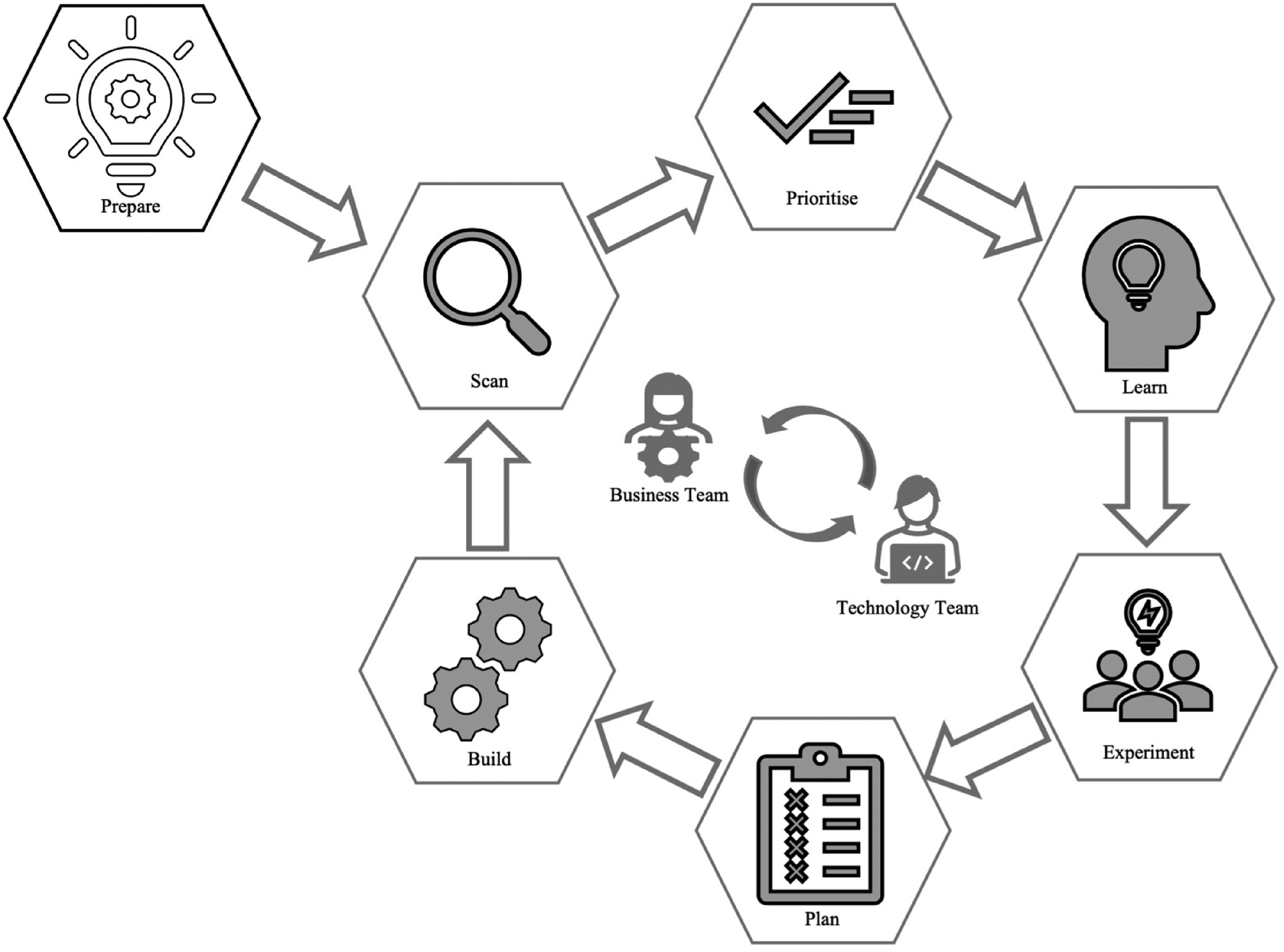
The digital transformation loop: A conceptual model showing seven structured steps for agile digital transformation.
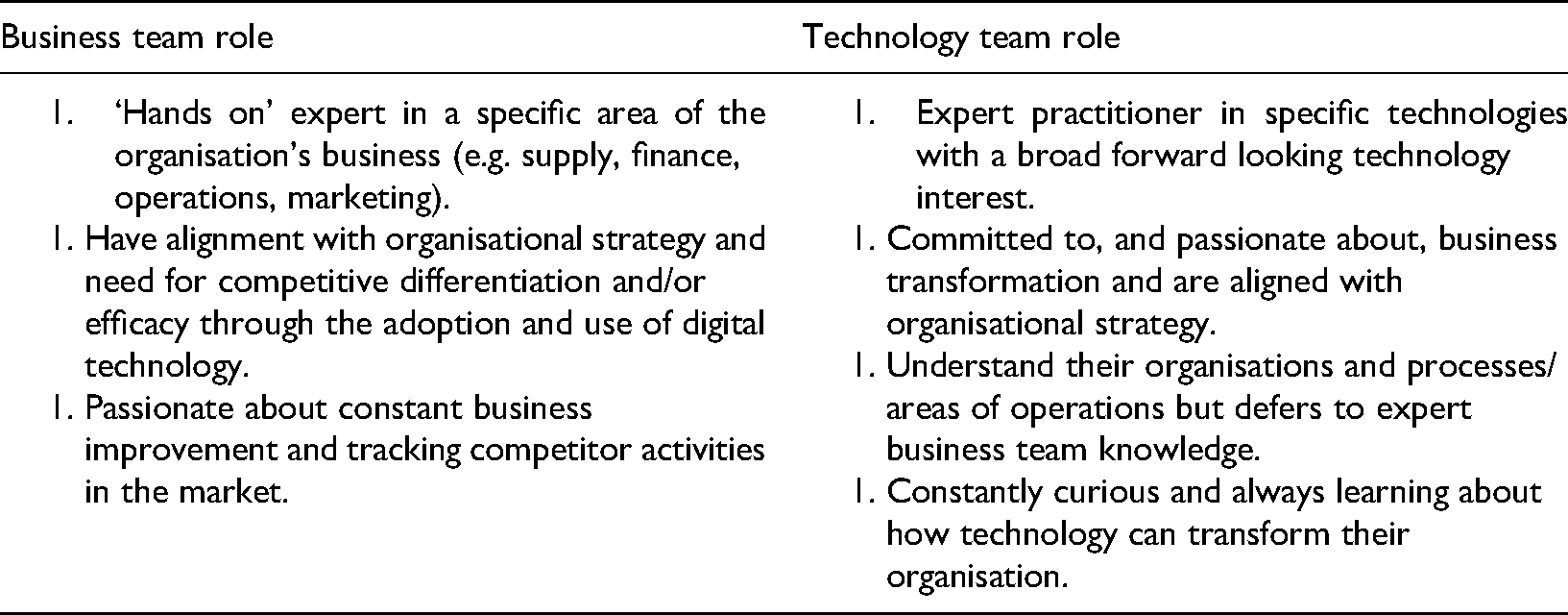
A close, balanced collaboration between these two teams is needed for agile digital transformation to be successful. By balanced, we emphasise that each of these teams has something specialised to offer which ensure digital transformation projects make the most impact on the business and make best use of available technologies. This also means that the membership of each team needs to be balanced. For example, the business team must combine operations and lines of business with business services such as human resources, finance, and marketing. Equally, the technology team must include those responsible for systems and applications development in addition to infrastructure, end-user support, and security and privacy. These teams can then ensure close collaboration through process mapping techniques which capture relevant business and technology processes in an organisation. Workshops can take place with business and technology teams to capture these maps. For example, in a health care setting the business team would be able to share how operational patient data should be classified, stored, what the management practices are, whilst the technology team can advise on technological systems that meet this example requirement of the organisation. Further, the technology team could research and guide on how similar problems are addressed in parallel or related industries and/or different geographies.
We propose that five key points are relevant here. First, organisational culture needs to be understood from the viewpoints of different leaders in the organisation, and those leading digital transformation. Second, it needs to be considered if, and how, culture can be measured. There are also many value frameworks that can be used by organisations to assess organisational culture. Third, culture needs to be assessed directly in relation to digital transformation. Fourth, it can be assessed whether any changes are needed to support effective digital transformation. Lastly, the role of different leaders and other stakeholder needs to be clearly outlined as part of the digital transformation process. If leadership and culture are not well understood, any initiative to change the organisation is likely to be sub-optimal. Should deficiencies be found in any of these five areas, corrective action must be taken so the organisation can get the best return on their transformation investments. The role of each team, and their balance in agile digital transformation, is summarised in Table 1.
The role of business and technology teams in the prepare step.
Now that the organisation's culture and leadership are prepared to support the transformation process, and roles are clearly defined and understood, the business and technology teams can experiment with ideas inspired by the operating principles that define the organisation's ‘to be’ strategic vision. Such experimental ideas create a pathway towards design principles, which add a development or technology flavour to the experiment idea and use the style of ‘we will do X’ as opposed to ‘we will do Y’ format. For example, when building the design principle, ‘Y’ will represent how the organisation currently operates. Design principles can cover the application of new technology, the evolution of the organisational infrastructure, the optimisation of processes (including adding new processes), or changes to an organisation's information base. Once the design principles are complete and clear, the business and technology teams prioritise the list into a ‘transformation backlog’. This backlog is then built by refining, prioritising, and validating the experiment ideas which in turn will shape the digital transformation process. These important considerations as part of the prepare step are summarised with an illustrative, general example in Figure 2.
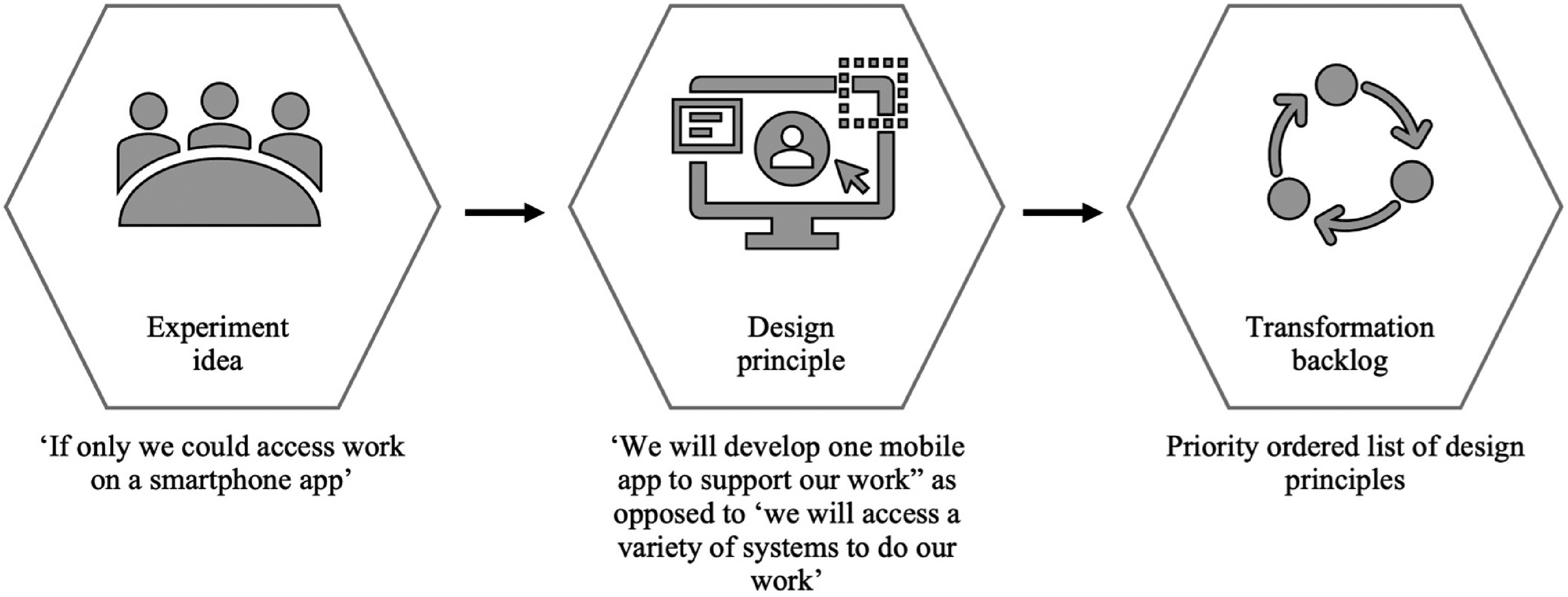
Experiment ideas, to design principles, and a transformation backlog.
Overall, the alignment of culture and leadership as is central to this step has been important in the delivery of long-term digital transformation in the health care sector, such as fully digitised patient records at Addenbrooke's Hospital in Cambridge which was part of a 10-year e-Hospital investment programme. There are three key questions to reflect upon at this step which help organisations to prepare for digital transformation and to recognise its potential for driving innovation (these are refined to focus on health care organisations, but can be adapted to other organisations):
Is the strategic vision clear, and well communicated across the whole practitioner base?; Are the current business processes well understood, including limitations such as the over-reliance on paper-based systems?; Is the health care organisation's information base well understood, including the ability of care professionals to access patient information at the point of need? What technologies are driving efficiencies elsewhere in the sector, in different geographies or parallel industries?; What innovative business models could be leveraged to address key sector challenges such as staff attrition or funding leakage? Which candidate technologies can drive maximum organisational efficiencies in the near term?; What innovation capabilities can our organisation leverage to realise these efficiencies through use of the candidate technologies?; How can these capabilities be enhanced to support experimentation and potential rollout? What sources can be leveraged to gain enough information about the candidate technologies to decide whether an experiment would prove value?; What organisational benefits (e.g. improved staff retention, enhanced care efficiencies) are expected from the experiment? How can the candidate technologies be applied to the organisation's business challenge to prove benefit prior to scale up/scale out?; How will the health care practitioners be involved in the experiment to provide first-hand information/process input? What levels of investment will be needed to ensure the successful roll out of the system enhancement resulting from the experiment?; How will the new/enhanced systems integrate with existing organisational infrastructure to ensure agility? How will the new systems be built and rolled out for maximum practitioner benefit and to drive innovation?; How will development risks be identified and successfully mitigated to maximise innovation and change of project success?
This projection of likely business benefit and implementation effort for each candidate technology is used in
A subset of candidate technologies are taken forward into
Last is arguably the most compelling part of the transformation, where managers and teams witness all the careful planning come to fruition and see the delivery of real innovation benefit to the organisation. This is
We also stress that a successful transformation must be highly inclusive involving different groups of individuals as shown in Table 2. It is critical that key members of each of these groups are appropriately involved in the transformation as appropriate as it progresses.
Groups and their involvement in agile digital transformation.
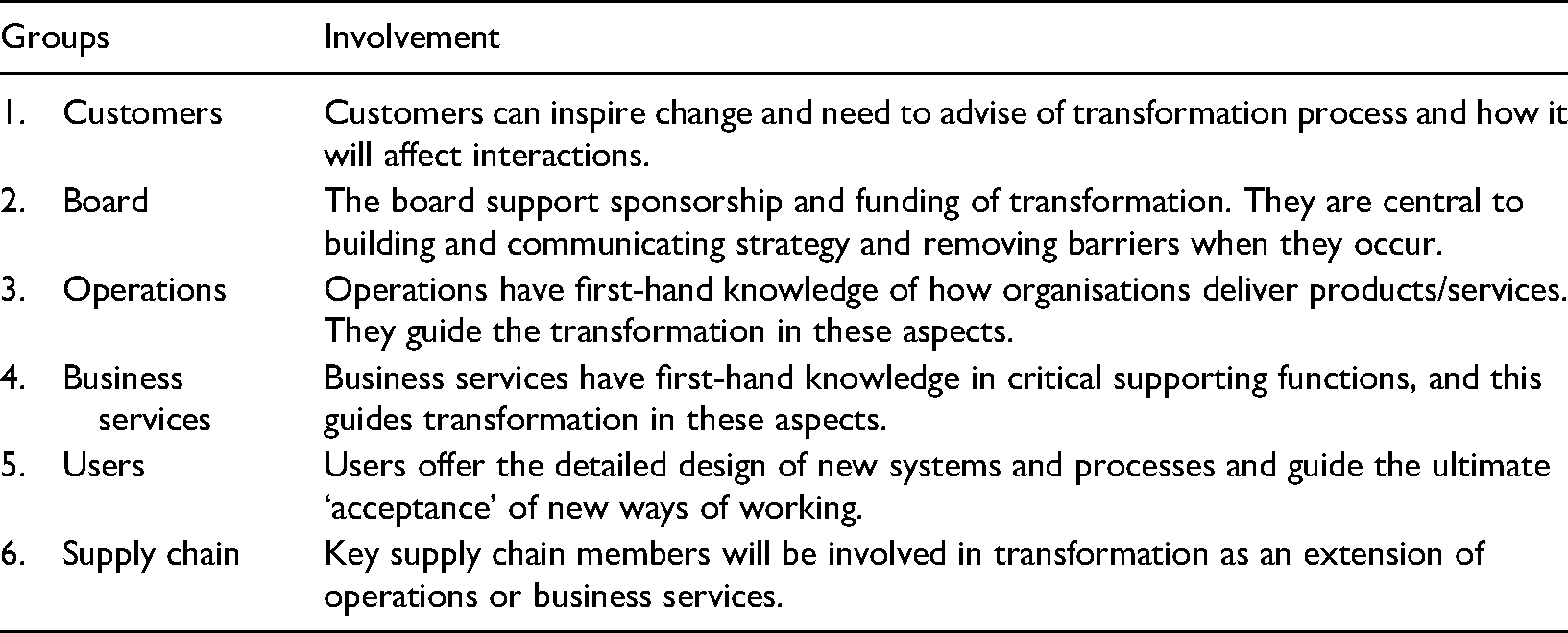
Involvement should be through transparent, appropriate, and open communication supplemented by regular playbacks to check and validate progress. When and how this involvement occurs will vary in different organisations and can be flexible. Whilst the above reflection of steps, key questions, and groups is targeted at the health care context and innovation as an example in this conceptual paper, these insights are malleable and can also be adopted for consideration and benefit in different settings and situations. The examples shown in Table 2 can also be expanded in more detail and there is potential for other groups to be added. For instance, in the context of health care in the UK, as has been our specific focus in this paper, we can consider that customers might refer more specifically to patients, and that various other types of stakeholders or stakeholder groups might exist including government ministers and civil servants. We conclude in the next section with some brief closing remarks.
Concluding remarks
Our work has outlined the importance of an agile approach to digital transformation and has done so by connecting to innovation in the UK health care context. The seven steps detailed in our work provide a critical reflection on what is required for organisations and managers to be agile and approach digital transformation in simple terms. It also contributes to the growing literature on digital transformation (e.g. Vial, 2019), including in the health care sector (Agarwal et al., 2010; Kraus et al., 2021), and its relevance to strategy and innovation in the digital age (e.g. Newell et al., 2020). We also hope that the seven steps we have developed as part of the digital transformation loop might inspire future research. For example, we encourage empirical studies that can expand, challenge, or validate these steps through varied methodological approaches and in different settings. We emphasise that whilst this paper focuses on health care innovation, the steps are not limited to, or drawn exclusively from insights within, this specific context. Empirical work could be conducted through explication of agile digital transformation in single case studies, or in wider studies which capture insights from across industry sectors. Overall, our interpretation of seven distinct steps and a model incorporating there with reflective questions relevant to agile digital transformation is, we hope, a valuable insight for relevant streams of literature, future research, and for a range of practitioners.
Footnotes
Declaration of conflicting interests
The authors declared no potential conflicts of interest with respect to the research, authorship, and/or publication of this article.
Funding
The authors received no financial support for the research, authorship and/or publication of this article.
