




Abstract
Modern complex contracts require cooperation, solid effective governance and a hard core of clear and workable terms and conditions to make them work. In this essay I explore exactly what cooperation and governance mean through the lens of a major global survey of contract practitioners. I discuss formal and informal elements of contract management because both matter. I find that contract managers show a marked reluctance to use punitive measures, but that value is seen in escalation, negotiation, communication, and professional governance. These require constructive engagement, that the parties talk, communicate, and work together to find the cause of the problem and agree solutions. I conclude that respondents are more interested in performance than in revenge, and that the key task is about making the contract work.
Keywords
Introduction
This essay is a distilled version of Chapter 3 of Commercial Expectations and Cooperation in Symbiotic Contracts – a Legal and Empirical Analysis (Soper, 2020) in which I consider the role of expectations in contract. These expectations are the soul of the contract (words are the body) and are too often neglected by Judges. The central thrust of my work is to show that expectations can be verified and defined at a level which creates the potential for legal enforceability. It reveals to researchers and practitioners that cooperation is at the heart of success in contract management, that good communications skills are required, that early and proactive problem solving together with some give and take is essential to making modern complex contracts work. Good soft and hard governance is an essential element and serious attention must be paid at all management levels to this requirement.
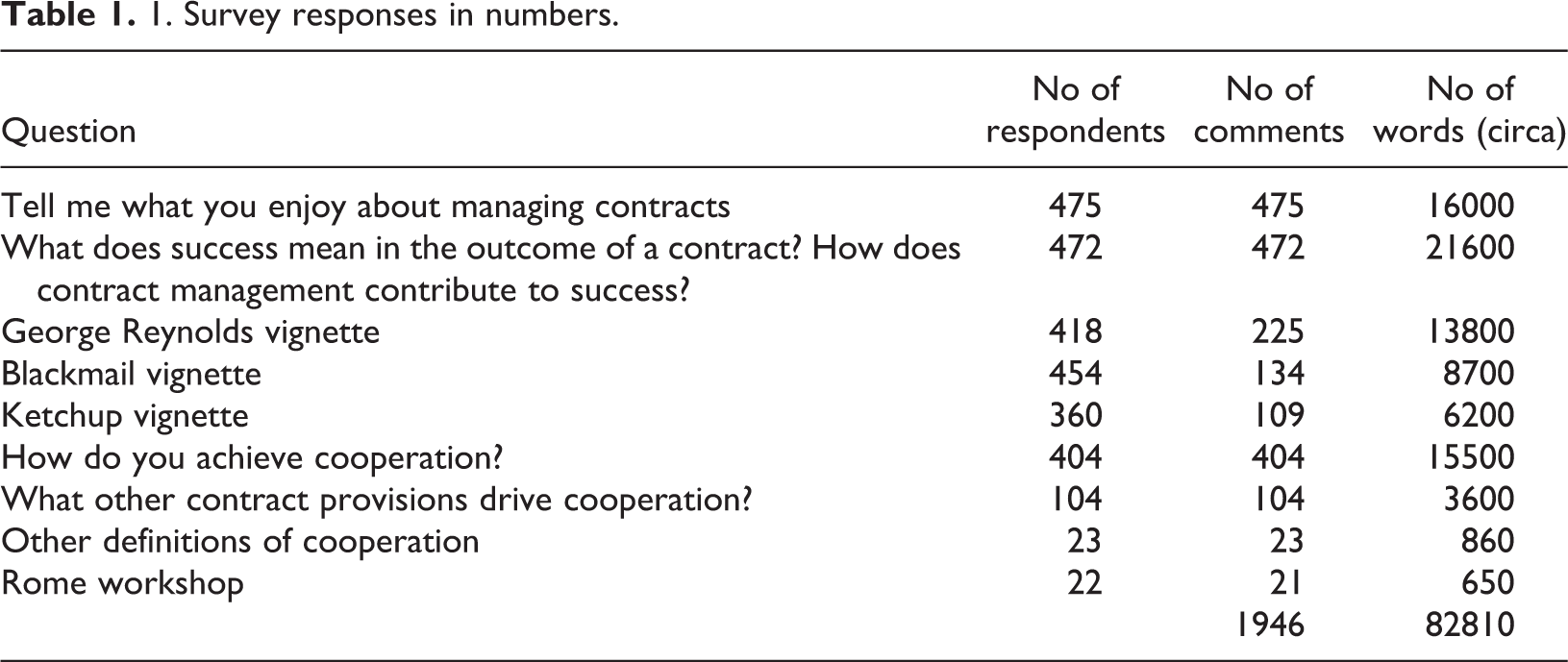
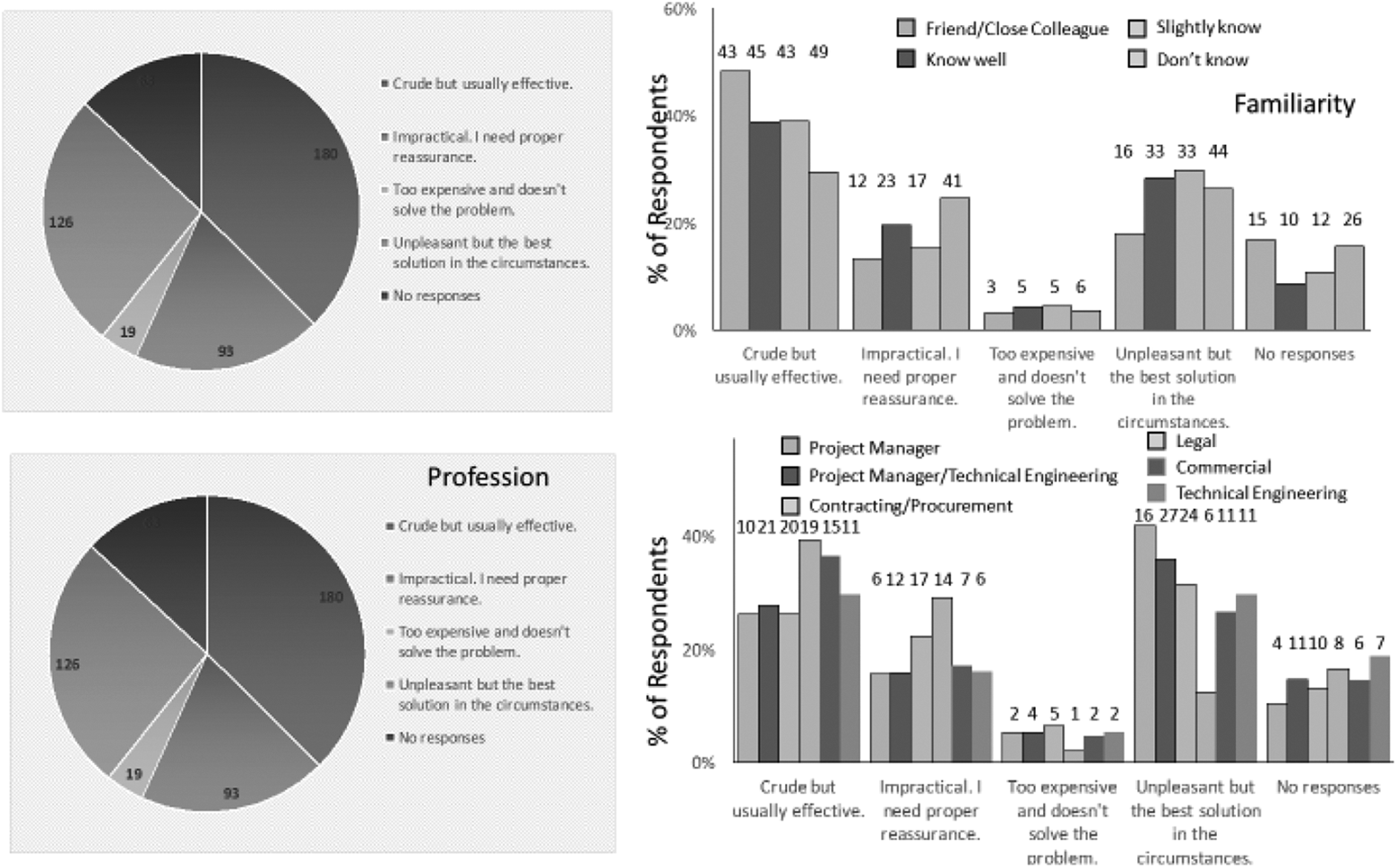
The survey (Table 1) provides significant and original working-level detail of how contracts are made to work and how cooperation is achieved in practice. Further, respondents are experienced professionals drawn from a wide variety of backgrounds.
Respondents overwhelmingly consider cooperation to be important or mission critical. They define cooperation as high-level active cooperation and constructive engagement.
1. Survey responses in numbers.
Methods and results
I selected experienced contract managers who understand in broad terms the relevant background 1 to symbiotic contracts, who are in possession of underlying commercial common sense and could be described as the notional reasonable people referred to by Lord Neuberger, when President of the Supreme Court. 2 They deploy profound, and wide-ranging experience and in their number we find a former CEO of a FTSE company, a former oil-supermajor Executive Vice President, City Law firm partners, facilities managers, outsourcing specialists, IT consultants, project managers, geologists, engineers, lawyers, procurement professionals and architects.
Non-random samples are typical in such studies (Bryman, 2012: 191) as commercial enterprises are generally unable or unwilling to provide population data to researchers (Robson, 2011: 276). I elicit from the ‘lived experience’ (Brinkmann, 2013: 47) (‘qualitative interviews…. lend themselves most naturally to the study of individual lived experience’) of this powerful, global, heterogeneous, creative elite a sense of what business necessity and commercial coherence (practical or commercial coherence being another of Lord Neuberger’s phrases) means. As you can see this was a global sample (Figure 1).
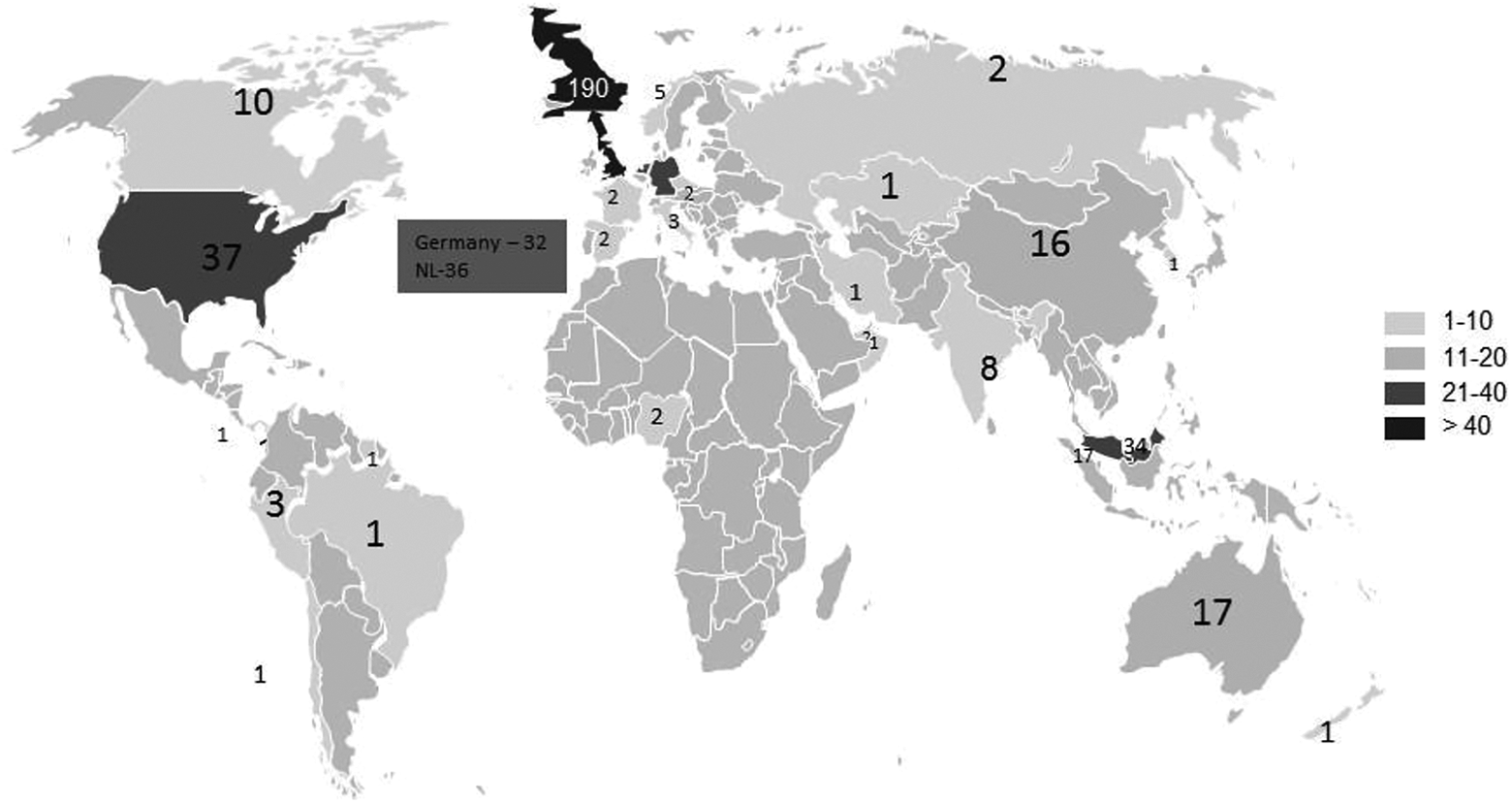
Participant location.
Of those responding 80% were male, 18.9% female. Professionally, (rounded numbers) 19% were project managers, 17% technical/engineers, 25% contracting/procurement specialists, 13% lawyers and 8% others. 60% emanate from an English Common Law legal culture, 10% US Common Law, 21% civil law, 2% China, 3% mixed (Scotland Philippines or South Africa), 3% other and 1.5% emerging jurisdictions such as the Former Soviet Union. Because it might show that as people move up the greasy pole they become more, or less, cooperative in their outlook I collected data on seniority finding that 31% were executive managers or directors, 12% general managers, 25% contract or project managers, 20% managers and 11% other. I also wondered whether attitudes would change with portfolio value; 7% had portfolios of up to $1 M, 17% between $1–10 M, 30% between $10–100 M, 26% between $100 M–1 Bn and 17% more than $1Bn. As less experienced respondents might be more inclined to manage in ‘tell’ mode and use formal contractual mechanisms more than those with significant experience; as people gain experience they may become more, or less, cooperative in their outlook I collected longevity data finding that 10% had 1–5 years of experience, 17% 6–10, 32% 11–20, and 43% over 20. By industry 107 come from an infrastructure background, 97 oil and gas, 35 engineering, 27 are consultants, 21 facilities or housing managers, 14 from education, 12 from legal, 10 from maintenance, 8 from energy. Many did not specify.
Open questions – Enjoyment and success
On opening the survey respondents were confronted with a direct and required open question: –
what do you enjoy about managing contracts?
Allowing them space and time to expatiate was intended to provide insight into their general thinking about contracts and contract management. Responses broke out into four themes – management, intellectual challenge, meeting people/variety, and outcomes/performance. One former direct report, taking advantage of a new relationship, said: –
Much like you, I enjoyed a good fight in the early part of my career. More recently, I have learned the value of collaboration and am always now seeking to have the other party working for/with me.
Management, mentioned by 266, involves the creation and management of relationships, collaboration and teambuilding, problem-solving and conflict resolution. Respondents refer to working to the spirit rather than the letter of the contract, using the contract to ‘drive a strong relationship’, being ‘collegiate’ and ‘achieving common aims’.
Intellectual challenge, mentioned 159 times, was described as: –
…orchestrating all these elements to work coherently and achieve the individual and overarching goals. A bit like getting the pieces of a jigsaw to fit together. Two analogies for the price of one!
Turning business needs into hard and soft obligations (64),
dealing with complexity (24),
innovation (33)
109 mentioned: – meeting people, variety (36), interaction with other people (57) or cultural learning (16).
Outcome or performance was mentioned 285 times, in sub-themes of managing risk (29), finding ‘clarity’ (39), making the business smoother (35), creating value (54), delivery to time and budget (47). Respondents comment included: – ‘the sense of order’ contracts bring I enjoy building something that will be providing power after I’m dead. The enjoyment comes from finding the sweet spot whereby both (all) parties meet their objectives.
Nobody said that contracts provided a mechanism for punishing the other party or behaving opportunistically. I asked in another survey section whether risk and reward sharing mechanisms which ensure that a mutual or joint interest in the outcome of the contract would promote cooperation and 86.7% thought such provisions likely to promote cooperation or be helpful (Soper, 2020).
I then asked what success means in contract management and themes which emerged involved contract formation and negotiation, contract execution and contract delivery (Figure 2). Contract formation meant providing structure or ‘rules of the game’, aligning objectives, identifying risks, creating clarity, balancing risk and reward, and providing a forum for open discussion of expectations – ‘establishing a contractual relationship where each party fully understands the asks, needs…’. Fairness was mentioned 24 times and ‘win-win’ 21.
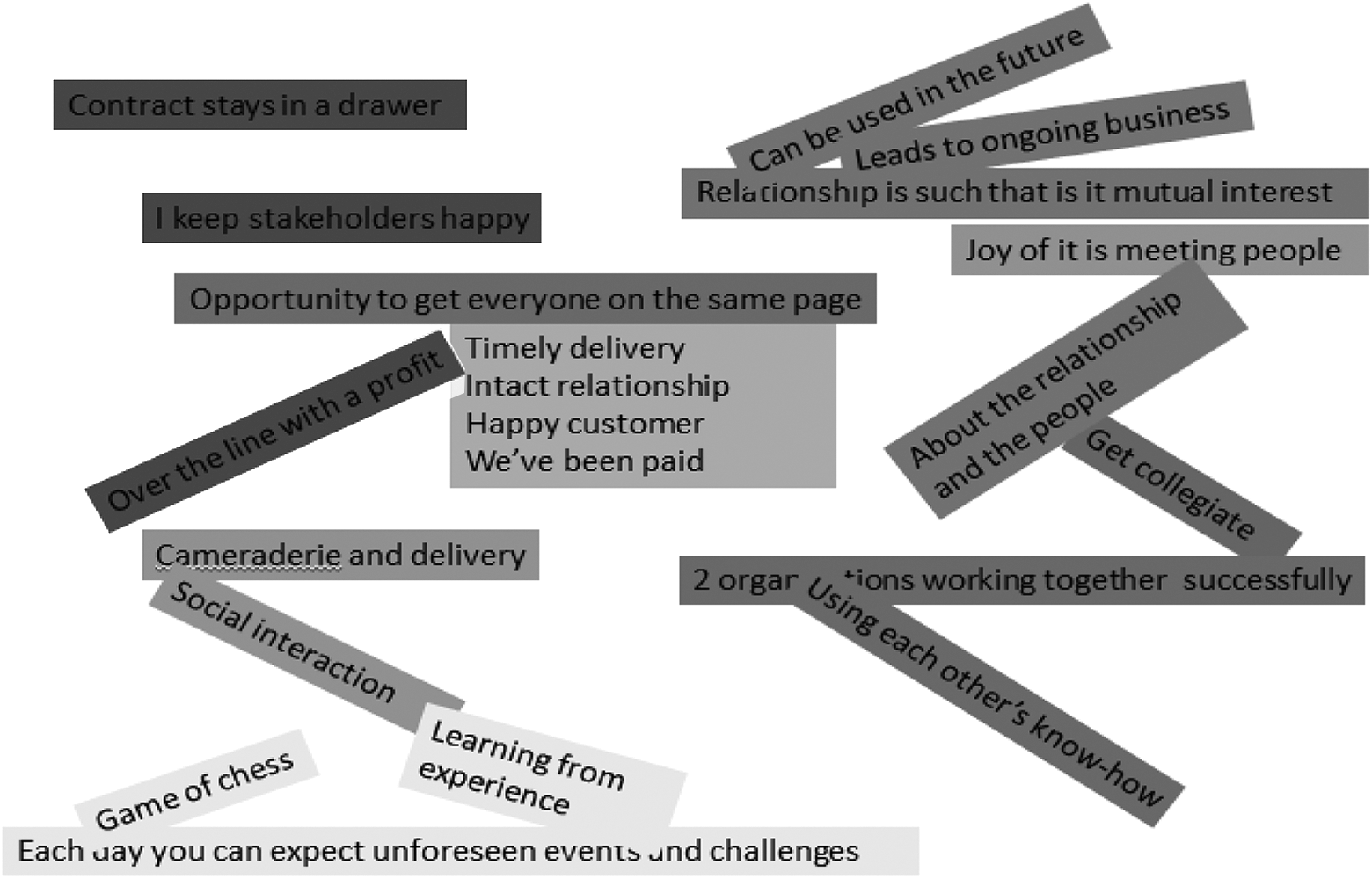
What success means.
There is a strong, highly practical focus on management, the joint nature of the contract, getting the contract performed successfully, and creating value. Interviewees referred to the contract as – ‘For planning’; ‘A governance mechanism’; ‘A roadmap for successful business’; and ‘A management tool’.
The vignettes/case studies
I created case studies using my professional experience and real-life Court cases. They provided a platform to draw comparisons between judicial pronouncement and the needs of the contract manager in the firing-line. a supplier, having fixed a defective machine, refuses to provide an explanation of the cause. a manager with complete discretion must allocate site accommodation. time is tight, and a critical subcontractor refuses to perform unless more money is offered. an employer is making thoroughly unreasonable monetary deductions for defective performance.
Vignette 1 detail follows.
Vignette 1 – The power and the story
You are George Reynolds, the owner of a business which makes and sells MDF, a material used in many different applications, but most widely known for kitchen worktops and you are the market leader for these. As the business expands you need new premises and you find a suitable location in the North of England but there is no connection to the electricity grid. The Grid’s price for a connection is very high and you elect to buy a gas engine, as there is a high-pressure gas supply to the site, and you also instal a back-up diesel generator for emergencies.
At first all goes well. The gas engine produces a stable supply and you are able to run at full capacity. However, it develops a vibration and, after consultation with the supplier, you continue to run it. The vibration gets worse and the engine shuts down. The supplier returns, carries out some work on the gas engine, assures you that all is well and leaves. It works again but the vibration returns after a short period, the supplier comes back to the factory, fixes the gas engine again, assures you, again, that all is well and leaves.
This pattern repeats until the supplier advises you that the engine will have to be returned to their factory for repair and you agree to it being uninstalled and returned. During the absence of the engine your line is running at 60% of capacity and other options such as arranging a Grid connection, or a further diesel generator are extremely expensive and very difficult.
After a short period, the machine is returned, reinstalled and appears to work well. You ask the supplier for a report on what had caused the problem, how it had been fixed, and reassurance. The supplier refuses to provide a report. The supplier takes the view that you have a working gas engine and that this is the extent of his responsibility. You are pretty surprised and pressurise the supplier for a report, escalating matters because you need the reassurance and the gas engine is critical to you; another interruption in power supply would cause you major problems. You explain this to the supplier. The supplier continues to refuse to supply a report.
One respondent aged ‘at least ten years’ in a similar situation.
4 interviewees discussed this vignette – they wondered just what was going on: – How much trust do I have? I’m not comfortable. I need an absolute guarantee – I think the things work by magic anyway. Why won’t they tell you? They’re hiding something! indicate that there may be commercial consequences. In the end escalate and talk. Keep Boy Scout badges polished – don’t give them any bricks to throw back.
225 other respondents commented, mainly proposing talking to the supplier or trying to obtain a better understanding of what was driving the supplier’s behaviour: – sit down with the customer to try and negotiate a suitable outcome. If the understanding of the report is the goal…there ought to be some compromise. Ultimately you have to find a working relationship to get through these type of issues. Life is too short to continue along this stand-off vein! A discussion can be fruitful for both sides, if this will result in a win-win-situation: GR needs warranty and the supplier expects comprehension. Holding back payment is a one-off trump card and if Client is reliant on the supplier in the longer term this may make matters worse.
In general, reaction is analytical. Respondents want to understand why the supplier is behaving like this and to find a way of getting the report; mainly by discussion and negotiation. A few thought that threats, such as blacklisting, or taking service business elsewhere might help. Escalation or leveraging the relationship was mentioned by many. Answers are characterised by a desire to play it straight, get to the heart of the problem and find a commercial solution.
I asked detailed questions to determine what respondents would do next and which remedies might work.
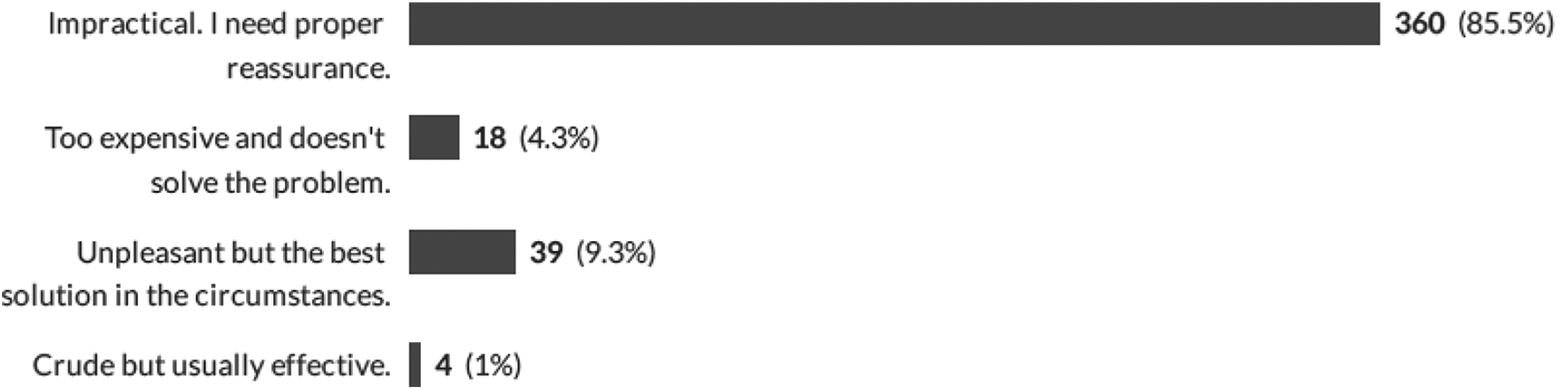
Sigh. Reluctantly accept the situation.
This is the result I expected; with a large majority loath to accept the supplier’s brush-off. Some respondents maintained that a report would not solve the problem. It might, however, begin to restore any confidence that had been lost in the machine.
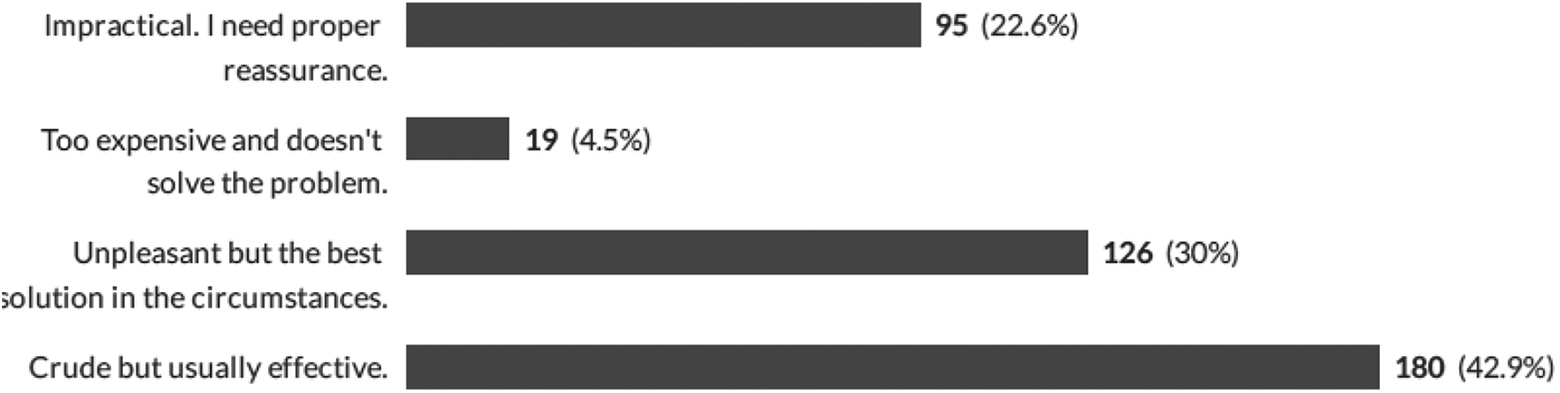
Make sure the user group for this model hears of the problem.
User groups are usually manufacturer organised, by invitation, fora established to allow users to exchange experiences and opinions. For example, the creator of this socio-legal field, Stewart Macaulay refers to ‘gossip exchanged by purchasing agents and salesmen at meetings…of associations…’ (Macaulay, 1963: 4). Lawyers tended to be a bit averse to this solution.
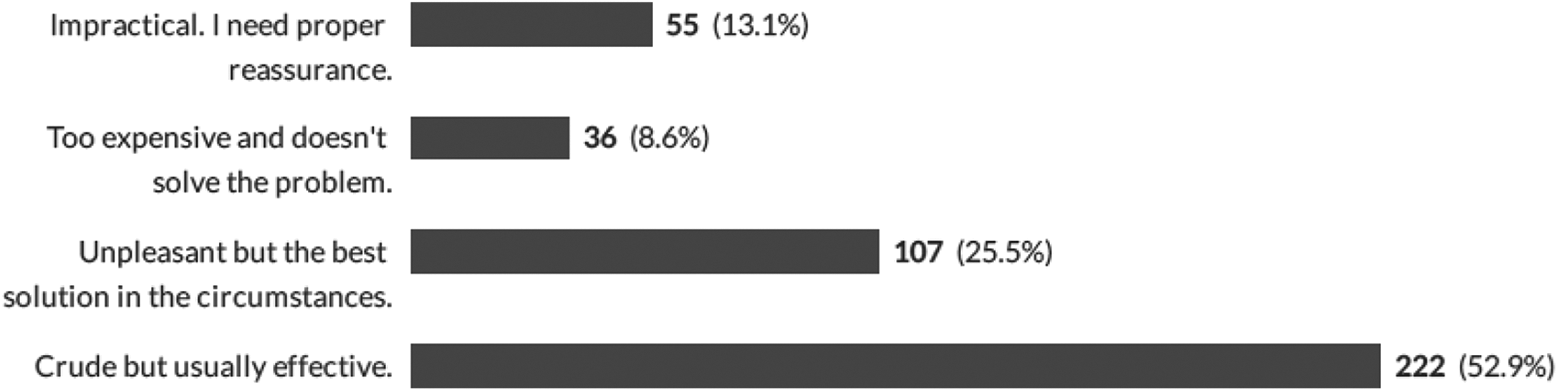
Refuse to pay outstanding bills.
In the case of a sophisticated machine such as a gas turbine a manufacturer will usually make serious money (perhaps 90% of the total profit made on such a machine) in the aftermarket and threatening future revenue may be effective. Interestingly, many lawyers see it as impractical.
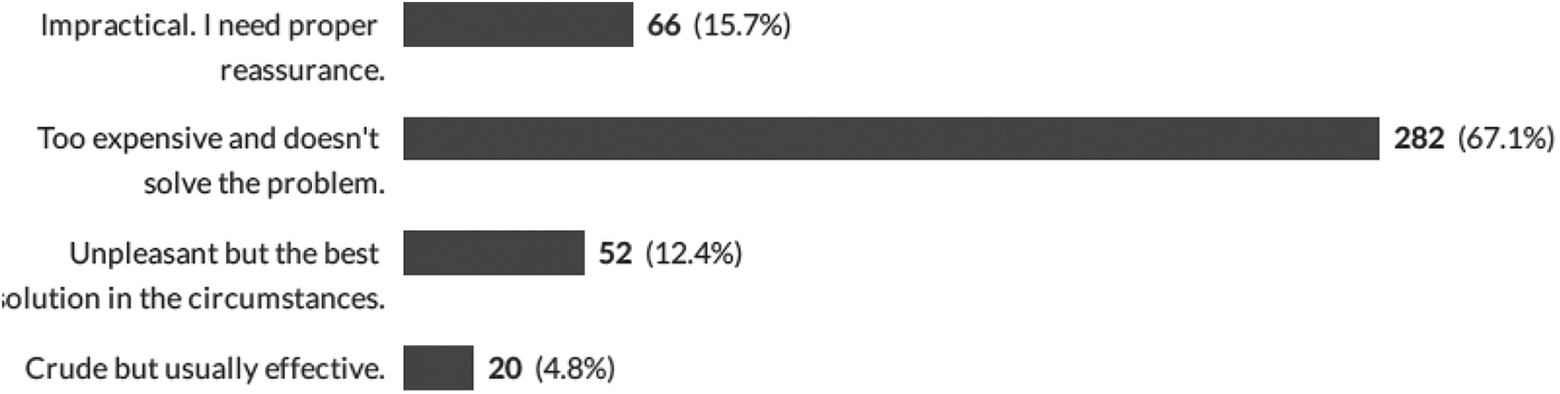
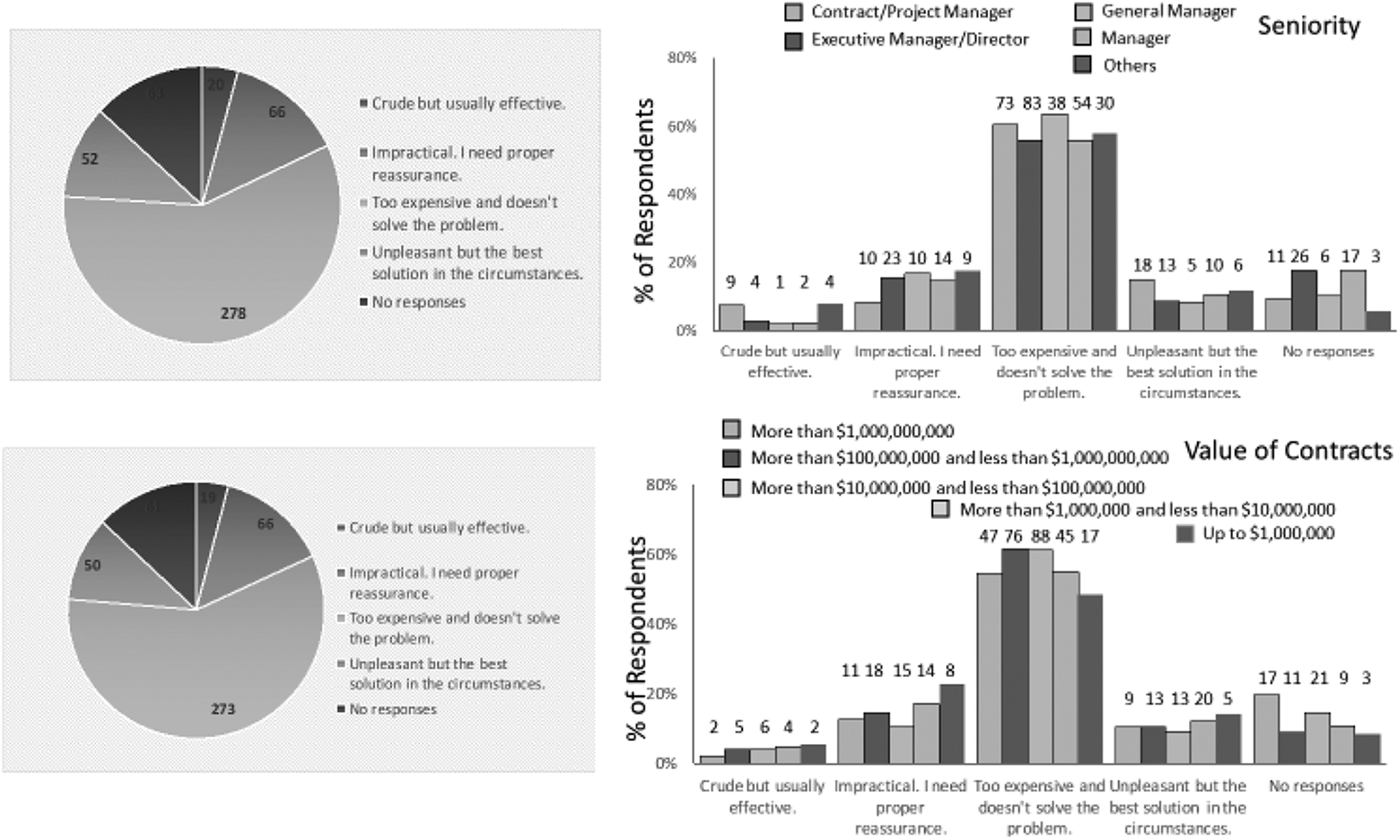
Terminate. Reject the machine. You have wholly lost confidence in the machine and the supplier.
Overwhelmingly, 83% considering this too expensive or impractical, consistent across sub-groups, commercial players eschew termination. They want to make the contract work. There is a willingness to use self-help remedies as we can see from 4.2 and 4.3 but those remedies fall short of termination. Around 40% of outsourcing respondents thought termination effective whereas 100% of finance people thought it too expensive.

Provide for fast track binding procedure allowing you access to the supplier

Provide a fast track process which could force the supplier to provide you a report.
I suspect that these remedies are popular as they preserve the contract and provide the reassurance of a report. They seem to support wider access to fast track adjudication, now available in the construction industry (Soper, 2021: 19). There’s little apparent difference between them bar the possibility that the supplier may not always produce a full report or that internal reports may be indigestible to the commercial user.

Allow termination and rejection for non-cooperation or unreasonable behaviour.
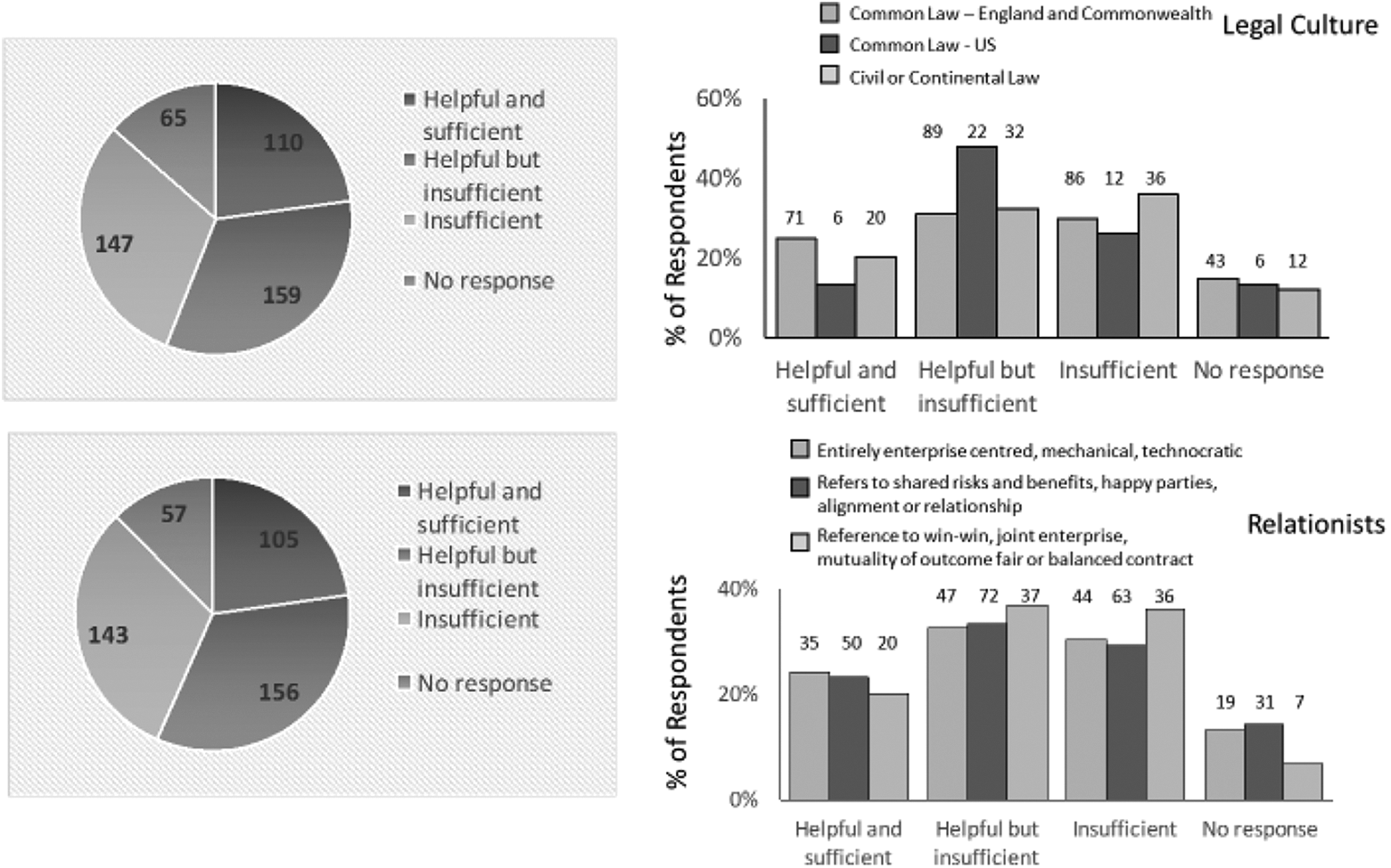
26.6% thought that this might put an end to the matter. 73.5% considered it helpful but insufficient or insufficient. Notwithstanding the egregious nature of the refusal (in Ritchie Lord Hamilton referred to a ‘lack of candour’ and Lord Brown said that Lloyds ‘adamantly refused to reveal the nature of the problem’) respondents show a significant preference for information over termination. Respondents show a significant preference for information over termination. Interestingly, those with a US Common Law background were more likely to consider termination to be helpful.
Cooperation themes
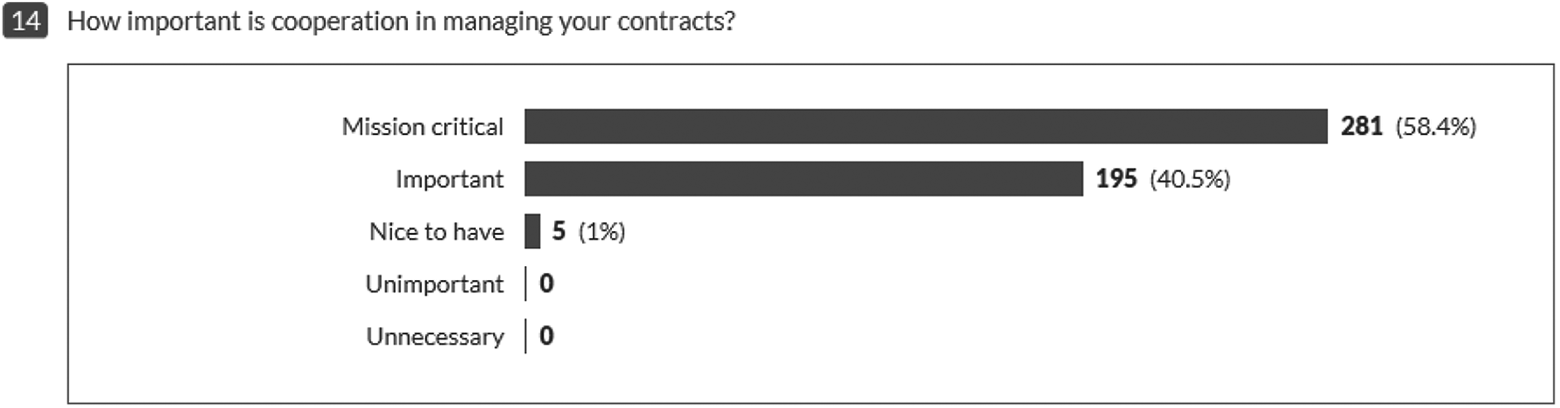
How important is cooperation in the management of contracts?
99% said that cooperation is mission critical or important, describing it as ‘top-max’, ‘everything’, ‘absolutely critical’, ‘key to success’, or ‘don’t get the job done without it’.
Taken in conjunction with the result below showing a preference for high level cooperation, not mechanical cooperation but real working together for a common objective this is a very striking finding.
Around 20 respondents managed long-term supply contracts or transactional contracts. 60% in this cohort say that cooperation is important, and 30% that it is mission critical differing, expectedly, from the 30.5% and 58.5% respectively in the whole sample. Lawyers are outliers, more likely to be in the ‘important’ group than ‘mission-critical’.
What does cooperation mean?
Interviewees mentioned flexibility, trim/negotiate, give and take (11), mutual understanding (7), the need to ‘talk things out’, resolve issues (15), communication (10), keeping ‘friction to one side’ or other management points (14). Others commented that cooperation can ‘descend to a nice chat’, that some formality is required that it isn’t a question of ‘fairness’, that ‘woolly stuff’ is insufficient and ‘blackmail is old school’.
Underlining this, a question asking whether contract provisions which discouraged late notification of problems, applying disincentives and requiring open and constructive communication would promote cooperation resulted in answers which agreed that these were very likely to do so by 39% and helpful by 46% (Soper, 2020: 136).
What cooperation means
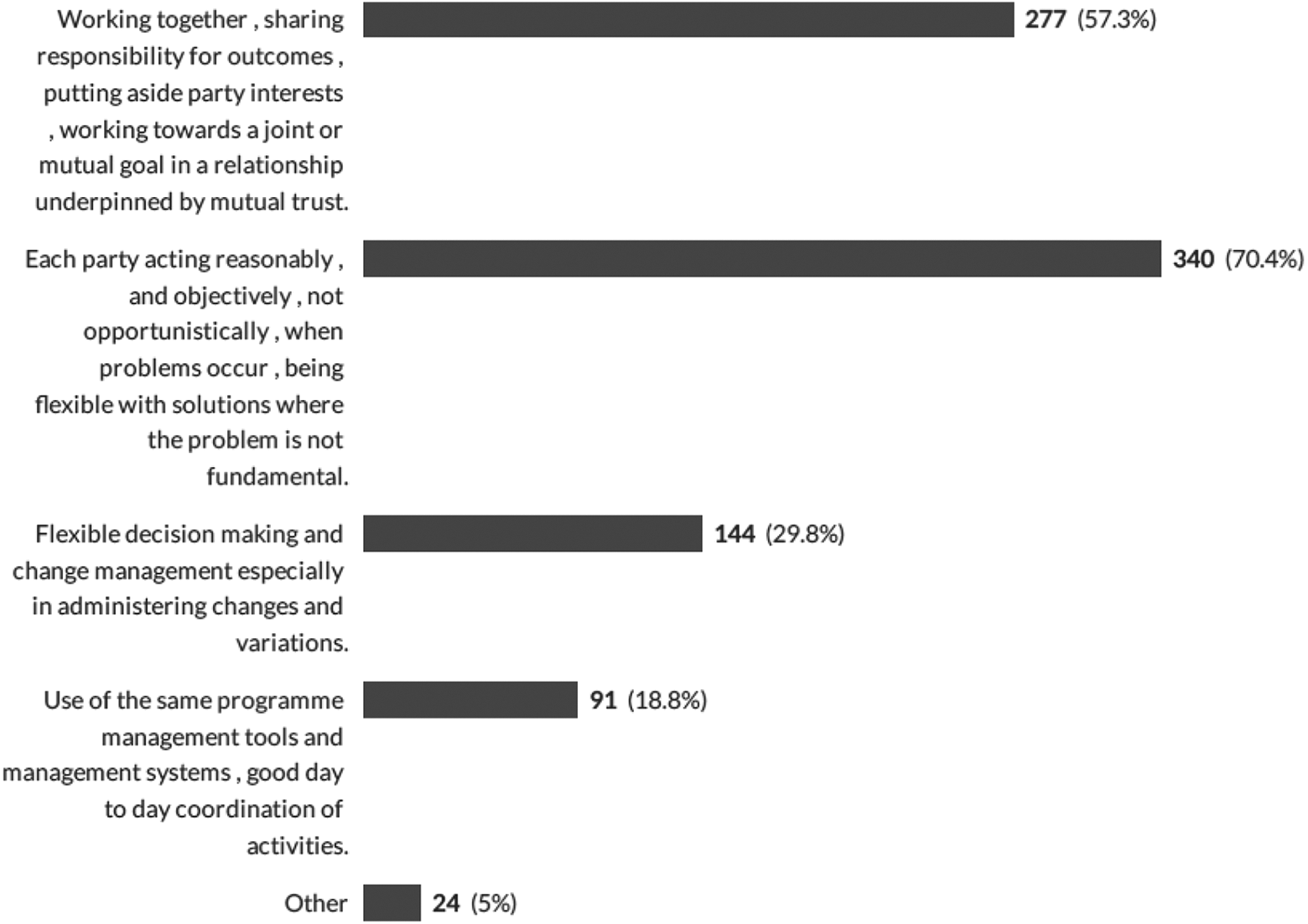
481 responded to a request for a definition of cooperation. 275 selected the ‘high-le vel’ answer: –
Working together, sharing responsibility for outcomes, putting aside party interests, working towards a joint or mutual goal in a relationship underpinned by mutual trust
340 selected this version of Judge Toulmin’s 3 deathless definition of active cooperation: –
Each party acting reasonably, and objectively, not opportunistically, when problems occur, being flexible with solutions where the problem is not fundamental
Toulmin J’s version, longer of course, was: –
It is well understood that the design and installation of a computer system requires the active co-operation of both parties…The duty of co-operation…extends to the customer accepting where possible reasonable solutions to problems that have arisen. In the case of unimportant or relatively unimportant items that have been promised and cannot be supplied each party must act reasonably.
99%+ selected one or other of these options, either on its own or in combination with others. Around 23% chose the top option alone and 30% option 2 alone. Conversely, around 1% chose only one of the two bottom options.
Summary
There are major differences between my study and previous studies. I asked experienced commercial players to answer open questions about the wider frame of reference, their day to day actuality and used real-life vignettes to add detail and provide arguable confirmation of results. The survey results are broadly aligned with other empirical results when questions and context are comparable. For example, as I note in (Soper, 2018) Chapter 3, and above (citing Macaulay), one can compare Macaulay’s, and Ernest Weintraub’s (Weintraub, 1992) results with mine and find good alignment; so where there are comparable empirical works they tend to underscore that my results are credible and robust.
Stewart Macaulay in his pioneering and seminal study, concludes that ‘Contract, then, often plays an important role in business, but other factors are significant’ (Macaulay, 1963: 67). By ‘contract’ he appears to mean the ‘legal’, hard, black-letter element of the deal. To respondents, that hard part is one element of a matrix, which comprises hard and soft elements; each of which must work.
The hard elements are of two types. One is the hard-core ‘contract’, which few want to use and that means ‘terms and conditions’, the ‘legal’ elements. The other hard element includes scope, objectives, risks, and governance. Respondents express a clear desire for clarity here; one saying that it allows ‘service expectations, delivery, management information and costs to be discussed openly’.
Others say: – I might get the contract out but that’s a failure for everyone Non-enforcement is the key
This means talking, picking the ‘phone up, trying to resolve problems in a business-like manner. Macaulay (Macaulay, 1963: 793) quotes businessmen on how you solve problems: – You get the other man on the telephone…you don’t read legalistic clauses at each other if you ever want to do business again…. Customers had better not rely on legal rights…. [I will] not be treated as a criminal
The soft elements also comprise two types. One is the informal element of governance and deal-making. The other is informal relationship-building, including ‘boots on the ground’ and social events, which underpin success by helping each party to understand others’ drivers and opinions and ensures that formal and informal channels of communication are kept open and used appropriately.
The purpose of formal and informal relationship-building is to ensure that communication channels are open and clear; that everyone knows who does what, or, when things go awry who to talk to and how to talk to them and what fixes are possible within reasonable boundaries. It also recognises that contracts are neither perfect nor complete and that there is room for legitimate debate as to what they mean, notwithstanding that such debate should be conducted openly and constructively. There is no emotional content; it is business driven, allowing the contract work to proceed in a recognisable form. Steven McCann says that: –
…. there is a link between the public partner’s contract management style for achieving a positive organisational culture and satisfactory delivery of VfM [value for money]. (McCann, 2014: 126)
This is another reason why parties cooperate. It is cheaper!
My survey respondents were offered the option of reciprocation in Vignette 4 and few found the idea attractive; just 6% rating as their first choice and 12% as their second choice. It was said that it involved ‘stooping to their level’, would dig ‘deeper trenches’, or ‘relationships would sour’. Tit-for-tat, the bedrock of Prisoner’s Dilemma or game theory, simply does not figure in the management of these modern complex contracts. Pragmatism reigns; a realistic, problem-solving approach to the contract and its difficulties. Those differences reflect the real-world nature of my study and the proximity of respondents to the actuality of managing contracts. Another interesting point is that there is very little gender-based divergence which appears to contradict some feminist theory (see eg Hunter et al., 2010: 188).
There is a marked reluctance to use punitive measures or to terminate but value is seen in fast track dispute resolution, escalation, senior management intervention, negotiation, communication, and professional governance. These require constructive engagement, that the parties talk, communicate, and work together to find the cause of the problem and agree solutions. This requires time and effort, as parties must make proper endeavours to find space and time to consider and unravel issues and to put the lid back on the can of worms. This underlines the conclusion that respondents are more interested in performance than in revenge, the task is about making the contract work. This reluctance to punish is in line with Beale and Dugdale who say that ‘Buyers [did not] seem to be very keen to make use of [liquidated damages]’, (Beale and Dugdale, 1975: 55) a conclusion shared by Lisa Bernstein (Bernstein, 2015: 571–572). A former direct report of mine with huge experience said that: –
Although “High interest rates to be charged for underpayment of invoices or overcharging” might seem appealing, my experience is that such charges are never invoked.
In a different vignette one respondent said ‘I would not actually use [punitive measures] but indicate that I could do. Then say, that would do harm to both sides, so let’s rather focus on establishing an effective dispute resolution mechanism’. And Macaulay (Macaulay, 1977) quotes a survey of Polish managers who talk of the need to use threats ‘intelligently’, saying that penalties work well ‘as a threat’ (Kurczewski and Frieske, 1977). Steven McCann quotes a senior PPP manager saying ‘why would you abate, even if you’re entitled to under the contract? It doesn’t serve any purpose. You have a right to abate, and…the state has a very big stick, but you want to use it wisely. If you abate them, it hurts them financially, but the relationship is important and it’s about give and take’ (McCann, 2014).
Termination carries very little support. It may derive from the fear of the cost of change; mentioned by several. One observed (law and economics scholars will recognise a transaction cost analysis in this comment): –
I’d still negotiate”. Termination is still disruptive for both parties and it’s possible after negotiation…that they’re still cheaper, especially taking into account the cost to change.
In broad terms, what I gleaned from respondents is consistent with other studies. However, there are significant differences in that what I say is that the contract creates the relationship; not vice versa. The relationship may pave the way for future business, but its raison d’être is that of making the contract at hand work. It follows the contract or contracting process; it does not lead it.
The survey provides a definition of cooperation, a clear opinion that cooperation is necessary and many hints and tips on how to achieve it. The requirements of good communication between the parties, timeous and accurate information flow, solid formal and informal governance, and reasonable attempts to solve problems and disputes (constructive engagement) are essential to successful performance. Parties cooperate to make the contract work, in part because people are generally cooperative, and partly because making the contract work is part of the deal that they have done; they feel somewhat obliged to cooperate. Cooperation is also necessary to make these symbiotic contracts work; that’s another reason why they cooperate.
Further research in these areas would help to build on the work which I have carried out How do you measure governance? What metrics might one use? How might one split hard and soft governance elements to this end? How do you draft effective and enforceable cooperation clauses? I have made some headway in this in my book but I have not done the hard yards of actual drafting.
Cooperation in contract management involves complex human and corporate interaction. It is a social and a business process, intellectual and managerial in nature, structured and unstructured. It requires business-like interaction, efficacious, formal and informal, between people and within businesses/enterprises working towards a successful contract outturn.
In summary cooperation is achievable. The basic themes include management, reasonable behaviour, relationship management, governance and problem solving. The building of personal relationships is essential to success and the creation of cooperation through mutual understanding, role clarity, good communication and formal and informal problem-solving mechanisms. It requires a relentless focus on managing the contract and understanding the counterparty, the real deal and the paper deal.
Footnotes
Declaration of conflicting interests
The author(s) declared no potential conflicts of interest with respect to the research, authorship, and/or publication of this article.
Funding
The author(s) received no financial support for the research, authorship, and/or publication of this article.
