




Abstract
Public procurement scholars have been striving to identify technical and behavioral competencies to drive toward professionalization. However, there is no vetted body of knowledge that practitioners and scholars can use to establish roles and responsibilities. This empirical study outlines a logical process to identify the foundational elements of the body of knowledge, specifically technical competencies, serving as the building blocks for advancement toward a recognized profession. Findings suggest that 87 job tasks can be classified under 6 job domains that contain many of the components and conceptual constructs for the field of public procurement. These domains can improve understanding of the knowledge, skills, and abilities necessary in public administration.
Keywords
Introduction
Recent scholarship suggests that public procurement is an emerging academic discipline (Flynn and Davis, 2014; McCue and Gianakis, 2001; Snider and Rendon, 2012; Thai, 2001) and a maturing profession (Harland et al., 2006; Prier et al., 2010; Steinfeld et al., 2015). According to Snider and Rendon (2012), public procurement is a core administrative function of public organizations, and, as such, it should be part of the curriculum of all Master of Public Administration (MPA) degrees, like budgeting, finance, or human resource management. In fact, they posit that public procurement can be situated in MPA programs, either by integrating public procurement into existing courses, developing individual public procurement courses, or establishing a concentration in public procurement. Snider and Rendon further contend that “as public administration educators, we fail to serve our students well when we fail to equip them with the knowledge and skills they need to serve the public well” (2012, 342). However, to suggest that public procurement has reached a disciplinary point of maturity where curriculum has been vetted and established within MPA programs may be premature. Snider and Rendon, as well as Cooper (1980), MacManus and Watson (1990) and Thai (2013) point to the fact that public procurement is no longer a “clerical” function within public organizations, and that educational and training programs must understand the axiomatic nature of the developing discipline.
To do so, the roles and responsibilities in public procurement must be understood with the underlying activities identified to establish how procurement influences public administrative outcomes. The purpose of this research is to identify the tasks necessary to perform the public procurement function, and the level of knowledge that is required to perform those tasks. In doing so, the technical competencies can be identified, and their attendant competency domains, to establish the basis from which education and training, certification or licensure requirements can be established. By identifying the technical competencies necessary to perform on the job, general standards of practice can be established that will provide the foundational elements for developing a public procurement body of knowledge (PPBOK), and future research can develop more robust behavioral aptitudes that describe the knowledge, skills, and abilities (KSAs) facilitating the application of technical knowledge to job-related behavior. As a result, the following two research questions will be addressed. What are the important job tasks performed by public procurement practitioners? What is the level of knowledge necessary to perform those job tasks?
A descriptive research methodology is employed in this study to illustrate and empirically describe the current state of the knowledge. The tasks that are deemed important by practitioners and requiring knowledge to perform the task above basic knowledge will provide the foundational elements that should be included in the PPBOK. The findings demonstrate that the strategic elements of the public procurement practice serve as the foundation of a PPBOK based on the technical activities that are reported by practitioners as being most important and requiring the highest level of knowledge.
Toward a PPBOK
Public procurement continues to mature from a subfield of public administration into its own field of practice and scholarship. There is a growing awareness that a body of knowledge (BOK), which is predicated on a systematized mapping of the knowledge of certain job tasks that are important to the function of public procurement, needs to be identified (see Snider and Rendon, 2012). However, one of the major limitations of developing the disciplinary boundaries on which academic programs and professionalism in public procurement can rest is the lack of an articulated BOK that differentiates public procurement from other professions or occupational domains. The gaps in the literature are filled herein by formally outlining this process to push closer to establishing a BOK for public procurement practitioners.
A BOK serves as the intellectual foundation of any field, and the BOK then forms the basis for establishing academic programs, development of educational and training curricula, and identifying the criteria for accreditation and certification of specialists, including licensure. According to Krause (1996), a BOK is typically maintained by a recognized learned society or professional association, and the BOK is generally known by practitioners and their associated stakeholders as norms of practice. The BOK can be articulated in a variety of ways including conferring university degrees; certification by accredited bodies such as the International Organization for Standardization; or legislated through government regulation in the cases of licensure and standards of practice. A BOK should constantly adapt to changes in the environment because of knowledge gained through scientific inquiry, through either deductive or inductive reasoning. Although more on this will be discussed later in the methodology section, the current research uses abductive reasoning to establish the foundational elements of a working PPBOK.
A BOK, however, is not simply a reading list of academic articles and textbooks that describe a profession, nor is it a collection of specific job tasks that are required to be performed by a specific occupation. Fanning and Camplin (2008) contends that a BOK establishes the necessary competencies that are manifest in a taxonomy with a specific level of proficiency stated for each competency. Consequently, the BOK is a recognized set of competencies (the KSAs necessary to adequately function within the occupation and the behavioral competencies necessary to perform job tasks successfully) that is based on past and emerging practices, which are regularly vetted by stakeholders, for its relevance and currency.
A BOK supports the view that an occupation’s and a profession’s academic basis defines its jurisdictional practice (Brooks, 2013; Guerin and Martin, 2010; Morris et al., 2006). Yet to date, there has been limited success in identifying the jurisdictional boundaries, course content, and educational standards for public procurement (Snider and Rendon, 2012). As a result, public procurement’s intellectual domain and specific practical competencies lack public confidence and professional standing. While the development of an academic identity and professional recognition evolves, public procurement operates in the public sphere in which the “professional” bureaucrat is uniquely complicated (see Gargan, 1998), and the BOK that underpins the field has not been widely recognized by practitioners and stakeholders alike.
Situating public sector procurement in a BOK
Because public procurement operates in the public domain, delimiting a PPBOK includes numerous political issues that raise both procedural and operational questions (Johnson et al., 2003; Roman, 2014). After recently conducting a literature review, Trammell et al. (2020: 665) concluded that in “order to further establish the legitimacy of public procurement as a subfield of public management, the field of public procurement needs to work on its disciplinary credibility.” Furthermore, there are additional questions surrounding the extent to which this subfield of public administration is specialized enough to be considered autonomous (Prier et al., 2013; Roman, 2014). In other words, it is still debated whether public procurement itself is sufficiently distinctive from other subfields of public administration to justify a unique BOK. This issue is similar to other occupations seeking professional recognition, such as project management or human resource management.
In terms of knowledge domain specificity, research has shown that public procurement can be much different than private sector procurement (Bowersox et al., 2002; Murray, 1999; Quayle, 2000; Telgen et al., 2007;). However, this distinction between public and private procurement may not rest in the tasks necessary to perform technical competencies, but instead may lie in different environmental conditions impacting how and what tasks are performed (Johnson et al., 2003). The notion that the public sector operates in a political environment that focuses on transparency, accountability, and process integrity makes the technical aspects of procurement in the public sector distinctly different (Frumkin, 2001; Khademian, 2000; Klingner et al., 2002; Romzek and Johnston, 2005). Moreover, even under the general rubric of procurement, it is admittedly debatable whether the knowledge, skills, and functions of the public job are unique enough to warrant a self-identified area of practice from the private sector. While the assumption in the current research is that public procurement is esoteric enough to warrant self-identity compared to its counterparts in the private sector (Steinfeld et al., 2015), it is not central to the research herein which documents and maps what public procurement practitioners actually do in their jobs. The current research is confined to the public space, and if the findings are applicable to the private sphere, the more general and thus the more robust the findings.
Within the public arena, public procurement practitioners serve many roles and responsibilities, but ultimately the functional purpose of these practitioners is to reduce cost and maximize value to their respective governments and the broader communities they serve. Generally, public procurement practitioners consider price, quality, availability, reliability, and technical support when choosing suppliers and undertaking specific procurements, yet they operate in a political environment and are thus responsible for the integrity of the procurement process. Consistent with this, they promote transparency and open government, and effectuate relations with various businesses that encourage competition – all while addressing competing policy concerns such as serving women and minority-owned businesses or encouraging local preferences. Ultimately, public procurement practitioners have multiple roles and responsibilities, and how these are operationalized in practice is typically codified in legislation, best practices, and administrative norms.
Tacit knowledge involving political issues, cultural issues, and value-orientations is a crucial element in the public sector as well (McAdam and Reid, 2000). Public procurement practitioners therefore are expected to contribute to the strategic policy process by interpreting what “good service” means through reconciling the diverse values of constituent groups and deeper community cultures (Chen, 2009) coupled with the need to promote certain values inherent in the process (such as transparency, equity, accountability, and responsiveness). Public procurement practitioners ensure accountability by balancing numerous sources of authority including board policies, purchasing guidelines, public hearing requirements, and civil service regulations (Morgan et al., 1996). If accountability is degraded within the procurement function, such as through some form of corruption, or, as Nanda (2003) notes, violating the trust clients have in the professional, there is a chance of eroding democracy and impeding citizen participation, leading to failures in advancing public values (Bozeman, 2007).
Considering the copious dimensions of KSAs that may be theoretically necessary to perform the procurement function within a variegated political, economic, and constitutional framework, the difficulties of KSA-identification necessary to perform the job that, in turn, are used in developing a PPBOK are obvious. Moreover, prior to establishing the PPBOK, a necessary first step to identifying the attributes of the PPBOK is to recognize the important job tasks performed by practitioners and how proficient one needs to be in order to function within the field – the aim of this research.
The combination of the important job tasks performed and the level of knowledge necessary to perform those job tasks are latently indicative of KSAs that are required to complete such activities. That is, those job tasks that are deemed important by practitioners, relative to the level of knowledge necessary to perform the tasks, can establish the foundational elements of the KSAs necessary to, but not sufficient for, doing the job of the public procurement practitioner. Subsequently, these job tasks can be examined for relationships which shed light on broad competencies (groupings of specific job tasks) about what public procurement practitioners actually do on the job. Then, by examining how important is the knowledge of a job task to the function of public procurement by practitioners, the essential competencies can be linked.
While attempting to identify job task competencies, one might suggest that the practice should simultaneously be contextualized in terms of its broader operational position. That is, procurement practitioners perform a group of job tasks, but how they operate and under what circumstances they function depend on the administrative state they serve, which can vary based on numerous political considerations. For this study, it is contended that practitioners must have the knowledge (whether a priori or a posteriori) to effectively perform “important job tasks” in public procurement, and these job tasks can be grouped into defined job competencies irrespective of the environmental conditions under which they operate.
Job competencies form the foundational elements to develop occupational profiles, workforce planning, curriculum planning, human resource management (such as writing job descriptions, pay, and promotion), certification and licensure, and of course, training requirements. Specifically, as Marzagão and Carvalho (2016) note, competencies can be classified as either technical or behavioral. Technical competencies reflect the knowledge required to perform a specific job function, while behavioral competencies describe the requisite KSAs that enable the application of technical knowledge on the job. In other words, technical competencies reflect what knowledge public procurement practitioners apply to their jobs, and behavioral competencies reflect how they apply this knowledge.
However, prior to defining those behavioral competencies it is necessary to identify the technical competencies essential to function within the job. Competencies generally, and technical competencies specifically, reflect the actual job tasks that are performed, and therefore form the basis for identifying behavioral competencies. That is, one must know what the job entails in terms of particularized functions (tasks), and then what non-technical competencies (behavioral) are necessary for practitioners to perform effectively in their job. Combined, both the technical and behavioral competencies form the basis of defining a PPBOK.
Methodology
Public procurement job analysis survey
To identify the important job tasks performed by public procurement practitioners and the level of knowledge necessary to perform those job tasks, this study utilizes survey data from a 2012 study conducted by the Universal Public Procurement Certification Council (UPPCC) of 2593 public procurement practitioners in the US. The UPPCC hired Prometric, Inc. to execute the job analysis, a firm that specializes in conducting job analyses, developing test specifications, and administering exams across a host of professional certifications. The development of the survey instrument by Prometric Inc. was consistent with The Standards for Educational and Psychological Testing (American Educational Research Association, American Psychological Association, and National Council on Measurement Education, 1999).
Prior to developing the survey instrument, 14 public procurement subject matter experts (SMEs) were identified. They were selected based on their years of experience, and their participation in leadership roles in various organizations, large- and medium-size municipal governments, state agencies, universities, and one member of the nation’s largest professional organization dedicated to public procurement, the National Institute of Governmental Purchasing (NIGP). Through a series of emails, telephone conversations, and on-site meetings, the SMEs identified 87 different tasks they thought were important to the job of the public procurement practitioner. In addition to identifying the job tasks to be included in the survey, the SMEs were asked to group the individual job tasks under different domains. For both the importance of the task to the job and the knowledge necessary to complete the job, the SMEs identified six domains: Procurement Administration; Sourcing; Negotiation Process; Contract Administration; Supply Management; and Strategic Procurement Planning. Each job task and knowledge statement were then grouped under one of these domains.
Based on those domains and the job tasks and knowledge of those tasks identified by the SMEs, a draft survey was pretested with various procurement professionals. The purpose of the pretest was to verify that the job tasks and knowledge of those tasks, as identified by the SMEs, are important to the work of public procurement professionals. The survey link was sent to 31 participants, 13 of whom completed the survey. Pretest participants were asked to review the survey for clarity of wording, ease of use, and comprehensiveness of content coverage. Comments were compiled by Prometric staff and reviewed with the SMEs. The survey was revised and finalized based on the review of the pretest comments.
The final survey instrument was sent to 36,564 procurement specialists who were members of state and federal procurement associations. 1 From the original list of 36,564, a total of 5584 contact emails were determined to be invalid or inactive, hence reducing the actual sample pool to 30,980. An additional open participation link was provided on UPPCC’s website for at-large procurement specialists. There were 2226 responses to the email invitation, and 367 responses were received via the open participation link on the website, for a total sample size of 2593 (8.4% response rate). It is notable that the survey instrument was not designed with this specific study in mind since the purpose of the job analysis was to identify positional task activities of public procurement practitioners for certification testing purposes, and therefore all the caveats associated with secondary data analysis apply to this study.
Research design
The research design employed herein is anchored in a two-step abductive process to logically establish the foundational elements of a PPBOK. This is accomplished in the following manner: (a) identifying the important job tasks performed and the knowledge necessary to perform those tasks; and (b) validating a classification scheme of the job tasks. The methodology is calibrated to illustrate a logical process that, when broadly applied, identifies and defines the foundational elements and competencies of the PPBOK.
Abductive reasoning is distinguished from the more traditional inductive process in that the latter tends to be more ad hoc and subject to greater heterogeneity in its inferential conclusions, but because the purpose here is to systematically authenticate some elements in the establishment of a BOK, an abductive approach is warranted (see Brenner-Golomb 1993: 304–306 esp.). The scientific and philosophical debate about whether there is a true difference between strict inductive and abductive reasoning, and the pitfalls associated with determining what is meant by “inference to the best explanation”, is avoided here (see Douven, 2017; Josephson and Josephson, 1994). Instead, the descriptive research design encapsulates an integrated approach that utilizes the experience and knowledge of a group of SMEs to inform the beliefs of individual practitioners.
Because the research design adapts elements of an intuitively rich Bayesian framework to generate knowledge about the foundational elements of a PPBOK, the abductive approach offers a more stable and coherent approach to the identification of foundational KSAs and domains than a purely inductive method would exhibit (e.g. Pearl, 2009; Robert, 2001: 507–518 esp.). Indeed, while abduction can be used for counterfactual reasoning (Pearl and Mackenzie, 2018), this research methodology does not technically rely upon inverse probability likelihood functions (McElreath, 2020). Instead, the abductive reasoning process utilized herein draws from both frequentist and Bayesian conceptual tools to draw valid conclusions about how to generate the PPBOK. So, the interest is not in the causal factors that produced the data for either SMEs or practitioners but, instead, it is a conceptually descriptive method to ascertain the foundational components of the PPBOK.
The unknown KSAs that comprise the PPBOK are treated as random instead of as fixed as they would be in a traditional null hypothesis statistical test approach. This Bayesian approach is borrowed in the sense that knowledge itself comprises beliefs about what are the tools and KSAs appropriate to producing procurement outputs and outcomes. Since each practitioner has their own beliefs about the KSAs and the domains under which they “should” be structured, the methods utilized are appropriate. In essence, conclusions instead of probabilities are abductively drawn from probability statements where the initial knowledge sets are conditioned on the observed inputs of SMEs to obtain conclusions about density functions of practitioners for those same SME inputs. Given KSAs identified by the SMEs, what is the distribution of practitioner KSA identification? Moreover, given the KSA domains ascertained by the SMEs, what is the practitioner distribution of KSA domains? Of course, this process is intuitively similar to Bayesian methods but departs from typical statistical Bayesian probabilities associated with posterior density functions that are described in Gelman et al. (2013).
Non-response bias
To determine if the respondents to the original survey were reflective of the general population of public procurement practitioners (non-response bias), and to address the low response rate, various methods were employed. In terms of non-response bias the survey respondent’s demographic characteristics were compared to both the NIGP membership dataset (approximately 15,000 members) and the U.S. Department of Labor, Bureau of Labor Statistics (BLS) (2015) Occupational Outlook Handbook. Simple comparative analysis was conducted examining gender, education level, tenure in the position, and tenure in government. The findings suggest that there were only minor differences found between the demographic characteristics of the survey respondents compared to those found in the membership list of the NIGP as well as the population profile identified on the BLS website (https://www.bls.gov/ooh/business-and-financial/buyers-and-purchasing-agents.htm). In addition, no claims are made regarding generalizability of the findings presented here, given the purpose of this research is to determine what job tasks are important to the procurement function, and what level of proficiency one needs to demonstrate the job task.
Survey design and instrumentation
The UPPCC survey instrument addressed performance and knowledge in separate parts of the survey for each of the job tasks (87 job tasks each for “performance” and “knowledge” sets). For the “performance” and “knowledge” question sets, the practitioner is asked the following in terms of each job task: “How important is performance of the task in your current role?” and “At what level does a professional in your role need to demonstrate the knowledge?” respectively. For the performance set, the survey responses are coded in SPSS accordingly: 0 = of no importance, 1 = of little importance, 2 = of moderate importance, 3 = important, 4 = very important. For the knowledge set, the responses are coded: 0 = unnecessary, 1 = basic, 2 = intermediate, 3 = expert.
To empirically confirm that the SMEs identified the important job tasks, and then properly modeled the individual tasks into the six latent domains, two approaches were utilized. First, the responses were examined with regard to how important the tasks are to the job and the level of knowledge a practitioner needs to perform the task. The tasks that are deemed important by practitioners and requiring knowledge to perform the task above basic knowledge will provide the foundational elements that should be included in the BOK.
The second approach is to evaluate how the individual tasks are grouped into the six domains; that is, technical competencies. In fact, if the groupings identified by the SMEs prior to issuing the survey are confirmed, then all 87 job tasks can be grouped into the 6 domains, where certain job tasks are perceived by respondents as important and others as not so important. To evaluate if the individual job tasks were classified correctly, analysis was conducted on a specific question asked: “How well do the knowledge statements in Domain 1 cover important aspects of Procurement Administration?” The scale for the coverage question ranged from 1 = very poorly, 2 = poorly, 3 = adequately, 4 = well, to 5 = very well.
Findings
The findings presented herein are divided into two sections. The first section deals with identifying the important job tasks performed and the knowledge necessary to perform those tasks by public procurement practitioners. The second section looks at validating the classification of the job tasks into the six domains identified by the SMEs a priori. By examining both the important job tasks and knowledge of those tasks, and then confirming the domains identified by the SMEs, the foundational elements and competencies of the PPBOK can be articulated.
Importance of the job task and knowledge necessary to perform the task
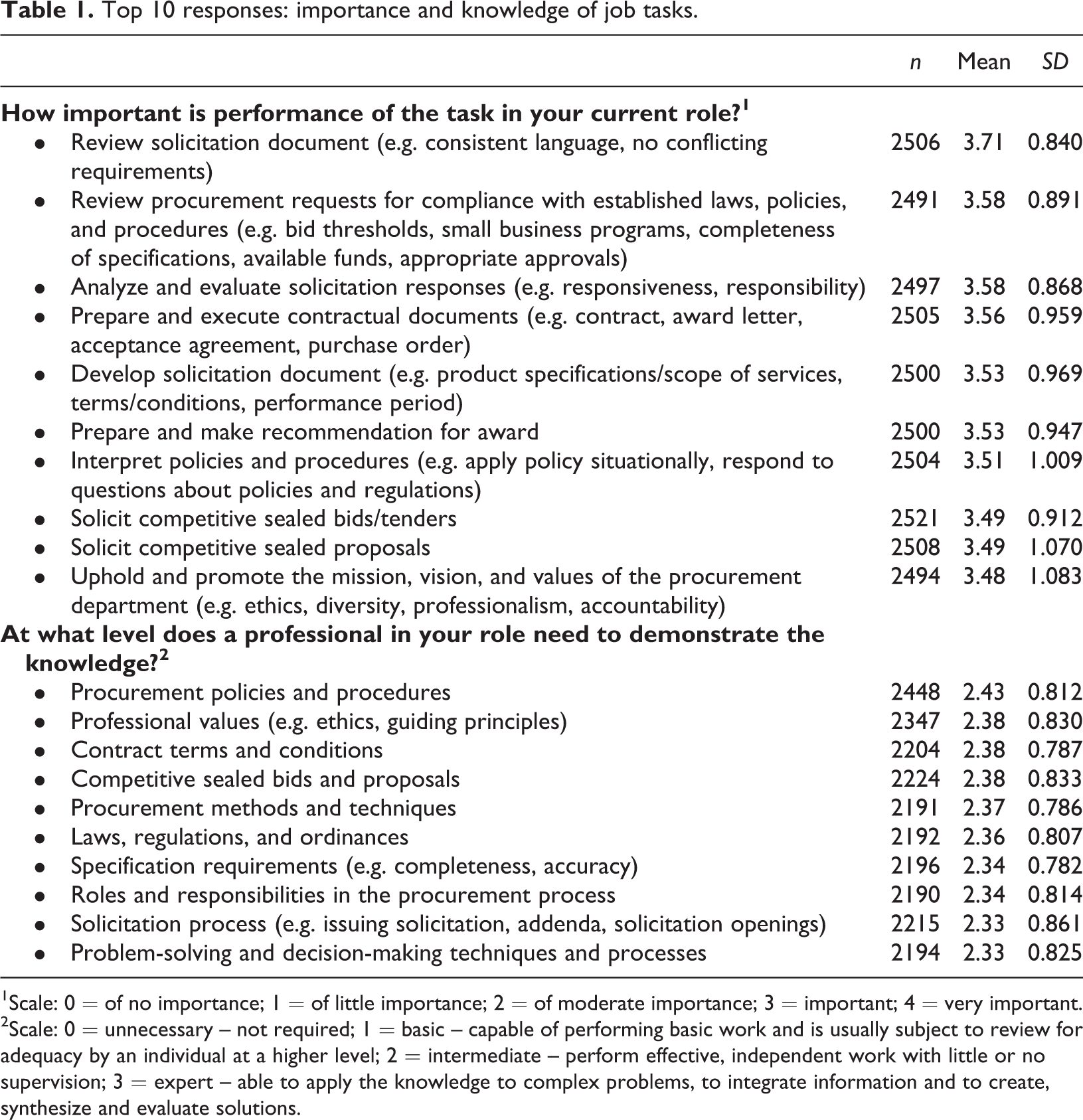
Table 1 shows the responses to the two primary focal areas for this research: how important is the performance of a given task in the respondent’s current role, and at what level does a professional in that role need to demonstrate the knowledge of each task, where the top 10 ranked responses for both question sets are exhibited. Responses to both question sets shows that the mean response for the top 10 tasks rank somewhere between important to very important for the individual job tasks, and from intermediate to expert knowledge of the job task.
Top 10 responses: importance and knowledge of job tasks.
1Scale: 0 = of no importance; 1 = of little importance; 2 = of moderate importance; 3 = important; 4 = very important.
2Scale: 0 = unnecessary – not required; 1 = basic – capable of performing basic work and is usually subject to review for adequacy by an individual at a higher level; 2 = intermediate – perform effective, independent work with little or no supervision; 3 = expert – able to apply the knowledge to complex problems, to integrate information and to create, synthesize and evaluate solutions.
Results exhibited in Table 1 show that the top five knowledge areas for procurement are: procurement policies and procedures; professional values (e.g. ethics, guiding principles); contract terms and conditions; competitive sealed bids and proposals; and procurement methods and techniques. In terms of the important job tasks, the top five are: reviewing solicitation documents; reviewing procurement requests for compliance with established laws, policies, and procedures; analyzing and evaluating solicitation responses; preparing and executing contractual documents; and developing solicitation document. It is interesting to note, that when looking at the highest-ranked job task (review solicitation document) and the second-ranked job task (review procurement requests for compliance with established laws, policies, and procedures), the mean difference is the largest between all top 10 tasks (3.71 to 3.58). The same holds true for the first- and second-ranked knowledge statements, where the mean difference between procurement policies and procedures (2.43) and professional values (2.38) exhibits the largest differences in penultimate rankings. The implication for the values of these mean differences supports robustness of the findings as survey respondents indicated agreement as to the most important job tasks and those requiring the highest level of knowledge.
What may be most interesting about the results shown in Table 1 is the fact that the respondents ranked “uphold and promote the mission, vision, and values of the procurement department (e.g. ethics, diversity, professionalism, accountability)” 10th, and review solicitation document first. This potentially indicates that in terms of the importance of their job tasks, practitioners still view the technical components of their job as the most important. This point is further supported when looking at the knowledge of the job task, where procurement policies and procedures is ranked first, and problem-solving and decision-making techniques and processes is ranked 10th. In both cases, respondents demonstrated that the field is still focused on the technical competencies of the job.
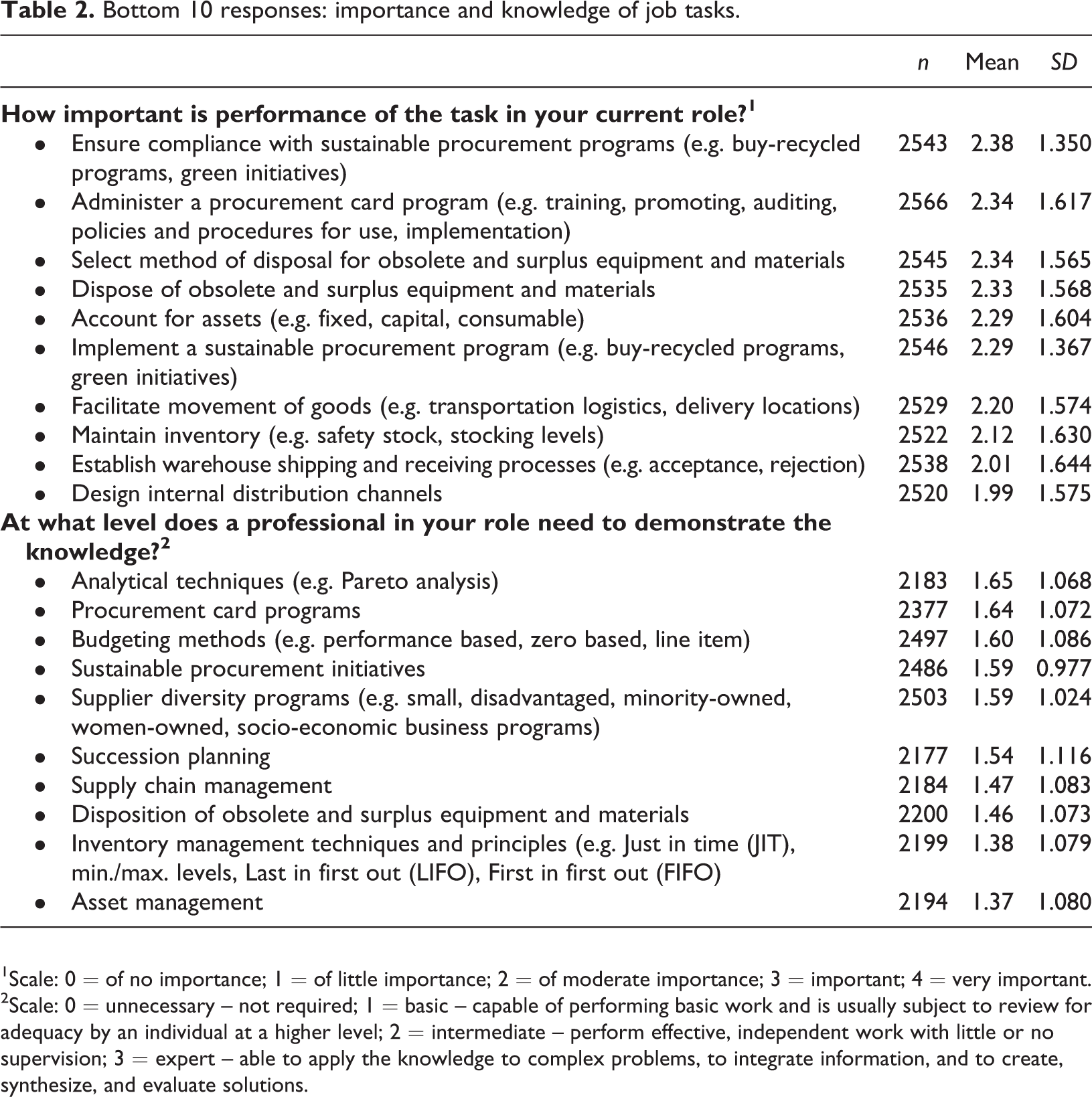
Now looking at the bottom 10 job tasks (Table 2), it is interesting to note that the least important tasks are warehousing (mean = 2.01), distribution channels (mean = 1.99), and asset management (mean = 1.37). Moreover, asset management (mean = 1.37) and inventory management (mean = 1.38) are also ranked as the least important knowledge statements. This may reflect the fact that what was typically considered one of the basic procurement functions, such as maintaining inventory and managing assets, is no longer viewed by the respondents as an important task they perform, nor do they need any particular knowledge of inventory and asset management to function within the job.
Bottom 10 responses: importance and knowledge of job tasks.
1Scale: 0 = of no importance; 1 = of little importance; 2 = of moderate importance; 3 = important; 4 = very important.
2Scale: 0 = unnecessary – not required; 1 = basic – capable of performing basic work and is usually subject to review for adequacy by an individual at a higher level; 2 = intermediate – perform effective, independent work with little or no supervision; 3 = expert – able to apply the knowledge to complex problems, to integrate information, and to create, synthesize, and evaluate solutions.
Looking at the results presented in both Tables 1 and 2, one takeaway becomes readily apparent: the lowest mean score for the performance of job tasks is 1.99, which indicates that respondents reported designing internal distribution channels to be of little to moderate importance, while asset management (1.37) is ranked the lowest, potentially indicating that only basic to intermediate knowledge is required for performance of the job task. When looking at the importance of the job task and knowledge necessary to perform the task, respondents contend that more traditional financial management activities (asset management, inventory, disposal, and the like) are no longer important functions in procurement. But what may be more interesting is the fact that for both importance and knowledge statements, those issues that may suggest that procurement is becoming more strategic – such as promoting sustainable procurement, diversity, using e-procurement, and supply chain management – seem to be less important than those tasks typically associated with procurement, such as developing and evaluating solicitations.
Confirming the domains identified by the SMEs
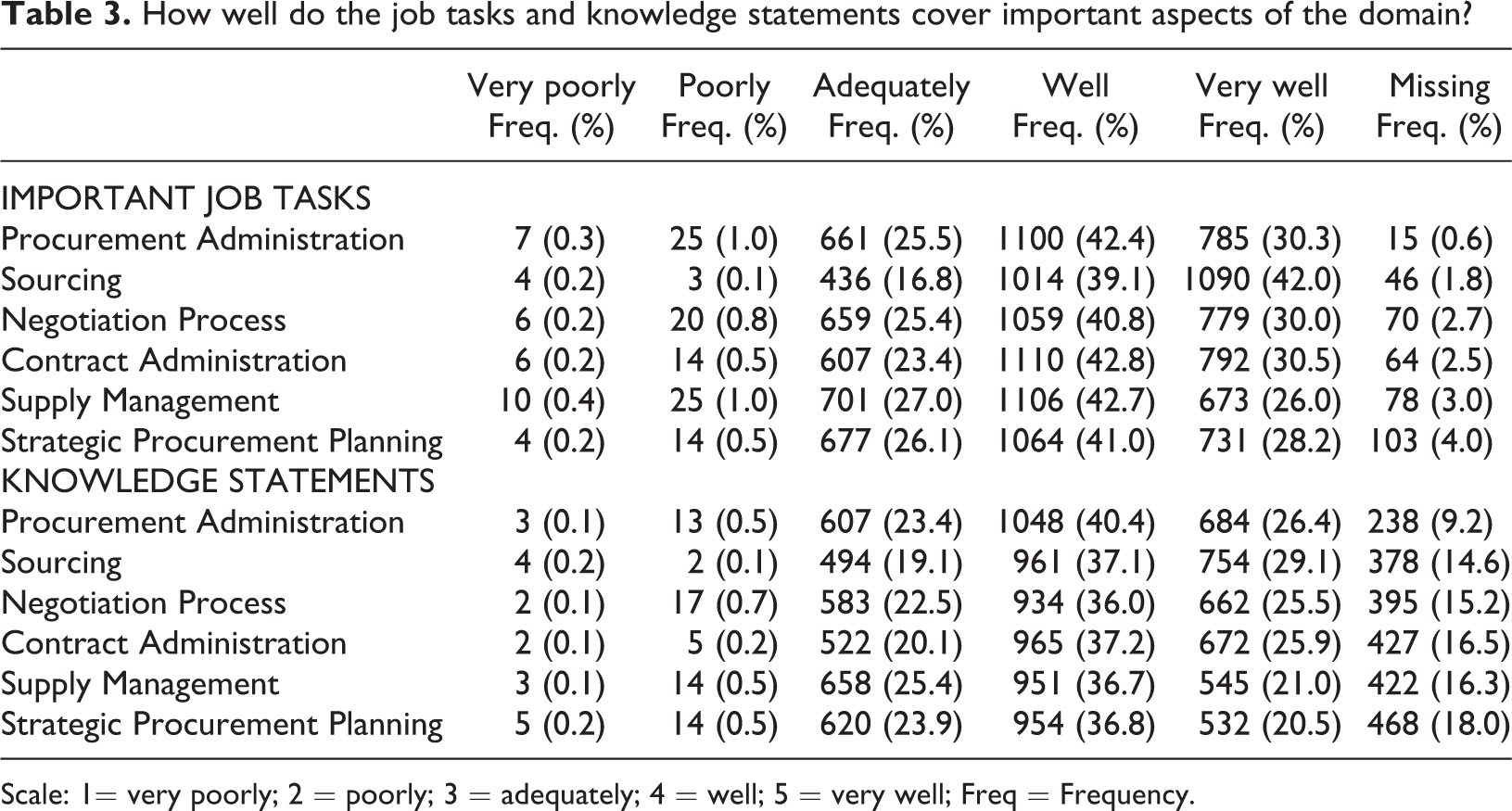
In terms of how the respondents viewed the groupings of the individual tasks for both question-sets into the six domains developed by the SMEs, Table 3 shows that a significant majority of respondents agreed with the groupings of the SMEs. Specifically, respondents were asked to rate how the SMEs classified the individual job tasks into the domains provided. The question asked: “How well do the task statements in Domain 1 cover important aspects of Procurement Administration?” The question was repeated for each domain. The coding for the question was: 1 = very poorly, 2 = poorly, 3 = adequately, 4 = well, and 5 = very well.
How well do the job tasks and knowledge statements cover important aspects of the domain?
Scale: 1= very poorly; 2 = poorly; 3 = adequately; 4 = well; 5 = very well; Freq = Frequency.
Table 3 shows that respondents overwhelmingly feel that the way the SMEs classified the individual tasks in the identified domains was on target for both question-sets. What is also interesting is that, on average, over 60% of the respondents feel that the classifications were either well or very well grouped. This indicates that, in general, respondents were very comfortable with this classification scheme, and that only negligible numbers felt that the domains were either poorly or very poorly classified for either question set. However, Table 3 reports a number of missing responses for the knowledge statements. There could be a host of reasons why some respondents did not respond, including avoidance of negative responses; skipping the question because it required the respondent to remember all job tasks located under the domain; or the respondents did not consider the question important. However, the missing responses do not present a limitation of the findings, for a number of reasons. Firstly, the vast majority of respondents did respond to each of the importance (> 96%) and knowledge statement (> 82%) questions. Secondly, the overall sample size of respondents who did respond to each importance and knowledge statement question is large enough to generate conclusions from the data. Any value for n over 2,401 (
Discussion
The findings yield substantive results for the purposes of identifying the minimal elements of a PPBOK that is founded upon widespread public procurement practices that are anchored in the technical activities reported by practitioners as being most important and requiring the highest level of knowledge. Looking at Table 1, the three tasks viewed as most important are “Review solicitation document,” “Review procurement requests for compliance with established laws, policies, and procedures,” and “Analyze and evaluate solicitation responses.” In addition, professionals reported the top four tasks that necessitated the highest levels of knowledge are “Procurement policies and procedures,” “Professional values,” “Contract terms and conditions,” and “Competitive sealed bids and proposals” (note the three-way tie of the means for the second-rated tasks).
This suggests that the task “Review solicitation document” is at the core of the strategic, tactical nature of public procurement. The solicitation document encapsulates numerous procurement functions that are inherent to the contracting work being sought which may include but not be limited to the type of goods or service requested, the quality, quantity, and delivery, and consistency with regard to stipulation of requirements. The solicitation document serves as the cornerstone for the described work to be performed and it is integral that it contains consistent language. The manner that the solicitation document communicates requirements must be internally consistent so that prospective bidders garner an understanding that is aligned with the intent of the requirements articulated by the procuring entity.
Moreover, the task “Review procurement requests for compliance with established laws, policies, and procedures” further indicates the strategic nature of public procurement and the BOK that serves as a basis for procurement work. As Waldo (1968) notes, strategic public administration involves the interpretation of rules and laws wisely and correctly with public values in mind. In public procurement, not only are there myriad rules and regulations governing procurement and contracting actions, but there may be multiple laws, statutes, mandates, or guidelines that simultaneously govern discretionary decisions. As one example, consider the procurement of library subscriptions for scholarly materials at an institution of higher education. There may be numerous authorities to be consulted for legality and procedure of related procurement actions including local, state, federal, and higher education procurement law/policy. Thus, a complicated mix of procurement laws, policies, and procedures mandated by various institutional authorities may need to be simultaneously considered by the procurement professional, with due consideration given to each based on the phase of the contracting cycle, scope, or nature of the work, or evolving legal precedent. Meanwhile, there may be guidelines within a procurement policy document that allow circumvention or nullification of other procurement policies and documents. The procurement practitioner must therefore make sound judgment decisions, which can be of both an objective and a subjective nature, in determining which laws, policies, and procedures to follow.
Separately, “Analyze and evaluate solicitation responses” particularly deals with “responsiveness” and “responsibility”, thus illustrating the tactical knowledge required in practice. Responsiveness refers to the extent to which a contractor’s bid matches the requirements outlined in the solicitation document and responsibility addresses the perceived ability of the contractor to perform to the contract (Thai, 2013). However, when dealing with complex services, contractors may respond to solicitations with customized solutions or product and service offerings. Thus, it may be difficult to determine which contractor has the most responsive bid, and which service will offer the best solution to government. It is then left to the procurement practitioner to evaluate the bid that will most efficiently and effectively yield a solution to government’s problem; requiring substantial foresight and consideration of a multitude of externalities that require estimation and coordination of a number of factors. There may be disagreement among practitioners regarding the solution most likely to fulfill government’s objectives.
While assessing responsibility may require looking at contractors’ past performance, technical expertise, and capitalization, it may also necessitate a strategic approach in public procurement. For instance, the manner in which past performance was recorded is likely to be inconsistent among interested bidders; previous work may not reflect needs of the solicitation at-hand; and the economic resources of the bidder may be difficult to construe. As an example, a contractor with a large cash position may indicate that the company is well capitalized and can afford to pay its labor, materials, and operational costs to keep the project going prior to receiving government compensation. Yet the cash position may have been generated through assumption of liabilities; or the contractor may be facing financial or economic obligations that supersede its obligations to perform to contract with the procuring entity.
Table 1 also shows the level of knowledge required by a professional to complete various procurement functions. The task “Procurement policies and procedures” is considered by practitioners to require the highest level of knowledge. This is consistent with Waldo’s (1948) conception of the strategic elements imbued in public administration, where unwavering public policy and politicized mechanisms enable public administrators to exercise discretion. As opposed to a clerical, apolitical, non-strategic orientation to procurement, the comprehension and application of policies and procedures to particular procurement functions for a given contract implicate the various bases of knowledge that must be considered. After all, it is the procurement policies and procedures that eventually dictate procurement outputs, such as selection of bidder, acquisition of a slated product or service given the options, and the extent to which socio-economic objectives will be prioritized over, or along with, tenets of cost effectiveness that dominate public budget decision-making (see Weidenbaum, 1981). Furthermore, the procurement practitioner needs to visualize how these various procurement outputs will lead to successful outcomes for the procuring entity, the contractor, and all stakeholders involved such as internal and external customers, users, consumers, constituents, the public at large, and society.
In addition, the task involving “Professional values” such as ethics and guiding principles insinuates the nature of work forming the basis for a BOK in public procurement. Kline (1981) and Christensen (1994) suggest that professionals pursue goals and objectives that transcend self-serving objectives and exceed the mere requirements of law. Downs (1967) characterizes public administrators as statesmen, advocates, climbers, conservers, and zealots. In a public procurement action, practitioners need to consider how various stakeholders to procurement, including oneself, may be acting according to one of these characterizations, or a combination thereof, in order to manage inputs that will result in outputs affecting the needs and demands of stakeholders. The process becomes iterative, where the procurement practitioner searches for areas of congruency to maximize outcomes for all stakeholders involved so that individual, departmental, and organizational goals and objectives can be achieved for all parties to the contract and the identified beneficiaries. The utmost consideration of facts, values, and interdependencies across actors, and the broader network of stakeholders, becomes vitally important and becomes the foundation for a PPBOK.
The task dealing with “Contract terms and conditions” refers to the stipulations set forth by the procuring entity and agreed upon by all parties through ratification of the contractual document. The terms and conditions directly govern the actions to be taken by the contractor and how the procuring entity may respond to such actions. This task requires public procurement practitioners to delve into the regulatory, control nature of politicized bureaucracy (see Waldo, 1948), where public administrators develop the rules and mechanisms necessary to steer a public procurement process toward achieving stated goals and objectives. However, rules may pile on rules (see Miller, 2002), so public procurement practitioners must keep abreast of the limiting, as opposed to liberating, structure of a procurement and the terms and conditions that help guide the contractor’s performance.
Finally, the task “Competitive sealed bids and proposals” illustrates the subjective yet strategic aspects of public procurement and the complexity of the field’s BOK. Curry (2017) highlights the advantages and disadvantages of competitive sourcing versus sole-sourcing. While competitive sourcing is thought to increase competition, encouraging contractors or vendors to offer higher-quality products and services at lower cost and speedier delivery in order to win a contract, there may be substantial costs to pursuing competitive markets for both the procuring entity and contractor. For example, when several contractors, suppliers, or vendors respond to a solicitation, then the procuring entity may invest substantial time and resources in the evaluation of bids or proposals, requiring scoring techniques to be applied, consideration of value-add features, or exposing the procuring entity to protest from losing bidders. On the other hand, the contractor, supplier, or vendor may also invest substantial resources in putting together a bid or proposal in order to out-compete other bidders.
The competitive bidding process is also aimed at instilling fairness and equity into the solicitation phase so that contracts are awarded to entities based on perceived ability to perform to the contract while potentially pursuing equity preferences based on firm size and firm ownership characteristics including sex, race, disability, and armed force experience. A multitude of goals may be served through the engagement of preference for these firms that may have difficulty competing with larger, more established corporations including that these businesses may offer unique solutions, skill-sets, expertise, or craftsmanship. Furthermore, contracts that generate profits for these businesses may help expand the marketplace for development of innovative products and services, as well as provide economic stimulus to geographic areas where these businesses are located. A virtuous economic cycle may result while simultaneously increasing the availability of higher quality products and services at lower cost.
The public procurement practitioner needs to juggle a milieu of socio-economic considerations to make a strategic decision regarding source selection that can lead to maximized benefit and minimized cost. This effort involves a decision to prioritize an agent’s principal (see Nanda, 2003), other agents to the procurement, as well as direct and indirect stakeholders, including implications for public interest. Depending on the needs assessment, risk parameters, and aspects of responsiveness and responsibility, the public procurement practitioner may decide to competitively source or sole-source a contract, and the design of evaluation tools to support the competitive process affects which entity will be awarded the contract. Thus, not only are there implications of sourcing to the success of a particular contract, but there are implications of sourcing regarding the externalities that may result from choosing a particular bidder with respect to marketplace drivers such as best value and innovation.
Conclusion
Conventionally, budget managers allocate resources according to the policy directives of elected officials and look toward public procurement practitioners for acquisition of public goods and services. As evidenced by the findings, practitioners must juggle nested goals and socio-economic objectives that are anchored in a strategic orientation. That is to say, the public procurement function is becoming viewed as a critical input to budgetary decisions regarding allocation of public resources. Roman (2014) delineates public procurement practitioners according to a politics–procurement dichotomy where practitioners assume roles as either “purists” or “brokers.” Purists take on a neutral, positivist orientation in serving their roles and responsibilities as public servants while brokers seek solutions that affect policy and interorganizational networks (Roman, 2014).
Roman’s characterization of practitioners is important because it demonstrates how public procurement may be situated in a formal educational and training context. For example, it remains arguable whether public procurement is most appropriately situated and studied within the context of supply management, contract management, budgeting and financial management, law and policy, economics, accounting, or public administration, among other disciplines. The politics–procurement dichotomy indeed builds on Waldo’s (1948) convention of the politics–administration dichotomy in which administrative tasks cannot be separated from political considerations. Essentially, public administrative neutrality is practically impossible to conceive when accounting for what practitioners say they do, and the importance they assign to the tasks in which they engage.
Accordingly, this model for public procurement, as supported by the findings herein, corresponds well with Waldo’s seminary convention in public administration. It may then be concluded that public procurement belongs within a public administration curriculum. Looking at the job tasks identified in this study to be most important to public procurement practitioners, and those tasks identified to require the highest level of knowledge, the associated KSAs underlying these tasks may best be studied and developed within an MPA curriculum. Indeed, academic programs in public procurement are beginning to be established, and some US universities are heeding the call. As examples, Old Dominion University, University of Illinois at Springfield, California State University at San Bernardino, and Florida International University, offer specialized certificate programs in public procurement within a public administrative context. However, despite the public administrative focus of each of these select programs, the course offerings are different for each as well as the curricula.
This study contributes to the academic agenda by empirically evaluating common KSAs, given employment job roles and responsibilities, that public procurement practitioners deem to be important. This is first step in ultimately establishing the foundation for a PPBOK that can serve as a map for universities and other institutions seeking to establish education and training programs in public procurement, as well as those specialized programs seeking to improve their curricula to match the actual roles and responsibilities being practiced.
However, there are a few limitations of this study. With regard to surveys, there may be challenges with respect to validity such as in a qualitative approach to labeling the variables studied or subjectivity in determining whether actual practice or knowledge is being captured through the variable being reported by the practitioner respondent. There can also be reliability issues in a survey including response bias that may involve a respondent’s knowing or unknowing inclination to adhere to preconceived taxonomies with respect to job description roles and responsibilities as well as value judgments. Moreover, it is possible that instead of focusing on the specifics of the question asked, some respondents may not be assessing the importance of each skill but instead may be evaluating each question in terms of the time they spend on each item.
While these limitations typically exist in any study of this kind, the totality of the research methodology nonetheless abductively addresses these issues through a stepwise process concluding with an empirical assessment of classifying domains – all of which systematically categorizes the domains of measured KSA variables that form the foundational elements of a PPBOK. An interesting yet unexplored aspect of the foundational knowledge that might complement a PPBOK would link procurement success with operational task importance and performance, but this is not explored in this study and is left to future research.
Takeaways of this study serve public administrative entities that are seeking ways to improve efficiency and effectiveness. By understanding the public procurement job tasks deemed to be most important and requiring the highest levels of knowledge in public procurement, public management can assign roles and responsibilities to respective practitioners by developing appropriate job descriptions for those who perform these functions. This can lead to the identification of specialized job descriptions in public procurement so that the practitioners most suited for a particular job task can be mobilized for completion.
In summary, this research links Bayesian intuition with abductive reasoning to illustrate a logical empirically based process for identifying and then serially updating the foundational elements of the PPBOK. In turn, public administration may expect improved outcomes, from a good governance standpoint, by relying on public procurement as a vital input to decision-making.
Footnotes
Declaration of conflicting interests
The author(s) declared no potential conflicts of interest with respect to the research, authorship, and/or publication of this article.
Funding
The author(s) received no financial support for the research, authorship, and/or publication of this article.
