




Abstract
Whether contracting out to private actors results in value for money depends on how public authorities govern, organize and manage service contracting. However, only a few studies have attempted to investigate how local governing practices can help to ensure that the contracting out of public services enhances economic efficiency and service quality. To further advance our knowledge on this topic, we present the results of a systematic review of 21 international studies, published between 2000 and 2018, on the impact of governance on the outcomes of contracting out. We combine insights from the reviewed studies to develop a theoretical framework of use to both practitioners and researchers that posits how eight impact factors mediate the influence of local governance on the outcomes of contracting out.
Introduction
The practice of contracting out public services to private actors is as old as the public sector itself, and is found in areas as diverse as military defence, digital solutions, public utilities and specialized social services (Kelman, 2002). More recently, however, a mixture of tighter fiscal constraints, anti-government ideologies, political pressures from external actors, and administrative reforms inspired by the New Public Management approach has significantly expanded governments’ reliance on private markets to deliver tax-funded services (Amirkhanyan, Kim and Lambright, 2007; Bel and Fageda, 2007). Even though systematic reviews show a relative decline over time in the economic gains from allowing private for-profit actors to produce and deliver public services (Petersen, Hjelmar and Vrangbæk, 2015), contracting out will continue to be a major task for governments in the foreseeable future. Local governments all over the world are caught in the crossfire between citizens’ growing expectations and scarce public resources. They are constantly looking for ways to improve service quality while cutting costs, and contracting out is frequently used as a tool to achieve those aims.
Public services are contracted out to a range of private for-profit actors, private non-profit actors, intergovernmental collaborations and public-private corporations (Bel and Fageda, 2008, 2010; Warner and Hefetz, 2002). However, the early enthusiasm for outsourcing public services has dwindled due to the frequent absence of the right conditions for successful outsourcing, and the discovery of a series of unintended consequences of service contracting (Boardman and Hewitt, 2004; Davies, 2008). As a result, public managers today seek to navigate in imperfect conditions and to balance competing goals and concerns in a politically charged environment (Hefetz and Warner, 2011). Hence, the study of contracting out is both growing as an empirical field, and becoming increasingly focused on analysing the complex conditions for more or less successful outcomes (Bel, Fageda and Warner, 2010).
In response to the growth, complexity and mixed results of contracting out, Kettl (2002) called for the development of a more comprehensive strategic-analytical framework for practicing and studying its management. While some scholars have heeded that call, the bulk of research on contracting out continues the line of research originally defined by transaction cost theory (Lane, 2000; Milgrom and Roberts, 1992; Williamson, 1981, 1985). The transaction cost perspective focuses on the reasons and conditions for contracting out public services, as well as on the actual gains in terms of higher economic efficiency. This explanation has steered the theoretical focus of researchers towards the need to coordinate the exchange between public and private actors, motivate both parties to observe contractual obligations, and minimize the transaction costs of contracting (Milgrom and Roberts, 1992). Few studies, however, have focused on the important question of how public authorities govern, organize and manage service contracting in practice (Brown and Potoski, 2003b; Romzek and Johnston, 2002). Fewer still have explored whether and how local governing practices contribute to improving the outcomes of contracting out in terms of service quality and economic efficiency (Fernandez, 2007; Girth et al., 2012; Lindholst and Bogetoft, 2011).
Nonetheless, government officials increasingly find themselves governing the contracting out of public services rather than producing and delivering them (Romzek and Johnston, 2005). Therefore, we need to know what works in terms of public actors’ efforts to secure the desired outcomes of contracting out. This article aims to deepen our understanding of the impact that local governing practices have on the outcomes of contracting out, based on a systematic review of 21 international studies between 2000 and 2018. Specifically, the article sets out to answer the following research question: how do local governing practices influence the outcomes of contracting out? Based on the literature review, the article combines existing empirical and theoretical knowledge on the governance of contracting out in order to develop a theoretical framework. The purpose of the framework is to clarify the causal link between governance and the outcomes of contracting out, facilitate the development of testable hypotheses for empirical studies, and provide a guide that practitioners can use to improve contract performance.
The article proceeds in the following way. The next section presents the methodology used to conduct the systematic literature review. We then develop a theoretical framework based on the results from the literature review, deducing eight impact factors that mediate the influence of governance, organization and management on the outcomes of contracting out. Finally, we discuss the use and relevance of the theoretical framework for developing testable hypotheses, before summarizing the argument and avenues for further research.
Methodology: Systematic literature review
In order to shed more light on the impact of governing practices on the outcomes of contracting out, we conducted a systematic review of the research literature from 2000 to 2018 that focuses on the impact of local governance on the outcomes of contracting out.
Search for studies
The search was conducted in three steps. First, we searched for relevant studies in a database consisting of 6177 international studies on contracting out published between 2000 and 2014. This database was compiled by a previous research project in which a systematic search was conducted in 13 databases (see Petersen, Hjelmar and Vrangbæk, 2018; Petersen, Hjelmar, Vrangbæk and la Cour, 2011). 1 The search comprised studies in English and Scandinavian languages that focused on contracting out, public procurement, outsourcing, marketization and service contracting in advanced industrialized countries including in Europe, North America, the Antipodes, Japan and South Korea. The choice of countries represents a wider geographical scope than previous literature reviews on the outcomes of contracting out, and allows us to examine the governance of contracting out in countries with different institutional and regulatory contexts, albeit within comparable economic situations (Petersen, Hjelmar and Vrangbæk, 2018). We do not include privatization, as in the sale of public assets, or public-private partnerships in our definition of contracting out (Hodge, 2000). We only consider those cases where the production of public services has been temporarily transferred to a private business based on competitive tendering, and is paid for by public authorities (Petersen et al., 2018). This database of 6177 studies represents the population of relevant studies on contracting out for the purpose of our study. However, we supplemented the database with an updated search from 2015 to 2018, as described in step three.
Second, in order to narrow the search in the existing database of studies on contracting out to align it with our research question, we defined further search terms pertaining to our focus on local governing practices. Local governing practices structure and condition attempts by public officials to use contracting out to produce better services at lower costs (for notable exceptions see Amirkhanyan, Kim and Lambright, 2007; Brown, Potoski and Slyke, 2006; Lindholst, 2009; Lindholst and Bogetoft, 2011; Nuppenau, 2008). In accordance with the new institutionalism (Peters, 2011), we assume that public actors aiming to improve the outcomes of contracting out operate in an institutional context of relatively stable forms of governance, organization and management that together constitute local governing practices. Governance is here defined as the rule-bound procedures that channel and regulate social interaction. Organization is defined as the rules, norms and routines that authorize action, empower actors and shape their cultural orientation. Management is defined as the attempt to influence the perception and actions of social actors in order to generate particular outcomes. Together, these three interrelated types of institutional governing practice shape public actors’ calculations about the consequences of different actions, as well as their perception of which actions are appropriate in different situations (March and Olsen, 1995).
Based on this understanding of governing practices, we searched the titles, abstracts and keywords of the 6177 studies using the following search terms: governance, management, leadership, organization, steering, coordination and transaction costs. We did not include the term ‘outcome’ or any specific definitions of outcomes of contracting out, such as economic efficiency or cost reduction, as this would have narrowed down the search too much. Instead, we used this as a criterion for the inclusion of studies, which we present in the next section. 2 The search resulted in 140 studies that appeared to focus on the public governance of contracting out.
Finally, we supplemented the search in the database of studies from 2000 to 2014 with a new search in the Social Science Citation Index (SSCI) from 2015 to 2018, in order to identify more recent studies that were not included in the database by Petersen et al. (2011, 2018). We searched for journal articles in English and employed the same geographical criteria. Moreover, we applied the same keywords for contracting out and governance that we used in the first literature review from 2000 to 2014 (see above). 3 The only exception was the term ‘transaction cost’, which we did not apply in the second search, recognizing that it was less relevant for our definition of governance. We did not use the full range of databases applied in the first search on contracting out, as we considered that the governance of contracting out is mainly a concern for those academic disciplines (especially public management and administration) represented by journals covered by the SSCI. With regard to language, we furthermore found that including Scandinavian languages might create a bias in the search for literature. Hence, in the second round, we limited the search to studies in English. This yielded 1100 results, of which 26 appeared to be relevant, leading to a total of 166 studies.
Criteria for the inclusion and exclusion of studies
We read the abstracts for all 166 studies and evaluated the eligibility of each study for inclusion in the systematic review, based on the criteria listed below. If the relevance of the study was not clear from the abstracts, then we read the article in full. Criteria pertaining to language, region/geography, type of publication and time delimitation are defined in the review by Petersen et al. (2018) that formed the basis for our search. As the last systematic review of the effects of contracting out was published at the turn of the millennium (Hodge, 2000), we only searched for studies published since 2000, and which corresponded to the criteria used by Petersen et al. (2018). Below, we clarify the two additional criteria of specific relevance to our focus that we applied in evaluating the search results. Topic: We only included studies that related local governance to the outcomes of contracting out public services. Different types of outcome are relevant in a discussion of contracting out (Lindholst et al., 2018). We acknowledge the diversity in outcomes, but the focus of this study is the crucial and recurring question of whether or not contracting out provides services at lower costs without eroding service quality. We only included studies that dealt with outcomes pertaining to cost and service quality, and we excluded studies that solely focused on other types of outcome, for example, innovation. We included studies that examined governing practices as defined earlier in this article. Research design and methods: Both empirical and theoretical studies were included, as they provide insights into the mechanisms linking governance, contracting out and outcomes. All types of empirical design and methods were included, as long as the authors applied them in a valid and transparent way and moved beyond a purely descriptive purpose.
In total, 145 out of the 166 articles failed to meet our criteria, bringing the sample of relevant studies for the systematic review down to 21. The 145 studies were excluded due to one or more of three reasons: a) they were not concerned with public governance, organization and management in relation to contracting out public services; b) they were not deemed eligible either because they were descriptive case studies, reviews, focused on the impact of contracting out on public governance (reverse causality), or aimed to discover the determinants for contracting out, including the decision to make or buy; c) they used valid and transparent methods and empirical data to document new findings and trends in the public governing of contracting out, but without relating these to the outcomes of contracting out in terms of economic efficiency and service quality.
Descriptive overview of the included studies
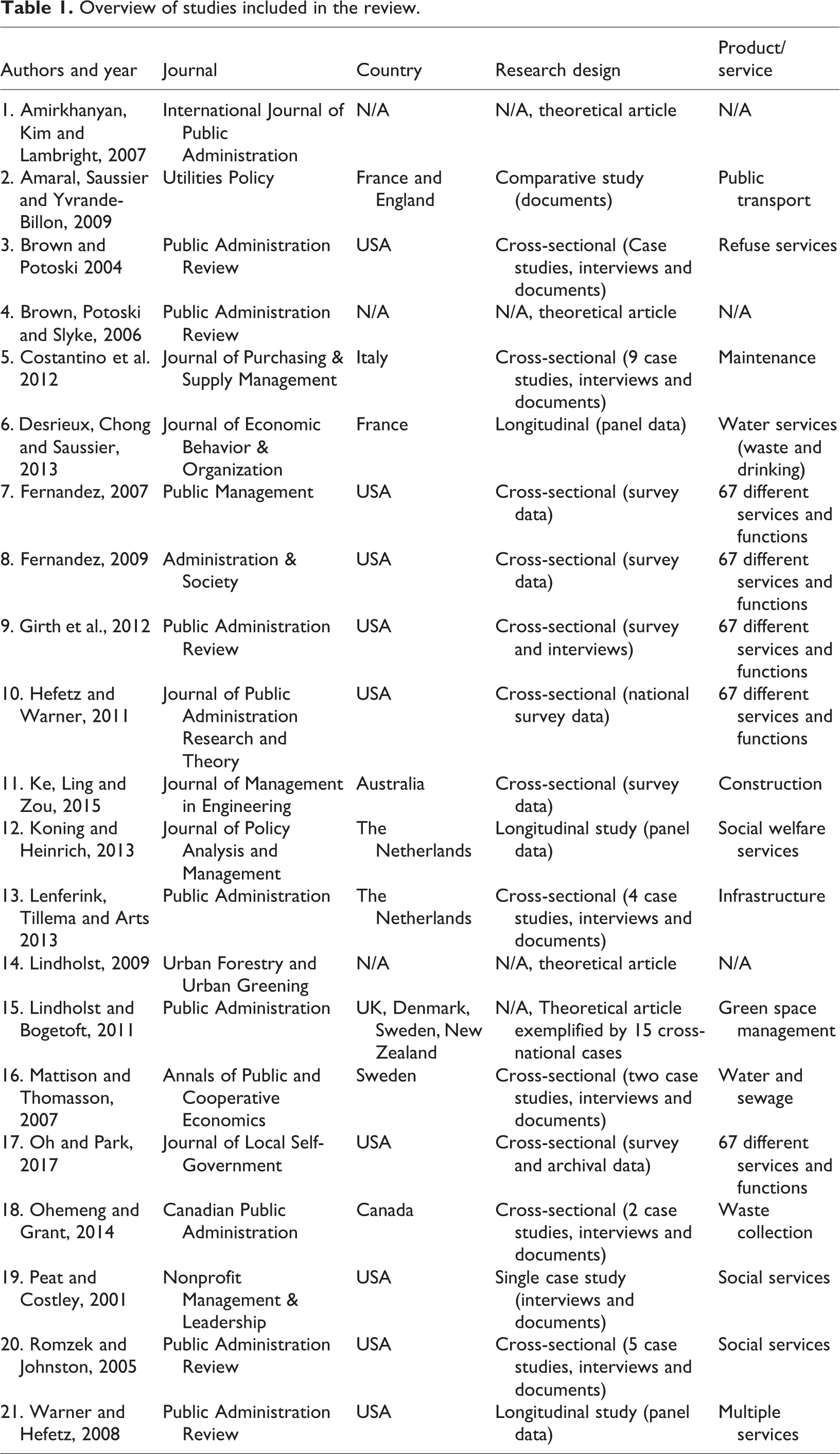
Among the 21 studies included in the review, four are theoretical and aim to conceptualize the link between contracting out and outcomes, and we draw on these in the next section, where we develop our own framework for studying the impact of governance on the outcomes of contracting out. The 17 empirical studies explore or test the impact of public governance, organization and/or management on enhancing quality and lowering the costs by contracting out.
Table 1 provides an overview of the 21 studies. The table shows that the majority of the empirical studies are set in the USA, while the rest are distributed across European countries, with only a few studies in Australia and Canada. The most common research designs are longitudinal and cross-sectional (case studies and surveys), displaying a mix of quantitative and qualitative data and methods. Finally, the studies analyse the local governance of the contracting out of many different types of product or service of either a technical or human nature, such as refuse services or elder care. Several American studies furthermore analyse multiple types of service based on the same source of data.
Overview of studies included in the review.
Data analysis
Due to the limited number of studies and the variety in research designs and data, we analysed the included studies using a qualitative thematic approach rather than, for example, quantitative meta-analysis (Booth, Sutton and Papaioannou, 2016). We carefully read each article and assessed which key factors the authors find crucial in explaining the relationship between governance and the outcomes of contracting out (see supplementary material) and how these were found to influence the outcomes. In this process, we found several recurring factors across countries and types of service that are central to understanding the impact of local governance on the outcomes of contracting out in different contexts. We return to these impact factors when we develop the theoretical framework.
Development of a theoretical framework: The impact of governance on the outcomes of contracting out
In the introduction, we touched upon the need to develop a theoretical framework due to some of the shortcomings of especially transaction cost theory in fully explaining the influence of governance on the outcomes of contracting out. Our systematic review identified four studies that address some of these shortcomings by striving to develop a broader framework for studying how governing practices may affect the likelihood that contracting out will lead to better and cheaper services.
Brown, Potoski and Slyke (2006) emphasize the role of public managers in managing competitive tendering and handling the implicit goal conflicts, but they also insist that public managers operate within a broader political and institutional context. Lindholst (2009), as well as Lindholst and Bogetoft (2011), agree that institutional theory provides an important supplement to transaction cost theory and helps us to broaden the analytical perspective from the coordination, motivation and minimization of transaction costs to include competences and resources, communication and collaboration, and intrinsic forms of motivation. Amirkhanyan, Kim and Lambright (2007) come closest to developing a comprehensive framework that can guide systematic studies of the impact of public governance on the outcomes of outsourcing.
Overall, these four studies provide important theoretical insights. However, they do not fully explain the causal links in terms of how, when and why different local governance practices influence the outcomes of contracting out, and some of them define the dependent variable in much broader terms than we do. In this section, we present the results of our systematic review by developing a theoretical framework. The framework combines insights from the four theoretical studies with findings from the past two decades of empirical research represented by the 17 empirical studies to conceptualize and operationalize these causal links. Specifically, we deduce eight impact factors expected to mediate the influence of governance on the outcomes of contracting out.
The overall layout of the theoretical framework
Figure 1 illustrates the overall theoretical framework. The basic assumption informing Figure 1 is that, depending on the structural context, local governing practices will play a decisive role in shaping the various impact factors that provide the necessary and sufficient conditions for contracting out to lead to better and cheaper services. Hence, governance, organization and management are the levers that institutionally situated public actors can use to enhance the likelihood that contracting out will improve public services while lowering costs. Learning-based feedback from reflections on actual performance may help to improve institutional governing practices. Hence, we acknowledge that there is a feedback loop between independent, mediating and dependent variables. This suggests a bi-directional causality, as public agencies may adopt new or changed governing practices based on experiences with, and feedback from, mediating and dependent variables.
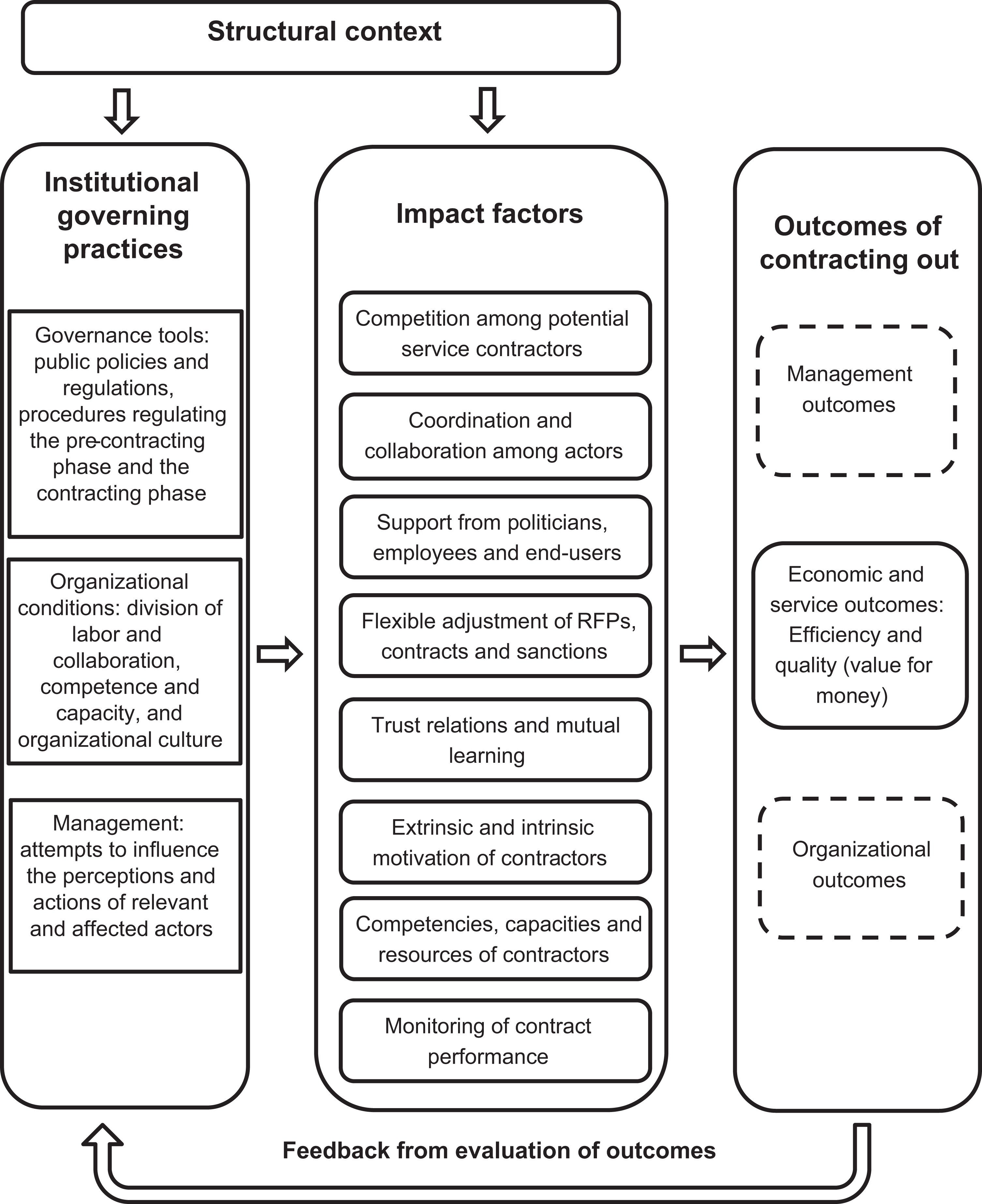
The basic layout of the theoretical framework.
Let us take a closer look at these intervening and independent variables in order to better understand their content and effects, after a brief definition and discussion of the outcomes of contracting out.
Outcomes of contracting out
The dependent variable is ‘value for money through contracting out’. In less ideologically charged words, the dependent variable aims to capture whether contracting out leads to lower service costs without eroding quality, preferably with an increase in quality alongside reduced costs (Osborne and Gaebler, 1993). Supporters of New Public Management believe that both cost efficiency and service quality can be measured, but in practice this is often difficult (Hood and Dixon, 2015; Lindholst et al., 2015; Lindholst et al., 2018). Moreover, whether contracting out improves value for money is contested, as empirical studies point in different directions and many of them suffer from a series of methodological problems (see Boyne, 1998). The overall verdict is that there is a net gain if certain conditions are fulfilled (Domberger and Jensen, 1997; Hodge, 2000; Savas, 1987; but see Bel, Fageda and Warner, 2010). Still, a systematic review of international studies on the economic gains resulting from contracting out public services to for-profit contractors shows that the average efficiency gains have declined progressively (Petersen, Hjelmar and Vrangbæk, 2015). In addition, there is evidence of systematic trade-offs between economic efficiency and quality (Lowery, 1998; Sclar, 2000) as well as between economic efficiency and other relevant public goals such as equity, accountability and responsiveness (Brown, Potoski and Slyke, 2006). The purpose of this study, however, is not to assess whether or to what degree contracting out results in more value for money, but to identify and theorize how local governing practices can increase the likelihood of better outcomes.
Impact factors
We define the intermediate or intervening variable in terms of a series of ‘impact factors’. These are eight critical factors that improve the likelihood that the local governing of contracting out will create greater value for money. Building on Lindholst and Bogetoft (2011) and the bulk of the reviewed studies, the list of impact factors is expanded beyond the traditional focus on competition, coordination, extrinsic motivation and contract monitoring. We will now explain the eight impact factors, their causal mechanisms and what we view as their associated dilemmas.
First, the reviewed studies show that local governance serves the important role of managing and responding to markets to increase competition. It is a well-known assumption that competition among potential contractors can drive prices down and service quality up and thus generate value for money. Our review shows that when competition is low in terms of the number of bidders, public managers make use of such procedures as ‘unbundling’ services, attracting private for-profit and non-profit bidders, making public agencies compete with private bidders, retaining a portion of the contracted service in-house (concurrent sourcing), and using intergovernmental contracting as an alternative to competitive contracting (Girth et al., 2012; Ohemeng and Grant, 2014; Warner and Hefetz, 2008). A comparative case study of bus tendering shows that there are more bidders, more contract renewals and fewer collusive behaviours in London, where the transport network is unbundled so that contractors can bid for one or several bus routes, than in France, where entire transport networks are contracted out (Amaral, Saussier and Yvrande-Billon, 2009). Consequently, the price for contracted bus services is falling in London but rising in France. However, while more competition helps to discipline private contractors, there can sometimes be too much competition. A high number of bidders is costly for both the public purchaser and the private providers, potentially offsetting the benefits of increased competition (Constantino et al., 2012; Fernandez, 2009). In these situations, a pre-qualification system is justified to limit the number of bidders by defining a threshold in terms of required experience, competences and capacity. In a study of local US governments, Fernandez (2007) found that the most successful cases of contractual relationships are characterized by a smaller number of bidders compared to the average case. An example from Italy likewise shows that reducing the number of actual bidders to an ‘optimal number’ lowers transaction costs for both the public purchaser and the private providers (Constantino et al., 2012). Hence, the dilemma is to establish an appropriate level of competition in a given market, keeping in mind that increasing market competition can reduce the size of the contractors’ market share and thus their ability to benefit from scale economies.
Secondly, when public authorities contract out services to private providers, the actual outcome depends on coordination and collaboration between public managers and private actors (Desrieux, Chong and Saussier, 2013; Lenferink, Tillema and Arts, 2013; Mattisson and Thomasson, 2007; Peat and Costly, 2001). Specifically, outcomes depend on the ability to align goals, ensure compatibility between different organizational systems, create synergies, avoid gaps and overlaps in the provision of services, and solve emerging problems. The reviewed studies show that ‘competitive dialogue’ and ‘pre-qualification’ represent some of the procedures and regulations that public managers use to coordinate and collaborate with private actors to enhance outcomes (Brown and Potoski, 2004; Costantino et al., 2012; Lenferink, Tillema and Arts, 2013; Hefetz and Warner, 2011; Ohemeng and Grant, 2014). ‘Competitive dialogue’ may be used in relation to complex services where it is difficult to specify the technical, legal and financial makeup in advance (Lenferink, Tillema and Arts, 2013). Competitive dialogue allows public purchasers to organize and engage in a pre-bid public-private dialogue about the public’s needs and requests and the solutions proposed by potential private bidders. As an example, a study of four Dutch infrastructure projects applying the competitive dialogue tool found that it facilitated information exchange, clarified and modified public expectations, and stimulated interest in competitive bidding. However, the dilemma is that coordination and collaboration are costly and time-consuming, especially when information asymmetry is high and there are diverging goals and interests (Brown and Potoski, 2004; Ke, Ling and Zou, 2015; Oh and Park, 2017). Consequently, public authorities should enhance coordination and collaboration, while seeking to avoid a situation where rising transaction costs undermine the potential gains of contracting out (Brown, Potoski and Slyke, 2006; Lindholst and Bogetoft, 2011).
The third impact factor is support from politicians, employees and end users. In some places, contracting out is politically controversial because of the inherent risks of lower supply security, opportunistic behaviour such as parking and creaming, high transaction costs from monitoring, and lack of responsiveness and accountability (Amirkhanyan, Kim and Lambright, 2007). Several studies document that support from politicians, public employees and end users is, therefore, important in preventing opposition that will undermine the potential benefits of contracting out (Fernandez, 2009; Hefetz and Warner, 2011; Ohemeng and Grant, 2014; Romzek and Johnston, 2005). However, attempts to secure support through information, consultation and open debate may result in either increased support or stronger resistance. Hence, the dilemma is whether decisions to contract out public services should be subject to public debate that tends to politicize the issue, but may help to create support through negotiation; or to rely instead on administrative routines that will tend to de-politicize such decisions, but fail to generate widespread support (Brown, Potoski and Slyke, 2006).
The fourth impact factor is the flexible adjustment of requests for proposals, contracts and procedures. Our own general observation across the reviewed studies is that requests for proposals, service contracts and the procedures for monitoring and sanctioning performance are often rigid, inadequate and difficult to specify. Hence, there is much to gain from flexible adjustments in response to changing conditions, possibilities and demands, as higher levels of contract performance can be achieved based on flexible and cooperative methods (Fernandez, 2007). Flexible adjustment requires an open and constructive dialogue that may be stymied by public displays of authority and internal competition among contractors. Flexibility thereby influences, and is influenced by, other impact factors, depending to some extent on more coordination and trust, but less monitoring and control. The rule of thumb is that the higher the degree of flexibility, the greater the benefits of contracting out; however, the dilemma is that enhanced flexibility will tend to make it more difficult to monitor performance. It is always tricky to measure a moving target.
The fifth impact factor is trust relations and mutual learning, which relates to the second impact factor of coordination and collaboration. Trust lowers transaction costs because it becomes easier to coordinate actions, and the costs of monitoring performance are reduced (Brown, Potoski and Slyke, 2006). Since contracts are always incomplete, purchasers and providers have to deal with non-contractible issues and outcomes through informal interaction and collaboration. A high level of trust and trust-based learning facilitates the coordination required to deal with non-contractible issues, thereby improving efficiency (Fernandez, 2009). Trust also facilitates mutual learning that, in turn, leads to continuous improvement or innovative step change, both in the way that coordination is provided (Desrieux, Chong and Saussier, 2013; Mattison and Thomasson, 2007). For instance, Desrieux, Chong and Saussier (2013) show that the bundling of public services provided by the same private provider lowers the total price of the services without hampering quality, based on contract information from 5000 local governments in France. Empirical tests show that this result can neither be explained by economies of scale nor by endogeneity. Rather, public purchasers seem to develop a closer interaction with those private providers that are responsible for delivering a bundle of services; the collaborative interaction helps to detect and solve emerging problems and challenges at an early stage. However, empirical studies of contracting strategies in Australia (Ke, Ling and Zou, 2015) and the USA (Oh and Park, 2017) find that the use of relational contracting – that is, emphasis on trust and shared understanding over time – can incur higher costs. Trust is conditioned by close personal interaction and the development of common values that tend to reduce competition and increase transaction costs (Brown, Potoski and Slyke, 2006; Oh and Park, 2017). So here we have another dilemma.
The sixth impact factor is the extrinsic and intrinsic motivation of contractors. Whether or not value for money is generated by outsourcing depends on the motivation of private contractors to deliver the desired outcomes (Amirkhanyan, Kim and Lambright, 2007: Koning and Heinrich, 2013). There is growing appreciation of the need to supplement the extrinsic ‘sticks and carrots’ motivation of private providers through performance-based contracts with intrinsic motivation and a public service commitment that is integrated into their professional training and sustained by the culture of the organizations to which they belong (Lindholst and Bogetoft, 2011). A study of the introduction of high-powered performance contracts in the Netherlands in 2002–2005 shows that the pre-programme selection effects in terms of parking and creaming were negligible in relation to private contractors’ attempts to place unemployed people in jobs, whereas the unintended negative incentive effects were considerable for the job placement of disabled people (Koning and Heinrich, 2013). The negative incentive effects of high-powered performance contracts emerged despite attempts to minimize them by assigning groups of disabled people with more or less the same job prospects to private contractors. On the positive side, however, the introduction of performance contracts seemed to enhance job placement overall, although it was not necessarily those who were most in need of help who received it. The dilemma here is that strong extrinsic motivation associated with high-powered performance contracts may crowd out other important forms of motivation.
The seventh impact factor pertains to the competence, capacity and resources of contractors and public managers. The production of high-quality services at low cost requires that private providers have access to relevant materials and facilities, qualified staff members and new technologies, while public managers need the capacity and experience to manage contracts (Brown, Potoski and Slyke, 2006; Hefetz and Warner, 2011; Lindholst and Bogetoft, 2011; Mattison and Thomasson, 2007). The choice between different market management tools, the creation of norms and procedures for selecting the most promising service providers, collaboration and incentive steering in the post-tendering phase, and contract monitoring are all tasks that require professional competence and expertise, sufficient resources and capacity. This is confirmed by North American studies which show that local governments that have professional city managers are more reluctant to contract out when there is little or no competition, and make better use of alternatives to competitive tendering, than cities without professional city managers (Hefetz and Warner, 2011). Contractors must also be capable of leading and managing their organization in order to ensure the efficient deployment of the resources and capacities at their disposal (Amirkhanyan, Kim and Lambright, 2007). Management is particularly important in the post-tendering phase. In a comparative study of two Swedish cases of service contracting in the local water and sewage sector, Mattisson and Thomasson (2007) show that long-term planning was prevented by conflicts between purchaser and provider, resulting in reduced service quality in one of the municipalities. In the other municipality, the public purchaser had both the competence and the capacity to manage unforeseen events, cultivate positive working relations and facilitate mutual learning that, in turn, boosted the quality of the provided services. The dilemma with regard to this impact factor is that the more public purchasers invest in the development of private contractors’ competences, capacities and resources, the more expensive the provided services become – at least in the short run.
Finally, the information asymmetry between public purchasers and private providers will facilitate opportunistic behaviour that must be curtailed through monitoring, which constitutes the eighth impact factor. Effective contract accountability refers to the ability of public funding agencies to design and implement systems that hold service contractors to account for their performance and motivate them to fulfil their contractual obligations (Romzek and Johnston, 2005). The theoretical expectation is that monitoring will lead to better outcomes (Peat and Costley, 2001). Effective monitoring can either be provided through the collection and consequential assessment of performance data, or through joint evaluations, based on dialogue and collaboration, that lead to continuous improvement (Amirkhanyan, Kim and Lambright, 2007; Brown and Potoski, 2004; Brown, Potoski and Slyke, 2006; Oh and Park, 2017; Romzek and Johnston, 2005). Meanwhile, the reviewed studies offer mixed empirical findings. For instance, Oh and Park (2017) find that local US governments that effectively monitor contracts reduce operating expenditures. Fernandez (2009), on the other hand, shows that monitoring does not improve the outcomes of contracting out in local US governments, as opposed to trust, which has a significant positive effect on contract performance. The findings indicate that more monitoring is not necessarily the answer, but rather how the collected information is put to use (Fernandez, 2009), and how public managers create an effective system for specifying and monitoring contracts. However, the dilemma is that a control-based monitoring system is likely to undermine the interpersonal trust that is a precondition for dialogue and collaboration. This dilemma demonstrates the interrelated and sometimes conflicting roles of the various impact factors.
Despite these trade-offs and dilemmas, the eight impact factors are likely to increase the chance of obtaining beneficial results from contracting out public services. Since the impact factors do not arise spontaneously, we need to identify the different forms of public governance, organization and management that can help to generate the right impact factors and shape them in such a way that they support positive outcomes.
Institutional governing practices
The independent variable in the framework is termed ‘institutional governing practices’. It captures the different ways in which public authorities govern contracting out. While institutional governing practices affect, and indeed explain, the impact factors, there is no ‘one best way’, as different constellations of institutional governing practices may have the same combined effect on the impact factors. However, variations in the structural context – including the size and economic affluence of government, the level of trust in society, a tradition for public-private interaction, the size of markets, the type of service, etc. – may support the development of local equilibria that are hard to change due to the combination of positive feedback mechanisms and sunk costs that tend to produce strong path dependence (Pierson, 2000).
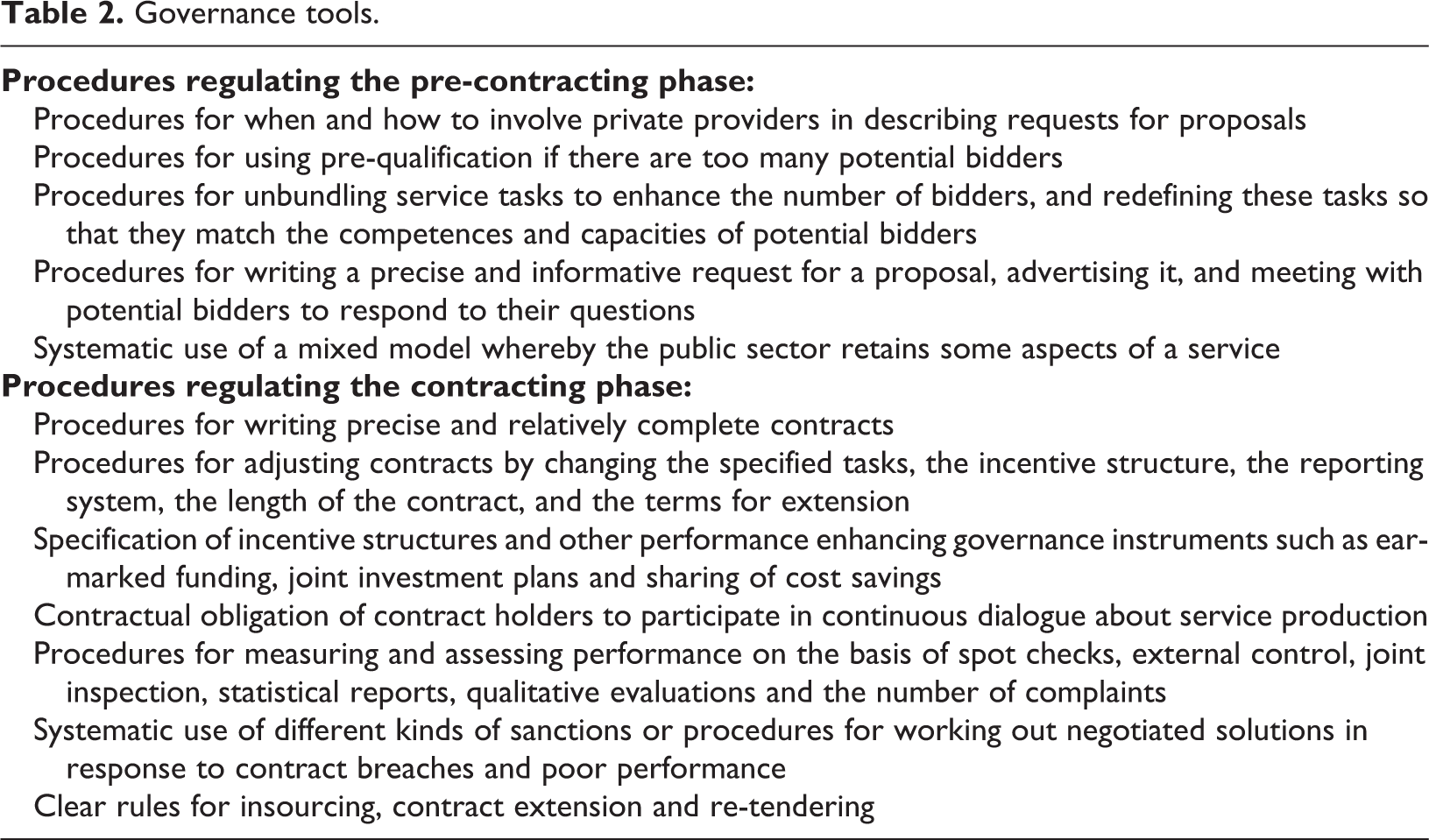
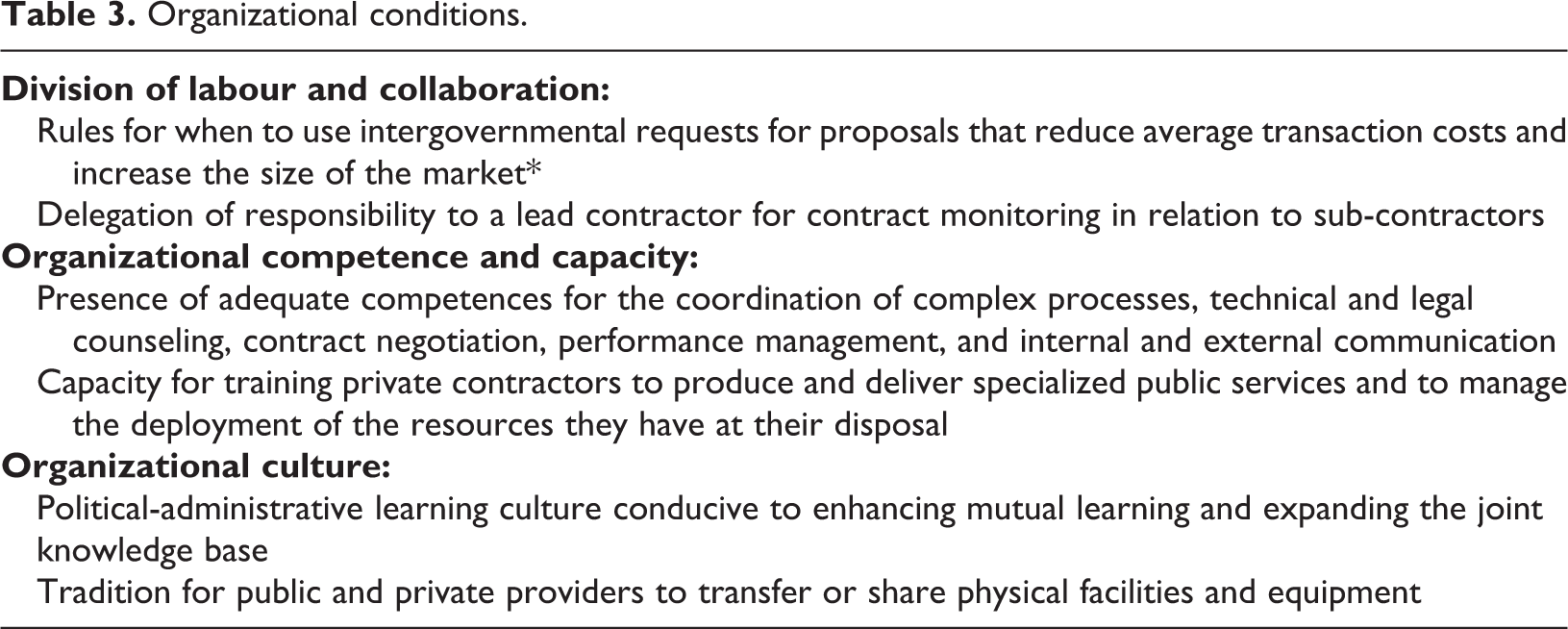
We previously explained how our independent variable of institutional governing practices can be divided into more or less interdependent forms of governance, organization and management (March and Olsen, 1995). Based on the systematic literature review, these different and interrelated governing practices are further operationalized into a catalogue of tools and procedures associated with contracting out (see Tables 2 –4). Some of these tools are presented and discussed in the previous section, for example, the use of governance tools such as the ‘unbundling of services’ to mediate the level of competition and thereby improve contract performance. We will not discuss each tool further here, as our main focus is on the causal link between governance practices and the outcomes of contracting out in terms of the eight impact factors. The purpose of Tables 2 –4 is merely to provide researchers and practitioners with an overview of the tools available to mediate the influence of the eight impact factors on the outcomes of contracting out.
Governance tools.
Organizational conditions.
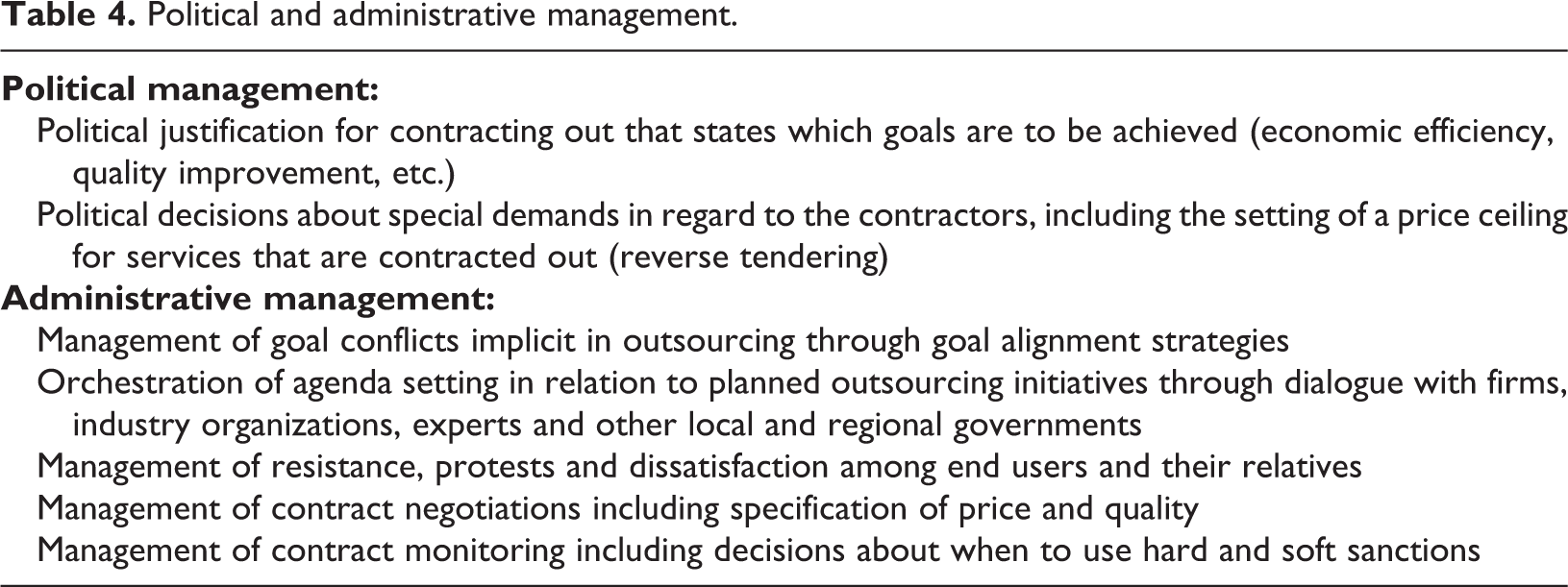
Political and administrative management.
Governance concerns those particular tools and instruments aimed at regulating the behaviour of public purchasers and private providers, such as public policies and regulations, procedures regulating the pre-contracting phase, and procedures regulating the contracting phase. Table 2 presents an overview of the different governance tools.
Organization refers to the way that public authorities support and organize the contracting out of public services. It comprises the division of labour and collaboration, organizational competence and capacity, and organizational culture. Table 3 provides an overview of these organizational conditions.
Management refers to attempts by political and administrative leaders to influence the perceptions and actions of relevant and affected actors in order to align values and optimize the preparation, negotiation and implementation of service contracts. Table 4 provides an overview of different forms of political and administrative management that are likely to affect the impact factors.
The listing of institutional governing practices in Tables 2 –4 may not be exhaustive, and further studies may add to it. Nevertheless, the three tables provide a comprehensive overview of relevant factors that, in different constellations, can generate the right impact factors, which, in turn, can improve the outcomes of contracting out.
Discussion: Use and relevance of the theoretical framework
The theoretical framework enables researchers and practitioners to link the outcomes of contracting out, notably in terms of higher quality and lower costs, to eight crucial impact factors. The aim is to offer a catalogue of factors relating to institutional forms of governance, organization and management, which public managers can use to achieve the desired outcomes and assess them in the light of feedback. While practitioners will be able to use the framework to identify levers to enhance competition, flexible adjustment or other important impact factors in the pursuit of value for money, researchers will find it useful in generating hypotheses for the empirical testing of the contracting out of different types of service. In the following, we provide two examples of how such hypotheses might be developed from the framework, and suggest which empirical steps might be taken to further the research agenda and test these hypotheses empirically.
First, the review shows that there is only limited research on the impact of governance on the outcomes of contracting out in human services such as elder care. Hence, we might ask ourselves how contracting out can increase value for money due to improved coordination and collaboration between public purchasers and private providers in the field of elder care. The catalogue of institutional governing practices reveals a number of relevant triggering factors. In terms of governance tools, coordination and collaboration can be enhanced by establishing procedures for when and how potential contractors should be involved in drafting requests for proposals, making sure that they are contractually obliged to participate in continuous dialogue, and attempting to find negotiated solutions to contract breaches and malperformance. In terms of organizational conditions, it is crucial to strengthen the range of organizational competences available for coordinating complex processes, and to negotiate and communicate with private providers in order to achieve the desired outcomes, as well as to articulate an organizational discourse that emphasizes trust and collaboration. Finally, a variety of management factors can enhance coordination and collaboration, such as the management of goal conflicts implicit to contracting out, the orchestration of agenda-setting dialogue meetings with a clear focus, and the handling of contract negotiations with a view to securing the trust-based exchange of knowledge and information. These causal relations can be translated into testable hypotheses, such as: ‘Contractual obligation of private providers to participate in a continuous dialogue will enhance coordination and collaboration and increase value for money.’
Alternatively, we may ask how value for money can be increased by ensuring that private providers have the competences and capacities that are needed to deliver high-quality, low-cost services, and which local governing practices will facilitate this particular impact factor. In terms of governance tools, the answer is that procedures for the pre-qualification of private bidders, the use of shadow proposals drafted by public service organizations, and incentives for private providers to invest in technology and capacity building will help to ensure that private contractors can achieve the goals and meet the standards specified in the contract. In terms of organizational conditions, the organizational capacity to train private contractors, and organizational designs that facilitate the transfer of facilities and equipment from public to private contractors – perhaps even including joint facilities – will help to ensure adequate competences and capacities. Last, but not least, if contract negotiation is managed in a way that facilitates the exchange of relevant knowledge and information, this will help to identify gaps in the competences and capacities of the private contractors and to draw up plans for closing these gaps. Again, it is possible to translate these causal relations into a series of testable hypotheses, such as: ‘The use of shadow proposals helps to test the presence of adequate competences and capacities and increases value for money.’
Systematic empirical testing of these and other hypotheses that can be derived from the theoretical framework will advance our insights about a relatively neglected area in the expanding research on contracting out. It will help us to build an interdisciplinary theory that combines insights from public administration with insights from public economics. The reviewed studies show a widespread use of cross-sectional (case studies and surveys) and to some degree longitudinal research designs to empirically examine the governance of contracting out. The next step would be to use QCA to identify the causal link between different constellations of governance practices, impact factors and outcomes. Moreover, survey experiments and, if possible, field experiments among public procurement officers and private providers can test the effect of those constellations and estimate by how much the outcomes of contracting out improve.
Conclusion
A systematic review of 21 studies conducted between 2000 and 2018 has confirmed the paucity of research on the role and impact of governance, organization and management. With a view to contributing to this type of research, we have presented a theoretical framework that combines existing theoretical and empirical insights from the past two decades on the impact of local governance on the outcomes of contracting out. The framework a) connects the production of value for money from service contracting with a number of impact factors that are known to be conducive to positive outcomes; and b) links these impact factors to a broad catalogue of governance tools, organizational conditions and management practices that singly, or in different constellations, promote and enhance the impact factors. The theoretical framework can inform and structure the ways that practitioners and researchers make inferences from governance issues to the results of the contracting out of public services. The examples presented show how the theoretical framework can help to generate testable hypotheses, and demonstrate the need for further research in this area that will hopefully benefit from the assumptions and ideas set out in the above.
Supplemental material
Supplementary_material - The impact of governance on the outcomes of contracting out
Supplementary_material for The impact of governance on the outcomes of contracting out by Jacob Torfing, Eva Sørensen and Lena Brogaard in Journal of Strategic Contracting and Negotiation
Footnotes
Declaration of Conflicting Interests
The author(s) declared no potential conflicts of interest with respect to the research, authorship, and/or publication of this article.
Funding
The author(s) received no financial support for the research, authorship, and/or publication of this article.

Supplemental material
Supplemental material for this article is available online.
Notes
References
Supplementary Material
Please find the following supplemental material available below.
For Open Access articles published under a Creative Commons License, all supplemental material carries the same license as the article it is associated with.
For non-Open Access articles published, all supplemental material carries a non-exclusive license, and permission requests for re-use of supplemental material or any part of supplemental material shall be sent directly to the copyright owner as specified in the copyright notice associated with the article.
