



Abstract
There is a huge discussion on whether an increased use of contracting out will increase public efficiency, and that the public sector needs to use the private sector more to increase innovation. However, contracting (in-or-out) is not the only option. The phenomenon of using both internal and external suppliers simultaneously, i.e. concurrent sourcing, has previously only been examined to a limited extent. Two effects are typically mentioned for concurrent sourcing: first, an efficiency effect from enhanced possibilities for benchmarking and controlling both internal and external supplier; and second, a knowledge effect from enhanced possibilities of knowledge sharing and learning between the internal and external production. However, these effects may differ depending on which supplier is producing the largest share of the total production. We propose a typology containing four distinct concurrent sourcing strategies by combining the aim of concurrent sourcing (efficiency versus knowledge oriented) and the amount produced internally and externally.
Keywords
Introduction
For public organizations an important question is how much to make and how much to buy (Brown and Potoski, 2003b; Kettl, 2005). There has been a huge literature on explanations for the choice of make or buy (Bel and Fageda, 2007, 2009) and the performance of the choice (Bel et al., 2010; Domberger and Jensen, 1997). Furthermore, the literature discussing whether an increased use of contracting out will raise public efficiency is growing. It has also been argued that the public sector needs to use the private sector more to increase innovation. However, public organizations have more than just the option to contract in or out. Recently, a few papers have investigated why public organizations sometimes use both internal and external production simultaneously, that is, they apply a so-called concurrent sourcing strategy (e.g. Bel et al., 2014; Hansen et al., 2011, Mols et al., 2012). These studies show that concurrent sourcing is a very common phenomenon in practice (Hansen et al., 2011; Hefetz and Warner, 2007; Warner and Hefetz, 2008). An even larger and growing empirical research exists on concurrent sourcing in the private sector (e.g. Heide, 2003; Heide et al., 2014; Nordigården et al., 2014; Parmigiani, 2007). Most of the public studies draw heavily on this (e.g. Mols et al., 2012) without much consideration for how concurrent sourcing functions in a public setting (exceptions are e.g. Brown et al., 2015; Hefetz et al, 2014).
However, the reasons for choosing to source concurrently may differ from private to public organizations. One of the reasons for using concurrent sourcing in the provision of public services is to create more competition in the market (e.g. Brown and Potoski, 2004), since concurrent sourcing can be perceived as a strategy to complement outsourcing but at the same time reduce the need for insourcing by the added competition in the market (Warner and Hefetz, 2012). Moreover, it is argued that large scale outsourcing is hollowing out the state and local government (Milward and Provan, 2000; Rhodes, 1994). Concurrent sourcing can be a way to deal with hollowing out, as the public sector keeps part of the production in-house. Therefore, the concurrent strategy secures sufficient internal capacity within the public entity to revoke outsourcing decisions if necessary. Such a situation may arise as a result of changes in the markets, citizens’ preferences and service demands (Warner and Hefetz, 2012). Concurrent sourcing can also create benchmarks for new contracts with for-profit, non-profit and public suppliers.
Furthermore, focus has increasingly been on the fact that the public sector needs to use the private sector more to ensure innovation in public service production (Brown et al., 2006; Edler and Georghiou, 2007; Edler and Uyarra, 2013; Potoski and Van Slyke 2006). A need has been detected for more knowledge sharing between the public and private sector, that is, the two must work closer together, partly to create innovations. This can for example be seen in the rapidly increasing literature on public–private partnerships (Hodge and Greve, 2007) and other hybrids forms (Bel et al., 2014). However, concurrent sourcing is another way to increase public and private collaboration and knowledge sharing, and thus increase innovation in both sectors further. As no new joint organization, or similar, is constructed, concurrent sourcing may be a more obvious and simple strategy. This is an important difference as these new joint organizations often are a challenge for public organizations and are related to risk, which has been shown in the public–private partnership literature (Hodge, 2004) and other hybrid organizations. There are therefore multiple arguments for concurrent sourcing in the public sector (Hansen et al., 2011; Hefetz et al., 2014). As the arguments for concurrent sourcing are very different, we argue that a need for understanding different types of concurrent sourcing exists. Understanding the variety of concurrent sourcing is also empirically interesting as the results regarding concurrent sourcing literature in public organizations are rather mixed (Hansen et al., 2011). Previous results indicate that concurrent sourcing works differently in different settings and, potentially, that there are distinct types of concurrent sourcing strategies. We therefore propose a typology for different concurrent sourcing strategies and explain how the different strategies may interact and how the strategies are expected to function in the public sector.
In the literature there are two overall goals with concurrent sourcing, either aiming at efficiency or knowledge sharing (Puranam et al., 2013). Moreover, there can be different types of concurrent sourcing based on the level of internal/external production. The composition of the concurrent sourcing strategy is an aspect often forgotten in the literature (Krzeminska et al., 2013; Puranam et al., 2013). Yet, major differences between having mainly internal production with a minor part being produced externally versus having mainly external production with a minor internal production exist. Based on whether the focus is on efficiency or knowledge sharing and whether the main part of production is internal or external, we propose a typology on differences between concurrent sourcing strategies.
In the following we first propose our typology and suggest four overall types of concurrent sourcing strategies. We argue why they are relevant for public organizations and develop propositions for each of the concurrent sourcing strategies. We consider the boundary conditions for the strategies and potential interactions between the efficiency and knowledge transfer effects. Next, we elaborate on whether and where these arguments can be found in a public setting drawing on formerly studied public service areas where concurrent sourcing has been investigated. Finally, we discuss a future research agenda for investigating different concurrent sourcing strategies in the public sector.
Theory
Within the literature on concurrent sourcing, many definitions of when an activity is actually being sourced concurrently exist under a variety of names: concurrent sourcing (Hefetz et al., 2014; Parmigiani, 2007); plural sourcing (Krzeminska et al., 2013; Puranam et al., 2013); tapered integration (Harrigan, 1983; Porter, 1980); bi-sourcing (Du et al., 2006); dual sourcing (Mols et al., 2010); and “make and buy” (Hansen et al., 2011; Lim and Tan, 2010). We follow Bradach and Eccles’ definition of plural forms as “distinct organizational control mechanisms operating simultaneously for the same function by the same firm” (Bradach and Eccles, 1989: 113); however, we limit the focus to service provision, that is, we analyze decisions regarding contracting out. Brown et al. investigate local governments’ use of mixed service delivery and define mixed delivery as “an alternative that combines elements of both direct and contract delivery. Under mixed delivery, the financing, production, and management can be split or shared between the government and a partner organization, such as a government, non-profit, or private firm” (Brown et al., 2015: 4). Our understanding of concurrent sourcing is narrower. First, in concurrent sourcing the public organization is responsible for the financing of the entire service delivery, that is, public–private partnerships are part of the mixed service delivery concept, but are not considered concurrent sourcing. Secondly, Brown et al. (2015) suggest that a government can pursue mixed service delivery as a multilateral network coordinator and overseer. Such a mixed delivery strategy implies that the public organization is performing different tasks than the partnering organizations. Instead we argue that for a mixed service delivery strategy to be concurrent sourcing, the production of the service must be split.
An important distinction between concurrent sourcing and hybrid forms of governance, as defined by Williamson (1991), is that hybrid forms combine features of the hierarchy and market. For instance, Albalate et al. (2014) investigate the extent of private involvement in the European airport industry. In their view, shared ownership of an airport is considered partial privatization, whereas such an arrangement would be classified as a hybrid form according to Williamson (1991). In the public sector literature there are many papers on these hybrids, for example, the large literature on public–private partnership (for a review see Hodge and Greve, 2007). Yet, concurrent sourcing may be at least as relevant as it is a much less demanding strategy. For example, it does not include the same amount of risks as joint organizations that often have some type of joint ownership. However, concurrent sourcing has received much less interest, though the interest has increased recently.
In some public service areas the choice of sourcing strategy is similar across the public authorities responsible for the service provision. Since public organizations within the same service area face similar challenges, this is expected. However, Ménard (2013) identifies several reasons for organizations to make different decisions on the optimal governance structure, even though they are in the same industry. Different sourcing strategies can be chosen for the same service because: (1) there may be doubts about which way to organize the provision in order to get the wanted benefits from the chosen sourcing strategy (Ménard, 2013). For some public services, quality is prioritized heavily, for other services, efficiency is the top priority. However, how to get these benefits, often wanted at the same time, can be unclear and/or influenced by political beliefs (Brown et al., 2006); (2) if a high level of complexity exists in an organization, complexity can create uncertainty about which governance structure is the most efficient, for example, how transactions are best monitored (Ménard, 2013). Since public organizations, e.g. municipalities, undertake the provision of many, very diverse services, high levels of complexity within these organizations must be expected; and (3) strategic behavior may vary with respect to which benefits are wanted from the governance structure (Ménard, 2013) while simultaneously facing control difficulties for a transaction. In a public context, strategic behavior can be heavily influenced by political beliefs and the general public opinion. According to Ménard, all of these factors lead to pressure for concurrent sourcing.
The use of concurrent sourcing in the public sector is both examined in general (e.g. Brown et al., 2015; Miranda and Lerner, 1995; Warner and Hefetz, 2008) and in more specific areas such as water supply services (Porcher, 2016), refuse collection (Savas, 1977), school cleaning, information technology (IT) maintenance, road maintenance, and job activation (Hansen et al., 2011). Empirical results suggest that concurrent sourcing enhances competition in markets and secures internal production capacity at the public organization responsible for providing the service in the case the private supplier fails to deliver (Warner and Hefetz, 2012); in line with this, Hefetz et al. (2014) find that total contracting out is used to a larger extent when the external supplier is another public organization, whereas partial contracting out is used to a larger degree when the external supplier is a for-profit organization. The latter is done to continuously ensure citizen interest and reduce potential contracting risks. It is still not clear what impact concurrent sourcing has on performance: Mols et al. (2012) investigate different measures of supplier performance and find that concurrent sourcing decreases the negative effects of asset specificity, technological uncertainty, and performance uncertainty. The results depend, however, on how concurrent sourcing is measured. Furthermore, Savas (1977) finds that when a consortium of private firms started collecting refuse in part of Minneapolis, the city department closed the initial gap between the two in terms of costs and performance after a new competitive pressure was introduced. Porcher (2016) examines how concurrent sourcing affects performance in water public services and finds that concurrent sourcing has positive impact on quality performance but results in higher prices. On the contrary, Miranda and Lerner (1995) find that arrangements with both a private or non-profit supplier and some in-house government production in general are cost-effective. In some cases, these mixed arrangements are even more cost-effective than exclusive production by the private sector.
While the former research shows rather mixed results, the later studies clearly show that concurrent sourcing is a substantial empirical phenomenon which also seems to be stable and not only a transition going from one way of production to the other (Hansen et al., 2011). Overall, there seems to be a need for understanding concurrent sourcing better. We propose that one potential explanation for these mixed results is that there is not only one single concurrent sourcing strategy but a variety of different strategies. In the following we argue that there can be four main types of strategies for concurrent sourcing.
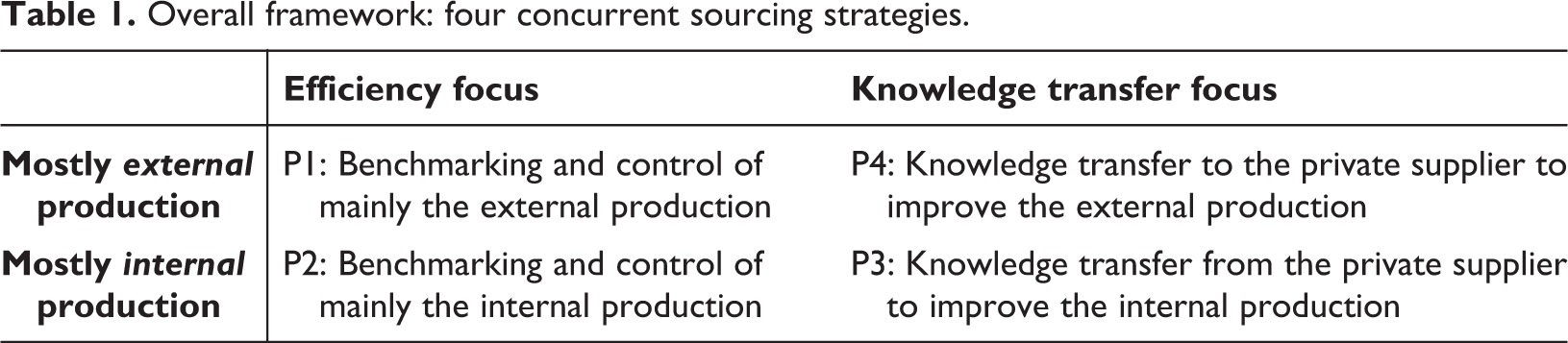
There are two major streams of literature on concurrent sourcing with very different assumptions (Puranam et al., 2013). One stream assumes that organizations need to deal with performance uncertainty and opportunism in order to enhance efficiency. Because of the uncertainty of both the supplier’s motives and how to evaluate the actual performance, there exists a fundamental need for controlling the suppliers, both the private supplier and the internal one. Concurrent sourcing is a means to reduce such uncertainty and opportunistic behavior because having both an internal and an external supplier allows for comparisons of costs, quality, etc. (Miranda and Lerner, 1995). The other stream argues that organizations need to build resources and knowledge to improve value creation and innovation and reduce technological uncertainty; in that case, concurrent sourcing is a way to increase the sourcing organization’s and/or the external supplier’s knowledge base if the knowledge possessed by the public and the private supplier differ (Krzeminska et al., 2013; Parmigiani, 2007; Puranam et al., 2013). Concurrent sourcing can reduce technological uncertainty, but requires more trustful relationships with suppliers than the case of simply letting the two suppliers compete with each other and then compare them (Krzeminska, 2008; Parmigiani, 2007). The two streams therefore clearly represent two very diverse views of the goal of concurrent sourcing. Moreover, there are also major differences between the different types of concurrent sourcing. Puranam et al. (2013) develop their model on concurrent sourcing as a continuum from complete make to complete buy, everything in between being concurrent sourcing, and identify the attributes pushing for either make, buy or concurrent sourcing; however, they do not discuss the differences between various placements on the continuum, that is, different combinations of internal and external production. At one extreme it can be mostly internally based (e.g. 90 percent internal production). At the other extreme, it can be highly dependent on external sourcing (e.g. only 10 percent internal production). Unless the concurrent sourcing strategy consists of roughly 50 percent internal production and 50 percent external production, one of the two suppliers will be the primary source of production. We argue that it makes a difference for the organization whether its own production is the primary production source. Combining the two basic assumptions: the aim of concurrent sourcing (efficiency versus knowledge) and type of concurrent sourcing (mostly internal versus mostly external sourcing), we propose four different concurrent sourcing strategies, as shown in Table 1. Arguments for each strategy will be discussed in the following.
Overall framework: four concurrent sourcing strategies.
Efficiency as the main purpose
The efficiency stream mainly draws insights from transaction cost theory and agency theory (Santos and Eisenhardt, 2005). Previous studies who apply a transaction cost perspective on concurrent sourcing have mainly found that the strategy was applied due to transactional heterogeneity (He and Nickerson, 2006). Transactional heterogeneity means that differences in the governance structure (make or buy) are caused by differences in the underlying transaction; as is predicted by traditional transaction cost theory (Williamson, 1985). According to Mols and Ménard (2014) concurrent sourcing moderates the negative relationship between transaction specific assets and performance because the internal production gives the company a termination safeguard. The organization can end the relationship with the supplier in the case of supplier opportunism and simply expand the internal production instead. The termination safeguard is especially important in a public context where governments are legally required to provide certain public services to the citizens (Warner and Hefetz, 2012). However, Mols and Ménard (2014) question why the ability to internalize production itself is not a sufficient threat. It is unclear from the existing literature how large a proportion of internal production is necessary for the internal production to be a genuine termination threat. Parmigiani (2007) expects that it is necessary for a larger part of the production to be produced internally for the threat to be believable in cases with high asset specificity. This point is also supported by Beladi and Mukherjee (2012). They claim that a credible commitment to in-house production is important for concurrent sourcing to last over time.
According to agency theory, the risk of opportunism arises when everything is bought externally, as information asymmetries exist between the supplier and buyer (Bergen et al., 1992). Internal production can decrease these asymmetries. Heide notes that the positive effect from internal production does not require that a large amount is produced internally; therefore, when wanting mainly efficiency through external production: “plural forms may be a strategy for ‘managing’ markets” (Heide, 2003: 26). In line with the argument that suppliers need to be controlled by the outsourcing organization, another reason for keeping some of the total production internally is bargaining power. Stenbacka and Tombak (2012) argue that if an organization chooses to either produce the entire needed amount internally or buy the amount externally, it may lose bargaining power to the exclusive supplier. These arguments about keeping part of production internal are related to the issue of hollowing out the public sector. The argument is that the public organization will lose both capabilities and control over the service production by contracting it all out (Rhodes, 1994). The concurrent sourcing strategy may therefore be even more important in the public sector, since the public sector often has obligations to deliver some services; if they contract out all activities, external suppliers are difficult to control as no internal benchmark exists. Further, it will be harder to reverse the outsourcing decision at a later point in time. Based on the above, the following proposition is stated: P1: When most of the total production is provided by an external supplier, information from the internal supplier is used to benchmark and control the external supplier.
A type of uncertainty that can be mitigated by concurrent sourcing is demand uncertainty. If the demand for a service is volatile, performance can decrease because unpredictable demand makes it harder to plan production (Mols, 2010a). Examples of this in public services are the need for health care, nursing homes, and supply utilities in local areas. By using concurrent sourcing, the internal production capacity is set close to maximal production capacity, and the remaining demand is covered through external sourcing. Demand fluctuations have less impact on the sourcing organization’s sensitivity towards excess production capacity, as the cost of keeping excess capacity is transferred to the external suppliers (Adelman, 1949). Normally, we expect a negative relation between demand uncertainty and performance, as excess capacity represents financial resources that could be used more efficiently for other purposes. Concurrent sourcing reduces demand uncertainty and moderates the negative relationship between this kind of uncertainty and performance (Mols, 2010b).
One of the requirements for use of benchmarking is that the services provided internally and externally are very similar (Krzeminska et al., 2013). If they are not, the information from the supplier providing the smallest part of total production will be useless in terms of controlling the largest supplier. In the sense that the internal and external supplier are competing on different terms, it seems likely that one of the suppliers will perceive such competition as unfair, which may lead to opportunistic behavior from the displeased supplier (Heide et al., 2014). The requirement of similarity in the service provided applies no matter whether the internal or external supplier provides the main part of the service. Reversely, if access to external information through the supplier is wanted, the internal production should be seen as dominating in the sourcing strategy (Nordigården et al., 2014). In the event that local government faces strong labor unions (Mols and Ménard, 2014) or other powerful stakeholders are present within the organization (Coff, 1999), controlling internal production can be problematic if the entire amount is produced internally. This means that the organization’s dependence on the internal production can also be reduced by using concurrent sourcing (Mols et al., 2010). In line with the arguments stated for P1, the information that follows from buying from an external supplier can be used to control how efficient the internal production is. Therefore, we state the following proposition: P2: When most of the total production is provided by an internal supplier, information from the external supplier is used to benchmark and control the internal supplier.
Knowledge transfer as the main purpose
Organizations’ external knowledge relations are becoming more and more important through the increase in and specialization of knowledge production (Brusoni et al., 2001); this is often mentioned in relation to public organizations because of their complex tasks. The knowledge effect is based on arguments originated in the resource based view (Mols, 2010a; Santos and Eisenhardt, 2005). According to the resource based view, sourcing decisions are determined by the resources and capabilities possessed by the sourcing organization, that is, organizations delivering the same product or service may make different sourcing decisions due to differences in their attributes (Barney, 1991; Wernerfelt, 1984). Porcher (2016) includes variables from the resource based view in his study of municipalities’ use of concurrent sourcing in water services; he finds a positive relationship between the municipalities’ contracting capabilities and concurrent sourcing and a negative relationship between production capabilities and concurrent sourcing, that is municipalities with superior production capabilities to a larger extent rely on their own internal production than external suppliers. Porcher (2016) does not, however, address knowledge transfer between the municipality and the private supplier. The studies previously dealing with knowledge effects assume that knowledge transfer is possible and are typically built on the logic of absorptive capacity. Internal production is a source of absorptive capacity that makes it easier for the company to understand and absorb knowledge from the external environment (Cassiman and Veugelers, 2006). Hence, internal production eases knowledge transfer, even though knowledge may be used in functions other than direct production, for example, maintenance or quality control. Parmigiani (2007) argues that there can be an advantage from sharing knowledge and that a concurrent sourcing strategy increases the absorption capacity which in turn eases knowledge sharing. Hansen et al. (2011), in a public setting, find that concurrent sourcing is more likely to happen when both the internal and external expertise is high. As supported by Grimpe and Kaiser (2010) the probability of external knowledge being used in a way that is unique, less generic, and therefore more valuable, depends first and foremost on the amount of existing knowledge within the organization. The absorptive capacity is theoretically an important factor for the sourcing organization in order to learn from its environment, and in the case of concurrent sourcing, its external supplier. Knowledge transfer is particularly important in service areas with technological uncertainty, a concept closely linked to the resource based view. Frequent changes in technology require flexibility from the organizations but at the same time a need to learn from the environment (Krzeminska et al., 2013). The knowledge effect from concurrent sourcing is a way to deal with technological change and uncertainty, as the strategy offers an extended knowledge base to the sourcing organization. When the external and internal knowledge of a service area are combined, the sourcing organization’s knowledge base becomes more divers, and the organization has knowledge of several technologies’ development and future potential and thus, avoids committing itself to only one technology (Mols, 2010a). Based on the argument that a large amount of internal production secures the necessary absorptive capacity and hence enables the organization to learn from an external supplier, the following proposition is stated: P3: When most of the total production is provided by an internal supplier, transferring knowledge is used to increase the internal supplier’s knowledge base.
With the strategy presented in P3, the knowledge possessed by the external supplier may be increased to some extent as well. In order to meet the organization’s needs more accurately, it can be beneficial for both parties that the external supplier learns more about the sourcing organization itself and the context it operates in. Such learning will secure that the knowledge transferred into the sourcing organization is more relevant and useful in the specific setting. However, the transfer is only expected to occur as long as it benefits the quality of knowledge coming into the organization. Spending resources on educating external suppliers above this certain point will increase the costs more than is gained by doing so.
Instead of focusing on how the sourcing company can learn from the external supplier’s knowledge, a focus point is also how internal capabilities can be used more directly in relation to the supplier. It is questionable whether the benefits of producing in-house while outsourcing are significantly greater than those potentially gained by replacing the internal production with employees who have specialized knowledge about the outsourced service and then using that knowledge to monitor and control suppliers. It is argued by Brusoni et al. (2001) that a gap between what organizations make and what they know may exist and their argument is that some technological knowledge concerning the production may be relevant in order to understand, develop, and/or produce other parts of a complete product or service. Knowledge has to be kept up-to-date over time which is probably ensured best if the sourcing organization is involved directly in the production. Hence, the argument put forward here supports Parmigiani and Mitchell’s claim that “firms often need to make in order to know” (Parmigiani and Mitchell, 2009: 1065, emphasis in original). If the organization possesses sufficient expertise some of the production can be outsourced. In other words, it can be desirable that most of the service is provided by the external supplier because of economies of scale advantages or other cost and knowledge advantages held by the supplier. The sourcing organization can still possess knowledge, for example derived from previous experience that can be of great value, in terms of costs and quality, for the general service provision. In a public setting, this is especially true, since public service provision is subject to much, often complex, legislation. Insights in legislation are often necessary or at least valuable to a private supplier to be able to undertake the outsourced services in a manner that is both efficient and meets the required standards. However, private suppliers may not possess knowledge about all rules and regulation, and knowledge transfer from the public authorities to the private suppliers is therefore valuable for both private suppliers and the outsourcing authorities. The mechanism of sharing the organization’s knowledge may be even more important in public organizations where value appropriation is not the key focus, but instead value creation for the stakeholders (Hansen and Ferlie, 2016). For the public organizations it is not necessarily a problem to transfer knowledge to private organizations, if it can help the citizens in general. In a public setting with a service provision responsibility, the internal knowledge is furthermore important as it secures the ability to conduct the task if the supplier fails to deliver. Based on the above, the following proposition is stated: P4: When most of the total production is provided by an external supplier, transferring knowledge is used to increase the external supplier’s knowledge base.
Possible interactions between efficiency and knowledge effects
The four strategies may not necessarily be mutually exclusive. There can be a number of potential interactions between them. With a highly externally-based provision strategy, knowledge sharing and efficiency may exist together. However this potential coexistence depends on what kind of knowledge that needs to be shared. Knowledge possessed by public administration such as legal requirements, etc. can easily be shared, since the administration has an interest in getting efficiency effects from using an external supplier. If the knowledge sharing on the other hand is dependent on the in-house operational staff to transfer the knowledge, it may be harder to obtain under benchmarking conditions. The in-house staff may fear a complete outsourcing of the service due to efficiency reasons after having handed over valuable knowledge to the external supplier. The internal staff will then either get a new employer or lose their job. These potential conflicting interests from the administrative and operational staff may hinder knowledge transfer when it is a matter of operational knowledge.
With a highly internally-based provision strategy, we argued that the limited use of external suppliers was either to benchmark the internal production or to gain access to knowledge possessed by the private sector. It may be possible that these two effects can work together. In services where several production units are needed within a municipality, for example, schools and nursing homes, these units can be internally benchmarked as well as externally. The operational staff at the different units may be more inclined to exchange knowledge with external suppliers if this results in better performance relatively to the other internal production units. In this case, benchmarking, and hence the efficiency effect, may actually give some incentives to work together with the external partner and adopt new knowledge.
Boundary conditions for the propositions
The proposal of the four concurrent sourcing strategies is only a first step, as there is a great need for further research on the boundary conditions for the propositions. In general, the concurrent sourcing literature lacks findings and discussion on which levels of transaction costs, uncertainty, and absorptive capacity are optimal for the performance of the concurrent sourcing mode; according to Brown et al. (2015) the probability for choosing mixed service delivery increases when more specialized investments in the service delivery are needed. In other words, when the asset specificity increases, the likelihood of using a concurrent sourcing strategy increases. However, this is only true up to a certain point; according to transaction cost theory, the production should be internalized if asset specificity is too high. Large investments specific to the service delivery make the transaction less attractive for the external supplier if the time frame for delivering the service has not got a sufficient length to get the investments covered. It is unclear at which levels of asset specificity the concurrent sourcing mode experiences a high performance and at which it does not. In line with this, it is unclear at what point the organization reaches the sufficient amount of knowledge to be able to absorb external knowledge or how much technological uncertainty is needed for concurrent sourcing to perform the best.
The strategies’ applicability for different service areas
For government at different levels (e.g. local and state) there are different reasons for applying an internally based versus externally based concurrent sourcing strategy. Even though most of the service production is contracted out, government still has the overall obligation and responsibility to provide the service (Kolderie, 1986). Keeping a small part of the production internally will in some cases secure production capabilities that can be rolled out on a larger scale, if needed at a later point. Government also avoids hollowing out competences, which is the risk with complete outsourcing because of the small internal production (Milward and Provan, 2000; Rhodes, 1994). On the other hand, arguments do exist for applying an internally based concurrent sourcing strategy. If the demand for the service is volatile, government can produce the most certain demand while external suppliers handle the volatile part of the demand. The public organizations often have an obligation to provide the service without interruptions, whereas the private company can say no to orders or adjust their prices in periods with high demand. Moreover, for some services, competitive markets do not always exist (Brown et al., 2015; Warner & Hefetz, 2008). While such markets are in their infancy, it makes sense to contract only a small part of the production out, as the market may not be ready to handle a complete outsourcing and it may be perceived as too risky from the local government’s point of view.
The question is how empirically relevant the four concurrent sourcing strategies are in the public sector and in specific service areas. It is implied that the four different strategies are likely to occur in different settings because according to Hansen et al. (2011) and Mols et al. (2012) there is a variety in the different degrees of concurrent sourcing (i.e. most internal/external production) across different service areas. We thus expect that the concurrent sourcing strategies used vary a lot across the service areas. In some service areas, an extended use of benchmarking is likely to be used, while a larger need for knowledge sharing in other areas exists. The same goes for the distribution of production between the public and private supplier. We therefore expect that some of the earlier areas studied in regard to concurrent sourcing in the public sector (i.e. refuse collection, water supply, school cleaning, road maintenance, and IT maintenance) differ in their likelihood of strategies used. Further, we expect that the organization’s specific characteristics influence the use of concurrent sourcing strategies, for example, organizational size, capabilities and change in organizations. For instance, municipalities with superior contracting capabilities use concurrent sourcing in water supply services to a larger extent than other municipalities according to Porcher’s results (Porcher, 2016). When investigating interactions effects between capabilities and transaction costs, he finds that such capabilities have a declining effect on the use of concurrent sourcing, when transaction costs are high.
For a relatively simple task like school cleaning, the reason for using concurrent sourcing is more likely to be due to benchmarking (either benchmark the internal or external production) because the demand for knowledge sharing is not the same as for a more complicated task. Refuse collection is another service task we expect to utilize mostly efficiency strategies. We expect that local government keeps some refuse collection in-house to have the possibility of benchmarking the external supplier. Yet, we also expect that the concurrent sourcing strategies are more externally based if the general external suppliers have greater expertise and scale than the municipalities (e.g. the external supplier can increase their expertise and scale by delivering service for multiple local governments). A similar argument about expertise and scale is found in road maintenance; the private supplier can benefit from having greater scale and expertise, again from maintaining roads for several municipalities. Yet, the municipality still needs to keep some internal production to deal with its responsibility for the roads within its jurisdiction. Yet this varies from setting to setting, since larger municipalities will have greater expertise and scale relative to smaller municipalities. However, knowledge sharing strategies could also be expected, i.e. in periods where the refuse collection changes. For instance, many countries experience changes in how garbage is sorted and recycled, which may increase the needed knowledge for refuse collection. IT maintenance is an area that can hardly be considered a core service for the public sector. However, there are large dependencies between providing a specific service and the underlying IT system. Sufficient knowledge of the service area and its legal requirements is essential for making the right IT to support the service, for example, in terms of documentation. For government officials to be able to understand and specify the IT needs for a service area, an internal IT department plays a key role. The need for knowledge transfer, in some instances from internal to external supplier, in others the opposite direction, is likely to persist over time as the service area develops. In general, understanding the complexity of the specific task is therefore of great importance. Again, this emphasizes that the sourcing strategies depend on the specific context.
The services included in former studies of concurrent sourcing in the public sector are mainly of a technical character. Social services have been used to a lesser degree as a case in concurrent sourcing. However, it is unclear whether social services, that generally are argued to be more difficult to measure the performance of (Petersen et al., 2015), will cause a need for benchmarking or knowledge sharing, and Brown et al. (2015), perhaps due to measurement difficulties, find that concurrent sourcing in social services is more likely to happen with a non-profit external partner. Benchmarking through a concurrent sourcing strategy may in fact be helpful in monitoring social services such as child care, nursing homes, teaching, etc. It varies from country to country whether government provides such services or not. In Scandinavia where the welfare state for many years has been the largest provider of such services, contracting partially out can be used to increase efficiency in social services because benchmarking is made possible. The concurrent sourcing strategy may especially be used in weak and thin service markets, which are argued to be the case for social services (see e.g. Van Slyke, 2003). Having minor levels of outsourcing that can be benchmarked against internal production is a way to create markets in the longer run. In other countries, the concurrent sourcing strategy is the opposite because the public organizations build up service areas that they did not have earlier, for example, some countries did not have public elderly homes and now have to establish these. When concurrent sourcing is used to build up either a market or internal service production, both cases illustrate some of the dynamics of the concurrent sourcing strategies.
At the same time, some local governments may feel a need to increase their knowledge base concerning social services as it is a field focusing more on increasing evidence-based performance of the tasks (Nutley et al., 2000). The use of external suppliers is a way to get access to different types of knowledge; having non-profit organizations as suppliers can be a strategy to access knowledge that public organizations do not have to the same extent. Bel et al. (2014) discuss the differences between using private and non-profit suppliers, and Moore (2000) argues that one of the strengths of the non-profit organization is the time and effort donated from volunteers. Gaining knowledge about effective volunteer management offers great potential for some service areas delivered directly by public authorities. Often, social services rely on or entail complex social relations where different organizations such as public, non-profit, and for-profit may have different insights and knowledge that would be fruitful for all organizations to share.
Discussion
Overall, this paper contributes by proposing four concurrent sourcing strategies and the theoretical argumentation behind the four strategies. Future studies are needed to examine the strategies empirically and especially in which context the different strategies and theoretical rationales are best. It could for instance be interesting to understand how differences in, for example, degree of competitive market, assets specificity, service measurability, and complexity between areas (Brown and Potoski, 2003a) influence the use of strategies. Equally interesting is how the strategies can be used in varied areas, since technical and social services have been shown to differ in regard to contracting out (Petersen et al., 2015).
Though each of the four strategies is rather simple to understand, they also raise two fundamental issues that research on concurrent sourcing needs to consider. The first issue is the relationship between the buyer and supplier; the relationship can be even more complex in the public sector which is influenced by a lot of rules and regulations (Brown et al., 2016), and as we argue in this paper that some unique characteristics may exist within the public context which can influence the strategy used. Second, the concurrent sourcing strategies raise the issue of the stability of the four concurrent strategies; are they stable strategies or a transition to another type of sourcing? After discussing the issues of relationship and stability, the discussion ends with a proposal for future research on concurrent sourcing and more specifically these four sourcing strategies.
Relations
The two objectives of the concurrent sourcing strategies presented here, efficiency and knowledge transfer, may lead to very different supplier relations. The requirements in terms of coordination and collaboration depend on what type of knowledge that has to be transferred. Nickerson and Zenger (2004) argue that more complex problems need more coordination and are hence best undertaken within the hierarchy. This governance structure is not immediately possible when it comes to knowledge sharing between organizations. The primary risk for knowledge-sharing companies is the “likelihood of unilaterally or disproportionately losing one’s own core capability or skill to the partner” (Kale et al., 2000: . 217). Knowledge spillovers can mean that knowledge not meant for sharing is nevertheless shared. As the internal production and the supplier can be perceived as a competitor to the supplier in a concurrent sourcing setting, such knowledge spillovers can render potentially high costs for both parties. Where some argue that trust is important for knowledge sharing, Janowicz-Panjaitan and Noorderhaven (2009) emphasize the importance of trust on the operational level, that is, that the personnel hired by the public organization directly and the external supplier’s personnel trust each other.
Because the supplier perceives monitoring and control as more legitimate when based on internal production Heide et al. (2014) conclude that the effect of these governance mechanisms will be higher under concurrent sourcing than complete outsourcing. This is a key finding as previous research has shown that increased monitoring under certain circumstances can lead to more opportunistic supplier behavior (Heide et al., 2007). The study made by Heide et al. (2014) furthermore finds that when solidarity norms are used as a governance mechanism as part of a concurrent sourcing strategy, the supplier to a larger extent acts opportunistically. Solidarity norms means that the relationship between the sourcing company and the supplier is considered valuable itself. Such norms will therefore decrease goal divergence and initial transactional difficulties. The authors find that concurrent sourcing undermines solidarity norms, either because internal production in this scenario is perceived as missing commitment in the supplier relation or because the sourcing company has goals that are different from the goals the supplier expected to be similar for the two.
In regard to public organizations, there may be some challenges in constructing relationships that can benefit knowledge sharing, as public organizations are under very strict procurement rules to insure accountability, fairness, etc. It is found that there is much more red tape in public procurement compared to private procurement. Though procurement rules are changing towards more innovative and flexible opportunities for contracts, the public organizations’ rules will still be a challenge for long term collaborative relationship. On the other hand, as formerly mentioned, the goal of public organizations is not value appropriation, and having other goals instead may influence the sourcing decision, also in regard to concurrent sourcing (Hansen et al., 2011). Public organizations are therefore in general more likely to be able to collaborate, especially if they collaborate with other public organizations that also have value creation, not appropriation, as their key goal. Furthermore, one of the key points of Hefetz et al. (2014) is that collaboration with other public organizations is less risky than collaboration with for-profit organizations. Thus, the opportunity of knowledge sharing with an external supplier also depends on the ownership of the supplier.
Stability
A theme in the literature on concurrent sourcing is whether the concurrent sourcing strategy continues to exist in the long run or if it is abandoned for a single sourcing strategy, that is, make or buy. For both strategies concerning either an efficiency or a knowledge transfer objective, it can be argued that concurrent sourcing is just a temporary phenomenon when an organization is changing its sourcing strategy from complete make to complete buy or vice versa (Mols, 2010a). However, both efficiency effects and knowledge effects may diminish over time leading to a single sourcing strategy as the most efficient. When it comes to knowledge transfer, it may not be needed in the long run but only in a transition period. When the necessary knowledge is transferred, one of the supplier relationships, either the internal or the external, is terminated. On the other hand, if the technological uncertainty in a service area remains at a high level, knowledge transfer may be necessary in the long run as well (Krzeminska et al., 2013; Parmigiani, 2007).
Nickerson and Zenger (2004) argue that concurrent sourcing is a temporary phenomenon, only used in transitions between complete in- or out-sourcing. Similar to this, concurrent sourcing can be perceived as keeping all options open and then deciding on a more permanent sourcing strategy later on (Alvarez and Stenbacka, 2007; Du et al., 2006; Lim and Tan, 2010). Applying an agency perspective, Heide (2003) argues that concurrent sourcing is particularly useful in order to reduce information asymmetries when choosing a supplier. It is particularly important in the public sector because of the complexity of tasks (Brown et al., 2016). When the supplier and buyer come to know each other better through direct interaction, the supplier’s characteristics are revealed for the buyer, and the need for concurrent sourcing as a source of information, and hence control, will be more redundant (Heide, 2003). Furthermore, supplier relationships can evolve over time and become more specialized, which might decrease the principal’s ability to control the external supplier further (White, 1985). In terms of efficiency, using a concurrent sourcing strategy permanently would require that the supplier relationship does not become specialized over time or that information asymmetries in some way continue to exist.
According to Mols and Ménard (2014) concurrent sourcing can also occur as a result of lock-ins. When an organization is forced to use a specific form of governance for parts of the production, a lock-in exists. This aspect is even more important in the public sector where public authorities often have a delivery responsibility. Lock-ins occur when an organization struggles to terminate the internal production due to labor contracts, legislation, or labor unions (Puranam et al., 2013). The latter point is supported by Parmigiani (2007) who finds that companies greatly influenced by unions experience larger difficulties when complete outsourcing is wanted. Again, this is highly relevant in a public sector with large levels of legislation (Brown et al., 2016) and often highly influenced by unions. Technological changes can also lead to the phenomenon that production relying on long-term obligations, both internally and externally, becomes inefficient. Overall, concurrent sourcing then occurs because the organization is tied to a more inefficient governance form compared to alternative forms of governance. In such a case, the concurrent sourcing will imply larger costs than if the most efficient governance form is used: according to this argument, the concurrent sourcing solutions optimal under lock-ins are not optimal in the long run (when the lock-ins disappear), and the strategies are therefore not permanent (Mols and Ménard, 2014). Similarly, if the sourcing organization’s internal production primarily is upheld because it represents large sunk costs, the internal production is likely eventually to be replaced by external suppliers (Mols et al., 2010).
However, resourced based explanations for concurrent sourcing come to a different conclusion; when technological uncertainty continues to remain, the sourcing organization and the external supplier depend on each other permanently (Parmigiani, 2003). Such a dependency is caused by a continuous need to stay updated in terms of new knowledge and new technologies. Especially in high-technological areas you can imagine a permanent need for concurrent sourcing because of the knowledge complementarity effects the concurrent sourcing strategy presents. When it comes to the optimal production set-up, however, Puranam et al. (2013) expect that the knowledge effects are most significant for relatively new production technologies where there is still a lot to be resolved. It could therefore be expected that the knowledge synergies will decrease over time. Furthermore, knowledge effects will to a larger degree occur in dynamic environments with technological uncertainty but are likely to be temporary (Mols and Ménard, 2014). Due to the increasing want for evidence-based approaches, knowledge effects may be more likely to occur in social service areas.
Krzeminska (2008) argues that concurrent sourcing will continue to be valuable for the sourcing organization when the amount of uncertainty continues to stay at high levels over time. Empirically, Parmigiani and Mitchell (2009) find that concurrent sourcing is a stable phenomenon over time and not just a transition from internal production to buying from external suppliers or vice versa. They also discover that practitioners can identify examples from real life where the strategy is used over a long time span. In their study, almost 60 percent of the companies using a concurrent sourcing strategy have always used that strategy. Less than 12 percent find it likely that they will chance the strategy (Parmigiani and Mitchell, 2009: 1075). Hansen et al. (2011) also investigate whether the surveyed municipalities expect to change the sourcing decision in the future. The results indicate that the concurrent sourcing strategy is rather stable over time.
Future studies on concurrent sourcing and the four strategies
First of all, there is a need for qualitative studies in regard to understand how managers and decision-makers think and reason about concurrent sourcing, especially whether the concurrent sourcing phenomenon and the four specific strategies are something managers use deliberately. Equally important is to understand under what conditions these different strategies are best used, for example, in which contexts they are most suitable. In general, a challenge within the concurrent sourcing literature seems to be that it is very context specific. We therefore see a need for investigating empirically and theoretically the conditions under which different strategies are used and furthermore perform best. This also relates to the issue that we need more quantitative and generalizable studies of concurrent sourcing. Though several interesting quantitative studies have been conducted on concurrent sourcing, the literature still needs studies using questionnaires specifically constructed to understand the mechanism of concurrent sourcing. Former studies have generally used questions traditionally used to understand make-or-buy which can be very helpful, but there is a need to use both the direct and indirect approaches to study concurrent sourcing. Furthermore, it is indeed highly relevant to investigate the performance implications of concurrent sourcing strategies. However, performance is a multifaceted concept, especially in the public sector, and as these different concurrent sourcing strategies have different aims, future research needs to investigate performance more broadly. Moreover, we need to understand both sides of the supplier relationship; how do the buyer and supplier use concurrent sourcing and what do they think about these concurrent sourcing strategies? Such understandings are highly relevant in regard to the four concurrent sourcing strategies. Finally, future studies in a public setting need to consider public characteristics more specifically, for example, Hefetz et al. (2014) argue that there may be major differences between whether the supplier is a private organization, another public organization, or a non-profit organization. The type of supplier may also influence the concurrent sourcing strategies.
Conclusion
The key contribution of this paper is the proposal of four distinct strategies for using concurrent sourcing. It is based on whether the focus of using concurrent sourcing is efficiency or knowledge sharing and based on the level of internal and external production. We proposed four different propositions (one for each strategy) that future research can test. We also argued why these strategies can help deal with some of the challenges of contracting in the public sector, for example, hollowing out, the demand for service delivery, fairness, and accountability which former have been argued to be important characteristics that distinguish the public sector and the private sector in regard to concurrent sourcing (Hansen et al., 2011). We considered the applicability of the different concurrent sourcing strategies in regard to different service areas formerly studied. We emphasize the importance for future research to investigate whether and how public managers use these strategies to conduct their tasks. Especially, it would be interesting to understand in what service areas the different strategies are used (or have a particular potential) and if they are stable strategies for service production or just stages on the way to either full internal or external production. Finally, it would be important to understand the performance of these different strategies, especially if they can help the public sector be more efficient and/or more innovative.
Footnotes
Acknowledgements
We are grateful for useful comments from Niels Peter Mols, Ole Helby Petersen, Kurt Houlberg and the feedback we received the participants at the “Innovations in Service Delivery” workshop at the University of Barcelona’s Department of Economic Policy, Barcelona, March 2016, where an earlier version of this paper was presented. We would further like to thank the two anonymous Journal of Strategic Contracting and Negotiation reviewers for constructive feedback.
Declaration of Conflicting Interests
The author(s) declared no potential conflicts of interest with respect to the research, authorship, and/or publication of this article.
Funding
The author(s) received no financial support for the research, authorship, and/or publication of this article.