




Abstract
This work contributes to the literature on water governance by attempting to provide an answer to the question of what are the differences in efficiency of alternative governance arrangements of water utilities. We test hypotheses derived from property rights, principal–agent, and transaction costs theories using a comprehensive database of 260 water utility systems provided by the Portuguese Regulatory Authority of Water and Waste Services. Using endogenous switching regression models estimated through maximum likelihood, the study is designed in two steps. First, we investigate differences in efficiency between in-house options and externalization and find that in-house solutions as a set (direct provision and municipal companies) are more efficient than externalization options (mixed companies and concessions). Second, we test differences in efficiency within both in-house and externalization solutions, and fail to find statistically significant differences in efficiency between in-house bureaucracies and municipal companies and between mixed companies and concessions.
Keywords
Introduction
There is an abundant body of empirical work addressing the determinants of efficiency of water utilities, including public versus private ownership, institutional setting, structural variables, water losses, and population density (see Walter et al., 2009 for a comprehensive survey of the literature). In this paper, we go beyond the ‘usual suspects’ affecting the efficiency of water delivery systems by investigating the impact of four alternative modes of service delivery: in-house bureaucracies; municipal companies; mixed companies; and concession contracts to private companies.
Efficiency levels in the supply of water services are one of the most relevant matters of research in utility policies. The focus on efficiency is justified by the distortions of market competition in the water sector, which render financial indicators inaccurate measures of economic performance (Abbott, 2006). The crucial question is then under which governance arrangements efficiency can be enhanced, given the incentives and constraints associated with each alternative and the specific features of the water sector in each country. With a few exceptions (Peda et al., 2013), most studies have focused on the discussion of the efficiency implications of ownership (public versus private) rather than on efficiency comparisons between governance arrangements at the disposal of elected officials and decision-makers to provide water services. Rather than framing the decision from this dichotomous ownership perspective, we argue that the decision should be addressed from the perspective of the trade-offs between alternative water service delivery arrangements which have implications for technical efficiency. In other words, whether the service is being directly provided by the municipality, indirectly provided by a municipal company or a mixed firm, or externalized to a private partner is likely to have efficiency consequences.
In addition, the analyses of efficiency in water utility systems have been plagued by technical problems, including, but not limited to, endogeneity in regression models. Prior studies have failed to account for unobserved characteristics that simultaneously influence the probability of choosing the externalization of water supply and the level of efficiency of the water delivery arrangements. Neglecting these selectivity effects is likely to convey a false picture of the relative efficiency of alternative water service delivery systems. In this paper, we adopt a two-step research design that is able to accommodate the assumption that the decision to externalize is endogenous to efficiency performance and driven by market opportunities. We investigate differences in efficiency between in-house options and externalization solutions. First, we contend that in order to assess differences in the level of efficiency resulting from alternative governance arrangements one needs to control for variables conditioning the initial choice for externalization. Failure to account for the initial conditions favoring externalization, namely how appealing is the municipal utility to private investors, will result in biased estimates indicating externalization solutions as more efficient. The first research question is: “What are the differences in efficiency between in-house arrangements and externalization solutions in water service delivery?” Second, we separately test differences in efficiency within both in-house and externalization solutions. Two research questions will be answered in this second part of the analysis: (1) “Are there any differences in efficiency between in-house bureaucracies and municipal companies?”; and (2) “Are there any differences in efficiency between mixed companies and franchise concessions in the water delivery sector?”
The choice of Portugal as a single-country study is justified for two reasons. First, the Portuguese water sector possesses many features in common with other countries, which makes the lessons from this study valuable for other contexts: high degree of fragmentation in water distribution; insufficient investment in an aged network; and monopoly status of water services providers (Martins et al., 2012). Second, Walter et al. (2009) point out that cross-country studies create empirical problems that render more difficult comparisons between systems operating under different institutional settings. By focusing on a single country where reliable data are available and where the operating environment is the same across all water utilities, we avoid this problem associated with comparative work and are better able to isolate the effect of alternative modes of service delivery and market conditions on efficiency. Finally, the number of studies conducted in the Portuguese context is still scarce, but the interest about utility policies is growing steadily, as demonstrated by recent works focusing on the sustainability of water services (Marques et al., 2015), on cost efficiency of the joint provision of water and wastewater services (Da Cruz et al., 2013), and on sector choice contracting for water services (Pinto et al., 2015). Other work provides relevant clues about how to use data envelopment analysis (DEA) to measure the relative efficiency of local governments as a whole, and econometric methods to estimate the determinants of their performance (Da Cruz and Marques, 2014). Despite their undeniable significance, the important question of the impact of alternative modes of service delivery in the efficiency of water utility systems is still under-researched.
The paper proceeds as follows. After this introduction, the second section presents water service delivery as subject to alternative service delivery arrangements and discusses possible implications for efficiency associated with this choice. The section draws on property rights theory, principal–agent theory, and transaction costs economics to derive the key hypotheses of this study. The third section offers an overview of urban water policy in Portugal. Next, we describe DEA as a technique to measure the performance of water utility systems and estimate the relative efficiency of the 260 water delivery systems in Portugal using a comprehensive database provided by the Portuguese Regulatory Authority of Water and Waste Services for the years 2012 and 2013. In section five we estimate endogenous switching regression models of the determinants of efficiency under different regimes: (1) in-house solutions versus externalization; (2) direct provision using in-house bureaucracies versus municipal companies; and (3) mixed companies versus concessions to private firms. The paper ends with conclusions and directions for future research.
Governance arrangement choices and efficiency in water services
The comparison of efficiency between governance alternatives for water service delivery cannot be undertaken without an understanding of how local officials opt between in-house alternatives and externalization solutions. In other words, the profit motive operates as a strong incentive for externalization of water service delivery. Larger markets are generally more attractive to private partners due to the potential for reaping economies of scale, so externalization is more appealing for systems with a larger number of clients to be served and where contracting by municipalities is facilitated by the potential availability of private firms (Levin and Tadelis, 2010). The intensity of political influence through lobbying activities is also likely to be higher (Noll, 2002). As a result, any attempts to compare efficiency between in-house and externalization solutions should first control for the initial motivation to externalize (or not). Based on the contributions of property rights theory, principal–agent theory, and transaction costs theory, this section develops the hypotheses about the relationships between governance arrangements for water service delivery and efficiency levels.
Efficiency levels in in-house bureaucracies and externalization solutions
According to property rights theory, competitive markets should favor more efficient operations in governance arrangements where a private partner plays the major role, as principal–agent incentives tend to be more aligned than in purely public sector alternatives (Saal and Parker, 2001). This occurs because private owners as principals are able to design contracts aligning managerial (agent) incentives with their own goals as residual claimants (Alchian, 1965; De Alessi, 1983; Demsetz, 1967). In contrast, under public ownership, bureaucrats are unable to capture profits associated with efficiency improvements, which combined with budget-maximizing assumptions regarding the behavior of bureaucrats (Migué and Bélanger, 1974; Niskanen, 1971) , lead to expectations of reduced efficiency under public ownership.
A few studies find evidence of differences in efficiency between publicly-owned and privately-owned water utilities. Using a sample of 221 US water utilities, Bhattacharyya et al. (1995) found that privately owned water utilities are comparatively more efficient when the scale of the operation is small, but public water utilities are more efficient for larger scales. Estache and Kouassi (2002) used a sample of 21 African water utilities from 1995 to 1997 to estimate a production frontier for the sector and found evidence that privately owned water utilities were slightly more efficient than their public counterparts. Work by Correia and Marques (2011) uses an unbalanced panel of 68 Portuguese water utilities in 2004–2005 and concludes that private utilities are, on average, more efficient than public utilities. González-Gómez et al. (2010) investigate the levels of efficiency of Spanish utilities and find that private management is more efficient when the estimations employ a conventional model to assess efficiency and when quality is taken into account. However, there are no significant differences between private and public management when hydraulic yield is included, which suggests that public managers are more sensitive to the sustainable management of water resources. Finally, Peda et al. (2013) analyze 43 water utilities, serving more than 68% of the Estonian population, and conclude that small public utilities are less efficient in comparison to six other combinations of ownership and size, including small private utilities.
Hence, based on property rights theory we can expect that:
H1a: Governance arrangements with private partner participation are expected to be more efficient than public solutions.
The provision of water services always involves the delegation of authority. In the case of bureaucratic supply, the mayor delegates the task to bureaucrats acting as agents, whereas municipal companies are the product of the delegation of authority by the municipal council responsible for their creation. The typical municipal company is owned by the local government, who act as the sole residual claimant. In contrast with in-house bureaucracies and municipal companies, service delivery arrangements such as mixed companies and franchise concessions entail drafting, negotiating, and monitoring contracts with private partners. According to transaction costs theory, possible efficiency gains associated with external delegation may be undercut by the transaction costs associated with the externalization decision.
Furthermore, the water sector is typically characterized by frequent market distortions, including private monopolies which allow excessive rent-extractions and X-inefficiency (Lobina and Hall, 2007) and natural monopoly conditions (Bel et al., 2010). As a result, these theoretical foundations point to private sector operators having no more incentives to be efficient than their public sector counterparts facing similar conditions (Abbott and Cohen, 2009; Anwandter and Ozuna, 2002). The alignment of objectives between principal and agent is questionable under market concentration conditions, particularly when owners are unlikely to benefit from using resources in monitoring or when a firm take over or bankruptcy is improbable (Bel et al., 2010). In addition, transaction costs theory suggests that the costs associated with negotiating and monitoring an agreement with a private partner in the water sector characterized as a natural monopoly with high asset-specificity features would cancel possible efficiency gains derived from better technical efficiency secured by private provision Bel et al., 2010; Brown and Potoski, 2005).
Empirical work has treated the effect of ownership as a dichotomy between public and private ownership, with comprehensive reviews addressing this topic concluding that “no clear picture emerges” (Walter et al., 2009: 227). Bel and Warner (2008) review all econometric studies about water service delivery published since 1970 and find no cost savings as a result of privatization. A similar review of 22 empirical tests and 51 case studies shows that private sector participation in water supply per se does not have a significant positive effect on efficiency (Pérard, 2009).
Several studies conclude that there is no evidence of differences in efficiency and productivity between public and private ownership: Estache and Rossi (2002) for Asian and Pacific regional water companies; Kirkpatrick et al. (2006) for African water utilities; García-Sánchez (2006) for Spain; Da Silva e Souza et al. (2007) for Brazil; Carvalho and Marques (2011) for Portugal; and Peda et al. (2013) for Estonia. In many of these empirical studies, the authors attribute this result to several factors, including the specific nature of the water sector and regulatory ineffectiveness.
Shih et al. (2006) employ data sets from the US Environmental Protection Agency’s 1995 and 2000 Community Water Systems surveys to examine production costs of water supply systems and find that public systems are more efficient than private systems. Romano and Guerrini (2011) employ DEA to measure and compare the efficiency of 43 Italian water utilities and find that ownership structure is a relevant predictor to explain differences in efficiency between companies. Their results show that public companies display higher efficiency scores than mixed companies, a sign of better purchase, management and organization of inputs and this regardless of scale effects. This study confirms prior findings using similar data (80 Italian water utility companies between 2004 and 2008), but considering only labor costs ratios as a measure of efficiency (Guerrini et al., 2011).
In sum, due to weak competition in or for the water service delivery market, principal–agent theory and transaction costs theory suggest that no differences in efficiency should be expected between in-house and externalization governance arrangements. In fact, as many empirical studies have shown, it is likely that under market concentration, significant asset specificity, and high transaction costs, public sector provision will be more efficient than private sector choices. The potential efficiency gains associated with private production have to be weighed against the higher transaction costs in concession contracts and goal alignment problems in mixed companies. In other words, market distortions are likely to subvert the usual expectations regarding the superiority of private production conveyed by both property rights theory and public choice theory in competitive market settings (Peda et al., 2013). Hence, transaction costs theory suggests that:
H1b: In-house solutions are expected to be more efficient than externalization alternatives.
Efficiency levels in in-house bureaucracies and municipal companies
An alternative to the externalization of water service delivery is to use a municipal company with 100% of shares owned by the enacting municipality. Corporatization is motivated by the ability to take advantage of industrial scale type of operations, without relinquishing control over sociopolitical orientation in service delivery. Municipal companies have long been thought of as alternatives to direct provision employing in-house bureaucracies. Direct provision using municipal bureaus is tax-financed, subject to competitive budget allocations, and entirely dependent upon the preferences of local elected officials (Tavares and Camões, 2010). In contrast, municipal companies are governed by an executive board presided by a politically appointed chief executive officer and have larger managerial discretion in financial, human resources, and public procurement decisions. Typically, they are less subject to borrowing and debt limitations and are primarily self-financed through output sales at a per-unit rate (Horn, 1995; Tavares and Camões, 2010).
Municipal companies for water service delivery have the potential to realize productive efficiency gains as a result of more flexible personnel and financial management rules, but these gains are likely countered by the loss of political control (Tavares and Camões, 2007). However, the loss of political control is primarily a problem of allocative efficiency rather than technical efficiency. Municipal bureaucracies are more likely to value the political goals of their principals than municipal companies. In other words, universal water service provision is likely a major goal valued by locally elected officials keeping in-house bureaucracies under tight supervision, whereas municipal companies are less subject to this allocative efficiency goal and more likely to value technical efficiency (Tavares and Camões, 2010).
In the case of larger municipalities opting to maintain water service delivery under some political control, municipal companies are likely to become the preferred governance arrangement, as they allow gains of scale, specialization, and autonomy not allowed by in-house municipal bureaus (Tavares and Camões, 2010). Others have argued that corporatization is likely to provide improvements in efficiency that privatization can only accomplish if combined with stringent economic regulation of the water sector (Abbott and Cohen, 2009; Peda et al., 2013). Nevertheless, reduced market pressures, particularly the possibility of takeovers and risk of bankruptcy, should also be considered as detrimental to these efficiency improvements (Bel et al., 2010).
Based on these arguments from both transaction costs theory and principal–agent theory, our second hypothesis states that:
H2: Municipal companies are expected to be more efficient than in-house solutions.
Efficiency levels in mixed companies and franchise concessions
A mixed company is “an organization where both the private sector and the public sector legitimately and meaningfully exercise authority and influence over the organization’s behaviour because each holds some part of the formal (therefore, fractionalized) property rights” (Vining et al., 2014: 62). In hybrid solutions such as these, goal alignment between the two principals becomes substantially more difficult to achieve due to the potential conflicting goals associated with dual ownership. Public partners may concentrate on sociopolitical goals (e.g., social equity, quality of service, reelection, among others), directly at odds with the private partner(s) profit-seeking goals (Vining et al., 2014). In addition, shirking by the agent (manager) may occur as a result of the dual principals. This problem can only be tackled by improving monitoring, which significantly increases transaction costs and, as a result, reduces efficiency (Bel et al., 2010). According to Vining et al. (2014), three scenarios are possible for mixed companies: (1) the best of both worlds scenario, where both private returns and social output are secured; (2) the worst of both worlds scenario, where neither private returns nor social output are achieved; and (3) the profit-collusion world, when both the public and private partners seek to maximize profit.
The evidence regarding the provision of local public goods using mixed companies is still up for debate, with Vining et al. (2014: 78) arguing, nevertheless, that “…the aggregate large-N evidence suggests that Mixed Enterprises do exhibit a degree of cost-efficiency superiority when compared to State-Owned Enterprises” and are certainly a better option in social welfare terms than provision through a regulated private-sector firm. These findings should be tempered by the fact that the empirical studies reviewed by these authors do not concern the water sector and its market distortions. The few case studies about mixed companies operating in the water sector provide a much less rosy picture (Da Cruz and Marques, 2012; Lobina and Hall, 2007).
A concession to a private firm can be regarded as an externalization alternative to mixed companies for the delivery of water services. A concession is a “delegation of service operation and at least a significant part of the economic risk to a private company” (Antonioli and Massarutto, 2012: 522). A concession contract includes both performance measures and incentives and sanctions capable of securing efficiency in service delivery (Brown et al., 2006). Concessions using a transactional contract may be more efficient solutions if the transaction costs involved in securing a more complete contract are lower than the costs associated with the suboptimal allocation of risks and accountability problems associated with mixed companies (Da Cruz and Marques, 2012). However, in contrast with the simultaneous jointly-shared property rights of mixed companies, concessions involve sequential property rights, which tend to display the absence of a clear division of ownership-related property rights, intensifying contract incompleteness, and increasing transaction costs (Boardman and Vining, 2012; Vining et al., 2014). The large investments in fixed network infrastructure required by the water sector combined with the long duration of contracts favoring the incumbent worsen contract incompleteness and the transaction costs associated with concessions.
Based on the theoretical arguments and the review of empirical studies by Vining et al. (2014), we suggest that:
H3a: Mixed companies are expected to be more efficient than franchise concessions in the delivery of water services.
However, because there is evidence that mixed companies operating in the water sector are affected by a suboptimal allocation of risks between the public and private partners (Da Cruz and Marques, 2012) and by significant accountability problems and monitoring costs associated with the “dual principal” condition (Grossi and Thomasson, 2011; Vining et al., 2014), we propose an alternative hypothesis:
H3b: Franchise concessions are expected to be more efficient than mixed companies in the delivery of water services.
The following section provides a brief characterization of the water sector in Portugal.
Urban water governance in Portugal
The water sector in Portugal is characterized by a high degree of fragmentation, with water distribution managed by 260 local water utilities responsible for the distribution and customer service, with substantial overlap with the territorial limits of the 278 municipalities in Continental Portugal. There is also significant vertical fragmentation, since production (catchment management, collection, storage, and treatment) and distribution and customer service are handled by different sets of operators (Da Cruz et al., 2012; da Cruz et al., 2013). Production is in the hands of a small number of public–public partnerships, which have the national government as the major shareholder and the municipalities as minority shareholders (Marques, 2008). The majority of water utilities responsible for distribution are also in charge of wastewater management. Insufficient investment in the renovation of water supply networks causes significant water losses that contribute to overall levels of inefficiency in systems already compromised by the highly fragmented nature of the sector (Martins et al., 2012), but the situation has improved slightly in recent years (Entidade Reguladora dos Serviços de Águas e Resíduos, 2015). The water sector is regulated by the Regulatory Authority of Water and Waste Services, a sector specific regulator that has been primarily concerned with water quality, performance assessment of concessionary companies, and economic regulation of all operators in the market (da Cruz et al., 2013). Water utilities responsible for distribution operate in a monopolistic environment and customer choice is virtually absent in the Portuguese context.
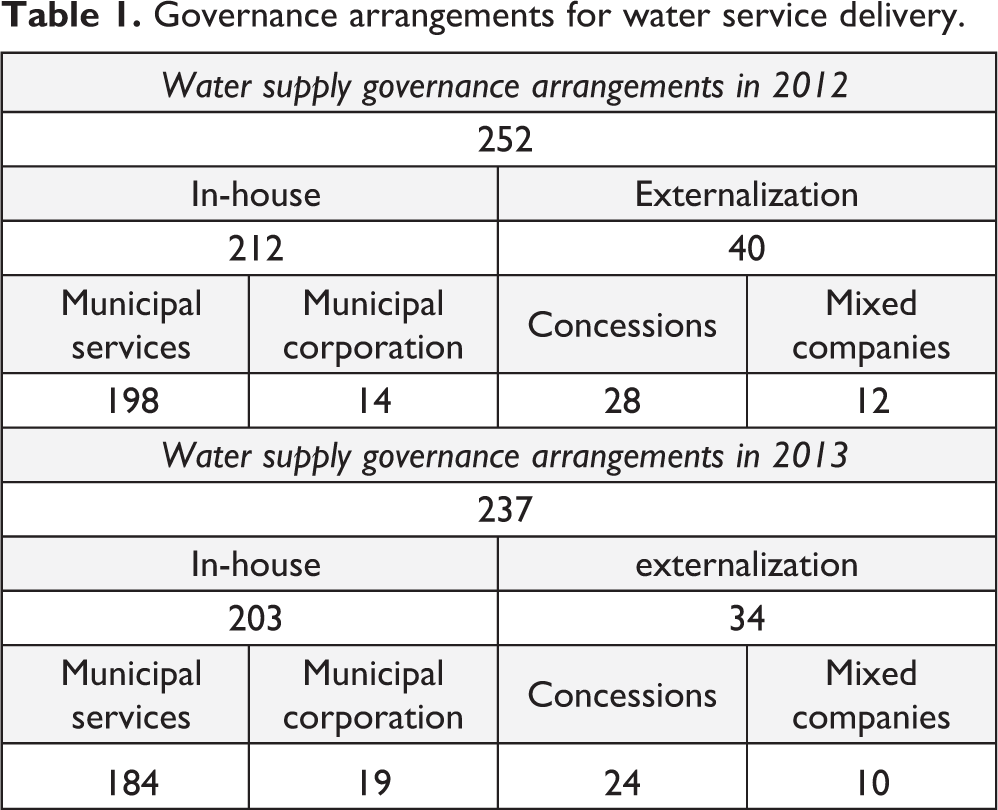
Water services can be directly provided by the municipality’s in-house bureaucracy (also known as serviços municipais). In 2013, this arrangement was present in 184 municipalities (see Table 1). Alternatively, larger municipalities embarked upon a corporatization strategy and created their own municipal companies. This model requires the signing of a management contract that defines the objectives to be pursued by the company and the pricing policy to be practiced. In this arrangement, the municipality is still in charge of providing the service, but chooses to do so using an organization at-arm’s length of the municipal executive. Municipal companies are single-purpose organizations not allowed to levy taxes, rely on revenues derived from user fees, are governed by an executive board appointed by the local executive and confirmed by the city council, and have independent corporate status (including the right to own property and the right to sue and be sued) (Tavares and Camões, 2010). There were 19 municipal companies in charge of water delivery services in 2013, all of them with 100% of shares held by their parent municipal government. Thirty-four municipalities opted for the externalization of water delivery, the large majority of them concessions to private firms (24), seven mixed companies, and three public–public partnerships (see Table 1). In all mixed companies in the Portuguese water sector the public partner is the majoritarian shareholder partnering with private minority shareholder(s); public–public partnerships include partnerships between the municipality and the national government and between two or more municipalities. The empirical analysis will bundle mixed companies and public–public partnerships into a single group, as the two models share some similarities already described above: jointly-shared property rights; and the “dual-principals” problem.
Governance arrangements for water service delivery.
Relative efficiency of water delivery systems in Portugal
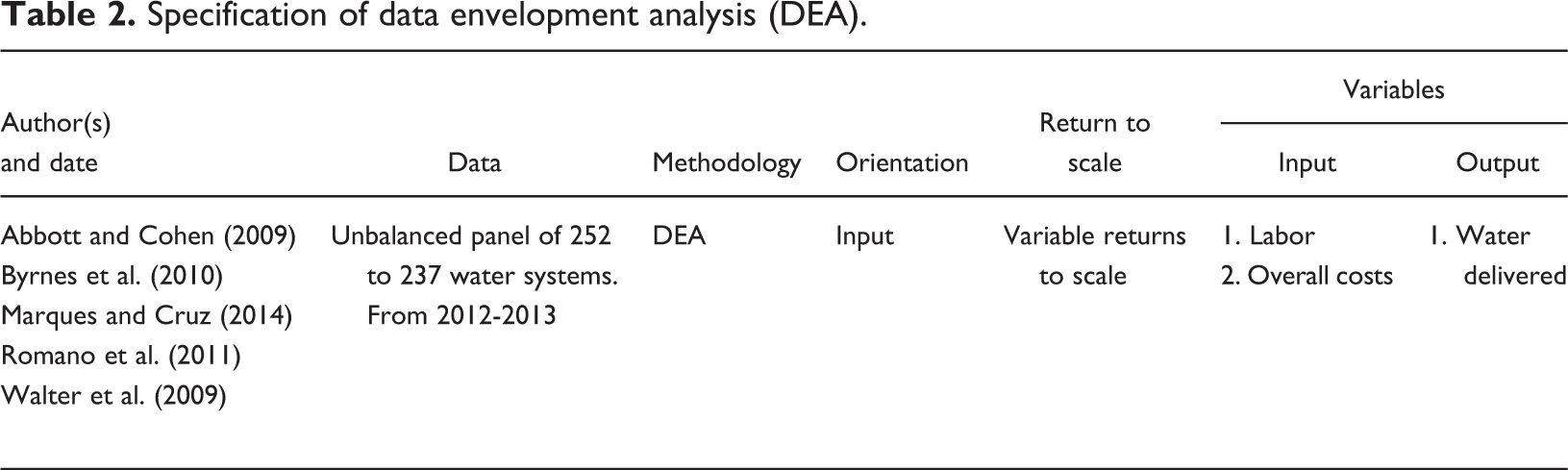
First, we compute the levels of relative efficiency for each of the 260 systems of water delivery in Portugal responsible for the distribution and customer service. In order to accomplish this, we employ DEA, one of the most commonly used methodologies to assess public sector efficiency/performance (Afonso and Fernandes, 2008; De Borger and Kerstens, 1996; R Gonzalez et al., 2011; Rogge and De Jaeger, 2012). Public service outputs are seldom measured in prices that reflect the costs of their inputs and the market fails to provide prices of services of a not-for-profit nature. Despite this drawback, some techniques are used to measure service efficiency without requiring the definition of weights. Non-parametric techniques such as DEA seek to draw a production frontier and to assess relative efficiency by comparing data on inputs and outputs of decision-making units (DMUs) (Afonso and Fernandes, 2008; Moore, 2005).
Following common procedures in the extant literature (Abbott and Cohen, 2009; Cubbin, 2005; Da Cruz et al., 2012; Romano and Guerrini, 2011), we compute the levels of efficiency for all 260 water utilities in Portugal as DMUs using overall costs and labor as inputs and water delivered as the output. For this analysis, we opted for an input orientation and multi-stage DEA. The input orientation allows us to compute efficiency as a proportional reduction of inputs to the same levels of output; the multi-stage is used to avoid slacks and provide Pareto optimal projected points (Romano and Guerrini, 2011). Another choice to be made is the specification of returns to scale. The literature points out that water supply is sensible to economies of scale. DEA offers two alternative ways to compute it. Constant returns to scale draws a scale as a linear combination between inputs and outputs; while variable returns to scale (VRS) upholds the effect of size and is more suited to a sector that displays higher diversity. We opted for VRS (see DEA specification in Table 2).
Specification of data envelopment analysis (DEA).
Empirical analysis of the determinants of the efficiency of water delivery systems
It has been suggested that the mixed findings regarding the efficiency effects of different governance arrangements can be explained by the failure of many studies to take into account market size and competition in the water sector (Abbott and Cohen, 2009). This criticism implies that any assessment of the effect of different governance arrangements on the efficiency of water utilities requires taking into account selection effects associated with market size. In practice, it is likely that market size influences the decision to externalize water supply in the first place, so that the assessment of water utility efficiency requires a research design that takes into account market size as a control variable in a selection equation to avoid overestimating the efficiency of private water utilities.
Accordingly, the design of this study compares efficiency levels of different arrangements for water delivery by controlling for endogenous factors that are likely to bias efficiency assessments. First, we assume that decision-makers choose between two sets of governance arrangements: provision through in-house solutions; and provision using externalization options. Second, we assess the impact of the different governance structures within each of these two groups on the efficiency of water delivery systems. The first group – in-house solutions – entails the option between direct bureaucratic provision and municipal companies, whereas the second group – externalization solutions – comprises mixed companies and franchise concessions to a private contractor as a possible alternative. The analysis of the discretionary choice is not the major goal of this article; rather we aim to assess differences in the level of efficiency resulting from each alternative governance arrangement.
Endogenous switching regression
Endogenous switching regression using maximum likelihood estimation is the most appropriate method to fit our research design and data 1 . The use of an ordinary least squares estimator would produce inefficient estimates since the individual regressions are not independent. We recognize the limitations associated with the use of second-stage regressions involving DEA scores referred by Simar and Wilson (2011). However, given the research design proposed in this study, we adopt the “instrumentalist” approach supported by Ramalho et al. (2010). These authors suggest that DEA scores can be treated as a standard dependent variable as long as the frontier is regarded “as a (within-sample) observed best practice construct”.
Endogenous switching regression corrects for the selection bias by allowing the specification of two equations based on a conditional one that works as a criterion function, I i, determining which regime the agent faces (Lokshin and Sajaia, 2004):




The outcome of the conditional equation, which is the expression of the discretionary choice, drives us to one of the alternative regimes to explore our dependent variable – the level of efficiency. Furthermore, the variables used in the conditional equation, (Z i) are a vector of characteristics which influence the decision regarding the outcome (I i) and cannot be used as vectors in the estimation of the parameters (X 1i) to determine the dependent variable (Y i).
In our data set, the conditional equation concerns the choice by local governments between two sets of governance arrangements. Hence, the selection is between in-house solutions and externalization and we include size, measured by the natural log of water connections, and the existence of economies of scope, assessed by the joint provision of water and waste services, as the independent variables explaining the choice. Larger markets and joint provision of water and waste services should have a positive effect on the choice for the externalization of service delivery. Economies of scope are present for both vertical integration (water production and distribution) (da Cruz et al., 2013; Garcia and Thomas, 2001; Garcia et al., 2007) and horizontal integration (water and wastewater systems) (Fraquelli and Giandrone, 2003; Fraquelli and Moiso, 2005; Hunt and Lynk, 1995; Martins et al., 2006), but both types of integration generate efficiency in small companies, not necessarily larger ones (Abbott and Cohen, 2009). The aforementioned study by Carvalho and Marques (2014) also found economies of vertical integration in drinking water supply utilities and in water and wastewater utilities operating in the retail market. Similarly, the study by Nauges and van den Berg (2008) finds support for the presence of economies of vertical integration in the three countries where utilities feature joint supply of water and wastewater services: Brazil; Moldova; and Romania.
We opt to simplify the conditional equation to prevent any disturbance on the dependent variable of interest: the efficiency levels. The selection model is defined by:


X2–is the natural log of water connections
X3–is the dummy variable for economies of scope (joint provision of water and waste
Two regimes result from the conditional equation:


where Y 1i is the level of efficiency of in-house solutions, Y 2i is the level of efficiency of externalization solutions, Xβ i is a vector of control variables, and ε1i is the error term.
The first stage of the analysis computes the differences in efficiency between the two sets of options: in-house versus externalization. Next, we move to the second stage of the analysis and compare differences in efficiency within each set of choices. We begin the second stage with in-house solutions. Our dependent variable remains the efficiency levels and we compare differences in performance between in-house bureaucracies (municipal services) and municipal companies. Again, the conditional equation of the initial choice employs the same predictors: number of water connections in log form; and a dummy variable for economies of scope. The alternative regimes are municipal services and municipal companies.

Ii –Prob(municipal services)
The outcome is the definition of two alternative regimes:


where Y 3i is the level of efficiency of municipal services, Y 4i is the level of efficiency of municipal companies, Xi is a vector of control variables, and ε1i is the error term.
Next, we move the analysis to the externalization alternatives. We seek to analyze the differences in efficiency between franchise concessions and mixed companies. The same rationale is followed. The conditional equation employs the number of water connections in natural log form and a dummy variable for economies of scope to predict the choice of a franchise concession.

Ii −Prob(franchise)
Again, the results provide the possibility to compare two regimes:


where Y 5i is the level of efficiency of franchise solutions, Y 6i is the level of efficiency of mixed companies, Xi is a vector of control variables, and ε1i is the error term.
Control variables
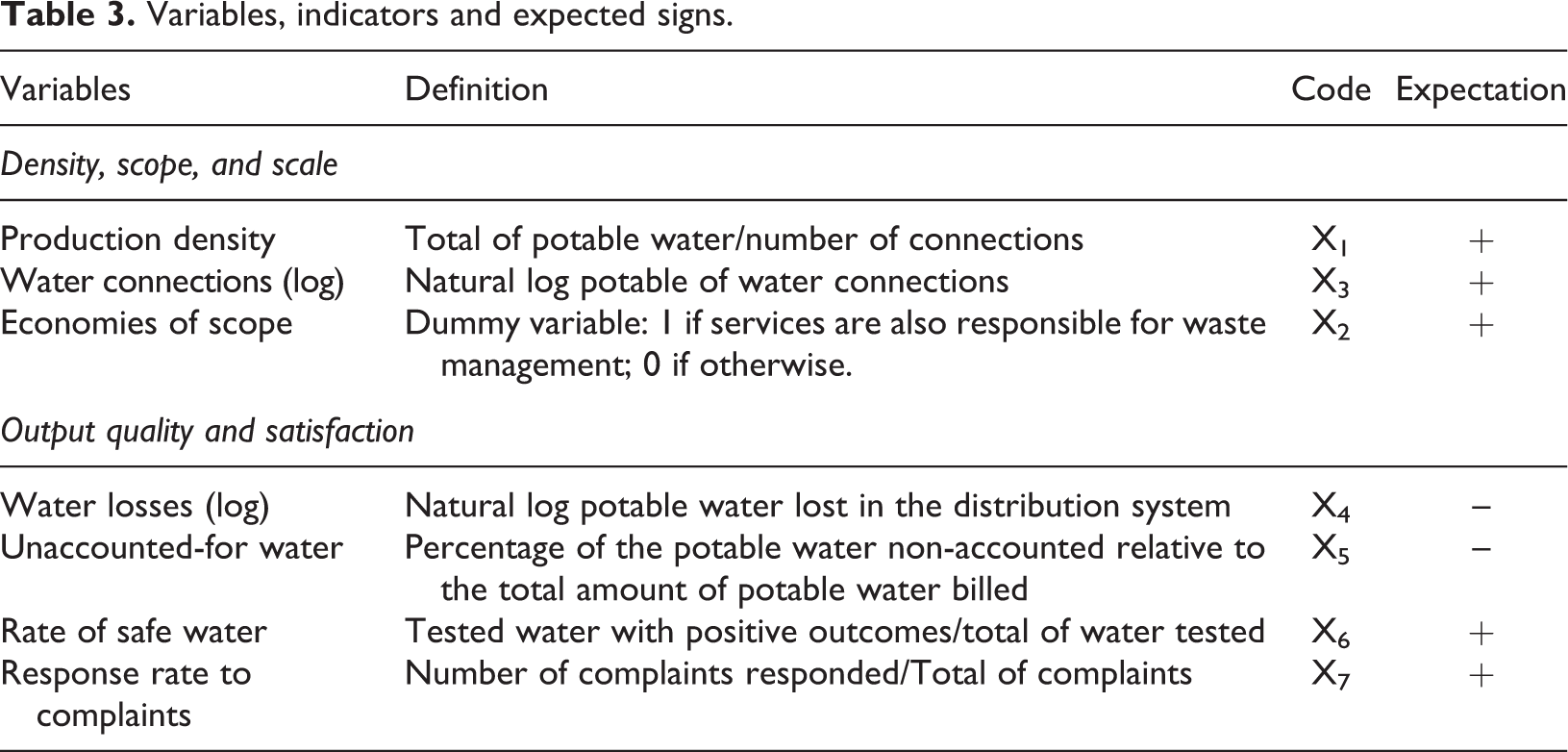
The remaining variables are controls mentioned in the literature as possibly affecting efficiency levels in water delivery systems. These variables are common to all equations. One large set of studies indicates that economies of scale can be reaped mainly by small water utilities (Garcia and Thomas, 2001; Nauges and van den Berg, 2008; Renzetti, 1999; Shih et al., 2006), with empirical studies finding that diseconomies begin at different levels, depending on the sample and context of research: 100,000 connections in the study by Fraquelli and Giandrone (2003); and up to 1 million in Fraquelli and Moiso (2005). In a rare comparative study of developing nations, Nauges and van den Berg (2008) employ panel data from water utilities in four countries (Romania, Vietnam, Moldova, and Brazil) to estimate a translog cost function and find evidence of economies of scale in the first three. Marques and De Witte (2011) analyze the Portuguese water market structure using non-parametric techniques with data from 2005 and diagnose the presence of scale economies but not scope economies. The optimal scale of water utilities lies between 160,000 and 180,000 inhabitants, corresponding to 60 water utilities in the Portuguese water sector operating at optimal levels. Carvalho and Marques (2014) employ partial frontier nonparametric methods to analyze efficiency of water utilities operating in Portugal between 2002 and 2008. They find evidence of economies of scale in drinking water supply utilities and in water and wastewater utilities operating mainly in the retail segment. Economies of scale were also found in water and wastewater utilities operating exclusively in the wholesale market. In our analysis, production density is measured by the total potable water divided by the number of connections to assess the existence of economies of scale and is expected to have a positive effect on efficiency.
Picazo-Tadeo et al. (2008) argue that the quality dimension has been systematically excluded from efficiency analyses of water utilities. They employ data from a sample of Spanish water utilities and assess quality as unaccounted-for water measured in thousands of cubic meters. The study finds significant differences between conventional and quality-adjusted assessments of performance, even though the actual ranking of relative efficiency of water utilities does not change. The authors suggest that there is a trade-off between quantity and quality. In other words, failing to take quality into account frees productive resources and increases the quantity of output that can be produced, but this is accomplished at the expense of quality. In addition to unaccounted-for water, water losses along the pipelines are also an important dimension of quality from a social perspective. A study conducted by Anwandter and Ozuna (2002) also finds a negative effect of water losses on the efficiency of Mexican water utilities. A negative effect of water losses on total costs is also reported for Portuguese water supply systems (Martins et al., 2012).
In our models, water losses and unaccounted-for water are the expression of common problems with water supply that can affect efficiency. A negative coefficient is expected for both variables. The model also controls for the effect of the rate of safe water on efficiency. Again, a positive effect is expected. Lastly, the models include the response rate to complaints, which should have a positive effect on efficiency; however, as Picazo-Tadeo et al. (2008) have argued, responding to customer complaints reduces short-term efficiency and this is likely to be reflected in our efficiency measure. The predicted coefficient for this variable is, therefore, uncertain.
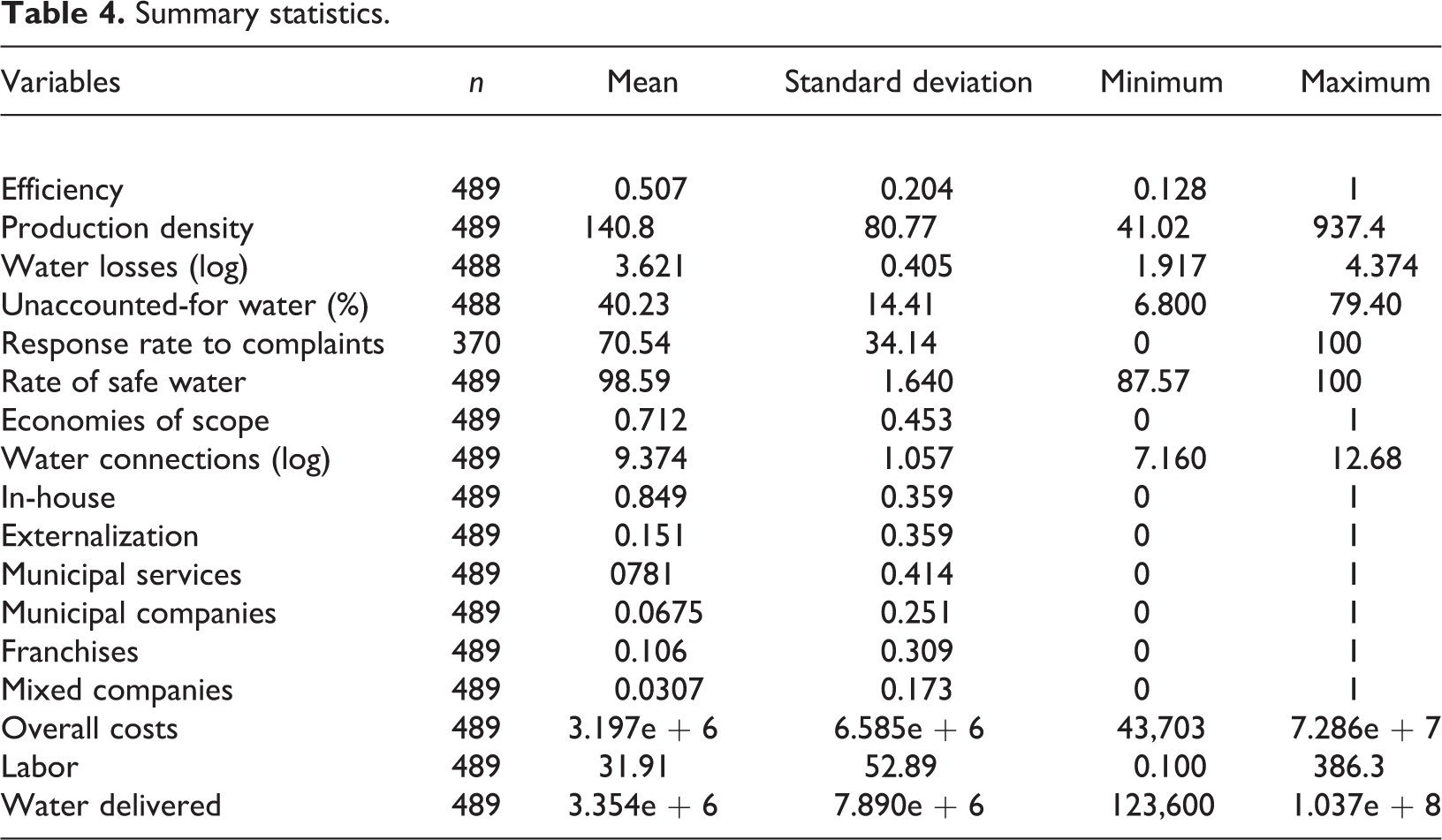
All data were provided by the Regulatory Authority of Water and Waste Services. Variable descriptions and predicted coefficients can be found in Table 3 and all summary statistics in Table 4.
Variables, indicators and expected signs.
Summary statistics.
Findings
Figure 1 shows the distribution of governance arrangements for water service delivery. Results of the analysis for the years 2012 and 2013 show that the majority of local governments (over 75% of the total), opt to organize the delivery of water services in-house. When the option is for externalization, a concession to a private partner is the preferred solution in more than 70% of the cases.
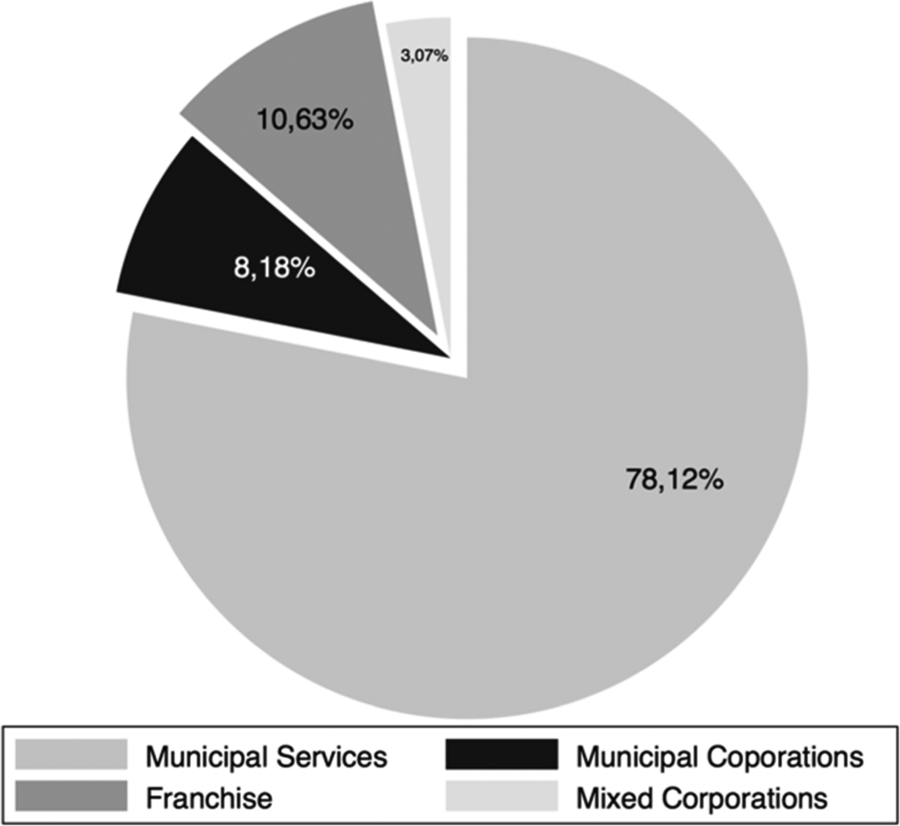
Governing mechanisms in water service delivery (2013).
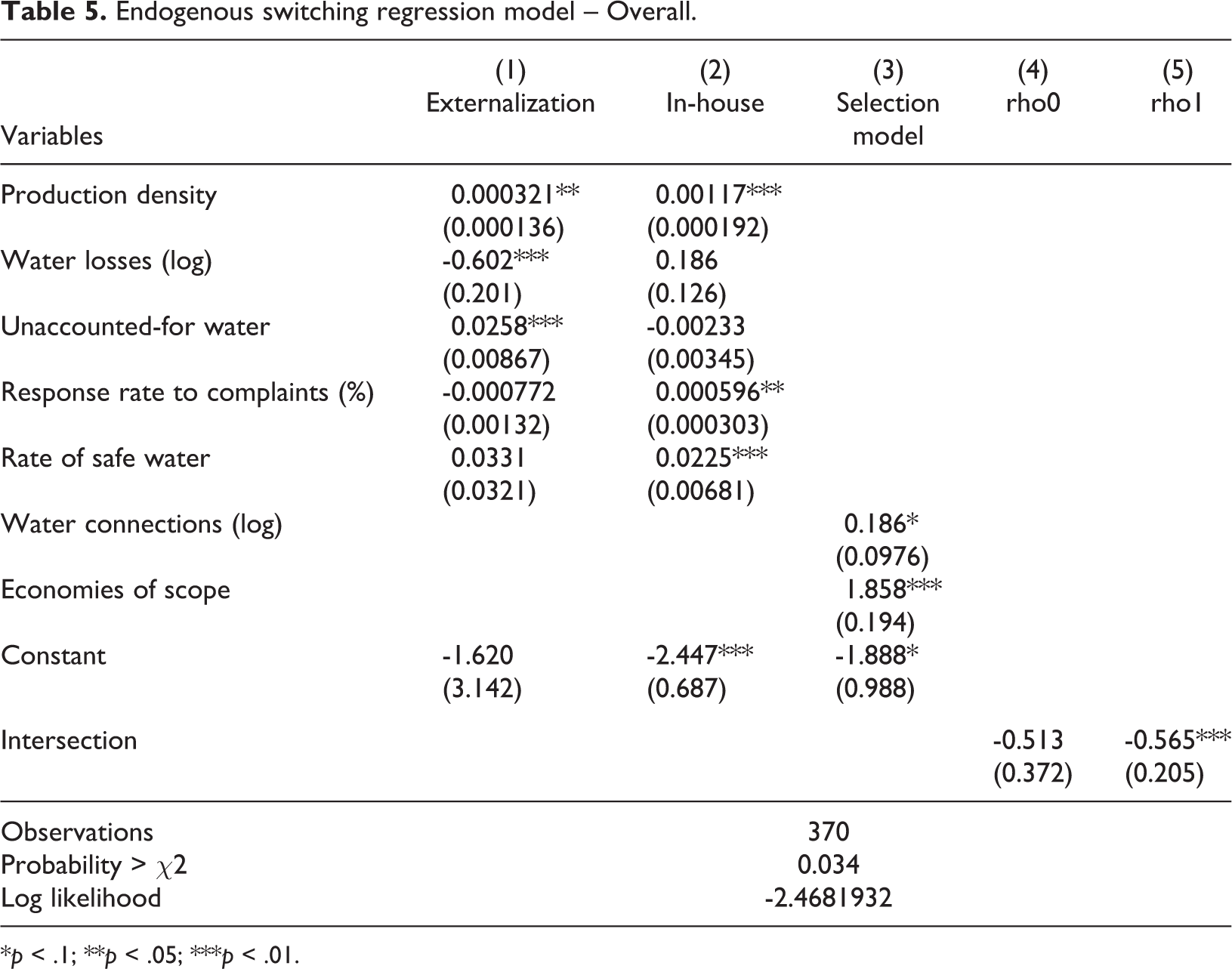
Table 5 reports the results of the first endogenous switching regression model comparing in-house regimes with externalization regimes as defined above. The equation for regime selection addresses the choice between in-house and externalization. Results provide evidence that market size, measured by the log of water connections, is a relevant factor and, as expected, has an adverse impact on the option for in-house service delivery. We can see that the result is positive (0.186) and achieves statistical significance, meaning that market size is positively associated with the choice of external provision of water supply. Hence, a larger number of water connections support the choice of local decision-makers for an externalization solution. Similarly, the effect of the joint provision of water and waste is also positively associated with externalization, as denoted by the coefficient of 1.858 for the dummy variable economies of scope.
Endogenous switching regression model – Overall.
*p < .1; **p < .05; ***p < .01.
After controlling for the effects of market size and joint provision of water and waste services on the choice between in-house solutions and externalization options, we can now assess the effect of each of these sets of solutions on the efficiency of water service delivery. Statistic rho1 is negative, significant and lower than rho0. It suggests that governance arrangements that belong to the set of in-house solutions have higher efficiency levels than a random governance arrangement from the sample would have had. This result does not support hypothesis 1a, which predicted a positive effect of externalization decisions on efficiency. Our result is therefore consistent with the competing hypothesis 1b and suggests that, after controlling for the factors influencing externalization, in-house solutions appear as more efficient.
Figure 2 displays a graphic comparison of relative efficiency levels of externalization and in-house arrangements. The slope of the line for in-house solutions (on the right side of Figure 2) is steeper than the line for externalization (on the left). This indicates that the aggregated level of efficiency is higher for in-house solutions when compared to externalization solutions.
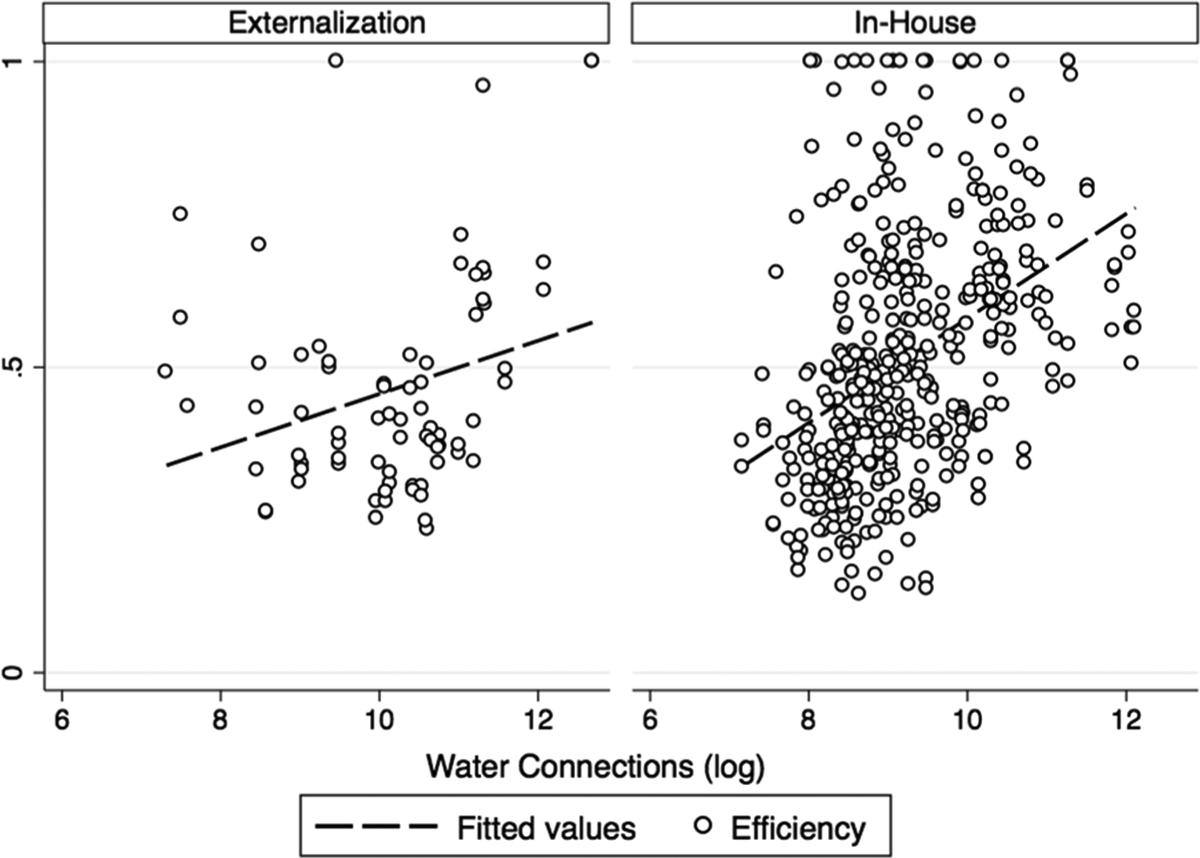
Comparison between in-house and externalization levels of efficiency.
Several control variables display statistically significant coefficients. As predicted, there are economies of scale to be captured in the highly fragmented Portuguese water delivery systems, evidenced by the positive and statistically significant coefficient for both in-house solutions and externalization options. Consistently with our expectations, the water losses variable displays a negative sign for externalization regimes, indicating a detrimental effect on efficiency. In contrast, the result for unaccounted-for-water is positive and significant. This finding is particularly puzzling, as prior studies have shown this effect on efficiency to be negative. Response rate to complaints and the rate of safe water have positive effects on efficiency of in-house regimes, indicating that concerns about the quality of service provision do not seem to negatively affect technical efficiency.
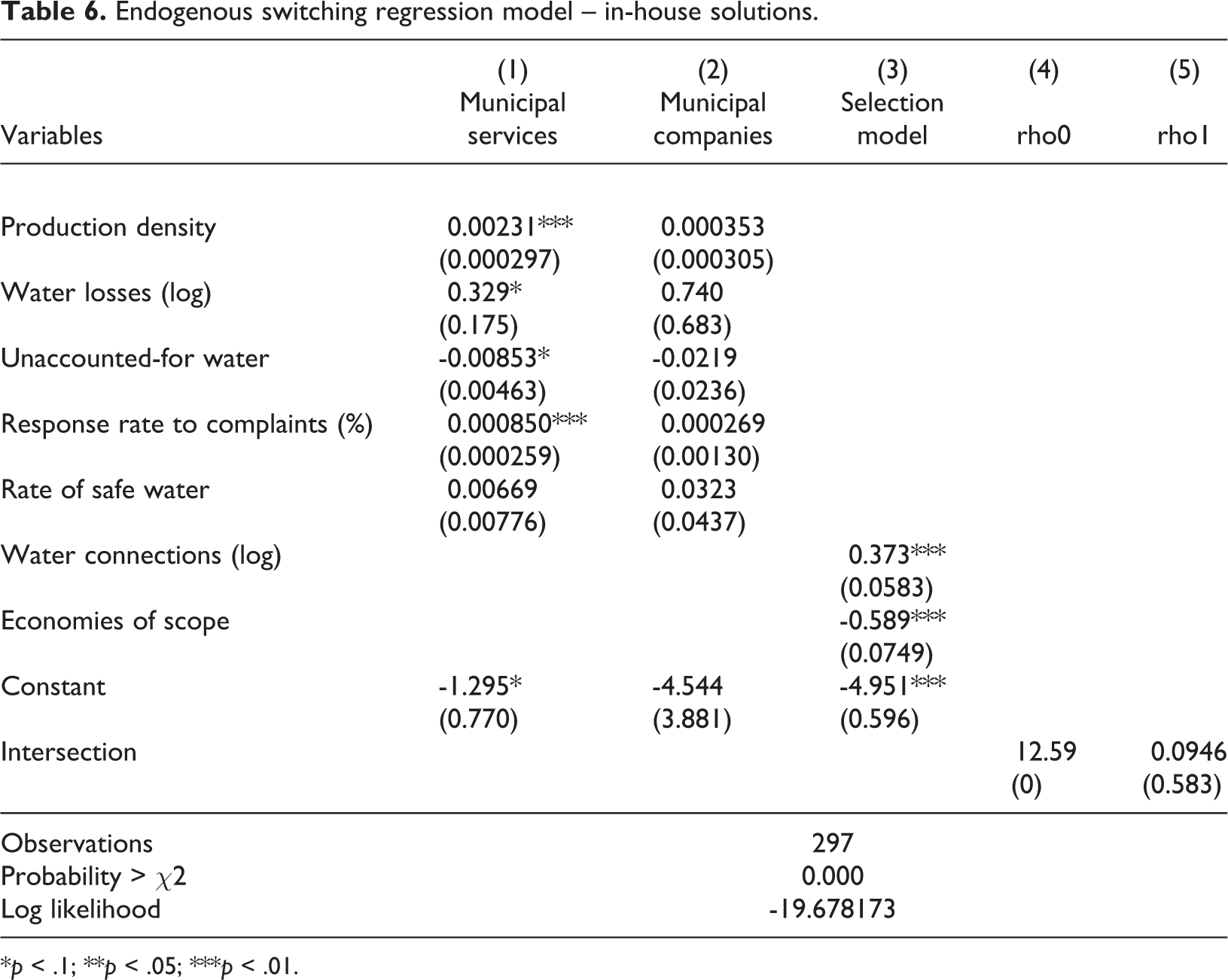
Table 6 reports the findings of our second endogenous switching regression model comparing efficiency levels for in-house solutions (direct bureaucratic provision versus municipal companies). Following the same procedure, the model controls for the effects of market size and joint provision of water and waste services in the choice between the in-house bureaucracy and the establishment of a municipal company. Interestingly, the coefficients for the two variables included in the selection model display opposite signs. The water connections variable shows a positive sign, indicating that their number is positively associated with keeping a service in-house. The preference to keep a service in-house rather than shifting it to a municipal company when a larger number of connections is involved can be explained by the preference of local elected officials to secure universal service provision and avoid paying the political costs of service disruptions associated with municipal companies (Tavares and Camões, 2007). In contrast, the joint provision of water and waste services is associated with the preference of local officials for the municipal company governance arrangement, as indicated by the negative sign in the dummy variable economies of scope.
Endogenous switching regression model – in-house solutions.
*p < .1; **p < .05; ***p < .01.
Using a municipal company or the municipal bureaucracy does not appear to be associated with varying efficiency levels, as it can be attested by the non-significant values of rho0 and rho1 in columns (4) and (5) in Table 6. This result fails to provide support for our second hypothesis. Figure 3 provides a graphic display of this result. The difference in the steepness of the lines representing the levels of efficiency of municipal services (on the left side of Figure 3) and municipal corporations (on the right) is not substantial. The level of efficiency displayed by municipal services is not statistically discernible from a random governance arrangement from the sample. The same is true for the efficiency levels computed for municipal corporations. Thus, on average, no increment in efficiency is expected when moving from one arrangement to the other.
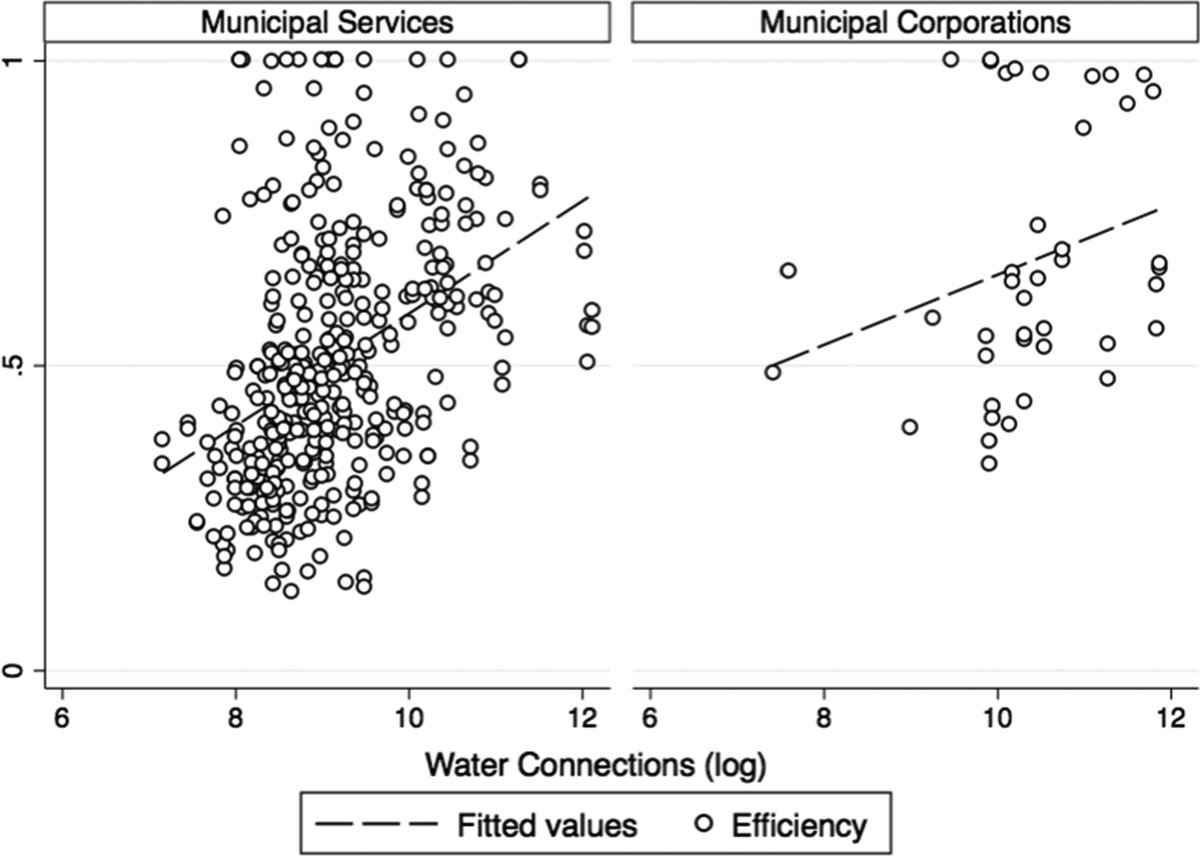
Comparison between the levels of efficiency of municipal services and municipal corporations.
Production density has a positive effect, indicating that economies of scale can be captured in in-house bureaucracies. The indicator of output quality displays the expected behavior: a higher response rate to complaints contributes to higher standards of technical efficiency. This result contradicts prior findings by Picazo-Tadeo et al. (2008) suggesting a trade-off between quantity and quality in the efficiency of water delivery services.
Table 7 displays the results of our third endogenous switching regression model comparing efficiency levels for externalization options (mixed companies versus franchise concessions). The results of the selection equation suggest that the number of water connections is negatively associated with the choice for mixed companies. This finding indicates that larger numbers of water connections are associated with the preference for externalization to a purely private partner. This is both consistent with the relevance of market size for franchise concessions and profit as a primary motive for these decisions.
Endogenous switching regression model – externalization solutions.
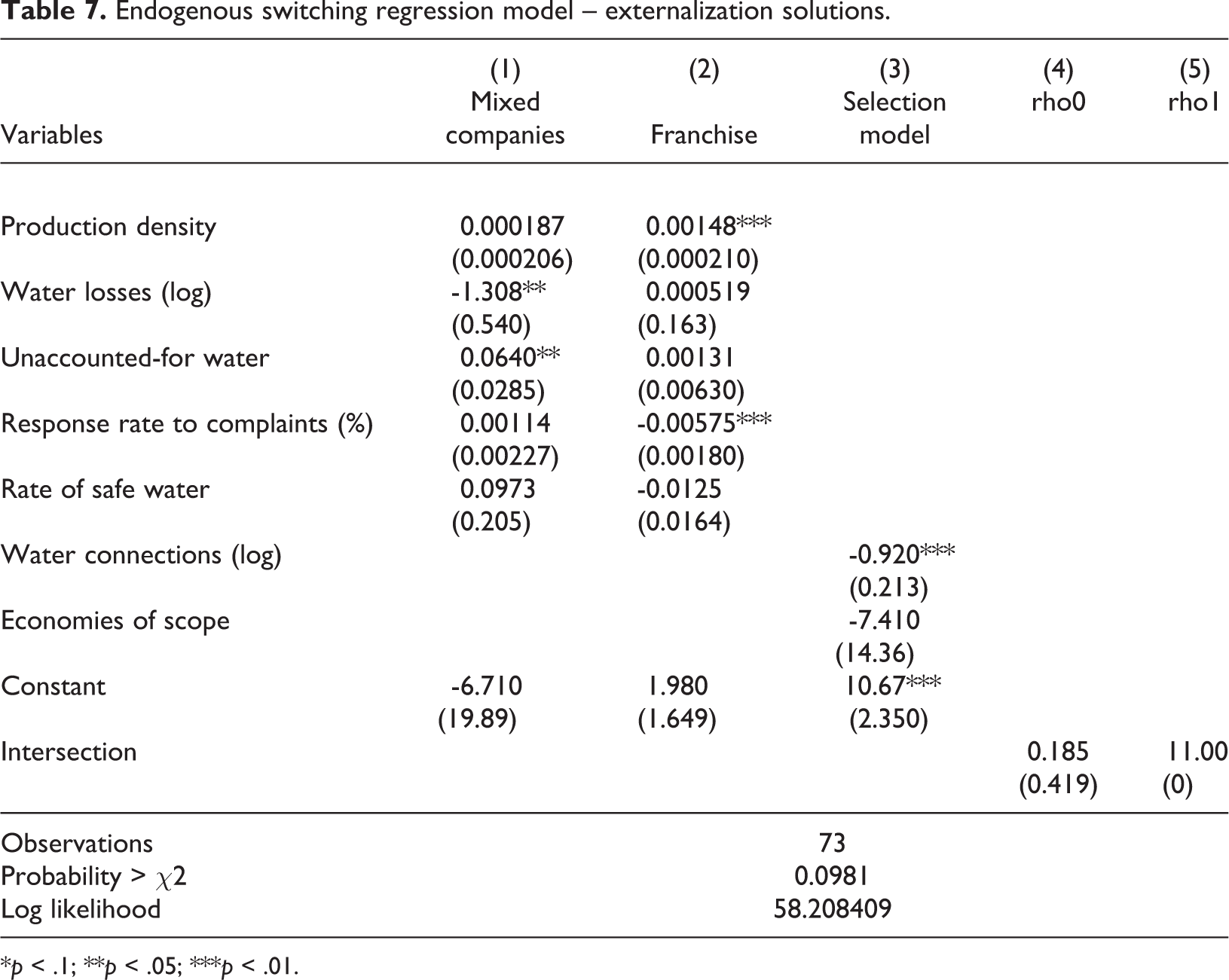
*p < .1; **p < .05; ***p < .01.
Both values of rho miss statistical significance, indicating that there are not statistically discernible differences in terms of efficiency levels between the two options under analysis, thus failing to provide support for both hypothesis 3a and hypothesis 3b. Figure 4 compares efficiency levels in mixed corporations (on the left panel) and franchises (on the right panel). The slope of both lines is similar, providing a visual indication that no statistically significant differences in relative efficiency levels can be detected between mixed corporations and franchises.
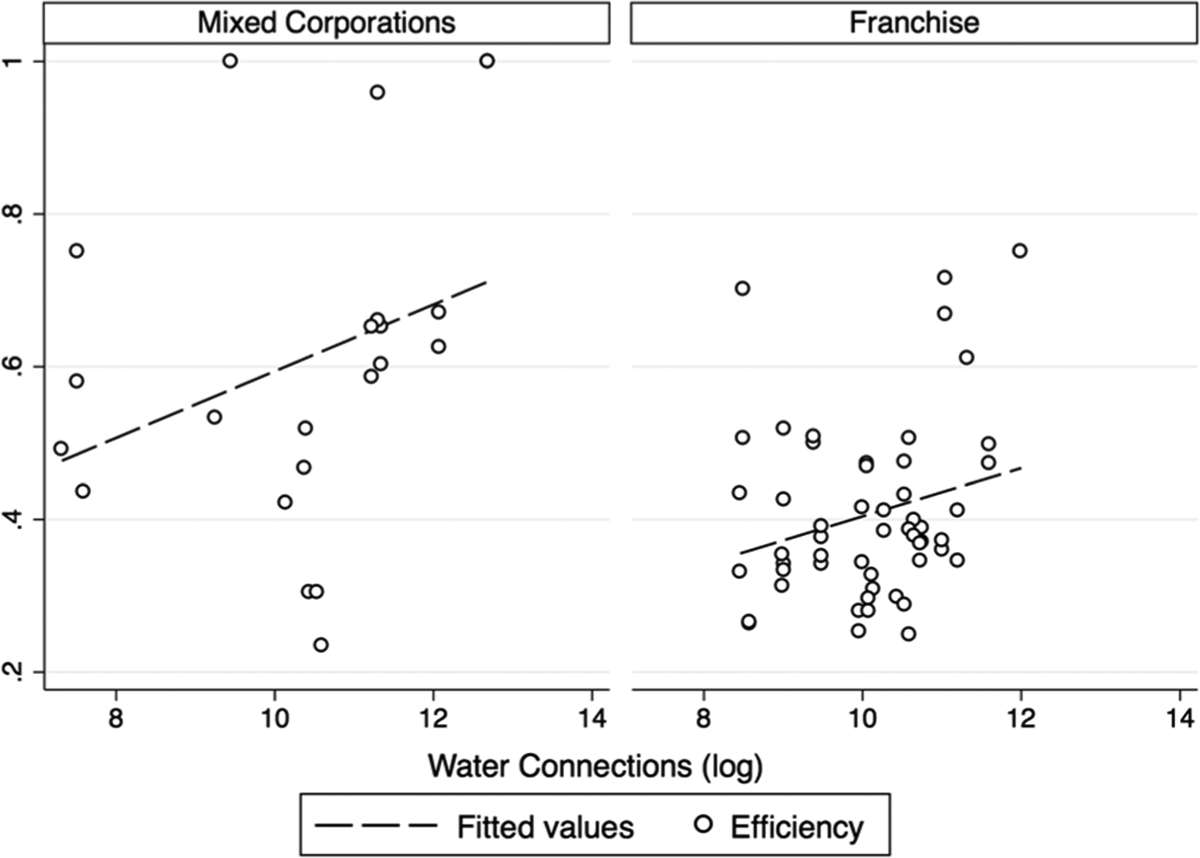
Comparison between the levels of efficiency of franchises and mixed corporations.
Production density has a positive effect (0.00148) on efficiency levels in franchise concessions. This confirms the idea that economies of scale are present in the Portuguese Water Sector and contribute to explain efficiency in franchise concessions. In contrast, the response rate to complaints displays a negative sign suggesting the presence of a trade-off between quantity and quality in the efficiency of franchise concessions (Picazo-Tadeo et al., 2008).
Conclusions and direction for future research
The main objective of this paper was to assess the effect of alternative governance arrangements on the levels of efficiency of water delivery systems in Portugal. Empirical works in the literature that addressed this question are still unable to provide a clear answer. In different contexts, using different techniques and alternative classifications of governance structures we find studies that reach distinct conclusions. Our research seeks to bring some clarification to this particular issue. After controlling for the effect of market size on the choice of governance arrangements, our results allow us to highlight three important contributions to this field of research: (1) in-house solutions display higher efficiency than the governance arrangements included in the externalization group; (2) there are no statistically significant differences in efficiency between in-house solutions; and (3) there are no statistically discernible differences in efficiency between mixed companies and concessions.
These conclusions strengthen the argument that change in ownership, moving from in-house to externalization may not produce the expected results in terms of efficiency. All potential efficiency gains associated with using private partners seem to be neutralized and even reversed by the monopolistic nature of water distribution markets and by the unique features of high asset specificity associated with them. As a result, private sector involvement should be considered only if the expected efficiency gains surpass the higher transaction costs associated with externalization. In order to accomplish this, the use of private partners to deliver water services should also be complemented by additional changes in market access and regulation. However, given the absence of competition in water markets in general, and in the Portuguese water distribution sector in particular, it is doubtful that the involvement of private partners in municipal water service delivery will bring about significant cost savings without sacrificing other sociopolitical goals, such as universal access and accessible rates for customers. Ultimately, these sacrifices may be deemed as necessary, as local elected officials are increasingly confronted with a combination of high debt and strict debt ceilings. In face of old water networks, deficient maintenance, and the need for massive investments, local executives may have to “pay the price” for private sector involvement to avoid politically costly service disruptions. 1
We also found evidence, in line with the majority of the literature, that economies of scale and scope are positive determinants of efficiency levels. This is not exactly a surprise in the Portuguese context, given the significant fragmentation present in the water distribution sector (Da Cruz et al., 2012; Martins et al., 2012), but it does point to the need for consolidation in order to capture some of these potential economies. In our work, we also introduced a dimension, not often used in empirical analyses, related to the quality of the output. In the case of direct in-house provision using municipal services, we were able to find supporting evidence of a positive effect of output quality on efficiency.
The major limitation of our analysis is the inability to assess and control for the effect of customer satisfaction and environmental quality on efficiency levels. On one hand, we think that the response to customer complaints has an impact on efficiency, either reducing it short-term, because more resources have to be devoted to process the complaints, or increasing it as these complaints may have positive effects on output quality (e.g., reducing water losses). On the other hand, the water sector is facing an increased scrutiny regarding the environmental impacts of the processes of abstraction, conveyance and treatment of water and wastewater (Rothausen and Conway, 2011). These concerns justify a closer look at the implications of these activities for energy use and greenhouse-gas emissions (Frijns, 2012; Rothausen and Conway, 2011). Future studies aiming to assess the efficiency of water utilities should control for the degree of customer satisfaction as well as include an environmental quality variable, such as the ratio of energy produced-to-energy consumed during the water delivery process, to assess the environmental impact on the efficiency of water companies.
Footnotes
Acknowledgements
This paper was prepared for presentation at the Workshop on ‘Innovations in Service Delivery’ – Faculty of Economics and Business, Universitat de Barcelona, Barcelona, 4 March 2016. The authors would like to thank our colleagues José M. Alonso, Germà Bel, Matthew Potoski, Ringa Raudla, and José Zafra-Gómez for providing useful comments on an earlier version of this paper, and Miguel Portela for his advice and revision of the econometric methods contained in this work.
Declaration of Conflicting Interests
The author(s) declared no potential conflicts of interest with respect to the research, authorship, and/or publication of this article.
Funding
The author(s) disclosed receipt of the following financial support for the research, authorship, and/or publication of this article: This research is partially supported by the “Programa Operacional da Região Norte”, NORTE2020, in the context of project NORTE-01-0145-FEDER-000037 (SmartEGOV) and by the Portuguese Science and Technology Foundation (Fundação para a Ciência e Tecnologia) [Grant No. PEst-OE/CJP/UI0758/2014]. Any opinions, findings, and conclusions or recommendations expressed in this paper are those of the authors and do not necessarily reflect the views of the Portuguese Science and Technology Foundation.