



Abstract
After analysing the explanatory factors underlying the renewal of privatisation contracts, this paper examines the likelihood of local authorities renewing their contracts with private entities for the provision of public services, by studying a sample of 623 Spanish municipalities for the period 2002–2013, using a logit model. The type of service, the duration of the contract and certain political and economic factors were all found to influence the renewal or otherwise of this type of contract. Moreover, this effect differed between initial privatisation and subsequent contract renewal.
Introduction
In recent years, due in part to the current context of global economic and financial crisis, many local authorities have sought to achieve significant cost savings. Numerous studies have been conducted into how this goal may be achieved, and privatisation has been identified as an important mechanism in this respect (Zafra-Gómez et al., 2016b; Plata-Díaz et al., 2017).
Although cost savings are one of the most sought-after outcomes, this is not the only benefit derived from privatisation. This change can also favour the optimisation of resources and/or promote competitiveness (Bel and Fageda, 2006) and some proponents argue that privatisation can contribute to enhancing service quality (Christoffersen and Bo Larsen, 2007; Levine, 1978) and to raising levels of efficiency (Bel et al., 2010; Boyne, 1998; Hodge, 2000; Osborne and Gaebler, 1992; Plata-Díaz et al., 2014).
Nevertheless, studies of privatisation have raised doubts about the real-world benefits obtained by the local authorities that have adopted this form of service provision. Questions have been raised as to whether privatisation actually increases efficiency levels, citing empirical evidence that privatisation does not achieve cost savings (Bel et al., 2010; Berg and Marques, 2011; Hodge, 2000; Simões and Marques, 2012; Stevens, 1978). Similarly, Domberger and Jensen (1997) and Jensen and Stonecash (2005), among others, found no evidence that privatisation reforms produce cost savings or efficiency improvements.
Furthermore, even if privatisation does reduce costs, it may also incur transaction costs (Brown and Potoski, 2003a). In view of these conflicting opinions, we believe it necessary to analyse whether privatisation actually generates sufficient cost savings to offset any transaction costs, taking into account that the changeover will probably involve significant new costs in terms of the significant time and effort required to dismantle existing production and management systems and to create new ones. It should be taken into account that such an assessment should be conducted over the long term (Máñez et al., 2016), as a short-term outlook could produce erroneous results. In the presence of significant transaction costs, we would expect few changes in the form of service delivery (Brown et al., 2008). Another important feature that could shed light on the viability of privatisation is that of the possibility of its renewal. This aspect is rarely discussed in the literature, and is the focus of our study in this paper.
The analysis of privatisation contracts and their renewal should include characteristics such as the type of service, the complexity of its provision and the duration of the contract – factors that may determine its renewal or otherwise (Bel and Fageda, 2011; Brown et al., 2015; Joskow, 1987; Rodrigues et al., 2012).
Taking into account the above considerations, the main aim of this paper is to analyse the factors that might influence the renewal of contracts for the privatisation of local public services, taking renewal to mean the continued provision of a public service by a private body following the conclusion of the initial period of contract validity. To achieve the study goals, we examined various factors, including characteristics of the contracts, such as their duration, the type of services provided, and economic, financial, political and socio-economic factors, in the context of a large set of privatisation contract renewals that took place during the period 2002–2013 in Spanish municipalities. This analysis was performed using logistic regression (Ashworth et al., 2005; Bel and Fageda, 2007, 2009; Dubin and Navarro, 1988).
The results obtained indicate that this type of contract renewal depends largely on the type of services to be provided; in general, water supply and treatment, waste disposal and public transport, which present the highest degree of service complexity (Brown and Potoski, 2003a; Rodrigues et al., 2012), are the most likely to be renewed, while the opposite is true for administrative services. Moreover, the greater the duration of the previous contract, the lower the likelihood of renewal. This finding contradicts the hypothesis that a longstanding commitment between the two parties increases the likelihood of renewal. When the municipality has a budget surplus, this too decreases the likelihood of contract renewal. On the other hand, the political strength of the governing party and its political ideology, as well as the population size, are all significantly and positively related to the probability of contract renewal. Finally, the political cycles considered in this study did not affect the renewal of contracts for the provision of public services.
The rest of this article is structured as follows. In the next section, we analyse the contractual characteristics that might affect contract renewal. We then study the economic, financial, political and socio-economic factors that could exert an influence in this respect, after which we conduct an empirical analysis of the variables, the data and the method applied. Finally, the results obtained are analysed and discussed, and we present the main conclusions drawn.
Contract renewal and contract features: type of service and duration
Before privatising a public service, managers must analyse the risks involved in the operation and the transaction costs that may be incurred (Brierly, 2004; Brown and Potoski, 2003a; Williamson, 1981, 1991). The latter calculation is a key element in the decision, and is often complicated by inadequate information. The service characteristics that most often affect the privatisation decision are those of asset specificity and the presence/absence of difficulties in measuring or monitoring service quality (Williamson, 1981), which in turn reflect the degree of service complexity.
By asset specificity, we refer to services that require specialised investment which is difficult to adapt to the provision of other services (Brown and Potoski, 2003a). Previous studies have shown that local managers are more likely to privatise services with high levels of asset specificity (Brown and Potoski, 2003a; Shrestha and Feiock, 2004) because such services require a large initial capital investment, which is most readily obtained by means of privatisation (Brown and Potoski, 2003a). However, the privatisation of these services often causes public entities and private providers to engage in a longstanding contractual relationship because of the high costs involved in switching to another seller or buyer (Klein et al., 1978). For this reason, contract renewal is most likely for the provision of public services that present high asset specificity.
The term measurement difficulty refers to the problems encountered in evaluating service outcomes and in monitoring supplier performance (Brown and Potoski, 2003b; Carr et al., 2009). This feature, too, may influence the process of contract renewal with private operators. Moreover, for services that are already privatised, re-municipalisation could involve significant costs, for example if the production and management capacity necessary for their direct delivery were lost (Brown et al., 2008; Sclar, 2001; Van Slyke, 2003) and production and management systems had to be reconstructed, staffed and activated (GAO, 1998, 2002).
A priori, we assume that the contract renewal of a privatised service is determined by the complexity of the municipal service to be provided. Thus, the first hypothesis to be tested is:
Another feature that is relevant to the renewal of a privatisation contract is its duration. According to Joskow (1987), this factor is directly related to contractual commitment. The stipulated contract duration can significantly affect subsequent renewal decisions. The passage of time is known to be a relevant factor in privatisation operations (Bel and Fageda, 2007; González-Gómez and Guardiola, 2009), since it can influence the achievement of the efficiency goals established for the privatisation process. In this respect, see Máñez et al. (2016) regarding municipal waste collection services. These authors concluded that in the short term the expected cost savings are not usually achieved, although the situation improves in the long term, possibly due to better contract management. Other studies of situations in which local authorities have contracted private entities for the provision of public services have concluded that long-term contracts, as well as producing savings on transaction costs (Domberger and Jensen, 1997; Hart and Moore, 1999; Tadelis, 2002) help create a relationship based on trust, reciprocity and joint participation in the application of contracts (Brown et al., 2006). These benefits are presumed to represent a predisposition in favour of renewal. For these reasons, we make the following hypothesis about the contract duration-renewal relationship:
Political and economic factors underlying the renewal of public service contracts
Financial condition is one of the most important factors influencing privatisation decisions, in the sense that a poor financial situation is expected to lead to greater privatisation (Zafra-Gómez et al., 2014). The existence of a relation between financial condition, specifically financial stress, and the privatisation of services suggests that this financial variable will also impact on the renewal of contracts for the provision of public services.
Nevertheless, some previous studies have failed to detect any relation between financial stress and privatisation (for example, Bel and Fageda, 2007), and therefore the existence of a relation between contract renewal and financial stress, and the possibility of measuring this relation by reference to financial condition, is open to debate. However, financial condition is a complex concept, which can be measured through various magnitudes that do affect the above-mentioned relation, and so it is important to study them as possible determinants of contract renewal.
Financial stress can be defined as the condition, level or degree of a public entity’s financial situation (Hendrick, 2011) whose presence tends to provoke a worsening of this financial situation (Hendrick, 2011). Different magnitudes can be used to measure financial condition, including long-term budgetary solvency and service-provision solvency (Groves et al., 2003), together with indicators such as sustainability, flexibility and vulnerability (Greenberg and Hillier, 1995).
In the present study, short-term solvency and budget sustainability are considered as possible explanatory factors of contract renewal for the provision of public services. These variables were selected because empirical evidence has been obtained of their significance in the probability of privatisation (Zafra-Gómez et al., 2014). The latter study concluded that the study of changes in formulas for the provision and management of public services should address financial variables other than those strictly related to borrowing or taxation.
Short-term solvency is defined as an organisation’s ability to generate sufficient liquidity to pay its short-term debts (Groves et al., 2003). Zafra-Gómez et al. (2016a, 2016b) confirmed the existence of a relation between short-term solvency and privatisation, finding that when short-term solvency worsens, public services are more likely to be privatised. Therefore, we propose the following hypothesis:
For a local authority, budget sustainability can be defined as its ability to maintain, promote and protect the welfare of the population, using the resources available for this purpose (CICA, 1997; Greenberg and Hillier, 1995; Groves et al., 2003; Hendrick 2011; López-Hernández et al., 2017). According to previous studies, privatisation tends to improve service quality, particularly in small municipalities (Boyne, 1998; Morgan et al., 1981; Stein, 1990). Accordingly, the following hypothesis is proposed:
In addition, the renewal of contracts for the provision of local authority services may be influenced by other factors, such as the political ideology of the governing party (Bel and Fageda, 2009; Dubin and Navarro, 1988). Political ideology may be an explanatory factor both of privatisation and of the renewal or otherwise of contracts. There is empirical evidence that more conservative governments tend to rely more on the market for the provision of public services (Plata-Díaz et al., 2014; Zafra-Gómez et al., 2016a). In the same vein, Bel and Fageda (2007) concluded that progressive governments are more likely to oppose the use of market mechanisms and to favour the public provision of municipal services. On the other hand, some studies have observed no significant influence of political factors on privatisation decisions (Lane, 2000) and hence on the renewal of service contracts. Taking into account these findings, the following hypothesis is proposed:
Political strength is another factor that can affect the renewal of public service contracts. In this respect, Ashworth et al. (2005) and Hagen and Vabo (2005) concluded that political fragmentation increases the possibility of greater long-term public spending, which can lead to increased privatisation as municipalities seek to eliminate the most-costly services from their budgets (Zafra-Gómez et al., 2014). In consequence, this factor could also affect the renewal of privatisation contracts. Therefore, the following hypothesis is proposed:
In analysing local authority decision-making, the presence of the electoral cycle, or what has been termed the “political budget cycle”, should also be considered. In this respect, Bastida et al. (2013) and Klomp and De Haan (2012) reported empirical evidence that political cycles can affect public finances, while Lago-Peñas and Lago-Peñas (2009) concluded that greater proximity to municipal elections is associated with a worsening financial situation. This phenomenon is provoked by the decisions, often motivated by political interests, taken by public managers as elections approach, and which can affect the municipal deficit or debt (Aidt et al., 2011; Bastida et al., 2013; García-Sánchez et al., 2014; Nordhaus, 1975).
In order to mitigate this effect, public managers seek to achieve cost savings, without reducing the provision or quality of public services (Christoffersen and Bo Larsen, 2007; Zafra-Gómez et al., 2010), and one way to do so is to privatise municipal services (and subsequently renew this privatisation). In this respect, the following hypothesis is proposed:
Finally, there may also be other socio-economic and geographical factors that influence contract renewal decisions. Thus, Bivand and Szymanski (2000) highlighted the presence of spatial effects in the distribution of the costs of the waste collection service in the United Kingdom. Other studies, by González-Gómez and Guardiola (2009) and Zafra-Gómez et al. (2016b), indicate the influence of variables such as the size of the municipality (measured by the resident population), the index of tourism-oriented activities and the importance of the industrial sector in the area, all of which require analysis of their influence on the contract renewal process.
Application to Spanish municipalities: data and method
The Spanish context
Government of the public sector in Spain is structured in three territorial areas – General State Administration, Autonomous (Regional) Administration and Local Administration – among which competences in the provision of public services are distributed.
The local administrations are regulated by the Local Government Act (LRBRL) 7/1985, of 2 April, amended in 2013 by the Local Administration Rationalisation Act which stipulates the public services that must be provided, according to the size of the municipality. However, it does not establish any obligation to privatise municipal services, and local administrations retain the final decision as to the form of service management and provision (Balaguer-Coll et al., 2007). Thus, even smaller municipalities can decide how to manage their basic public services, such as water and waste collection (Warner and Bel, 2008). Accordingly, they are also empowered to decide on contract renewal. In this respect, the decision-making process must take into account the level of effective cost compared to other entities with similar characteristics, and possible outcomes include elimination of the service, delegating its provision to a higher administrative entity, or privatisation.
Data and method
This study was conducted using annual data obtained from various databases, for municipalities throughout Spain with more than 1000 inhabitants. After financial, political and socio-economic filtering, the final study sample consisted of 623 municipalities, representing almost 20% of the Spanish total (3183 municipalities with more than 1000 inhabitants). During the study period (2002–2013), these 623 local governments reported the existence of 1802 contracts (the value taken for the dependent variables in our logit model) with private entities for the provision of public services. These contracts, in turn, were renewable during the study period. Of the 1802 observations (contracts) obtained, those which were not renewed were awarded a score of 0 for the dependent variable, while those that were renewed were awarded a score of 1 for this variable.
The information analysed was obtained from various sources, depending on the type of data required. The information on socio-economic variables was obtained from the Economic and Social Yearbook published by La Caixa and from the Spanish National Institute of Statistics, among others. The data for the financial variables were obtained from the Directorate-General for Financial Coordination of Local and Regional Entities, except for the period 1999–2002, when it was unavailable from this source. The information on political variables was obtained from the Ministry of the Interior, through its web page on electoral information. Finally, the data on privatisation were provided by an external company, which compiled the necessary information for the period 2002–2013.
Thus, a wide-ranging database was created, in which the dependent variable was assigned the value 1 when the local authority renewed its privatisation contracts as they expired, and the value 0 otherwise. The necessary information for assigning these values was obtained from the privatisation data supplied by an external company contracted for this purpose, and for each of the local authorities sampled we determined whether the privatisation contract was renewed or whether, on the contrary, the service was re-internalised.
We also took into consideration the variables that might affect the contract renewal decision, assuming those related to the characteristics of the contracts to be explanatory variables. In order to analyse the complexity of the services, the classification proposed by Cuadrado-Ballesteros et al. (2012) and Pérez-López et al. (2015) was used to group the services provided by Spanish municipalities into four categories. Service complexity was analysed in terms of asset specificity and difficulty of measurement, following the method described by Brown and Potoski (2003a). Table 1 shows the services included in each of these categories. Category 1 includes those related to water supply and treatment and the collection of urban waste. According to Brown and Potoski (2003a), these services are characterised as requiring high levels of specific assets and as presenting little measurement difficulty. Category 2 refers to services related to cultural and sports management, social and health care, and promotion (economic, employment, tourism, etc.). A high level of specific assets is required, but in this case, the measurement difficulty is also high (Brown and Potoski, 2003a). Category 3 comprises public transport and urban infrastructure services (street repair, lighting, etc.), which, according to the Brown and Potoski classification, have low measurement difficulty, while the specificity of their assets is in some cases (transport or lighting) very high and in others, very low. Finally, Category 4 includes all other services, such as those related to the maintenance of infrastructure and public protection. In these cases, the asset specificity and measurement difficulty vary according to the service in question.
Classification of asset specificity and measurability.
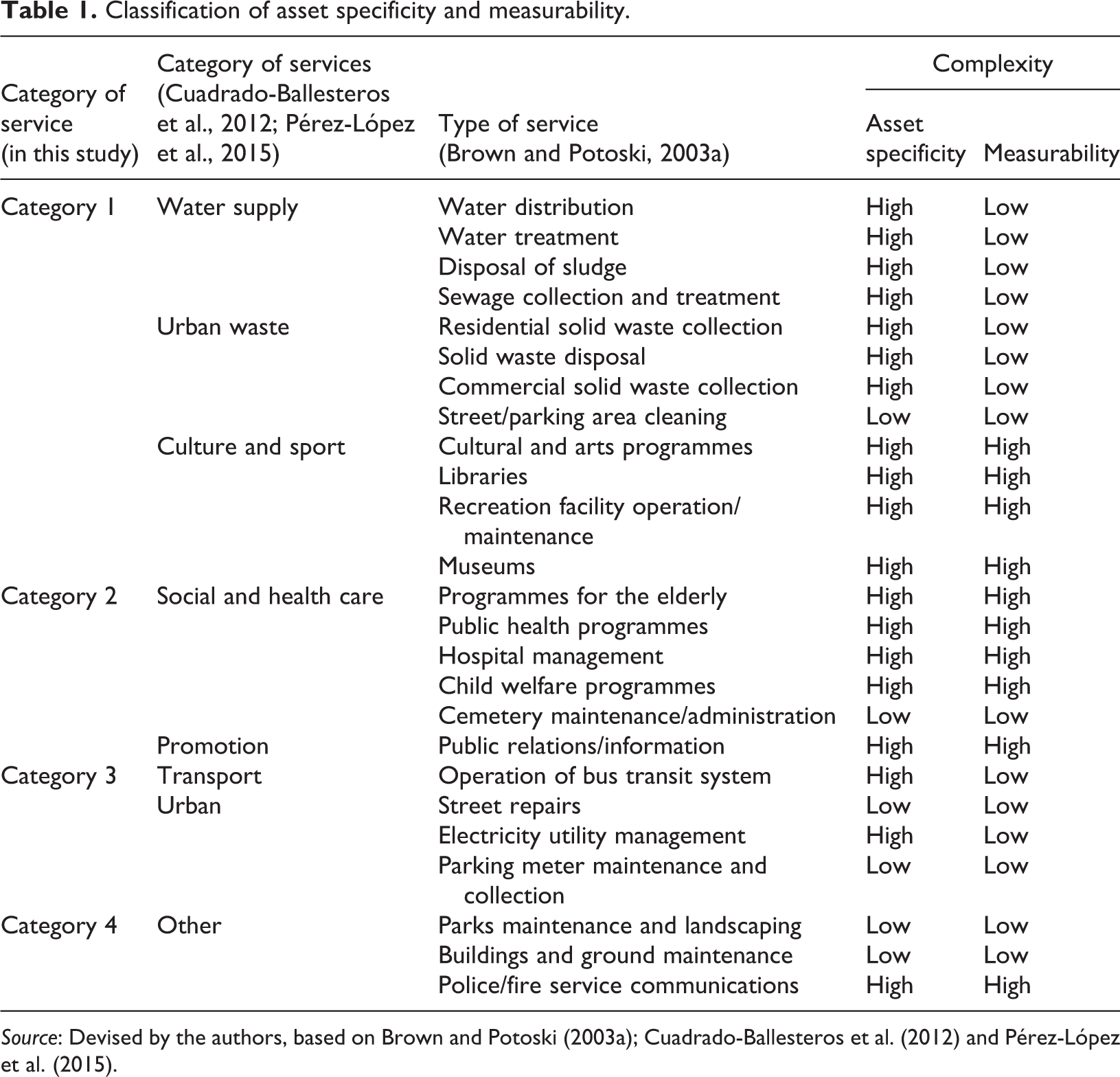
Source: Devised by the authors, based on Brown and Potoski (2003a); Cuadrado-Ballesteros et al. (2012) and Pérez-López et al. (2015).
Figure 1 shows the number of contract renewals by type of service, for each year of the study period. It is notable that the Category 2 services presented most contract renewals during this period, especially from 2008 onwards. Another variable taken into account was that of contract duration, that is, the period during which the privatisation contract remained in force.
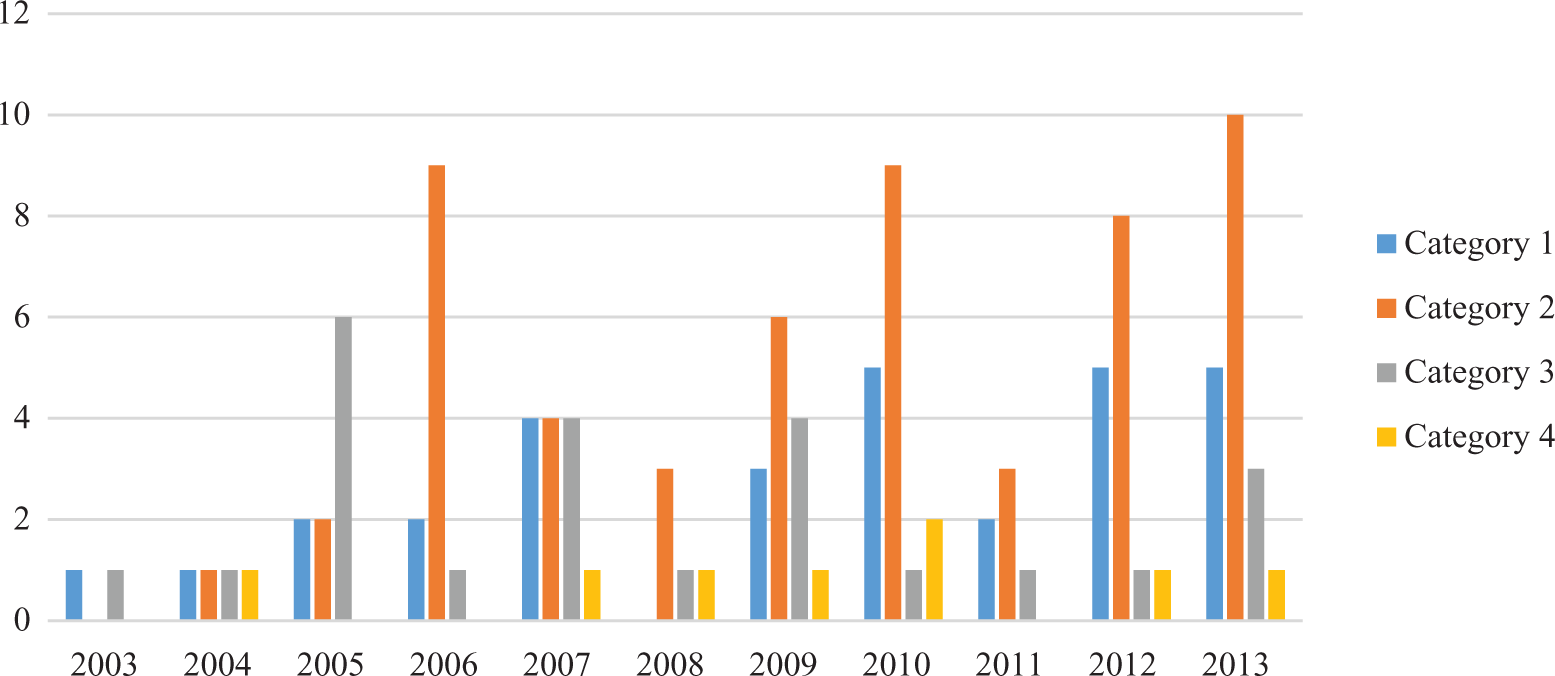
Number of contract renewals according to service categories.
Our analysis also includes variables reflecting the financial condition of the municipalities, as possible explanatory factors of contract renewal (Table 2). According to Boyne (1998), who analysed the relation between fiscal stress and privatisation, one of the major problems encountered in measuring the relation between financial condition and contract renewal is the absence of reliable measures for this indicator. In this respect, Bel and Fageda (2007) observed that in some cases the measurement used for fiscal stress is the legal limitation imposed on public-sector borrowing and the tax burden. Taking into account these considerations, we analysed contract renewal using two factors to reflect financial condition, namely liquidity (Groves et al., 2003) and sustainability (CICA, 1997; Greenberg and Hillier, 1995; Groves et al., 2003; Hendrick, 2011). These indicators of financial condition have been adapted to the Spanish context by Zafra-Gómez et al. (2009a, 2009b, 2009c).
Description of variables.
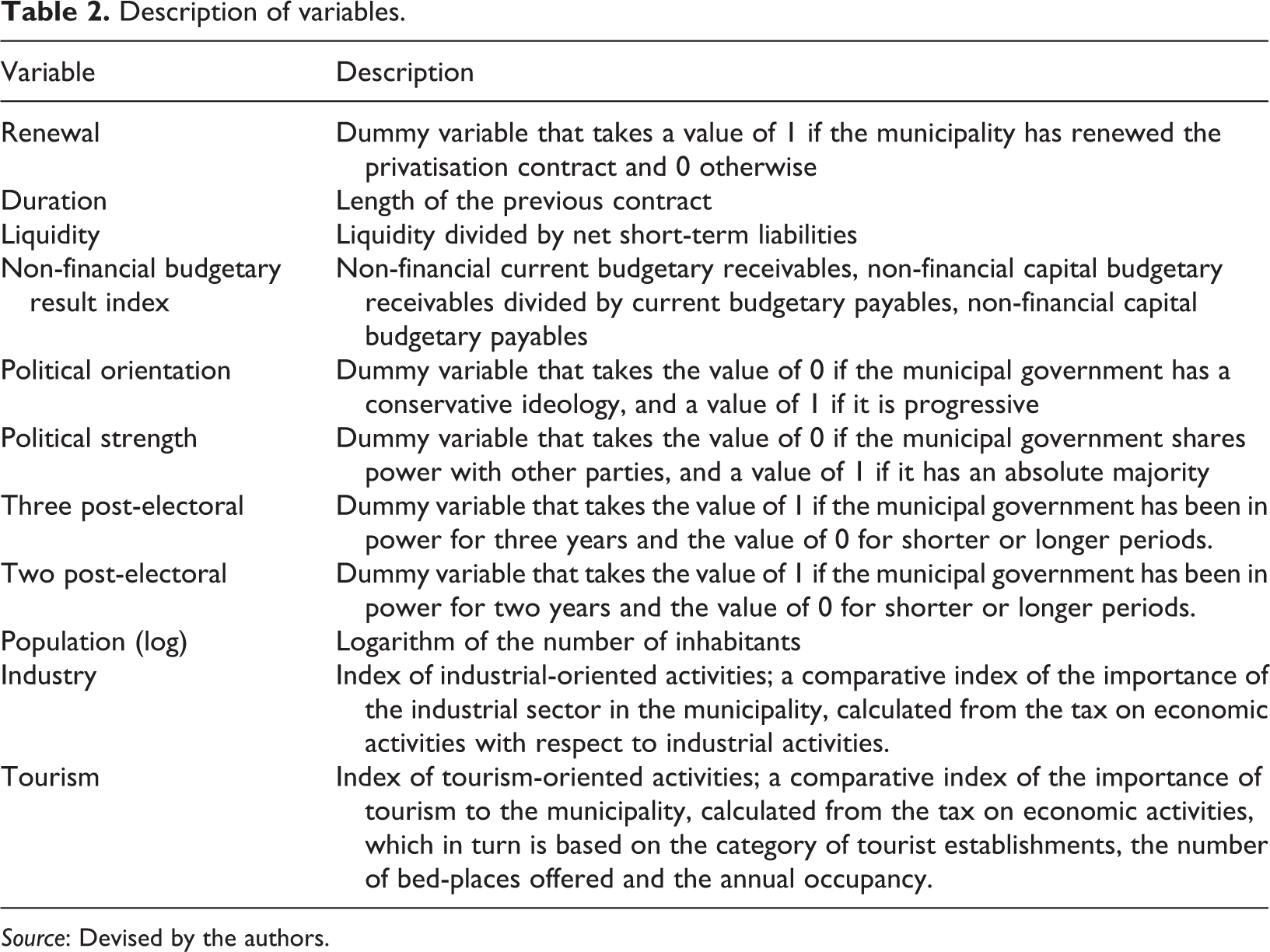
Source: Devised by the authors.
The information on political variables was obtained from the Ministry of the Interior, which publishes information on the political parties governing in each municipality. The information on political fragmentation was obtained by determining the number of councillors from each party present in each municipal government.
Most studies of the factors underlying the privatisation decision are based on a discrete choice model (Bel and Fageda, 2010; Bel and Miralles, 2003; Dijkgraaf et al., 2003; González-Gómez et al., 2011; Joassart-Marcelli and Musso, 2005; Mohr et al., 2010; Tavares and Camöes, 2007; Warner and Hefetz, 2012; Gradus et al., 2014). The present study uses a logit model, following González-Gómez et al. (2011), who analysed the transaction cost of privatisation and the privatisation water services, respectively.
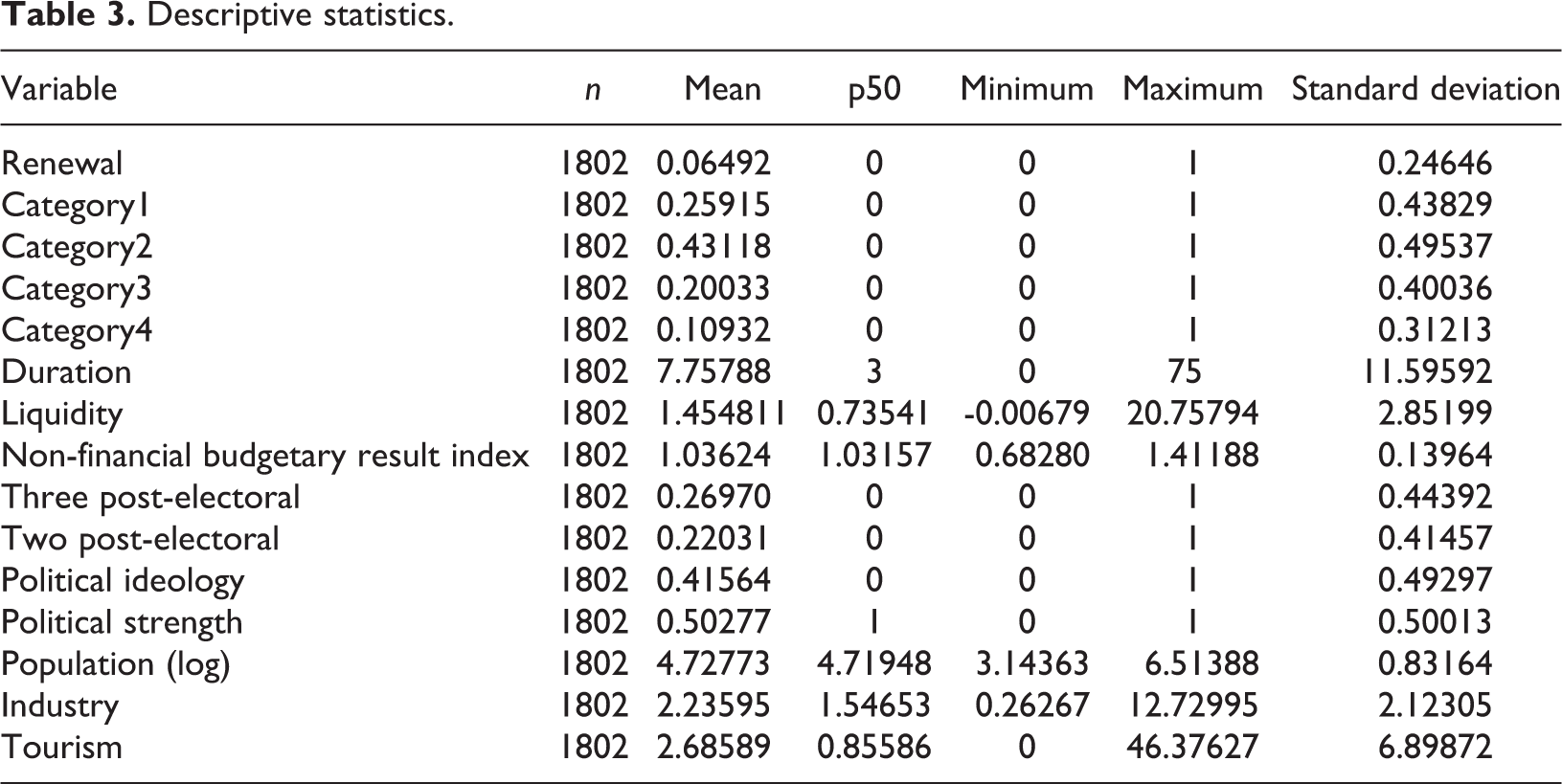
The dependent variable used is a dummy variable that takes the value 1 if the privatisation contract is renewed and 0 otherwise. With this model, we estimated the probability of a municipality deciding to renew the service. Table 3 shows the descriptive statistics obtained for the variables included in the model to study their influence on renewal decisions.
Descriptive statistics.
Results
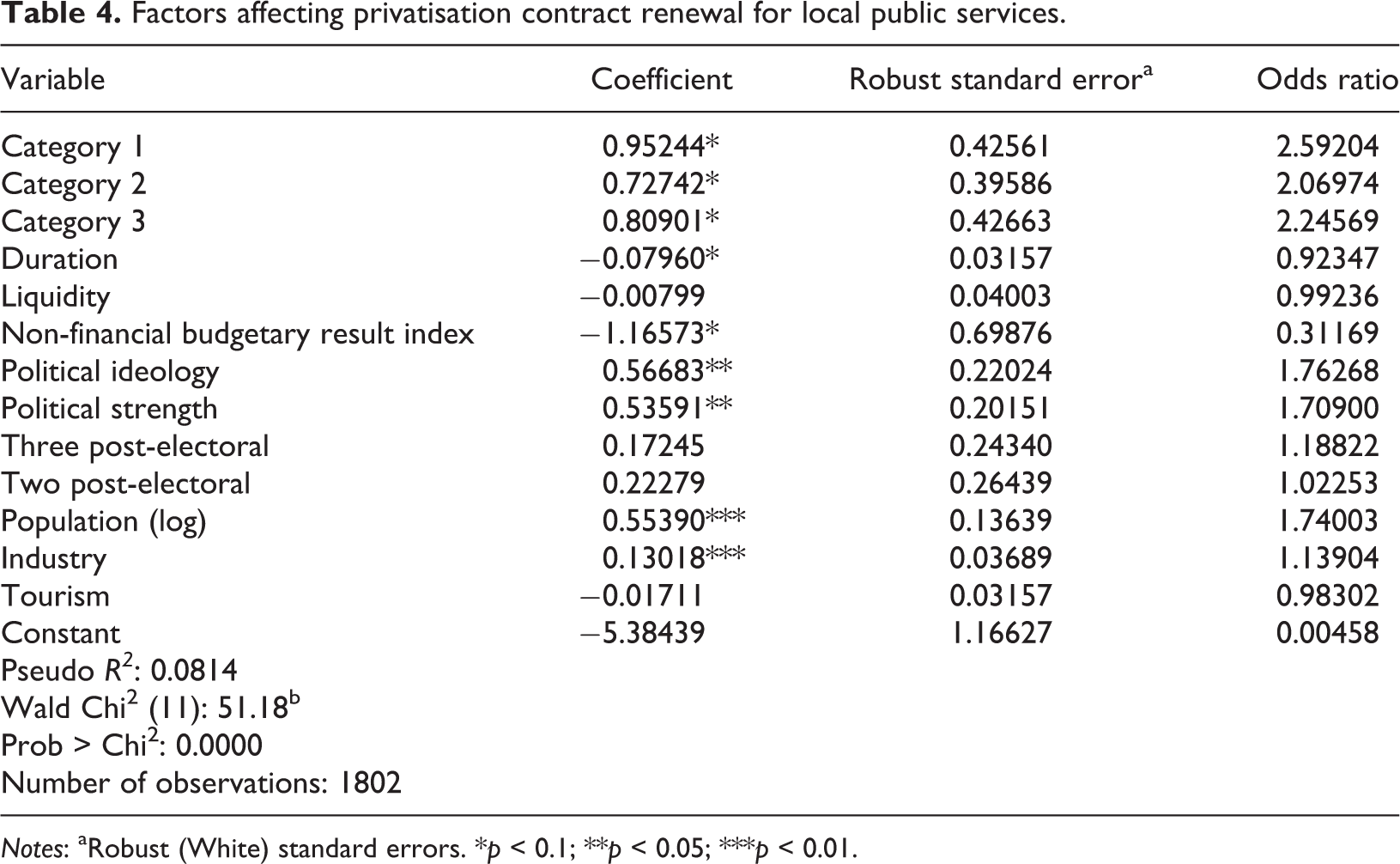
Table 4 shows the results obtained from the logit model, on the basis of which we developed a risk model for the renewal of public service contracts for the period 2002–2013. The model developed for this study contains variables reflecting contract characteristics, together with financial, political and socio-economic variables.
Factors affecting privatisation contract renewal for local public services.
Notes: aRobust (White) standard errors. *p < 0.1; **p < 0.05; ***p < 0.01.
This model is based on the risk rate, which is relatively easy to interpret, assuming that a value greater than 1 corresponds to a positive effect on the risk rate, and that a value of less than 1 reflects a negative impact on the risk rate.
Regarding Hypothesis 1, according to which contract renewal is influenced by service complexity, we observed the variables corresponding to the characteristics of these contracts and found that service complexity does have a significant and positive effect in all cases. These results are consistent with those obtained by Brown and Potoski (2003a), Carr et al. (2009) and Rodrigues et al. (2012), who concluded that contract complexity influenced the decision to privatise local authority services. With regard to the types of services, those which have most influence on the probability of contract renewal are the Category 1 services (water, waste collection and treatment, street cleaning and the maintenance of parks and gardens). Category 2 services (management education, training centres, cultural activities, sports, social services, etc.) also have a positive effect on the risk rate, as do the Category 3 services (urban transport, bus stations, public works, land development, and parking). In short, Hypothesis 1 was found to be satisfied for all types of services, except Category 4, which was then excluded from the model. The results obtained, thus, are consistent with those of Rodrigues et al. (2012).
Continuing with the variables relating to contract characteristics, the results obtained show that contract duration has a negative and significant effect on the rate of risk, that is, the longer a contract lasts, the less likely it is to be renewed. Accordingly, Hypothesis 2 is rejected. This finding is contrary to what had been expected, in view of the study by González-Gómez and Guardiola (2009), on municipal water services, who concluded that over time, the likelihood of privatisation increased. In consequence, a longer contract duration was expected to increase the likelihood of renewal.
We also analysed the influence of certain financial factors on the contract renewal decision. The first indicator of financial stress in our analysis was liquidity; this factor was not found to influence contract renewal, and therefore Hypothesis 3 is rejected. Our results presented no statistical significance, unlike those obtained by Zafra-Gómez et al. (2014). However, in relation to Hypothesis 4, regarding the possible relation between the budget deficit and contract renewal, we found that this variable was significant and negatively associated with the risk rate; thus, an increase in the budget surplus reduces the likelihood of contract renewal, and hence an increase in the deficit increases the likelihood of renewal. Accordingly, Hypothesis 4 is accepted, corroborating the results obtained by Zafra-Gómez et al. (2014).
Political variables are addressed in Hypotheses 5, 6 and 7. According to the first of these, progressive parties are less likely to renew privatisation contracts for the provision of public services. However, we found that the progressive government had a positive and very significant effect on the risk rate, and therefore this hypothesis must be rejected. These results contradict the widely accepted association between privatisation and conservative government (Bastida et al., 2012; Bel and Fageda, 2007). On the other hand, the results obtained for Hypothesis 6, related to political strength, lead us to accept this hypothesis, since this variable had a very significant and positive effect on the risk rate. Thus, our study presents empirical evidence that political strength is an explanatory factor in the renewal of contracts for public services, in the same line as Ashworth et al. (2005), who observed a relation between political fragmentation and public debt.
With regard to Hypothesis 7, on the influence of political cycles on the likelihood of privatisation contracts being renewed, the results obtained do not confirm the presence of political cycles, in contrast to previous findings (Bastida et al., 2013; García-Sánchez et al., 2014). However, the sample period of three election events may have been insufficient to determine their influence, which would account for the non-significance of this variable in our results. Nevertheless, Hypothesis 7 must be rejected.
Finally, the control variables, that is, the socio-economic factors considered, also produced significant results. The population size had a positive and significant effect: the larger the municipality, the greater the likelihood of the privatisation contract being renewed. These results are consistent with those obtained by Zafra-Gómez et al. (2016a). The industry sector index was also associated with contract renewal, and in the same direction, that is, the higher the index of industrial activity in the municipality, the greater the likelihood of contract renewal. However, the index of tourism-related activities had no influence in this respect.
Conclusions and discussion
Traditionally, studies of whether public services should be provided via a particular form of management have examined whether privatisation leads to increased competitiveness, greater economies of scale, improved efficiency or a better financial condition. However, no conclusive results have yet been obtained. In view of this uncertainty, together with the added effect of other contextual factors, such as the Great Recession, it has been suggested that the re-municipalisation, or re-internalisation of privatised services may be a feasible option. Indeed, in recent years, there has been a growing trend towards in-house management or re-internalisation (Warner and Hefetz, 2012; Hall et al., 2013; Gradus et al., 2014). From the standpoint of governance, this shift may be influenced by the increasing complexity of society and the interdependence of public actors (Klijn, 2002).
The emergence of re-municipalisation highlights the need for a detailed reconsideration of the factors that may affect the renewal of municipal contracts with private operators, in order to identify the underlying causes of this process.
In view of these considerations, the main aim of the present study is to determine which factors influence the renewal of privatisation contracts, examining variables such as service complexity and contract duration, together with political factors such as the strength and political ideology of the governing party and the impact of electoral cycles, and financial variables such as liquidity and the budget deficit.
The results obtained show that service complexity, measured by asset specificity and measurability, is relevant to the contract renewal decision. Thus, contracts for the provision of services whose control and measurement do not present special management problems are more likely to be renewed, even if they are subject to asset specificity. Such is the case of waste collection, water supply and urban services, as street repair (Categories 1 and 3). However, services that are more difficult to measure and which at the same time require very specific assets, such as social services (Category 2), are less likely to be renewed. In short, as regards the impact on contract renewal, service complexity is especially significant in terms of the relative ease or difficulty of measuring the quality of the service provided. Accordingly, it would be of great interest to analyse this complexity by distinguishing each of the service characteristics.
Other factors, such as political ideology, presented unexpected results. Previous studies had reported empirical evidence that progressive parties are reluctant to initiate privatisation processes (Zafra-Gómez et al., 2016a). Nevertheless, our findings suggest that progressive parties, in fact, are more likely to favour contract renewal. However, it was not possible to verify the influence on contract renewal of political variables such as the presence of cyclical behaviour linked to electoral periods, possibly due to the scant presence of electoral processes in the study period considered. For this reason, another interesting line of future research would concern the possible influence of political cycles on the renewal of privatisation contracts and/or on re-municipalisation.
In summary, our results show that in the context of Spanish local government there is a high probability that municipal contracts with private operators will be renewed. We present evidence that the explanatory variables of privatisation do not always act in the same direction as those of contract renewal. Accordingly, the factors that influence the latter decision may also be determinant in the current trend towards a re-municipalisation of public services. These re-municipalisation processes have been considered by Warner and Hefetz (2002), who measured citizen voice and privatisation and found that governments which engage in higher levels of privatisation pay more attention to measures of technical efficiency than to citizen voice.
In view of these considerations, future research in this field should be aimed at determining which other factors may explain the non-renewal of a privatisation contract and either the reversion of service management via reinternalisation (towards public entities, operating either alone or through intermunicipal cooperation) or, in some cases, the suspension of the service.
Footnotes
Declaration of Conflicting Interests
The author(s) declared no potential conflicts of interest with respect to the research, authorship, and/or publication of this article.
Funding
The author(s) disclosed receipt of the following financial support for the research, authorship, and/or publication of this article: The author(s) received financial support for the research, authorship, and/or publication of this article: we are grateful for the financial support received from Ministry of Education and Science (Spain; ECO2013-48413-R and ECO2016-76578-R), from the grant of the Ministry of Education, Culture and Sport (FPU14/01403) and Beca propia de la Universidad de Granada de Iniciación a la Investigación para estudiantes de Grado Convocatoria 2015.
References
Supplementary Material
Please find the following supplemental material available below.
For Open Access articles published under a Creative Commons License, all supplemental material carries the same license as the article it is associated with.
For non-Open Access articles published, all supplemental material carries a non-exclusive license, and permission requests for re-use of supplemental material or any part of supplemental material shall be sent directly to the copyright owner as specified in the copyright notice associated with the article.
