




Abstract
When governments deliver services through mixed delivery arrangements, the sponsoring government and an implementing partner split or share service production, delivery, or management responsibilities. By combining aspects of contract and direct service delivery, mixed service delivery may combine the benefits of contracting with those of direct service delivery. Analyses of 87,009 services delivered by 2174 local governments in the USA shows that over 20% of local government services are delivered through approaches that mix elements of direct and contract production. Local governments choose mixed approaches in response to the transaction cost and market factors that affect their choice of direct and contract approaches. Mixed service delivery may provide the opportunity to harness the upsides of both contract and direct delivery approaches. If conditions are favorable, mixed service delivery allows governments to simultaneously evaluate alternative suppliers while maintaining a degree of their own internal production capacity.
Governments in the USA can select among an array of modes when they decide how to implement a policy through service delivery (Salamon, 2002). 1 An important choice is between direct service delivery, where governments use their own employees exclusively to deliver the service, and contract service delivery, where governments enter into a contract with another government, private firm, or non-profit organization to deliver the service (Bel and Fageda, 2007; Brown, 2008; Ferris and Graddy, 1991; Hefetz and Warner, 2004, 2012; Johnston and Girth, 2012; Morgan and Hirlinger, 1991). Along with direct and contract delivery is a set of approaches for delivering services, in which government shares responsibility for implementation with another entity or entities. This approach is sometimes referred to as mixed or collaborative service delivery (Brown and Potoski, 2005; Warner and Hefetz, 2008). Under mixed service delivery, the government and an implementing partner split or share service production, delivery, and/or management responsibilities. By combining aspects of contract and direct service delivery, mixed service delivery is on the frontier of innovation in public management practice. The aim is to leverage the benefits of both contracting and direct service delivery while mitigating their downsides (Bel et al., 2014; Girth, 2014; Girth et al., 2012; Hefetz et al., 2014; Johnston and Girth, 2012; Lamothe and Lamothe, 2012; Lamothe et al., 2008; Warner and Hefetz, 2008).
Transaction cost factors – service-specific characteristics, market conditions, and the organizational type of alternative providers – have important impacts on governments’ decisions to “make or buy” services (Bel and Fageda, 2007; Brown and Potoski, 2003; Brown et al., 2008; Hefetz and Warner, 2004; Lamothe et al., 2008; Levin and Tadelis, 2010). These same factors also influence the use of mixed service delivery relative to direct and contract service delivery. Contracting is more likely to be successful when the service is easy to describe and specify in a contract, the service is easy to produce and does not require specialized investments, and the market has plenty of alternative suppliers. Not surprisingly, such favorable conditions are when governments are also more likely to pursue contracting (Bel et al., 2010; Brown et al., 2013; Ferris and Graddy, 1991; Hefetz and Warner, 2012; Malatesta and Smith, 2011; Williamson, 1997). When a service is difficult to describe and difficult to make, and there are few alternative producers, governments have fewer service delivery options to optimize cost, quality, and service continuity. In these cases, governments tend to prefer direct delivery (Aghion et al., 2014; Albalate et al., 2014; Anderson and Dekker, 2005; Johnston and Girth, 2012; Tadelis, 2002; Tirole, 1999; Warner and Hebdon, 2001).
Mixed service delivery provides the opportunity to harness the upsides of both contract and direct delivery approaches: so long as there are enough potential vendors, mixed service delivery allows governments to simultaneously evaluate alternative suppliers while maintaining a degree of their own internal production capacity. Such an approach can mitigate some transaction costs of being wholly reliant on a single producer for all aspects of service delivery. Governments are likely to turn to mixed delivery when service outputs and outcomes are difficult to specify and a service is difficult to produce, but some number of viable suppliers exist in the market. As services become very difficult to describe and to make, and the market thins, opportunities for mixed delivery diminish. When opting for mixed service delivery, governments also face a choice about what type of organization with which to split service delivery tasks. As service characteristics become more challenging and the market of alternative suppliers begins to thin, governments may choose to move away from collaborating with private firms and towards organizations that share their values, like other governments and non-profits (Lamothe and Lamothe, 2012). In addition, in those rare cases when service-specific characteristics are particularly challenging, but there are numerous actors that can participate in its delivery, governments may decide that the benefits of collaboration are higher than their costs and enter into mixed service delivery networks (Borgatti and Halpin, 2011; Bryson et al., 2006; Emerson et al., 2012; Granovetter, 1985, 2005; McGuire, 2002; O’Leary et al., 2009; Provan and Kenis, 2008; Provan and Lemaire, 2012; Provan and Milward, 1995, 2001; Provan et al., 2007; Romzek et al., 2014; Vangen et al., 2015).
To unpack mixed service delivery and examine the impact of service characteristics, market conditions, and the organizational type of alternative suppliers, we examine the service delivery decisions of US municipalities, a rich tableau of governments responsible for the delivery of a wide array of services. We draw on data from the International City/County Management Association’s (ICMA’s) Alternative Service Delivery surveys from 2002 and 2007, supplemented with additional data from a variety of sources. Our analyses of these data show that one-fifth of all services are delivered through a mixed delivery approach of one type or another. Local governments are most likely to use mixed service delivery when services are moderately difficult to describe and require moderately specialized investments, and there are multiple alternative suppliers with which to partner (Hefetz and Warner, 2012; Lamothe et al., 2008). When they do choose mixed service delivery, local governments are most likely to split service delivery tasks with private firms when services are easier to describe and make, but turn towards non-profits and other governments as services become harder to describe and make (Lamothe and Lamothe, 2012). In discussing our results, we provide illustrations of the types of services that are typically delivered via mixed arrangements. Finally, we conclude the paper by identifying pathways for how service delivery should be studied in the future and the implications that policy makers and public managers may wish to consider in collaborating through mixed delivery of publicly financed services.
Mixed service delivery
One of governments’ most important roles is to decide which and how much public services to deliver to citizens. How governments deliver a service, whether they choose to contract or produce the service themselves, is seen by some as of secondary importance. However, service delivery decisions can have important consequences for service quality, efficiency, and continuity (Amirkhanyan, 2009; Bel et al., 2010, 2014; Fernandez, 2009; Girth et al., 2012; Hefetz and Warner, 2012; Malatesta and Smith, 2011), and are often of political importance themselves. Much of the controversy surrounding Boston’s “Big Dig” transportation project focused not on whether the project should have happened but on whether the project’s contracts were properly managed. More recent research has focused on the importance of service, market, and management characteristics and changing service delivery patterns over time (Hefetz and Warner, 2012; Lamothe et al., 2008) and this has advanced our understanding of current direct and contract service delivery practices. Mixed delivery represents a relatively unexplored alternative to direct and contract service delivery.
In this section, we first define and describe mixed service delivery arrangements. We follow this definitional discussion by presenting a conceptual framework to understand how governments choose to deliver services. Drawing on prior research, we argue that service-specific characteristics and market conditions influence the transaction costs of service delivery, a key contributor to mode choice. We then focus on governments that have decided to collaborate at some level and elect a mixed service delivery mode for a particular service by examining bilateral and multilateral arrangements with different types of organizations, namely other governments, for-profits, and non-profits. In presenting the transaction costs framework, we identify testable hypotheses about service characteristics, market conditions, and the organizational type of alternative suppliers.
Mixed service delivery defined
Most scholarly treatments of governments’ “make or buy” decision tend to frame service delivery decisions as an all-or-nothing choice between direct and contract delivery (Boyne, 1998; Ferris and Graddy, 1986; Klein et al., 1978; Legros and Newman, 2013, 2014; Savas, 2000). Under direct delivery, a government performs with its own employees all the tasks required to finance, produce, and manage a service. Under contract delivery, a government finances another organization – another government, a for-profit, or a non-profit – through a contract to perform the core production and management tasks (Brown et al., 2006; Kelman, 1990). 2 Mixed delivery is an alternative that combines elements of both direct and contract delivery. Under mixed delivery, the financing, production, and management can be split or shared between the government and a partner organization, such as a government, non-profit, or private firm. 3
Miranda and Lerner (1995) were among the first scholars to identify “mixed” alternatives to direct and contract service delivery. Later scholarship sought to assess the prevalence of mixed service delivery (Bel and Fageda, 2007; Bel et al., 2010; Brown et al., 2006; Warner and Hefetz, 2008). These studies found that local governments often rely on mixed service delivery for an array of common local services. Warner and Hefetz (2008) assert that local governments increased their use of mixed service delivery in the previous decade.
Governments that pursue mixed contracted delivery choose between collaborating with one organization – bilateral mixed service delivery – or with multiple organizations – multilateral mixed service delivery. Bilateral mixed service delivery arrangements are those in which a local government collaborates with another government, a for-profit, or a non-profit to participate in the delivery of a service. For example, larger neighboring governments may have the scale to offer services smaller governments cannot afford to provide so efficiently on their own (Bardach, 2001; Brown, 2008). Private firms may have the capability to deliver highly technical services, such as hazardous materials disposal (Bel and Miralles, 2003; Dijkgraaf et al., 2008). Non-profits may offer specialized expertise or localized knowledge of a particular service population, such as the homeless or long-term unemployed (Brown et al., 2007; Gazley, 2008; Heinrich and Choi, 2007; Lambright, 2009; Romzek and Johnston, 2002).
In some circumstances, services may be delivered with more than two partners. Multilateral mixed service delivery can involve other governments, for-profits, or non-profits. The distinguishing characteristic of multilateral mixed service delivery is that there are multiple partner organizations sharing or splitting service delivery tasks. 4 For example, some services, such as public health programs, foster care, or job training programs, involve multiple domains of specialized knowledge and expertise (McBeath and Meezan, 2008; Provan and Milward, 1995; Provan et al., 2004). Local governments may play different roles in these networks, sometimes serving as the organizing hub, and other times serving as a participant with some other organization taking on the role of convening and managing the network (Agranoff and McGuire, 2003; Granovetter, 2005, Hill and Lynn, 2005). Local governments may also serve as the overseer of the networks, functioning somewhat like a regulator in a market context. Here government employees take on management tasks such as setting the rules of participation or providing information to participants, but without performing service production tasks. For example, a local government may determine that it has the responsibility to enhance the cultural and arts offerings in its community. Instead of creating its own cultural and arts programs or contracting with other organizations to offer specific programs, the government might make public spaces available and help other organizations, such as non-profit or private dance or choral groups, put on their own cultural activities. The local government’s role may be relatively passive in overseeing a larger network of providers, stepping in only when the network begins to disintegrate or fails to provide sufficient service to meet community preferences.
Both bilateral and multilateral mixed service delivery allow governments to harness the upside of direct and contract delivery while mitigating potential downsides through its collaboration with a range of other partner organizations. Working with multiple partners offers the benefits from the “choice” that come from competitive contract service delivery, such as richer information about the relative trade-offs among important service delivery criteria. Different partner organizations may be able to perform at lower cost or higher quality than the government could on its own or contracting with others (Fernandez, 2009; LeRoux, 2007; Malatesta and Smith, 2011; Sandfort and Milward, 2008). At the same time, the government can mitigate the risks of discontinued service delivery if the mixed service delivery partnership fails. For example, retaining some capacity to finance, produce, and manage the delivery of the service, the government faces lower costs of ramping up to full responsibility relative to contract service delivery (Alford, 2009; Brandsen and Pestoff, 2006; Brown et al., 2008; Needham, 2008; Van Slyke, 2003).
The “make, buy, or mixed service delivery” decision
Service delivery choices are at core a decision about how to organize the tasks required to properly produce and deliver a service. All things being equal, governments pursue service delivery modes that balance cost efficiency, service quality, and service continuity (Brown, 2013). 5 Optimizing these criteria is conditioned by factors that raise or lower the costs of organizing service delivery tasks, namely the comparative costs of “planning, adapting, and monitoring task completion under alternative institutional arrangements” (Williamson, 1981: 552–553). We focus on three interrelated sets of factors that drive transaction costs: service characteristics, market conditions, and the organizational type of alternative suppliers. We discuss service characteristics and market conditions together before addressing the organizational type of alternative suppliers.
Service characteristics and market conditions
There are three important characteristics that influence the transaction costs of contracting for services. Firstly, the degree to which a service is easy to describe; that is, whether it is relatively straightforward to write down what is required to produce a service or its desired results and outcome. Secondly, the degree to which the service production requires specialized investments in assets, skills, or procedures. A third important characteristic is the number of suppliers offering to sell service production; contracting is more likely to be effective in markets with more buyers and sellers because, for example, there is more information about the relative costs and quality of direct versus contract service delivery. When services are difficult to describe, difficult to make, and available in markets with few, if any, alternative providers, threats to cost, quality, and continuity are high (Girth et al., 2012). Turning to the market in these conditions runs the risk of getting locked in to a contract with an opportunistic vendor delivering a substandard product or requesting an inflated price. Governments are more likely to deliver services directly when transaction costs are high (Brown and Potoski, 2005). When a government does opt to outsource under these conditions it is often because it lacks the productive capacity and financial means to deliver the service on its own (Crocker and Masten, 1996; Kelman, 1990).
Mixed delivery offers an alternative approach. By partnering with another organization, the government can still capture benefits of the market, such as information about the relative trade-offs in cost, quality, and continuity that different providers can offer, but with lower risks of becoming locked in to a single produce. The danger of lock-in is diminished because the costs of exiting the mixed service delivery are lower than if the government had turned all the production and management tasks over to one producer. For these reasons, mixed delivery is likely to be more attractive to governments as services become more difficult to measure and require specialized investments. At the same time, mixed delivery requires the presence of viable potential organizations open to participating in service delivery. Hypotheses 1 and 2, below, articulate these arguments.
Bilateral and multilateral mixed service delivery partners
One approach to improving service outcomes is to share or split service delivery tasks with multiple organizations. Aligning value profiles reduces potential conflict in areas where more formal agreements could not be fully specified, thereby lowering the transaction costs of service delivery. Every organization is beholden to its stakeholders to one degree or another: other governments to their voters or elected political overseers, private firms to their shareholders, and non-profits to their boards and funders. However, governments are more likely to share more key values with non-profits and other governments than with private firms (Bel et al., 2014; Brown et al., 2006; Sclar, 2000). The profit motive may cause a private firm to behave in ways that might undermine a partnership.
The same service characteristics and market conditions that influence whether to choose mixed service delivery are likely to influence their choice of who joins them in producing the service. Because other governments and non-profits have values that more closely align with partnering governments, they may be more attractive for mixed service delivery when services become more difficult to evaluate and to produce, and the range of alternative suppliers narrows (Girth et al., 2012; Lichbach, 1996). Alternatively, when services are easier to evaluate and produce, and the range of alternative suppliers increases, private firms may be equally or more desirable because they offer unique or less expensive productive capacity. These dynamics are reflected in hypotheses 3 and 4 below.
The interorganizational networks (IONs) literature helps identify conditions when a government would pursue mixed service delivery (Borgatti and Halpin, 2011; McGuire, 2002; Popp et al., 2014; Provan and Kenis, 2008; Provan et al., 2007). In particular, the ION and network management literatures offer analytical guidance about partner selection, the delegation and assignment of tasks and responsibilities, and the management imperatives associated with integrating partner contributions for mixed service delivery (Agranoff, 2005; Alford, 2009; Brandsen and Pestoff, 2006; McGuire, 2006; Needham, 2008). In some instances, governments participate in network delivery by producing some component of the service along with other participants, while in other instances governments coordinate and oversee others who do the service production.
Governments are most likely to produce the service in a multilateral mixed service delivery arrangement when there are some transaction costs (e.g. moderate difficulty in describing and producing the service) and when there are multiple other organizations that can also produce the service. Lower transaction costs mean the government does not need to perform as much coordination. Governments are more likely to move into the role of coordinator when service characteristics are more challenging and market failures are more prevalent: services are particularly difficult to describe and produce and there is a limited range of alternative suppliers (Girth et al., 2012). Hypotheses 5 and 6 specify these conditions.
In summary, service characteristics, market conditions, and the organizational type of suppliers can influence whether governments use mixed service delivery relative to direct and contract delivery. Governments are most likely to use mixed delivery when the service outputs and outcomes are difficult to specify, when the service is difficult to produce, and when viable alternative suppliers exist in the market. Governments are most likely to share or split service delivery tasks with private firms when service characteristics are less challenging and there are multiple alternative suppliers. As service characteristics become more challenging and there are fewer alternative suppliers, governments are likely to partner with other governments and non-profits. Governments are most likely to enter into multilateral, mixed service delivery when service-specific characteristics are particularly challenging, but there are numerous actors that can participate in its delivery.
Data and methods
To investigate when local governments select mixed service delivery practices, we draw on data from the ICMA’s 2002 and 2007 “Profile of Local Government Service Delivery Choices” surveys and other sources. The ICMA survey asked a stratified random sample of municipal and county governments a battery of questions about which of 67 local services they provided and their service delivery mode for each service they deliver. 6 As a result, the ICMA survey is possibly the strongest large sample study of governments’ service delivery practices. The response rate for each of the two surveys is around one-quarter of those surveyed: of the 5370 cities and counties that received surveys in 2002, 1283 (23.9%) participated, and of the 6095 cities and counties that received surveys in 2007, 1599 (26.2%) participated. Our sample consisted of 2147 governments (548 responded to both surveys). 7 Consistent with previous analyses of ICMA data, the samples are over-representative of council-manager governments: around 60% of the respondents in the two samples use this form of government. Otherwise, we found surveys to be generally representative of cities and counties along basic criteria such as population, geographic location, and metropolitan status. In this section we describe the dependent, independent, and control variables, as well as our analytic methods.
Dependent variables
Local governments’ mixed service delivery choices can best be studied by considering them in the context of their overall choices among all delivery approaches. The dependent variable is governments’ service delivery mode for each delivered service. Respondents to the ICMA survey were asked which of the services their government provides and which service mode they use to deliver each service. The dependent variable in our analyses is the service delivery mode chosen by each government for each service it provided in 2002 and 2007. The responses of one government could be incorporated for 128 different services in our sample, although not every city provides every service. Direct service delivery is when respondents indicated that the service was provided by “your employees entirely”. The three contracting categories, contract with another government, contract with for profit, and contract with non-profit, are when respondents indicated respectively that the service was provided via contracts with other governments, for profit firms, and non-profit organizations. From the ICMA survey responses, we coded six mixed service delivery categories. Firstly, we coded the categories mixed with other government, mixed with for profit, and mixed with non-profit, when respondents selected respectively the response “your employees in part” and just the category “another government,” “private for profit”, or “private non-profit”, respectively. 8 Together, these measure instances of bilateral mixed service delivery. We then coded two categories for cases where more than two organizations delivered the services. Mixed through a network measures cases where respondents selected “your employees in part” and two or more of the other three organizations. Mixed as a network overseer measures cases where respondents did not select “your employees in part” but selected at least two of the other cases. These two measures constitute instances of multilateral mixed service delivery. Finally, the category mixed not specified contains cases where respondents selected “your employees in part” but did not indicate another organization delivering the service. 9
Table 1 lists the delivery mode categories and their frequencies for each year of the survey, with the primary dependent variables of interest – bilateral and multilateral mixed service delivery –highlighted in gray. The frequency of mixed service delivery modes ranges from a low of .63% (Mixed as Network Overseer in 2002, n = 248) to a high of 9.53% (Mixed with a Private Firm in 2002, n = 3753).
Percentage of services delivered by mode, 2002 and 2007.
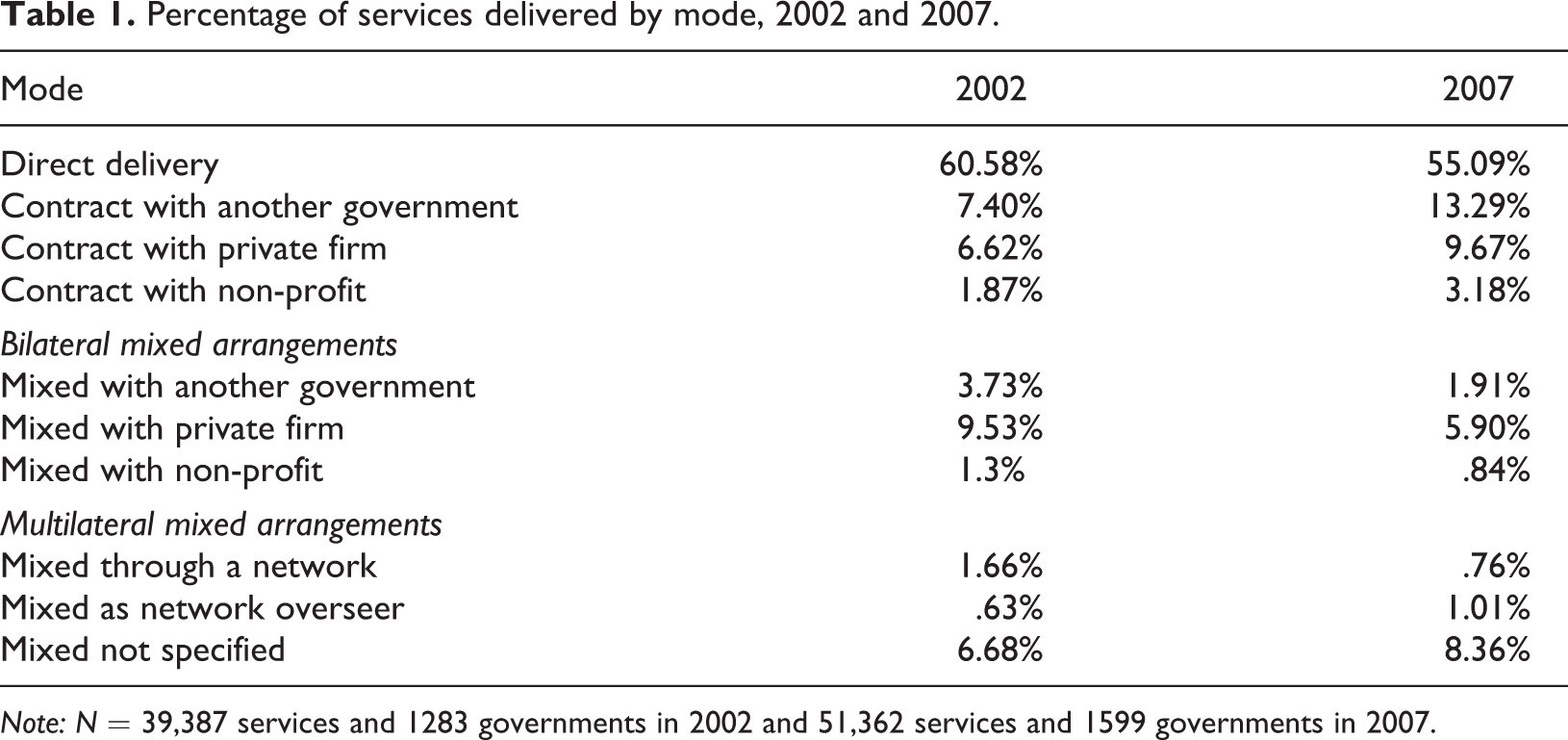
Note: N = 39,387 services and 1283 governments in 2002 and 51,362 services and 1599 governments in 2007.
A strength of this measurement approach is that it measures a broad range of mixed service delivery approaches. Note, however, that within the category of mixed delivery are several more specific arrangements through which a service can be delivered, such as partnerships and collaborations. Approaches measured as “mixed deliver” in our data can include important differences in how responsibilities and activities are divided among the organizations. For example, in some cases the government and/or other organizations independently produce and deliver all of the service, with each serving a separate portion of the recipient population. In other cases a government and other organizations combine efforts to produce a service that serves the entire recipient population. Likewise, sometimes organizations work in parallel, without much coordination and collaboration between them, while other times organizations work together quite closely.
In this paper, we use “mixed service” delivery to refer to all cases where the government and another organization contribute to producing a good or service, regardless of how the activities and responsibilities are divided and the nature of their collaboration. Network service delivery refers to cases with more than two organizations producing the service, again without reference to the specific division of activities and responsibilities and the nature of their collaboration. We choose this definition because it is what the ICMA survey data measure, and leave to future research to explore these issues more fully.
Independent variables
Our framework highlights three transaction cost factors – service-specific characteristics, market conditions, and the organizational type of alternative suppliers – as important drivers of mixed service delivery. To assess the impact of service-specific characteristics on service mode choices we follow previous transaction cost research (e.g. Brown and Potoski, 2003, 2005). 10 Brown and Potoski asked local government officials to rate the services in the ICMA survey on two scales, one for ease of specification and one for specialized investments. Respondents rated each service on a 1–5 scale for each characteristic. To measure how easy or difficult it is to describe a service we use Brown and Potoski’s variable ease of measurement. This variable measures the extent to which the service’s activities, outputs, and outcomes can be written down and quantified in contractible terms, with 1 representing easy to measure and 5 representing difficult to measure. To measure how easy or difficult it is to produce a service we use Brown and Potoski’s variable specialized investments. This variable measures the extent to which the service requires assets that lose value if not put to use for delivering the service, with 1 representing a low level of specialized investments and 5 representing a high level of specialized investments. Since the effects of ease of specification and specialized investments on service delivery choices may vary across their values, we include the variables’ squared terms, ease of specification 2 and specialized investments 2 .
To measure service market conditions, we draw on a survey of municipal administrators conducted by Hefetz and Warner (2012). The variable supplier alternatives measures the number of alternative (to direct government provision) supplier respondents identified for each service, and is scaled from 0 (for no alternatives to direct government provision) to 4 (four or more alternative suppliers). We use the average across respondents to the Hefetz and Warner survey for each service in our analysis.
We test hypotheses 1 and 2 by examining the impact of the ease of specification and specialized investment variables on mixed service delivery relative to direct and contract service delivery. We test hypotheses 3–6 by examining the impact of these same variables on the choice of partner type when governments pursue mixed service delivery.
Control variables
The analyses include several control variables for factors that might influence governments’ choices of service delivery modes. To control for citizen awareness and interest in a service, we again turn to the Hefetz and Warner (2012) data. The variable citizen interest measures the level of public interest in how each service is delivered, with a rating of 1 indicating a low level of interest and a rating of 5 indicating a high level of interest. We control for form of government with a dummy variable called council-manager, scored 1 if the government is a council-manager form of government, else 0. Two variables measure the government’s location. Center City is a dummy variable scored 1 if the government is a central city in a metropolitan area and Non-metro is a dummy variable scored 1 if the government is not in a metropolitan area. The reference category is non-central governments in metropolitan areas. The variable county is scored 1 if the respondent is a county, else 0. Population is the (logged) number of people living in the government’s jurisdiction. We also control for the year of the survey by including a dummy variable called Year (2007), scored 1 for the 2007 survey results and 0 for the 2002 survey results. Table 2 reports the descriptive statistics for all the dependent, independent, and control variables in our analyses.
Descriptive statistics.
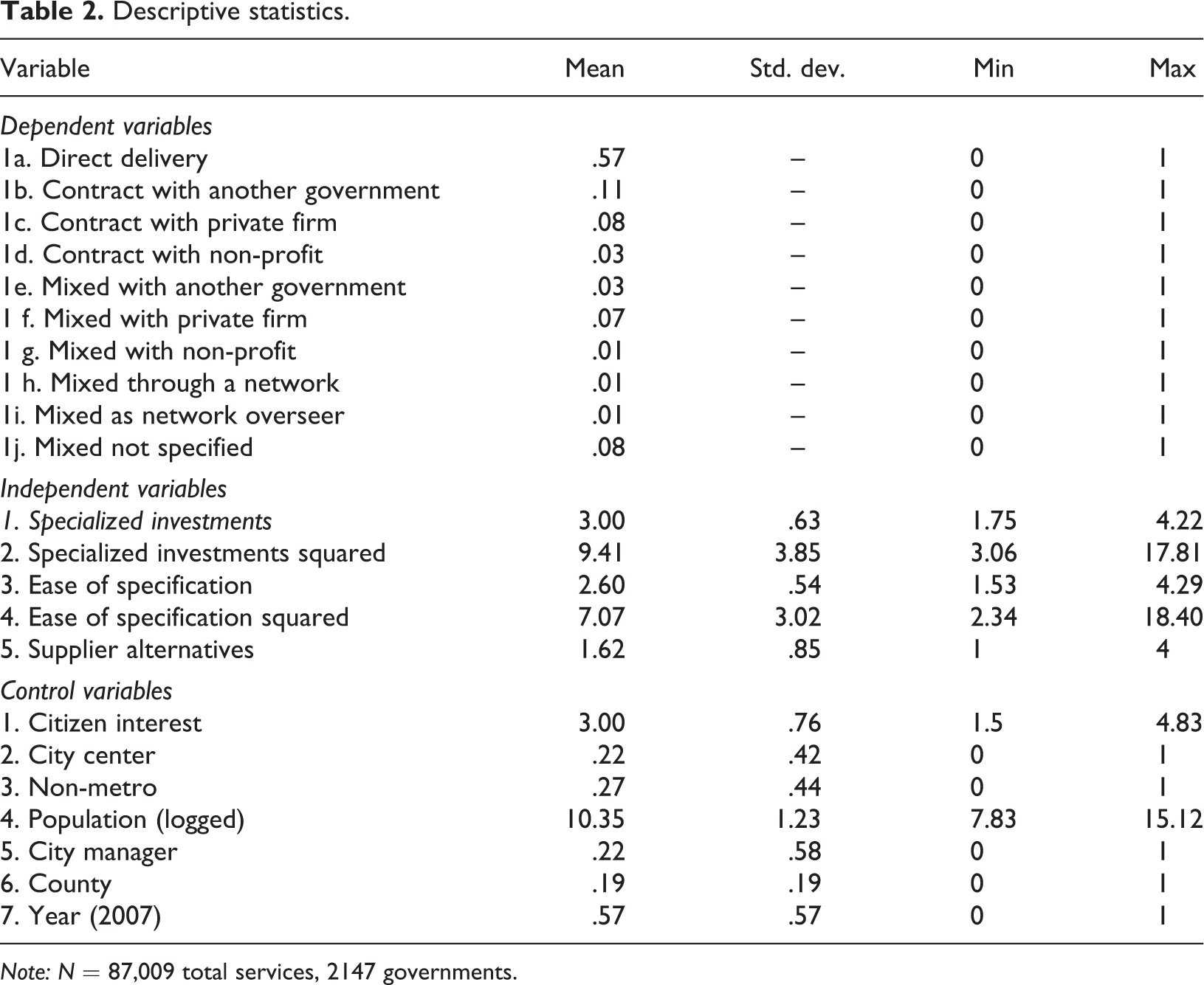
Note: N = 87,009 total services, 2147 governments.
Methods
We use multinomial logit to evaluate governments’ service delivery decisions. Multinomial logit provides an analytical mechanism for examining the effect of a constellation of independent variables on the likelihood of respondents choosing among a multi-category dependent variable (Long, 1997). The intuition behind the approach is that each model selects a reference category (such as “direct service delivery”) and then estimates for each of the other dependent variable categories coefficients estimating the effects of independent variables on being in that category relative to the reference category. Rotating the reference category among all dependent variable categories produces coefficients of the probabilities of being in each category relative to all other categories for each independent variable. Interpreting multinomial logit models is complicated by the potentially large number of independent variables. In our case, with five key independent variables and a 10-category dependent variable, there are 60 independent variable coefficients meriting attention. Interpreting the coefficients is further complicated by multinomial logit’s non-linear functional form. Our results table shows the coefficients for changes in probabilities of the dependent variable being in just one of 10 categories relative to the probabilities of being in the other categories. 11
To ease interpretation and see the full range of effects, we present “predicted effects” summarizing the coefficients for the key independent variables (Long, 1997). Service delivery choices are unlikely to be independent within cities, although we assume independence across cities. That is, the factors that compel a city to contract for one service may also compel contracting for other services. Treating these choices as independent may potentially risk artificially deflating the standard errors. To address this issue, we follow White’s approach for robust standard errors, clustered by government (Greene, 1997). This adjustment essentially weights each observation (service delivery choice) by the number of services a city provides. All estimations were conducted using the mlogit command in Stata v. 10 software.
Results
We report our overall results about service characteristics, market conditions, and organizational type of suppliers on the use of different modes of mixed service delivery. We first report the use of the different modes in our complete analyses to highlight the use of mixed service delivery modes relative to other modes. Next, we present the results of multinomial logit analyses on the impact of all of the independent and control variables on the use of different service delivery modes. Finally, we focus our presentation by reporting the predicted probabilities of selecting one of the different modes in our analysis for the primary independent variables we use to measure values and service characteristics and markets. Overall, the results support our hypotheses: service characteristics and markets have significant and substantive impacts on governments’ mixed service delivery decisions. Given the complexity of our analyses we discuss the impact of these variables in a separate section.
The impact of service characteristics and market conditions on the use of mixed service delivery
Figure 1 reports the use of each of the three basic service delivery modes – direct, contract, and mixed – across all services provided by local governments in the 2002 and 2007 surveys. For now, we collapse the different mixed approaches into a single category. Direct service delivery is the dominant mode used by local governments, with 60.58% of services in the 2002 survey and 55.09% of services in the 2007 survey delivered directly. Contract delivery with another government, for profit, or non-profit is 15.89% of services in the 2002 survey and 26.14% of services in the 2007 survey. In the 2002 survey, 23.53% of services were delivered through mixed service delivery, and in the 2007 survey, 18.78% of services were delivered in the same way. 12
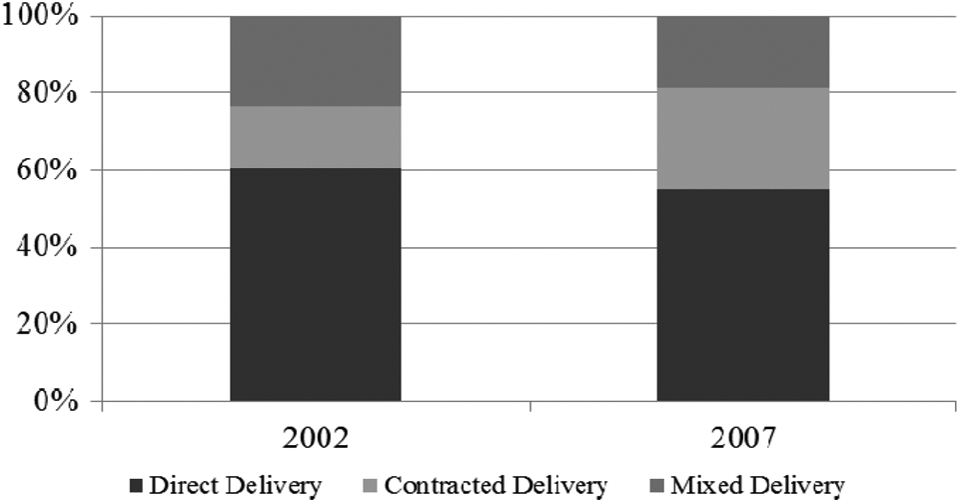
Percentage of services delivered by mode, 2002 and 2007.
Table 3 reports the multinomial logit results for the impact of each of the independent and control variables on the use of different service delivery modes, including all mixed approaches. Given that direct service delivery is the dominant service delivery mode, we use this category as the base reference category. Almost all of the independent and control variables are statistically significant and in the ways anticipated. We focus our presentation on the mixed categories of interest.
Multinomial logit analysis of local governments’ service delivery practices.
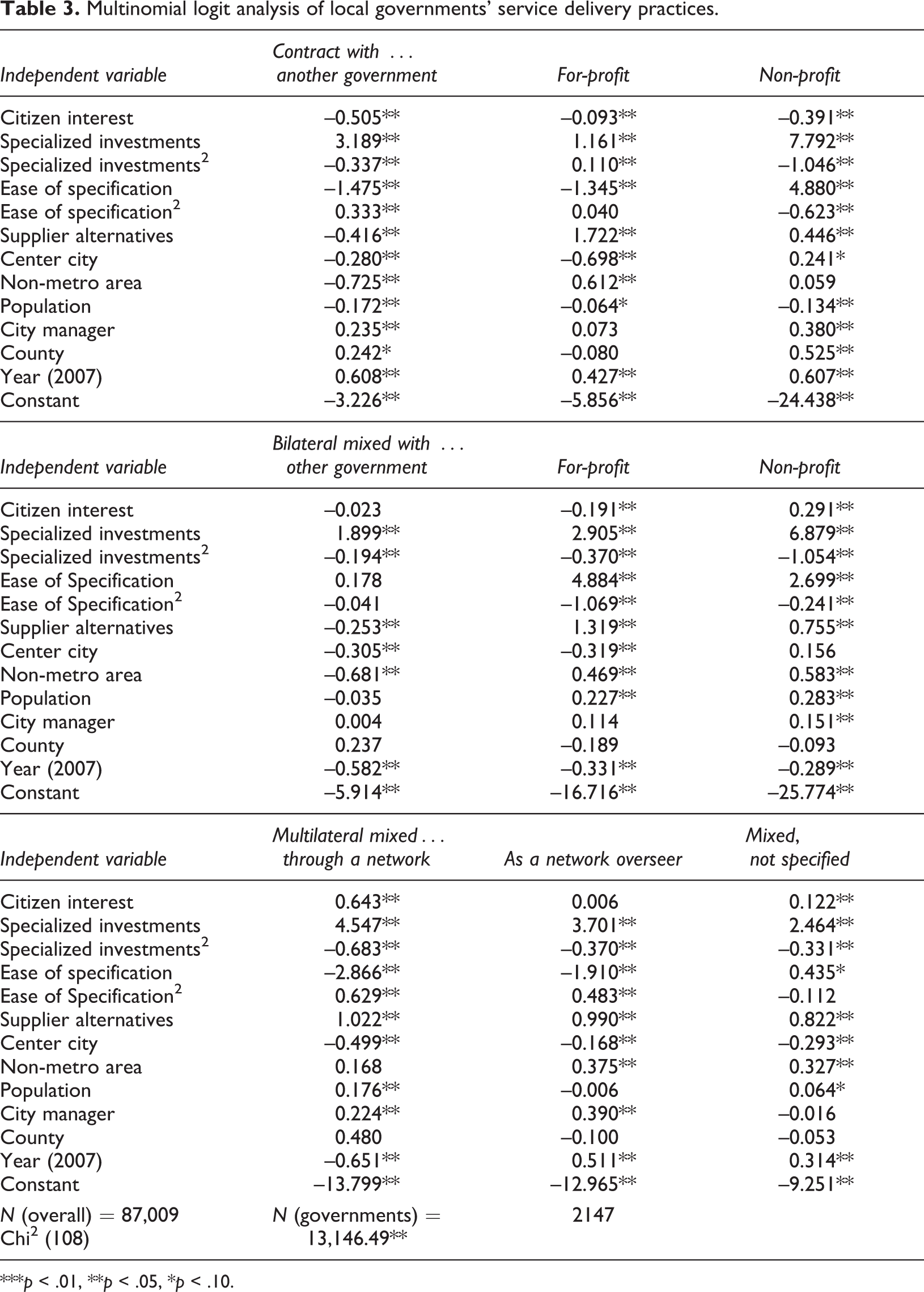
***p < .01, **p < .05, *p < .10.
Figures 2 –4 plot the changes in the predicted probability of being in the three basic service delivery modes across the key independent variables from Table 3, holding the effects of all other variables constant at their means. 13 The Y-axis reports the probability of being in each of the three service delivery categories – direct, contract, and mixed delivery – and the X-axis of each figure is the independent variable scaled as percentiles from 1 to 99. As Figure 2 reports, as the combined variables specialized investments and specialized investments 2 increase, the predicted probability of a local government selecting a mixed service delivery mode initially increases and then decreases to a lower predicted probability than when the independent variable is at its lowest levels. As Figure 3 reports, as the combined variables ease of specification and ease of specification 2 increase, the predicted probability of a local government selecting a mixed service delivery mode increases. Finally, as Figure 4 reports, as the variable supplier alternatives increases, the predicted probability of a local government selecting a mixed service delivery mode increases substantially.
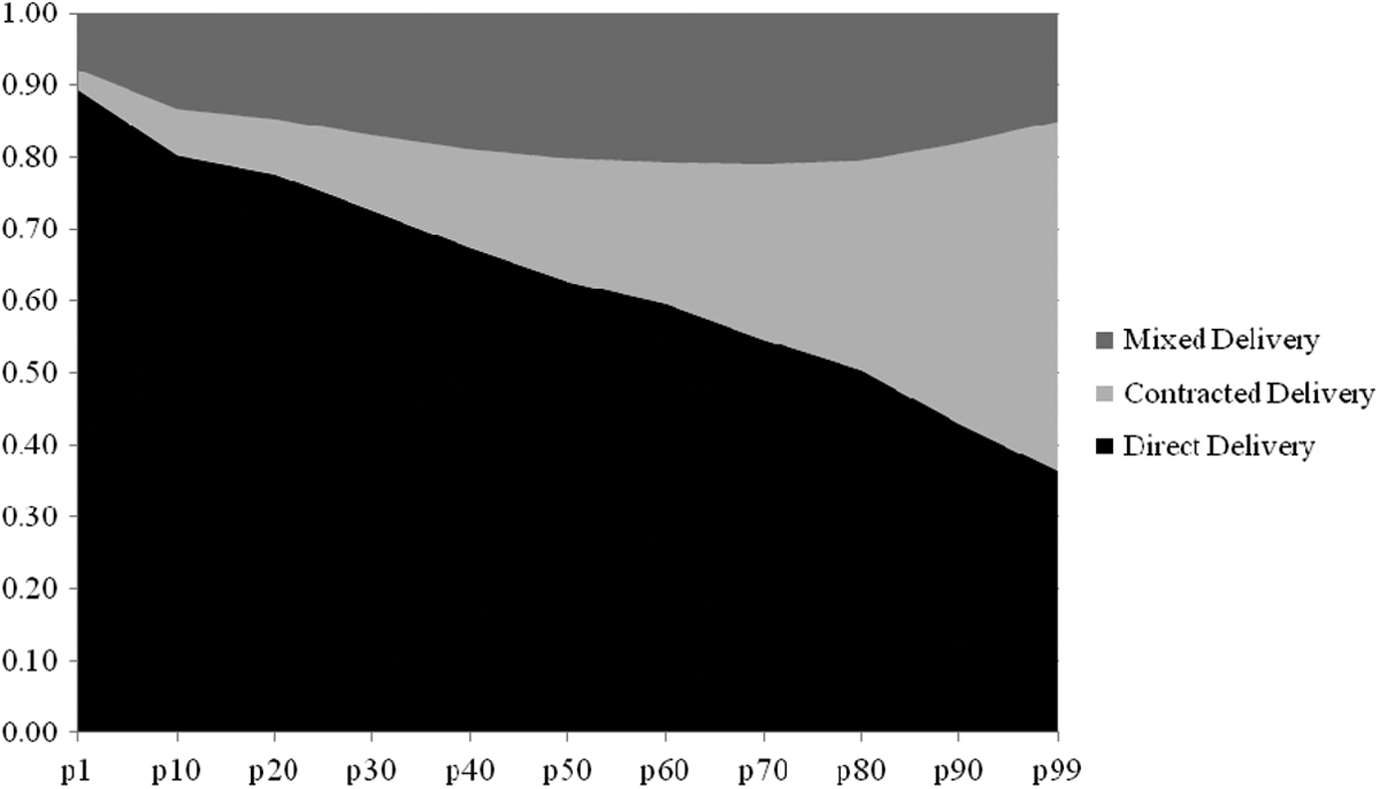
Predicted probability of service delivery mode by specialized investments and specialized investments 2 .
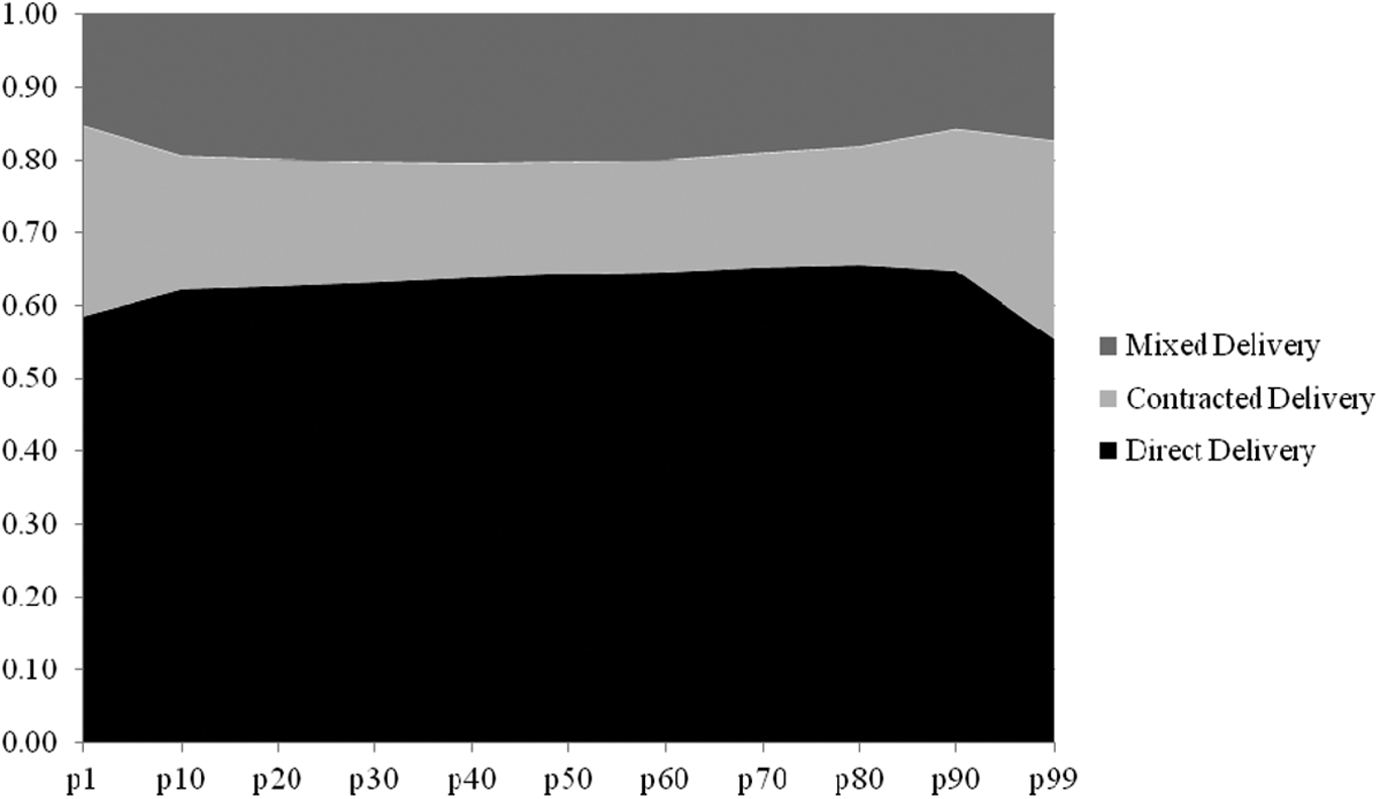
Predicted probability of service delivery mode by ease of specification and ease of specification 2 .
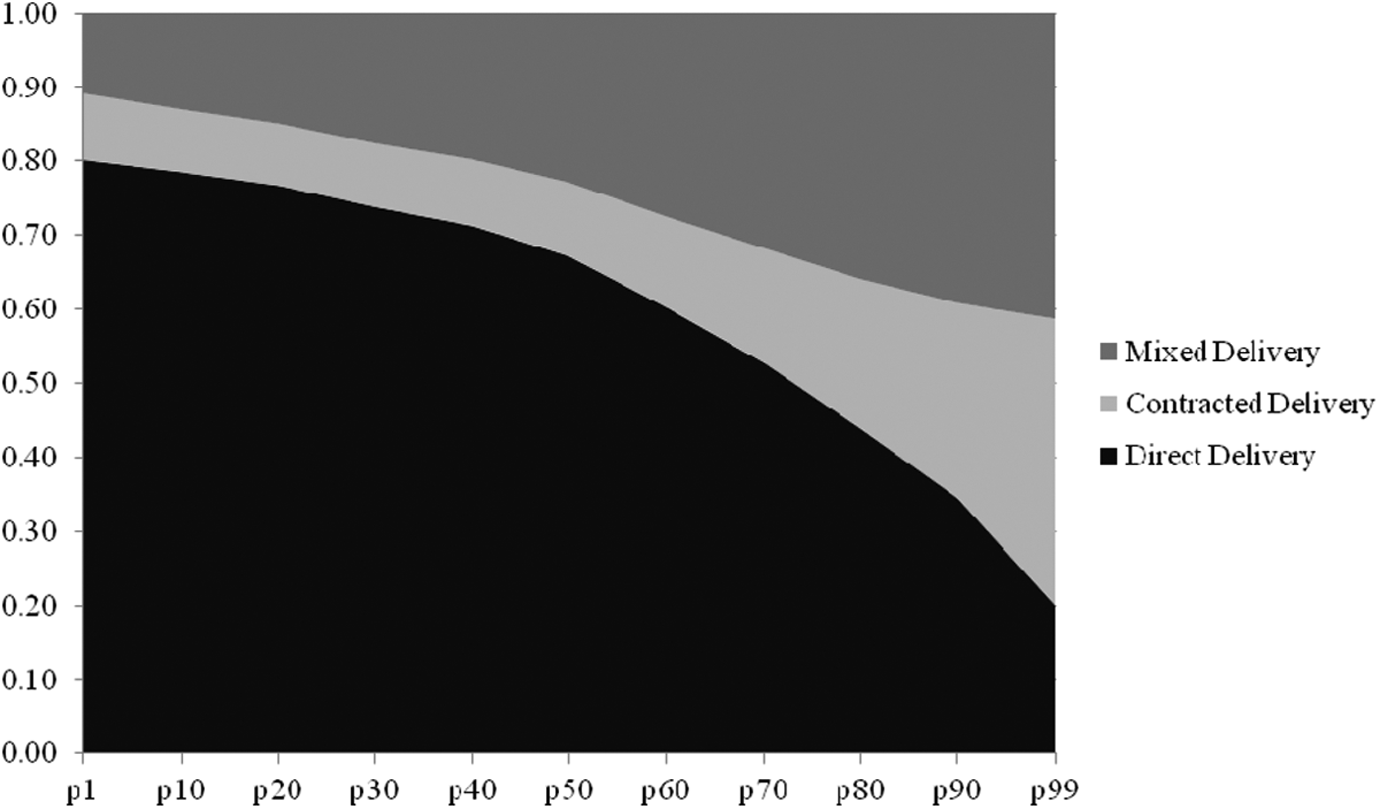
Predicted probability of service delivery mode by supplier alternatives.
Taken together, these results provide support for the impact of service characteristics and market conditions on the use of mixed service delivery modes (hypotheses 1 and 2). When services require moderately specialized investments, local governments increase their use of mixed service delivery, but when services require significant specialized investments (which are likely high-cost fixed investments) local governments reduce their mixed service delivery activity and expand their use of contracted service provision. When services are moderately difficult to specify, local governments expand their use of mixed arrangements and direct service delivery relative to contracted service delivery, and dramatically increase their use of mixed arrangements when services are very difficult to specify. Finally, as service markets offer more alternative providers, local governments ramp up their use of mixed service delivery relative to direct service delivery.
The impact of service characteristics and market conditions on the organizational type of bilateral and multilateral mixed service delivery partners
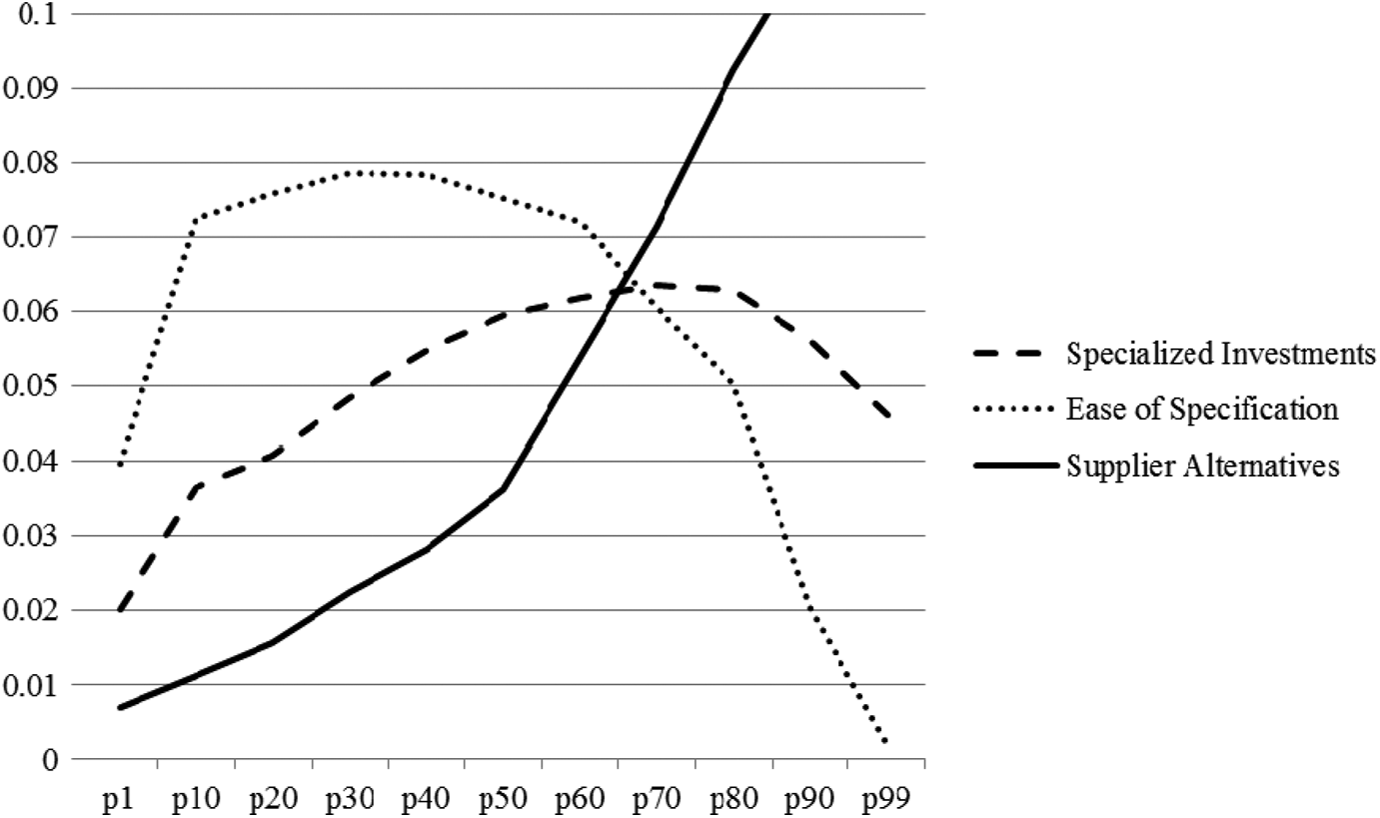
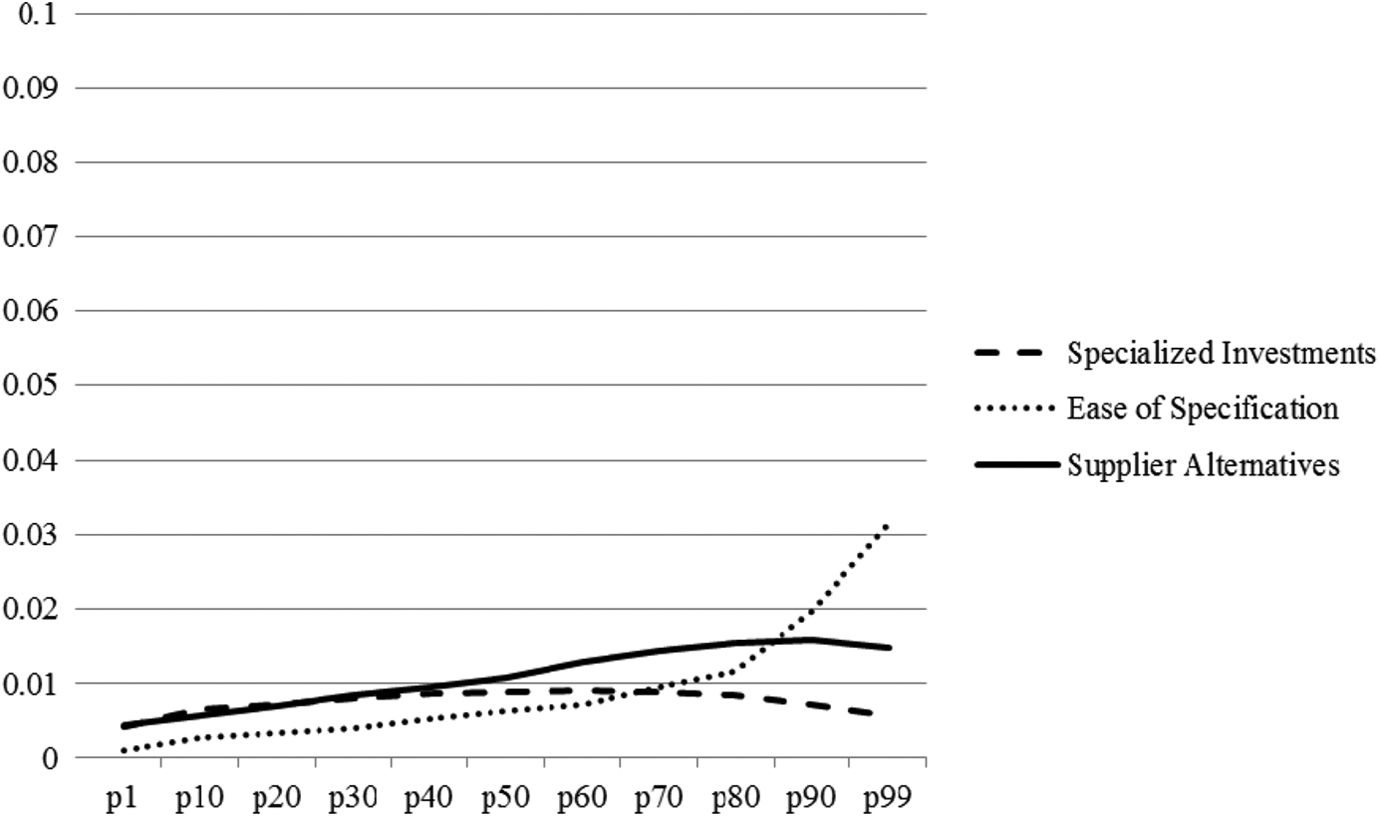
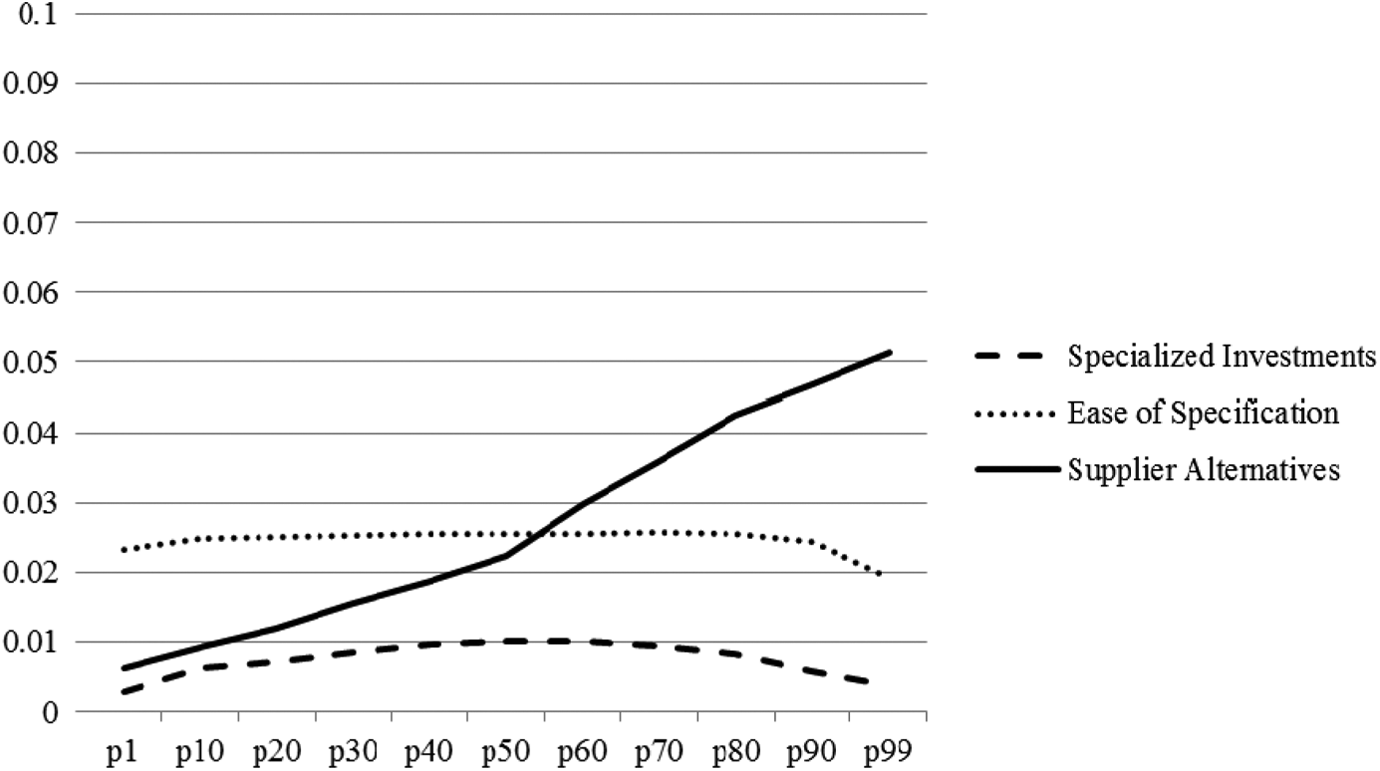
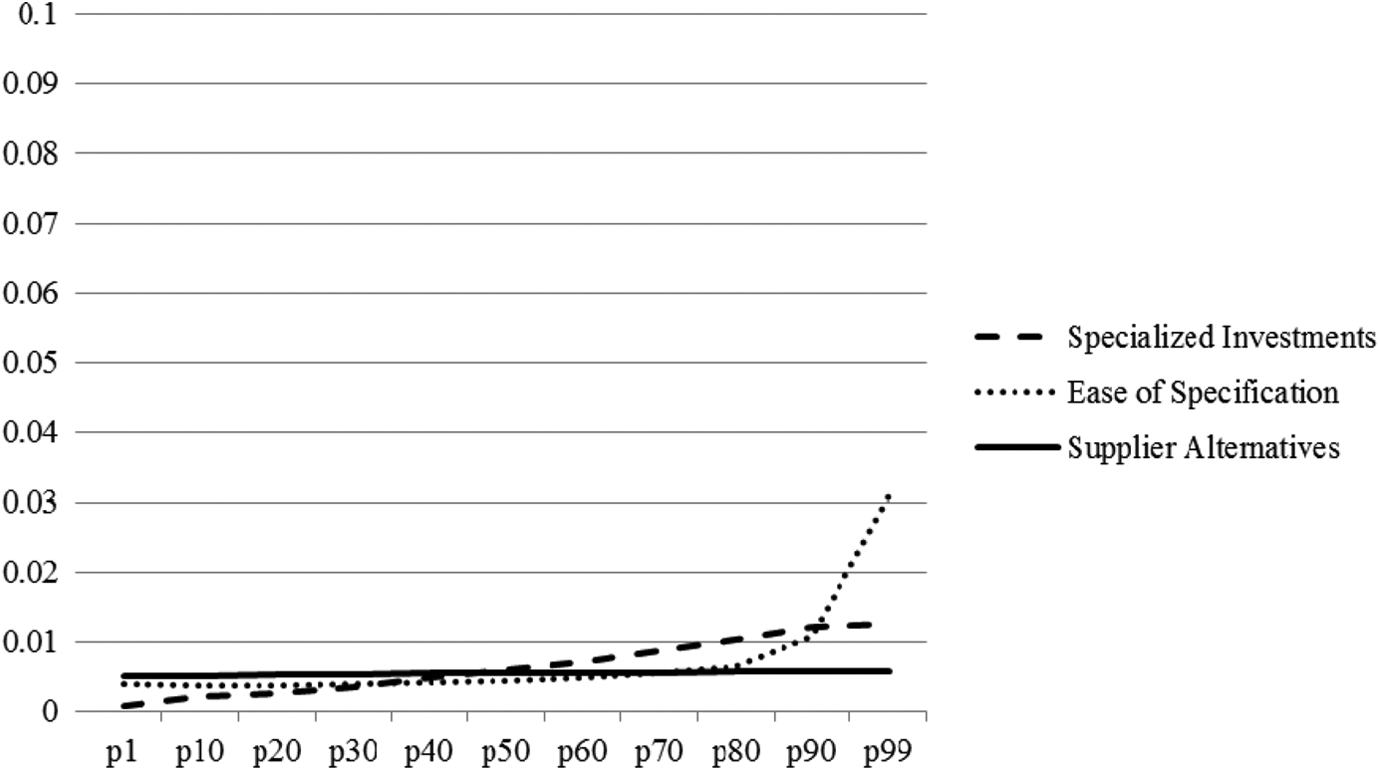
Here we report results that shed light on the use of the bilateral and multilateral mixed service delivery and the organizational type of the partner under bilateral arrangements. Figures 5 –9 plot changes in the predicted probability of being in one of the bilateral or multilateral mixed service delivery modes across the range of the key independents, holding the effects of all other variables constant at their means. Like the previous predicted probability figures, these figures are based on the multinomial logit results presented in Table 3. The Y-axis reports the probability of being in the mixed service delivery mode and the X-axis of each figure is scaled as percentiles from 1 to 99. While around one-fifth of services are delivered through mixed arrangements of one type or another, the use of any one of the mixed modes is low relative to all possible modes. By unpacking mixed delivery we are investigating the use of increasingly specialized delivery modes. Note that the Y-axis runs from 0 to .1 rather than 1. We reduce the range of the Y-axis to better display the impact of changes in the key independent variables on the use of each mixed delivery mode. We examine the impact of the three independent variables on the predicted probability of the use of each mixed service delivery mode. We also provide illustrative examples of the types of services that are the most likely to be delivered through that mode to provide context for the impact of the independent variables on the dependent variable. We take the three bilateral modes first, and follow with the two multilateral modes.
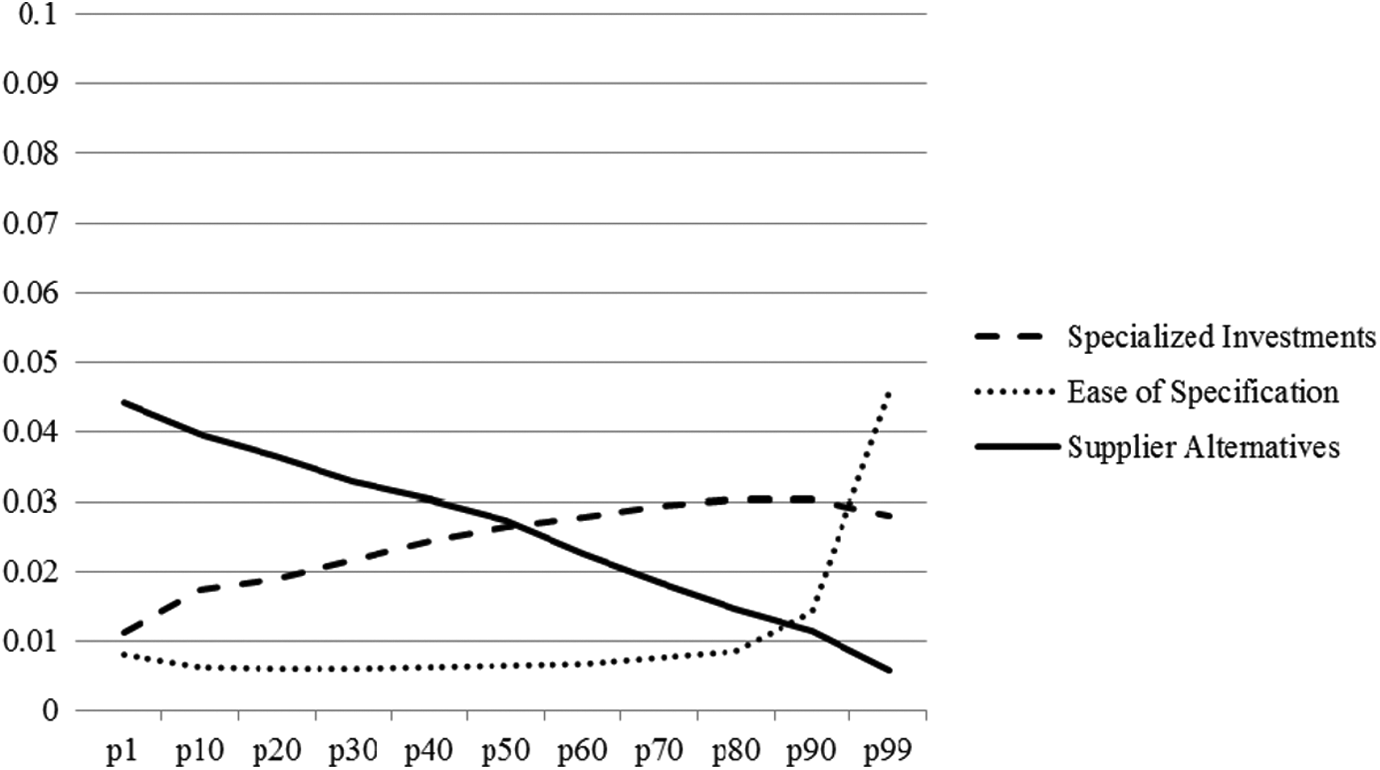
Predicted probability of mixed delivery with another government.
Predicted probability of mixed delivery with a for-profit.
Predicted probability of mixed delivery with a non-profit.
Predicted probability of mixed delivery through a network.
Predicted probability of mixed delivery as a network overseer.
Mixed delivery with another government
Figure 5 reports the changes in probability of mixed service delivery with another government associated with changes in the variables specialized investments, ease of specification, and supplier alternatives. As Figure 5 shows, the probability of a local government delivering a service through mixed service delivery with another government increases as the specialized investments of services increase, decreases as supplier alternatives increases, and remains unchanged with ease of specification until it increases dramatically at very high levels, holding constant the effects of all other variables at their means. More specifically, the probability of mixed service delivery with another government almost doubles from .017 at the 10th percentile of the variable specialized investments to .03 at the 90th percentile. The probability of mixed service delivery with another government decreases from .04 at the 10th percentile of the variable supplier alternatives to .01 at the 90th percentile. The effect of the variable ease of specification on the probability of mixed service delivery with another government changes across levels of the variable, holding constant the effects of other variables at their means. Mixed service delivery with another government remains unchanged at around .006 moving from the 10th percentile of the variable ease of specification to the 70th percentile. The probability of mixed service delivery with another government dramatically increases from .009 at the 80th percentile of the variable ease of specification to .05 at the 99th percentile.
The operation and maintenance of prisons and jails is a service that is among the most frequently delivered via mixed service delivery with another government. Of the 1274 respondents that deliver the service, 8% indicated that their government delivered the service via this mode. According to our transaction cost measures, this service ranks high on the variable specialized investments (4.04), in the middle range of ease of specification (3.21), and very low in supplier alternatives (.84). These measures make the provision of prisons and jails among the most likely for a local government to collaborate to deliver the service with another government by utilizing a mixed service delivery arrangement.
Mixed delivery with a private firm
Figure 6 reports the changes in the probability of mixed service delivery with a for-profit firm associated with changes in the variables specialized investments, ease of specification, and supplier alternatives. As Figure 6 shows, the probability of a local government delivering a service in collaboration with a for-profit firm increases as the variable supplier alternatives increases, holding constant the effects of all other variables at their means. More specifically, the probability of mixed service delivery with a for-profit firm increases 10-fold from .01 at the 10th percentile of the variable supplier alternatives to .11 at the 90th percentile. The effects of the variables specialized investments and ease of specification on the probability of mixed service delivery with a for-profit firm change across levels of the variables, holding constant the effects of other variables at their means. The probability of mixed service delivery with a for-profit firm increases from .04 at the 10th percentile of the variable specialized investments to .06 at the 90th percentile. The probability of mixed service delivery with a for-profit firm declines from .07 at the 10th percentile of the variable ease of specification to .02 at the 90th percentile.
The maintenance of heavy equipment is among the most frequently delivered services via mixed delivery with a for-profit firm. Of the 2463 respondents that deliver the service, 22% indicated that their government delivered the service via this mode. According to our transaction cost measures, this service ranks moderately on the variable specialized investments (3.06), low in ease of specification (2.22), and moderate in supplier alternatives (2.08). This same general pattern is true for other services that governments deliver via mixed service delivery with a for-profit firm. This includes, for example, the maintenance of emergency vehicles at 21% (3.28, 2.11, and 2.08 respectively). These measures make the provision of maintenance of heavy equipment and emergency vehicles among the most likely for local governments to use mixed deliver with a for-profit firm.
Mixed delivery with a non-profit
Figure 7 reports the changes in the probability of mixed service delivery with a non-profit associated with changes in the variables specialized investments, ease of specification, and supplier alternatives. As Figure 7 shows, the probability of a local government delivering a service in collaboration with a non-profit using a mixed service delivery arrangement remains relatively unchanged for the variable specialized investments from .007 at the 10th percentile to .007 at the 90th percentile. The probability of mixed service delivery with a non-profit more than doubles from .006 at the 10th percentile of the variable supplier alternatives to .016 at the 90th percentile. The probability of mixed service delivery with a non-profit is .003 at the 10th percentile of the variable ease of specification and increases more than six-fold to .02 at the 90th percentile.
The operation of cultural and arts programs is a service that is among the most frequently delivered via mixed service delivery with a non-profit. Of the 1102 respondents that deliver the service, 12% indicated that their government delivered the service via this mode. According to our transaction cost measures, this service ranks moderately on the variable specialized investments (3.0), moderately difficult in ease of specification (3.26), and moderate in supplier alternatives (2.35). Governments deliver a number of other services collaboratively with a non-profit that are higher on the need for specialized investments, where specification is more difficult, and supplier alternatives are lower by using a mixed service delivery arrangement. For example, 8% of respondents report collaboratively delivering elderly programs with a non-profit and 6% for drug/alcohol treatment programs. These measures make the provision of arts/culture and social/mental health services among the most likely for government to collaboratively engage in a mixed service delivery arrangement with a non-profit.
Mixed delivery through a network
Figure 8 reports the changes in probability of mixed service delivery with a network of other participants associated with changes in the variables specialized investments, ease of specification, and supplier alternatives. As Figure 8 shows, the probability of a local government delivering a service in collaboration with a network of other participants using a mixed service delivery network arrangement increases as the variable supplier alternatives increases. The probability of mixed service delivery with a network of other participants increases five-fold from .009 at the 10th percentile of the variable supplier alternatives to .05 at the 90th percentile. The probability of mixed service delivery with a network of other participants is .03 at the 10th percentile of the variable ease of specification and remains constant until declining to .02 at the 90th percentile, holding constant the effects of all other variables at their means. The probability of government delivering a service with a network of other participants is relatively constant for the variable specialized investments from .006 at the 10th percentile to the 90th percentile.
The operation of drug and alcohol treatment programs is a service that is among the most frequently delivered via mixed service delivery with a network of other participants. Of the 716 respondents that deliver the service, 8% indicated that their government delivered the service via this mode. According to our transaction cost measures, this service ranks moderately high on the variables specialized investments (3.63) and ease of specification (4.12), and moderate in supplier alternatives (2.66). Governments do deliver a number of other services jointly with a network of other participants that are consistent with these transaction cost measures. For example, 8% of survey respondents report collaboratively delivering elderly programs with a mixed service delivery network of other participants and 8% for the maintenance of recreational facilities. These measures make the provision of social and cultural services among the most likely for local governments to collaboratively deliver the service with a network of other participants.
Mixed delivery as a network overseer
Figure 9 reports the changes in probability of mixed service delivery when government serves as a network overseer in the delivery of services associated with changes in the variables specialized investments, ease of specification, and supplier alternatives. As Figure 9 shows, the probability of a local government delivering a service as a network overseer increases as the variable specialized investments increases six-fold from .002 at the 10th percentile to .012 at the 90th percentile. The probability of mixed service delivery when government serves as a network overseer in the delivery of services is .004 at the 10th percentile of the variable ease of specification and doubles to .01 at the 90th percentile, holding constant the effects of all other variables at their means. The probability of mixed service delivery when government serves as a network overseer is relatively stable from the 10th to the 99th percentiles of the variable supplier alternatives at .005.
The operation of daycare facilities is a service that is among the most frequently delivered via mixed service delivery when government serves as a network overseer in the delivery of services. Of the 471 respondents that deliver the service, 14.65% indicated that their government delivered the service via this mode. According to our transaction cost measures, this service ranks moderately high on the variables specialized investments (3.14) and ease of specification (3.32), and moderate in supplier alternatives (3.3). Governments do deliver a number of other services collaboratively when they employ a mixed service delivery arrangement and serve as a network overseer in a manner consistent with these transaction cost measures. For example, among the survey respondents, 10.6% report the operation and management of hospitals, 9.22% for drug/alcohol treatment programs, and 9.22% for the operation of mental health programs using this delivery mode. These measures make the provision of social and public health services among the most likely for local government to collaboratively deliver when a mixed service delivery arrangement is used and government serves as a network overseer.
Discussion
Taken together the results of our analyses provide support for the six hypotheses. In support of hypotheses 1 and 2, local governments are most likely to choose mixed service delivery when services are more difficult to specify and more difficult to produce and there is a range of alternative suppliers. In support of hypotheses 3 and 4, local governments are most likely to select private firms as mixed service delivery partners when service characteristics pose fewer challenges and there are many alternative suppliers. As service characteristics pose greater challenges and there are fewer alternative suppliers, local governments are more likely to collaborate with other governments and non-profits. Finally, in support of hypotheses 5 and 6, although the use of multilateral mixed service delivery is less common, local governments are most likely to serve as a participant or an overseer in a network when service characteristics become more challenging and the number of potential alternative suppliers increases.
When choosing a bilateral mixed service delivery mode, local governments are most likely to pursue mixed delivery with private firms and are the least likely to pursue mixed delivery with non-profits. This does not mean, however, that governments see private firms as the most desirable partners and non-profits as the least. On the contrary, in certain circumstances private firms are better suited as partners, while non-profits are superior in others. When services are easy to specify, governments are more likely to choose mixed delivery with a private firm. When services become difficult to specify the likelihood of mixed delivery with a private firm decreases, while the likelihood of mixed delivery with a non-profit increases. Non-profits might be preferable partners in these cases, because as mission-driven organizations they may be willing to tolerate the uncertainty that comes with mixed delivery for difficult-to-specify services and may pose lower risks to the local government that the partnership will falter on the other party’s self-interest.
Mixed delivery with private partners is more likely than mixed delivery with non-profits because there are often lots of firms across different service areas. For all the focus on the rise of non-profits as service providers, at the local level in the USA, they remain concentrated in a few policy areas, namely health and human services and cultural and arts programs. Private firms, on the other hand, operate across the range of services offered by local governments, including the arenas where non-profits are active. This pattern is reflected in the increase in the probability of mixed service delivery with a private firm as the number of alternative providers increases; most of these alternative providers are likely private firms rather than non-profits or local governments.
As with non-profits, when services become difficult to specify, the likelihood of mixed delivery with another government increases. Non-profits also appear to provide advantages as partners in managing the challenges of specialized investments; as services require more specialized investments, the likelihood of mixed service delivery with another government increases. This is not the case for mixed delivery with private firms; while the likelihood of mixed delivery with a private firm initially increases as services require specialized investments, it decreases precipitously when services require a high level of specialized investments. Governments may be safer partners when the risk of lock-in increases. Governments also appear to be preferable partners to private firms when the market thins. As the number of alternative suppliers increases, the likelihood of bilateral mixed service delivery with a private firm increases, while the likelihood of bilateral mixed service delivery with another government decreases.
Among the two multilateral mixed service delivery options, local governments appear to be active network participants. When there are multiple available partners (as indicated by an increase in the number of alternative suppliers) and there are moderate specification challenges, the likelihood of a local government delivering a service as an active network participant increases. When services become very difficult to specify, the likelihood of a local government serving as an active participant in a network decreases and the likelihood of a government serving as a network coordinator and overseer increases. Even when it becomes too challenging to specify all the different tasks required to provide a service, say for some complex health and human services, local governments take on the role of serving as a steward of the network (Popp et al., 2014; Provan and Milward, 1995).
Conclusion
Local governments face many mixed service delivery options beyond direct and contract service delivery. Local governments used mixed service delivery for around a fifth of all services in our sample, about the same amount as contract service delivery. The “make or buy” decision is better framed as the “make, buy, or mix” decision. Mixed delivery with a single partner – bilateral mixed delivery – is common when service-specific transaction costs are moderate and there are a limited number of alternative suppliers. As the number of alternative suppliers increases, private firms predominate as mixed delivery partners; mixed arrangements with other governments or non-profits are most common when there are no other available partners. Mixed delivery with multiple partners – multilateral mixed delivery – is less common than bilateral mixed delivery; multilateral, networked arrangements are the most common when service-specific transaction costs are high and there are multiple alternative suppliers.
Our findings have implications for the practice of policy implementation through service delivery. The promise of mixed delivery is that governments can harness the upside of contracting, notably the ability to evaluate alternatives and select a desirable partner, while still capturing some of the benefits of direct delivery, such as minimizing the risk of interrupted service provision by maintaining internal productive capacity. Mixed service delivery is not a seamless activity, however. As is the case with contracted service delivery, mixed service delivery requires coordinating, planning, monitoring, and negotiating and renegotiating with another organization. These management tasks can be costly (Brown et al., 2008) and may explain why mixed service delivery is not used more often than contracted service delivery. Another important management lesson of our findings is that partners are unevenly distributed across the array of services delivered at the local level (Bovaird, 2004). Even large governments in dense metropolitan areas may find a limited range of alternative suppliers for services such as prisons. Governments contemplating mixed delivery not only need to assess the management costs of entering into a partnership with another organization, but also the array of different types of suppliers available for partnering (Boyer et al., Forthcoming). A government may prefer a non-profit or other government partner for a service with high transaction costs, but only find private firms available in the market. In these cases, direct service delivery may offer advantages to mixed service delivery.
Much more could be done to understand the structure and dynamics of these different partnerships. Firstly, future research should begin by sharpening the definition of mixed service delivery and acquiring appropriate data to best measure different conceptualizations of the construct. The ICMA data we use here are the best available data on mixed service delivery approaches, but are insufficiently granular to differentiate between partnerships and collaborations with differential distributions of effort across partners (Entwistle and Martin, 2005). For example, as noted in our methods discussion, the ICMA data does not distinguish between instances where localities partner with another organization to each deliver the same service to different recipient groups within a jurisdiction and instances where localities partner with another organization to perform different service delivery tasks for all recipients within a jurisdiction.
Secondly, future research should look to bridge the gap between the rich case study literature on bilateral and multilateral mixed service delivery and the growing empirical research on local service delivery practices (Bel et al., 2010; Lamothe et al., 2008). There is a growing literature that suggests that networked service delivery is on the rise (Popp et al., 2014). Our results suggest that multilateral, networked service delivery is less common than other delivery modes and limited to specific types of services and in specific market conditions. Future research can more fully explore the management tasks required for bilateral and multilateral mixed service delivery. For example, there may be important differences between more loosely formed networked arrangements and more contractual bilateral arrangements (Bryson et al., 2006).
Thirdly, future research can explore the impact of factors beyond service-specific characteristics, market conditions, and the organizational type of potential partners. Other factors, such as location (e.g. urban versus suburban versus rural) and community size, are likely to play important roles in the use of mixed service delivery (Bel and Fageda, 2011; Ohemeng and Grant, 2014; Warner and Hefetz, 2008). Finally, the ultimate goal of research on policy implementation through alternative service delivery modes is to understand how different approaches influence the trade-offs between the different goals policies are designed to impact. Generally, service delivery focuses on the goals of cost efficiency, service quality, and service continuity. Different delivery approaches likely have different impacts on the achievement of these goals. Once the precursors of service delivery choice are determined, the next step is to determine how different service delivery approaches, inclusive of mixed service delivery, impact service delivery outcomes.
Footnotes
Acknowledgments
We are grateful for feedback we received from participants at the “Neither Public Nor Private: Mixed Forms of Service Delivery around the Globe” workshop at the University of Barcelona’s Department of Economic Policy, Barcelona, Spain, May 2012, where an earlier version of this paper was presented. We also appreciate the constructive feedback of the anonymous Journal of Strategic Contracting and Negotiation reviewers.
Declaration of Conflicting Interests
The author(s) declared no potential conflicts of interest with respect to the research, authorship, and/or publication of this article.
Funding
The author(s) received no financial support for the research, authorship, and/or publication of this article.
Notes
References
Supplementary Material
Please find the following supplemental material available below.
For Open Access articles published under a Creative Commons License, all supplemental material carries the same license as the article it is associated with.
For non-Open Access articles published, all supplemental material carries a non-exclusive license, and permission requests for re-use of supplemental material or any part of supplemental material shall be sent directly to the copyright owner as specified in the copyright notice associated with the article.
