




Abstract
The aim of this essay is to argue the importance of inter-organizational trust in global outsourcing relationships and the need to proactively develop trust between the outsourcing buyer and provider. Outsourcing of information technology (IT) and related business processes is a well-established business tactic for reducing costs and gaining other benefits which include access to rare skills and faster delivery of services. IT outsourcing frequently occurs as a contract arrangement between two large, complex global organizations. Inter-organizational trust is one of the key elements for success in the outsourcing arrangement. Given the complexity of many outsourcing arrangements, the management of trust between the two parties can be critical to a successful long-term relationship for both parties. The ability of both parties to repair trust without resorting to legal action is important. This essay examines the literature on inter-organizational trust and trust relationships in outsourcing, then introduces preliminary field data from surveys and a case study, and suggests directions for further research. This issue deserves focused research as outsourcing continues to grow.
Introduction
Outsourcing provides a number of benefits for both organizations and economies, and is prevalent across a variety of tasks, including information technology (IT), human resources, finance and accounting, and customer service. Often outsourcing contracts are created between firms in different counties, referred to as offshoring. However, outsourcing contracts sometimes fail, or experience serious breaches in expectations between outsourcing buyers and providers. With the collaboration of teams across the globe occurring at a much higher rate than ever, it is important to explore why outstanding issues arise when observing success in outsourcing. However, mutual understanding and trust are not only informal pieces required for outsourcing success, but are also integral components when considering contract sustainability, organization reputation, and future contract procurement. The research presented in this essay is preliminary, relying on a small sample and an exploratory case. However, with the preliminary findings the paper argues that the role of trust between organizations in global outsourcing is significant, not well explored, and requires further research and discussion.
This preliminary research responds to the challenge of Lumineau et al. (2015) to “improve our understanding of how IOCs (Inter-organizational Conflicts) operate, within more complex constellations.” This essay examines the role of trust in the complex contractual and relationship structures of global outsourcing, and begins to explore complicated conflict resolution strategies to rebuild trust. As Lumineau et al. (2015) point out, conflict is pervasive in inter-organizational arrangements yet there is a dearth of research on IOCs, and in particular on IOCs in outsourcing.
Literature review
We build on Child (2001) in defining trust as the confidence required for committing valuable resources with a partner, despite the risk of being taken advantage of by the same partner (Child, 2001), as an appropriate foundation for considering trust between organizations. Several authors have examined trust in the outsourcing relationship and concluded that “trust is a central aspect of successful IT outsourcing” (Lee et al., 2008) and “that trust is considered to be very fragile in outsourcing relationships” (Oza et al., 2006). We also consider the institutionalized mechanisms for building and repairing trust as a set of socialized norms and enforcement mechanisms that support expectations of restraint by outsourcing partners that could act opportunistically (Barber, 1983; Kramer and Lewicki, 2010; Williamson, 1979). For many outsourcing relationships, buyers and suppliers are located in different locations, which may provide less of a common environment for cultivating trust between outsourcing partners (Child, 2001). At the same time, the development of outsourcing industries in low-wage countries, with buyers clustering in higher-wage countries suggests that either a common environment is unnecessary, or that institutionalized norms and contracting mechanisms have developed. High-trust societies are found to be countries with a strong institutional basis, such as the United States (Child, 2001); while countries where legal gaps exist in enforcement of contracts, such as India and China, are found to be low-trust societies (Goo et al., 2008). Pursuing a successful relationship requires a greater degree of investment of not only time, but also knowledge and resources from both providers and buyers (Kern and Willcocks, 2000), creating a relationship-specific investment that is likely to contain trust. We therefore focus on several related questions. First, is repair of trust following a breach important to maintaining the outsourcing relationship? Second, if trust is important, are societal expectations of trust critical to repairing the relationship? Alternatively, are outsourcing partners’ actions as important, controlling for the level of trust in the societies of outsourcing partners?
Trust can be generated and sustained in outsourcing relationships as outsourcing partners observe each other’s behaviours, and can either strengthen or deteriorate after its initial beginnings (Child, 2001). Cultural differences can not only slow the development of mutual understanding, but can also delay the completion of formal agreements (Child, 2001). Accordingly, development of trust facilitates initial information exchange (Child, 2001). As a result, during the early stages of outsourcing relationships, personal contact gained can serve to be the basis for the design of respective contractual safeguards for each party (Child, 2001). Trust may continue to develop between these two parties through frequent communication and knowledge exchange, both formal and informal (Kern and Willcocks, 2000). With trust based on both capability and the intention to perform on previously agreed upon tasks, a system of controls for monitoring and controlling can greatly aid in the growth of trust. This is often referred to as the governance of outsourcing. Through the quality of knowledge obtained through these systems, parties can ensure that their expectations are met while teams perform in collaborative conditions that foster growth (Child, 2001). Conditions such as these allow for trust to be assessed and graded; by doing so, parties can achieve mutual goals (Kern and Willcocks, 2000). Through repeated interactions in the early stages of an outsourcing relationship, the basis for the successful delivery of services and the formation of trust is established.
Lumineau (2017) suggests that trust and distrust may not be opposite ends of a continuum, and that a “trust and distrust are separate constructs” and “the elements contributing to the development of trust are not necessarily the same as the elements supporting the development of mistrust.” Further, Lumineau posits that both trust and distrust can have positive and negative outcomes; distrust is not entirely undesirable. Finally, he suggests that contracts can be structured to enhance positive outcomes of both trust and distrust.
Additionally, trust can be enhanced through the use of trust-warranting properties, such as social and relational ties, and through the use of bases of presumptive trust (Kramer and Lewicki, 2010). The experience of the partner in an outsourcing relationship may also play a role in establishing trust, because experience with other partners will have enabled it to acquire knowledge about how to signal that it is trustworthy. It may also aid in the interpretation of the partner’s behaviour and enable it to avoid misinterpreting the partner’s actions. Because the vendor gives up control of the outsourced process, over time a variety of breaches of trust may occur in the delivery of services, and this increases the risk of the relationship. The more experience with outsourcing, the more likely it is that the provider will have experience with both breaches of trust and repair of trust in the outsourcing relationship. It is also likely to have successfully managed norms of outsourcing relationships, and likely be using consultants to acquire best practices to understand how to manage the relationship, including signalling trustworthy intentions. This type of firm is also more likely to have developed skills at managing outsourcing relationships, and therefore continue in these relationships because they are achieving the intended cost reductions. While these relationships may seem obvious, we use them to test the likelihood that firms have been able to acquire institutionalized norms for outsourcing relationship, including the best practices that will enable them to signal legitimacy (Fligstein, 1997; Scott, 2014).
While experience in outsourcing is likely important for understanding trust in outsourcing relationships, several sources identify best practices for trust reparation. Tit-for-tat strategies were found to be the most successful in situations where a breach of trust had occurred (Kramer and Lewicki, 2010). Punishment, even where contractually sanctioned, can create hostility and weaken satisfaction and social solidarity (Kern and Willcocks, 2000). Communication, including apologies, and increasing the level of communication between organizations are all recommended (Kern and Willcocks, 2000), while a variety of contractual methods may also be used, such as changing measurement schemes, seeking advice from third parties, and renegotiating contracts. The most common technique used by a party in the event of breach of trust is the use of a formal apology. Although the use of an apology is better than not apologizing at all, apologies are occasionally perceived as the lowest form of trust repair as apologies were found to be perceived as “cheap-talk” (Kramer et al., 2010). When given with a lack of direct and substantive reparations, apologies are found to be excuses that not only minimize blame and damage to identity, but also undermine existing reliability and trustworthiness (Kramer and Lewicki, 2010). Breaches could be written-off as isolated events; however, the effectiveness of apologies were found to be minimized when breaches of trust were found to be habitual (Kramer and Lewicki, 2010). Reparations through financial, contractual, or other arrangements assisted with the establishment of sincerity when apologies are given (Kramer et al., 2010). However, trust can only be repaired once forgiveness, from the party who witnessed the infraction, is given (Goo et al., 2008). Forgiveness is not only found to be a critical link when repairing trust, but is also found to be the basis for transitioning into the future and moving past adverse trust events. Through forgiveness, Kramer and Lewicki established in their 2010 report that not only do victims acknowledge that a violation has occurred, but also the fact that the party committing the breach displays regret while showing commitment towards not repeating similar actions.
A preliminary survey
To explore inter-organizational trust in outsourcing, a preliminary survey was conducted. Participants from two large outsourcing buyer organizations agreed to respond to the survey. One organization is a large North American government. The second is a global consumer goods company, with participants in the UK and India. Respondents were directly engaged in an outsourcing relationship with one or more outsourcing provider.
At the time of analysis, data had been collected from 44 unique participants, with a total 85.4% of candidates completing the full survey. Respondents were all managers within a client organization responsible for managing an outsourcing relationship.
Some 95% of respondents considered outsourcing to be a standard practice within their organizations, with the remainder deeming outsourcing to be necessary only when required. A total of 92% of respondents worked with more than one provider when performing outsourcing initiatives. Over 45% of respondents have been using outsourcing arrangements for 10 years or more. The survey found that over 68% of respondents engaged five or more vendors, a finding that agrees with previous research findings on multi-sourcing.
Although only 3% of respondents indicated dissatisfaction with their current outsourcing relationships, the survey found that outsourcing satisfaction was predominantly neutral, with over 50% of respondents reporting this. Considering that 69% of respondents indicated they had never terminated an outsourcing contract early, this was a surprising finding. An interesting result from the survey: 0% of respondents indicated extreme satisfaction with their existing outsourcing relationship.
A variety of corrective actions were used to improve satisfaction with outsource contracts. By increasing vendor management activities, increasing communications, or temporarily changing service levels, clients could maintain existing relations with providers while continuing to move forward in the outsourcing lifecycle. With these actions, respondents were least likely to be involved in disputes that would cause a business disruption; respondents used renegotiation and legal action only as last resorts.
From the survey data, a trust grade was calculated as viewed from the buyers’ perspective. Figure 1 shows a positive correlation between time spent implementing outsourcing initiatives (measured in years of experience), the average number of providers or vendors used, and the level of trust observed for outsource buyers. Specifically, if an individual has 10 years or more of working with outsourcing initiatives and is managing four to five outsourcing vendors, trust in the outsourcing relationship from the buyer’s perspective is very high. This finding aligns with previous research that suggests buyer maturity and working with multiple outsource providers can create a more valued and successful outsourcing arrangement (Babin and Saunderson, 2016). Another important finding from this data is that trust increases at the greatest rate when “gaining competitive advantage” is identified to be one of the most critical outsourcing objectives for buyers.
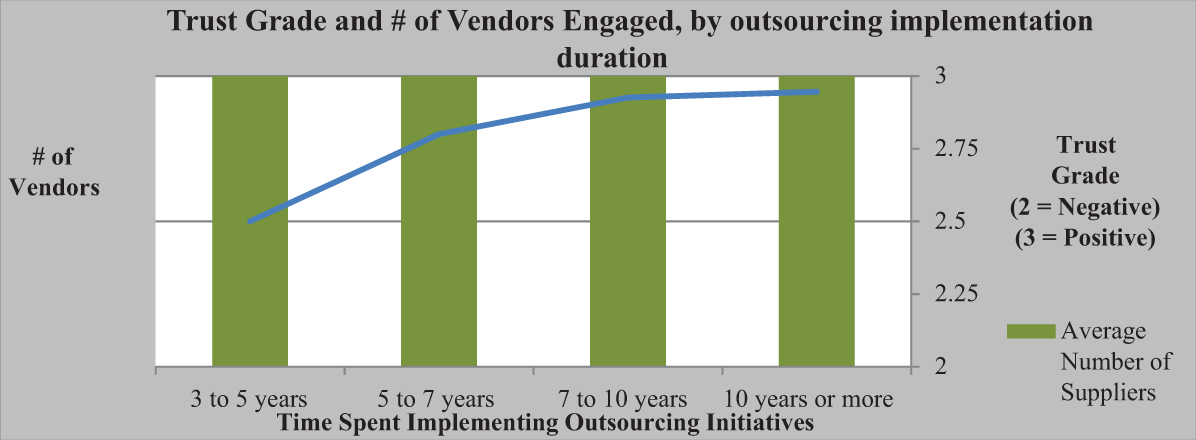
Trust grade and number of vendors.
With 94% of respondents indicating occurrences of unmet expectations, the survey showed that over 55% of all respondents indicated that they had experienced a breach of trust during their most recent outsourcing contract. A breach of trust is defined as a reduction in the level (or stage) of trust, with a diminished willingness to accept at face value statements from the provider.
Breaches of trust were found to occur for a number of reasons, with unmet expectations being the most dominant; this was followed closely by communication issues and the unwillingness by vendors to acknowledge adverse events and/or the impact of events.
From the survey data one of the most prevalent techniques applied in trust repair is the use of apologies after the occurrence of a breach event. Through a comparison involving instances of apology and the probability of trust breach, the survey showed not only a positive correlation between the two and trust grade, but that an interesting effect also occurred. The probability of a trust breach decreases significantly as increases within trust grade occur. The survey also showed that as trust grade increased, apologies were not only more likely to be made, but also more likely to be made sooner.
Despite these two conclusions, it is important to note that the probability of a trust breach never fell below 25%, and no instances were found where an apology was certain. In other words, in any outsourcing relationship, there is at least a 25% chance that, from the buyer’s perspective, trust will be broken at some point. However, it is important to note that these findings indicate that buyers who achieved a higher level of trust with their vendors were more inclined to initiate methods of trust repair. It was also found that financial or service reparations were provided more often to buyers who mentioned that their outsourcing relationship had a higher degree of trust.
Case study data: an illustrative vignette
An exploratory case study was conducted to further understand trust repair in an outsourcing relationship. The outsourcing relationship under review was an IT infrastructure arrangement between a North American natural resources company and a global IT services company. In mid-2016 a two-day exploratory workshop was conducted to address trust issues in the outsourcing arrangement.
The outsourcing contract had been plagued by two major challenges. First, shortly after the outsourcing agreement was signed and the project initiated, the industry experienced a dramatic business decline with reduced revenues for all industry participants. As a result, the outsource buyer severely reduced operations and cut its workforce by approximately 50%. The key executive proponents of the outsourcing arrangement left the company at that time. Second, as the outsourcing arrangement continued over three years, there was significant turnover in the outsource provider staff. The overall result was a governance team that did not create the deal, with limited background documentation, in a client environment where short-term cost reduction had become increasingly important. Trust and communication were identified as two key issues that hindered the relationship, reducing the value both parties experienced in the arrangement and creating a potentially difficult challenge at contract-renewal time in a few years.
Trust was the defining issue of the workshop. Both parties felt hurt and mislead by the other. Both parties realized the importance of working together to resolve past issues, to create a positive working relationship, and to prepare to meet future challenges. Both parties agreed to take action to rebuild trust.
The workshop identified the need for action on two issues.
First, in the words of the participants, there was a need for “honest, frank, candid discussions” between both parties, regularly. Second there was a need to collect accurate information from the “voice of the customer” so that innuendo and hearsay would be removed and the governance team would be able to respond to legitimate end-user problems. Each issue was examined in detail and a work-plan was constructed for both parties to take action to resolve the issues.
This case illustrates three issues regarding inter-organizational trust in outsourcing. First, trust is not guaranteed and can erode quickly. In this case, the industry recession, staff departures, and lack of documentation created an environment where small problems quickly grew larger, and gossip and innuendo replaced facts. In an environment where half of the employees had been let go, the outsource provider was an easy target for criticism from the remaining employees.
Second, both parties need each other for success. The buyer needs to achieve value in the outsourcing relationship, through lower costs, shorter time to resolve problems, current technology, and reliable services. The provider needs a profitable relationship that can be renewed into the future. Resolving the dispute through contract litigation would be expensive and disruptive to the relationship.
Third, a proactive approach in the form of a third-party facilitated workshop was needed to address the trust problem. When both sides feel hurt, and do not trust the other side, it can be difficult to take preliminary steps to begin to repair inter-organizational trust. An objective outsider using a formal approach proved useful to initiating the trust repair activities.
Yin (2009: 4) describes case study research as a qualitative research approach “to understand complex social phenomena,” and an approach “that investigates a contemporary phenomenon in depth and within it real-life context.” Although the exploratory case (an illustrative vignette) described here does not meet the standards of a full research case study, it does point towards an opportunity to better understand trust in an inter-organizational context by examination of the realities of trust breakdown and repair. The case study approach will be utilized in greater detail in follow-on work to this preliminary research.
Why is this important?
The International Data Corporation has found that over 80% of firms with over 1000 employees currently use outsourcing. For many organizations, the efficient management of outsourcing has become a core competency and a competitive differentiator.
However, research from Lacity and Willcocks (2012) found that approximately 40% of outsourcing arrangements in the last 20 years were not successful because either the deals did not achieve their objectives or original contracts were suspended, renegotiated, or re-tendered. This significant shortfall in outsourcing success suggests that the client–provider relationships in this US$440b global business can be improved through strategic management of outsourcing. Specifically, by focusing on trust and trust repair proactively, organizations can improve the value from outsourcing. Our preliminary survey data and case study suggest this is a significant opportunity for buyers and providers of outsourcing services.
Successful outsourcing can be difficult for several reasons, many of which are beyond the control of the buyer and provider. Building trust, and when damaged, repairing trust, are key elements of the outsourcing relationship that can be controlled by the two parties.
As organizations rely more on external arrangements for business and technology services, the role of inter-organizational trust will become increasingly important. A proactive approach, based on established models to build and maintain trust, should be a required feature of any complex outsourcing arrangement. Waiting to respond to trust problems is problematic. As Lumineau et al. (2015) point out, “reliance on third party enforcement (e.g. arbitration, litigation, etc.) is costly and imperfect.” This preliminary research suggests that organizations that prepare to build trust will see greater value from working with external providers and will experience less disappointment and failure. Although difficult to codify in a contract, trust is clearly a critical element for outsourcing success and this research suggests that buyers and providers should invest in the trust factor when outsourcing.
This essay has provided evidence of the importance of the topic of trust in outsourcing research. Further research will explore in more detail the issues raised in this paper with a thorough survey of outsource buyers and providers, as well as detailed case studies.
Footnotes
Declaration of Conflicting Interests
The author(s) declared no potential conflicts of interest with respect to the research, authorship, and/or publication of this article.
Funding
The author(s) received no financial support for the research, authorship, and/or publication of this article.