



Abstract
Governments’ endeavours to improve the efficiency of public service delivery often involve contracting out to external providers, which, allegedly, provides the possibility of exploiting the innovative capacity and expertise of the private market. However, most previous studies have focused on economic effects, thereby leaving open the question of whether contracting out results in mere cost savings or in real efficiency gains. This article offers some insights to advance the debate. Using municipal road maintenance in Denmark as an empirical test bed, we find that contracting out has on average reduced costs. Furthermore, we include a control for service quality, and show that the cost savings are still significant, thus indicating that a genuine efficiency gain has been realized. Nevertheless, while some municipalities have benefitted from contracting out, others have not. We conclude that cost effects are heterogeneous and contingent on municipal size and prior level of contracting out.
Introduction
In response to the continued strains on public finances and rising pressure to lower costs and improve service quality, governments are increasingly looking to the private market for effective and innovative ways of delivering public services (Bel and Costas, 2006; Brown and Potoski, 2003; Dijkgraaf and Gradus, 2013). Increasingly, such attempts to exploit private market competencies are taking the form of contracting out, here broadly defined as private delivery of tax-financed public services in return for economic compensation (Bhatti et al., 2009). A key rationale for involving market actors in public service delivery is that private companies – due to their right to extract profits – have a greater incentive to invest in innovative technologies and/or new working practices (Bennmarker et al., 2013). From this perspective, contracting out has the potential for lowering costs and/or improving the quality of public services, thus benefitting taxpayers, users and society at large (Domberger and Jensen, 1997), though recent reviews have found mixed evidence of superior efficiency when public services are privately delivered (Bel et al., 2010; Petersen and Hjelmar, 2013).
Transaction cost economics (Williamson, 1979) establishes that the potential benefits of involving the private market in public service delivery could particularly be found in service areas characterized by low asset specificity and/or ease of measurability (Brown and Potoski, 2003; Hefetz and Warner, 2011). The possibility of exploiting economies of scale is another potential benefit because private companies can operate several contracts at the same time (Christoffersen et al., 2007), thereby making it possible to utilize vehicles and specialized equipment across several geographical jurisdictions. Municipal road maintenance provides an empirical setting characterized by medium-high asset specificity and relative ease of measurability (Hefetz and Warner, 2011), which makes it more suitable for externalization than other local services such as health programmes, care of the elderly and utilities. The private market share in road maintenance is high (almost 50 per cent in the Danish context), and cross-municipal collaboration is almost non-existent, whereas private companies have the possibility of exploiting economies of scale to gain a comparative advantage over public production. Overall, the municipal road sector can thus be regarded as one of the most likely cases of a public service area in which contracting out could possibly result not merely in cost savings but in genuine efficiency gains (see also Blom-Hansen, 2003).
This article contributes to the literature on public/private service delivery by empirically examining the experiences with private provision of municipal road maintenance services in Denmark, with a focus on outcomes for costs and service quality. The study builds on a comprehensive panel data set covering municipal spending on road maintenance services in all 98 Danish municipalities from 2008 to 2014. Municipal road services have been extensively contracted out for many years, though both the level of contracting out and the production costs vary considerably across municipalities. The road sector is thus a suitable empirical setting for comparing public and private production, while most previous analyses have examined other local services such as refuse collection (Dijkgraaf and Gradus, 2013), water treatment (Correia and Marques, 2011) and public transportation (Boitani et al. 2013). Our data set includes detailed register data on municipalities’ spending on road maintenance (dependent variable) and an indicator measuring the proportion of contracting out of road maintenance (independent variable) for each year in all the municipalities. In addition to benefitting from exact measures of the dependent and independent variables on continuous scales, the analysis moreover includes a standardized measure of all control variables (for further details see the Methodology and data section).
The contribution of the article to the existing literature is threefold. First, the analysis examines economic effects and confirms the only prior study of contracting out in the road sector (Blom-Hansen, 2003): cost savings have been realized. Second, whereas many previous studies have not measured quality outcomes (O’Toole and Meier, 2004), we are able to include data on municipal road quality from another register covering approximately 50 per cent of the municipalities. We therefore run an additional analysis including a control for service quality and find that the cost savings survive the test. Hence, a real efficiency gain from contracting out seems to have been realized. Third, the detailed nature of the data set enables us to examine heterogeneous effects in municipalities with different sizes and prior levels of contracting out. The findings show that some municipalities have gained from contracting out whereas others have not, thus indicating that the outcomes of contracting out are heterogeneous across municipalities.
The article proceeds as follows. In the next section, we examine the theories and previous literature. This is followed by a brief presentation of the empirical context of municipal road maintenance in Denmark. Then, we present the variables, data set and estimation methods. A results section follows, in which the estimations concerning economic effects, service quality and heterogeneous effects are presented. Finally, a discussion and conclusion are provided.
Theoretical and empirical background
Theoretical expectations about the potential outcome of introducing market principles to public service delivery are commonly drawn from public choice theory and property rights theory, which stress competition and ownership, respectively, as sources of superior market efficiency (Alonso et al., 2015; Boyne, 1998). Considering these theoretical perspectives in turn, public choice theory builds on the notion of politicians and public bureaucrats as self-interested individuals who seek to maximize their personal interests (Bel et al., 2010; Niskanen, 1971). Public service delivery absent of competition will result in monopoly production, which enables public politicians and bureaucrats to engage in rent-seeking (e.g. maximize salaries and other material benefits) and/or bureau-shaping (e.g. maximize personal satisfaction from work). Therefore, monopolistic public service delivery is destined to result in excess production and economic inefficiency that, however, can be counteracted by introducing the economic discipline of the private market by means of contracting out public services. This line of argument, which is also referred to as the competition argument (Blom-Hansen, 2003), emphasizes the superior incentives of private providers to invest in innovative and/or cost-saving technologies that will allow them to gain a comparative advantage over their contestants (Bennmarker et al., 2013). This rivalry can involve either gaining a share of the market (competition in the market) or winning the right to the market for a fixed term (competition for the market), the latter often being the case with contracting out of public services (Boitani et al., 2013: 1420).
Turning to property rights theory, this theoretical perspective shares a similar vision of the private market as being superior to public production, although the theoretical starting point is somewhat different (Alonso et al., 2015). In contrast with public organizations, which are dependent on political support but can survive even if they operate with low economic efficiency, companies with private ownership operate under the fundamental threat of bankruptcy. This economic constraint limits the leverage for economic inefficiency and provides private firms with greater incentives to develop new working practices and invest in innovative technologies to lower production costs and/or improve service quality (Bennmarker et al., 2013). Moreover, public-owned organizations are managed by politicians and bureaucrats who do not have property rights and therefore cannot extract profit from the organization, whereas private ownership allows private owners to obtain profits from efficiency improvements (Bel et al., 2010; Shleifer and Vishny, 1994).
Although public choice theory and property rights theory commence from different perspectives, they both share the vision of the private market as being more efficient for delivering public services. Private ownership and competition thus provide joint theoretical arguments in favour of contracting out public services, though recent literature has generally framed competition as the more convincing mechanism, some empirical studies even suggesting that contracting out in the absence of competition could be less efficient than public provision (Bel and Costas, 2006; Dijkgraaf and Gradus, 2007; Thompson, 2011). Theoretical accounts on incomplete contracting also highlight the fundamental complexity of contracting for public services (Brown et al., 2016; Dixit, 1997). Public service contracts are characterized by principal–agent relationships, in which the agent (the firm) has a significant information advantage over the principal (the public organization) with regard to the quality of the service that is being produced. These information asymmetries make it difficult for the public principal to monitor the quality of externalized services, which can lead to quality shading and other moral hazard problems.
Further nuancing the theoretical conditions under which contracting out takes place, transaction cost economics (TCE) specifies the more precise conditions under which the delegation of a task to an external party could yield superior efficiency or not (Brown and Potoski, 2003; Hansen et al., 2011; Williamson, 1979). From a TCE perspective, this is the case when the asset specificity of the service is relatively low, thus keeping the entrance costs at a reasonable level, and the measurability is good, meaning that the monitoring costs are not excessive (Brown and Potoski, 2003; Hefetz and Warner, 2011). Efficiency gains from contracting out are therefore most likely when the product or service can be unambiguously measured, which is seldom the case in public quasi-markets characterized by asymmetric information and limited competition (Bartlett and Le Grand, 1993; Gilmour and Jensen, 1998). Additional studies drawing on the TCE framework have further suggested that the theoretical relationship between asset specificity and contracting out is more of a u-shaped form, thus making externalization of services most attractive when asset specific is either very low or very high (cf. Brown and Potoski, 2003; Foged, 2016).
Turning to the empirical literature on contracting out of public services, the private market has for decades been perceived as superior to public sector provision in areas such as refuse collection (Dijkgraaf and Gradus, 2007), cleaning (Christoffersen et al., 2007), road maintenance (Blom-Hansen, 2003) and infrastructure services (Bekken et al., 2006). Indeed, most systematic reviews in the 1980s and early 1990s supported this vision and found average cost savings in the range of 20 per cent and sometimes even higher (Domberger and Jensen, 1997; Savas, 1987). However, other systematic analyses found smaller and more diverse cost savings and stressed the lack of documentation with regard to outcomes of contracting out for service quality (Bel et al., 2010; Petersen et al., 2017; Boyne, 1998; Hodge, 2000). The only previous international study of contracting out of local road maintenance found that private provision was associated with significantly lower costs in Danish municipalities from 1988 to 1999 (Blom-Hansen, 2003). While limited previous research focused on service quality outcomes of contracting out, the study by Blom-Hansen (2003) included a control variable for service quality and found no difference in the cost estimate.
Considering the specific task of delivering municipal road maintenance, which is our focus in the article, this is a service characterized by relatively standardized procedures and quantifiable and measurable performance. On the other hand, there is a need to invest in specialized machinery and equipment, which represents medium-high asset specificity. Private companies could, however, partly offset some of these costs by operating across many municipalities and thereby gaining from economies of scale (Christoffersen et al., 2007; Houlberg and Petersen, 2015). Based on the theoretical characteristics of the road sector as a suitable service area for contracting out and the findings of the previous study, we thus expect that contracting out in this specific service area could be associated with cost savings without a deterioration in service quality. Hence, our theoretical and empirical expectation is a genuine efficiency gain from contracting out within the context of local road maintenance.
Contracting out of local roads in Denmark
The Danish public sector is divided into three layers of government: the national, regional and local levels. The system is highly decentralized, and the 98 local governments are multi-purpose units that are responsible for funding and delivering a wide range of public services, including technical services such as garbage collection, local roads and infrastructure, as well as social services, including primary education, child care, services for the disabled, labour market activities and care of the elderly (Petersen et al., 2015).
The Danish public road network consists of approximately 74,500 km of roads, of which the municipalities are responsible for maintaining 70,600 km or roughly 95 per cent. Local road services include both maintenance and construction tasks, but since road construction for many decades has been almost fully delegated to private companies, we focus solely on maintenance services. These include the maintenance of asphalt on public roads, road shoulders, pavements, bicycle lanes, traffic lights and snow clearing. In 2014 the net expenditure related to road maintenance represented 5 billion DKK or approximately 2 per cent of the overall net expenditure by local governments.
The local road sector is subject to little national regulation, which provides the municipalities with widespread leverage to choose between in-house and private production. Municipally owned enterprises rarely exist in the road sector, and only one small municipality buys a limited part of their road services (3–4 per cent) from a larger neighbouring municipality. Local road maintenance is among the service areas with the most enduring and widespread private involvement in Denmark. Register data show that the level of contracting out increased from approximately 34 per cent in 2007 to 44 per cent in 2014.
Although the average level of contracting out is high compared with other municipal services (the average for all services is 26 per cent), there is still great inter-municipal variation: over the years 2008–2014, the level of contracting out of road maintenance varied from 2 to 97 per cent. This variation, combined with large differences in production costs (from 26 DKK to 809 DKK per metre of road) and good data availability, makes the road sector a suitable empirical setting for comparing public and private efficiency in service delivery.
Methodology and data
Main variables
The data for the study were collected from comprehensive administrative registers, including detailed accounts for all the Danish municipalities on the costs of road maintenance and purchases from private suppliers. The dependent variable is the yearly expenditure on municipal road maintenance per metre of municipal road measured in Danish kroner (DKK) in 2014 prices (1 Euro equals approximately 7.5 DKK). The expenditure data are based on a standardized municipal accounting system. Since some municipalities to a limited extent maintain private roads or roads for other municipalities for payments, any road-specific income is subtracted. The expenditure on roads is thus calculated net to identify the costs of maintaining the municipality’s own roads.
The main independent variable is the level of contracting out of municipal road maintenance, which is measured on a continuous scale and operationalized by the official national Private Purchases Index (PPI). The PPI is calculated as the economic costs of purchases from private actors as a percentage of the total gross expenditure on road maintenance (Ministry of Economic Affairs and the Interior, 2012). Like information on municipal expenditure, the data on contracting out have the advantage of being financial data drawn from official registers that are counted in a uniform way across all municipalities and years. All types of contracting out are measured, including arrangements based on competitive tendering as well as private purchases without a prior tender.
Control variables
Municipal spending and performance are generally affected by various social, economic, environmental and political factors (Andrews et al., 2005). Road expenditure is no exception (Blom-Hansen, 2003). Hence, in addition to the independent variable for private purchases, we include a number of control variables known from previous analyses of municipal road expenditure in Denmark (Blom-Hansen, 2003; Houlberg, 2014). First, we include three indicators for spending needs and potential economies of scale: the number of commuters as an indicator of the wear and tear of roads; the length of roads as an indicator of potential economies of scale; and the degree of urbanization as an indicator of the need for and usage of roads (Blom-Hansen, 2003). Second, an indicator of municipal wealth is included to control for higher spending capabilities in wealthier municipalities. Third, an indicator for party politics is included to control for potential variations in ideological preferences concerning road expenditure and public/private delivery modes (Blom-Hansen, 2003; Petersen et al., 2015).
Finally, because changes in costs may potentially be related to differences in service quality standards, it is crucial to control for possible changes in quality. By including a control for road quality, we can test whether contracting out results in mere cost savings or in genuine efficiency gains. Road quality is measured by a quality index administered by local and national road authorities. The index varies from 0 (critical quality) to 10 (perfect quality) and summarizes the severity of cracks in the road edge, cracks in the road surface, and crackles, potholes and patches in municipal roads (Kommunalteknisk Chefforening and Vejdirektoratet, 2013). Unfortunately, the quality index is not available for every year, and it is only available for a subset of municipalities: 44 municipalities in 2009 and 47 municipalities in 2011. Apart from a slightly shorter road length, however, the municipalities covered by the quality data neither differ in the dependent variable nor in the independent variables from the municipalities not covered by the quality data (see Table 1).
Drop-out analysis of the differences between municipalities with and without road quality data.
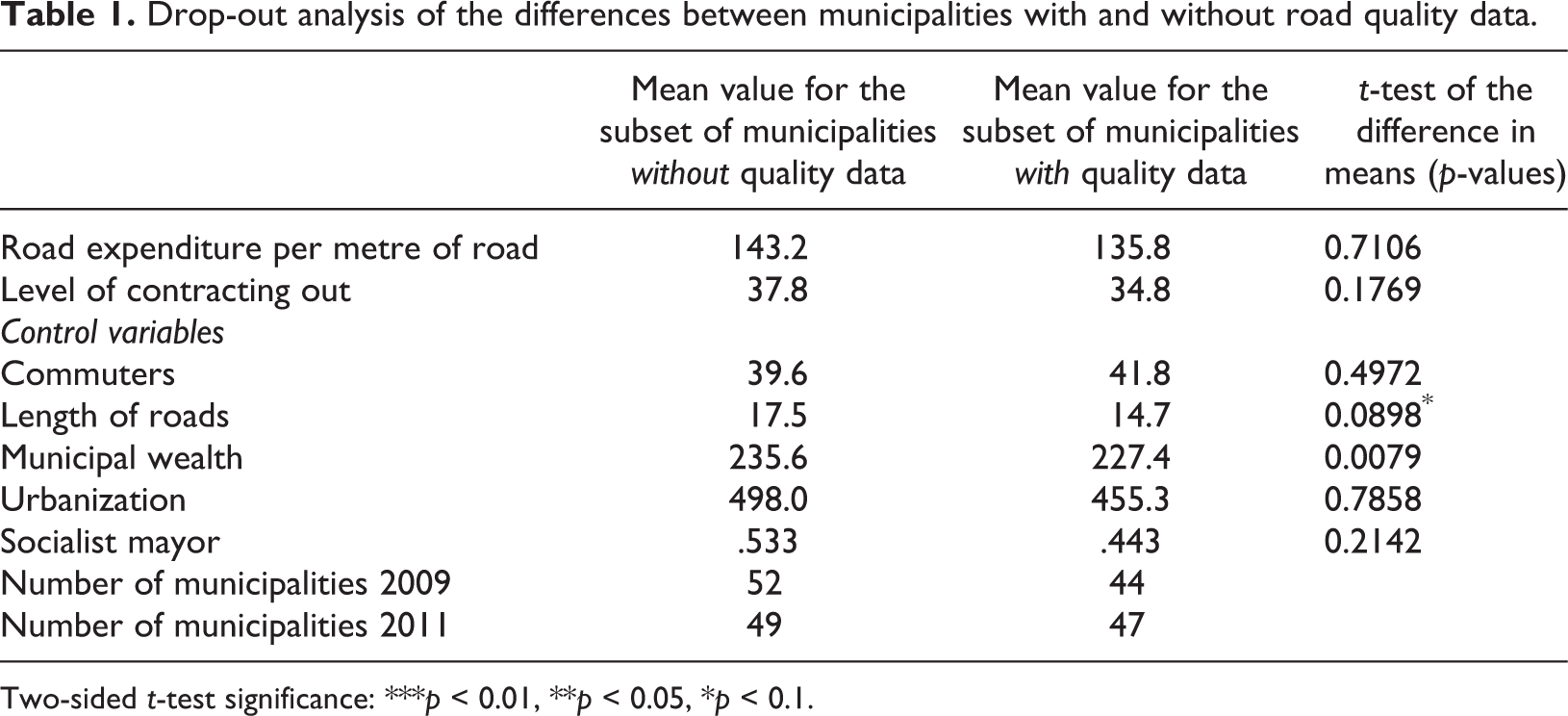
Two-sided t-test significance: ***p < 0.01, **p < 0.05, *p < 0.1.
Admittedly, the road quality index also has some limitations. First, municipal costs relating to road construction are not included in the analysis but may also affect how municipalities score in the road quality index. Second, insufficient road maintenance is not necessarily affecting road quality instantaneously. For example, cracks and potholes may not show up during the first year(s). Road quality is thus also a product of road maintenance in previous years, in which the municipality may have used another production mode. Though not a perfect measure, the quality index enables us to carry out an indicative control for service quality, which few previous studies on contracting out have been able to.
Table 2 presents descriptive statistics for all variables. See Table 3 for the measurement details. For the two main variables of interest – road expenditure and level of contracting out – Table 2 displays considerable variation both between and within municipalities.
Descriptive statistics 2008–2014 (2014 prices). Overall, within and between variation.
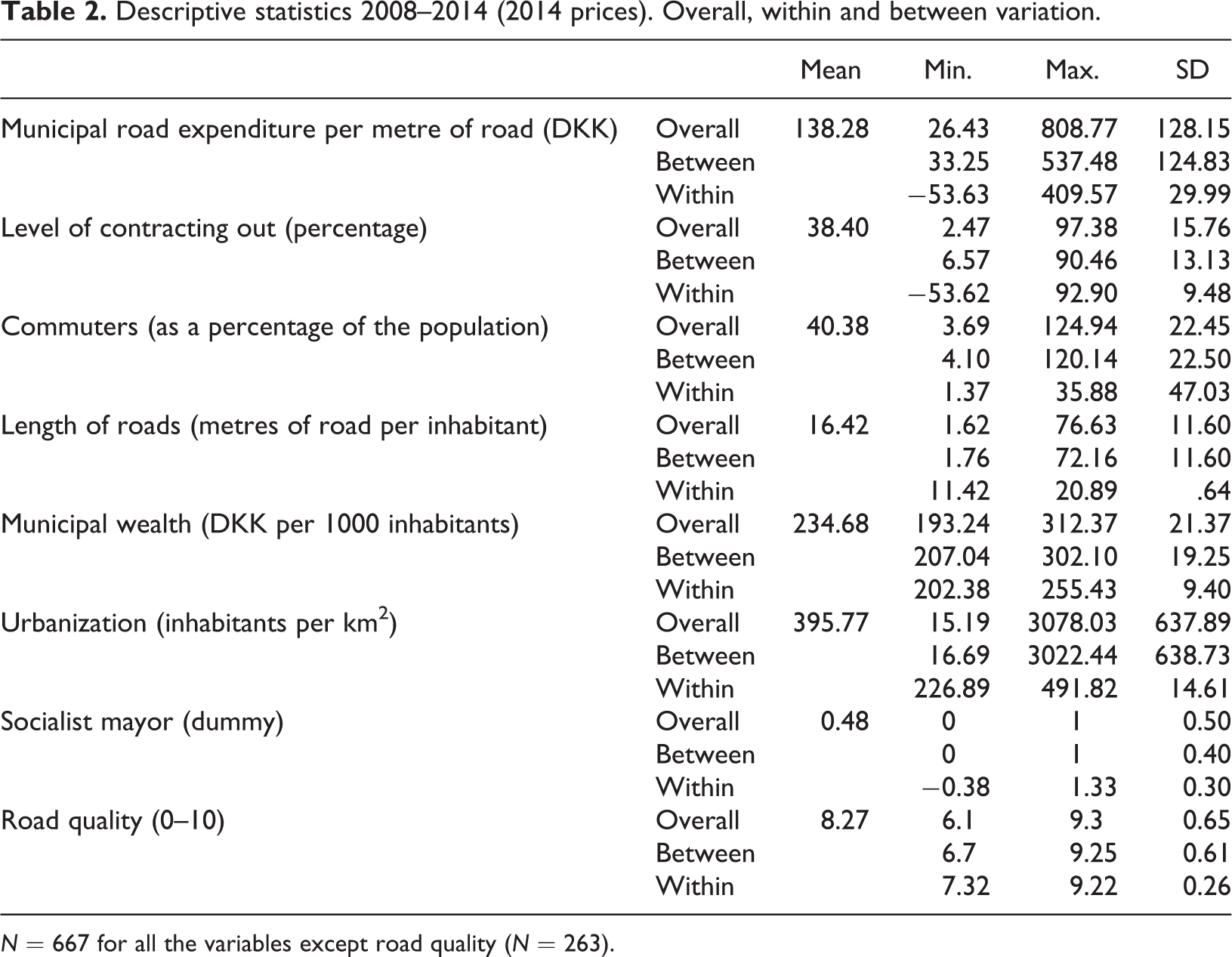
N = 667 for all the variables except road quality (N = 263).
Data and measurements.
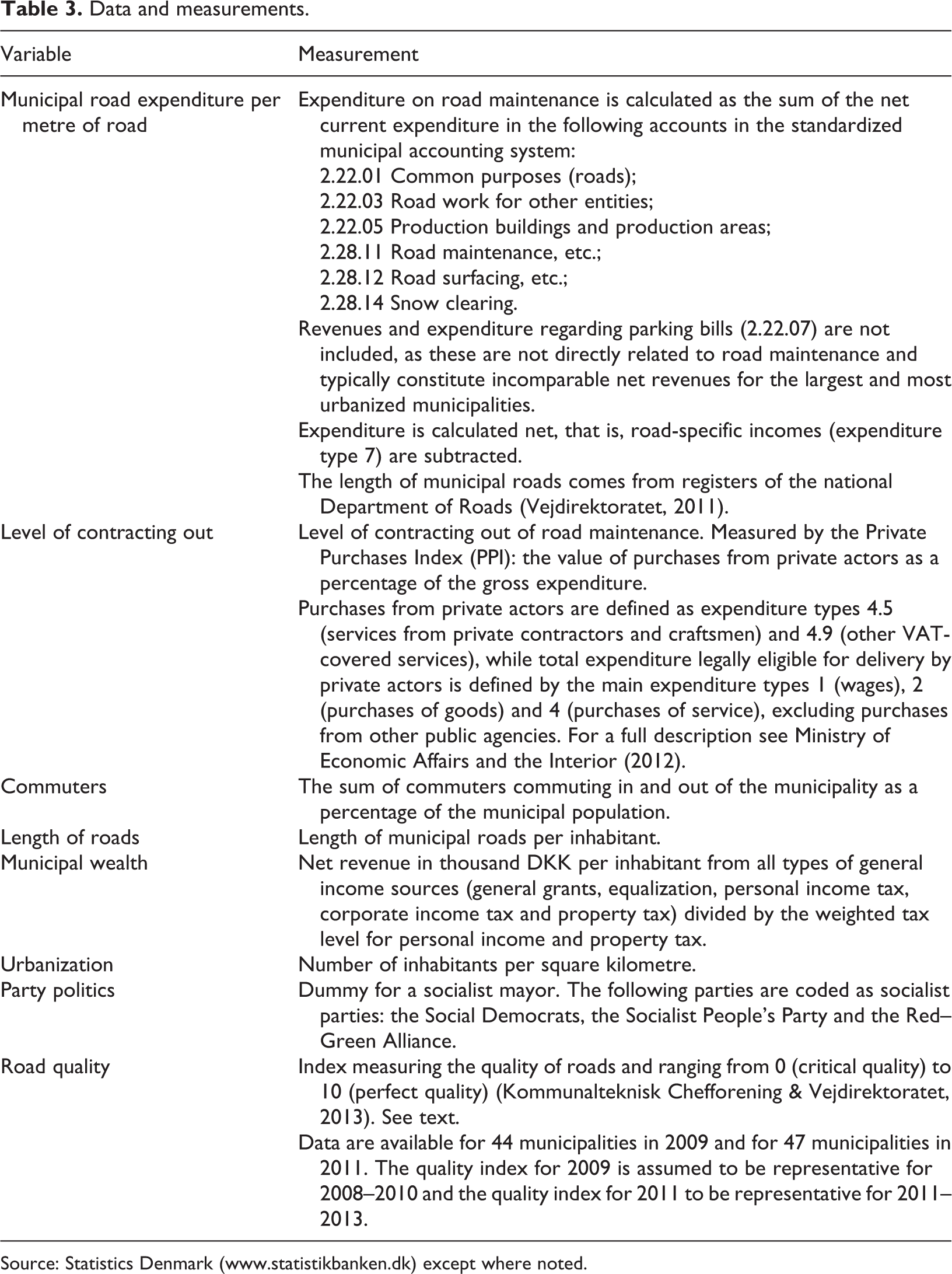
Source: Statistics Denmark (www.statistikbanken.dk) except where noted.
Organization of the data set
The data are organized as a panel data set basically comprising observations for all 98 Danish municipalities across 7 years from 2008 to 2014. However, in line with Blom-Hansen (2003), a small number of municipalities are excluded from the analysis. First, the two capital municipalities, Copenhagen and Frederiksberg, have extraordinary road expenditures and are excluded. Second, for a few years, a single observation is excluded due to invalid PPI values (PPI above 100 or less than 0). Summing up, we have a panel data set with 667 observations: 96 municipalities times 7 years minus 5 invalid PPI observations.
Estimation methods
Since our data have a panel structure, ordinary least squares (OLS) regression is not likely to produce unbiased results because of problems related to autocorrelation and heteroscedasticity. We employ three often-recommended solutions to these problems. First, we run OLS regressions with cluster-corrected standard errors clustered at the level of the individual municipality (Williams, 2000). This model is suitable for identifying the relationship between road expenditure and contracting out as well as the control variables. The model, however, may be troubled by endogeneity and selection bias (Wooldridge, 2009), as the causality may be reverse, and it cannot be assumed to be random which municipalities are contracting out to the largest extent and for which stretches of roads. Some selection factors are addressed by our control variables, while others are unobservable.
Second, to control for unobserved factors, we run the model with municipal-level fixed effects (FE). Since individual municipalities are held constant in the FE model, all time-constant unobserved differences between municipalities are handled, for instance if the roads in a municipality are particularly wide, the weather conditions are especially tough, or the municipality has a certain inclination to contract out on a habitual basis. Hence, the FE model is our primary model of causal inference. Although controlling for time-constant unobservables reduces the risk of endogeneity, not all endogeneity issues are handled by the FE model. Therefore, like in all other studies based on non-experimental designs, we cannot exclude the possibility of endogeneity and reverse causality.
Third, since annual changes are less likely to suffer from serial autocorrelation than levels, as a robustness check we run the regressions with all the time-variant variables changed into first-order differences. This robustness test is by nature a conservative test, as significant estimates require changes in both road expenditure and contracting levels from one year to the subsequent year and year-to-year changes in the level of contracting out are usually small due to multi-annual contracts. In comparison, the FE model ‘only’ demands variations across the period of analysis to identify a change and potentially arrive at a significant estimate.
Furthermore, to empirically test whether the relationship between contracting out and costs is linear or u-shaped, we carried out an additional empirical test (not shown) that returned a poorer model fit than the linear relationship. Finally, because changes in the explanatory variables cannot be expected to have an instantaneous effect on road expenditure, and to further reduce the risk of endogeneity, in line with Blom-Hansen (2003: 427) we lag all the explanatory variables by one year relative to the dependent variable.
Results
The empirical results are reported below in three sections: first, we report the analysis of the average economic effects based on the full data set; second, we present the results for the subset of municipalities where controlling for the road quality is possible; third, we return to the full data set and test whether the economic effects are heterogeneous with respect to the municipalities’ size and prior level of contracting out.
Economic effects
The results of the analysis of economic effects from contracting out are presented in Table 4. In model 1 the level of contracting out is significantly negatively correlated with the costs of local road maintenance. Model 1 thus indicates that a higher level of contracting out is significantly correlated with lower road expenditure. The estimate may, however, be affected by selection bias due to unobservable factors that are not controlled for.
Regressions of contracting out and municipal road expenditure, 2008–2014 (2014 prices).
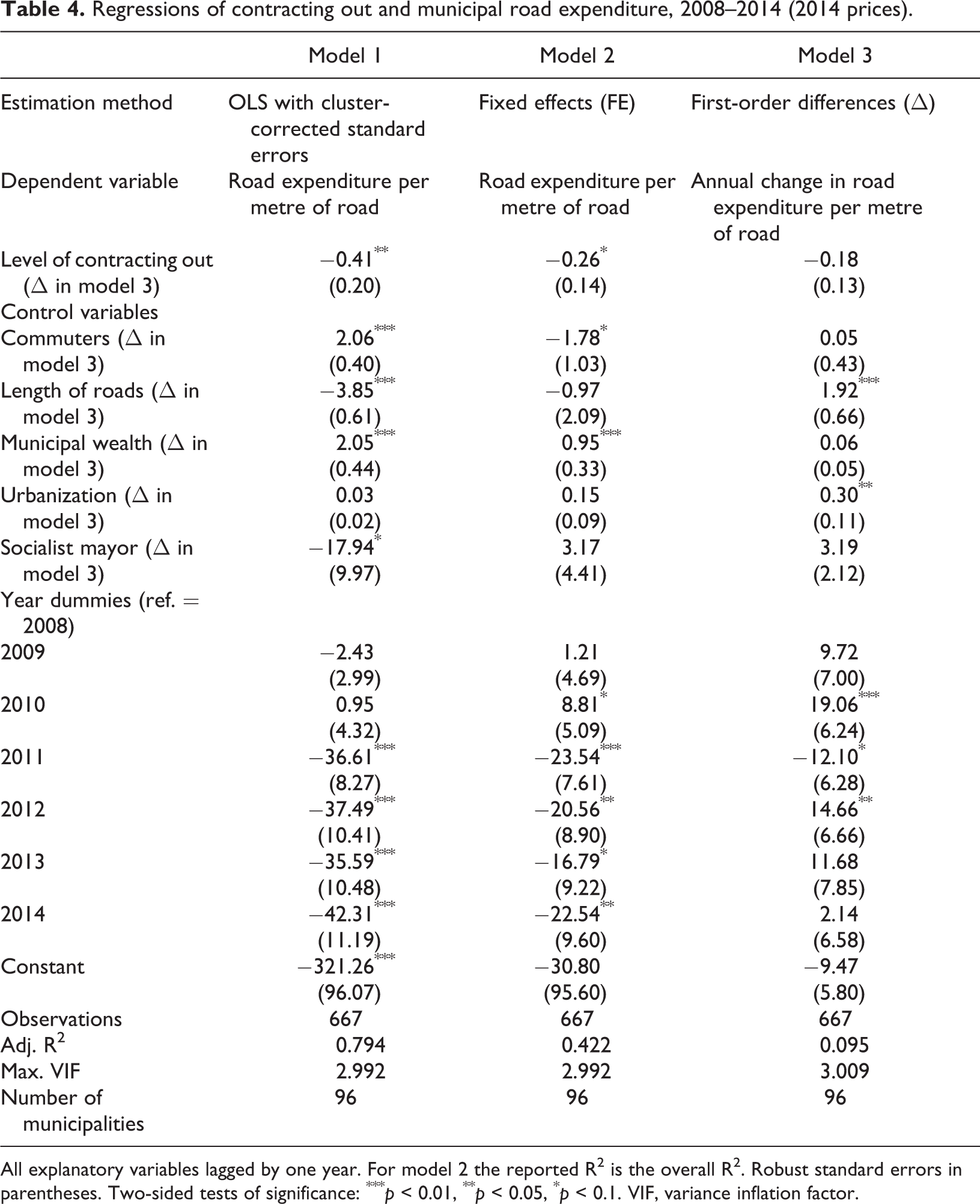
All explanatory variables lagged by one year. For model 2 the reported R2 is the overall R2. Robust standard errors in parentheses. Two-sided tests of significance: *** p < 0.01, ** p < 0.05, * p < 0.1. VIF, variance inflation factor.
These deficiencies are handled in model 2, in which the FE model controls for all the unobserved time-constant differences between municipalities. The parameter estimate for contracting is relatively smaller than in model 1, indicating the existence of important time-constant unobserved differences not handled by standard OLS regressions (Dijkgraaf and Gradus 2013). Though the estimate in model 2 is lower than in model 1, it is still significant and shows that a change in contracting out significantly reduces road expenditure. The stronger causal design in model 2 thus provides a firmer ground for concluding that contracting out of municipal road maintenance has resulted in significantly lower costs.
Finally, model 3 examines whether changes in contracting from one year to the subsequent year are associated with changes in road expenditure. Consistent with the other models, the estimate for contracting out is negative, yet insignificant. However, it should be borne in mind that model 3 is based on year-to-year changes and thus is a conservative test since contracts often last for several years. A supplemental model (not shown) based on the difference-in-difference-logic shows that a ‘treatment’ group, of the 25 per cent of the municipalities increasing contracting out the most, experiences significant cost reductions compared with other municipalities. However, the model also confirms that year-to-year effects of changes in contracting out are unlikely because cost reductions are not significant until seen over a time span of 5–6 years.
As discussed in the Methodology and data section, our main model of causal inference is the FE model. In substantial terms the coefficient of −0.26 for contracting out in model 2 shows that an increase of 1 percentage point in the level of contracting out reduces road expenditure by 0.26 DKK per metre of road. This equals a cost reduction of 0.2 per cent of the average road expenditure of 138 DKK per metre of road. In line with Blom-Hansen (2003), we thus find significant cost savings from involving private contractors in municipal road maintenance in Danish municipalities.
As a number of the control variables are close to being time-constant, model 1 is the most suitable for interpreting the association between these variables and road expenditure. Four out of the five associations turn out to be significant. First, commuting is positively correlated with road expenditure, indicating that more commuters mean more wear and tear on the roads. Second, the length of roads is negatively correlated with road expenditure, thus indicating that road maintenance is subject to economies of scale. Third, more prosperous municipalities spend more money on maintaining roads than poorer ones. Fourth, municipalities with a Left-wing mayor on average spend less money on maintaining the local road network than municipalities with a Conservative mayor. The last control variable, urbanization, is not statistically significant. The year dummies control for changes in technology, financial conditions, national regulations and so on over the years. The drop in expenditure level from 2011 is a likely consequence of the implementation of a national government sanction regime on municipal budget overruns, which was succeeded by across-the-board budget cuts in most municipalities.
Control for service quality
If road quality is time-constant, the FE model in Table 4 basically controls for inter-municipal variation in road quality. However, assuming that road quality is time-constant and thus by definition unaffected by changes in contracting out would be heroic. To test whether a trade-off between costs and quality exists, we ran an additional analysis including a control for road quality for the subset of municipalities for which road quality data are available (see Table 5). Since quality data are only measured at two points in time and for a limited and unbalance number of municipalities, we refrain from running this analysis with fixed effects.
Regressions of contracting out and municipal road expenditure 2008–2013, with a control for road quality (2014 prices).
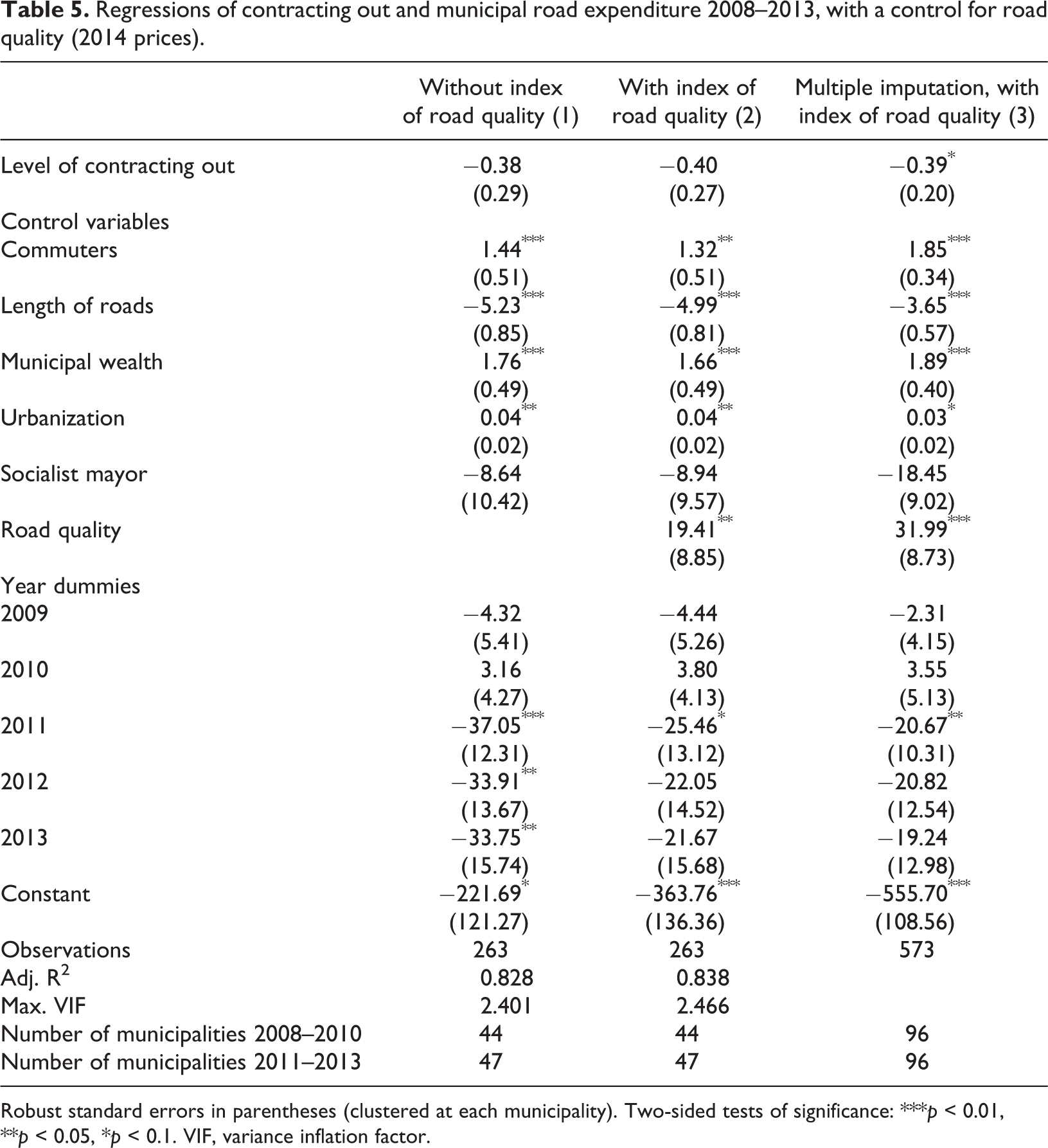
Robust standard errors in parentheses (clustered at each municipality). Two-sided tests of significance: ***p < 0.01, **p < 0.05, *p < 0.1. VIF, variance inflation factor.
Model 1 in Table 5 is similar to model 1 in Table 4 but restricted to the subpopulation of municipalities with data for road quality. The estimate for contracting out for the subpopulation is −0.38 and largely identical to the −0.41 estimate for all the municipalities in Table 4. The subset of municipalities for which data for road quality are available therefore does not differ to any major extent from all the municipalities with regard to the correlation between contracting out and expenditure per metre of road. In model 2 in Table 5, the control for road quality is added, and the estimate for contracting out is virtually the same as that in model 1. The most important conclusion from Table 5 is therefore that the estimate for contracting out is not affected by controlling for road quality.
The specific estimate for road quality is significantly positive, indicating that higher quality is associated with higher costs independently of the production method. Though the estimate for contracting out including the control for quality is substantially the same as that for the full data set in Table 4, the estimate for the subset of municipalities is not statistically significant. This may be a consequence of having less explanatory power due to the reduced number of municipalities.
To examine this possibility, in model 3 we use the Multiple Imputation (MI) facility in STATA (Royston and White, 2011) to impute quality data for the municipalities without quality data on the basis of multivariate imputation based on the dependent variable and all the other independent variables. The imputation is based on 10 imputations assuming quality data to be missing at random (MAR) (see Cameron and Trivedi, 2005: 926–937). The MAR restriction is not directly testable, but testing model 3 with a dummy for the imputed observations reveals no significant differences between imputed and non-imputed observations. The MI analysis in model 3 confirms that controlling for road quality does not affect the estimated economic effects of contracting out and that contracting out is also associated with significant cost savings when quality data for the remainder of the municipalities are imputed. Bearing in mind the limitations of the quality index that were discussed in the Methodology and data section, the findings indicate that contracting out has not merely lowered costs at the expense of service quality but has resulted in genuine efficiency gains.
Below, we further examine whether all the municipalities have benefitted equally from contracting out.
Heterogeneous effects
The analyses until now have focused on the average effects from contracting out on the municipal costs of road maintenance. These effects may, however, conceal important heterogeneous effects stemming from differences in municipal characteristics that are not revealed by the standard estimations. To examine this, we return to the full data set and carry out a number of additional analyses to scrutinize whether the effects are similar for all the municipalities. We focus first on the municipalities’ size as a proxy for economies of scale and second on the initial level of contracting out as a test of differing effects at varying levels of contracting out.
To examine whether the economic effects are contingent on the size of the municipality, we split the 98 municipalities into four equally large size groups and run the analysis for each of the quartiles (for a similar approach see Bel and Mur (2009)). The split-file analysis in Table 6 reveals significant cost savings among mid-sized municipalities with 43,500–60,000 inhabitants, whereas the coefficients for both smaller and larger municipalities are insignificant. Part of the explanation for the insignificant results may be the smaller sample sizes compared with the previous analyses. These reservations notwithstanding, the analysis indicates that the economic effect of contracting out is merely significant for mid-sized municipalities with 43,500–60,000 inhabitants and not for smaller and larger ones. For municipalities with 29,000–43,500 inhabitants an economic effect in line with the average effect for all municipalities seems to exist, although not significant, which is probably due to fewer observations in the split analysis.
Regressions of contracting out and municipal road expenditure 2008–2014 for quartiles of municipal size (2014 prices).
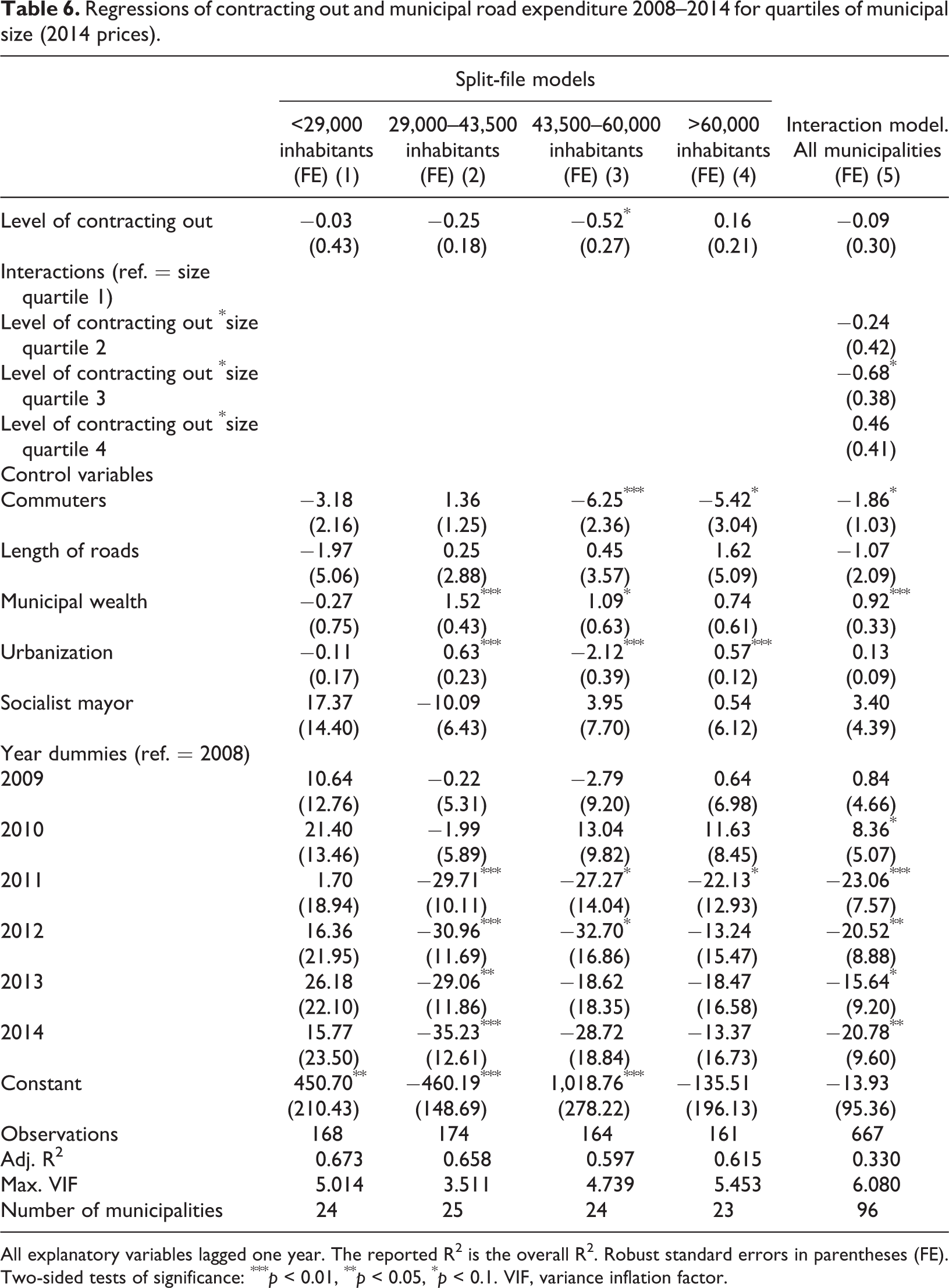
All explanatory variables lagged one year. The reported R2 is the overall R2. Robust standard errors in parentheses (FE). Two-sided tests of significance: *** p < 0.01, ** p < 0.05, * p < 0.1. VIF, variance inflation factor.
The interaction model in column 5 confirms the results, although the parameter estimates are not fully identical because only interactions for contracting out are included to avoid over-determination. The estimate for contracting out can be interpreted as the economic effect for the first quartile, whereas the interaction terms test whether the economic effects in the other three quartiles differ from the first quartile. The mid-sized municipalities of quartile 3 are the only size category in which the cost savings of contracting are significantly different from the insignificant cost savings in the smallest municipalities.
Additional models (not shown) switching the reference category show that cost savings in quartile 2 are significantly higher than in quartile 4, while the cost savings in quartile 3 are significantly higher than in quartile 1 and 4 but not significantly higher than in quartile 2. Possible reasons for the non-significant results in the smaller and larger municipalities may be variations in place characteristics like market structure and in-house production capacity (Hefetz and Warner, 2011). Unfortunately, the data we have does not enable us to test these varying theoretical explanations, but the empirical estimations indicate that cost savings from contracting out are merely present in mid-sized Danish municipalities.
In addition to the analysis of size heterogeneity, we compare the development in four quartiles of municipalities according to the initial level of contracting out in 2007. This was done to examine whether the effect of contracting out varies for different levels of contracting out, so that the effect may, for instance, be particularly large or small for municipalities that increase contracting out from a low initial level. Figures 1(a) and 1(b), respectively, display the 2008–2014 development in the average level of contracting out (PPI) and in the expenditures per metre of road for each quartile. Figure 1a shows that the municipalities with the lowest initial level have increased their contracting out the most, while it has remained stable at about 50 per cent for the quartile with the highest initial level.
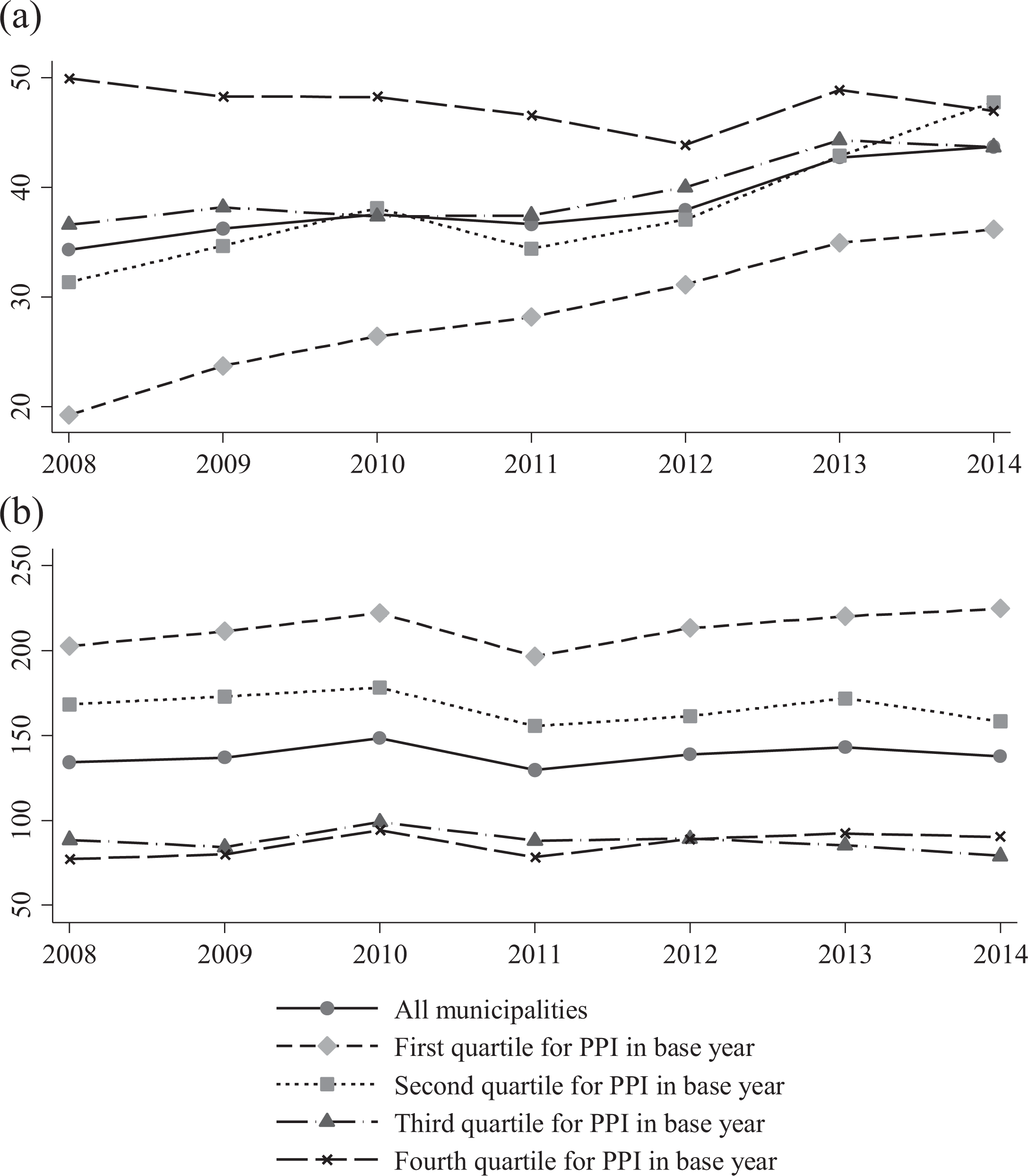
(a) Development in the level of contracting out 2008–2014, Private Purchases Index (PPI), for quartiles of contracting out (per cent). (b) Net current road expenditure per metre of road 2008–2018 (DKK per metre of road).
Figure 1(b) further shows the time trend in spending per metre of road for the same four quartiles of municipalities. In line with the findings from the previous analyses, Figure 1(b) illustrates that the average cost per metre of road is highest in municipalities with a modest involvement of private providers and lowest in municipalities with more extensive contracting out. Interestingly, the spending trend was almost completely parallel across the four quartiles in the period from 2008 to 2014. Hence, whereas Figure 1(a) shows convergence concerning the level of contracting out, Figure 1(b) indicates no tendency towards convergence regarding the municipal road expenditure in the same period. Regression models formally testing the change in quartile differences (not shown, can be obtained from the authors) support the visual expressions from Figure 1(a) and (b).
The analysis thus shows that over the period the municipalities with a low initial level of contracting out significantly increased their level of private involvement compared with the municipalities with the highest initial level. However, the large gap in road maintenance costs between the groups of municipalities was not closed during the same period. Interestingly, increasing the use of contracting out in municipalities with modest levels of private involvement has not provided any measurable cost savings compared with municipalities with a high initial level of contracting out. Again, this signals that economic effects of contracting out are not necessarily similar across all municipalities but may be contingent on market structure and other place characteristics.
Discussion
The findings provide a number of insights that confirm and expand the previous literature on the effects of contracting out.
First, in line with Blom-Hansen’s (2003) study of contracting out local road maintenance services in the 1990s, we also find significant and substantial cost savings after a major municipal amalgamation reform in 2007. An increase in contracting out by 1 percentage point reduces the average road expenditure per metre of road by 0.2 per cent. The results confirm the insights from previous studies of contracting out in other technical services such as garbage collection (Dijkgraaf and Gradus, 2013) and cleaning (Christoffersen et al., 2007): involving the private market in the maintenance of public roads has on average lowered costs. When considering the broader literature relevance of this result, indeed, it should be borne in mind that road maintenance is subject to relatively standardized specification, ease of measurability and potential scale economies, which theoretically makes it more suitable for externalization than other local services (see Bel et al., 2010). The combination of service characteristics, market situation and institutional context for contracting out in road services could thus be more favourable than in other service areas characterized by differing task complexity, measurability and market structure (Brown and Potoski, 2003; Hefetz and Warner, 2011).
Second, the relevance of measuring service quality in evaluations of contracting out has been stressed by several previous reviews and meta-analyses (Bel et al., 2010; Boyne, 1998; Hodge, 2000; Petersen and Hjelmar, 2013; Petersen et al., 2017), though few empirical studies have until now accomplished this important task. Based on the available data for municipal road quality, we were able to carry out an additional analysis of cost changes including a control for service quality. The measure of service quality covers roughly half of the municipalities and does not measure possible changes in long-term quality. Bearing these data reservations in mind, the results are noteworthy because they show that the cost savings survive the control for service quality. This finding extends the previous literature that has been largely focusing on costs by indicating that contracting out has resulted not merely in cost savings but in genuine efficiency gains. As international research on contracting out continues to develop, these insights speak to scholars and policy-makers who are interested in comprehending the intricate relation between costs and quality in the alternative public/private modes of delivering public services.
Third, the analyses show that the average economic effects conceal heterogeneous effects of both theoretical and empirical importance (for a similar approach in waste management, see Bel and Mur (2009)). Empirically, the economic effects of contracting out in the Danish case are contingent on the size of the contracting municipality, as the largest and most significant cost savings are found in mid-sized municipalities. Heterogeneous effects also apply to the initial level of contracting out. The cost savings achieved by high-contracting municipalities were not replicated when low-contracting municipalities gradually increased the level of contracting out in the period covered by this study. The result indicates that not all municipalities have been able to utilize contracting out to reduce the costs of local road maintenance. The average effect thus conceals significant variations across municipalities that could be due to differences in the market structure, economies of scale and in-house production capacity (Dixit, 1997; Hefetz and Warner, 2011). The insights about heterogeneous effects challenge the forecast of public choice theory and property rights theory concerning universal efficiency gains from contracting out. Theories of quasi-markets and incomplete/complex contracting (Brown et al., 2016) seem more suitable predictors of outcomes of contracting out across municipalities with differing size and contracting levels.
Fourth, a closer inspection of the results compared with former studies reveals that the magnitude of cost savings has decreased significantly over time. Using data for Danish road expenditures from 1988 to 1999, Blom-Hansen (2003) did not apply fixed-effects modelling but used a more conservative panel-corrected model of estimation. Repeating this method with the present data (not shown but can be obtained from the authors) did not return statistically significant results. The lack of significance may, however, be a reflection of the smaller number of municipalities after an amalgamation reform in 2007 (reduction from 271 to 98 municipalities, see Blom-Hansen et al., 2016), a relative decline in contracting out in the amalgamated municipalities (Foged, 2016) and a narrower time span of our analysis.
It is noteworthy, nonetheless, that the substantial significance has also significantly declined since the 1990s. Using the same method as Blom-Hansen (2003) and aggregating the pre-reform municipalities to the post-reform structure, we find a present economic effect less than half of the effect in the 1990s (for details see Houlberg and Petersen (2015)). These decreases in cost savings over time of contracting out road maintenance are in line with recent studies in other countries and service areas (cf. Bae, 2010; Bekken et al., 2006; Bel and Costas, 2006; Hutchinson and Pratt, 2007).
Finally, the findings support the conclusion of Dijkgraaf and Gradus (2013) that cross-section analyses with insufficient control for exogenous differences between municipalities tend to produce biased estimates and may overestimate the effect of contracting out. Most studies control for observable differences relating, for instance, to size and economic prosperity. However, selection bias relating to potentially important unobservable factors, such as local traditions and the local market structure, is harder to handle and may cause endogeneity problems with respect to causal inferences in cross-sectional studies. Like Dijkgraaf and Gradus (2013), our solution to this methodological issue was to use panel data and correct for municipal fixed effects. The result is striking: using fixed effects in this case reduces the parameter estimate by almost 40 per cent, thus highlighting that the choice of estimation method significantly influences the conclusions that we as researchers draw regarding the economic effects of contracting out.
Conclusions
Contracting out of public services remains controversial after decades of academic and political debate. On the one hand, proponents perceive contracting out as a way of exploiting the innovative capacity, specialized expertise and knowhow of the private market, which could lead to more efficient service delivery. Sceptics, on the other hand, have repeatedly criticized the empirical evidence for lacking appropriate measures of service quality and transaction costs, thus making it difficult to judge the real impact of contracting out on efficiency. This article provides some insights that contribute to and extend previous research.
Using the Danish road sector as an empirical test bed, we find that an increase of 1 percentage point in the level of contracting out on average reduces road expenditure by 0.2 per cent. Importantly, we find similar results when a control for service quality is included in the analysis. The quality index included is not a perfect measure, as insufficient road maintenance may not affect road quality instantaneously. Nonetheless, the finding that controlling for quality does not affect the cost estimate is noteworthy, because it indicates that contracting out has not merely provided lower costs but an increase in the overall efficiency of local road maintenance services. It almost goes without saying that this finding has much broader policy relevance than analyses that examine cost changes without controlling for possible changes in service quality.
Moreover, in two additional analyses, we further examined the heterogeneous outcomes of contracting out and find that the economic effect varies with both municipal size and prior level of contracting out. With regard to size, cost savings are only significant in mid-sized municipalities, whereas both smaller and larger municipalities have not benefitted to the same extent. Furthermore, the analysis in municipalities with different levels of contracting shows convergence towards greater usage from 2008 to 2014, whereas the differences in road expenditure have not converged in the same period.
We thus conclude that Danish municipalities have experienced noteworthy differences in the economic effects of contracting out within road maintenance services. The study shows that the effects of private involvement in public service delivery depend on a number of contextual factors. Assuming that contracting out yields similar effects regardless of municipal characteristics would be naive. Discussing the efficiency of service delivery mainly in the context of higher or lower costs seems futile. There is an obvious need to take service quality more into account in future studies. In order to address and improve these important issues, future studies need to pay closer attention to service quality as well as heterogeneous effects of contracting out.
Footnotes
Acknowledgements
The authors would like to thank two anonymous reviewers and the participants at the Innovations in Service Delivery – Workshop, Barcelona, 4 March 2016, for their comments on an earlier version of the manuscript.
Declaration of Conflicting Interests
The author(s) declared no potential conflicts of interest with respect to the research, authorship, and/or publication of this article.
Funding
The author(s) disclosed receipt of the following financial support for the research, authorship, and/or publication of this article: Parts of the empirical analyses were initially carried out during a research project that was partially funded by a number of public service unions in Denmark.