




Abstract
Antenarrative (before-the-narrative) analysis reveals features of historical Native American and Euro-Western negotiations which contributed to undesired and unintended outcomes, while sometimes overlooking the resplendent possibilities of living stories. This study uncovers the antenarrative processes in existing accounts of three particular indigenous cultures negotiating with Euro-Westerners. These three case examples include two negotiations that were partial victories accompanied by lingering resentments, and one success. In the latter, participants were able to use elements of living story to break an impasse and achieve lasting success based on mutually beneficial outcomes. Breaking out of restrictive linear and cyclical antenarratives, and instead incorporating spiral and rhizomatic ones, opens more options for negotiators. Power-equal perspectives, along with the diversity-accommodating nature of rhizomatic (decentered and networked) ways of telling stories, can help negotiating parties to co-create upsurging spirals of win–win stories for mutual benefit.
Introduction
“The fundamental factor that keeps Indians and non-Indians from communicating is that they are speaking about two entirely different perceptions of the world.” – Deloria (1979: 1)
Almost everyone knows the story of how the Dutch settlers negotiated the sale of the island of Manhattan for a paltry $24 worth of trinkets. What shrewd negotiators! And everyone knows the story of how Pilgrim settlers shared their harvest with American Indians at the first Thanksgiving celebration. Everyone “knows” these stories because they were in every US schoolchild’s history books (Brown, 2016).
In these and other popular histories, indigenous peoples have often been framed “more as artifacts of history rather than as members of a living culture” (Brown, 2016: 68). Instead of “the” story that “everyone knows,” we now hear different stories. Told by indigenous voices, these are very different stories about the “discovery” of America and the first Thanksgiving (Dunbar-Ortiz and Gilio-Whitaker, 2016; Krystal, 2011; Loewen, 2007).
Scholars of contracting and negotiation have begun to pay attention to story and narrative. Consider, for example, Zeitoun, Talhami Eid-Sabbagh’s (2013) work on the role of narratives in Middle Eastern water disputes. Bülow and Boje (2015) offer a theory on the embeddedness of antenarrative patterns in negotiation practices.
We expand this discussion by identifying antenarrative patterns across the history of three case examples of interactions between indigenous peoples with Euro-Westerners. Two of these cases involve American Indian nations (Paiute and Seneca), and the third case example is a farm workers’ coalition, the majority of whose members are Aztec and Mayan. A review of these cases, we contend, will highlight ways in which indigenous living story practices can create what we are calling “antenarrative assemblages:” these are self-organizing, generative processes that are antecedent and necessary to living stories and narratives (Boje, 2011). Antenarrative (Boje, 2008) refers to what is ante-to, or before-the-story. The prefix “ante” also suggests a bet on the future, a hint of the trajectory of events leading to a future outcome. Antenarrative processes can break the bonds of the past and disclose new possibilities for ethical human interaction.
In this paper, we describe how four different forms of antenarrative storytelling may limit or expand the possible outcomes of negotiations. We also contend that two of those antenarrative forms, the spiral and the rhizomatic assemblage, open greater possibilities for mutually beneficial outcomes from negotiations than linear and cyclical patterns provide. We offer examples from indigenous cultures to demonstrate how these different antenarrative patterns have played out historically. Finally, we provide three case examples to support our argument that using spiral and rhizomatic/assemblage antenarrative storytelling patterns to establish power-equal relationships can initiate upsurging antenarrative spirals of mutual benefit to negotiating parties.
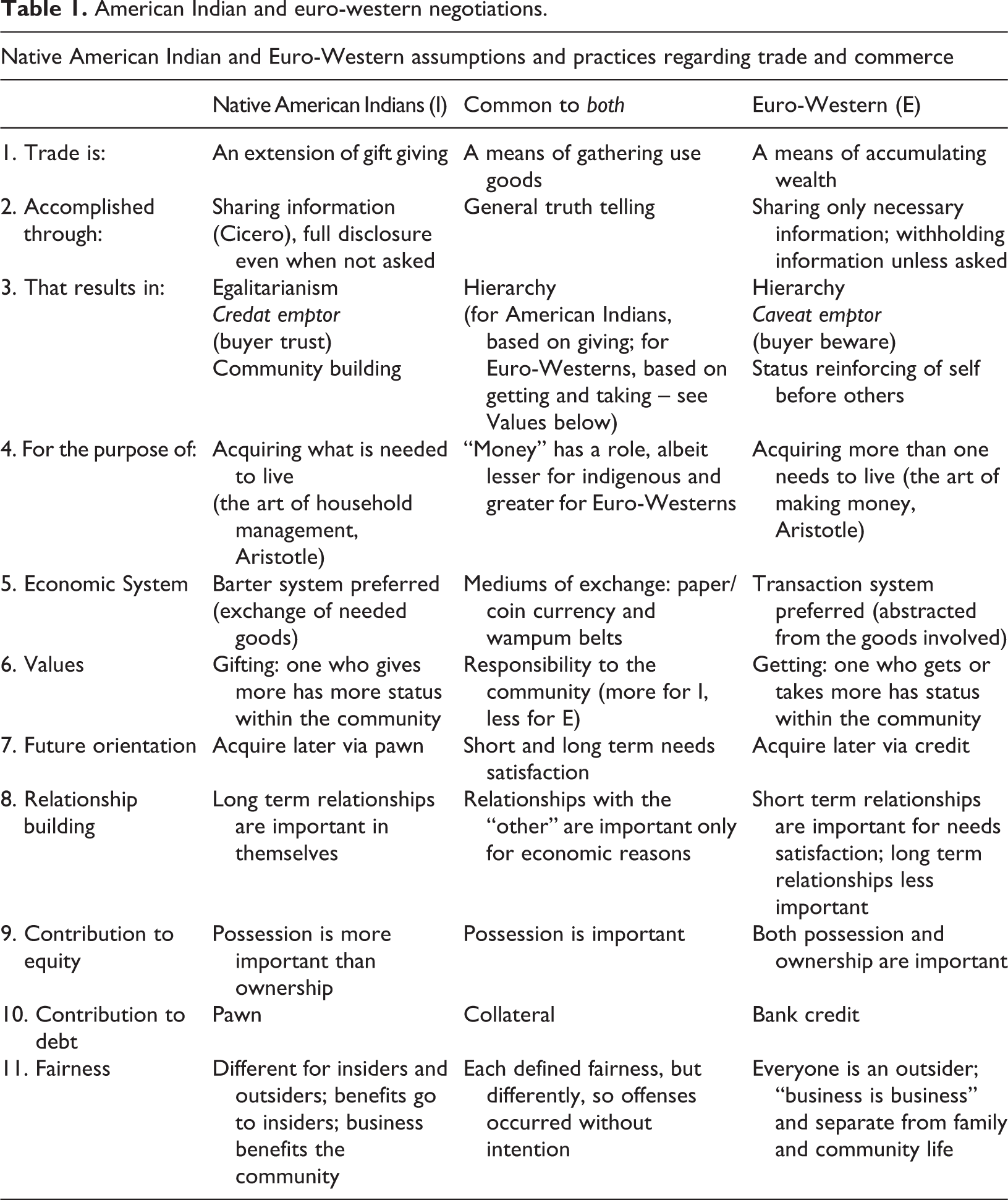
This essay has 5 parts. Part 1 begins with a self-reflexive consideration of our selves (the authors) as non-indigenous peoples writing about indigenous peoples. We seek to position ourselves as listeners rather than tellers. Then in Part 2 we offer an overview of antenarrative theory in relation to the trading practices of indigenous peoples, and recent literature on strategic contracting and negotiation. In Part 3 we review and compare indigenous and Euro-Western assumptions and practices regarding trade and commerce. These differences are summarized in Table 1. Also in Part 3, we recount stories of indigenous and Euro-Western encounters that exemplify four antenarrative types: linear; cyclic; spiral; and rhizomatic assemblage.
American Indian and euro-western negotiations.
Part 4 brings together the linear, cyclic, and spiraling forms into a rhizomatic assemblage antenarrative, offering the most complex form of story. We illustrate the dynamics of antenarrative analysis applied to public records of three case example negotiations. The first case concerns the efforts of the Seneca nation to enforce the provisions of a one hundred year old treaty. The second case traces halting efforts of the US government to support commercial farming in a traditional Paiute homeland. The third case reviews highlights of the Coalition of Immokalee Workers (CIW), in their successful efforts to eradicate human trafficking and improve working conditions in commercial agriculture in Florida. Our conclusions are summarized in Part 5.
Part 1: Non-natives writing about natives
The focus here is on tracing the stories of indigenous peoples in order to reveal their antenarrative patterns. We aim for accuracy, even while recognizing its illusory and elusive nature. We as authors feel an ethical responsibility to assure that the emerging stories of our relationships to indigenous peoples are co-created with them. To do this, it is important to encourage them to speak in their own voices. It is also important to recognize that those voices are multiple, not unitary. In this paper, we cite primarily indigenous scholars writing about issues of importance to their communities.
Unfortunately, we authors are sometimes in the position of double-narrating; that is, we are saying what it is that others have said, thus affecting and influencing the voice of the other, even when using direct verbatim quotations. We apologize if we have misrepresented and/or misunderstood the voices of our valued indigenous colleagues; that was not and is not our intention. Our intention is, if possible, to give wider exposure to the wisdom of these scholars. One of the ways we attempted to ensure that we have, so to speak, gotten these stories right, is through respondent validation. We sought input of indigenous people, in particular indigenous people who are knowledgeable regarding these issues, on our research and conclusions. We also acknowledge five years of previous work with numerous indigenous scholars leading up to this current study (Rosile, 2016).
Part 2: Antenarratives and living stories in the context of contracting and negotiation
The word “antenarrative” was coined by David Boje (2000: 1) who defined it as “the fragmented, non-linear, incoherent, collective, unplotted, and pre-narrative speculation, a bet.” In offering this definition Boje makes a distinction between story and narrative. Story refers to rich, idiosyncratic accounts of lived experience. Narrative refers to diminished and emplotted accounts that follow upon story and make larger claims about what is true and how life should be lived. Boje’s definition also privileges agency (as in the placing of a storytelling bet) and in that sense it is related to the rhetorical notion of kairos, most commonly defined as the art of strategic timing (Herder, 2011). The implication here is that antenarrative refers to a set of living processes through which storytelling practices shape societal narratives in various ways.
We will trace four such antenarrative processes, but there may be more. As storytellers (and that includes all of us) become more mindful of these processes and how they work, it becomes possible to craft more ethical, complex, and life affirming narratives. In the present context, an awareness of antenarrative processes can open possibilities for other ways of negotiating, and offer fresh perspectives on the ethics and practices of business negotiations (Boje, 2001, 2008; Rosile, 2016). In the balance of this section we explain the four types of antenarrative processes (linear, cyclical, spiral, and rhizomatic assemblage). Then we move on to discuss the relationship of antenarrative theory to the indigenous concept of living story, and to recent developments in the study of contracting and negotiation.
We turn first to antenarrative patterns. Linear antenarratives are cause–effect stories, plotted in a predictable beginning, middle, and end manner and told from one dominant perspective (Boje, 2001, 2008; Rosile, 2016). In the post-Columbian history of the Americas, for instance, Western/European accounts of indigenous history often have linear patterns.
The second antenarrative pattern is the cyclical pattern. These more complex patterns are marked by repeated sequences of positive or negative interactions. As an example of the former, in native storytelling practices the circle holds special significance (Brill de Ramirez, 2016). Stories are told in communal fashion in storytelling circles where traditional storytelling practices serve to connect the past and the future.
Third, spiraling antenarratives feature repeated interactions as well, but pick up new material along the way. This new material can lead to clashes between cultures and the tragedy of lose–lose outcomes with downward spirals. New input can also open new possibilities for positive interaction and upsurging spirals.
Finally, spiraling patterns can lead to rhizomatic assemblage antenarrative patterns that resemble the complex root systems of certain grasses and other plants like irises, ginger, and hops. In a rhizomatic assemblage, multiple storytelling trajectories (some linear, some cyclic, and some spiral) overlap, connect, and become entangled (Boje, 2011; Deleuze and Guatarri, 1987). The study of rhizomatic patterns can allow us to trace complex webs of living stories and recover threads of lost, marginalized, or forgotten stories. By recognizing and recovering these roots one can shed light on past and present ethical dilemmas and open greater possibilities for our future narratives.
Rhizomatic assemblages also bear a family resemblance to what Kaylynn Twotrees (1997, 2000) has described as the living story practices in native cultures. Boje has used Twotrees’ insights as a starting point for a detailed description of living story practices that operate within all cultures and peoples. By this account living stories have at least four qualities. First, they are ontological, that is storytelling cannot be disentangled from the material experience of daily lives. Our bodies are storytelling vessels. As such the genetic traces of our ancestors become entangled with the stories we know about them (Boje, 2014). In the same fashion the stories we tell one another about our families, workplaces, politics and the like cannot be separated from our material experiences of the same. The foods we eat, the scars we bear, the electro-chemical processes in our brains cannot be divorced from the stories we tell. Second, storytelling webs are living webs. In this sense Jo Tyler writes of “story aliveness” that defies the “reductionist simplicity of the templates and algorithms” professional storytelling consultants are wont to employ (Tyler and Rosen [2008]: 63). Third, living story operates according to what Mikhail Bakhtin (1990) has termed an ethics of answerability. In a Bakhtinian sense, we are all artists in that we are all storytellers. As such, we are responsible for the ways in which the components of our storied lives: “interpenetrate each other in the unity of guilt and answerability” (Bakhtin, 1990: 2).
Fourth, as Gregory Cajete (2000) has argued, the “material-agentive force” of living story traditions has become sublimated within the linear narrative practices of Euro-Western culture. Scott L. Pratt (2006) has used a similar term, “agent ontology,” to describe Vine Deloria’s account of the deep source of conflicts between indigenous and Euro-Western world views. Given the importance of these ideas to indigenous negotiation practices, we will provide a necessarily brief overview of Deloria’s agent ontology before considering the implications of antenarrative theory and living story practices for current discussions.
As Pratt explains, Deloria’s agent ontology can be related to the philosophic concept of vitalism, which holds that seemingly inanimate objects can have vitality and purpose. Deloria reanimates this often discredited concept in order to offer an alternative to the mechanistic “physico-chemical ontology” of Western science (Pratt, 2006: 6). In doing so he draws upon indigenous traditions to produce a “new metaphysic” that acknowledges mystery and features a model of change in which dynamic overlapping entities interact in complex and complementary ways that resemble the rhizomatic antenarrative assemblage we discussed earlier (Deloria, 1979; Deloria and Wildcat, 2001). The universe, by this way of thinking, is made up of various kinds of persons or agents that share certain qualities with human beings but lack others. These agents share common traits but retain their profound distinctiveness. This worldview, in turn, lends the universe a moral character since “interactions among persons are moral relations” (Pratt, 2006: 7). It suggests as well that “there is a proper way to live in the universe” (Deloria, 1999: 46). Those actions which honor the earth and nurture life count as moral relations. For native peoples, actions such as hunting, fishing, and trading have an inescapably moral dimension. One must take care when hunting a bear or a fish because “she or he is literally partly a bear or fish” (Pratt, 2006: 7). Actions that might cause unnecessary suffering or lead to species extinction would count as immoral. In the context of negotiation and contracting an ethics of agent ontology would obligate participants to seek agreements that acknowledge the multiple agencies of the natural world and honor the shared traits and distinctive qualities of all participants. This ethic would allow all parties (including agents such as the birds, rocks, and trees) to flourish.
The history of Euro-Western contracting and negotiation practices has traditionally been characterized as zero-sum. In zero-sum games, distributive negotiation strategies are applied, because one party stands to lose when the other gains (Boardman, personal interviews, June and October, 2010). Integrative strategies allow for both parties to gain.
Some writers continue to see power discrepancies as at least potentially productive, in that they decrease the chance of stalemates and are more likely to produce outcomes (Malik and Yazar, 2016; Zartman and Rubin, 2002). In recent times, however, scholars and, to a lesser degree, practitioners have largely preferred integrative practices in which interests are prioritized above strategic positions and where parties negotiate in order to maximize mutual gains (Tomlinson and Lewicki, 2015).
We will have more to say about integrative practices momentarily. However, first we want to consider how in historical terms American Indian people have seldom fared well in traditional zero-sum negotiation scenarios. Arthur Spirling, for instance, conducted a detailed textual analysis of almost 600 treaties between various American Indian nations and the US government and “found strong evidence – statistical and substantive – that treaties became harsher over time” (Spirling, 2012: 96). That is, as the United States gained economic and political power in the 19th and early 20th centuries, American Indian people lost power. While most Americans grew richer, American Indians grew poorer; as most Americans gained political freedoms, American Indians (quite literally) lost ground.
Spirling’s (2012) research concerned treaty negotiations. However, native people have traditionally negotiated with Euro-Westerners in other ways as well, especially through trade. Widespread lack of awareness of the rich history of indigenous people means that the trajectories of the possible storylines about intercultural and commercial interaction may be severely stunted.
Many inaccurate assumptions persist in the form of dominant narratives about indigenous people. In recent years, historians have begun to piece together a more complex history of indigenous people in the Americas and their commercial trading practices. We now understand that before Columbus “discovered” America, trade networks connected tribes throughout the North American continent (Cordova et al., 2007). And middle school teachers now teach lessons on the complex trading paths that existed before Europeans brought “civilization” to the Americas (Wilmoth, 2006). Given these recent advancements in the study and teaching of pre-Columbian history, the time has come for scholars to pay more attention to the long-overlooked history of contracting and negotiation among indigenous people in the Americas.
Recent work in this area contradicts notions of indigenous tribes as naïve or unsophisticated negotiators (contrary accounts such as the “purchase” of Manhattan notwithstanding) (Braun, 2008; Bordewich, 1996; Mann, 2005; Ordahl Kupperman, 2000; Smith, 2009). We now have compelling evidence, for example, that American Indians were not meek victims of English colonists. Both sides had their own “hidden agendas.” These included hope of profitable trade and increased power and influence over competing nations. American Indians valued some of the products the English offered, like steel knives, which could, and historically did, put their tribes in a more powerful position relative to other tribes not in proximity to the English settlements. Far from being naïve, even gullible victims, the American Indians likely had interests in trading as a means of increasing their own wealth and power (Ordahl Kupperman, 2000).
A similarly complex picture has emerged of early encounters between European colonists and indigenous people in what is now Latin America. In that regard, Boardman et al. (2007) cite an early account of Columbus’s first, tentative cross-cultural encounters: “Soon…(American Indians) came to the ship….The admiral (Columbus) ordered that they should all be treated courteously because they are the best and most gentle people in the world, (Columbus (c.a. 1492), The Diary of Christopher Columbus” (cited in Boardman et al., 2007: 18). In its full context, this quotation reflects some projection, in that indigenous people were seen as generous and gentle (i.e., naïve) because they gave their gold so willingly. It also ignores another important fact – that the indigenous people with whom Columbus was interacting did not view gold as extraordinarily valuable, but this hardly meant they were economically unsophisticated.
As evidence of the scope and sophistication of indigenous trading practices, Boardman et al. (2007) cite the following passage regarding the size and orderliness of public markets in what is now Central America and Mexico: Some of the soldiers among us who had been in many parts of the world, in Constantinople, and all over Italy, and in Rome, said that so large a market place and so full of people, and so well regulated and arranged, they had never beheld before. (Bernal Díaz Del Castillo (1492–1584),
Conferring among themselves, they replied that the Christians lied: We had come from the sunrise, they from the sunset; we healed the sick, they killed the (healthy); we came naked and barefoot, they, clothed, horsed, and lanced; we coveted nothing but gave whatever we were given, while they robbed whomsoever they found and bestowed nothing on anyone. (Cabeza de Vaca quoting an indigenous friend (ca. 1536) in G.C. Ward’s,
For present purposes, we offer a brief hypothetical scenario which captures some of the “the story” behind Table 1. We know that American Indian trading practices varied according to the relationship of trading partners. Trading within families required sellers to give favorable treatment and a “better deal” to trading partners. The more distant the relationship, the less favorable the deal, and the more “profit” to the seller (Wilmoth, 2006). Trading extended from a relationship-based community-building activity, to a lesser-relationship-based activity with more remote partners. Regardless of distance, the overriding concern was with fostering positive relationships.
By contrast, Euro-Western trading practices with American Indian people were marked by a distinct interest in the acquisition of goods and the maximization of profits. The phrase “business is business” reflects the Euro-Western attitude that trade and commercial transactions are, and ought to be kept, separate from “personal” relationships. These different starting points create different antenarrative trajectories, which in turn lead to different narratives and practices, as summarized in Table 1. The differences between the Euro-Western and American Indian trading practices and their ethical and antenarrative implications can be highlighted by examining their different “ask and bid” processes (Boardman, personal interviews, June and October, 2010). The two systems are outlined in the scenarios below. Notice how the central value placed on relationships in the American Indian system contributes to building long-term relationships. In the typical Euro-Western scenario, the central value is profit (“business is business”). Now assume that we hold profit constant, that is, the trading partners in both scenarios reach an agreement for the same price.
Euro-Western ask–bid process
The buyer approaches the seller, and offers a bid much less than seller is asking (Boardman, personal interviews, June and October, 2010). Seller defends the value of item, praising its quality, and reduces asking price slightly. Buyer questions flaws in the item, and increases the bid slightly. Both sides share as little information as possible and little information of value is shared unless the right question is asked. If a price is agreed upon, then the transaction is completed. Each party walks away. What is the state of the relationship between these two after their transaction? Are they both a bit uncomfortable? Are both thinking they could have done better in the negotiating process? If so, do they harbor resentment? Will each be looking for some strategy or leverage to “even the score,” so that next time they come out better off? The potential for that sort of resentment is a hallmark of zero-sum negotiation strategies.
Native American ask–bid process
The buyer seeks an item (Boardman, personal interviews, June and October, 2010). Buyer indicates interest in the item by praising its qualities and value. Seller downplays the value of the item, pointing out its flaws and reasons for lacking value. Buyer suggests the item is worth much more than either an asking price (if indicated) or an assumed or quoted price. Eventually they agree on a price, and the transaction is completed.
Imagine the feelings in each partner after this type of transaction, their feelings about the value of the item exchanged, and their feelings towards their trading partner. It could well be that the final agreed-upon price in each ask–bid process is the same. However, the American Indian process is more likely to leave each partner feeling like a winner, with positive feelings about the relationship.
It is important to notice as well how the Native American ask–bid process bears some of the markings of living story traditions and agent ontology. Notice first, that the participants in the negotiation approach one another as friends, rather than alienated, self-interested opponents. Notice as well how the ethical dimensions of the transaction come immediately to the foreground in that each party in the negotiation appears answerable for the outcome of the other. As evidence of this, the seller demonstrates humility as to the value of the object and the buyer honors her trading partner by offering a higher price.
Even a cursory review of post-Columbian history suggests that indigenous people have not often fared well in treaty and commercial negotiations with their Euro-Western counterparts. Given this history it is hardly surprising that many indigenous peoples developed jaded and cynical attitudes toward negotiating with non-native people and organizations (Gunia, et al., 2011). The history of these exchanges is littered with lies and disappointments. As Dean Pruitt and Kim (2004) has argued when any party, not just indigenous bargainers, is unable to approach negotiations with a sense of optimism, the likelihood of stalemates increases dramatically.
None of this is to suggest that the study and practice of contracting and negotiation practices of all sorts have not been evolving in more promising and more cooperative directions. To cite only a few examples, recent issues of the Journal of Contracting and Strategic Negotiation have featured articles on using social construction theory as an antidote for power struggles (Van Den Ende and Marrewijk, 2015), drawing attention to the need for resolving discrepancies between theory and practice (Pitsis, 2015) and calling for “fresh approaches” to ensure “the contracting process provides the essential glue that ensures integrity across the links in the value chain (emphasis added, Cummins, 2015: 7).
An antenarrative turn toward the living story practices of native people would challenge scholars and practitioners alike to consider the far reaching ethical implications of words such as integrity and value. It would also demand that we recognize the agency and interconnection of all things and beings, including the marginalized and disempowered of this world and the components of the natural environment. For this to happen, will require nothing less than the restorying of negotiation practices – a disruption of linear and cyclic processes that can open new possibilities for ethical, rhizomatic interaction.
To accomplish relationship-oriented, power-equal negotiations, Euro-Western negotiators may look to indigenous cultures and traditions, but also may draw upon the ethical and narrative resources of their own traditions. In that regard they might look to authors such as Deirdre McCloskey (2006) who has praised traditional bourgeois virtues as an ethical exemplar in an age of commerce. Also relevant here is Emmanuel Levinas (1979), whose abiding concern for the wellbeing of the other echoes similar themes in the living story practices of many indigenous people. In particular, Levinas would have us abandon assumptions about the other as seen from the position of an “I” in favor of an approach that would respect the radical Otherness (capital O) of our interlocutors. Far from conflicting with indigenous tradition, a Levinasian ethic can be read as largely consistent with an abiding concern for the unity of all being and the distinctiveness of the other in the work of indigenous philosophers such as Cajete (2000) and Deloria (1979) Deloria and Wildcat (2001)).
Part 3: Antenarrative patterns in indigenous and Euro-Western trading
We turn next to a review of events from the history of native people in the Americas that illustrate the four antenarrative patterns we referenced earlier, and their attendant limitations and possibilities.
Linear antenarratives: Static a-historical cages
“Before Disney came, there was NOTHING here!” said the clean-cut young man taking our group of faculty on a behind-the-scenes tour of Disneyland in Florida. His eyes were wide in amazement; we business school faculty were practically rolling our eyes in disbelief. How could a college graduate in the present era be so unaware of ecological issues that he did not realize that his “nothing” may have been a valuable swampland, frequented by indigenous hunters and teeming with species in their own sustainable cosmos? For indigenous people who view the entire earth as brimming with life, the propensity for many in the West to label land without buildings as “nothing” can be viewed as astonishing, if not outright offensive.
The inability to see or recognize a natural environment or its history is an indication of a linear antenarrative. Linear antenarratives become thin, predictable, and frozen in time. There is no real sense of complex events playing out across history in ongoing cycles, such as birth, growth, maturity, old age, and death.
Westerners have also romanticized indigenous people, by framing them as in some ways more “innocent” and “pure” than the jaded and corrupted people of Europe and its colonies. Much of the idealization of American Indians, especially in early English accounts, appears to have been a projection of concerns regarding their own identities and roles in the world – a response to religious movements protesting the excess of luxury and perceived degeneration of society among aristocrats and the wealthy. By this view, the relative similarity of dress of among American Indians, regardless of status, struck many English colonists as a refreshingly simple and more authentic form of society that stood in sharp contrast to the “dandified” dress of the English upper class.
Mann (2005) has critiqued popular portrayals of American Indians as living in and with nature, in a changeless and timeless never-land of perfect harmony. The quintessential example is the image of a noble American Indian paddling a canoe across a still lake with barely a ripple, surrounded by tall lush forest. This was the stereotypical scene popular in TV ads a few decades ago. In actual fact, indigenous cultures flourished most abundantly where farming became the source of sustenance, belying the media-promoted vision of nomadic people hunting and foraging off the land.
Cyclic antenarratives: Projections of the self
Cyclic antenarratives depict the circularity of a chain of events. They accommodate change within the bounds of predictable, repeating patterns that incorporate the past, present, and future. The self-projection of Euro-Western identities and interests onto indigenous people counts as an example of a cyclic antenarrative pattern in that pre-conceptions cycle back on themselves in a self-confirming manner. These sorts of cyclic patterns can be identified in written texts and even in artistic representations of indigenous people.
Karen Ordahl Kupperman, for example, describes telling discrepancies between a Euro-Western artist’s rendering of American Indians and subsequent copying of that painting: This comparison of a painting by John White, depicting a mother (the wife of the chief of Pomeiooc) and daughter, with the copperplate that Theodor de Bry’s artists created from it shows how images from America were received in Europe. Although some aspects of the figures were carefully preserved, most, particularly body shape and postures, were modified to fit old-world expectations (Ordahl Kupperman, 2000: 44–45).
Ordahl Kupperman (2000) discuss the tendency of us as Euro-Westerners to see ourselves mirrored in indigenous cultures and to project onto indigenous societies our own issues. She goes on to explain how American Indians were depicted in postures which denoted their status and authority as perceived by the English. High-status persons were portrayed, for example, with a hand on the hip which throws the elbow out at an angle (Ordahl Kupperman, 2000: 45–46).
Spiral antenarratives: Amplification and out-of-control spiraling
Bordewich provides an example of an out-of-control antenarrative spiral by tracing a withering history of negative encounters between American Indians and whites: Both Indians and whites see their common past as apocalypse, as a story shaped crucially by violence, competing martyrdoms, and the collision of irreconcilable opposites. But there the similarity ends. Few other Americans, and perhaps none, have been so reshaped and so crippled by the events of the past, and at the same time so distorted in the national vision by myth and illusion. In a nation that is often impatient with history, Indians are still often dominated by it in a deep, visceral way that others find difficult to grasp (Bordewich, 1996: 29–30). Although wartime atrocities were perpetrated against both the colonists and the Indians, those committed by whites were usually forgotten, while the natives’ were long remembered and were attributed less to the awful nature of colonial war than to the moral failings of Indians as a race (Bordewich, 1996: 35).
Rhizomatic assemblage antenarratives
Rhizomatic assemblage antenarrative can incorporate linear, cyclical, and spiral antenarrative forms within its complex hybridized web. The history of the Inka Empire (spelling of Inka is Mann’s, 2005) provides examples of all these forms of antenarrative, culminating with rhizomatic assemblage.
The Inka Empire was huge comparable in scale to that of Alexander the Great. It was very different from other empires in that it had no monetary system (Mann, 2005). Instead, people worked for part of the time for the state and the state provided food in return. One result of this was that the Inka Empire had virtually no hunger and it was one of the few societies known to have achieved this feat.
Linear, cyclical, and spiral antenarratives
Prior to the enlightening work of Mann (2005) and others, most Western accounts of Inka history were dominated by a linear, cause–effect antenarrative pattern that can be summed up as “Conquistadors had superior technology (guns, horses, and armor), and the Inka did not, so the Inka were defeated.” The death of indigenous people from smallpox and other diseases was interpreted as judgment from God and as further evidence of the superiority of Euro-Western civilization. Continuing defeats at the hands of the Conquistadors led to greater abuses of power. Abuses of power led to greater oppression, and continued greater oppression reinforced the belief in the inferiority of the oppressed Inka. This is a common spiral seen too often marking low points in the moral life of humankind.
Rhizomatic assemblage antenarratives
The work of Mann (2005) and others has yielded a more complex formulation of the history of the Inka Empire as a rhizomatic assemblage of plotlines. Similar to American Indians in the northeast portion of the (now) United States, the Inka may have been defeated by the Europeans more due to devastating smallpox than military prowess (Mann, 2005). As much as 95% of the Inka population may have been killed by smallpox. Mann (2005) posits that pestilence, rather than military power, discouraged, decimated, and ultimately defeated this highly advanced civilization.
The other side of the story
While the Inka lacked metal tools and armaments, they created ornate religious and decorative implements out of gold and silver. Instead of armor, they wove a cloth which could resist most weapons. It was so effective that Europeans sometimes abandoned their heavy armor in favor of the lighter, cooler protective garment of the Inkas.
Instead of the musket, the Inka had a woven long, narrow, curved basket, with which they could throw rocks up to 100 miles per hour. It was powerful enough to fell a horse. The clever Inka also heated these rocks and wrapped them in pitch-soaked cotton, which would spontaneously ignite in mid-air, raining fire down upon their enemies (Mann, 2005).
Instead of horses, the Inka had domesticated llamas. In the Andes Mountains, roads were often like stairs, which llamas were comfortable climbing. However, the horses of the Europeans had difficulty with such roads. It was very hard on their hooves and on musculatures of the horses which were not adapted to climbing (Mann, 2005).
While large horses and loud muskets may have intimidated the Inka at first, it appears the novelty and fear soon wore off. Those firing the muskets were not especially good shots, and the musket balls did not travel very far. In one experiment, an arrow shot from a bow traveled farther than a musket ball. Invaders did not want their enemies to discover these facts, and counted on the loud noise of the gunshot to provide much of the effectiveness of these weapons.
The histories of several American Indian tribes share parallel plotlines with the history of the Inka Empire. Complex, rhizomatic-like assemblages of unfavorable factors led to a weakening of the tribes. One of the most tragic examples concerns the Cherokee nation.
Rhizomatic assemblage of the Cherokee
In 1828, gold was discovered in a part of Georgia that at that time was “the heart of the Cherokee nation” (Bordewich, 1996: 44). By 1830, “Georgia declared Cherokee laws null and void and banned Indians from testifying in cases involving whites, ensuring that the Cherokees could not legally protect themselves from the seizure of their land” (Bordewich, 1996: 44). Later that year, Cherokees sued the State of Georgia in the United States Supreme Court (Bordewich, 1996). In 1832, the Court upheld the Cherokee’s rights in the face of Georgia’s transgressions. Then “Georgia simply ignored the court” (Bordewich, 1996: 46–47): Pushing some Cherokee leaders to sign a new treaty, the State of Georgia parceled out Cherokee lands to whites in a grand lottery….(and) seven thousand federal troops were mobilized to flush the Cherokees from their cabins, herding them at bayonet point into stockades, where some two thousand died from disease even before the march west began. In the autumn of 1838, they started for Oklahoma. Another four thousand Cherokees, 25 percent of the population, died enroute from illness and exposure during the grueling winter march that has come to be known as the Trail of Tears….Never again did an Indian tribe venture to sue for its right to exist (Bordewich, 1996: 47).
Antenarratives and power discrepancies
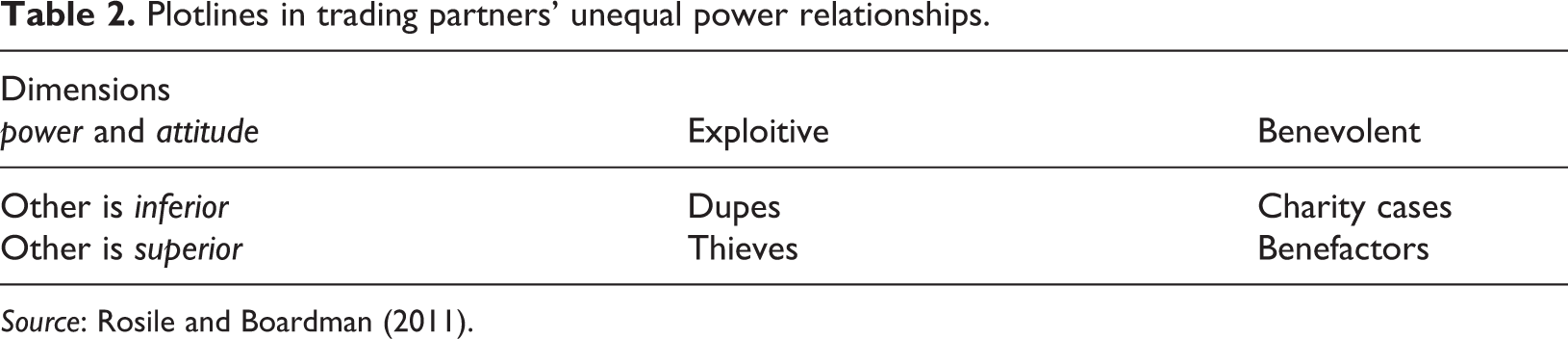
Of the four types of antenarratives we reviewed, only the rhizomatic assemblage offers enough complexity to accommodate the full range of living stories of diverse groups of people capable of negotiating on an equal basis and achieving mutually beneficial outcomes. Of course, as the histories of the Inkas and Cherokees suggest, complexity alone does not guarantee just outcomes. Antenarratives of inequality, whether in fact or in the minds of the perceivers, will not produce ethical story lines. Power disparities are likely to lead to disempowering outcomes, whether or not the party with the most power has a benevolent or exploitive attitude (see Table 2). In other words, it hardly matters whether Spanish Conquistadors or Georgia lawmakers were motivated by benevolence or greed, the outcome would likely be disadvantageous to the weaker party.
Plotlines in trading partners’ unequal power relationships.
Source: Rosile and Boardman (2011).
The reports of early contact between American Indian people and the European colonists reflect ambivalence regarding whether the other was friend or foe, stronger or weaker. Older traditional versions of the story of the first Thanksgiving, told primarily from the colonists’ perspective, claim Pilgrims shared their bounty with American Indians in a friendly feast. By other accounts Pilgrims looted American Indian stores of food. Only when caught did they offer to share their ill-gotten bounty.
Reflecting the disparities between these two accounts, Table 2 views trading relationships of unequal power, and organizes them according to dimensions of “power” and “attitude.” The perceiver (whether indigenous or Euro-Western) could perceive the other as inferior or superior in power. The different power perceptions are combined with an attitude of either exploitation or benevolence. These combinations yield four plot-lines: If the perceiver is exploitive, the inferior other is a weak, gullible, easy prey (dupe), while the superior other is seen as a dangerous predatory exploiter (thief). If the perceiver has a benevolent attitude, the inferior other is a charity case, while the superior other is a potential benefactor.
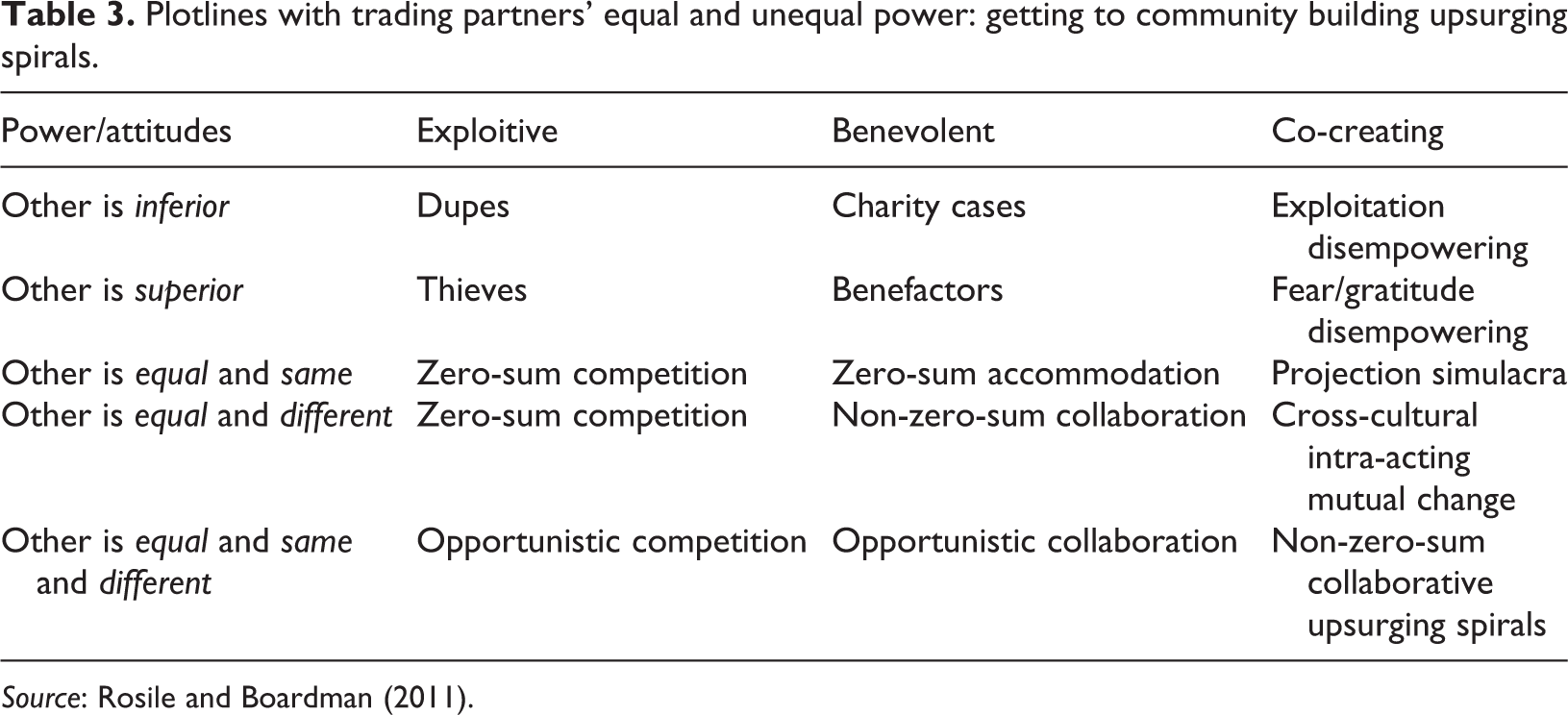
Table 3 considers the resultant relationships from these unequal power combinations displayed in Table 2, by adding a third column. This column is labeled “Co-creating” to reflect more recent views that each party to the relationship somehow actively promoted or passively allowed that relationship to develop. Both parties have responsibility for the co-created relationship. A further assumption of Table 3 is that whether attitudes were benevolent or exploitive, when under the condition of unequal power relationships, both statuses would be disempowering.
Plotlines with trading partners’ equal and unequal power: getting to community building upsurging spirals.
Source: Rosile and Boardman (2011).
Table 3 also expands Table 2 by addressing the situation of perceived equal power. Perceived equal power is split into three conditions: perceived equal and the same as the perceiver; perceived equal and different from the perceiver; and equal while being both same and different.
When a trading partner sees the other as equal, whether equal and same or equal and different, this contributes to zero sum assumptions about trading. If traders have zero-sum assumptions, this means that for one to win a given amount, the other must lose a comparable amount.
If partners are equal and same then an exploitive perceiver will assume both parties will desire and compete for the same things, using a competitive style. As an exploitive competitor, the trading partner does not care for the welfare of the other partner. When seeing the other as equal, combined with a competitive relationship, then I take care of myself and I assume that the others can take care of themselves. This leads to the “business is business” attitude, separating business and trading decisions from relationship-building and community-building considerations.
The co-creating column in Table 3 acknowledges that both parties to a relationship at some level must be complicit in either passively allowing, or actively promoting, that relationship. When a trading partner sees the other as superior or inferior, they are promoting a disempowering relationship, whether exploitive or benevolent. Perhaps no context more than that of American Indians so well exemplifies what terrible outcomes may be the result of presumably benevolent intentions. From the reservation to the assimilation eras, we see examples of destructive and disempowering “helpfulness.”
Viewing the other as equal is not enough to correct the disempowering effects of unequal relationship. When partners see the other as equal and the same, they are engaging in projection of one’s own qualities onto the other. Such projection is well documented in scholarship on indigenous history and culture (Bordewich, 1996; Cordova et al., 2007; Ordhal Kupperman, 2000) and can lead to further misunderstanding and miscommunication.
The fourth row in Table 3 addresses perceived equal relationships among trading partners with the equal-and-different perspective rather than the equal-and-same perspective. Native science (Cajete, 2000; Deloria, 1979) focuses on anomalies and differences and honors the dignity of all agents, thus it is by nature more suited to the appreciation of what Western science calls “diversity.” By becoming open to discovering difference, partners may engage in what Barad (2007) calls “intra-acting,” or interactions characterized by mutual change. This opens possibilities for newly co-creating relationships.
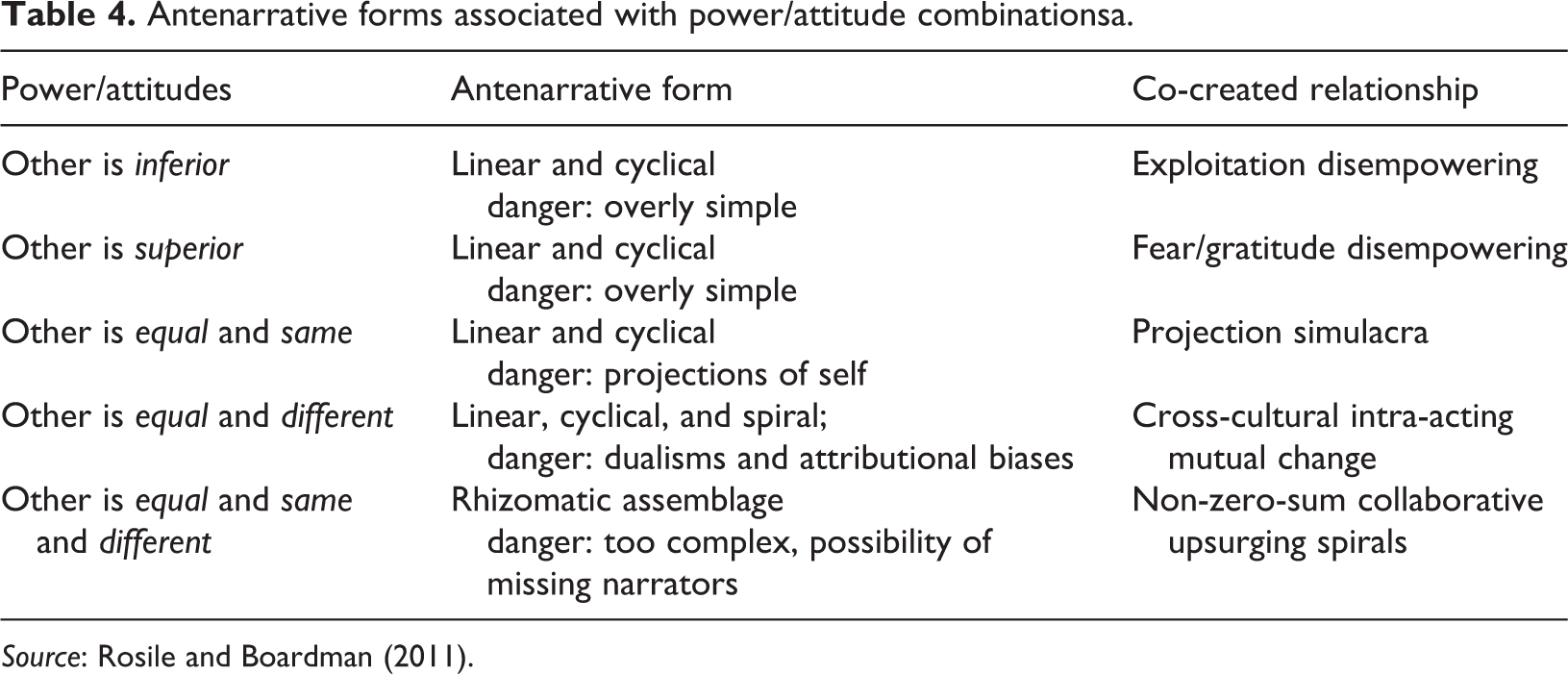
Table 4 summarizes the antenarrative forms which tend to emerge from each of the power–attitude combinations. Each antenarrative form contributes to a different form of co-created living story of the future. Our ethical position, and that of indigenous philosophy, is that others ought to be accepted and viewed as equals even when they are radically different. From this stance, with both parties recognizing similarities as well as differences, the rhizomatic assemblage form of antenarrative accommodates the collaboration of multiple voices in co-creating a mutually desirable future.
Antenarrative forms associated with power/attitude combinationsa.
Source: Rosile and Boardman (2011).
In part four, we suggest a broader canvas to paint a more ethical vision of the future of negotiation practices. We offer the rhizomatic assemblage as a form of antenarrative more suited to self and others who have perceived power equality, and who desire to co-create an empowering future narrative. Co-creation by power-equal participants is what we consider an ethical process. The outcomes and choices of that process may be productive or non-productive, but they will be ethical.
We do not offer solutions to old problems nor do we promise happy endings. Rather, we suggest that the way our history and context are storied affects the possible story of our futures. Allowing linear, cyclic, and spiral story patterns to play out in a rich assemblage can break the boundaries of a singular antenarrative form, and provide the necessary conditions for a rich and diverse future story. In the next section, we take up three case examples of negotiations between indigenous and Euro-Western parties. The first two examples demonstrate certain limitations of the first three antenarrative patterns, and the third illustrates the promise of replacing old dysfunctional patterns with more ethical multi-voiced and multi-storied negotiating processes.
Part 4: Rhizomatic assemblage antenarratives and breaking bonds of the past
Part of the epic sadness of the history of many indigenous peoples is the way that even well-intentioned policies and programs, like misguided assimilation efforts, have had devastating effects on tribal cultures, almost eradicating tribal languages, religions, and education. The first two case examples underscore this point by recounting negotiations that resulted in lingering resentments and distrust. The third recounts a more hopeful series of events in which people from radically different backgrounds were able to reframe their power contexts and negotiate as equals.
The Salamanca, NY, case example
The first case is the story with which Bordewich opens his book Killing the White Man’s Indian (1996), and it offers a glimpse of how disempowering dynamics can play out in negotiations. The story takes place in the state of New York in the small town of Salamanca in 1991. A century earlier, in 1891, Salamanca’s Euro-White leaders learned most of their town had been built illegally on American Indian land. They plied Seneca leaders with alcohol and persuaded them to sign a lease on the entire town for 99 years at a ridiculously low price. In 1991 the lease was up, and the Seneca wanted their town back (Bordewich, 1996: 9–10).
When the lease came due in 1991 the city had 6,600 residents approximately 20% of whom were American Indian (Bordewich, 1996; DataUSA, 2016). Seneca leaders insisted on renegotiating the terms of the contract. As the New York Times reported, “Hoping to make up for the inflationary decades they spent collecting 1890’s rents, the Senecas…set the price of a new lease at $800,000 a year [as opposed to the $17,000 per annum they had been receiving under the old agreement]. They have also asked for an immediate payment of $60 million to make up for the inequities of the original lease” (Kolbert, 1990). The Seneca succeeded in enforcing the terms of the lease, including a provision that stated any improvements on the property belonged to the landlord (Johansen and Mann, 2000; Kolbert, 1990). One resident of the city responded by jacking his house off the foundation and moving it off the reservation. Others sought permits to raze their homes rather than allow Senecas to hold the titles (Treadwell, 1992). Contemporary news accounts describe a heated conflict between white citizens and the Seneca tribe, but make no mention of the numerous lawsuits the tribe won in order to enforce the terms of the renewed lease agreement (Johansen and Mann, 2000; Kolbert, 1990; Treadwell, 1992).
The antenarrative processes that animated these two events, the original lease in 1891 and the 1991 renegotiation of the lease, are cyclical. Perceptions of unequal power resulted in fear and exploitation. The cycle of “(you think) we cheated you, now you are going to cheat us” reflects a tit-for-tat adversarial strategy in negotiations. Being locked into the old story of Euro-Westerners cheating American Indians led to fears and expectations that the American Indians would now retaliate. Bordewich describes local reactions among the whites when the lease ran out as “nearly hysterical with fear” and characterized by attributions of hostile intent: “They’re trying to punish us because their land was taken away from them years ago” (Bordewich, 1996: 10).
For their part, the Senecas remained cool. As Bordewich explains: The Senecas, meanwhile, were strictly business. ‘When they negotiated the original leases, they thought we weren’t going to be here at the end,’ Dennis Lay, the president of the Seneca Nation, told a reporter from the New York Times. ‘I guess we fooled them’ (Bordewich, 1996: 10).
We see no evidence of attempts to break out of the cycle of antenarrative form in this example of Salamanca. However, later in his book, Bordewich offers another contemporary case example involving similar reversal-of-fortunes between indigenous people and Euro-Western interests. This example includes a more detailed reporting of the negotiations and decision-making processes, with evidence of attempts to break out of linear and cyclic antenarrative forms to more complex spiral and rhizomatic antenarratives. Although negotiations stall for many years, the attempts are beautiful examples of the possibilities and pitfalls of breaking free of old narratives in a negotiation process.
The Paiute nation case example
The Pyramid Lake band of the Paiute nation has lived for a thousand years or more around a lake area in present-day Nevada (Bordewich, 1996). The lake shores made a bountiful oasis in the desert at the end of the Truckee River. This area was further blessed with abundant fish in the lakes nourished by the spring floods coming off the Sierra Nevada Mountains. The cui-ui fish in particular were so plentiful the tribes took a name that meant “cui-ui eaters” (Bordewich, 1996: 141).
In a seemingly progressive move, that in hindsight turned out to be a foolish and costly boondoggle, in 1903 the US government was persuaded by agricultural interests to dam the river in an effort to turn over 300,000 acres of desert into a green garden. The government subsidized farmers to settle this new Eden. Problems quickly emerged. Apparently no thought had been given to the Paiutes and their livelihoods. Damming and diverting water caused one lake to disappear completely, and the water level in another to drop by 80 feet, and so changed the chemistry of the water that the fish were nearly wiped out.
The American Indians attempted a lawsuit, which the government stymied by first blocking the tribe’s access to its own attorney, then withholding tribal funds needed to travel to Washington to plead their cause. They went anyway, and stayed for weeks, to no avail (Bordewich, 1996: 140–145). Meanwhile, the government project had begun to falter. Paiutes were left impoverished and hungry, and the new farmers were discovering that the soil they had irrigated with so much hope was unsuitable for cultivation. However, they could not be persuaded to give up their rights to the diverted water for the sake of the lake and the “unimportant fish” (to them and the Department of Justice). Paiutes may have had a right to water, but they were unable to enforce it.
Within 50 years the tables turned. A combination of droughts and a better understanding of environmental issues led to the view that the farms, not the fish, were using too much water. Farming was using 45% of the region’s drought-challenged water supply for approximately 3% economic returns (Bordewich, 1996: 150). Local citizens along with environmentalists, resort owners, and power companies worked with American Indians and farmers in a four-year negotiation process. The result, called “the settlement,” in 1990 “invited Paiutes to participate as equal partners in the management of the Truckee basin” (Bordewich, 1996: 152–153).
In 1992 an even more severe drought brought a request to the Paiutes from local county government for water, asking for: “the loan of five thousand acre-feet. It is the kind of transaction that the settlement specifically mandated, with the tribe’s permission….intended to prevent shortage and to create among longtime enemies a sense of shared responsibility” (Bordewich, 1996: 154). By the mid-1990’s the tribe’s attorney was “telling the Paiutes to horsetrade, to deal with the whites, to trust them…‘The question should be, what else can we get by giving the water?’”(Bordewich, 1996: 154).
But the mood of the tribe became resentful. Bordewich quotes participants at the time: “It’s always been ‘to hell with the Indians.’ It’s always been that way. It’ll always stay that way” (Bordewich, 1996: 154). Some speak of a sacred obligation to protect the water. One person expressed a common wariness, “They always make it look good on paper, but it will always nullify whatever benefits you’re supposed to get” (Bordewich, 1996: 155). As Bordewich (1996) concludes: In contemptuous voices, one can hear the resignation of people still accustomed to defeat, and incomprehension that, for the first time in their modern history, the Paiutes hold the stronger hand, the power to dominate and thwart their white neighbors, if they wish, and to exert power through negotiation and cooperation…. (The attorney) is telling the Paiutes that water is power, that it can be transmuted directly into political leverage. But he has failed to sway.
The coalition of Immokalee workers example
The third case example provides a more hopeful conclusion than the previous two. The CIW was formed in the early 1990s by a group of predominantly Aztec and Mayan farmworkers intent on drawing attention to low wages and harsh working conditions in the commercial tomato fields of South Florida. Frustrated in their efforts to work with local growers, by 2000 the CIW concluded it was multinational corporations that actually controlled pay in commercial farming (Bowe, 2003). The first target was Taco Bell, whom the coalition presented with a demand that remains at the heart of their “Campaign for Fair Food” to this day (Nieves, 2005a). They asked the fast food company to pay one penny more per pound for tomatoes with the extra money bypassing the supply chain and being paid directly to farmworkers (Bowe, 2007).
About that same time, the CIW had also began to conduct undercover investigations to expose slavery rings in commercial farming; they quickly uncovered compelling evidence that Taco Bell and many other corporations that purchased tomatoes in Florida had been profiting from involuntary servitude (Bowe, 2007). By 2005, Taco Bell relented and signed onto the penny-per-pound agreement. In the years since CIW investigations have continued apace. By 2010 they had uncovered nine different human trafficking operations, all of them leading to federal convictions (Coalition of Immokalee Workers, 2016; Nieves, 2005b). The CIW has continued on to win agreements with more than a dozen other multi-national corporations including McDonald’s, Burger King, Chipotle Mexican Grill, Whole Foods, and Walmart (Coalition of Immokalee Workers, 2016).
Most remarkable of all, in the spring of 2011 the CIW signed an agreement to cooperate with an old nemesis, the Florida Tomato Growers Exchange. This group only three years earlier had threatened to bring suit against the CIW for supposedly violating federal Racketeer Influenced and Corrupt Organizations Act statutes (Brown, 2005). The initial agreement led to the formation of the Fair Food Standard Council, a partnership between workers and growers that, essentially, codifies the penny-per-pound agreement and guarantees regular human rights inspections on 90% of Florida’s tomato farms (Cox, 2016).
The CIW’s Campaign for Fair Food bears many of the hallmarks of the indigenous living story tradition. Their campaign set in motion a series of actions that brought an end to a storytelling stalemate and prompted an antenarrative assemblage process. In effect, they have managed to restory commercial farm labor in Florida.
How did the CIW achieve their historic success? In contrast to the well-documented individualism of Euro-Western (and especially US) culture, the CIW lives by the motto: “We are all leaders” (Bowe, 2007: 33). Consistent with this motto, the members of the coalition forged the distinctive strategies for the Campaign for Fair Food by holding a series of encuentras, radically open community discussions in which uneducated farmworkers could speak on equal footing with legal advisors.
What is more, the penny-per-pound strategy they developed is largely consistent with the indigenous style of ask–bid process we described earlier. They opened negotiations by making a modest request to be paid one penny more per pound which, by Taco Bell’s own estimates would have cost the company only $110,000 in the first year (Rosenblum, 2015). And while that is a very small sum of money by corporate standards, the CIW made clear it would have crucial material consequences for the daily lives of farm workers.
The CIW campaign against Taco Bell featured theatrical protests in which they drew upon Aztec performance traditions to reenact harsh working conditions in the field. They distributed literature and press releases detailing the results of their slavery investigations. They staged hunger strikes at the company’s corporate headquarters and gave talks in churches and schools in neighborhoods where executives lived, and ensured that corporate executives could not simply ignore the living stories and material conditions of the workers who picked the tomatoes for the company’s highly profitable Mexican food (Herder, 2011).
In effect, consistent with indigenous storytelling and negotiation traditions, the CIW treated company executives more as neighbors who needed to talk through an urgent moral issue than as opponents in a contest. The breakthrough moment came in 2004 when one of those executives, Taco Bell’s vice president for consumer relations Jonathan Blum, took action.
Blum took time off from a family vacation to make an unannounced visit to Immokalee in order “to go into the fields to see the conditions faced by these workers firsthand” (Blum, 2008). What Blum learned disturbed him, and he proceeded to lobby other members of the company’s executive committee to concede to the worker’s demands.
From an antenarrative standpoint, it is not difficult to recognize Blum’s visit to the farm fields as a moment when a cycle of resentment was disrupted and an upsurging spiral pattern emerged. What he learned in the fields helped change the antenarrative pattern and led to a breakthrough in negotiations. Moreover, in the years since that initial breakthrough, working conditions for farmworkers in Florida have been transformed (Cox, 2016).
Today, the human traffickers appear to have been put out of business, at least in the farm fields of South Florida. Not many years ago, workers were paid poverty level wages and could be beaten for simply asking to get a drink of water (Nieves, 2005b). Today they enjoy better pay and can now take regular breaks in sheltered areas with access to ice water.
What is more, the CIW’s slavery investigations helped pave the way for passage of the federal Victims of Trafficking and Violence Protection Act of 2000 (McGaha and Theiss, 2007). The living stories the indigenous farmworkers of Immokalee have told about slavery and harsh working conditions in commercial agriculture have circulated widely and connected in myriad ways with the living stories of people across the US and around the globe. That is the very definition of an antenarrative rhizomatic process.
Part 5: Conclusions
The case of the Salamanca property dispute resulted in the tribe’s contract being upheld and tribal lands being restored. However, negotiations failed to find mutual benefit, and instead resurrected old hurts and resentments. Salamanca required the third-party intervention of the courts.
The story of the Paiutes reflects an increasing number of role-players (stakeholders) involved over time in negotiations around scarce water resources. Changing science, changing values in support of more environmentally-sustainable economic development, new communities around resort areas, and new government attitudes towards American Indian sovereignty, are only some of the multitude of factors clamoring to be recognized as actors in this ongoing story.
Instead of moving towards a relationship of equal power, players in the Paiute case became stuck in the old antenarrative patterns of cycles of disempowering exploitation and equally-disempowering misguided benevolence. These antenarrative patterns reinforced lack of trust, preventing parties from breaking the cycles of distrust and betrayal, from creating a new story, and possibly from seizing an opportunity to engage in truly equal-power negotiations.
We see reasons for hope in this story of failure. First, the four-year negotiation process brought Paiutes to the table as equal participants. This was a significant step towards creating a collaborative new story, a story incorporating a rhizomatic assemblage of multiple voices, multiple antenarratives and with the potential for disrupting and replacing petrified historical narratives. In addition, many of the players in the case explicitly discussed shedding old patterns of power abuse and mistrust (Bordewich, 1996). A new vision of the win–win possibilities of power-equal collaborative antenarrative co-creation was explicitly discussed, even though ultimately rejected. The next time such an opportunity arises, the outcome may be different. That is our hope.
The CIW case example demonstrates the effectiveness of many of the antenarrative and equal-power strategies suggested in this paper. The Immokalee workers insisted on being recognized as power-equals. They treated each other as equal, with each member being considered a leader. Different members are often sent to speak with the press, so no individual can be identified as “the” leader. In their negotiations, the CIW’s style is closer to the indigenous ask–bid process starting with a very modest, relatively low “ask” of only a penny per pound. In addition, despite past experience, the CIW held optimism and a vision of mutual benefit which they brought to reality. Now over a decade old, the CIW’s success continues to grow.
The antenarrative patterns we have traced across three case studies have at least three important implications for theory and practice in contracting and negotiation. First, they suggest the importance of recognizing and reflecting upon deep philosophic assumptions that serve to shape the attitudes and actions of participants in any negotiation process. For scholars and practitioners operating in the Euro-Western tradition, this would likely mean recognizing and interrogating Enlightenment assumptions that privilege individualism and linear rationality. Second, they demonstrate the relevance of indigenous perspectives, and in particular indigenous philosophy to the study and practice of contracting and negotiation. By writing of the agential force of living stories and of the natural world, American Indian philosophers such as Vine Deloria and Gregory Cajete have provided useful tools for exposing and analyzing counter-productive antenarrative patterns that have haunted American Indian and Euro-Western relations for centuries. One implication of looking to these sources may be an expansion of the stakeholders in any negotiation process to include non-human agents. Deloria, Cajete and other American Indian thinkers would have us recognize how, by denying the agencies of the natural world, we have treated the earth as a deaf mute. Who, they would ask, speaks for the earth, the rivers, the buffalo and the eagles? Third, these three case studies underscore the critical importance of disrupting counter-productive linear and cyclical antenarrative patterns in order to unleash the creative and transformative power of upsurging spirals. The CIW campaign, for instance, provides compelling evidence of what can happen when marginalized people come to recognize their own storytelling agency – nothing short of the restorying of human relations within a series of corporate supply chains. The CIW’s transformative campaigns are important for other reasons as well. To date, contracting and negotiation scholars have paid little attention to the strategies of social protest movements who in recent years have been able to use public media and digital communication to challenge corporate and governmental powers.
We offer this view of antenarrative as a way for people to recognize that stories have tremendous power. Material conditions of exploitation happen when participants’ power is taken away or is unrecognized, even by themselves. In all three of the cases cited here, resources were taken, and material conditions of indigenous peoples were severely affected to the point of impoverishment. Yet today, for the CIW, circumstances have changed, their voices are being heard, and their power, long dormant, is again visible. For any group to accept and productively use their power, we suggest they must be able to recognize and break free of old limiting stories which constrain antenarrative trajectories and future possibilities. Instead, equal-power parties to negotiation may co-create new antenarratives as a living-story “ante,” or bet, on a negotiated future of upsurging spirals of mutual benefits.
Footnotes
Acknowledgements
The authors wish to thank Michele Knife-Sterner of Southwest Minnesota State University and the Rosebud Sioux Tribe (Sicangu Lakota) for her kindness and insight in discussing American Indian philosophy.
Declaration of Conflicting Interests
The author(s) declared no potential conflicts of interest with respect to the research, authorship, and/or publication of this article.
Funding
The author(s) received no financial support for the research, authorship, and/or publication of this article.