




Abstract
Leaders assume to have recourse to narratives of crisis in order to legitimize their command authority to act as desired. Yet leaders are never the singular storytellers in organizations, and resistance to the stories they tell is possible. A recent case of collective bargaining is presented as a case of competing storytelling about an organization (a university). Drawing from excerpts from publicly available texts, the differences in narrative social construction are illustrated. The case highlights the central role for communications in leadership as leaders attempt to manage the sensemaking of organizational members through discursive activity. As a result, we are forced to rethink leadership as a set of dialectical relationships where meaning is co-constructed.
This paper is based on a recent case of collective bargaining within a unionized university and the polyphonic interplay of competing narratives. Underpinning this paper is a narrative approach to sensemaking whereby collective narratives – coherent stories, in particular – are the devices used to create shared meanings that shape the identity work of organizational members and the social construction of organization (Cunliffe and Coupland, 2011). Antenarratives are connected to prospective sensemaking and are used to promote or resist specific kinds of change (Vaara and Tienari, 2011). Antenarratives are story fragments, not fully formed, yet which are used intentionally by sensegivers in the hopes of shaping the future story upon which an organization is constructed and identities and plot come together (Boje et al., 2016). The round of collective bargaining featured herein highlights antenarrative processes at work built upon an interpretive view of collective bargaining as narrative performance. The effect was to restore polyphony to the organizational story in a manner that countered and corrected the dominanting story built upon a narrative of financial crisis. Since the discursive activity surrounding collective bargaining was primarily engaged in by sensegivers, namely the leaders within the union and administrative parties involved in negotiations, the leadership implications of engaging in such narrative processes in negotiations are considered. First, the case clearly highlights the idea that communications are ‘central, defining and constitutive of leadership’ (Fairhurst and Connaughton, 2014: 8) as leaders attempt to manage the sensemaking of organizational members through discursive activity, and union-management negotiations provide an exemplary occasion for witnessing this process taking place. Second, there are limitations on the power of leaders to manage meanings because leaders are not the singular storytellers in organizations, and resistance to the stories they tell is indeed possible. Finally, crisis narratives may reflect negatively on the leaders at the helm during the onset of crisis; using language to such an end may have unintended consequences.
Narrative sensemaking and sensegiving
Sensemaking is ‘the process by which we label, categorize and create plausible stories that…“rationalize what people are doing”’ (Cunliffe and Coupland, 2011: 65). It follows then that ‘a sensemaking lens is closely related to a narrative one’ (Sonenshein, 2010: 479), and such is the position adopted in this paper. A narrative contains three elements: ‘an original state of affairs, an action or event, and the consequent state of affairs’ (Czarniawska, 1998: 2). Moreover, these three elements are held together by chronology and causality, forming a plot, so that the consequent state of affairs is subsequent to and a product of the original (Czarniawska, 1998). Plots are central to the particular narrative form we label as stories (Collins, 2013; Czarniawska, 2004; Gabriel, 2004). ‘As we move from narrative to story we are forced to recognize the increasing importance of plot, which “knits events together”, allowing us to understand the deeper significance of an event in light of others’ (Gabriel, 2004: 64).
A narrative approach to sensemaking ‘is based on the assumption that we make sense of our experience through narratives, stories or drama. Collective narratives create shared meanings around events’ (Cunliffe and Coupland, 2011: 65-66). Drawing from earlier work, Cunliffe and Coupland (2011: 67) describe narratives as ‘spontaneous acts of interpretation and meaning-making which are often improvised, situated, contested and responsive performances that are temporally and contextually sensitive’. Organizational members engage in narrative sensemaking not as a one-off activity but as an ongoing process of ‘figuring out what to do and who we are’ (Cunliffe and Coupland, 2011: 81). Such sensemaking efforts produce organizational stability and order (Cunliffe and Coupland, 2011; Näslund and Permer, 2011) through the emergence of narrative rationality where identities make sense and the organization story begins to come together, plot and character connected (Cunliffe and Coupland, 2011).
Given the contested nature of narrative sensemaking as defined above, it must also be understood as a polyphonic process involving competing narratives and narrating voices (Cunliffe et al., 2004). The presence of a dominant story, however, restricts sensemaking and ‘cause[s] inherent polyphony to be silenced, making alternative stories seem unpalatable or even unthinkable’ (Näslund and Permer, 2011: 95). Narratives may limit the sensemaking abilities of organizational members to run contrary to the rather bounded and determined understandings of reality advanced by leaders in organizations (Boje, 2001), giving rise to the distinction between sensemaking and sensegiving in organizational storytelling (Collins, 2013; Gioia and Chittipeddi, 1991). ‘Sensegiving refers to intentional attempts to influence the way people make sense of and construct their organizational reality’ (Vuori and Virtaharju, 2012: 48). Building on the premise that language is a central mechanism through which constructed realities take shape, Weick (1995, 2001) claimed that the use of stories are a symbolic means by which managers can attempt to order the practices and thinking of employees. There is, then, strategy in storytelling and instrumentality in sensegiving. In sum, sensemaking and sensegiving may be treated as interchangeable with narratives when the latter are understood as ‘discursive construction[s] that actors use as a tool to shape their own understanding (sensemaking), as a tool to influence others’ understandings (sensegiving), and as an outcome of the collective construction of meaning’ (Sonenshein, 2010: 480).
Narrative analysis points to an examination of power within organizations, for within organizations, leaders enjoy the institutionalized privilege of storytelling, of imposing their own interpretation of organizational realities onto others. Smircich and Morgan (1982: 258) argued that this is the essential work of leaders, ‘to frame and define the reality of others’. ‘Leadership situations may be conceived as those in which there exists an obligation or a perceived right on the part of certain individuals to define the reality of others’ (Smircich and Morgan, 1982: 258, emphasis in original). Näslund and Permer (2011: 95) admit that ‘this regime of truth is not absolute’ but is contested and renegotiated within an ongoing power struggle whereby organizational members and groups engage in purposive storytelling and offer deviant stories. Despite the backdrop of a dominant story, legitimacy, coherence and closure may remain elusive as organizational members try to make sense of things amongst the polyphonic interplay of competing narratives (Cunliffe et al., 2004). ‘It often becomes difficult to separate out sensemaking and sensegiving and who is narrating and being narrated because our narrating voices are always entwined with others’ (Cunliffe and Coupland, 2011: 97).
Antenarrative processes come into play when we consider how storytelling can be a purposive effort of managing meanings. Antenarratives are ‘fragmented pieces of discourse…that create specific kinds of meanings’ (Vaara and Tienari, 2011: 372). They do not yet tell a coherent story but instead are used intentionally in the hopes of affecting the shape of future stories upon which an organization is constructed. ‘An antenarrative approach allows one to focus on ongoing prospective sensemaking and sensegiving, how storytelling is used in action to promote or resist specific kinds of change’ (Vaara and Tienari, 2011: 372). These story fragments, or ‘terse stories’ that form antenarratives ‘either bolster or speak against organizational power in situated context and as polyphonic histories’ (Boje et al., 2016: 401) yet regardless of agenda are employed in the same effort to shape the future.
Narratives of crisis
This paper has its genesis in Grint’s (2005) critique of crisis narratives, for a narrative of crisis lies at the heart of the case analyzed herein. Grint (2005) sought to problematize the construction of situations as crises in which critical problems demand decisive action. ‘A crisis does not emerge objectively…but at the point at which a ‘crisis’ is pronounced by someone significant and becomes accepted as such’ (Grint, 2005: 1474). Crises turn entities into enemies, something to be overcome. A financial crisis, for example, transforms expenses into targets and reconstructs organizational costs into items of excess, wastefulness and inefficiency. In making this observation, Grint (2005) challenged prevailing contingency theories of leadership by noting how leaders are complicit in constructing the very situations that give them legitimate power and authority, and which in turn legitimate certain action. The concern for Grint (2005) is that the construction of a crisis by a leader in turn legitimizes authoritative leadership behaviours; critical problems enable leaders as commanders to use coercive power over an amenable followership because they constituted the problem as critical in the first place.
Using the example of US President Bush’s rendition of the problem of terrorism as both the most important and critical problem facing America, Grint (2005) demonstrated that the accuracy of the account of the situation as both significant and imminent was less relevant that its persuasiveness. So long as the story held, subsequent demands placed upon the American public by their elected leaders, from military escalation (e.g. Iraq) to restrictions on freedoms (e.g. Patriot Act), were more willingly endured. Likewise, a financial crisis can be a precursor to cost cutting and other austerity measures, and the availability of the broader discourse of austerity certainly lends legitimacy to the sensegiving or meaning-making efforts of those who would engage in such narrative performances in organizations. Here we can see how discourse is a strategic resource that can be used to support and make more plausible a story being told (Hardy, Palmer and Phillips, 2000). Grint (2005: 1469) hence called for greater focus on language processes ‘through which decision-makers persuade their followers, and perhaps themselves, that a certain kind of action is required’.
The case study
This case study involves a relatively small, primarily undergraduate university situated in a rural part of Canada. I examine the process of constructing a story about the organization grounded upon a narrative of financial crisis, and how this narrative was used by a university administration as a means of denying the demands of the academic union during a recent round of collective bargaining.
Czarniawska (1998) reminded us that the interpretation of a story, particularly its status as being either fact or fiction, is negotiated; there is no way to decide amongst alternative readings of the same story except by negotiation. The formalized role of negotiations in collective bargaining is therefore well suited for the analysis of prospective sensemaking through antenarratives; ‘bets on the future are an essential part of negotiation theory’ (Bülow and Boje, 2015: 209). Indeed, the bargaining table is the site of discursive activity used to promote certain ideas and meanings while resisting others, all with the intention of affecting future outcomes. To view bargaining as an example of narrative performance supports Putnam’s (2003: 36) interpretive (versus economic) perspective on negotiation that is informed by dramaturgical and cultural approaches, and where ‘language and symbols are key’.
The collective agreement between the academic union and the employer expired in June 2012, at which time the process of collective bargaining commenced to produce a new collective agreement. The backdrop of financial crisis had already been established by the administration through prior acts of narration, creating a context hostile to any monetary gains sought by the union. At the annual presentation of the budget in the year leading up to negotiations, all staff were reminded of the challenges of declining revenue, rising costs and the ‘expensive model’ of our university, with courses taught primarily by full-time faculty. For the fiscal year of 2012–2013, it was announced that the salary budget for academic staff was set to rise by 0%.
I am a member of the university’s academic union, the legal bargaining agent for the 400 academic employees of the university, and I was the union’s Chief Negotiator during the round of collective bargaining being examined. The union’s lead-up to collective bargaining was characterized by information gathering and canvassing our members to ensure we had a fair and representative list of bargaining proposals. As a result, we entered into collective bargaining with a mandate to, amongst other things, create a new professional development fund, extend health benefits to part-time employees and improve the benefits available to all members, extend the contract length for those groups of members whose contract terms were less than twelve months, secure replacements for faculty members on leave or retiring, and achieve an average annual salary increase of 2.9%.
Despite having the authority to represent its membership, the union historically did not assume a significant leadership role within the university, instead deferring to the privilege of the senior university administrators as sensegivers to advance their bounded version of organizational reality. As the plausibility of that story began to unravel, the union found itself in a somewhat new role of organizational storyteller, and with it came the capacity for resistance through antenarrative processes. The union’s antenarrative challenged both the sensegiving being imposed and the remedial action being recommended by the administration, in the process challenging their authority and power and ultimately their construction of leadership. The dialectic presented herein does not represent the totality of voices (noticeably absent are the stories from students), but rather a discursive struggle that played out publicly with narrative artifacts that were published and available to be analyzed.
During our first meeting with the administration’s bargaining team in June 2012, they quickly sought to establish the narrative of financial crisis, employing the specific words ‘crisis’ and ‘dire’ and hence establishing their intended plot of ‘there’s no money’. As Kopp et al. (2011: 376) predicted, ‘stories deployed in crises would supplant the normal dominant narrative of the organization’, the latter of which in our case was a much more marketable narrative of a premier ‘destination’ and ‘experience’ characterized by productivity in research, excellence in teaching and vibrancy in campus life. The desired implication of the story that emerged during negotiations was that the union must immediately and significantly lower its expectations. The union subsequently engaged in antenarrative processes of communication to suggest an alternative causal explanation for how the university ‘states’ could be knit together, thus suggesting that the administration’s story was in fact much less determined and definitive then they would have us believe.
The primary audience for the texts produced by both the union and the administration was the union membership. The union understood that solidarity was the key success factor behind a successful round of negotiations, and I personally could speak with greater conviction at the bargaining table if I understood that I was channeling the beliefs and interests of a strong majority of our members. Our acts of narration therefore helped to foster a shared understanding of our organizational reality, which was at odds with the narrative advanced by the administration that was equally interested in swaying the belief system of our members. Both parties engaged in a discursive struggle over meaning, the union seeking to present a plausible counter-narrative to inhibit the emerging dominance of the administration’s narrative of crisis and hardship. ‘Once established, such dominant stories will provide a backdrop and sounding board for any other stories told within the organization, and therefore contradictory stories will lack the verisimilitude necessary to make them seem plausible and convincing’ (Näslund and Permer, 2011: 94).
The challenge mounted by the unionized academic staff against the austerity discourse being drawn into this university was not new amongst Canadian universities, and this discourse has only gained strength in the years since. Negotiations have become increasingly difficult, particularly in areas of compensation and job security, with no less than five labour strikes in Canadian universities in 2015 and an even greater number of strong strike votes and job actions that were narrowly averted. The stakes are high, and the consequence for academics is found amongst the swelling ranks of university professors with temporary or part-time, low-paying and precarious employment contracts, now estimated to be one out of every three (CAUT, 2015). Within the national context, the case studied in this paper is inevitably not unique, making it all the more appropriate to derive some generalizable insights into leadership and negotiations.
Throughout negotiations, both sides continued to produce texts that were intended to strengthen a premise that was advanced from the start. The intended plots did not emerge over time but rather the story fragments were often retold using different words and illustrative examples to create specific meanings while resisting others. The frequency of these texts increased in the lead-up to the union’s strike vote (which established the legal right and mandate to strike), with both sides producing more versions of the same arguments in what amounted to a trading of punches. The mood at the bargaining table was one of inertia and exhaustion. As predicted by the conciliator, the eventual settlement was one in which both sides were equally disappointed. Eight months of protracted negotiations and government facilitated conciliation culminated in a three-week strike prior to an eventual collectively-bargained settlement and ratification of the collective agreement in February 2013. To achieve the support necessary to sustain this job action, a majority of the union membership determined that the union’s version of events contained sufficient meaning and appearance of truth as compared to the story told by the administration. This support was neither complete nor indefinite. The prospects of walking a picket line challenged many of our members’ ability to make sense of their identity as academics. Also as time passed other narratives, particularly a narrative of hardship told by or on behalf of students, began to greatly influence the sensemaking of administrators and academic staff alike.
Method
Textual artifacts
This paper presents the relative differences in narrative social construction by examining excerpts from the competing stories told about the crisis which served as a backdrop to the last round of collective bargaining. The method is in keeping with Boje et al. (2016) and Vaara and Tienari (2011) with their common attention to ‘microstories’, ‘storytelling episodes’ and ‘fragments of communication’ that form the antenarratives used by both parties in this negotiation process. This level of analysis allows for the juxtaposition of ‘terse, fragmented stories that either bolster or speak against organizational power in situated context and as polyphonic histories’ (Boje et al. 2016: 401). The fragments of text illustrated herein were, collectively, intended to provide alternative ways of making sense of the university and the reality of our fiscal situation, the causality for crisis, and the subsequent ability to afford the proposals tabled by the union during negotiations. With similarities to Vaari and Tienari (2011: 370), this case highlights how ‘antenarratives may exist in a dialogical relationship, that is, as mutually constitutive constructions that each serve specific purposes’.
The administration’s texts were the product of senior administrators, dedicated communications professionals, and advisors from academics, finance and operations. Our team’s ‘failure’ to make sense of the organizational reality being advanced by the administration at the bargaining table led them to go public with their narrative in an effort to speak directly to our members, students and the public at large through a series of documents, online updates and media releases. These texts mostly took the form of emails and summary documents that were subsequently emailed and posted on the university website.
The union’s texts were the product of several faculty and other academic staff from various parts of campus who all assumed key service roles on either the negotiating team or the union executive and its various committees. As the Chief Negotiator, I was deeply embedded in this discursive activity. The union published a series of ‘Bargaining Bulletins’ and other documents, such as flyers and press releases, all of which were supplemental to our periodic newsletter (The Beacon), in which we tried to expose the plurivocal nature of the university’s financial story and voice a more polyphonic history that could challenge the dominant story. Given the administration’s public campaign, the union eventually removed the login requirement to their website and made all this documentation equally a part of the public realm.
A short time following our contract settlement, I compiled a file of all this public data prior to its eventual removal from organizational web pages. It is only this public data that I analyze in this paper, and I make no reference to individuals or their statements and actions that were not part of the public record. My corpus of union texts consists of 20 separate documents averaging two pages each. My corpus of administration texts is more varied, consisting of 6 multi-page updates to the campus community, 1 campus newspaper article, 2 public letters from the university President, and excerpts from over 30 broadly distributed emails.
Analysis
The structure of the data I present is inspired by Forray and Stork’s (2002) ‘two tellings’ of an annotated parable, which was used as a literary device ‘to give voice to alternative narratives’ (Forray and Stork, 2002: 498). Textual artifacts from both the administration and the union are layered onto descriptive statements about the university to highlight how opposing yet mutually constitutive antenarratives can emerge simultaneously. The texts were not coded inductively; rather, I read through my corpus to find causal statements that were illustrative of the sensegiving efforts of both parties as they related to the descriptive states about the university that I wrote. These five statements (A through E) may be incomplete but nevertheless represent my insider understanding of the key contextual details about which each party attempted to give meaning through their efforts of text production. The texts map the contours of a discursive struggle that played out over the imposition of organizational meaning, and highlight how the legitimacy of the administration’s ‘answers’ to the challenges that arose during collective bargaining hinged upon the persuasiveness of their communicated interpretation of reality. Since antenarratives are bets placed on the future emergence of cohesive stories that will shape prospective sensemaking (Bülow and Boje, 2015), the plots of the competing stories that each party gambled upon are subsequently summarized and analyzed.
Data: competing antenarratives
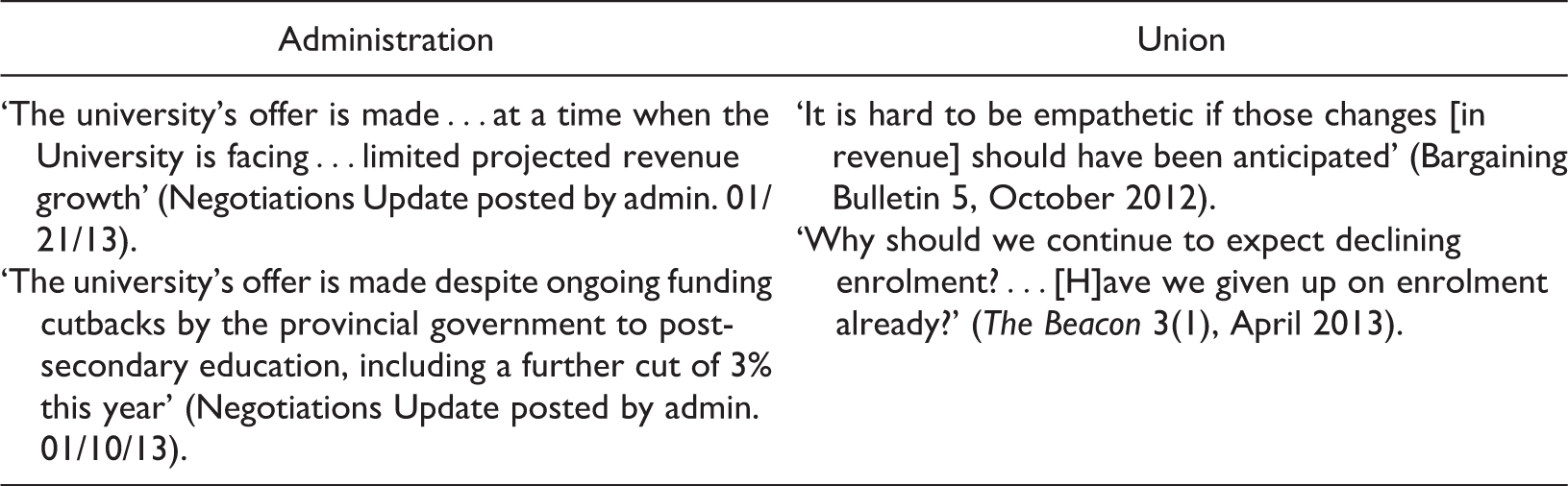
A) Revenue
Government funding, accounting for roughly half of revenue, has been constricted in recent years. Tuition levels, however, have been allowed to increase in rough proportion to these cuts, although university enrolment is stagnant at just over 4,000 students. The demographic conditions of the region have placed downward pressure on the number of local high-school graduates, and hence maintaining enrolment numbers is a challenge.
Sensegiving efforts
B) University budget
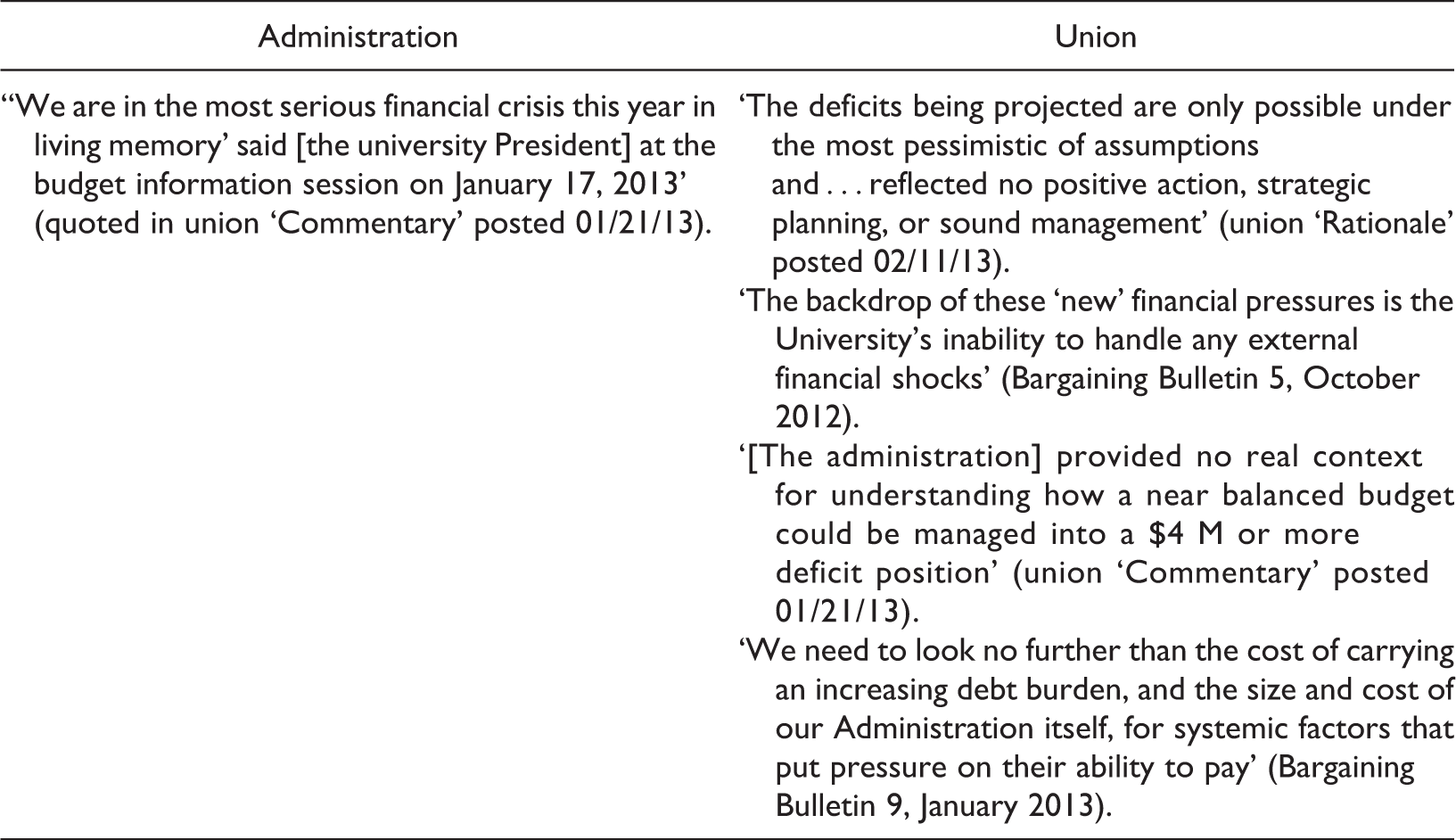
The effect of declining funding has been felt across campus in areas ranging from academics to student services. Financial statements reveal that the university is experiencing an operating deficit; the extent of the projected deficit varies based on the assumptions used.
Sensegiving efforts
C) Spending
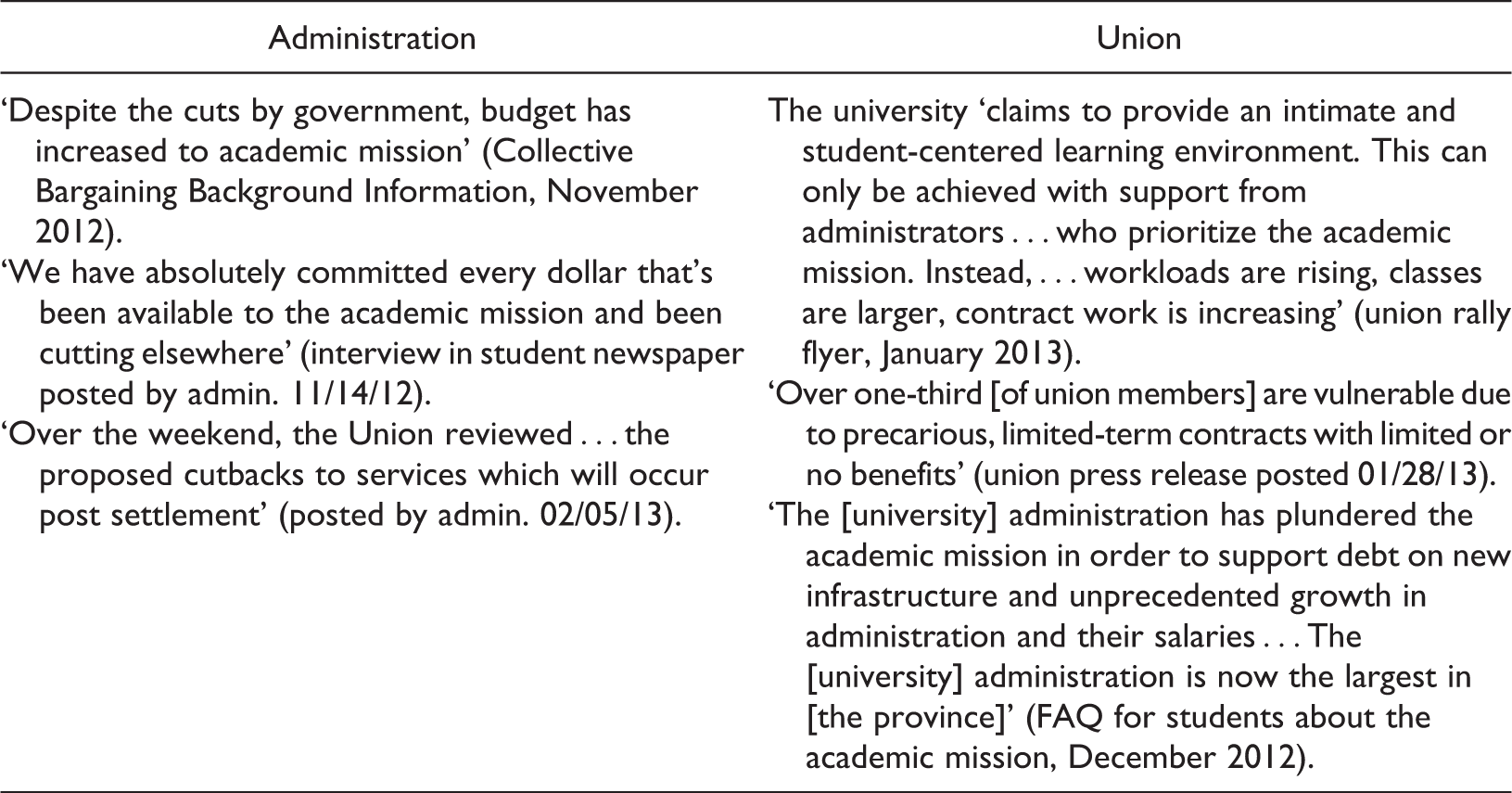
The university budget is managed in an envelope system whereby academic expenses are separated from administration, student services, facilities management and the like. The trend in proportion of expenses in each envelope is one indicator of their priority.
Sensegiving efforts
D) Spending on residences
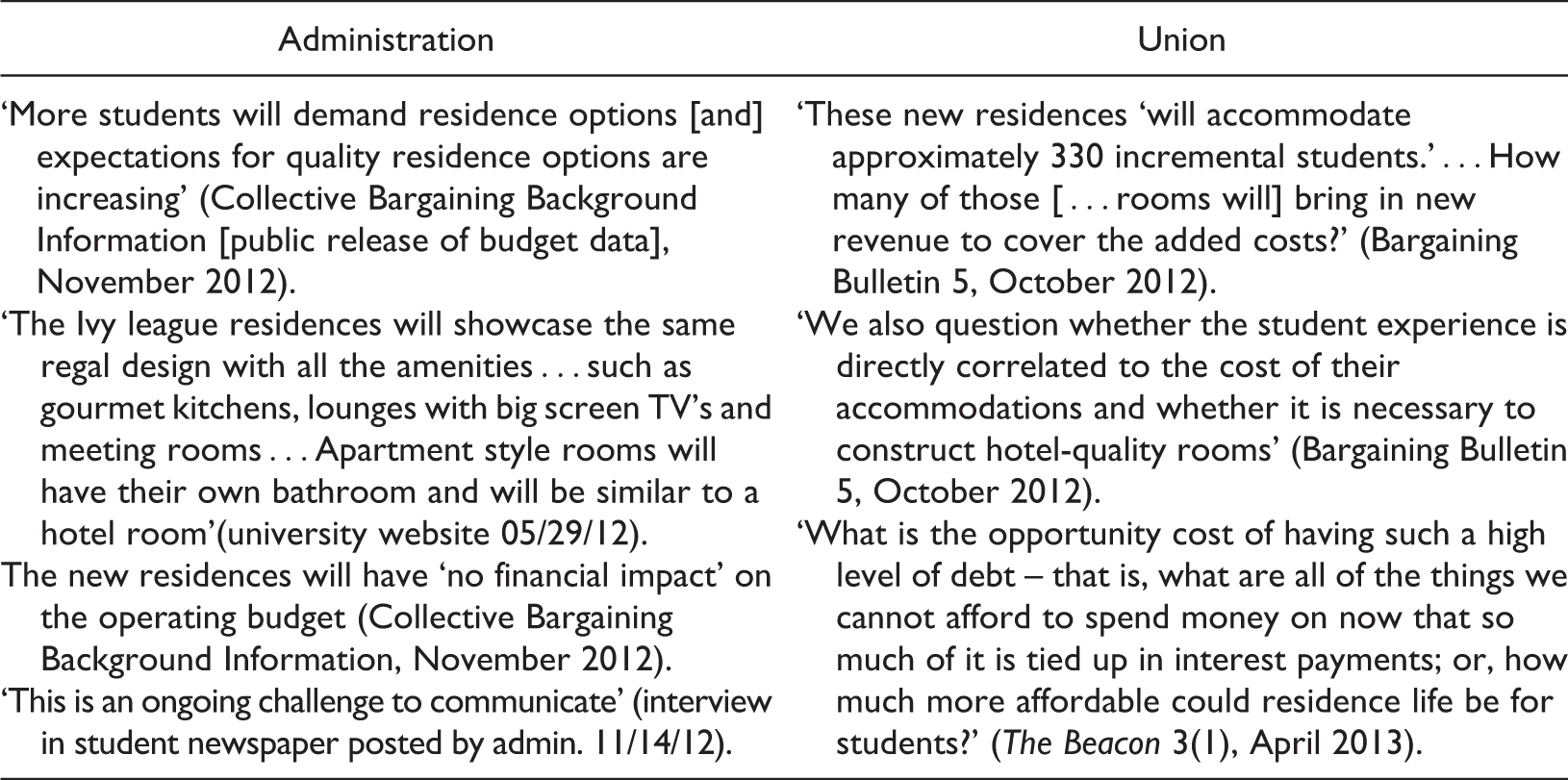
Given the location of the university, many students opt to live in one of the several residences on campus. Overall, the campus has an aging infrastructure, but there are several new buildings including two new residences.
Sensegiving efforts
E) Ability to pay
The negotiations leading up to a new collective agreement between the university and the academic union have stalled in matters of a mostly financial nature owing to different views on the merits of the union’s proposals.
Sensegiving efforts
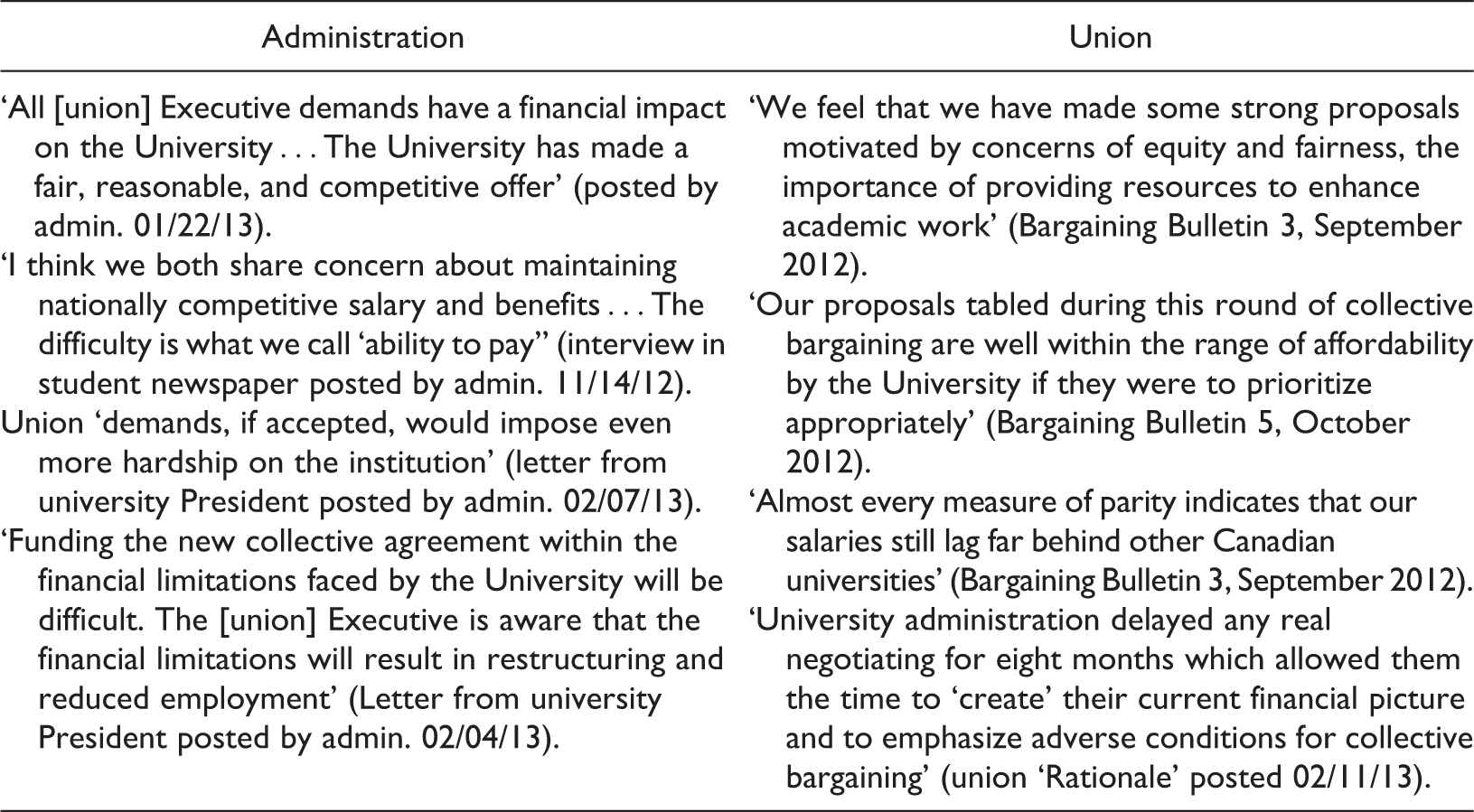
Summarizing the stories that emerged from negotiations
The fragments of text noted above collectively formed parts of a prospective bet that the stories advanced by both the administration and the union, each with causality and chronology, would stick and impact the sensemaking of organizational members such that the narrative rationality or coherence of each side’s version of the university story would trump the other. According to the university administration, the existent crisis or consequent state of affairs was primarily the product of external downward pressure on revenue and the restrictions on spending that inevitably followed. The plot can be summarized as follows: There is no money available to meet union demands because we simply do not have the funding necessary to adequately support the high cost service delivery model of the university. The university is foremost a victim of demographics and government policy, with the administration left struggling to manage through this crisis while maintaining services. Under such a challenging scenario, union proposals are both unreasonable and irresponsible, and the administration has no choice but to deny anything that might increase spending. Further cost escalation is impossible.
As the administration’s telling of the university story began to spread, the union leadership assumed a more active role via antenarrative processes in presenting an alternative way of prospectively making sense of the same set of facts. According to the union’s story, the administration’s own cost management failures were the greater culprit than revenue levels, the latter of which are reasonably predictable and modeled in university-sector financial planning. The plot to this story can be summarized as follows: If the state of the university’s financial affairs means that no more money is available to accept the union proposals, the causality for this situation must be accurately understood as a result of funds being misdirected away from the academic mission of the university. A decline in the relative value of resources available for spending on academic initiatives is of greater causal significance to our financial woes than a decline in their absolute value. Academic staff are central to the academic mission and deserve the conditions of employment necessary to realize it.
This case features acts of resistance to the dominant story achieved through antenarrative processes; competing stories expose organizations to multiple (or ‘plurivocal’, e.g. Boje, 1995) interpretations and highlights the polyphonic nature of narrative sensemaking. Tyler (2005: 567) predicted with precision the discursive struggle over meaning that transpired: A crisis often disrupts that official story, the dominant narrative about itself that an organization attempts to maintain…Competing narratives that the organization had temporarily (semi-successfully) suppressed in favour of its preferred dominant narrative now erupt to counter the dominant narrative, as do alternative narratives of which the organization is wholly unaware.
The contrasting crisis stories clearly implicated one another in a dialogical relationship, as meaning-making activities were in reference to the other side in the negotiations; each was sensegiving and being made sense of, narrating and being narrated (Cunliffe and Coupland, 2011; Vaara and Tienari, 2011). As noted, the primary stakeholder was the unionized academic staff, whose security of employment and ability to perform their professional responsibilities with a high level of excellence – and hence organizational identity – seemed increasingly at stake. Variations in causality and thus legitimacy of the different paths out of the crisis meant that only one version of the story could carry the requisite measure of narrative rationality to be held together coherently (Cunliffe and Coupland, 2011). Support from other stakeholders then became additionally important to the union to ensure members maintained solidarity of their identity amongst the collective union that went beyond sharing an employer. This included the presence of members from other unions both locally and nationally on the picket line, donations from local businesses, signs of support hanging from windows and letters in the student newspaper by students expressing concern for academic quality and the working conditions of their professors, all of which was retold and publically celebrated.
Discussion and implications for leadership in negotiations
This paper presented narrative sensemaking as a source of organizational stability because collectively held narratives created shared meanings. Yet, there is a polyphonic nature to organizational narratives; there is never a singular narrative or narrating voice. There may be, however, dominant stories, and indeed where they exist, sensemaking possibilities become restricted. Stories have strategic value, and so the instrumental act of sensegiving sees some organizational members or groups attempt to influence the sensemaking of others and come to construct a particular organizational reality. There is power then in storytelling, and it is organizational leaders who typically enjoy the institutionalized privilege of doing so. An antenarrative lacks the plot and coherence of stories, being ‘just a simple tale’ (Boje, 2007: 506) used in the hopes of shaping emergent stories of organizations and hence the prospective sensemaking of its members. This paper then drew upon Grint (2005) to problematize narratives of crisis, for it was against this backdrop of a crisis narrative and an emerging dominant story of economic hardship (made plausible in part by the austerity discourse) that we witnessed antenarrative processes return us to the polyphonic nature of narrative sensemaking. Fragments of texts, or microstories, were highlighted which show how ‘an antenarrative approach allows one to focus on prospective sensemaking and sensegiving, how storytelling [through fragments] is used in action to promote or resist specific kinds of change’ (Vaara and Tienari, 2011: 372).
Prior research on the discursive activity of negotiations provides insights into negotiation strategy and conflict resolution. Bülow and Boje (2015: 210) argued that ‘collecting the discursive fragments that constitute antenarrative is…a practical skill that negotiators can and should acquire’, enabling each party in negotiations the ability to foresee and account for the other, defuse objections and establish the basis for finding common ground. Putnam (2010: 332) also attends to communicative practices within conflict resolution and recommends that both parties in a negotiation participate in joint storytelling that will ‘engage members in coconstructing sense making’. This is sound advice because, as discussed already, collective narratives create shared meaning, produce concordance from discordance and unite organizational members. When negotiators share collective stories, it can change the culture of collective bargaining, transform disputes and promote new understandings and ways of working together (Putnam, 2010). Perhaps indicative of our mutual lack of skill in negotiating, and perhaps because of mutual distrust, the round of bargaining described in this case by no means benefitted from this advice.
The leadership implications of narrative processes in negotiations have not been thoroughly addressed in the negotiations literature, and so my aim is to extend the lessons from this case in a different direction by drawing out several implications for leadership in the context of collective bargaining. Attention to leadership is important because those who purposively engage in sensegiving in organizations tend to occupy positions of leadership within them. ‘Antenarratives justify strategies and visions in which managers want stakeholders to believe’ (Boje et al., 2016, emphasis added). Likewise for Collins (2013: 48), stories may be regarded ‘as narrative devices that skillful managers call upon when they wish to secure a change in the ways in which their employees and/or colleagues think, feel and act at work’. And Cunliffe and Coupland (2011: 81) state that ‘managers, decision-makers and leaders’ need to understand the processes in which individual identities begin to make sense within an emergent organizational story. Although the research cited above situated narrative sensemaking at the bargaining table, attention has not been on the sensegivers and hence has not contextualized leadership implications through the lens of collective bargaining.
First and foremost, this case contributes to the communication-centred view of leadership, summarized by Fairhurst and Connaughton (2014: 8), in which communication is recognized as being ‘central, defining and constitutive of leadership’. In particular, this research is illustrative of a meaning-centred view of communication, with its emphasis on authorship and examination of the discursive struggle over meaning (Fairhurst and Connaughton, 2014). Beyond simply trying to manage the meanings that organizational members attached to the university, to construct a particular understanding of the university through storytelling, both parties attempted within their stories to construct the other as a causal actor in the grave environment in which the university now found itself. Indeed both the administration and the union were wrapped up in dialectical relations with one another. Like all storytellers, both parties were selecting events and ignoring others in order to present a more coherent and persuasive construction of reality.
Second, this case points to another possibility than that identified by Smircich and Morgan, whose argument ‘fails to appreciate how meaning is co-constructed through dialectical forms of talk that are “essentially contested”’ (Collinson, 2005: 1425). Collinson (2005: 1419) takes issue with how ‘leadership issues are frequently understood in binary terms’ as is often the case when referring to the separated concepts of leader and follower, upon which such dualistic understandings as subject-object or leader-led are often layered. With reference to Giddens and his caution against privileging structure, Collinson (2005: 1421) reminded readers ‘of “the dialectic of control” [which] holds that, no matter how asymmetrical, power relations are always two-way, contingent and to some degree interdependent’. This dialectic is elsewhere referred to as the co-production of leadership (e.g. Jackson and Parry, 2008), in which interdependencies, asymmetrical power relations and agency are all features of the leader-led relationship. We can see in this case that it is not simply the role of leaders to construct meaning, for followers also have the capacity to engage in storytelling and influence organizational sensemaking, so much so that the imposition of meaning upon others (objects of control) can be seen as neither the obligation nor right of leaders. Resistance in the inherent flipside of control and resistance amongst followers ‘is especially the case when followers perceive leaders to be “out of touch” with organizational realities and when they detect discrepancies between leaders’ policies, discourses or practices’ (Collinson, 2005: 1428). Understanding this may allow leaders to recognize the eventual limitations of narratives of crises and the fallacy of spending too much unproductive energy trying to tighten the grip on that which is inherently fleeting.
Given the existence of a union, with its collective agreement, collective bargaining processes and legislative protections, the application of coercive power (in this case, austerity measures) that is often the central rationale for the crisis narrative in the first place is somewhat limited. Aside from sheer bullying, it is legitimate power that grants leaders the capacity to use coercive power, and in the case of collective bargaining this legitimate power is, by definition, shared. In such a context, whatever the desired solution to a crisis will be, it still has to be negotiated. Moreover, since legitimacy is not a differentiator, access to alternative power bases will aid in the attributions of leadership to either the union or administrative representatives. Competence – even expertise, particularly with respect to understanding and interpreting data – combined with commitment, sincerity and efficacy, add to the personal power that helps a storyteller’s story become plausible.
Finally, crises may catalyze a redefinition of not just how people make sense of the organization, but how people make sense of the kind of collectively held assumptions about leadership (Probert and James, 2011). ‘The residual anxiety generated by the crisis may be sufficient to prompt the organization to re-think several assumptions, including its leadership model’ (Probert and James, 2011: 146). This was certainly our experience, with both the university leadership and the union leadership under a microscope throughout the period of negotiations. The wide scale turnover in senior administration at the university in the months following the settlement are seen by many, in the union ranks at least, as a validation for their call for a new model of leadership.
Circling back to Grint (2005: 1475), this case reminds us to resist the tendency to ‘opt either for a Management solution – engaging a tried and trusted process – or a Command solution – enforcing the answer upon followers’ when faced with a problem. These behaviours are in fact antithetical to leadership. Ultimately leaders need to overcome the hubris of being positioned to impose a ‘counterfeit coherence’ through an authoritative narrative, but instead ask questions, engage in conversations and meaningful collaboration, and embrace a more democratic from of leadership (e.g. Foster, 1989). Organizational leaders might even ‘encourage internal dissent…and listen to diverse voices (rather than work to suppress those voices)’ (Tyler, 2005: 570), all of which might provide the context for shared meaning generation about crisis and negotiation of the solutions to it. Practically speaking, this case supports the call for ‘improving faculty, student, and support staff representation on university decision-making bodies’ (ANSUT, 2012: 20) and other means of interacting, networking and relationship building that collectively create space for listening and multiple tellings of the university story.
Directions for future research
The analysis herein focuses on the construction of reality accomplished by the discursive activities of the two main actors in the case. An important limitation of this research, then, is that the investigation did not subsequently examine individual-level sensemaking processes amongst organizational constituents targeted by these texts. In arguing for efforts to advance polyphony within organizational narratives, I focused only on the dominant narrative of financial crisis and the union’s counter to it, not the full plurality of possible organizational stories. Future research of similar cases could focus on meaning-making activities and investigate how individuals navigated their dual roles within the university (as employee) and the union (as member).
Probert and James (2011) suggested that the more leaders engage in language acts that construct crisis, the more called into question is their model of leadership and whether it is appropriate for the future of the organization. Crises, in other words, reflect poorly upon the leaders at the helm. Further research could also explore the practical experiences of leaders-turn-commanders and investigate the instances of post-crisis turnover in organizational leadership.
Finally, further research could take up Collinson’s (2005: 1435) call for greater attention to how ‘dissent constitutes a crucially important feature of leadership dialectics’. Within this lies an investigation into the influence of parallel power structures, such as unions, upon leaders’ capacity to resort to crisis narratives complete with critical problems and authoritative answers.
Footnotes
Declaration of Conflicting Interests
The author(s) declared no potential conflicts of interest with respect to the research, authorship, and/or publication of this article.
Funding
The author(s) received no financial support for the research, authorship, and/or publication of this article.