




Abstract
Distributed leadership focuses on what teachers and school leaders do together, but also on how the situation mediates that interaction. This paper focuses on the importance and function of the situational dimension of practice. By framing situational aspects in terms of local educational infrastructure, it explores organizational components in the educational infrastructure and how they condition teachers’ sensemaking about their instructional practice. Two schools in the same school district in Sweden were purposively chosen to reflect significant variation in student outcomes. Semi-structured interviews were conducted, in addition to observations of meetings. The results show that an important function of the infrastructure is to facilitate and guide teachers’ sensemaking about their instructional practice and that these processes are influenced by the clarity of the school’s vision and the principal’s use of the infrastructure for sensegiving purposes. The outcome is an argument for studying school leadership through the lens of organizational components in the educational infrastructure
Introduction
During the last few decades, the traditional view on the school principal as the main actor responsible for school development and improvement of student results has been challenged. Distributed leadership has been suggested as an inclusive and more collective form of leadership practice (Harris, 2004; Seashore Louis et al., 2013). This practice has been criticized for not always being effective and for establishing a superficial understanding of power (Lumby, 2013) and underscoring the role of social authority (Woods, 2016). However, a distributed perspective on leadership has also been suggested as an alternative framework for analysing educational practice that takes organizational aspects into account (Gronn, 2000, 2002). Such a distributed perspective focuses on understanding what teachers and school leaders do together, but also on how the situation mediates that interaction and becomes the infrastructure for instructional practice in a school (Spillane et al., 2004).
This paper addresses the importance and function of the situational dimension of practice. We follow Diamond and Spillane (2016) by framing situational aspects in terms of local educational infrastructure. Based on a sensemaking perspective (Gioia and Chittipeddi, 1991; Weick, 1995), the article presents findings from a study focusing on organizational components in the educational infrastructure in two Swedish schools in the same school district. We argue that an important function of these organizational components is to facilitate and guide teachers’ sensemaking about their instructional practice. We suggest that these sensemaking processes are influenced by the clarity of the vision of the school and the formal leader’s use of the infrastructure for sensegiving purposes.
We begin by clarifying our view on leadership in schools as an organizational phenomenon and introduce the concepts of distributed leadership and educational infrastructure. We present our theoretical perspective based on the concepts of sensemaking and sensegiving. A description of the schools and the methodological approach is followed by the empirical findings from each school concerning organizational components in the educational infrastructure. Finally, we discuss the function of these components as well as implications for the formal school leader’s role.
A distributed perspective
The organizational perspective has gradually vanished from the leadership discussion (Crawford, 2012). This conclusion was earlier made by Ogawa and Bossert (1995), claiming that such a perspective can be traced back to early organization scholars but has been overlooked in recent leadership research. The main argument is that the importance of school leaders has been emphasized but not seldom set apart from the social context (Collinson et al., 2018; Lipke and Manaseri, 2019; Tan, 2012), leaving less room for organizational or contextual explanations.
Our understanding of what constitutes a school that meets the demands of twenty-first-century teaching and learning does, however, once again raise organizational issues in the leadership discussion. Glatter (2006), for example, claims that in educational research specifically, it may be time to refocus leadership on ideas associated with organization. His conclusion is that ‘educational leadership and management may be too restrictive a label to capture adequately the dynamics of the complex human and adaptive systems which we know as educational organizations’ (p. 79). A growing understanding of leadership as a collective social process has further contributed to advancing an organizational perspective in the leadership discussion.
Today, a range of partly overlapping concepts is used to describe this collective view on leadership practice. Döös (2015) uses the term shared leadership to describe two or more formally appointed managers who have the same managerial mandate and together assume responsibility and joint work tasks, while Gale and Densmore (2003) use the concept of democratic leadership to label an educational leadership practice that is characterized by democratic influences. These two approaches focus on the formal leadership positions, while collective leadership can also be described as a co-construction by all involved in any undertaking, a plural phenomenon (Denis et al., 2012). Accordingly, a distributed perspective emphasizes that leadership practice is distributed among both positional leaders and followers. This is potentially relevant in schools since the number of teachers who have been assigned responsibilities for specific areas within the school, for example teacher team leaders, development leaders and subject leaders, has increased in recent years. Teachers in these positions are still substantially focused on teaching and have in the Swedish situation no formal school leadership role. They should therefore not be regarded as equivalents of formal teacher leaders within the Anglo-Saxon leadership context. In the Swedish school system, it is only the principal who has a formal leadership position. Even though the collectivistic leadership approaches mentioned above, and other comparable concepts, have significant differences, they all open the window for a broader view on how schools are governed and led, reaching beyond those in formal positions and challenging established hierarchies in organizations (Harris and Muijs, 2005).
In this article we adopt a distributed perspective on leadership as an analytic framework for understanding the totality of leadership in a school (Diamond and Spillane, 2016; Gronn, 2000), focusing not only on what people do together but also on how the situation, including organizational structures, activities and cultural beliefs, condition the interaction between people and become an integral part of the leadership practice. In other words, leadership practice is constitutive of interdependencies among leaders, followers and the situation simultaneously. Of these aspects, the situation has attracted least attention in distributed leadership research. Therefore, we agree with Liljenberg (2015) that it is of interest from a distributed perspective to find out how aspects of the organizational situation enable or constrain leadership practice.
Educational infrastructure
Educational infrastructure is conventionally referred to as classrooms, laboratories and playing fields where learning takes place, but also to curricular materials, student assessments, teacher training and so on that enable schools to enact their visions (Mehta and Fine, 2015). Previous research emphasizes the relationship between educational infrastructure and local practice, meaning that examining educational infrastructure requires attention to both the structures and the activities in themselves and how local actors reshape and make sense of them (Hopkins and Woulfin, 2015; Nordholm and Liljenberg, 2018).
Diamond and Spillane (2016) add to the more conventional understanding of the concept of educational infrastructure by emphasizing the importance of situational aspects in their distinction between what they call obvious and less obvious components. In doing so, they borrow from Gidden’s (1984) theory of structuration when they say that the structural conditions are both the medium and the outcome of a situation like an educational practice in a school. ‘Obvious components’ are those that are familiar in a school context such as teaching approaches, curricular materials, student assessments and teacher training. In addition, educational infrastructure also includes ‘less obvious’ components, components that are primarily related to organizational aspects like routines, structures, formal positions and sets of norms and cultural-cognitive beliefs. In this paper we focus on these kinds of organizational aspects of the educational infrastructure, that is, planned or emergent organizational structures and resources intended to support teachers’ instructional practice and promote efforts to improve that practice. These components have not attracted the same attention from scholars and policy makers, but being an integrated part of teachers’ work, they can nevertheless inform practice in a significant way (Diamond and Spillane, 2016). They appear to be underdeveloped in many school systems, especially in low-performing schools (Peurach and Neumerski, 2015). Teachers’ beliefs about instruction, teaching and student learning seem to demand especially important consideration. Spillane et al. (2018) found that teachers’ reform-oriented beliefs were facilitated when the educational infrastructure fostered opportunities for teachers to interact with and learn from one another. Furthermore, Shirrell et al. (2018) show that ‘initial changes in teachers’ practices during a time of reform are predicted by on-the-job exposure to colleagues’ practices rather than by formal professional development’ (p. 11). This underscores the importance of an educational infrastructure that affords the learning opportunities that change or guide beliefs and practices.
In this paper, educational infrastructure is related to places for learning at the school level but also takes local interpretations of the organized support structure into account. Drawing on recent scholars, we define educational infrastructure as the aspects of the school system that are intended to support, coordinate and maintain teachers’ instructional practice and promote efforts to improve that practice as well as how this is made sense of (Cohen et al., 2017; Shirrell et al., 2018; Spillane et al., 2015). The distributed perspective on leadership assumes that teachers’ educational practice is influenced by the principal (formal leader) and other people that take on leader responsibilities, but also that this interaction is conditioned by situational aspects (educational infrastructure), especially organizational activities, structures and cultural-cognitive beliefs. We use the distributed perspective as a conceptual framework for studying organizational components in the local educational infrastructure in two Swedish schools. More specifically, the study addresses the following research questions: What are the organizational components in the educational infrastructure in two schools? How do they shape teachers’ sensemaking about their instructional practice?
Theoretical considerations
Most school organizations build educational infrastructure to support or improve teachers’ instructional practice. But building the structure seems not to be enough. The educational infrastructure is used or understood differently by different teachers or in different schools (Peurach and Neumerski, 2015). This may be understood through the concept of sensemaking which, according to Weick et al. (2005: 409), can be described as ‘turning circumstances into a situation that is comprehended explicitly in words and that serves as a springboard into action’. In the sensemaking process people notice or select information from the environment, construct meaning from it and act on those interpretations (Coborn, 2005). This is an ongoing process, where individuals’ beliefs relate to individual or shared, pre-existing frameworks (Weick, 1995). Besides being an individual process, sensemaking in organizations is relational, grounded in social interaction and identity (Weick, 1995). Such collective sensemaking means that groups evolve shared understanding of the job, leading to common action and agreed activities (Seashore Louis et al., 2013; Weick and Roberts, 1993). Identity and identification are central to sensemaking. Who people think they are in their context shapes what they enact and how they interpret events (Weick et al., 2005). This study understands sensemaking as a systemic ongoing process whereby people seek to understand issues or events that are novel, ambiguous or confusing to them. This provides insights into why examining educational infrastructure requires attention to both the structures and activities themselves and how actors interpret them. While sensemaking in general is considered a crucial mechanism for understanding distributed leadership (Coburn, 2001; Seashore Louis et al., 2013), collective sensemaking has attracted specific attention in relation to the function of educational infrastructure. Hopkins and Spillane (2015), for example, show that the infrastructure helps teachers and leaders to engage in a collective sensemaking process.
Recent work has focused on the role of principals in shaping the course, focus and direction of sensemaking among teachers (Coburn, 2001; Dunford and Jones, 2000; Peurach and Neumerski, 2015; Seashore Louis et al., 2013). Leaders cannot prevent sensemaking from occurring, but they can seek to influence the interpretations arrived at (Dunford and Jones, 2000). Such sensegiving activities are defined by Gioia and Chittipeddi (1991: 442) as ‘the process of attempting to influence the sensemaking and meaning construction of others toward a preferred redefinition of organizational reality’. When principals attempt to communicate to the teachers their understanding of, for example, a development activity, they act as sensegivers. However, teachers also act as sensegivers back to the principal, and to each other, based on what sense they make of the message. This means that principals and teachers are involved in an ongoing and reciprocal organizing process in terms of sensemaking and sensegiving. Since ‘sensemaking and organizing constitute each other’ (Weick et al., 2005: 410), the focus should be shifted from the organization’s structure to its ongoing organizing processes. Changing the formal structure is therefore not enough for changes to occur in practice (Larsson et al., 2001), although organizational aspects of the educational infrastructure can moderate the sensemaking process (Hopkins and Spillane, 2015; Seashore Louise et al., 2013).
Research design and methodology
This paper is based on a qualitative and explorative study focusing on how school leadership is distributed and structured in two public (municipal) compulsory schools in the same school district. Each school is seen as a specific case of systemic leadership in a Swedish school context. The two schools took part in a larger research project on school leadership and were selected purposively in order to include schools with different student outcomes in the 9th grade. Both schools have the same school district manager (superintendent) and belong to the same district office, offering the schools training opportunities. In both schools, here given the names Lowville and Highville for the sake of anonymity, there are two principals who cooperate closely, even though they are formally responsible for different school grades.
Lowville is a compulsory rural school with classes from preschool class to Grade 9 and approximately 440 students. Highville is a lower secondary school with Grades 7 to 9 and 420 students, located in the centre of a middle-sized Swedish town. The schools have the same formal organization; teachers are divided into cross-disciplinary teams led by team leaders and have established subject teams led by subject leaders. The team leaders and the principals constitute each school’s management team. In that sense the team leaders’ position can be understood as a hierarchical position in the organization, although they have no formal power and authority. Their task is to coordinate the teamwork activities and chair the team meetings. In the same way the subject leaders coordinate the teaching in a specific subject. In both schools some teachers are also appointed as lead teachers – a career position for experienced teachers – working part of their time with local school development processes. In the Swedish school system, teachers are assigned to these positions by the school principals. In addition, both schools have special-needs teachers working with educational plans for children with special needs and school counsellors supporting teachers and students on psychological and social-emotional issues. In Lowville, new teacher positions as development leaders have recently been adopted to lead the pedagogical development at the school.
The student outcomes of the schools vary. Lowville is chosen as the most under-performing school in the district concerning student grades in the final 9th year compared with an estimated value based on the students’ social and ethnic composition, sex and parents’ educational background (constructed in a statistical model from the Swedish National Agency for Education). Highville, on the other hand, is the most over-performing school according to the same measurement.
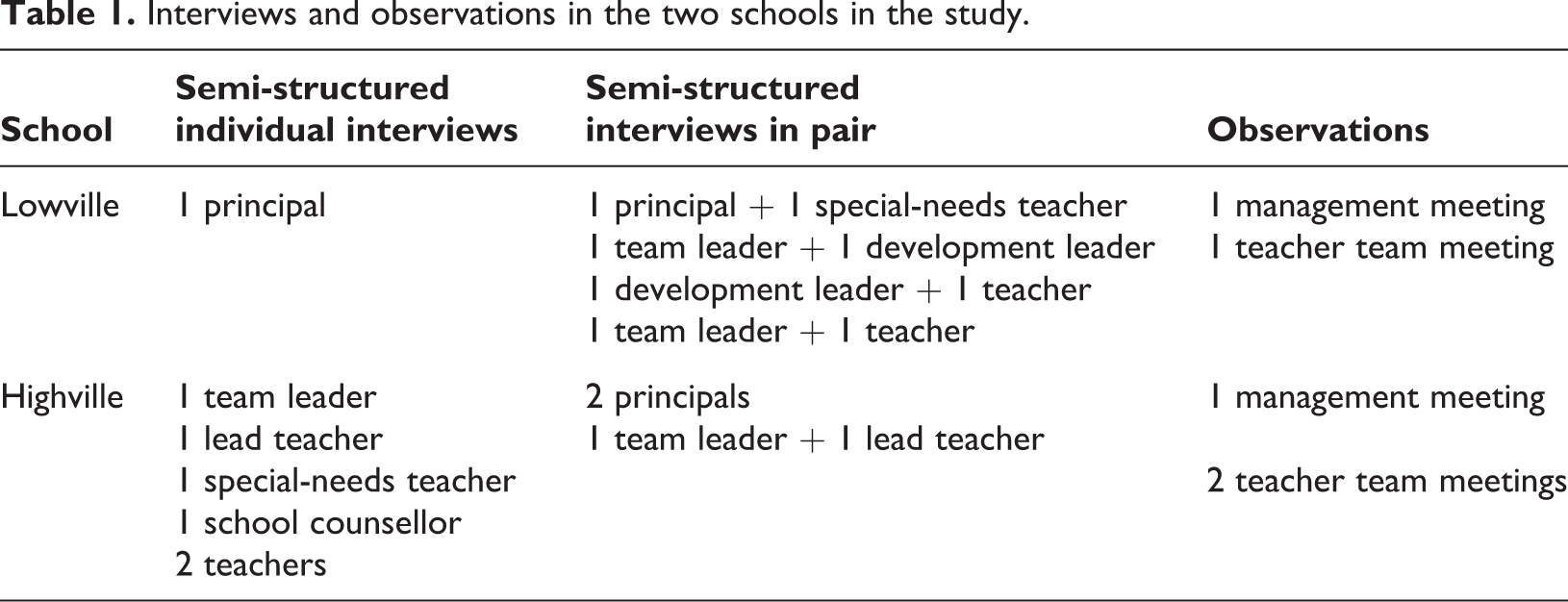
The study is based on nine 45–60-minute, semi-structured interviews with principals, teacher team leaders, subject leaders, lead teachers and teachers in Lowville, and with ten equivalent persons in Highville (see Table 1). For practical reasons most interviews in Lowville were conducted in pairs. The interviews focused on the question: Who or what leads or influences the teachers’ work with their students in this school? In other words, everything that influences, governs or guides the teachers’ instructional work. Participative observations on formal and informal meetings at each school and an interview with the school district superintendent were also conducted. This information was used in the analysis to validate the interview data through convergence of findings by triangulation (Yin, 2018).
Interviews and observations in the two schools in the study.
The empirical data from the interviews and observations were coded and analysed by a thematic analysis inspired by Braun and Clark (2006) and Vaismorade et al. (2016). In a first step, data from the interviews concerning organizational activities and structures that were reported to govern and support the educational work were examined for each school separately. Based on these reports, initial categories of influencing aspects were identified, such as, for example, individual training activities and morning meetings but also culturally established belief patterns or frameworks. To achieve a deeper understanding of these categories, notes and transcripts from observations were added in a second step of the analytical work as well as data from the interview with the district superintendent. This contextualized the categories and added a richer picture of the identified categories as components in each school’s educational infrastructure and their potential influence on the teachers’ educational practice. In a third step, the findings at each school were compared and the reports from the two schools cross-checked for similarities and differences. Finally, a more theory-driven analysis (Braun and Clark, 2006) was conducted across the established categories, based on a theoretical sensemaking perspective, to identify ways in which they influence teachers’ sensemaking about their instructional practice.
Results
In this section we present our findings concerning organizational components in the educational infrastructure in each of the two schools focused on in this paper. We start with Lowville, where external input and individual professional development are identified as core components in the educational infrastructure.
Lowville
External input of new knowledge
The district administration arranges several types of training activities for all schools in the district. Workshops or lectures on topics relevant for teachers in general are offered as well as networking activities where teachers meet and exchange experiences. In Lowville, we identify this support from the school district as a core component in their educational infrastructure. Based on a firm belief that external input of new knowledge informs and improves teaching practice, such occasions for exchanges of experiences with colleagues from other schools are highly valued. For this work, that we are going to do now, we have received courses with a man named [xx] that the school district has arranged. We do get external input. That’s good. /…/ It affects the teaching. (Development leader Jennifer) We have a number of times talked about visiting each other’s classrooms, to learn from each other. It would be great, we say. But it doesn’t happen. I think we’ve been talking about it for 15 years. (Teacher Alice)
Individual professional development
Teachers’ individual professional development is identified as another important component in the educational infrastructure. It is described as a way of informing teaching practice according to the latest research and didactic trends, but also as a means for making the school an attractive workplace for teachers. It’s very important that we can offer courses and other competence development activities. We have to give our teachers new influences to improve their teaching practice. How can we make this an attractive workplace unless we give them some external influences? (Principal)
Our participative observations show, however, that information, planning and coordination dominate the teacher team meetings as well as the school management meetings. Less time is devoted to sharing experiences or knowledge. The principals genuinely care for their staff and are keen to inspire and motivate them, convey hope and support them by administrating individual professional development. Fewer efforts are devoted to establishing a common vision for the school. Hence, a lack of a clear, long-term vision is recognized also at the school level, making the purpose of different development initiatives vague or fragmented. Each teacher, individually, has to make sense of new knowledge and its instructional use. In Lowville, as in other schools, teachers are confronted with a multitude of messages about teaching (Coburn, 2001). The consequence of not having a vision that reduces complexity by binding the different messages together is illustrated by a teacher with the metaphor of throwing a dice. It feels like we are throwing a handful of dices and let them fall, and then we see what happens. And if it doesn’t turn out well, we throw them again and see what happens this time. (Team leader Ruth) I would like us to turn more to ourselves, and not just embrace everything that comes from outside. We should trust what we already know and can do. We already have a mass of competences in the school. (Principal)
Lowville in summary
In Lowville we identified two prominent organizational components in the local educational infrastructure: 1) meetings, networks or courses offered by the school district, and 2) individual professional development on the latest instructional trends. The importance of these components is based on a cultural-cognitive belief in external input to inform practice. The individual competences reached in these activities are supposed to be transferred to the rest of the teaching staff in the school. Lack of time and space for exchanging experiences and the absence of a culture supporting it make this diffusion less credible. Consequently, each teacher, individually, has to make sense of how to use the new knowledge in their own teaching practice.
Highville
Teachers in Highville are offered the same development activities from the district office as in Lowville. However, these activities are not at all stressed in the same way as critical for the instructional quality at the school, although they are equally valued per se. In contrast, three quite different organizational aspects are identified: a centrally located café, Monday meetings and a counselling team.
A centrally located café
When the school was rebuilt some years ago, it was decided to place a café in the hallway in the centre of the school. This café is identified in the analysis as an important organizational component, shaping teachers’ understanding of the educational work. The idea was to make the café a place where students and teachers could meet and socialize informally. Today the café works as a meeting place for informal exchanges of experiences. If you have been in the hallway there is always a bunch of teachers having coffee together. You spend a lot of time with students and colleagues. You do not take your coffee in your office. No, no, no. There you work! (School counsellor Joanna) [The principals] are available. They also have coffee in the hallway. I mean it’s easy, for both students and staff, to come close to them. It’s really important. (Lead teacher Anna)
Monday meetings
Every Monday morning a 20-minute meeting is held for all staff, teachers as well as administrative personnel, caretakers and cleaners. In our analysis these meetings are identified as an important organizational activity that influences the teachers’ understanding of their work. It is an opportunity for the management to gather the staff for the week to give and receive information. It is likewise an opportunity for any staff member to reach out to all co-workers with information or questions. It’s great. It’s an opportunity for plenty of questions or information. And many are active and say things or remind us about things. Everyone comes to talk and have their say. (Principal) It [the Monday meetings] creates a community, like a start of the week. The principals are always very welcoming: ‘How nice to see you again!’ and ‘Here we go!’ So, both welcoming and pep talk. (Teacher Eva)
Counselling team
A third influential organizational component is what the school calls the ‘well-being team’, a counselling resource to be called upon in case of conflicts among students and other difficulties the responsible teacher cannot handle on their own. The team meets every Friday and consists of the career guidance counsellor, the school counsellor, the school nurse, the special-needs teacher, one principal and some experienced teachers. The group works with more acute incidents, but also preventively to promote safety and well-being among students and staff. This consultation is a way to informally and swiftly handle disturbances in the teachers’ assignments. One teacher describes the informality of the procedure by saying: One can just come here, without having to fill in a lot of forms, and put what you think is a problem on the table and we talk it through together. (Special-needs teacher Stina) Many of those [in the counselling team] who have worked here for a long time talk about the importance of relationship, of talking to each other and the importance of working together. (School counsellor Joanna) It’s the collegial cooperation that affects my teaching the most, I would say. We help each other, so to say. (Team leader Susan)
Highville in summary
We distinguish three organizational components in the educational infrastructure of Highville: 1) a café in the centre hallway functioning as an informal meeting and access point, 2) Monday meetings for all staff, and 3) a counselling team of experienced teachers helping colleagues to informally handle problems in their teaching. These three organizational components influence and coordinate teachers’ sensemaking about their instructional practice. Together they constitute different arenas for interaction that mediates teachers’ understanding of how things are done here, a cultural-cognitive belief in being visible and accessible to each other that forms a coherent guidance to a joint understanding of the instructional practice.
Comparing the schools’ educational infrastructure
The analysis of the two schools highlights two contrasting views on organizational components in the educational infrastructure. In Lowville, the educational infrastructure is focused on what Diamond and Spillane (2016) call ‘obvious components’, supporting external, individual and formal competence development. The infrastructure is personalized and dependent on individual competence and motivation among teachers. Its roots can be traced to a cultural-cognitive belief in external solutions or formulas to inform practice. In contrast, in Highville the ‘less obvious components’ (Ibid.) of the educational infrastructure are in focus, being explicit and organized arenas for cooperation and collegial support. It is based on a cultural-cognitive belief in being visible and accessible to each other. In both schools we found that the educational infrastructure played a significant role in the teachers’ sensemaking about their instructional practice. How the organizational components in the infrastructure condition the teachers’ sensemaking processes is discussed below.
Two ways of guiding teachers’ sensemaking
Our analysis suggests that an important function of the educational infrastructure is to facilitate and guide teachers’ sensemaking processes. However, the activities, structures and beliefs at the two schools guide the sensemaking processes differently. The organizational activities in Highville enable the teachers to engage in collective sensemaking about instructional practice. In Lowville they rather fostered individual sensemaking processes.
The café and the Monday meetings in Highville are arenas that bring teachers together from different parts of the school with other staff members, offering space (Hopkins and Spillane, 2015) for school leaders, teachers and others to jointly make sense of the school’s daily activities. Such sensemaking is highly contextualized and relational (Weick, 1995). When teachers meet informally in the café and solve everyday problems, it is part of an ongoing organizing process. The café offers a place for collective sensemaking that the formal leaders are part of. The Monday meetings have the same function. Everyone can take part in what is going on in the school and can hear different interpretations of it. At the Monday meetings most people are very active, say things, inform about what will happen during the week, explain and so on. /…/ It’s a planned and conscious way of working, an important instrument for us. (Principal Highville)
In Lowville, on the other hand, the educational infrastructure influences the teachers’ individual sensemaking about their instructional practice. With its focus on external and individual training activities, and less time and space for educational discussions, each teacher makes their own interpretations of how the knowledge gained in external training activities can be applied in their teaching practice. In other words, each teacher makes sense of new knowledge from professional development activities against their own pre-existing individual cognitive script. Informal meetings do certainly occur, but are less organized, and the formal meetings seldom give rise to collective sensemaking about teaching practice. Our meetings are so full of practical things to be solved. We talk about getting into pedagogical discussions. But we’re not there yet. (Principal Lowville)
A guiding vision
Highville has an explicit and enacted vision of a good school based on the notion of transparency and collegiality. The principals have worked hard to establish an equivalent culture. We try to be very visible. We make a lot of classroom visits which is in no way prestigious. We just slip in. We are constantly out in the school talking to staff or students. And we aim for transparency in all decisions. (Principal Highville) Of course, we have a vision for this school, but what is most important is that the teachers feel that we listen to them and confirm that they are doing a good job, that they feel safe, that we are here for them. (Principal Lowville)
As a consequence, each teacher was expected to construct meaning individually where several interpretations seem plausible. Hence, each teacher developed important competences, but the use of new or improved methods to inform teaching practice turned out to be quite fragmented at the school, less easy to turn into joint action. This analysis is supported by Hopkins and Spillane (2015), who argue that the way educational infrastructure influences teachers’ work depends ultimately on the cultural-cognitive beliefs inside schools. This means that the ongoing introduction of development teams in Lowville has, as the principal suspects, a long way to go before pedagogical discussion occurs naturally in the teams. While the belief in professional development in Lowville supports professional identity as a teacher, the guiding vision in Highville encourages cooperation and co-practices that support the teachers’ organizational identity.
The principal as sensegiver
The principals in Highville deliberately use the educational infrastructure as a governing means. By participating in the informal small talk in different forms of gatherings, principals get to know what is going on in the organization and have an opportunity to influence the teachers’ work by setting the direction of information, representing the culture of the school and fostering a common identity. Thereby they actively act as sensegivers (Gioia and Chittipeddi, 1991) for the teachers’ common understanding of their role and work as teachers. They facilitate a joint sensemaking process informally (Coburn, 2005) by using the infrastructure to communicate and visualize their vision for the school. In this way, activities like the café, meetings and the counselling team provide teachers with an interpretive framework for the construction of meaning towards a preferred understanding to serve as a foundation for their future decisions and actions (Degn, 2015). These findings align well with previous studies (Brown et al., 2019; see e.g. Witziers et al., 2003) that foreground the significance of leaders’ indirect influence through their impact on school organization and culture.
The principals at Lowville have a more traditional role, focusing on meeting the teachers’ demands for professional training and development. The principals’ role can be understood as administrating support for the teachers’ professional development, which is considered important for teaching quality as well as the legitimacy of the school. The management has not, however, succeeded in its ambition to use individual professional training as a means for school development. An active and persistent transfer of new knowledge to colleagues has not yet been established. Teachers develop their competence individually and construct meaning from new input for their own instructional practice. Informal meetings occur, of course, also among the teachers in Lowville. They are, however, more random and less focused on sharing experiences and forming a common ground for their work. Equally important, neither formal nor informal meeting spaces are actively or consciously used by the principals to facilitate joint sensemaking. Without sensegiving support from the formal leaders, the educational infrastructure will not, as in Highville, be the same steppingstone for supporting the teachers’ collective sensemaking. Our conclusion is that formal leadership that maintains and uses the infrastructure for sensegiving purposes is a prerequisite for enabling and supporting teachers’ collective sensemaking processes (Harris, 2012). The leadership in a school needs, however, to be compatible with the existing local culture in the school (Brown et al., 2019). A distributed culture has evolved among the teachers in Highville for a long time, and the present principal’s leadership style fitted in nicely. The previous principal was more hierarchical in his leadership; he was, as one teacher put it, ‘not long-lived at the school’.
Does educational infrastructure make a difference?
The two schools in this study were purposively selected for their different student outcomes. Since Lowville is an under-performing school, according to a statistical model from the Swedish National Agency for Education (see Method section), our results can tentatively support the notion that school improvement is difficult to achieve in schools that embrace an individual learning belief (Blossing and Ertesvåg, 2011). Furthermore, Peurach and Neumerski (2015) argue that the educational infrastructure in low-performing schools is often weakly developed and highly fragmented. In such schools, they argue, there is less potential to focus on identifying and addressing the educational needs of students. In Highville, the strong sense of collegiality and accessibility can be assumed to facilitate on-the-job interaction and learning. Findings by Shirrell et al. (2018), that the development of teachers’ practices is more driven by on-the-job learning than by formal professional development, support the view that the educational infrastructure matters.
On the other hand, Lowville is also a well-functioning school, where the educational infrastructure supports an equally important development activity: individual professional development. There might also be other aspects such as the premises, the size of the school, teacher competence, the culture and so on that finally define how the infrastructure can be designed and utilized. Mehta and Fine (2015) argue that the discussion on infrastructure has so far not been sensitive to contextual aspects. They suggest that different forms of infrastructure are likely to fit different contextual conditions. Nevertheless, our conclusion is that framing situational aspects in terms of local educational infrastructure reveals important aspects of a school’s management system, an often-overlooked aspect of governing and supporting teacher work. The reason for this is that a traditional leadership perspective has its focus on the single leader and tends to neglect the importance of organizational aspects and their contribution to the development of teachers’ educational practice. This does not necessarily mean that formal leaders are less influential. Rather, this study highlights the fact that leaders’ efforts to develop and use the educational infrastructure become an integral way of governing educational practice.
Conclusions
The distributed leadership perspective adopted in this paper suggests that school leaders, teachers and the situation in interaction shape the instructional practice in a school. The paper focuses on the situational dimension framed as local educational infrastructure in two schools, more specifically on the organizational components in the educational infrastructure. The results highlight two contrasting views. In Lowville, external input and individual professional development are identified as core components in the educational infrastructure, while three quite different organizational aspects are identified in Highville: a centrally located café, Monday meetings and a counselling team.
However, the results show that what is important is not simply the single components of the educational infrastructure, but how these components work together (Cohen et al., 2017; Spillane et al., 2018). What is equally important is the way the individual elements in the infrastructure – organizational structure, culture, beliefs, activities – fit together (Mehta and Fine, 2015). In Highville, the organizational components in the infrastructure make up a coherent guidance system tightly connected to the cognitive-cultural beliefs, forming a glue that binds the staff together. In addition, the educational infrastructure does not present itself as given (Weick, 1995) or self-enacting (Mehta and Fine, 2015), either for principals or for teachers. This means that the principal must make a conscious choice about the design of the infrastructure, but, even more important, how to use it. The leadership practice in Highville integrates the principal’s use of the infrastructure for sensegiving purposes, the teachers’ common understanding of their role and work and the organizational components of the infrastructure into coherent instructional guidance. In Lowville, the organization and the leadership practice is more loosely coupled (Weick, 1976) based on individual sensemaking processes.
Our analysis suggests that an important function of the educational infrastructure is to enable and guide teachers’ sensemaking about their instructional practice; and, from the two schools we learn that it can promote both individual and collective sensemaking. We identify two aspects that influence how the infrastructure conditions the sensemaking processes. First, there must be an enacted vision of the school that functions as a cultural-cognitive framework supporting the teachers’ collective construction and sensemaking of their teaching practice. In the absence of such a vision, the infrastructure risks supporting only individual and fragmented sensemaking processes among teachers. Our conclusion is that activities for collective learning and sensemaking will only work if they are based on a clear vision for the school. Second, the formal leader’s use of the infrastructure shapes how the sensemaking processes unfold among the teachers. The principal’s use of the infrastructure for sensegiving purposes facilitates the teachers’ collective sensemaking processes. Using a public space in the school, like a café, for social interaction and discussion is an example of how collective sensemaking can be made possible. The infrastructure can alternatively be regarded as an integrated means for teachers’ professional development, and the role of the principal is to administer such support. That the formal leaders’ actions are vital is well known, even from a distributed perspective. But previous research does not clearly show how it matters, and in what way (Bouwmans et al., 2019; Tian et al., 2016). This study provides one tentative explanation of how and why formal leadership matters: it enables and guides teachers’ sensemaking about their instructional practice.
To conclude, this study suggests that an important function of organizational components in the educational infrastructure is to facilitate and guide teachers’ sensemaking processes about their instructional practice, both individually and collectively. The success of this function depends on the clarity of the school’s vision and the principal’s use of the infrastructure for sensegiving purposes.
Limitations and future research
This research has several limitations. First, the findings are mainly based on data collected via qualitative interviews from two schools; they cannot therefore be generalized for a larger target population. Nor can the components in the infrastructure found to promote teachers’ practice be generalized, due to the contextual sensitivity discussed above. In addition, the study was conducted in a Swedish school context where the team leaders’ and other middle leaders’ roles and mandates differ from those in many other countries.
Second, most interviews in Highville were conducted individually, while in Lowville, for practical reasons, most were conducted in pairs. This could have affected the results, but no deviation was detected between the interviews, observations and informal discussions on site. Interviews in pairs meant that each interviewee elaborated on the interview questions in turn; they were not supposed to reach a joint statement. Rather, the pairs helped each other to exemplify their descriptions and clarify different perspective views that emerged.
Despite these limitations, this article adds to the theoretical discussion of the role of the educational infrastructure. It highlights a need for further studies on school leadership through the lens of organizational components in the educational infrastructure. Therefore, more comparative studies on important infrastructure components and their consequences in different contexts are needed, both nationally and internationally. The infrastructure’s role in power distribution and social authority, and how it affects the sensemaking and sensegiving processes in public spaces, is an important area for further research. Finally, there is a need to know more about the way the infrastructure may be designed to help school leaders manage the development of teachers’ practice in local schools.
Footnotes
Declaration of conflicting interests
The author(s) declared no potential conflicts of interest with respect to the research, authorship, and/or publication of this article.
Funding
The author(s) disclosed receipt of the following financial support for the research, authorship, and/or publication of this article: This research was funded by FORTE – The Swedish Research Council for Health, Working Life and Welfare – as part of the project ‘The many Faces of School management’ (project no 2015-00552). The authors thanks FORTE for the financial support.
