




Abstract
Background
The promotion of exercise among black individuals with multiple sclerosis (MS) is important for managing the functional and symptomatic manifestations of MS.
Objective
The objective of this study was to elicit exercise program preferences among black individuals with MS.
Methods
Participants completed a survey delivered through Qualtrics. The survey measured exercise program component preferences, the importance of racial considerations, and barriers and facilitators to exercise participation.
Results
Forty black individuals with MS completed the survey and reported a preference for five days per week (range 0–7) of exercise at a moderate intensity (50% of the sample). Over 60% of participants desired an exercise program that was longer than six months, and over half wanted the aid of a behavioral coach. Participants preferred weight/resistance training exercises (52.5%) and easy walking (35%) modalities. The outcomes expected from exercise were increased muscle strength (65%) and improved overall body functioning (60%). The anticipated barriers for exercise were largely fatigue (40%) and time management (32.5%). The desired facilitators were a personal trainer (57.5%) and more exercise information (32.5%). Cultural and racial tailoring was very important or held some importance on the components of the program.
Conclusion
The findings of this study should be considered when developing exercise interventions for black individuals with MS.
Introduction
Multiple sclerosis (MS) is a chronic neurological disease characterized by demyelination of axons and degeneration of neurons within the central nervous system with a prevalence exceeding one million adults in the United States.1,2 MS was once considered a disease of those with Northern European ancestry, but recent evidence indicates an increased prevalence of MS among black individuals in the United States. Black individuals with MS may experience a more aggressive disease course and have poorer response to disease modifying therapies than whites with MS.3–5 Further, the adjusted odds of having a physical comorbidity (e.g., diabetes, hypertension, heart disease) for blacks with MS is 1.49 times (95% confidence interval 1.08–1.86) the odds for whites with MS. 6 Diseases such as diabetes, hypertension, and heart disease can be prevented and managed with physical activity participation.7–9 Little is known about rehabilitation approaches for black individuals with MS, and one particularly promising strategy for managing the manifestations of MS among the black community may be participation in physical activity and exercise.
The benefits of physical activity and exercise for individuals with MS are well documented and may include favorable effects on muscular strength, aerobic capacity, ambulatory performance and quality of life. 10 One important caveat, however, is that the majority of evidence on the benefits of exercise and physical activity is derived from samples of middle class white individuals with MS; minority populations are not well represented in studies of physical activity and exercise in MS. 11 One recent study reported that less than one percent of the nearly 60,000 scientific articles on MS focus on minority populations. 12
Despite the wealth of evidence detailing the safety and benefits of exercise and physical activity, individuals with MS as a whole do not engage in sufficient levels of physical activity and exercise, and black individuals with MS engage in less physical activity than white individuals with MS.13,14 This further highlights the need for efforts that target the promotion of physical activity and exercise among black individuals living with MS.
The barriers and facilitators related to physical activity and exercise have been explored in the MS population.15–17 Yet, the barriers identified in these studies largely represent the middle class white individuals with MS, as minority populations are not well represented in the existing research. 11 The investigation of the needs and preferences for exercise, as well as the potentially unique barriers and facilitators experience by this population, is an essential next step to developing programs that may successfully promote the adoption of physical activity and exercise behaviors in black individuals with MS. Tailoring physical activity and exercise programs may increase receptivity to, acceptance of, and salience of health information and programs. 18
The present study surveyed black individuals with MS regarding exercise program component preferences, importance of racial considerations in exercise program design, current exercise levels, and anticipated barriers and facilitators to exercise. Such knowledge may better inform the design of physical activity and exercise interventions, promotional efforts, and guidelines in this underserved segment of the MS community.
Materials and methods
Participants and procedures
This study was approved by the University of Illinois at Urbana-Champaign Institutional Review Board. One hundred black individuals with MS were identified through the Exercise Neuroscience Research Laboratory database. This database includes previous research study participants from across the United States who have provided permission to be contacted about future research. Potential participants were recruited by email to participate in a survey delivered via Qualtrics (Prove, UT). Participants were emailed an invitation to participate in a study on “understanding opinions about exercise programs for black individuals with multiple sclerosis.” Once participants provided informed consent they were directed to complete a 30-minute survey regarding demographics, ideal exercise program, barrier and facilitators to engaging in exercise, the importance of racial and cultural considerations, and current exercise levels. The inclusion criteria included: (a) being at least 18 years of age; (b) confirmed diagnosis of MS; (c) identifying as Black/African-American; and (d) willingness to complete a 30 min survey.
Measures
Participant demographics were captured by a survey developed by the research team and included questions on age, weight, height, education, marital status, sex, and income.
Participant exercise program preferences were captured by a survey developed by the research team and included questions concerning preferences for an ideal exercise program and racial considerations. The survey was informed by over 13 years of formative interactions with the general MS population through research studies, including recent formative work with black persons with MS. The survey questions were formatted as multiple choice and checkboxes with the ability to select “other” and write in an additional answer. The survey was piloted using a convenience sample of three black women with MS who provided feedback on the appropriateness and clarity of the content. The feedback resulted in minor modifications for improving the clarity of the questions. The survey questions are provided in Table 1.
Perceptions of an ideal exercise program questionnaire.

Exercise behavior was measured using the Godin Leisure-Time Exercise Questionnaire (GLTEQ).19,20 The GLTEQ consists of three open-ended questions that measure the frequency of strenuous (e.g., jogging), moderate (e.g., fast walking), and mild (e.g., easy walking) exercise for sessions more than 15 min during one’s free time in the preceding week. The weekly frequencies of strenuous, moderate, and mild activities were multiplied by 9, 5, and 3 metabolic equivalents (METs), respectively, and the sum was calculated to form a measure of total leisure activity. Additionally, the health contribution score (HCS; i.e., equivalent of time spent in moderate-to-vigorous activity) was calculated from the frequency of only strenuous and moderate activities. The frequencies for strenuous and moderate activities were multiplied by 9 and 5 METs, respectively, and then summed into a HCS (0–98) that reflects MET/min per week. The scores are then classified into three categories: active (substantial benefits; >24 MET/min per week), moderately active (some benefits; 14–23 MET/min per week), and insufficiently active (less substantial or low benefits; <13 MET/min per week).
Data analysis
All analyses were performed using SPSS version 25.0 (SPSS Inc., Chicago, IL). Means and frequencies were used to characterize study participants. Means and frequencies were used to describe the preferences, barriers, facilitators, and outcome expectations of the study participants.
Results
Of the 100 individuals who were recruited, 40 individuals completed the online questionnaire. The sample was mostly female (92.5%), unmarried (57.5%), well-educated (77.5% were college graduates), had a household income of greater than USD 40,000 per year (55%), and a mean age of 52.2 years (SD = 9.0). The mean MS duration was 15.9 (SD = 7.9) years and the majority of participants had relapsing remitting MS (65.0%). The mean body mass index (BMI) was 30.4 (SD = 9.3), the mean GLTEQ score was 44.5 (SD = 22.2), and the mean HCS score was 30.6 (SD = 19.4). The characteristics of the sample can be found in Table 2.
Demographic, clinical, morphological, and behavioral characteristics.
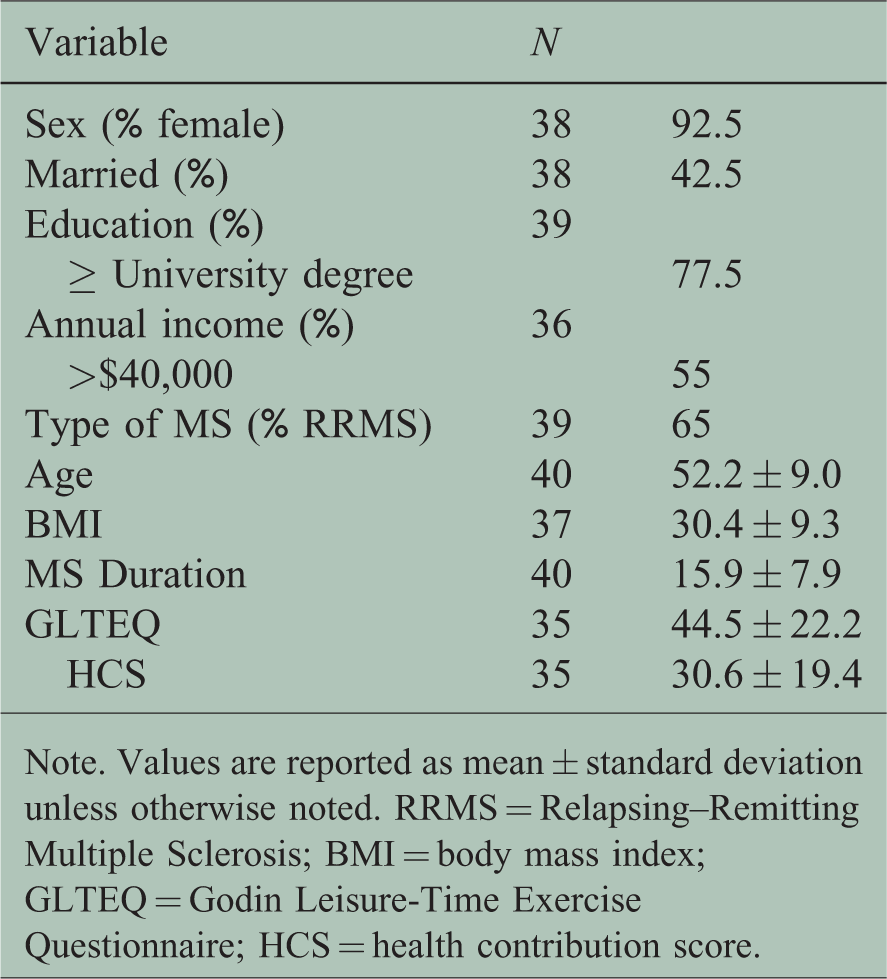
Note. Values are reported as mean ± standard deviation unless otherwise noted. RRMS = Relapsing–Remitting Multiple Sclerosis; BMI = body mass index; GLTEQ = Godin Leisure-Time Exercise Questionnaire; HCS = health contribution score.
The sample’s ideal exercise program characteristics are provided in Table 3, indicating the participant preferences. This sample of black individuals with MS reported a desire to engage in an average of 5 (range 0–7) days of exercise per week at a moderate intensity (57.5% of the sample) with the support of a behavioral coach (63.9%). The exercise sessions would consist of resistance/weight training (52.5%) and easy or fast walking (35% and 20%, respectively). The behavioral coach would interact with the participant on a tapering basis (i.e., more contact at the beginning of the program and fewer interactions as the program progresses).
Participant’s perceptions of an ideal exercise program.

The sample’s barriers, facilitators, and outcome expectations are presented in Table 4. Common barriers that the sample reported needing assistance with were fatigue (40%), time management (32.5%), and the cost of the exercise program (22.5%). Facilitators for keeping participants engaged in an exercise program were a personal trainer (57.5%), more exercise information (32.5%), exercise equipment (32.5%), and clear exercise instructions (30%). The most common outcome expectations reported were increased muscle strength (65%), improved overall body functioning (60%), increased ability to perform daily activities (57.5%), and managed stress (57.5%). Other notable outcome expectations were weight loss (47.5%), decreased fatigue (47.5%), increased sense of personal accomplishment (45%), increased flexibility (45%), and increased endurance (45%).
Participant’s perceived exercise barriers, facilitators, and outcome expectations.

Lastly, participants noted that cultural and racial tailoring was very important (32.5%) or had some importance (25%) concerning the design of an exercise program. Specifically, feeling represented in the media of the program (40% very important; 25% some importance), including motivational content from people who share their race (27.5% very important; 37.5% some importance), being based in faith (17.5% very important; 32.5% some importance), and having the same race as the behavioral coach (12.5% very important; 42.5% some importance) were all important factors to be considered in the design of an exercise program.
Discussion
Exercise is regarded as one of the best comprehensive strategies for MS management yet, black individuals with MS do not engage in sufficient amounts of physical activity or exercise.21,22 The purpose of this study was to elicit the preferences of an ideal exercise program and the importance of racial considerations in exercise program design, as well as anticipated barriers and facilitators to exercise in a sample of black individuals with MS. The results will inform the development of racially tailored exercise interventions for black individuals with MS.
Concerning exercise program components, participants indicated a preference for five exercise sessions per week prescribed at a moderate intensity of effort. The preferred exercise modalities were resistance/weight training and varying speeds of walking. Participants reported wanting the guidance of a behavioral coach on a tapering basis specifying more interaction in the beginning of the program and less interaction as the program continued. Phone calls were the preferred medium to communicate with a behavioral coach and participants reported a desire for an online or phone based exercise-tracking application. Previous research exploring exercise preferences of individuals with MS have observed preferences for walking, strengthening and weight exercise, which are consistent with our findings. However, previous research has also observed preferences for flexibility and stretch exercise session at a frequency of three times per week. 23 When designing interventions that include or target black individuals with MS, it is important to consider the differences in the detailed exercise preferences.
Anticipated barriers of exercise included fatigue, time management, and cost of exercise program materials. These findings are consistent with other research conducted on the barriers of physical activity and exercise in MS populations.15,16,23 Requested facilitators of exercise participation included a personal trainer, exercise information, exercise equipment and clear exercise instruction. These findings suggest that participants desire interaction with a personal trainer to facilitate engaging in exercise and increased availability of exercise information and equipment.
Concerning exercise outcome expectations, participants anticipated increased muscle strength, improved overall body functioning, increased ability to perform daily activities and to help manage stress. Previous research has reported improving emotional health, fitness, and functioning as the primary goals for participating in exercise. 24 The reported outcome expectations may serve as motivational targets when designing an exercise intervention. Further, incorporating functional training that may improve muscle strength, overall body functioning and the ability to perform daily activities may be relevant for this population.
The most novel findings from this study are the results related to cultural and racial tailoring. Participants reported that cultural and racial tailoring was very important or held some importance relating to the design, media representations, motivational content, faith related content, and the racial identity of a behavioral coach. When designing future exercise programs for this population including participants in the design of the program may help to make the program as racially appropriate as possible. Further, including more representative pictures, videos, and testimonials, and staff may allow participants to find the exercise program as racially and culturally appropriate.
Although this study provides important information regarding the design and components of an ideal exercise program for black individuals with MS, there are several limitations to be considered when interpreting the results of this study including sample bias and sample size. The sample size was relatively small with only 40 participants. Disability level was not measured in this study. Future research would do well to characterize participant preferences by disability level. The sample included mostly physically active, well-educated, middle-aged black women with a household income of greater than USD 40,000 per year. The results of this study may not be generalizable among other subpopulations within the black MS community. Future research would do well to include participants with more variability in demographics and in exercise participation to capture more representative preferences of an exercise program. However, it is important to note that previous research found no significant difference in exercise program preferences between regular exercisers and MS participants who did not regularly exercise.24
In conclusion, this study reports the preferences of an ideal exercise program for black individuals with MS. A qualitative investigation reviewing the findings of this study as well as a more thorough investigation of specific barriers, facilitators, and motivations related to exercise in black individuals with MS is an important next step in identifying how to best serve this population. This is critical for designing exercise programs that can address the increased prevalence of comorbid conditions that can impact the progression and severity of MS among black individuals.
Footnotes
Acknowledgments
The authors gratefully acknowledge the participants of this research study.
Conflict of Interests
The author(s) declared no potential conflicts of interest with respect to the research, authorship, and/or publication of this article.
Funding
The author(s) received no financial support for the research, authorship, and/or publication of this article.