




Abstract
Background
Plantar fasciitis is a common condition that impacts patients’ motor function and quality of life. As short video platforms such as TikTok and Bilibili become increasingly popular for information seeking, patients are turning to them for health guidance, yet the quality of this content varies significantly. This cross-sectional study was designed to systematically evaluate the quality, reliability, and content completeness of plantar fasciitis videos on TikTok (Chinese TikTok, Douyin) and Bilibili.
Methods
A total of 158 videos were collected and assessed using the global quality score (GQS), modified DISCERN (mDISCERN), and JAMA benchmarks, while uploader identity and user interaction data were also analyzed.
Results
Compared with Bilibili videos, higher GQS scores were observed for TikTok videos (p = 0.003), whereas no significant between-platform differences were observed for mDISCERN (p = 0.496) or JAMA (p = 0.103). User engagement was also higher on TikTok. Professionally uploaded content, particularly from medical personnel, significantly outperformed videos from nonprofessional sources in terms of quality and reliability (p < 0.001). In terms of content, a significant gap was identified: 91.8% (n=145) of the videos addressed treatment, whereas only 15.8% (n=25) mentioned prevention. Crucially, correlation analysis revealed no significant associations between user engagement metrics (e.g., likes, shares) and GQS, mDISCERN, or content completeness scores.
Conclusion
These findings reveal a dual role for short video platforms in plantar fasciitis information dissemination: they not only enhance public access but also risk spreading low-quality content due to inadequate oversight. Enhanced credential verification for health creators, greater involvement of medical institutions in content creation, and improved public education to prioritize verified sources are therefore warranted.
Introduction
Plantar fasciitis is the most common cause of heel pain and a significant public health concern. 1 Its chronic, debilitating pain can substantially impair mobility, work productivity, and mental well-being.2,3 Pathologically, the condition is commonly characterized by degenerative microtearing and collagen disorganization at the plantar fascia origin near the medial calcaneal tubercle, with associated fascial thickening and perifascial soft-tissue changes. Although diagnosis is primarily clinical, imaging modalities—including musculoskeletal ultrasound, magnetic resonance imaging, and weight-bearing radiography—can support diagnosis and help exclude alternative causes of heel pain. In particular, ultrasound-based measurement of plantar fascia and fat-pad thickness at predefined plantar target points has been proposed as a rapid and cost-effective diagnostic adjunct. 4 The condition’s management pathway is complex and lacks a gold standard. Common treatment strategies include activity modification, plantar fascia/Achilles stretching, foot orthoses, nonsteroidal anti-inflammatory drugs, and structured physical therapy, with adjunctive options such as extracorporeal shock wave therapy or surgical intervention reserved for refractory symptoms. Consequently, multiple therapeutic options, from physical therapy to pharmacological interventions, coexist with inconsistent clinical outcomes.5,6 For example, comparative clinical evidence has shown that although corticosteroid injections may provide faster short-term pain relief for chronic plantar fasciitis, platelet-rich plasma (PRP) injections may yield more durable improvements in pain and functional recovery over subsequent months. 7 Such treatment heterogeneity and high recurrence rates further exacerbate the long-term physical and economic burden on patients. 8 A consensus in the literature holds that effective patient education is a cornerstone of successful long-term self-management, improved treatment adherence, and recurrence prevention.9,10 However, in traditional clinical settings, limited consultation time and standardized educational materials often fail to meet the personalized informational needs of patients. 11
The proliferation of digital technologies, particularly the rise of short video platforms, has brought about disruptive changes in the health information ecosystem. 12 Platforms such as TikTok and Bilibili have become central channels through which hundreds of millions of users access health information.13,14 Their highly visual and narrative-driven formats may improve the accessibility of complex medical information. 15 These platforms have shown significant potential in bridging gaps in traditional patient education, for instance, by guiding rehabilitative exercises or fostering patient communities for emotional support. 16
However, this decentralized information environment has also given rise to formidable challenges. The engagement-centric algorithmic mechanisms of these platforms tend to prioritize content that elicits strong emotional responses or promises “quick fixes” over evidence-based scientific information,17,18 potentially creating a significant disconnect between a video’s popularity and its scientific validity—a phenomenon known as the “quality-popularity paradox”.19,20 Furthermore, immense variability in information quality is introduced by the heterogeneity of content creators—ranging from certified clinicians to commercially motivated fitness influencers. 21 The general absence of robust credential verification systems on these platforms makes it difficult for the public to discern the authority of a source. This environment may also foster systematic content bias, where easily digestible symptomatic treatments are overemphasized while more crucial, complex etiological discussions and preventive strategies are marginalized, creating a “content gap”. 22
While the quality of online health information has become a broad area of research, a systematic investigation focused on plantar fasciitis within the emerging medium of short video platforms remains a distinct gap in the literature. 23 A comprehensive analysis of the quality, reliability, and content of related videos on TikTok and Bilibili was therefore conducted to assess their current state as patient education tools. This study mapped the current content ecosystem, identified its primary deficiencies, and explored the relationships among uploader identity, user engagement, and informational accuracy, thereby providing empirical evidence for patients, healthcare professionals, and platform governance. It was hypothesized that plantar fasciitis videos on TikTok would demonstrate higher overall information quality and greater content completeness than those on Bilibili, and that videos uploaded by medical professionals would show superior quality, reliability, and content completeness compared with those uploaded by nonprofessional sources.
Methods and materials
Ethical considerations
This study was reviewed and approved by the Professor Committee of the School of Sport and Physical Education, Zhengzhou University (approval no. ZZUIRB 2026-03). Publicly accessible social media content posted on TikTok and Bilibili was used as the study material. Data were collected and analyzed responsibly, in accordance with the terms of use of the relevant platforms. No private content was accessed, and no directly identifiable personal information was extracted, reported, or retained. All data were analyzed in anonymized form. As this study involved only the secondary analysis of publicly accessible online content, with no direct interaction with individuals, informed consent was not required.
Use of artificial intelligence
No artificial intelligence tool was used in the preparation, revision, analysis, or writing of this manuscript.
Video search and selection
A cross-sectional study was conducted in October 2025 to evaluate educational videos related to plantar fasciitis on TikTok and Bilibili. In this study, TikTok refers to Chinese TikTok (Douyin). For consistency, the term “TikTok” is used throughout the remainder of this manuscript. These platforms were selected because they are large video platforms on which health-related content is publicly available and because they represent different but complementary health-information environments. Wide international use has been achieved by TikTok, whereas Bilibili has been recognized as a large video-sharing platform relevant to the health information environment. To reduce the influence of personalized recommendation algorithms, all searches were conducted in a logged-out state, thereby minimizing their effect.
Video retrieval was performed using the Chinese keyword “足底筋膜炎” (“plantar fasciitis” in Chinese). The first 100 videos returned by the default comprehensive ranking on each platform were screened. Videos were eligible for inclusion if they were presented in Chinese or in English with Chinese subtitles. Videos in other languages, as well as English-language videos without Chinese subtitles, were excluded. Language eligibility was determined on the basis of the spoken language and subtitle availability during screening. Screening was performed independently by two researchers, and videos unrelated to plantar fasciitis or primarily commercial in nature were excluded. The final sample comprised 158 videos, including 78 from TikTok and 80 from Bilibili, as illustrated in Figure 1. Flowchart of the video selection process.
Data extraction and uploader classification
Several key metrics were extracted for each video in the final sample, including video length and the number of likes, comments, collections, and shares, as well as platform source and uploader category. The uploaders of each video were also classified into one of four predefined categories to better understand the source of the information: professional medical personnel, professional individuals, nonprofessional medical personnel, or nonprofessional individuals.
Professional medical personnel were defined as licensed health care providers with clearly stated professional credentials. Professional individuals were defined as nonphysician creators with relevant professional backgrounds, when such identities were explicitly stated. Nonprofessional medical personnel were defined as uploaders with a medical background but without clear professional qualification. Nonprofessional individuals were defined as laypersons without stated medical or health-related professional credentials. Classification was determined on the basis of publicly available uploader information, including account profiles, self-descriptions, credential displays, and other identifiable account information, when available.
Assessment of quality and reliability
The quality and reliability of each video were assessed via a multifaceted approach involving three validated tools. Each video was independently evaluated once by two assessors with clinical backgrounds in sports medicine. Blinding was not implemented during scoring, as uploader identity and engagement metrics were inherently visible on the original platform interface. Inter-rater reliability was subsequently assessed statistically.
First, the global quality score (GQS) was used to assign a rating from 1 (poor) to 5 (excellent) for overall educational and production quality (Supplementary Table S1). Second, to evaluate the reliability of the health information presented, the modified DISCERN (mDISCERN) scale was applied; this is a five-item questionnaire resulting in a total score ranging from 5 to 25 (Supplementary Table S2). Finally, the Journal of the American Medical Association (JAMA) benchmark criteria were applied to assess adherence to four key reporting standards—authorship, attribution, currency, and disclosure—with one point awarded for each standard met (Supplementary Table S3).
Analysis of video content
To analyze the educational content itself, a checklist was developed with primary reference to the 2023 clinical practice guideline for heel pain–plantar fasciitis, with supplementary reference to the 2014 revision,1,24 which covered seven essential topics 1 : disease overview, 2 etiology, 3 symptoms, 4 diagnosis, 5 treatment, 6 prevention, and 7 contraindications. These domains were selected to reflect the core elements of patient-oriented plantar fasciitis education addressed in the reference guidelines.
The content analysis was conducted with two primary objectives. First, to determine topic prevalence, a binary score was assigned to each domain (1 if mentioned, 0 if not). Second, to assess content depth within each video, each domain was scored using a three-point scoring system (2 for relatively comprehensive coverage, 1 for a brief mention, and 0 if not mentioned). The summed score across all seven domains was used as the total content completeness score for each video. Higher scores reflected more complete coverage of content consistent with the reference standard within each domain.
Statistical analysis
All statistical analyses were performed using R software (version 4.4.0). Depending on the data distribution, descriptive statistics were presented as either the mean ± standard deviation (SD) or median (interquartile range, IQR). For group comparisons, the Mann–Whitney U test was used for two groups and the Kruskal–Wallis H test was used for three or more groups. To explore the relationships between video engagement metrics and quality scores, Spearman’s rank correlation coefficient (ρ) was calculated. Inter-rater reliability between the two assessors for GQS, mDISCERN, content completeness, and JAMA scores was evaluated using a two-way random-effects, absolute-agreement, single-measure intraclass correlation coefficient model, ICC,1,2 with 95% bootstrap confidence intervals. Reliability was interpreted as poor (<0.50), moderate (0.50–0.75), good (0.75–0.90), or excellent (>0.90). 25 No intra-rater reliability analysis was performed. A two-tailed p value of less than 0.05 was considered statistically significant.
Results
Video characteristics
Comparison of video characteristics, quality, and content on TikTok and Bilibili.

Uploader characteristics
In this study, video uploaders were categorized primarily as individuals (63.2%) or medical personnel (36.7%), as illustrated in Figure 2(a). On Bilibili, individuals dominated with 79% uploads, whereas medical personnel had a lower share. Conversely, on TikTok, medical personnel were the predominant uploaders at 53%, with individuals contributing less, as shown in Figure 2(b). Further classification into four categories is shown in Figure 2(c): nonprofessional individuals (39.9%), professional medical personnel (28.5%), professional individuals (23.4%), and nonprofessional medical personnel (8.2%). As shown in Figure 2(d), on Bilibili, nonprofessional individuals (44%) and professional individuals (35%) were the main contributors, whereas on TikTok, professional medical personnel accounted for the largest share at 42%. Distribution of video uploaders. (a) Overall distribution of uploaders into individuals and medical personnel. (b) Distribution of individuals and medical personnel. (c) Overall distribution of the four uploader subgroups. (d) Distribution of the four subgroups on Bilibili and TikTok.
Video quality and reliability
In Part II of Table 1, the median GQS score for TikTok was 3 (Q1 = 2, Q3 = 3), with a mean score of 2.63 ± 0.85; for Bilibili, it was 2 (Q1 = 1, Q3 = 3), with a mean score of 2.21 ± 0.96. For JAMA scores, TikTok had a median score of 2 (Q1 = 1, Q3 = 2) and a mean score of 1.82 ± 0.70; Bilibili had a median score of 2 (Q1 = 1, Q3 = 2) and a mean score of 1.55 ± 0.97. The median mDISCERN score for TikTok was 10 (Q1 = 7, Q3 = 12), with a mean of 9.69 ± 2.97; for Bilibili, the median score was 10 (Q1 = 6, Q3 = 12), with a mean of 9.41 ± 3.59. Figure 3(a) shows a significant between-platform difference in GQS scores, whereas no significant between-platform differences were observed for JAMA or mDISCERN scores (Figure 3(b) and (d)). Comparison of quality and content completeness scores between TikTok and Bilibili. (a) GQS score. (b) JAMA score. (c) Content completeness score. (d) mDISCERN score.
Comparison of video characteristics, quality, and content on uploader.

Comparison of video characteristics, quality, and content among the four uploader subgroups.


Comparison of quality and content completeness scores among uploader categories. (a) Content completeness score. (b) JAMA score. (c) GQS score. (d) mDISCERN score.
Inter-rater reliability was good across all rating instruments, with ICC1,2 values of 0.852 (95% CI, 0.774–0.910) for GQS, 0.858 (95% CI, 0.823–0.887) for mDISCERN, 0.858 (95% CI, 0.818–0.891) for the content completeness score, and 0.850 (95% CI, 0.784–0.900) for JAMA.
Video content analysis
In the video content analysis section, as shown in Figure 5(a) and detailed in Table 1, the most frequently covered topics were treatment (n=145), symptoms (n=122), diagnosis (n=115), etiology (n=104), and disease overview (n=92). Conversely, contraindications (n=38) and prevention (n=25) were the least mentioned topics. A platform-specific breakdown is provided in Figure 5(b). On TikTok, the most common topics were treatment (n=74), diagnosis (n=62), and symptoms (n=60). On Bilibili, the primary topics were treatment (n=71), symptoms (n=62), and etiology (n=58). As indicated in Figure 3(c), there was no significant difference in content completeness scores between the two platforms. However, the content completeness scores did vary significantly among the four uploader categories (p < 0.001), as detailed in Table 3. Figure 4(a) illustrates this variation, showing that professional medical personnel produced videos with the highest content completeness scores. Content distribution of plantar fasciitis videos. (a) Total distribution across seven content categories. (b) Comparison between the TikTok and Bilibili distributions across seven content categories.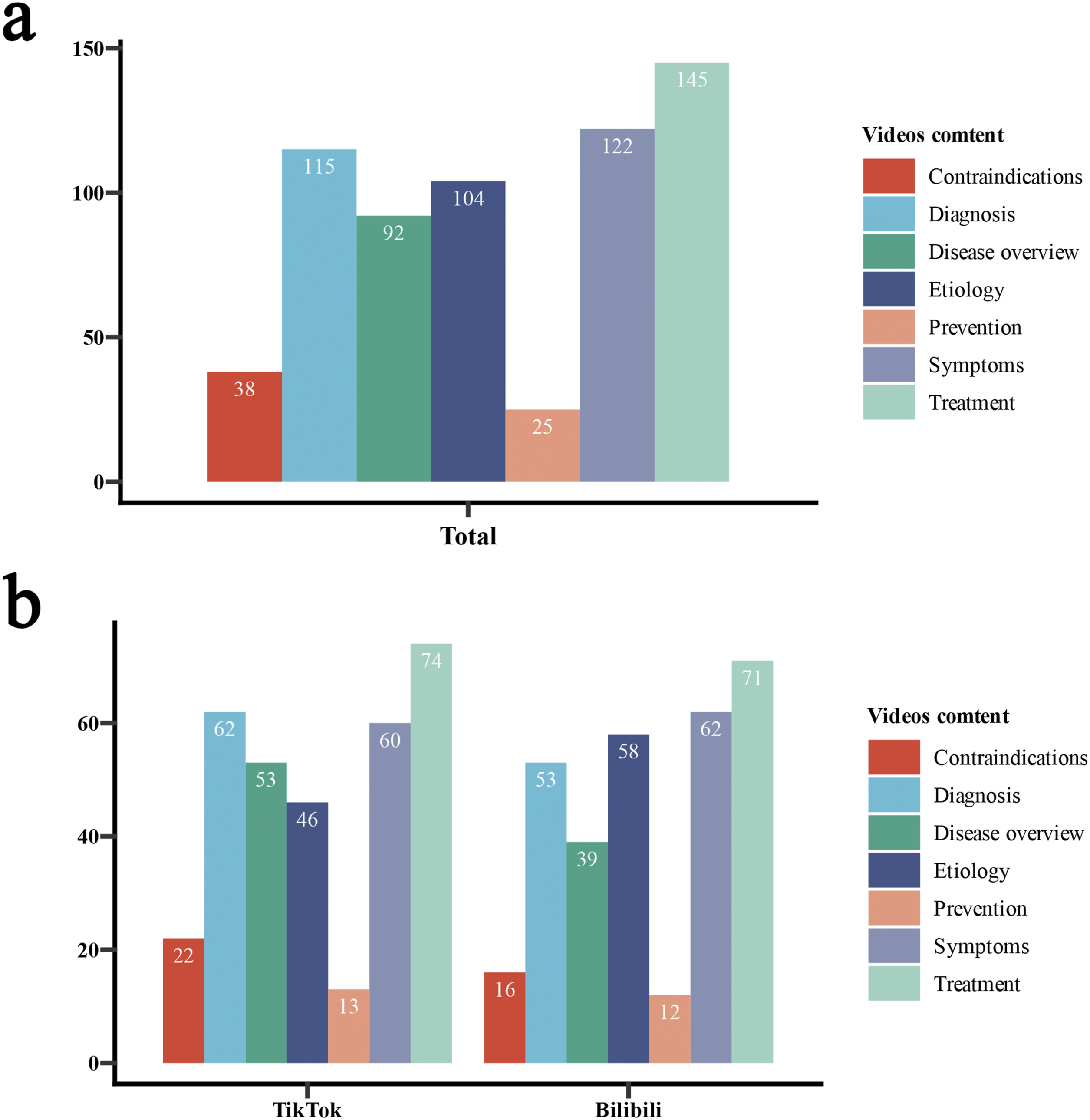
Correlation analysis
Spearman correlation analysis was conducted to investigate the relationships between video metrics, the content completeness score, and quality scores (Figure 6). Significant positive correlations were found among the user interaction metrics; notably, the correlation coefficients between likes and collections (ρ = 0.95) and likes and shares (ρ = 0.94) were very strong. Similarly, strong positive correlations were observed among all the quality and content completeness scores. The mDISCERN score was strongly correlated with the content completeness score (ρ = 0.88) and the JAMA score (ρ = 0.86), and the content completeness score was also strongly correlated with the JAMA score (ρ = 0.82). Conversely, no significant correlations were found between the user engagement metrics (likes, collections, comments, shares) and any of the quality or content completeness scores. Video length demonstrated a weak positive correlation with the content completeness score (ρ = 0.29) and the mDISCERN score (ρ = 0.28) but showed no significant correlation with the user interaction metrics. Spearman correlation matrix among video engagement indicators and quality measures.
Discussion
Overview of the research context
While extensive clinical research on plantar fasciitis has been conducted, evidence regarding the quality of plantar fasciitis-related information on short-video platforms remains limited.23,26 In the present study, differences were more pronounced across uploader categories than across platforms. Videos uploaded by medical professionals consistently scored higher, whereas between-platform differences were comparatively modest. Given that online health information can influence patient health behaviours and health-related decision-making, 27 these findings are clinically relevant.
Overall findings of the characteristics
A close relationship was observed between platform characteristics and uploader composition. Videos on TikTok were significantly shorter yet garnered substantially higher interaction metrics, a pattern consistent with modern media consumption trends in which brevity and high visual impact are prioritized. 28 This format may be particularly attractive to medical personnel, who constituted the predominant uploader group on TikTok (53%). The efficiency of producing and consuming short-form content may fit better within the time constraints faced by clinicians, thereby facilitating their participation as primary content providers on the platform. Conversely, the longer format prevalent on Bilibili, which demands greater user commitment and is associated with lower overall interaction metrics, was dominated by individuals (79%). This format may lend itself more readily to narrative-driven content, such as the sharing of personal patient experiences to foster community support.29,30 Two distinct online environments for health information were created by this divergence in platform characteristics and uploader preferences. Importantly, videos from professional medical personnel, whose content received the highest interaction metrics among the four categories, were most prevalent on TikTok. These findings may indicate that professionally produced content is more highly valued by audiences when presented in an accessible format. 31
Comparison of quality and reliability
The analysis of quality and reliability scores provided further insight into the digital health information landscape. A significant between-platform difference was observed for GQS, whereas JAMA and mDISCERN scores did not differ significantly. This disparity is likely not an intrinsic feature of the platforms themselves but rather a consequence of their distinct uploader communities. As shown by the results, medical personnel, who were found to produce higher-quality content, were the predominant uploaders on TikTok. This may be attributed to stricter verification processes and content moderation policies on TikTok, 31 combined with the fact that the short video format has been shown to garner higher interaction metrics, which may be more appealing to qualified healthcare professionals seeking to maximize the reach of their educational content.
A notable finding was the significant difference in quality across the primary uploader groups. Compared with those from individuals, videos from medical personnel were superior across all quality metrics (mDISCERN, GQS, and JAMA). This quality gap is important for understanding online health communication. The provision of more accurate and reliable information by medical professionals is consistent with principles of evidence-based practice and the ethical obligations associated with digital professionalism.32,33 In contrast, content from individuals, while potentially offering emotional support through shared experiences, is typically based on personal experience rather than scientific evidence. A clear practical implication was identified: the credibility of the source should be regarded as a primary factor in assessing the quality of online health information. 34
The analysis of the four uploader categories provides a more nuanced view of this quality gradient. A distinct and statistically significant hierarchy was observed, with professional medical personnel consistently achieving the highest scores and nonprofessional individuals scoring the lowest. This nuanced hierarchy indicated that expertise should not be regarded as a binary concept. The intermediate scores observed for professional individuals (e.g., trainers, therapists) and nonprofessional medical personnel (e.g., students) may reflect the presence of some relevant knowledge, while indicating a possible lack of the specialized clinical expertise or accountability associated with a licensed medical professional. This presents a challenge to the public, as differentiating among these varying levels of authority may be difficult, potentially leading users to place trust in information from sources that are not fully qualified. 35
Content gaps and their clinical implications
The information landscape for plantar fasciitis on both platforms is significantly imbalanced, with a strong focus on treatment and symptoms. While no significant difference was observed in the overall content completeness scores between TikTok and Bilibili, crucial topics such as prevention and contraindications were found to be severely underrepresented, a finding that is consistent with other studies of online health information.36–38 This content gap has direct clinical implications. For conditions such as plantar fasciitis, preventative strategies are paramount to both avoid initial injury and prevent recurrence. The lack of focus on prevention in the analyzed videos was identified as a significant issue because it reinforces a reactive model of healthcare, in which patients are encouraged to seek information only after symptoms arise rather than being empowered with knowledge for health maintenance.39,40 Patients’ understanding of recurrence-reducing strategies, including load management, stretching adherence, and footwear modification, may also be limited by this imbalance, although these measures are emphasized in current guideline-based management. 24
Similarly, the low coverage of contraindications was considered concerning, as patients may not be warned about potentially harmful or ineffective treatments. In addition, insufficient discussion of contraindications may contribute to unrealistic patient expectations regarding rapid symptom relief or “quick-fix” interventions, especially given the heterogeneity of treatment responses reported across plantar fasciitis therapies.5,7
The significant difference in content completeness scores among uploader categories, with professional medical personnel achieving the highest scores, further highlights this issue. These findings indicate that, although more comprehensive information was provided by professionals, the overall digital landscape still lacked a sufficient volume of high-quality content focused on prevention.21,41
Key findings in the correlation analysis
The correlation analysis offered important insight into the relationship between video popularity and information quality. Although metrics of user interaction (likes, collections, shares) were strongly intercorrelated, no positive correlations were observed between these metrics and the quality and reliability scores (mDISCERN, GQS, and JAMA) or the content completeness score. These findings suggest a “quality–popularity paradox” within this specific domain of health information, a phenomenon that has also been identified in other studies of health content on social media.20,42,43 This phenomenon may be explained by two main factors. First, user engagement can be influenced by factors other than scientific accuracy, such as the appeal of personal narratives and the perceived relatability of the uploader. 44 Second, the algorithms that govern content visibility on these platforms are often designed to maximize user interaction rather than to curate for scientific validity. 45 A feedback loop may therefore be created, in which content that is algorithmically engaging, regardless of its accuracy, is promoted to a wider audience. 46 One implication of this finding is that patients seeking information may be guided by popular rather than reliable content, which could contribute to the dissemination of misinformation. This places a greater burden on the individual user to critically appraise the information they encounter.
Limitations
These findings should nevertheless be interpreted in light of several limitations. First, only two short-video platforms were included, which may limit the generalizability of the findings to other digital health-information environments. Second, video retrieval was performed using a Chinese search term, and eligibility was restricted to videos presented in Chinese or in English with Chinese subtitles; therefore, the sample reflects a specific linguistic and cultural context and may not represent plantar fasciitis-related content in other commonly used languages. In addition, TikTok in this study refers to Chinese TikTok (Douyin); therefore, the findings should be interpreted primarily within the Chinese-language short-video environment. Third, although all searches were conducted in a logged-out state to reduce personalization, the default ranking systems and underlying recommendation algorithms of the platforms may still have influenced video visibility and selection. Fourth, uploader classification was based on publicly available account information and credential displays, which may have resulted in some degree of misclassification. Fifth, blinding was not feasible during video assessment because uploader identity and engagement metrics were inherently visible on the original platform interfaces. Finally, although good inter-rater reliability was observed across the rating instruments, no intra-rater reliability analysis was performed.
In addition, engagement metrics were analyzed as raw values rather than being normalized according to the elapsed time between video upload and assessment, which may have introduced bias related to video age. These limitations should be considered when interpreting the present findings.
Conclusion
In conclusion, plantar fasciitis-related information on TikTok and Bilibili was evaluated in this study. The findings indicate that video popularity, as measured by interaction metrics, is not an indicator of information quality. The professional identity of the uploader was identified as a primary determinant of content quality, with videos from medical personnel scoring significantly higher. Furthermore, the analysis identified content gaps, with an emphasis on treatment over preventative topics. These results suggest a need for improved content curation on video platforms, highlight the role of healthcare professionals in creating balanced, evidence-based content, and underscore the importance of enhancing the digital health literacy of the public.
Supplemental material
Supplemental material - Assessment of information quality and reliability on plantar fasciitis in short video platforms: A cross-sectional study of TikTok and Bilibili
Supplemental material for Assessment of information quality and reliability on plantar fasciitis in short video platforms: A cross-sectional study of TikTok and Bilibili by Yancong Wang, Qingyu Xu, Yuanbo Lei, Dan Ma in DIGITAL HEALTH
Footnotes

Ethical considerations
This study was reviewed and approved by the Professor Committee of the School of Sport and Physical Education, Zhengzhou University (approval no. ZZUIRB 2026-03).
Consent to participate
This study was based solely on publicly accessible online content and did not involve direct interaction with individuals.
Consent for publication
This study does not contain any individual person’s data in any form that could lead to identification.
Author contributions
Funding
The authors disclosed receipt of the following financial support for the research, authorship, and/or publication of this article: This work was supported by the Youth Fund Project of the Humanities and Social Sciences Research Project of the Ministry of Education of China (Grant No. 22YJC890017), the Henan Provincial Philosophy and Social Science Planning Project (Grant No. 2022CTY031), and the College Young Backbone Teacher Project in Henan Province of China (Grant No. 2023ZDGGJS002).
Declaration of conflicting interests
The authors declared no potential conflicts of interest with respect to the research, authorship, and/or publication of this article.
Data Availability Statement
The datasets used and analyzed during the current study are available from the corresponding author on reasonable request.
Supplemental material
Supplemental material for this article is available online.